

Submitted:
08 November 2024
Posted:
11 November 2024
You are already at the latest version
Abstract
Background/Objectives: To evaluate whether fine needle aspiration biopsy (FNAB) of melanocytic uveal tumors (MUT) using 27-gauge (27G) needles yields aspirates like those obtained using 25-gauge (25G) needles for cytology. Methods: A retrospective review conducted on 32 primary uveal melanomas. Tumors were sampled at three adjacent sites first using a 27G needle for gene expression profile (GEP) testing, the second and third with a 27G and 25G needles for cytology. The endpoints evaluated were the sufficiency of aspirates for cytopathology and GEP. Results: Among the 32 patients, 17 tumors were choroidal, 6 ciliochoroidal, 7 iridociliochoroidal, and 2 exclusively iridic. Tumor diameter ranged from 3.3 mm to 23 mm (mean 13.2 mm) and thickness from 0.5 mm to 12 mm (mean 6.4 mm). Aspirates from both needle sizes were sufficient for cytopathological diagnosis and GEP in 31 of 32 cases (96.9%). The single insufficient aspirate was insufficient with both the 27G and 25G needles. Cytopathology was identical in all other cases. Tumors were Class 1 in 22 cases (71.0%) and Class 2 in 9 cases (29.0%). Conclusions: FNAB aspirates of MUTs using 27G needles appear sufficient for cytology and GEP in most cases showing similar diagnostic yield compared to 25G needles.
Keywords:
melanoma
; uveal neoplasms
; needle biopsy
; cytology
; ocular oncology
; biopsy
1. Introduction
In most centers in the US, the current management of uveal melanocytic tumors clinically diagnosed as an uveal melanoma (UM) or an indeterminate melanocytic lesion (encompassing atypical nevi and large nevi versus small melanomas, i.e., uveal melanocytic tumor) includes a prognostic, confirmatory, or diagnostic biopsy prior to or at the time of treatment. [1,2]
Several techniques are currently being used to biopsy intraocular tumors, in particular, uveal melanocytic tumors. These techniques include transcleral, transaqueous (or translimbal) as well as multiple transvitreal approaches, using either a needle or a vitrector. [1,3,4]
Recent publications have shown that fine needle aspiration biopsy (FNAB) carries limited risks that must be balanced with the need for obtaining adequate specimen yield. [2,5,6,7] Despite this evidence supporting the safety and benefit of tumor biopsy, there are still those who refuse to adopt such important tool claiming reasons such as risk of vision threatening complications, and low diagnostic yield of such procedures.
Because of the challenge of yielding aspirates that are sufficient for diagnosis while minimizing the procedure associated risks that include bleeding and retinal detachment, there is a continuous search to improve biopsy techniques to be less invasive. [1] While using a smaller gauge needle may reduce the risks of complications such as hemorrhage, and retinal tear/detachment, thicker needles will retrieve larger samples at the cost of tissue disruption. [6] This balance between successful specimen procurement and minimizing complications led us to consider transitioning from using 25-gauge (25G) (our standard of care at the time) to 27-gauge (27G) needles. To address the concern of decreased biopsy yield, we decided to harvest sequential samples using 27G and 25G needles and compare the findings as a quality measure before changing our institutional standard of care so not be detrimental to patients.
The purpose of this study is to review the yield, quality of the cytology sample, and complications associated with 25G and 27G needles utilized for FNAB of melanocytic uveal tumors.
2. Materials and Methods
This was a retrospective review of consecutive patients with a clinical diagnosis of UM evaluated by FNAB for diagnostic, confirmatory or prognostic purposes at the Department of Ophthalmology, University of Cincinnati College of Medicine, Cincinnati, OH. In the seniors’ authors practices, FNAB has been part of the standard of care either as diagnostic, confirmatory, or prognostic since 2007. The data was abstracted in a de-identified manner and covered by a waiver provided by the Institutional Review Board to abstract data from the ocular oncology database. Prior to the procedure, the patients were informed of this change in practice and voluntarily agreed to having their tumor sampled by two different gauge needles understanding the risks involved, subsequently providing a signed consent for the procedure. The Declaration of Helsinki and the Health Insurance Portability and Accountability Act were followed throughout the study.
The biopsy technique employed was previously described. [7,8] Briefly, it was an outpatient procedure conducted in the operating room with local anesthesia (via retrobulbar injection). For small (less than 1.5 mm thick) posterior tumors, the procedure involved an eye-wall puncture in the pars plana region determined based on the tumor’s position within the eye. Preparation for the site involved creating a partial-thickness scleral incision, about 0.5 to 1.0 mm long, parallel to the limbus at a precise distance of 3.5 mm from it. The needle was bent slightly at the end of its bevel using a hemostat or a large needle driver, with the bending angle tailored to the tumor’s intraocular location (Figure 1). The eye was stabilized using two or more 4-0 black silk traction sutures placed behind the rectus muscles’ insertions. PUM with thickness over 1.5 mm were biopsied in a similar fashion without bending the needle tip.
During the biopsy procedure, the needle’s position was meticulously monitored with indirect ophthalmoscopy as it passed through the vitreous and retina into the choroidal tumor. Once the needle penetrated the tumor, aspiration was performed with subtle rotating movements and repeated aspiration cycles. The needle was promptly removed after the aspirations, and light pressure was applied to the puncture site to ensure hemostasis for one minute.
For posterior tumors at or anterior to the equator, a scleral tunnel (2 mm long) was created over the identified tumor epicenter through which the needle was advanced to obtain the specimen. For tumors in the iris, a limbal approach was taken progressing the needle into the tumor under direct visualization using a microscope. In these cases, shorter needles were used. The aspiration was carried out in a similar fashion regardless of the tumor location. At the end of the biopsy, the puncture site was thoroughly rinsed with distilled water and double freeze-thaw cryotherapy was used to sterilize the aspiration pathway.
In this research protocol, each tumor underwent sampling of three distinct located sites. For the initial site, a 27G needle was employed. The aspirate collected from this site was specifically designated for DecisionDx-UM® gene expression profile test (Castle Biosciences, Inc, Friendswood, Texas, USA) for prognostic classification. The second site was also sampled using a 27G needle, mirroring the technique used for the first site. However, this sample was sent for cytological analysis. For the third and final site, a 25G needle was utilized. The aspirate from this site, like the second one, was dedicated to cytological examination and compared to the previous one.
These aspirates were flushed on a Poly-L-Lysine coated glass slide (Thermo Fisher Scientific, Inc, Waltham, MA - Product No. P4981), and smeared using a second slide. The specimen was fixated with alcohol spray (Azer Scientific Inc, Morgantown, PA) and air dried for 15 minutes. After that, slides were stained according to a standard hematoxylin and eosin (H&E) protocol.
This approach allowed us to compare the quality and diagnostic yield between the samples obtained with needles of different calibers (25G vs. 27G). The cytopathological examination of these samples consistently allows identification of the melanoma cell type, confirm that the sampling for genomic testing is of a melanocytic tumor, hence, guiding treatment decisions.
The principal endpoints evaluated were sufficiency of the two cytopathological aspirates obtained using the different caliber needles, quality of the sample (more or less red blood cells and acellular debris), and cytopathological assignment of melanoma cell type in the two aspirates. Descriptive analyses were performed using SPSS Statistics v22.0 (IBM, Armonk, NY). The alpha error was set at 0.05.
3. Results
The 32 patients in this series ranged in age from 28 to 88 years (mean age 65.2 ± 13.9). Eighteen patients (56.3%) were women. The tumor was exclusively choroidal in 17 (53.1%), ciliochoroidal in 6 (18.8%), iridociliochoroidal in 7 (21.9%), and exclusively iridic in 2 (6.2%). The tumors ranged in size from 3.3 mm to 23 mm in largest basal diameter (mean LBD 13.2 ± 4.8 mm) and from 0.5 mm to 12 mm in maximal thickness (mean thickness 6.4 ± 3.3 mm). Supplemental Table 1 summarizes baseline prebiopsy characteristics of the patients and their respective tumors.
The aspirates obtained using the different caliber needles were sufficient for cytopathological diagnosis and classification in 31 of the 32 cases (96.9%). The single case that yielded an insufficient aspirate (Patient 22) for cytopathological diagnosis using a 27-gauge needle also yielded an insufficient aspirate using the 25-gauge needle. Figure 2 shows representative cytopathology smears using different gauge needles.
The cytopathological classification of tumor cell type was identical in the two aspirates in all 31 cases that yielded sufficient aspirates. The obtained melanocytic tumor cells were classified as spindle melanoma cells in 14, mixed spindle and epithelioid melanoma cells in 14, epithelioid melanoma cells in 1, and nevus cells in 2. The only difference between the 25-gauge and 27-gauge aspirates was a greater amount of blood and fibrinous debris in the 25-gauge cases. Thirty-one of the 32 tumors (96.9%) also yielded sufficient aspirates for gene expression profile classification. The tumor cells were classified as Class 1 in 22 (71.0%) and Class 2 in 9 (29.0%). The three tumors classified as nevi and one tumor that yielded insufficient aspirates for cytopathological diagnosis were all classified as GEP Class 1A tumors. The tumors that yielded insufficient aspirates for cytopathological diagnosis and GEP classification were not identical: the former was a choroidal tumor 9 mm x 9 mm x 2.8 mm in size and the latter was a ciliochoroidal tumor 16.5 mm x 15 mm x 8.2 mm. Table 1 depicts the final diagnosis, sufficiency of aspiration material, GEP class, and follow-up information for each patient.
4. Discussion
The use of FNAB has evolved to include a range of distinct approaches, each tailored to specific diagnostic and therapeutic needs. Diagnostic biopsies are critical when clinical diagnoses are uncertain, particularly in cases where malignant neoplasms are suspected. [4,9] Confirmatory biopsies, on the other hand, play a crucial role in reinforcing a diagnosis that is already highly probable, serving to reassure patients and justify complex treatments to medical peers. [4] Investigational biopsies are instrumental in assessing the efficacy of surgical techniques, tools, and diagnostic accuracy, as well as in evaluating the safety and prognostic potential of various treatment approaches. [4] Lastly, prognostic biopsies have become a cornerstone in determining the future course of a disease, especially for melanocytic uveal tumors, where they assist in classifying tumors for prognostic purposes using validated laboratory methods. [1,3,10,11] It is well stablished that uveal melanomas class II have a greater probability of spreading clinical metastasis in the affected patient comparing with the GEP class I. [11]
Each biopsy type, with its unique purpose and methodology, significantly contributes to the nuanced and precise management of intraocular tumors, underscoring the importance of tailored approaches in medical diagnostics and treatment planning. [1,4,9]
Our results demonstrated that both 25G and 27G FNAB yields sufficient material for cytopathological and GEP classifications of uveal melanocytic tumors. To the best of our knowledge, this is the largest study, albeit retrospective, to analyze the results from specimens acquired using two different needle gauges with a standardized FNAB technique for uveal melanocytic tumors.
Klofas LK et al. (2021) has also reported an equivalent success rate (75%, 6 out of 8 patients) for in vivo samples between 25 G and 27 G needles using a transscleral technique. Their much smaller cohort was also supported by a retrospective review of 100 cases using series of in vitro, ex vivo, and in vivo studies to assess biopsy yield. Similarly, our results corroborate to their findings showing the same sufficiency material rate between 25G and 27G lumens (96.8%, 31/32) comparing the same patients and using the same technique by the same surgeon. Recent scientific literature reports higher cellular yield rate for both 25G needle (99.4%, 158/159) [3] and 27G needle (100%, 65/65) [6] and obtaining sufficient material for cytopathological and gene profile classification. Of note, an insufficient material result can also be informative as more cohesive tumors are associated with more differentiation, and perhaps higher likelihood of being benign. [5] Such understanding drove us to investigate the biopsy yield of 25G and 27G in consecutive patients, using different biopsy routes, and including clinically diagnosed uveal melanomas as well as indeterminate small lesions. These measures likely minimized multiple biases and made this small cohort representative of real world clinical practice.
5. Conclusions
FNAB aspirates obtained using 27G biopsy needles appear sufficient for cytopathological and GEP classifications of primary uveal melanomas in most cases. 25G needles appear to cause more bleeding but generally do not increase the yield of tumor cells.
Supplementary Materials
The following supporting information can be downloaded at website of this paper posted on Preprints.org, Table S1: Baseline prebiopsy characteristics of the 32 patients their respective tumors.
Author’s Note
This study was presented in part at the 2024 American Association of Oncologists and Ophthalmic Pathologists’ annual meeting in Chicago, IL.
Author Contributions
Conceptualization, Data curation: Z.M.C., Formal analysis: Z.M.C., G.R.G., J.J.A., CCV; Funding acquisition: Z.M.C., J.J.A.; Methodology: Z.M.C., J.J.A.; Project administration: Z.M.C., Writing - original draft: Z.M.C., G.R.G.; review & editing: Z.M.C., G.R.G., C.C.V., J.J.A.
Funding
This study was supported in part by the James J. Augsburger Ocular Oncology Research & Education Fund, Department of Ophthalmology, College of Medicine, University of Cincinnati, Cincinnati, OH, USA. Bascom Palmer Eye Institute was supported by NIH Center Core Grant P30EY014801, Research to Prevent Blindness Unrestricted Grant (GR004596) to the University of Miami, NIH Center Core Grant P30 CA240139 to the Sylvester Comprehensive Cancer Center. “The APC was waived by the publisher”.
Institutional Review Board Statement
Ethical review and approval were waived for this study due to the retrospective and de-identified manner the data was abstracted from the University of Cincinnati’s ocular oncology database.
Data Availability Statement
All data generated and analyzed during this study are included in this article. Further inquiries can be directed to the corresponding author.
Conflicts of Interest
Dr. Correa is an investigator for Castle Biosciences, Inc; Ideaya Biosciences, Inc; and Aura Biosciences, Inc. Dr. Gameiro is partially funded by Lemann foundation, IPEPO Vision Institute and CAPES foundation. Dr. Augsburger has no financial interests to disclose. The funders had no role in the design of the study; in the collection, analyses, or interpretation of data; in the writing of the manuscript; or in the decision to publish the results
References
- Corrêa ZM, Augsburger JJ. Fine Needle Aspiration Biopsy for Intraocular Tumors: Why and When. Curr Ophthalmol Rep. 2022;10(2):48-52. [CrossRef]
- Harbour JW, Chen R. The DecisionDx-UM Gene Expression Profile Test Provides Risk Stratification and Individualized Patient Care in Uveal Melanoma. PLoS Curr. 2013;5(APR 2013). [CrossRef]
- Correa ZM, Augsburger JJ. Sufficiency of FNAB aspirates of posterior uveal melanoma for cytologic versus GEP classification in 159 patients, and relative prognostic significance of these classifications. Graefes Arch Clin Exp Ophthalmol. 2014;252(1):131-135. [CrossRef]
- Corrêa ZM, Augsburger JJ. Indications for Fine Needle Aspiration Biopsy of Posterior Segment Intraocular Tumors. Am J Ophthalmol. 2019;207:45-61. [CrossRef]
- Augsburger JJ, Corrêa ZM, Trichopoulos N. Prognostic implications of cytopathologic classification of melanocytic uveal tumors evaluated by fine-needle aspiration biopsy. Arq Bras Oftalmol. 2013;76(2):72-79. [CrossRef]
- Klofas LK, Bogan CM, Coogan AC, Schultenover SJ, Weiss VL, Daniels AB. Instrument Gauge and Type in Uveal Melanoma Fine Needle Biopsy: Implications for Diagnostic Yield and Molecular Prognostication. Am J Ophthalmol. 2021;221:83. [CrossRef]
- Augsburger JJ, Shields JA, Folberg R, Lang W, O’Hara BJ, Claricci JD. Fine needle aspiration biopsy in the diagnosis of intraocular cancer. Cytologic-histologic correlations. Ophthalmology. 1985;92(1):39-49. [CrossRef]
- Augsburger JJ, Corrêa ZM, Schneider S, et al. Diagnostic transvitreal fine-needle aspiration biopsy of small melanocytic choroidal tumors in nevus versus melanoma category. Trans Am Ophthalmol Soc. 2002;100:225.
- Correa, ZM. Uveal melanoma: clinical management of ocular complications after tumor biopsy. Expert Rev Ophthalmol. 2022;17(2):115-121.
- Onken MD, Worley LA, Char DH, et al. Collaborative Ocular Oncology Group Report No. 1: Prospective Validation of a Multi-Gene Prognostic Assay in Uveal Melanoma. Ophthalmology. 2012;119(8):1596. [CrossRef]
- Harbour JW, Correa ZM, Schefler AC, Mruthyunjaya P, Materin MA, Aaberg TA Jr, Skalet AH, Reichstein DA, Weis E, Kim IK, Fuller TS, Demirci H, Piggott KD, Williams BK, Shildkrot E, Capone A Jr, Oliver SC, Walter SD, Mason J 3rd, Char DH, Altaweel M, Wells JR, Duker JS, Hovland PG, Gombos DS, Tsai T, Javid C, Marr BP, Gao A, Decatur CL, Dollar JJ, Kurtenbach S, Zhang S. 15-Gene Expression Profile and PRAME as Integrated Prognostic Test for Uveal Melanoma: First Report of Collaborative Ocular Oncology Group Study No. 2 (COOG2.1). J Clin Oncol. 2024 Oct;42(28):3319-3329. [CrossRef]
Figure 1.
Side-by-side images of 27-gauge and 25-gauge needles utilized for fine-needle aspiration biopsy.
Figure 1.
Side-by-side images of 27-gauge and 25-gauge needles utilized for fine-needle aspiration biopsy.
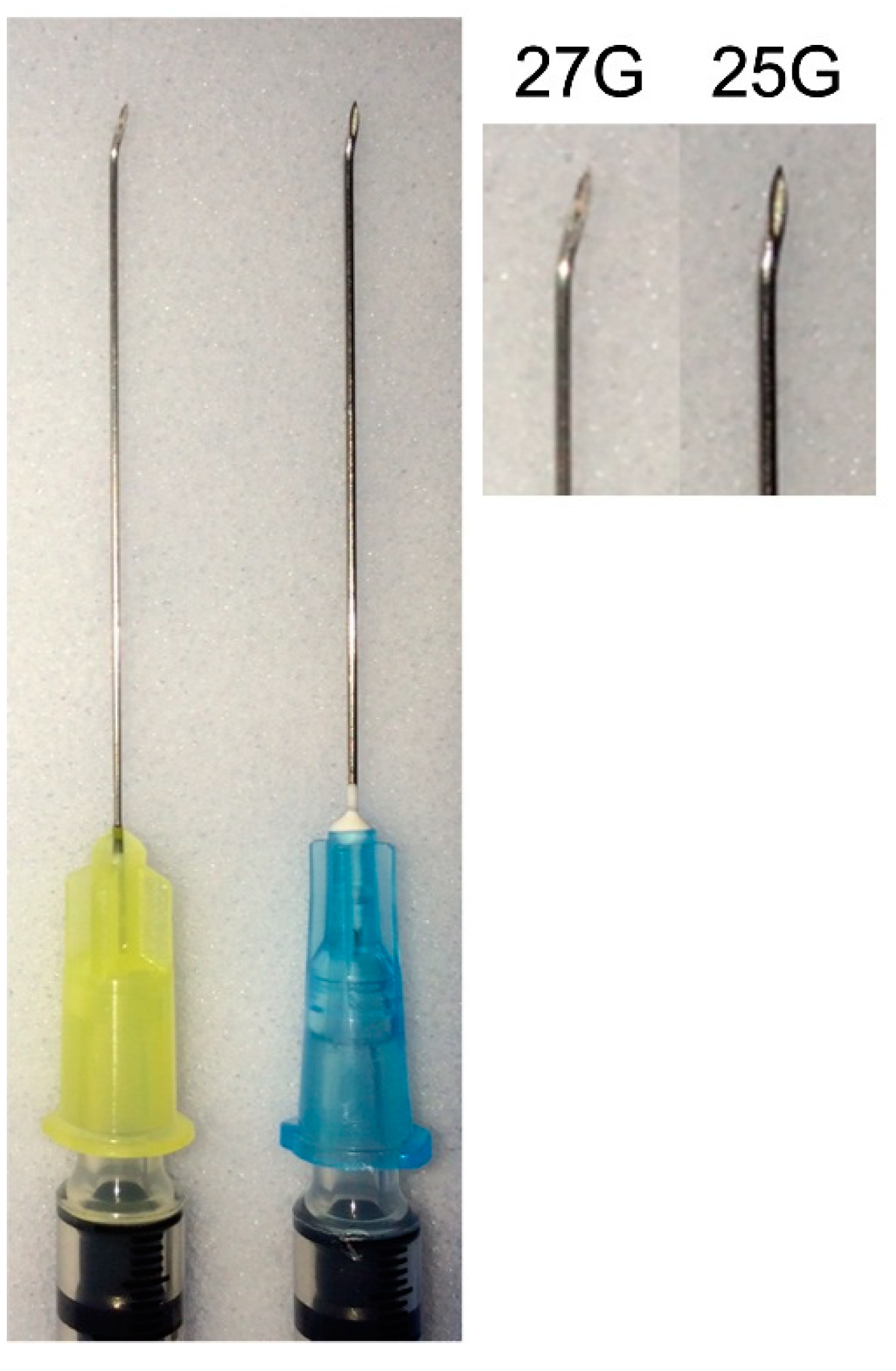
Figure 2.
Comparison between cytology smears from fine needle aspiration biopsy using 27-gauge and 25-gauge needles of the same tumor. A and D, B and E, C and F. Note how the 27-gauge aspirates still yield a sufficient specimen but slight paucicellular and with less extracellular debris.
Figure 2.
Comparison between cytology smears from fine needle aspiration biopsy using 27-gauge and 25-gauge needles of the same tumor. A and D, B and E, C and F. Note how the 27-gauge aspirates still yield a sufficient specimen but slight paucicellular and with less extracellular debris.
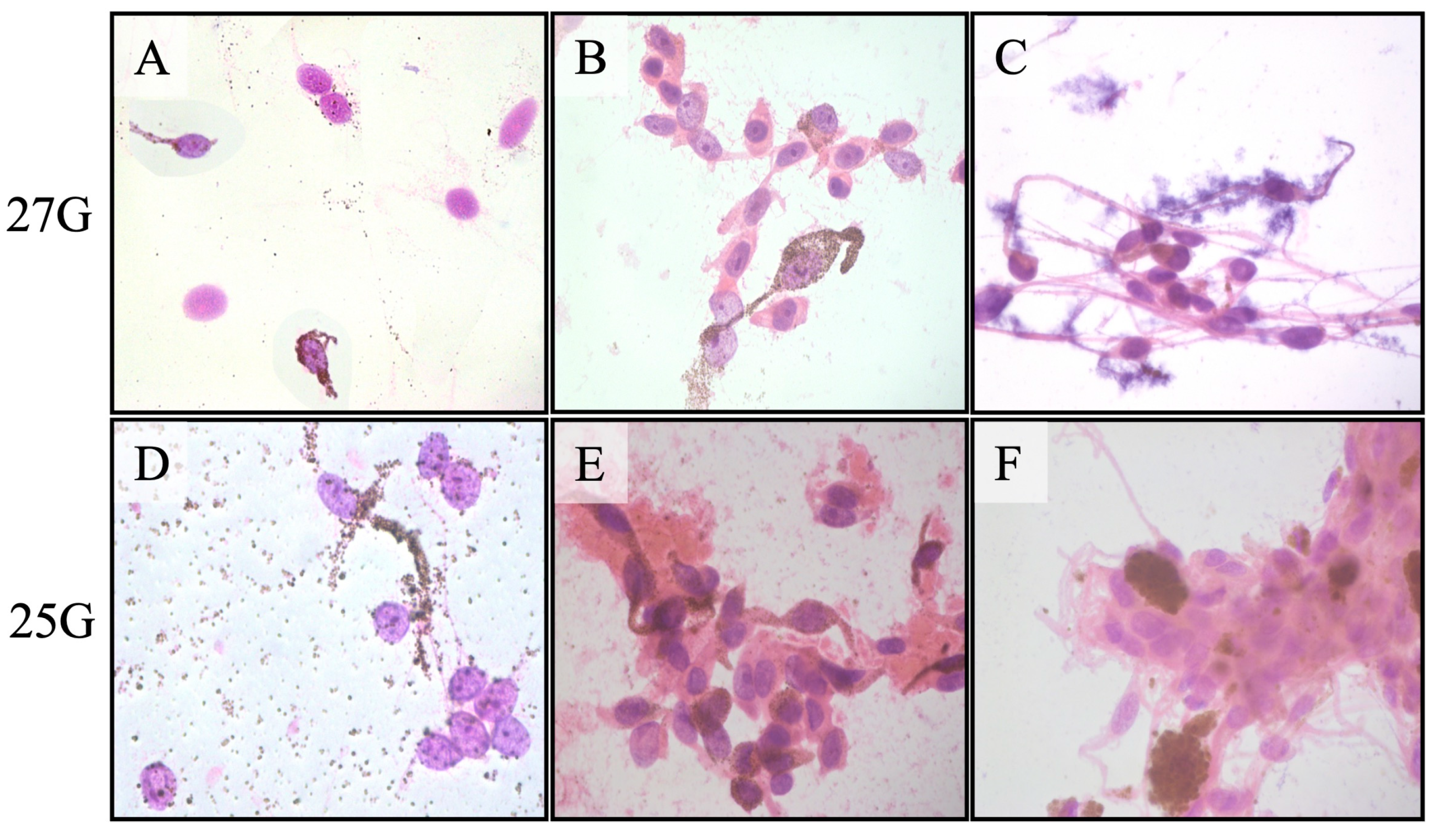

Table 1.
Conclusive diagnosis, gene expression profile and subsequent follow-up data for 32 patients using diagnostic fine-needle aspiration biopsy.
Table 1.
Conclusive diagnosis, gene expression profile and subsequent follow-up data for 32 patients using diagnostic fine-needle aspiration biopsy.
| Patient | Adequacy of the Aspirate | Melanoma Cell Type | Final Dx | Initial Management | GEP Class | Metastasis | OS (Months) | Life Status |
|---|---|---|---|---|---|---|---|---|
| 32 | Yes | Spindle | UM | Plaque | 1A | No | 15 | Deceased |
| 1 | Yes | Mixed | UM | Enucleation | 1A | No | 23 | Living |
| 2 | Yes | Spindle | UM | I-125 | 2 | No | 14 | Living |
| 3 | Yes | Epithelioid | UM | Enucleation | 2 | Yes | 93 | Living |
| 4 | Yes | Mixed | UM | I-125 | 2 | Yes | 39 | Deceased |
| 5 | Yes | Mixed | UM | I-125 | 2 | No | 11 | Living |
| 6 | Yes | Mixed | UM | Enucleation | 1A | No | 50 | Deceased |
| 7 | Yes | Spindle | UM | I-125 | 1A | No | 14 | Living |
| 8 | Yes | Spindle | UM | I-125 | 1A | No | 23 | Living |
| 9 | Yes | Spindle | UM | I-125 | 1A | No | 23 | Living |
| 10 | Yes | Mixed | UM | I-125 | 2 | Yes | 3 | Deceased |
| 11 | Yes | Mixed | UM | I-125 | Failed | No | 23 | Living |
| 12 | Yes | Spindle | UM | I-125 | 1A | No | 94 | Living |
| 13 | Yes | Spindle | UM | Resection | 1A | No | 26 | Living |
| 14 | Yes | Mixed | UM | Enucleation | 1A | No | 27 | Living |
| 15 | Yes | Mixed | UM | Plaque | 2 | Yes | 52 | Deceased |
| 16 | Yes | Spindle | UM | Plaque | 1A | No | 31 | Living |
| 17 | Yes | Spindle | UM | Plaque | 2 | No | 62 | Living |
| 18 | Yes | Mixed | UM | Plaque | 1A | No | 26 | Living |
| 19 | Yes | Spindle | UM | Plaque | 1A | Yes | 52 | Deceased |
| 20 | Yes | Mixed | UM | Plaque | 1B | No | 51 | Living |
| 21 | Yes | Mixed | UM | Enucleation | 2 | No | 12 | Living |
| 22 | No* | QNS | UN | Observation | 1A | No | 2 | Living |
| 23 | Yes | Spindle | UM | Plaque | 1B | Yes | 86 | Deceased |
| 24 | Yes | Spindle | UM | Enucleation | 1A | No | 96 | Living |
| 25 | Yes | Spindle | UM | Plaque | 1A | No | 96 | Living |
| 26 | Yes | Spindle | UM | Plaque | 1A | No | 9 | Living |
| 27 | Yes | Mixed | UM | Plaque | 1A | Yes | 6 | Deceased |
| 28 | Yes | Mixed | UM | Plaque | 1A | No | 52 | Living |
| 29 | Yes | Nevus | UN | Observation | 1A | No | 0 | Living |
| 30 | Yes | Nevus | UN | Observation | 1A | No | 64 | Living |
| 31 | Yes | Mixed | UM | Plaque | 1A | No | 70 | Living |
1QNS: quantity not sufficient; *specimen inadequate when obtained by 25G & 27G needles; Melanoma cell type: cytology result, Final Dx: final diagnosis based on biopsy findings, UM: uveal melanoma; UN: uveal nevus; management: initial treatment based on biopsy result, Plaque: I-125 brachytherapy; GEP: Gene Expression Profile Classification; OS: overall survival.
Disclaimer/Publisher’s Note: The statements, opinions and data contained in all publications are solely those of the individual author(s) and contributor(s) and not of MDPI and/or the editor(s). MDPI and/or the editor(s) disclaim responsibility for any injury to people or property resulting from any ideas, methods, instructions or products referred to in the content. |
© 2024 by the authors. Licensee MDPI, Basel, Switzerland. This article is an open access article distributed under the terms and conditions of the Creative Commons Attribution (CC BY) license (http://creativecommons.org/licenses/by/4.0/).
Copyright: This open access article is published under a Creative Commons CC BY 4.0 license, which permit the free download, distribution, and reuse, provided that the author and preprint are cited in any reuse.


