

Submitted:
05 January 2025
Posted:
06 January 2025
You are already at the latest version
Abstract
The purpose of this study was to investigate and compare the mechanical properties of a non-cushioned minimalistic shoe and cushioned shoe during walking at 6 and running at 10 and 14 km∙h-1 in habituated female runners. Specifically, the study aimed to examine the spatio-temporal and kinetic variables of gait in these two shoe conditions. Methods: Twelve habituated female runners completed two trials (cushioned shoe vs. minimalist shoe) with three within-trial speeds (6, 10 and 14 km∙h-1) in a counter-balanced design. Flexible pressure insole sensors were used to determine kinetic variables (peak vertical impact force, average loading rate, active vertical peak force, time to active peak vertical force, and impulse) and spatio-temporal variables (stride duration, cadence, ground contact time, swing time and time to mid stance). Results: Cushioned running shoes exhibited greater energy absorption (690%), recovered energy (920%), and heat dissipation (350%). These differences resulted in the cushioned shoes significantly reducing peak vertical impact (~12%) and average loading rate (~11%) at running speeds 10-14 km∙h-1 while not affecting peak active force, impulse, stride duration, ground contact or swing time. Conclusion: Cushioned running shoes provide significant benefits in energy absorption, energy recovery and heat dissipation, which decreases impact-related forces and loading rates in female runners without changing spatio-temporal variables of gait.
Keywords:
Gait
; Running
; Females
; Injury
; Ground Reaction Forces
1. Introduction
On a global scale walking (Bullo et al., 2018) and running (Scheerder et al., 2015) are some of the most popular physical activities undertaken by the general population. The collision between foot and ground during fast walking or running generates a shock wave of energy every step, necessitating passive attenuation processes to protect vital systems (Hamill et al., 1995; Lafortune et al., 1996; Voloshin et al., 1998; Winter & Challis, 2017). Both activities face challenges as these passive processes are highly sensitive to factors such as impact force magnitude, loading rate, and repetition (Davis et al., 2016; Milner et al., 2006). All of these are exacerbated at faster paces, particularly at speeds >12 km∙h-1, which involve increases in stride length and/or stride frequency (Arampatzis et al., 1999; Dorn et al., 2012; Hamill et al., 1983; Mercer et al., 2005; Nigg et al., 1987; Nilsson & Thorstensson, 1989).
To reduce these forces, midsole cushioning serves as an important feature of footwear in providing a foam layer between the outsole and innersole. Its functional definition revolves around the ability to reduce vertical ground reaction force upon impact (Aerts & Clercq, 1993; Nigg et al., 1995) and to enhance energy absorption during loading (Aimar et al., 2024). Holistically, the properties focus on absorbed, lost and recovered energy. The findings in the literature regarding the effectiveness of such cushioning capability are somewhat inconclusive (Bergstra et al., 2015; Hannigan & Pollard, 2020; Kulmala et al., 2018; Nigg et al., 1987; Stoneham et al., 2021). However, few research articles report the actual cushioning properties of the shoes being tested, as per industry standards (Baltich et al., 2015; Hoogkamer et al., 2018; Huang, 2019; Worobets et al., 2014), making it hard to establish a cause.
Early studies indicated that midsole softness did not reduce peak impact (Clarke et al., 1983; Nigg et al., 1987). However, it was later found that runners adapt their technique (joint kinematics) to compensate for changes in surface impact absorbing characteristics (Dixon et al., 2000) and shoe cushioning (Baltich et al., 2015). Shoes with greater cushioning tend to result in a narrower range of motion at the ankle in the transverse plane, less internal rotation at the hip, and reduced knee abduction (Fu et al., 2019). Consequently, it is believed that runners operate within a personal kinetic bandwidth when responding to impact stresses (McNair & Marshall, 1994); they adapt their technique to cope with impact stresses, suggesting footwear plays a significant role.
Importantly, running or walking barefoot, or with minimal cushioning, alters gait through decreasing stride length and increasing stride frequency, which in turn reduces ground reaction forces and their associated metrics (De Wit et al., 2000; Lieberman et al., 2010). Thus, it is hypothesized that the change in stride kinematics, rather than the absence of shoes, leads to the reduction of impact forces (Thompson et al., 2014).
Moreover, the effects of wearing minimalistic shoes whilst running have provided mixed results. Some studies have shown significantly lower impact forces compared to maximally cushioned shoes (Pollard et al., 2018), while others have found no difference or even increased loading rate or peak impact forces compared to cushioned shoes running and/or walking (Agresta et al., 2018; Aminaka, 2018; Hannigan & Pollard, 2020; Huber et al., 2022; Sinclair et al., 2016).
Comparisons between minimalist and traditional running shoes in female-only populations have shown considerably greater peak pressure and maximum mean pressures for the forefoot, midfoot and rearfoot in minimalist shoes (Bergstra et al., 2015). Further, maximally cushioned shoes decrease in-shoe plantar loading forces from a total perspective and at the forefoot when compared with minimalist shoes (Ogston, 2019). However, there is currently no link between plantar pressures and impact forces in minimalist and maximally cushioned shoes.
It’s no surprise that researchers are calling for more biomechanical studies involving gait based on gender (Clermont et al., 2019), as female runners are at an increased risk of running-related injuries compared to male counterparts (Arendt et al., 2003; Davis et al., 2016; Dempster et al., 2021), have slightly different patterns of gait (Clermont et al., 2019), and present greater shock attenuation than males (Dufek et al., 2009). This could mean either lower tolerance to peak impact forces or they are experiencing greater forces on impact and may respond differently to different shoe conditions based on gait and anatomy (Bergstra et al., 2015; Hoffman, 2008; Malisoux et al., 2020; Ogston, 2019).
The non-consensus regarding the effects of midsole cushioning on metrics of vertical ground reaction forces is often attributed to factors such as changes in kinematics, running speed, and challenges related to habituation to multiple conditions. However, most studies do not provide mechanical properties of the midsoles being used. This study addresses these concerns by acknowledging the shoes mechanical properties, while utilising paired samples of habituated female runners experienced in both barefoot and highly cushioned shoe conditions. It investigates the mechanical energy absorption, loss and recovery properties of a non-cushioned minimalistic shoe and a commercially advertised midsole cushioned shoe, and their impact on the kinetic and spatiotemporal variables of gait, during walking and running at different speeds, in habituated female runners.
2. Materials and Methods
2.1. Participants
Twelve recreational to nationally competitive female endurance runners (mean ± SD; age (yrs.) 24.2 ± 6.2, height (cm) 167.0 ± 4.4, body mass (kg) 62.3 ± 6.6 and Body Mass Index 22.3 ± 2.1) free of injury participated, after giving written consent in accordance with the University Human Ethics Committee approval. All participants grew up in New Zealand where barefoot activity is socially normal (Francis et al., 2018), and all still participate actively barefoot, to some extent. They were also accustomed to running on asphalt using modern (circa 2023) cushioned shoes.
This sample size was based on a priori statistic (G*power V 3.1.9.7, Heinrich-Heine University, Dusseldorf, Germany) for analysis of variance (ANOVA) repeated measures between factors, with an alpha value of 0.05, power 0.8, and effect size of 0.8 based on prior findings (Bergstra et al., 2015; Ogston, 2019).
2.2. Procedures and Measurements
The experimental protocol consisted of two trials (cushioned shoe vs minimalist-control shoe) and three condition walk-run treadmill speeds (6, 10 and 14 km∙h-1) that were typically used by the participants in their everyday running shoe. These speeds have also been shown to produce significant differences in vertical ground reaction forces (Arampatzis et al., 1999).
Each trial was performed in one session on the same day, performed in a counter-balanced order of shoe conditions, and separated by 15 min to minimise sequence effect on the dependent variables of interest.
Upon arrival at the laboratory, participants were measured, weighed, and had their footwear size determined by a shoe specialist to ensure best fit based on participant input and expertise. The mean (range) in a United States women’s size was 8.5 (7.5-9.5) for the cushioned shoe and 8 (6-10) for the non-cushioned shoe. The cushioned shoe (Asics Gel-Nimbus 25, Asics Corporation, Kobe, JP) has a 40.5 mm heel and a 32.5 mm forefoot (8 mm drop) midsole featuring a single layer of FlyteFoam BLASTTM ECO Plus foam cushioning with an extra PureGELTM insert in the rearfoot, had a rocker (manually measured using Kinovea, version 0.9.5 (Charmant, 2021)) angle 15°, rocker radius 45°, apex position 70%, apex angle 75°, with a weight of 235 ± 9 g. The midsole hardness scale C measured with a durometer (HC) was 30.1 ± 0.1 HC. The minimalist shoe (Coetzee et al., 2018) had a 0 mm heel-toe drop, a 5 mm PVC rubber outsole (H&S, The Warehouse, New Zealand) and weighed 206 ± 14 g, with a midsole durometer reading of 55.0 ± 6.1 HC. Trial order was selected, and the appropriate footwear was fitted with a flexible pressure insole to record kinetic data (LoadSol® Pro, Novel GmbH, Munich, Germany), whereupon each insole (left and right) was configured for the specific participant and followed the manufacturer’s bipedal calibration process.
Each trial consisted of a 5 min warm-up period on the treadmill (Life Fitness, Hamilton, New Zealand) at the participant’s preferred running speed. Each condition (shoe*speed) was performed for a period of 1 min, with data logged throughout and analysed during the last 10 s of each condition (Renner et al., 2022). Participants were blind to any dependent variables being measured.
LoadSol® time*force data (200 Hz) were uploaded into MATLAB (R2022b, (MathWorks, Inc., Natick, MA, United States), re-sampled to 1,000 Hz, and processed using force threshold values of 20-30 N to determine initial foot contact and toe-off (Wright et al., 1998). From these outputs the following dependent variables were calculated using techniques previously described for walking (Su et al., 2015) and running (Chan et al., 2018) and expressed per body weight (N) where appropriate: a) Peak vertical impact force (N∙BW-1) identified as the first peak between initial contact and the active peak. If the first peak was not present in running (mid-forefoot strike) it was defined as the force at 13% of the stance phase; b) Active peak vertical force (N∙BW-1) was the second peak for walkers and heel strike runners, or the highest force reading of each step for mid-forefoot strikers. In running, this point (mid-stance) was described where the foot was directly below the centre of mass. In walking the midstance occurs at the lowest vertical force reading between the two peaks; c) Time to mid-stance (s) was the time to the lowest force value between peak 1 and 2 in walking, and the time to the active peak force in running; d) To calculate the average rate of loading (N∙BW-1∙s-1) the difference between forces at 20% and 80% of the peak impact force was divided by the corresponding time interval (s) between these two points; e) Impulse (N∙s), the area under the force-time curve; f) Ground contact time (s) was the time the foot remained in contact with the floor; g) Swing time (s) was the time the foot has no contact with the ground; h) Stride duration was the time from one initial impact to the next initial impact for the same foot.
Mechanical Testing
Shoe cushioning property assessment was performed post-running trials using a modified industry standard test (ISO 20344:2021 (5.17)). The Instron (4467, Instron, Norwood, MA, United States) was programmed to compress the midsole in the vertical direction at a deformation rate of 10 mm per minute and applied a maximum force of 2.2 kN. Following 20 conditioning cycles, 5 cycles were performed while recording deformation (mm) and load (N). Energy absorption (J) was calculated as the area under the load-extension curve until peak extension was met. Recovered energy (J) was calculated as the area under the load-extension curve from the peak extension to the return to zero extension. The recovered energy (%) is calculated as: (recovered energy/energy absorbed) *100, while heat dissipation (J) is the difference between the energy absorbed and the recovered energy.
All dependent variable data were calculated per step, with the number of steps, overall mean±SD, and the mean±SD of the Coefficient of variation (CV (%)) per independent variable presented. Differences between shoes and speed were analysed using a two-way repeated-measures ANOVA, with 2 within-subject variables (speed*shoe). Where significant difference was found, Sidak’s post-hoc multiple comparisons testing was performed. All statistics were performed using GraphPad Prism (V 8.4, (GraphPad Software, San Diego, CA, United States) Significance was set at p<0.05.
3. Results
3.1. Mechanical Properties
The mechanical testing resulted in a deformation of 4.22 - 3.39 mm, and 25.78 – 22.37 mm for the 1st and 5th cycles in the minimalist-control and cushioned shoe, respectively. The deformation curves and relevant data for the two shoes are presented in Figure 1A,B.
3.2. Kinetic Data Analysis
Two-way ANOVA of kinetic data identified significant interaction (speed*shoe) for peak vertical impact (F(2,22)=11.44, p=0.005, Figure 2A) with a main effect for speed (F(2,22)=22.93, p<0.0001) but not shoes (F(1,11)=0.916, p=0.361). Key post-hoc multiple comparison between shoes indicated decreased impact differences for cushioned shoes versus minimalistic control at both 10 km∙h-1 (1.42 vs 1.32 N∙BW-1, p=0.009) and 14 km∙h-1 (1.72 vs 1.51 N∙BW-1, p=0.005). There was also a significant interaction (speed*shoes) for average loading rate (F(2,22)=5.456, p=0.013, Figure 2C) with main effects for both speed (F(2,22)=71.05, p<0.0001) and shoes (F(1,11)=6.596, p=0.028). Key post-hoc multiple comparison between shoes indicated decreased average loading rate differences for cushioned shoes versus minimalistic control at both 10 km∙h-1 (44.9 vs 39.7 N∙BW-1∙s-1, p=0.008) and 14 km∙h-1 (61.4 vs 54.7 N∙BW-1∙s-1, p=0.004), but not 6 km∙h-1 (14.9 vs 14.6 N∙BW-1∙s-1, p>0.999).
There was no speed*shoe interaction (F(2,22)=0.427, p=0.659, Figure 2B) or main effect of shoe (F(1,11)=3.695, p=0.084) for active peak force. However, there was an increased main effect for speed (F(2,22)=458.3, p<0.0001). Time to active peak force presented no speed*shoe interaction (F(2,22)=3.444, p=0.052), but there were decreased main effects for speed (F(2,22)=4647, p<0.0001) and increased main effects of shoe (F(1,11)=6.596, p=0.028). However, shoes only presented post-hoc differences at 6 km∙h-1 (0.449 vs 0.462s-1, p=0.0004).
There was no speed*shoe interaction for step impulse (F(2,22)=0.365, p=0.204) or main effect of shoe. However, there was a decreased main effect of speed (F(2,22)=1023, p<0.0001, Figure 2D).
3.2. Kinematic Data Analysis
Two-way ANOVA of kinematic variables found significant interactions for stride duration (F(2,22)=3.885, p=0.036, Figure 3A) with a main effect for speed where stride duration decreased (F(2,22)=1249, p<0.0001). There was no main effect of shoes (F(1,11)=2.518, p=0.144). Further breakdown of the gait cycle presented no speed*shoe interaction (F(2,22)=1.896, p=0.176) for ground contact time (Figure 3B), with no main effect of shoes (F(1,11)=2.266, p=0.163), but a decreased effect of speed (F(2,22)=1076, p<0.0001). There was a significant interaction (F(2,22)=22.47, p<0.0001) for time to mid-stance (Figure 3C) with an increased main effect for shoes (F(1,11)=30.77, p=0.0002) and a decreased effect of speed (F(2,22)=1203, p<0.001. However, shoes only presented post-hoc differences at 6 km∙h-1 (0.276 vs 0.301s-1, p<0.0001). There was also no interaction (F(2,22)=0.147, p=0.864) or main effect of shoe (F(1,11)=2.728, p=0.130) for swing time. There was, however, a main effect for speed (F(1,11)=43.96, p<0.0001, Figure 3D).
Overall, the mean number of steps analysed from all trials were 23±2 steps. It’s also important to note that even with such few steps there is a certain degree of variance within participants as shown in Table 1.
4. Discussion
The purpose of this study was to assess mechanical properties of two subjective categories of running shoe – minimalist and cushioned - and then to compare spatiotemporal and kinetic variables of gait in habituated female runners at treadmill speeds of 6, 10, and 14 km∙h-1. Key findings indicate the cushioned shoe exhibited greater energy absorption (690%), recovered energy (920%), and heat dissipation (350%). These mechanical property differences resulted in the cushioned shoes significantly reducing peak vertical impact (~12%) and average loading rate (~11%) at running speeds 10-14 km∙h-1 while not affecting peak active force, impulse, stride duration, ground contact or swing time.
As expected (Figure 3) and supported by prior research, increased speed led to higher running cadence (Mero & Komi, 1986) due to decreased ground contact time, time to mid-stance, and swing time (Cavanagh, 1987). Additionally (Figure 2), higher speeds resulted in increases in peak vertical impact, average loading rate, and active vertical peak force, along with a decreased time to active vertical peak force (Hamill et al., 1983; Nigg et al., 1987; Nilsson & Thorstensson, 1989; Ricard & Veatch, 1994). These kinetic variables have also been associated with running-related injuries (Davis et al., 2016; Winter & Challis, 2017), implicating running speed as a factor in injury aetiology (Bertelsen et al., 2017).
Understanding strategies to attenuate impact-related metrics is crucial as walkers and runners increase their speed (Arampatzis et al., 1999). One such strategy involves the mechanical properties of shoe midsoles, particularly energy absorption (cushioning) and energy recovery (Shorten, 1993; Shorten, 2024). The data presented (Figure 1) shows two very different shoe types acquired during 2023. Although there is no standardised classification for shoe cushioning, the 690% difference in energy absorption capability suggests one of the shoes used, provides much greater cushioning compared to the other.
The overarching purpose of a more cushioned midsole is to attenuate vertical ground reaction forces upon impact (Aerts & Clercq, 1993; Nigg et al., 1995), where females are more susceptible to loading injuries (Davis et al., 2016) compared to males (Dufek et al., 2009). It has been suggested (Hannigan & Pollard, 2020; Kulmala et al., 2018; Pollard et al., 2018) that cushioned shoes either increase loading rates or have no significant impact on peak forces over less cushioned shoes. Classifying shoes as soft (40), medium (52), or hard (65) using the Asker C hardness scale (Baltich et al., 2015) has shown that as a midsole becomes softer, vertical peak impact force increases. However, research specifically involving female participants has indicated that such shoes can alleviate the plantar pressures (Bergstra et al., 2015; Ogston, 2019), although no link to impact forces was established. The current study utilised shoes typical of cushioned models from 2023, which were considerably softer (HC 30.1) than those previously studied (Baltich et al., 2015). Participants’ running speed was controlled via a treadmill, and data were presented as the mean of multiple steps (n=23±2). This provides clear evidence for increased (690%) midsole cushioning regarding the attenuation of both peak impact forces (Figure 2A) and average loading rates (Figure 2C) when running at 10 and 14 km∙h-1, but not while walking at 6 km∙h-1. This finding contrasts with earlier work that presented a decreased effect of shoe type on impact forces during walking barefoot versus athletic shoes at 5.4 km∙h-1 (Lafortune et al., 1996). However, the differences observed between the minimalistic and cushioned shoes (0.07 N∙BW-1) are comparable to those between the street-leather soled shoe and the athletic shoe (0.04 N∙BW-1) reported by Lafortune et al.
Explanations for the increased impact forces and loading rate have previously focused on landing hardness (Baltich et al., 2015), suggesting that runners adapt their technique to compensate (McNair & Marshall, 1994). Specifically, as the landing becomes softer, ankle and knee joint stiffness increases (Baltich et al., 2015), potentially decreasing stride duration, ground contact time, and swing time (Möhler et al., 2021). However, Figure 3 shows no changes in stride duration, ground contact time or swing time because of the shoe. This leads to the plausible assumption that participants’ techniques remained relatively unaltered between shoe types. Furthermore, no changes in vertical peak active force (Figure 2B) or vertical impulse (Figure 3D) were observed. This suggests that even though the cushioned shoe had an energy return that was 920% of the minimalist shoe, it either did not affect the vertical oscillation of the centre of mass- reflected through no change in vertical impulse- or that muscle activation, which typically increases with running speed (Kyröläinen et al., 2001), was reduced when wearing the cushioned shoe.
The results of this study can be attributed to the acute nature and the extended data collection period compared to previous work and may reflect a true comparison of shoe midsole properties. This suggests that the protocol used facilitated a control mechanism, preventing changes in gait that could alter the findings. However, this may not accurately represent the true response of the runner in a non-treadmill settings, indicating the need for further research in this area.
5. Conclusions
The cushioned running shoes provide significant benefits in energy absorption, energy recovery and heat dissipation compared to minimalist shoes, particularly at running speeds of 10-14 km∙h-1. These cushioned shoes are effective in reducing peak vertical impact and average loading rates, while not altering spatiotemporal variables of gait, which could potentially lower the risk of impact-related injuries in female runners. Further research needs to explore the interaction between footwear, running mechanics, and muscle activation in real-world conditions.
Author Contributions
Conceptualization, PWM and SW; methodology, SW, PWM and DC; software, PWM; validation, PWM, SW and DC; formal analysis, PWM; investigation, SW; resources, SW, PWM and DC; data curation, PWM; writing—original draft preparation, PWM writing—review and editing, SW and DC; visualization, PWM; supervision, PWM, and DC; project administration, PWM. All authors have read and agreed to the published version of the manuscript.
Funding
This research received no external funding.
Institutional Review Board Statement
The study was conducted in accordance with the Declaration of Helsinki, and approved by the Ethics Committee of Massey University (4000018780 approved 29.9.2023)
Informed Consent Statement
Informed consent was obtained from all subjects involved in the study.
Data Availability Statement
The raw data supporting the conclusions of this article will be made available by the authors on request.
Acknowledgments
We would like to acknowledge the help and support of Aden Murtagh and the New Zealand Leather & Shoe Research Association (inc.) for assistance with the mechanical testing of the shoes used in this research
Conflicts of Interest
The authors declare no conflicts of interest.
References
- Aerts, P., & Clercq, D. D. (1993). Deformation characteristics of the heel region of the shod foot during a simulated heel strike: The effect of varying midsole hardness. Journal of Sports Sciences, 11(5), 449-461. [CrossRef]
- Agresta, C., Kessler, S., Southern, E., Goulet, G. C., Zernicke, R., & Zendler, J. D. (2018). Immediate and short-term adaptations to maximalist and minimalist running shoes. Footwear Science, 10(2), 95-107. [CrossRef]
- Aimar, C., Orgéas, L., Rolland du Roscoat, S., Bailly, L., & Ferré Sentis, D. (2024). Compression fatigue of elastomeric foams used in midsoles of running shoes. Footwear Science, 1-11. [CrossRef]
- Aminaka, N., Arthur, K., Porcari, J.P., Foster, C., Cress, M. i Hahn, C. (2018). No immediate effects of highly cushioned shoes on basic running biomechanics.
- Arampatzis, A., Brüggemann, G.-P., & Metzler, V. (1999). The effect of speed on leg stiffness and joint kinetics in human running. Journal of Biomechanics, 32(12), 1349-1353. [CrossRef]
- Baltich, J., Maurer, C., & Nigg, B. M. (2015). Increased Vertical Impact Forces and Altered Running Mechanics with Softer Midsole Shoes. PloS one, 10(4), e0125196. [CrossRef]
- Bergstra, S. A., Kluitenberg, B., Dekker, R., Bredeweg, S. W., Postema, K., Van den Heuvel, E. R., Hijmans, J. M., & Sobhani, S. (2015). Running with a minimalist shoe increases plantar pressure in the forefoot region of healthy female runners. Journal of Science and Medicine in Sport, 18(4), 463-468. [CrossRef]
- Bertelsen, M. L., Hulme, A., Petersen, J., Brund, R. K., Sørensen, H., Finch, C. F., Parner, E. T., & Nielsen, R. O. (2017). A framework for the etiology of running-related injuries. Scandinavian journal of medicine & science in sports, 27(11), 1170-1180. [CrossRef]
- Bullo, V., Gobbo, S., Vendramin, B., Duregon, F., Cugusi, L., Di Blasio, A., Bocalini, D. S., Zaccaria, M., Bergamin, M., & Ermolao, A. (2018). Nordic Walking Can Be Incorporated in the Exercise Prescription to Increase Aerobic Capacity, Strength, and Quality of Life for Elderly: A Systematic Review and Meta-Analysis. Rejuvenation Res, 21(2), 141-161. [CrossRef]
- Cavanagh, P. R. (1987). The Biomechanics of Lower Extremity Action in Distance Running. Foot & Ankle, 7(4), 197-217. [CrossRef]
- Chan, Z. Y. S., Au, I. P. H., Lau, F. O. Y., Ching, E. C. K., Zhang, J. H., & Cheung, R. T. H. (2018). Does maximalist footwear lower impact loading during level ground and downhill running? European Journal of Sport Science, 18(8), 1083-1089. [CrossRef]
- Charmant, J. (2021). Kinovea (0.9.5). In (Version 0.9.5).
- Clarke, T. E., Frederick, E. C., & Cooper, L. B. (1983). Effects of Shoe Cushioning Upon Ground Reaction Forces in Running. International Journal of Sports Medicine, 04(04), 247-251. [CrossRef]
- Clermont, C. A., Benson, L. C., Osis, S. T., Kobsar, D., & Ferber, R. (2019). Running patterns for male and female competitive and recreational runners based on accelerometer data. Journal of Sports Sciences, 37(2), 204-211. [CrossRef]
- Coetzee, D. R., Albertus, Y., Tam, N., & Tucker, R. (2018). Conceptualizing minimalist footwear: an objective definition. Journal of Sports Sciences, 36(8), 949-954. [CrossRef]
- Davis, S. I., Bradley, J. B., & David, R. M. (2016). Greater vertical impact loading in female runners with medically diagnosed injuries: a prospective investigation. British Journal of Sports Medicine, 50(14), 887. [CrossRef]
- De Wit, B., De Clercq, D., & Aerts, P. (2000). Biomechanical analysis of the stance phase during barefoot and shod running. Journal of Biomechanics, 33(3), 269-278.
- Dixon, S. J., Collop, A. C., & Batt, M. E. (2000). Surface effects on ground reaction forces and lower extremity kinematics in running.. Medicine & Science in Sports & Exercise, 32 (11), 1919-1926.
- Dorn, T. W., Schache, A. G., & Pandy, M. G. (2012). Muscular strategy shift in human running: dependence of running speed on hip and ankle muscle performance. Journal of Experimental Biology, 215(11), 1944-1956. [CrossRef]
- Dufek, J. S., Mercer, J. A., & Griffin, J. R. (2009). The Effects of Speed and Surface Compliance on Shock Attenuation Characteristics for Male and Female Runners. Journal of applied biomechanics, 25(3), 219-228. [CrossRef]
- Francis, P., Schofield, G., & Mackay, L. (2018). Being barefoot. Prevalence at home, in school and during sport: a cross-sectional survey of 714 New Zealand secondary school boys. Journal of Foot and Ankle Research, 11(1), 42. [CrossRef]
- Fu, L., Gu, Y., Mei, Q., Baker, J. S., & Fernandez, J. (2019). A kinematics analysis of the lower limb during running with different sports shoes. Proceedings of the Institution of Mechanical Engineers, Part P: Journal of Sports Engineering and Technology, 233(1), 46-52. [CrossRef]
- Hamill, J., Bates, B. T., Knutzen, K. M., & Sawhill, J. A. (1983). Variations in ground reaction force parameters at different running speeds. Human Movement Science, 2(1), 47-56. [CrossRef]
- Hamill, J., Derrick, T., & Holt, K. (1995). Shock attenuation and stride frequency during running. Human Movement Science, 14(1), 45-60.
- Hannigan, J. J., & Pollard, C. D. (2020). Differences in running biomechanics between a maximal, traditional, and minimal running shoe. Journal of Science and Medicine in Sport, 23(1), 15-19. [CrossRef]
- Hoffman, M. D. (2008). Anthropometric Characteristics of Ultramarathoners. International Journal of Sports Medicine, 29(10), 808-811. [CrossRef]
- Hoogkamer, W., Kipp, S., Frank, J. H., Farina, E. M., Luo, G., & Kram, R. (2018). A Comparison of the Energetic Cost of Running in Marathon Racing Shoes. Sports Medicine, 48(4), 1009-1019. [CrossRef]
- Huang, J. (2019). Effects of the material of running shoes on biomechanical characteristics during running. Mechanics of Advanced Materials and Structures, 26(24), 2017-2022. [CrossRef]
- Huber, G., Jaitner, T., & Schmidt, M. (2022). Acute effects of minimalist shoes on biomechanical gait parameters in comparison to walking barefoot and in cushioned shoes: a randomised crossover study. Footwear Science, 14(2), 123-130. [CrossRef]
- Kulmala, J.-P., Kosonen, J., Nurminen, J., & Avela, J. (2018). Running in highly cushioned shoes increases leg stiffness and amplifies impact loading. Scientific reports, 8(1), 17496. [CrossRef]
- Kyröläinen, H., Belli, A., & Komi, P. V. (2001). Biomechanical factors affecting running economy. Medicine & Science in Sports & Exercise, 33(8), 1330-1337.
- Lafortune, M. A., Lake, M. J., & Hennig, E. M. (1996). Differential shock transmission response of the human body to impact severity and lower limb posture. Journal of Biomechanics, 29(12), 1531-1537.
- Lieberman, D. E., Venkadesan, M., Werbel, W. A., Daoud, A. I., D’Andrea, S., Davis, I. S., Mang’Eni, R. O., & Pitsiladis, Y. (2010). Foot strike patterns and collision forces in habitually barefoot versus shod runners. Nature, 463(7280), 531-535.
- Malisoux, L., Delattre, N., Urhausen, A., & Theisen, D. (2020). Shoe Cushioning Influences the Running Injury Risk According to Body Mass: A Randomized Controlled Trial Involving 848 Recreational Runners. The American Journal of Sports Medicine, 48(2), 473-480. [CrossRef]
- McNair, P. J., & Marshall, R. N. (1994). Kinematic and kinetic parameters associated with running in different shoes. British Journal of Sports Medicine, 28(4), 256-260. [CrossRef]
- Mercer, J. A., Bezodis, N. E., Russell, M., Purdy, A., & Delion, D. (2005). Kinetic consequences of constraining running behavior. J Sports Sci Med, 4(2), 144-152.
- Mero, A., & Komi, P. V. (1986). Force-, EMG-, and elasticity-velocity relationships at submaximal, maximal and supramaximal running speeds in sprinters. European Journal of Applied Physiology and Occupational Physiology, 55(5), 553-561. [CrossRef]
- Milner, C. E., Ferber, R., Pollard, C. D., Hamill, J., & Davis, I. S. (2006). Biomechanical factors associated with tibial stress fracture in female runners. Medicine & Science in Sports & Exercise, 38(2), 323-328.
- Möhler, F., Fadillioglu, C., & Stein, T. (2021). Fatigue-Related Changes in Spatiotemporal Parameters, Joint Kinematics and Leg Stiffness in Expert Runners During a Middle-Distance Run [Original Research]. Frontiers in Sports and Active Living, 3. [CrossRef]
- Nigg, B. M., Bahlsen, H. A., Luethi, S. M., & Stokes, S. (1987). The influence of running velocity and midsole hardness on external impact forces in heel-toe running. Journal of Biomechanics, 20(10), 951-959. [CrossRef]
- Nigg, B. M., Cole, G. K., & Brüggemann, G.-P. (1995). Impact forces during heel-toe running. Journal of applied biomechanics, 11(4), 407-432.
- Nilsson, J., & Thorstensson, A. (1989). Ground reaction forces at different speeds of human walking and running. Acta Physiologica Scandinavica, 136(2), 217-227.
- Ogston, J. K. (2019). Comparison of in-shoe plantar loading forces between minimalist and maximalist cushion running shoes. Footwear Science, 11(1), 55-61. [CrossRef]
- Pollard, C. D., Ter Har, J. A., Hannigan, J. J., & Norcross, M. F. (2018). Influence of Maximal Running Shoes on Biomechanics Before and After a 5K Run. Orthopaedic Journal of Sports Medicine, 6(6), 2325967118775720. [CrossRef]
- Renner, K. E., Peebles, A. T., Socha, J. J., & Queen, R. M. (2022). The impact of sampling frequency on ground reaction force variables. Journal of Biomechanics, 135, 111034. [CrossRef]
- Ricard, M. D., & Veatch, S. (1994). Effect of Running Speed and Aerobic Dance Jump Height on Vertical Ground Reaction Forces. Journal of applied biomechanics, 10(1), 14-27. [CrossRef]
- Scheerder, J., Breedveld, K., & Borgers, J. (2015). Running across Europe: the rise and size of one of the largest sport markets. Springer.
- Shorten, M. R. (1993). The energetics of running and running shoes. Journal of Biomechanics, 26 Suppl 1, 41-51. [CrossRef]
- Shorten, M. R. (2024). Energy return in footwear–revisited. Footwear Science, 1-14.
- Sinclair, J., Fau-Goodwin, J., Richards, J., & Shore, H. (2016). The influence of minimalist and maximalist footwear on the kinetics and kinematics of running. Footwear Science, 8(1), 33-39. [CrossRef]
- Stoneham, R., Barry, G., Saxby, L., Waters, L., & Wilkinson, M. (2021). Differences in stride length and lower limb moments of recreational runners during over-ground running while barefoot, in minimalist and in maximalist running shoes. Footwear Science, 13(2), 133-141. [CrossRef]
- Su, B. L., Song, R., Guo, L. Y., & Yen, C. W. (2015). Characterizing gait asymmetry via frequency sub-band components of the ground reaction force. Biomedical Signal Processing and Control, 18, 56-60. [CrossRef]
- Thompson, M. A., Gutmann, A., Seegmiller, J., & McGowan, C. P. (2014). The effect of stride length on the dynamics of barefoot and shod running. Journal of Biomechanics, 47(11), 2745-2750. [CrossRef]
- Voloshin, A. S., Mizrahi, J., Verbitsky, O., & Isakov, E. (1998). Dynamic loading on the human musculoskeletal system—effect of fatigue. Clinical Biomechanics, 13(7), 515-520.
- Winter, S. L., & Challis, J. H. (2017). Classifying the variability in impact and active peak vertical ground reaction forces during running using DFA and ARFIMA models. Human Movement Science, 51, 153-160. [CrossRef]
- Worobets, J., Wannop, J. W., Tomaras, E., & Stefanyshyn, D. (2014). Softer and more resilient running shoe cushioning properties enhance running economy. Footwear Science, 6(3), 147-153. [CrossRef]
- Wright, I. C., Neptune, R. R., van den Bogert, A. J., & Nigg, B. M. (1998). Passive regulation of impact forces in heel-toe running. Clinical Biomechanics, 13(7), 521-531. [CrossRef]
Figure 1.
Force deformation curves and corresponding values of energy absorption, energy return, heat dissipation, and elastic return (%) for A. the minimalist-control shoe, and B. the cushioned shoe.
Figure 1.
Force deformation curves and corresponding values of energy absorption, energy return, heat dissipation, and elastic return (%) for A. the minimalist-control shoe, and B. the cushioned shoe.
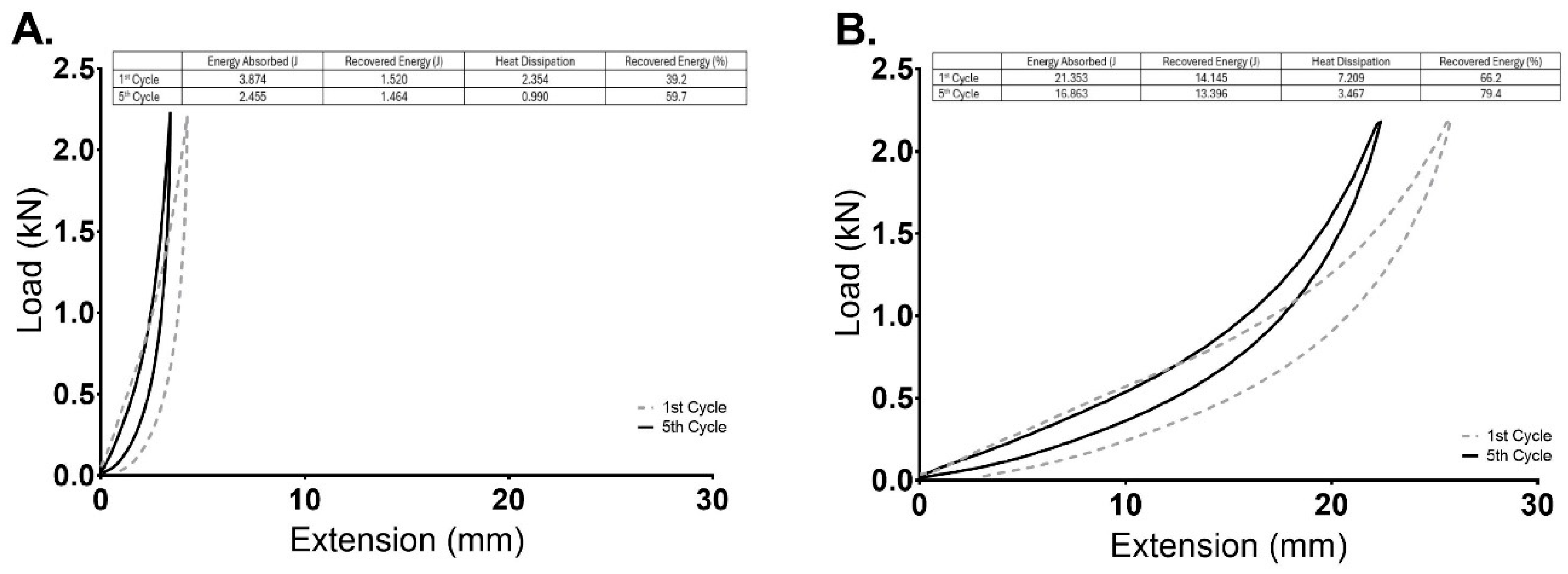
Figure 2.
Mean±SD data for each treadmill running speed (6, 10 and 14 km∙h-1) whilst wearing minimalist and modern-day cushioned shoes for A. Peak vertical impact (N∙BW-1), B. Peak active force (N∙BW-1), C. Average loading rate (N∙BW-1∙s-1), and D. Impulse (N∙s∙BW-1). Where, ∎ is the minimalist shoe, and ∎ is the cushioned shoe.
Figure 2.
Mean±SD data for each treadmill running speed (6, 10 and 14 km∙h-1) whilst wearing minimalist and modern-day cushioned shoes for A. Peak vertical impact (N∙BW-1), B. Peak active force (N∙BW-1), C. Average loading rate (N∙BW-1∙s-1), and D. Impulse (N∙s∙BW-1). Where, ∎ is the minimalist shoe, and ∎ is the cushioned shoe.
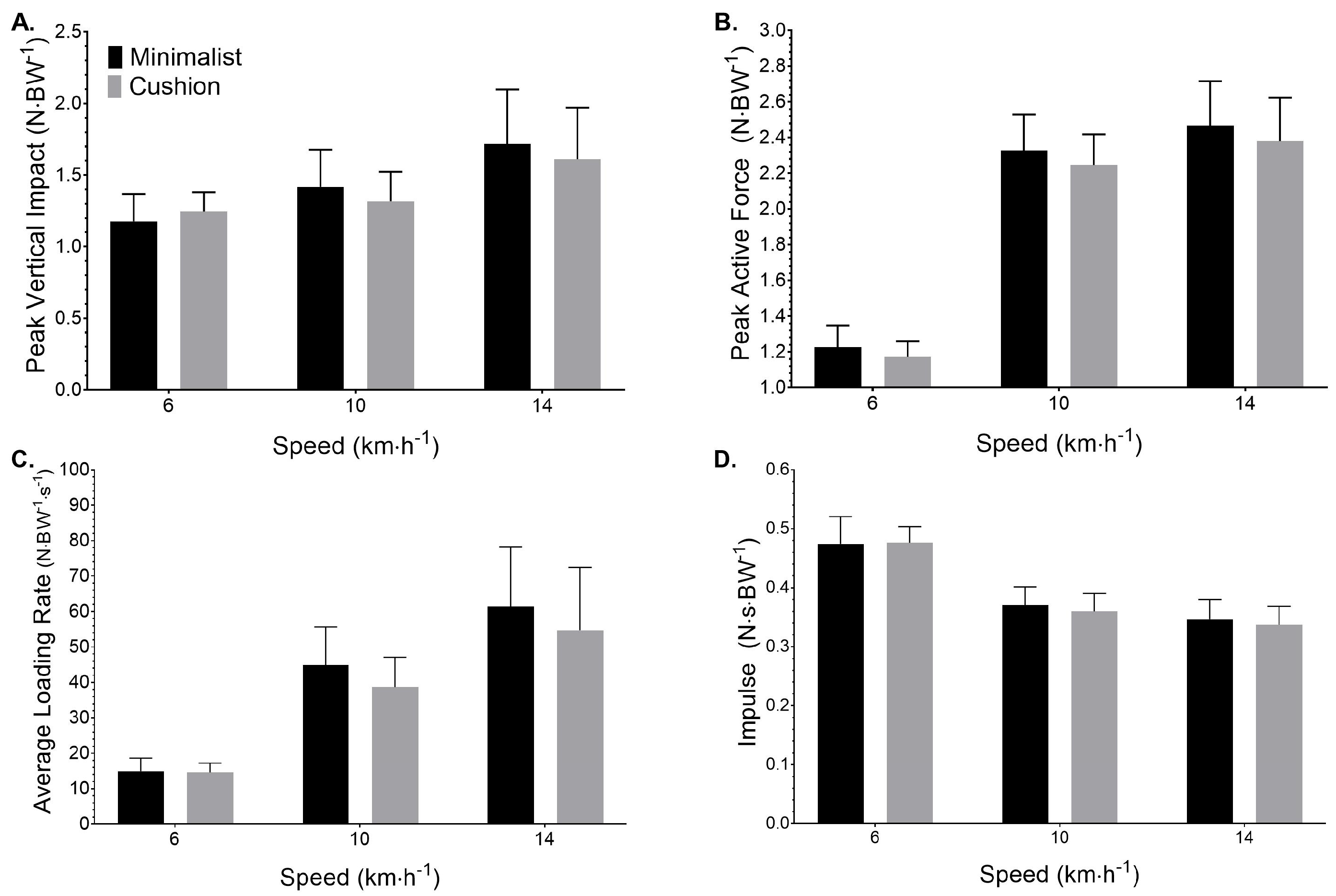
Figure 3.
Mean±SD data for each treadmill speed (6, 10 and 14 km∙h-1) whilst wearing minimalist and modern-day cushioned shoes for A. Stride duration (s), B. Ground contact time (s), C. Mid-stance time (s), and D. Swing time (s). Where, ∎ is the minimalist shoe, and ∎ is the cushioned shoe.
Figure 3.
Mean±SD data for each treadmill speed (6, 10 and 14 km∙h-1) whilst wearing minimalist and modern-day cushioned shoes for A. Stride duration (s), B. Ground contact time (s), C. Mid-stance time (s), and D. Swing time (s). Where, ∎ is the minimalist shoe, and ∎ is the cushioned shoe.
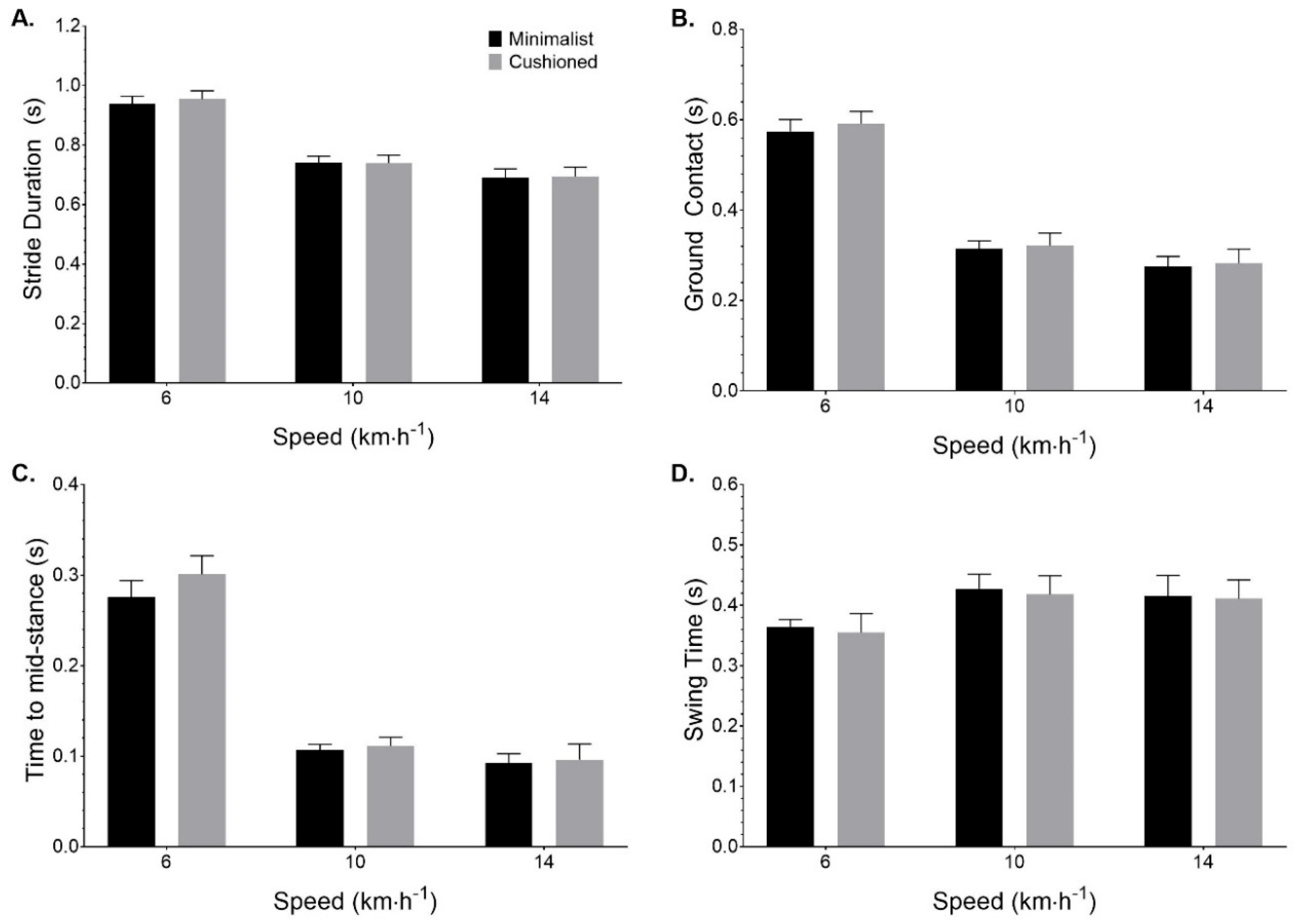

Table 1.
The overall mean±SD for the CV(%) for each trial (speed*shoe) for all dependent variables.
| Shoe | Minimalist | Cushion | Minimalist | Cushion | Minimalist | Cushion |
| Speed (km∙h-1) | 6 | 6 | 10 | 10 | 14 | 14 |
| Stride Duration | 1.2±0.3 | 1.1±0.3 | 1.0±0.2 | 1.2±0.4 | 1.1±0.3 | 1.1±0.3 |
| Stride Frequency | 1.3±0.3 | 1.3±0.4 | 1.0±0.2 | 1.2±0.4 | 1.1±0.3 | 1.1±0.3 |
| Ground Contact Time | 1.7±0.5 | 2.4±1.3 | 4.6±0.7 | 4.6±0.8 | 4.6±1.7 | 5.0±1.2 |
| Swing Time | 3.8±0.7 | 4.3±1.4 | 3.5±0.6 | 3.2±0.8 | 3.8±2.0 | 3.7±1.4 |
| Peak Impact Force | 3.5±1.4 | 3.2±0.8 | 7.1±1.0 | 7.0±2.1 | 6.8±1.8 | 6.5±1.1 |
| Loading Rate | 13.6±4.8 | 11.2±2.3 | 10.1±2.4 | 11.4±3.0 | 8.4±1.9 | 7.4±0.9 |
| Active Peak Force | 2.9±1.7 | 2.8±0.8 | 1.6±0.4 | 2.2±0.5 | 1.9±0.4 | 2.6±0.7 |
| Time to Active Peak Force | 2.3±0.6 | 5.7±0.5 | 6.1±1.8 | 7.3±2.4 | 5.7±1.5 | 6.3±2.4 |
| Impulse | 2.4±0.6 | 2.7±1.0 | 3.1±0.4 | 2.8±0.4 | 2.7±1.0 | 2.8±0.9 |
Disclaimer/Publisher’s Note: The statements, opinions and data contained in all publications are solely those of the individual author(s) and contributor(s) and not of MDPI and/or the editor(s). MDPI and/or the editor(s) disclaim responsibility for any injury to people or property resulting from any ideas, methods, instructions or products referred to in the content. |
© 2025 by the authors. Licensee MDPI, Basel, Switzerland. This article is an open access article distributed under the terms and conditions of the Creative Commons Attribution (CC BY) license (http://creativecommons.org/licenses/by/4.0/).
Copyright: This open access article is published under a Creative Commons CC BY 4.0 license, which permit the free download, distribution, and reuse, provided that the author and preprint are cited in any reuse.


