

Submitted:
30 October 2024
Posted:
01 November 2024
You are already at the latest version
Abstract
Recent studies have reported important benefits of Resistance Training (RT) in cognitive function; however, there are certain aspects concerning the study of this relation between RT and cognition that still remain unexplored. Some of these aspects encompass populations, programming parameters, and outcome measures. Our interest is unveiling the potential benefits of RT on cognitive function among healthy young adults engaged in complex cognitive tasks, shedding light on RT's impact on cognitive processing through innovative methodology like Eye Tracking. Hence, this study aims to explore the impact of chronic RT, specifically with free weights (FW), on cognitive function among healthy young adults, employing Eye Tracking (ET) technology. We adopted an experimental design including both experimental and control groups. Participants (18) were randomly assigned to either group. The experimental group engaged in a 10-week program of free weight strength training. Cognitive function was operationalized as written text processing and assessed through ET metrics (including First Pass Reading Times and Total Reading Times). The results show significant improvements in eye-tracking measures: Total Reading Times and First Pass Reading Times. These improvements can be attributed to RT, as it has been shown to enhance executive functions, which in turn influence reading performance.
Keywords:
Cognition
; Resistance training
; Cognitive Function
; Eye Tracking
; Text processing
; Exercise
; Executive Function
1. Introduction
Neuromuscular function is one of the most important and determining factors in athletic performance [1,2], and a key objective of Resistance Training (RT), such as weightlifting. However, RT, defined as a physical exercise program designed to maintain and improve muscular strength, endurance, and lean muscle mass [3,4], is also vital for maintaining health and enhancing functional capacity in both young and older populations [5,6]. In this regard, RT has been associated with a reduction in all-cause mortality, decreased cardiovascular risk and blood pressure [7], improvements in glucose metabolism [8], benefits to bone, tendon health, and cartilage loss prevention [9], cancer treatment [10], prevention of muscle loss, and reduction of obesity by promoting fat loss [11]. Alongside physical benefits, there is also evidence suggesting that RT can prevent cognitive and neuronal declines [12,13,14]. The physiological explanation for this cognitive improvement considers the reduction in inflammation [14] and the increase in blood flow to the brain [15,16]. Another reason is that RT enhances the availability of various growth factors on the brain, such as insulin-like growth factor-1 (IGF-1) [7] and vascular endothelial growth factor (VEGF) [12], which regulate exercise-induced angiogenesis and neurogenesis in the hippocampus. RT also increases the production of brain-derived neurotrophic factor (BDNF), which is involved in neuroplasticity and learning [17].
While the existing literature presents encouraging potential regarding the use of RT as a tool to enhance cognitive function, it also reveals specific aspects within the research domain that warrant further exploration. These aspects include populations, programming parameters, and outcome measures. Most studies have concentrated on populations experiencing age-related or disease-related cognitive decline [12], but, there are relatively few studies that have specifically targeted healthy young adults and demonstrated a positive impact of RT [18]. Regarding programming parameters, existing studies have mainly used exercises with machine weights, or a combination of machine and free weights (FW), revealing improvements in attention, short and long-term memory [19], inhibitory control [20,21] and general cognitive function [22]. However, very few have explored the exclusive use of free weights [12]. When it comes to outcome measures, they have frequently been associated with executive functions like inhibitory control, working memory, attention, and cognitive flexibility [23,24,25]. These measures have been assessed using various tests, such as the Montreal Cognitive Assessment (MoCA) [25], the Alzheimer's Disease Assessment Scale–Cognitive Subscale (ADASCog) [22], the Wechsler Adult Intelligence Scale (WAIS) [19], the Toulouse–Pieron’s Concentration Attention Test [19], the Rey–Osterrieth Complex Figure (ROCF) [19], the Stroop test [23], or the Modified Sternberg Task [24].
In this scenario, it may be worthwhile exploring the potential benefits of chronic RT in healthy young adults, considering the use of a methodology that enables the on-line evaluation of cognitive performance in higher-order processing tasks, such as written text processing. One of these methodologies is Eye Tracking (ET), a device that allows for the measurement of eye movement, gaze behavior, and pupil dilation. ET allows for assessing performance based on various saccadic movements during information processing, assuming that longer fixation and regression times indicate higher processing costs. Eye movement research in the context of reading is grounded in the eye-mind hypothesis [26], which posits a strong relation between eye gaze and cognitive processes and assumes that longer fixation times indicate a higher cognitive load imposed by a task. Studies employing this methodology have uncovered important aspects of the interaction between vision and cognition in the reading process, such as the amount of information gathered during a single fixation, the time required for different types of information extraction from words, and the challenges readers encounter in comprehending textual material [27].
Given that at present there is no evidence regarding the impact of RT on cognitive function of healthy young adults engaged in higher-order processing tasks, the aim of this study is to determine the impact of RT with FW on written texts processing, utilizing eye-tracking technology.
2. Materials and Methods
2.1. Experimental Approach to the Problem
To assess the impact of an RT intervention on text processing and comprehension, we conducted a clinical trial employing an experimental design including both experimental and control groups. Participants were randomly assigned to either group using concealed allocation, facilitated by Excel's randomization function. Moreover, the assessor remained blinded throughout the study, ensuring unbiased evaluation. Cognitive function, assessed through ET metrics (including First Pass Reading Times and Total Reading Times), was evaluated at the study's outset and again after 10 weeks of the training intervention in both groups. The experimental group engaged in a 10-week program of free weight strength training, that encompassed push, pull, and leg exercises. In the second week, the experimental group determined their indirect 1RM values as part of a technical learning phase for the exercises and underwent a reevaluation in the tenth week.
2.2. Participants
Twenty-two students from Pontificia Universidad Católica de Valparaíso (PUCV) participated in this study, comprising seventeen women and five men aged between 19 and 28. All participants were Chilean, native Spanish speakers, and fourth-year students in the Translation program at PUCV. Given that they were all in the same year and program, their academic workload and formal reading hours were similar. Additionally, they were untrained individuals without health issues that could interfere with the training, had not participated in any training programs in the six months prior to the study, and had normal or corrected-to-normal vision. This information was collected through a registration form completed by the participants themselves (Appendix 5). The study received ethical approval from the Bioethics and Biosafety Committee at PUCV (BIOEPUCV-HB 546-2022 September 8th, 2022), and written consent was obtained from each participant. All participants were randomized after signing the consent form to maintain blinding [28]. Additionally, the evaluator was also blinded to the group to which the participants belonged. This ensured that the study followed a double-blind design [28].
The sample size was calculated following the recommendations of Beck [29] and Faul et al [30]. The calculation was performed using G*Power, based on a repeated measures ANOVA test with an effect size (f) of 0.80, an alpha value of 0.05, and a beta of 0.80, considering two groups and two time points for evaluation. This resulted in a total of 12 participants. Figure 1 shows the distribution of the participants and the blinding of the study design.
A total of 18 young adult university students completed their participation in this study, overall only significant differences in age were found between the experimental and control groups. Table 1 shows a description of the baseline values of the participants.
2.3. Materials
2.3.1. RT Program
The program lasted 10 weeks, including 2 weeks previous to the intervention, which aimed at learning the exercises and evaluating maximum strength. The training frequency consisted of 3 sessions per week, with each session comprising 5 exercises [23] organized around push, pull, and leg movement patterns. Free weights targeting large muscle groups were utilized for the exercises [12]. Specific exercises included Bench Press, Close grip Bench press, Military Press, Bench press dumbbell, Shoulders Press dumbbell, Bent over Row bar, T grip Row, Close grip Row, Meadows row, Single arm DB row, Squat high bar, Deadlift bar, Bulgarian squat, Lunges dumbbell, and Hip thrust. The program incorporated moderate intensities [12] ranging from 60% to 80% of 1RM [31], with a focus on progressive overload. Additionally, there was an increase in volume from week 5, reaching 2-3 sets per exercise. Table 2
2.3.2. Processing and Comprehension
Six expository texts written in Spanish on general knowledge topics of language, history, and science were utilized (two for each topic). To ensure the suitability of the texts for the readers' characteristics, they were extracted from school textbooks. The length of the texts ranged between 110 and 112 words. Each text had two versions: difficult and easy, based on their syntactic complexity (high/low). Appendix 5 shows a sample of a text in both conditions. Additionally, each text was accompanied by two multiple-choice comprehension questions, assessing inferences based on the text that was read. Texts were distributed in lists that contained three texts each and were randomly assigned to each participant, ensuring that they did not read the same texts before and after the intervention.
2.4. Procedures
2.4.1. Recording 1RM Procedures
To measure indirect 1RM, the experimental group performed a general warm-up that included low-intensity aerobic work and joint mobility exercises of the muscle groups involved [4]. Subsequently, a specific warm-up was performed with 10 repetitions of the exercises to be performed with several repetitions in reserve. Finally, the number of repetitions achieved in the last series with the best possible technical execution (less than 10 repetitions) was recorded. The repetitions achieved with each weight were entered into Brzycki's formula to obtain the 1RM for each exercise. These baseline values were then used to schedule the remaining 8 weeks of training, ranging from 60% to 80% intensities. In the tenth week, indirect 1RM measurements were recorded again to assess strength gains.
2.4.2. Training Session Procedures
Each training session was supervised by two certified physical trainers and included both a warm-up and conditioning phase [4]. The warm-up consists of light aerobic activity and joint mobility work aimed at the main muscle groups to be worked on in the session. Three sessions were carried out per week, incorporating different exercises organized by movement patterns. Consequently, each day was composed of five exercises corresponding to specific movement patterns (Push-Pull and Legs).
2.4.3. Processing and Comprehension
Participants were tested individually and were informed that the task involved reading with an eye tracking equipment. Prior to commencing the experimentation, each participant signed an informed consent form. Following this, the eye tracker was set up, and a nine-point calibration screen was conducted for each participant. The participants were instructed to read to comprehend each text, silently, at their own pace and indicate their readiness to proceed to the comprehension questions by pressing a keyboard button. To prevent the latent learning effect from the first test, in the pre and post-tests, participants read different texts, but care was taken to ensure they had the same length in terms of the number of words and syntactic complexity. In addition, in both instances the eye tracking measurement was performed between 9 and 11 am. They were seated 70 cm from the screen, and a chin rest was used to stabilize the head. Eye movements were recorded monocularly using an EyeLink Portable Duo (SR Research Ltd., Ontario, Canada) at a sampling frequency of 500 Hz. The stimuli were presented on a 16” Notebook Gamer Rog Zephyrus M16 with a refresh rate of 100 Hz and a resolution of 1920 × 1080 pixels.
2.5. Data Preparation
For strength-associated measures, data preparation procedure encompassed an initial phase of cleaning, involving the identification and removal of outliers. Missing data were managed to ensure the dataset's integrity. Subsequently, variables were transformed, with measurements normalized and adjustments applied to meet the necessary statistical assumptions. Data distribution was checked with the Shapiro Wilk test and with visual analysis of residuals and Q-Q plots. For the Eye Tracking measures, fixations shorter than 80 ms were either merged with a nearby fixation (if the distance between the fixations was < 1°) or removed from the data. Two eye movement measures associated with particular patterns of text processing were used: First Pass Reading Times [FPRT], which corresponds to the sum of the duration of all fixations on the first pass within an area of interest and Total Reading Times [TRT], the sum of the duration of all fixations that fall within an area of interest [31]. The reading time measures were skewed and consequently transformed. The best fitting transformation was selected to normalize the measures; first pass time and second pass time were square-root transformed and total reading time measure was logarithmically transformed.
2.6. Data Analysis
To observe the expected differences in reading performance between the experimental and control groups after the intervention period, data were analyzed with linear mixed-effects models (LMM) using the lme4 package [32] in the R statistical software (Version 4.0.1; R Core Team, 2021). Several models were constructed, each focusing on a specific eye movement measure corresponding to individual target sentences within the texts. Variables such as Moment (pre vs. post), Group (control vs. experimental), and Syntactic Complexity (high vs. low) were incorporated into these models as deviation-coded fixed effects. Random intercepts for both Participants and Items were included in the models. [33]. The models were constructed with a maximal random structure [34]. In instances where the full random structure led to convergence issues, a top-down trimming process was applied to the random structure, initially considering correlations between factors [35]. For two models that failed to converge using only random intercepts for Participants and Items, non-significant interaction terms among fixed effects were progressively removed, starting with those associated with the smallest t or z values. Due to difficulties in precisely determining degrees of freedom for statistics estimated by Linear Mixed Models (LMMs), exact p-values or degrees of freedom were not ascertainable. Hence, instead of reporting specific p-values, statistical significance at the .05 level was inferred based on |t or z| values exceeding 1.96 [33]. Given the observed differences between groups and time, subsequent analysis of variance (ANOVA) tests were conducted to confirm that such differences were due to increased strength. This time, strength was categorized into pre-post values in order to compare whether higher levels of post-intervention strength are associated with improvements in eye tracker measures. The p-value and effect size were computed for each comparison (hedges' G). The G of edges was used to adjust the effect size to the sample size.
3. Results
As for the results regarding differences in reading performance between the experimental and control groups after the intervention period, our findings indicate a significant improvement in terms of group and moment. In First Pass Reading Times for the Experimental Group (see Figure 2), the model revealed a main effect of the intervention, 95% CI [-25.44, -2.79], t = -2.48, indicating that the experimental group reduced their fixation times after the intervention in both syntactic complexity conditions. Also it was observed in the experimental group that in the high syntactic complexity condition, the fixation times were significantly lower than in the low syntactic complexity condition 95% CI [-35.76, -13.73], t = -4.46. However, after the intervention, the experimental group increased their fixation times in the texts with high syntactic complexity 95% CI [-14.33, -45.57], t = 3.81. In the control group, no significant effect was observed.
When examining Figure 3, it becomes apparent that the total reading times in the control group are greater in the high condition compared to the low condition during the pretest, and these times diminish in the posttest, maintaining a consistent trend regarding syntactically high and low conditions. Nevertheless, none of these variances reach statistical significance. Conversely, in the experimental group during the pretest, the scenario is different as the low condition presents longer fixation times. Subsequent to the intervention, fixation times decrease in both conditions, reducing the previously existing disparity between them.
To confirm the effect of strength on cognitive performance, ANOVAs were conducted in the experimental group according to the average strength levels of the pre-post intervention maximal tests (mean pre = 31.5 ± 9.50; mean post = 42.7 ± 11.1). Figure 4 shows the comparison in the eye tracker measurements obtained with the pre-post intervention strength levels globally and separated by complexity. Overall, in the Total Reading Times and in the First Pass we found significant differences attributed to the increase in strength after the intervention. In particular, there were significant differences in favor of increased strength in overall reading times and at low complexity. Similarly, in the first pass we found significant differences in high and low complexity.
4. Discussion
The most relevant findings from our study are the improvements in eye-tracking measures: Total Reading Times and First Pass Reading Times. These improvements were observed in the experimental group that engaged in the RT program, allowing us to attribute them to our FW training intervention. Given the outcomes of various studies addressing the impact of RT on executive functions and their influence on reading performance, it is plausible to connect the identified improvements in the study with enhancements in executive functions. Regarding the relation between RT and executive functions, Nagamatsu 's study [20] conducted on older adults exhibited positive effects on inhibitory control, as a result of a chronic RT intervention. Though, our results could be more directly associated with findings in young adults, such as those obtained by Wilke et al. (2020) [21], which showed that improvements in inhibitory control are more pronounced in FW-based RT interventions compared to machine weights-based RT, with the caveat that this study measured acute effects. Another executive function that improves as a result of RT, which could potentially enhance reading and writing performance, is memory, as evidenced by Cassilhas et al. (2007) [19], who reported significant improvements in both long and short-term memory in healthy older adults. The same was observed in the study by Nagamatsu et al. (2012) [20], which revealed enhancements in associative memory.
Regarding the relation between executive functions and reading performance, it has extensively been observed [36,37] that executive functions play a pivotal role in processing and comprehending written texts by orchestrating specific processes, such as information integration, retrieval from the mental lexicon, strategy utilization, and simultaneous engagement in multiple reading tasks. Systematic reviews have also demonstrated that working memory updating aids comprehension by maintaining the activation of pertinent information during reading; inhibitory control aids comprehension by restricting the activation of irrelevant text details and preventing irrelevant memory intrusions; and shifting attention supports comprehension by integrating different types of information and focusing on various text features and situational contexts. Hence, the potential impact of RT on EF might be the reason why participants in the experimental group exhibit greater efficiency as readers.
Another possible explanation for the improvement in reading times as a result of FW-based RT is that this type of intervention selectively enhances aspects of cognition due to differential demands. For instance, individuals engaging in weightlifting need to pay constant attention to what they are doing to avoid injuring themselves or those around them. In this sense, these periods of vigilance could act as a form of attention training and explain why there was an improvement in performance on executive function tests, as many of these tasks assess an individual's ability to attend to specific stimuli [13]. While significant differences between the effects of FW-based RT and machine weights on athletic performance and muscular architecture have not yet been found [38], it is evident that attentional demands differ between these two RT modalities. Exercises using machine weights isolate muscles and follow predetermined paths; conversely, FW exercises used in our intervention require individuals to pay attention to a greater number of coordination and balance-related variables to maintain control over the weight movement [4]. These more complex execution conditions could impact attentional enhancement, thereby potentially improving reading times. However, it would be interesting to evaluate this hypothesis in future studies directly comparing these two forms of RT.
From another perspective, it is plausible that the effects of RT on executive functions, and consequently its positive impact on text processing, may be mediated by neurobiological mechanisms unrelated to the specific cognitive demands of the exercise. These mechanisms include increases in molecules such as brain-derived neurotrophic factor (BDNF) and proteins like insulin-like growth factor 1 (IGF-1), which are associated with exercise effects on learning and depression, as well as the combined action of IGF-1 and vascular endothelial growth factor (VEGF) on hippocampal angiogenesis and neurogenesis [18]. These molecular changes are thought to induce structural alterations, such as increased gray and white matter volume [13] which could also lead to cognitive changes, such as an impact on learning and memory, considering the highly plastic nature of the hippocampus [40]. It is also worth noting that exercise acts as a stimulus for new blood vessel formation, and increased cerebral blood flow correlates with cognitive enhancement [19]. In fact, Bullitt et al. (2009) [39] demonstrated that physical fitness was positively associated with the number of small blood vessels in older individuals undergoing magnetic resonance angiography, indicating angiogenesis, a phenomenon not observed in sedentary individuals.
It is also possible that neurobiological and cognitive mechanisms work synergistically. For instance, neurobiological mechanisms may enhance neuroplasticity [17,40], which in turn might have an impact on executive functions that are more consistently engaged during resistance exercises, such as attention [13], inhibitory control [36], and associative memory [20]. However, clear connections between exercise, neurobiological mechanisms, and cognitive changes still need further investigation.
Indeed, one of the results that motivates us to continue investigating this relationship pertains to the contrast in the First Pass Reading times within the experimental group under high complexity conditions, particularly given the higher cognitive load inherent in processing syntactically complex structures. In such conditions, the intricate nature of these syntactic forms likely demanded greater cognitive resources, thus leading to extended reading times compared to those in the low syntactic complexity condition. However, an unexpected shift was observed post-intervention, as fixation times in the high syntactic complexity condition increased. This unexpected augmentation of fixation durations following the intervention challenges the expectation of decreased reading times, presumed due to the cognitive advantages gained from strength training. This deviation prompts a critical inquiry into the relationship between strength training and cognitive function, particularly their intricate interplay with discourse processing. The findings hint at a more nuanced narrative, suggesting that while strength training enhances attention, its impact might extend further, facilitating a heightened acuity for intricate syntactic structures in addition to bolstering cognitive capacities.
5. Conclusions
The RT with FW exhibited significant improvements in text processing measured through eye-tracking variables of Total Reading Times and First Pass Reading Times in young adults. These improvements in reading times within the experimental group could be mediated by the positive effects that RT generates in executive functions, such as attention, inhibitory control, and memory. These, in turn, relate to improvements in text processing and comprehension. From a neurobiological perspective, these positive effects could also stem from molecular adaptations and neuroplasticity, elements that should be considered and measured in future research endeavors. It can be concluded that RT with FW has a positive effect on text processing. However, it would be interesting to make a direct comparison between RT with machine weights to glimpse possible differences [22]. Additionally, there is a low number of studies on the effects of RT on cognitive function in young adults [12,13], and even fewer on variables measured through eye-tracking. Therefore, this scarcity opens a line of research in which these variables could even be crossed with executive functions, and thus understand RT as a enhancer of cognitive and academic performance in this age group [36].
Author Contribution: Conceptualization, Cristián Mateluna-Núñez and Romualdo Ibáñez-Orellana; Methodology, Cristián Mateluna-Núñez, Romualdo Ibáñez-Orellana, Andrea Santana-Covarrubias, Rodrigo Fuentes Figueroa and Ricardo Martínez-Flores; Formal analysis, Cesar Campos-Rojas and Ricardo Martínez-Flores; Investigation, Romualdo Ibáñez-Orellana, Andrea Santana-Covarrubias and Rodrigo Fuentes Figueroa; Data curation, Cesar Campos-Rojas; Writing – original draft, Cristián Mateluna-Núñez, Romualdo Ibáñez-Orellana, Cesar Campos-Rojas, Andrea Santana-Covarrubias and Ricardo Martínez-Flores; Writing – review & editing, Cesar Campos-Rojas.
Funding
This research received no external funding.
Institutional Review Board Statement
This study received ethical approval from the Bioethics and Biosafety Committee at PUCV (BIOEPUCV-HB 546-2022 on 8 September 2022)
Informed Consent Statement
All participants gave written informed consent.
Data Availability: The data presented in this study are available on request from the corresponding author.
Acknowledgments
The authors wish to express their gratitude to the administration of GAF gymnasium of physical conditioning of the school of physical education PUCV for facilitating their facilities for the application of the intervention.
Conflicts of Interest
There is no financial support or other benefit from commercial sources for the work reported on in the manuscript. There are no financial interests that any of the authors may have, which could create a potential conflict of interest or the appearance of a conflict of interest with regards to the work.
Appendix 1
Linear Mixed Model for First Pass Reading Times in Experimental Group
| First Pass Reading Times in Experimental Group | ||||
| Predictors | Estimates | std. Error | CI | Statistic |
| (Intercept) | 70.24 | 4.10 | 62.10 – 78.37 | 17.15 |
| Syntactic complexity [High] | -24.74 | 5.55 | -35.76 – -13.73 | -4.46 |
| moment [Post] | -14.12 | 5.70 | -25.44 – -2.79 | -2.48 |
| Syntactic complexity [High] × moment [Post] | 29.95 | 7.86 | 14.33 – 45.57 | 3.81 |
Appendix 2
Linear Mixed Model for First Pass Reading Times in Control Group
| First Pass Reading Times in Control Group | ||||
| Predictors | Estimates | std. Error | CI | Statistic |
| (Intercept) | 51.08 | 3.98 | 43.20 – 58.96 | 12.85 |
| Syntactic complexity [High] | 4.07 | 4.84 | -5.52 – 13.66 | 0.84 |
| moment [Post] | -0.19 | 5.08 | -10.25 – 9.87 | -0.04 |
| Syntactic complexity [High] × moment [Post] | 1.67 | 6.71 | -11.63 – 14.96 | 0.25 |
Appendix 3
Linear Mixed Model for Total Reading Times in Experimental Group
| Total Reading Times in Experimental Group | ||||
| Predictors | Estimates | std. Error | CI | Statistic |
| (Intercept) | 9.03 | 0.17 | 8.70 – 9.37 | 53.42 |
| Syntactic complexity [High] | -0.26 | 0.19 | -0.63 – 0.11 | -1.42 |
| moment [Post] | -0.39 | 0.15 | -0.69 – -0.09 | -2.55 |
| Syntactic complexity [High] × moment [Post] | 0.20 | 0.19 | -0.18 – 0.57 | 1.04 |
Appendix 4
Linear Mixed Model for Total Reading Times in Control Group
| Total Reading Times in Control Group | ||||
| Predictors | Estimates | std. Error | CI | Statistic |
| (Intercept) | 8.52 | 0.15 | 8.22 – 8.81 | 56.85 |
| Syntactic complexity [High] | 0.12 | 0.20 | -0.27 – 0.52 | 0.63 |
| moment [Post] | -0.17 | 0.11 | -0.40 – 0.05 | -1.51 |
| Syntactic complexity [High] × moment [Post] | -0.06 | 0.15 | -0.35 – 0.23 | -0.42 |
Appendix 5
Fragment of text in two conditions of syntactic complexity
| Easy | Difficult |
| With an immense variety of visual techniques, technology increased the spectacularity of images on the big screen. | Technology, with an immense variety of visual techniques, increased the spectacularity of images on the big screen. |
References
- Cormie, P.; McGuigan, M.R.; Newton, R.U. Developing maximal neuromuscular power: part 2 - training considerations for improving maximal power production. Sports Med 2011, 41, 125–146. [Google Scholar] [CrossRef] [PubMed]
- Núñez, C.A.M.; Zavala-Crichton, J.P.; Monsalves-Álvarez, M.; Olivares-Arancibia, J.; Yáñez-Sepúlveda, R. Efectos del entrenamiento con movimientos de halterofilia en el rendimiento de esprint, salto y cambio de dirección en deportistas: Una revisión sistemática (Effects of weightlifting training on sprint, jump and change of direction performance in athlete: Una revisión sistemática. Retos 2022, 44, 464–476. [Google Scholar] [CrossRef]
- American College of Sports Medicine American College of Sports Medicine position stand. Progression models in resistance training for healthy adults. Med Sci Sports Exerc 2009, 41, 687–708. [Google Scholar] [CrossRef] [PubMed]
- Liguori, G. ; American College of Sports Medicine (ACSM) ACSM’s Guidelines for Exercise Testing and Prescription 2021.
- Hillman, C.H.; Erickson, K.I.; Kramer, A.F. Be smart, exercise your heart: exercise effects on brain and cognition. Nat Rev Neurosci 2008, 9, 58–65. [Google Scholar] [CrossRef]
- Guizelini, P.C.; de Aguiar, R.A.; Denadai, B.S.; Caputo, F.; Greco, C.C. Effect of resistance training on muscle strength and rate of force development in healthy older adults: A systematic review and meta-analysis. Exp Gerontol 2018, 102, 51–58. [Google Scholar] [CrossRef]
- El-Kotob, R.; Ponzano, M.; Chaput, J.-P.; Janssen, I.; Kho, M.E.; Poitras, V.J.; Ross, R.; Ross-White, A.; Saunders, T.J.; Giangregorio, L.M. Resistance training and health in adults: an overview of systematic reviews. Appl Physiol Nutr Metab 2020, 45, S165–S179. [Google Scholar] [CrossRef] [PubMed]
- Colberg, S.R.; Sigal, R.J.; Yardley, J.E.; Riddell, M.C.; Dunstan, D.W.; Dempsey, P.C.; Horton, E.S.; Castorino, K.; Tate, D.F. Physical Activity/Exercise and Diabetes: A Position Statement of the American Diabetes Association. Diabetes Care 2016, 39, 2065–2079. [Google Scholar] [CrossRef]
- Maestroni, L.; Read, P.; Bishop, C.; Papadopoulos, K.; Suchomel, T.J.; Comfort, P.; Turner, A. The Benefits of Strength Training on Musculoskeletal System Health: Practical Applications for Interdisciplinary Care. Sports Med 2020, 50, 1431–1450. [Google Scholar] [CrossRef]
- Hojman, P.; Gehl, J.; Christensen, J.F.; Pedersen, B.K. Molecular Mechanisms Linking Exercise to Cancer Prevention and Treatment. Cell Metab 2018, 27, 10–21. [Google Scholar] [CrossRef]
- Westcott, W.L. Resistance training is medicine: effects of strength training on health. Curr Sports Med Rep 2012, 11, 209–216. [Google Scholar] [CrossRef]
- Chow, Z.-S.; Moreland, A.T.; Macpherson, H.; Teo, W.-P. The Central Mechanisms of Resistance Training and Its Effects on Cognitive Function. Sports Med 2021, 51, 2483–2506. [Google Scholar] [CrossRef] [PubMed]
- Landrigan, J.-F.; Bell, T.; Crowe, M.; Clay, O.J.; Mirman, D. Lifting cognition: a meta-analysis of effects of resistance exercise on cognition. Psychol Res 2020, 84, 1167–1183. [Google Scholar] [CrossRef]
- Chupel, M.U.; Direito, F.; Furtado, G.E.; Minuzzi, L.G.; Pedrosa, F.M.; Colado, J.C.; Ferreira, J.P.; Filaire, E.; Teixeira, A.M. Strength Training Decreases Inflammation and Increases Cognition and Physical Fitness in Older Women with Cognitive Impairment. Front Physiol 2017, 8, 377. [Google Scholar] [CrossRef] [PubMed]
- Barnes, J.N. Exercise, cognitive function, and aging. Advances in Physiology Education 2015, 39, 55. [Google Scholar] [CrossRef] [PubMed]
- Wilke, J.; Giesche, F.; Klier, K.; Vogt, L.; Herrmann, E.; Banzer, W. Acute Effects of Resistance Exercise on Cognitive Function in Healthy Adults: A Systematic Review with Multilevel Meta-Analysis. Sports Med 2019, 49, 905–916. [Google Scholar] [CrossRef]
- Cotman, C.W.; Berchtold, N.C.; Christie, L.-A. Exercise builds brain health: key roles of growth factor cascades and inflammation. Trends Neurosci 2007, 30, 464–472. [Google Scholar] [CrossRef]
- Brush, C.J.; Olson, R.L.; Ehmann, P.J.; Osovsky, S.; Alderman, B.L. Dose-Response and Time Course Effects of Acute Resistance Exercise on Executive Function. J Sport Exerc Psychol 2016, 38, 396–408. [Google Scholar] [CrossRef]
- Cassilhas, R.C.; Viana, V.A.R.; Grassmann, V.; Santos, R.T.; Santos, R.F.; Tufik, S.; Mello, M.T. The impact of resistance exercise on the cognitive function of the elderly. Med Sci Sports Exerc 2007, 39, 1401–1407. [Google Scholar] [CrossRef]
- Nagamatsu, L.S.; Handy, T.C.; Hsu, C.L.; Voss, M.; Liu-Ambrose, T. Resistance training promotes cognitive and functional brain plasticity in seniors with probable mild cognitive impairment: A 6-month randomized controlled trial. Archives of internal medicine 2012, 172, 666. [Google Scholar] [CrossRef]
- Wilke, J.; Stricker, V.; Usedly, S. Free-Weight Resistance Exercise Is More Effective in Enhancing Inhibitory Control than Machine-Based Training: A Randomized, Controlled Trial. Brain Sci 2020, 10, 702. [Google Scholar] [CrossRef]
- Fiatarone Singh, M.A.; Gates, N.; Saigal, N.; Wilson, G.C.; Meiklejohn, J.; Brodaty, H.; Wen, W.; Singh, N.; Baune, B.T.; Suo, C.; et al. The Study of Mental and Resistance Training (SMART) study—resistance training and/or cognitive training in mild cognitive impairment: a randomized, double-blind, double-sham controlled trial. J Am Med Dir Assoc 2014, 15, 873–880. [Google Scholar] [CrossRef] [PubMed]
- Coetsee, C.; Terblanche, E. The effect of three different exercise training modalities on cognitive and physical function in a healthy older population. Eur Rev Aging Phys Act 2017, 14, 13. [Google Scholar] [CrossRef] [PubMed]
- Hsieh, S.-S.; Chang, Y.-K.; Hung, T.-M.; Fang, C.-L. The effects of acute resistance exercise on young and older males’ working memory. Psychology of Sport and Exercise 2016, 22, 286–293. [Google Scholar] [CrossRef]
- Smolarek, A. de C.; Ferreira, L.H.B.; Mascarenhas, L.P.G.; McAnulty, S.R.; Varela, K.D.; Dangui, M.C.; Barros, M.P. de; Utter, A.C.; Souza-Junior, T.P. The effects of strength training on cognitive performance in elderly women. Clinical Interventions in Aging 2016, 11, 749. [Google Scholar] [CrossRef]
- Just, M.A.; Carpenter, P.A. A theory of reading: From eye fixations to comprehension. Psychological Review 1980, 87, 329–354. [Google Scholar] [CrossRef] [PubMed]
- Hyönä, J.; Kaakinen, J.K. Eye Movements During Reading. In Eye Movement Research: An Introduction to its Scientific Foundations and Applications; Klein, C., Ettinger, U., Eds.; Springer International Publishing: Cham, 2019; ISBN 978-3-030-20085-5. [Google Scholar]
- Smart, N.A.; Waldron, M.; Ismail, H.; Giallauria, F.; Vigorito, C.; Cornelissen, V.; Dieberg, G. Validation of a new tool for the assessment of study quality and reporting in exercise training studies: TESTEX. Int J Evid Based Healthc 2015, 13, 9–18. [Google Scholar] [CrossRef]
- Beck, T.W. The importance of a priori sample size estimation in strength and conditioning research. J Strength Cond Res 2013, 27, 2323–2337. [Google Scholar] [CrossRef] [PubMed]
- Faul, F.; Erdfelder, E.; Buchner, A.; Lang, A.-G. Statistical power analyses using G*Power 3.1: tests for correlation and regression analyses. Behav Res Methods 2009, 41, 1149–1160. [Google Scholar] [CrossRef]
- Schoenfeld, B.J.; Grgic, J.; Van Every, D.W.; Plotkin, D.L. Loading Recommendations for Muscle Strength, Hypertrophy, and Local Endurance: A Re-Examination of the Repetition Continuum. Sports (Basel) 2021, 9, 32. [Google Scholar] [CrossRef]
- Bates, D.; Mächler, M.; Bolker, B.; Walker, S. Fitting Linear Mixed-Effects Models Using lme4. Journal of Statistical Software 2015, 67, 1–48. [Google Scholar] [CrossRef]
- Baayen, R.H.; Davidson, D.J.; Bates, D.M. Mixed-effects modeling with crossed random effects for subjects and items. Journal of Memory and Language 2008, 59, 390–412. [Google Scholar] [CrossRef]
- Barr, D.J.; Levy, R.; Scheepers, C.; Tily, H.J. Random effects structure for confirmatory hypothesis testing: Keep it maximal. Journal of Memory and Language 2013, 68, 255–278. [Google Scholar] [CrossRef] [PubMed]
- Brauer, M.; Curtin, J.J. Linear mixed-effects models and the analysis of nonindependent data: A unified framework to analyze categorical and continuous independent variables that vary within-subjects and/or within-items. Psychol Methods 2018, 23, 389–411. [Google Scholar] [CrossRef] [PubMed]
- Pineda, P.A.O.; Martínez, E.O.P. Evaluación de funciones ejecutivas en estudiantes de primer año universitario que presentan bajo y alto rendimiento en comunicación escrita y producción lectora. Revista de Lenguas Modernas 2020. [Google Scholar] [CrossRef]
- Nouwens, S.; Groen, M.A.; Kleemans, T.; Verhoeven, L. How executive functions contribute to reading comprehension. Br J Educ Psychol 2021, 91, 169–192. [Google Scholar] [CrossRef]
- Hernández-Belmonte, A.; Buendía-Romero, Á.; Franco-López, F.; Martínez-Cava, A.; Pallarés, J.G. Adaptations in athletic performance and muscle architecture are not meaningfully conditioned by training free-weight versus machine-based exercises: Challenging a traditional assumption using the velocity-based method. Scand J Med Sci Sports 2023, 33, 1948–1957. [Google Scholar] [CrossRef]
- Bullitt, E.; Rahman, F.N.; Smith, J.K.; Kim, E.; Zeng, D.; Katz, L.M.; Marks, B.L. The effect of exercise on the cerebral vasculature of healthy aged subjects as visualized by MR angiography. AJNR Am J Neuroradiol 2009, 30, 1857–1863. [Google Scholar] [CrossRef]
- Cassilhas, R.C.; Tufik, S.; de Mello, M.T. Physical exercise, neuroplasticity, spatial learning and memory. Cell Mol Life Sci 2016, 73, 975–983. [Google Scholar] [CrossRef]
Figure 1.
Consort flow chart of the study.
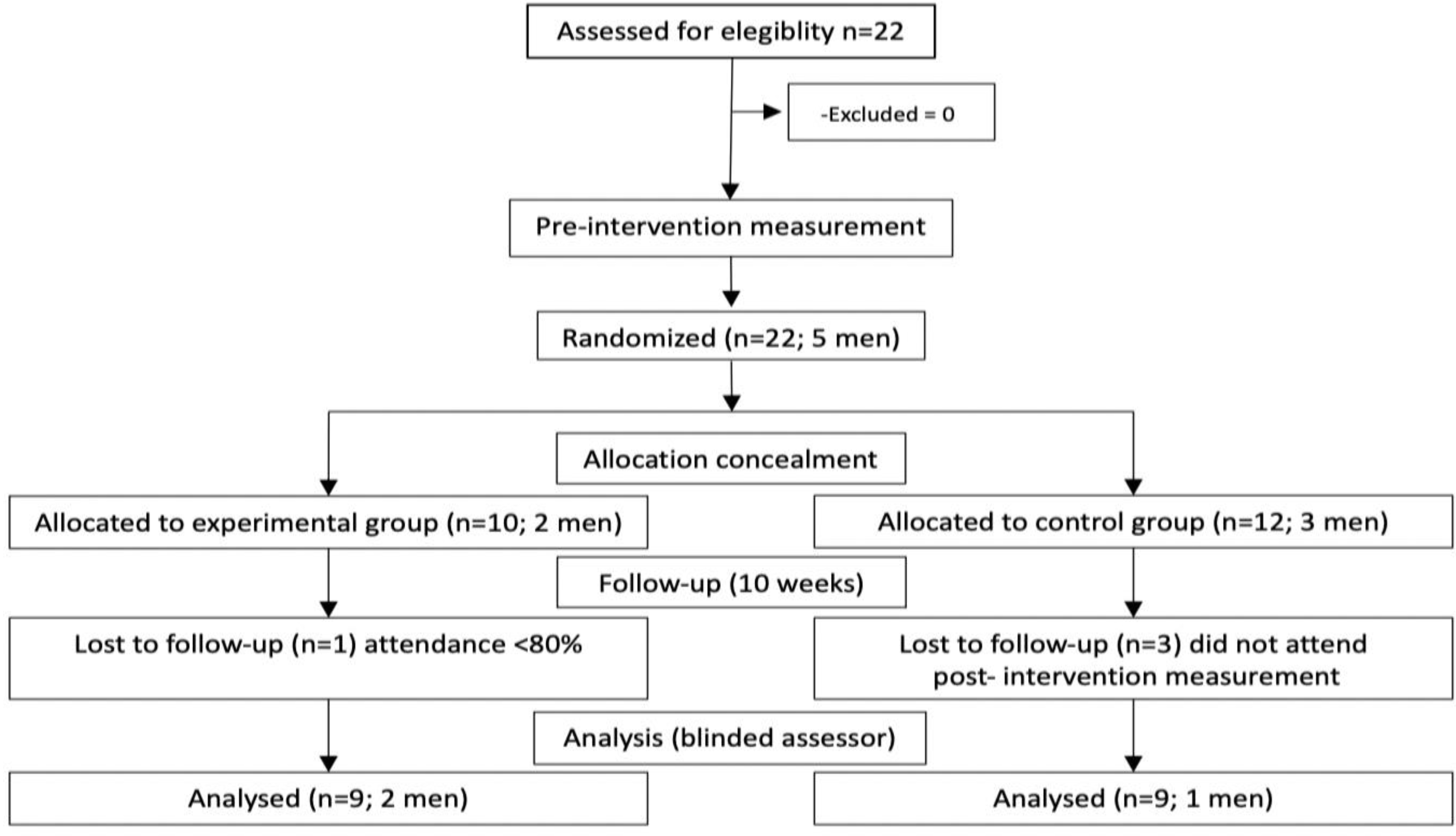
Figure 3.
Total Reading Times for control and experimental group be listed as: (a) reading times of control group pre-post; (b) reading times of experimental group pre-post.
Figure 3.
Total Reading Times for control and experimental group be listed as: (a) reading times of control group pre-post; (b) reading times of experimental group pre-post.
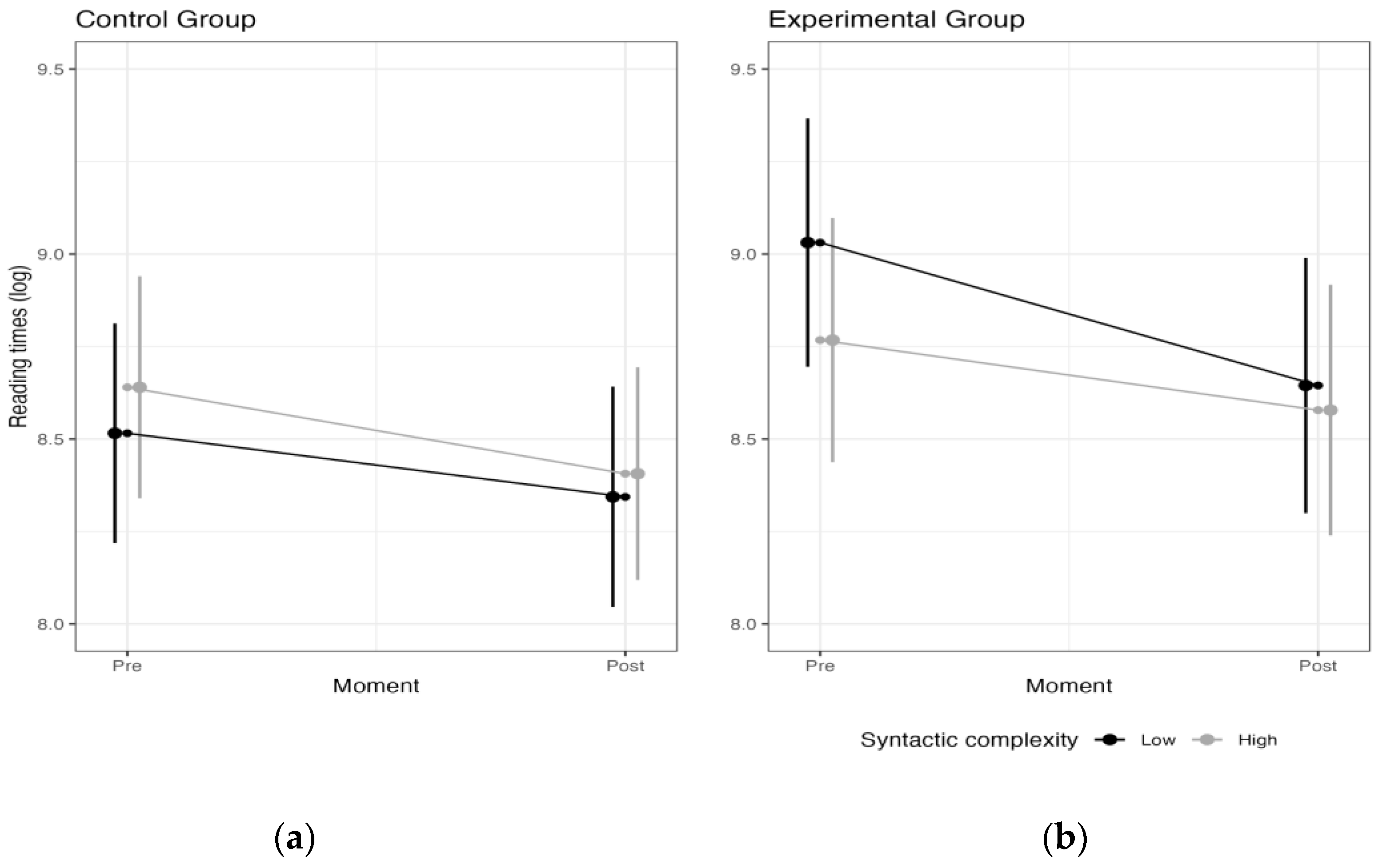
Figure 4.
ANOVAS result between pre-post intervention strength values and eye tracker measurements. In bold, significant p values (<0.05). ES = effect size (Hedges' g).
Figure 4.
ANOVAS result between pre-post intervention strength values and eye tracker measurements. In bold, significant p values (<0.05). ES = effect size (Hedges' g).
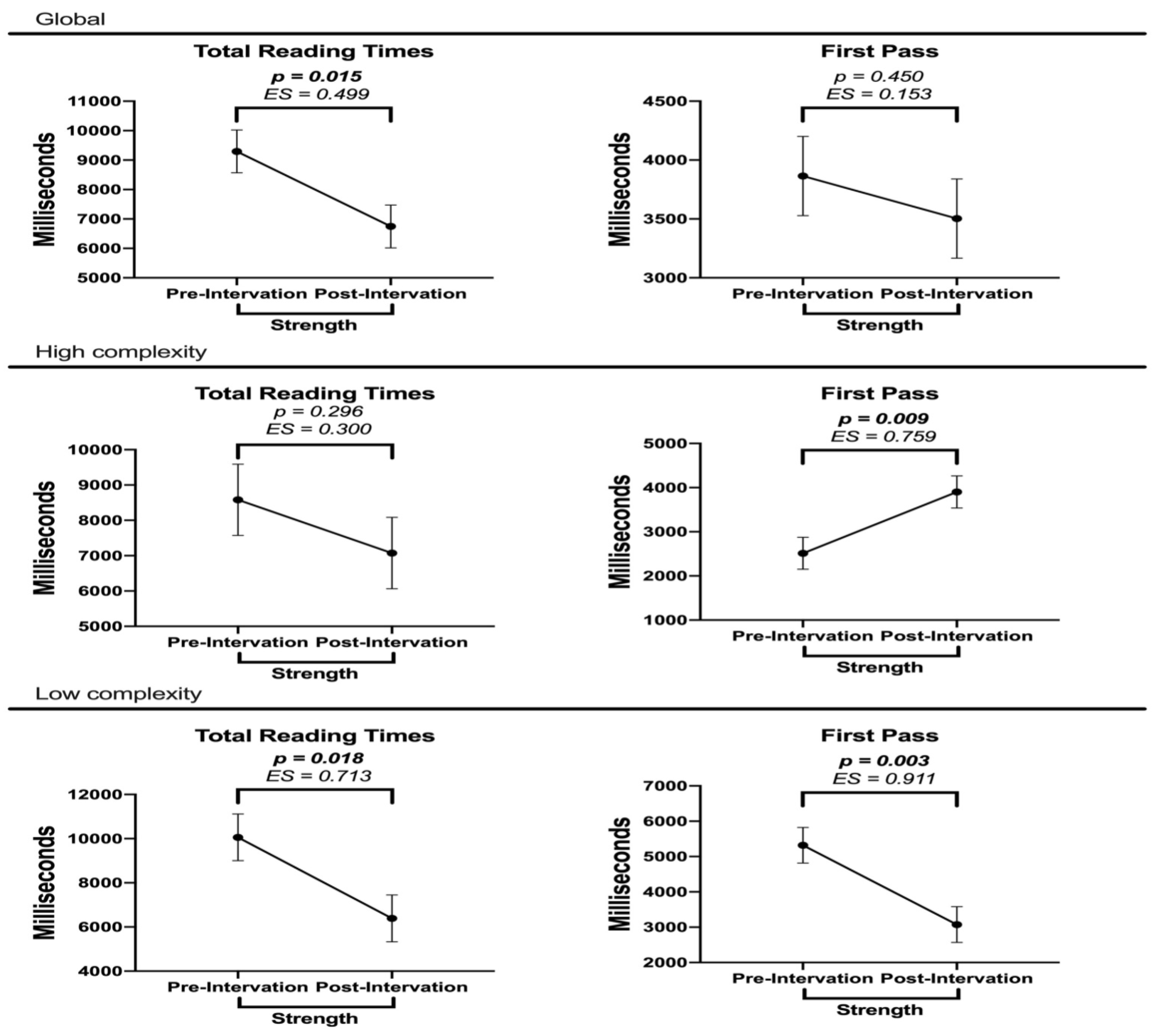

Table 1.
Participants' baseline values. P-value of t-test for independent samples for continuous variables and chi-square for category variables. (cm): centimeters; (kg): kilograms. p-value <.005 in bold.
Table 1.
Participants' baseline values. P-value of t-test for independent samples for continuous variables and chi-square for category variables. (cm): centimeters; (kg): kilograms. p-value <.005 in bold.
| Variables | All (n=18) |
Experimental (n=9) |
Control (n=9) |
P-value |
|---|---|---|---|---|
| Sex | 0.555 | |||
| Women | 15 (83.3%) | 7 (38.9%) | 8 (44.4%) | |
| Men | 3 (16.7%) | 2 (11.1%) | 1 (5.6%) | |
| Age (years) | 21.0 ± 2.14 | 20.0 ± 0.86 | 22.0 ± 2.60 | 0.044 |
| Height (cm) | 161 ± 0.07 | 1,62 ± 0.09 | 1,59 ± 0.04 | 0.340 |
| Weight (kg) | 58.9 ± 10.3 | 62.3 ± 12.8 | 55.4 ± 5.66 | 0.159 |
| BMI | 22,8 ± 3.49 | 23,6 ± 4.11 | 22,0 ± 2.75 | 0.338 |
Table 2.
Resistance training Program.
| Exercises | Week 1 | Week 2 | Week 3 | Week 4 | Week 5 | Week 6 | Week 7 | Week 8 |
|---|---|---|---|---|---|---|---|---|
| Day 1 | ||||||||
| Squat high bar | Int: 60% RM | Int: 65% RM | Int: 70% RM | Int: 75% RM | Int: 70% RM | Int: 75% RM | Int: 80% RM | |
| Deadlift bar | Rep: 12 | Rep: 10 | Rep: 8 | Rep: 6 | Rep: 8 | Rep: 6 | Rep: 4 | Control |
| Bulgarian squat | S: 2 | S: 2 | S: 2 | S: 2 | S: 3 | S: 3 | S: 3 | 1RM |
| Dumbbell lunge | R: 2´ | R: 2´ | R: 2´ | R: 2´ | R: 2´ | R: 2´ | R: 2´ | |
| Hip thrust | ||||||||
| Day 2 | ||||||||
| Bench Press | Int: 60% RM | Int: 65% RM | Int: 70% RM | Int: 75% RM | Int: 70% RM | Int: 75% RM | Int: 80% RM | |
| Close grip Bench press | Rep: 12 | Rep: 10 | Rep: 8 | Rep: 6 | Rep: 8 | Rep: 6 | Rep: 4 | Control |
| Military Press | S: 2 | S: 2 | S: 2 | S: 2 | S: 3 | S: 3 | S: 3 | 1RM |
| Bench press dumbbell | R: 2´ | R: 2´ | R: 2´ | R: 2´ | R: 2´ | R: 2´ | R: 2´ | |
| Shoulders Press dumbbell | ||||||||
| Day 3 | ||||||||
| Bent over Row bar | Int: 60% RM | Int: 65% RM | Int: 70% RM | Int: 75% RM | Int: 70% RM | Int: 75% RM | Int: 80% RM | |
| T grip Row | Rep: 12 | Rep: 10 | Rep: 8 | Rep: 6 | Rep: 8 | Rep: 6 | Rep: 4 | Control |
| Close grip row | S: 2 | S: 2 | S: 2 | S: 2 | S: 3 | S: 3 | S: 3 | 1RM |
| Meadows row | R: 2´ | R: 2´ | R: 2´ | R: 2´ | R: 2´ | R: 2´ | R: 2´ | |
| Single arm dumbbell row |
Int: intensity; Rep: repetition; S: series; R: rest; 1RM: 1 maximum repetition.
Disclaimer/Publisher’s Note: The statements, opinions and data contained in all publications are solely those of the individual author(s) and contributor(s) and not of MDPI and/or the editor(s). MDPI and/or the editor(s) disclaim responsibility for any injury to people or property resulting from any ideas, methods, instructions or products referred to in the content. |
© 2024 by the authors. Licensee MDPI, Basel, Switzerland. This article is an open access article distributed under the terms and conditions of the Creative Commons Attribution (CC BY) license (http://creativecommons.org/licenses/by/4.0/).
Copyright: This open access article is published under a Creative Commons CC BY 4.0 license, which permit the free download, distribution, and reuse, provided that the author and preprint are cited in any reuse.