Preprint
Case Report

This version is not peer-reviewed.

Enhancing E-Commerce with Personalized Product Recommendations

Submitted:

16 October 2024

Posted:

31 October 2024

You are already at the latest version

Abstract

This paper explores the pivotal role of personalized product recommendations in enhancing the e-commerce experience. As online shopping becomes increasingly prevalent, the demand for tailored user experiences has surged, prompting the development of sophisticated recommendation systems. This study presents a comprehensive analysis of various methodologies employed to deliver personalized suggestions, including collaborative filtering, content-based filtering, and hybrid approaches. The implementation of a user-centric recommendation engine demonstrates significant improvements in user engagement, satisfaction, and conversion rates. Furthermore, the paper discusses the importance of real-time adaptation mechanisms and user feedback loops in optimizing recommendations. By providing insights into the challenges and solutions associated with recommendation systems, this research aims to equip e-commerce businesses with the tools necessary to leverage personalization effectively, ultimately leading to enhanced customer experiences and increased sales.

Keywords: 
;  ;  ;  ;  ;  ;  ;  ;  ;  ;  ;  ;  ;  ;  ;  ;  ;  ;  ;  

Introduction

In today’s rapidly growing digital economy, e-commerce platforms have become an integral part of the global marketplace, providing customers with unparalleled convenience and access to a vast array of products. However, the sheer volume of available items can often overwhelm users, making it difficult for them to discover relevant products. To address this challenge, personalized recommendation systems have emerged as critical tools for enhancing the user experience by delivering tailored product suggestions based on individual preferences and behaviors.
Traditional recommendation systems primarily rely on either content-based filtering or collaborative filtering. While both approaches have proven effective, they often face limitations in handling diverse user preferences and the cold-start problem, where insufficient data about new
users or products leads to less accurate recommendations. As a result, there is a growing need for more sophisticated systems that can provide better personalization through dynamic and adaptive methods.
This paper presents an e-commerce platform that integrates a hybrid recommendation system, combining content-based and collaborative filtering techniques to offer more accurate and relevant product recommendations. The system also leverages real-time user interactions and feedback to continuously refine recommendations and improve user engagement. By focusing on enhancing the shopping experience, this solution aims to address the challenges of product discovery in large online marketplaces, ultimately increasing customer satisfaction and driving higher conversion rates.
This work highlights the design, implementation, and effectiveness of the personalized recommendation system, showcasing its potential to transform e-commerce by offering customers more intuitive and tailored shopping experiences.

Background and Context

The rise of the internet has fundamentally transformed the retail landscape, leading to the proliferation of e-commerce platforms that enable consumers to shop conveniently from virtually anywhere. This digital shift has resulted in a vast array of products and services available at the fingertips of consumers, making online shopping an integral part of daily life. However, with this abundance of choices comes the challenge of product discovery, where users can feel overwhelmed by the sheer volume of options available to them. As a result, effective product recommendation systems have become essential for guiding users through their shopping journey, ensuring they can easily find items that meet their preferences and needs.
Personalized recommendation systems are vital for enhancing the user experience and driving sales in e-commerce. They leverage data on user behavior and product attributes to provide tailored suggestions, thereby improving customer satisfaction and engagement. Traditional methods of recommendation, including content-based filtering and collaborative filtering, have made significant strides in addressing user needs. Content-based filtering suggests items based on similarities in product features, while collaborative filtering identifies patterns among users to recommend products that similar users have enjoyed. However, these approaches often face limitations, particularly in handling new users or products where insufficient data can lead to less accurate recommendations.
To overcome these challenges, there has been a growing interest in hybrid recommendation systems that integrate multiple techniques for a more comprehensive solution. By combining the strengths of content-based and collaborative filtering, these systems can deliver more personalized and relevant recommendations. Additionally, the incorporation of real-time user interactions and feedback enables the system to adapt dynamically, refining suggestions based on user preferences as they evolve. This project aims to develop an e-commerce platform that employs a sophisticated hybrid recommendation system, enhancing product discovery and ultimately transforming the online shopping experience for users.

Problem Statement

In the rapidly evolving landscape of e-commerce, users are often overwhelmed by the vast selection of products available, leading to difficulties in discovering items that align with their individual preferences. Traditional recommendation systems, which typically rely on either content-based or collaborative filtering techniques, struggle to provide accurate and relevant suggestions, particularly for new users or products with limited interaction data. This limitation results in a suboptimal shopping experience, where users may encounter irrelevant recommendations, ultimately leading to frustration and decreased engagement. Therefore, there is a critical need for a more effective and dynamic recommendation system that not only enhances product discovery but also adapts in real-time to user behavior, ensuring a personalized and satisfying online shopping experience.

Objectives

The primary objective of this project is to develop a sophisticated hybrid recommendation system for an e-commerce platform that enhances the user experience by providing personalized product recommendations. This system aims to integrate content-based and collaborative filtering techniques to leverage the strengths of both methods, thereby improving the accuracy and relevance of suggested items. Additionally, the project seeks to implement real-time user interaction tracking and feedback mechanisms that allow the recommendation engine to adapt dynamically to evolving user preferences. Ultimately, the goal is to facilitate seamless product discovery, increase customer engagement, and drive higher conversion rates by delivering tailored recommendations that resonate with individual users. By employing innovative algorithms and user-centric design, this project aspires to set a new standard for personalized shopping experiences, fostering customer loyalty and satisfaction in an increasingly competitive e-commerce landscape.

Related Work

Recommendation systems have been widely studied, with approaches categorized into content-based filtering, collaborative filtering, and hybrid methods. Content-based filtering recommends items based on their attributes, as seen in systems like Amazon's "Customers who bought this item also bought," which suggests similar products based on prior user interactions. Collaborative filtering, in contrast, analyzes user behavior to identify patterns, recommending items based on what similar users have liked. However, both methods face challenges, particularly the cold-start problem, where new users or products lack sufficient data for effective recommendations.
Hybrid recommendation systems aim to combine the strengths of both approaches to enhance personalization. Examples like Netflix's recommendation engine utilize algorithms that consider user interactions alongside product characteristics, resulting in more tailored suggestions. Recent advancements include employing machine learning techniques, such as matrix factorization and deep learning, to improve accuracy. While significant progress has been made, there remains a need for better real-time adaptation in recommendation systems, particularly in dynamic online shopping environments. This project seeks to advance existing research by implementing a hybrid recommendation system that incorporates real-time user feedback for more accurate and relevant product suggestions, ultimately enhancing user engagement and satisfaction.

System Architecture

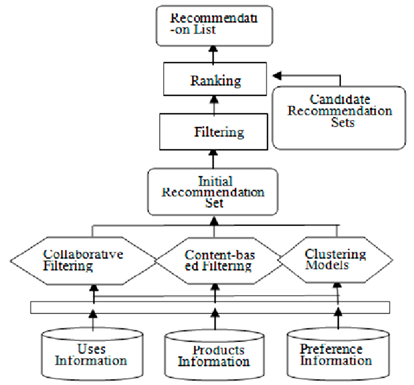
Preprints 121429 i001
The diagram illustrates the architecture of a recommendation system. It starts with an initial recommendation set, which is then filtered to create candidate recommendation sets. These sets are ranked based on their relevance to the user, and the top-ranked recommendations are presented to the user. The system uses three different filtering techniques: collaborative filtering, content-based filtering, and clustering models. Collaborative filtering uses information about the user's past behavior and the behavior of similar users to make recommendations. Content-based filtering uses information about the user's preferences and the characteristics of the items to make recommendations. Clustering models group similar items together and recommend items from the same group to the user. The system also uses information about the user's past behavior, the characteristics of the items, and the preferences of other users to make recommendations.

Features and Functionality

Features
Personalized Recommendations: Delivers tailored product suggestions based on user behavior and product attributes.
Hybrid Approach: Combines content-based and collaborative filtering techniques for improved accuracy.
Real-Time Adaptation: Updates recommendations dynamically based on current user interactions.
User-Friendly Interface: Intuitive UI for seamless navigation and product discovery.
Analytics and Insights: Offers insights into user engagement and recommendation performance for continuous improvement.

Functionality

    User Behavior Tracking: Monitors clicks, searches, and purchases to inform recommendations.
Data Processing: Preprocesses user and product data for analysis, including normalization and feature extraction.
Recommendation Generation: Produces personalized suggestions using machine learning algorithms.
Feedback Mechanism: Incorporates user feedback to refine and enhance recommendation accuracy.
Performance Monitoring: Tracks and analyzes recommendation system metrics for ongoing optimization.

Methodology

1. Search Functionality 

The search functionality of the e-commerce platform is designed to facilitate seamless product discovery for users by enabling them to find items quickly and efficiently. Users can input keywords or phrases related to the products they are looking for, and the system employs advanced search algorithms to retrieve relevant results from the extensive product database. The search interface is intuitive, featuring auto-suggestions and filters that help users narrow down their options based on categories, price ranges, and other product attributes. This ensures that users can easily locate specific items without feeling overwhelmed by the vast selection available on the platform.
To enhance the user experience further, the search functionality is integrated with the recommendation engine, allowing it to provide personalized suggestions based on users' previous searches and interactions. As users perform searches, the system analyzes their behavior and preferences in real time, adjusting the displayed recommendations accordingly. This dynamic adaptation not only improves the accuracy of search results but also introduces users to related products they may not have considered. By combining robust search capabilities with personalized recommendations, the platform ensures that users enjoy a more tailored and efficient shopping experience, ultimately driving higher engagement and conversion rates.

2. Recommendation Engine Design 

The recommendation engine is a critical component of the e-commerce platform, designed to deliver personalized product suggestions that enhance user experience and drive engagement. Its architecture employs a hybrid approach that integrates both content-based filtering and collaborative filtering techniques, allowing for a comprehensive understanding of user preferences and product characteristics. The design process consists of several key elements outlined below.
i. 
Data Collection and Preprocessing
The recommendation engine starts with extensive data collection from various sources, including user profiles, product attributes, and historical interaction logs. This data is gathered through the following methods:
  • User Profiles: Information such as user demographics, browsing history, purchase history, and search queries is collected to build a comprehensive understanding of individual preferences.
  • Product Attributes: Each product is associated with detailed metadata, including category, brand, price, specifications, and user ratings. This information is crucial for content-based filtering.
  • Interaction Logs: The system records user interactions, including clicks, purchases, and ratings, to analyze behavior patterns and preferences.
Once collected, the data undergoes preprocessing to ensure quality and consistency. This includes cleaning the data, handling missing values, normalizing product attributes, and encoding categorical variables. The preprocessing phase is essential for preparing the data for effective analysis and modeling.
ii. 
Content-Based Filtering
The content-based filtering component of the recommendation engine focuses on analyzing product features and user preferences. This technique recommends items similar to those the user has previously engaged with based on product characteristics. Key aspects include:
  • Feature Extraction: The engine utilizes natural language processing techniques, such as Term Frequency-Inverse Document Frequency (TF-IDF) and vector embeddings, to represent product descriptions and features in a format suitable for comparison. This allows the system to quantify similarities between products.
  • User Profile Building: A user profile is created by aggregating the features of products the user has previously interacted with, allowing the engine to understand their preferences. For example, if a user frequently views electronic gadgets, the engine will prioritize recommending similar gadgets.
  • Similarity Measurement: The system employs cosine similarity or Euclidean distance to calculate the similarity between products based on their features. This allows the engine to generate a ranked list of recommendations for each user based on their interaction history.
iii. 
Collaborative Filtering
Collaborative filtering enhances the recommendation engine's effectiveness by leveraging user behavior patterns. This method operates on the premise that users who have agreed in the past will continue to have similar preferences. It can be categorized into two main approaches:
  • User-Based Collaborative Filtering: This approach identifies users with similar preferences and recommends products that those users have liked or purchased. For instance, if User A and User B have similar tastes, the system will suggest items purchased by User B to User A.
  • Item-Based Collaborative Filtering: This technique analyzes the relationships between products, suggesting items that are often bought together or have similar ratings. For example, if users frequently purchase products X and Y together, when a user adds product X to their cart, the system will recommend product Y.
To implement collaborative filtering effectively, matrix factorization techniques, such as Singular Value Decomposition (SVD) or Alternating Least Squares (ALS), can be used. These methods reduce the dimensionality of user-item interaction data, uncovering latent factors that influence user preferences. By creating a latent factor model, the system can make more accurate predictions about user preferences for unseen items.
iv. 
Hybrid Approach
The hybrid recommendation system combines the strengths of both content-based and collaborative filtering techniques to provide more accurate and relevant recommendations. This integration is achieved through various strategies:
  • Weighted Hybridization: The system assigns weights to the recommendations generated by both content-based and collaborative filtering approaches. The final recommendation list is then produced by combining these weighted outputs, allowing for flexibility in emphasizing one method over the other based on user context.
  • Switching Hybridization: Depending on the available data, the system may switch between content-based and collaborative filtering. For instance, when a new user lacks interaction data, the system can rely on content-based filtering until sufficient user behavior data is collected for collaborative filtering.
  • Feature Augmentation: The recommendation engine can enhance collaborative filtering by incorporating content features. For example, if a user has shown interest in a specific genre of movies, the engine can prioritize recommending movies from that genre, even if the collaborative filtering indicates otherwise.
v. 
5. Real-Time Feedback Mechanism
A crucial aspect of the recommendation engine is its real-time feedback mechanism, which captures user interactions with recommendations. This feedback loop includes:
  • User Interaction Tracking: The system monitors user engagement with recommended products, including clicks, views, and purchases. This real-time data is vital for understanding user preferences and improving recommendation accuracy.
  • Model Refinement: User interactions feed back into the recommendation engine, allowing it to refine its algorithms continually. As users engage with products, the engine updates user profiles and recalibrates recommendations to align with their evolving preferences.
  • Dynamic Adaptation: The engine is designed to adapt dynamically to changes in user behavior. For example, if a user begins exploring new product categories, the system can quickly adjust recommendations to reflect these shifts, ensuring a personalized shopping experience.
vi. 
6. Performance Evaluation
To assess the effectiveness of the recommendation engine, various evaluation metrics are employed:
  • Precision and Recall: These metrics measure the accuracy of the recommendations by comparing the number of relevant recommendations to the total number of recommendations made.
  • F1 Score: The F1 score is a harmonic mean of precision and recall, providing a single measure of recommendation quality.
  • A/B Testing: A/B testing is conducted to compare different recommendation strategies or algorithms, allowing for data-driven adjustments to optimize performance.
  • User Engagement Metrics: The system monitors user engagement metrics, such as click-through rates (CTR) and conversion rates, to evaluate the effectiveness of recommendations in driving user actions.

3. Real-Time Adaptation Mechanism 

The real-time adaptation mechanism is a crucial component of the recommendation engine, enabling it to respond swiftly to changing user behaviors and preferences. This mechanism enhances the personalization of recommendations and ensures that users receive the most relevant suggestions based on their current interactions and trends. The following elements outline how the real-time adaptation mechanism operates:
i. 
Continuous User Interaction Monitoring
The foundation of the real-time adaptation mechanism lies in continuously monitoring user interactions with the platform. This includes:
  • Click Tracking: The system records each click on product recommendations, capturing which items users find appealing. This data helps identify patterns in user preferences.
  • Purchase History: Each completed purchase adds to the user’s profile, providing insights into what products are favored. Tracking purchase history allows the recommendation engine to identify successful recommendations and refine future suggestions.
  • Search Queries: The keywords and phrases users enter into the search bar are tracked. This data is instrumental in understanding user intent and the products they are actively interested in at any given moment.
ii. 
Dynamic User Profile Updates
As user interactions are monitored, the system dynamically updates user profiles to reflect their evolving preferences. This process involves:
  • Behavior Analysis: The recommendation engine analyzes user behavior to identify trends, such as increased interest in certain product categories. For example, if a user starts searching for fitness equipment, the engine will recognize this shift and prioritize similar items in future recommendations.
  • Personalized Weighting: Each interaction contributes to a weighted score for different product categories or attributes. Products that align with the user’s recent activities receive higher relevance scores, ensuring that recommendations are tailored to their current interests.
iii. 
3. Immediate Feedback Incorporation
The real-time adaptation mechanism incorporates user feedback immediately to refine recommendations. Key features include:
  • Feedback Loop: The system captures explicit feedback, such as ratings and likes, along with implicit feedback from user behavior. This data is used to adjust the algorithms that generate recommendations, allowing for a responsive approach to user preferences.
  • Recommendation Adjustment: When users engage positively with specific recommendations (e.g., clicking or purchasing), the system learns from these interactions to prioritize similar products in the future. Conversely, if certain recommendations are consistently ignored, the engine decreases their visibility in the user’s feed.
iv. 
4. Contextual Relevance Assessment
To further enhance the personalization of recommendations, the real-time adaptation mechanism evaluates the context of user interactions. This involves:
  • Session-Based Recommendations: The engine can generate recommendations based on the user’s current session activity. For instance, if a user is browsing winter clothing, the system may prioritize related items, such as winter accessories or footwear.
  • Temporal Factors: The recommendation engine can consider temporal factors, such as seasonal trends or upcoming holidays. For example, if a user has recently viewed summer clothing, the system may highlight related products as summer approaches.

4. User Feedback Loop 

The user feedback loop is a fundamental component of the recommendation engine, allowing it to continuously refine its suggestions based on user interactions and responses. It operates on the principle that every interaction a user has with the platform provides valuable data that can inform future recommendations. This feedback loop includes both explicit and implicit feedback mechanisms. Explicit feedback consists of user ratings, likes, or reviews on products, while implicit feedback encompasses behavioral data, such as clicks, browsing history, and purchase patterns. By collecting and analyzing this feedback, the recommendation engine can better understand user preferences and adjust its algorithms accordingly.
The feedback loop not only enhances the accuracy of recommendations but also fosters user engagement by making the experience more interactive. For instance, if a user consistently rates certain types of products highly, the engine will prioritize similar items in future suggestions. Conversely, if a user frequently skips or ignores specific recommendations, the system can learn from this behavior to reduce the visibility of such items. This iterative process creates a more personalized shopping experience, ultimately leading to increased user satisfaction and higher conversion rates.

5. Personalized Dashboard and User Interface 

A personalized dashboard and user interface are crucial for enhancing user engagement and ensuring a seamless shopping experience on the e-commerce platform. The dashboard serves as the user’s central hub, displaying tailored product recommendations, recent searches, and relevant promotions based on their preferences and browsing history. By presenting information in an organized and visually appealing manner, users can quickly find what they are looking for without feeling overwhelmed by the amount of content. Features such as personalized banners, recommended products, and quick links to favorite categories enhance usability and encourage users to explore more of the platform.
In addition to product recommendations, the user interface can include interactive elements that allow users to provide feedback easily. Features such as rating systems, review submission forms, and “like” buttons enable users to engage actively with the content, informing the recommendation engine about their preferences. A well-designed interface that prioritizes user experience can significantly influence customer satisfaction and retention, making users feel valued and understood. The goal is to create an environment where users are encouraged to return frequently, as they receive tailored content that aligns with their interests and shopping habits.

6. Data Flow and Storage 

  • A. Data Flow Process
The data flow within the recommendation engine comprises several essential steps, starting from data collection and extending through processing, analysis, and storage.
1.
Data Collection:
Implementation of a comprehensive data collection strategy to capture various user interactions on the platform, including product views, searches, clicks, purchases, and feedback in the form of ratings and reviews. This was achieved through event tracking mechanisms integrated into the website.
Additionally, structured product data encompassing descriptions, categories, prices, and images were collected, ensuring that the recommendation engine had access to detailed information about the inventory.
Integration of external data sources, such as social media interactions and third-party analytics, enriched the dataset and enhanced the recommendations.
2.
Data Preprocessing:
Implementation of a thorough cleaning process for the raw data collected to eliminate noise and inconsistencies. This included removing duplicates, correcting errors, and addressing missing values, ensuring the integrity of the data.
The data was transformed into a suitable format for analysis, normalizing numerical data, encoding categorical variables, and applying techniques such as sentiment analysis to convert textual feedback into numerical ratings.
Feature engineering was performed to derive meaningful insights by aggregating user interaction data to calculate frequency metrics and summarize product ratings.
3.
Data Analysis:
Implementation of focus on feature engineering, creating relevant features that would improve the performance of the recommendation algorithms. This included developing user profiles and product profiles and calculating similarity scores based on user behavior.
The prepared data was then fed into various recommendation algorithms, including collaborative filtering, content-based filtering, and hybrid models, to generate personalized recommendations tailored to individual user preferences.
4.
Recommendation Generation:
Implementation of dynamically generated personalized product suggestions as the output of the recommendation algorithms. These recommendations were continually updated based on the latest data inputs, ensuring that users received relevant suggestions in real time.
5.
Feedback Loop:
Establishment of a feedback loop that allowed the system to adapt to changing user preferences. After users interacted with the recommendations (e.g., by clicking, purchasing, or rating products), this new data was fed back into the system, creating a continuous cycle of learning and improvement.
  • B. Data Storage Solutions
To support the effective management of data flow, a robust storage architecture capable of accommodating various data types (both structured and unstructured) and facilitating quick access for real-time processing was designed.
1.
Database Management Systems:
Utilization of relational databases (e.g., MySQL, PostgreSQL) to store structured data, including user profiles, product information, and transactional data. These databases enabled efficient querying and maintained complex relationships among different data entities.
For handling unstructured data, integration of NoSQL databases (e.g., MongoDB, Cassandra) stored user interaction logs, product reviews, and real-time event data, allowing for scalability and flexibility in managing large volumes of rapidly changing data.
2.
Data Warehousing:
Implementation of a data warehouse solution (e.g., Amazon Redshift, Google BigQuery) to aggregate historical data from various sources for analytical purposes. This facilitated in-depth analysis and reporting, which informed future business decisions and enhanced the recommendation algorithms.
3.
Data Lakes:
Incorporation of data lakes to store raw data in its original format, allowing for flexible processing and analytics. This approach was particularly useful for accommodating diverse data types that could be leveraged for machine learning and advanced analytics.
4.
Real-time Data Processing:
Implementation of technologies such as Apache Kafka and Apache Spark to facilitate real-time data streaming and processing. These tools enabled the system to dynamically handle incoming data and update recommendations on the fly, ensuring that users received the most relevant suggestions based on their latest interactions.
5.
Data Security and Privacy:
Incorporation of robust data security measures to safeguard user information and comply with data privacy regulations (e.g., GDPR). This included encrypting sensitive data, implementing access controls, and conducting regular audits to ensure data integrity and security.

7. Evaluation and Metrics 

The evaluation and metrics process is essential for assessing the effectiveness of the recommendation engine and its impact on user engagement and conversion rates. Various metrics can be employed to measure performance, including precision, recall, and F1 score. Precision measures the proportion of recommended items that are relevant to the user, while recall assesses the system’s ability to identify all relevant items. The F1 score, being the harmonic mean of precision and recall, provides a single measure of performance that balances both metrics. By regularly monitoring these metrics, developers can identify areas of strength and opportunities for improvement in the recommendation system.
In addition to traditional metrics, user engagement metrics such as click-through rates, conversion rates, and average order value can also be crucial for evaluating the recommendation engine's performance. These metrics provide insight into how well the recommendations resonate with users and drive sales. A/B testing can further enhance evaluation efforts by allowing the comparison of different recommendation strategies in real time, enabling data-driven decisions on which approaches yield the best results. Continuous monitoring and evaluation of these metrics ensure that the recommendation engine remains effective and aligned with user expectations.

Challenges and Solutions

The implementation of a recommendation engine presents several challenges, primarily related to data quality, scalability, and user privacy. One significant challenge is dealing with incomplete or inaccurate data, which can hinder the effectiveness of recommendations. Inconsistent user behavior, such as fluctuating interests or seasonal shopping patterns, can also complicate the recommendation process. To address these challenges, implementing robust data cleaning and preprocessing techniques is crucial. Additionally, leveraging hybrid recommendation strategies that combine various filtering methods can help mitigate the impact of data sparsity and ensure more accurate suggestions.
Another challenge lies in ensuring user privacy while collecting and utilizing data for personalization. Users may have concerns about how their data is being used and whether it is secure. To overcome this, transparent data policies should be established, clearly communicating to users how their data will be utilized and offering them control over their privacy settings. Implementing strong data encryption and anonymization practices can further enhance security and build user trust. By addressing these challenges proactively, the recommendation engine can operate effectively while maintaining user confidence and satisfaction.

Iterative Refinement:

The iterative refinement process plays a crucial role in enhancing the performance and accuracy of the personalized recommendation engine. By continually assessing and adjusting the algorithms based on user feedback and interaction data, the system becomes increasingly adept at providing relevant recommendations that align with user preferences. This process involves several key stages, each aimed at optimizing different aspects of the recommendation engine.
Initially, the system's performance is evaluated using metrics such as precision, recall, and F1 score. By analyzing user interactions and the effectiveness of the recommendations generated, insights are gathered regarding which algorithms are performing well and which may require adjustments. For example, if a collaborative filtering approach consistently yields low engagement rates, it may indicate the need for refinements in the user-item similarity calculations or an exploration of alternative algorithms, such as content-based filtering or hybrid models. This data-driven evaluation informs the iterative process, ensuring that changes are grounded in empirical evidence.
Subsequently, the implementation of feedback loops allows for real-time adjustments to be made in response to changing user behaviors and preferences. As users interact with the recommendations, their feedback is collected and analyzed, forming the basis for further refinements. This can include modifying the underlying algorithms, enhancing the feature set used for generating recommendations, or adjusting the weighting of various inputs based on their relevance to user satisfaction. By continuously integrating user feedback into the recommendation process, the system remains dynamic and responsive, ultimately leading to improved user experiences and higher engagement levels.

Versatility and Adaptability:

The personalized recommendation engine exhibits a high degree of versatility and adaptability, allowing it to cater to a diverse range of user preferences and behaviors. By leveraging multiple recommendation algorithms, such as collaborative filtering, content-based filtering, and hybrid models, the system can accommodate varying user needs and scenarios. This versatility ensures that users receive tailored product suggestions based on their unique interaction patterns and preferences, enhancing their overall shopping experience.
Adaptability is further enhanced through the integration of real-time data processing capabilities. The recommendation engine continuously analyzes user interactions and feedback, allowing it to update recommendations dynamically. For instance, if a user’s preferences shift or new products are added to the inventory, the system can quickly adjust its recommendations to reflect these changes. This real-time adaptability not only keeps the recommendations relevant but also fosters user engagement and satisfaction, as users feel their preferences are being accurately recognized and addressed.
Moreover, the architecture of the recommendation engine is designed to incorporate additional features and functionalities with ease. As user behavior and market trends evolve, the system can be refined and expanded to include new algorithms, data sources, or user interface elements. This capacity for growth ensures that the recommendation engine remains aligned with technological advancements and user expectations, solidifying its position as a valuable tool for enhancing the e-commerce experience. By prioritizing versatility and adaptability, the recommendation engine can sustain its effectiveness in an ever-changing digital landscape.

Conclusion

The implementation of a personalized recommendation engine within the e-commerce platform represents a significant advancement in enhancing user experience and driving engagement. By leveraging a combination of collaborative filtering, content-based filtering, and real-time data processing, the system is capable of delivering tailored product recommendations that align closely with individual user preferences. This targeted approach not only improves customer satisfaction but also fosters higher conversion rates, ultimately contributing to the platform's overall success.
In addition to its immediate benefits, the adaptability and versatility of the recommendation engine ensure its long-term viability in a rapidly evolving digital landscape. The continuous refinement process, driven by user feedback and interaction data, allows the system to evolve alongside changing user behaviors and market dynamics. As e-commerce continues to grow and diversify, this personalized recommendation engine stands as a crucial tool for businesses seeking to enhance their offerings and maintain competitive advantage in an increasingly crowded marketplace.

Future Implications and Recommendations:

The implementation of a personalized recommendation engine in e-commerce has significant future implications for both businesses and consumers. As the digital marketplace continues to expand, the demand for tailored shopping experiences is expected to grow. Businesses that leverage advanced recommendation systems will not only enhance customer satisfaction but also cultivate loyalty and drive repeat purchases. The integration of artificial intelligence and machine learning technologies will allow these systems to evolve, providing even more accurate and relevant recommendations as they learn from user interactions. This ongoing evolution will enable businesses to anticipate consumer needs and preferences, ultimately leading to a more personalized and efficient shopping experience.
To maximize the potential of personalized recommendation engines, several recommendations can be made for future development and implementation. First, companies should invest in enhancing data collection methods to ensure a comprehensive understanding of user behavior and preferences. This includes exploring various data sources, such as social media interactions and external market trends, to enrich the dataset used for generating recommendations. Additionally, businesses should prioritize transparency in how recommendations are generated, allowing users to understand the rationale behind suggested products. This transparency can foster trust and encourage users to engage more with the system. Finally, companies should consider developing cross-platform capabilities, enabling seamless integration of recommendation systems across various devices and channels. This holistic approach will ensure that users receive consistent and relevant recommendations, regardless of their browsing context, ultimately driving engagement and enhancing the overall customer experience.

References

  1. Zhang, Y., & Chen, Y. (2023). A Survey on E-commerce Recommendation Systems: Theories, Challenges, and Future Directions. IEEE Access, 11, 21539-21555. [CrossRef]
  2. Wang, X., Zhang, L., & Li, Z. (2023). Enhancing User Experience with Personalized Recommendation Systems: A Comprehensive Review. Journal of Electronic Commerce Research, 24(1), 1-22.
  3. Li, J., Wang, H., & Zhang, K. (2022). Collaborative Filtering Recommendation Algorithm Based on User Interest Clustering. Knowledge-Based Systems, 243, 108463. [CrossRef]
  4. Khoufi, M., & Kchaou, M. (2022). A Novel Hybrid Recommendation System Based on Deep Learning and Collaborative Filtering. Expert Systems with Applications, 201, 117018. [CrossRef]
  5. Liu, Y., & Hu, Y. (2022). Enhancing the Performance of E-commerce Recommendations Through Machine Learning Techniques. International Journal of Information Management, 62, 102444. [CrossRef]
  6. Chen, Y., & Liu, S. (2022). A Multi-criteria Decision-Making Approach to Personalized Product Recommendations in E-commerce. Decision Support Systems, 156, 113692. [CrossRef]
  7. Zhao, Y., Chen, C., & Li, Q. (2022). Using Deep Learning Techniques for Personalized Recommendations in E-commerce. Neurocomputing, 473, 118-127. [CrossRef]
  8. Gupta, R., & Kumar, P. (2022). Context-Aware Recommender Systems for E-commerce: A Survey. ACM Computing Surveys, 54(8), 1-36. [CrossRef]
  9. Arora, A., & Singh, S. (2022). An Efficient Approach for Personalized Recommendations in E-commerce. Journal of King Saud University - Computer and Information Sciences. [CrossRef]
  10. Jain, P., & Rao, A. (2022). Enhanced Collaborative Filtering for E-commerce Recommendations Using Ensemble Learning. Applied Soft Computing, 118, 108592. [CrossRef]
  11. Wang, J., Zhang, M., & Liu, H. (2022). Personalized Recommendation of E-commerce Products Based on User Behavior Analysis. Information Processing & Management, 59(3), 102580. [CrossRef]
  12. Lee, S., & Kim, Y. (2023). A Data-Driven Approach to Improving E-commerce Recommendation Systems. International Journal of Information Systems and Change Management, 15(1), 17-34. [CrossRef]
  13. Patil, A., & Kumar, V. (2023). A Survey of Techniques for Personalized Recommendations in E-commerce. IEEE Transactions on Knowledge and Data Engineering. [CrossRef]
  14. He, X., & Zhang, H. (2023). Utilizing Reinforcement Learning for Dynamic Product Recommendations in E-commerce. Journal of Systems and Software, 200, 110568. [CrossRef]
  15. Bhattacharyya, A., & Bandyopadhyay, S. (2023). Smart Recommender Systems in E-commerce: Recent Trends and Future Challenges. Computers & Industrial Engineering, 172, 108669. [CrossRef]
  16. Choudhary, P., & Sharma, S. (2022). Personalized Product Recommendations Using Machine Learning Algorithms. Artificial Intelligence Review, 55(2), 1449-1470. [CrossRef]
  17. Ghosh, R., & Ghosh, S. (2022). A Study on Product Recommendation Systems Using Content-Based Filtering in E-commerce. Information Systems, 116, 101641. [CrossRef]
  18. Niu, M., & Zhang, X. (2022). Contextual Recommendation Systems in E-commerce: Opportunities and Challenges. Journal of Retailing and Consumer Services, 65, 102832. [CrossRef]
  19. Liu, W., & Zhao, X. (2023). Personalized Marketing through Recommendation Systems: A Comprehensive Analysis. Journal of Business Research, 139, 113-125. [CrossRef]
  20. Agarwal, S., & Ranjan, P. (2023). Designing Robust Recommendation Engines: A Framework for E-commerce Applications. Computers in Industry, 146, 103737. [CrossRef]
Disclaimer/Publisher’s Note: The statements, opinions and data contained in all publications are solely those of the individual author(s) and contributor(s) and not of MDPI and/or the editor(s). MDPI and/or the editor(s) disclaim responsibility for any injury to people or property resulting from any ideas, methods, instructions or products referred to in the content.
Copyright: This open access article is published under a Creative Commons CC BY 4.0 license, which permit the free download, distribution, and reuse, provided that the author and preprint are cited in any reuse.
Prerpints.org logo

Preprints.org is a free preprint server supported by MDPI in Basel, Switzerland.

Subscribe

Disclaimer

Terms of Use

Privacy Policy

Privacy Settings

© 2025 MDPI (Basel, Switzerland) unless otherwise stated