

Submitted:
30 October 2024
Posted:
30 October 2024
You are already at the latest version
Abstract
Federated learning (FL) is a decentralized machine learning paradigm that allows multiple local clients to collaboratively train a global model by sharing their model parameters instead of private data, thereby mitigating privacy leakage. However, recent studies have shown that gradient-based data reconstruction attacks (DRA) can still expose private information by exploiting model parameters from local clients. Existing privacy-preserving FL strategies provide some defence against these attacks but at the cost of significantly reduced model accuracy. Moreover, the issue of client heterogeneity further exacerbates these FL methods, resulting in drifted global models, slower convergence, and decreased performance. This study aims to address the two main challenges of FL: data heterogeneity, particularly in Non-Identical and Independent Distributions (Non-IID) clients, and client privacy through DRA. By leveraging the Lagrange duality approach and employing a generator model to facilitate knowledge distillation (KD) between clients, thereby enhancing local model performance, this method aims to concurrently address the primary challenges encountered by FL in real-world applications.
Keywords:
Federated learning
; knowledge distillation
; Non-Identical and Independent Distributions
; data reconstruction attacks
; Dual Decomposition Optimization
1. Introduction
With the advancement of wireless communication networks enabling the Internet of Things (IoT), edge clients are now equipped with increasingly sophisticated sensing, communication, computing, and analysis capabilities [1]. To address data-driven learning tasks arising from various real-world problems, artificial intelligence (AI), particularly deep learning and deep neural networks [2], has been widely adopted for feature extraction and model building to enhance decision-making. This approach is expected to benefit numerous application fields, including smart healthcare [3], smart manufacturing [4], smart cities [5], and smart agriculture [6]. In the traditional centralized deep learning framework, large volumes of raw data collected from edge clients are directly transmitted to a central server for the development of comprehensive deep learning models. However, this data often contains sensitive information (e.g., healthcare records, private photos), posing significant privacy risks. Consequently, ensuring data security and privacy is one of the most critical concerns in this context.
Federated Learning (FL) [7] is an approach to distributed machine learning that enhances privacy by transmitting gradients or model parameters rather than raw data. This framework exchanges parameters between the server and each client, enabling the server to learn from the clients’ private data without directly accessing it. According to the Data Processing Inequality [8], communicating via parameters— which are deterministic mappings of local data—reduces the risk of compromising data privacy compared to sharing raw data. However, recent research has demonstrated that even parameter-based communication in FL can still lead to privacy breaches. For instance, multiple studies have shown that adversaries can perform membership inference attacks (MIA) using the transmitted model parameters [9,10,11], thereby compromising data privacy and anonymity. Additionally, attackers can fully reconstruct training data through data reconstruction attacks (DRA) [12,13,14,15,16], posing significant privacy threats to FL systems. Several innovative privacy-preserving techniques have been proposed to mitigate these risks. For example, [17] introduces a decentralized FL scheme that combines quality-based aggregation with an extended dynamic contribution broadcast encryption (DConBE) and local differential privacy. [18] proposes an adaptive FL framework that integrates adaptive gradient descent with differential privacy mechanisms. To address the dual challenges of ensuring provable privacy guarantees while minimizing communication and computational overheads in FL, especially for linear regression models, [19] suggests a differential private FL scheme. Lastly, [20] presents the Noising before Model Aggregation FL framework, which enhances differential privacy by adding artificial noise to parameters at the client’s side before aggregation.
In addition to privacy concerns, a significant challenge in FL is data heterogeneity, where clients’ data exhibit Non-Identical and Independent Distributions (Non-IID). Non-IID data refers to substantial variations across clients in terms of statistical properties, such as data distributions, feature representations, and class imbalances. This heterogeneity complicates model training, as models trained on Non-IID data may struggle to generalize effectively across different clients or accurately represent the overall patterns within the entire dataset. Conventional FL algorithms, such as FedAvg [21], have been observed to result in divergent local models and a considerable loss of global knowledge under Non-IID conditions, leading to decreased performance and slower convergence [22,23]. To address this issue, the concept of Knowledge Distillation (KD), as introduced by [24], offers a potential solution by transferring knowledge from teacher (client) models to a student (global) model. For instance, FedDF [25] employs ensemble distillation for model fusion, where the global model is trained using the averaged logits from local models. FedAUX [26] enhances this approach by determining model initialization for local models and assigning weights to local model logits using (, )-differential private certainty scoring. FedBE [27] takes a Bayesian approach, generating multiple global models from local models and then merging them into a single global model through ensemble KD. FedFTG, as introduced in [28], addresses the Non-IID challenge by training a GAN generator as a data generation model and fine-tuning the global model with the data produced by the GAN. Similarly, FedGen [29] trains a lightweight generator to mitigate the impact of Non-IID data on the global model’s performance.
Deploying differential privacy mechanisms for preserving privacy while simultaneously utilizing KD methods to address heterogeneity is a challenging task. This difficulty arises because distilling knowledge from noisy clients is not possible, and basically, privacy and model performance are inversely proportional, meaning that improving privacy typically comes at the cost of model performance, such as accuracy. Consequently, centralized learning often outperforms FL applications in terms of overall performance due to the added privacy constraints in FL. In this work, we propose a novel method, FedSGAN, to tackle the Non-IID challenge in heterogeneous systems while maintaining the privacy of clients against DRA concurrently. FedSGAN employs a dual decomposition optimization approach to tackle the privacy challenge and leverages a Generative Adversarial Network (GAN) model to distill knowledge between clients by generating pseudo data. Consequently, FedSGAN effectively addresses the Non-IID challenge while concurrently preserving client privacy. The primary contributions of this work are outlined as follows:
- We present an innovative method for enhancing client model performance through data-free knowledge distillation.
- We modified GAN training procedure to generate pseudo data, effectively facilitating knowledge transfer between clients to tackle Non-IID challenges.
- We utilize dual decomposition optimization technique to protect clients’ private data against DRA.
- FedSGAN simultaneously enhances client model performance and preserves privacy.
2. Preliminaries
In this paper, our methodology tackles Non-IID challenges by distilling knowledge between clients and employing dual decomposition to preserve client parameter privacy against DRA. This section elucidates the characteristics of the methods utilized in the development of the FedSGAN approach.
2.1. Dual Decomposition Optimization
Dual decomposition optimization, as proposed in [30], is a privacy-preserving optimization technique designed to address multi-constraint problems, such as those encountered in FL. In FL, the set of active clients is denoted as A where , and each client,, has access to its local private dataset, . The goal for each client is to determine the optimal weight vector solving the following optimization problem:
In this context, C denotes the classifier, represents the softmax function, and refers to the loss function employed for computing the error of the model. Here, represents the prediction score for , where X is the input data and Y is its ground truth label, with . Additionally, N signifies the total number of clients. For utilizing the Dual Decomposition, the Equation (1) is reformulated into an equivalent constrained optimization problem that mathematically shares a common optimal value which each client aims to solve the following problem:
In Equation (2), each client i holds a copy of the weight vector , and all these copies are required to agree with the mentioned constraint. However, it can be noticed this constraint in 2 can be replaced with pairs of double-sided inequality constraints. Therefore, the Equation (2) can be rewritten as a standard constrained distributed optimization problem within equality constraints as follows:
where can be designed in infinitely possible ways to represent the equality constraint in Equation (2). For instance, Algorithm 3 provides a detailed explanation for calculating the output vector of .
The function represents one of the infinitely many possible realizations that can satisfy the constraint in Equation (3). In Algorithm 1 , denotes the zero vector of size m. Considering Equation (3) and the Lagrange multipliers vector with zero initial value, denoted as for client i, along with the vector calculated as , the training in client i process can be performed as follows:
- Clients randomly initialize .
- Clients initialise with zero value and with value and send them to the server.
- Client Calculates the loss value :
- Clients fine-tune its gradient of loss value as below:
- Clients update its weight with learning rate as below:
- Repeat steps 3 to 7 till the end of the training phase.
| Algorithm 1 Calculating the . |
|
Inputs: The client local model parameters , m is the size of , N is the total number of clients.
Output: Vector with size of
Case 1:
Case 2:
Case 3:
|
2.1.1. Assumption.1
For all , we assume that the are not disclosed to the server. In other words, the server is unaware of the exact realization of for all .
2.2. GAN
Generative Adversarial Networks (GANs), introduced by [31], are a class of deep learning models designed to generate new data samples that resemble a given training dataset. GANs have gained significant attention in privacy-preserving data generation due to their ability to generate pseudo data that preserves the statistical properties of the original data without revealing sensitive information. This pseudo data can then be used for the training phase without compromising privacy. A GAN consists of two neural networks, namely a Generator with a set of model parameters denoted as and a Discriminator , which are trained simultaneously. Through an adversarial process, the generator takes as input a random noise vector z sampled from a prior distribution, which typically is a uniform or Gaussian distribution. The generator maps this noise vector to the data space, aiming to produce pseudo data indistinguishable from real data. As illustrated in Figure 1, the discriminator receives either a real data sample or a generated sample as input and outputs a probability representing the likelihood that the input is real rather than generated.
The GAN framework is mathematically formulated as a minimax optimization problem, where the objective is to find an equilibrium between the generator and the discriminator. The objective function for GANs can be expressed as Equation (12) where and :
The generator aims to minimize the loss function by generating samples that maximize the discriminator’s error, while the discriminator tries to maximize the loss function by correctly classifying real and generated samples.
3. Methodology
In this section, we delineate the FedSGAN training phase with Non-IID clients. Figure 2 represents that each client initializes two models: a local model for the FL objective task, denoted as , and a generator model, denoted as with model parameters set , aimed at enhancing local model performance under Non-IID conditions.
During each communication round, clients employ a local optimizer loss function, , to train their local model on their private dataset, . Furthermore, the local model at each client is refined using pseudo data generated by . Unlike conventional FL methods, where clients transfer their local model gradients or parameters, , for aggregation, FedSGAN clients employ the modified dual decomposition optimization method, as explained in the Section 2.1. They transfer only and vectors, and as a result, FedSGAN protects clients from sharing their local model parameters, thereby defending them against DRA. The FedSGAN client-side and server-side processes are further explained in the subsequent subsections.
3.1. Client Side
Clients in FedSGAN utilize the decomposition optimization method described in Section 2.1 for aggregation and to keep their data privacy against DRA. But decomposition optimization causes the performance loss as it shown in Table which compare the decomposition FL mehtod with FedAVG and FedProx, the FedAVG and FedProx have better accuracy on MNIST classification and also decomposition FL method could not address the Non-IID challenges in Heterogeneous systems. Therefore, The proposed FedSGAN utilizes the model with GAN architecture to distillate knowledge from other clients and improve the performance. During the training phase, gets noise z, and y grand true label for generating pseudo data, , as described in Equation (13).
The is the model parameter for client i, z is Gaussian noise and . The number of grand true data, , with label Y label is denoted as and for generating pseud data is calculated from Equation (14) while it is objective to each client and is not disclosed to the server. In Equation (14), for each class, represents a random number for each label Y and is significantly greater than .
The pseudo data generated by is employed to fine-tune the client loss function, . By evaluating the loss of the local model, , on this pseudo data, , as detailed in Equation (15), the performance loss induced by decomposition optimization is mitigated. Moreover, the distribution compels to generate pseudo data that guide the client towards a more uniform data distribution for training. This approach mitigates the drift during aggregation caused by the Non-IID challenge, as demonstrated by the experimental results in the subsequent section.
After calculating the , the is computed from Equation (7) and then clients updates their model parameters, , with learning rate from Equation (8). In the end, refer to the Equations (9)–(11) clients update the and for transferring them to the server for aggregation.
FedSGAN addresses the privacy performance loss and Non-IID challenge by using during the training phase, but training the still remains a critical task. The can not use client’s local private dataset, , for training because in the Non-IID situation training on the clients private dataset caused to generated pseudo data in a similar distribution as client has and it can not help us to address the Non-IID. Therefore, for training the , FedSGAN modified the formal GAN architecture as illustrated in Figure 3. In taring phase of , FedSGAN remove Discriminator , Figure 3, and utilize loss value as it describe in Equation (15). calculates the loss of the local model on the pseudo data generated by . Clients transfer the gradient of to the server for aggregation and receive the from the server for updating the with learning rates as described in Equation (16). The method for calculating from is detailed in Equation (17) in the server side subsection.
As illustrated in Figure 2, clients in FedSGAN, in addition to transferring the and to a server in the training phase, also transfer the for training their . The step-by-step FedSGAN training phase on the client side has been shown in Algorithm 2.
| Algorithm 2 FedSGAN, Client side. |
|
Inputs: Average Lagrange multiplier vector: , Average Lagrange dual vector: ,Average gradient loss function of generator model: , Local model learning rate: , Generator model learning rate: , .
repeat
for all client i∈N in parallel do
Client receive , and from server.
from Equation (16).
).
from Equation (13).
from Equation (15).
from Equation (15).
from Equation (9)
from Equation (10).
from Equation (11).
client sends and to the server.
end for
until training stop
|
3.1.1. Remark.1
The Assumption. 1 Section 2.1.1 ensures that when executing Algorithm 2, the server is unable to reconstruct , thereby preventing access to information about the clients’ private local dataset . It is important to note that the transferred between clients and the server represents the gradient of the loss function of the local model on the pseudo data generated from Equation (13). Consequently, state-of-the-art privacy attacks can only reconstruct information about (the pseudo data) and not the clients’ private data. Additionally, due to in Equation (14), the distribution of the private data ’s ground truth labels cannot be reconstructed from the pseudo data’s ground truth label distribution. Therefore, Algorithm 2 strengthens the privacy of FedSGAN by safeguarding the clients’ private data.
3.2. Server Side
As previously mentioned, unlike conventional FL methods, FedSGAN protects client DRA by avoiding the transfer of the client’s local model parameters, , to the server. Consequently, there is no global model at the server side for training or aggregation. Additionally, the server lacks any information about the clients’ data distributions and the function used for decomposition optimization, as explained in Remark.1Section 3.1.1, thereby ensuring the privacy of FedSGAN’s clients. Server received the , and from clients and process to calculate the average of these parameters as formulated in Equations (4), (5), (17) and send back the , and to the clients for updates their models. The server-side FedSGAN algorithm has been represented in Algorithm 3.
| Algorithm 3 FedSGAN, Server side. |
|
Inputs: clients average Lagrange multiplier vector: , clients average Lagrange dual vector: and clients average gradient loss function of generator model:, Number of communication round: T.
for t=1,...,T do
Collect and from clients.
from Equation (4)
from Equation (5)
from Equation (17)
sends and to the clients.
end for
|
4. Experiments
This section will elucidate the implementation aspects of FedSGAN and provide a comparative analysis of its performance against state-of-the-art methods for addressing Non-IID challenges. Additionally, a comparison of its performance in situations involving DRA with state-of-the-art methods will be conducted in Section 4.2.
4.1. Implementation Details
In this section, we conduct a comparative analysis to evaluate the performance of FedSGAN against other notable related works. Detailed implementation specifics and comprehensive experimental results are discussed in the subsequent subsections. In addition, the Python source code of FedSGAN is accessible via the following link: https://anonymous.4open.science/r/FedSGAN-2816/README.md.
4.1.1. Reference Methods
In this study, we compare FedSGAN with several significant related works, including FedAvg [7], FedProx [32], SCAFFOLD [33], FedFTG [28], FedGen [34], FedRand [35], FedKD [36], and f-differential [37]. Table 1 outlines the features of these state-of-the-art methods and demonstrates that FedGen and FedFTG utilize KD to address the Non-IID challenge. FedFTG employs a classification model for the client’s local model , utilizing ResNet18 [38], and uses a GAN architecture [31] for its model. Similarly, FedGen also employs ResNet18 as the local model and utilizes a simple Autoencoder model for its architecture. Notably, FedAvg, FedProx, SCAFFOLD, FedGen, and FedFTG do not mention any techniques in their methodologies to ensure client privacy against DRA. Meanwhile, the FedKD local model employs a Multi-Layer Perceptron (MLP) architecture and utilizes the KD for performance improvement but does not employ any generator model.
4.1.2. FedSGAN Networks Architecture
FedSGAN, similar to FedFTG and FedGen, has ResNet18 architecture for clients local model . Additionally, The GAN proposed in [39] is employed as the model.
4.1.3. Datasets
The effectiveness of FedSGAN is evaluated using the CIFAR-10 [40] and MNIST [41] datasets, which feature heterogeneous dataset partitions. To emulate Non-IID data distribution among clients, a practice adopted by previous studies [28,42,43,44], we utilize the Dirichlet distribution Dir() on label ratios. Here, a smaller value of signifies increased data heterogeneity. For FedSGAN implementation, and .
4.1.4. Differential Privacy
We also compare FedSGAN with reference methods under differential privacy conditions as proposed by [45]. This comparison involves deploying Gaussian noise with varying privacy budgets () to the clients’ weight models to protect their privacy against DRA.
4.1.5. Hyperparameters
The number of clients , number of local training epochs 50, communication rounds , for local training, the batch size is 50. Moreover the and are both initialized to 0.1 and is . The dimension of X and are for CIFAR-10 and for MNIST.
4.2. Performance Comparison
In this section, we first compare the proposed FedSGAN without the model, utilizing only decomposition optimization, to the full implementation containing . This analysis highlights the significance of the model and utilizing KD method, particularly in the context of Non-IID clients. Subsequently, we conduct a comparative analysis of FedSGAN’s accuracy against existing state-of-the-art methods in three scenarios: I. with Non-IID clients and without privacy consideration, II. with implemented privacy measures and all clients are IID, and III. with Non-IID clients while considering private training by utilizing the DP method.
4.2.1. Comparison of FedSGAN Model Without Utilizing KD Method
We compare the accuracy of FedSGAN with and without using the KD method. The experimental results of this comparison across different values of are illustrated in Figure 4 for the MNIST and CIFAR-10 datasets. As shown in Figure 4, the accuracy of FedSGAN with the KD method significantly surpasses without KD, particularly in the presence of Non-IID clients. This highlights the importance of the KD method in enhancing FedSGAN’s performance.
4.2.2. I.Performance Without Privacy Consideration
The overall accuracy comparison between FedSGAN and other state-of-the-art methods is presented in Table 2 for the CIFAR-10 and MNIST datasets across two various values. All experiments were conducted using three random seeds. As shown in Table 2, FedSGAN surpasses most of the methods for and , except for FedFTG. FedFTG demonstrates strong performance in Non-IID client FL applications. However, as illustrated in Figure 5 which presents a comparison of test accuracy across various , the accuracy of FedSGAN is comparable to FedFTG when the value is close to 1, indicating clients are IID. For values less than , SCAFFOLD’s accuracy exceeds that of FedSGAN, likely due to FedSGAN’s approach of not transferring clients’ local model parameters Unlike other methods, and utilizing decomposition optimization for privacy considerations. Nonetheless, FedSGAN’s accuracy remains competitive with state-of-the-art methods, particularly for non-IID clients in CIFAR-10 classification applications, and it shows minimal differences from FedFTG.
4.2.3. II.Performance with Privacy Consideration
The strength of FedSGAN lies in its ability to ensure client privacy against DRA while maintaining performance in heterogeneous systems, as it mentioned in Remark.1Section 3.1.1. Differential privacy is a well-known method utilized to address the privacy challenges of DRA in FL applications. Table 3 compares various state-of-the-art FL methods that employ differential privacy techniques with FedSGAN, using different values on the MNIST dataset. As shown, for lower values, the accuracy of f-differential slightly surpasses FedSGAN by less than . However, for higher values, FedSGAN outperforms all methods with significant difference and remains independent of values because it maintains privacy without relying on differential privacy techniques. Like FedSGAN, FedAKD employs the KD method to preserve accuracy, but its performance does not compare favorably to FedSGAN.
Table 4 compares state-of-the-art methods with accuracy levels similar to FedSGAN in MNIST classification, now applied to CIFAR-10 classification across varying values. This comparison underscores how FedSGAN performs relative to these leading methods in maintaining accuracy while addressing privacy concerns. Unlike in MNIST classification, where FedSGAN’s accuracy is comparable, in CIFAR-10 classification, FedSGAN’s accuracy is notably higher than that of other methods, demonstrating significant performance improvements at larger .
4.2.4. III.Performance with Privacy Consideration and Non-IID Clients
FedSGAN effectively preserves client privacy against DRA while simultaneously addressing the challenges posed by Non-IID clients. As discussed in previous subsections, its performance in independent scenarios, Non-IID environments, and privacy protection against DRA is comparable with state-of-the-art methods. We now compare FedSGAN’s performance with other leading methods that either outperform or match FedSGAN in the previously discussed scenarios. Figure 6 illustrates its accuracy in scenarios where both privacy must be maintained and clients are Non-IID, with a value of 0.5 for CIFAR-10 classification. Based on Remark 1Section 3.1.1, FedSGAN ensures privacy against DRA, whereas other methods utilize differential privacy with varying values for comparison. As shown in Figure 6, FedSGAN demonstrates a significant advantage over other methods at values greater than zero, specially in compare to FedFTG that has better performance than FedSGAN when . However, its performance under differential privacy is significantly reduced and less effective than FedSGAN, underscoring FedSGAN’s strength for real-world federated learning applications.
5. Discussion
The primary limitation of FedSGAN lies in the parameters transferred between clients and servers. As detailed in Methodology section, FedSGAN clients transmit , , and instead of their model parameters. While the size of depends on the client’s model architecture, the parameters and have a size of , which depends on the number of clients, N. In scenarios with a large number of clients and bandwidth constraints, FedSGAN becomes unsuitable due to the large data size transferred between clients and the server. To address this challenge, one potential solution involves optimizing the parameter communication process with techniques such as parameter compression, or quantization, which can significantly reduce the data volume without compromising model performance.
6. Conclusion
We have introduced a novel data-free knowledge distillation approach in FL that effectively balances accuracy and privacy preservation. By transmitting alternative parameters (, , and ) instead of direct model parameters, FedSGAN maintains privacy against DRA while addressing the challenges posed by Non-IID client distributions. Leveraging a GAN model, FedSGAN efficiently transfers knowledge between clients, overcoming the discrepancies of Non-IID data. FedSGAN achieves over better accuracy compared to the FedFTG method, which uses the same data-free knowledge distillation approach, when and in CIFAR-10 classification, demonstrating significant improvements in overall accuracy. Comprehensive evaluations across two benchmark datasets confirm the effectiveness of FedSGAN, positioning it as a promising solution for privacy preservation with Non-IID clients in FL applications.
Appendix A. Appendix
In this appendix, we provide detailed proofs for the optimization Equations (3) to (11) proposed in Section 2.1, which describe the Dual Decomposition Optimization method used in FedSGAN.
Appendix A.1. Optimization Problem Formulation
The optimization problem for FedSGAN is formulated as follows:
This can be reformulated into a set of inequalities:
By using Equation (A2) we could defined the function as explained in Equation (A3) which had describe in Algorithm1. Additionally, from Equation (A3) we impose the following constraint:
Appendix A.2. Lagrangian Formulation
Appendix A.3. Gradient Descent Update
The parameter update rule using gradient descent is:
Expanding this for the specific Primal update, we have:
where is the learning rate, is the loss function for the data distribution .
Moreover Let denote the optimal solution of 3. We define the regret functions as follows:
where T represents the number of communications. A successful FL algorithm must ensure that:
The success criteria, as expressed through , articulate the convergence of regrets over time, indicating the effectiveness and convergence properties of the FL algorithm. The following theorem guarantees the desired performance.
Appendix A.3.1. Theorem.1
Suppose for all clients , we assume that the respective gradients and are convex and uniformly bounded. In other words, there exists a positive constant C such that and , where represents a Jacobian matrix at . Consider that FedSGAN Algorithm 2 is executed by all clients with , where and .Then the limits introduced in tend to 0.
Appendix A.3.2. Proof:
The aggregation process in the server during Algorithm3 closely resembles the scenario where clients communicate in a complete graph, assigning to their incoming edges. In this context, the graph’s adjacency matrix is doubly stochastic and strongly connected. Consequently, noticing the proposed values for and , the fulfillment of above assumption satisfies all the essential conditions outlined in Theorem.1 and as a result, it holds concluding the proof.
References
- Nguyen, D.C.; Ding, M.; Pathirana. 6G Internet of Things: A comprehensive survey. IEEE Internet of Things Journal 2021, 9, 359–383. [Google Scholar] [CrossRef]
- Goodfellow, I.; Bengio, Y.; Courville, A. Deep learning; MIT press, 2016. [Google Scholar]
- Gupta, R.; Shukla, A.; Tanwar, S. BATS: A blockchain and AI-empowered drone-assisted telesurgery system towards 6G. IEEE Transactions on Network Science and Engineering 2020, 8, 2958–2967. [Google Scholar] [CrossRef]
- Lin, C.C.; Deng, D.J.; Chih, Y.L.; Chiu, H.T. Smart manufacturing scheduling with edge computing using multiclass deep Q network. IEEE Transactions on Industrial Informatics 2019, 15, 4276–4284. [Google Scholar] [CrossRef]
- Singh, S.K.; Jeong, Y.S.; Park, J.H. A deep learning-based IoT-oriented infrastructure for secure smart city. Sustainable Cities and Society 2020, 60, 102252. [Google Scholar] [CrossRef]
- Vimalajeewa, D.; Kulatunga. A service-based joint model used for distributed learning: Application for smart agriculture. IEEE Transactions on Emerging Topics in Computing 2021, 10, 838–854. [Google Scholar] [CrossRef]
- McMahan, B. ; Moore. Communication-efficient learning of deep networks from decentralized data. Artificial intelligence and statistics. PMLR, 2017, pp. 1273–1282.
- Cover, T.M. Elements of information theory; John Wiley & Sons, 1999.
- Carlini, N.; Chien, S. ; Nasr. Membership inference attacks from first principles. 2022 IEEE Symposium on Security and Privacy (SP). IEEE, 2022, pp. 1897–1914.
- Choquette-Choo, C.A. Label-only membership inference attacks. International conference on machine learning. PMLR, 2021, pp. 1964–1974.
- Long, Y. ; Wang. A pragmatic approach to membership inferences on machine learning models. 2020 IEEE European Symposium on Security and Privacy (EuroS&P). IEEE, 2020, pp. 521–534.
- Carlini, N. ; Tramer. Extracting training data from large language models. 30th USENIX Security Symposium (USENIX Security 21), 2021, pp. 2633–2650.
- Chen, J.; Zhao, Y.; Li, Q.; Feng, X.; Xu, K. FedDef: defense against gradient leakage in federated learning-based network intrusion detection systems. IEEE Transactions on Information Forensics and Security 2023. [Google Scholar] [CrossRef]
- Haim, N.; Vardi, G.; Yehudai, G.; Shamir, O.; Irani, M. Reconstructing training data from trained neural networks. Advances in Neural Information Processing Systems 2022, 35, 22911–22924. [Google Scholar]
- Hitaj, B.; Ateniese, G.; Perez-Cruz, F. Deep models under the GAN: information leakage from collaborative deep learning. Proceedings of the 2017 ACM SIGSAC conference on computer and communications security, 2017, pp. 603–618.
- Zhu, L.; Liu, Z.; Han, S. Deep leakage from gradients. Advances in neural information processing systems 2019, 32. [Google Scholar]
- Gao, Y.; Zhang, L.; Wang, L.; Choo, K.K.R.; Zhang, R. Privacy-preserving and reliable decentralized federated learning. IEEE Transactions on Services Computing 2023, 16, 2879–2891. [Google Scholar] [CrossRef]
- Wu, X.; Zhang, Y.; Shi, M.; Li, P.; Li, R.; Xiong, N.N. An adaptive federated learning scheme with differential privacy preserving. Future Generation Computer Systems 2022, 127, 362–372. [Google Scholar] [CrossRef]
- Anand, A.; Dhakal, S. ; Akdeniz. Differentially private coded federated linear regression. 2021 IEEE Data Science and Learning Workshop (DSLW). IEEE, 2021, pp. 1–6.
- Wei, K.; Li, J.; Ding. Federated learning with differential privacy: Algorithms and performance analysis. IEEE transactions on information forensics and security 2020, 15, 3454–3469. [Google Scholar] [CrossRef]
- McMahan, B. ; Moore. Communication-Efficient Learning of Deep Networks from Decentralized Data. Proceedings of the 20th International Conference on Artificial Intelligence and Statistics; Singh, A.; Zhu, J., Eds. PMLR, 2017, Vol. 54, Proceedings of Machine Learning Research, pp. 1273–1282.
- Hsu, T.M.H.; Qi, H.; Brown, M. Measuring the Effects of Non-Identical Data Distribution for Federated Visual Classification, 2019. arXiv:cs.LG/1909.06335].
- Khaled, A.; Mishchenko, K.; Richtarik, P. Tighter Theory for Local SGD on Identical and Heterogeneous Data. Proceedings of the Twenty Third International Conference on Artificial Intelligence and Statistics; Chiappa, S.; Calandra, R., Eds. PMLR, 2020, Vol. 108, Proceedings of Machine Learning Research, pp. 4519–4529.
- Hinton, G.; Vinyals, O.; Dean, J. Distilling the Knowledge in a Neural Network, 2015. arXiv:stat.ML/1503.02531].
- Lin, T.; Kong, L.; Stich, S.U.; Jaggi, M. Ensemble Distillation for Robust Model Fusion in Federated Learning. Advances in Neural Information Processing Systems; Larochelle, H.; Ranzato, M.; Hadsell, R.; Balcan, M.; Lin, H., Eds. Curran Associates, Inc., 2020, Vol. 33, pp. 2351–2363.
- Sattler, F.; Korjakow, T.; Rischke, R.; Samek, W. FedAUX: Leveraging Unlabeled Auxiliary Data in Federated Learning. IEEE Transactions on Neural Networks and Learning Systems 2023, 34, 5531–5543. [Google Scholar] [CrossRef] [PubMed]
- Chen, H.Y.; Chao, W.L. FedBE: Making Bayesian Model Ensemble Applicable to Federated Learning, 2021. arXiv:cs.LG/2009.01974].
- Zhang, L.; Shen, L.; Ding, L.; Tao, D.; Duan, L.Y. Fine-tuning global model via data-free knowledge distillation for non-iid federated learning. Proceedings of the IEEE/CVF conference on computer vision and pattern recognition, 2022, pp. 10174–10183.
- Zhu, Z.; Hong, J.; Zhou, J. Data-Free Knowledge Distillation for Heterogeneous Federated Learning. Proceedings of the 38th International Conference on Machine Learning; Meila, M.; Zhang, T., Eds. PMLR, 2021, Vol. 139, Proceedings of Machine Learning Research, pp. 12878–12889.
- Tjell, K.; Wisniewski, R. Privacy preservation in distributed optimization via dual decomposition and ADMM. 2019 IEEE 58th Conference on Decision and Control (CDC). IEEE, 2019, pp. 7203–7208.
- Goodfellow, I.; Pouget-Abadie, J. Generative adversarial nets. Advances in neural information processing systems 2014, 27. [Google Scholar]
- Li, T.; Sahu, A.K.; Zaheer, M.; Sanjabia. Federated optimization in heterogeneous networks. Proceedings of Machine learning and systems 2020, 2, 429–450. [Google Scholar]
- Karimireddy, S.P.; Kale, S. ; Mohri. Scaffold: Stochastic controlled averaging for federated learning. International conference on machine learning. PMLR, 2020, pp. 5132–5143.
- Zhu, Z.; Hong, J.; Zhou, J. Data-free knowledge distillation for heterogeneous federated learning. International conference on machine learning. PMLR, 2021, pp. 12878–12889.
- Varun, M.; Feng, S.; Wang, H.; Sural, S.; Hong, Y. Towards Accurate and Stronger Local Differential Privacy for Federated Learning with Staircase Randomized Response. Proceedings of the Fourteenth ACM Conference on Data and Application Security and Privacy, 2024, pp. 307–318.
- Gad, G.; Gad, E.; Fadlullah, Z.M.; Fouda, M.M.; Kato, N. Communication-Efficient and Privacy-Preserving Federated Learning Via Joint Knowledge Distillation and Differential Privacy in Bandwidth-Constrained Networks. IEEE Transactions on Vehicular Technology 2024. [Google Scholar] [CrossRef]
- Zheng, Q.; Chen, S.; Long, Q.; Su, W. Federated f-differential privacy. International conference on artificial intelligence and statistics. PMLR, 2021, pp. 2251–2259.
- He, K.; Zhang, X.; Ren, S.; Sun, J. Deep residual learning for image recognition. Proceedings of the IEEE conference on computer vision and pattern recognition, 2016, pp. 770–778.
- Fang, G.; Song, J.; Shen, C.; Wang, X.; Chen, D.; Song, M. Data-free adversarial distillation. arXiv 2019, arXiv:1912.11006 2019. [Google Scholar]
- Krizhevsky, A.; Hinton, G.; others. Learning multiple layers of features from tiny images 2009.
- MNIST handwritten digit database, Yann LeCun, Corinna Cortes and Chris Burges — yann.lecun.com. https://yann.lecun.com/exdb/mnist/, 2010. [Accessed 14-08-2024].
- Acar, D.A.E.; Zhao. Federated learning based on dynamic regularization. arXiv 2021, arXiv:2111.04263 2021. [Google Scholar]
- He, C.; Li, S.; So. Fedml: A research library and benchmark for federated machine learning. arXiv 2020, arXiv:2007.13518 2020. [Google Scholar]
- Yurochkin, M. ; Agarwal. Bayesian nonparametric federated learning of neural networks. International conference on machine learning. PMLR, 2019, pp. 7252–7261.
- Talaei, M.; Izadi, I. Adaptive Differential Privacy in Federated Learning: A Priority-Based Approach. arXiv 2024, arXiv:2401.02453 2024. [Google Scholar]
Figure 1.
The GAN model training procedure architecture.
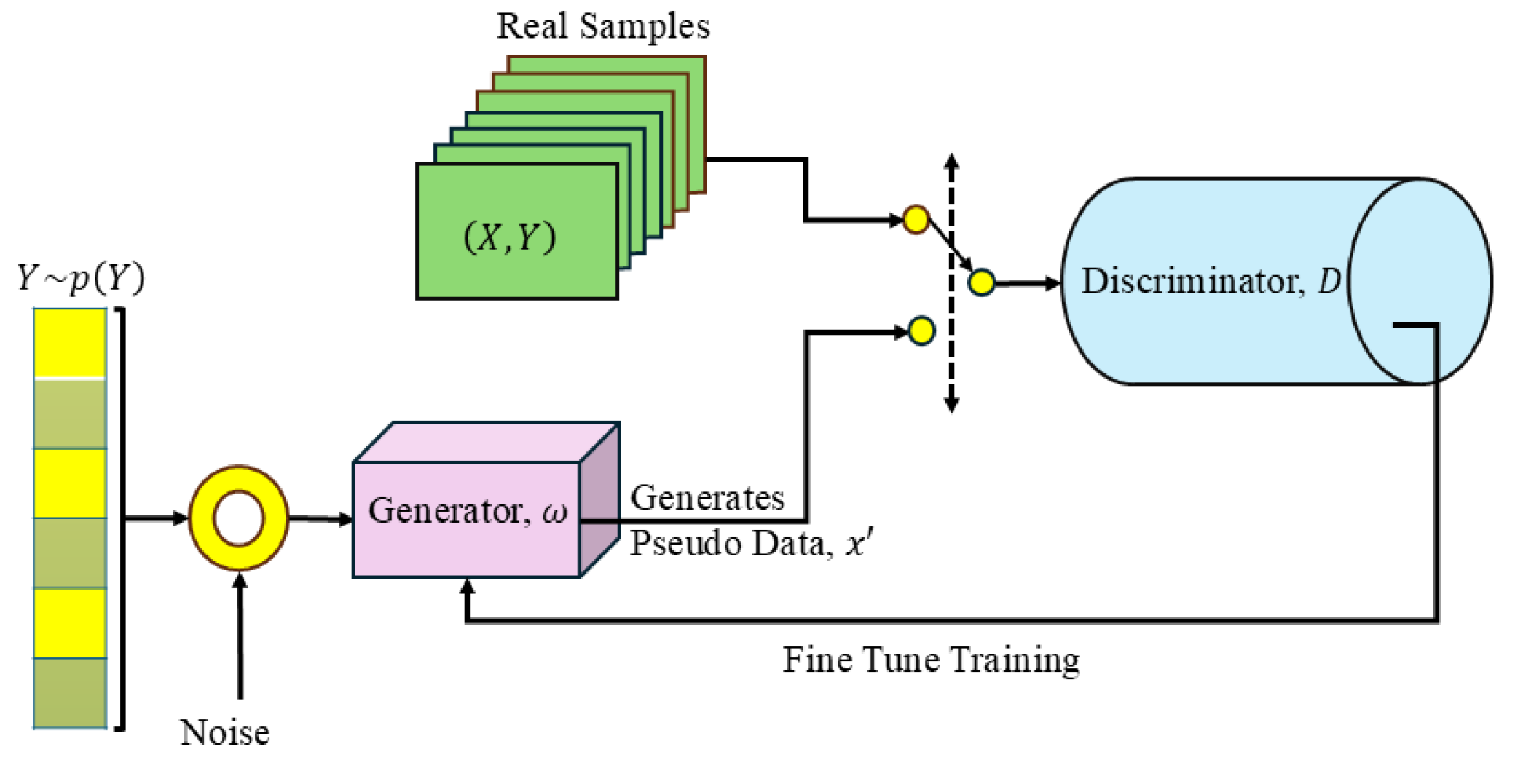
Figure 2.
The proposed FedSGAN model architecture.
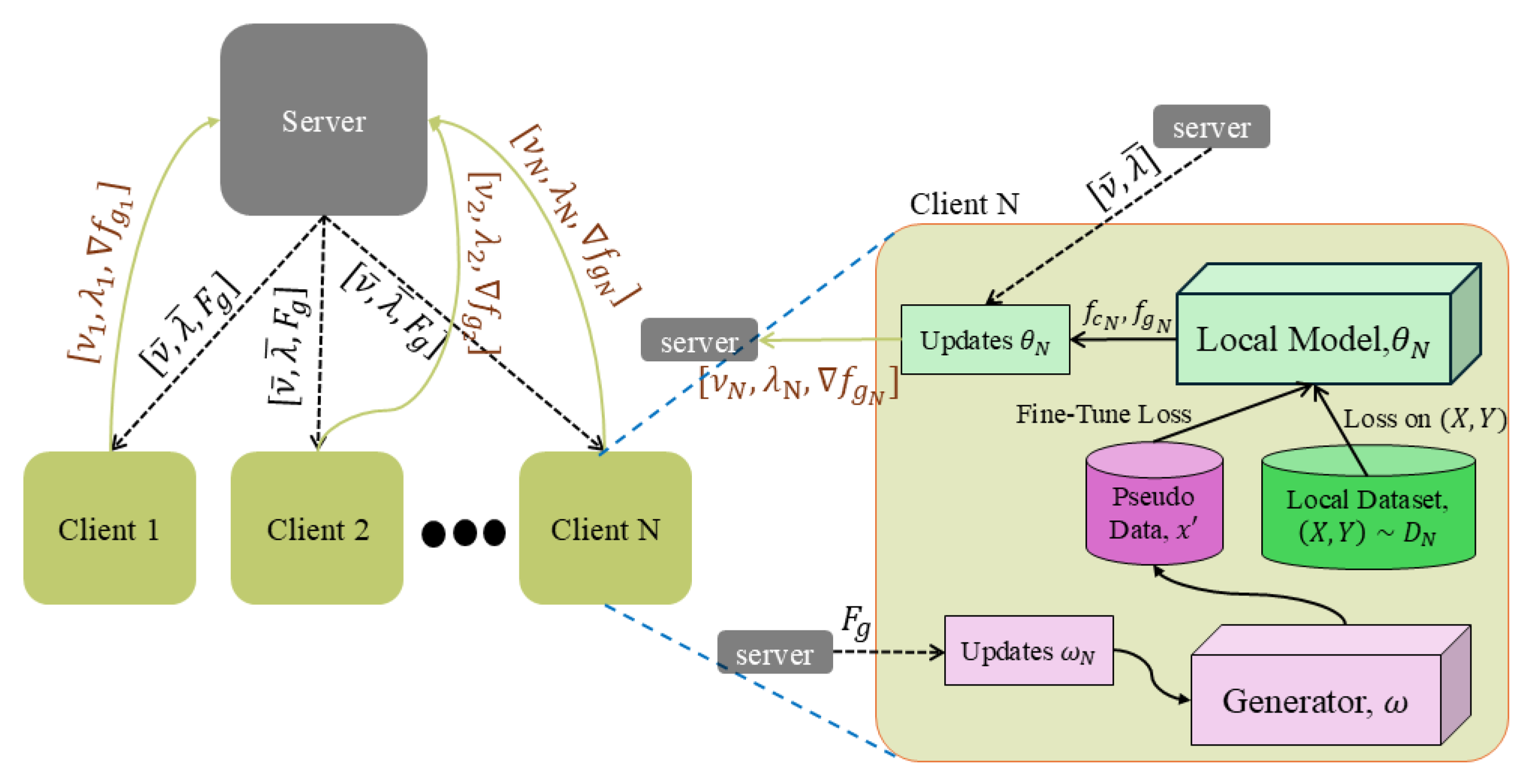
Figure 3.
The modified GAN training procedure.
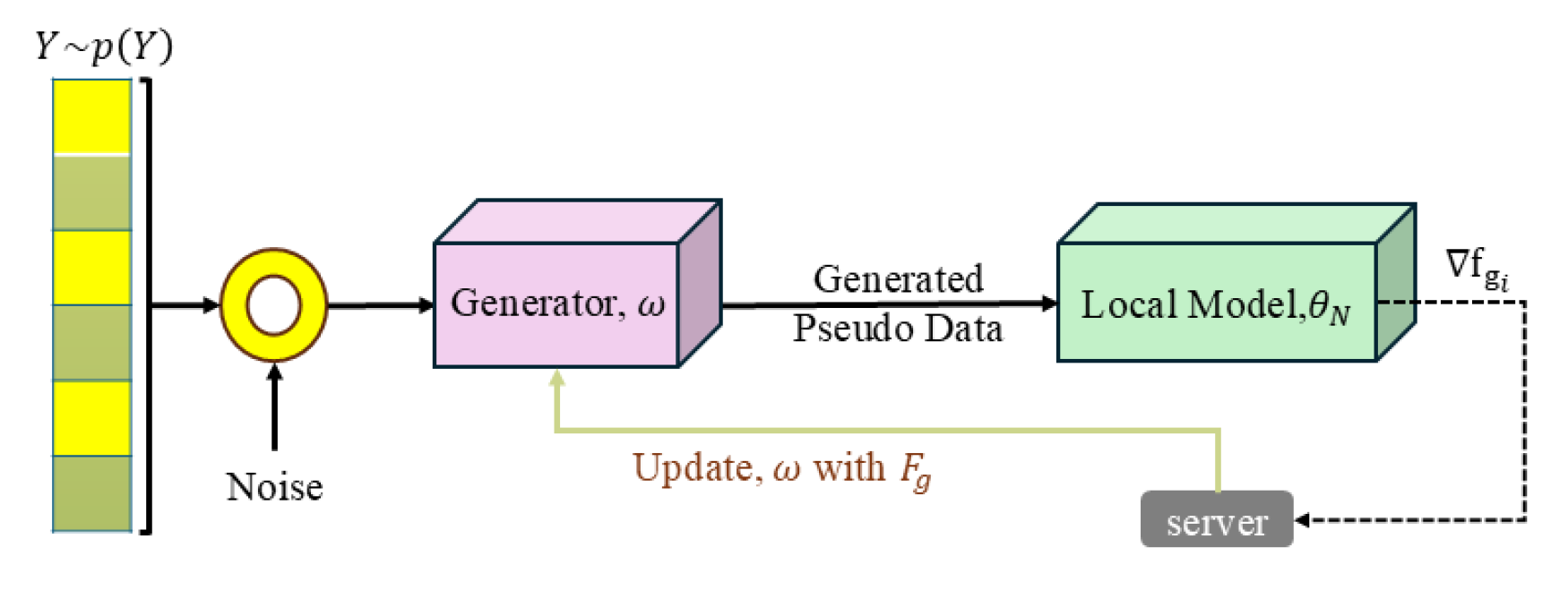
Figure 4.
Comparison of FedSGAN With and Without KD on MNIST and CIFAR-10.
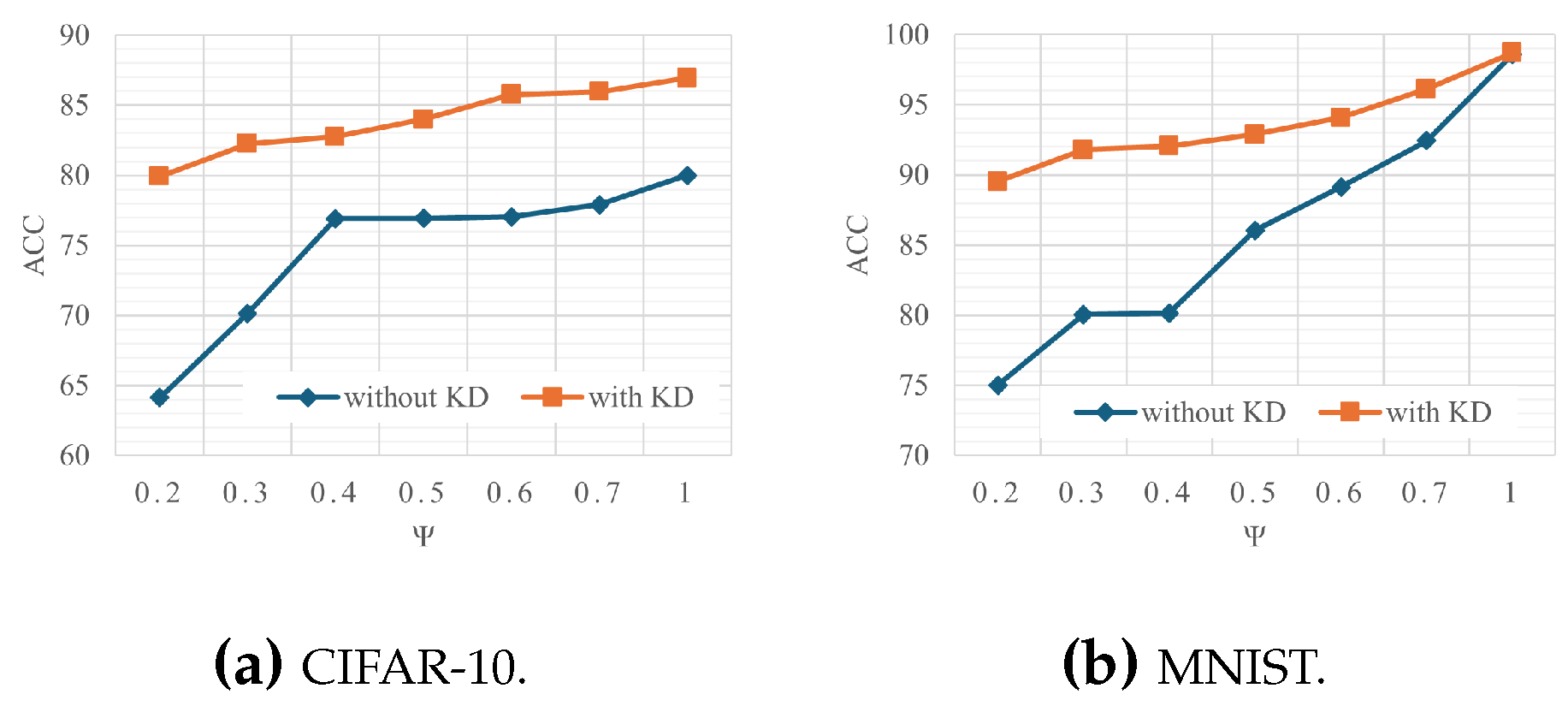
Figure 5.
Compare the accuracy of state-of-the-art Methods on different (data heterogeneity) on CIFAR-10.
Figure 5.
Compare the accuracy of state-of-the-art Methods on different (data heterogeneity) on CIFAR-10.
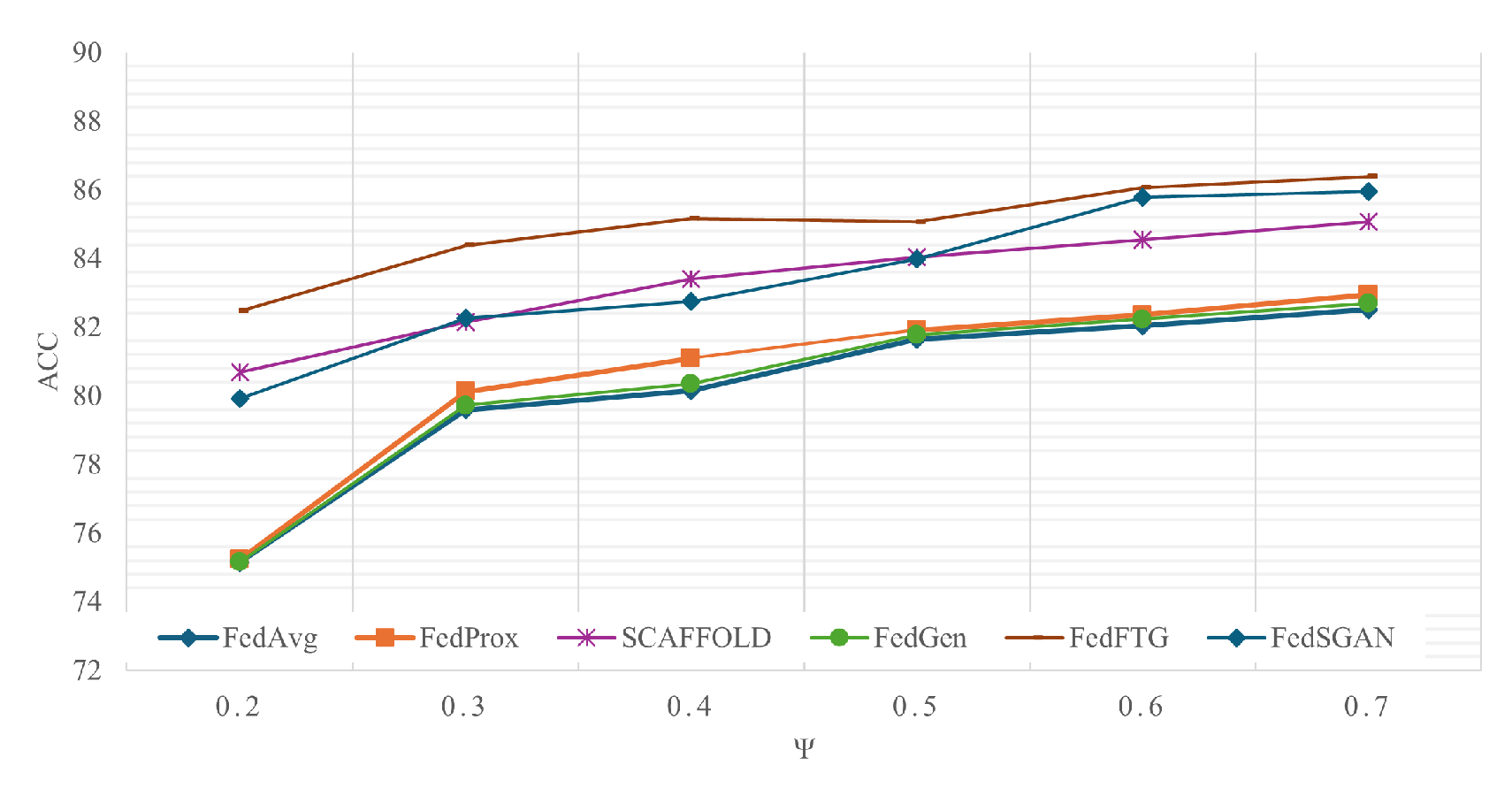
Figure 6.
Compare the accuracy of state-of-the-art Methods on different while (Non-IID clients) on CIFAR-10.
Figure 6.
Compare the accuracy of state-of-the-art Methods on different while (Non-IID clients) on CIFAR-10.
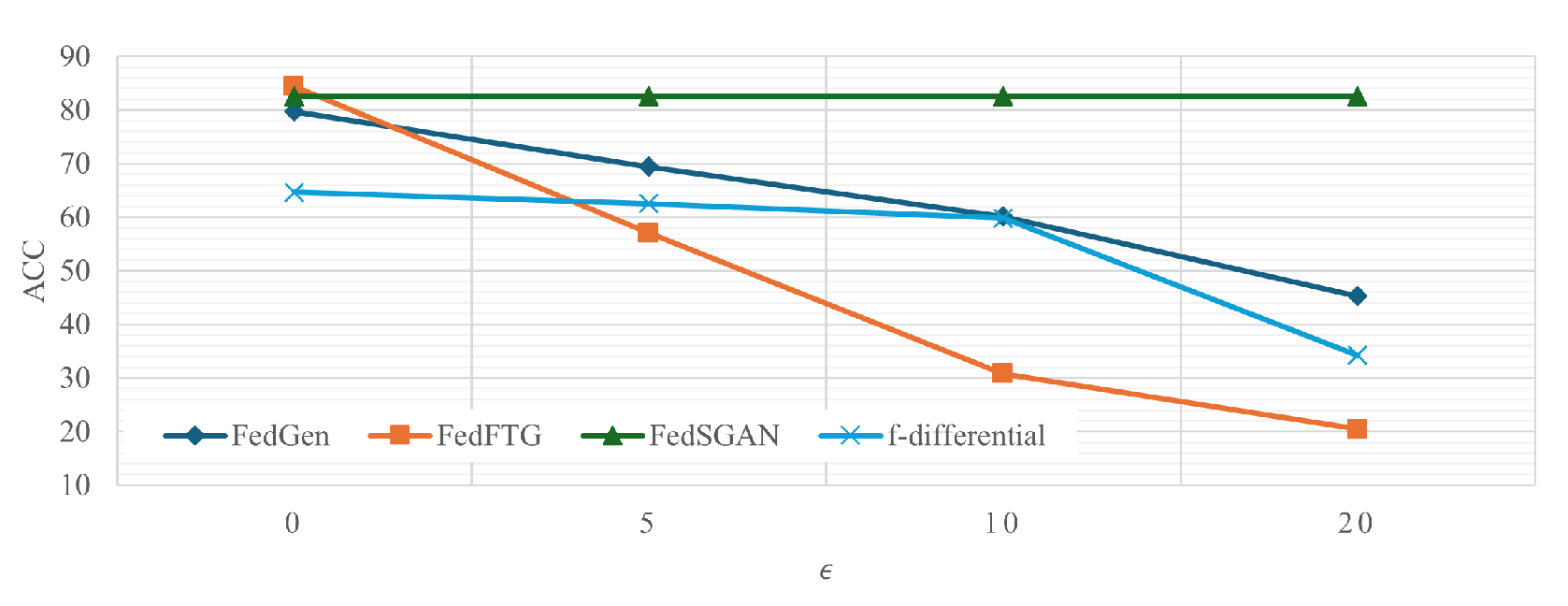

Table 1.
The state-of-the-art methods main features.
| Model Name | Local Model | KD | Generator | Privacy against DRA |
|---|---|---|---|---|
| FedAvg | CNN | × | - | × |
| FedProx | CNN | × | - | × |
| SCAFFOLD | CNN | × | - | × |
| FedGen | ResNet18 | Autoencoder | × | |
| FedFTG | ResNet18 | GAN | × | |
| FedRand | CNN | × | - | |
| FedKD | MLP | No generator | ||
| f-differential | CNN | × | - | |
| FedSGAN | ResNet18 | GAN |
Table 2.
The Average Test Accuracy (%) of different FL methods on CIFAR-10 and MNIST.
| Model Name | CIFAR-10 | MNIST | ||||
|---|---|---|---|---|---|---|
| FedAvg | 82.04 | 79.59 | 93.84 | 90.16 | ||
| FedProx | 82.36 | 80.12 | 93.83 | 90.10 | ||
| SCAFFOLD | 84.55 | 82.14 | 97.14 | 95.94 | ||
| FedGen | 82.23 | 79.72 | 95.52 | 93.03 | ||
| FedSGAN | 85.78 | 82.254 | 94.07 | 91.81 | ||
| FedFTG | 86.06 | 84.38 | 98.91 | 97.01 | ||
Table 3.
Comparison of various FL methods on MNIST with IID clients () considering privacy with different ).
Table 3.
Comparison of various FL methods on MNIST with IID clients () considering privacy with different ).
| FedRand | f-differential | FedAvg | FedAKD | FedSGAN | |
|---|---|---|---|---|---|
| 0 | 97.1 | 98.74 | 78.12 | 60.15 | 98.71 |
| 5 | 96.2 | 98.72 | 78.16 | 60.14 | 98.71 |
| 10 | 94.3 | 98.55 | 70.15 | 60.16 | 98.71 |
| 20 | 34.5 | 90.11 | 46.15 | 20.48 | 98.71 |
Table 4.
Comparison of various FL methods on CIFAR-10 with IID clients () considering privacy for different ).
Table 4.
Comparison of various FL methods on CIFAR-10 with IID clients () considering privacy for different ).
| FedRand | f-differential | FedSGAN | |
|---|---|---|---|
| 0 | 64.20 | 64.72 | 86.06 |
| 5 | 60.00 | 62.55 | 86.06 |
| 10 | 42.20 | 59.61 | 86.06 |
| 20 | 22.40 | 34.12 | 86.06 |
Disclaimer/Publisher’s Note: The statements, opinions and data contained in all publications are solely those of the individual author(s) and contributor(s) and not of MDPI and/or the editor(s). MDPI and/or the editor(s) disclaim responsibility for any injury to people or property resulting from any ideas, methods, instructions or products referred to in the content. |
© 2024 by the authors. Licensee MDPI, Basel, Switzerland. This article is an open access article distributed under the terms and conditions of the Creative Commons Attribution (CC BY) license (http://creativecommons.org/licenses/by/4.0/).
Copyright: This open access article is published under a Creative Commons CC BY 4.0 license, which permit the free download, distribution, and reuse, provided that the author and preprint are cited in any reuse.


