

Submitted:
28 October 2024
Posted:
28 October 2024
You are already at the latest version
Abstract
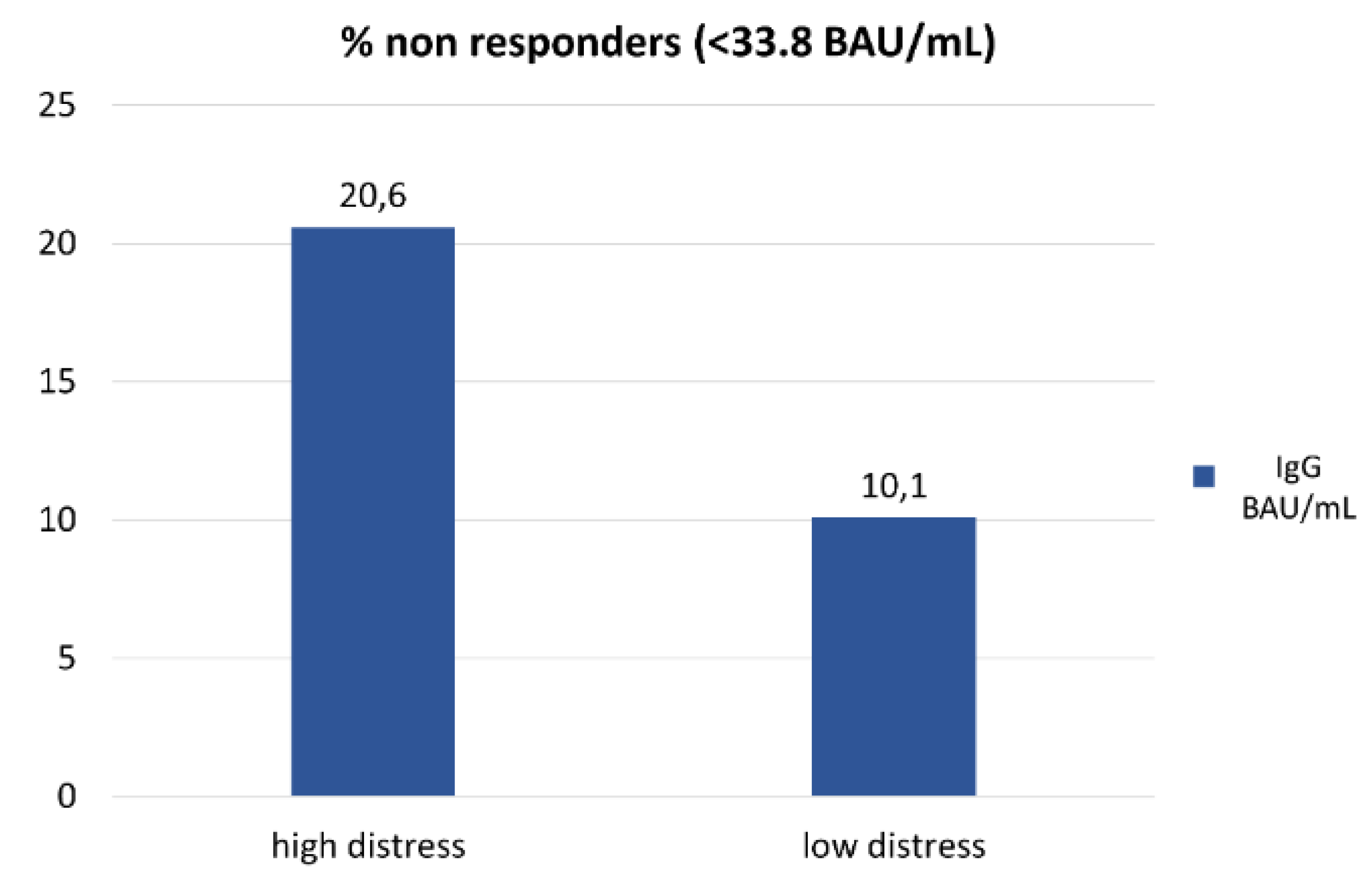
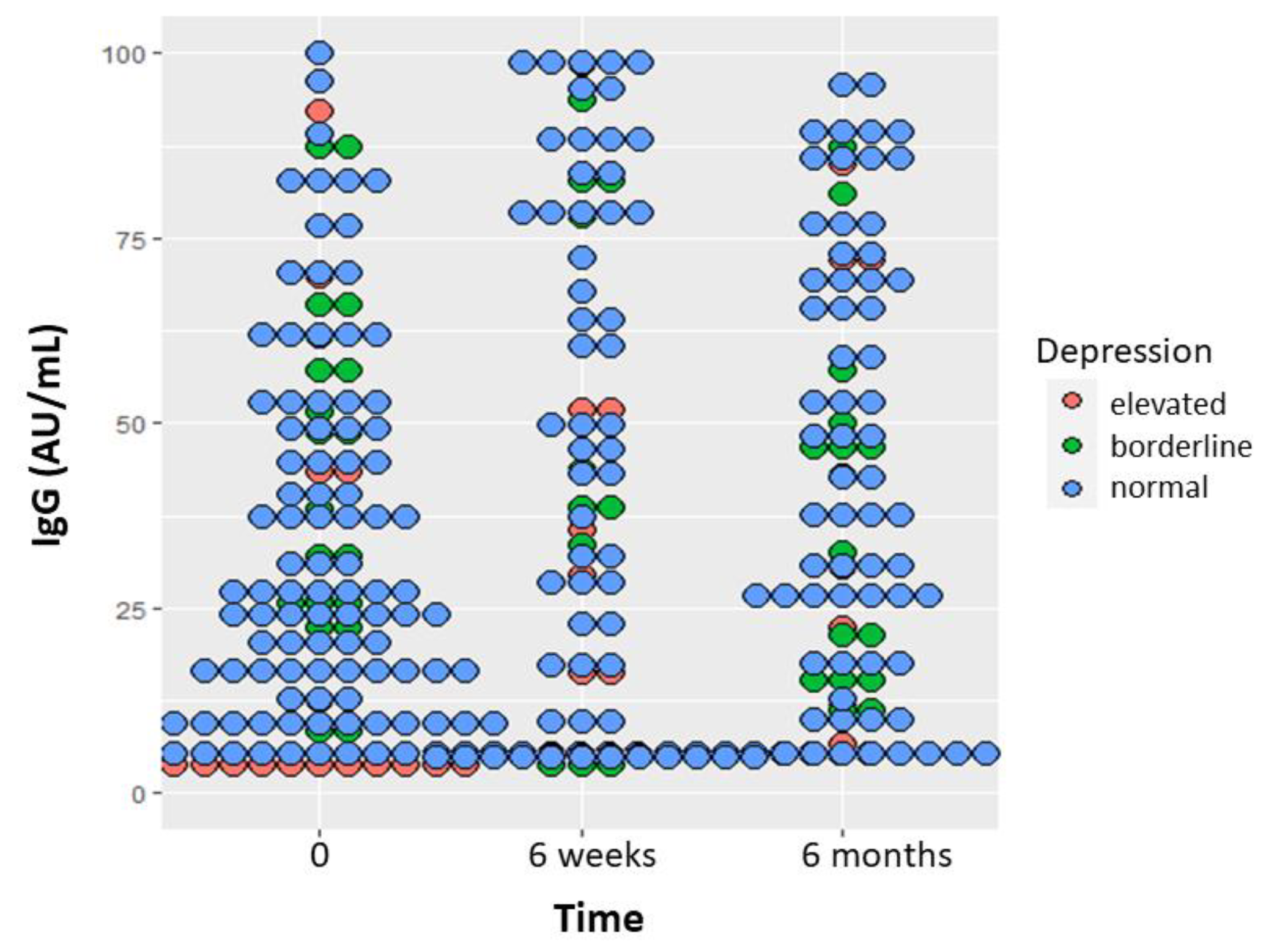
In our previous study of 291 cancer patients, we showed that 20% did not respond to two doses of COVID-19 vaccine administered six weeks apart. Here we investigated if psychological factors (distress, anxiety and depressive symptoms) affected antibody response and markers of vaccine activation (D-dimer) after 6 months from initial vaccination. Overall, 31 subjects (14.2%) had no antibody response at 6 months. Our analysis revealed significant predictors of vaccine failure, including stage of metastatic disease and high stress levels (OR=2.46, 95% CI, 1.05-5.77, p=0.04). Notably, nonresponders showed twice the prevalence of distress than responders (21% vs. 10%, p=0.04). Longitudinal measurements of IgG levels indicated that participants with high depressive symptoms at baseline maintained lower antibody levels over six months (p=0.003). In addition, women with high anxiety showed reduced levels of D-dimer at 6 month time (p=0.03). The data also showed that smokers and former smokers had significantly lower antibody levels than their nonsmoking counterparts (p=0.0004). At baseline, the high discomfort rate (≥5) was 34.4% in women and 23.8% in men; only men experienced an increase in median discomfort during the observation period. Moreover, higher educational level was related to increased distress among women (p=0.046). These findings underscore a critical association between elevated psychological distress and reduced immune responses to the COVID-19 vaccine, emphasizing the urgent need for targeted psychological and behavioral support within this vulnerable population.
Keywords:
1. Introduction
2. Materials and Methods
2.1. Study Design and Participants
2.2. Procedures
2.3. Statistical Analysis
3. Results
4. Discussion
5. Conclusions
Supplementary Materials
Author Contributions
Funding
Institutional Review Board Statement
Informed Consent Statement
Data Availability Statement
Acknowledgments
Conflicts of Interest
References
- Kuderer NM, Choueiri TK, Shah DP, et al; Clinical impact of COVID-19 on patients with cancer (CCC19): a cohort study. Lancet. 2020 Jun 20;395(10241):1907-1918. [CrossRef] [PubMed]
- Lee LYW, Cazier JB, Starkey T, et al.; COVID-19 prevalence and mortality in patients with cancer and the effect of primary tumour subtype and patient demographics: a prospective cohort study. Lancet Oncol. 2020 Oct;21(10):1309-1316. [CrossRef] [PubMed]
- Buttiron Webber T, Provinciali N, Musso M, et al; A Predictors of poor seroconversion and adverse events to SARS-CoV-2 mRNA BNT162b2 vaccine in cancer patients on active treatment. Eur J Cancer. 2021 Dec; 159:105-112. [CrossRef] [PubMed]
- Madison AA, Shrout MR, Renna ME, et al; Psychological and Behavioral Predictors of Vaccine Efficacy: Considerations for COVID-19. Perspect Psychol Sci. 2021 Mar;16(2):191-203. [CrossRef] [PubMed]
- Segerstrom SC, Hardy JK, Evans DR, et al; Vulnerability, distress, and immune response to vaccination in older adults. Brain Behav Immun. 2012 Jul;26(5):747-53. [CrossRef] [PubMed]
- Pedersen AF, Zachariae R, Bovbjerg DH. Psychological stress and antibody response to influenza vaccination: a meta-analysis. Brain Behav Immun. 2009 May;23(4):427-33. [CrossRef] [PubMed]
- Whittaker, AC. The Vaccination Model in Psychoneuroimmunology Research: A Review. Methods Mol Biol. 2018; 1781:309-326. [CrossRef] [PubMed]
- Gallagher S, Howard S, Muldoon OT, et al; Social cohesion and loneliness are associated with the antibody response to COVID-19 vaccination. Brain Behav Immun. 2022 Jul; 103:179-185. [CrossRef] [PubMed]
- Li Y, Zhao K, Wei H, et al; Dynamic relationship between D-dimer and COVID-19 severity. Br J Haematol. 2020 Jul;190(1):e24-e27. [CrossRef] [PubMed]
- Lippi G, Favaloro EJ. Cerebral Venous Thrombosis Developing after COVID-19 Vaccination: VITT, VATT, TTS, and More. Semin Thromb Hemost. 2022 Feb;48(1):8-14. [CrossRef] [PubMed]
- Rondanina G, Siri G, Marra D, et al; Effect of sex on psychological distress and fatigue over time in a prospective cohort of cancer survivors. J Cancer Surviv. 2022 Nov 7. [CrossRef] [PubMed]
- Glück T, Kiefmann B, Grohmann M, et al; Immune status and risk for infection in patients receiving chronic immunosuppressive therapy. J Rheumatol. 2005 Aug;32(8):1473-80. [PubMed]
- National Comprehensive Cancer Network. NCCN clinical practice guidelines in oncology: distress management Version1. 2013.
- Bultz BD, Carlson LE. Emotional distress: the sixth vital sign--future directions in cancer care. Psychooncology. 2006 Feb;15(2):93-5. [CrossRef] [PubMed]
- Donovan KA, Grassi L, McGinty HL, et al; Validation of the distress thermometer worldwide: state of the science. Psychooncology. 2014 Mar;23(3):241-50. [CrossRef] [PubMed]
- Grassi L, Johansen C, Annunziata MA, et al; Italian Society of Psycho-Oncology Distress Thermometer Study Group. Screening for distress in cancer patients: a multicenter, nationwide study in Italy. Cancer. 2013 May 1;119(9):1714-21. [CrossRef] [PubMed]
- Zigmond AS, Snaith RP. The hospital anxiety and depression scale. Acta Psychiatr Sc 1983 Jun;67(6):361-70. [CrossRef] [PubMed]
- Bonelli F, Sarasini A, Zierold C, et al. Clinical and Analytical Performance of an Automated Serological Test That Identifies S1/S2-Neutralizing IgG in COVID-19 Patients Semiquantitatively. J Clin Microbiol. 2020 Aug 24;58(9): e01224-20. [CrossRef] [PubMed]
- National SARS-CoV-2 Serology Assay Evaluation Group. Performance characteristics of five immunoassays for SARS-CoV-2: a head-to-head benchmark comparison. Lancet Infect Dis. 2020 Dec;20(12):1390-1400. [CrossRef] [PubMed]
- Xiong X, Qu K, Ciazynska KA, et al; A thermostable, closed SARS-CoV-2 spike protein trimer. Nat Struct Mol Biol. 2020 Oct;27(10):934-941. [CrossRef] [PubMed]
- Legnani C, Cini M, Scarvelis D, et al; Multicenter evaluation of a new quantitative highly sensitive D-dimer assay, the Hemosil D-dimer HS 500, in patients with clinically suspected venous thromboembolism. Thromb Res. 2010 May;125(5):398-401. [CrossRef] [PubMed]
- Monin L, Laing AG, Muñoz-Ruiz M, et al. Safety and immunogenicity of one versus two doses of the COVID-19 vaccine BNT162b2 for patients with cancer: interim analysis of a prospective observational study. Lancet Oncol. 2021 Jun;22(6):765-778. [CrossRef] [PubMed]
- Polack FP, Thomas SJ, Kitchin N, et al.; Safety and Efficacy of the BNT162b2 mRNA Covid-19 Vaccine. N Engl J Med. 2020 Dec 31;383(27):2603-2615. [CrossRef] [PubMed]
- Lippi G, Mullier F, Favaloro EJ. D-dimer: old dogmas, new (COVID-19) tricks. Clin Chem Lab Med. 2022 Jul 14;61(5):841-850. [CrossRef] [PubMed]
- Muscatell, KA. Social psychoneuroimmunology: Understanding bidirectional links between social experiences and the immune system. Brain Behav Immun. 2021 Mar; 93:1-3. [CrossRef] [PubMed]
- Slavich, GM. Social Safety Theory: A Biologically Based Evolutionary Perspective on Life Stress, Health, and Behavior. Annu Rev Clin Psychol. 2020 May 7; 16:265-295. [CrossRef] [PubMed]
- Kaneko H, Tsuboi H. Depressive symptoms predict antibody titers after a second dose of the SARS-CoV-2 BNT162b2 vaccine among hospital workers in Japan. Brain Behav Immun. 2023 Jan; 107:414-418. [CrossRef] [PubMed]
- Xiao K, Gillissie ES, Lui LMW, Ceban F, Teopiz KM, Gill H, Cao B, Ho R, Rosenblat JD, McIntyre RS. Immune response to vaccination in adults with mental disorders: A systematic review. J Affect Disord. 2022 May 1; 304:66-77. [CrossRef] [PubMed]
- Prather AA, Marsland AL, Muldoon MF, et al; Positive affective style covaries with stimulated IL-6 and IL-10 production in a middle-aged community sample. Brain Behav Immun. 2007 Nov;21(8):1033-7. [CrossRef] [PubMed]
- de Frel DL, Atsma DE, Pijl H, et al; The Impact of Obesity and Lifestyle on the Immune System and Susceptibility to Infections Such as COVID-19. Front Nutr. 2020 Nov 19; 7:597600. [CrossRef] [PubMed]
- Gasmi A, Kumar Mujawdiya P, Noor S, Piscopo S, Résimont S, Menzel A. Increasing Efficacy of Covid-19 Vaccines by Lifestyle Interventions. Arch Razi Inst. 2022 Oct 31;77(5):1527-1538. [CrossRef] [PubMed]
- Perez-Arce F, Angrisani M, Bennett D, et al; COVID-19 vaccines and mental distress. PLoS One. 2021 Sep 8;16(9): e0256406. [CrossRef] [PubMed]
- Molarius A, Granström F. Educational differences in psychological distress? Results from a population-based sample of men and women in Sweden in 2012. BMJ Open. 2018 Apr 28;8(4): e021007. [CrossRef] [PubMed]
- Qiu F, Liang CL, Liu H, et al. Impacts of cigarette smoking on immune responsiveness: Up and down or upside down? Oncotarget. 2017 Jan 3;8(1):268-284. [CrossRef] [PubMed]
- Sopori, M. Effects of cigarette smoke on the immune system. Nat Rev Immunol. 2002 May;2(5):372-7. [CrossRef] [PubMed]
- Chen L, Liang H, Liu L, Qiu W, Su L, Yang H. The association between adverse events of COVID-19 vaccination and anxiety and willingness to receive a booster dose. Hum Vaccin Immunother. 2023 Dec 31;19(1):2176643. [CrossRef] [PubMed]

| Age, years | 67.6 [58.5-74.3] |
| Sex Female Male |
135 (61.9) 83 (38.1) |
| Body Mass Index, kg/m2 | 24.6 [22.4-27.9] |
|
Tumor site Digestive Lung Breast Genitourinary and gynecologic Other* |
64 (29.4) 25 (11.5) 57 (26.1) 66 (30.3) 6 (2.7) |
|
Stage I II III IV |
17 (7.8) 46 (21.1) 33 (15.1) 122 (56.0) |
|
Line of treatment Adjuvant/Neoadjuvant 1st 2nd 3rd or more Missing |
89 (40.8) 75 (34.4) 32 (14.7) 21 (9.6) 1 (0.5) |
|
Type of treatment No treatment** Chemotherapy Hormone therapy Biological therapy Immunotherapy |
54 (24.8) 71 (32.6) 57 (26.1) 21 (9.6) 15 (6.9) |
| Method | ||
|---|---|---|
| Dimeric AU OR (CI 95%), p |
Trimeric BAU OR (CI 95%), p |
|
|
Age, years ≤68.2 vs >68.2 |
0.58 (0.17-1.82), 0.36 |
0.51 (0.21-1.19), 0.12 |
|
Stage Stage IV vs I-III |
4.52 (1.32-20.9), 0.03 |
2.80 (1.15-7.56), 0.03 |
|
Distress at baseline* High vs low |
3.77 (1.24-12.2), 0.02 |
2.46 (1.05-5.77), 0.04 |
Disclaimer/Publisher’s Note: The statements, opinions and data contained in all publications are solely those of the individual author(s) and contributor(s) and not of MDPI and/or the editor(s). MDPI and/or the editor(s) disclaim responsibility for any injury to people or property resulting from any ideas, methods, instructions or products referred to in the content. |
© 2024 by the authors. Licensee MDPI, Basel, Switzerland. This article is an open access article distributed under the terms and conditions of the Creative Commons Attribution (CC BY) license (http://creativecommons.org/licenses/by/4.0/).