

Submitted:
13 June 2026
Posted:
16 June 2026
You are already at the latest version
Abstract
The incidence of technologies created with the support of federal funding at universities and federal laboratories that are transferred to the private sector is nowhere close to its potential. The natural question that this observation raises is why has technology transfer research not led to a significantly higher incidence of technology transfer? This paper argues that reification is a primary trait of the analytical frameworks used in technology transfer studies and has detrimental effects on technology transfer research. It examines how reification can adversely impact technology transfer research by distorting our understanding of technology transfer, adversely impacting descriptive research, overstating causal relationships, oversimplifying complex causal mechanisms, and obscuring the role of human agency. It presents a human-centered theoretical framework to mitigate reification. The framework presented has practical implications for technology transfer policy, practice, and research particularly policy design, organizational alignment, and metrics. The suggestions for extending the work presented in this paper focus on empirically testing the HCF and developing measurement instruments to operationalize the human-centered mechanisms of mediation in the framework. This paper contributes to the field by introducing a methodological innovation, identifying a potential flaw in widely used analytical frameworks, and exploring an under-examined topic in technology transfer research.
Keywords:
reification
; science policy
; technology policy
; university technology transfer
; federal laboratory technology transfer
; science and technology studies
; technology transfer frameworks
; theories
; and models
; organization studies
Introduction
Despite the advances in our understanding of technology transfer as a phenomenon, the incidence of technologies created with the support of federal funding by universities and federal laboratories that are transferred to the private sector for use that benefits society is nowhere close to its potential (see Figure 1). It is estimated that no more than 5% of such technologies were licensed prior to 1980 (Schacht, 2012). This increased to roughly 18% by the end of the first two decades of the 21st century (see Table 1). But this estimate likely overstates the number of technologies that have positively impacted the lives of people and society because not every licensed technology is a commercial success.
The natural question that this observation raises is why has technology transfer research not led to a significantly higher incidence of technology transfer? A reasonable concern is that the conceptual schema, theoretical frameworks, and investigatory models (i.e., analytical paradigms) that guide and facilitate orthodox technology transfer research are not sufficient and are somehow lacking in explanatory power.
One justifiable concern is that reification is a primary feature of the analytical paradigms used in technology transfer studies and detrimentally affects the efficacy of research on the topic. At its most basic, reification is the misplaced attribution of material reality to human abstract concepts and constructs (Beamish, 2011). It causes people to conceptualize sociological phenomena as static elements of physical reality independent of the social actors or even to govern the social actors themselves (Beamish). Marx (1867/2012) first broached the concept of reification in the context of social theory in his discussion of commodity fetishism, although he did not use the term “reification” itself (see Vandenberghe, 2013). Marx argued that under capitalism, various social phenomena such as market values, wages, and rents, which are sociologically determined, are misattributed to commodities, land, and labor and the social actors who interact to produce the social phenomena are seen as passive elements or disappeared entirely (Wikipedia contributors, 2026, January 19). György Lukács articulated the social theory definition of the concept in his theory of reification in which he synthesized Max Weber’s theory of formal rationalization and Karl Marx’s theory of commodity fetishism (see Lukács, 1922/1971; Vandenberghe, 2013). Commodity fetishism is a type of reification, which in turn is a form of alienation (Wikipedia contributors, 2026, January 27).
Reification in technology transfer research is not a trivial issue. It likely has far-reaching implications for technology transfer studies, which influence both public policy and practice. While analytical paradigms help researchers understand phenomena, they also can constrict the focus of research and the perspective from which scientific inquiry is pursued, which creates knowledge gaps. Analytical paradigms also constrain the methodologies that one can employ to conduct studies, which can limit scholars’ investigations of various aspects and dimensions of phenomena.
Reification has likely contributed to the lack of sociological factors in technology transfer studies. This is an area where scholars have argued that further effort is desperately needed in research on aspects of invention and innovation, such as technology transfer. Economics based theories are prevalent in technology transfer research. However, our experience in applying classical economics to studying innovation reveals that “…sociological data may be urgently needed for economic analysis of inventive activity” (Nelson, 1962, p. 8).
Over the years, there have been regular periodic calls for more sociological orientations in studies applicable to technology transfer research. Crane (1977) was among the earliest to highlight the need for sociological factors to be included in studies of phenomena related to technology transfer. Phan and Siegel (2006) encouraged researchers to apply theoretical frameworks and perspectives appropriate to three contexts which are psychosociological in nature. More recently, Mahdi et al. (2025) illustrated that the role of social and cultural factors in technology transfer and commercialization has not been comprehensively addressed. However, reification makes this difficult to accomplish.
It is also likely that reification is a contributing reason that most university technology transfer research seems to focus either on studying the phenomenon from the perspective of universities and research institutions or examining intra-organizational technology transfer within large multinational private sector firms, while relatively fewer efforts have been made to investigate inter-organizational technology transfer or explore university technology transfer from the demand-side perspective (Bengoa et al., 2020). University technology transfer from the perspective of private sector firms, particularly small and medium-sized enterprises, seems to be particularly understudied.
These observations raise an important question. What theoretical framework for examining technology transfer related phenomena mitigates reification while maintaining or increasing explanatory power across multiple contexts, internal consistency, definitional clarity of concepts and variables, and alignment with the extant literature? This paper presents the results of an effort to develop such a theoretical framework.
Literature Review
This section presents the literature relevant to the question of focus. It first discusses the literature about reification in the context of science and technology studies. It then examines the prevalence of reification in the predominant analytical frameworks used for technology transfer research. The final section touches upon the stream of inquiry in technology transfer research that is relevant to analytical frameworks.
Examinations of Reification
No literature was found that directly addresses reification in the context of technology transfer research. In an examination of the Web of Science database, a search of the term “reification” in abstracts produced a total of 691 papers published across 201 academic journals. None of the journals were among the 25 most productive and influential journals for technology transfer research as identified in Bengoa et al. (2020). Refinement of the search results for the academic journals most relevant to science and technology studies produced only 12 published papers (see Table 2). None of these papers discuss the implications of reification for science and technology studies broadly. Several of these works examine domain-specific implications of the reification of specific social phenomena or constructs (see e.g., Clinton et al., 2021; Delgado, 2023; Hodgson & Cicmil, 2007; Pelly, 2016; Vaara et al., 2005; Woolgar & Lezaun, 2015; Wynne, 1996).
It seems that there has only been limited examination of reification in the broader science and technology studies literature. This research has primarily focused on how case-specific practices used in scientific research and technology creation contexts obscure social relations. For example, Elzinga (2004) provides a review of the book National Innovation System: Scientific Concept of Political Rhetoric (Miettinen, 2002) in which he summarizes and expounds upon the author’s observations about the influence of reification of the term “National Innovation System” on science and technology policy discourse in Finland and its effect on how relevant sociological relations are conceptualized in science and technology policy.
Reification in Predominantly Used Frameworks
The analytical paradigms currently used to investigate technology transfer are not well suited to avoid reification, which in many cases affects their efficacy in helping scholars understand technology transfer as a truly sociological phenomenon (see Table 3). These analytical paradigms have significant epistemological implications because they establish the boundaries for what phenomena can be examined, how those phenomena are examined, and how results are interpreted.
Reification is a trait that is prevalent among the analytical paradigms used for technology transfer studies (see Table 3 above). The predominant analytical paradigms often take the organization as the unit of analysis and employ the “organization as organism” metaphor. While this metaphor was a seminal advancement in organization studies, it has inherent limitations which have spurred debate about its analytical value. Critiques of the representation note that it tends to oversimplify the complexity of organizations and actually hinders conceptual advancements, particularly in contexts where understanding the role of human agency is vital (see e.g., Barter & Russell, 2013; Cummings & Thanem, 2002).
A Gap in the Major Streams of Inquiry in Technology Transfer Research
Model development is a predominant stream of inquiry in technology transfer research and scholars have developed a plethora of models to examine technology transfer in various contexts (see Arenas & González, 2018; Barros et al., 2020). The literature describing these models generally does not explicitly specify the underlying theories from which the models are derived. Instead, they typically only outline the concepts that support them. In fact, the models themselves tend to be reified conceptual frameworks rather than theoretical explanations.
Although model development is a predominant stream of inquiry for technology transfer research, model development is not the same as theory development. The systematic reviews of the technology transfer literature do not identify theory development as a major line of inquiry in technology transfer research (see e.g., Anatan, 2015; Barros et al., 2020; Bengoa et al., 2020). This fact in conjunction with the proliferation of models in technology transfer research that are largely reified conceptual frameworks rather than theoretical explanations suggests that there is a need for research that aims to develop non-reified, unifying grand theories with broad explanatory power to better understand and predict technology transfer phenomena.
Developing an Analytical Framework to Mitigate Reification
This section presents an analytical framework for explaining the phenomenon of technology transfer that aims to mitigate reification. It begins by defining the constructs of technology and technology transfer as applied in this examination. It then explains the philosophical principles and theoretical foundations of the theoretical framework. The section concludes by describing the core elements and causal relationships of the framework.
Defining Technology and Technology Transfer
For the purposes of this examination, technology is defined as culturally influenced information that social actors use to pursue the objectives of their motivations, and which is embodied in such a manner to enable, hinder, or otherwise control its access and use (see Townes, 2022, 2024, 2025). University technology transfer is defined as technology (as specified above) created by university or federal laboratory researchers through their use of systematic methods and practices of inquiry in their role as employees of their universities or federal laboratories that is knowingly and willingly conveyed to other parties with the expectation that the technology will be applied in a setting or context in which it has not previously been applied to achieve a desired end (see Townes, 2022).
Concerns About Reification in Technology Transfer Studies
At its core, technology transfer is a psychosociological phenomenon. Inquiries that take the organization as the unit of analysis and apply the “organization as organism” metaphor either minimize or altogether eliminate the human element. In doing so, they ignore the psychosociological dimensions of technology transfer. This has the potential to detrimentally distort our understanding of technology transfer as a phenomenon and greatly limits the ability of scholars, policymakers, and practitioners to identify options and pursue initiatives that will increase the incidence of technology transfer from universities and federal laboratories.
Most of the analytical paradigms identified seem primarily suited to either descriptive or correlational research. Descriptive research is limited to communicating the characteristics of technology transfer related phenomena without concern for causal explanations. The inherent reification in the relevant analytical paradigms identified in the literature can adversely impact descriptive technology transfer research. By treating dynamic sociological processes as static objects within material reality, they disguise the true nature of the technology transfer phenomenon, foster a false sense of objectivity, and conceal the effects of human agency.
At the other end of the analytical spectrum, multiple regression analysis is a popular method for correlational research on technology transfer. Reification can distort such research by treating mathematical models as reality. This can lead one to overstate causal relationships between independent and dependent variables, confuse constructed variables with physical reality, and obscure the fact that such constructed variables are simplified representations of complex social phenomena. What are frequently identified in the literature as determinants of successful technology transfer are often simply constructs that tend to correlate with measures used as proxies for the occurrence of technology transfer or associated outcomes. The adage that correlation does not mean causation often seems to be forgotten when it comes to interpreting the results of such research. Reification appears to be a contributing factor. Consequently, the causal factors identified from studies that employ such methods are potentially spurious, which has significant epistemological implications. Often, correlational research simply generates causal postulations.
Reified conceptual frameworks seem to be widespread within the technology transfer literature. Conceptual frameworks are structures of connected concepts that delineate the relationships among variables within a specific research study (Jabareen, 2009). In contrast, theoretical frameworks are more structured explanations of phenomena that are rooted in accepted theory and form the basis for formulating hypotheses, steering research designs, and interpreting study results (French et al., 2012; Grant & Osanloo, 2014). In short, conceptual frameworks emphasize connections among concepts while theoretical frameworks concentrate on explaining why phenomena occur by applying the latest accepted theories to illuminate the mechanisms of phenomena (Andrews & Boklage, 2023; Grant & Osanloo, 2014).
Reification in the conceptual frameworks and models used for technology transfer studies can detrimentally affect research. While simplifying complex phenomena is often necessary to examine and understand them, reification can lead to oversimplification which masks important nuance relevant to technology transfer in real-world settings. Reification of analytical frameworks and their elements make the findings of analyses susceptible to misinterpretation and can lead technology transfer policymakers and practitioners to make faulty decisions. Reification of concepts often produces analytical inertia which makes scrutinizing and altering the concepts needlessly difficult. Finally, reified analytical frameworks conceal the influence of human agency in the sociological processes that produce the occurrence of technology transfer.
Philosophical Principles for a Human-Centered Framework
Given the prevalence of reification in the analytical paradigms used in orthodox technology transfer research and other critiques, it is reasonable to conclude that a new theoretical framework could prove valuable. Thus, the goal of this study was to develop a theoretical framework that would minimize reification while still having sufficient explanatory power across multiple contexts, internal consistency, definitional clarity of concepts and variables, and alignment with what is known about technology transfer in the extant literature. It was postulated that such a framework must be human centered. Thus, the theoretical framework presented below draws from the sociology and organization studies literatures.
This theoretical framework (henceforth referred to as the human-centered framework or HCF for convenience) is built upon several core premises. First, humans create institutions (i.e., rules, values, beliefs, and patterns of social behavior) and organizations (i.e., purposefully structured social collective of two or more people) to perform coordinated actions that impact the physical and social world in such a way as to produce an actual future reality that resembles a desired future reality as closely as possible. Second, all activities attributed to organizations manifest through the activities of the members of the organization. Thus, technology transfer and other actions attributed to organizations are psychosociological phenomena at their most fundamental level. Third, the scientific examination of sociological phenomena requires understanding the “contextual meaning of action” and thus necessitates explanations of the behavior of human individuals because human individuals are the “sole understandable agents of meaningfully oriented action” (Weber, 1921-1922/2019, pp. 90-91). Fourth, macro-level organizational phenomena manifest through micro-level factors. Finally, the ideal theoretical framework is one that accurately represents the phenomena of consideration while stripping away unnecessary complexity and aligns with empirical reality.
Theoretical Foundations
Technology transfer is a multifaceted phenomenon, and scholars have explored many of its dimensions. But the approaches that most organizational theorists use to study organizational decision-making often obscure its psychosociological factors. Several theorist have broached this issue.
Although more recent publications often receive more interest than older works, the insights of previous generations of scholars are particularly useful for the inquiry at hand. One such work is the administrative theory that Simon (1945/1997) proposed, which is a seminal contribution in organization studies. It sought to deepen our understanding of phenomena attributed to organizations. Simon’s administrative theory (SAT) focused on the decision processes that organization members employ. The organization as a construct is conceptualized as a pattern of communications and human relations formed to carry out two primary functions – making decisions and taking actions (Simon). Since 2000, a modest amount of research has directly examined Simon’s concept of decision premises, including efforts that have provided empirical validation (see e.g., Campitelli & Gobet, 2010; Gündüz, 2018; Katsikopoulos & Lan, 2011; Liberatore & Wagner, 2022; Swanson, 2003).
According to SAT, deciding and acting are inextricably linked, somewhat analogous to entangled quantum particles in physics. When particles have entangled quantum states, measuring one particle’s quantum state provides complete information about the other particles quantum state (Musser, 2015). Likewise, knowledge of organizational actions and their consequences provide information about organizational decisions as well as their underlying decision premises and vice versa.
The behavioral theory of the firm (BTF) is another landmark work that is particularly useful for this inquiry. The BTF sought to explain the economic decision making of businesses in a way that connects economic research and organization research (Cyert & March, 1963). The theory as originally presented comprises three core concepts (goals, expectations, and choices) that function as variable categories that are connected by four relational concepts – quasi-resolution of conflicts, uncertainty avoidance, problemistic search, and organizational learning (see Figure 2).
Over the past two decades, empirical research has largely validated the relational concepts and core tenets of the BTF in several contexts including financial services, family business, air transportation, shipbuilding, and technology industries (see e.g., Argote & Greve, 2007; Chen, 2008; Greve, 2003; Mazzelli, 2015; Mezias et al., 2002). Current research on the BTF largely focuses on the conditions under which it holds. There have been several refinements of the relational concepts of the BTF (see e.g., Gaba & Greve, 2019; Harvey, 2025; Kotlar et al., 2014). However, the consensus among those who study the BTF seems to be that it is highly predictive of short-term, reactive organizational actions but less effective at predicting proactive, visionary leaps (see e.g., Dew et al., 2008; Gavetti, 2012; Souder & Bromiley, 2012).
Although both SAT and the BTF make strides to address the psychosociological nature of organizational decision making and offer compelling concepts, they are not without their shortcomings. While SAT offers a more accurate representation of decision making in organization contexts which makes it a more suitable for understanding and examining real-world scenarios (Goolkasian, 1996), its critics argue that empirical demonstration of its concepts is limited, it oversimplifies organizational decision-making, and it ignores power dynamics (see Cunha, 2022; Estrada, 2010; Schumacher & Thysen, 2022). Critiques of the BTF have noted that it does not adequately consider the influence of extra-organizational factors, ignores collaborative coalitions in organizational decision making, and presents a somewhat static conception of the firm (Akard, 1995; Hayward & Broady-Preston, 1994; Holdsworth, 2011).
The HCF builds upon SAT and the BTF by considering the causal flow of decisions that lead to actions attributed to organizations. It aims to recognize the human element of organization without disappearing the organization construct all while enabling one to examine and understand macro-level organizational phenomena without reifying the organization construct and disregarding the human element.
Core Elements
The HCF conceptualizes technology transfer as the outcome of a sociological process that typically occurs in an organizational context. This sociological process is what Simon (1945/1997) called a decision fabrication process. It is designed to produce decisions that generate actions and intentional inactions that yield specific desired outcomes – in this case, the occurrence of technology transfer.
Considering the causal flow of decisions and actions that individuals take in the name of an organization raises two central questions. First, what triggers the need or desire for organization members to make any number and type of decisions? Second, what are the essential mechanisms and conditions in the causal pathway between the need or desire to make any given decision and the subsequent organizational action that results from it, such as licensing a university technology and pursuing its commercialization?
The HCF is comprised of several interrelated and interconnected elements that address the two questions posed above (see Figure 3). The main causal pathway that connects organizational decisions with organizational action starts with “Motivations of Decision Makers” and runs through “Goals of Decision Makers”, “Perceived Strategic and Tactical Options for Actions”, “Strategic and Tactical Decisions”, and “Actions to Effectuate Decision” in sequence. Each element in the main causal path of the HCF feeds into the next unidirectionally. Two additional elements, “Consequences of Actions” and “Assessments of Consequences”, follow “Actions to Effectuate Decision” and play roles in the feedback mechanism to facilitate organizational learning. This causal chain helps explain what triggers the need or desire for organization members to make organizational decisions that are ultimately coupled with organizational actions as well as how and why organizational members learn and institute changes in the actions of the organizations and within organizations themselves.
Motivations of Decision Makers, the first of the HCF’s elements, directly addresses the question of what triggers the need or desire for organization members to make decisions on behalf of the organization in the first place. Motives are one of several factors than can cause an individual to pursue a course of action (Simon, 1945/1997). If one accepts that all organization activity manifests itself through human activity and all human activity is driven by human behavior which is often, but not always, determined by human motivations compelled by human needs (Maslow, 1943), then organization activity is largely determined by the human needs of its members.
In the current state of civilization and under normal conditions, the most predominant basic human needs (physiological, safety, and love as categorized and defined by Maslow) tend to be significantly satisfied and therefore can usually be considered non-existent when trying to understand what truly motivates human behavior (Maslow). As such, esteem and self-actualization needs are the primary motivators of human behaviors (Maslow) and thus are likely the primary motivators of activity ascribed to organizations. However, this is not always the case. It is easy to contemplate that needs regarding safety and love can present themselves quite forcefully as motivators for actions taken on behalf of an organization. Thus, in large part, the motivations of organization members drive the goals of an organization. Ultimately, human motivations drive organization decision makers to establish technology transfer goals for their organizations.
The literature recognizes goals as a core element of organizational actions (see e.g., Gagné, 2018; Steinmann et al., 2018; Sung & Kim, 2021). According to SAT, goals are an element in establishing the equilibrium of the organization (Simon, 1945/1997). In the BTF, goals drive organizational decisions and the need to make them. They serve to align organizational actions with desired outcomes (Cyert & March, 1963). The challenge is to specify the goals of an organization without “postulating an ‘organizational mind’” (Cyert & March, 1963, p. 26) and reifying the organization construct. Such reification obscures the underlying complexity and true causal mechanisms of organizational actions. The influence of those for whom the success of the organization provides some utility, which includes both members and non-members of the organization (e.g., customers of a for-profit commercial enterprise), also influences the goals of an organization (Simon). One can argue that any goal established by an organization member who commits organization resources to achieve it is a goal of the organization. For many private sector organizations, economic profit is the core goal, but not always the only goal. Thus, the decision of executives at a private sector organization to acquire and assimilate a university technology or the decision of administrators of a university to transfer technology to the private sector can be driven not only by the goal of generating economic profit but by other non-economic goals as well.
In the HCF, several other elements function as mediators and moderators of the relational connections between the elements of the primary causal pathway. Chief among these is Simon’s (1945/1997) concept of “decision premises” which was a vital conceptual advancement in organization studies. Decision premises express the beliefs of members of the organization and take one of two forms. Etiological decision premises, what Simon called factual decision premises, are essentially assertions or propositions about existence and the nature of cause-and-effect relationships among events and phenomena of the physical and social world in which the individual employing the assertion or proposition genuinely believes that it corresponds with reality. However, etiological decision premises may or may not be objectively true. In contrast, normative decision premises, what Simon called values decision premises, denote beliefs about the way things “ought” to be. Normative decision premises are often the decisions of individuals in the upper levels of an organizational hierarchy. Other organization members lower in the hierarchy abide by them primarily because of the established norms and patterns of behavior of the organization. These decision premises influence whether decision-makers in private sector firms choose to acquire and assimilate any given university technology. In universities, decision premises influence how technology transfer office (TTO) staff go about identifying and soliciting private sector organizations.
In addition to decision premises, communication and other psychosociological factors act as mediators between the core elements of the HCF. Factors associated with the organization as a collectivity and the environment in which the organization operates drive the motivations of decision makers, influence their options for action, and shape the consequences of actions taken in the name of the organization. But they can also act as moderators of the relationships between core elements along the primary causal pathway.
Once the goals of the organization are established, the issue becomes what course of action needs to be taken to achieve those goals. Applying the principle of equifinality (Gresov & Drazin, 1997; von Bertalanffy, 1969), one can surmise that many, if not most, organization goals can be attained by multiple possible means. These multiple possible means constitute the options for action available to the members of the organization for attaining the goals. Some options for action will be readily apparent to organization members. Others will present themselves only through an active search for alternatives. However, the principle of bounded rationality suggests that the options for action that organization decision makers consider will not be comprehensive because various factors will constrain the number of options that they can and will consider (Simon, 1955, 1957, 1972, 1982). Thus, while there may be several technologies from across multiple universities that can help organization members achieve a goal of a private sector organization, the organization’s decision-makers may not become aware of all options and are unlikely to expend extensive resources to locate all such technologies. From a supply-side perspective, there may be multiple private sector organizations capable and willing to acquire and assimilate a university technology, but technology transfer office (TTO) staff may not become aware of all of them and are unlikely to expend extensive resources to locate all such organizations.
Goal decisions lead to a perceived set of options for achieving them through the mediating influence of decision premises, communication, and other psychosociological factors. Decision premises provide guiderails for determining which options are acceptable and thus serve to constrain the options that decision makers consider. Additionally, psychosociological factors influence how organization members interpret and respond to organization goals and thus help shape what options organization decision makers include in the choice set. In the organizational context, communication plays an important role in how organization decision makers obtain, perceive, and interpret the data and information that goes into formulating and assessing the options for actions. Therefore, different communication practices within private sector organizations are likely to affect decisions about acquiring and assimilating university technologies in different ways. Within universities, communication practices are likely to affect decisions about the commercialization strategies that are chosen for technologies.
Given a set of options to achieve the specified organizational goals, decision makers choose the option they believe will lead to the desired future state. Decision premises, communication, and psychosociological factors mediate the choice which is made via the institutions of the organization. Once the relevant organization members decide on a course of action to attain the goals ascribed to the organization, various members perform tasks necessary to implement the action. The action either produces consequences, some of which may be unanticipated and contrary to the goals of the organization, or they have no effect at all in bringing about the desired future state that the organization’s decision makers sought. Thus, organization members make assessments about the results of the action taken. Once again, decision premises, communication, and psychosociological factors surface as the means for transitioning from one element to another – in this case consequences are translated into assessments of the appropriateness and usefulness of the action taken. These assessments feed back into the motivations and goals of the organization’s decision makers as well as the perceived options for action as part of the learning mechanism of the organization. This sequence functions as a double-loop learning mechanism for private sector organization decision-makers that engage in acquiring and assimilating university technologies as well as university TTO staff seeking to transfer university technologies to the private sector. It also enables meta-processes in both demand-side and supply-side organizations that can improve decision making and the execution of actions that produce the occurrence of technology transfer.
Theoretical Propositions of the Human-Centered Framework
According to Popperian philosophy, a theory is considered scientific only if it is capable of being falsified (see Popper, 1934/2002, 1963/2002). This section presents several propositions of the HCF that lend themselves to testing thus allowing researchers to either confirm or refute them empirically.
Proposition 1.
The occurrence of technology transfer is best understood as a probabilistic phenomenon.
The HCF conceptualizes technology transfer as fundamentally the outcome of sociological processes. There seems to be no consensus among physicists as to whether reality is fundamentally deterministic or probabilistic (Schlosshauer et al., 2013). There is also a split among scientists as to whether human free will exists (Ding, 2024; Schooler, 2010). However, even if the universe in which humanity exists is a macroscopically deterministic physical reality absent of human free will, there are other overriding factors that drive the epistemologically probabilistic nature of the social world.
The macroscopic systems, from the human brain to societal interactions, that produce the phenomenon of technology transfer are characterized by emergent complexity. The level of precision necessary for deterministic prediction in such systems requires absolute knowledge of every microscopic component and is beyond the computational capacity of humanity (see Nicolis & Nicolis, 2011). Thus, the deterministic rules that truly underpin the system are unobservable at the level of human social systems.
Determinism itself is not synonymous with predictability or the absence of probabilistic behavior. Human social systems are complex, chaotic, and sensitive to initial conditions (Strevens, 2003). Causal chains intersect to create unpredictability (Strevens). Aggregation of individual behaviors into large-scale populations causes stable, statistical regularities to emerge on a macro level (Fortunato et al., 2013; Strevens).
Proposition 2.
The occurrence of technology transfer is characterized by complex causality rather than linear additive causality.
In the HCF, technology transfer is fundamentally a function of sociological processes. The epistemology of the frameworks used in orthodox technology transfer studies are based on linear additive causality and tend to focus on properties of reified system components. However, such an approach is likely insufficient for developing a deep comprehension of technology transfer. Understanding the properties of system components is insufficient to explain and predict sociologically driven phenomena because their patterns and dynamics are produced from the interactions among the system components (Törnberg, 2017). Causally complex phenomena are characterized by conjunctural causation, equifinality, and causal asymmetry of outcomes (Ragin, 2000; Ragin & Amoroso, 2011; Schneider & Wagemann, 2012). Thus, alternative methods and methodologies, such set-theoretic approaches and configurational analyses, are likely to be better suited to examine the phenomenon of technology transfer.
Proposition 3.
The occurrence of technology transfer is positively mediated by the existence of communication mechanisms that serve to increase the degree of alignment between decision premises that influence the decisions and actions of technology transfer office (TTO) licensing staff and the decision premises that influence the decisions and actions of academic inventors.
In the HCF, decision premises form the basis of choices made on behalf of the organization. The transition from goals to choices is a psychosociological process mediated by communication and decision premises. When decision premises are aligned, the cognitive divergence between TTO licensing staff and academic inventors is minimized. Thus, the perceived options for action are limited to those that directly support the organizational goal of successfully transferring technologies to the private sector. This challenges the neo-classical economics and transaction cost economics approaches that frame the occurrence of technology transfer as driven by static structural incentives and agency costs. This proposition likely holds true within tier-one research universities and federal laboratories where professional identities diverge between academic and commercial and thus produce friction because of differing organizational incentives. But it likely will not hold in highly centralized or authoritarian organizational structures where decision premises are formed and enforced through coercive power dynamics.
Discussion
This section of the paper discusses the merits of the HCF and the implications of its adoption and use in technology transfer studies. The section then presents several caveats about the HCF. It concludes by providing recommendations for future research about reification in technology transfer research and the usefulness of HCF as an analytical paradigm.
Merits of the Human-Centered Framework
The HCF holds promise as a useful tool to advance technology transfer research based on the criteria of empirical adequacy, internal consistency, simplicity, parsimony, and testability (see e.g., Bacharach, 1989; Coppedge, 2012; Fawcett, 2005; Wilton & Harley, 2018). The HCF seems capable of integrating other frameworks and models for technology transfer research and reasonably accounting for observed technology transfer phenomena. Its foundational assumptions and propositions appear to logically cohere without internal contradictions. Moreover, the HCF is built on a limited number of core premises and thus lends itself to being more easily comprehended and applied. At the same time, it appears to provide additional explanatory breadth and depth beyond that offered by many of the conceptual frameworks and models that have been developed to study technology transfer. Additionally, the HCF seems to more accurately represent technology transfer as a phenomenon.
Some scholars take solace in the position expressed by Milton Friedman who argued that the goal of theory is not to accurately represent or reproduce phenomena (e.g., social, economic) but to develop propositions that can be analyzed (Cyert & March, 1963). For these scholars, predictive adequacy and the stimulation of intellectual discourse are the relevant yardsticks for evaluating theory. However, this seems a bit shortsighted and limiting. Accurate representation of phenomena is necessary for a theory to optimally explain and predict sociological behavior, which is a theory’s primary function (Felin & Foss, 2009). Representational accuracy cultivates theoretical validity and facilitates our understanding of empirical reality (Bergenholtz & Busch, 2015). Theory that does not accurately represent phenomena can only provide an inaccurate, and quite possibly misguided, understanding of phenomena. Thus, its usefulness will always be knowingly limited to an unknown degree. For example, the Ptolemaic model of the solar system had substantial predictive power in accounting for the motion of the planets despite being an Earth-centered model that did not accurately represent the solar system (Benson, 2012). If the scientists and philosophers of an earlier era had not discarded the Ptolemaic model in favor of a model that more accurately represented the solar system, it is unlikely that civilization could have made many of the advancements that have improved humanity’s situation. One can argue that in the long run theories and models that do not accurately represent the phenomena they aim to explain will be less useful than those that do. But this is not to say that accuracy agnostic theories have no use.
The HCF represents not only a more accurate theoretical explanation (as opposed to simply a conceptual framework) of technology transfer, but it is also quite useful for structuring one’s reasoning about investigations of the phenomena in a way that the analytical paradigms that have traditionally been employed in orthodox technology transfer research likely cannot. Creative application of the HCF can overcome many of the limitations of other traditional analytical paradigms such as the neglect of sociological factors, oversimplification of processes that produce technology transfer, reification of constructs, and normative biases. Thus, the HCF potentially can enable researchers to pursue inquiries for which traditional analytical paradigms are not well suited. The HCF expands the aspects of technology transfer that can be investigated and the kinds of questions that one can examine.
Implications
The HCF has significant implications for technology transfer research, policy, and practice. Its replacement of the “organization as organism” metaphor with an approach that centers on human agency reorients how technology transfer is studied, regulated, and practiced.
The HCF overcomes reification by modeling the occurrence of technology transfer as a dynamic, interactive psychosociological phenomenon. It can help expand the boundaries of technology transfer research by enabling researchers to pursue rigorous investigatory studies around previously overlooked sociological dimensions. Application of the HCF causes one to avoid anthropomorphizing universities and research institutions as utility-maximizing organisms and instead focus on the micro-foundations of organizational action. Additionally, the HCF opens the door for technology transfer studies beyond supply-side perspectives and large multinational firms.
Regarding technology transfer policy, the HCF has implications for the metrics used, policy design, and innovation ecosystem incentives. The HCF implies that policymakers would be well-served to expand beyond rigid, reified transactional metrics that obscure the underlying causes of why technology transfer endeavors either succeed or fail and incorporate holistic impact metrics. Additionally, mandating strict adherence to transaction-based scorecards produces analytical blindness and institutional inertia. The HCF suggests that policy which enables universities and research institutions to engage in double-loop learning will help to maximize the incidence of technology transfer and address the unrealized potential of the inventory of unlicensed technologies.
The implications of the HCF for technology transfer practice largely relate to organizational alignment, impact metrics, and licensing frameworks. The HCF suggests that technology transfer practitioners should prioritize cultivating and leveraging communication channels to align decision premises across organizational units and minimize intra-organizational friction. It also suggests that technology transfer practitioners would be well-served to look beyond passive metrics such as patent counts and track holistic human-centered metrics such as the commercialization self-efficacy of researchers, the health of the local innovation and entrepreneurship ecosystem, and the long-term sustainability of university-industry research collaborations.
Limitations
There are several caveats regarding the theoretical framework presented in this paper. To begin with, the HCF is currently an unproven theoretical explanation of the occurrence of technology transfer. To rise to the level of true theory, it must be challenged and tested. This will entail others using the HCF to derive hypotheses that can be empirically examined. Only through such extensive hypothesis derivation and testing can the usefulness of the HCF be validated.
Because the HCF emphasizes the minimization of reification, it might edge users towards analytical voluntarism. When applying the framework, it is important for one to remember that human actors do not possess absolute autonomy to direct sociological outcomes irrespective of macro-structural constraints. Historical social patterns of human activity can have the effect of objective structural realities (Bourdieu, 1977). Although reified social phenomena are not fundamental to material reality, the Thomas Theorem still applies. What humans perceive to be real is in fact real in its sociological consequences (Thomas & Thomas, 1928). The HCF might underemphasize immutable boundaries that human agency cannot overcome.
By shifting the focus of inquiry to micro-foundational variables, the HCF may also create measurement burdens. Collecting data on human-centered variables tends to require primary research designs and methods that entail greater challenges in data collection and often restrict sample sizes. This typically limits the generalizability of empirical findings across contexts.
Finally, the underlying theoretical mechanisms of the HCF assume that the occurrence of technology transfer is a function of complex, psychosociological processes that entail intensive human mediation. In contexts where technology is completely and unambiguously codified, the HCF may be analytically inefficient.
Opportunities for Future Research
There are several opportunities to extend the work presented in this paper. The most immediate opportunity for future research is the translation of the core conceptual tenets of the HCF into testable hypotheses. This would entail research designs based on epistemology for complex causality that explicitly examine the mechanisms of mediation and moderation in the HCF that predict the occurrence of technology transfer. This may require the development of new research methods and methodologies.
Another opportunity relates to unlocking the descriptive and explanatory potential of the HCF. This requires building, refining, and validating robust measurement instruments capable of operationalizing the human-centered mechanisms of mediation and moderation in the HCF. According to Kuhn (1962/2012), measurement instruments are neither created independent of theoretical paradigms nor do they manifest new theoretical paradigms. However, they are deeply ingrained within the development stages of a theoretical paradigm and researchers specifically design measurement instruments to identify indicants that a paradigm predicts (Kuhn, 1962/2012). In Kuhn’s framework for the transition from one theoretical paradigm to another, measurement instruments of increasing precision are constructed to flesh out the dominant paradigm that defines normal scientific inquiry within a discipline and to narrow the gap between theory and observation. However, there is no readily apparent logical reason that one cannot take the same approach towards measurement instruments for a newly proposed theoretical paradigm.
Conclusions
This paper argued that reification adversely impacts technology transfer research and limits the explanatory power of the predominant analytical frameworks used in orthodox technology transfer studies. It discussed the detrimental effects of reification on technology transfer research which include distorting our understanding of technology transfer, adversely impacting descriptive research, overstating causal relationships, oversimplifying complex causal mechanisms, and obscuring the role of human agency. A human-centered framework (HCF) was proposed to mitigate reification in technology transfer research. Propositions were offered to facilitate future empirical evaluation of the HCF. The merits, implications, and limitations of the HCF were then examined. Finally, the paper presented opportunities for future research which focused on formulating hypotheses to test the HCF and developing measurement instruments to operationalize the human-centered mechanisms of mediation in the HCF.
Funding Sources
The author did not receive funding from any organization to assist with this work or the manuscript.
Competing interests
The author has no relevant financial or non-financial interests to disclose.
Data availability
The author has withheld certain data used in this study because the data are the proprietary and confidential intellectual property of third parties. All other data used in this study are publicly available from the sources cited in the paper.
Ethics Statement
This research did not comprise any studies performed by the author involving human participants or animals as subjects.
Declaration regarding artificial intelligence (AI) and AI-assisted technologies
The author used Elicit, Google Gemini, Scite, and Perplexity to identify relevant literature and used Google Gemini to assist with analyzing data and information and to facilitate reasoning. The author did not use AI tools to write any sections of the paper or any substantial text and takes full responsibility for the content of this paper.
References
- Afonso, O.; Monteiro, S.; Thompson, M. J. R. A growth model for the quadruple helix innovation theory [Working paper]. 2010. Available online: http://www3.eeg.uminho.pt/economia/nipe/docs/2010/NIPE_WP_12_2010.pdf (accessed on 30 June 2025).
- Akard, P. The return of the market?: Reflections on the real “conservative tradition” in U.S. policy discourse. Sociol. Inq. 1995, 65(3-4), 286–308. [Google Scholar] [CrossRef]
- Aksom, H.; Tymchenko, I. How institutional theories explain and fail to explain organizations. J. Organ. Change Manag. 2020, 33(7), 1223–1252. [Google Scholar] [CrossRef]
- Allard, G.; Miner, J.; Ritter, D.; Stark, P.; Stevens, A. J. AUTM 2020 licensing activity survey: A survey report of technology licensing and related activity for U.S. academic and nonprofit research institutions and technology investment firms Association of University Technology Managers. 2021. Available online: https://autm.net/AUTM/media/SurveyReportsPDF/FY20-US-Licensing-Survey-FNL.pdf (accessed on 23 January 2024).
- Anatan, L. Conceptual issues in university to industry knowledge transfer studies: A literature review. Procedia-Soc. Behav. Sci. 2015, 211, 711–717. [Google Scholar] [CrossRef]
- Andersén, J.; Jansson, C.; Ljungkvist, T. Can environmentally oriented CEOs and environmentally friendly suppliers boost the growth of small firms? Bus. Strategy Environ. 2019, 29(2), 325–334. [Google Scholar] [CrossRef]
- Andrews, M.; Boklage, A. Supporting inclusivity in STEM makerspaces through critical theory: A systematic review. J. Eng. Educ. 2023, 113(4), 787–817. [Google Scholar] [CrossRef]
- Arenas, J. J.; González, D. Technology transfer models and elements in the university-industry collaboration. Adm. Sci. 2018, 8(2), 1–17. [Google Scholar] [CrossRef]
- Argote, L.; Greve, H. R. A Behavioral Theory of the Firm--40 years and counting: Introduction and impact. Organ. Sci. 2007, 18(3), 337–349. [Google Scholar] [CrossRef]
- Bacharach, S. B. Organizational theories: Some criteria for evaluation. Acad. Manag. Rev. 1989, 14(4), 496–515. [Google Scholar] [CrossRef]
- Barney, J. Firm resources and sustained competitive advantage. J. Manag. 1991, 17(1), 99–120. [Google Scholar] [CrossRef]
- Barney, J.; Wright, M.; Ketchen, D. J., Jr. The resource-based view of the firm: Ten years after 1991. J. Manag. 2001, 27(6), 625–641. [Google Scholar] [CrossRef]
- Barros, M. V.; Ferreira, M. B.; do Prado, G. F.; Piekarski, C. M.; Picinin, C. T. The interaction between knowledge management and technology transfer: A current literature review between 2013 and 2018. J. Technol. Transf. 2020, 45(5), 1585–1606. [Google Scholar] [CrossRef]
- Barter, N.; Russell, S. Organisational Metaphors and Sustainable Development: Enabling or Inhibiting? Sustain. Account. Manag. Policy J. 2013, 4(2), 145–162. [Google Scholar] [CrossRef]
- Battistella, C.; De Toni, A. F.; Pillon, R. Inter-organisational technology/knowledge transfer: A framework from critical literature review [Periodical]. Journal of Technology Transfer 2016, 1195. [Google Scholar] [CrossRef]
- Beamish, R. Reification. In The concise encyclopedia of sociology; Ritzer, G., Ryan, J. M., Eds.; Wiley Blackwell, 2011; pp. 500–501. [Google Scholar]
- Bengoa, A.; Maseda, A.; Iturralde, T.; Aparicio, G. A bibliometric review of the technology transfer literature. J. Technol. Transf. 2020, 46, 1514–1550. [Google Scholar] [CrossRef]
- Benson, D. The ballet of the planets: A mathematician’s musings on the elegance of planetary motion; Oxford University Press, 2012. [Google Scholar]
- Bergenholtz, C.; Busch, J. Self-fulfillment of social science theories. Philos. Soc. Sci. 2015, 46(1), 24–43. [Google Scholar] [CrossRef]
- Borge, L.; Bröring, S. Exploring Effectiveness of Technology Transfer in Interdisciplinary Settings: The Case of the Bioeconomy. Creat. Innov. Manag. 2017, 26(3), 311–322. [Google Scholar] [CrossRef]
- Bourdieu, P. Outline of a theory of practice; Nice, R., Translator; Cambridge University Press, 1977. [Google Scholar] [CrossRef]
- Bozeman, B. Technology transfer and public policy: A review of research and theory. Res. Policy 2000, 29, 627–655. [Google Scholar] [CrossRef]
- Bozeman, B.; Rimes, H.; Youtie, J. The evolving state-of-the-art in technology transfer research: Revisiting the contingent effectiveness model. Res. Policy 2015, 44(1), 34. [Google Scholar] [CrossRef]
- Cai, Y. What contextual factors shape ‘Innovation in Innovation’? Integration of insights from the Triple Helix and the institutional logics perspective. Soc. Sci. Inf. 2015, 54(3), 299–326. [Google Scholar] [CrossRef]
- Cai, Y.; Amaral, M. The triple helix model and the future of innovation: A reflection on the triple helix research agenda. Triple Helix 2021, 8(2), 217–229. [Google Scholar] [CrossRef]
- Campanella, F.; Peruta, M. R. D.; Bresciani, S.; Dezi, L. Quadruple Helix and firms’ performance: An empirical verification in Europe. J. Technol. Transf. 2017, 42(2), 267–284. [Google Scholar] [CrossRef]
- Campitelli, G.; Gobet, F. Herbert Simon’s decision-making approach: Investigation of cognitive processes in experts. Rev. General. Psychol. 2010, 14(4), 354–364. [Google Scholar] [CrossRef]
- Carayannis, E. G.; Barth, T. D.; Campbell, D. F. J. The Quintuple Helix Innovation Model: Global warming as a challenge and driver for innovation. J. Innov. Entrep. 2012, 1(1), 2. [Google Scholar] [CrossRef]
- Carayannis, E. G.; Campbell, D. F. Triple Helix, Quadruple Helix and Quintuple Helix and how do knowledge, innovation and the environment relate to each other?: A proposed framework for a trans-disciplinary analysis of sustainable development and social ecology. Int. J. Soc. Ecol. Sustain. Dev. (IJSESD) 2010, 1(1), 41–69. [Google Scholar] [CrossRef]
- Chen, W.-R. Determinants of firms’ backward- and forward-Looking R&D search behavior. Organ. Sci. 2008, 19(4), 609–622. [Google Scholar] [CrossRef]
- Clinton, E.; McAdam, M.; Gamble, J. R.; Brophy, M. Entrepreneurial learning: The transmitting and embedding of entrepreneurial behaviours within the transgenerational entrepreneurial family. Entrep. Reg. Dev. 2021, 33(5-6), 383–404. [Google Scholar] [CrossRef]
- Cloitre, A.; Dos Santos Paulino, V.; Theodoraki, C. The quadruple/quintuple helix model in entrepreneurial ecosystems: An institutional perspective on the space case study. R&D Manag. 2023, 53(4), 675–694. [Google Scholar] [CrossRef]
- Coppedge, M. Criteria for evaluating causal theories. In Democratization and Research Methods; Cambridge University Press, 2012; pp. 49–75. [Google Scholar] [CrossRef]
- Costa, L. s. A.; Cool, K.; Dierickx, I. The competitive implications of the deployment of unique resources. Strateg. Manag. J. 2012, 34(4), 445–463. [Google Scholar] [CrossRef]
- Crane, D. Technological innovation in developing countries: A review of the literature. Res. Policy 1977, 6(4), 374–395. [Google Scholar] [CrossRef]
- Croft, C.; McGivern, G.; Currie, G.; Lockett, A.; Spyridonidis, D. Unified divergence and the development of collective leadership. J. Manag. Stud. 2022, 59(2), 460–488. [Google Scholar] [CrossRef]
- Cummings, S.; Thanem, T. Essai: The Ghost in the Organism. Organ. Stud. 2002, 23(5), 817–839. [Google Scholar] [CrossRef]
- Cunha, E. P. Herbert Simon’s epistemological itinerary on the limits of rationality. Organ. Soc. 2022, 29(103), 614–637. [Google Scholar] [CrossRef]
- Curado, C.; Bontis, N. The knowledge-based view of the firm and its theoretical precursor. Int. J. Learn. Intellect. Cap. 2006, 3(4), 367–381. [Google Scholar] [CrossRef]
- Cyert, R. M.; March, J. G. A behavioral theory of the firm; Prentice-Hall, 1963. [Google Scholar]
- Deakin, M. Triple, Quadruple and N-Tuple Helices: The RIS3 and EDP of a Higher-Order Policy Model. Triple Helix J. 2022, 9(1), 32–42. [Google Scholar] [CrossRef]
- Delgado, A. N. Race and statistics in facial recognition: Producing types, physical attributes, and genealogies. Soc. Stud. Sci. 2023, 53(6), 916–937. [Google Scholar] [CrossRef]
- Dew, N.; Read, S.; Sarasvathy, S. D.; Wiltbank, R. Outlines of a behavioral theory of the entrepreneurial firm. J. Econ. Behav. Organ. 2008, 66(1), 37–59. [Google Scholar] [CrossRef]
- DiMaggio, P. J.; Powell, W. W. The iron cage revisited: Institutional isomorphism and collective rationality in organizational fields. Am. Sociol. Rev. 1983, 48(2), 147–160. [Google Scholar] [CrossRef]
- Ding, J. Exploring the existence of free will: A neuroscientific investigation. In 8th International Conference on Education, Management, and Social Science (EMSS 2024), 39; Manila, Philippines. Journal of Education, Humanities and Social Sciences; Manila, Philippines, 2024; pp. 412–419. [Google Scholar] [CrossRef]
- Eðvarðsson, I. R.; Óskarsson, G. K. Outsourcing in knowledge-based service firms. Int. J. Knowl.-Based Organ. 2011, 1(3), 39–55. [Google Scholar] [CrossRef]
- Elzinga, A. Metaphors, models and reification in science and technology policy discourse Science as Culture 2004, 13(1), 105–121. [CrossRef]
- Estrada, F. Economics and rationality of organizations: An approach to the work of Herbert A. Simon. SSRN Electron. J. 2010. [Google Scholar] [CrossRef]
- Fawcett, J. Criteria for evaluation of theory. Nurs. Sci. Q. 2005, 18(2), 131–135. [Google Scholar] [CrossRef] [PubMed]
- Felin, T.; Foss, N. J. Social reality, the boundaries of self-fulfilling prophecy, and economics. Organ. Sci. 2009, 20(3), 654–668. [Google Scholar] [CrossRef]
- Fortunato, S.; Macy, M.; Redner, S. Editorial. J. Stat. Phys. 2013, 151(1), 1–8. [Google Scholar] [CrossRef]
- French, S.; Green, S.; O’Connor, D.; McKenzie, J. E.; Francis, J.; Michie, S.; Grimshaw, J. Developing theory-informed behaviour change interventions to implement evidence into practice: A systematic approach using the theoretical domains framework. Implement. Sci. 2012, 7(1). [Google Scholar] [CrossRef] [PubMed]
- Gaba, V.; Greve, H. R. Safe or profitable? The pursuit of conflicting goals. Organ. Sci. 2019, 30(4), 647–667. [Google Scholar] [CrossRef]
- Gagné, M. From strategy to action: Transforming organizational goals Into organizational fehavior. Int. J. Manag. Rev. 2018, 20(S1). [Google Scholar] [CrossRef]
- Gavetti, G. Toward a behavioral theory of strategy. Organ. Sci. 2012, 23(1), 267–285. [Google Scholar] [CrossRef]
- Ghoshal, S.; Moran, P. Bad for practice: A critique of the transaction cost theory. Acad. Manag. Rev. 1996, 21(1), 13–47. [Google Scholar] [CrossRef] [PubMed]
- Goolkasian, P. Picture-word differences in a sentence verification task. Mem. Cogn. 1996, 24(5), 584–594. [Google Scholar] [CrossRef] [PubMed]
- Grant, C.; Osanloo, A. F. Understanding, selecting, and integrating a theoretical framework in dissertation research: Creating the blueprint for your “house”. Adm. Issues J. Educ. Pract. Res. 2014, 4(2). [Google Scholar] [CrossRef]
- Grant, R. M. Toward a knowledge-based theory of the firm. Strateg. Manag. J. 1996, 17, 109–122. [Google Scholar] [CrossRef]
- Gresov, C.; Drazin, R. Equifinality: Functional equivalence in organization design. Acad. Manag. Rev. 1997, 22(2), 403–428. [Google Scholar] [CrossRef] [PubMed]
- Greve, H. R. A Behavioral Theory of R&D expenditures and innovations: Evidence from shipbuilding. Acad. Manag. J. 2003, 46(6), 685–702. [Google Scholar] [CrossRef]
- Gündüz, E. Effect of decision premises that resolve issues on workers: Case of Istanbul textile industry. Int. J. Bus. Manag. 2018, 6(1), 1–7. [Google Scholar] [CrossRef]
- Hardt, Ł. An inquiry Into the explanatory virtues of transaction cost economics. Journal Philos. Econ.> Vol. V. Issue 1 (Articles) 2011. [Google Scholar] [CrossRef]
- Harvey, J.-F. Microfoundations of sensing capabilities: From managerial cognition to team behavior. Strateg. Organ. 2025, 23(2), 167–194. [Google Scholar] [CrossRef] [PubMed]
- Hayward, T.; Broady-Preston, J. Macroeconomic change: Information and knowledge. J. Inf. Sci. 1994, 20(6), 377–387. [Google Scholar] [CrossRef]
- Hodgson, D.; Cicmil, S. The politics of standards in modern management: Making ‘The project’ a reality. J. Manag. Stud. 2007, 44(3), 431–450. [Google Scholar] [CrossRef]
- Holdsworth, D. G. Economics and the limits of optimization: Steps towards extending Bernard Hodgson’s moral science. J. Bus. Ethics 2011, 108(1), 37–48. [Google Scholar] [CrossRef]
- Jabareen, Y. Building a conceptual framework: philosophy, definitions, and procedure. Int. J. Qual. Methods 2009, 8(4), 49–62. [Google Scholar] [CrossRef]
- Jackson, R. P. Lebowitz, Lukacs and Postone: Subjectivity in capital. Sci. Soc. 2017, 81(2), 248–278. [Google Scholar] [CrossRef]
- Katsikopoulos, K. V.; Lan, C.-H. Herbert Simon’s spell on judgment and decision making. Judgm. Decis. Mak. 2011, 6(8), 722–732. [Google Scholar] [CrossRef]
- Keen, S. Debunking economics: The naked emperor of the social sciences; Zed Books, 2001. [Google Scholar]
- Keen, S. Debunking economics: The naked emperor dethroned? Zed Books Ltd, 2011. [Google Scholar]
- König, J.; Suwala, L.; Delargy, C. Helix models of innovation and sustainable development goals. In Industry, Innovation and Infrastructure. Encyclopedia of the UN Sustainable Development Goals; Leal Filho, W., Azul, A., Brandli, L., Lange Salvia, A., Wall, T., Eds.; Springer, 2020; pp. 473–487. [Google Scholar] [CrossRef]
- Kotlar, J.; Fang, H.; De Massis, A.; Frattini, F. Profitability goals, control goals, and the R&D investment decisions of family and nonfamily firms. J. Product. Innov. Manag. 2014, 31(6), 1128–1145. [Google Scholar] [CrossRef]
- Kuhn, T. S. The structure of scientific revolutions, Fourth ed.; University of Chicago Press. (Original work published 1962); 1962/2012. [Google Scholar]
- Kunwar, R. R.; Ulak, N. Extension of the Triple Helix to Quadruple to Quintuple Helix Model. J. Apf Command Staff Coll. 2024, 7(1), 241–280. [Google Scholar] [CrossRef]
- Leslie, E. Lukacs’ red revolution. Sci. Soc. 2023, 87(2), 182–195. [Google Scholar] [CrossRef]
- Leydesdorff, L.; Etzkowitz, H. Emergence of a Triple Helix of university—industry—government relations. Sci. Public Policy 1996, 23(5), 279–286. [Google Scholar] [CrossRef]
- Leydesdorff, L.; Etzkowitz, H. Triple Helix of innovation: Introduction. Sci. Public Policy 1998, 25(6), 358–364. [Google Scholar] [CrossRef]
- Leydesdorff, L.; Smith, H. L. Triple, Quadruple, and higher-order helices: Historical phenomena and (neo-)evolutionary models. Triple Helix J. 2022, 9(1), 6–31. [Google Scholar] [CrossRef]
- Liberatore, M. J.; Wagner, W. P. Simon’s decision phases and user performance: An experimental study. J. Comput. Inf. Syst. 2022, 62(4), 667–679. [Google Scholar] [CrossRef]
- Lukács, G. History and class consciousness: Studies in Marxist dialectics; Livingstone, R., Translator; The MIT Press. (Original work published 1922); 1922/1971. [Google Scholar]
- Mahdi, K.; Jahangir Yadollahi, F.; Shayan Khajeh, H. Social factors influencing university technology transfer and commercialization: A review study. Rāhburdhā-Yi Mudīriyyat Dar Niẓām-I Salāmat 2025, 10(2), 80–92. [Google Scholar] [CrossRef]
- Mahoney, J. T. A resource-based theory of sustainable rents. J. Manag. 2001, 27(6), 651–660. [Google Scholar] [CrossRef]
- Marcinkowska, E. Concept of transaction costs and its influence on the development of offshore outsourcing. China-Usa Bus. Rev. 2015, 14(3). [Google Scholar] [CrossRef]
- Marx, K. Das kapital: A critique of political economy; Engels, F., Translator; Regnery Publishing. (Original work published 1867); 1867/2012. [Google Scholar]
- Maslow, A. H. A theory of human motivation. Psychol. Rev. 1943, 50(4), 370. [Google Scholar] [CrossRef]
- Mazzelli, A. Chapter 3: Behavioural theory and the family business. In Theoretical Perspectives on Family Businesses; Nordqvist, M., Melin, L., Waldkirch, M., Kumeto, G., Eds.; Edward Elgar Publishing, 2015; pp. 35–57. [Google Scholar] [CrossRef]
- McInerney, C. R. Knowledge management and the dynamic nature of knowledge. J. Am. Soc. Inf. Sci. Technol. 2002, 53(12), 1009–1018. [Google Scholar] [CrossRef]
- Meier, C.; Jäckli, U. Linking business ecosystems and transaction cost theory: Between market and hierarchy and the role of power. Int. J. Manag. Knowl. Learn. 2023, 12. [Google Scholar] [CrossRef]
- Meyer, J. W.; Rowan, B. Institutionalized organizations: Formal structure as myth and ceremony. Am. J. Sociol. 1977, 83(2), 340–363. [Google Scholar] [CrossRef] [PubMed]
- Mezias, S. J.; Chen, Y.-R.; Murphy, P. R. Aspiration-level adaptation in an American financial services organization: A field study. Manag. Sci. 2002, 48(10), 1285–1300. [Google Scholar] [CrossRef]
- Miettinen, R. National innovation system: Scientific concept or political rhetoric; Edita Publishers, 2002. [Google Scholar]
- Mineiro, A. A. d. C.; Arantes, R. d. C.; Vieira, K. C.; Castro, C. C.; Carvalho, E. G.; Amaral, M. G. d. Business practices for strengthening the Quadruple and Quintuple Helix: A study using structural equation modeling. Int. J. Innov. Sci. 2021, 15(1), 1–18. [Google Scholar] [CrossRef]
- Miranda, S. M.; Kim, Y. M. Professional versus political contexts: Institutional mitigation and the transaction cost heuristic in information systems outsourcing. Mis Q. 2006, 30(3), 725–753. [Google Scholar] [CrossRef]
- Mulder, P.; Bergh, J. C. J. M. v. d. Evolutionary economic theories of sustainable development. Growth Change 2001, 32(1), 110–134. [Google Scholar] [CrossRef]
- Musser, G. Spooky action at a distance: The phenomenon that reimagines space and time--and what it means for black holes, the Big Bang, and theories of everything; Macmillan, 2015. [Google Scholar]
- Mutlu, C.; Arikboga, F. Ş. Evolution of Triple and Quadruple Helix Model to Qintuple Helix Model: A bibliometic analysis. Int. J. West. Black Sea Soc. Humanit. Sci. 2023, 7(2), 246–272. [Google Scholar] [CrossRef]
- National Institute of Standards and Technology. Federal laboratory technolgy transfer fiscal year 2019: Summary report to the President and the Congress; U.S. Department of Commerce, 2022. Available online: https://www.nist.gov/system/files/documents/2022/09/29/FY2019%20Federal%20Technology%20Transfer%20Report.pdf (accessed on 1 November 2023).
- Nelson, R. R. (Ed.) The rate and direction of inventive activity: Economic and social factors, 1 ed.; Princeton University Press, 1962; Vol. 1925, Available online: https://www.nber.org/books-and-chapters/rate-and-direction-inventive-activity-economic-and-social-factors.
- Nicolis, G.; Nicolis, C. Foundations of complex systems: Emergence, informaiton and prediction, 2nd ed.; World Scientific, 2011. [Google Scholar] [CrossRef]
- Noya, S.; Taneo, S. Y. M.; Melany, M.; Widyaningrum, S. Collaboration with Triple Helix: The mediating effect of mass media in expanding SMEs’ information access. Qual. Innov. Prosper. 2024, 28(1), 67–87. [Google Scholar] [CrossRef]
- Pelly, R. D. M. A bureaucrat’s journey from technocrat to entrepreneur through the creation of adhocracies. Entrep. Reg. Dev. 2016, 28(7-8), 487–513. [Google Scholar] [CrossRef]
- Phan, P. H.; Siegel, D. S. The effectiveness of university technology transfer. Found. Trends Entrep. 2006, 2(2), 77–144. [Google Scholar] [CrossRef]
- Popper, K. R. The logic of scientific discovery; Routledge. (Original work published 1934); 1934/2002. [Google Scholar]
- Popper, K. R. Conjectures and refutations: The growth of scientific knowledge; Routledge. (Original work published 1963); 1963/2002. [Google Scholar]
- Prodan, I.; Drnovsek, M.; Ulijn, J. A conceptual framework for studying a technology transfer from academia to new firms. In New Technology-Based Firms in the New Millennium: The Production and Distribution of Knowledge; Oakey, R., Groen, A., Cook, G., van der Sijde, P., Eds.; Emerald Group Publishing Limited, 2009; vol. 7, pp. 185–203. [Google Scholar] [CrossRef]
- Puzon, K.; Gisselquist, R. M. Theoretical models of inequality: Examples From rational choice theory and behavioural economics. Int. Soc. Sci. J. 2023, 73(248), 325–338. [Google Scholar] [CrossRef]
- Ragin, C. C. Fuzzy-set social science; University of Chicago Press, 2000. [Google Scholar]
- Ragin, C. C.; Amoroso, L. M. Constructing social research: The unity and diversity of method; Pine Forge Press, 2011. [Google Scholar]
- Schacht, W. H. The Bayh-Dole act: selected issues in patent policy and the commercialization of technology. (RL30276); Library of Congress: Washington, DC, 2012. Available online: http://crsreports.congress.gov (accessed on 9 January 2020).
- Schlosshauer, M.; Kofler, J.; Zeilinger, A. The interpretation of quantum mechanics: From disagreement to consensus? Ann. Der Phys. 2013, 525(4), A51–A54. [Google Scholar] [CrossRef]
- Schneider, C. Q.; Wagemann, C. Set-theoretic methods for the social sciences: A guide to qualitative comparative analysis; Cambridge University Press, 2012. [Google Scholar]
- Schooler, J. W. What Science Tells Us about Free Will. In Free will and consciousness: How might they work? Baumeister, R. F., Mele, A. R., Vohs, K. D., Eds.; Oxford University Press, 2010; pp. 191–218. [Google Scholar] [CrossRef]
- Schumacher, H.; Thysen, H. C. Equilibrium contracts and boundedly rational expectations. Theor. Econ. 2022, 17(1), 371–414. [Google Scholar] [CrossRef]
- Scott, W. R. Institutional theory: Contributing to a theoretical research program. In Great minds in management: The process of theory development; Smith, K. G., Hitt, M. A., Eds.; Oxford University Press, 2005; Available online: https://www.researchgate.net/profile/W-Scott/publication/265348080_Institutional_Theory_Contributing_to_a_Theoretical_Research_Program/links/54de42450cf2966637857c60/Institutional-Theory-Contributing-to-a-Theoretical-Research-Program.pdf.
- Shafeey, T. E.; Trott, P. Resource-based competition: Three schools of thought and thirteen criticisms. Eur. Bus. Rev. 2014, 26(2), 122–148. [Google Scholar] [CrossRef]
- Simon, H. A. Administrative behavior: A study of decision-making processes in administrative organization [Non-fiction], 4th ed.; The Free Press. (Original work published 1945); 1945/1997. [Google Scholar]
- Simon, H. A. A behavioral model of rational choice. Q. J. Econ. 1955, 69(1), 99–118. Available online: http://www.suz.uzh.ch/dam/jcr:ffffffff-fad3-547b-ffff-fffff0bf4572/10.18-simon-55.pdf. [CrossRef]
- Simon, H. A. Models of man, social and rational: Mathematical essays on rational human behavior in society setting; John Wiley and Sons, 1957. [Google Scholar]
- Simon, H. A. Theories of bounded rationality. In Decision and organization: A volume in honor of Jacob Marschak; McGuire, C. B., Radner, R., Eds.; North-Holland Publishing Company, 1972; pp. 161–176. [Google Scholar]
- Simon, H. A. Models of bounded rationality; MIT Press, 1982. [Google Scholar]
- Smart, J.; Benaroya, H. An examination of non-linear and passive technology transfer in the space sector: Consideration of the Contingent Effectiveness Model as a basis for formal modeling. Space Policy 2016, 38, 39–47. [Google Scholar] [CrossRef]
- Souder, D.; Bromiley, P. Explaining temporal orientation: Evidence from the durability of firms’ capital investments. Strateg. Manag. J. 2012, 33(5), 550–569. [Google Scholar] [CrossRef]
- Srivastava, B.; Mir, R. The knowledge based view of the firm: An assessment. J. Organ. Psychol. 2022, 22(3). [Google Scholar] [CrossRef]
- Starosta, G. Scientific knowledge and political action: On the antinomies of Lukaks’ thought in History and Class Consciousness. Sci. Soc. 2003, 67(1), 39–67. [Google Scholar] [CrossRef]
- Steinmann, B.; Klug, H. J. P.; Maier, G. W. The path is the goal: How transformational leaders enhance followers’ job attitudes and proactive behavior. Front. Psychol. 2018, 9. [Google Scholar] [CrossRef] [PubMed]
- Strevens, M. Bigger than chaos: Understanding complexity through probability; Harvard University Press, 2003. [Google Scholar]
- Sung, W.; Kim, C. A study on the effect of change management on organizational innovation: Focusing on the mediating effect of members’ innovative behavior. Sustainability 2021, 13(4), 2079. [Google Scholar] [CrossRef]
- Swanson, R. A. Decision premises and their implications for developing decision-making expertise. Adv. Dev. Hum. Resour. 2003, 5(4), 378–392. [Google Scholar] [CrossRef]
- Thomas, W. I.; Thomas, D. S. Child in America: Behavior problems and programs; Alfred A. Knopf, 1928. [Google Scholar]
- Törnberg, A. The wicked nature of social systems: A complexity approach to sociology; University of Gothenburg, Department of Sociology and Work Science, 2017; Available online: https://gupea.ub.gu.se/server/api/core/bitstreams/4068e7b1-0571-4019-9bf1-f16d1e2ded2f/content (accessed on 24 May 2026).
- Townes, M. S. The influence of technology maturity level on the incidence of university technology transfer and the implications for public policy and practice (Publication Number 29209868). Doctoral dissertation, Saint Louis University, ProQuest, 2022. [Google Scholar]
- Townes, M. S. The role of technology maturity level in the cccurrence of university technology transfer. J. Knowl. Econ. 2024. [Google Scholar] [CrossRef]
- Townes, M. S. The conceptualisation of techology in scholarly research and public policy regarding university technology transfer. Int. J. Technol. Transf. Commer. 2025, 21(3). [Google Scholar] [CrossRef]
- Vaara, E.; Tienari, J.; Piekkari, R.; Säntti, R. Language and the circuits of power in a merging multinational corporation. J. Manag. Stud. 2005, 42(3), 595–623. [Google Scholar] [CrossRef]
- Valentinov, V.; Iliopoulos, C. The idea of adaptation in transaction cost economics: An application to stakeholder theory. Soc. Bus. Rev. 2024, 19(3), 473–495. [Google Scholar] [CrossRef]
- Valentinov, V.; Roth, S. Relationality in transaction cost economics and stakeholder theory: A new conceptual framework. Bus. Ethics Environ. Responsib. 2024, 33(3), 535–546. [Google Scholar] [CrossRef]
- Vandenberghe, F. Reification: History of a concept. Logos 2013, 12(3). Available online: https://logosjournal.com/article/vandenberghe/ (accessed on 6 February 2026).
- von Bertalanffy, L. General system theory: Foundations, development, applications; George Braziller, Inc, 1969. [Google Scholar]
- Walker, A.; Wing, C. K. The relationship between construction project management theory and transaction cost economics. Eng. Constr. Archit. Manag. 1999, 6(2), 166–176. [Google Scholar] [CrossRef]
- Weber, M. Economy and society; Tribe, K., Ed. and Translator; Harvard University Press. (Original work published 1921-1922); 1921-1922/2019. [Google Scholar]
- Wikipedia contributors Commodity fetishism. Wikipedia, The Free Encyclopedia. 19 January 2026. Available online: https://en.wikipedia.org/w/index.php?title=Commodity_fetishism&oldid=1333779574 (accessed on 6 February 2026).
- Wikipedia contributors Reification (Marxism). Wikipedia, The Free Encyclopedia. 27 January 2026. Available online: https://en.wikipedia.org/w/index.php?title=Reification_(Marxism)&oldid=1335034221 (accessed on 6 February 2026).
- Williamson, O. E. Transaction cost economics: How it works; where it is headed. De Econ. 1998, 146(1), 23–58. [Google Scholar] [CrossRef]
- Williamson, O. E. The transaction cost economics project: The theory and practice of the governance of contractual relation; Edward Elgar Publishing, 2013. [Google Scholar]
- Wilton, R.; Harley, T. The criteria used for choosing between competing theories. In Science and Psychology; Routledge, 2018; pp. 43–60. [Google Scholar] [CrossRef]
- Woolgar, S.; Lezaun, J. Missing the (question) mark? What is a turn to ontology? Soc. Stud. Sci. 2015, 45(3), 462–467. [Google Scholar] [CrossRef] [PubMed]
- Wright, P. M. Human resources and the resource based view of the firm. J. Manag. 2001, 27(6), 701–721. [Google Scholar] [CrossRef]
- Wynne, B. SSK’s identity parade: Signing-up, off-and-on. Soc. Stud. Sci. 1996, 26(2), 357–391. [Google Scholar] [CrossRef]
- Zhang, T. L. Reification as ecological critique. Sci. Soc. 2024, 88(4), 481–512. [Google Scholar] [CrossRef]
Figure 1.
Estimated Percentage of Federal Laboratory and University Technologies That Are Licensed. Note. Figure created by author. Data sources: Schacht, 2006; Author’s analysis (see Table 1).
Figure 1.
Estimated Percentage of Federal Laboratory and University Technologies That Are Licensed. Note. Figure created by author. Data sources: Schacht, 2006; Author’s analysis (see Table 1).
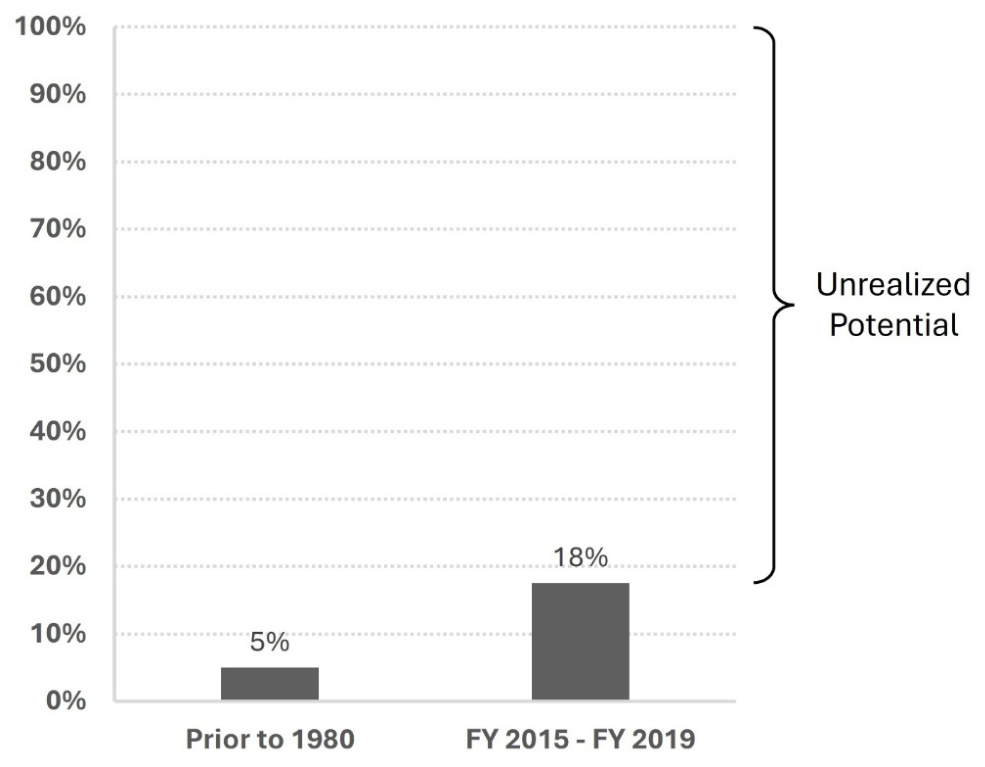
Figure 2.
Diagrammatic Illustration of the Behavioral Theory of the Firm. Note. Figure created by author.
Figure 2.
Diagrammatic Illustration of the Behavioral Theory of the Firm. Note. Figure created by author.
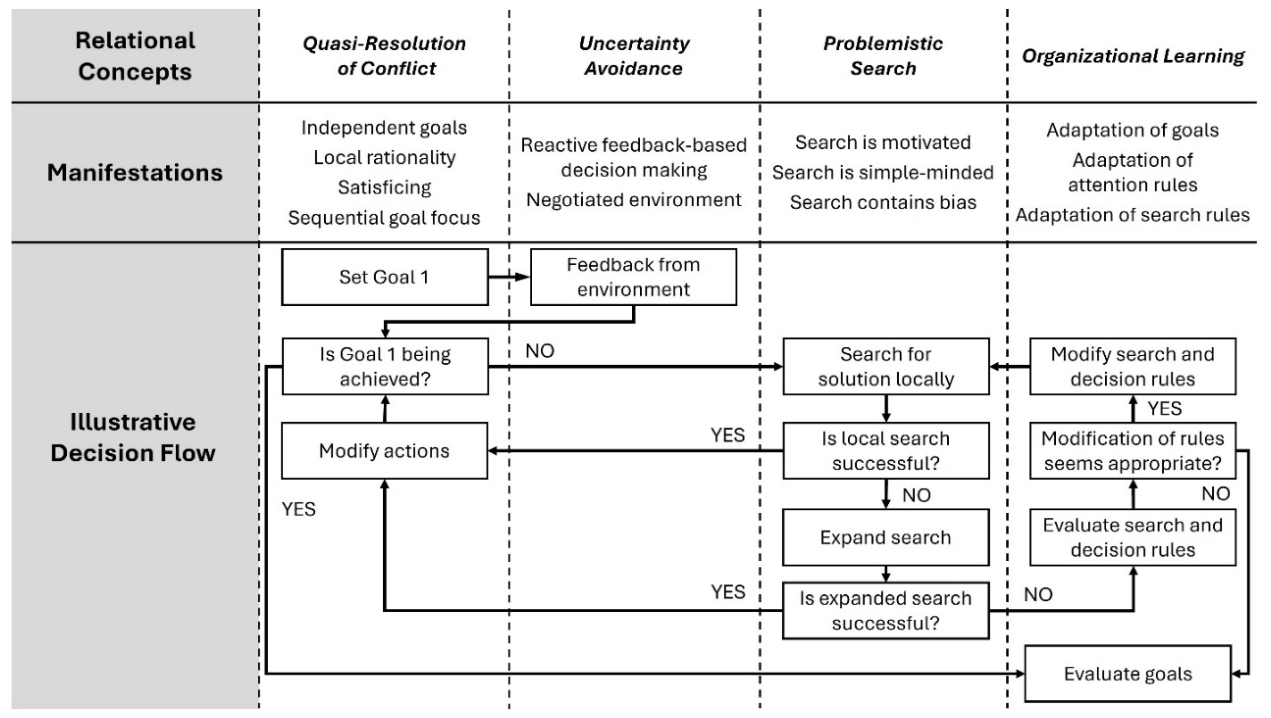
Figure 3.
Human-Centered Framework. Note. Figure created by author.
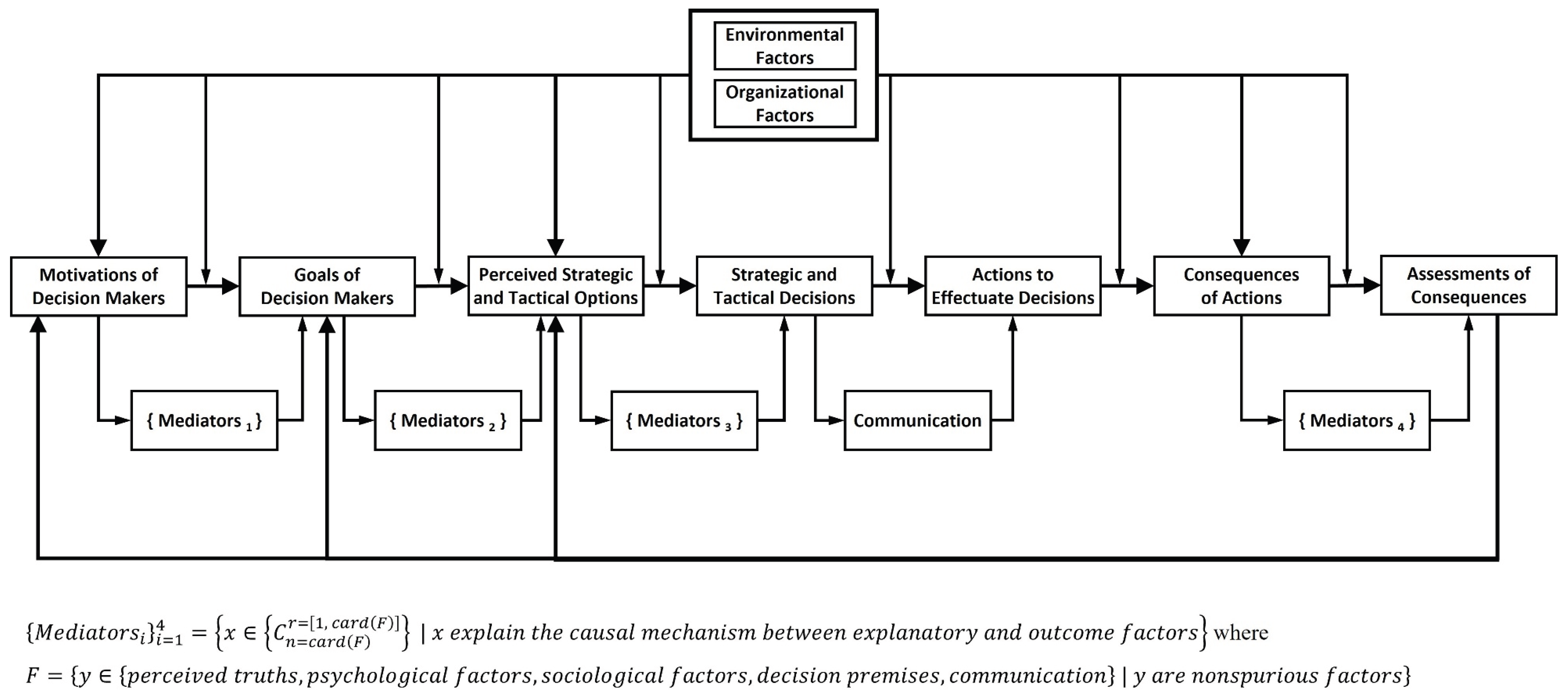

Table 1.
Estimated Percentage of Academic and Federal Technologies Licensed, 2015 to 2019.
| Federal | Academic | Total | |
|---|---|---|---|
| Disclosures for new inventions | 26,966 | 127,745 | 154,711 |
| U.S. patent applications | 12,941 | 80,834 | 93,775 |
| U.S. patents allowed | 11,744 | 36,313 | 48,057 |
| Unique inventions licensed | 2,839 | 13,598 | 16,437 |
| Unique inventions licensed as a percentage of invention disclosures |
10.53% | 10.64% | 10.62% |
| Unique inventions licensed as a percent of patent applications |
21.94% | 16.82% | 17.53% |
| Unique inventions licensed as a percentage of patents allowed |
24.17% | 37.45% | 34.20% |
Note. Table created by author. Data sources: Allard, G. et al., 2021; National Institute of Standards and Technology, 2022. Assumes an average of five licenses for each unique invention licensed non-exclusively.
Table 2.
Articles Published in Relevant Academic Journals that Discuss Reification.
| Article Title | Authors | Year Published | Journal Title |
|---|---|---|---|
| Reification as Ecological Critique | Zhang, T. L. | 2024 | Science & Society |
| Scientific knowledge and political action: On the antinomies of Lukaks’ thought in History and Class Consciousness | Starosta, G. | 2003 | Science & Society |
| Unified Divergence and the Development of Collective Leadership | Croft, C.; McGivern, G.; Currie, G.; Lockett, A.; Spyridonidis, D. | 2022 | Journal of Management Studies |
| Lukacs’ Red Revolution | Leslie, E. | 2023 | Science & Society |
| Lebowitz, Lukacs and Postone: Subjectivity in Capital | Jackson, R. P. | 2017 | Science & Society |
| Missing the (question) mark? What is a turn to ontology? | Woolgar, S.; Lezaun, J. | 2015 | Social Studies of Science |
| A bureaucrat’s journey from technocrat to entrepreneur through the creation of adhocracies | Pelly, R. D. M. | 2016 | Entrepreneurship and Regional Development |
| Language and the circuits of power in a merging multinational corporation | Vaara, E.; Tienari, J.; Piekkari, R.; Säntti, R. | 2005 | Journal of Management Studies |
| Entrepreneurial learning: The transmitting and embedding of entrepreneurial behaviours within the transgenerational entrepreneurial family | Clinton, E.; McAdam, M.; Gamble, J. R.; Brophy, M. | 2021 | Entrepreneurship and Regional Development |
| Race and statistics in facial recognition: Producing types, physical attributes, and genealogies | Delgado, A. N. | 2023 | Social Studies of Science |
| The politics of standards in modern management: Making ‘The project’ a reality | Hodgson, D.; Cicmil, S. | 2007 | Journal of Management Studies |
| SSK’s identity parade: Signing-up, off-and-on | Wynne, B. | 1996 | Social Studies of Science |
Note. Table created by author.
Table 3.
Analytical Frameworks Used to Examine University Technology Transfer.
| Framework | Primary Purpose | Core Premises | Critiques and Criticisms | Sources |
|---|---|---|---|---|
| Neo-Classical Economics | To explain and predict how scarce resources are allocated | Resources are scarce and competition is unrestricted Markets are the most efficient means of allocating scarce resources Decision makers have perfect information Individuals make rational choices to maximize utility Profit maximization is the dominant goal |
Reifies the organization concept Reifies the concept of the market Assumptions are highly idealized and rarely, if ever, achieved in the real world Core premises embed normative biases Presents a static view Ignores the influence of social institutions |
Holdsworth (2011); Keen (2001, 2011); Mulder and Bergh (2001); Puzon and Gisselquist (2023) |
| Transaction Cost Economics | To explain why profit-seeking organizations (i.e., firms) exist, how they are structured, and why they adopt given governance mechanisms | Profit maximization is the dominant goal of profit-seeking organizations Agents may maximize their own utility at the expense of the organization Asset specificity, uncertainty, and transaction frequency mediate a firm’s choice of governance mechanisms |
Reifies the organization concept Reifies the concept of transaction Overemphasizes the assumptions of rationality and opportunism Presents a static view Ignores the influence of social norms and relationships Ignores motivations of organizational behavior other than profit |
Ghoshal and Moran (1996); Hardt (2011); Mahoney (2001); Marcinkowska (2015); Meier and Jäckli (2023); Miranda and Kim (2006); Valentinov and Iliopoulos (2024); Valentinov and Roth (2024); Walker and Wing (1999); Williamson (1998); Williamson (2013) |
| Resource-Based View | To explain differences in the performance of profit-seeking organizations To explain how profit-seeking organizations create and maintain a sustainable advantage |
Profit maximization is the dominant goal of profit-seeking organizations Profit-seeking organizations derive their competitive advantage from internal resources that are valuable, rare, imperfectly imitable, and non-substitutable |
Reifies the organization concept Reifies firm-level advantages Lack of actionable insights Presents a static view Neglects important external factors Ignores institutional factors such as industry norms and cultural elements that influence how firms acquire, manage, and use resources |
Andersén et al. (2019); Barney (1991); Barney et al. (2001); Costa et al. (2012); Eðvarðsson and Óskarsson (2011); Mahoney (2001); Shafeey and Trott (2014); Wright (2001) |
| Knowledge-Based View | To explain differences in the performance of profit-seeking organizations To explain how knowledge assets influence the competitive advantage and performance of profit-seeking organizations |
Profit maximization is the dominant goal of profit-seeking organizations Knowledge (in the lay meaning of the term) is an internal resource that organizations use to create and sustain their competitive advantages |
Reifies the organization concept Treats knowledge as commodity Presents a static view Conceptually vague Ignores organizational and environmental factors that affect competitiveness Ignores sociological factors, such as power dynamics, that significantly influence how knowledge is shared and used |
Curado and Bontis (2006); Grant (1996); McInerney (2002); Srivastava and Mir (2022) |
| Institutional Theory | To explain how rules, norms, and patterns of behaviors (i.e., institutions) influence the actions of individuals and organizations. To explain stability and change within social systems. |
External pressures influence the actions of organizations The strategies and activities of organizations are linked to cultural and social frameworks in their environment |
Reifies institutions Ambiguously defines institution Assumptions and premises are not empirically validated to a sufficient degree Emphasizes organizational stability and ignores agency and innovation Does not explain why institutions are modified Ignores certain sociological factors like power dynamics |
Aksom and Tymchenko (2020); DiMaggio and Powell (1983); Meyer and Rowan (1977); Scott (2005) |
| Contingent Effectiveness Model | To organize technology transfer literature To understand how specific contextual conditions either facilitate or impede efficient and effective transfer of technology from one party to another |
The efficiency and effectiveness of technology transfer is dependent on organizational, social, and environmental conditions (i.e., contingencies) | Reifies the organization concept Reifies the transfer process Reifies contingency dimensions Assumptions and premises are not empirically validated to a sufficient degree Application is difficult Lacks well-defined quantitative measures for effectiveness Does not sufficiently emphasize institutional factors |
Borge and Bröring (2017); Bozeman (2000); Bozeman et al. (2015); Smart and Benaroya (2016) |
| Triple Helix Model | To provide guidance for fostering collaboration between universities, industry, and government to enhance innovation outputs that drive economic development | Collaborative interactions among universities, industry, and government drive innovation The generation and cross-pollination of new knowledge drives economic growth The boundaries of the roles between universities, industry, and government evolve Institutional factors moderate the influence of innovation on generating economic development |
Primarily conceptual Reifies the organization concept Reifies government Some constructs are ambiguous Difficult to measure some constructs of the model Oversimplifies the interactions in real-world innovation ecosystems Ignores certain sociological factors like power dynamics Inadequate consideration of the environment in which universities, governments, and private sector firms operate May not accurately reflect various institutional and cultural contexts such as developing countries Contextual variability limits generalization across contexts |
Cai (2015); Cai and Amaral (2021); Deakin (2022); Leydesdorff and Etzkowitz (1996, 1998) |
| Quadruple Helix Model | To provide guidance for fostering collaboration between universities, industry, government, and society to enhance innovation outputs that drive socially responsible economic development that is sustainable | Collaborative interactions among universities, industry, government, and society drive innovation The generation and cross-pollination of new knowledge drives economic growth Society plays an essential role in shaping innovation The dynamics of innovation likely vary across different contexts Innovation should align with the broader goals of society |
Primarily conceptual Reifies the organization concept Reifies the concepts of civil society and the public Assumptions and premises are not empirically validated to a sufficient degree Additional complexity makes the model difficult to apply The role and influence of society is ambiguous Does not adequately account for certain sociological factors such as power dynamics Core premises embed normative biases |
Afonso et al. (2010); Campanella et al. (2017); Carayannis et al. (2012); Cloitre et al. (2023); König et al. (2020); Kunwar and Ulak (2024); Leydesdorff and Smith (2022); Mineiro et al. (2021); Noya et al. (2024) |
| Quintuple Helix Model | To provide guidance for fostering collaboration between universities, industry, government, society, and the natural environment to enhance innovation outputs that drive socially responsible, ecologically sound economic development that is sustainable | Collaborative interactions among universities, industry, government, society, and the natural environment drive innovation The generation and cross-pollination of new knowledge drives economic growth Society plays an essential role in shaping innovation The natural environment has an integral role in shaping innovation The dynamics of innovation likely vary across different contexts Innovation should align with the broader goals of society |
Primarily conceptual Reifies the organization concept Reifies the concepts of civil society and the public Reifies the natural environment Assumptions and premises are not empirically validated to a sufficient degree Additional complexity makes the model difficult to apply The role and influence of the natural environment is ambiguous Overgeneralizes interactions among the various actors and thus fails to account for contextual differences Core premises embed normative biases |
Carayannis et al. (2012); Carayannis and Campbell (2010); Kunwar and Ulak (2024); Leydesdorff and Smith (2022); Mineiro et al. (2021); Mutlu and Arikboga (2023) |
| Battistella-DeToni-Pillon Model of Technology and Knowledge Transfer | To identify critical factors for technology and knowledge transfer from academia to the private sector and direct future research on the relationships of the identified factors | Mutual understanding and trust between knowledge producers and acquirers are necessary conditions for successful transfer Intermediaries function as bridges between research entities and private sector organizations Contextual factors such as social, economic, and regulatory environments affect the technology transfer process Feedback mechanisms between research entities and private sector organizations support iterative improvements |
Primarily conceptual Reifies the organization concept Reifies knowledge as a commodity Lacks empirical validation Difficult to operationalize Oversimplifies the technology transfer process Presents technology transfer as a linear process Does not adequately account for the influence of socio-political contexts Does not adequately account for the influence of organizational factors such as absorptive capacity May not be able to generalize to different industries and geopolitical contexts |
Battistella et al. (2016) |
| Prodan-Drnovsek-Ulijn Model of Technology Transfer |
To help researchers, policy makers, and practitioners design policy and instruments to facilitate the transfer of technology from academia to new business ventures | University technology transfer via new business ventures is primarily driven by faculty involvement Academic entrepreneurs rely on their personal networks to secure necessary resources Technology transfer via faculty involved new business ventures is affected by the nature of the academic’s personal network, the length of their academic career, the nature of the academic’s research, personality-driven motivational factors, entrepreneurial self-efficacy, previous engagement with the private sector, exposure to academic entrepreneurial role models, and institutional support |
Primarily conceptual Reifies human agency and social networks as static variables Overly abstract Lacks empirical validation Focus is only on technology transfer via new business ventures Ignores certain sociological factors like power dynamics Ignores the influence of environmental factors Does not account for potential organizational change May not be able to generalize to different cultural contexts |
Prodan et al. (2009) |
Note. Table created by author.
Disclaimer/Publisher’s Note: The statements, opinions and data contained in all publications are solely those of the individual author(s) and contributor(s) and not of MDPI and/or the editor(s). MDPI and/or the editor(s) disclaim responsibility for any injury to people or property resulting from any ideas, methods, instructions or products referred to in the content. |
© 2026 by the authors. Licensee MDPI, Basel, Switzerland. This article is an open access article distributed under the terms and conditions of the Creative Commons Attribution (CC BY) license (http://creativecommons.org/licenses/by/4.0/).
Copyright: This open access article is published under a Creative Commons CC BY 4.0 license, which permit the free download, distribution, and reuse, provided that the author and preprint are cited in any reuse.