
Submitted:
24 October 2024
Posted:
25 October 2024
You are already at the latest version
Abstract
This comprehensive state-of-the-art literature review investigates the status of electric vehicle (EV) market share and the key factors that affect EV adoption. Investigating the current scenarios of EV, this study observes a rapid increase in the number of EVs and charging stations in different parts of the world. It reports that people’s socio-economic features (e.g., age, gender, income, education, vehicle ownership, home ownership, political affiliation) significantly influence EV adoption. Moreover, factors such as high driving range, fuel economy, safety technology, financial incentives, availability of free charging stations, and the capacity of EVs to contribute to decarbonization emerge as key motivators for EV purchases. The literature also indicates that EVs are predominantly used for short-distance travel and users commonly charge their vehicles at home. Most users prefer fast chargers and maintain a high state of charge (SoC) to avoid unforeseen situations. Despite the emergent trend, there is a disparity in charging infrastructure supply compared to the growing demand. Thus, there is a pressing need for more public charging stations to meet the surging charging demand. The integration of smart charging stations equipped with advanced technologies to optimize charging patterns based on energy demand, grid capacity, and people’s demand can help policymakers to leverage smart city movement. This paper makes valuable contributions to the literature by presenting a conceptual framework articulating the factors of EV adoption, outlying their role in achieving smart cities, and proposing suggestions for future research directions.
Keywords:
Electric vehicle
; consumer adoption
; influential factors
; sustainability
; smart city
; review
1. Introduction
Global climate has been changing partly because of a higher rate of energy consumption by the transportation sector and thereby greenhouse gas (GHG) emission [1,2]. To reduce GHG emissions, many nations have agreed to abide by the Paris Agreement Treaty to keep global temperature increase under 20C above the pre-industrial levels and limit the temperature increase to 1.50C [3]. As the transportation sector is single-handedly responsible for 23% of GHG emissions, the adoption of zero-emission vehicles (ZEV) (including electric vehicles (EV)) would significantly reduce fossil fuel consumption and climate-changing GHG emission [2,4,5,6,7,8,9]. Thus, the technological progression from combustion engines to electric motors makes the transportation systems more clean, dependable, and sustainable [1,6,10]. Plug-in electric vehicles (PEVs) [i.e., Plug-in hybrid electric vehicles (PHEVs) and battery electric vehicles (BEVs)] provide numerous benefits over conventional Internal Combustion Engines (ICE) [11,12,13]. PEVs curtail fossil fuel use, reduce GHG emission, improve energy security, provide energy diversity to the market, improve air quality, reduce vehicle operation and maintenance costs. Considering the emerging potentials in the smart city context, we aim to explore the status of EV market share in the world, associated charging infrastructure, and factors (e.g., socioeconomic profile of people, financial and institutional aspects, and charging behaviors) that influence the acceptance of EVs among populations.
PEVs, whether wholly or partially propelled by electric motors, depend on rechargeable batteries. The concept of vehicle electrification emerged in the mid-19th century when electricity was used for vehicle propulsion due to its level of comfort and greater ease of operation than a gasoline car [14,15]. However, electric power became mainly used in trains and small vehicles, while ICEs became the primary propulsion method for over a century. Considering the adverse environmental impacts of gasoline vehicles, high fuel price, and energy shortage, transport professionals rekindled their interests in EVs and their associated infrastructure [14,16,17]. Consequently, the market share of PEVs is increasing rapidly in the world [18]. In the last few years, the EV market has transformed from a fringe technology with limited production to a fast-growing part of the vehicle market [19].
Despite growing demand for EVs, widespread market adoption is being hindered by certain factors (e.g., limited car models and styles, higher cost, lack of convenient and ubiquitous charging stations, and low range) [11]. Among them, ubiquitous and effective charging stations, commonly known as electric vehicle charging equipment (EVSE), are mandatory for the decisive growth of EVs. To promote EVs, a convenient and effective charging network should be established to allow long-range travel and extended metropolitan commutes with BEVs, nudge people who do not have residential charging facilities, and offer convenient charging options to all PEV drivers [20].
Considering the broader supporting needs of ever-increasing EV users into the future, gaining a deeper understanding of users’ attitudes and preferences to predict variations in their behaviors and their responses to policy interventions and to new technological trends and solutions is critical for facilitating the transportation sector in smart cities. Equally important is the pipeline of supporting infrastructure solutions (e.g., chargers, power grids, ubiquitous information networks) that are core features of smart cities. The confluence and concomitant consideration of these approaches is essential to fulfil the collective societal needs in terms of charging stations demand and mobility needs. The technological advancement coupled with huge mobility demands (due to natural population growth and migration of rural people to urban areas) administers pressure on city infrastructure (e.g., energy, transportation) to improve efficiency and preserve natural resources [21]. A smart city makes the infrastructure and its services more efficient and more accessible to city dwellers by applying Information and Communication Technology (ICT) with minimal external supports [22,23,24,25]. Additionally, a green smart city encourages people to transition to lower impact technologies that increase the utilization of renewable energy and protect natural resources [26]. Thus, EVs and smart cities have a shared destiny, shared objectives, and shared pathways. The integration of electricity and transportation in a smart city context unleashes synergistic benefits by reducing emission and congestion and by transitioning to renewable energy use [6]. EVs in smart cities will play a major role in sustainable transportation and decarbonization [27]. A smart city is positioned to manage all energy-related activities to meet the increasing energy demand of the present and future generations [28]. However, an integration of electricity and transportation affects the modern power supply system due to uncertainties in people’s demand [29]. Interactions of social and human features, on the one hand, and technological systems, on the other hand, are necessary for a certain outcome. Thus, understanding socio-economic factors of EV adoption is mandatory to plan future power infrastructure in smart cities.
Although a fashion of EV adoption has been growing in the US, Europe, and China, many other countries still lag behind in selling EVs and in adopting new technologies [30,31]. Thus, an up-to-date assessment of the factors of EV adoption and charging infrastructure requirements is necessary. A sense of inadequate knowledge on EV market share, charging stations, and the factors that influence EV ownership can be a great barrier to EV adoption. Researchers around the world have conducted a good deal of comprehensive and state-of-the-art review studies. However, these studies mainly focused on EV technologies such as batteries, electric motors, energy controls, vehicle automation and connectivity, power converter, charging infrastructure, smart grid [32,33,34,35,36]. Only a handful of studies have evaluated the current status of EVs, people’s perceptions, and key determinants of EV use, and the implication and status of EVs in smart city context have seldom been discussed considering recent development of technologies and smart mobility options [37]. Therefore, this study aims to assess the status of EV adoption and understand the factors that affect the acceptance of EVs to support the current and future growth of EVs and address current concerns with a view on their place in smart cities. To achieve this research objective, the following questions have been formulated:
- What is the present status of EV adoption in the world to meet growing travel demand and comply with smart city initiatives?
- What is the demographic and socio-economic profile (e.g., age, gender, education, income, family size, vehicle ownership, and political affiliation) of EV adopters?
- What are the impacts of various factors such as travel and charging behaviors, battery range and charging status, charging infrastructure, cutting edge technology, the built environment, energy demand, and financial and institutional aspects on EV adoption?
- What are the research gaps in the extant literature regarding the transition to EVs in the context of the smart city and how can they be addressed?
This state-of-the-art review study makes significant contributions to literature by synthesizing existing published works on the salient features of EV adoption in the world. The contributions of this study are fivefold: First, this study critically evaluates the selected articles to understand people’s knowledge and opinion about EVs. Second, it determines the key factors that influence people’s use of EVs. Third, a conceptual framework is proposed articulating the factors of EV adoption. Fourth, the role of EVs in achieving smart cities is outlined. Finally, this paper identifies several shortcomings in the literature and proposes directions for future research.
The rest of the article is outlined as follows. Section Two introduces search strategies and different attributes of reviewed articles and reports. Section Three discusses the current status of EVs. A synthesis of the results on the key factors that influence people’s decisions to purchase and use EVs from previous studies is presented in the Fourth Section. Summary of this research and the interfacing between smart city development and EVs adoption are discussed in Section Five. Finally, conclusions and shortcomings of prior research and directions for future study are drawn in Section Six.
2. Tools and Techniques
2.1. Study Approach
This state-of-the-art review was prepared by selecting different published reports and peer-reviewed journal articles and by critically analyzing them. Figure 1 outlines various phases of this review study, starting from study conceptualization and progression through article selection and analysis, concluding in the identification of study gaps in the existing literature. We performed a preliminary literature review to conceptualize the study in Phase 1. Based on the preliminary literature review, we finalized and formulated the study aims and objectives in Phase 2.
In Phase 3, we searched for relevant articles and reports in different databases based on defined keywords. A systematic search was conducted to identify the studies that investigated factors that affect EV adoption, prospects and potentials of EVs, and current market demand for EVs. Using Google Search Engine, Google Scholar, Science Direct, Scopus, SAGE journals, SpringerLink, Taylor & Francis Online, Web of Science, and different transportation-related journals, relevant references were identified to understand the current status of EVs in smart cities. Some keywords: “electric vehicle”, “hybrid electric vehicle”, “plug-in electric vehicle”, “alternative fuel vehicle”, “zero-emission vehicle” coupled with “charging station”, “charging infrastructure”, “charging behavior”, “fuel economy”, “vehicle ownership” were used to identify published studies. The articles compiled by the literature search were screened based on some inclusion criteria and included for this review in Step 4. The focus was placed on the empirical studies that were conducted to understand public knowledge on EVs, the recent development of technologies and the trend of EV usage among consumers. Some articles and reports were excluded from the review due to unavailability of the full text and due to not being written in English. A total of 127 articles and reports were finally identified for critical analysis in this review.
In Phase 5, the included articles and documents were critically reviewed to identify data sources, methods used, core themes, and key findings. We reviewed the articles and reports in detail and analyzed the data extracted from them to find out socio-economic profile of EV users and factors affecting EV usage and to develop a conceptual framework in Step 6. Results were discussed and policy guidelines were provided to encourage people to use EVs and increase their market share in Stage 7. Finally, we concluded the review study by identifying research gaps in literature and by providing directions for future research in Stage 8.
2.2. Key Attributes of the Selected Articles and Reports
As mentioned in Subsection 2.1, a total of 127 articles and reports were selected for this review study. Among the reviewed literature, about 52% of studies were conducted within the last five years (2019-2024) (Figure 2). About 30.7% were conducted between 2014 and 2019, and only 17.3% of studies were conducted before 2014, which can be leveraged to conduct a more detailed investigation of EV market demand trend over time.
A compilation of data used and methods applied in the prior research is given in Table 1. This table demonstrates that a variety of data from different sources (e.g., household survey, simulation, national survey, census) have been used to investigate EV ownership, travel behavior, and energy demand, following several distinct methodologies (e.g., regression, simulation, graphical presentation). Further summaries are provided in Figure 3 and Figure 4.
About 63% of studies have conducted household surveys to collect data while 5 to 8% of studies used national household travel surveys and censuses as the primary data sources. Additionally, about 14% of studies used simulated data by conducting trials of EVs. Some studies (10%) also relied on data from other collection streams, such as private agencies or social media). Collecting data from current and potential EV owners provides first-hand and real-life information on travel behaviors and choices. Moreover, using real-world data avoids having to make any assumptions about the stochastic behaviors of EV users and minimizes uncertainties [39]. In contrast, data collected from simulation trials fall short of providing real-world travel information, which can create misleading conclusions [38]. Thus, real-world data with adequate representation of people of all socio-economic strata is important to determine the factors that affect EV adoption. A piece of real-world evidence that portrays the probabilistic nature of EV users will facilitate efficient energy management scenarios in smart cities.
Researchers have used several methods to investigate the factors that affect EV adoption (Figure 4). It is conceived that 49% of studies have used some form of regression model. In contrast, about 18% and 7% of studies used simulation and probabilistic methods, respectively. Additionally, about 26% of studies have relied on various other methods (e.g., graphical presentation of descriptive analysis, GIS-based analysis). The application of probabilistic methods to real-world data can address uncertainties in travel and EV charging behaviors [39]. In contrast, simulations conducted under alternative assumptions that may change in different circumstances may provide inconclusive decisions [40]. Thus, to investigate the actual effect of driver characteristics, built environment, road conditions, temperature, and policies on EV use, the conduct of an empirical study is desirable [41,42]. An empirical study using real-world data on EV users and proper statistical methods can be expected to provide concrete results conducive to guiding policymakers to formulate appropriate policies that promote EVs in the smart city context.
3. Current Status of EV Adoption
The world has recently been experiencing a rapid surge in EV sale and adoption due to a combination of supporting conditions including the recent leap forward in technologies, several new business undertakings, pertinent policies and regulations, and government incentives such as tax rebate, purchase aids, toll exemption, free public parking and charging stations [35,97]. According to the International Energy Agency (IEA), worldwide EV market share has experienced an exponential growth, exceeding 16 million EVs in 2024 (Figure 5) [108]. The market share of EVs has more than tripled from approximately 4% in 2020 to reach 14% in 2022, and 18% in 2023 [108,109]. It is forecasted that almost half of the vehicle stock of a country will be BEVs within 2030-2050 in most countries [110].
Figure 5 illustrates that China dominates the global EV market, followed by European countries (singularly, Germany, France, the United Kingdom, Norway) and the United States (US). About 60.84%, 20.48%, and 10.24% of new EVs were registered in China, Europe, and the US, respectively, which corresponding to around 92.57% of global EV sales combined. Thus, despite the rapid growth, EV sales remain concentrated in a few major markets [108]. However, some developing countries such as India, Brazil, Thailand, and Turkey have experienced a boost in sales in recent years due to low cost EV models [109]. To support EV adoption, there were about 2.7 million public charging points in 2022 globally compared to 1.8 million in 2021 [111]. Like for EVs, China dominated the market here as well, with around 0.36 million slow and 0.30 million fast charging points in 2022, followed by 0.45 million in Europe.
EVs have reemerged in the US vehicle market in late 2010 and sustained development of their market is now the utmost interest of many automakers, policymakers, and researchers [112]. Recently, there has been tremendous growth in the production and marketing of EVs. In 2022, about 1.2 million EVs were sold in the US, and this number increased by about 60% in 2023 [108]. According to the Kelley Blue Book, the market share of EVs in the US has grown from 5.9% in 2022 to 7.6% in 2023, and has been projected to reach 10% in 2024 [113]. To meet the growth in charging demand, over 0.26 million public and private electric charging stations were established in the US between 2010 and 2022 [114]. It is anticipated that the number of charging stations will increase as EVs continue to grow. The IEA projected that the number of charging stations in the US will grow to between 0.8 to 1.7 million by the end of this decade due to adopted public policies such as President Biden’s infrastructure package (Infrastructure Investment and Jobs Act) to establish a national network of 500,000 charging stations [115].
This rapid growth of EV share is the result of a significant improvement in PEV technologies, battery price reduction, and institutional support. Institutional support includes research and development (e.g., battery technology), regulations (e.g., fuel economy standards, zero-emission vehicle mandates, targeted phasing out of ICE vehicles), financial incentives for PEV purchase (e.g., $7500 tax credit in the US) and charging station installations (e.g., $1000 tax credit for a home charger and up to $30,000 for business chargers), and other measures (e.g., preferential parking, access to high-occupancy vehicle lanes) [11,16].
Despite the increasing trend of EVs and charging stations, the market share of EVs is nonetheless growing much more slowly than anticipated due to high purchase prices, push back of EV targets by major companies, political spin, inadequate infrastructure, and consumers hesitancy [116,117]. It has been found that people often purchase EVs to supplement their gasoline vehicles rather than fully transitioning to EVs [117]. However, the introduction of a variety of EV models including electric cars and SUVs with higher range, a reliable and denser charging network, longer battery autonomy and support from auto industry and governments can bring about a revolution in EV usage [117].
4. Synthesis of Extant Literature
4.1. Multi-Factor Interactions of EV Adoption
A conceptual framework (Figure 6) is developed to comprehend the factors that influence people’s decision to use EVs. The diagram indicates that people’s socioeconomic characteristics (e.g., age, gender, income, education, marital status, vehicle ownership, household size, homeownership, political affiliation) directly influence their choices to purchase and use EVs. For example, younger generation and adult workers are more inclined to use EVs compared to others. Similarly, high income people are more likely to purchase and use an EV than low- and middle-income people due to their high purchase costs. The factors of the built environment (e.g., population density, employment density) also have direct impacts on EV use. Specifically, people residing in urban areas are more interested in using EVs compared to their rural counterparts. People’s socioeconomic profile can also define their household and employment locations, and hence can influence their EV ownership through this pathway.
Additionally, people’s socioeconomic features and the built environment indirectly influence EV use by mediating prior knowledge on EVs, willingness to pay, travel behaviors, and charging behaviors. For example, the younger generation, people with higher educational attainment, and people with higher income have a better understanding of EVs and are willing to pay more to purchase EVs. Working adults living in urban areas and with short travel distances to work are more likely to own and use EVs. Moreover, people with environmental awareness are eager to use EVs to reduce travel-related energy use and carbon emission. On the other hand, people usually avoid EVs for long-distance travel due to the relatively short range of EV batteries. However, people can travel a long distance due to the recent development in battery technologies and with adequate State of Charge (i.e., amount of available energy) of batteries. People’s driving behaviors and EV charging behaviors also interact with one another and influence EV use.
Figure 6 also indicates that the availability of charging stations at home, workplace or public sites directly influences people’s EV purchasing behavior. The availability and location of EV charging stations also indirectly affects EV use by influencing charging behaviors. Specifically, travelers are more likely to use EVs when they have charging stations at home or at their workplace. In other words, the use of EVs and the availability of charging stations have a two-way interaction. The growing number of EVs demands more charging stations, while the availability of charging stations acts as a catalyst for the purchase and use of EVs. Additionally, growth in EVs and daily charging demand exert pressure on the local power grid, which also determines the reliability of the electricity systems to power EVs.
Other factors also influence EV use. For example, institutional aspects such as tax rebate and subsidies and various EV-friendly policies (e.g., access to bus lanes) have been found to significantly increase EV purchases around the world. Additionally, EVs’ high purchase prices deter people from buying and using EVs. In contrast, rises in the price of gasoline drive people to use EVs to lower overall travel costs.
With survey instruments targeted at dwellers, previous researchers have evaluated people’s perceptions of EVs and investigated the factors that influence EV adoption. Key findings from notable studies are represented in Table 2, outlining the main motivations to purchase EVs. These studies have reported that people’s tendency to purchase and use EVs is determined by multi-factor interactions.
4.2. Prior Knowledge About EV
Previous studies have examined people’s familiarity with EVs. Through consumer preference surveys, researchers found that about 8 to 65% of respondents possess some basic knowledge about EVs, can distinguish EVs from other vehicles, and have some driving experience with EVs. About 46% of respondents could name a specific PEV make and model and a similar number of respondents commented that all EVs are similar or better than gasoline vehicles [50]. About 12 to 39% of respondents have reported that they have charging stations near home or workplace [80,120]. About 10% of respondents mentioned that they have a neighbor who owns an EV [50]. Conversely, a few respondents (9.75%) are not familiar with EVs at all [80]. These findings suggest that a considerable number of people are aware of EVs, have previous experience, and are interested in adopting EVs [95,97,101].
Researchers have identified that perceived advantages (e.g., fuel-efficient, cost-effective, environment friendly), ease of use (e.g., easy to drive and handle, charging and maintenance is convenient), trust in technologies, and social motives significantly increase EV adoption, whereas perceived risk (e.g., battery damage, cannot change on time) negatively affect people’s adoption of EVs [92,99,121,122]. Thus, personal EV driving experience and psychological factors greatly influence consumer understanding of EVs and their adoption [100,101,123,124]. However, Lindland [52] noted that people face difficulty distinguishing hybrids from EVs in the US. About 44% and 33% of consumers mistakenly recognized Toyota Prius and Chevrolet Volt, respectively, as an EV. Therefore, adequate resource mobilization is necessary to raise people’s awareness and motivate them to use EVs.
Public demonstration of EVs has a significant impact on EV adoption by increasing real-EV riding experiences [124,125]. Liu, Sun [126] reported that public demonstration of EVs (e.g., electric bus, commercial vehicles) significantly stimulates people’s attitudes towards EVs even when controlling for the influence of fuel price and incentives on EV purchase. They found that for every 1000 new deployments of commercial EVs, there is a possibility that the private EV sales would increase by 840 due to better intuitive knowledge of new technologies after riding a public electric bus. Thus, public demonstration of EVs is an effective strategy to gauge the future adoption rate of EVs. Moreover, people’s knowledge of EV will increase with a higher rate of EV penetration, which leads to change in consumer’s preferences and resolves many misconceptions and challenges (e.g., short-range, low charging stations) associated with EVs [127].
To sum up, many people are familiar with EVs, although they are not fully aware of the functionality and advantages associated with EVs. Positive attitudes and different psychological factors significantly influence EV adoption. Public demonstration of EVs could significantly motivate people to adopt EVs.
4.3. Willingness to Pay for EV and Charging Infrastructure
Previous studies have recorded that most consumers are keen to pay extra money for an increased driving range, for charger availability, and fuel cost reduction (Table 3). Consumers are also ready to pay extra for some non-financial reasons, like to reduce their carbon emission, to save energy, or to have access to cutting edge technologies) [82]. Many respondents (47%) have a willingness to pay (WTP) incremental costs for PEVs [50]. However, in their dissenting study, Bienias, Kowalska-Pyzalska [120] observed that a majority of respondents are unwilling to pay more for EVs or HEVs; they also found that respondents are interested in EVs or HEVs when their purchase price is similar to conventional vehicles (CVs). Thus, reduction in EV purchase price can significantly increase willingness of people to adopt EVs [128].
A comparative study found that Americans are willing to pay more for EVs than the Japanese. Moreover, California residents pay considerably more than in other US states [79]. Another comparative study reported that Chinese people are ready to pay more than Americans for using EVs [129]. Appropriate policy (e.g., suspension of purchase and driving restrictions, access to bus lanes, exemption from sales tax and road tolls) incentivize Chinese people to pay more. For example, people are ready to pay an extra $29,179 for an EV in China, which is greater than all subsidies provided by central and local governments [130]. Thus, evidence shows that proper policy measures, adequate infrastructure, low purchase costs, and higher driving range are instrumental to grow the market penetration of EVs [131].
Researchers also mentioned that WTP for EV largely depends on people’s socio-economic profile. Generally, affluent, younger, male, more educated, and employed people pay higher than their counterparts [88]. WTP of EV owners rises with increasing income (i.e., households with income under $50,000 pay $1462 extra) [86]. In Japan, a household with $100 higher income wants to pay $318 and $393 more to purchase EV and PHEV, respectively, in Japan [79]. College graduates have higher WTP for buying EVs and PHEVs in the US ($318 and $271, respectively). Couples pay higher for EVs and PHEVs in the US ($834 and $1005 respectively). In contrast, people’s WTP drops by $127 in the US and $1 in Japan with every additional year of age. Similarly, females have negative WTP for EVs and PHEVs (-$1081 and -$1437, respectively). Although WTP is higher in various countries, marginal WTP is seen to decrease with further expansion of the refueling infrastructure [70].
The extant literature shows that consumers are willing to spend more for EVs, enticed by financial (e.g., fuel cost reduction, exemption of purchase tax and road toll) and non-financial benefits (e.g., increased driving range, charger availability, carbon emission reduction, new technology, access to bus lanes). Consumers in the US and China show a greater willingness to pay more compared to those in other countries.
4.4. Socio-Economic Profile of EV Users
Several studies have explored different socio-economic characteristics of EV users to identify which segment of the population prefer EVs and are willing to buy them in future [56,68,71,75]. Table A1 summarizes survey respondents’ socio-economic features that were found to affect EV adoption in previous studies.
4.4.1. Users’ Age
Results from various studies conducted across different regions of the world (e.g., the US, Australia, and Germany) indicate that most current and future EV owners are younger, typically under 50 years old (Table A1). Some studies have shown higher EV ownership among young individuals (aged 35 or less) than older adults due to their attraction to new technology [50,125,132,133]. Younger and middle-aged individuals are 2.2 and 1.3 times, respectively, more EV oriented than the elderly [72]. Similarly, a study in Germany noted that about 33% of consumers are interested in Alternative Fuel Vehicles (AFVs), with young people showing more interest than the elderly [74]. This interest is driven by higher education, environmental awareness, and technological affinity. Thus, preference for EVs and AFVs decreases with increasing age [70,74]. With each additional year of age, respondents are 0.42% less interested to purchase a PEV [80]. In contrast, a 1% increase in median age is associated with a 1.07% increase in HEV ownership per person in Texas, indicating that as people age, they become financially capable of purchasing EVs [85]. Thus, people’s financial condition as they age is a crucial indicator to determine EV ownership.
4.4.2. Gender
Most studies have found a higher rate of EV ownership among males than females (Table A1). Males tend to drive more than females and have a stronger preference for hybrid vehicles [93,95,125]. For example, a study in Texas found that a 1% increase in male population in each census tract is associated with a 3% increase in HEV ownership [85]. Similarly, another study in the 21 largest US urban areas found that men are 11.5% more likely to purchase PEVs than women [80]. Conversely, other research [73] found a minimal effects of gender on the choice of specific fuel types. However, Higueras-Castillo, Molinillo [134] observed a higher tendency of EV ownership among young women in high-income cohorts. Thus, individuals with a stable and well-paid income show more interest in purchasing EVs regardless of their gender identity.
4.4.3. Educational Attainment
Education is one of the important factors that influence EV ownership. Many studies have found a higher rate of EV ownership among highly educated people (Table A1). Completing a bachelor’s or master’s degree positively impacts EV ownership, motivated by values such as environmental awareness [85,132,133]. EV ownership increases by a factor 1.3 among those with a bachelor’s degree [72]. In contrast, individuals with a high school degree and some college education only are 17.1% and 5.6% less likely to purchase EVs, respectively, than those with a bachelor’s degree or higher [80]. Thus, higher educational attainment is an indicator of EV use, as it contributes to reduce carbon emission and protect the environment.
4.4.4. Household Income
Previous studies have documented that household income significantly affects EV ownership (Table A1). Affluent households have a greater preference for EVs [86,132,134] than others and are more likely to own EVs [58,85,135]. Similarly, areas with a high density of well-off households (annual incomes >$35,000) exhibit high EV ownership [87]. In contrast, areas with a high density of low-income households (annual income <$35,000) are negatively associated with EV ownership. Forecasting EV market share through 2030, researchers perceive that middle-income people will initially adopt HEVs and later transition to PHEVs or BEVs after 2025, while high-income people will show interest in PHEVs [83]. In contrast, very few low-income people will switch from ICE by 2025 due to the higher price of EVs. However, Carley, Krause [80] found no significant impact of income on PEV purchases. Overall, considering the high price of EVs and additional cost of chargers, it is apparent that household income significantly influences EV purchase.
4.4.5. Household Size, Composition, and Type
Household size and the number of children significantly influence vehicle ownership and fuel type preference (Table A1). Larger households tend to avoid purchasing EVs, preferring bigger vehicles (e.g., van) [86,127]. The presence of children in a household significantly reduces EV ownership and increases diesel or gas-fueled vehicle ownership [85]. However, Hackbarth and Madlener [73] noticed a minimal effect of the number of children on vehicle preference. Since larger households need a bigger vehicle to accommodate all family members, they show preference for a diesel or gas-fueled large vehicle. Going against the grain, Chen, de Rubens [125] and Buhmann and Criado [95] observed a higher interest in purchasing EVs among households having children, considering greater overall benefits of EVs.
EV ownership is also influenced by house types. Researchers show that people living in detached single-family houses are more likely to own an EV (Table A1). For example, researchers have found a large number of single-family detached houses in the northern and southwestern part of Santa Monica, California, with higher PEVs ownership with charging option at home [48]. However, PEVs ownership drops with increase in multi-unit dwelling units (MUDs) [58]. Renters are less likely to own an EV, primarily due to lower household income and the lack of designated places to install charging stations at their residence [132].
4.4.6. Number of Vehicles in the Household
The number of vehicles in a household significantly affects EV ownership. In developed countries, most households own more than one vehicle (Table A1). Households often purchase EVs as secondary cars (6%), commercial cars (15.4%), leisure cars (13%), and family cars (5.6%), thus affirming multi-car ownership [76,92]. Consequently, having more vehicles in a household reduces EV adoption tendency [72,125]. In contrast, some other studies have found no significant effects of the number of cars on EV ownership [73,80]. Researchers also report low ownership of EVs in the households, indicating the dominance of conventional gasoline vehicles in the market [83,120]. Additionally, new car buyers show considerable hesitation to purchase AFVs [73], which contradicts the findings from [125] where researchers argued that buying a new car significantly increases the possibility of choosing an EV. However, to boost the market share of EVs, it is necessary to reduce vehicle prices, improve efficiency, and provide appropriate incentives to buy EVs.
4.4.7. Driver’s License and Political Affiliation
As expected, possession of a driver’s license is another important socio-economic factor that influences EV ownership (Table A1). Given the mandatory nature of a driving license for vehicle ownership and operation, licenses increase people’s likelihood to own a vehicle due to their mobility needs and interest in technologies, which may encourage them to purchase and use EVs [136,137]. Additionally, political affiliation plays a role in EV ownership. About 52% of respondents are Democrats who show a strong interest in EVs due to their environmental awareness, compared to 13% of Republicans with comparatively low interest in EVs [5]. Individuals with no political affiliation show the least interest in EVs.
In summary, various socio-economic and demographic features significantly influence their decisions to purchase and use EVs. Thus, policymakers should implement targeted measures considering users’ socioeconomic profile to effectively promote EV adoption.
4.5. Travel Behavior
Many studies have investigated different aspects of travel behaviors that may correlate well with EV ownership. Exploring the relationship between travel purpose and EV ownership, some studies reported a higher likelihood of EV ownership when people mostly use EVs for short-distance work trips [85,90,133] and have higher travel demand [135]. A considerable number of people (67%) drive EVs to work [49], and 90% of people use EVs for work, personal errands, and shopping purposes [56]. The majority of respondents (97%) drive EVs more than three days a week, primarily for commuting to work (70%) [54]. Although people use EVs for work trips during week days, weekend trips are made for other personal purposes [47]. Moreover, about 44.4% of respondents shared EVs with family members [75]. Thus, people use EVs for various purposes (e.g., work, commercial, industrial, recreational trips) and share EVs with family members, effectively meeting their travel demands.
People mostly use EVs for short-distance travel [73], with the average daily travel distance being about 40 miles or lower (Table 4). The probability of travel by EVs drops with increasing travel distance (i.e., >40 miles) due to the short-range of vehicles [53]. However, many people now use EVs also for long-distance travel taking into consideration increased battery range and greater lifetime benefits from BEV [53,132]. Some people (29%) explore charging stations before starting a journey, and many (50%) carry a map of charging stations to travel beyond vehicle range [55]. Additionally, researchers mentioned that the availability of charging stations can influence people’s travel distance. For example, access to charging stations at work and at public sites increases electric vehicle miles traveled (eVMT) by 3 to 12% and 5 to 12%, respectively [58]. Similarly, the expansion of Direct Current Fast Charge (DCFC) from 18 to 68 increases eVMT by 5% and from 68 to 146 by 2% [62]. Furthermore, eVMT increases by 2-3% if multi-unit dwellings (MUDs) have charging facilities at home. Thus, the availability of charging stations has a positive impact on EV use.
Driving behaviors (e.g., speed), road network condition (e.g., topography, congestion), and atmospheric condition can influence EV charging requirements and use [42,63,120]. Driving in the same conditions, an aggressive driver consumes 1.8% more power than normal driving [39]. Similarly, aggressive driving and unpleasant ambient condition reduce the efficiency of BEV from 85% to <75% [62].
In summary, existing studies show that travel behavior, network condition, and atmospheric conditions significantly influence people’s EV use. While EVs are typically used for short distance travel, the availability of charging stations and higher battery range boosts long-distance travel.
4.6. EV Charging Behaviors
4.6.1. Charging Duration and Frequency
Vehicle charging time is a critical factor for the adoption of EVs. Longer charging time (i.e., 40 minutes) increases waiting times in the queues, which creates a barrier to EV adoption [73,139,140]. In contrast, reducing charging time to 5 min can significantly boost the market shares of EVs (i.e., >46% for BEVs and 8% for PHEVs), while decreasing the market share of all other vehicles by 2–3% [73]. Although some people (28.02%) consider long charging times as a serious disadvantage, they believe it the least problematic issue with EVs [80]. Summarizing charging behaviors in Table 5, it is observed that EVs typically take about 1-2 hours to recharge. Technological innovations have enabled even quicker charging times (i.e., 20-30 min for DCFC). For comparison, the average charging time from 15% state of charge (SoC) to 100% SoC is nearly one hour [81]. This reduction in charging time has significant implications on the number of chargers needed and their installation costs. For example, the reduction of charging time from 1 to 0.5 hour can decrease the density of charging stations by 44.9% and total costs by 47.7% [81]. Thus, reduction in charging times has significant impacts on EV use, charger demand, and overall maintenance costs associated with EVs.
Researchers have noted that about 70% of EVs charged only once a day, 21% charged twice, and less than 8% charged three or more times a day [38]. Another study reported that 47%, 18%, and 19% of users recharge their EVs within 100 miles, 101-200 miles, and 201-300 miles of travel, respectively [55]. This indicates that the daily energy demand of EVs often exceeds battery capacity (i.e., 20 kWh), leading to multiple charging events within 24 hours [39,43]. Many owners (45%) use slow charging options with 3.3 kW charging power, which results in longer charging time [138]. Thus, it is necessary to introduce DCFC widely to facilitate quicker charging and reducing charging events.
4.6.2. Charging Time During the Day and Night
Charging events throughout the day and night affects the electricity supply of the power grid. Previous studies have indicated that most people charge their EVs at night and in the morning before going to work (Table 5). Individuals with charging facilities at their place of work tend to charge EVs after arriving at work (after 8 am and at noon), coinciding with peak electricity demand from offices and retail stores. People also charge their EVs after work (at 6 pm), which contributes to a heavy load on the power system. To avoid peak demand in the morning and evening, some people charge their EVs at midnight. During this time, electricity demand from residential and commercial land use is low and users enjoy the time of use (TOU) rates, which reduces their electricity cost [43,141]. An effective TOU rate can encourage people to adopt EVs by reducing overall operation costs.
Another study has reported that 59.1% of consumers prefer to charge their EVs at home during the night (6 pm-6 am) [67]. In contrast, 40.9% of consumers prefer to charge their EVs at public stations during the day (6 am-6 pm). Areas with inadequate on-site parking and charging facilities, and those with clusters of small businesses invite higher EVs during midday peak hours (9 am to 3 pm) [48]. For places where demand for additional chargers is high during the daytime, particularly in downtown areas, curbside chargers would be an ideal option. This intervention can increase EV use among commuters. Analyzing charging patterns, Zhang and Zhou [44] reported that 72.5% and 74.2% of EVs show the same frequency and connection time on weekdays and weekends, respectively. This consistency indicates no major difference in the charging demand throughout the week, which is essential for managing resources to meet the charging demand effectively.
4.6.3. State of Charge
Maintaining adequate SoC in EVs is critical for long-distance travel. Cautious drivers tend to have higher SoC than a daring driver to avoid any inconvenience during their travel [42]. Many people (86%) are averse to wait for their vehicle to be completely out of fuel [55]. Researchers have noticed that users typically charge their EVs when the SoC reaches 15% and prefer to keep an SoC above 16.66% [38]. Most users keep the SoC between 25% and 75% both on weekdays (between 15h and 21h) and weekends (between 12h and 18h), which indicates that EVs are charged shortly after returning home from work or leisure activities. Simulating user charging profile, Neaimeh, Wardle [39] have documented that about 50% of charging events started at an SoC of greater than 53% and 50% ended with an SoC over 93%. Another study has noted a lower SoC in the latter half of the day when EV charging is necessary and load on the power network is huge [53]. Thus, it is recommended to keep the SoC of EVs at a safe level to prevent difficult situations while driving.
4.6.4. Location and Type of Charging Station
The availability and adequacy of charging stations at home and nearby public sites significantly influence household’s decision to purchase an EV [118,142,143]. Researchers have documented a 3.3-fold rise in EV purchases when people have a place to install a EV charger at home [72]. Similarly, about 72% of respondents are interested to purchase EV if they have free charging opportunities at work [55]. On the other hand, about 63% of Americans have no interest to buy an EV if there is no charging capability at home [51]. Likewise, an escalation of charging costs at the workplace by 10% reduces preference for work charging by 5.7% [75]. Thus, huge investment to facilitate EV charging at home and at workplaces can diminish demand for CVs (15-16%) and grow demand for EVs (6%-30%) [73]. The growth of charging stations (from 50 to 250) increases 60-mile range EVs from 31% to 65% and 300-mile long-distance trips from 86.1% to 100% [84]. The widespread distribution of charging stations reduces the risk of being stranded with an empty tank or battery [73]. Researchers have found a higher impacts of charger density (chargers/million km2) (0.975) than driving restriction (0.103) and land availability for charging stations (0.088) [144]. Thus, access to charging stations is an important factor that significantly influences EV adoption [96,135].
As indicated in Table 5, most people have a stronger preference for home chargers than for chargers located at workplaces and public sites due to lower electricity costs and access convenience to the workplace or public charging stations at any time [43,58,120]. Some people (33-44.4%) have solar panels at home, further reducing charging costs [49,75,125]. Moreover, the increasing EV range of latest models has significantly reduced reliance on workplace and public chargers [58]. Yet, long-distance travelers still heavily rely on public chargers. Additionally, many people are unable to install chargers at home due to limited space [77]. Thus, the use of workplace and public chargers is expected to increase, largely driven by free charging options at work and the availability of public chargers close to their home. Researchers have also found that users rated chargers located at workplaces, gas stations, and shopping facilities almost equally and regarded as important to meet their demand [68]. In contrast, chargers located at leisure facilities and educational institutions need some improvement. Thus, it is necessary to improve facilities at public charging stations in addition to providing free services to encourage EV use.
Demand for charging at public stations increased from 6% in 2014 to 20% in 2018 [49]. Most EV users (90%) have access to public charging stations within 5km of home, with less than 1% having stations more than 20km away [42]. About 56% of users conveniently use stations near their home [55]. Researchers found that shorter working hours reduces workplace charges by 28%, while increasing demand for public Level 2 and DCFC chargers by 83% and 82%, respectively [63]. A 10% growth in home charging cost increases public station usage by 3.8% [75]. Despite this, 50-67% of EV owners never used a public station [49]. In fact, many respondents (83%) have expressed dissatisfaction with public charging stations [56]. Researchers also found that a 10% growth in charging time reduces preference for public stations by 2% [75]. Thus, it is imperative to improve the physical and operating conditions of the stations to encourage greater use of public stations.
To address the rising demand, some studies have suggested to establish public charging stations at the core and periphery of city centers, where retail and manufacturing companies, park and ride facilities, high density residential areas, university, and major travel corridors are located [64,110,145]. People who live in city centers meet the majority of their charging demand (70.34%) at stations located within 5 km of their homes. Other studies have also demonstrated that while 60% of EV owners live in the suburbs, about 50% work there and 58% of trips originates from suburban areas [54]. This indicates that a sufficient number of charging stations should be located in both urban and suburban areas with high population and employment density and retail and manufacturing facilities [77]. These charging stations should be accessible, reliable, well lit, open 24/7, covered, provide safe and secure environment for both males and females [63,68,146]. Additionally, incorporating solar panels besides traditional power sources is recommended to reduce environmental impact, and these stations should have access to sunlight [2,146].
As indicated in Table 5, people prefer Level 2 and DCFC chargers over Level 1 chargers due to fast charging times. A DCFC can charge a battery from 0% to 80% SoC in less than 30 min [39,68]. Users are more interested to buy an EV if they have a Level 2 charger at home, which charges six times faster than a Level 1 charger [71]. Public chargers (L2 and DCFC) are preferred over workplace chargers, which reduce non-residential L2 demand by 14% and increase DCFC demand by 11% [12].
In summary, charging behaviors and the location and type of chargers play a crucial role in EV usage. Shorter charging times can increase EV adoption by lowering overall costs. Most users charge their EVs at night or in the morning before going to the office, preferring to maintain a high SoC to avoid inconvenience. The availability of chargers at home and nearby public locations significantly enhances EV purchase. Additionally, free workplace charging greatly increases EV use for commuting. Users also expressed a demand for improved charging stations and facilities at public locations.
4.6.5. Electricity Demand for EVs
With the rapid growth of EVs, the increasing daily charging demand is putting extra pressure on local power grids, challenging the reliability of electricity systems [45,67,147]. Charging demand is typically high at home between 4-10 pm and at workplaces between 7 am-2 pm [12,46,60]. To alleviate the demand at peak periods, utilities often offer lower rates to charge EV at off-peak periods. Currently, around 20% of EV charging occurs during peak periods, 4% during mid-peak, and the remaining 76% during off-peak periods to take advantage of TOU rates [57].
Considering the huge peak load on the local grid that is anticipated as EVs continue their expansion, researchers have recommended strong regulatory measures, smart charging, and vehicle-to-vehicle charging to manage additional charging demand [43,45,46]. However, regulatory measures, such as time restrictions, only transfer peak demand to other periods. For example, restricting charging from 4:30-9 pm causes a sharp surge immediately after 9-9:30 pm [43] and restricting home charging intensifies peak demand at 6 pm [46]. Load shedding can reduce peak charging demand by 7%, charging fee by 8%, and increase revenue by 22% [138]. Thus, the implementation of a strong regulatory framework, such as TOU rates combined with smart charging, can significantly reduce peak demand and charging fees and facilitate EV adoption by mass people.
EV charging demand significantly varies based on users’ socio-economic profile. Simulating daily EV charging load, Zhang, Yan [148] found that peak charging demand for elderly is observed around noon, as they are not bound by commuting schedules and may stay at home during day time. In contrast, peak demand for other age groups is observed around 10-11 am and 4 pm. Also, the elderly have a charging demand up to 77% lower than younger users due to being less active and traveling less frequently. Thus, the demographic profile of users, which significantly impacts daily charging demand, should be considered when modeling the charging load on the electric grid.
According to the US National Renewable Energy Laboratory (NREL), by 2050, electricity consumption is projected to increase by 20% (934 Terawatt Hour (TWh)) and 38% (1782 TWh) in medium and high demand scenarios, respectively, due to high adoption of EVs [149,150]. In the US, growth in electricity demand projected under the scenario of complete vehicle electrification shows significant variation between states (Figure 7) [151]. The sharpest increase is expected in Maine (55%), New Hampshire (53%), and California (47%). In contrast, the lowest increases are anticipated in the District of Columbia (8%), Wyoming (17%), and North Dakota (20%). Overall, most states are expected to experience a 20-30% growth in electricity demand, which can be a barrier to EV market expansion if it is not managed appropriately by power companies and public regulators. Thus, policymakers should take this into account while planning for future clean transportation options and power supply.
In short, the growing demand for EV charging is placing additional pressure on local power grids, especially during peak hours. To reduce this pressure, policymakers are introducing regulatory measures, smart charging solutions, and vehicle-to-vehicle charging options. Utilities are also offering reduced rates for charging EVs during off-peak periods to ease the burden on the grid during peak periods.
4.7. Innovative Technology
Advanced safety technologies, vehicle autonomy, and cutting-edge innovations have notable impacts on EV adoption [51,99,105]. For example, EV share among newly registered vehicles sharply increased from 2.31% to 8.74% (i.e., an annual increase from 19,000 to 73,000) in Korea due to advancement in technology and improvement in charging infrastructure [67]. Vehicle-to-grid (V2G) capabilities, easy operation, and technological reliability significantly enhance the likelihood of EV adoption [125]. The driving range of EVs on a single charge is another critical factor influencing purchase decisions [152,153]. A longer driving range prompts people to buy EVs [69,134,140]. For instance, about 47% of respondents expressed an interest in purchasing EVs if they could travel 300 miles on a single charge [50]. Increasing the driving range of BEVs to 750 km upsurges their demand by over 143% [73]. Nevertheless, concerns remain about the availability of public charging stations (47%) and about battery range (39%) [49]. Making matters even worse, many respondents (84%) also reported a 10-25% reduction in battery range in colder temperatures. About 44.88% of respondents identified low battery range as a barrier to EV purchase [80]. To support long-distance travel, a minimum range of 100 miles for BEVs has been recommended [84]. However, increasing battery range may raise EV price. To address this, gasoline taxes and funding for affordable long-range battery could serve as an effective measure [82,96].
In contrast, another study has found that about 90% of respondents were apathetic to battery range and they reported to never have run out of charge [55]. There is indication that the market may be evolving in this direction, as fewer drivers have been concerned about running out of charge while driving (58% compared to 68% the previous year) [51]. Concerns about battery range vary across generations, with Baby Boomers (66%) and Generation X (64%) more worried about running out of charge than Millennials (48%). Meanwhile, PHEVs would be more popular than pure EV designs, regardless of driving range [71]. Furthermore, advanced technologies are evolving frantically so that it is expected to double the driving range (from 143.5 km to 287 km), reduce the need for charging stations by 50.1% and cutting total cost by 49.9% [81]. Thus, extended EV charging range is important for increasing market share, which can reduce infrastructure investment and improve user convenience.
In brief, innovative technologies play a crucial role in increasing EV usage. However, these technological innovations are relatively less influential than other factors such as environmental concerns, vehicle and fuel price, and infrastructure availability.
4.8. Car Purchase Price and Gasoline Cost
Many existing studies have reported that high car purchase price remains a major barrier to vehicle ownership [105,118,153,154]. About 55.79% and 50% of respondents identified cost of EVs and their sticker price, respectively, as key limitations for purchasing EVs [80]. In fact, about 72% of respondents rated their willingness to own a PEV at three or less on a 10-point scale due to a high price, with only 3.5% showing serious interest by rating eight or higher. Similarly, Tanaka, Ida [79] have found that EV adoption in the US and Japan are limited by high purchase price. Their simulation study forecasted that reducing purchase price premium by $5000 could increase EV shares to 10.7% and 14.4% in the US and Japan, respectively. Additionally, with technological advancement and lower purchase price, EV shares could reach 60.8% in the US and 81.5% in Japan. Thus, reduction in EV price along with improved performance can considerably increase their market share [83,98]. A simulation study under identical price scenario showed a 117% increase for BEVs choice probability, 81% for FCEVs, 33% for PHEVs and more than 2% for HEVs, driven by innovation in technologies, economies scale in vehicle and battery, and fuel cell production [73]. Thus, while high purchase price remains a barrier, many consumers still prefer EVs due to advanced technology, massive production, and government financial assistance. Thus, the purchase price is one of several factors that may influence overall consumer attitudes towards EVs [140].
Other studies have identified rising gasoline price as the main motivator for purchasing EVs as a substitute for ICE vehicles [82,125,155]. Cost saving on fuel is the top priority for EV owners [52,78,133]. Consumers save a substantial amount on gasoline each month, with 52% saving more than $50, 24% saving over $75, and 30% saving $25 or more [49]. A combination of lower electricity costs and higher gasoline price can increase EV usage by 60-70% [155]. Research has also shown a 7.5% increase in EV sales if operating cost of CVs increased by 6.8%, operating cost of EVs dropped by 10.6-66%, driving range raised to 160 miles, speed increased to 130 mph, and fuel availability increased from 40% to 55% [69]. Though EV owners with a home charging station have indicated a slight increase in electricity use, with 40% reporting a $10/month increase in their electric bills and 20% reporting a rise of $10-20/month, many drivers (92%) have recommended EVs to friends and families for the potential savings [49].
In conclusion, existing studies have shown that car purchase price and gasoline cost significantly influence EV adoption. Despite high purchase and gasoline prices, people are disposed to adopt EVs due to technical innovation, economies scale in vehicle, battery, and fuel cell production, fuel economy, and government subsidy.
4.9. Environmental Awareness
Several studies have reported environmental awareness as a key driver for purchasing EVs (Table 2). Many consumers are motivated to buy EVs to help reduce environmental pollutions [9,123,156,157]. Environmental concern ranked as the top reason for purchasing EVs (46%), followed by efficiency and performance (47%), and price and status (36%) [54]. In Canada, 8% of PEV enthusiasts, motivated by technology and environmental concern, are willing to pay more for EVs, while 25% value EVs for saving fuel and environment benefits [71]. Additionally, a significant number of early PEV owners (47%) exhibited more pro-environmental lifestyle than non-PEV owners [71]. A shift in lifestyle over the last five years, aimed at supporting environmental causes, has increased people’s likelihood to adopt EVs by 2.9 times [72]. Moreover, reduction of oil dependence, technological innovation, and environmental benefits upsurge EV purchase by 21.6%, 16.4%, and 9.2%, respectively [80]. However, 35.01% of respondents do not perceive that owning EVs is beneficial for the environment. Nonetheless, the widespread belief is that EV will help reduce energy consumption and carbon emission [93,94,96,158].
4.10. Institutional Aspects
Various policies (e.g., access to bus lanes) and incentives (e.g., price rebates, tax reductions, and subsidies) have significantly increased EV purchase globally [107,156,159,160]. A representative list of financial incentives is provided in Table 6. For example, a substantial incentive of $5077 encourages people to purchase EVs in Switzerland [65]. Similarly, Japan has seen a growth in green vehicle adoption due to a 5.7% tax credit and tonnage credit on the total purchase price [79]. In the US, the Obama administration promoted EV adoption by implementing policies like investment in battery production, tax credits, loans, and research initiatives, aiming for 1 million EVs in the market by 2015 [72]. Currently, US consumers receive a federal tax credit of up to $7500 when purchasing an EV [79,161]. The 2005 Energy Policy Act has also contributed to escalate EV purchase by 3-20% between January 2006 and December 2010 [89]. A study by Carmax and Technica [55] found that 55% of respondents received a rebate from the government for purchasing EVs, while about 87% failed to receive any discounts from utility companies. However, state production subsidies for manufacturers have a greater impact on EV diffusion compared to consumer purchase subsidies [155].
In China, the government has implemented numerous policies (e.g., incentives, charging stations installation, research and development) to increase EV adoption [162]. However, these financial incentives had little effect on overall EVs sale until 2014 (below 0.01%) due to insufficient charging stations. However, expanding the network of charging stations has a clear potential to increase EV penetration. Wang, Tang [130] have described the positive effects of non-financial incentives on EV acceptance in China. For example, an additional 100 km in battery range, relaxation of purchase and driving restrictions, and access to bus lanes have increased EV adoption by 0.69%, 104.18%, 72.53%, and 36.21%, respectively. Thus, these non-financial incentives have a stronger effect on EV acceptance than financial incentives (e.g., charging fees, toll fees, parking fees, insurance fees, tax exemption). In Poland, about 26% of respondents were motivated by financial subsidies, 19% by free parking and tax exemption, 15% by extended warranties, and 12% by access to charging stations to purchase EVs [120]. However, only 4% believed that zero-emission zones and bus lanes are effective strategies to increase EV adoption. Thus, pertinent and effective policies are crucial to increase EV adoption.
Short-term incentive programs and small incentives have very little impact on EV purchase. Consumers are unwilling to purchase EVs if monetary premiums are high and incentives are minimal [89,159]. Temporary tax credit in the US have had a limited effect unless producers lower sticker prices [82]. Similarly, a six-year subsidy of $8023 on EVs failed to significantly increase EV market share in the UK because in this circumstance only a few people purchase EV [69]. Thus, more robust and long-term incentive programs are essential to increase EV share [103,104,154].

Table 6.
Financial incentives in different countries.
| Study | Incentives | Key Result | context |
| [86] | Tax savings of $1,000 and $3,000 | 4% and 13% increase in HEVs | US |
| [89] | $1,000 incentive | 4.6% increase in HEV sales | US |
| $3150 incentive | 15% increase in Toyota Prius sales | US | |
| [83] | Rebates of $7500 in 2020 than 2010 | BEV (22.9%), PHEV (24.1%), HEV (20%), ICE (33.1%) | Australia |
| Rebates of $7500 from 2020 to 2030 | BEV (23.1%), PHEV (23.4%), HEV (20%), ICE (33.6%) | ||
| Rebates of 25% (max $8500) from 2020 to 2030 | BEV (20.8%), PHEV (24.1%), HEV (20.1%), ICE (35.1%) | ||
| Feebate (upfront additional fees) of 4% from 2015 to 2030 | BEV (12.7%), PHEV (21.3%), HEV (22.1%), ICE (43.9%) | ||
| [69] | $8023 subsidy for 3 years, $8023 subsidy for 6 years. | 40%-58% share of PIHV and BEV | UK |
| [73] | No vehicle tax, free parking, and bus lane use | 27% increase in PHEVs, 1% increase of BEVs | Germany |
| Purchase price premiums | 13% increase in PHEVs, 35-36% increase in BEVs | ||
| [163] | Total of more than 5.9 billion RMB as direct subsidies in 2016 | 12.57% increase of PEVs | China |
| [129] | Subsidy of $9000 (US) and $18,000 or more (China) | To achieve a 50% share of low range PEVs | China and the US |
| Subsidies of more than $20,000 in both US and China | To achieve a 50% share of long-range PEVs | ||
| [144] | License fee exemption | 18.1% increase of PHEVs, 45.6% increase of EVs | China |
| [130] | Parking fee full exemption | 9.5% increase in EVs | China |
| Full exemption of road tolls | 4.1% increase in EVs | ||
| Purchase tax full exemption | 30.1% increase in EVs | ||
| Insurance charge full exemption | 5.18% increase in EVs | ||
| Vehicle and vessel (V & V) tax exemption | 1.77% increase in EVs | ||
| [155] | Production subsidies of $13450 | 70% increase in EVs | China |
| Purchase subsidies of $7300 | 60% increase in EVs | ||
| [102] | Purchase subsidy of $6600 to $8800 | 33 % increase in new registered vehicles | Greece |
| Home charger subsidy of $550 | |||
| Old car withdrawal subsidy of $1100 |
*Pounds were converted into dollars using the rate in the respective years the studies were conducted.
In short, studies suggest that relevant policies, along with financial and non-financial incentives, effectively increase EV usage. Non-financial incentives have been proven to be more influential in driving EV adoption than financial ones. However, researchers recommend implementing long-term incentive programs and robust policies to boost EV adoption.
4.11. Built Environment
Built environment factors, such as population density, employment density, and land-use diversity, have a significant impact on EV ownership. A study in Philadelphia, US, reported positive associations of household and employment density with EV ownership, with households having two or more workers being more likely to own an EV [85]. In contrast, areas with a higher density of non-worker households show reduced EV ownership. Similarly, researchers have observed that a higher unemployment rate reduces EV sales [89]. Accessibility to the city center also influences EV ownership, with a 1% increase in travel distance to the city center reducing Prius EV and non-Prius EV ownership by 0.26% and 0.20%, respectively [85].
Researchers have also found that EV owners tend to be concentrated in particular geographical settings, driven by socio-economic and behavioral characteristics [59]. Higher EV ownership is seen in urban areas [87,106,135]. Elsewhere, researcher found that EV owners living and working in suburbs are generally wealthier and have multiple vehicles [5]. Higgins, Paevere [83] have identified a profound difference in BEV ownership between rural and urban residents, with an estimated overall 12.67% BEV uptake, 7% in rural areas, and 22% in urban areas in Victoria, Australia. The discrepancies are attributed to factors like driving distance, occupation, income, and education. Namdeo, Tiwary [77] have also observed that many EV owners live in a detached housing unit in peri-urban areas, with many early PEV adopters residing in inner-city regions. Thus, people who live in detached houses and in urban areas are EV users [95,110]. Chen, Kockelman [90] found higher parking demand, used as a proxy for EV charging demand, in the areas with higher employment density, parking price, and transit accessibility. They have also found a positive association of student density and network connectivity with total parking demand.
In conclusion, existing studies demonstrate a substantial impact of the built environment on EV adoption. EV owners are predominantly located in urban areas, often associated with high household income. Areas with high parking demand, connected network, and good transit accessibility also show elevated levels of EV ownership.
5. Discussion
5.1. Summary
EV usage has increased dramatically worldwide due to new technologies, price reduction, institutional support, and recognized economic and environmental benefits. To support this pace of development, it is necessary to know the prospects and potential of all factors and challenges of EV adoption and market demand. This study conducted a comprehensive literature review to understand the current condition of EV adoption in the world. Additionally, it evaluated the key factor of EV adoption.
In examining the current state, we have observed that EV adoption is increasing rapidly globally due to advancements in technology, pertinent policies and regulations, and government incentives. China leads the global market for EVs, followed by European countries and the US. Despite this growth, EV sales remain concentrated in a few major markets. However, the introduction of a variety of EV models with longer ranges, a reliable charging network, and support from the auto industry and governments has the potential to revolutionize EV usage.
The conceptual framework (Figure 6) constructed on the corpus of prior studies demonstrates that people’s tendency to purchase and use EVs is determined by multi-factor interactions. While many people are familiar with EVs, a full understanding of their functionality and benefits remains to be gained by the public. Public demonstrations of EVs can significantly enrich this understanding and nudge towards wider adoption. Globally, consumers show a greater interest in paying extra for different benefits of EVs, such as increased driving range, charger availability, carbon emission reduction, new technology, and access to bus restricted lanes. American and Chinese consumers, in particular, are willing to pay more than those in other countries. Additionally, various socioeconomic and demographic factors like age, gender, income, education, marital status, vehicle ownership, household size and composition, home ownership, and political affiliation play a crucial role in shaping EV adoption trends. Thus, targeted policy measures that take these socioeconomic profiles into account are very effective in promoting EV adoption.
Various aspects of travel behaviors, including travel purpose, mode, distance, time, speed, departure and arrival times also significantly influence people’s intentions to adopt EVs along with external factors affecting driving behaviors, like network condition and weather. Although EVs are typically used for short distance travel, improved battery range and a widespread charging infrastructure can make them viable for long-distance travel. Charging behaviors, for instance duration, frequency, timing, SoC, and the location and type of chargers, also significantly influence EV use. Reducing charging time can make EVs more attractive by lowering opportunity costs. Most users charge EVs at night or in the morning before going to the office and prefer to maintain a high SoC to avoid inconvenience. The availability of chargers at home, workplace, and near public sites significantly boosts the intention to purchase EVs. Consumers prefer Level 2 and DCFC chargers over Level 1 chargers due to fast charging times.
The growing demand for EV charging is putting additional pressure on the local power grids. Consequently, policymakers are introducing regulatory measures, while market operators have been piloting various innovative services like smart charging solutions and vehicle-to-vehicle charging options. Utility companies are also offering reduced rates for off-peak charging to reduce grid load during peak periods.
While technological innovations are key to increasing EV adoption, they are relatively less impactful than other factors such as environmental consciousness, vehicle and fuel price, and infrastructure availability. The price of EVs and gasoline costs greatly affect EV adoption. Yet, despite the high purchase price and gasoline costs, many people are disposed to adopt EVs owing to their environmental awareness, economies scale of battery, fuel economy, and supportive government policies. Government policies, both financial (e.g., price rebates, tax reductions, and subsidies) and non-financial incentives (e.g., battery range, relaxation of purchase and driving restrictions, and access to bus lanes), effectively increase EV usage. Notably, non-financial incentives are more effective than financial ones.
Finally, the built environment is also a strong factor of EV adoption. EV ownership is more prevalent in urban and suburban areas. Areas with high parking demand, connected network, and good transit accessibility tend to have higher levels of EV ownership.
5.2. Smart City Development and Transition to EVs
Innovative and transformative concepts and technologies are necessary for achieving a sustainable, efficient, and eco-friendly transportation system. By integrating with EVs, smart city development can ensure connected, efficient, and smart transportation systems [164]. The concept of smart city has evolved and expanded significantly over the years [165]. According to IBM, a smart city is an urban area where technologies such as ICT and Internet of Things (IoT) and associated real-time data collection improve quality of life as well as the sustainability and efficiency of city operations [166]. Smart city initiatives develop interactive and responsive administration, uphold livability, emphasize sustainability, implement decarbonization, improve air quality, and minimize environmental impacts [167,168,169]. It is our contention that vehicle electrification and smart urbanization have a shared and intrinsically intertwined destiny. Specifically, electrification is an important pathway towards the multiple objectives of the smart city that is achievable in the near and middle term, contrary to other energy technologies that can only materialize in the long term because they are very early in their life cycle. Also, electrification is facing substantial challenges highlighted earlier in this article. Many of the socio-technical layers of development that frame the drive towards the smart city can bring electrification into focus and support its decisive adoption across cities and regions in various stages of economic development. These synergistic interdependencies are emerging at different levels as discussed below.
(1) Smart cities prioritize the integration of renewable energy sources such as solar and wind to ensure efficient energy system management. They also invest in smart electric transmission and distribution infrastructures, and vehicle charging networks, promoting the installation of fast and reliable charging stations across a diversity of sites, including single-family residential neighborhood, multi-family developments, employment centers, retail and entertainment districts and along thoroughfares. EV smart charging technologies, such as vehicle-to-grid and grid-to-vehicle, enable the exchange of energy between vehicles and grids and improve energy management systems [164]. Vehicle-to-grid applications allow grid operators and end-users to interact with vehicle in real-time, therefore helping to efficiently manage overall power demand [170]. Since EVs can store energy and supply back to the grid, they may act as a distributed energy system [168]. Additionally, Vehicle-to-House (V2H) communication can connect EVs with home charging stations and other intelligent appliances to charge EVs and operate home automation tasks such as controlling lights [171]. However, proper management of the grid system is necessary to avoid peak electricity demand and power fluctuation on the city grid possibly contributing to overwhelming the system, and to prevent power outage [172]. With the anticipated escalation in load on the power grid, several challenges must be confronted. First, better space-time management of the grid is needed to meet the local demand for electric power and establish the local distribution power systems centered on sub-stations, including redundancies to avoid jeopardizing the reliability of the systems and avoid resorting to black-outs and brown-outs. Second, robust, ubiquitous, and real-time communication must be available to EV users to enable them to meet their own charging needs at convenient places and times, while managing slots to access public charging stations and optimizing queues dynamically. Third, robust and secure mobile e-payment systems must be deployed to handle payment for the power service purchased at public stations. The systems infrastructure of the smart city will be instrumental in the deployment of these functionalities.
(2) Smart cities are also equipped with advanced communication infrastructure that not only provides information on routes, schedules, quality of roads, ticket information, and others [27] but also real-time information on the location and availability of parking and charging stations, permitting dynamic searches that better match demand and supply [29,168].
(3) Smart cities implement policies and strategies that encourage EV adoption and use for a sustainable future. For example, the smart city promotes the development of low-emission zones, encouraging the use of EVs and improving air quality [173]. Land use strategies of denser urban developments are also more conducive to using EVs.
(4) With strong technological underpinnings and a strong record of delivering benefits commensurate with goals and investments, the smart city weaves a narrative of success with technological solutions and fosters technological savviness among dwellers. Hence, acceptance of electrification is enhanced and life style changes can be activated.
The adoption of EVs plays a key role in creating a clean, advanced, and sustainable transportation system [27], which aligns with the goals of smart city development. Furthermore, modern EVs, equipped with sensors, cameras, and IoT devices, can provide real-time traffic data which assist in informed decision making for smart traffic management which can reduce traffic congestion, accidents, and emission [168]. Additionally, electric public transport, e-bike, e-scooter, electric ride-hauling and electric ride-sharing services support smart city development goals by integrating ICT, traffic management systems, and global positioning systems (GPS), which enable real-time information sharing, system monitoring, and online ticketing [174,175]. The traffic central control system can collect vehicle information and detect any disruptions and then communicate updates to the transit stations information board and passengers via mobile phone or other apps [175]. As EVs are often seen as the catalyst towards vehicle automation [176], longer term prospects of a tight coupling with the smart city can be anticipated to be even more considerable.
In sum, EV adoption and smart city development share common aims and objectives. They complement and reinforce each other, offering tangible opportunities to protect future urban environments, improve quality of life of residents, and support economic development.
6. Conclusions and Directions for Future Research
To reduce GHG emissions from the transportation sector and protect the environment, the adoption of EVs presents a realistic solution. This state-of-the-art literature review investigated the status of EVs and identified key factors that affect EV adoption, summarizing insights from contemporary published reports and journal articles. The interdependence between EV adoption and smart city development was also explored. Additionally, gaps in the current literature are identified and recommendations for future research are provided. The research aims to help policymakers and other stakeholders in implementing effective measures to promote EV adoption, protect the environment and support smart city development.
While it makes significant contributions to literature, this study also has some cautionary limitations. Analyzing these limitations, the following pointers are provided for future research:
- Numerous studies have gathered data through household travel surveys to estimate EV adoption and charging behaviors [38,61]. Some of these studies relied on small sample sizes to represent real-world scenarios for relevant policy formulation, which may inadequately capture the complexity of this phenomenon [45,61,122]. Thus, future research should collect data from larger, more diverse samples that include various demographics (e.g., age, gender, income, education, EV awareness, geography) to gain a more comprehensive understanding of EV adoption and charging patterns. This will particularly enable us to study whether EV-based mobility technologies may be instrumental in reducing social disparities in mobility or exacerbate current disparities.
- Several studies have investigated charging infrastructure requirements for personal EVs only, disregarding demands from transportation network companies and other shared mobility providers [11]. This may lead to an inaccurate estimation of the number of charging stations and of the impact on electric grids. Future study should include all transportation modes to calculate the number of charging stations accurately and avoid any inconvenience for the EV consumers.
- Some studies have used simulated pseudo-synthetic datasets generated from personal GPS data to assess the economic feasibility of shared EV services [11,63]. However, the lack of actual data on user travel behaviors and charging patterns may undermine the real-world impacts of these mobility systems. To overcome this, it is recommended to collect data from actual shared mobility systems to accurately estimate their impacts and adoption rates.
- Most previous studies are cross-sectional in nature, limiting insights on how attitudes and opinions, and EV adoption evolve over time [64,67]. Consequently, longitudinal studies are necessary to estimate EV adoption as socio-political systems and technologies change, by observing the same individuals at different points in time.
- While estimating EV charging demand, researchers have assumed uniform travel patterns and continued decrease trend in electricity costs [67]. They often overlooked the potential rebound effects on energy systems from a growing EV population and the limited capacity of transmission and power grids. Future study should consider this rebound effect and the existing capacity of electrical grids to better estimate actual charging demand, as these factors can significantly influence EV market share.
- Most studies have been conducted in developed countries (e.g., North America, European cities, Australia, Japan, Korea) and a handful of developing nations (e.g., China, India). Considering the rapid growth of EVs, it is crucial to understand consumer behaviors in other developing and least developed countries to enrich literature. This will enable policymakers in diverse countries to identify key determinants of EV adoption and implement pertinent effective measures to promote EVs across all segments of population. This also fits well with burgeoning interest towards decarbonization and green energy transition in these countries.
- While the existing literature addresses the relationship between EV adoption and smart city development, no studies, to the best of our knowledge, have specifically explored the perspectives of EV consumers on this connection. Thus, a study can be conducted to assess EV owners’ knowledge of smart cities and how they perceived EV’s role in smart city development.
Author Contributions
MMR: Conceptualization, Methodology, Software, Formal analysis, Visualization, Writing – Original draft, Review & Editing; JCT: Conceptualization, Methodology, Supervision, Writing – Original draft, Review & Editing.
Funding
This research received no external funding.
Data Availability Statement
The original contributions presented in the study are included in the article, further inquiries can be directed to the corresponding author
Conflicts of Interest
The authors declare no conflicts of interest.
Abbreviations
| ABM | Agent-based modeling |
| AFV | Alternative Fuel Vehicle |
| AHP_OWA | Analytic hierarchy process-ordered weighted averaging |
| BEV | Battery Electric vehicle |
| BEVxx | Battery electric vehicle with a range of xx miles |
| BV | Biofuel Vehicle |
| BLAST-V | Battery Lifetime Analysis and Simulation Tool for Vehicles |
| BTPCAR | Bivariate and trivariate Poisson–lognormal conditional autoregressive models |
| CV | Conventional vehicle |
| DCFC | Direct Current Fast Charge (Level 3 charger) |
| DS | Descriptive statistics |
| DSO | Distribution system operator |
| ECML | Error component multinomial logit model |
| ERDEC | Estimating Required Density of EV Charging stations model. |
| eVMT | Electric vehicle miles traveled |
| EVI-Pro | Electric Vehicle Infrastructure Projection Tool |
| EVSE | Electric vehicle supply equipment |
| FA | Factor analysis |
| FCEV | Fuel Cell Electric Vehicle |
| GMM | Gaussian Mixture Models |
| GaD | Gamma distribution |
| GauD | Gaussian distribution |
| GHG | Greenhouse Gas |
| GM | Generalized method of moments model |
| GP | Graphical presentation |
| HEV | Hybrid electric vehicle |
| ICT | Information and Communication Technology |
| ICE | Internal Combustion Engine |
| IEA | International Energy Agency |
| IoT | Internet of Things |
| LCM | Latent class model |
| LDV | Light-duty vehicle |
| LM | Logit model |
| MCA_CM | A diffusion of Multi-criteria analysis (MCA) and choice modeling |
| MCDS | Multi-criteria decision support |
| MCM | Monte Carlo method |
| MFRLM | Modified flow-refueling location model |
| MUD | Multi-unit dwelling |
| MILM | Mixed integer linear model |
| MLM | Mixed logit model |
| MNL | Multinomial logit model |
| MWh | Mega-watt hour |
| MCA | Multiple correspondence analysis |
| NGV | Natural gas Vehicle |
| NO | Numerical optimization |
| OLM | Ordered logistic model |
| OLS | Ordinary least squares regression |
| PEV | Plug-in electric vehicle |
| PHEV | Plug-in hybrid electric vehicle |
| PHEVxx | Plug-in hybrid electric vehicle with a range of xx miles |
| QGM | Quadratic growth model |
| SEM | Structural equation model |
| SErM | Spatial error model |
| SA | Supplier or retailer |
| SOC | State-of-Charge |
| SLM | Standard logit model |
| SRA | Stepwise regression analysis |
| SUD | Single-unit dwelling |
| TOU | Time-of-Use |
| TWh | Terawatt Hour |
| TPCAR | Trivariate Poisson-lognormal conditional autoregressive model |
| TSO | Transmission system operator |
| US | United States |
| USDOT | US Department of Transportation |
| VMT | Vehicle miles traveled |
| WOA | Weighted overlay analysis |
| WTP | Willingness to pay |
| WSM | Two-level weighted sum model |
| ZEV | Zero-emission Vehicle |
Appendix A
Table A1.
Summary of socio-economic characteristics of the survey respondents.
| Feature | Results | |
| Age | Median age | 39.22 [68], 50.36 [80], 42 [90] |
| Less than 50 | 43.9% [55], 62% [70], 57.8% [74], 73% [72], 59.2% [75], 58.3% in US and 77.9% in Japan [79], 97.3% [177], 92.7% [130]. | |
| 50 and above | 66.7% [5], 41.8% [55], 38% [70], 27% [72], 40.8% [75], 7.3% [130], 6.07% [178], 12.23% [179] | |
| Gender | Male | 75% [5], 93% [55], 71% [56], 73% [68], 74.6% [70], 40.4% [74], 43% [72], 79.6% [75], 38.2% in US and 56% in Japan [79], 47% [90], 63.4% [177], 77.7% [130], 64% [127], 53% [91], 57.7% [120], 49% [134], 59.54% [178], 47.83% [179], 53.4% [94] |
| Marital status | Married/ couple | 85.1% [5], 69.8% in US and 80.3% in Japan [79], 87% [71], 48.4% [177], 84.11% [127] |
| Education | Bachelor/ Master | 90% [5], 70% [55], 87% [56], 47.6% [68], 43.5% [70], 63.5% [74], 37% [72], 66.6% [75], 41.05% [80], 81.6% [71], 51.7% [177], 54.6% [130], 77.09% [127], 52% [91], 57.7% [120], 66.6% [134], 86.85% [178], 69.84% [179], 67.5% [94] |
| Income | Over $100,000 | 80% [5], 79% [56], 10.3% [72], 57% [86], 25% [127] |
| Household size | 2 or more | 90.3% [5], 93% [56], 84.7% [74], 87% [71], 95.61% [179] |
| Homeownership | 96% [56] | |
| Home type | Detached | 91% [56], 72.8% [72], 72% in US and 54% in Japan [79], 66.7% [71] |
| Apartment | 20.8% [72], 16.4% [71] | |
| Vehicle ownership | No or 1 | 57.4% [74], 38.1% [72], 55.1% [177], 79.8% [130], 38% [91], 89.13% [179], 24.9% [97] |
| 2 or more | 92.8% [5], 70% [49], 58% [50], 42.3% [74], 61.8% [72], 73% [55], 10.87% [179], 75.1 [97] | |
| EV ownership | 22% [49], 4% in US and 21.5% in Japan [79], 3.87% [80], 5.7% [120] | |
| License | Yes | 78% [90] |
| Interested to buy EV/HEV | Next purchase | EV 20% and HEV 31% [51], EV 24% [50], 52.7% [74], 60% in US and 53% in Japan [79], 22.22% [80], 53% current EV owner and 82% current non-EV owner [52], 79% [55], HEV 44% and EV 33% [71] |
| Political affiliation | Democrats | 52% [5] |
References
- Kumar, R.R. and K. Alok, Adoption of electric vehicle: A literature review and prospects for sustainability. Journal of Cleaner Production, 2020. 253. [CrossRef]
- Onat, N.C., et al., From sustainability assessment to sustainability management for policy development: The case for electric vehicles. Energy Conversion and Management, 2020. 216. [CrossRef]
- Nations, U., Adoption of the paris agreement – framework convention on climate change. 2015.
- Canizes, B., et al., Electric vehicles’ user charging behaviour simulator for a smart city. Energies, 2019. 12(8). [CrossRef]
- Farkas, Z.A., et al., Electric Vehicle Ownership Factors, Preferred Safety Technologies and Commuting Behavior in the United States–Phase I. 2017.
- Oldenbroek, V., L.A. Verhoef, and A.J. Van Wijk, Fuel cell electric vehicle as a power plant: Fully renewable integrated transport and energy system design and analysis for smart city areas. International Journal of Hydrogen Energy, 2017. 42(12): p. 8166-8196. [CrossRef]
- Heinisch, V., et al., Smart electric vehicle charging strategies for sectoral coupling in a city energy system. Applied Energy, 2021. 288. [CrossRef]
- Balali, Y. and S. Stegen, Review of energy storage systems for vehicles based on technology, environmental impacts, and costs. Renewable and Sustainable Energy Reviews, 2021. 135. [CrossRef]
- Hamzah, M.I. and N.S. Tanwir, Do pro-environmental factors lead to purchase intention of hybrid vehicles? The moderating effects of environmental knowledge. Journal of Cleaner Production, 2021. 279. [CrossRef]
- Capuder, T., et al., Review of challenges and assessment of electric vehicles integration policy goals: Integrated risk analysis approach. International Journal of Electrical Power & Energy Systems, 2020. 119. [CrossRef]
- Wood, E.W., et al., National plug-in electric vehicle infrastructure analysis. 2017, National Renewable Energy Lab.(NREL), Golden, CO (United States).
- Moniot, M., C.L. Rames, and E.W. Wood, Meeting 2025 Zero Emission Vehicle Goals: An Assessment of Electric Vehicle Charging Infrastructure in Maryland. 2019, National Renewable Energy Lab.(NREL), Golden, CO (United States).
- Hardman, S. and G. Tal, Exploring the decision to adopt a high-end battery electric vehicle: role of financial and nonfinancial motivations. Transportation Research Record, 2016. 2572(1): p. 20-27. [CrossRef]
- Carter, D., et al., Upstate Plug-In Electric Vehicle Readiness Project, in Alternat ive and Renewable Fuel and Vehicle Technology Program, Final Project Report. 2014, California Energy Commission.
- Plötz, P., et al., Who will buy electric vehicles? Identifying early adopters in Germany. Transportation Research Part A: Policy and Practice, 2014. 67: p. 96-109. [CrossRef]
- Coffman, M., P. Bernstein, and S. Wee, Electric vehicles revisited: a review of factors that affect adoption. Transport Reviews, 2017. 37(1): p. 79-93. [CrossRef]
- Wang, H., et al., Taxi trajectory data based fast-charging facility planning for urban electric taxi systems. Applied Energy, 2021. 286. [CrossRef]
- Ucer, E.Y., et al. Development of a DC Fast Charging Station Model for use with EV Infrastructure Projection Tool. in 2018 IEEE Transportation Electrification Conference and Expo (ITEC). 2018. IEEE. [CrossRef]
- Hall, D. and N. Lutsey, Emerging best practices for electric vehicle charging infrastructure. The International Council on Clean Transportation (ICCT): Washington, DC, USA, 2017.
- Moniot, M., C.L. Rames, and E.W. Wood, Meeting 2025 Zero Emission Vehicle Goals: An Assessment of Electric Vehicle Charging Infrastructure in Maryland. 2019, National Renewable Energy Lab.(NREL), Golden, CO (United States).
- Naphade, M., et al., Smarter cities and their innovation challenges. Computer, 2011. 44(6): p. 32-39. [CrossRef]
- Pellicer, S., et al. A global perspective of smart cities: A survey. in 2013 Seventh International Conference on Innovative Mobile and Internet Services in Ubiquitous Computing. 2013. IEEE. [CrossRef]
- Kumar, H., et al., Moving towards smart cities: solutions that lead to the smart city transformation framework. Technological forecasting and social change, 2020. 153. [CrossRef]
- Ahad, M.A., et al., Enabling Technologies and Sustainable Smart Cities. Sustainable Cities and Society, 2020. [CrossRef]
- Suresh, S., et al., Developments in the UK road transport from a smart cities perspective. Engineering, Construction and Architectural Management, 2020. 28(4): p. 845-862. [CrossRef]
- Li, B., et al., Big data analytics for electric vehicle integration in green smart cities. IEEE Communications Magazine, 2017. 55(11): p. 19-25. [CrossRef]
- Tcholtchev, N., et al. On the interplay of open data, cloud services and network providers towards electric mobility in smart cities. in 37th Annual IEEE Conference on Local Computer Networks-Workshops. 2012. IEEE. [CrossRef]
- Calvillo, C.F., A. Sánchez-Miralles, and J. Villar, Energy management and planning in smart cities. Renewable and Sustainable Energy Reviews, 2016. 55: p. 273-287. [CrossRef]
- Soares, J., et al., Scenario generation for electric vehicles’ uncertain behavior in a smart city environment. Energy, 2016. 111: p. 664-675. [CrossRef]
- Munoz, F. A breakdown of the US EV market by State shows more incentives equals more sales. 2019; Available from: https://www.jato.com/a-breakdown-of-the-us-ev-market-by-state-shows-more-incentives-equals-more-sales/.
- IEA, Global EV Outlook 2019. 2019: Paris, French.
- Chan, C. and Y. Wong. The state of the art of electric vehicles technology. in The 4th International Power Electronics and Motion Control Conference, 2004. IPEMC 2004. 2004. IEEE.
- Van Mierlo, J., et al., Beyond the state of the art of electric vehicles: A fact-based paper of the current and prospective electric vehicle technologies. World Electric Vehicle Journal, 2021. 12(1). [CrossRef]
- Islam, S., et al., State-of-the-art vehicle-to-everything mode of operation of electric vehicles and its future perspectives. Renewable and Sustainable Energy Reviews, 2022. 166. [CrossRef]
- Shahed, M.T. and A.H.-u. Rashid, Battery charging technologies and standards for electric vehicles: A state-of-the-art review, challenges, and future research prospects. Energy Reports, 2024. 11: p. 5978-5998. [CrossRef]
- Naqvi, S.S.A., et al., Evolving Electric Mobility: In-Depth Analysis of Integrated Electronic Control Unit Development in Electric Vehicles. IEEE Access, 2024. 12: p. 15957-15983. [CrossRef]
- Patel, A.R., G. Tesoriere, and T. Campisi. Users’ socio-economic factors to choose electromobility for future smart cities. in International Conference on Computational Science and Its Applications. 2022. Malaga, Spain: Springer. [CrossRef]
- Quirós-Tortós, J., et al. Statistical representation of EV charging: Real data analysis and applications. in 2018 Power Systems Computation Conference (PSCC). 2018. IEEE.
- Neaimeh, M., et al., A probabilistic approach to combining smart meter and electric vehicle charging data to investigate distribution network impacts. Applied Energy, 2015. 157: p. 688-698. [CrossRef]
- Lin, Z. and D.L. Greene, Assessing energy impact of plug-in hybrid electric vehicles: significance of daily distance variation over time and among drivers. Transportation Research Record, 2011. 2252(1): p. 99-106. [CrossRef]
- Lin, Z., et al., Estimation of energy use by plug-in hybrid electric vehicles: Validating gamma distribution for representing random daily driving distance. Transportation Research Record, 2012. 2287(1): p. 37-43. [CrossRef]
- Blythe, P., et al., The north east england electric vehicle and infrastructure trials. World Electric Vehicle Journal, 2012. 5(4): p. 856-865. [CrossRef]
- Board, E.S., Preparation for EVs on the distribution system: Pilot project report. 2015.
- Zhang, K. and S. Zhou. Data-Driven Analysis of Electric Vehicle Charging Behavior and Its Potential for Demand Side Management. in 2018 International Conference on Advanced Technologies in Energy, Environmental and Electrical Engineering (AT3E 2018). 2019. Qingdao, China: IOP Publishing. [CrossRef]
- Erden, F., M.C. Kisacikoglu, and O.H. Gurec. Examination of EV-grid integration using real driving and transformer loading data. in 2015 9th International Conference on Electrical and Electronics Engineering (ELECO). 2015. IEEE. [CrossRef]
- Ashtari, A., et al., PEV charging profile prediction and analysis based on vehicle usage data. IEEE Transactions on Smart Grid, 2012. 3(1): p. 341-350. [CrossRef]
- Almeida, P.R., F. Soares, and J.A.P. Lopes, Impacts of large-scale deployment of electric vehicles in the electric power system, in Electric Vehicle Integration into Modern Power Networks. 2013, Springer. p. 203-249. [CrossRef]
- DeShazo, J.R., et al., Siting Analysis for Plug-in Electric Vehicle Charging Stations in the City of Santa Monica. 2017, Luskin Center for Innovation, University of California, Los Angeles.
- NRCM, 2018: The State of Electric Cars in Maine. 2018, Natural Resources Council of Maine.
- Singer, M., The Barriers to Acceptance of Plug-in Electric Vehicles: 2017 Update. 2017, National Renewable Energy Laboratory. [CrossRef]
- American Automobile Association, I., American Automobile Association’s Consumer Attitudes: Electric Vehicles fact sheet. 2018.
- Lindland, R., EV Consumer Study, in EIA Energy Conference. 2017, Cox Automotive: Washington, DC, USA.
- Nicholas, M.A., G. Tal, and T.S. Turrentine, Advanced Plug-In Electric Vehicle Travel and Charging Behavior—Interim Report. 2017, Research Report.
- Farkas, Z.A., H.-S. Shin, and A. Nickkar, Environmental Attributes of Electric Vehicle Ownership and Commuting Behavior in Maryland: Public Policy and Equity Considerations. 2018, Morgan State University.
- Carmax and C. Technica. 2017 Hybrid & Electric Cars Survey Results. 2017 [cited 2019 29 May]; Available from: https://www.carmax.com/articles/hybrid-electric-2017-survey-results.
- CCSE, California Plug-in Electric Vehicle Owner Survey. 2012, Calofornia Center for Sustainable Energy, California Environmental Protection Agency: California, USA.
- Energy, U.S.D.o., Evaluating electric vehicle charging impacts and custoomers charging behaviors- experiences from six smart grid investment grant projects. 2014.
- Wood, E., et al., Regional charging infrastructure for plug-in electric vehicles: A case study of Massachusetts. 2017, National Renewable Energy Lab.(NREL), Golden, CO (United States). [CrossRef]
- Wood, E.W., et al., Charging electric vehicles in smart cities: An EVI-Pro analysis of columbus, ohio. 2018, National Renewable Energy Lab.(NREL), Golden, CO (United States). [CrossRef]
- Bedir, A., et al., California Plug-In Electric Vehicle Infrastructure Projections: 2017-2025. 2018, California Energy Commission: California.
- Morrow, K., D. Darner, and J. Francfort, US Department of Energy Vehicle Technologies Program--Advanced Vehicle Testing Activity--Plug-in Hybrid Electric Vehicle Charging Infrastructure Review. 2008, Idaho National Laboratory (INL). [CrossRef]
- Wood, E.W. and C.L. Rames, Electric Vehicles in Colorado: Anticipating Consumer Demand for Direct Current Fast Charging. 2017, National Renewable Energy Lab.(NREL), Golden, CO (United States). [CrossRef]
- Wood, E.W., et al., Analysis of Fast Charging Station Network for Electrified Ride-Hailing Services. 2018, National Renewable Energy Lab.(NREL), Golden, CO (United States). [CrossRef]
- Csiszár, C., et al., Urban public charging station locating method for electric vehicles based on land use approach. Journal of Transport Geography, 2019. 74: p. 173-180. [CrossRef]
- Glerum, A., et al., Forecasting the demand for electric vehicles: accounting for attitudes and perceptions. Transportation Science, 2013. 48(4): p. 483-499. [CrossRef]
- Lin, H., et al., Modeling charging demand of electric vehicles in multi-locations using agent-based method. Energy Procedia, 2018. 152: p. 599-605. [CrossRef]
- Moon, H., et al., Forecasting electricity demand of electric vehicles by analyzing consumers’ charging patterns. Transportation Research Part D: Transport and Environment, 2018. 62: p. 64-79. [CrossRef]
- Philipsen, R., et al., Fast-charging station here, please! User criteria for electric vehicle fast-charging locations. Transportation research part F: traffic psychology and behaviour, 2016. 40: p. 119-129. [CrossRef]
- Shepherd, S., P. Bonsall, and G. Harrison, Factors affecting future demand for electric vehicles: A model based study. Transport Policy, 2012. 20: p. 62-74. [CrossRef]
- Achtnicht, M., G. Bühler, and C. Hermeling, The impact of fuel availability on demand for alternative-fuel vehicles. Transportation Research Part D: Transport and Environment, 2012. 17(3): p. 262-269. [CrossRef]
- Axsen, J., J. Bailey, and M.A. Castro, Preference and lifestyle heterogeneity among potential plug-in electric vehicle buyers. Energy Economics, 2015. 50: p. 190-201. [CrossRef]
- Hidrue, M.K., et al., Willingness to pay for electric vehicles and their attributes. Resource and energy economics, 2011. 33(3): p. 686-705. [CrossRef]
- Hackbarth, A. and R. Madlener, Consumer preferences for alternative fuel vehicles: A discrete choice analysis. Transportation Research Part D: Transport and Environment, 2013. 25: p. 5-17. [CrossRef]
- Hackbarth, A. and R. Madlener, Willingness-to-pay for alternative fuel vehicle characteristics: A stated choice study for Germany. Transportation Research Part A: Policy and Practice, 2016. 85: p. 89-111. [CrossRef]
- Jabeen, F., et al. Electric vehicle battery charging behaviour: findings from a driver survey. in Proceedings of the Australasian Transport Research Forum. 2013.
- Lieven, T., et al., Who will buy electric cars? An empirical study in Germany. Transportation Research Part D: Transport and Environment, 2011. 16(3): p. 236-243. [CrossRef]
- Namdeo, A., A. Tiwary, and R. Dziurla, Spatial planning of public charging points using multi-dimensional analysis of early adopters of electric vehicles for a city region. Technological Forecasting and Social Change, 2014. 89: p. 188-200. [CrossRef]
- Zubaryeva, A., et al., Spatial multi-criteria assessment of potential lead markets for electrified vehicles in Europe. Transportation Research Part A: Policy and Practice, 2012. 46(9): p. 1477-1489. [CrossRef]
- Tanaka, M., et al., Consumers’ willingness to pay for alternative fuel vehicles: A comparative discrete choice analysis between the US and Japan. Transportation Research Part A: Policy and Practice, 2014. 70: p. 194-209. [CrossRef]
- Carley, S., et al., Intent to purchase a plug-in electric vehicle: A survey of early impressions in large US cites. Transportation Research Part D: Transport and Environment, 2013. 18: p. 39-45. [CrossRef]
- Ahn, Y. and H. Yeo, An analytical planning model to estimate the optimal density of charging stations for electric vehicles. PloS one, 2015. 10(11). [CrossRef]
- Eppstein, M.J., et al., An agent-based model to study market penetration of plug-in hybrid electric vehicles. Energy Policy, 2011. 39(6): p. 3789-3802. [CrossRef]
- Higgins, A., et al., Combining choice modelling and multi-criteria analysis for technology diffusion: An application to the uptake of electric vehicles. Technological Forecasting and Social Change, 2012. 79(8): p. 1399-1412. [CrossRef]
- He, Y., K.M. Kockelman, and K.A. Perrine, Optimal locations of US fast charging stations for long-distance trip completion by battery electric vehicles. Journal of cleaner production, 2019. 214: p. 452-461. [CrossRef]
- Bansal, P., K.M. Kockelman, and Y. Wang, Hybrid electric vehicle ownership and fuel economy across Texas: an application of spatial models. Transportation Research Record, 2015. 2495(1): p. 53-64. [CrossRef]
- Liu, Y., Household demand and willingness to pay for hybrid vehicles. Energy Economics, 2014. 44: p. 191-197. [CrossRef]
- Chen, T.D., Y. Wang, and K.M. Kockelman, Where are the electric vehicles? A spatial model for vehicle-choice count data. Journal of Transport Geography, 2015. 43: p. 181-188. [CrossRef]
- Greene, D.L., D.H. Evans, and J. Hiestand, Survey evidence on the willingness of US consumers to pay for automotive fuel economy. Energy Policy, 2013. 61: p. 1539-1550. [CrossRef]
- Jenn, A., I.L. Azevedo, and P. Ferreira, The impact of federal incentives on the adoption of hybrid electric vehicles in the United States. Energy Economics, 2013. 40: p. 936-942. [CrossRef]
- Chen, T.D., K.M. Kockelman, and M. Khan, Locating electric vehicle charging stations: Parking-based assignment method for Seattle, Washington. Transportation Research Record, 2013. 2385(1): p. 28-36. [CrossRef]
- Danielis, R., et al., Drivers’ preferences for electric cars in Italy. Evidence from a country with limited but growing electric car uptake. Transportation Research Part A: Policy and Practice, 2020. 137: p. 79-94. [CrossRef]
- Xue, Y., et al., Understanding the Barriers to Consumer Purchasing of Electric Vehicles: The Innovation Resistance Theory. Sustainability, 2024. 16(6). [CrossRef]
- Bhat, F.A., M. Verma, and A. Verma, Who will buy electric vehicles? Segmenting the young Indian buyers using cluster analysis. Case Studies on Transport Policy, 2024. 15. [CrossRef]
- Bösehans, G., et al., Something for every one?-An investigation of people’s intention to use different types of shared electric vehicle. Travel Behaviour and Society, 2023. 30: p. 178-191. [CrossRef]
- Buhmann, K.M. and J.R. Criado, Consumers’ preferences for electric vehicles: The role of status and reputation. Transportation research part D: transport and environment, 2023. 114. [CrossRef]
- He, S.Y., K.K. Sun, and S. Luo, Factors affecting electric vehicle adoption intention: The impact of objective, perceived, and prospective charger accessibility Journal of Transport and land use, 2022. 15(1): p. 779-801. [CrossRef]
- Al-fouzan, A.A. and R.A. Almasri, Indicators of Potential Use of Electric Vehicles in Urban Areas: A Real-Life Survey-Based Study in Hail, Saudi Arabia. World Electric Vehicle Journal, 2024. 15(3). [CrossRef]
- Ali, I. and M. Naushad, A study to investigate what tempts consumers to adopt electric vehicles. World Electric Vehicle Journal, 2022. 13(2): p. 26. [CrossRef]
- Bhat, F.A., M. Verma, and A. Verma, Measuring and modelling electric vehicle adoption of Indian consumers. Transportation in Developing Economies, 2022. 8(1). [CrossRef]
- Adu-Gyamfi, G., et al., Who will adopt? Investigating the adoption intention for battery swap technology for electric vehicles. Renewable and Sustainable Energy Reviews, 2022. 156. [CrossRef]
- Gunawan, I., et al., Determinants of customer intentions to use electric vehicle in Indonesia: An integrated model analysis. Sustainability, 2022. 14(4). [CrossRef]
- Mpoi, G., C. Milioti, and L. Mitropoulos, Factors and incentives that affect electric vehicle adoption in Greece. International journal of transportation science and technology, 2023. 12(4): p. 1064-1079. [CrossRef]
- KV, S., et al., Factors influencing adoption of electric vehicles–A case in India. Cogent Engineering, 2022. 9(1). [CrossRef]
- Manutworakit, P. and K. Choocharukul, Factors influencing battery electric vehicle adoption in Thailand—Expanding the unified theory of acceptance and use of technology’s variables. Sustainability, 2022. 14(14). [CrossRef]
- de Oliveira, M.B., et al., Factors influencing the intention to use electric cars in Brazil. Transportation Research Part A: Policy and Practice, 2022. 155: p. 418-433. [CrossRef]
- Caulfield, B., et al., Measuring the equity impacts of government subsidies for electric vehicles. Energy, 2022. 248. [CrossRef]
- Shakeel, U., Electric vehicle development in Pakistan: Predicting consumer purchase intention. Cleaner and Responsible Consumption, 2022. 5. [CrossRef]
- IEA. Electric car sales, 2016-2024. 2024 [cited 2024 June 12]; Available from: https://www.iea.org/data-and-statistics/charts/electric-car-sales-2012-2024.
- BloombergNEF, Electric Vehicle Outlook 2024. 2024: New York City, USA.
- Huang, Y. and K.M. Kockelman, Electric vehicle charging station locations: Elastic demand, station congestion, and network equilibrium. Transportation Research Part D: Transport and Environment, 2020. 78. [CrossRef]
- Virta Global, The global electric vehicle market overview in 2024: statistics & forecasts. 2024.
- Vergis, S. and B. Chen, Understanding variations in US plug-in electric vehicle markets. 2015.
- The Cox Automotive, Electric Vehicle Sales Report — Q4 2023. 2024.
- Alternative Fuel Data Center, U.S. Public and Private Alternative Fueling Stations by Fuel Type. 2023.
- DeSilver, D., Today’s electric vehicle market: Slow growth in U.S., faster in China, Europe. 2021, Pew Research Center.
- McKerracher, C., The US Could Become the Odd Market Out in the EV Success Story, in Bloomberg. 2023, Bloomberg: New York, NY.
- Morgan, K., Three big reasons Americans haven’t rapidly adopted EVs, in BBC. 2023, BBC: London, United Kingdom.
- Noel, L., et al., Understanding the socio-technical nexus of Nordic electric vehicle (EV) barriers: A qualitative discussion of range, price, charging and knowledge. Energy Policy, 2020. 138. [CrossRef]
- Adhikari, M., et al., Identification and Analysis of Barriers against Electric Vehicle Use. Sustainability, 2020. 12(12). [CrossRef]
- Bienias, K., A. Kowalska-Pyzalska, and D. Ramsey, What do people think about electric vehicles? An initial study of the opinions of car purchasers in Poland. Energy Reports, 2020. 6: p. 267-273. [CrossRef]
- Chalermpong, S., P. Thaithatkul, and A. Ratanawaraha, Trust and intention to use autonomous vehicles in Bangkok, Thailand. Case Studies on Transport Policy, 2024. 16. [CrossRef]
- Kautish, P., et al., Electric vehicles’ choice behaviour: An emerging market scenario. Journal of Environmental Management, 2024. 354. [CrossRef]
- Cui, L., et al., Predicting determinants of consumers’ purchase motivation for electric vehicles: An application of Maslow’s hierarchy of needs model. Energy Policy, 2021. 151. [CrossRef]
- Pamidimukkala, A., et al., Barriers and motivators to the adoption of electric vehicles: a global review. Green Energy and Intelligent Transportation, 2024. [CrossRef]
- Chen, C.-f., et al., Assessing the socio-demographic, technical, economic and behavioral factors of Nordic electric vehicle adoption and the influence of vehicle-to-grid preferences. Renewable and Sustainable Energy Reviews, 2020. 121. [CrossRef]
- Liu, X., et al., The effects of demonstration projects on electric vehicle diffusion: An empirical study in China. Energy Policy, 2020. 139. [CrossRef]
- Giansoldati, M., et al., Does electric car knowledge influence car choice? Evidence from a hybrid choice model. Research in Transportation Economics, 2020. 80. [CrossRef]
- Wicki, M., et al., What do we really know about the acceptance of battery electric vehicles?–Turns out, not much. Transport Reviews, 2023. 43(1): p. 62-87. [CrossRef]
- Helveston, J.P., et al., Will subsidies drive electric vehicle adoption? Measuring consumer preferences in the U.S. and China. Transportation Research Part A: Policy and Practice, 2015. 73: p. 96-112. [CrossRef]
- Wang, N., L. Tang, and H. Pan, Effectiveness of policy incentives on electric vehicle acceptance in China: A discrete choice analysis. Transportation Research Part A: Policy and Practice, 2017. 105: p. 210-218. [CrossRef]
- Maheshwari, J., S. Cherla, and A. Garg. Consumer Perspectives on Electric Vehicle Infrastructure in India: Survey Results. in ISUW 2019: Proceedings of the 5th International Conference and Exhibition on Smart Grids and Smart Cities. 2022. New Delhi, India: Springer, Singapore. [CrossRef]
- Mukherjee, S.C. and L. Ryan, Factors influencing early battery electric vehicle adoption in Ireland. Renewable and Sustainable Energy Reviews, 2020. 118. [CrossRef]
- Letmathe, P. and M. Suares, Understanding the impact that potential driving bans on conventional vehicles and the total cost of ownership have on electric vehicle choice in Germany. Sustain. Futures, 2020. 2. [CrossRef]
- Higueras-Castillo, E., et al., Potential Early Adopters of Hybrid and Electric Vehicles in Spain—Towards a Customer Profile. Sustainability, 2020. 12(11). [CrossRef]
- Yang, A., et al., Electric vehicle adoption in a mature market: A case study of Norway. Journal of Transport Geography, 2023. 106. [CrossRef]
- Atombo, C., et al., Evaluating the adoption of electric vehicles: Insights from Ghana. African Transport Studies, 2024. 2. [CrossRef]
- Ling, Z., C.R. Cherry, and Y. Wen, Determining the factors that influence electric vehicle adoption: A stated preference survey study in Beijing, China. Sustainability, 2021. 13(21). [CrossRef]
- Yi, F., et al. Power demand side response potential and operating model based on EV mobile energy storage. in 2017 IEEE Conference on Energy Internet and Energy System Integration (EI2). 2017. IEEE. [CrossRef]
- Huang, Y. and K.M. Kockelman, Electric Vehicle Charging Station Locations: Recognizing Elastic Demand and User Equilibrium, in 98th Annual Meeting of the Transportation Research Board. 2019, Transportation Research Board: Washington D.C.
- Higueras-Castillo, E., et al., A mixed analysis of perceptions of electric and hybrid vehicles. Energy Policy, 2020. 136. [CrossRef]
- Wood, E., et al., Modeling Framework and Results to Inform Charging Infrastructure Investments, in 2019 Annual Merit Review and Peer Evaluation Meeting. 2019, National Renewable Energy Laboratory.
- Pradhan, S., D. Ghose, and Shabbiruddin, Planning and design of suitable sites for electric vehicle charging station–a case study. International Journal of Sustainable Engineering, 2021. 14(3): p. 404-418. [CrossRef]
- Thananusak, T., et al., The Development of Electric Vehicle Charging Stations in Thailand: Policies, Players, and Key Issues (2015–2020). World Electric Vehicle Journal, 2021. 12(1). [CrossRef]
- Wang, N., H. Pan, and W. Zheng, Assessment of the incentives on electric vehicle promotion in China. Transportation Research Part A: Policy and Practice, 2017. 101: p. 177-189. [CrossRef]
- He, S.Y., Y.-H. Kuo, and D. Wu, Incorporating institutional and spatial factors in the selection of the optimal locations of public electric vehicle charging facilities: A case study of Beijing, China. Transportation Research Part C: Emerging Technologies, 2016. 67: p. 131-148. [CrossRef]
- Mayfield, D., Siting Electric Vehicle Charging Stations. 2012, Sustainable Transportation Strategies.
- Buzna, L., et al., An ensemble methodology for hierarchical probabilistic electric vehicle load forecasting at regular charging stations. Applied Energy, 2021. 283. [CrossRef]
- Zhang, J., et al., Daily electric vehicle charging load profiles considering demographics of vehicle users. Applied Energy, 2020. 274. [CrossRef]
- Walton, R. EVs could drive 38% rise in US electricity demand, DOE lab finds. 2018; Available from: https://www.utilitydive.com/news/evs-could-drive-38-rise-in-us-electricity-demand-doe-lab-finds/527358/.
- Mai, T., et al., Electrification Futures Study: Scenarios of Electric Technology Adoption and Power Consumption for the United States. 2018, National Renewable Energy Laboratory. [CrossRef]
- Davidson, F.T., et al. Is America’s Power Grid Ready for Electric Cars? 2018.
- Zhang, J., et al., Eco-driving control for connected and automated electric vehicles at signalized intersections with wireless charging. Applied Energy, 2021. 282. [CrossRef]
- Hsu, C.-W. and K. Fingerman, Public electric vehicle charger access disparities across race and income in California. Transport Policy, 2021. 100: p. 59-67. [CrossRef]
- Zhuge, C., et al., The potential influence of cost-related factors on the adoption of electric vehicle: An integrated micro-simulation approach. Journal of Cleaner Production, 2020. 250. [CrossRef]
- Hu, Y., Z. Wang, and X. Li, Impact of policies on electric vehicle diffusion: An evolutionary game of small world network analysis. Journal of Cleaner Production, 2020. [CrossRef]
- Asadi, S., et al., Factors impacting consumers’ intention toward adoption of electric vehicles in Malaysia. Journal of Cleaner Production, 2021. 282. [CrossRef]
- Wang, X.-W., Y.-M. Cao, and N. Zhang, The influences of incentive policy perceptions and consumer social attributes on battery electric vehicle purchase intentions. Energy Policy, 2021. 151. [CrossRef]
- Asadi, S., et al., Drivers and barriers of electric vehicle usage in Malaysia: A DEMATEL approach. Resources, conservation and recycling, 2022. 177. [CrossRef]
- Gong, S., A. Ardeshiri, and T.H. Rashidi, Impact of government incentives on the market penetration of electric vehicles in Australia. Transportation Research Part D: Transport and Environment, 2020. 83. [CrossRef]
- Zhou, M., et al., Characterizing the motivational mechanism behind taxi driver’s adoption of electric vehicles for living: Insights from China. Transportation Research Part A: Policy and Practice, 2021. 144: p. 134-152. [CrossRef]
- Hayashida, S., S. La Croix, and M. Coffman, Understanding changes in electric vehicle policies in the US states, 2010–2018. Transport Policy, 2021. 103: p. 211-223. [CrossRef]
- Zhang, X., et al., Review of electric vehicle policies in China: Content summary and effect analysis. Renewable and Sustainable Energy Reviews, 2017. 70: p. 698-714. [CrossRef]
- Ji, Z. and X. Huang, Plug-in electric vehicle charging infrastructure deployment of China towards 2020: Policies, methodologies, and challenges. Renewable and Sustainable Energy Reviews, 2018. 90: p. 710-727. [CrossRef]
- Singh, A.P., et al. Promoting Sustainable Transportation Solutions Through Electric Vehicles in Smart Cities. in E3S Web of Conferences. 2024. Madurai, India: EDP Sciences. [CrossRef]
- Zhang, H., Z. Gong, and J.-C. Thill. A Review on Urban Modelling for Future Smart Cities. in International Conference on Spatial Data and Intelligence. 2024. Nanjing, China: Springer. [CrossRef]
- Gomstyn, A. and A. Jonker, What is a smart city? 2023, IBM.
- Karpenko, A., et al., Data exchange interoperability in IoT ecosystem for smart parking and EV charging. Sensors, 2018. 18(12). [CrossRef]
- Anthony Jnr, B., Integrating electric vehicles to achieve sustainable energy as a service business model in smart cities. Frontiers in sustainable cities, 2021. 3. [CrossRef]
- Kutty, A.A., et al., Urban resilience and livability performance of European smart cities: A novel machine learning approach. Journal of Cleaner Production, 2022. 378. [CrossRef]
- Paffumi, E., M. De Gennaro, and G. Martini, Innovative technologies for smart cities: towards customer driven infrastructure design for large scale deployment of electric vehicles and Vehicle-to-Grid applications. Transportation Research Procedia, 2016. 14: p. 4505-4514. [CrossRef]
- Elassy, M., et al., Intelligent transportation systems for sustainable smart cities. Transportation Engineering, 2024. [CrossRef]
- Nour, M., et al., Review of positive and negative impacts of electric vehicles charging on electric power systems. Energies, 2020. 13(18). [CrossRef]
- Wolniak, R., Smart mobility in smart city–Copenhagen and Barcelona comparision, in Organization and management. 2023, Silesian University of Technology: Silesia, Poland. [CrossRef]
- Sanseverino, E.R. and R.R. Sanseverino. Smart urban energy districts and energy policies. in 2018 IEEE Green Technologies Conference (GreenTech). 2018. Austin, Texas, USA: IEEE. [CrossRef]
- Kang, M., How is Seoul, Korea transforming into a smart city? 2020, World Bank: Washington, DC, USA.
- Rahman, M.M. and J.-C. Thill, Impacts of connected and autonomous vehicles on urban transportation and environment: A comprehensive review. Sustainable Cities and Society, 2023. 96. [CrossRef]
- Lin, B. and W. Wu, Why people want to buy electric vehicle: An empirical study in first-tier cities of China. Energy Policy, 2018. 112: p. 233-241. [CrossRef]
- Xu, G., et al., Moving towards sustainable purchase behavior: examining the determinants of consumers’ intentions to adopt electric vehicles. Environmental Science and Pollution Research, 2020. 27: p. 22535-22546. [CrossRef]
- Li, W., et al., Public preference for electric vehicle incentive policies in China: a conjoint analysis. International Journal of Environmental Research and Public Health, 2020. 17(1). [CrossRef]
Figure 1.
Overall structure of this review study.

Figure 2.
Distribution of studied papers/reports.
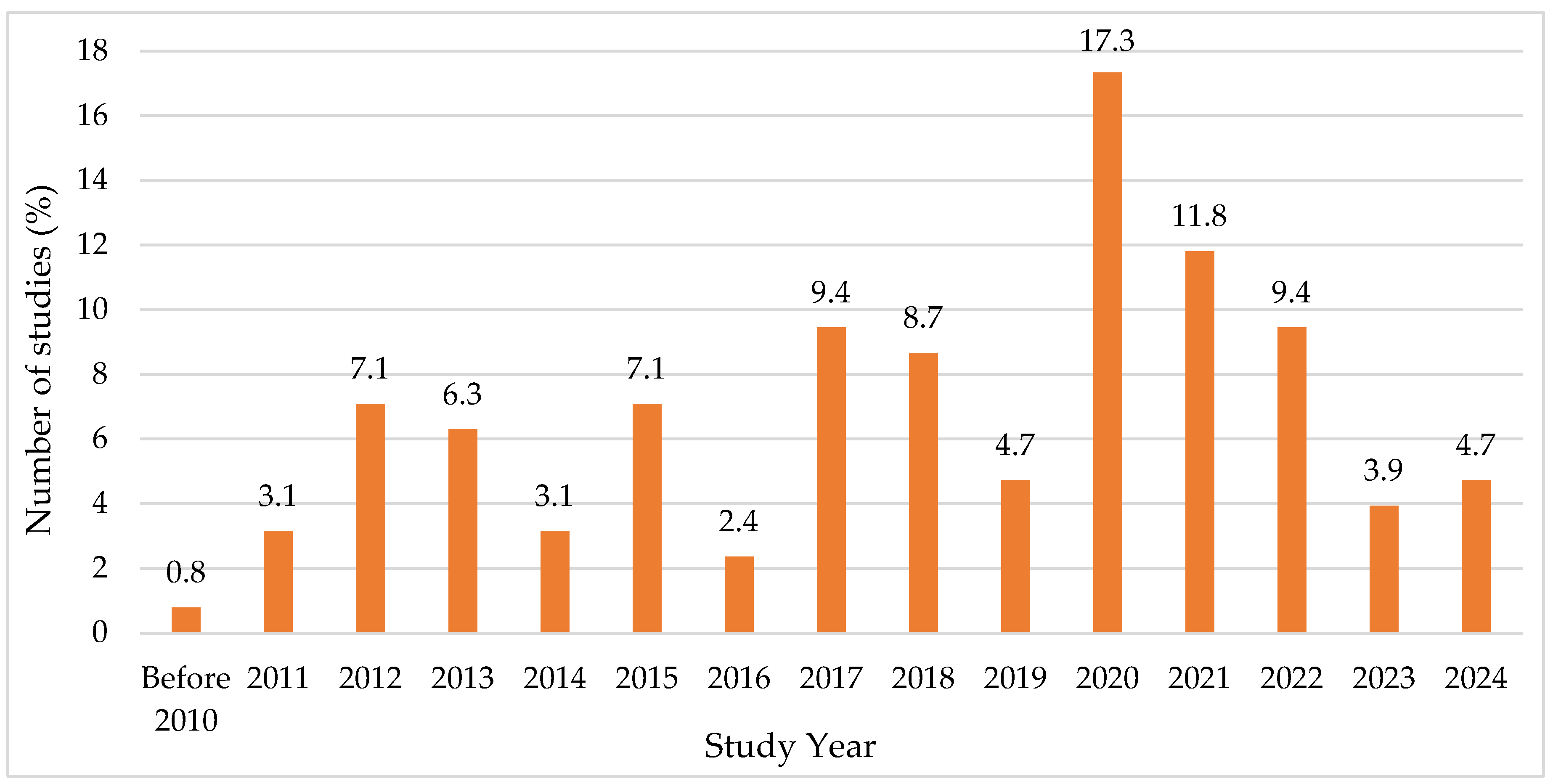
Figure 3.
Primary data sources of past studies.
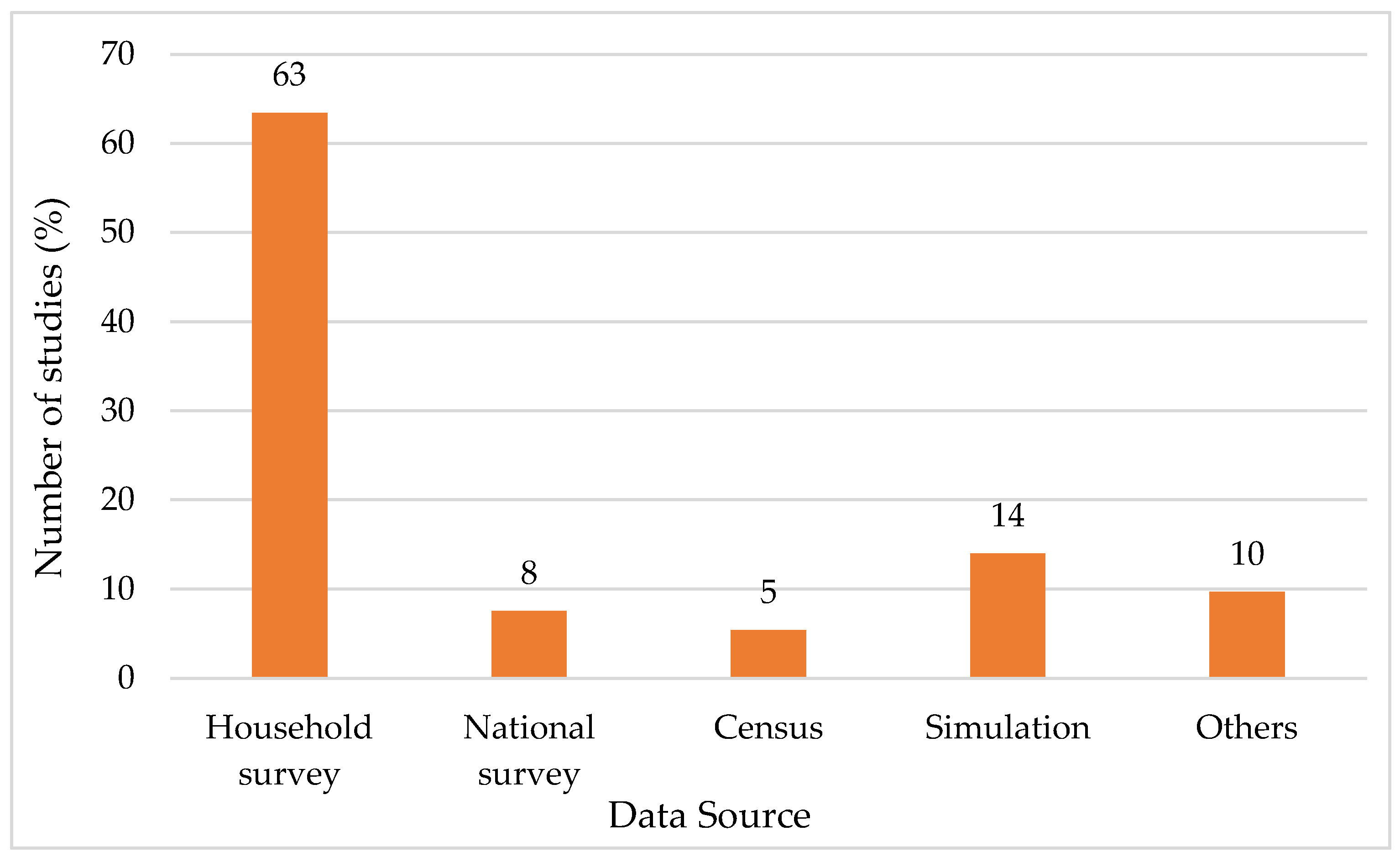
Figure 4.
Methods used in past studies.
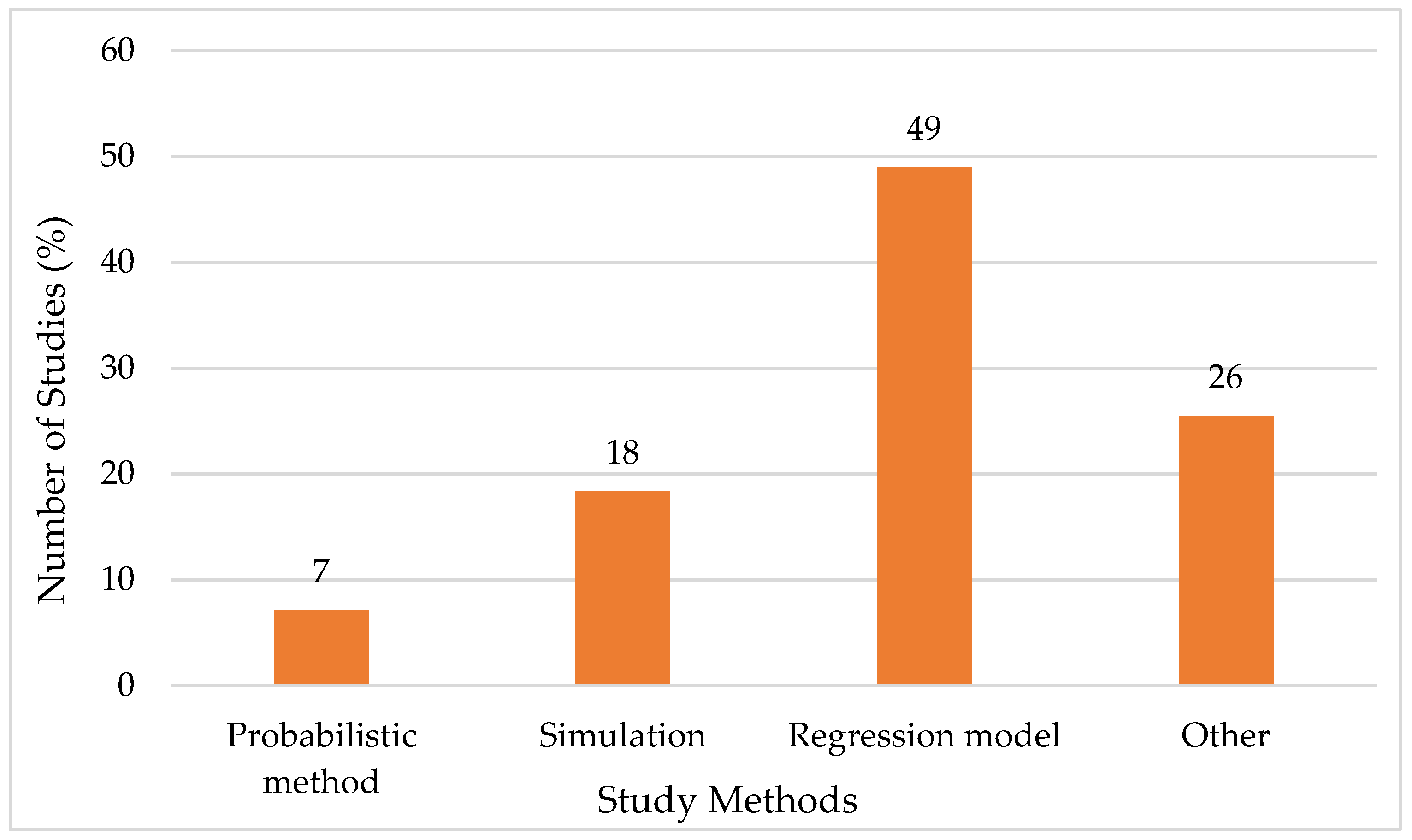
Figure 5.
EV sales from 2016 to 2024.
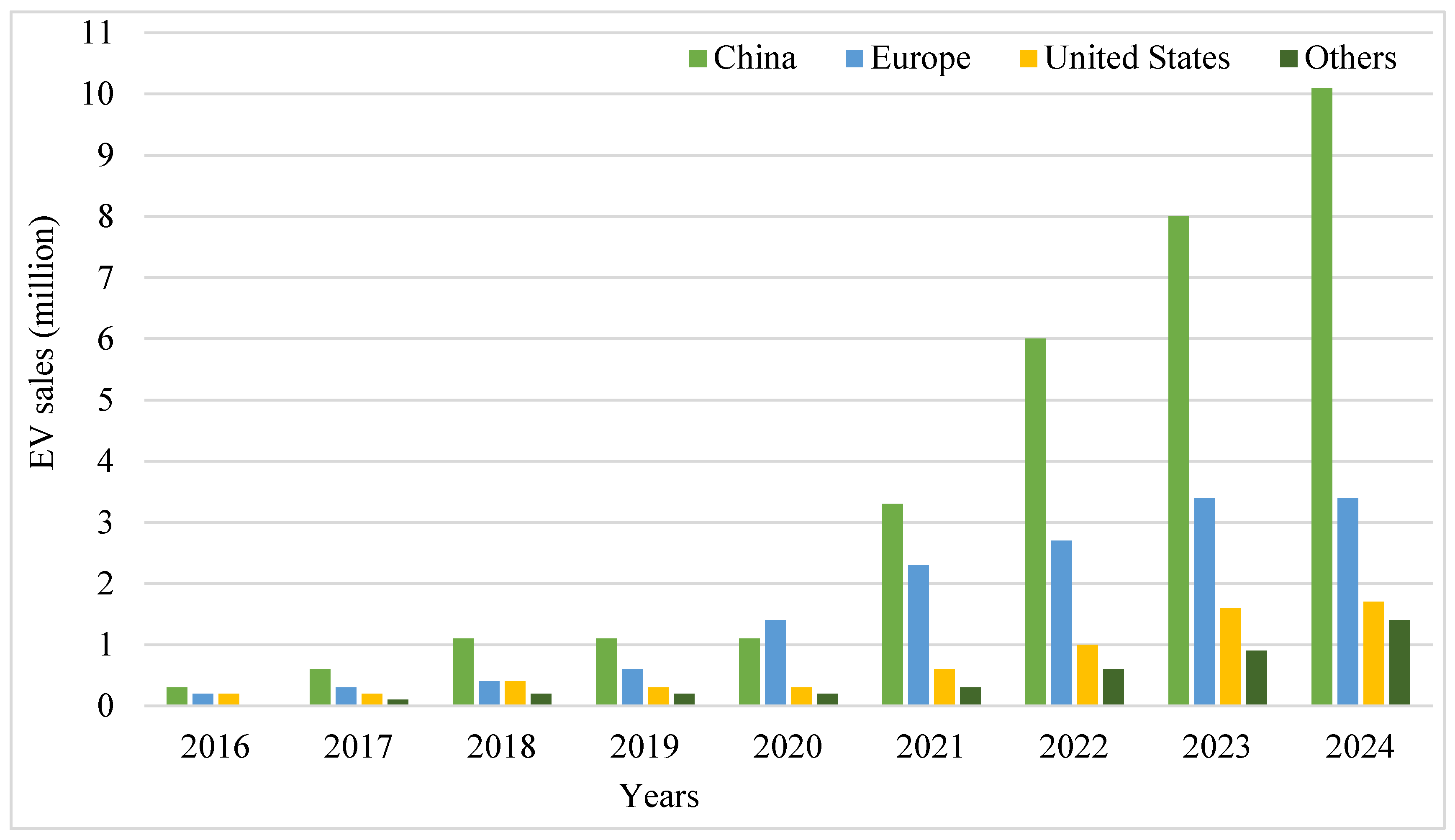
Figure 6.
Multi-factor interactions of EV adoption.
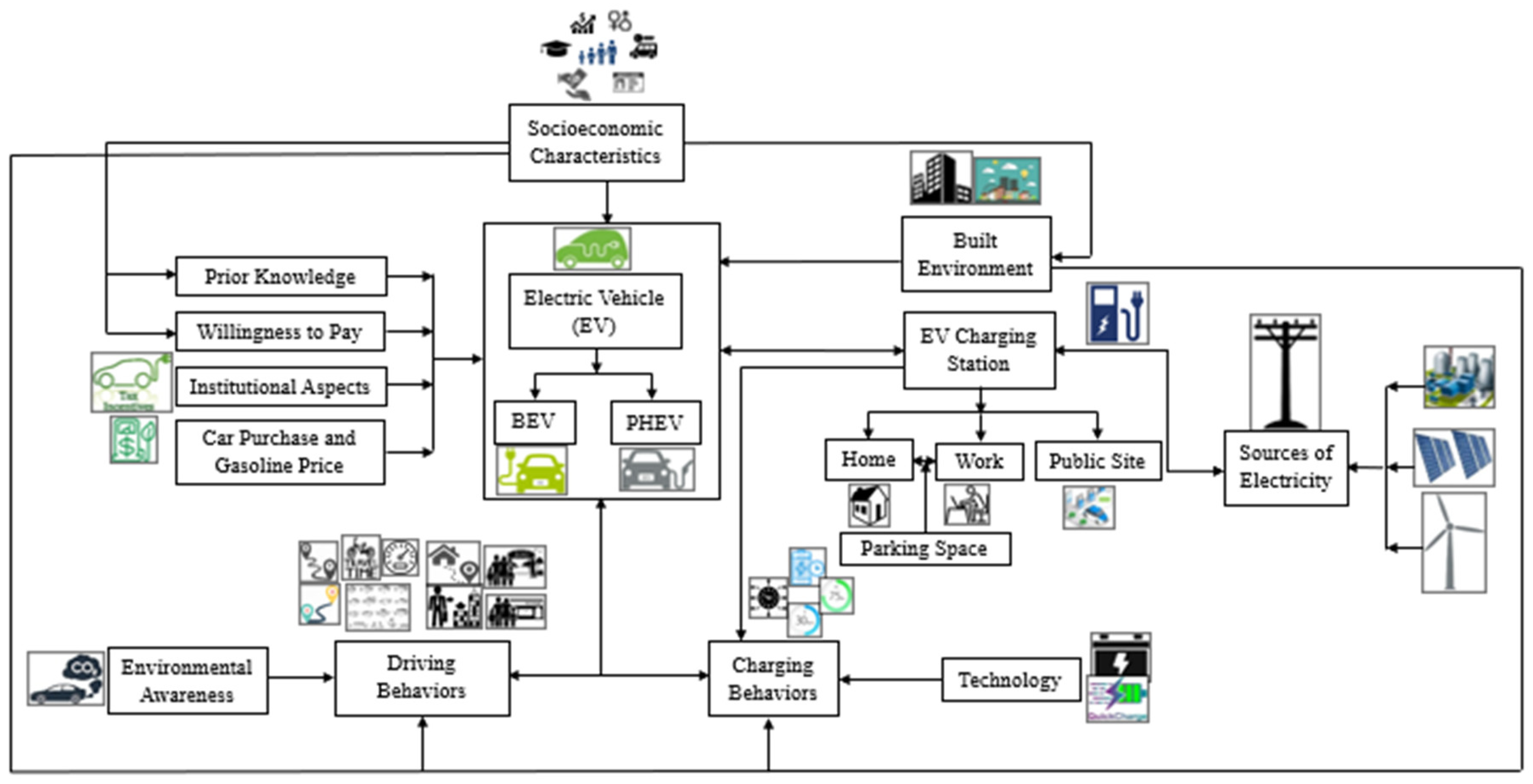
Figure 7.
Projected growth of electricity consumption due to EVs [151].
Figure 7.
Projected growth of electricity consumption due to EVs [151].
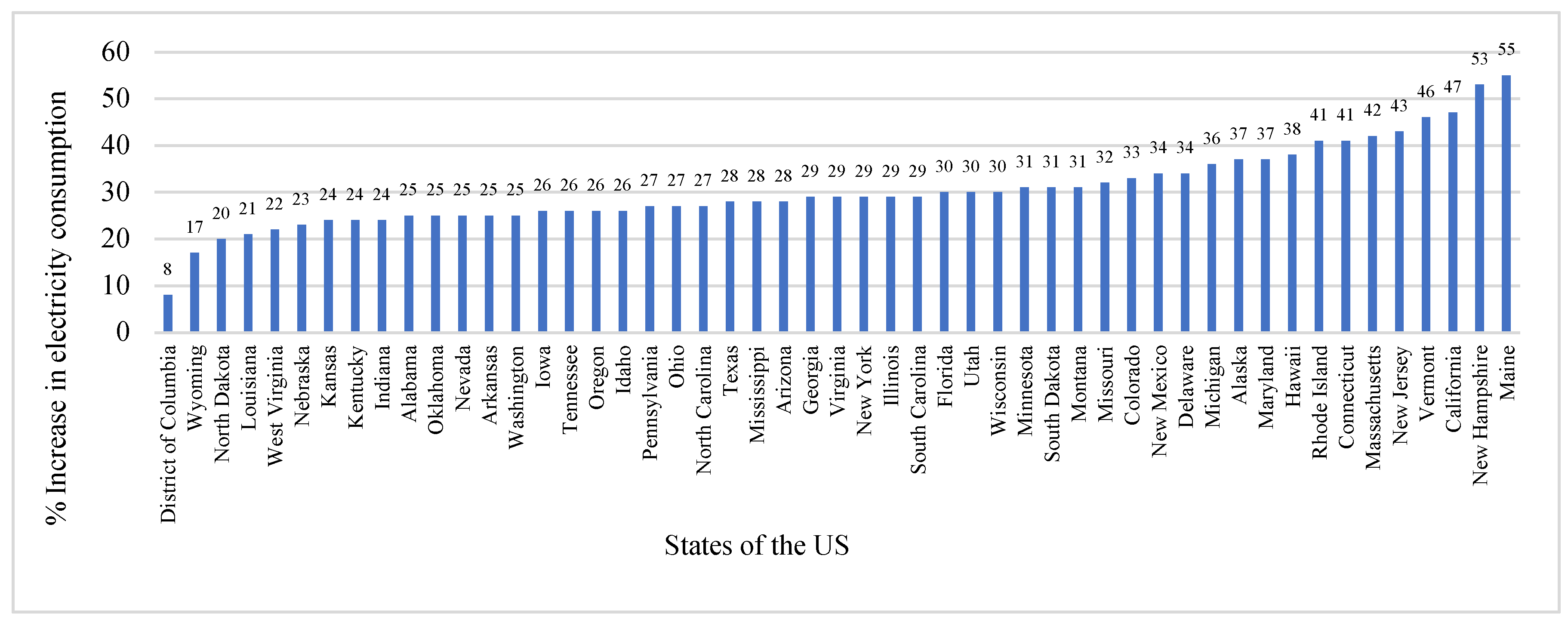
Table 1.
Sources of data and study methodologies of previous studies.
| Study | Data Source | Study Methodology |
| [38] | Trial of 212 EVs (4) | GMMs (1) |
| [39] | Trial of 44 EVs (4) | MCM (1, 2) |
| [40] | 2001 National Household Travel Survey (NHTS) (2) | GaD (1) |
| [41] | Travel data from the vehicle using GPS (1) | GaD (1) |
| [42] | Trial of 44 EV (4), interview (1) | GP (4) |
| [43] | Field trial (4) | GP (4) |
| [44] | 70 residential users (1) | GP (4), NO (4) |
| [45] | Travel data from the vehicle using GPS (1) | GauD (1) |
| [46] | Travel data from the vehicle using GPS (1) | MCM (1, 2) |
| [47] | Typical semi-urban/rural 15 kV grid (4) | MCM (1, 2) |
| [48] | PEV registration data from Southern California Association of Governments (5) | QGM (4) |
| [49] | Mail survey to EV owners (1) | GP (4) |
| [50] | Survey of 1,027 respondents by Opinion Research Corporation (ORC) for NREL (1) | GP (4) |
| [51] | Telephone survey of 1,003 respondents (1) | GP (4) |
| [52] | Mobile survey to 6,499 individuals (1) | GP (4) |
| [53] | Household travel survey of 264 respondents (1) | GP (4) |
| [54] | Online survey of 1,257 EV owners (1) | MNL (3) |
| [12] | GPS travel survey by INRIX (5), 2016 American Community Survey (ACS) (3) | EVI-Pro (2) |
| [55] | Survey of 2,300 CarMax customers (1) | GP (4) |
| [56] | Survey of 1,419 PEV owners (1) | GP (4) |
| [57] | Data from 270 public chargers and 700 residential chargers (1) | GP (4) |
| [58] | ACS (3), 2011 Massachusetts Travel Survey (MTS) (1), Alternative Fuels Data Center (AFDC), and IHS Automotive (5) | OLS (3), EVI-Pro tool (2) |
| [59] | GPS travel survey by INRIX and IHS Automotive (5) | EVI-Pro tool (2) |
| [60] | 2010-2012 California Household Travel Survey (1) | EVI-Pro tool (2) |
| [11] | Vehicle registration data from IHS Automotive (5) | EVI-Pro tool (2) |
| [61] | 2001 NHTS (2), Household survey of PHEV owner (1) | GP (4) |
| [62] | Vehicle registration data from IHS Automotive (5), Front Range Travel Counts (FRTC) survey of 12385 households (1) | BLAST-V (2) |
| [63] | GPS travel survey by INRIX (5) | EVI-Pro tool (2) |
| [64] | Survey of 500 EV owners (1) | WSM (3) |
| [65] | Online survey of EV owners (Phase-1 666 and Phase-2 593) (1) | LM (3) |
| [66] | 2017 NHTS (2), Simulated trip chains of 1000 EVs for 30 days (4) | ABM (2) |
| [67] | Online survey conducted by Gallup Korea (1) | MLM (3) |
| [68] | Online survey of 252 respondents (1) | GP (4) |
| [69] | EV sales data, purchase price, operating costs, speed, fuel availability, emission rating, and battery range from Energy-saving trust and Automobile association (5) | MNL, MLM (3) |
| [70] | Survey of 598 potential car buyers (1) | SLM (3) |
| [71] | Survey of 1,754 new car buyers (1) | MNL (3) |
| [72] | Online survey of 3,029 potential car buyers (1) | MNL, LCM (3) |
| [73] | Online survey of 711 potential car buyers (1) | MNL and MLM (3), simulation (2) |
| [74] | Online survey of 711 potential car buyers (1) | MNL, LCM (3) |
| [75] | A survey of 54 respondents in the Western Australia Electric Vehicle trial (1) | MNL and MLM (3) |
| [76] | Online survey of 1152 potential car buyers (1) | GP (4) |
| [77] | UK Ordnance Survey (5), A series of consumer surveys (1) | WOA (4) |
| [78] | Socioeconomic, environmental and transportation data from European Statistical Databases (2010), European Commission (5) | MCDS and AHP_OWA (4) |
| [79] | Online survey of 4202 respondents in US and 4000 in Japan (1) | ECML (3) |
| [80] | Online survey of 2,302 respondents (1) | OLS (3) |
| [81] | Real EV taxi operation data collected by Daejeon Techno Park (5) | ERDEC (2) |
| [82] | Simulations (4) | ABS (2) |
| [83] | Focus group discussion (1), Australian Bureau of Statistics (ABS) (3) | MCA_CM (4) |
| [84] | 2010 ACS (3) | MILM, MFRLM (4) |
| [85] | 2010 ACS (3) | BTPCAR, SErM (3) |
| [86] | 2010 NHTS (2) | MLM (3) |
| [87] | 2012 vehicle registration data from Delaware Valley Regional Planning Commission (DVRPC) (5) | TPCAR (3) |
| [88] | 1000 household surveys by ORC International (1) | SRA (3) |
| [89] | Monthly sales data of HEVs for the 2000-2010 period from Data Center Archives (5) | GM (3) |
| [90] | Puget Sound Regional Council’s 2006 Household Activity Survey (1) | OLS (3) |
| [91] | Stated preference survey of 996 individuals in October-December 2018 (1) | MLN (1) |
| [92] | Household questionnaire survey of 332 respondents (1) | FA, LM (3) |
| [93] | Survey of 660 respondents (1) | FA, k-means clustering (3, 4) |
| [94] | Online survey of 2,493 respondents (1) | FA, MLM (3) |
| [95] | Online survey of 2,198 individuals (1) | FA, MCA, LM (3) |
| [96] | Survey of 982 individuals (1) | FA, OLM (3) |
| [97] | Survey of 346 participants (1) | DS (4) |
| [98] | Survey of 366 individuals (1) | FA, SEM (3) |
| [99] | Survey of 675 students (1) | SEM (3) |
| [100] | Survey of 405 individuals (1) | SEM (3) |
| [101] | Survey of 526 respondents (1) | SEM (3) |
| [102] | Survey of 350 individuals (1) | OLM (3) |
| [103] | Survey of 172 respondents (1) | FA (3) |
| [104] | Survey of 403 participants (1) | Partial least squares SEM (3) |
| [105] | Online survey of 488 respondents (1) | SEM (3) |
| [106] | Census data (3) | OLS (3) |
| [107] | Survey of 511 respondents (1) | SEM (3) |
Data Source: (1) Household survey, (2) National survey, (3) Census, (4) Simulation, (5) Other; Study Methodology: (1) Probabilistic method, (2) Simulation, (3) Regression model, (4) other.
Table 2.
Positive and negative factors that influence EV adoption.
| Studies | Results |
| [49] | Reduced air pollution (76%), money savings on gasoline (50%), cutting-edge technology (30%), easy driving (39%), quite ride (33%), reliability (96%), easy to maintain (89%), using less or no gas (20%). |
| [51] | Concern for environment (80%), lower long-term costs (67%), cutting-edge technology (54%), access to the carpool lane (35%), reliability (92%), fuel economy (87%), crash rating (77%), cost (71%), vehicle performance (69%), advanced safety technology (60%). |
| [52] | Affordable pricing (52%), longer driving range (37%), improved infrastructure (19%). |
| [54] | Concern for the environment (75%), reduce dependence on petroleum (45%), low price of electricity vs gasoline (43%), tax breaks and net price of the vehicle (38%), cutting-edge technology (32%), vehicle performance (21%). |
| [74] | Replacement of old vehicle (82.7%), additional vehicle (12.1%), initial vehicle purchase (5.2%). |
| [80] | Fuel economy (59.66%), appearance (19.77%), adequate space (8.32%), advanced safety technology (22.29%), reduced dependence on gasoline (26.57%). |
| [118] | Range (59.9%), price (57.3%), charging station (48.5%), consumer knowledge (41.9%), apartment charging (21.6%), lack of incentives (19.8%), lack of car model (17.2%), impacts to grid (16.3%), winter weather (15.9%), lack of political will (12.3%), long charging time (11%). |
| [119] | Charging stations (13.6%), purchase price (12.6%), long-term planning by government (12.1%), repair and maintenance workshops (6.9%), tax exemption policy (6.7%), range (6.1%), battery life (5.7%), battery replacement cost (5.5%), reliability and performance (5.2%), awareness-raising (5.0%), domestic industry (4.1%), understanding of product quality (3.5%), electricity price (2.1%), knowledge about EVs (2.6%), credit access to purchase EVs (2.8%). |
Table 3.
Respondents’ willingness to pay.
| Study | EV | Charging station | Fuel |
| [71] | $1000 to $3000 for PHEV, $3000 to $6000 for EV | - | - |
| [70] * | - | $1089 to $525 | - |
| [88] | - | - | $5.36 -$3.38 per gallon |
| [86] | $963 to $1718 for hybrid | - | - |
| [79] | $21.5 in both US and Japan for full battery | $49.8 in the US and $33.6 in Japan | $49.8 in the US and 36.7 in Japan for fuel cost savings, Americans pay more for emissions reduction than Japanese (i.e., $29 vs. $26.2) |
| [75] | - | $1.17 extra for 10-minute reduction in charging time | - |
| [73]* | $22.1-$45.5 for BEV for every additional driving range, $3215.4 and $6486 for vehicle tax reduction | $62.1 to $127 for 1% expansion of stations, $7 and $24.84 for saving every charging minute | $731.4 to $1476.6 for fuel cost savings of $1.38 per 100 km, $27.6 to $55.2 and $62.1 to $124.2 depending on the budget and environmental concern for a 1% reduction of CO2 emissions |
| [72] | $35 to $75 for a mile of added driving range, $6000 to $16,000 for desirable attributes | $425 to $3250 for a one-hour reduction in charging time | $4853 for each $1.00/gallon reduction, up to $4300 for a 95% reduction of pollution |
| [74]* | $12.6–$131.05 for additional km of driving range, $7522 for vehicle tax exemption, $6212 for using bus lanes and parking for free | $63 to $310.3 for increasing fuel availability by 1%, $5.24-$203.4 for saving one minute charging time | $1105 for fuel cost saving of $1.05/100 km, $14.7 to $1501.3 for reducing 1% of CO2 emissions |
| [52] | Extra $5000 for increasing range from 150 to 200 miles | - | - |
| [56] | - | 40% - 70% more for public charging, double for 15 minutes charge by DCFC what they pay for 1 hour of Level 2 charging, 2.5 to 3 times higher for meeting emergency demands than the daily charging | |
| [65]* | Extra $1131.29 if the monthly leasing cost of battery reduced by $10.2 | - | - |
| [129] | $10,000-$20,000 for BEV technology (US), $0-$10,000 (China), Chinese pay almost twice more than Americans to decrease operating costs of EV ($3000 vs $1600 per $0.01/mile reduction), Chinese pay almost three times more than Americans to decrease acceleration time ($5000 vs $1200 per 1 s decrease), Chinese pay less than Americans to purchase most preferred vehicle ($18,000 vs $27,000) | $6400 for fast charging capability | |
| [130]* | $3822 for an increasing range of 100 km | $4917 for exemption of public charging fee | - |
| [91]* | $3059 to $17180 more for an EV, $34 for an extra km of driving range | $120 for per minute saving for Fast charging time | $353 for fuel cost saving of $1.18/100 km |
| [131] | - | More than 50% of consumers favored quick charging option and were willing to pay double price for that | - |
*Euros, Swiss Francs, and Chinese Yuan were converted to US dollar using the rate in the respective years the studies were conducted.
Table 4.
Average travel distance.
| Study | Average daily travel distance | Travel time | |
| Depart from home | Arrive at home | ||
| [39] | 24.17 miles | - | - |
| [40] | 40 miles | - | - |
| [45] | 24.54 miles | - | 6:55 pm |
| [49] | 20+ miles (30%), 33 miles (33%) | ||
| [46] | <6.2 miles (24%), 21% 6.2-12.43 miles (21%), 12.43-18.64 miles (18%) | 6am to 9am, 6pm to 7pm | 3pm to 6pm |
| [54] | 11.3 and 33.6 miles | - | - |
| [58] | 34.9 miles | - | - |
| [61] | 32.73 miles | - | - |
| [63]. | 37 miles | - | - |
| [68] | 26.72 miles | - | - |
| [80] | 28.35 miles | - | - |
| [81] | Maximum 89.17 miles | - | - |
| [44] | <30 miles | - | - |
| [138] | 12.5 miles (34%), 25 miles (23%), 37.5 miles (15%), 50 miles (10%), 62.5 miles (7.5%), 75 miles (6%) and 87.5 miles (3%) | - | - |
| [127] | 27.42 miles | - | - |
Table 5.
EV charging behaviors.
| Study | Charging duration | Connection time | Charger location | Charger type |
| [56] | - | 8pm-8am (67%), 12am-6am (peak) | Home (91%), public and work (71%) | Level 2 (56%), |
| [55] | 4-8 hrs (48%), 1-3 hrs (23%) and 9-12 hrs (11%) | - | Home (84%), public (8%), Within 5miles (69%), 6-10 miles (18%) | Level 2 (64%) |
| [12] | - | 4pm-8pm, 8am-12pm | Home (66%), | Level 2 and DCFC |
| [53] | after 12am, 7-8 am, 5pm-6pm | Level 2 | ||
| [49] | - | - | Home (87%), work (8%) | - |
| [48] | 6am-9am, 9am-3pm | Work, Metro station | ||
| [54] | - | - | Home (80%), highly travelled corridors | - |
| [51] | 30 min (68%), 15min (44% women, 33% men) | - | - | - |
| [44] | 1-2 hrs, >3 hrs | 4pm-10pm, 8pm-9pm (peak), 4am-7am | - | - |
| [43] | - | 4pm-6:30pm, 10:30pm | Home, work, public | - |
| [42] | - | Working hour | Work | - |
| [39] | - | 12pm, 9am-1pm, midnight | Home, work, public | - |
| [38] | - | 8am-9am, 12pm, 6pm, night | - | - |
| [79] | - | - | Home (82.3% in US, 70.3% in Japan) | - |
| [77] | - | - | Home, City center | - |
| [139] | - | - | City center, along major highways | - |
| [64] | 43 min (retail), 21 min (office), 2 hours 9 min (park and ride), 1-hour 21min (transit station), 21 min (gas station) | - | Home, work, public | - |
| [141] | - | - | Home (85%-95%), work (25%), public (18%) | - |
| [62] | 3 pm-6 pm | Level 1, Level 2, DCFC | ||
| [61] | 3 hrs | Evening, 11pm | - | Level 1 |
| [67] | - | 9am-12pm, 3pm-6pm, | Home (59.1%), public (40.9%) | - |
| [11] | 20 min (DCFC) | Home (88%) | Level 2DCFC | |
| [59] | 8am (peak), 4pm-12am | Home, work, public | Level 2DCFC | |
| [58] | 4pm-10pm, 7am-2pm, 8am-8pm, | Home, work, public | Level 1, Level 2, DCFC | |
| [57] | 1-2 hrs | 9 am-7pm | Home, public (low) | - |
| [68] | 30 min (DCFC) | - | Home (58.4%), work (29.1%) | Level 1 (38.6%), Level 2 and DCFC (51.4%) |
| [66] | - | 8pm (peak), 8am-11am | Home (44.4%), work, public (58.7%) | Level 2 and DCFC |
| [47] | - | 10pm-8am (low rate) | Home, public | Level 1, Level 2, DCFC |
| [138] | - | 7am-10am and 4pm-7pm (65%), 4pm-12am (63%) | - | - |
Disclaimer/Publisher’s Note: The statements, opinions and data contained in all publications are solely those of the individual author(s) and contributor(s) and not of MDPI and/or the editor(s). MDPI and/or the editor(s) disclaim responsibility for any injury to people or property resulting from any ideas, methods, instructions or products referred to in the content. |
© 2024 by the authors. Licensee MDPI, Basel, Switzerland. This article is an open access article distributed under the terms and conditions of the Creative Commons Attribution (CC BY) license (http://creativecommons.org/licenses/by/4.0/).
Copyright: This open access article is published under a Creative Commons CC BY 4.0 license, which permit the free download, distribution, and reuse, provided that the author and preprint are cited in any reuse.