

Submitted:
22 October 2024
Posted:
24 October 2024
You are already at the latest version
Abstract
Autonomous Underwater Vehicles (AUVs) are highly efficient tools for underwater exploration, capable of carrying various payloads to perform specific missions as needed. To ensure the success of these missions and the spatiotemporal accuracy of sampled data, integrated navigation systems and appropriate filtering algorithms are essential. These systems process and merge motion data to provide accurate positioning information. The most commonly used algorithms in integrated navigation systems are Kalman filter and its nonlinear derivatives. Of these, the ensemble Kalman filter (EnKF) is particularly notable for its ability to handle nonlinear systems by incorporating Monte Carlo methods. This study proposes an enhanced adaptive EnKF algorithm to improve the smoothness and accuracy of the filtering process. Instead of the conventional Gaussian distribution, this algorithm employs a Laplace distribution to construct the system state vector and observation vector ensembles, enhancing stability against non-Gaussian noise. Additionally, the algorithm dynamically adjusts the number of vector members in the ensemble using adaptive mechanism by specifying thresholds during filtering, to adapt the requirements of real-world observational settings. Using measured data from field trials, including DVL, GPS, and electronic compass data, we examine the effects of various parameter settings on the algorithm's performance. Optimal parameter settings are identified to fine-tune and verify the filtering algorithm as well as its adaptive capability. The results demonstrate that the enhanced adaptive EnKF algorithm exhibits superior filtering performance in terms of both accuracy and smoothness compared to the conventional EnKF and EKF algorithms. This indicates the significant advantages of our proposed algorithm for AUV navigation.
Keywords:
1. Introduction
2. AUV Platform and Sensors
3. Setup of Our Proposed Ensemble Kalman Filter
3.1. General Framework of EnKF
3.2. AUV State Model and Settings
3.3. Generation of State Vector Ensemble
4. Parameters Optimization in EnKF
4.1. Data Sources
4.2. Impact of Key Parameters on EnKF Filtering Performance
4.2.1. Process Noise
4.2.2. Process Noise
4.3. Optimization and Comparative Analysis of Parameter Schemes
5. Adaptive Mechanism in EnKF
5.1. Key Criteria of Adaptive Mechanism
5.1.1. Smoothness of Filtering Results
5.1.2. Credibility of Filtering Outputs
5.2. Validation of Adaptive Mechanism
6. Comparison of Filtering Performance
6.1. Comparison with Conventional EnKF
6.2. Comparison with EKF
6.3. Discussions
6. Conclusions
Author Contributions
Funding
Data Availability Statement
Acknowledgments
Conflicts of Interest
References
- Yuh, J. Design and Control of Autonomous Underwater Robots: A Survey. Auton. Robots 2000, 8, 7–24. [Google Scholar] [CrossRef]
- Leonard, J.J.; Bahr, A. Autonomous Underwater Vehicle Navigation. In Springer Handbook of Ocean Engineering, 1st ed.; Dhanak, M.R., Xiros, N.I., Eds.; Springer International Publishing: Cham, Switzerland, 2016; pp. 341–358. [Google Scholar] [CrossRef]
- Mu, X.; He, B.; Wu, S.; Zhang, X.; Song, Y.; Yan, T. A Practical INS/GPS/DVL/PS Integrated Navigation Algorithm and Its Application on Autonomous Underwater Vehicle. Appl. Ocean Res. 2020, 106, 102441. [Google Scholar] [CrossRef]
- Sahoo, A.; Dwivedy, S.K.; Robi, P.S. Advancements in the Field of Autonomous Underwater Vehicle. Ocean Eng. 2019, 181, 145–160. [Google Scholar] [CrossRef]
- Wynn, R.B.; Huvenne, V.A.I.; Bas, T.P.; McPhail, S.D.; White, D.; Murton, B.J.; Harris, J.; Bett, B.J.; Tyler, P.A. Autonomous Underwater Vehicles (AUVs): Their Past, Present and Future Contributions to the Advancement of Marine Geoscience. Mar. Geol. 2014, 352, 451–468. [Google Scholar] [CrossRef]
- Paglia, J.G.; Wyman, W.F. DARPA’S Autonomous Minehunting and Mapping Technologies (AMMT) Program: An Overview. In Proceedings of the OCEANS 96 MTS/IEEE Conference: The Coastal Ocean - Prospects for the 21st Century, Fort Lauderdale, FL, USA, 23–26 September 1996; IEEE: Fort Lauderdale, FL, USA, 1996; pp. 794–799. [Google Scholar] [CrossRef]
- Larsen, M.B. High Performance Autonomous Underwater Navigation: Experimental Results. Hydro Int. 2002, 6, 6–9. [Google Scholar]
- Li, Y.P.; Feng, X.S. Application of 6000m Autonomous Underwater Robots “CR-01” in the Investigation of Manganese Nodules in the Pacific Ocean. High Technol. Lett. 2001, 1, 85–87. [Google Scholar]
- Stutters, L.; Liu, H.; Tiltman, C.; Brown, D. Navigation Technologies for Autonomous Underwater Vehicles. IEEE Trans. Syst. Man Cybern. C 2008, 38, 581–589. [Google Scholar] [CrossRef]
- Zhang, B.; Ji, D.; Liu, S.; Zhu, X.; Xu, W. Autonomous Underwater Vehicle Navigation: A Review. Ocean Eng. 2023, 273, 113861. [Google Scholar] [CrossRef]
- Paull, L.; Saeedi, S.; Seto, M.; Li, H. AUV Navigation and Localization: A Review. IEEE J. Ocean. Eng. 2014, 39, 131–149. [Google Scholar] [CrossRef]
- Silva, D.C.; Frutuoso, A.; Souza, L.F.; de Barros, E.A. Comparative Analysis of Innovation-Based Adaptive Kalman Filters Applied to AUVs Navigation. In Proceedings of the 2022 Latin American Robotics Symposium (LARS), 2022 Brazilian Symposium on Robotics (SBR), and 2022 Workshop on Robotics in Education (WRE), 10 October 2022; pp. 31–36. [Google Scholar] [CrossRef]
- Kalman, R.E. A New Approach to Linear Filtering and Prediction Problems. J. Basic Eng. 1960, 82, 35–45. [Google Scholar] [CrossRef]
- Fryxell, D.; Oliveira, P.; Pascoal, A.; Silvestre, C.; Kaminer, I. Navigation, Guidance and Control of AUVs: An Application to the MARIUS Vehicle. Control Eng. Pract. 1996, 4, 401–409. [Google Scholar] [CrossRef]
- Barfoot, T.D.; Forbes, J.R.; Yoon, D.J. Exactly Sparse Gaussian Variational Inference with Application to Derivative-Free Batch Nonlinear State Estimation. Int. J. Robot. Res. 2020, 39, 1473–1502. [Google Scholar] [CrossRef]
- Fulton, T.F.; Cassidy, C.J. Navigation Sensor Data Fusion for the AUV Remus. Mar. Technol. SNAME News 2001, 38, 65–69. [Google Scholar] [CrossRef]
- Crassidis, J.L. Sigma-Point Kalman Filtering for Integrated GPS and Inertial Navigation. IEEE Trans. Aerosp. Electron. Syst. 2006, 42, 750–756. [Google Scholar] [CrossRef]
- Julier, S.J.; Uhlmann, J.K. Unscented Filtering and Nonlinear Estimation. Proc. IEEE 2004, 92, 401–422. [Google Scholar] [CrossRef]
- Allotta, B.; Ridolfi, A.; Costanzi, R.; Monni, N.; Nuti, F.; Fenucci, D.; Mengali, G. An Unscented Kalman Filter-Based Navigation Algorithm for Autonomous Underwater Vehicles. Mechatronics 2016, 39. [Google Scholar] [CrossRef]
- Krauss, S.T.; Stilwell, D.J. Unscented Kalman Filtering on Manifolds for AUV Navigation - Experimental Results. In Proceedings of the OCEANS 2022, Hampton Roads, VA, USA, 10–13 October 2022; pp. 1–6. [Google Scholar] [CrossRef]
- Arulampalam, M.S.; Maskell, S.; Gordon, N.; Clapp, T. A Tutorial on Particle Filters for Online Nonlinear/Non-Gaussian Bayesian Tracking. IEEE Trans. Signal Process. 2002, 50, 174–188. [Google Scholar] [CrossRef]
- Shariati, H.; Moosavi, H.; Danesh, M. Application of Particle Filter Combined with Extended Kalman Filter in Model Identification of an Autonomous Underwater Vehicle Based on Experimental Data. Appl. Ocean Res. 2019, 82, 32–40. [Google Scholar] [CrossRef]
- Donovan, G.T. Position Error Correction for an Autonomous Underwater Vehicle Inertial Navigation System (INS) Using a Particle Filter. IEEE J. Ocean. Eng. 2012, 37, 431–445. [Google Scholar] [CrossRef]
- Houtekamer, P.L.; Mitchell, H.L. Data Assimilation Using an Ensemble Kalman Filter Technique. Mon. Weather Rev. 1998, 126, 796–811. [Google Scholar] [CrossRef]
- Liu, C.; Xue, J. The Ensemble Kalman Filter Theory and Method Development. J. Trop. Meteorol. 2005, 21, 628–633. [Google Scholar]
- Cui, B.; Zhang, J. The Improved Ensemble Kalman Filter for Multisensor Target Tracking. In Proceedings of the 2008 International Symposium on Information Science and Engineering, 20–22 December 2008; pp. 263–265. [Google Scholar] [CrossRef]
- Pornsarayouth, S.; Wongsaisuwan, M.; Yamakita, M. An Improvement of Ensemble Kalman Filter for OOSM Tracking. IFAC Proc. Vol. 2011, 44, 12003–12008. [Google Scholar] [CrossRef]
- Tin, N.; Apriliani, E.; Nurhadi, H. Comparison of AUV Position Estimation Using Kalman Filter, Ensemble Kalman Filter and Fuzzy Kalman Filter Algorithm in the Specified Trajectories. InPrime Indones. J. Pure Appl. Math. 2022, 4, 1–18. [Google Scholar] [CrossRef]
- Ngatini; Apriliani, E.; Nurhadi, H. Ensemble and Fuzzy Kalman Filter for Position Estimation of an Autonomous Underwater Vehicle Based on Dynamical System of AUV Motion. Expert Syst. Appl. 2017, 68, 29–35. [Google Scholar] [CrossRef]
- Tin, N.; Nurhadi, H. Estimasi Lintasan AUV 3 Dimensi (3D) Dengan Ensemble Kalman Filter. INOVTEK Polbeng - Seri Inform. 2018, 4, 12–21. [Google Scholar] [CrossRef]
- Fan, S.; Zhang, X.; Zeng, G.; Cheng, X. Underwater Ice Adaptive Mapping and Reconstruction Using Autonomous Underwater Vehicles. Front. Mar. Sci. 2023, 10, 1124752. [Google Scholar] [CrossRef]
- Miller, P.A.; Farrell, J.A.; Zhao, Y.; Djapic, V. Autonomous Underwater Vehicle Navigation. IEEE J. Ocean. Eng. 2010, 35, 663–678. [Google Scholar] [CrossRef]
- Aghababa, M.P.; Amrollahi, M.H.; Borjkhani, M. Application of GA, PSO, and ACO Algorithms to Path Planning of Autonomous Underwater Vehicles. J. Mar. Sci. Appl. 2012, 11, 378–386. [Google Scholar] [CrossRef]
- Xu, C.; Xu, C.; Wu, C.; Liu, J.; Qu, D.; Xu, F. Accurate Two-Step Filtering for AUV Navigation in Large Deep-Sea Environment. Appl. Ocean Res. 2021, 115, 102821. [Google Scholar] [CrossRef]
- Houtekamer, P.L.; Mitchell, H.L. Ensemble Kalman Filtering. Q. J. R. Meteorol. Soc. 2005, 131, 3269–3289. [Google Scholar] [CrossRef]
- Carrillo, J.; Hoffmann, F.; Stuart, A.; Vaes, U. The Ensemble Kalman Filter in the Near-Gaussian Setting. 2022. [Google Scholar] [CrossRef]
- Kozubowski, T.J.; Nadarajah, S. Multitude of Laplace Distributions. Stat. Pap. 2010, 51, 127–148. [Google Scholar] [CrossRef]
- Kotz, S.; Kozubowski, T.; Podgorski, K. The Laplace Distribution and Generalizations: A Revisit with Applications to Communications, Economics, Engineering, and Finance; Springer: New York, NY, USA, 2001. [Google Scholar] [CrossRef]
- Akaike, H. A New Look at the Statistical Model Identification. IEEE Trans. Autom. Control 1974, 19, 716–723. [Google Scholar] [CrossRef]
- Li, D.; Ji, D.; Liu, J.; Lin, Y. A Multi-Model EKF Integrated Navigation Algorithm for Deep Water AUV. Int. J. Adv. Robot. Syst. 2016, 13, 3. [Google Scholar] [CrossRef]
- Mirzaei, M.; Hosseini, I.; Makarem, H. Attitude Determination Improvement in Accelerated Motions for Maneuvering Underwater Vehicles. Appl. Ocean Res. 2020, 104. [Google Scholar] [CrossRef]
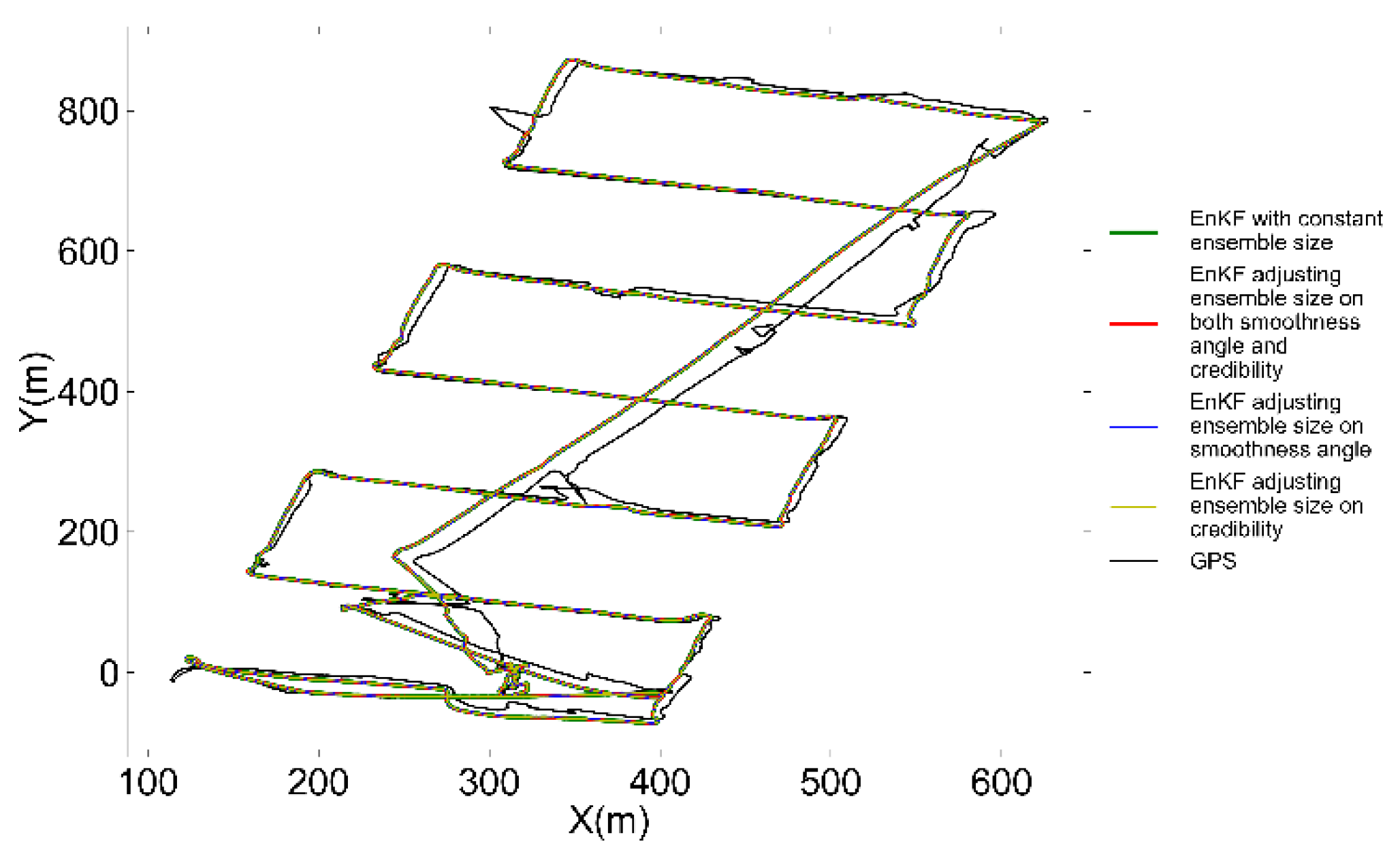
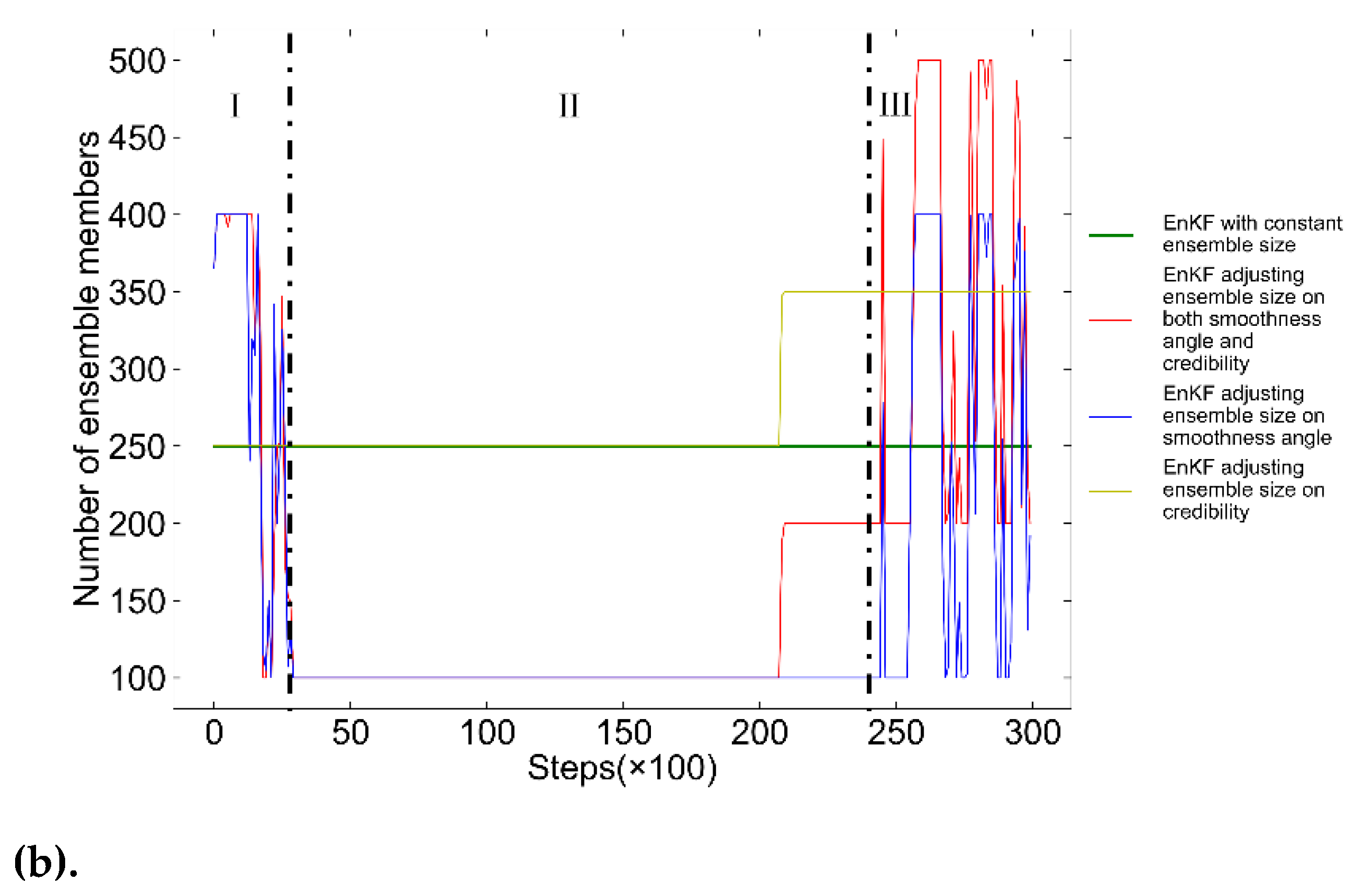
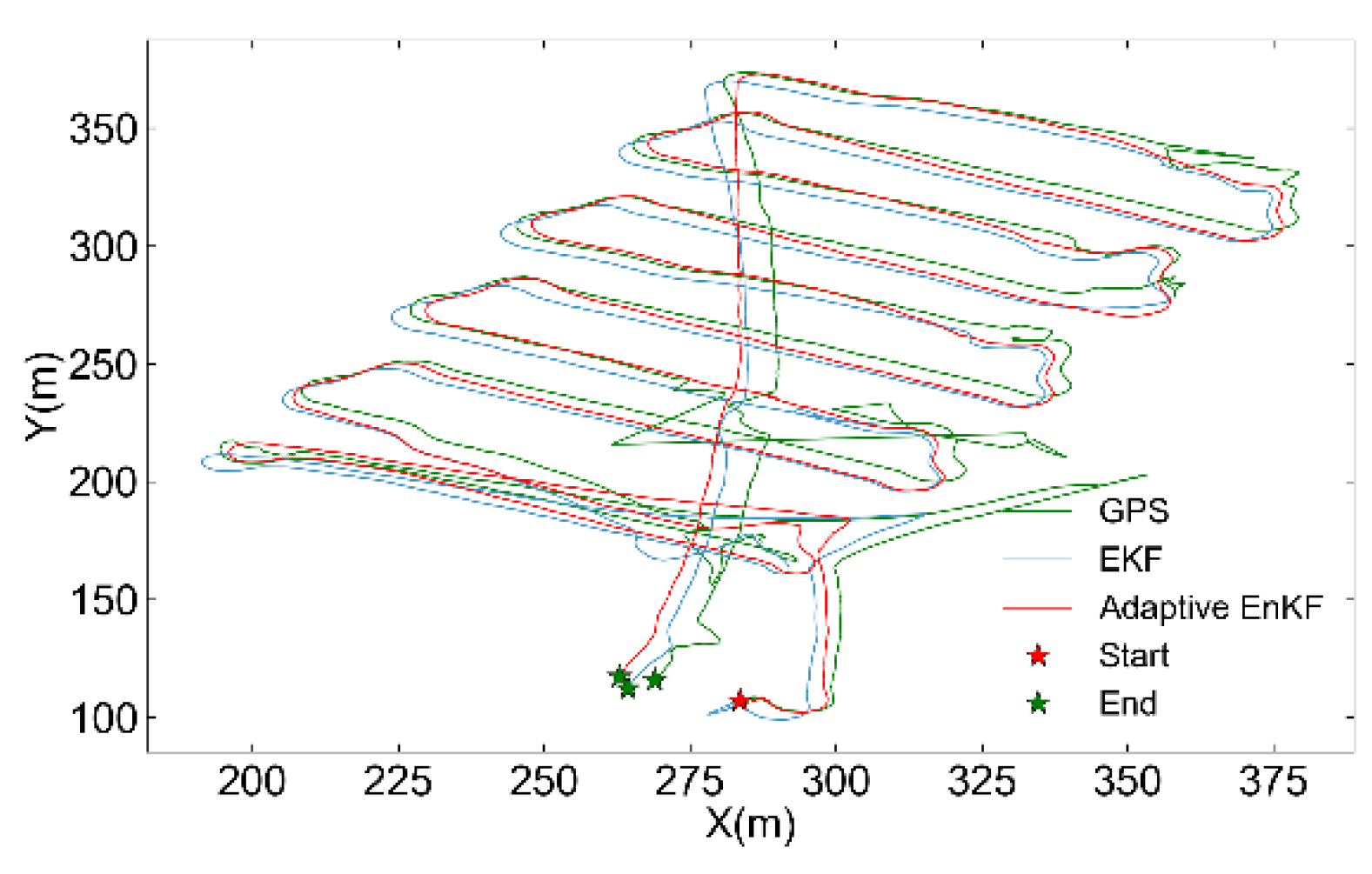

| EnKF with a constant ensemble size(Green curve) | Adaptive EnKF based on both smoothness and credibility of filtering outputs (Red curve) | Adaptive EnKF based on smoothness of filtering results (Blue curve) | Adaptive EnKF based on credibility of filtering outputs (Yellow curve) | |
|---|---|---|---|---|
| Total time(s) | 39.0735s | 36.0798s | 35.7675s | 39.4438s |
| Average time per iteration(s) |
0.0012785s | 0.0011784s | 0.0011683s | 0.0012895s |
| Relative time consumption | 100% | 92.17% | 91.38% | 100.86% |
| Conventional EnKF | Adaptive EnKF | ||||
| Average | RMSE | Average | RMSE | ||
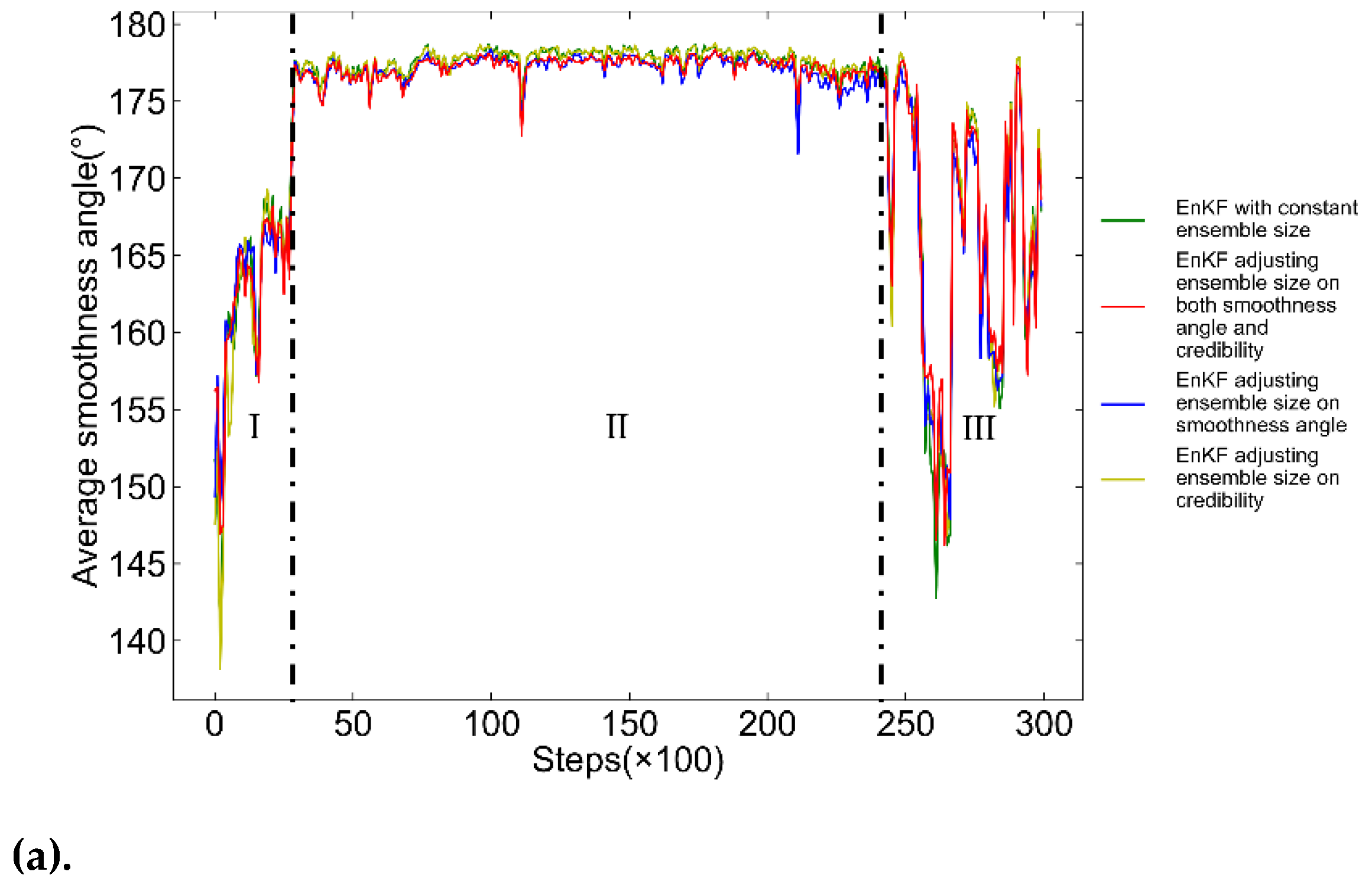
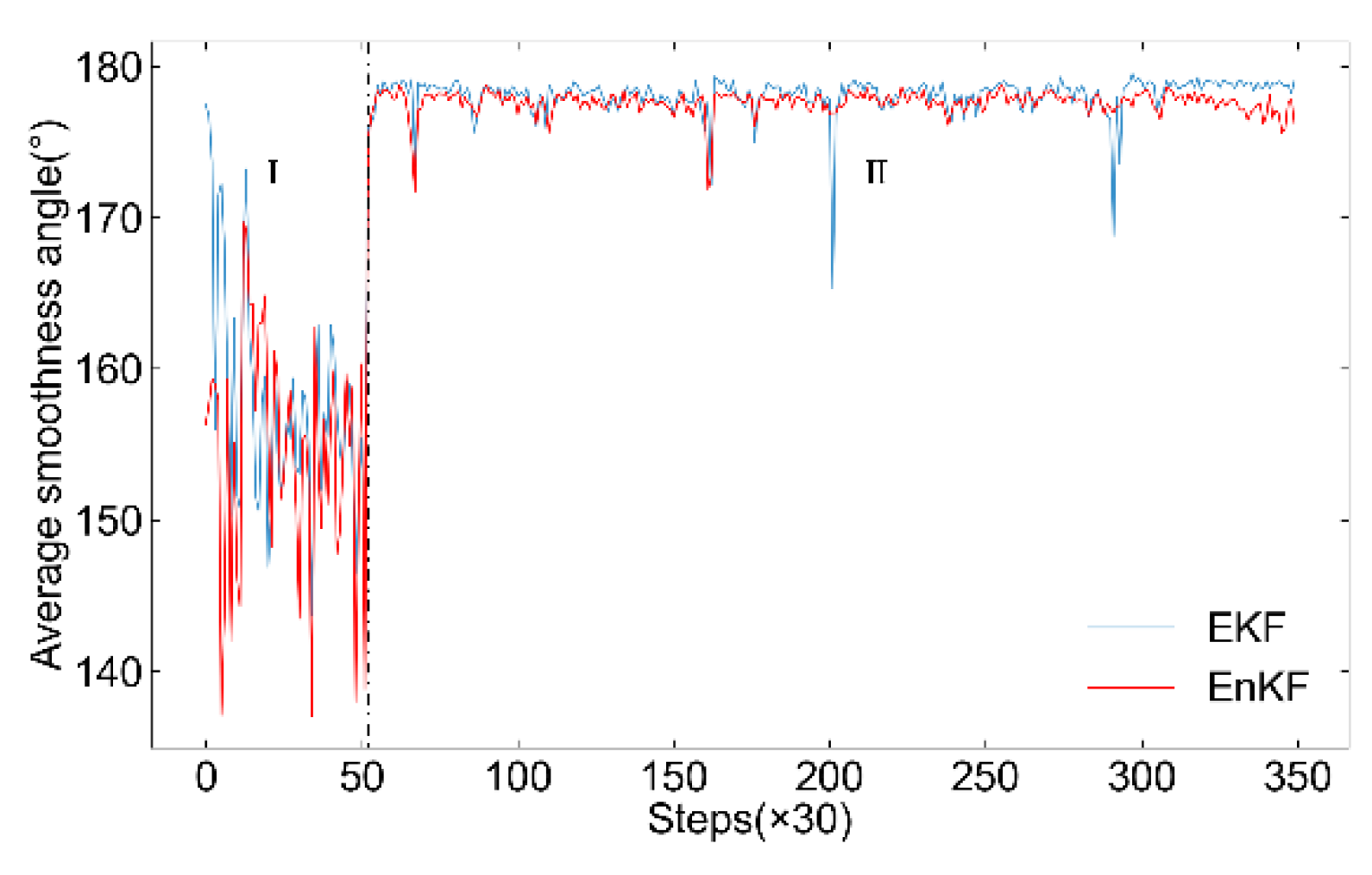
| Smoothness angle | Total | 172.52° | 18.81° | 174.16° | 14.60° |
| Segment I | 152.20° | 17.14° | 157.52° | 13.59° | |
| Segment II | 176.72° | 7.76° | 177.60° | 5.34° | |
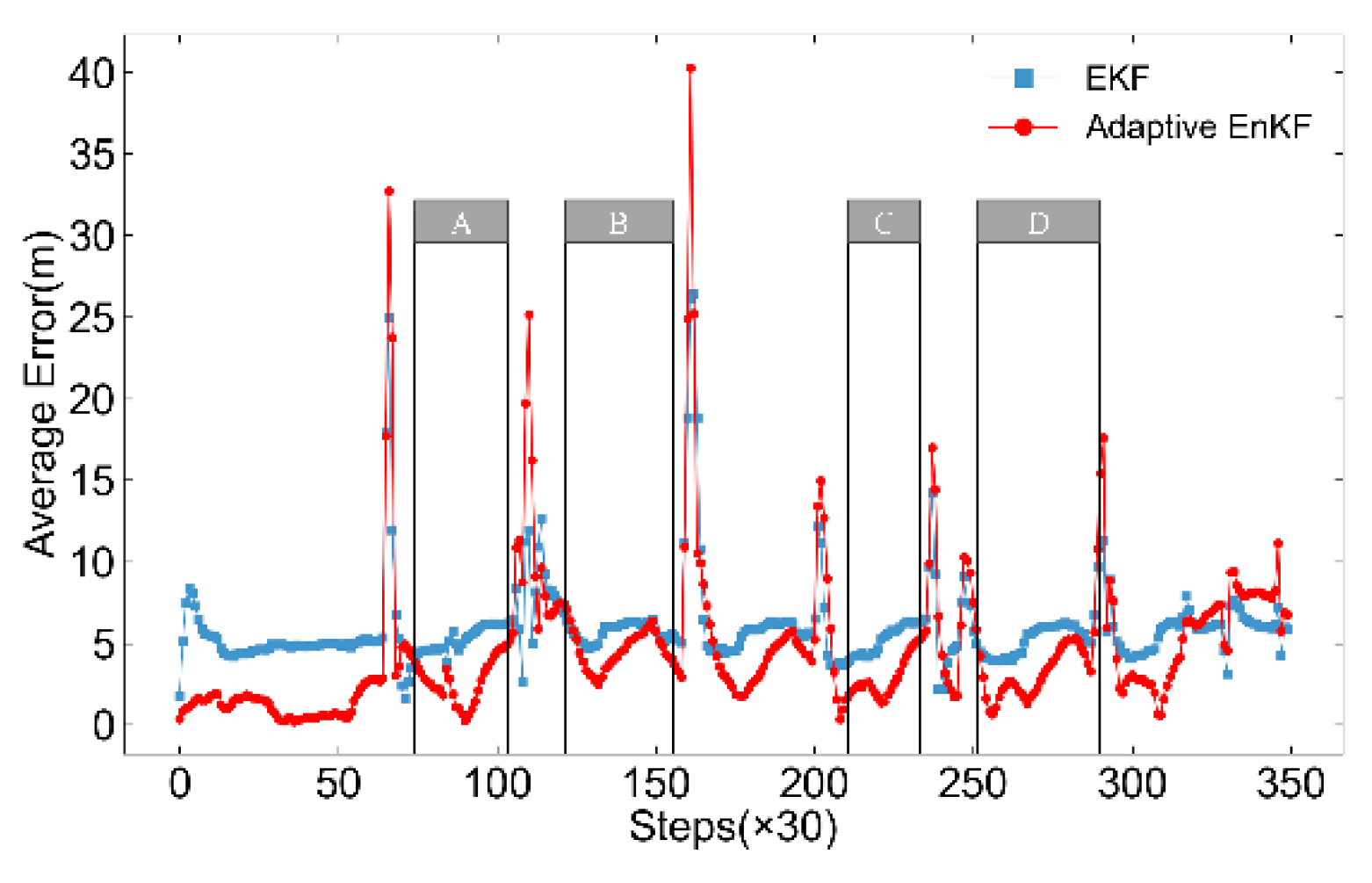
| Absolute Error | 4.28m | 2.54m | 3.47m | 1.67m | |
| Adaptive EnKF | EKF | ||||
| Average | RMSE | Average | RMSE | ||
| Smoothness angle of the trajectory | Total | 174.16° | 14.60° | 175.09° | 13.13° |
| 0-60 steps () | 157.52° | 13.59° | 160.47° | 12.15° | |
| After 60 steps () | 177.60° | 5.34° | 178.12° | 4.97° | |
| Absolute Error | 3.47m | 1.67m | 5.35m | 0.88m | |
Disclaimer/Publisher’s Note: The statements, opinions and data contained in all publications are solely those of the individual author(s) and contributor(s) and not of MDPI and/or the editor(s). MDPI and/or the editor(s) disclaim responsibility for any injury to people or property resulting from any ideas, methods, instructions or products referred to in the content. |
© 2024 by the authors. Licensee MDPI, Basel, Switzerland. This article is an open access article distributed under the terms and conditions of the Creative Commons Attribution (CC BY) license (http://creativecommons.org/licenses/by/4.0/).