
Submitted:
21 October 2024
Posted:
22 October 2024
You are already at the latest version
Abstract
This paper explores the effects of internal marketing practices and transformational leadership on employee customer-oriented behaviour. It uses social exchange and broadened-and-build theories to extend the motivation-opportunity-ability framework to the internal marketing and customer-oriented behaviour literature. Basic psychological needs theory is applied to refine the conceptualisation of internal marketing practices for a more holistic view of employee needs by including spiritual needs. Survey data from 174 frontline employees from the service sector in Pakistan is analysed using PLS-SEM. Results reveal a positive influence of internal marketing practices and transformational leadership on employee customer-oriented behaviour. Specific internal marketing practices and strategies are offered.
Keywords:
customer-oriented behaviour
; internal marketing
; motivation-opportunity-ability frameworkp
; Pakistan
; spiritual needs
; transformational leadership
; SDG8
Summary Statement of Contribution (75words)
This study is un ique in three ways. It extends current CO literature by providing empirical findings on the simultaneous effect of internal marketing practices and transformational leadership on CO. We improved the conceptualisation of internal marketing practices by adding aspect of well-being. Additionally, we adopted the motivation-opportunity-ability framework as mediating IM and TL on CO. It offers practical guides for managers to develop effective IM programs and achieve CO goals. and contribute to SDG 8.
1. Introduction
The service sector is increasingly interested in the concept of 'customer-oriented behaviour' (COB), which refers to employees’ behaviours that promote effective service delivery, customer satisfaction, and fulfilling customers' changing needs. This concept addresses major managerial concerns about quality employee-customer interactions and superior customer experience [1]. Customer-oriented employees engage in effective customer interactions to identify, analyse and answer customer needs through the organisation’s products and services [2]. As a result, customers perceive superior value [3], creating customer loyalty that increases sales and profitability [4].
Indeed, the role of an employee’s COB has proven to affect customers and various aspects of their behaviours. For example, COB was found to influence customers' perceived service quality positively [5], repurchase intention [6] and rapport [7,8]. Research has also found the attitude and behavioural implications of employees’ COB such as job involvement [9], commitment [10], organisational citizenship behaviour [10], selling behaviour [11], intention to leave and burnout [12].
However, a review of the customer orientation literature reveals a need for a more holistic approach. While some studies have been conducted, they often focus on specific aspects of the job environment that may influence COB. Researchers must integrate practices such as job autonomy, communication, growth and development opportunities, and leadership behaviours to understand and improve COB fully. These elements, not extensively covered in the customer orientation literature, are crucial in shaping COB.
Calls for more studies on organisational and work-related elements to improve employees’ COB are long overdue. Joshi [13] highlights the lack of knowledge about how organisational systems and immediate supervisors manage employees to be customer-centric at work. Herhausen [14] calls for a study on the elements of the work environment and job characteristics that promote employee customer orientation. Luu [15], while substantiating the positive influence of authentic leadership on COB and service performance in his research, recommends that future research explore other leadership behaviors and mechanisms driving customer-oriented behavior in an Asian context.
Responding to the persistent calls to study the role of work-related factors and leadership on employee customer-oriented behaviours, this study incorporates internal marketing and transformational leadership as pertinent antecedents to achieve customer orientation. The internal marketing program is a set of practices designed to satisfy employee needs, wants, and expectations to improve performance [16,17], inspiring and motivating employees to show similar concerns to satisfy customer needs in their interactions with them [18]. However, internal marketing may not succeed without the right leadership behaviours since leadership is a starting point for moulding employee behaviour to implement organisational plans [15]. Transformational leaders motivate employees to perform beyond the minimum level of organisational requirements and align follower interests and goals with the organisation’s vision and goals. Hence, transformational leadership and effective organisational practices would create a favourable environment for customer-oriented behaviours to manifest [19].
Regrettably, literature on the intervening mechanisms between internal marketing and customer-oriented behaviour is rare [20,21,22]. To a great extent, an individual’s psychological characteristics matter significantly in the performance of behaviours [23]. Knowing and understanding the influence mechanism is essential. It will guide theory and practice in understanding employees’ cognitive processes, which inform their attitudes and perceptions and are reflected through their behaviour performance. This study uses an established intervening model of motivation, opportunity, and ability to perform framework (MOA) to address the research gap. The MOA framework, which postulates that internal marketing affects employee customer-oriented behaviour through its impact on motivation, opportunity to contribute and ability to perform, provides a formula for causality within the employee and performance link [23].
Against the research gaps discussed above, this study answers the following research questions.
- a.
- How do employees’ perceptions of internal marketing practices and transformational leadership behaviours influence employee customer-oriented behaviour?
- b.
- How does transformational leadership facilitate employees’ perception of internal marketing practices?
- c.
- How do internal marketing practices influence employee motivation, opportunity, and ability to encourage customer-oriented behaviour?
To answer these crucial questions, we endeavour this research to inform theory and practice on the role of comprehensive internal marketing practices and transformational leadership behaviour for COB. Our findings will shed light on the critical mediating attitudes via the MOA framework that must be catered through internal marketing to build a motivating and encouraging climate for enabling employee COB, thereby enlightening the reader on these essential aspects.
The remainder of this paper is organised as follows. First, we present a literature review and hypotheses. Second, we describe the methodology. Third, we analyse the data using PLS-SEM and test hypotheses. We continue to discuss our findings and their theoretical and managerial implications. In the final sections, we present the study’s limitations and avenues for future research.
2. Literature Review and Hypothesis Development
The customer orientation concept originated in the relationship marketing literature and at the centre of relationship marketing theory. It aims to build and maintain long-term customer relationships [24]. The key trends that have reinforced the need for firms to be customer-oriented are intense competition and market productivity, demanding and well-informed consumers, and declining product differentiation, especially in the service industry [24].
An organisation’s goal to become customer-oriented depends on its employees since they are responsible for service delivery hence fostering customer orientation at the employee level is critical [4]. Research suggests that positive actions toward employees improve the organisation's image and encourage customer-focused behaviour among staff [25]. Employees can be influenced to act in a customer-oriented manner due to pressure or obligation [25].
Internal Marketing and Transformational Leadership are crucial antecedents of Employee Customer-Oriented Behaviours. It shape the behaviour of employees and influencing their interactions with customers. Since customer orientation is a relational concept that aims to fulfil customer needs to build long-term relationships [25,26], organisations must adopt an inside-out approach and develop relationships with employees [27,28]. Building long-term relationships with employees is based on satisfying their needs, consistent with the strategic intent of internal marketing practices [29] and transformational leadership [30]. Internal marketing practices and transformational leadership are relational and convey a consistent message of employee care and concern. As a result, quality social exchange relationships are formed between the organisation and its employees. Consequently, well-treated employees will serve their customers better.
The social exchange theory perspective provides a foundation for explaining these associations. The social exchange theory Blau [31] suggests that employees would adopt specific behaviours based on the norm of reciprocity to express gratitude to their organisations [32]. When employees believe that their organisations care and value them, they will feel a certain sense of pressure or obligation to return the favour to the organisation through the same behaviours in their interaction with the customers [33]. Therefore, internal marketing practices and transformational leadership behaviour would establish quality exchange relationships with employees, and employees would sense that it is their responsibility to adopt actions that satisfy a variety of customer's needs as well.
For example, Nart [33] explains that when employees receive benefits in the workplace, they feel obligated to repay in various ways. Hence, adopting internal marketing practices such as internal communication, training, and internal market research encourages employees to repay the organisation through organisationally desired behaviour based on the norm of reciprocity to express gratitude to their organisations [34]. Men [30] explains that leadership is essential in creating an internal environment that influences employees’ attitudes and motivation. Therefore, the transformational leadership style should be advocated to develop a favourable internal reputation to generate positive behaviour [30,34,35].
Internal marketing requires a compatible leadership style for successful implementation. A proper leadership style will successfully influence employee attitudes and behaviours to achieve organisational goals and meet the fundamental objectives of internal marketing [29]. Transformational leaders are conscious of employee needs and demands and empower employees to grow and develop. Employees appreciate such leadership behaviours and are motivated to fulfil organisational goals. Fulfilling employee needs is also a significant purpose of internal marketing. Transformational leaders build relationships with subordinates and transform employees by emphasising organisational values and creating a shared vision among organisational members [36]. Hence, transformational leader behaviours create a mental connection between employees and the organisation so that employees come to accept the defined goals and values of the organisation and form positive perceptions of the organisation’s practices. Hence, we hypothesise:
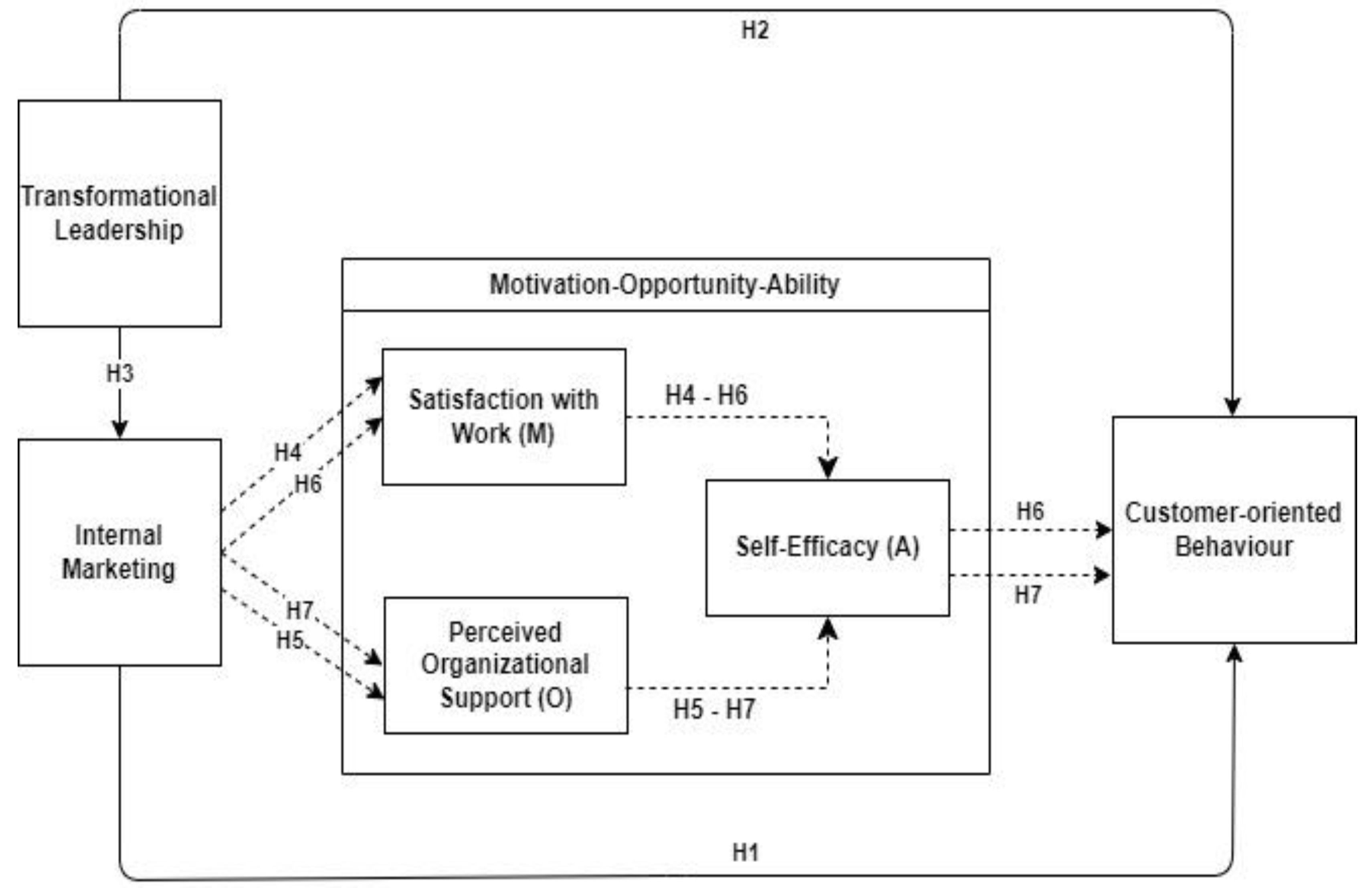
Hypothesis 1:
Employee perception of internal marketing practices positively influences customer-oriented behaviour.
Hypothesis 2:
Transformational Leadership behaviour positively impacts employee customer-oriented behaviour.
Hypothesis 3:
Transformational leadership behaviour positively influences the employee perception of internal marketing practices.
Mediators of Internal Marketing and Customer-Oriented Behaviour
Employee motivation, perception of the organisation’s environment, and performance ability are critical factors determining employee performance. There is little understanding of how employees’ perception of internal marketing contributes to positive attitudes and enhances customer-oriented behaviour [36]. The scarcity of literature on the intervening mechanisms between internal marketing and outcomes prompts calls for further research. Arasli et al. [36] and Cho and Choi [37] call for more empirical research to explain the relationship between internal marketing and attitudes and outcomes. Unfortunately, employee motivation, perceived opportunities, and self-beliefs are not woven well into the conceptual framework of internal marketing and customer-oriented behaviour [20,21].
The mediating mechanism for the ultimate variable customer-oriented behaviour is rare and fragmented, and the theoretical underpinnings of these mediating mechanisms need to be synthesised. This study adopted the motivation, opportunity to perform and ability (MOA) framework [37] to investigate the mediating mechanism between internal marketing and employee customer-oriented behaviour. The MOA framework provides a formula for causality within the employee and performance link. The MOA model's advantage is that it postulates that an internal marketing program that satisfies employees’ needs will produce a more motivated, satisfied, and competent workforce. Satisfied and motivated employees will reciprocate with more productive, prosocial, and customer-oriented behaviours [38,39] .
In line with the literature, satisfaction with work is categorised as motivation [40,41]; perceived organisational support is categorised as an opportunity to perform [35,41,42] and perceived self-efficacy is categorised as ability [43,44]. This research aims to amalgamate the MOA framework’s mediating factors to offer a complete picture of the underlying mechanisms of internal marketing and its relationship with employees’ customer-oriented behaviour. Hence, MOA is proposed as the mediating link between internal marketing and customer-oriented behaviour. It explains how the changes in employee motivation (satisfaction with work) and opportunity to perform (perceived organisational support) influence their ability (perceived self-efficacy) resulting in improved customer-oriented behaviour.
In internal marketing, job satisfaction is a significant outcome [45]. Various studies have found a positive relationship between internal marketing and employees’ job satisfaction [40,46,47]. Job satisfaction is believed to predict employee self-efficacy, which was confirmed in a recent study by Burić and Kim [48]. The broaden-and-build theory of Fredrickson [49] explains this direction of the association between satisfaction with work and self-efficacy. Satisfied employees able to think creatively when faced with diverse job demands [49]. Based on the theoretical and empirical discussion, it is proposed that employee perception of internal marketing practices will enhance employee satisfaction with work, improving employee efficacy beliefs. Hence, it is hypothesised:
Hypothesis 4:
Satisfaction with work positively mediates the relationship between perceived internal marketing practices and perceived self-efficacy
Organisations that invest in employees through internal marketing practices create an effective organisational support system. A supportive organisational environment reduces employees’ stress levels and helps them to recuperate a sense of control in the [50]. Santos and Gonçalves [51] found that internal marketing positively influences employees’ perception of organisational support. Perceived organisational support positively influences employees’ emotional and psychological states and reinforces their self-beliefs. They are more committed and resourceful to accomplish the task [52].
This could further be explained by the broaden-and-build theory [49], which states that positive emotions lead to the development of positive resources such as self-efficacy. When employees believe that the organisation values their contribution and expects that it will provide them with resources and reward their performance, they experience positive emotions. Caesens and Stinglhamber [52] found that the more employees feel supported and valued by their organisation, the more they develop a high self-efficacy. Employees' perception of organisational support boosts their self-confidence for challenging tasks, making them more effective [53]. As Internal marketing represents arrays of organisational efforts to support employees, their perception of internal marketing practices positively influences employees' perceived organisational support, consequently improving employee efficacy beliefs.
Hypothesis 5:
Perceived organisational support positively mediates the relationship between perceived internal marketing practices and perceived self-efficacy.
Employee elf-efficacy influences one's activity choices, involvement and persistence [54], the strongest driver of frontline employees’ service and sales performance [55]. Gountas, Gountas, and Mavondo [3] found a significant positive relationship between self-efficacy and employee customer orientation in the real estate industry. Similarly, Pimpakorn and Patterson [44] found a significant positive relationship between self-efficacy and customer-oriented behaviour among frontline employees in four service industries: life insurance, mobile phones, retail banks and post offices in Thailand. In sum, employees' perception of internal marketing practices positively influences their satisfaction, perception of organisational support, efficacy beliefs, and customer-oriented behaviour. Hence, the following hypotheses depict the anticipated mediations:
Hypothesis 6:
Employee perception of internal marketing practices positively influences employees’ satisfaction with work, enhancing their perceived self-efficacy and improving customer-oriented behaviour.
Hypothesis 7:
Employee perception of internal marketing positively influences employees’ perceived organisational support and enhances their self-efficacy, leading to a positive influence on customer-oriented behaviour.
Figure 1.
Conceptual Framework representing Research Hypotheses.
3. Methodology
3.1. Data Collection
We employed a questionnaire survey to collect data from frontline employees working in the service sector. The survey and its administration procedure was approved by UBD School of Business, Faculty Ethicss committee. A total of 200 surveys were collected, and after removing missing and straight-lining (26 invalid cases), a valid sample of 174 questionnaire surveys was used for analysis. The sample consists of respondents employed in sales (59.8%), customer service (38.5%), and marketing roles (1.7%). The sample also reveals a high education level of participants as 40.8% have either completed a master’s or are undergoing a master’s degree, while 39.7% have completed graduation, and 19.5% are enrolled in an undergraduate program.
3.2. Measures
Established measures in the literature are used to gauge the constructs of this study, except for internal marketing. Grizzle et al.’s [56] customer-oriented behaviour scale was adapted to reflect consumer psychometrics better. For example, ‘Is empathetic to customers’ is changed to ‘I try to be empathetic to customers.’ Transformational leadership is measured with a shortened version of the Global Transformational Leadership Scale (GTL) by Carless, Wearing, and Mannis [57], which consists of seven items representing seven transformational leadership behaviours. Bérubé et al.’s [58] Work Domain Satisfaction Scale (WDSC) is used, which is an English version of Blais et al.’s [59] Satisfaction with Work Scale (SWWS) in the French language. The WDSC is a cognitive appraisal of work satisfaction. Bérubé et al. [58] validated the WDSS in their longitudinal study conducted with six samples and found it reliable across samples. Perceived organisational support is measured with 4-items [60]. An 8-item New Generalized Self-Efficacy Scale (NGSE) developed by Chen et al. [60] is used to measure employee’s perceived self-efficacy.
There is a plethora of measures of internal marketing that differ in number and constituents of dimensions. Internal marketing measures are reported to have three dimensions [61,62] , five [63], and six dimensions [64]. However, some common points exist regarding its content. For example, the most used dimension is internal communication, followed by training and reward systems. The diversity in the internal marketing measure is due to the lack of application of an established framework for employee motivation in designing internal marketing programs.
Various business environment factors lead to changing values among the workforce regarding work demanding work-life balance, meaning and purpose in the workplace press the need for a more comprehensive internal marketing program [65,66]. This study uses a comprehensive seven-dimensional internal marketing measure based on basic psychological needs theory. It recognises employees' spiritual, intellectual, social, and emotional needs and their unique contribution. These dimensions of internal marketing are operationalised using items from already established measures to reflect training and development, internal communication, internal market research, reward system, job autonomy, career growth opportunities, and spiritual empowerment. The items are adopted and adapted from the studies of Tsai and Tang [67], Rundle-Thiele [62], Paré and Tremblay [68], Liu [69] and Kolodinsky, Giacalone and Jurkiewicz [69] Fifty-three (53) items cover each internal marketing dimension (7 training and development, 11 internal communication, 6 internal market research, three reward systems, three job autonomy, three career growth and development, and 20 spiritual empowerment).
3.3. Data Analysis
PLS-SEM is used to analyse the data in two stages. The first stage evaluates the seven-dimensional internal marketing measurement model for the lower-order constructs' reliability and validity. All indicators with loadings less than 0.70 are removed. The Cronbach alpha values ranging from α = 0.761 to α = 0.888 confirmed the internal consistency of the lower-order constructs of internal marketing. Composite reliability, the other measure of internal consistency, shows high reliability for all the constructs as the values lie above the threshold value of 0.70 (Hair, Risher, Sarstedt, & Ringle, 2019). The average variance extracted (AVE) is within the acceptable level (≥ 0.50). Thus, convergent validity of all the dimensions of internal marketing is achieved. Using the HTMT test, discriminant validity for training and development, internal communication, internal market research, career growth, reward, job autonomy, and spiritual empowerment are established as the HTMT value falls below the threshold of 0.90 [70].
In stage two, the complete measurement model presented in Figure 2 is evaluated for the reliability and validity of the measures applied. The latent variable scores obtained for the first-order dimensions of second-order internal marketing are used in the measurement model to specify internal marketing. The bootstrapping t-values are computed based on 174 cases and 5000 samples [71]. The model assessment focused on satisfying all relevant criteria: internal consistency, convergent and discriminant validity. All indicators with loadings less than 0.70 are removed. Other reliability and validity measures are assessed after removing items with lower loadings in stages through multiple runs. All the constructs show a high level of internal consistency with composite reliability greater than the threshold value of 0.70. The average variance extracted (AVE) is found to be within the acceptable level in the literature (≥ 0.50), thus revealing the adequacy of convergent validity of all the constructs of the study. Based on the HTMT criterion, discriminant validity of internal marketing, transformational leadership, satisfaction with work, perceived organisational support, general self-efficacy, and customer-oriented behaviour can be established (see Table 1 and Table 2) [70].
To assess the structural relationships between latent variables for hypothesis testing, collinearity is examined first to confirm that it does not bias the results [72]. Table 3 below shows VIF values for predictor variables in the structural model. All the VIF values are below the threshold value (VIF < 3). For the given structural model the regression coefficient for the endogenous variables ranges from 0.446 to 0.525 (see Table 4) which indicates moderate explanatory power. The Q[2] values ranging from 0.271 to 0.327 also indicate medium predictive power.
In addition to examining the model’s in-sample explanatory power, Hair and colleagues (2019) recommended examining its out-of-sample predictive power. Smart PLS provides an option PLSpredict that generates holdout sample-based predictions. The results of PLSpredict show the Q[2]predict values for the customer-oriented behaviour above zero for all its indicators. Next, the PLS-SEM-based prediction errors regarding RMSE for all customer-oriented behaviour indicators are lower than the LM-based prediction errors (see Table 5). For example, when using PLS-SEM to estimate the model, indicators COB_4, COB_5, and COB_6 have RMSE values of 1.289, 1.262, and 1.159, whereas the LM produces RMSE values of 1.309, 1.274, and 1.186. The differences are more pronounced for indicators COB_1, COB_2, COB_3 and COB_7, which have PLS-SEM-based RMSE values of 1.34, 1.352, 1.236, and 1.239 compared to 1.374, 1.387, 1.273, and 1.272 in the LM. Hence, based on Shmueli et al.’s (2019) criteria, none of the indicators of customer-oriented behaviour have higher RMSE values than the LM benchmark; therefore, the path model has high predictive power.
4. Results
The structural relationships between latent constructs specified through hypotheses 1 to 7 are tested using bias-corrected (BC) bootstrapping procedures with 5000 samples. Since the research hypotheses are directional, one-tailed hypothesis testing was conducted using α = 0.05 significance level. Results are shown in Table 6.
4.1. Direct Paths
Results reveal significant direct relationships between latent constructs specified in the hypothesis (H1, H2, and H3). Our hypothesis H1 predicted that internal marketing positively influences employee customer-oriented behaviour. As shown in Table 6, results support substantial and positive influences of internal marketing (ꞵ= 0.191, p < 0.05) on customer-oriented behaviour. Results of the study also support hypothesis H3, that is, transformational leadership influences the employee perception of internal marketing practices (ꞵ= 0.736, p < 0.05). The results also support hypothesis H2 that transformational leadership positively impacts employee customer-oriented behaviour (ꞵ= 0.197, p < 0.05).
4.2. Testing for Mediation
According to the guidelines proposed by Rahi et al. [73] and Li et al.[74] , the mediating relationships should be substantiated based on a bias-corrected confidence interval. If the bias-corrected interval is either entirely higher or lower than zero, it indicates an adequate mediation effect at a 0.05 significance level[73,74]. As illustrated in Table 6, satisfaction with work and perceived organisational support positively mediate the relationship between internal marketing and perceived self-efficacy (ꞵ=0.332, t=5.516, p<0.05; ꞵ=0.179, t=2.559, p<0.05). Also, as per the Rahi et al. [73] guidelines, the bias-corrected interval does not include zero (0.232-0.430; 0.066-0.297). Hence, hypotheses H4 and H5 are supported.
The results support hypotheses H6 and H7. In support of H6 internal marketing significantly and positively influences employees’ satisfaction with work, enhancing their perceived self-efficacy, resulting in improved customer-oriented behaviour (ꞵ= 0.146, t=3.463, p < 0.05, CI = 0.082-0.222). Accordingly, H7 predicts that internal marketing significantly and positively influences employees’ perceived organisational support that enhances their self-efficacy, positively impacting their customer-oriented behaviour (ꞵ= 0.079, t=2.241, p < 0.05, CI = 0.021-0.111).
5. Discussion
The study’s results prove that employees' perception of internal marketing practices has a significant positive impact on employees’ customer-oriented behaviour. This implies that if employees perceive that their organisation is highly invested in internal marketing practices to satisfy their needs, they will feel obliged to reciprocate the same treatment as their organisation in their interactions with the customers. Hence, employees will work to identify and meet the customers’ changing needs and adopt conscientious behaviour in service delivery activities. This is consistent with findings in the literature [33,75]. For example, Cho and Choi [76] found that training, rewards and benefits influence employees' customer orientation when working for tourist, business, and luxury hotels in South Korea. According to Park and Tran [38], management concerns, training, communication, empowerment, and rewards favourably impact the customer-oriented behaviour of salespeople in the banking sector in Vietnam.
The findings of this study show that transformational leadership is an essential antecedent to both internal marketing practices and employee customer-oriented behaviour. Transformational leadership style plays a vital role in the codification of internal marketing, which accentuates satisfying employees’ needs to improve performance. While transformational leadership also focuses on the subordinates’ needs and demands, it communicates the organisation’s vision and objectives to align employee goals with the organisational goals. Communication is also an essential element of internal marketing. Transformational leaders also empower employees through involvement and participation and encourage novel solutions to the problems that nurture subordinates’ growth and development. Internal marketing also empowers and motivates employees through autonomy, reward, training, and growth opportunities. Finally, they establish an actual connection between employees and the organisation by providing emotional support through ethical, conscious and spiritual processes. Internal marketing through spiritual empowerment taps into employees’ spiritual and emotional needs to uplift them and develop an association between the organisation and employees. Thus, the transformational leadership style possesses all the elements relevant to internal marketing practices. Hence, transformational leadership and internal marketing practices sync up as Akbari and colleagues proposed in their theoretical study that transformational leadership and internal marketing go hand in hand as a transformational leadership style affects internal marketing dimensions [29].
The study also illustrates the mediating mechanism in transitioning the effect from employee perception of internal marketing practices to employees’ customer-oriented behaviour. The findings of this study align with the propositions in the extant literature that internal marketing acts as a pre-requisite that converts employees into satisfied, motivated, and competent human capital that would subsequently enact the organisations’ marketing objectives and strengthen the competitive position of the firm in the external market [77,78]. Hence, employee’s perception of internal marketing practices elevates customer-oriented behaviour through the positive mediating role of satisfaction with work and perception of organisational support on their perceived ability. The takeaway point from this finding is that organisations must work and implement internal marketing practices to improve employees’ job-related attitudes such as satisfaction and perceived support that will improve employees’ self-confidence in their ability to perform the job [22,79,80]. Also, applying the MOA framework provides a comprehensive perspective by accounting for employees' attitudes and perceptions as determinants of workplace performance [81].
6. Implications
6.1. Theoretical Contributions
From a theoretical perspective, knowing what is known about customer orientation from the organisational level antecedents in a service context is essential. Research on the organisational antecedents of customer-oriented behaviour is fragmented and mainly focused on the soft elements of the organisation [82]. As a result, this has left the critical issue of what organisations can do to improve employee customer-oriented behaviour unanswered. This research contributes to the customer orientation literature by integrating two crucial domains, internal marketing and transformational leadership, as antecedents to employee customer-oriented behaviour [22,29]. Hence the current research responds to the calls for more studies regarding the organisational factors that impact customer-oriented behaviour [33,38,83]. This research study heeds the call and extends the stream of research by gauging the concurrent effects of internal marketing practices and transformational leadership on employee customer-oriented behaviour. To the author’s knowledge, there is no report on the simultaneous test of the three concepts in a single study.
This study contributes to the leadership literature exploring the relationship between transformational leadership and internal marketing. Although the importance of leadership has been empirically documented for successful organisational strategy implementation [84,85], its application in the internal marketing context is scant [29]. This thesis contributes to understanding the vital role of transformational leadership in influencing employees’ perceptions of their organisation’s internal marketing practices. It sheds light on the alignment of transformational leadership with internal marketing practices.
Another contribution this study makes is extending the discussion on internal marketing. The literature on internal marketing is inconsistent and lacks clarity at the conceptual and operational levels [18,39]. The present study provides an improved conceptualisation of internal marketing and uses basic psychological needs theory to define its dimensions [39]. Hence, this thesis presents a more comprehensive conceptualisation of internal marketing dimensions. It also extends the internal marketing concept by including the spiritual empowerment of employees in its set of practices to consider a more holistic view of employee needs.
This research also extends the motivation, opportunity, and ability to perform (MOA) framework as a mediating explanation to the internal marketing and customer orientation link. Though the MOA framework has been used to explain employee performance for high-performance work practices [20,21,36], it has not been used and understood to explain the influence of internal marketing for a specific behavioural outcome such as customer orientation[36]. Understanding employees’ cognitive process between the internal marketing practices and customer-oriented behaviour relationship provides knowledge on employees’ attitudes and motivations required for performance. Hence, the MOA framework provides an integrated view of employees’ motivations and attitudes that convey the influence of internal marketing on employee customer-oriented behaviour.
This study also contributes to the existing literature by integrating the Theory of Relationship Marketing, Social Exchange Theory, and Broadened-and -Build Theory to explain the relationship among the variables. Under the umbrella of Relationship Marketing Theory, this study proposed internal marketing and transformational leadership as an organization’s tools for developing long-term employee relationships that subsequently result in improved employees’ customer-oriented behaviour - critical for customer relationship building in the service industry. The Social Exchange Theory helps understand the relationship between internal marketing practices, transformational leadership, and employee customer-oriented behaviour. When employees feel that their organization and supervisor care about and value and satisfy their needs, they feel obliged and engage in a social exchange - reciprocating through organisationally desired behaviours [86]. The Broadened-and-Build Theory is applied to clarify the role of employee work satisfaction and perception of organisational support. It broadens their attention and thinking and builds personal resources such as self-efficacy beliefs that lead to customer-oriented behaviour.
6.2. Managerial Implications
In the competitive business landscape, good management practices and leadership must be considered to generate economic value for the organisation. This study provides guidelines to managers regarding specific internal marketing practices that would help satisfy employee needs and build and maintain relationships with employees to achieve customer orientation. Managers can use the specified internal marketing practices to identify areas lacking in their internal marketing programs and make improvements.
By communicating and aligning the organisation’s vision and goals with employees and engaging in focused development and coaching of employees, transformational leaders create enabling situations in which people think and behave in ways that contribute to corporate goals [87]. Hence, findings from this study may further professionals’ interest in transformational leadership behaviours, providing training to managers to align their leadership styles to transformational leaders. The findings would suggest how instrumental transformational leadership is for successful internal marketing.
This study embraces the MOA framework to guide managers on cognitive processes for behavioural change and inform the practice of how internal marketing influences customer-oriented behaviour. Hence the findings from this study suggest that the critical mediating attitudes that practitioners must attend to through internal marketing to build a motivating and encouraging climate for employees to be customer-oriented.
7. Limitations and Future Research
This study has limitations that affect the interpretation of its findings. The cross-sectional design captures a static view of employees’ perceptions of internal marketing and customer-oriented behaviour, overlooking how these may evolve. Organisational changes in policies, practices, and leadership could also influence employee attitudes. Therefore, future research should employ longitudinal studies to assess the long-term effects of internal marketing and transformational leadership on employee perceptions and customer-oriented behaviour.
The study used purposive sampling from a single city in Pakistan, limiting representativeness [88]. COVID-19 further restricted data collection due to reduced employee availability. Therefore, the results cannot be generalised, and future research with a larger, more representative sample is needed. Future studies could apply the non-self-reported measure of employee customer-oriented behaviour, such as customer evaluation of employee customer-oriented behaviour. The assessment of internal marketing practices can be from the viewpoint of other employee groups other than frontline employees. Continuing validation studies might incorporate other theoretically related job attitudes and behaviours and their distal customer and organisational outcomes.
The internal marketing measure offers a valuable tool for comparing outcomes between organisations that prioritise internal marketing and those that do not or compare the practices to develop improved programs for specific industry and organisations. Future research could also explore the impact of multiple leadership styles on internal marketing and customer-oriented behaviour, providing insights into the best leadership approaches for influencing employee behaviour. Additionally, future studies should consider contextual factors, such as organisational culture, structure, and employee traits, which may affect the relationship between internal marketing, leadership, and customer orientation. Research could also extend to industries, including healthcare or non-service sectors like manufacturing and public services.
8. Conclusions
Customer orientation, the ability to identify and meet customer needs, has become crucial for achieving competitive advantage in today’s saturated markets. This study fills a gap in the literature by examining the influence of internal marketing and transformational leadership on employee customer-oriented behaviour. The findings confirm that internal marketing practices and transformational leadership significantly enhance customer orientation. The study also shows that the MOA framework explains how internal marketing affects employee attitudes, influencing customer-oriented behaviour. Additionally, transformational leadership is crucial for aligning employees’ goals with organisational objectives. Implementing comprehensive internal marketing and transformational leadership programs for service sector managers is critical to fostering customer-oriented behaviour. The findings provide practical insights for improving employee engagement and driving customer satisfaction.
Conflicts of Interest
No conflict of interest.
References
- Jawaad, M.; Amir, A.; Bashir, A.; Hasan, T. Human Resource Practices and Organizational Commitment: The Mediating Role of Job Satisfaction in Emerging Economy. Cogent Business & Management 2019, 6. [Google Scholar] [CrossRef]
- Reychav, I.; Weisberg, J. Going beyond Technology: Knowledge Sharing as a Tool for Enhancing Customer-Oriented Attitudes. International Journal of Information Management 2009, 29, 353–361. [Google Scholar] [CrossRef]
- Gountas, S.; Gountas, J.; Mavondo, F. T. Exploring the Associations between Standards for Service Delivery (Organisational Culture), Co-Worker Support, Self-Efficacy, Job Satisfaction and Customer Orientation in the Real Estate Industry. Australian Journal of Management 2013, 39, 107–126. [Google Scholar] [CrossRef]
- Wang, Y.; Feng, H. Customer Relationship Management Capabilities: Measurement, Antecedents and Consequences. Management Decision 2012, 50, 115–129. [Google Scholar] [CrossRef]
- Chang, T. S.; Zhu, W. Enhancing Corporate Reputation for Market Expansion in China: Customer Orientation and the Mediating Effect of Product and Service Quality. Journal of Strategic Marketing 2011, 19, 153–170. [Google Scholar] [CrossRef]
- Homburg, C.; Müller, M.; Klarmann, M. When Does Salespeople’s Customer Orientation Lead to Customer Loyalty? The Differential Effects of Relational and Functional Customer Orientation. Journal of the Academy of Marketing Science 2010, 39, 795–812. [Google Scholar] [CrossRef]
- Kim, W.; Ok, C. Customer Orientation of Service Employees and Rapport: Influences On Service-Outcome Variables in Full-Service Restaurants. Journal of Hospitality & Tourism Research 2010, 34, 34–55. [Google Scholar] [CrossRef]
- Tsaur, S.-H.; Dai, Y.-Y.; Liu, J.-S. SOCO’s Impact on Service Outcomes of Tour Guides: The Moderating Effect of Customers’ Shopping Orientation. Current Issues in Tourism 2015, 21, 917–933. [Google Scholar] [CrossRef]
- Gazzoli, G.; Hancer, M.; Park, Y. Employee Empowerment and Customer Orientation: Effects on Workers’ Attitudes in Restaurant Organizations. International Journal of Hospitality & Tourism Administration 2012, 13, 1–25. [Google Scholar] [CrossRef]
- Donavan, D. T.; Brown, T. J.; Mowen, J. C. Internal Benefits of Service-Worker Customer Orientation: Job Satisfaction, Commitment, and Organizational Citizenship Behaviors. Journal of Marketing 2004, 68, 128–146. [Google Scholar] [CrossRef]
- Kaynak, E.; Kara, A.; Chow, C. S. F.; Laukkanen, T. Role of Adaptive Selling and Customer Orientation on Salesperson Performance: Evidence from Two Distinct Markets of Europe and Asia. Journal of Transnational Management 2016, 21, 62–83. [Google Scholar] [CrossRef]
- Babakus, E.; Yavas, U. Customer Orientation as a Buffer against Job Burnout. The Service Industries Journal 2012, 32, 5–16. [Google Scholar] [CrossRef]
- Joshi, A. W. When Does Customer Orientation Hinder (Help) Radical Product Innovation? The Role of Organizational Rewards. Journal of Product Innovation Management 2015, 33, 435–454. [Google Scholar] [CrossRef]
- Herhausen, D.; De Luca, L. M.; Weibel, M. The Interplay Between Employee and Firm Customer Orientation: Substitution Effect and the Contingency Role of Performance-Related Rewards. British Journal of Management 2017, 29, 534–553. [Google Scholar] [CrossRef]
- Luu, T. T. Linking Authentic Leadership to Salespeople’s Service Performance: The Roles of Job Crafting and Human Resource Flexibility. Industrial Marketing Management 2020, 84, 89–104. [Google Scholar] [CrossRef]
- Ballantyne, D.; Christopher, M.; Payne, A. Improving the Quality of Services Marketing: Service (Re) Design Is the Critical Link. Journal of Marketing Management 1995, 11, 7–24. [Google Scholar] [CrossRef]
- Kadic-Maglajlic, S.; Boso, N.; Micevski, M. How Internal Marketing Drive Customer Satisfaction in Matured and Maturing European Markets? Journal of Business Research 2018, 86, 291–299. [Google Scholar] [CrossRef]
- Qiu, J.; Boukis, A.; Storey, C. Internal Marketing: A Systematic Review. Journal of Marketing Theory and Practice 2021, 30, 53–67. [Google Scholar] [CrossRef]
- Kia, N.; Halvorsen, B.; Bartram, T. Ethical Leadership and Employee In-Role Performance: The Mediating Roles of Organisational Identification, Customer Orientation, Service Climate, and Ethical Climate. Personnel Review 2019, 48, 1716–1733. [Google Scholar] [CrossRef]
- Edgar, F.; Zhang, J. A.; Blaker, N. M. The HPWS and AMO: A Dynamic Study of System- and Individual-Level Effects. International Journal of Manpower 2020, 42, 794–809. [Google Scholar] [CrossRef]
- Harney, B.; Jordan, C. Unlocking the Black Box: Line Managers and HRM-Performance in a Call Centre Context. International Journal of Productivity and Performance Management 2008, 57, 275–296. [Google Scholar] [CrossRef]
- Olorunsola, V. O.; Saydam, M. B.; Ogunmokun, O. A.; Ozturen, A. Service beyond the Status Quo: The Ripple Effect of Corporate Social Responsibility and Internal Marketing on Employee’s Customer-Oriented Behavior. International Journal of Bank Marketing 2022, 40, 820–841. [Google Scholar] [CrossRef]
- Jiang, K.; Lepak, D. P.; Hu, J.; Baer, J. C. How Does Human Resource Management Influence Organizational Outcomes? A Meta-Analytic Investigation of Mediating Mechanisms. Academy of Management Journal 2012, 55, 1264–1294. [Google Scholar] [CrossRef]
- Shah, D.; Rust, R. T.; Parasuraman, A.; Staelin, R.; Day, G. S. The Path to Customer Centricity. Journal of Service Research 2006, 9, 113–124. [Google Scholar] [CrossRef]
- Lervik Olsen, L.; Witell, L.; Gustafsson, A. Turning Customer Satisfaction Measurements into Action. Journal of Service Management 2014, 25, 556–571. [Google Scholar] [CrossRef]
- Schultz, R. J.; Good, D. J. Impact of the Consideration of Future Sales Consequences and Customer-oriented Selling on Long-term Buyer-seller Relationships. Journal of Business & Industrial Marketing 2000, 15, 200–215. [Google Scholar] [CrossRef]
- Macky, K.; Boxall, P. The Relationship between ‘High-Performance Work Practices’ and Employee Attitudes: An Investigation of Additive and Interaction Effects. The International Journal of Human Resource Management 2007, 18, 537–567. [Google Scholar] [CrossRef]
- Narteh, B.; Odoom, R. Does Internal Marketing Influence Employee Loyalty? Evidence From the Ghanaian Banking Industry. Services Marketing Quarterly 2015, 36, 112–135. [Google Scholar] [CrossRef]
- Akbari, M.; Seyyed Amiri, N.; Imani, S.; Rezaeei, N.; Foroudi, P. Why Leadership Style Matters: A Closer Look at Transformational Leadership and Internal Marketing. The Bottom Line 2017, 30, 258–278. [Google Scholar] [CrossRef]
- Men, L. R.; Stacks, D. W. The Impact of Leadership Style and Employee Empowerment on Perceived Organizational Reputation. Journal of Communication Management 2013, 17, 171–192. [Google Scholar] [CrossRef]
- Blau, P. Exchange and Power in Social Life, 2nd ed.; Routledge: New York, 2017. [Google Scholar] [CrossRef]
- Kim, H.; Qu, H. Effects of Employees’ Social Exchange and the Mediating Role of Customer Orientation in the Restaurant Industry. International Journal of Hospitality Management 2020, 89, 102577. [Google Scholar] [CrossRef]
- Nart, S.; Sututemiz, N.; Nart, S.; Karatepe, O. M. Internal Marketing Practices, Genuine Emotions and Their Effects on Hotel Employees’ Customer-Oriented Behaviors. Journal of Human Resources in Hospitality & Tourism 2018, 18, 47–70. [Google Scholar] [CrossRef]
- Jayakody, J. A. S. K.; Sanjeewani, W. M. A. The Impact of Salesperson Transformational Leadership Behavior on Customer Relationship Marketing Behavior: A Study of the Sri Lankan Corporate Banking Sector. International Journal of Bank Marketing 2006, 24, 461–474. [Google Scholar] [CrossRef]
- Liaw, Y.-J.; Chi, N.-W.; Chuang, A. Examining the Mechanisms Linking Transformational Leadership, Employee Customer Orientation, and Service Performance: The Mediating Roles of Perceived Supervisor and Coworker Support. J Bus Psychol 2010, 25, 477–492. [Google Scholar] [CrossRef]
- Arasli, H.; Nergiz, A.; Yesiltas, M.; Gunay, T. Human Resource Management Practices and Service Provider Commitment of Green Hotel Service Providers: Mediating Role of Resilience and Work Engagement. Sustainability 2020, 12, 9187. [Google Scholar] [CrossRef]
- Blumberg, M.; Pringle, C. D. The Missing Opportunity in Organizational Research: Some Implications for a Theory of Work Performance. Academy of Management Review 1982, 7, 560–569. [Google Scholar] [CrossRef]
- Park, J. H.; Tran, T. B. H. Internal Marketing, Employee Customer-oriented Behaviors, and Customer Behavioral Responses. Psychology & Marketing 2018, 35, 412–426. [Google Scholar] [CrossRef]
- Qaisar, F. S.; Muhamad, N. Internal Marketing: A Review and Future Research Agenda. Asia Pacific Business Review 2021, 27, 267–300. [Google Scholar] [CrossRef]
- Ferdous, A. S.; Polonsky, M. The Impact of Frontline Employees’ Perceptions of Internal Marketing on Employee Outcomes. Journal of Strategic Marketing 2014, 22, 300–315. [Google Scholar] [CrossRef]
- Korunka, C.; Scharitzer, D.; Carayon, P.; Hoonakker, P.; Sonnek, A.; Sainfort, F. Customer Orientation among Employees in Public Administration: A Transnational, Longitudinal Study. Applied Ergonomics 2007, 38, 307–315. [Google Scholar] [CrossRef]
- Yoo, J. (Jay); Arnold, T. J. Frontline Employee Customer-Oriented Attitude in the Presence of Job Demands and Resources: The Influence Upon Deep and Surface Acting. Journal of Service Research 2015, 19, 102–117. [Google Scholar] [CrossRef]
- Judge, T. A.; Jackson, C. L.; Shaw, J. C.; Scott, B. A.; Rich, B. L. Self-Efficacy and Work-Related Performance: The Integral Role of Individual Differences. Journal of Applied Psychology 2007, 92, 107–127. [Google Scholar] [CrossRef] [PubMed]
- Pimpakorn, N.; Patterson, P. G. Customer-Oriented Behaviour of Front-Line Service Employees: The Need to Be Both Willing and Able. Australasian Marketing Journal 2010, 18, 57–65. [Google Scholar] [CrossRef]
- Sukati, I. International Business Management Year: 2013 | Volume: 7 | Issue: 6 | Page No.: 436-445. International Business Management 2013, 7, 436–445. [Google Scholar] [CrossRef]
- Bailey, A. A.; Albassami, F.; Al-Meshal, S. The Roles of Employee Job Satisfaction and Organizational Commitment in the Internal Marketing-Employee Bank Identification Relationship. International Journal of Bank Marketing 2016, 34, 821–840. [Google Scholar] [CrossRef]
- Huang, Y.-T.; Rundle-Thiele, S. The Moderating Effect of Cultural Congruence on the Internal Marketing Practice and Employee Satisfaction Relationship: An Empirical Examination of Australian and Taiwanese Born Tourism Employees. Tourism Management 2014, 42, 196–206. [Google Scholar] [CrossRef]
- Burić, I.; Kim, L. E. Job Satisfaction Predicts Teacher Self-Efficacy and the Association Is Invariant: Examinations Using TALIS 2018 Data and Longitudinal Croatian Data. Teaching and Teacher Education 2021, 105, 103406. [Google Scholar] [CrossRef]
- Fredrickson, B. L. The Broaden–and–Build Theory of Positive Emotions. Philosophical Transactions of the Royal Society of London. Series B: Biological Sciences 2004, 359, 1367–1377. [Google Scholar] [CrossRef]
- Liao, H.; Toya, K.; Lepak, D. P.; Hong, Y. Do They See Eye to Eye? Management and Employee Perspectives of High-Performance Work Systems and Influence Processes on Service Quality. Journal of Applied Psychology 2009, 94, 371–391. [Google Scholar] [CrossRef]
- González-González, M.; Fernández-Álvarez, Ó. Cultural Tourism, Religion and Religious Heritage in Castile and León, Spain. International Journal of Religious Tourism and Pilgrimage 2022, 10, 1–12. [Google Scholar] [CrossRef]
- Caesens, G.; Stinglhamber, F. The Relationship between Perceived Organizational Support and Work Engagement: The Role of Self-Efficacy and Its Outcomes. European Review of Applied Psychology 2014, 64, 259–267. [Google Scholar] [CrossRef]
- Islam, T.; Ahmed, I. Mechanism between Perceived Organizational Support and Transfer of Training: Explanatory Role of Self-Efficacy and Job Satisfaction. Management Research Review 2018, 41, 296–313. [Google Scholar] [CrossRef]
- Bandura, A. Self-Efficacy: Toward a Unifying Theory of Behavioral Change. Psychological Review 1977, 84, 191–215. [Google Scholar] [CrossRef] [PubMed]
- Patterson, P.; Yu, T.; Kimpakorn, N. Killing Two Birds with One Stone: Cross-Selling during Service Delivery. Journal of Business Research 2014, 67, 1944–1952. [Google Scholar] [CrossRef]
- Grizzle, J. W.; Zablah, A. R.; Brown, T. J.; Mowen, J. C.; Lee, J. M. Employee Customer Orientation in Context: How the Environment Moderates the Influence of Customer Orientation on Performance Outcomes. Journal of Applied Psychology 2009, 94, 1227–1242. [Google Scholar] [CrossRef]
- Carless, S. A.; Wearing, A. J.; Mann, L. Journal of Business and Psychology 2000, 14, 389–405. [CrossRef]
- Bérubé, N.; Donia, M. B. L.; Gagné, M.; Houlfort, N.; Lvina, E. Validation Evidence for the Work Domain Satisfaction Scale in Two Languages. International Journal of Psychological Studies 2016, 8, 26. [Google Scholar] [CrossRef]
- Blais, M. P.; Forget, J.; Richer, S.; Dulude, D. 14th Annual Meeting of the Quebec Society for Research in Psychology, Trois-Rivières, Quebec, 1991.
- Chen, G.; Gully, S. M.; Eden, D. Validation of a New General Self-Efficacy Scale. Organizational Research Methods 2001, 4, 62–83. [Google Scholar] [CrossRef]
- Foreman, S. K.; Money, A. H. Internal Marketing: Concepts, Measurement and Application. Journal of Marketing Management 1995, 11, 755–768. [Google Scholar] [CrossRef]
- Huang, Y.-T.; Rundle-Thiele, S. A Holistic Management Tool for Measuring Internal Marketing Activities. Journal of Services Marketing 2015, 29, 571–584. [Google Scholar] [CrossRef]
- Kim, J. (Sunny); Song, H. J.; Lee, C.-K. Effects of Corporate Social Responsibility and Internal Marketing on Organizational Commitment and Turnover Intentions. International Journal of Hospitality Management 2016, 55, 25–32. [Google Scholar] [CrossRef]
- Bansal, H. S.; Mendelson, M. B.; Sharma, B. The Impact of Internal Marketing Activities on External Marketing Outcomes. Journal of Quality Management 2001, 6, 61–76. [Google Scholar] [CrossRef]
- Cash, K. C.; Gray, G. R. A Framework for Accommodating Religion and Spirituality in the Workplace. Academy of Management Perspectives 2000, 14, 124–133. [Google Scholar] [CrossRef]
- Shrestha, A. K. Workplace Spirituality and Employee Attitudes: Moderating Role of Organizational Politics. Journal of Business and Management Research 2017, 2, (1–2). [Google Scholar] [CrossRef]
- Tsai, Y.; Tang, T.-W. How to Improve Service Quality: Internal Marketing as a Determining Factor. Total Quality Management & Business Excellence 2008, 19, 1117–1126. [Google Scholar] [CrossRef]
- Paré, G.; Tremblay, M. The Influence of High-Involvement Human Resources Practices, Procedural Justice, Organizational Commitment, and Citizenship Behaviors on Information Technology Professionals’ Turnover Intentions. Group & Organization Management 2007, 32, 326–357. [Google Scholar] [CrossRef]
- Kolodinsky, R. W.; Giacalone, R. A.; Jurkiewicz, C. L. Workplace Values and Outcomes: Exploring Personal, Organizational, and Interactive Workplace Spirituality. Journal of Business Ethics 2007, 81, 465–480. [Google Scholar] [CrossRef]
- Hair, J. F.; Howard, M. C.; Nitzl, C. Assessing Measurement Model Quality in PLS-SEM Using Confirmatory Composite Analysis. Journal of Business Research 2020, 109, 101–110. [Google Scholar] [CrossRef]
- Sarstedt, M.; Hair, J. F.; Ringle, C. M.; Thiele, K. O.; Gudergan, S. P. Estimation Issues with PLS and CBSEM: Where the Bias Lies! Journal of Business Research 2016, 69, 3998–4010. [Google Scholar] [CrossRef]
- Hair, J. F.; Risher, J. J.; Sarstedt, M.; Ringle, C. M. When to Use and How to Report the Results of PLS-SEM. European Business Review 2019, 31, 2–24. [Google Scholar] [CrossRef]
- Rahi, S.; Othman Mansour, M. M.; Alghizzawi, M.; Alnaser, F. M. Integration of UTAUT Model in Internet Banking Adoption Context: The Mediating Role of Performance Expectancy and Effort Expectancy. Journal of Research in Interactive Marketing 2019, 13, 411–435. [Google Scholar] [CrossRef]
- Li, X.; Yang, H.; Wang, H.; Jia, J. Family Socioeconomic Status and Home-Based Parental Involvement: A Mediation Analysis of Parental Attitudes and Expectations. Children and Youth Services Review 2020, 116, 105111. [Google Scholar] [CrossRef]
- Fu, Y.-K. The Influence of Internal Marketing by Airlines on Customer-Oriented Behavior: A Test of the Mediating Effect of Emotional Labor. Journal of Air Transport Management 2013, 32, 49–57. [Google Scholar] [CrossRef]
- Cho, Y.; Choi, Y. When and How Does Sustainable HRM Improve Customer Orientation of Frontline Employees? Satisfaction, Empowerment, and Communication. Sustainability 2021, 13, 3693. [Google Scholar] [CrossRef]
- Ahmed, P. K.; Rafiq, M.; Saad, N. M. Internal Marketing and the Mediating Role of Organisational Competencies. European Journal of Marketing 2003, 37, 1221–1241. [Google Scholar] [CrossRef]
- Lings, I. N.; Greenley, G. E. The Impact of Internal and External Market Orientations on Firm Performance. Journal of Strategic Marketing 2009, 17, 41–53. [Google Scholar] [CrossRef]
- Karatepe, O.; Arasli, H.; Khan, A. The Impact of Self-Efficacy on Job Outcomes of Hotel Employees. International Journal of Hospitality & Tourism Administration 2007, 8, 23–46. [Google Scholar] [CrossRef]
- Karatepe, O. M. High-Performance Work Practices and Hotel Employee Performance: The Mediation of Work Engagement. International Journal of Hospitality Management 2013, 32, 132–140. [Google Scholar] [CrossRef]
- Yildiz, H. E.; Murtic, A.; Zander, U.; Richtnér, A. What Fosters Individual-Level Absorptive Capacity in MNCs? An Extended Motivation–Ability–Opportunity Framework. Management International Review 2018, 59, 93–129. [Google Scholar] [CrossRef]
- Guenzi, P.; De Luca, L. M.; Troilo, G. Organizational Drivers of Salespeople’s Customer Orientation and Selling Orientation. Journal of Personal Selling & Sales Management 2011, 31, 269–285. [Google Scholar] [CrossRef]
- Hughes, D. E.; Richards, K. A.; Calantone, R.; Baldus, B.; Spreng, R. A. Driving In-Role and Extra-Role Brand Performance among Retail Frontline Salespeople: Antecedents and the Moderating Role of Customer Orientation. Journal of Retailing 2019, 95, 130–143. [Google Scholar] [CrossRef]
- Liao, H.; Chuang, A. Transforming Service Employees and Climate: A Multilevel, Multisource Examination of Transformational Leadership in Building Long-Term Service Relationships. Journal of Applied Psychology 2007, 92, 1006–1019. [Google Scholar] [CrossRef] [PubMed]
- Bowen, D. E.; Schneider, B. A Service Climate Synthesis and Future Research Agenda. Journal of Service Research 2013, 17, 5–22. [Google Scholar] [CrossRef]
- Tse, H. H. M.; Huang, X.; Lam, W. Why Does Transformational Leadership Matter for Employee Turnover? A Multi-Foci Social Exchange Perspective. The Leadership Quarterly 2013, 24, 763–776. [Google Scholar] [CrossRef]
- Weller, I.; Süß, J.; Evanschitzky, H.; von Wangenheim, F. Transformational Leadership, High-Performance Work System Consensus, and Customer Satisfaction. Journal of Management 2019, 46, 1469–1497. [Google Scholar] [CrossRef]
- Sekaran, U.; Bougie, R. Research Methods For Business: A Skill Building Approach, 7th ed.; Wiley, 2016. [Google Scholar]
Figure 2.
Measurement model with item loadings.
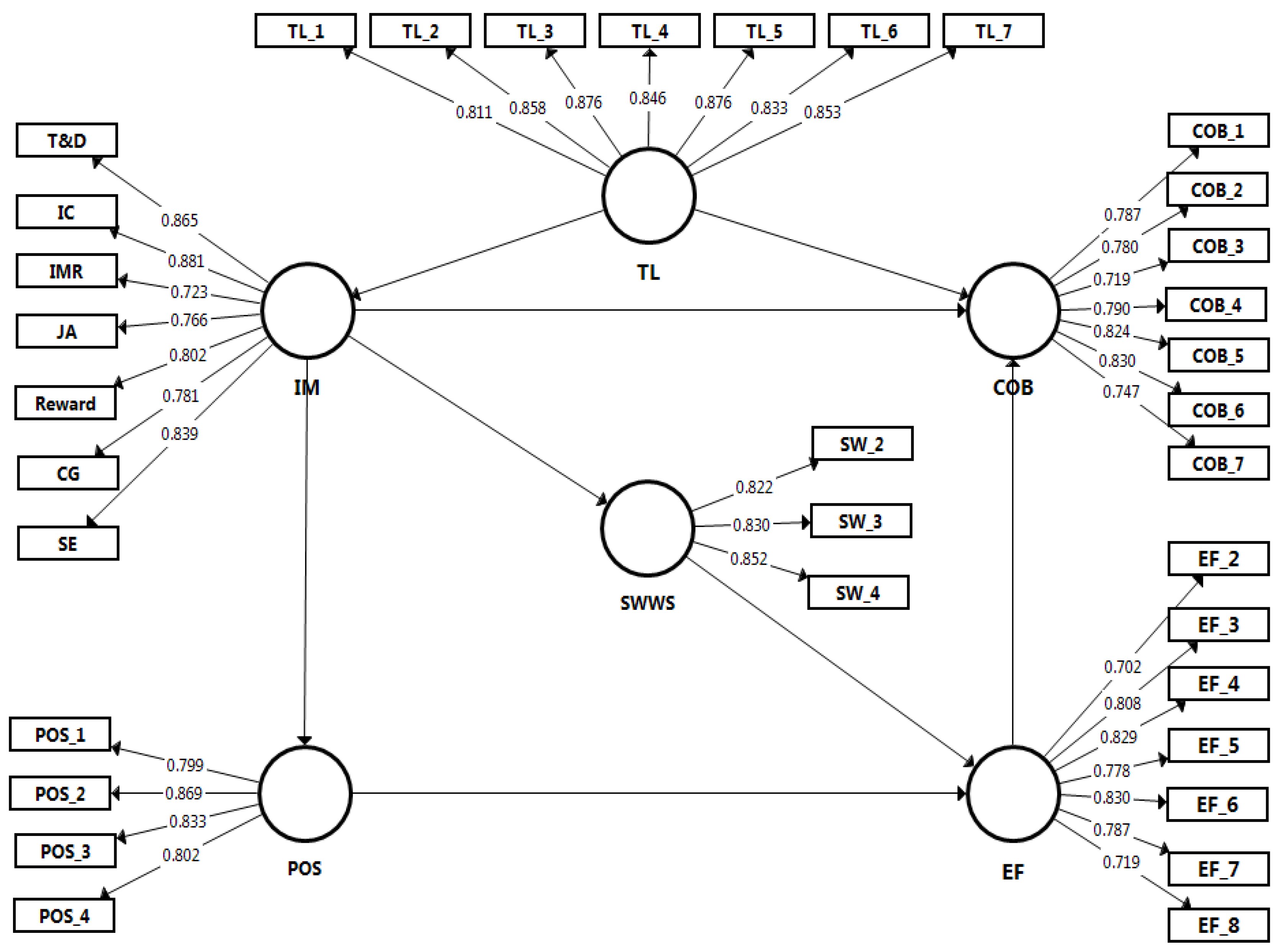

Table 1.
Reliability and Validity analysis for Measurement Model.
| Construct | Indicators | Loadings | Cronbach’s Alpha | Composite Reliability | Average Variance Extracted |
|---|---|---|---|---|---|
| Internal Marketing |
T&D IC IMR Reward JA CG SE |
0.843 0.874 0.723 0.803 0.768 0.785 0.849 |
0.911 | 0.929 | 0.652 |
| Satisfaction with work |
SW_2 SW_3 SW_4 |
0.822 0.83 0.852 |
0.782 | 0.873 | 0.679 |
| Perceived Organisational Support |
POS_1 POS_2 POS_3 POS_4 |
0.799 0.868 0.832 0.802 |
0.845 | 0.896 | 0.682 |
| Perceived Self-Efficacy |
EF_2 EF_3 EF_4 EF_5 EF_6 EF_7 EF_8 |
0.703 0.808 0.828 0.78 0.831 0.786 0.716 |
0.892 | 0.916 | 0.609 |
| Transformational Leadership |
TL_1 TL_2 TL_3 TL_4 TL_5 TL_6 TL_7 |
0.811 0.858 0.876 0.846 0.876 0.833 0.853 |
0.936 | 0.948 | 0.724 |
| Customer-oriented behaviour |
COB_1 COB_2 COB_3 COB_4 COB_5 COB_6 COB_7 |
0.789 0.779 0.717 0.788 0.823 0.831 0.748 |
0.895 | 0.917 | 0.613 |
Table 2.
Discriminant Validity assessment using HTMT criterion.
| COB | EF | IM | POS | SWWS | TL | |
|---|---|---|---|---|---|---|
| COB | ||||||
| EF | 0.751 | |||||
| IM | 0.68 | 0.728 | ||||
| POS | 0.539 | 0.633 | 0.79 | |||
| SWWS | 0.583 | 0.767 | 0.802 | 0.765 | ||
| TL | 0.635 | 0.617 | 0.789 | 0.638 | 0.607 |
Table 3.
VIF Values for the inner model.
| VIF values of Predictors | COB | EF | IM | POS | SWWS | TL |
|---|---|---|---|---|---|---|
| IM | 2.713 | 1 | 1 | |||
| TL | 2.214 | 1 | ||||
| EF | 1.842 | |||||
| POS | 1.623 | |||||
| SWWS | 1.623 |
Table 4.
Regression coefficients of the Endogenous variables.
| R Square | R Square Adjusted | Q² | |
|---|---|---|---|
| COB | 0.533 | 0.525 | 0.316 |
| EF | 0.452 | 0.446 | 0.271 |
| IM | 0.541 | 0.539 | 0.350 |
| POS | 0.490 | 0.487 | 0.327 |
| SWWS | 0.471 | 0.468 | 0.322 |
Table 5.
Results of PLSpredict for comparing prediction errors.
| Latent Construct | Indicators | Q[2]predict | PLS | LM | |
|---|---|---|---|---|---|
| RMSE | RMSE | PLS-SEM - LM | |||
| Customer-oriented behaviour | COB_1 | 0.171 | 1.34 | 1.374 | -0.034 |
| COB_2 | 0.168 | 1.352 | 1.387 | -0.035 | |
| COB_5 | 0.223 | 1.262 | 1.274 | -0.012 | |
| COB_3 | 0.182 | 1.236 | 1.273 | -0.037 | |
| COB_4 | 0.126 | 1.289 | 1.309 | -0.02 | |
| COB_6 | 0.258 | 1.159 | 1.186 | -0.027 | |
| COB_7 | 0.236 | 1.239 | 1.272 | -0.033 |
Table 6.
Hypotheses testing (one-tailed).
| Effect | Predicted Relationship | Direct | Bias corrected CI | Hypothesis | ||
|---|---|---|---|---|---|---|
| β | t | p | ||||
| Direct | IM → COB | 0.191 | 1.901 | 0.029 | [0.023-0.350] | H1: Supported |
| TL → IM | 0.736 | 17.727 | 0.000 | [0.656-0.794] | H3: Supported | |
| TL → COB | 0.197 | 1.959 | 0.025 | [0.032-0.360] | H2: Supported | |
| Indirect | IM → SWW → EF | 0.332 | 5.516 | 0.00 | [0.232-0.430] | H4: Supported |
| IM → POS → EF | 0.179 | 2.559 | 0.005 | [0.066-0.297] | H5: Supported | |
| IM → SWW → EF → COB | 0.146 | 3.463 | 0.00 | [0.082-0.222] | H6: Supported | |
| IM → POS → EF → COB | 0.079 | 2.241 | 0.013 | [0.029-0.145] | H7: Supported | |
| TL → IM → COB | 0.140 | 1.842 | 0.033 | [0.017-0.264] | ||
| TL → IM → SWW → EF → COB | 0.107 | 3.321 | 0.00 | [0.059-0.167] | ||
| TL → IM → POS → EF → COB | 0.058 | 2.169 | 0.015 | [0.021-0.111] | ||
| Total | IM → COB | 0.415 | 4.700 | 0.00 | [0.283-0.570] | |
| TL → COB | 0.502 | 7.894 | 0.00 | [0.398-0.607] | ||
Disclaimer/Publisher’s Note: The statements, opinions and data contained in all publications are solely those of the individual author(s) and contributor(s) and not of MDPI and/or the editor(s). MDPI and/or the editor(s) disclaim responsibility for any injury to people or property resulting from any ideas, methods, instructions or products referred to in the content. |
© 2024 by the authors. Licensee MDPI, Basel, Switzerland. This article is an open access article distributed under the terms and conditions of the Creative Commons Attribution (CC BY) license (http://creativecommons.org/licenses/by/4.0/).
Copyright: This open access article is published under a Creative Commons CC BY 4.0 license, which permit the free download, distribution, and reuse, provided that the author and preprint are cited in any reuse.


