

Submitted:
10 July 2025
Posted:
10 July 2025
You are already at the latest version
Abstract
Reviewed the research progress of Newton’s iterative methods for nonlinear equation. Convergence with second order, third order, fourth order, fifth order, sixth order, seventh order, eighth order and ninth order Newton’s iterative methods are given in turn, and the efficiency index of these iterative methods are analyzed. Numerical experiments show that the convergence process of the three Newton iterative methods, and the results indicate that the convergence of the higher-order Newton’s method can be well demonstrated only when the initial point is close to the root.
Keywords:
nonlinear equation
; Newton’s iteration method
; convergence order
; efficiency index
; initial point
1. Introduction
For the nonlinear equation, is a smooth curve, and has a single root on the open interval .The classical Newton’s method and the modified Newton’s method are the most basic methods for solving nonlinear equations. In order to improve the convergence speed, the third, fourth, fifth, sixth, seventh, eighth and ninth order Newton’s methods have appeared one after another. For the initial point , the higher the order of convergence, and the faster the convergence speed. If the nonlinear equations are convergent, the computational complexity also needs to be considered. In general, the higher the order of convergence and the larger the computational workload. Therefore, when constructing a higher-order Newton method, it is necessary to consider both the convergence order and the computational efficiency.
Definition1 Let the sequenceconverge to,is single root of the equation,denote . If there exist and a constant , such that the limit holds, then the sequenceis convergent of order. Here is the convergence factor and is the error equation. When ,the convergence is linear convergence. When ,the convergence is superlinear convergence. When, the convergence is square convergence.
Definition 2 If the convergence order of an iterative method is , and the computational workload for each iteration from to is (the computation numbers of function values and derivative function values), then the efficiency index of this iterative method is .
There are some Newton’s methods for solving nonlinear equations. Following we analyses the convergence order and efficiency index of these Newton’s iterative methods.
2. Several Newton’s Iterative Methods
2.1. Classical Newton’s Iterative
The process of classical Newton iteration is as follows:
The classical Newton’s method has a second-order convergence rate, i.e..Each iteration from to requires the calculation of the function value and the derivative function value. So the computational workload is 2. Therefore, the efficiency index of the classical Newton method is . The second-order convergence can be well reflected when the initial point is very close to the root in actual computation.
2.2. Newton’s Iterative Method with Third Order Convergence
Common Newton’s iteration methods with third order convergence are listed in following.
①Euler iterative method
Each iteration from to requires the calculation of the function value , and the derivative function value. So the computational workload is 3, thus the efficiency index of the iteration is .
②Halley iterative method
③Chebyshev iteration method
Moreover,
These are all convergent Newton’s iterations with third order, and the efficiency indices of all these iterative methods are . There are a variety of third order convergent Newton’s iterations in the literature [1]. Among them, what is striking is that
The computational workload for each iteration from to is 2 (just calculate ). Therefore, the efficiency index of this iteration is , which is the best result for the efficiency index of the current third order convergent Newton iteration method.
2.3. Newton’s Iterative Method with Fourth Order Convergence
The classical double Newton’s iterative method
It has fourth order convergence and its efficiency index is .
There is the fourth-order convergent Newton iterative method in the literature [2],
Its efficiency index is . In the literature [3], another fourth-order convergent Newton iterative method is given,
The Jarratt iterative method is an iterative format with fourth-order convergence [4]. Where one iteration requires the calculation of two derivative function values and one function value.The specific forms are as follows.
In the literature [5], an iterative method with fourth-order convergence is presented.
King gave a class of iterative formats with fourth-order convergence in the literature [6].
where . In any case, large values of should evidently be avoided, meanwhile, values of should satisfy .
The computational efficiency index of the last four iterations is , which is the best result for the efficiency index of the current fourth-order convergent Newton’s iteration method.
2.4. Newton’s Iterative Method with Fifth Order Convergence
The variation of the double Newton method
has fifth-order convergence.
Ham gave a fifth order convergent Newtonian iterative method in [7]
Where the parameters satisfy .
Xue gave a fifth order convergent Newton iterative method in [8]
Liu gave a class of Newton iterative methods with fifth order convergence in [9]
More fifth-order convergent Newton iteration methods are given in the literature [11,12,13,14,15,16,17].
In recent years, a new fifth order convergent Newton iteration method is presented in the literature [18],
It is successfully applied to solve linear programming and portfolio optimization.
The computational efficiency index of all these fifth order Newton iterations above is , which is the best result of the efficiency index of the current fifth order convergent Newton’s iteration method.
2.5. Newton’s Iterative Method for Sixth Order Convergence
In order to improve the convergence order, Kou [4] et al. constructed a new three-step iterative method as follows.
and proved that the iteration has sixth order convergence.
Chun proposed the Newton iterative methods with sixth order convergence based on the literature [19],
where , and it is the sixth-order convergence. When, it is the method of the Kou’s method. In the literature [10], Wu gave two Newton’s iterative methods with sixth order convergence in the following,
another sixth order convergent Newton iterative method is proposed in the literature [20].
The efficiency index of these sixth order Newton iterations above are .
2.6. Newton’s Iterative Method with Seventh Order Convergence
Two Newton iterative methods with seventh-order convergence are given by Zheng in the literature [21], one of them is
Its computational efficiency index is . Another Newton iterative method with seventh order convergence is
Its computational efficiency index is .
Shno [22] constructed a new three-step iterative method based on the Jarratt iterative method,
Its computational efficiency index is .
Wang [3] gave a Newton iterative method with seventh order convergence using difference quotient in the following form,
Where
Its computational efficiency index is .
The Newton iterative method with seventh order convergence is given by Kou [23] in the following form,
Whose efficiency index is ,which is the best result of the efficiency index of the current seventh order convergent Newton’s iteration method.
2.7. Newton’s Iterative Method with Eighth Order Convergence
The literature [3] gave the Newton’s iterative method with eighth order convergence in the following form,
Whose efficiency index is .
The literature [24] gave the Newton iterative method with eighth order convergence in the following form,
where is a real-valued function and satisfies , , are the first-order difference quotient and the second-order difference quotient, respectively. Following, we give three forms of .
The function value needs to be evaluated three times at each iteration and its first-order derivative is evaluated once, so the efficiency index of this method is .
A class of Newton’s iterative methods with eighth order convergent is given in the literature [25] with efficiency index of ,which is the best result for the efficiency index of the current eighth order convergent Newton’s iterative method. More Newton iterative methods with eighth order convergence can be found in the literature [26,27,28].
2.8. Newton’s Iterative Method with Ninth Order Convergence
A Newton’s iteration method with ninth order convergence is in the literature [29] as follows,
Whose efficiency index is .
The literature [30] constructed a Newton iterative method with ninth order convergence using the difference quotient,
Here , and the efficiency index of this method is .
3. Efficiency Index of the Newton Iterative Method
Table 1 gives the values of the corresponding functions for p taken from 2 to 9 and n taken from 2 to 9.
As pointed out earlier, the higher the order of convergence and the greater the computational cost required. Therefore, both the convergence order and the computational complexity need to be considered when constructing a higher order Newton’s iterative method for solving nonlinear equations. The underlined numbers in Table 1 indicate the best efficiency index that can be achieved when the convergence order is taken from 2 to 9. Whether the efficiency index can theoretically reach 2 needs to be further investigated.
4. Numerical Experiments
Following we give two numerical examples to verify the convergence process of Newton’s iterative method.
Figure 1.
Image of the function . (a) image of function ; (b) image of function ; (c) image of function ; (d) image of function (e) image of function ; (f) image of function .
Figure 1.
Image of the function . (a) image of function ; (b) image of function ; (c) image of function ; (d) image of function (e) image of function ; (f) image of function .
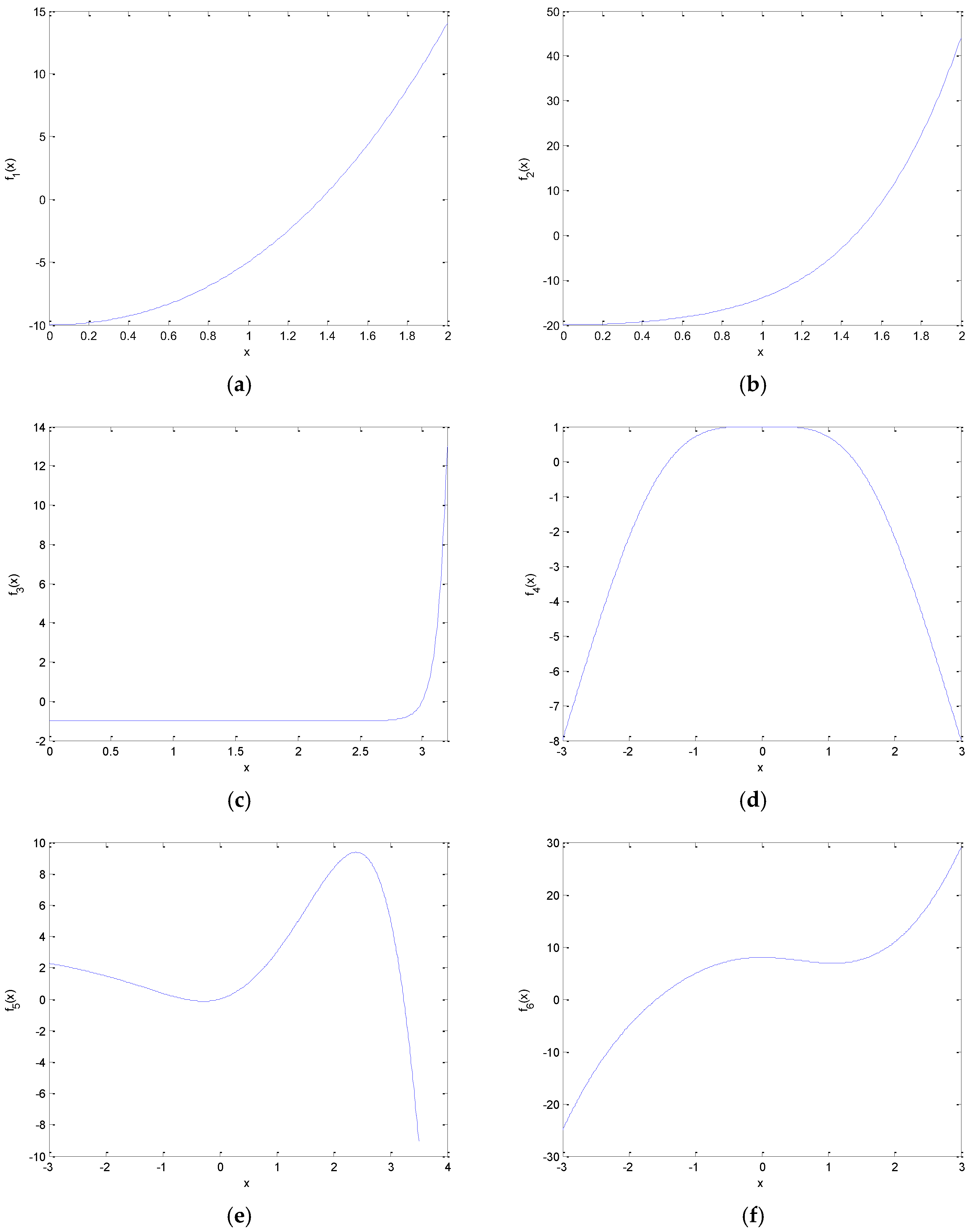
Three Newton’s iterative methods are used for solving, and the program is written by MATLAB R2009a. In the classical Newton iterative method, we set is the termination condition. In the fifth order Newton method [16] and the ninth-order Newton method [29], we set
is the termination condition, where .
Table 2 gives the calculation results of the three Newton’s iterative methods by taking the different initial points.
As can be seen from Table 2, although the initial points are sometimes far from the roots, three iterative methods are all eventually convergent for f1(x), f2(x) and f4(x). For f4(x), three iterative methods converge to the positive root when the initial point is greater than zero, and three iterative methods converge to the negative root when the initial point is less than zero. For f3(x), f5(x) and f6(x), sometimes the three iterative methods do not converge (N means not convergent in Table 2) when the initial point selection is inappropriate.
Given the same initial point, the number of ninth order Newton’s iteration is the smallest and the number of classical Newton’s iterations is the largest. Figure 2 and Figure 3 shows the Newton’s iterative process of functions and (the horizontal axis indicates the number of iterations, and the vertical axis indicates the value of during the iterative process).
3. Conclusions
In this paper, we reviewed the research progress of Newton’s iterative methods for a nonlinear equation. Convergence with second order, third order, fourth order, fifth order, sixth order, seventh order, eighth order and ninth order Newton’s iterative methods are given in turn, and the efficiency index of these iterative methods are analyzed. Numerical experiments show that the convergence process of the three Newton iterative methods, and the results indicate that the convergence of the higher-order Newton’s method can be well demonstrated only when the initial point is close to the root of the equation. Three points are noted in reference [39] for Newton’s iterative method for solving nonlinear equations. (1) For some equations, Newton’s method converges for any initial value. (2) For some equations, Newton iteration method does not converge when the initial value is taken on a certain interval. (3) For some equations, iteration values appear alternately, and Newton iteration method does not converge. Thus, even for the higher-order Newton’s iterative method, the higher-order convergence can be well reflected only when the initial point is close to the root.
Funding
This research received no external funding.
Institutional Review Board Statement
Not applicable.
Informed Consent Statement
Not applicable.
Data Availability Statement
The data used to support the findings of this study are available from the corresponding author upon request.
Acknowledgments
This work is supported by Natural Science Foundation of Shaanxi Province(2024JC-YBMS-014), and the Foundation of Shaanxi University of Technology (SLGNL202409).
Conflicts of Interest
The author declares that there is no conflict of interest regarding the publication of this paper.
References
- R. Thukral. New Modification of Newton Method with Third-Order Convergence for Solving Nonlinear Equations of Type f(x)=0[J].American Journal of Computational and Applied Mathematics 2016, 6(1): 14-18.
- Chun C. Iterative methods improving Newton’s methods by the decomposition method[J]. Comput.Math. Appl., 2005, 50(10-12): 1559-1568.
- Wang Xiao-feng; Shi Dong-yang. A novel and precise seventh-order newton’s iterative method for solving nonlinear equations[J].Journal of Mathematics. 2015(5):1017-1025.
- J.Kou,Y.Li,X.Wang,An improvements of the Jarratts method[J].J.Comput.Appl.Math., 2007, 189:1816-1821.
- Matinfar, M.; Aminzadeh, M. Three-step iterative methods with eighth-order convergence for solving nonlinear equations. J. Interpolat. Approx. Sci. Comput. 2013, 2013, 1–11. [CrossRef]
- King, R.F. A Family of Fourth Order Methods for Nonlinear Equations. SIAM J. Numer. Anal. 1973, 10, 876–879. [CrossRef]
- Ham Y M, Chun C. A fifth-order iterative method for solving nonlinear equations[J]. Applied Mathematics and Computation, 2007,194 :287-290.
- Xue Shuang.Two Families of Newton’s Iteration Methods With Third-Order Convergence[J].Journal of Anhui Normal University(Natural Science). 2013(5):430-436.
- Liu Tian-bo, Cai Hua. A Family of Fifth-order Iterative Methods for Solving Nonlinear Equations[J]. Communications in Mathematical Research, 2013, 29(3):255-260.
- Wu Jiang.The Research on High-order Iterative Methods for Solving Nonlinear Equations[D].Hangzhou: Hangzhou Normal University,2019.
- Ham Y M, Chun C. A fifth-order iterative method for solving nonlinear equations[J]. Applied Mathematics and Computation, 2007,194 :287-290.
- Noor M A, Noor K I. Fifth-order iterative methods for solving nonlinear equations[J]. Applied Mathematics & Computation, 2007,188(1):406-410.
- Rafiullah, M. A fifth-order iterative method for solving nonlinear equations. Numer. Anal. Appl. 2011, 4, 239–243. [CrossRef]
- Tian-Bao L , Hua C . A Family of Fifth-order Iterative Methods for Solving Nonlinear Equations[J]. Comm. in Math. Research, 2013,29(3):255-260.
- Liu Tian-bo, Cai Hua. A Family of Fifth-order Iterative Methods for Solving Nonlinear Equations[J]. Communications in Mathematical Research, 2013, 29(3):255-260.
- Sharma, J.R.; Gupta, P. An efficient fifth order method for solving systems of nonlinear equations. Comput. Math. Appl. 2014, 67, 591–601. [CrossRef]
- Liang, J.; Li, X.; Wu, Z.; Zhang, M.; Wang, L.; Pan, F. Fifth-Order Iterative Method for Solving Multiple Roots of the Highest Multiplicity of Nonlinear Equation. Algorithms 2015, 8, 656–668. [CrossRef]
- Foutayeni Y E, Bouanani H E, Khaladi M. An Efficient Fifth-Order Method for Linear Optimization[J]. Journal of Optimization Theory and Applications, 2016, 170(1):189-204.
- C.Chun. Some improvements of Jarrett’s method with sixth-order convergence[J].J.Comput.Appl. Math, 2007,190:432-1437.
- Grau, M.; Díaz-Barrero, J.L. An improvement to Ostrowski root-finding method. Appl. Math. Comput. 2005, 173, 450–456. [CrossRef]
- Zheng Hao, Zhang Yue-qin, Zhang Chuan-lin. Two Variants of Newton’s Iteration Method with Seventh-Order Convergence[J].Journal of Southwest University(Natural Science Edition). 2012(3):32-35.
- Shno O. Ahmed.An improvement of Jarratt method with seventh-order convergence[J]. International Journal of Scientific Research and Innovative Technology,2015,2(5) 97-102.
- Kou J, Li Y, Wang X. Some variants of Ostrowski’s method with seventh-order convergence [J]. Journal of Computational & Applied Mathematics, 2007, 209(2):153-159.
- Bi, W.; Ren, H.; Wu, Q. Three-step iterative methods with eighth-order convergence for solving nonlinear equations. J. Comput. Appl. Math. 2009, 225, 105–112. [CrossRef]
- Wang Xiao-feng, Zhang Tie.A Family of Optimal Eighth-Order Iterative Methods for Solving Nonlinear Equations[J].Journal of Jilin University(Science Edition). 2013(4):568-572.
- Kou Jisheng, Wang Xiuhua, Li Yitian, Some eight-order root-finding three-step methods[J]. Commun. Nonlinear Sci. Numer. Simulat., 2010, 15(3): 536-544.
- Thukral, R.; Petković, M. A family of three-point methods of optimal order for solving nonlinear equations. J. Comput. Appl. Math. 2010, 233, 2278–2284. [CrossRef]
- Neta, B.; Petković, M. Construction of optimal order nonlinear solvers using inverse interpolation. Appl. Math. Comput. 2010, 217, 2448–2455. [CrossRef]
- Hu Z, Liu G, Tian L. An iterative method with ninth-order convergence for solving nonlinear equations[J]. International Journal of Contemporary Mathematical Sciences, 2011, 6(1-4):17-23.
- Al-Subaihi I. A. A ninth-order iterative method free from second derivative for solving nonlinear equations[J]. Int. J. Math. Analysis, 2011, 5(47): 2337-2347.
- Maroju, P.; Magreñán, Á.A.; Motsa, S.S.; Sarría, Í. Second derivative free sixth order continuation method for solving nonlinear equations with applications. J. Math. Chem. 2018, 56, 2099–2116. [CrossRef]
- Sivakumar, P.; Jayaraman, J. Some New Higher Order Weighted Newton Methods for Solving Nonlinear Equation with Applications. Math. Comput. Appl. 2019, 24, 59. [CrossRef]
- Maroju, P.; Magreñán, Á.A.; Sarría, Í.; Kumar, A. Local convergence of fourth and fifth order parametric family of iterative methods in Banach spaces. J. Math. Chem. 2020, 58, 686–705. [CrossRef]
- Ramandeep Behl,Ali Saleh Alshomrani, Changbum Chun.A general class of optimal eighth-order derivative free methods for nonlinear equations[J].Journal of Mathematical Chemistry,2020,58:854-867.
- Ogbereyivwe, O.; Izevbizua, O.; Umar, S.S. Some high-order convergence modifications of the Householder method for nonlinear equations[J]. Commun. Nonlinear Anal. 2023, 11, 1–11.
- Devi, K.; Maroju, P. Local convergence study of tenth-order iterative method in Banach spaces with basin of attraction. AIMS Math. 2024, 9, 6648–6667. [CrossRef]
- Liu, C.-S.; Chang, C.-W. New Memory-Updating Methods in Two-Step Newton’s Variants for Solving Nonlinear Equations with High Efficiency Index. Mathematics 2024, 12, 581. [CrossRef]
- Panday, S.; Mittal, S.K.; Stoenoiu, C.E.; Jäntschi, L. A New Adaptive Eleventh-Order Memory Algorithm for Solving Nonlinear Equations. Mathematics 2024, 12, 1809. [CrossRef]
- Longquan Yong. Three notes on Newton’s iteration method for nonlinear equations[J]. Journal of Shaanxi University of Technology(Natural Science Edition),2024,40(6):82-86.
Figure 2.
Iteration process under the initial iteration point . (a) Classical Newton method (b) Fifth-order Newton iteration (c) Ninth-order Newton iteration.
Figure 2.
Iteration process under the initial iteration point . (a) Classical Newton method (b) Fifth-order Newton iteration (c) Ninth-order Newton iteration.
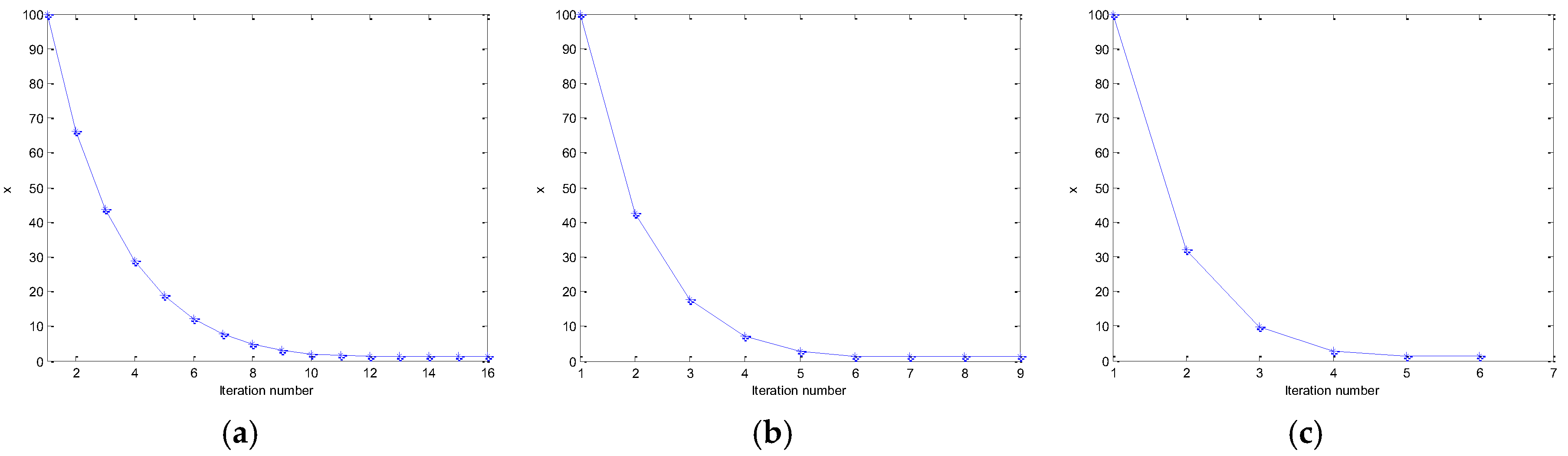
Figure 3.
Iteration process under the initial iteration point . (a) Classical Newton method (b) Fifth-order Newton iteration (c) Ninth-order Newton iteration.
Figure 3.
Iteration process under the initial iteration point . (a) Classical Newton method (b) Fifth-order Newton iteration (c) Ninth-order Newton iteration.
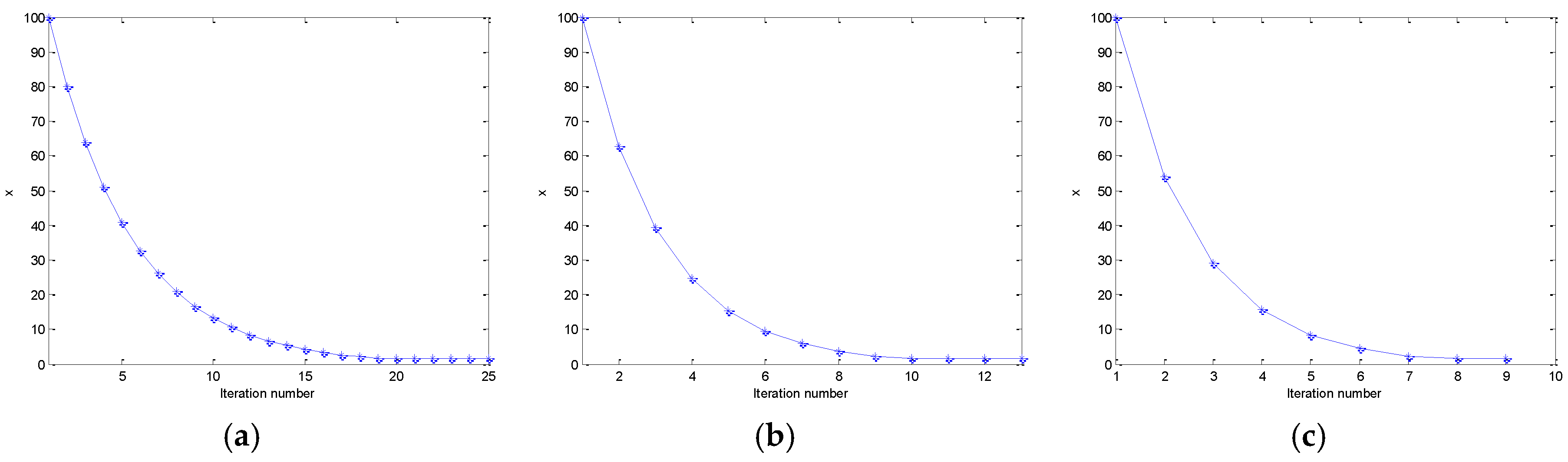

Table 1.
Values of the functions (p taken from 2 to 9 and n taken from 2 to 9).
| P n | 2 | 3 | 4 | 5 | 6 | 7 | 8 | 9 |
| 2 | 1.414 | 1.260 | 1.189 | 1.149 | 1.122 | 1.104 | 1.091 | 1.080 |
| 3 | 1.732 | 1.442 | 1.316 | 1.246 | 1.201 | 1.170 | 1.147 | 1.130 |
| 4 | 2.000 | 1.587 | 1.414 | 1.320 | 1.260 | 1.219 | 1.189 | 1.167 |
| 5 | 2.236 | 1.710 | 1.495 | 1.380 | 1.308 | 1.258 | 1.223 | 1.196 |
| 6 | 2.449 | 1.817 | 1.565 | 1.431 | 1.348 | 1.292 | 1.251 | 1.220 |
| 7 | 2.646 | 1.913 | 1.627 | 1.476 | 1.383 | 1.320 | 1.275 | 1.241 |
| 8 | 2.828 | 2.000 | 1.682 | 1.516 | 1.414 | 1.346 | 1.297 | 1.260 |
| 9 | 3.000 | 2.080 | 1.732 | 1.552 | 1.442 | 1.369 | 1.316 | 1.277 |
Table 2.
Calculation results of three Newton’s iterative methods.
| fi(x) | Initial point | Number of iterations | ||
| Classical Newton iteration | Fifth-order Newton iteration | Ninth-order Newton iteration | ||
| f1(x) | -100 | 26 | 11 | 9 |
| -10 | 76 | 11 | 21 | |
| -1 | 24 | 9 | 7 | |
| 1 | 5 | 3 | 2 | |
| 10 | 8 | 5 | 3 | |
| 100 | 14 | 7 | 4 | |
| f2(x) | -100 | 42 | 28 | N |
| -10 | 85 | 23 | N | |
| -1 | 85 | 5 | N | |
| 1 | 6 | 4 | 3 | |
| 10 | 12 | 7 | 4 | |
| 100 | 23 | 13 | 8 | |
| f3(x) | -100 | N | N | N |
| -10 | N | N | N | |
| -1 | N | N | N | |
| 1 | N | N | N | |
| 10 | 145 | 70 | 53 | |
| 100 | N | N | N | |
| f4(x) | -100 | 11(-) | 6(-) | 4(-) |
| -10 | 8(-) | 4(-) | 3(-) | |
| -1 | 5(-) | 4(-) | 3(-) | |
| 1 | 5(+) | 4(+) | 3(+) | |
| 10 | 8(+) | 4(+) | 3(+) | |
| 100 | 11(+) | 6(+) | 4(+) | |
| f5(x) | -100 | N | N | N |
| -10 | N | N | N | |
| -1 | N | N | N | |
| 1 | 6 | 4 | 3 | |
| 10 | N | N | N | |
| 100 | N | N | N | |
| f6(x) | -100 | 14 | 8 | 5 |
| -10 | 9 | 5 | 3 | |
| -1 | 5 | 3 | 2 | |
| 1 | 18 | 6 | N | |
| 10 | 14 | 21 | 5 | |
| 100 | 18 | 15 | N | |
Disclaimer/Publisher’s Note: The statements, opinions and data contained in all publications are solely those of the individual author(s) and contributor(s) and not of MDPI and/or the editor(s). MDPI and/or the editor(s) disclaim responsibility for any injury to people or property resulting from any ideas, methods, instructions or products referred to in the content. |
© 2025 by the authors. Licensee MDPI, Basel, Switzerland. This article is an open access article distributed under the terms and conditions of the Creative Commons Attribution (CC BY) license (http://creativecommons.org/licenses/by/4.0/).
Copyright: This open access article is published under a Creative Commons CC BY 4.0 license, which permit the free download, distribution, and reuse, provided that the author and preprint are cited in any reuse.


