

Submitted:
21 October 2024
Posted:
22 October 2024
You are already at the latest version
Abstract
(1) Background: The androgen receptor (AR) is critical for mediating the effects of androgens. The polymorphic CAGn locus in exon 1 of the AR gene is associated with several diseases, including spinal and bulbar muscular atrophy (SBMA), prostate cancer, and male infertility. This study evaluated the CAGn locus in 9,000 infertile Russian men and 286 fertile men (control group); (2) Methods: The CAGn locus was analyzed using the polymorphism of lengths of amplified fragments method; (3) Results: In the infertile cohort, CAG repeats ranged from 6 to 46, with a unimodal distribution. The number of CAG repeats in infertile and fertile men was 22.15 ± 0.93 and 22.02 ± 1.36, respectively. In infertile men, variants with 16 to 29 repeats were present in 97% of alleles. A complete mutation (≥42 CAG repeats) was found in three patients, while three others had 39-41 repeats. The incidence of SBMA was 1: 3,000 infertile men. Significant differences (p<0.05) were observed between infertile and fertile men in alleles with 21, 24 and 25 repeats; (4) Conclusions: This study revealed certain differences in the CAGn polymorphic locus of the AR gene in Russian infertile and fertile men, and determined the frequency of SBMA in infertile patients.
Keywords:
androgen receptor
; male infertility
; spermatogenesis
; pathozoospermia
; fertility
; trinucleotide repeats
; spinal and bulbar muscular atrophy
; SBMA (Kennedy disease)
; X chromosome
1. Introduction
Infertility is one of the most common medical and social problems of our time. Male infertility and subfertility are usually associated with abnormal basic semen parameters (sperm concentration, motility, vitality and morphology), which are detected in 50-60% of all men from infertile couples [1]. Various pathogenic factors affecting the reproductive system, including congenital anomalies and genetic defects, hormonal, oncological and multifactorial disorders, infections, toxins and environmental pollutants can disrupt spermatogenesis, semen parameters and male fertility [2].
Androgens are male sex hormones that play a pivotal role in regulating the development and function of the male reproductive system in both mammals and humans, skeletal growth, metabolism and homeostasis by acting on target genes through the activation of the androgen receptor (AR) protein, which regulates the functions of all androgen-dependent processes [3]. AR is a ligand-dependent transcription factor that binds to androgens and is required for the development of the male reproductive organs, the control of mitotic and meiotic divisions of immature male germ cells, spermiogenesis, the maturation of spermatozoa in the epididymis of the male accessory sex glands, the hormonal regulation of fertility and other biological processes [4].
In humans, the androgen receptor gene (AR/HUMARA; OMIM: 313700), located on the X chromosome (Xq12 locus), is 90 Kb in size and contains 8 exons [5]. The protein encoded by the AR gene contains three main domains: the N-terminal transactivating domain (encoded by exon 1), the DNA-binding domain (encoded by exons 2 and 3) and the ligand-binding domain - LBD (encoded by exons 4-8) [6]. Exon 1 contains two polymorphic trinucleotide repeat sites (CAG and CGG) that encode the polyglutamine and polyglycine tracts, respectively, in the AR protein. Normally, the length of the CAGn polymorphic locus of the AR gene varies from 7 to 37 repeats [7].
Pathogenic variants in the AR gene result in structural and functional defects of AR leading to various genetic disorders, including complete or incomplete insensitivity to androgens (androgen insensitivity syndrome, AIS) and male infertility associated with azoospermia or oligozoospermia [8,9]. Somatic AR gene pathogenic variants have also been described in patients with prostate cancer [10]. Expansion of the number of CAG repeats (more than 38-40) leads to the development of a progressive X-linked recessive neuromuscular disease – spinal and bulbar muscular atrophy, SBMA, also known as Kennedy disease [11]. Due to hemizygosity on the X chromosome, Kennedy disease is more common in males than in females. SBMA is characterized by late onset, with clinical manifestations of the disease usually seen in patients over the age of 30 years [12]. Mild defects in AR function are one of the genetic causes of impaired gametogenesis, development and function of the human reproductive system [13].
Numerous studies have shown an association between the AR CAG polymorphic locus and male subfertility or infertility in different populations and ethnic groups [14,15,16,17]; however, some researchers have failed to establish this association [18]. Some CAG repeats can affect androgen receptor (AR) function, with alleles containing small number of CAG repeats characterized by increased androgen receptor sensitivity and those with more repeats characterized by decreased androgen receptor sensitivity [19]. Some variations in the CAG repeats in exon 1 of the AR gene have been observed various populations, as well as fertile and infertile men from various regions [14,15,16,17]. For example, African Americans generally have fewer repeats than non-Hispanic whites [20]. Previously, this polymorphic locus of the AR gene has been studied in fertile and infertile men from the Russian Federation and Ukraine, and Russian men from general population [21,22,23,24], but these studies involved much smaller sample sizes and did not calculate or compare the frequency of individual CAG alleles between examined groups.
The aim of the study is to evaluate the CAGn polymorphic locus in exon 1 of the androgen receptor gene and to determine the frequency of its different allelic variants in a large cohort of infertile Russian men and to compare them with fertile Russian men.
2. Results
The number of CAG repeats in exon 1 of the androgen receptor (AR) gene in the infertile Russian men studied ranged from 6 to 46 (Figure 1). In fertile men (controls), CAG repeats varied from 13 to 31 (Figure 2).
None of the individuals studied showed heterozygosity for this polymorphic locus. The distribution of the different CAG alleles of the AR gene was unimodal in fertile and infertile individuals, very similar to the symmetric distribution in infertile patients. In both infertile men and controls, the most common allele (mode) contained 21 trinucleotide repeats. The average number of CAG repeats in infertile and fertile men was 22.15 ± 0.93 and 22.02 ± 1.36, respectively. Common variants with 16 to 29 repeats were found with allelic frequencies (AF) ranging from 0.0110 to 0.1698, representing 97.04% of all alleles detected in infertile men. Allelic variants of the AR gene with an AF greater than 0.01 (1% of all alleles) are shown in Table 1.
Variants of the AR gene with a number of CAG trinucleotides of 6 to 15 and 30 to 46, respectively, were much less frequent and accounted for approximately 3% of all detected alleles (Figure 1 and Figure 2). In the studied sample of Russian infertile men and fertile individuals (control group), AR gene variants with 20 to 24 CAG repeats were more frequent, the frequency of each of which exceeded 10% in the studied sample (Table 1). Alleles with the number of repeats from 6 to 15 and from 30 to 46 were found much less frequently, their share of all detected allelic variants was 2.96%. Each of the variants with the number of CAG repeats n≥39 was detected once; in total they were found in 6 (0.07%) patients (Figure 1). In fertile men (control group), the largest number of repeats was 31, detected in only 1 (0.35%) of 286 individuals.
A complete mutation (≥42 CAG repeats) in exon 1 of the AR gene, characteristic of spinal and bulbar muscular atrophy (SBMA), was found in 3 patients (all of them had developed SBMA at moment examination); and in 3 infertile men the number of repeats was n=39-41 (with no diagnosed SBMA at moment examination) (Figure 1). Thus, the incidence of SBMA in the sample studied was assessed as 1 per 3,000 infertile Russian men, if considering carriers of alleles with 39-41 CAG repeats, then 1 per 1,500 infertile patients.
Comparative analysis of each of the common CAGn alleles in infertile men and controls revealed statistically significant (p < 0.05) differences for three polymorphic variants of the AR gene containing 21, 24 and 25 trinucleotide repeats. The allelic frequency (AF) of the AR gene variants with 21 and 25 CAG repeats was lower in infertile men and higher in controls (AF 0.1698 vs. 0.2273; p = 0.012, and 0.0744 vs. 0.1189; p = 0.006, respectively). The allele with 24 CAG repeats was more frequent in infertile men than in the control group (0.1142 vs. 0.0734; p = 0.032) (Table 1). Statistically significant differences were found in the frequency of some common alleles (with 21, 24 and 25 CAG repeats) between the group of patients with infertility and fertile Russian men.
"Short" (n≤18), "medium" (n=19-25) and "long" (n≥26) allelic variants of the CAGn polymorphic locus were detected in 722 (8.02%), 7186 (79.84%) and 1092 (12.13%) infertile patients, respectively. In the group of fertile men, "short", "medium" and "long" alleles were found in 15 (5.24%), 247 (86.36%) and 24 (8.39%) individuals, respectively. There was a statistically significant difference in the frequency of "medium" CAG repeats and "short" and "long" repeats together (χ2 = 7.375; p = 0.007), but not in the groups of "short" (χ2 = 2.927; p = 0.088) and "long" (χ2 = 3.670; p = 0.056) repeats separately.
3. Discussion
The CAGn polymorphic locus of the AR gene has been studied in infertile men from different populations and countries, but the size of the samples studied has been significantly smaller [25,26,27,28]. Many authors have shown that "long" CAG repeats of the AR gene increase the risk of impaired spermatogenesis and male infertility in different populations and regions. A meta-analysis of studies performed on samples of sub-infertile and fertile men from various populations (European, Asian, American, African, and mixed origin of populations) revealed an association of "long" (n ≥ 26) repeats with male infertility and decreased semen quality [7,15,16,17,20,21,22,24,25,26,27,28].
In one of the largest studied cohorts of men (n=1977) from general populations of several European countries (Italy, Belgium, Poland, Sweden, United Kingdom, Spain, Hungary and Estonia), the number of CAG repeats of the AR gene varied between 6 and 39, with the variant with 21 CAG repeats showing the highest proportion (16.4%) of all detected alleles [29]. The distribution of CAG repeats in this cohort and our sample and is very similar, especially for the common alleles (CAGn, n=16-29).
In Russians and Ukrainians, as well as in many individuals from other populations, variants with 20 or 21 CAG repeats in exon 1 are the most common AR gene alleles [21,22,23]. In our cohort of infertile Russian men, these allelic variants accounted for about 29% of all detected androgen receptor gene alleles in this group. In the cohort of Russian infertile men (n=332) studied by Mikhaylenko et al. (2019), the number of CAG trinucleotides varied from 9 to 31, the frequency of the n=21 allele was 21.5%; ’long’ alleles (n≥27 repeats) were identified in 7.5% of patients [21]. Patients with chromosomal abnormalities, in particular with Klinefelter syndrome, were not excluded from the sample of men with infertility, fertile men were not examined as a control group. An information about the ethnicity of the examined patients was not provided by the authors. In our sample, the proportion of such allelic variants was very close and amounted to the 7.22%, the allele with 21 repeats was also the most frequent.
Previously we have evaluated the CAGn polymorphism of the AR gene in Russian patients with various form of pathozoospermia (n = 591), as well as fertile (n = 286), and normozoospermic (n = 131) men. No significant differences in frequencies of “short” (n ≤ 18), “medium” (n = 19–25) and “long” (n ≥ 26) alleles between groups of patients with various spermatological diagnoses and fertility status. Statistically significant (p < 0.01) differences were found between severe oligozoospermic patients and the controls in frequencies of “long” (n ≥ 26) and “short” (n ≤ 18) alleles, and the CAGn = 25 allele between azoospermic (18.1%) and severe oligozoospermic (2.6%) patients [24].
Fesai et al (2009) analyzed the CAGn polymorphic locus of the AR gene in Ukrainian infertile (n=228) and fertile (n=124) men [22]. The frequency of alleles with CAG repeats n ≤ 18 was significantly higher (р < 0.01) in azoospermic (17.7%) and oligozoospermic (12.5%) patients compared to fertile individuals (control group) (2.4%). The frequency of alleles with CAG repeats n≥28 was significantly (р < 0.01) higher in oligozoospermic patients (12.5%) compared to the control group (2.4%). Evidently, "short" and "long" alleles is a factor that associated to impaired spermatogenesis and risk of oligozoospermia for men from Russian and Ukrainian populations [24].
Recently, the CAGn polymorphic locus of the AR was evaluated in a cohort of 1324 young (median age 23.0 years) Russian men of different ethnicities (Slavs, n=697; Buryats, n=208; Yakuts, n=134) from the general population [23]. It should be noted that in the study all Russians, including individuals of Slavic group, lived in the Siberian region, and there was also no information about their fertility. In the Slavic, Buryat and Yakut subgroups, the most frequent CAGn alleles were n=21 (16.3%), n=22 (12.9%) and n=25 (21.6%), respectively. The most frequent in Slavic subgroup also as in Russians from our sample was CAGn allele, n=21 with very similar frequency. The number of trinucleotide repeats differed significantly between all ethnic groups (p < 0.001), the shortest being found in the Slavic subgroup (mean 23.0 ± 3.1, median – 23, range 19-29) and the longest in the Yakut subgroup (mean 25.0 ± 2.7, median – 25, range 21-31), the Buryat subgroup being in the middle (mean 24.0 ± 3.5, median – 24, range 19-30) (Table 1). A statistically significant difference (p < 0.05) was found in the frequency and mean CAG repeats between groups with the normal (23.2 ± 3.3) and impaired semen quality (23.9 ± 3.2). The long CAG alleles were associated with impaired semen quality in the Slavic and Buryat groups, but not in the Yakut group [23].
The number of the CAGn repeats in exon 1 of AR gene has an effect on the function of the androgen receptor. A critical range of 16-29 triplets is required for maximum interaction between the transactivating and the hormone-binding domains [15]. In vitro and in vivo studies have shown that increasing the length of the polyglutamine tract of the AR protein leads to a linear decrease in the transcriptional capacity of the androgen receptor in mammalian cell lines [19,30,31]. However, this effect has been shown to be specific to certain cell (or tissue) types [32]. This appears to be due to the different pattern of AR regulatory proteins [33]. For example, while androgen receptor-mediated mRNA levels in prostate cells appear to be inversely proportional to the length of the polyglutamine tract [34], the opposite is observed in myoblasts [35].
Spinal and bulbar muscular atrophy (SBMA) or Kennedy’s disease is a rare progressive, adult-onset, X-linked recessive disease related to repeat extension disorders, REDs [1,2]. The pathogenic mechanism of the disease is largely unknown, but it appears that the expansion of CAG repeats results in both loss of AR function and toxic gain of function [37]. In male patients, SBMA progresses slowly over decades with bulbar and lower motor neuron loss, disabling muscle denervation and direct skeletal muscle involvement, leading to progressive muscle loss with weakness, fasciculations and spasticity [37]. Bulbar muscle weakness follows, leading to dysarthria and dysphagia. The effects on the male reproductive organs and endocrine system include an increase in the level of luteinizing hormone (LH) and, as a result, testosterone, in the presence of signs of hypogonadism, testicular hypoplasia, decreased libido, erectile dysfunction, gynecomastia, infertility associated with azoospermia or oligozoospermia. The average age of onset of the disease in male carriers (CAG) of n=35-46 alleles varies from 44 to 68 years, while in some of them SBMA developed between the ages of 70 and 80 years. In most patients with CAG≥47 alleles, the age of manifestation ranged from 25 to 43 years [38].
In our study, prominent expansion of CAG repeats (39-46) was found in 6 patients, including 3 with a complete mutation (≥42 repeats), which is characteristic for spinobulbar muscular atrophy (SBMA). Thus, the frequency of SBMA in the studied cohort of Russian infertile men was estimated to be 1 per 3,000 infertile Russian men. However, if we take into account the carriage of alleles with 39-41 repeats, the frequency of carrying alleles that can lead to the development of the disease is twice as high and is estimated at 1 per 1,500 patients. The prevalence of the disease has been calculated to be 2.6:100,000 (1:38,462) men in the general population [3]. A relatively high frequency of expanded SBMA-associated alleles was found in the general population with (CAG)n, n ≥35 present in 107/100,000 individuals and CAGn, n≥38 present in 27/100,000 individuals [3]. Recently, the frequency of repeat expansion CAG alleles was found to be 1 : 3182, which is 10 times higher than the reported disease prevalence. Based on these data, the authors concluded that the prevalence of SBMA in the general population is underestimated and estimated at 1 : 6887 men [4]. In our sample of infertile men, the frequency of CAGn alleles, n>38 was 4.6 times higher. This is probably due to the fact that infertile men have a higher frequency of "long" CAG repeats, particularly alleles associated with SBMA, than the general population. As SBMA is usually characterised by late manifestation, this leads to an underestimation of its prevalence in young patients. It should also be noted that the samples of infertile men previously studied are much smaller in size, and since the frequency of risk alleles is low, these samples may not have been included.
Our study has a number of limitations. The number of individuals in the control group was relatively small. Obviously, this did not allow us to fully assess the frequency of rare CAGn alleles and could have some effect on the allelic frequency in fertile men. As we did not have precise information on the ethnicity of all the participants, nor on the semen parameters, it was not possible to distinguish a group of Russians and russians from individuals of other nationalities, nor to define their spermogram. As male fertility is not the same as normozoospermia and vice versa, men from infertile couples partially overlap with fertile men in terms of semen parameters. Neurological examination and follow-up of patients in the dynamic were not performed. This is relevant for individuals with long CAGn alleles (n>35), as they have a high risk of developing SMBA [3]. Therefore, the exact frequency of spinal bulbar muscular atrophy has not been determined. Further studies are needed to more precisely define the frequency of CAG alleles in different Russian populations.
4. Materials and Methods
The cohort studied consisted of 9,000 infertile Russian men. The patients were examined during 2003-2023 as part of a large-scale genetic study of male infertility at the Research Centre for Medical Genetics, RCMG (Moscow, Russian Federation).
Inclusion criteria were marital and reproductive age infertility and abnormal semen parameters. A most of infertile patients had azoospermia and oligozoospermia. Patients with Klinefelter’s syndrome, X chromosome polysomy, 46,XX testicular disorder of sexual development (DSD) and patients with 46,XX/46,XY karyotype were not included in the study. As a control group, data were obtained on the frequency of different allelic variants of the AR gene in a group of 286 unrelated Russian men with proven fertility (DNA genotyping) who had been previously studied [5]. All subjects were men of reproductive age, and the majority of subjects in both groups were Russians, ethnic Slavs living in Moscow and the Moscow region.
The study was approved by the Ethics Committee at Research Centre for Medical Genetics, RCMG (Moscow, Russian Federation). Written voluntary informed consent was obtained from each individual enrolled in the study.
Standard semen examination was performed by analyzing semen volume (ml), sperm concentration (×106/ml), sperm motility and normal morphology (percentage) according to the WHO laboratory manual for the examination and processing of human semen [6].
Genomic DNA was isolated from peripheral venous blood lymphocytes using the Wizard® Genomic DNA Purification Kit (Promega, USA) according to the manufacturer’s protocol. CAGn repeats were analysed by PCR using the PLAF (polymorphism of lengths of amplified fragments) method according to the approved and tested medical technology of the Research Centre for Medical Genetics (RCMG), Moscow. This method makes it possible to determine the relative length of PCR products in relation to the length standard and is based on the separation of DNA into fractions according to molecular weight. The method of studying the polymorphic locus was described in detail earlier [5].
Statistical data analysis was performed using various statistical methods (Pearson’s chi-square test, and chi-square test with the Yates correction) with the STATISTICA software version 10.0 (StatSoft Inc., Tulsa, USA). The presence of significant differences between groups and subgroups was determined at a value of p < 0.05.
5. Conclusions
In this study, the allelic frequency of different variants of the CAGn polymorphic locus of the AR gene in Russian men was determined in a large cohort of infertile men. A statistically significant difference in the frequency of some common alleles was found between infertile and fertile men. An important point is the assessment of the frequency of CAG repeat expansion, which makes it possible to determine the prevalence of SBMA or its risk in Russian infertile men. The relatively high frequency of CAG repeats expansion in the AR gene in patients with male infertility indicates the possibility of a presymptomatic diagnosis of the risk of developing the neuromuscular lesions and the need for careful examination and dynamic monitoring in individuals with high-risk alleles for SBMA.
Author Contributions
Conceptualization, V.C.; methodology, A.P.; investigation, M.S., A.S., E.B., O.I., and T.B.; resources, O.S. (Olga Solovova), T.S., V.C.; data curation, V.C.; writing—original draft preparation, V.C., O.S. (Olga Solovova); visualization, A.S., E.B., O.I.; supervision, O.S. (Olga Shchagina), A.P.; project administration, V.C., O.S. (Olga Shchagina), and A.P. All authors have read and agreed to the published version of the manuscript.
Funding
The present study was performed within the framework of the project Multicenter Research Bio-resource Collection “Human Reproductive Health” no. 15.BRK.21.0008 of the Ministry of Science and Higher Education of the Russian Federation.
Institutional Review Board Statement
The study was conducted in accordance with the Declaration of Helsinki, and approved by the Institutional Review Board (or Ethics Committee) of Research Centre for Medical Genetics (protocol code: №4/3; date of approval: April 19, 2021).
Informed Consent Statement
Informed consent was obtained from all subjects involved in the study.
Data Availability Statement
Data are contained within the article.
Conflicts of Interest
The authors declare no conflict of interest.
References
- Eisenberg, M.L.; Esteves, S.C.; Lamb, D.J.; Hotaling, J.M.; Giwercman, A.; Hwang, K.; Cheng, Y.-S. Male Infertility. Nat Rev Dis Primers 2023, 9, 49. [Google Scholar] [CrossRef] [PubMed]
- Gül, M.; Russo, G.I.; Kandil, H.; Boitrelle, F.; Saleh, R.; Chung, E.; Kavoussi, P.; Mostafa, T.; Shah, R.; Agarwal, A. Male Infertility: New Developments, Current Challenges, and Future Directions. World J Mens Health 2024, 42, 502. [Google Scholar] [CrossRef] [PubMed]
- Naamneh Elzenaty, R.; du Toit, T.; Flück, C.E. Basics of Androgen Synthesis and Action. Best Pract Res Clin Endocrinol Metab 2022, 36, 101665. [Google Scholar] [CrossRef] [PubMed]
- Walker, W.H. Androgen Actions in the Testis and the Regulation of Spermatogenesis. In Advances in experimental medicine and biology; Adv Exp Med Biol, 2021; Vol. 1288, pp. 175–203. [CrossRef]
- Brown, C.J.; Goss, S.J.; Lubahn, D.B.; Joseph, D.R.; Wilson, E.M.; French, F.S.; Willard, H.F. Androgen Receptor Locus on the Human X Chromosome: Regional Localization to Xq11-12 and Description of a DNA Polymorphism. Am J Hum Genet 1989, 44, 264–269. [Google Scholar] [PubMed]
- Lee, X.Y.; Van Eynde, W.; Helsen, C.; Willems, H.; Peperstraete, K.; De Block, S.; Voet, A.; Claessens, F. Structural Mechanism Underlying Variations in DNA Binding by the Androgen Receptor. J Steroid Biochem Mol Biol 2024, 241, 106499. [Google Scholar] [CrossRef] [PubMed]
- Ashraf, M.; Kazmi, DR.S.U.; Tariq, H.; Munir, A.; Rehman, R. Association of Trinucleotide Repeat Polymorphisms CAG and GGC in Exon 1 of the Androgen Receptor Gene with Male Infertility: A Cross-Sectional Study. Turk J Med Sci 2022, 52, 1793–1801. [Google Scholar] [CrossRef]
- Tyutyusheva, N.; Mancini, I.; Baroncelli, G.I.; D’Elios, S.; Peroni, D.; Meriggiola, M.C.; Bertelloni, S. Complete Androgen Insensitivity Syndrome: From Bench to Bed. Int J Mol Sci 2021, 22, 1264. [Google Scholar] [CrossRef]
- Yuan, S.-M.; Zhang, Y.-N.; Du, J.; Li, W.; Tu, C.-F.; Meng, L.-L.; Lin, G.; Lu, G.-X.; Tan, Y.-Q. Phenotypic and Molecular Characteristics of Androgen Insensitivity Syndrome Patients. Asian J Androl 2018, 20, 473. [Google Scholar] [CrossRef]
- Dai, C.; Heemers, H.; Sharifi, N. Androgen Signaling in Prostate Cancer. Cold Spring Harb Perspect Med 2017, 7, a030452. [Google Scholar] [CrossRef]
- Spada, A.R. La; Wilson, E.M.; Lubahn, D.B.; Harding, A.E.; Fischbeck, K.H. Androgen Receptor Gene Mutations in X-Linked Spinal and Bulbar Muscular Atrophy. Nature 1991, 352, 77–79. [Google Scholar] [CrossRef]
- Marchioretti, C.; Andreotti, R.; Zuccaro, E.; Lieberman, A.P.; Basso, M.; Pennuto, M. Spinal and Bulbar Muscular Atrophy: From Molecular Pathogenesis to Pharmacological Intervention Targeting Skeletal Muscle. Curr Opin Pharmacol 2023, 71, 102394. [Google Scholar] [CrossRef] [PubMed]
- Christin-Maitre, S.; Young, J. Androgens and Spermatogenesis. Ann Endocrinol (Paris) 2022, 83, 155–158. [Google Scholar] [CrossRef] [PubMed]
- Mifsud, A.; Sim, C.K.S.; Boettger-Tong, H.; Moreira, S.; Lamb, D.J.; Lipshultz, L.I.; Yong, E.L. Trinucleotide (CAG) Repeat Polymorphisms in the Androgen Receptor Gene: Molecular Markers of Risk for Male Infertility. Fertil Steril 2001, 75, 275–281. [Google Scholar] [CrossRef] [PubMed]
- Nenonen, H.A.; Giwercman, A.; Hallengren, E.; Giwercman, Y.L. Non-Linear Association between Androgen Receptor CAG Repeat Length and Risk of Male Subfertility - a Meta-Analysis. Int J Androl 2011, 34, 327–332. [Google Scholar] [CrossRef] [PubMed]
- Pan, B.; Li, R.; Chen, Y.; Tang, Q.; Wu, W.; Chen, L.; Lu, C.; Pan, F.; Ding, H.; Xia, Y.; et al. Genetic Association Between Androgen Receptor Gene CAG Repeat Length Polymorphism and Male Infertility. Medicine 2016, 95, e2878. [Google Scholar] [CrossRef]
- Mobasseri, N.; Babaei, F.; Karimian, M.; Nikzad, H. Androgen Receptor (AR)-CAG Trinucleotide Repeat Length and Idiopathic Male Infertility: A Case-Control Trial and a Meta-Analysis. EXCLI J 2018, 17, 1167–1179. [Google Scholar] [CrossRef]
- Westerveld, H.; Visser, L.; Tanck, M.; van der Veen, F.; Repping, S. CAG Repeat Length Variation in the Androgen Receptor Gene Is Not Associated with Spermatogenic Failure. Fertil Steril 2008, 89, 253–259. [Google Scholar] [CrossRef]
- Chamberlain, N.L.; Driver, E.D.; Miesfeld, R.L. The Length and Location of CAG Trinucleotide Repeats in the Androgen Receptor N-Terminal Domain Affect Transactivation Function. Nucleic Acids Res 1994, 22, 3181–3186. [Google Scholar] [CrossRef]
- Sartor, O.; Zheng, Q.; Eastham, J.A. Androgen Receptor Gene CAG Repeat Length Varies in a Race-Specific Fashion in Men without Prostate Cancer. Urology 1999, 53, 378–380. [Google Scholar] [CrossRef]
- Mikhaylenko, D.S.M.; Sobol, I.Y.S.; Safronova, N.Y.S.; Simonova, O.A.S.; Efremov, E.A.E.; Efremov, G.D.E.; Alekseev, B.Y.A.; Kaprin, A.D.K.; Nemtsova, M.V.N. The Incidence of AZF Deletions, CFTR Mutations and Long Alleles of the Ar CAG Repeats during the Primary Laboratory Diagnostics in a Heterogeneous Group of Infertily Men. Urologiia, 2019. [Google Scholar] [CrossRef]
- Fesai, O.A.; Kravchenko, S.A.; Tyrkus, M.Ya.; Makuh, G. V.; Zinchenko, V.M.; Strelko, G. V.; Livshits, L.A. CAG Polymorphism of the Androgen Receptor Gene in Azoospermic and Oligozoospermic Men from Ukraine. Cytol Genet 2009, 43, 401–405 [In Russian]. [Google Scholar] [CrossRef]
- Osadchuk, L.; Vasiliev, G.; Kleshchev, M.; Osadchuk, A. Androgen Receptor Gene CAG Repeat Length Varies and Affects Semen Quality in an Ethnic-Specific Fashion in Young Men from Russia. Int J Mol Sci 2022, 23, 10594. [Google Scholar] [CrossRef] [PubMed]
- Melikyan, L.P.; Bliznetz, E.A.; Polyakov, A. V.; Mironovich, O.L.; Kuznetsova, I.A.; Sorokina, T.M.; Shtaut, M.I.; Sedova, A.O.; Kurilo, L.F.; Solovova, O.A.; et al. Polymorphism of CAG Repeats in Exon 1 of the Androgen Receptor Gene in Russian Men with Various Forms of Pathozoospermia. Russ J Genet 2020, 56, 1000–1005. [Google Scholar] [CrossRef]
- Al Zoubi, M.S.; Bataineh, H.; Rashed, M.; Al-Trad, B.; Aljabali, A.A.A.; Al-Zoubi, R.M.; Al Hamad, M.; Issam AbuAlArjah, M.; Batiha, O.; Al-Batayneh, K.M. CAG Repeats in the Androgen Receptor Gene Is Associated with Oligozoospermia and Teratozoospermia in Infertile Men in Jordan. Andrologia 2020, 52. [Google Scholar] [CrossRef] [PubMed]
- Sharestani, S.; Mehdi Kalantar, S.; Ghasemi, N.; Farashahi Yazd, E. CAG Repeat Polymorphism in Androgen Receptor and Infertility: A Case-Control Study. Int J Reprod Biomed 2021, 19, 845–850. [Google Scholar] [CrossRef] [PubMed]
- Metin Mahmutoglu, A.; Hurre Dirie, S.; Hekim, N.; Gunes, S.; Asci, R.; Henkel, R. Polymorphisms of Androgens-related Genes and Idiopathic Male Infertility in Turkish Men. Andrologia 2022, 54. [Google Scholar] [CrossRef]
- Ashraf, M.; Kazmi, S.U.; Tariq, H.; Munir, A.; Rehman, R. Association of Trinucleotide Repeat Polymorphisms CAG and GGC in Exon 1 of the Androgen Receptor Gene with Male Infertility: A Cross-Sectional Study. Turk J Med Sci 2022, 52, 1793–1801. [Google Scholar] [CrossRef]
- Heald, A.; Cook, M.J.; Antonio, L.; Tournoy, J.; Ghaffari, P.; Mannan, F.; Fachim, H.; Vanderschueren, D.; Laing, I.; Hackett, G.; et al. Number of CAG Repeats and Mortality in Middle Aged and Older Men. Clin Endocrinol (Oxf) 2023, 99, 559–565. [Google Scholar] [CrossRef]
- Kazemi-Esfarjani, P.; Trifiro, M.A.; Pinsky, L. Evidence for a Repressive Function of the Long Polyglutamine Tract in the Human Androgen Receptor: Possible Pathogenetic Relevance for the (CAG)n-Expanded Neuronopathies. Hum Mol Genet 1995, 4, 523–527. [Google Scholar] [CrossRef]
- Tut, T.G.; Ghadessy, F.J.; Trifiro, M.A.; Pinsky, L.; Yong, E.L. Long Polyglutamine Tracts in the Androgen Receptor Are Associated with Reduced Trans-Activation, Impaired Sperm Production, and Male Infertility. J Clin Endocrinol Metab 1997, 82, 3777–3782. [Google Scholar] [CrossRef]
- Beilin, J.; Ball, E.; Favaloro, J.; Zajac, J. Effect of the Androgen Receptor CAG Repeat Polymorphism on Transcriptional Activity: Specificity in Prostate and Non-Prostate Cell Lines. J Mol Endocrinol 2000, 25, 85–96. [Google Scholar] [CrossRef]
- Heemers, H. V.; Tindall, D.J. Androgen Receptor (AR) Coregulators: A Diversity of Functions Converging on and Regulating the AR Transcriptional Complex. Endocr Rev 2007, 28, 778–808. [Google Scholar] [CrossRef] [PubMed]
- Albertelli, M.A.; Scheller, A.; Brogley, M.; Robins, D.M. Replacing the Mouse Androgen Receptor with Human Alleles Demonstrates Glutamine Tract Length-Dependent Effects on Physiology and Tumorigenesis in Mice. Mol Endocrinol 2006, 20, 1248–1260. [Google Scholar] [CrossRef] [PubMed]
- Sheppard, R.L.; Spangenburg, E.E.; Chin, E.R.; Roth, S.M. Androgen Receptor Polyglutamine Repeat Length Affects Receptor Activity and C2C12 Cell Development. Physiol Genomics 2011, 43, 1135–1143. [Google Scholar] [CrossRef] [PubMed]
- Ibañez, K.; Jadhav, B.; Zanovello, M.; Gagliardi, D.; Clarkson, C.; Facchini, S.; Garg, P.; Martin-Trujillo, A.; Gies, S.J.; Galassi Deforie, V.; et al. Increased Frequency of Repeat Expansion Mutations across Different Populations. Nat Med 2024. [CrossRef]
- Bellai, D.J.; Rae, M.G. A Systematic Review of the Association between the Age of Onset of Spinal Bulbar Muscular Atrophy (Kennedy’s Disease) and the Length of CAG Repeats in the Androgen Receptor Gene. eNeurologicalSci 2024, 34, 100495. [Google Scholar] [CrossRef]
- Laskaratos, A.; Breza, M.; Karadima, G.; Koutsis, G. Wide Range of Reduced Penetrance Alleles in Spinal and Bulbar Muscular Atrophy: A Model-Based Approach. J Med Genet 2021, 58, 385–391. [Google Scholar] [CrossRef]
- Zanovello, M.; Ibáñez, K.; Brown, A.-L.; Sivakumar, P.; Bombaci, A.; Santos, L.; van Vugt, J.J.F.A.; Narzisi, G.; Karra, R.; Scholz, S.W.; et al. Unexpected Frequency of the Pathogenic AR CAG Repeat Expansion in the General Population. Brain 2023, 146, 2723–2729. [Google Scholar] [CrossRef]
- World Health Organization. WHO Laboratory Manual for the Examination and Processing of Human Semen, 5th ed.; World Health Organization: Geneva, Switzerland, 2010; 271p. [Google Scholar]
Figure 1.
Distribution of CAG-repeats in exon 1 of the AR gene in infertile Russian men (n=9,000).
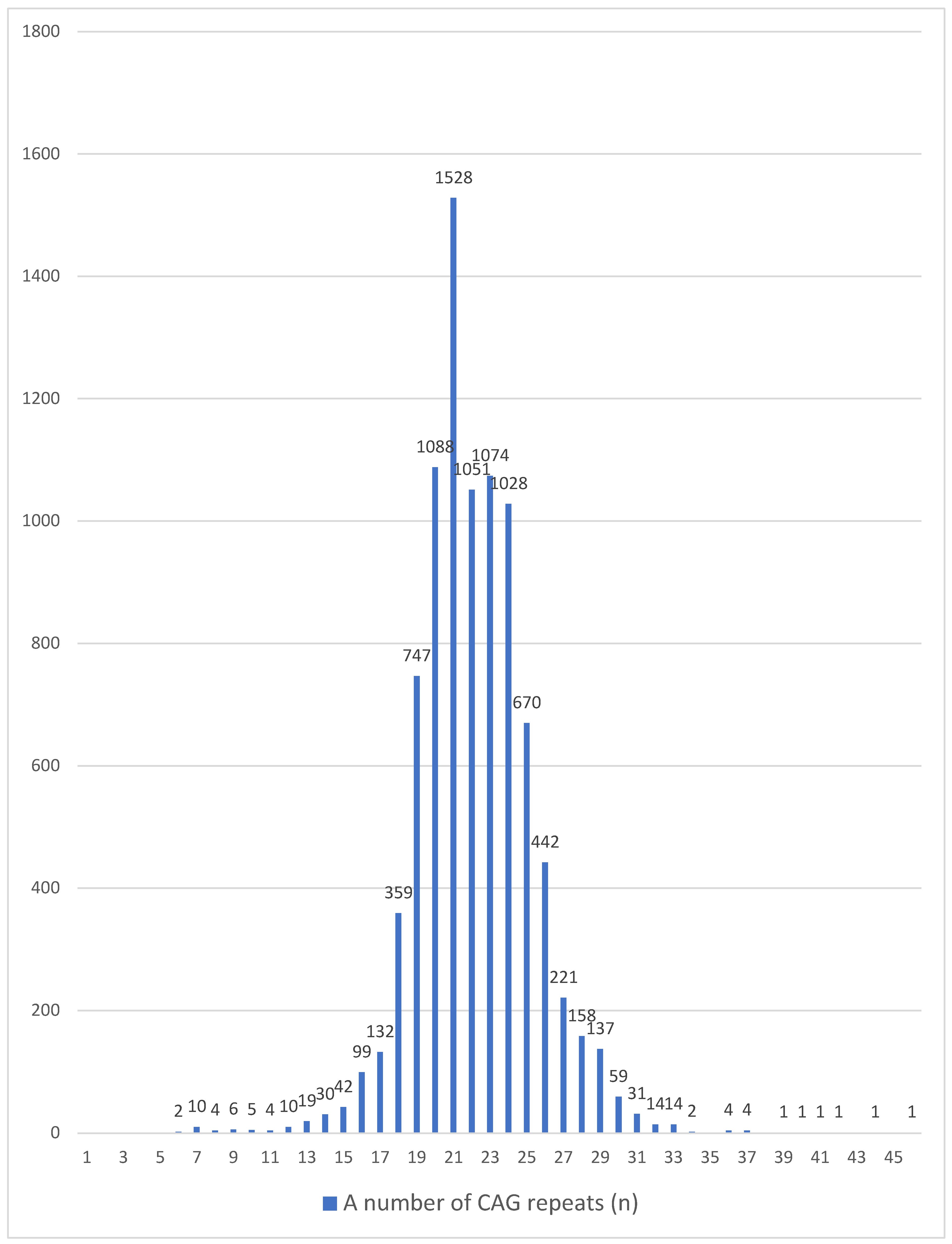
Figure 2.
Distribution of CAG repeats in exon 1 of the AR gene in fertile Russian men (controls, n=286).
Figure 2.
Distribution of CAG repeats in exon 1 of the AR gene in fertile Russian men (controls, n=286).
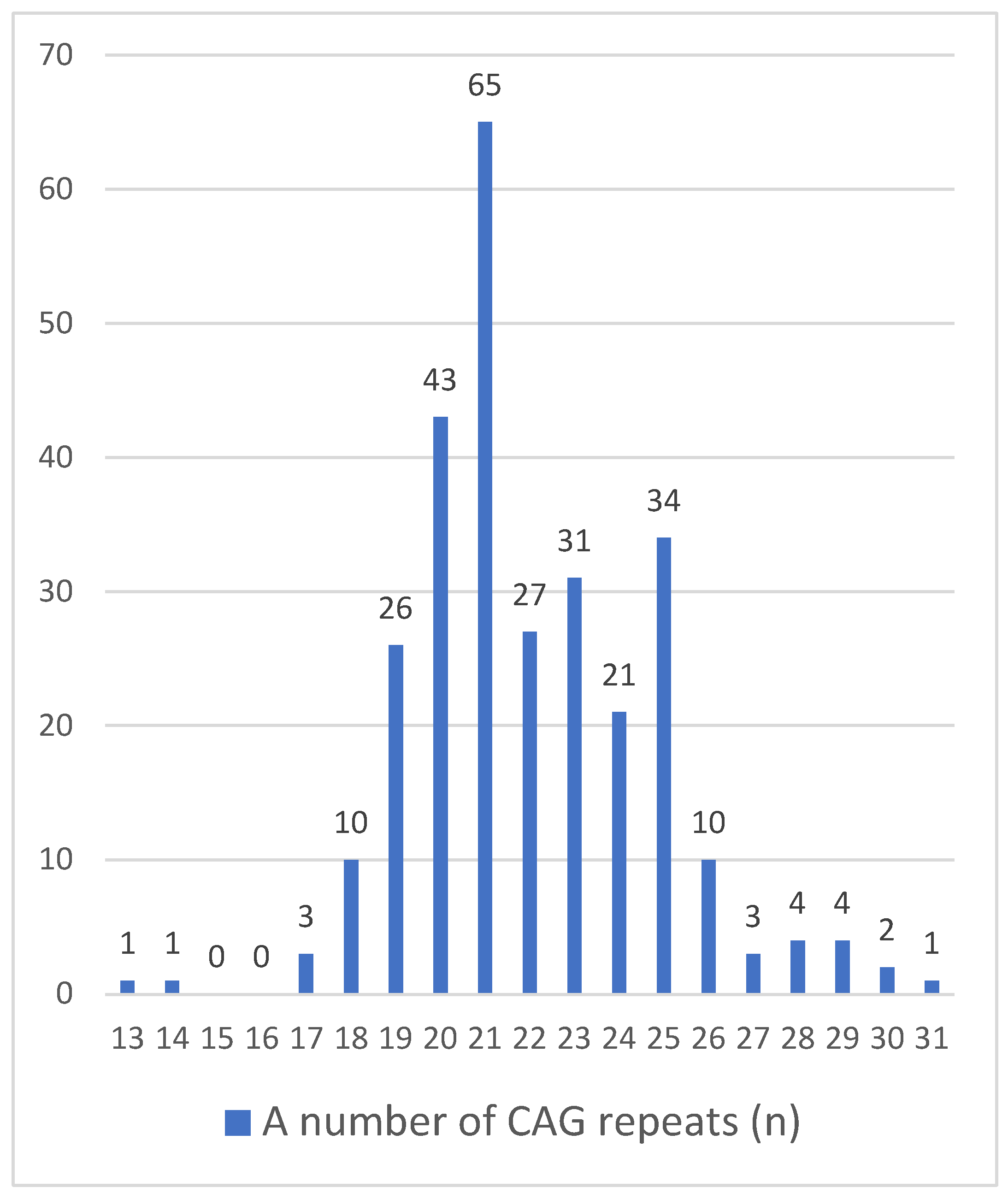

Table 1.
Allele frequencies of polymorphic (CAG)n variants of the androgen receptor (AR) gene in Russian infertile and fertile men.
Table 1.
Allele frequencies of polymorphic (CAG)n variants of the androgen receptor (AR) gene in Russian infertile and fertile men.
| Variants of the CAGn* polymorphic locus of the androgen receptor (AR) gene | Number of patients, allele frequency (AF) | P-value | |
|---|---|---|---|
| Russian infertile men (n=9000) | Russian fertile men (n=286) | ||
| 16 | 99 (0.0110) | - | - |
| 17 | 132 (0.0147) | 3 (0.0105) | 0.742 |
| 18 | 359 (0.0399) | 10 (0.0350) | 0.675 |
| 19 | 747 (0.0830) | 26 (0.0909) | 0.634 |
| 20 | 1088 (0.1209) | 43 (0.1450) | 0.134 |
| 21 | 1528 (0.1698) | 65 (0.2273) | 0.012 |
| 22 | 1051 (0.1168) | 27 (0.0944) | 0.245 |
| 23 | 1074 (0.1193) | 31 (0.1084) | 0.574 |
| 24 | 1028 (0.1142) | 21 (0.0734) | 0.032 |
| 25 | 670 (0.0744) | 34 (0.1189) | 0.006 |
| 26 | 442 (0.0491) | 10 (0.0350) | 0.274 |
| 27 | 221 (0.0246) | 3 (0.0105) | 0.184 |
| 28 | 158 (0.0176) | 4 (0.0140) | 0.823 |
| 29 | 137 (0.0152) | 4 (0.0140) | 0.939 |
* number of repeats. The p-values that revealed statistically significant differences between the groups are highlighted in bold.
Disclaimer/Publisher’s Note: The statements, opinions and data contained in all publications are solely those of the individual author(s) and contributor(s) and not of MDPI and/or the editor(s). MDPI and/or the editor(s) disclaim responsibility for any injury to people or property resulting from any ideas, methods, instructions or products referred to in the content. |
© 2024 by the authors. Licensee MDPI, Basel, Switzerland. This article is an open access article distributed under the terms and conditions of the Creative Commons Attribution (CC BY) license (http://creativecommons.org/licenses/by/4.0/).
Copyright: This open access article is published under a Creative Commons CC BY 4.0 license, which permit the free download, distribution, and reuse, provided that the author and preprint are cited in any reuse.