

Submitted:
17 October 2024
Posted:
21 October 2024
Read the latest preprint version here
Abstract
Time is what we measure with clocks. With clocks, we measure the duration of material change tuning in space. Material change runs in space only, time, as duration enters existence when measured. Time is an emergent physical reality that enters existence when measured by the observer. No measurement means no time. The motion does not require time. Motion requires only space and the physical object that moves in space, which is time-invariant. There is no physical past; there is no physical future. Past and future exist only in the human mind. Humans, we experience time-invariant space as NOW. The entire universe exists and develops into NOW.
Keywords:
space
; time
; matter
; energy
; gravity
; cosmology
1. Introduction
In physics, we have believed for more than 100 years that time is the 4th dimension of space, despite not having a single experimental proof. Recent research confirms that universal space is time-invariant [1]. Time as duration enters existence as an emergent physical entity when measured by the observer [2]. No measurement means no time. There is no such thing as “cosmological time." The universe does not exist in time, and time does not run in the universe. Only changes run in the universe, and when change is measured, we get time as an emergent physical reality, which is the result of the measurement done by the observer [3]. Rovelli also proved that time has no physical existence and should be abandoned as a fundamental physical reality [4,5]. Barbour also proved that time has no physical existence [6]. Despite undeniable proof that time has no physical existence, in fundamental physics it is still thought that motion requires time. A profound scientific discovery is that motion does not require time. For the existence of motion, only two things are needed: space and a material object that moves in space. When we measure motion with clocks, we get duration. This has crucial consequences in cosmology, namely, there is no physical past and no physical future, there is no cosmological time, there is no flow of time, and there is no arrow of time; change in the universe runs in time-invariant space that we humans experience as NOW.
Fundamental time is the numerical order of material change that runs in time-invariant space. The basic unit of fundamental time is Planck time. Events in the universe run one after the other, only in the sense of numerical order, not in the sense of one after the other in some physical time. Emergent time as duration enters the existence when measured by the observer. Every emergent time is the sum of Planck times [3]. Physical events run in time-invariant space and have no intrinsic duration. Duration enters existence when measured. This needs to be understood profoundly to progress fundamental physics and cosmology.
The model of time reversal symmetry (T-symmetry) has no physical correspondence in the physical world. The equation of time symmetry (1) below has no physical meaning:
The model of space-time, where the past is represented as the negative time and the future is represented as the positive time , has no support in human observation and experimental results. In physics, we do not have a single proof that negative time exists, and it is time we abandon this idea. The same applies to the symmetry in time. There is no symmetry in time because there is no negative time and there is no positive time; there is no past and there is no future.
Son, father, and grandfather are born in the same time-invariant space. Sure, the grandfather is born before the father, and the father is born before the son. But “before” and “after” have only mathematical reality in the sense of numerical order. For example, grandfather died in 1944, father died in 1980, and son died in 2024. All three have lived in the same time-invariant space. Between their deaths, there is no distance in some physical time. Dinosaurs lived in the same time-invariant space in which we live.
Time-invariant superfluid universal space is the medium of entanglement EPR-type [1]. Every elementary particle in the universe is entangled with every other particle via time-invariant space. Information transfer in time-invariant space is immediate. When a photon is moving through the time-invariant space, the velocity of information transfer has a light speed.
2. Implications of Time-Invariant Space Model on Gravitational Physics, Black Hole Physics, and Cosmology
The idea that space and time are warping and causing gravity was never experimentally proved. Gravity is a pushing force of time-invariant superfluid quantum space. Light is bending because of the variable energy density of superfluid space. Extension of the principle of equivalence of mass and energy on time-invariant superfluid quantum space shows that gravity is a pushing force of superfluid space; see equation (2) below [7]:
where is Planck energy density of superfluid space in intergalactic areas, is the energy density of superfluid space in the centre of a given object and is the volume of the object. The difference between energy densities generates gravity force. Gravitational mass and inertial mass can be expressed as follows in equation (3) below [7]:
When in interstellar space, a spaceship accelerates with , the astronaut has the same experience as he would stand on the Earth’s surface. This is because protons in the composite spaceship interact with the superfluid space, and this diminishes additionally the energy density of space in the spaceship, which becomes the same as on the Earth’s surface. Sbitnev developed a model where protons are vortexes of superfluid space [8]. The relativistic energy of the proton, when accelerated close to the light speed, is 7460 times bigger than its energy where the proton is at rest. The relativistic proton is integrating the energy of superfluid space in its vortex.
Relativistic mass is given by the following equation (4) below:
where γ is the Lorentz factor, and is the rest mass. Combining equations (2) and (4) we can express the Lorentz factor as follows in the following equation (5) below:
The higher the velocity of the physical object, the bigger the relativistic delta energy density and the bigger the value of the Lorentz factor. Equation (5) shows that the Lorentz factor depends on the relativistic delta energy density of the moving object. The mathematical formalism above is observer-invariant. It is valid for all observers, regardless of their position or velocity. Relativistic mass is the result of a moving object’s interaction with the superfluid quantum space [9]. The kinetic energy of every moving physical object is the energy of the superfluid space that is integrated into protons. For example, the protons of a falling stone integrate the superfluid space energy. When a stone crashes on the ground, this energy is released as electromagnetic energy in the form of heat and light.
Gravity force between two objects is generated by their gravitational masses. This can be expressed as follows in equation (6) below:
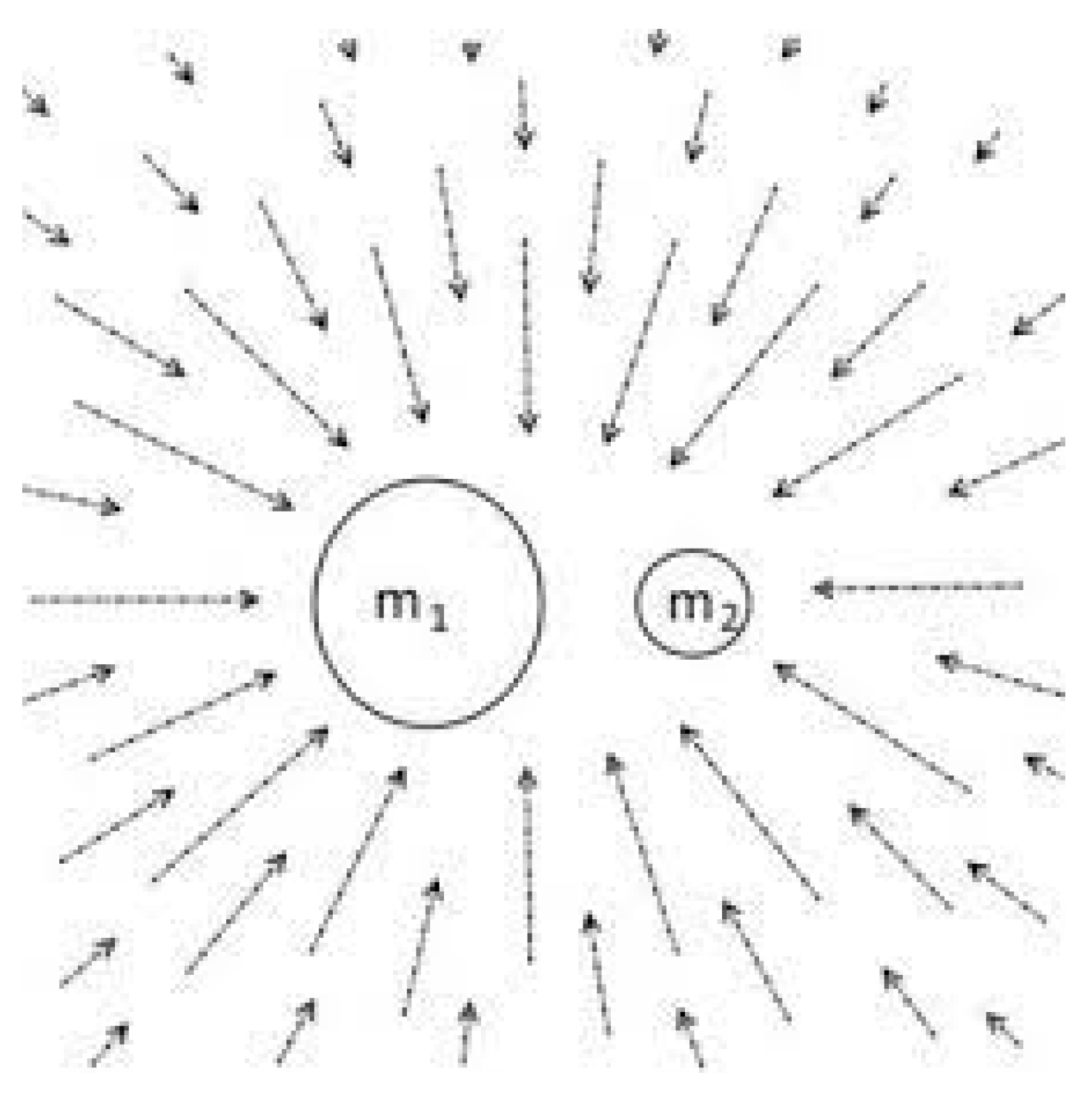
Two physical objects create an area of superfluid space with lower energy density. Two physical objects create an area of superfluid space with lower energy density. Outer space with higher energy density pushes toward lower energy density where physical objects are situated. This pushing force of space is the gravitational force. Physical objects are 3-dimensional; superfluid space is 4-dimensional. 3D physical objects are somehow trapped in 4D space. Physical objects are not emitting or receiving a gravity force. The idea that physical objects emit or receive gravitational force is flawed. Also, the idea that physical objects are curving space is flawed [7]. Gravity originates in fundamental symmetry between the mass of the given object and the diminished energy density of timeless superfluid space in its center.
Figure 1.
Gravity is a pushing force of superfluid space.
NASA measured in 2014 that universal time-invariant superfluid space has a Euclidean shape, which means that the universal space is flat and infinite in its spatial dimension [10]. The geometrization of gravity in GR has no physical meaning [11]. Gravitational singularity in the center of black holes proposed by Penrose [12] is a flawed model that contradicts fundamental postulates of physics and mathematics. Gravity inside the event horizon follows Newton’s shell theorem, as it is valid in all stellar objects [11].
In AGN, the energy density of superfluid space is so low that atoms that compose matter become unstable and fall apart into elementary particles that form stellar jets. Active galactic nuclei are rejuvenating systems of the universe, which is eternal, a non-created system in a permanent dynamic equilibrium. The only universe that exists is the one we can perceive NOW; the idea about some initial explosion in some distant physical past in which the universe started is just human imagination [13].
When the James Webb Space Telescope (JWST) discovered six galaxies that were too massive to fit into Bing Bang cosmology [14], there was a good point to recognize the Big Bang as a history of physics. The article was published on 22 February 2023. On 7 July 2023, the article was published in MNRAS, where the new age of the universe was calculated: 26.7 billion years [15]. Five months after the discovery of the JWST rocked Big Bang cosmology to its core, a paper appeared that seemingly saved the Big Bang cosmology model. Since 1931, hundreds of articles have been published in renowned journals about Big Bang cosmology. Today’s cosmology science has no power enough to admit that for almost a hundred years, cosmology has been wrong. To admit this error, one needs courage. Cosmology science today has an immense interest in keeping Big Bang cosmology artificially alive because of a lack of courage and scientific integrity.
Frankly, Big Bang cosmology has no necessary attributes to be considered science. An initial explosion of the mathematical point out of nothing where density, pressure, and temperature were infinite is not falsifiable and does not deserve to be called a scientific theory. The idea that CMBR is proving Big Bang cosmology is false. A given signal can move only through time-invariant space; it cannot come from some remote physical time that is non-existent. CMBR is the radiation of existent universal time-invariant superfluid space [13].
3. Discussion
In 1999, Barbour announced the next revolution of physics in his book “The End of Time – The Next Revolution of Physics” [16]. 25 years have passed, and fundamental physics and cosmology are still stuck in the old paradigm. In the last 25 years, numerous articles proved that time is not the 4th dimension of space and has no physical reality. The scientific community still did not accept this indisputable fact. Still, articles are published in high-ranked journals of physics where time is meant to be the 4th dimension of space. Top physicists are not willing to admit that the common interpretation of relativity theory is wrong: time is not the 4th dimension of space. In today’s physics, we are still living in space and time, although time is non-existent. Here is the main barrier to physics development.
Physicists are still experiencing physical reality through the linear psychological time that exists only in the scientific mind. They think time is running on its own in physical reality, although time is running only in their minds. The step out of the mind and so out of the time requires an awakening of the observer. Advances in fundamental physics and cosmology require the exploration of consciousness. The awakened observer is consciousness itself. Consciousness is fully aware that events in the universe run in time-invariant (timeless) space, where there is always and only NOW [17]. Erwin Schrödinger’s famous quote is a herald of the coming paradigm shift in physics: “Eternally and forever there is only now, one and the same now; the present is the only thing that has no end”.
The relational quantum mechanics statement is that different observers can experience differently the same sequence of events: “According to ref [1], the founding principle of RQM is the idea that ‘in quantum mechanics different observers may give different accounts of the same sequence of events.’ RQM has undergone significant development since this original proposal, but the basic idea remains the same: different observers may assign different quantum states to a given system and moreover in such cases all of the different assignations are equally correct, because the quantum state assigned to a system describes not only the system itself but also the relation between the system and the observer assigning the state. There exist other interpretations of quantum mechanics which take a similar view on the relational nature of quantum states [2,3,4,5,6] but typically these accounts regard (conscious) observers as playing some sort of privileged role. On the other hand RQM is built on strong naturalistic intuitions, and therefore in RQM the term ‘observer’ is understood in a broad sense which allows that any physical system can be an ‘observer,’ so we don’t have to accept that consciousness plays any fundamental role.” [18]. The idea that different observers can experience an event differently is already present in Special Relativity. The idea is flawed; the fact is that all observers in all different inertial systems experience a given event in an identical way. In the famous experiment, when the train is passing the station, the clock on the train has a lower rate than the clock in the station. And this is valid for both observers. The relative rate of clocks is "observer invariant"; it depends only on the variable energy density of superfluid space. The GPS is proving this without any doubt. Clocks on the satellites run at the same rate for all observers. If not so, the GPS could not work properly [19].
Concerning relational quantum mechanics where consciousness does not play an essential role [18], the idea is flawed. Consciousness is the origin of every observer. Through the eyes of every physicist, the same consciousness is acting as an observer. Consciousness gives physics the character of objectivity [20]. The future of the development of physics is physics, where reason will only be a tool; the main architect will be consciousness. Reason does not have the cognitive power to develop physics, so today we have a bunch of new theories that are just the ideas of physicists and have no objectivity. For example, the idea that time is the 4th dimension of space is the product of the mind. The awakened observer who is fully aware of how his scientific mind could influence the development of the theory is the only guarantee of the objectivity of physics. In its origin, physics is the science built by cosmic intelligence (consciousness) that acts as an awakened observer.
4. Conclusions
The only progress of science was and will be forever the doubt. Today, hundreds of professors of physics worldwide are teaching students that time is the 4th dimension of space. Nobody is willing to ask himself about the actual existence of time as the 4th dimension of space. The result is that we are stuck in the old paradigm of some physical past and future, and there is no progress. The progress of physics is in the minds of those who are still able to doubt.
References
- Šorli, A.S. & Čelan Š., Time-Invariant Superfluid Quantum Space as the Unified Field Theory, Reports in Advances of Physical Sciences, 4 (2020), no. 3, 2050007. [CrossRef]
- Šorli A., Čelan Š., Time as the result of the observer measurement, Physics Essays, 34 (4) (2021). [CrossRef]
- Fiscaletti, D., Sorli, A. Perspectives of the Numerical Order of Material Changes in Timeless Approaches in Physics. Found Phys 45, 105–133 (2015). [CrossRef]
- Rovelli C., “Forget time”, (2009) https://arxiv.org/abs/0903.3832. [CrossRef]
- Rovelli C., The Relational Interpretation (2021), https://arxiv.org/pdf/2109.09170.pdf.
- Barbour J. “The Nature of Time” (2009) https://arxiv.org/abs/0903.3489. [CrossRef]
- Sorli, N. Gorjup, R. Gorjup, Replacement of space-time with superfluid space and restoration of Newton’s dynamic ether, Rep. Adv. Phys. Sci., 7 (2023) 2350005. [CrossRef]
- V. I. Sbitnev, Hydrodynamics of the Physical Vacuum: II. Vorticity Dynamics. Found. Phys. 46 (2016) 1238–1252. [CrossRef]
- Amrit Sorli, Stefan Celan, Niko Gorjup, Superfluid quantum space, Einstein’s principle of equivalence, and Bohr’s complementary principle, Advanced Studies in Theoretical Physics, Vol. 16, 2022, no. 3, 115-120 https://www.m-hikari.com/astp/astp2022/astp1-4-2022/91847.html.
- NASA, https://map.gsfc.nasa.gov/universe/uni_shape.html (2014).
- Amrit Srecko Sorli, Rado Gorjup, Niko Gorjup, Tomaz Makovec, Akash Saroj, Akash Ranjan, Piyush Singh, Re-examination of Penrose’s and Kerr’s singularities and the origin of protons in astrophysical jets, Advanced Studies in Theoretical Physics, Vol. 18, 2024, no. 2, 61-82, https://www.m-hikari.com/astp/astp2024/astp1-4-2024/92117.html.
- Penrose, R. Gravitational collapse and space-time singularities, Physical Review Letters, 14 (1965), no. 3, 57. [CrossRef]
- Sorli A., Jafari. S., Fiscaletti D., Gorjup N., Gorjup R. Makovec T., Evidence-Based Cosmology – Black holes are rejuvenating systems of the universe, Reports in Advances of Physical Sciences, 7 (2023), 2350012. [CrossRef]
- Labbé, I., van Dokkum, P., Nelson, E. et al. A population of red candidate massive galaxies ~600 Myr after the Big Bang. Nature 616, 266–269 (2023). [CrossRef]
- Rajendra P Gupta, JWST early Universe observations and ΛCDM cosmology, Monthly Notices of the Royal Astronomical Society, Volume 524, Issue 3, September 2023, Pages 3385–3395. [CrossRef]
- Barbour J. The End of Time – The Next Revolution of Physics, Oxford University Press (1999).
- Sorli Amrit, Celan Stefan, Temporal and timeless cognition in physics, Physics Essays, Volume 35, Number 3, September 2022, pp. 305-308(4) https://doi.org/10.4006/0836-1398-35.3.305.
- Emily Adlam, Carlo Rovelli, Information is Physical: Cross-Perspective Links in Relational Quantum Mechanics (2022). https://doi.org/10.48550/arXiv.2203.13342.
- Amrit Sorli, Stefan Celan, Niko Gorjup, Physical origin of the relative rate of clocks in GPS and errors of relative motion concept, Advanced Studies in Theoretical Physics, Vol. 16, no. 4, 191-200 (2022) https://www.m-hikari.com/astp/astp2022/astp1-4-2022/91893.html. [CrossRef]
- Amrit Sorli, Oltre la fisica del Einstein – La fisica meravigliosa dello’osservatore risvegliato, ISBN 9788828510109, Gruppo Macro (2024) https://www.gruppomacro.com/prodotti/oltre-la-fisica-di-einstein.
Disclaimer/Publisher’s Note: The statements, opinions and data contained in all publications are solely those of the individual author(s) and contributor(s) and not of MDPI and/or the editor(s). MDPI and/or the editor(s) disclaim responsibility for any injury to people or property resulting from any ideas, methods, instructions or products referred to in the content. |
© 2024 by the authors. Licensee MDPI, Basel, Switzerland. This article is an open access article distributed under the terms and conditions of the Creative Commons Attribution (CC BY) license (http://creativecommons.org/licenses/by/4.0/).
Copyright: This open access article is published under a Creative Commons CC BY 4.0 license, which permit the free download, distribution, and reuse, provided that the author and preprint are cited in any reuse.