

Submitted:
18 October 2024
Posted:
21 October 2024
You are already at the latest version
Abstract
Background: Menstruation is a natural physiological process experienced by 1.8 billion girls, and pre-menopausal women globally, and can be experienced about 300 times in a woman’s lifetime. Even though menstruation is a sign of normal female reproductive functions and marks an important transition into womanhood for adolescent girls, it is bounded by several taboos, myths, misbeliefs, or misconceptions in low-and middle-income countries including Ghana. Hence, the topic and cultural practices around menstruation are rarely discussed, and the experiences of young girls during menarche and early menstrual life remain poorly captured. This study explored the cultural construction of menstruation in the Ghanaian context.
Methods: This study was qualitative and adopted an exploratory study design. We used purposive and convenience sampling procedures for sampling five Senior High Schools and participants in the Volta Region of Ghana. 15 Focus Group Discussions (FGD) were conducted. This comprised five FGDs for female students, five FGDs for teachers, and five FGDs for parents. For each of the FGDs, 10 to 12 participants were sampled to participate in the discussion. Data were audio-recorded, transcribed, translated, and imported into MAXQDA qualitative analysis software 2022 version for analysis. Data were coded and analyzed using a thematic analysis.
Results: We found that there are a myriad of socio-cultural beliefs and practices that are associated with menstruation in Ghana. These beliefs such as menstrual blood is unclean and practices like celebration of menarche, and upholding some menstruation-related cultural/tribal taboos including household restrictions, religion, and social restrictions were identified. Our findings revealed that myths have long enveloped the facts about menstruation.
Conclusion: Cultural and social practices regarding menstruation depend on girls’ education, attitude, family environment, culture, and beliefs, pointing to the need for public health officials in the Ghanaian society to provide more culturally oriented education to the general public on menstruation and the impact of some conservative socio-cultural practices on the menstrual health of adolescents.
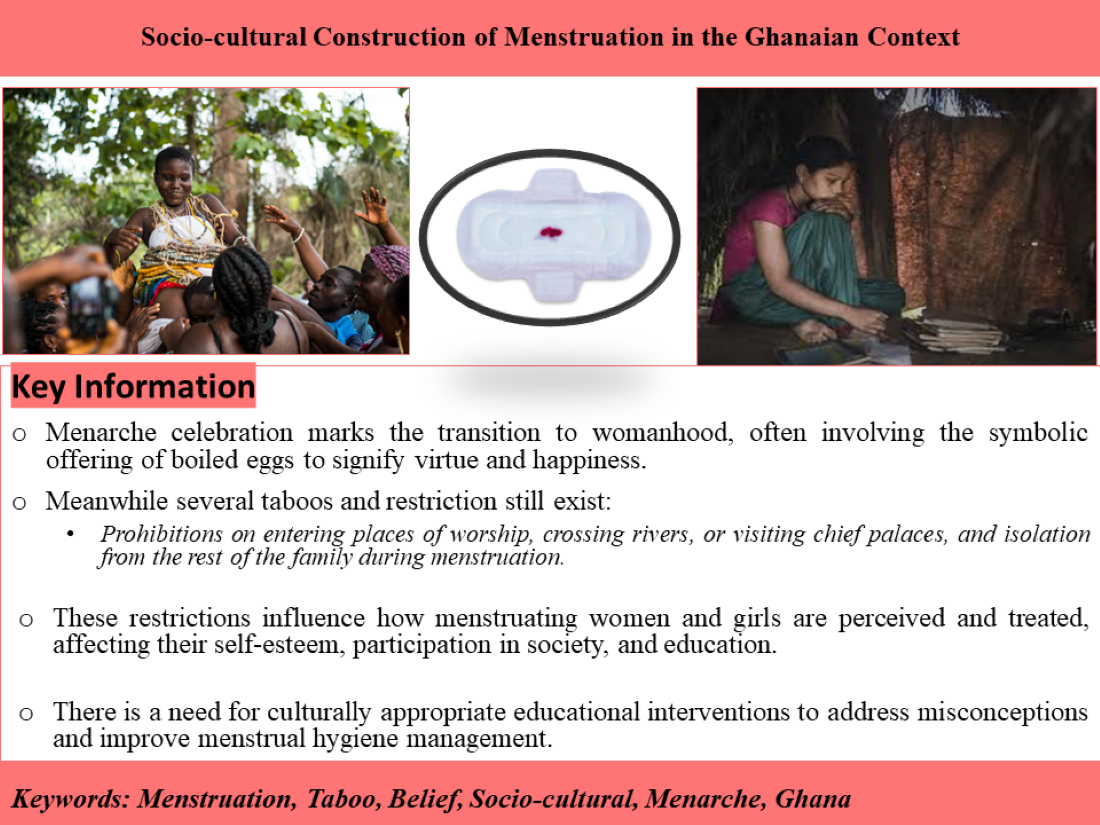
Keywords:
Menstruation
; Taboo
; Belief
; Socio-cultural
; Menarche
; Ghana
1. Introduction
Menstruation is a natural physiological process experienced by 1.8 billion girls, and pre-menopausal women, globally and can be experienced about 300 times in a woman’s lifetime [1,2]. Rapid transformations due to the hormonal changes that accelerate physical, cognitive, and psychosocial growth usually occur during adolescence [3]. From the many changes during adolescence, occurrence of menstruation or menarche is a natural event that is both a physiological and psychological milestone in women’s reproductive life [4]. This physiological occurrence is the same for girls and women globally. However, cultural differences account for contextual meanings ascribed to menstruation [5].
Even though menstruation is a sign of normal female reproductive functions and marks an important transition into womanhood for adolescent girls, it is bounded by several taboos, myths, misbeliefs, or misconceptions in low and middle-income countries [6,7]. In most traditional settings including African societies like Ghana, there is a relatively high prevalence of misconceptions; one of which is that menstruation is considered impure in some societies, the topic of menstruation is largely treated as a taboo, and is rarely discussed publicly [8,9]. Across societies, cultural beliefs and norms shape how girls view and experience this biological process making girls not feel free to discuss their menstruation with other individuals in public or discuss it in the family. Cultural beliefs, myths, and taboos surrounding menstruation persist in many communities, affecting how girls view and manage this biological process [10].
In many parts of Ghana, menstruation is perceived as shameful and dirty, as a result, girls face challenges like restrictions on daily activities, dietary limitations, and social exclusion from religious spaces or water sources [9,11]. These restrictions are mostly based on the misconception that menstrual blood is unclean hence menstruating women are similarly contaminated and should be isolated [12]. In some cultures in Ghana, some menstruating women are restricted from religious activities, or women are forced to practice menstrual exile [9,12]. These practices, combined with inadequate social support and taboos surrounding menstruation, often leave adolescent girls disillusioned and burdened with feelings of guilt, shame, unworthiness, fear, anxiety, and distraction [13]. Consequently, many adolescent girls and young women are predisposed to health, social, and cultural hazards including infection as a result of poor hygiene practices during menstruation [14]. Further, these challenges can potentially affect girls’ ability to thrive and succeed within the school environment [15]. The taboo and stigma surrounding menstruation have led to a lack of open discourse on the subject across cultures and societies.
Previous studies conducted in Ghana that explored menstrual restrictions were predominantly quantitative in nature [9,12,16], offering a limited in-depth comprehension of the cultural beliefs and practices shaping these restrictions. Besides, the present study provides narratives from varied participants from a geographically broader perspective supplementing the evidence from these past studies and building a strong argument towards the development of targeted interventions. The findings from this study are important for designing targeted interventions, improving menstrual hygiene management, and supporting the well-being and educational outcomes of girls in Ghana.
2. Methods
The reporting of this study follows the consolidated criteria for reporting qualitative research (COREQ) [17,18].
2.1. Setting
The study was conducted in five districts of the Volta region of Ghana. These districts are Hohoe, Afadzato South, Kpando, Ho West, and Ho Municipality. The Volta Region is one of the 16 administrative regions in Ghana. It is located between latitudes 50°45’N and 80°45’N and lies along the southern half of eastern Ghana. It is bounded on the north by the Oti Region of Ghana, south by the Gulf of Guinea, on the west by the Volta Lake, and on the east by the Republic of Togo. The region has approximately 9,504 km2 of surface area representing 8.6% of Ghana’s total land area, with a total population of 1,659,040 [19]. Overall, the gender composition of the region is males 47.7 % and females 52.3% [19]. The Ewe ethnic group is predominant with scores of Akans and Guans. The population of these five districts is as follows; Hohoe Municipality (114,472), Afadzato South (73,146), Kpando Municipality (58,552), Ho West District (82,886), and the Ho Municipality (180,420) according to the 2021 Population and Housing Census estimate [19].
2.2. Study Design
This study was qualitative and adopted an explanatory study design. Focus Group Discussion Guides were used in collecting data from the participants. We employed this design because it helps in generating in-depth information about the socio-cultural construction and practices surrounding menstruation [20].
2.3. Study Population
Our target population for this study was adolescent girls who are students of major Senior High Schools in the five selected districts in the Volta Region. We also targeted their teachers and parents for participation in this study.
2.4. Sampling Procedure and Sample Size
We used purposive and convenient sampling procedures for sampling all five Senior High Schools (Ve Senior High School, Alavanyo Senior High School, Kpando Senior High School, Kpedze Senior High School, and Shia Senior High School) and participants (adolescent female students, teachers, and parents). The approaches were employed to sample students who were available on the campuses of the selected Senior High Schools, teachers who were involved in student wellbeing and parents who had daughters who have ever menstruated and were accessible at the time of the data collection. In total, we conducted 15 Focus Group Discussions (FGD) across all five Senior High Schools. This comprised five FGDs for female students, five FGDs for teachers, and five FGDs for parents. For each of the FGDs, 10 to 12 participants were sampled to participate in the discussion.
2.5. Data Collection Instruments and Procedure
Data for this study was collected through face-to-face interactions using FGD data collection method. All the female students and teachers’ discussions were conducted in English. However, the majority of parents’ discussions were carried out using native Ghanaian languages (Ewe and Twi). The choice of local language for the parents’ discussion was to ensure that we had in-depth information from them without any language barrier. To ensure that the use of the local languages did not affect the quality of the data collected, training was carried out. The research assistants received a two-day training on qualitative research interviewing skills using a manual developed for this purpose. Each of the discussions with the participants lasted for about 60 minutes. The FGDs were conducted using FGD guides, which facilitated discussions about sociocultural beliefs regarding menstruation, and prevailing cultural and religious practices, and were piloted among similar populations to check for clarity and comprehension of the questions before the start of the data collection. Also, the guides were given to experts in the field of qualitative study for them to peruse in detail to check for the appropraiteness of the questions. We also recognized the importance of rigor and trustworthiness in qualitative research, we worked to ensure confirmability and transferability. The study findings were transferable and confirmable due to the detailed description of the study circumstances and techniques. Besides, audio recorders and hand-written notes were also used to record the discussions. The use of both the audio recorders and hand-written notes was to ensure that the interview process was not halted should any of the equipments (pen or audio recorder) break down during the interview process. After each interview, field notes were taken and referred to during the analysis, which included the participants’ nonverbal indications, worries, and interviewers’ reflections.
2.6. Data Processing and Analysis
All the recorded discussions from the participants were transcribed verbatim into a Microsoft Word document from which codes and themes were developed using flexible thematic analysis [21]. Transcriptions were carried out by trained transcribers with competencies in the local language. The transcripts were quality-checked by an independent person with both language and grammar competencies to ensure that the content of the transcripts was accurate. The transcripts were read and edited to resolve any omissions and mistakes in the original transcripts. Familiarization with the data was done to take note of key ideas and recurrent themes. MAXQDA qualitative analysis software 2022 version was used in developing the codes and identify themes. The method employed involved the integration of pre-established codes derived from research questions and literature review, as well as newly generated codes that emerged from the data itself during the analysis phase. The coding process involved identifying and labeling ideas in each transcript. This was after an exhaustive period of extensive reading of the transcripts by each analytical team member to familiarize themselves with the texts. The coding process was informed by two primary considerations, deductive, where themes were preselected based on the guide used for the interview, and inductive. Deductive coding involves identifying and labeling pre-existing ideas on the topic under study, while inductive coding refers to discoveries emanating from the transcripts. Before the coding process, the team had two separate meetings to agree on the constitution of a code and the labeling of emerging issues in the recorded audio. This was to ensure similar ideas occurring in any transcript analyzed by team members would be labeled or coded the same way. After the first round of coding, through constant comparison where observations from all transcripts were compared, a table was generated in Excel (Microsoft, Redmond, WA, USA) to align all the ideas in all transcripts against each other. From this table, dominant ideas and less dominant ideas were observed. The themes were defined and named and a detailed analysis was conducted and written based on how they fit into the broader story of the data. To ensure the validity of the analysis, we used extracts from the data that capture the essence of each theme being demonstrated to develop the full write-up of the report. A frequency table was, however, used to present the socio-demographic characteristics of the participants.
3. Results
3.1. Background Information of Participants
The Table 1 (A, B and C) present the background characteristics of the various groups that participated in this study.

Table 1.
A: Adolescent schoolgirls.
| Variable | Frequency, N=54 | Percentage (%) |
|---|---|---|
| Age | ||
| 15 | 5 | 9.3 |
| 16 | 14 | 25.9 |
| 17 | 24 | 44.4 |
| 18 | 9 | 16.7 |
| 19 | 2 | 3.7 |
| Level of education (form) | ||
| Form 1 | 17 | 31.5 |
| Form 2 | 24 | 44.4 |
| Form 3 | 13 | 24.1 |
| Ethnicity | ||
| Ewe | 45 | 83.3 |
| Akan | 5 | 9.3 |
| Ga/Dangbe | 4 | 7.4 |
| District | ||
| Hohoe | 10 | 18.5 |
| Kpando | 10 | 18.5 |
| Ho West | 13 | 24.1 |
| Ho | 11 | 20.4 |
| Afadjato South | 10 | 18.5 |
Table 1.
B: Parents.
| Variable | Frequency, N=45 | Percentage (%) |
|---|---|---|
| Age | ||
| 21-35 | 6 | 13.3 |
| 36-45 | 15 | 33.3 |
| 46-55 | 14 | 31.1 |
| 56-65 | 4 | 8.9 |
| 66 and above | 6 | 13.3 |
| Sex | ||
| Female | 28 | 62.2 |
| Male | 17 | 37.8 |
| Marital status | ||
| Single | 10 | 22.2 |
| Married | 29 | 64.4 |
| Divorced/Widowed | 5 | 11.1 |
| Co-habiting | 1 | 2.2 |
| Ethnicity | ||
| Ewe | 41 | 91.1 |
| Akan | 2 | 4.4 |
| Hausa | 2 | 4.4 |
| District | ||
| Hohoe | 6 | 13.3 |
| Kpando | 9 | 20.0 |
| Ho West | 11 | 24.4 |
| Ho | 10 | 22.2 |
| Afadjato South | 9 | 20.0 |
Table 1.
C: Teachers.
| Variable | Frequency, N=49 | Percentage (%) |
|---|---|---|
| Age | ||
| 20-30 | 10 | 20.4 |
| 31-40 | 20 | 40.8 |
| 41 and above | 19 | 38.8 |
| Sex | ||
| Female | 16 | 32.4 |
| Male | 33 | 67.3 |
| Marital status | ||
| Single | 18 | 36.7 |
| Married | 31 | 63.3 |
| Ethnicity | ||
| Ewe | 46 | 93.9 |
| Akan | 2 | 4.1 |
| Chamba | 1 | 2.0 |
| District | ||
| Hohoe | 7 | 14.3 |
| Kpando | 10 | 20.4 |
| Ho West | 11 | 22.5 |
| Ho | 10 | 20.4 |
| Afadjato South | 11 | 22.5 |
3.2. Thematic Results
The analysis of the teachers, parents, and students’ interviews on the social-cultural construction of menstruation yielded two major overarching themes. One theme reflects the celebration that comes with adolescents’ menarche and the other theme indicates the taboos that are associated with menstruation in the Ghanaian society and these themes are supported by minor themes (see Table 2).
3.2.1. Celebration of Menarche
It emerged from the participants that the adolescents’ first menstruation comes with celebration by the entire family. This celebration is indicated by a number of the participants as a way of ushering the adolescent who is menstruating for the first time to adulthood and womanhood. The participants report that the celebration involved offering the adolescent some boiled chicken eggs. Almost all of the participants emphasize that the celebration of the menarche with eggs varies from one ethnic group to another, However, it involves cooking two eggs, one to be chewed and the other to be swallowed by the adolescents. The following quotes summarize some of the views of the participants:
“For our forefathers when you menstruate for the first time there is an event they celebrate for the person. They wear clothes and celebrate by boiling eggs and yams and mixing them. So, here when a girl menstruates for the first time her family celebrates her with boiled eggs to welcome her to womanhood”(Parent, 40 years, female)
“For my daughter when she first saw her menses, she came running to me that she was discharging blood. So, I told her to clap for herself because she is now a woman. In Ewe [Majority Ethnic group in the Volta Region of Ghana] when you see your menses for the first time, you will be given an egg"(Parent, 55 years, female)
“When I menstruated for the first time, my mother boiled two eggs for me and she said I should swallow one and I should chew one. She said the one that I will chew and swallow all has a meaning, if I chew it [egg], I have to swallow one before chewing it [egg], the one that I am swallowing is like virtue for me but if I try to chew the one that I have to swallow is going to be like I have chewed all the eggs in my womb but the one that I chewed after swallowing that one is like happiness in my family. And I was like okay but I found it difficult to swallow the egg because that was my first time"(Student, 16 years)
2.3.2. Social Taboos Associated with Menstruation
While the occurrence of the first flow is mostly welcomed with celebrations, mostly to indicate a transition or growth, menstruation in general is surrounded by a myriad of taboos. These stigmatizing and discriminating practices come both from the community and even from family members. This discrimination takes many forms, manifested as negative attitudes stemming from a lack of knowledge and prejudice surrounding menstruation. The taboos shared by the participants involved household restrictions and communal restrictions.
Household Restrictions
A large number of the participants report several household practices and restrictions connected with menstruation for women and adolescent girls. These practices include not being allowed to cook for men (fathers, brothers, chiefs), isolation (using different rooms and items), not going into some rooms in the house (stool room [special room in traditional houses where gods are believed to live and ritual are performed]). Though some may view these practices as restriction, others might perceive them as a form of relaxation during menstruation.
Regarding the menstruating females not being allowed to cook for men to eat, almost all the participants explain that in their households when a female is in her menses she is not supposed to cook for men. The following quotes summarize some of the responses from the participants:
“What I know is that a woman will not cook for her husband if she is menstruating. So, when that time comes, the man does the cooking; so, it's an arrangement between the two of you”(Parent, 59 years, male)
“In a traditional setup, when somebody is menstruating, that person is not allowed to cook for the male person or the entire house. Because when that person cooks, the belief is that the potency of the power will be reduced. So, the power of the traditional belief will be reduced. So, the father will not even allow you to bring food to him or even water until the period is over”.(Teacher, 43 years, male)
“Please in the house, on my father's side when am menstruating I don’t cook, I use only one cup to drink water and one plate to eat but on my auntie's side I can cook I can do everything I want, but my father’s side we don’t do it.”(Student, 19 years)
Some of the participants indicate that in certain communities when women are in their menses, they are not allowed to stay in the same house or use the same room with others. As a result, there are separate rooms outside the house which are allocated for them to stay in during menstruation and can only return when they have finished with their menstruation. This practice reveals varying degrees of strictness within communities. It is crucial to acknowledge that although some parents have recounted these restrictions based on their own experiences, it is still unclear whether they regularly enforce the same restrictions on their daughters. Some of the responses from the participants are summarized below:
“So according to the GBI tradition area [traditional ruling area in Hohoe Municipality of Volta Region, Ghana] when they build, a room is allocated that when women are in their menses, they occupy that place until they are done before they join the others in the main house so that informed the name (Edoleafeme [being out of the house]) in ewe”(Parent, 53 years, male)
“In my father’s house, anyone who is menstruating isn’t allowed in that house, so whenever my siblings and I are in our menses we move out to our uncle's house. So, if you are in your menses and you aren't supposed to be in the house and you ignore it and stay in the house, you will be stuck with the gods; your menses won't stop until they take some things from you, and do a prayer before it stops”.(Parent, 53 years, female)
While these beliefs and practices could be fading out in some contexts, a lot more people still adhere to them, trickling it down to their next generations. Nevertheless, it has been noted that some adolescents, especially those who are extensively exposed to contemporary influences or diverse cultural viewpoints, manage to circumvent specific conventional menstrual practices. This implies a nuanced dynamic where adherence to these practices continue, yet younger persons may selectively navigate these norms, therefore reflecting more transformations in society perspectives. These excerpts explain the mix;
“Another one that I heard was someone saying that if he should give a woman a lift and later get to know that she is in her menses, he has to go and perform some rituals for cleansing. But in my house, I haven't heard of such. So because I don't know any, I haven't extended that to my daughter” .(Parent 46, female)
...So I plead, when we talk about cultural norms regarding menstruation we must comply if not we will just say we don't know... I am saying that they are there, they exist and they have consequences. .(Parent 54, female)
"In our hometown a woman is not supposed to cook during her period, but I cook at home and do other house chores without any problem. I think we are gradually overcoming all these traditions” .(Student 18 years)
Communal Restrictions
The results reveal that menstruating women or adolescent girls also face some community restrictions due to their menses at a particular period. These restrictions include; restrictions on visiting places of worship (churches, mosques, and shrines), restrictions on going to the riverside or traveling across rivers, and restrictions on visiting the Chief’s Palace.
- Restriction on visiting places of worship
The participants reveal that in their communities when a woman is menstruating, she is not allowed to visit places of worship such as churches, mosques, and shrines. The quotes below summarise some of the responses from the participants:
“Some fetish places [shrine] where they perform rituals for gods a woman who is menstruating must not go there"(Parent, 77 years, male)
“When I was growing up, if you are menstruating you are not to go to some churches, they would not allow you to step there, there is someone at the door to ask you before opening the door for you...but at times, it becomes so psychological that at times I cry. Because they make you feel so neglected as if menstruation is a sin.”(Teacher, 32 years, female)
“As for we the Muslims when you’re menstruating, you’re not allowed to cook, and you’re not allowed to go to the mosque and pray. That’s what I believe, …yeah.” (Student, 17 years)
- 2.
- Restriction on going to the riverside or travel across rivers
It was also noted in this study that when women are menstruating, they are admonished from visiting the riverside to fetch water or travel across rivers from their community to another community on the other bank of the river. The following quotes represent some of the responses of the participants:
“For instance, in Kpando [one of the districts in Volta Region, Ghana], there is a river that they will have to fetch the water and meet you midway when you are menstruating because you are not to go to the riverside. Someone will fetch the water and carry it and give it to you but you do not have to go there yourself."(Parent, 45 years, female)
“In my village, there is a stream and if you are a woman in your menses, you can’t go to that stream to fetch water for anybody or even cross the river to the other side of it. You know, we by perception or for real, any woman in that situation is unclean and this is a stream that we all fetch to drink and you are labeled as unclean, why do you go there.”(Teacher, 46 years, male)
“In my hometown, whenever I am in my period, I am warned not to go to the riverside, they say it is against the gods, and in the community, they encourage girls who are menstruating to respect the gods and not to dare go to the riverside…”(Student, 17 years)
- 3.
- Restriction on visiting some part of the community (Chief Palace)
This study also report that women, during their menstrual periods, are not allowed to visit or enter some places within the community such as the chief’s palace. It is believed that going to the chief’s palace while in your menses can affect the powers of the chief. The quote below summarises some of the views of the participants:
“All has been said but the other is that people have powers so when a menstruating woman goes to some places in this community or enters some houses if she goes there the person’s power is destroyed and we have the spiritual stool in the chief's Palace and if a menstruating woman enters that place, she has destroyed the stool, so because of that they don't allow menstruating women to go where they do traditions for the chiefs and rituals”(Parent, 75years, male)
“For me, I come from a chief’s palace. So, in my hometown, before you go to the palace, they interrogate you, are you in your menses and if you are in your menses, you won’t be allowed to go. When you are in your menses you won’t go to the house, you will not be seen around, you will not cook garden egg stew, you will not talk to the chief and immediately you see the chief, you have to run away. And to prevent all these things, if I know I will menstruate in two days when my parents are going to our hometown, I will stay, I will not follow them.”(Teacher, 32years, female)
“[In my community], if you’re menstruating, you are not supposed to go there ... the chief’s palace when you’re menstruating because they see you to be dirty at the time of your menstruation”(Student, 16years)
4. Discussion
This qualitative study explored the socio-cultural construction of menstruation in the Ghanaian context. The findings revealed that there are a myriad of socio-cultural beliefs and practices that are associated with menstruation. These beliefs and practices encompass the celebration of menarche and the upholding of some menstrual-related cultural/tribal taboos. These practices frequently impose stringent restrictions on women and girls, greatly affecting their everyday life, quality of education, and participation in societal activities. The study also revealed that although many still conform to these deeply rooted cultural norms, there is an increasing disposition among younger generations to question and devise methods to circumvent these practices, especially in urban areas and among those with higher levels of education.
Menarche is a time of significant psychological and sociocultural adjustment, potentially leading first-time menstruating girls to reconceptualize their identity as women within the societies they live [22]. In the Ghanaian cultural contexts, menarche is constructed as a symbolic transition from childhood to womanhood, a period of growth, marriageable age, and is often linked with sexual maturation. Menarche is a major landmark in girls’ lives in their transition from childhood to womanhood. Just as it is in most low-and middle-income countries [23,24,25] in Ghana, the ability to marry and reproduce is sanctioned when a girl reaches menarche as it is considered an important milestone of sexual maturation. Though a considerable variation in the meaning of menarche is noticed across cultures in Ghana, it is still considered a memorable event in a girl’s life.
We found that the celebration of the menarche for adolescent girls involves offering the first-time menstruating female chicken eggs. It was noted that the eggs are cooked and offered to adolescents who are menstruating for the first time as a sign of ushering them into womanhood. Also, we further found that the nature of the celebration varies from one ethnic group to another within the Volta region. The celebration with eggs generally involves cooking two eggs, one to be chewed and one to be swallowed by the adolescents. The swallowing of the first egg before chewing the second one is explained to mean that the one that is swallowed represents virtue for the adolescents and the second egg which is chewed by the first-time menstruating adolescent girl signifies happiness in her family. However, it was noted that defying this order of celebration by chewing the eggs means the adolescent has chewed all the eggs [ova] in their ovaries resulting in them becoming barren in the future. Our finding on the first menstruation celebration is consistent with the celebration of menarche in other countries like India, the Republic of Benin, Cameroon, and Zambia [23,26,27]. It is also worth noting that, in this modern era, these cultural celebrations and practices are changing due to modernization and deviations from traditional belief systems but it is still largely practiced in many communities in Ghana especially in the remote and rural settings with partakers in these rites expressing mix feelings about the celebration of menarche [28].
Menstruration and menarche experiences play a critical role in adolescent girls’ lives. While globally there are similarities in the way menarche and menstruation are experienced, there are also cultural differences, including specific beliefs, practices, and restrictions placed on women during menses. Though menarche is usually seen as a significant achievement in Ghanaian culture, we did note a clear difference in the following treatment of women and girls who menstruate. In many Ghanaian households, women are confronted with restrictions, such as being prevented from preparing meals for specific household members like men and chiefs, and experiencing restrictions on their social commitment during menstruation. This finding is congruent with the findings reported in India by Behera and colleagues [25] which suggested that in India, during menstruation, women are not allowed to attend to certain household chores, such as preparing food. Our finding on cooking restrictions on menstruating women or girls in the Ghanaian cultural context could be explained by the fact that in most Ghanaian cultures, it is believed that when menstruating women cook for men to eat, it can weaken them and they may lose their luck and not be successful in their economic activities.
Also, those who might have spiritual powers are believed to lose those powers when they eat food that is prepared by a menstruating woman. These restrictive practices come both from the community and even from family members and may take many forms, manifested as negative attitudes stemming from a lack of knowledge and prejudice surrounding menstruation. While modernization may have helped tone down some of these practices in Ghana, some people still practice them citing the need to revere traditions and biblical principles. Menstrual restrictions in households can create complex and often conflicting experiences for women and girls. These restrictions typically involve limitations on certain activities or spaces within the home during menstruation. On one hand, such restrictions can be perceived as inconvenient, disrupting daily routines and potentially leading to feelings of exclusion or shame. The stigma associated with these practices may reinforce negative perceptions about menstruation and female bodies, potentially impacting self-esteem and social interactions. However, paradoxically, some women and girls might find a silver lining in these restrictions. Being exempt from household chores during menstruation could provide a welcome break from daily responsibilities, offering a period of rest and relief from physical labor. The ambivalence arises from this tension between the negative aspects of being restricted and stigmatized, and the potential benefits of being relieved from certain obligations [29,30].
Our study revealed that in many communities in Ghanaian, especially in the rural areas, women or girls in their menses are strongly barred or admonished from visiting the river sides or traveling across it. This finding of community restriction is consistent with the previous literature that argued unfair community restrictions placed on menstruating women in many societies across the world and most especially in developing countries [13,23,30]. This finding could be attributed to the fact that menstrual blood is considered to be impure and thus, women are restricted from visiting riversides where the communities get water from and this could be a way to prevent the contamination of the water body with the “impure blood”.
In Ghana, reproductive and sexuality matters are still seen as taboo and considered a private affair, owing to the gender-centered patriarchal society, for example, in this current study, we found that in many communities in Ghana women, during their menstrual periods are not allowed to visit or enter some places within the community such as the chief’s palace and places of worship (church, mosque, and shrine). Our findings are consistent with observations made in previous studies that also reported community restrictions associated with menstruation including restriction from attending mosques, and church, touching religious texts, and abstaining from praying or fasting during menstruation [25,31,32,33]. These findings could be ascribed to general beliefs that going there to the chief palace while in your menses can affect the powers of the chief. They think that when a menstruating woman goes to the chief’s palace, she will distort the traditions of the stool and make the palace unclean for them. Further, menstrual blood is believed to be unclean and women are discouraged from engaging in any religious activities during menstruation.
5. Conclusion
Notwithstanding variations across geographical regions and cultures in Ghana and worldwide, our findings suggest that menarche and menstruation in general, significantly influence sexual and reproductive health and the lives of girls and women. Our findings revealed that myths, and taboos have long enveloped the facts about menstruation. The findings unfold many cultural practices: cultural and social restrictions associated with menstruation, myths, and misconceptions. Our findings highlight the need for more culturally appropriate educations to the general public on menstruation and the impact of some conservative cultural practice on the menstrual health of adolescent girls and women. Significantly, we observed distinct perspectives among participants about their commitment to these cultural norms. This diversity of perspectives provides useful insights for designing effective interventions in Ghana, indicating that a nuanced approach considering both traditional views and changing attitudes may be essential. The presumably old age practices and restrictions surrounding menstruation still exist in some communities in the Volta region as indicated in our findings. Hence, we recommend that reproductive health education services should incorporate culturally sensitive behavior change communication messages regarding menstruation into their routine community outreach services to ensure continuous education about the topic.
6. Strength and Weakness
The use of a qualitative approach in conducting this study was critical in unravelling an in-depth understanding of some socio-cultural beliefs and practices that surround menstruation in Ghana. Also, the conduct of the study in Senior High Schools and among adolescents, parents, and teachers provided broader insight into our findings that facilitate their generalizability to the broader Ghanaian societies. However, the use of Focus Group Discussion as a method for the data collection could have introduced response bias as well as social desirability bias on the part of the participants.
Author Contributions
Conceptualization: S.G and F.E.B; methodology: S.G., R.K.D., I.W., and W.K.A; formal analysis: R.K.D., I.W., W.K.A. and N.K.; writing-original draft preparation: S.G., I.W, R.K.D, and W.K.A.; writing- review and editing: J.H., S.G., W.K.A., N.K., I.W, E.G., P.K., C.M., P.E.N., I.B., S.O.M. and S.A.Y.A; supervision: S.G., V.C.K.D., J.H., F.E.B and F.N.B.; project administration: E.G., P.K., I.W, C.M., P.E.N., I.B., S.A.Y.A, and S.O.M. All authors have read and agreed to the published version of the manuscript
Funding
This work was funded wholly by the Reckitt Global Hygiene Institute (RGHI). The views expressed are those of the authors and not necessarily those of RGHI.
Institutional Review Board Statement
The study was conducted in accordance with the Declaration of Helsinki, and approved by the University of Health and Allied Sciences Research Ethics Committee [UHAS-REC A.10[163] 22-23].
Informed Consent Statement
Informed consent was obtained from all participants prior to including them in the study. However, for the students who were not yet 18 years old, a written parental consent and child assent were obtained. All ethical guidelines regarding the use of human participants were strictly adhered to in the study. Written informed consent has been obtained from the patient(s) to publish this paper.
Data Availability Statement
All relevant data are within the manuscript and its Supporting Information files. Any further requests regarding the data used for this study could be made through the corresponding author.
Acknowledgments
The authors acknowledge the support of the data collection team. We are also grateful to the teachers and administrators from all the Senior High Schools who assisted the research team during the data collection. The authors also acknowledge the study participants and their parents for making time to participate in this study.
Conflicts of Interest
The authors declare no conflicts of interest.
References
- “Ovulation & Menstruation,” IAPMD. Accessed: Aug. 28, 2024. [Online]. Available: https://iapmd.org/the-cycle.
- UNICEF, “Menstrual hygiene | UNICEF.” Accessed: Aug. 28, 2024. [Online]. Available: https://www.unicef.org/wash/menstrual-hygiene.
- S. Kapur. “Adolescence: the stage of transition,”. Horiz. Holist. Educ. 2015, 2, 233–50. [Google Scholar]
- R. Maqbool, M. Maqbool, M. Zehravi, and I. Ara. “Menstrual distress in females of reproductive age: a literature review,”. Int. J. Adolesc. Med. Health 2022, 34, 11–17. [Google Scholar] [CrossRef]
- J. Hennegan et al. “Menstrual health: a definition for policy, practice, and research,”. Sex. Reprod. Health Matters 2021, 29, 31–38. [Google Scholar] [CrossRef] [PubMed]
- P. Amatya, S. Ghimire, K. E. Callahan, B. K. Baral, and K. C. Poudel. “Practice and lived experience of menstrual exiles (Chhaupadi) among adolescent girls in far-western Nepal,”. PloS One 2018, 13, e0208260. [Google Scholar]
- A. D. Nsemo, I. N. Ojong, R. Agambire, R. Adu, and M. Dankwah. "Menstrual hygiene practices among adolescent girls in junior high schools in selected communities of Ashanti Region, Ghana,”. Glob. J. Health Sci. 2020, 12, 38–51. [Google Scholar] [CrossRef]
- S. Yagnik. “Reframing menstruation in India: metamorphosis of the menstrual taboo with the changing media coverage,”. Health Care Women Int. 2014, 35, 617–633. [Google Scholar] [CrossRef]
- S. Mohammed and R. E. Larsen-Reindorf. “Menstrual knowledge, sociocultural restrictions, and barriers to menstrual hygiene management in Ghana: Evidence from a multi-method survey among adolescent schoolgirls and schoolboys,”. PLOS ONE 2020, 15. [Google Scholar] [CrossRef]
- R. Kaur, K. Kaur, and R. Kaur. “Menstrual Hygiene, Management, and Waste Disposal: Practices and Challenges Faced by Girls/Women of Developing Countries,”. J. Environ. Public Health 2018, 2018, 1–9. [Google Scholar] [CrossRef]
- V. TRINIES, B. A. CARUSO, A. SOGORÉ, J. TOUBKISS, and M. C. FREEMAN. “Uncovering the challenges to menstrual hygiene management in schools in Mali,”. Waterlines 2015, 31–40. [Google Scholar]
- L. Kpodo, M. Aberese-Ako, W. K. Axame, M. Adjuik, and M. Gyapong. “Socio-cultural factors associated with knowledge, attitudes and menstrual hygiene practices among Junior High School adolescent girls in the Kpando district of Ghana: A mixed method study,”. Plos One 2022, 17, Art. [Google Scholar]
- L. Mason et al. “’We keep it secret so no one should know’--a qualitative study to explore young schoolgirls attitudes and experiences with menstruation in rural western Kenya,”. PloS One 2013, 8, e79132. [Google Scholar] [CrossRef]
- Emmanuel and A., E. Yawson, “Menstrual Hygiene Management and Resources for Adolescent Girls in an Urban Setting in Accra, Ghana,”. Postgrad. Med. J. Ghana 2019, 8. [Google Scholar]
- M. Sommer, S. Chandraratna, S. Cavill, T. Mahon, and P. Phillips-Howard. “Managing menstruation in the workplace: an overlooked issue in low- and middle-income countries,”. Int. J. Equity Health 2016, 15, 86. [Google Scholar] [CrossRef] [PubMed]
- A. A. Gyasi-Gyamerah, J. M. Manukure, L. N. Andoh, N. E. Y. Dey, K. O. Ansah, and P. Agbadi. “Rural-urban variation in exclusion from social activities due to menstruation among adolescent girls and young women in Ghana,”. Heliyon Accessed: Aug. 28, 2024. [Online]. Available: https://www.cell.com/heliyon/fulltext/S2405-8440(22)00751-4. 2022, 8. [Google Scholar]
- Tong, P. Sainsbury, and J. Craig. “Consolidated criteria for reporting qualitative research (COREQ): a 32-item checklist for interviews and focus groups,”. Int. J. Qual. Health Care J. Int. Soc. Qual. Health Care 2007, 19, 349–357. [Google Scholar] [CrossRef]
- N. Buus and A. Perron. “The quality of quality criteria: Replicating the development of the Consolidated Criteria for Reporting Qualitative Research (COREQ),”. Int. J. Nurs. Stud. 2020, 102, 103452. [Google Scholar] [CrossRef]
- Ghana Statisical Service, “2021 Population and Housing Census.” Accessed: Aug. 28, 2024. [Online]. Available: https://census2021.statsghana.gov.gh/subreport.php?readreport=MjYzOTE0MjAuMzc2NQ==&Ghana-2021-Population-and-Housing-Census-General-Report-Volume-3B%20on%2030/04/2024.
- R. Kumar, Research methodology: a step-by-step guide for beginners, Fourth edition. London: SAGE Publications Ltd., 2014.
- V. Braun and V. Clarke, “Reflecting on reflexive thematic analysis,” Qual. Res. Sport Exerc. Health, Aug. 2019, Accessed: Aug. 28, 2024. [Online]. Available: https://www.tandfonline.com/doi/abs/10.1080/2159676X.2019.1628806.
- T. E. Jackson and R. J. Falmagne, “Women wearing white: Discourses of menstruation and the experience of menarche,”. Fem. Psychol. 2013, 23, 379–398. [CrossRef]
- A. K. Uskul. “Women’s menarche stories from a multicultural sample,”. Soc. Sci. Med. 1982 2004, 59, 667–679. [Google Scholar] [CrossRef]
- C.-P. Lin, H.-L. Chen, and J.-S. Leu. “A predictive handover scheme to improve service quality in the IEEE 802.21 network,”. Comput. Electr. Eng. 2012, 38, 681–693. [Google Scholar] [CrossRef]
- Behera, M. Sivakami, and M. R. Behera. “Menarche and Menstruation in Rural Adolescent Girls in Maharashtra, India: A Qualitative Study,”. J. Health Manag. 2015, 17, 510–519. [Google Scholar] [CrossRef]
- A. J. Hawkey, J. M. Ussher, J. Perz, and C. Metusela. “Experiences and Constructions of Menarche and Menstruation Among Migrant and Refugee Women,”. Qual. Health Res. 2017, 27, 1473–1490. [Google Scholar] [CrossRef] [PubMed]
- S. Sharma, “They Celebrated Her First Period,” eclecticaparna. Accessed: Aug. 28, 2024. [Online]. Available: https://eclecticaparna.wordpress.com/2018/03/22/they-celebrated-her-first-period-eclecticaparna/.
- A. Abbey and N. A. Nasidi, “Krobo girls and Dipo puberty rites of passage in the eastern region of Ghana,”. Int. J. Mod. Anthropol. 2023, 2. [CrossRef]
- T. Hartman and N. Marmon. “Lived Regulations, Systemic Attributions: Menstrual Separation and Ritual Immersion in the Experience of Orthodox Jewish Women,”. Gend. Soc. 2004, 18, 389–408. [Google Scholar] [CrossRef]
- N. C. Dunnavant and T.-A. Roberts. “Restriction and Renewal, Pollution and Power, Constraint and Community: The Paradoxes of Religious Women’s Experiences of Menstruation,”. Sex Roles 2013, 68, 121–131. [Google Scholar] [CrossRef]
- M. A. Guterman, P. Mehta, and M. S. Gibbs, “Menstrual Taboos Among Major Religions,” Internet J. World Health Soc. Polit., 5, Dec. 2007, Accessed: Aug. 28, 2024. [Online]. Available: https://ispub.com/IJWH/5/2/8213.
- S. P. Shah, R. Nair, P. P. Shah, D. K. Modi, S. A. Desai, and L. Desai. “Improving quality of life with new menstrual hygiene practices among adolescent tribal girls in rural Gujarat, India,”. Reprod. Health Matters 2013, 21, 205–213. [Google Scholar] [CrossRef]
- S. Deo and C. H. Ghattargi. “Perceptions and practices regarding menstruation: a comparative study in urban and rural adolescent girls,”. Indian J. Community Med. 2005, 30, 33. [Google Scholar]
Table 2.
Thematic table.
| SOCIAL CULTURAL PRACTICES | |
|---|---|
| Menarche Celebration | Offering of Boiled Eggs |
| Taboos |
● Household Restrictions ✓ Cannot cook for men (Father, chiefs, brothers) ✓ Isolation (use different rooms and items) ✓ Not going into some rooms in the house [stool room] ● Communal Restrictions ➢ The place to avoid during menses ✓ Place of worship ✓ Riverside [Can’t travel across rive] ✓ Not allowed to go to some part of Chief Palace |
Disclaimer/Publisher’s Note: The statements, opinions and data contained in all publications are solely those of the individual author(s) and contributor(s) and not of MDPI and/or the editor(s). MDPI and/or the editor(s) disclaim responsibility for any injury to people or property resulting from any ideas, methods, instructions or products referred to in the content. |
© 2024 by the authors. Licensee MDPI, Basel, Switzerland. This article is an open access article distributed under the terms and conditions of the Creative Commons Attribution (CC BY) license (http://creativecommons.org/licenses/by/4.0/).
Copyright: This open access article is published under a Creative Commons CC BY 4.0 license, which permit the free download, distribution, and reuse, provided that the author and preprint are cited in any reuse.