

Submitted:
17 October 2024
Posted:
18 October 2024
You are already at the latest version
Abstract
Leveraging on the theory of social exchange theory, the current study investigated the influential role that perceived organizational support plays in understanding the relationship between organizational cynicism and organizational deviant work behaviour. Scant research has addressed contextual factors in determining organizational cynicism and its relationship to negative work outcomes such as deviant work behaviour. An interactive effect of perceived organizational support was investigated to determine if deviant individuals are more or less prone to become organizational cynics based on the presence or absence of organizational support. The study was conducted in South-Eastern Nigeria, involving 575 nurses using two-wave design. Validated self-reported measures were used to collect data for perceived organizational support, organizational cynicism and organizational workplace deviance, which were analyzed using the Hayes PROCESS Macro for SPSS model 1 version 3.00. The results revealed that organizational cynicism positively correlated with organizational workplace deviant behaviour, whereas perceived organizational support negatively correlated with workplace deviant behaviour among nurses. In addition, perceived organizational support moderated the relationship between organizational cynicism and organizational workplace deviant behaviour. The study's findings revealed the imperativeness of a supportive work environment by underscoring the importance of contextual factors like perceived organizational support in mitigating workplace deviant behaviour. By focusing on fostering a supportive environment, organizations can better manage employee attitudes and reduce deviant behaviours, which enhances overall workplace performance and culture.
Keywords:
Healthcare
; Organizational Deviance Behaviour
; Nurses
; Organizational Cynicism
; Perceived organizational support
Introduction
Employees' adherence to organizations' corporate norms, procedures, and policies is inevitable for the survival of an organization [1], even though strict adherence hinders innovation needed in the present-day organization. However, non-adherence may portend devastating effects on an organization's holistic functioning. Corollary, this non-adherence to corporate norms, policies, and procedures constitutes the phenomenon referred to as workplace deviance behaviour. Recently, workplace deviance has become a topic of discussion and debate among researchers, human resource experts, and managers due to its adverse and devastating effects on organizational efficiency, productivity, and sustenance and the diffusions of negative behaviours associated with its manifestation [2]. This is pertinent because for an organization to remain in a healthy and competitive environment, such organizational context must ameliorate workplace deviance, of which the healthcare sector is inclusive [3]. The healthcare sector is a critical player in health service delivery worldwide, which nursing profession accounts for more percentage of the workforce. Globally, the nursing profession plays a vital role in healthcare systems around the world, providing essential services in diverse settings such as hospitals, clinics, schools, and communities [4]. Nurses are often the frontline caregivers, managing patient care, advocating for health, and providing a crucial link between patients, families, and doctors [5] due to their specialized arrays of work. Despite challenges such as workforce shortages, education disparities, and occupational stress persist due to perception of non-contractual obligations and non-supportive work environment, nurses remain a cornerstone of patient care and advocacy for addressing the growing demand of patients care services worldwide.
In Nigeria, nurses constitute more than 50% of the workforce in the entire health sector [6] because of their array or broad range of health services. Corollary, the rate at which nurses engage in deviant behaviour has become a source of worry for health providers [7] and has posed a severe challenge due to a systemic workforce decline witnessed, especially among nurses. Workplace deviant behaviour in the Nigerian healthcare sector has several implications, affecting the workforce and the overall healthcare system [8]. Some of the implications include reduced productivity, impact on patient care, poor quality of service and sabotage [9]. These implications strain the existing workforce, affecting the quality and continuity of patient care [10]. Thus, addressing workplace deviant behaviour in the healthcare sector requires a multifaceted approach, including strategies to improve workplace conditions, enhance job satisfaction, provide professional development opportunities, and address perceived organizational support [11]. This could lead to a more stable and effective healthcare workforce, benefiting healthcare professionals (e.g., nurses) and patients.
Workplace deviant behaviours among nurses is a global phenomenon and its consequences have yet to be thoroughly studied in Sub-Saharan Africa [12,13]. The fulcrum of this study lies on the organizational workplace deviance behaviour of nurses. Thus, organizational workplace deviance behaviours refer to those voluntary actions of employees that violate notable organizational norms, policies, or rules and, at the same time, threaten the organization's and its employees' wellbeing [14,15]. It carries actions that harm the organization, counterproductive and detrimental to organizational effectiveness. Mignonac et al. [16] sees organizational workplace deviance behaviour as actions exhibited by employees that harm the organization. These organizational workplace deviance behaviours include sabotage, theft, breaking the rules, and losing and damaging organizational property [17]. These behaviours can be organization- or employee-directed, as well as minor, severe, or major [17]. Bennett and Robinson [18] postulated that this facet of deviance could be political (spreading rumours, favouritism), production (absenteeism, withholding efforts), or property deviance (theft, sabotage). Ugwu et al. [19] asserted that these workplace deviance behaviours are triggered by multifarious related factors such as organizational-related predictors (e.g., organizational integrity and organizational loyalty), work-related predictors (e.g., burnout, satisfaction), and personality-related predictors (e.g., locus of control and negative feeling of a mixture of mood state or negative affectivity)
However, the pertinent question is why nurses exhibit organizational workplace deviant behaviour in the work setting. Extant studies [13,20,21,22,23] have shown that many contingent factors predispose employees to engage in deviant behaviour; one such predictor variable is organizational cynicism. This is because of the work environment perspective of its pervasiveness to situation-specific outcomes [24]. This portrays that the level of organizational cynicism changes across situations and is controlled across specific situations, inferring that it is an attitude learned as a result of unpleasant experiences. Organizational cynicism refers to a negative attitude towards one's employing organization [22,25]. It is an outcome of an employee's belief that the organization lacks honesty; more specifically, the expectations of morality, justice and honesty are violated [26].
Research has shown that employees are becoming more cynical in this new millennium due to the inability to address these negative work attitudes in the workplace, which appear to be widespread and ignored by organizational researchers and management [27]. These negative attitudes are shaped by one’s experiences in the work context, which can be expressed overtly through direct statements, questioning the organization’s integrity and honesty towards employees' expectations, values, and ethics or covertly through the use of sarcastic humour and non-verbal behaviours like snubbing, smirks [19,22]. Invariably, the above assertion highlighted the three dimensions of organizational cynicism: cognitive, affective, and behavioural [20,22]. The cognitive dimension connotes the negative belief and perception as a result of the experience that the employing organization lacks specific values such as fairness, honesty and sincerity in distributing justice, benefits, rewards and entitlement [16]. As a result of these beliefs, they think that the organizational practices betray them [20], hence the exhibition of these negative attitudes towards the organization in response to the perceived betrayal by such an organization. The emotional or affective dimension implies those negative, strong emotional reactions towards the organization, such as hatred, feelings of disrespect and anger towards the organization, discomfort, boredom and rage when they think about the organization [22]. At the same time, the behavioural dimension deals with the overt and covert negative behavioural tendencies and attitudes towards the organization where an employee(s) manifest their cynicism behaviourally, such as fierce criticism of the organization, withdrawal, denigration, and condescension. Thus, such experiences may make employees alienated from or have severe ties with the organization. Corollary, organizational cynicism arises when employees perceive and believe that the organization lacks honesty in maintaining their psychological contract, which reflects in employees' negative cognitive, affective, and behavioural attitudes towards their employing organization [28]. Contrariwise, results in an increased propensity for organizational workplace deviant behaviour, due to incongruity in the experience of concern and wellbeing [29]. However, while organizational cynicism portrays a perception of negativity towards the organization, it also can potentially facilitate organizational workplace deviant behaviour among employees in response to the organizational breach of the psychological contract [26].
Invariably, the absence of perceived organizational support among employees may create adverse work outcomes such as organizational cynicism and organizational workplace deviant behaviour. These negative work outcomes pose a challenge in attaining a harmonious work relationship between the organization and employees, thus having a potential negative effect on organizational output [30]. This is pertinent because organizational support connotes the support - emotional, informational, and practical or instrumental support employees receive from their organization in reward for their contributions to the functionality of the organization [31]. Thus, building and maintaining social support greatly enhance positive work attitude such as resilience and overall quality of life and reduction in negative work attitudes like cynicism and counter work behaviour.
Furthermore, with a specific focus on the interplay between organizational cynicism and organizational workplace deviant behaviour, the current study aimed to investigate whether organizational cynicism was related to organizational workplace deviant behaviour. In addition, whether perceived organizational support negatively correlates with organizational workplace deviant behaviour and thirdly, whether perceived organizational support acts as boundary conditions between organizational cynicism and organizational workplace deviant behaviour to weaken such a relationship. Thus, this study focused on employees' well-being and support to handle the intricacies of the work environment and better have a nuanced understanding of the linkage between organizational cynicism, organizational workplace deviant behaviour and organizational support. Hitherto, prior studies has yielded inconsistent findings [19]. Hence, this present study explored the moderating role of perceived organizational support in the association between organizational cynicism and organizational workplace deviance behaviour. The proposed model of this research is depicted in Figure 1.
Theoretical Framework and Development of Hypothesis
The theoretical framework of the present study was anchored on social exchange theory (SET) [32], a comprehensive framework that explicitly shows the connection between behaviour and reciprocal action. Social Exchange Theory (SET) posits that social relationships are formed through an exchange of resources, whether tangible (e.g., money, benefits) or intangible (e.g., trust, recognition) [33]. The theory further asserts that employees form a general belief about the extent to which the organization values their contributions and cares about their well-being, known as perceived organizational support [34]. When employees feel supported by their organization, they tend to reciprocate with positive behaviours such as increased loyalty, higher job performance and decreased workplace deviance [35]. This positive exchange strengthens the relationship between the employee and the organization, making deviant behaviour less likely.
Conversely, when employees experience a perceived breach of the social exchange, they may develop cynical attitudes, which leads to reduced trust in the organization, fostering feelings of betrayal or resentment, withdrawal of effort, and counterproductive behaviours as a form of retaliation for perceived mistreatment [36]. According to SET, when employees perceive a lack of organizational support or face organizational cynicism, they may feel justified in engaging in deviant behaviour to "restore balance." For instance, employees may retaliate through absenteeism, theft, or sabotaging work processes if they feel the organization has not lived up to its end of the exchange (e.g., through unfair treatment or broken promises). Thus, social exchange theory helps explain how the balance (or imbalance) in perceived support and reciprocity between employees and their organization influences workplace attitudes and behaviours, including cynicism and organizational workplace deviance.
Literature Review
Organizational Cynicism and Organizational Workplace Deviance Behaviour
The social exchange theory (SET) proposed by Homans [32] suggests that relationships between employees and their organization develop based on the perceived balance between what is given and what is received. Thus, social behaviour can be explained through an exchange process rooted in the idea that human relationships are formed by using a subjective cost-benefit analysis and comparing alternatives [33]. In essence, people engage in interactions that they find rewarding or beneficial and avoid interactions with more costs than rewards. Within this framework, organizational cynicism - that is, the negative attitudes employees develop towards their organization, often stemming from unfulfilled promises, unmet expectations, or a perceived lack of fairness [22] can be viewed as a mitigating factor that propels organizational workplace deviance behaviour.
Organizational cynicism fosters experiences of negative perception, leading to the build-up of negative feelings toward the organization [37]. Thus, when employees perceive a breach in the social exchange, especially when they feel unsupported or unfairly treated, they manifest cynical behaviours such as fierce criticism, withdrawal, denigration, and condescension toward the organization, which in most cases translate to workplace deviance behaviours.
Extant studies have evidenced the inimical effects of organizational cynicism. A Meta-analysis study by Abas [38] revealed that organizational cynicism is related to different work outcomes such as deviance/counter work behaviour, turnover intention, psychological capital and psychological contract breach across different work contexts. Organizational cynicism significantly facilitates unethical behaviours. This typically arises when employees perceive that their organization is dishonest, unfair, or unable to meet its commitments or obligations. In addition, empirical evidence equally affirms the findings of prior studies. Aligning with this, Moghaddam and Meymand [39] analyzed responses from employees in an oil contracting company in Asaluyeh, Iran, showing that organizational cynicism positively affects the tendency to engage in deviant behaviours. Similarly, Ali et al. [28] revealed a positive association between organizational cynicism and workplace deviant behaviour, resulting in manifestations of negative organizational outcomes. However, Ugwu et al. [19] study indicated that organizational cynicism did not positively predict counterwork behaviour. This could be attributed to contextual variables in the work environment.
Furthermore, Evans et al. [40] explored the influential role that organizational cynicism plays in understanding the relationship between ethical leadership and deviant work behaviour. They reported that organizational cynicism positively predicted workplace deviance behaviour. Thus, based on the above contexts in line with empirical studies and reviewed literature, the researchers posit that:
Hypothesis 1 (H1): Organizational cynicism will positively correlate with organizational workplace deviant behaviour.
The Moderating Effect of Perceived Organizational Support
The social exchange theory (SET) proposed by Homans [32] argues that relationships between employees and their organization are cemented based on the perceived balance of reciprocity [33]. Thus, the perceived balance of reciprocity and non-violation of psychological contracts invariably mitigates organizational cynicism and organizational workplace deviant behaviours among employees. Perceived organizational support (POS) can, thus, be inferred as a recipe for navigating negative work outcomes because of its proximal influence on work attitudes [31]. This is pertinent because organizational support connotes employees' belief about the extent to which the organization values their contributions and cares about their well-being [41]. Hence, employees are likelier to engage in positive behaviours if they feel fairly treated, supported, and recognized. Inversely, they may engage in harmful behaviours like cynicism and workplace deviance if they perceive an imbalance.
However, the relationship between organizational cynicism and workplace deviance is often positive, meaning that higher levels of cynicism can lead to increased deviant behaviours. This is pertinent because cynical employees may engage in workplace deviance as a form of retaliation or because they feel alienated or mistreated by the organization. In order to cushion such an effect, the moderating role of POS becomes evident. Applying conservation of resources theory (JD-R) [42] to a work setting, POS refers to the principle of reciprocity, where employees exchange effort and dedication to their employers for obvious incentives like pay and other socio-emotional benefits such as esteem, approval and care [30]. Thus, employees who experience high POS are expected to mitigate the positive effects of organizational cynicism on workplace deviant behaviour [41]. According to (JD-R) theory, employees aim to conserve and protect their resources (like time, energy, and emotional well-being). In this context, organizational support (e.g., from leaders, co-workers, or the organization as a whole) can act as a resource that helps mitigate the emotional exhaustion or frustration that might come with organizational cynicism. Thus, employees who perceive high organizational support may be less likely to engage in organizational workplace deviance as a response to cynicism, as they feel supported and less depleted of their personal resources.
In addition, extant studies have evidenced the proximal influence of POS in work-related attitudes and outcomes. For example, Ike et al. [22] findings revealed that organizational support weakens the positive relationship between organizational cynicism and turnover intention. Similarly, Ugwu et al. [19] asserted the positive influence of organizational support on negative work outcomes such as workplace ostracism. These findings highlight the critical role of organizational support in buffering the negative work attitudes. Furthermore, empirical evidence has shown that employees who believe the organization values their contributions and cares about their well-being perceive that the organization supports them, igniting feelings of security, value, and connectedness to the organization [31]. Thus, POS helps mitigate the negative effects of organizational cynicism since employees who feel supported by the organization may be less likely to engage in deviant behaviours, even if they experience cynicism [43]. Hence, a feeling of value and support could discourage employees from retaliating against the organization. This underscores the imperativeness of considering POS as a buffer, when examining the interplay between organizational cynicism and organizational workplace deviant behaviour. Thus, given this insight, the researchers posit that:
Hypothesis 2 (H2): High perceived organizational support will have a significant negative relationship with organizational workplace deviant behaviour.
Hypothesis 3 (H3): Perceived organizational support would moderate the relationship between organizational cynicism and organizational workplace deviant behaviour, such that the positive relationship between organizational cynicism and organizational workplace deviant behaviour will be weaker when organizational support is high rather than low.
Materials and Methods
Participants and Procedures
The participants for the study comprised 575 nurses drawn from federal government-owned hospitals in South-Eastern Nigeria. The study adopted a two-wave design where the researchers collected data at two measurement points with a one-month interval between Time 1 and Time 2. However, code numbers were assigned to the participants before administering standardized measures. This enables them to record their unique numbers in their private diaries, which will act as a referral for subsequent responses. In the first wave (Time 1), the researchers collected data on the control variables (age, gender, educational qualification and year of service), the intervening variable (perceived organizational support) and the antecedent variable (organizational cynicism). At Time 2, we only collected data on the outcome variables (organizational workplace deviant behaviour) from participants who provided information in the first wave (Time 1). However, out of 675 participants initially contacted to provide data on the control and antecedent variables, only 625(92.6%) responses were received at Time1. During Time 2, we contacted only respondents who provided data at Time 1, and only 575 (92%) responses were received. The attrition rate of the participants sampled from waves 1 and 2 was 85.2%. The code numbers were subsequently used to match the data from the two measurement points. Only the observed valid 575 responses after matching were used for data analysis. According to Ugwu et al. [19] and Nicuta et al. [44], wave design of one or two-month intervals between the waves (Time 1 and 2) is enough to observe the potential effects of the antecedent variable on the outcome variable. Thus, short intervals produce a more significant effect when testing for endogenous or exogenous work attitudes or outcomes. The demographic characteristics of the participants indicate that 28.9% were male and 71.1% were female. The average age was 39.56 ± 8.13 years old. In addition, 94.3% had at least a bachelor’s degree, while (5.7%) had a M.Sc. degree. For the number of years spent working, (86.3%) had spent between 1 to 20 years in service, and (13.7%) had spent 21 years and above in service. The inclusion criterion is that the participants must be registered nurses between the ages of 28 and 55 years and be fully employed in any of the federal government hospitals under study. The exclusion criterion includes student nurses yet qualified as registered nurses, community health extension workers, and those not working in federal government-owned hospitals.
Measures
Perceived Organizational Support Survey Scale (POSS)
The perceived Organizational Support Scale developed by Eisenberger et al. [45] with an 8-item scale was used to measure employees' perceptions of the extent to which the organization values their contributions and cares about their well-being. Sample items include "My organization cares about my well-being" and "My organization takes pride in my accomplishments at work". The instrument is rated on a 5-point Likert scale ranging from 1 (Strongly Disagree) to 5 (Strongly Agree). A higher score indicates high perceived organizational support. Eisenberger et al. [45] reported Cronbach’s α coefficient of .93. The current study yielded a Cronbach’s α coefficient of .83.
Organizational Cynicism Scale (OCS)
Organizational cynicism was measured with the organizational cynicism scale developed by Dean et al. [20]. The 13-item scale was designed to assess the negative attitudes of employees towards their organization based on cognitive, affective and behavioural dimensions. Sample items include "I believe my company says something and does another", my company policies, goals, and practices seem to have little in common". The scale was responded on a 5-point Likert scale ranging from 1= = strongly disagree to 5= = strongly agree. A high score indicates a higher level of organizational cynicism and vice versa. Dean et al. [20] reported a reliability coefficient of .86, and the internal consistency reliabilities of the sub-scales ranged from .77 (cognitive), .80 (emotional), .85 (behavioural) and an overall score of. 87. Dean et al. [20] indicate that the scale can be used as a composite or a single scale. Thus, this study used it as a single construct, and the researchers reported a Cronbach’s α coefficient of .89.
Workplace Deviance Scale (WPDS)
Workplace deviance behaviour was measured using Bennett and Robinson [18] Organizational sub-scale of the Workplace Deviance Behaviour Scale. The scale has 12 items designed to measure organizational deviant behaviours of employees that are unconventional and against the work ethics in the organization. Sample items include; "Taken an additional or longer break than is acceptable at my workplace" and “Coming in late to work without permission”. The items were rated on a 7-point Likert scale format ranging from (1) “Strongly Disagree” to (7) “Strongly Agree”. A higher score indicates a high manifestation of organizational workplace deviant behaviour and vice versa. Bennett and Robinson [18] reported a reliability coefficient of .81 for the sub-scale of Organizational Deviance Behaviour. In the present study, Cronbach α coefficient was 0.72.
Ethical Considerations
All procedures were carried out under the ethical standards of the responsible committee on human experimentation (institutional and national) and with the Helsinki Declaration of 1975, as amended in 2000. Equally, an ethical approval with approval no (blinded for review) was obtained from the institution (blinded for review).
Statistical Analysis
SPSS 24.0 was used for descriptive statistics and correlation analysis, while Model 1 of Hayes’ regression-based PROCESS macro for SPSS version 3.00 was used to test the hypotheses. This was adopted due to its versatility in estimating complex models, such as direct and indirect interactions in a moderation model [22].
Measurement Model and Assessment
The study tested the reliability and validity of variables using Cronbach's alpha and KMO values. The results showed high instrument reliability, with correlations ranging from 0.72 to 0.89 between variables and better structural validity. Additionally, the fit-indices values (Chi-square d/f = 2. 207, GFI = 0.344, TLI = 0.761, CFI = 0. 740, RMSEA = 0.053, SRMR = 0.0276) were within the acceptable parameters [46,47]. Harman's single-factor test confirmed no common method variance, and the largest factor explained 37.68% of the data, which is below the threshold of 40% [48]. Collinear Diagnostics was used to test multicollinearity between independent variables, with a VIF of <5, indicating no multicollinearity and good questionnaire validity. Leveraging on these results, we contended that our measurement scales have good validity and reliability, as shown by Cronbach’s α values reported.
Results
Table 1 depicts that the demographic characteristics of the participants indicate that 28.9% were male and 71.1% were female. The average age was 39.56 ± 8.13 years old. In addition, 94.3% had at least a bachelor’s degree, while (5.7%) had a M.Sc. degree. For the number of years spent working, (86.3%) had spent between 1 to 20 years in service, and (13.7%) had spent 21 years and above in service.
Results obtained in Table 2 indicated that some variables were added as controls of which among them, it is only gender that correlated with POS (r = - .09, p <.05) and organizational workplace deviance (r = - .11, p <.05). Organizational cynicism was found to correlate with perceived organizational support (r = .12, p <.05) and organizational workplace deviance (r = .32, p <.01). The result also indicated that perceived organizational support (r = -.15, p <.05) correlated negatively with organizational workplace deviance.
Result obtained in Table 3 indicated that organisational cynicism positively correlated with organizational workplace deviance (β = .09, t = 6.54, [95% CI = .32, .47], p = < .01); thus, hypothesis 1 was supported. This shows that increase in organizational cynicism lead to increased organizational workplace deviant behaviours among the nurses. Thus, indicating that for every one-unit rise in organisational cynicism, organizational workplace deviance increases by .09 unit.
Perceived organisational support negatively correlated with organizational workplace deviance (β = -.14, t = -.34, [95% CI = -.26, -.18], p = < .05); thus, hypothesis 2 was also supported. This shows that an increase in perceived organisational support lead to a decrease in organizational workplace deviant behaviours among the nurses. Hence, indicating that for every one-unit rise in perceived organisational support, organizational workplace deviance decreases by -.14 unit.
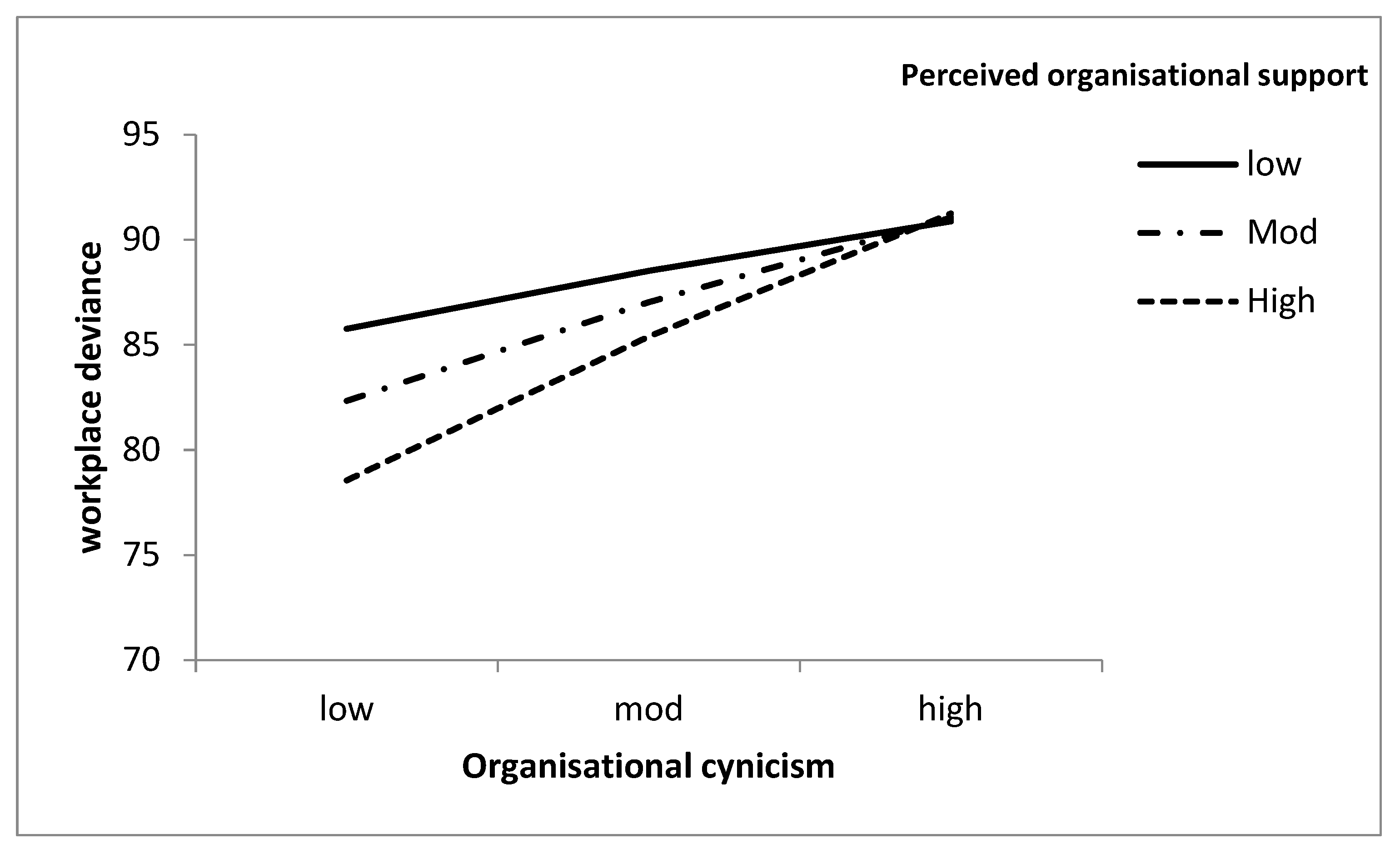
The interaction effect between perceived organisational support and organisational cynicism on organizational workplace deviance produced a significant effect (β = .07, t = .306, [95% CI = .04, .07], p = < .01); thus, supporting hypothesis 3. This shows that perceived organisational support weaken the positive relationship between organizational cynicism and organizational workplace deviant behaviours. Hence, indicating that perceived organisational support moderated relationship between organisational cynicism and organizational workplace deviance. The slope of the interaction (see Figure 1) indicated that organisational cynicism was significantly related with organizational workplace deviance for those with low perceived organisational support (β = .39, p = < .01), moderate perceived organisational support (β = .67, p = < .01), and high perceived organisational support (β = .98, p = < .01). The entire model accounted for 26% of the variance in organizational workplace deviance, R2 for the model was .26, F(4,295) = 22.47, p < .01.
Figure 1.
Interaction slope showing the moderating effect of perceived organisational support on organisational cynicism and workplace deviance.
Figure 1.
Interaction slope showing the moderating effect of perceived organisational support on organisational cynicism and workplace deviance.
Discussion
The present study widen our nuanced understanding of work attitudes and outcomes by highlighting the imperativeness of POS to addressing workers negative job attitudes and outcomes such as organizational cynicism and organizational workplace deviant behaviours. The current study responded to calls from previous studies for additional scientific enquiry on the versatility of POS on different work contexts in mitigating negative work attitudes in order to attain organizational success [19,22]. However, our results demonstrates support for prior studies that evidenced the beneficial association between POS and other work related factors like turnover intention, counterwork behaviour, organizational ostracism and cynicism, job engagement, job moral and organizational citizenship behaviour [3,19,22,41,49].
The result revealed that organizational cynicism positively correlated with organizational workplace deviant behaviour. The findings align with past studies [27,28], which reported that organizational cynicism could associate with increased workplace deviant behaviours. This connotes employees' negative cognitive, affective, and behavioural attitudes towards their employing organization [50], which results in an increased propensity for organizational workplace deviant behaviour due to incongruity in the honesty of maintaining psychological contract [51]. Thus, organizational deviant workplace behaviour arises as a result of the employees' negative perception of the organization, which leads to affective and behavioural manifestations of both overt and covert behavioural responses as revenge for the negative perception they have towards the organization [51]. No wonder, Han and Jekel [52] asserted that organizational cynicism is an antecedent that leads to workplace deviant behaviour. In addition, Ali [28] asserted that employees who experience organizational cynicism are more prone to workplace deviant behaviour and with an increased tendency to quit their job. Corollary, Job Demands-Resources Model (JD-R) model [42] gives credence to the direction of the result. Drawing on the expansion of the Job Demands-resources model, one can view organizational cynicism as a psychological demand that could lead to negative outcomes like deviance if the resources (in this case, organizational support) are not available. The (JD-R) model, suggests that organizational support acts as a critical resource that buffers the impact of the demand (cynicism), preventing deviance.
As expected, perceived organizational support negatively correlated with organizational workplace deviant behaviour among nurses. This is in line with extant studies [31,53], which revealed that perceived organizational support was a negative correlate of bad work attitudes. Evidently, organizational support suggests that responsive organizational functioning would result in reciprocal work exchange functioning, whereas non-responsive organizational functioning would cause an unfavourable perception of organizational support [54]. Thus, organizational support is a recipe for risk factor of deviant workplace behaviour in those employees who perceive the organization as not reciprocating their work effort [43]. Furthermore, the theoretical illustration of this finding could be espoused using social exchange theory. The theory illustrates that disparity in the evaluations of reciprocity and actualization of expected rewards promotes and facilitate employees' cynical behaviours (e.g., criticisms, denigration, condescension, revulsion, anger) vis-à-vis workplace deviance behaviours (e.g., increased absenteeism rate, sabotage, theft) toward the organization [33].
In addition, perceived organizational support (POS) moderated the relationship between organizational cynicism and organizational workplace deviant behaviour. This implies that the perception of high organizational support weakens and decreases the exhibition of cynical and deviant organizational workplace behaviours among employees. This study's findings align with previous studies [54,55,56], which reported that perceived organizational support acts as a boundary condition in influencing workplace negative behaviours. This is evident since organizational support entails four elements: fairness of treatment, supervisor support, organizational rewards, and job conditions [57]. However, any incongruity between these elements and employees' expectations invariably precipitates organizational cynicism and workplace deviance behaviour. This coincides with Usama [54] postulation that perceived organizational support could either buffer or attenuate work behavioural outcomes depending on the direction of the POS. However, employees who perceive favourable organizational treatment are bound to respond with positive organizational behaviour; contrariwise, employees who experience an unfavourable perception of organizational treatment tend to exhibit deviant workplace behaviours due to a bridge in the social exchange [30,56]. The POS theory explicitly explains this trajectory relationship. The theory posits that when an organization pays attention to employees' welfare and values their contributions; such employees reciprocate by better job performance, commitment, and less cynical behaviours towards the organization with the least intent of organizational workplace deviant behaviours.
Theoretical and Practical Implications
Theoretically, the expansion of the social exchange theory and Job Demands-Resources Model in understanding the intricacies of employment relations gives a nuanced understanding of these work related factors under study. These theories suggests that organizational support acts as a critical resource that buffers the impact of the demand (cynicism), thus, preventing deviance. Evidently, this sheds light on the complex interplay between employee attitudes (such as cynicism) and behaviours (such as deviance) by suggesting that employee actions are not solely determined by internal attitudes but are strongly influenced by external support mechanisms. Invariably, this contribute to the understanding of how perceived organizational support serves as a buffer in such a relationship.
Practically, organizations that understand the importance of perceived organizational support can create initiatives that strengthen employee loyalty and engagement. Recognizing that support can mitigate the harmful effects of cynicism can help in designing interventions aimed at reducing deviant behaviours and increasing job satisfaction. Thus, the findings canvasses the design of supportive HR practices such as wellness programs, open-door policies, and recognition systems where these practices can alleviate feelings of organizational cynicism and foster a more committed workforce by reducing the risk of deviant behaviours. This is pertinent because understanding that organizational support plays a role in mitigating deviance suggests the need for proactive interventions. Thus, organizations should monitor employee sentiments and perceptions of support by addressing any gaps before cynicism translates into harmful behaviours. This can be achieved through leadership development, training, enhanced organizational culture and climate.
Furthermore, organizations should focus on creating a culture that emphasizes fairness, transparency, and support. A supportive culture makes employees feel valued, which reduces the likelihood of them developing cynical attitudes or resorting to deviant behaviour when they encounter organizational issues. Hence, organizations that promote a culture of support may also foster stronger ethical standards and corporate responsibility. This is because employees who perceive the organization as supportive are more likely to uphold ethical behaviours and resist engaging in deviant actions that harm the organization and its stakeholders.
In sum, organizational support plays a crucial role in moderating the effects of organizational cynicism on organizational workplace deviance. By focusing on fostering a supportive environment, organizations can better manage employee attitudes and reduce deviant behaviours, thereby, enhancing overall workplace performance and culture. This will aid in far-reaching effects on organizational policies, practices, and the overall well-being of the organizational members.
Limitation and Future Directions
The research is constrained by some compelling factors. First, the findings of the study may be specific to the context in which it was conducted. This is pertinent because the study delineation is restricted to a given region and domain (e.g., nurses) in healthcare sector, thus its findings cannot be extrapolated to other regions and organizations. Thus, future studies should consider other organizational factors that facilitates employees attrition. Secondly, the study is a cross-sectional study and used self-reported measures for data collection, which is prone to common method bias and social desirability error, even though it has been taken care of through confidentiality in participants responses and use of two-wave design that establishes causality effect. Furthermore, acknowledging these limitations is crucial for interpreting the study's results accurately and for guiding future research in addressing these potential constraints. Thus, researchers should strive to design studies that mitigate these limitations and provide a more comprehensive understanding of the relationships under investigation.
Suggestion for Further Studies
Based on the foregoing, future research should consider studying the dependent variable, workplace deviant behaviour as a bi-construct of interpersonal and organizational deviance for broader generalization of findings. Future studies should also apply a mixed research method using both the quantitative and qualitative research method in data collection to determine causal links among the variable. More so, future studies should expand the scope of the participants to include other healthcare professionals by comparing different healthcare settings (e.g., hospitals, clinics, long-term care facilities) to identify variations in the relationships among organizational support, cynicism, and organizational workplace deviance by exploring the contextual factors that influence these dynamics. Hence, exploring these avenues, future research can contribute to a more nuanced understanding of the complex interactions among organizational support, cynicism, and workplace deviance behaviours, leading to actionable insights for organizational leaders and policymakers in healthcare settings.
Conclusion
In conclusion, organizational support plays a crucial moderating role in the relationship between organizational cynicism and organizational workplace deviance. Organizational cynicism, characterized by negative attitudes and distrust towards the organization, can lead to organizational workplace deviance, where employees engage in counterproductive behaviours such as absenteeism, sabotage, or reduced productivity. However, when employees perceive high levels of organizational support—such as recognition, care for employee well-being, and fair treatment—this cynicism can be mitigated. Furthermore, supportive organizational environments can buffer the negative effects of cynicism by fostering a sense of belonging, reducing feelings of frustration, and promoting positive work behaviours. Employees who feel valued and supported are more likely to demonstrate loyalty and constructive engagement, even in the presence of cynicism. Therefore, enhancing organizational support mechanisms can not only reduce workplace deviance but also improve overall organizational morale and performance. Thus, investing in a supportive organizational culture can diminish the harmful impact of cynicism on workplace deviance behaviour, leading to a more cohesive and productive workforce.
References
- Nwuche C.A,; Eketu, C.A. Career development practices and workplace deviance: The case of Nigeria. Finance, and Economics. 2015, 5(1), 101-117.
- Bujang, M.A.B; Kamaluddin, M.R; Mat-Basir, S.; Munusamy, S.; Jiow, J.H. Impacts of workplace culture on deviant workplace behavior: A systematic review. SAGE Open. 2024, 14(2), 1–17. [Google Scholar] [CrossRef]
- Sabitova, A.; Hickling, L.M.; Priebe, S. Job morale: a scoping review of how the concept developed and is used in healthcare research. BMC Public Health. 2020, 20, 1166. [Google Scholar] [CrossRef] [PubMed]
- Taylor, F.; Galloway, S.; Irons, K.; Mess, L.; Pemberton, L.; Worton, K.; Chambers, M. Understanding organisational and nursing behaviour changes associated with a therapeutic engagement improvement tool in acute mental health inpatient settings: A qualitative analysis, International Journal of Nursing Studies Advances 2024, 6. [CrossRef]
- Salihu, K. The evolution of nursing as a profession in healthcare. MEDIS 2024, 3, 7–11. [Google Scholar] [CrossRef]
- Nnadozie, E.; Ike, O.O.; Chuke, N.U.; Eze, I.C. The influence of psychological ownership on the association between satisfaction with work-family balance and intention to stay among nurses in South-eastern Nigeria public hospitals. Int J Afr Nurs Sci. 2022, 17. [Google Scholar] [CrossRef]
- Ojo, B.Y.; Tamunopipiriala, D.C. Organisational Predators of Workplace Deviant Behaviour in Hotel Industry. Journal of Tourism Management Research 2019, 6(1), 1–14. [Google Scholar] [CrossRef]
- Ojewole, F.; Ajibade, B. Impact of perceived organizational support on nurses' turnover intention: Evidence from Nigeria. International Journal of Africa Nursing Sciences, 2020, 12: 100197.
- Oleribe, O.O.; Ezieme, I.P.; Oladipo, O.; Akinola, E.P.; Udofia, D.; Taylor-Robinson, S.D. Industrial actions by health workers in Nigeria in 2013-2015: An inquiry into causes, consequences and control-a cross-sectional descriptive study. Human Resource Health 2016, 14(1), 46–62. [Google Scholar] [CrossRef]
- Talat, I.; Ghulam, A.; Ishfaq, A. Protecting healthcare through organizational support to reduce turnover intention. International Journal of Human Rights in Healthcare 2020, 3(2), 33–45. [Google Scholar]
- Hashish, E.A.A. Nurses’ perception of organizational justice and its relationship to theirworkplacedeviance.NursingEthics2020,27(1):273-288. [CrossRef]
- Aly, N.A.M.; Ghanem, M.; El-Shanawany, S. Organizational cynicism and its consequences on nurses and quality of care in critical care and toxicology units. Journal of Education and Practice 2016, 7(8), 85–96. [Google Scholar]
- Parisa, A.; Jalil, D.; Mansour, K. Counterproductive behaviour in state hospitals; A review of the role of organizational cynicism and justice, Mediterranean Journal of Social Sciences 2016, 7(4), 196-207.
- Eze, I.C.; Ike, O.O.; Omeje, O.; Okonkwo, E.; Attamah, I.; Okoro, C.M. Organisational justice and workplace deviance behaviour among bank workers in Nigeria: the role of perceived organisational support as a moderator. Journal of Psychology in Africa 2022, 32(6), 569–577. [Google Scholar] [CrossRef]
- Zappalà, S.; Sbaa, M.Y.; Kamneva, E.V.; Zhigun, L.A.; Korobanova, Z.V.; Chub, A.A. Current approaches, typologies and predictors of deviant work behaviors: A scoping review of reviews. Front. Psychol. 2022, 12, 674066. [Google Scholar] [CrossRef]
- Mignonac, K.; Boujendar S.; Bergon, G. How organizational cynicism can promote customer-directed deviance via employee resource depletion and how experiencing supervisory support may help overcome this effect. Group and Organization Management, 2023. [CrossRef]
- Eze, I.C.; Omeje, O.; Okonkwo, E.; Ike, O.O.; Ugwu, L.E. Job insecurity, employment status, and perceived organizational support predictors of workplace deviance behaviour among bankers. Practicum Psychologia 2020, 9(2), 264–287. [Google Scholar]
- Bennett, R.J.; Robinson, S.L. Development of a Measure of Workplace Deviance. Journal of Applied Psychology 2000, 85(3), 349–360. [Google Scholar] [CrossRef] [PubMed]
- Ugwu, F.; Nwali, A.C.; Ugwu, L.E.; Okafor, C.O.; Ozurumba, K.C.; Onyishi, I.E. Mediating roles of employee cynicism and workplace ostracism on the relationship between perceived organizational politics and counterproductive work behavior. Career Dev Int. 2023,28(3):314-332. [CrossRef]
- Dean, J.W.; Brandes, P.; Dharwadkar, R. Organizational Cynicism. Academy of Management Review 1998, 23, 341–352. [Google Scholar] [CrossRef]
- Ike, O.O.; Eze, C.I; Omeje, O.; Okonkwo, E.; Ugwu, L. Organizational Cynicism and Organizational Career Growth as Predictors of Turnover Intention among Employees. Practicum Psychologia 2020, 10(1), 49-69. http://journal.aphriapub.com/index.
- Ike, O.O.; Chuke, N.U.; Nnamchi, O. Organizational Cynicism and Turnover Intention Among Nurses: Do Perceived Organizational Support Moderates the Relationship? SAGE Open Nursing 2024, 10(5), 1–15. [Google Scholar] [CrossRef]
- Stavrova, O.; Ehlebracht, D. Cynical Beliefs about Human Nature and Income: Longitudinal and Cross-Cultural Analyses. Journal of Personality and Social Psychology 2015, 25, 1–17. [Google Scholar] [CrossRef]
- Kıral, B. Organizational Cynicism and School Administrators' Strategies to Cope with Teachers' Cynicism. International Journal on New Trends in Education and Their Implications (IJONTE) 2023, 14(1), 149–156. [Google Scholar]
- Zhang, C.; Irfan, M.; Sial, J.I. Effect of Workplace Harassment on Organizational Cynicism with the Mediation of Perceived Incivility and the Moderating Role of Perceived Organizational Obstruction, Heliyon 2024, 10(12). [CrossRef]
- Demir, K.; Ulutas, E. The effects of organizational cynicism on job satisfaction and turnover intention: The mediating role of counterproductive work behaviors. Journal of Business Research 2021, 13(1), 477–494. [Google Scholar]
- Elsayed, T.M. O.; Eid, N.M.; Mahmoud, S.I. Effect of Organizational Cynicism Management Educational Program on Nurses’ Organizational Commitment and Job Embeddedness. Journal of Nursing Science - Benha University 2023, 5(1),475-490.
- Ali, S.A.; Sair, S.A.; Mehta, A. M.; Naqvi, F. N.; Saleem, H. Impact of organizational cynicism and abusive supervisor behavior on work place deviance. Academy of Strategic Management Journal 2020, 19(5), 1–10. [Google Scholar]
- Thrasher, G.R.; Krenn, D.K.; Marchiondo, L.A. Are counter-productive workplace behaviors and workplace deviance parallel constructs? Occupational Health Science 2020, 4(3), 239–270. [Google Scholar] [CrossRef]
- Gervasi, D.; Faldetta, G.; Pellegrini, M.M.; Maley, J. Reciprocity in organizational behavior studies: A systematic literature review of contents, types, and directions. Eur. Manag. J. 2022, 40, 441–457. [Google Scholar] [CrossRef]
- Meira, J.V.D.S.; Hancer, M. Using the social exchange theory to explore the employee-organization relationship in the hospitality industry. International Journal of Contemporary Hospitality Management 2021, 33(2), 670–692. [Google Scholar] [CrossRef]
- Homans, G.C. Social behavior as exchange. American Journal of Sociology, 1958, 63, 597–606. [Google Scholar] [CrossRef]
- Liu, Y.; Zhu N.; Zhang J.; Raza, J. Does organizational reciprocity improve employees’ motivation? The mediating role of basic psychological need satisfaction. Curr Psychol. 2021, 40(7):3136-3150. [CrossRef]
- Fan, C.; Tang, S.; Chen, L.; Sun, T. Perceived organizational support and proactive innovation behavior: the mediating role of basic psychological needs. Front. Psychol. 2022, 13:804363. [CrossRef]
- Kabiri, S.; Choi, J.; Kruis, N.; Shadmanfaat, S.M.; Lee, J. Social concern as a means of understanding the risk of workplace deviance. Deviant Behav. 2022, 43(8), 939–958. [Google Scholar] [CrossRef]
- Načinovi,’ I.; Braje, N.; Aleksi, A.A., Rašic, S.R.; Jelavic, J. Blame it on individual or organization environment: What predicts workplace deviance more? Social Sciences 2020, 9(6), 99. [CrossRef]
- Durrah, O.; Chaudhary, M.; Gharib, M. Organizational cynicism and its impact on organizational pride in industrial organizations. Int J Environ Res Public Health. 2019, 16 (7):1203. [CrossRef]
- Abas, B.; Iqbal, S.; Bukhari, S.; Villivalam, S.; Khan, M. A retrospective of workplace deviance in hospitality: A two-tier literature review. Vis J Bus Perspect. 2024. [CrossRef]
- Moghaddam, A.; Meymand, M. The Effect of Organizational Cynicism on Tendency to Deviant Behaviours; the Moderating Role Leadership Style. Management Studies in Development and Evolution 2018, 27(89), 73–89. [Google Scholar] [CrossRef]
- Evans, W.R.; Davis, W.D.; Neely, A. The Role of Organizational Cynicism and Conscientiousness in the Relationship between Ethical Leadership and Deviance. Journal of Managerial Issues 2021, 33(1), 49–68. [Google Scholar]
- Tian, X.; Guo Y. The Effect of Deviant Workplace Behavior on Job Performance: The Mediating Role of Organizational Shame and Moderating Role of Perceived Organizational Support. Behavioral Sciences. 2023; 13(7):561. [CrossRef]
- Bakker, A.B.; Demerouti, E. Job demands–resources theory: Taking stock and looking forward. J Occup Health Psychol. 2017, 22(3), 273–285. [Google Scholar] [CrossRef]
- Eisenberger, R.; Rhoades, S.; Wen, X. Perceived organizational support: Why caring about employees counts. Annu Rev Organ Psychol Organ Behav. 2020, 7(1), 101–124. [Google Scholar] [CrossRef]
- Nicuta, E.G.; Opariuc-Dan, C.; Constantin, T. Gratitude, job resources, and job crafting: A two-wave longitudinal study on a sample of Romanian employees. Rev Psicol Trab Las Organ. 2024, 40(1), 19–30. [Google Scholar] [CrossRef]
- Eisenberger, R. Perceived organizational support. Journal of Applied Psychology 1986, 71(3), 500–507.
- Hair, J.F.; Black, W.C.; Babin, B.J.; Anderson, R.E. Multivariate Data Analysis. 7th Edition, Pearson, New York, 2010.
- Somers, T.M, Nelson, K.; Karimi, J. Confirmatory factor analysis of the end-user computing satisfaction instrument: Replication within an ERP domain. Decis Sci. 2003, 34(3), 595-621. [CrossRef]
- Podsakoff, P.M.; MacKenzie, S.B.; Lee, J.-Y.; Podsakoff, N.P. Common method biases in behavioral research: A critical review of the literature and recommended remedies. J. Appl. Psychol. 2003, 88, 879–903. [Google Scholar] [CrossRef] [PubMed]
- Wang, Q.; Lin, M.H.; Narayan, A.; Burns, G.N.; Bowling, N.A. A cross-cultural examination of the relationships between job attitudes and workplace deviance. Asia Pacific Journal of Management 2022, 39(1), 249–272. [Google Scholar] [CrossRef]
- Arslan, M. Organizational cynicism and employee performance: Moderating role of employee engagement. Journal of Global Responsibility 2018, 9(4), 415–431. [Google Scholar] [CrossRef]
- Jiang, H.; Chen, Y.; Sun, P.; Yang, J. The relationship between authoritarian leadership and employees’ deviant workplace behaviors: The mediating effects of psychological contract violation and organizational cynicism. Front Psychol. 2017, 8, 732. [Google Scholar] [CrossRef]
- Han, S.H.; Jekel, M. Organizational cynicism, employee attitudes, and turnover intention: A multi-dimensional approach. International Journal of Organizational Analysis, 2019, 27(5), 1041-1057.
- Su, M.K.; Sung, J.J. An Examination of the Effects of Job Insecurity on Counterproductive Work Behaviour through Organizational Cynicism; Moderating Role of Perceived Organizational Support and Quality of Leader-Member Exchange. SAGE Journal 2022, 127(2), 957–993. [Google Scholar] [CrossRef]
- Usama, B.I.; Amaz, M..; Bilal, A. The impact of perceived organizational support on work deviant behaviour: The mediating role of psychological empowerment. Global Scientific Journals 2022, 10(6), 693-703.
- Chen, L.; Yin, Fah, B.C.; Jin, T.C. Perceived organizational support and workplace deviance in voluntary sector. Procedia Economics and Finance. 2016, 35, 468–475.
- Nisar Khattak, M.; Al-Taie, M.Z.; Ahmed, I.; Muhammad, N. Interplay between servant leadership, leader-member-exchange and perceived organizational support: a moderated mediation model. Journal of Organizational Effectiveness: People and Performance 2024, 11 (2), 237-261. [CrossRef]
- Farasat, E.; Ziaaddin, M. Perceived organizational support and deviant behaviour. J. Basic. Appl. Sci. Res. 2013, 3(5), 517–582. [Google Scholar]
Figure 1.
Research model.
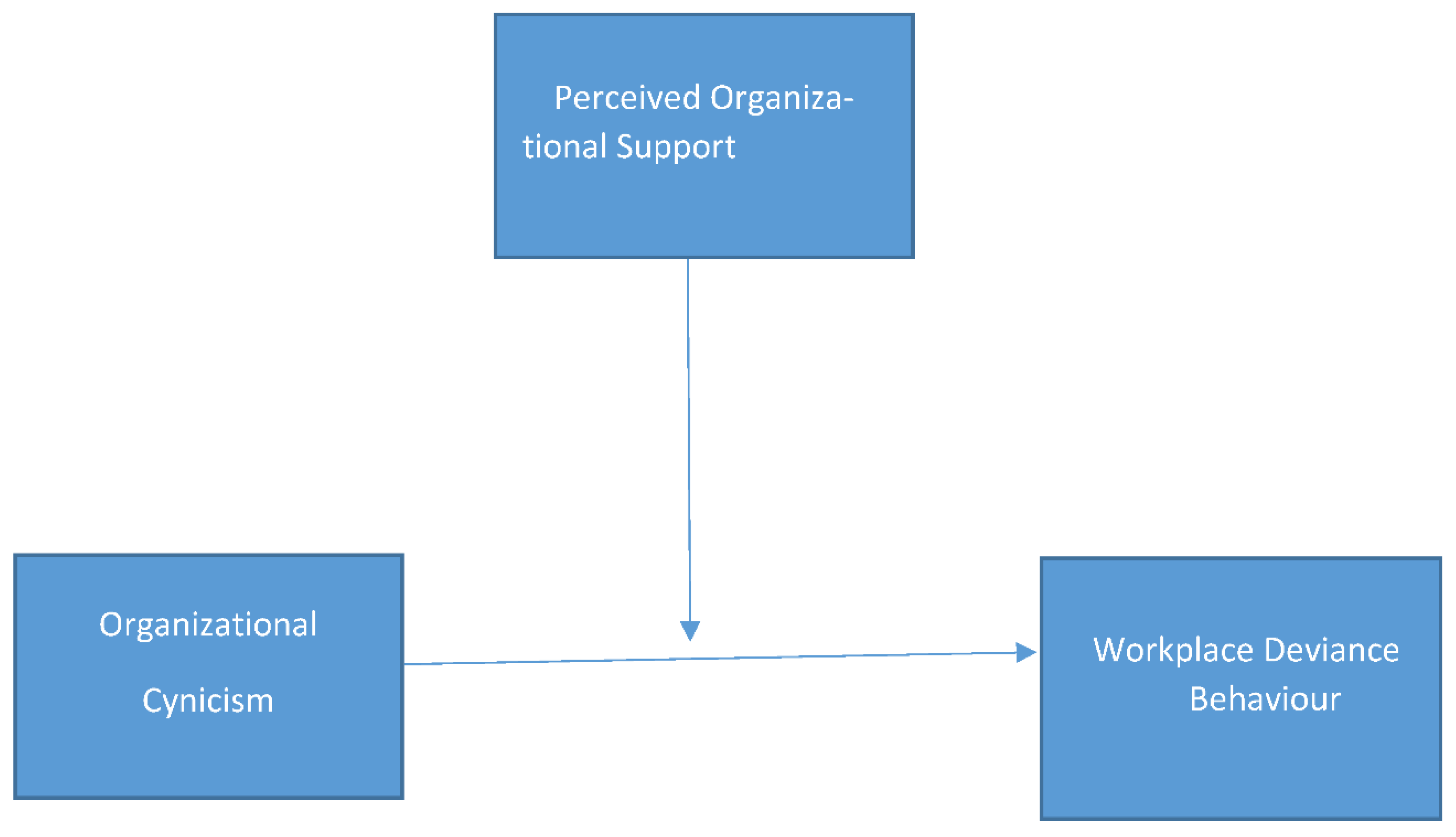

Table 1.
Demographic data of the participants.
| Age | 28-55 years |
|---|---|
| Mean Age | 39.56 |
| SD | 8.13 |
|
Gender Male Female |
74 (12.9%) 501 (87.1%) |
|
Marital status Single Married |
127 (22.1%) 448 (77.9%) |
|
Educational Qualification B.Sc. Nursing M.Sc. Nursing |
542 (94.3%) 33 (5.7%) |
|
Working Experience 1-20 years 21 and above |
496 (86.3%) 79 (13.7%) |
|
Wards/Units/Department Eye and Ophthalmic unit Accident & Emergency unit Dialysis unit Maternity ward Intensive care unit Counselling and Testing unit Paediatrics ward Operating theatre unit Anti-retroviral therapy unit Antenatal unit |
61 (10.6 %) 83(14.4 %) 45 (7.8%) 59 (10.3%) 76 (13.2%) 39 (6.8%) 71 (12.3%) 47 (8.1%) 38 (6.6%) 56 (9.7%) |
Table 2.
Correlations of demographic variables and statistics among the study variables.
| Variables M SD | 1 | 2 | 3 | 4 | 5 | 6 | 7 | 8 | ||
|---|---|---|---|---|---|---|---|---|---|---|
| 1.Gender | - | - | - | |||||||
| 2.Age | 42.56 | 10.09 | .05 | - | ||||||
| 3.Marital status | 1.73 | .49 | .05 | .74** | - | |||||
| 4.Length of Ser. | 1.27 | .44 | -.03 | .58** | .43** | - | ||||
| 5.EduQu | 1.22 | .48 | -.09 | .49** | .31** | .45** | - | |||
| 6.OCS | 37.81 | 6.42 | -.03 | .03 | -.02 | .09 | .06 | - | ||
| 7.POS | 57.20 | 10.95 | -.09* | .05 | .06 | -.01 | .02 | .12* | - | |
| 8.WPDV | 87.10 | 12.29 | -.11* | -.01 | -.02 | .09 | .09 | .32** | -.15* | - |
Note:N = 575, ** = p <.05 (two-tailed), **** = p < .01 (two-tailed). Gender was coded 1 = male, 2 = female. M=Mean, SD= Standard Deviation, Length of ser. = Length of service, Edu = educational qualifications, OCS = organisational cynicism, POS = Perceived organisational support, WPDV = workplace deviance.
Table 3.
Hayes PROCESS Macro results for association between organizational cynicism and workplace deviance with perceived organisational support as moderator.
Table 3.
Hayes PROCESS Macro results for association between organizational cynicism and workplace deviance with perceived organisational support as moderator.
| Variables | Β | SE | T | 95%CL LLCI ULCI |
|---|---|---|---|---|
|
Organizational Cynicism (OCS) |
.09 |
.17 |
6.54** |
.32 .47 |
| Perceived Organizational Support (POS) | -.14 | .36 | -.34* | -.26 - .18 |
| POS × OCS |
.07 |
.21 |
3.06** |
.04 .07 |
Note:* = p ≤ .05, ** = p ≤ .01, β = Regression Coefficient; SE = Standard Error; t = population t value; p= Probability Level; LLCI and ULCI = Lower and Upper Limit Confident Interval.
Disclaimer/Publisher’s Note: The statements, opinions and data contained in all publications are solely those of the individual author(s) and contributor(s) and not of MDPI and/or the editor(s). MDPI and/or the editor(s) disclaim responsibility for any injury to people or property resulting from any ideas, methods, instructions or products referred to in the content. |
© 2024 by the authors. Licensee MDPI, Basel, Switzerland. This article is an open access article distributed under the terms and conditions of the Creative Commons Attribution (CC BY) license (http://creativecommons.org/licenses/by/4.0/).
Copyright: This open access article is published under a Creative Commons CC BY 4.0 license, which permit the free download, distribution, and reuse, provided that the author and preprint are cited in any reuse.


