

Submitted:
17 October 2024
Posted:
18 October 2024
You are already at the latest version
Abstract
Water resource management in agriculture faces complex challenges due to increasing scarcity, exacerbated by climate change, and the intensification of conflicts among various user groups. This study addresses the issue of predicting and managing these conflicts in the Longaví River Basin, Chile, by considering the intricate interactions between hydrological, social, and economic factors. A socio-hydrological agent-based model (SHABM) was developed, integrating hydrological, economic, and behavioral data. The methodology combined fieldwork with computational modeling, characterizing three types of agents (selfish, neutral, and cooperative) and simulating scenarios with varying levels of water availability and oversight across three Water User Organizations (WUOs). The key findings revealed that: (1) selfish agents are more likely to disregard irrigation schedules under conditions of scarcity and low supervision; (2) high supervision (90%) significantly reduces conflicts; (3) water scarcity exacerbates non-cooperative behaviors; (4) high-risk conflict areas can be identified; and (5) behavioral patterns stabilize after the third year of simulation. This work demonstrates the potential of SHABM as a decision-making tool in water management, enabling proactive identification of conflict-prone areas and evaluation of management strategies.
Keywords:
Socio-hydrology
; Agent-based modeling
; Water conflicts
; Water resource management
; Agriculture
1. Introduction
Watershed management is influenced by various governance structures and multidimensional human actions, encompassing biophysical, technological, social, cultural, and political aspects [1,2]. These factors shape spaces where social and natural elements interact, referred to as hydro-social territories [3,4,5]. In this context, it is essential to understand how the co-evolutionary dynamics and complex interactions between humans and water resources affect access to water and decision-making related to its distribution.
In their seminal works, Sivapalan et al. [6,7] introduced the concept of socio-hydrology to explicitly and quantitatively study the evolution of coupled human-water systems and the diverse trajectories of their co-evolution. This approach encompasses the potential for generating emergent behavior, understood as complex and often unpredictable patterns arising at the basin or regional scale. These patterns emerge from the intricate interactions between human and water systems, resulting from the confluence of multiple individual or local decisions and natural hydrological processes. [5,8]. Thus, socio-hydrology, as a methodological approach, allows for understanding how human decisions and actions influence water resources and vice versa, becoming a valuable tool for the development and implementation of effective water resource management strategies, thereby contributing to the achievement of sustainable development goals [9].
Moreover, the integration of socio-hydrological models with agent-based models (ABM) offers a synergistic approach to addressing the complexity of water systems [10,11]. While socio-hydrological models provide a framework for understanding macro-level interactions between human and water systems [12,13], ABMs enable a detailed representation of individual decisions and behaviors that give rise to these macro-level patterns [14]. This combination allows for capturing both the emergent dynamics at the system level and the individual decision-making processes that drive them.
Some relevant works in this regard include the study by Huber et al. [15], where the authors demonstrated how the integration of ABM into socio-hydrological models (socio-hydrological agent-based modeling—SHABM) can enhance the understanding of farmers’ adaptive responses to water scarcity. Thus, the fusion of these approaches enables a multidimensional representation of complex systems, facilitating the exploration of future scenarios and the identification of more effective and sustainable potential interventions [16].
In Huber et al. [17], the focus was on evaluating water scarcity in the Alpine region using a SHABM model called Aqua.MORE. Its primary contribution lies in analyzing behavior and interactions within the human-water system. The researchers concluded that by combining annual runoff data, local runoff data, and land-use change scenarios with a SHABM, it is possible to forecast potential future water scarcity scenarios.
In Guo et al. [18], the authors simulated agricultural water user systems under a water-saving compensation policy, analyzing the influence of agent sensitivity and learning capacity on agricultural income and household water consumption in the context of a subsidy program. One of the main conclusions of the study is that ABM models, by incorporating factors such as farmers’ sensitivity, learning capacity, and access to information, provide a deeper and more nuanced understanding of socio-hydrological systems than traditional top-down approaches, offering valuable insights for decision-making in sustainable water management.
Despite the significant advances achieved through the implementation of ABMs, a marked gap remains between the results obtained in theoretical studies and their practical application in real-world water management [19]. This disparity presents ongoing challenges regarding model validation and the effective communication of findings to decision-makers and other stakeholders. Bridging this gap is essential to fully harness the potential of ABMs in water management from a multidimensional perspective, and to facilitate the adoption of more informed and sustainable decisions in this critical field.
In a context of limited water resources, the anticipation and management of water-related conflicts become imperative. The objective of this work is to develop and apply a SHABM to analyze and predict water-related conflicts within water user organizations (WUO). The model aims to identify factors driving non-cooperative behaviors and assess how water availability and supervision levels influence these dynamics, contributing to more equitable and sustainable water resource management.
The methodology incorporates precursors of conflict, including the characterization of agent personalities, water infrastructure, and crop typologies. The difference between water supply and demand is used as a catalyst for the reactions and interactions among agents. Such tools generate valuable information to support decision-making in a context of limited resources, where asymmetries in water access exacerbate tensions among the various stakeholders and decision-makers.
2. Methodology
The methodology is structured into three main components: site characterization, data collection through fieldwork, and the development of a socio-hydrological model. This approach enables the capture of the complexity inherent in the interactions between water users, irrigation infrastructure, and water management practices.
2.1. Study Site
The study area is located in the Longaví River Basin, in the Maule Region of Chile (), covering a total area of (Figure 1). The region has a Mediterranean climate characterized by hot, dry summers and an average annual precipitation of , concentrated between May and August. The Longaví River originates in the Andes at , flowing for with a pluvio-nival regime and an average annual discharge of . The hydrology is characterized by a rainy and snowy season (May to August) and a snowmelt season (September to December) [20].
The primary economic activity in the Longaví River Basin is agriculture, where highly fragmented land areas (80% are small farmers with plots of less than ) coexist with forestry companies [21]. The peak water demand for agricultural activities occurs between September and March. The main infrastructure includes a storage reservoir with a capacity of and 22 primary canals for distributing water among users.
In July 2023, researchers conducted a comprehensive field study to investigate the complex dynamics of agricultural practices and water management in the Longaví River Basin. The study aimed to uncover the underlying conditions that contribute to persistent discrepancies in agricultural practices and to examine the mechanisms of conflict resolution within this context.
Eight semi-structured interviews were carried out with key informants, including the President, Secretary, Water Masters, and Board Members of the “Primera Abajo” canal. Prior to conducting interviews, the researchers obtained informed consent from all participants, ensuring they understood the nature of the study and their rights as subjects. These individuals were selected for their specialized knowledge and their ability to provide critical insights and contextual understanding essential to the research.
Data collection efforts focused on several key areas: water usage patterns, land use practices (with particular emphasis on predominant crop types), irrigation technologies, water distribution practices, infrastructure conditions, interactions among water users, and governance frameworks.
The field study provided valuable insights into the decision-making processes within WUOs and the management and operation of water distribution overseen by the Water Board (WB) known as the Longaví River Water Users Association (Junta de Vigilancia del Río Longaví, JVRL)1. The JVRL, which oversees water distribution across the basin, is governed by a board of directors comprising representatives from 22 main canals. Each of these canals, in turn, is organized into individual WUOs that manage water distribution among end users via secondary and tertiary canals.
Water distribution to each of the 22 canals is based on a proportional allocation system, derived from the water rights (WR) held by each user. WR is a legal concept granting the holder the right to use, enjoy, and manage a specific proportion of water. In Chile, WR is distinct in that it is expressed as a proportion of the total available flow in a water source, defined by an irrigation rate (), rather than a fixed volume [22].
This particularity of the Chilean system means that the actual amount of water a WR holder can extract varies depending on hydrological conditions. In periods of abundance, the extractable volume is higher, while in times of drought, it is lower, but always maintaining the same proportional share of the total flow relative to their WR [23].
Specifically, in the Longaví River, the JVRL defines two operational modes that determine the amount of water allocated to each WR: (i) “Free River” from April to October each year, where users can access water without restrictions based on their WR, and (ii) “Regulated Irrigation” from September to March, which corresponds to the period of highest demand (agricultural irrigation), during which the water available per WR is proportional to the resource’s availability, which is often lower than users’ demand. To address this, the WUOs organize irrigation turns. These irrigation shifts allocate each farmer a set number of days, depending on the amount of WR they hold. Proper management of these shifts is crucial to prevent conflicts over water usage [23].
2.2. Proposed Model
Based on the information gathered during the field study, it was possible to understand the dynamics arising from the decisions of water users within Water User Organizations (WUOs) concerning the extraction of water beyond their allocated Water Rights (WR) during the “Regulated River” period.
A Spatially Heterogeneous Agent-Based Model (SHABM) was developed, which considers three main actors (Figure 2): (i) the Water Board (WB), responsible for managing the provision and distribution of water by assigning irrigation rates () to each canal; (ii) the Canal Administrator (CA), who allocates the irrigation rates designated by the WB to the WUOs; and (iii) the Farmers (F), the final users of water, who decide whether or not to extract more water than their assigned allocation according to their WR.
It is important to highlight that this model adopts a bottom-up approach, where the system dynamics emerge from the individual decisions of each farmer. The core component of the model is the decision made by each farmer to either adhere to or disregard their assigned irrigation turn. These individual decisions, based on personal perceptions and contextual conditions, aggregate to form patterns of collective behavior and potential areas of conflict at the basin level. This approach allows for the capture of farmer heterogeneity and illustrates how individual actions impact water management at the system scale. To achieve this, the SHABM employs a function to represent the multidimensional perception of an agent F (Eq.1).
where and are the weights assigned to each of the dimensions considered in the multidimensional function ; represents agent F’s perception of the availability of water for irrigation; refers to agent F’s perception of production costs, market value of the product, and the profitability of the investment; concerns F’s perception of the water status of their crops; and is agent F’s perception of the regulations governing water use.
Recent studies [24,25] underscore the variability in the perception of these rules, highlighting the importance of sanctions in maintaining cooperation among agents, with positive, negative, or neutral impacts depending on the context. In our SHABM, this dimension is influenced by the personality of agent F, and for this, a prosocial behavior classification has been applied, categorizing agents as: cooperative, selfish, or neutral [26,27,28]. Thus, selfish agents often perceive rules negatively, seeing them as constraints on their personal interests; in contrast, cooperative agents tend to value rules positively, viewing them as promoting cooperation and collective well-being. Neutral agents F typically exhibit a balanced or indifferent response to the rules, meaning their perception of can be neutral or have minimal impact on their overall assessment [29,30].
The decision of an agent F to ignore or respect their assigned turn was determined by comparing the agent’s perception (Eq. 1) with a threshold value (Eq. 2).
where represents the probability that agent F will ignore their assigned irrigation turn, and refers to the intensity of oversight in ensuring compliance with the irrigation shifts assigned to the users. This supervision is carried out by the water master of the WB., ranging from 0 to a maximum of 100%, while denotes the normalized complement of .
The prosocial behavior ranges for agent F, as defined by [31], were 10-30% for cooperative agents, 40-60% for neutral agents, and 80-100% for selfish agents. The probabilities of each agent F ignoring their turn were randomly varied within these defined classification ranges using a uniform probability function [32,33].
Regarding oversight, and based on data gathered from interviews with relevant actors in the “Primera Abajo” canal, which emphasized the critical role of supervision by the Local Water Users Board (JVRL) in ensuring that each WOU extracts the appropriate volume of water, the model implemented a monitoring staff allocation that depends on the canal’s length and the complexity of the distribution network [34] (Eq. 3). Thus, a minimum of 2 inspectors per canal was assigned for low levels of supervision (0-20%), progressively increasing to 9-10 inspectors for the highest levels (81-100%).
Once the values of and are obtained, they are subjected to the decision calculation of whether to “Respect” or “Ignore” the irrigation turn (Eq.4).
2.3. Simulation Scenario
The SHABM model was applied to three WOUs (WOU 1, WOU 2, and WOU 3) associated with the canal “Primera Abajo” (Figure 3). The simulation was conducted with a temporal horizon of 5 years, employing a daily temporal resolution. This study period provides an adequate time-frame to analyze patterns in farmer behavior, including their adaptation to changing conditions and the potential evolution of conflicts, which is particularly relevant when a constant cropping pattern is maintained despite environmental and management variations. Additionally, this duration strikes a balance between capturing medium-term trends and ensuring computational efficiency, which is crucial for an Agent-Based Model (ABM).
A total of 22 agents were characterized, distributed among the three WOUs. Each agent represents an individual plot and was classified according to its behavior into one of three prosocial behavior categories. The final distribution resulted in 10 selfish agents, 5 neutral agents, and 7 cooperative agents. Information on crop performance and production costs was obtained from the Office of Agricultural Studies and Policies (ODEPA) [35].
Table 1 presents the cropping pattern and the total planted area for each of the three WOUs. This cropping pattern was obtained from the work conducted by Lillo-Saavedra et al. [21].
Based on this cropping pattern, the water demand for the crops present in the three WOUs was determined, which was estimated using the potential water demand (PWD) for each crop. These values were obtained from the study conducted by Lillo-Saavedra et al. [21] for the same study area. The methodology begins by calculating the adjusted crop evapotranspiration () using the Eq. 5:
where is the reference evapotranspiration for day i, and is the adjusted crop coefficient (Eq. 6), obtained from the linear relationship between the FAO crop coefficient [36] and the leaf area index (LAI), which was calculated using Sentinel-2 satellite images through the Sen2-Agri software [37].
where and are the coefficients of the linear relationship linking the crop coefficient and the leaf area index (LAI) for each crop k.
To determine the F agent’s perception regarding production costs, market value of the product, and investment profitability, the information available in [35] was used, and is summarized in Table 2 for the crops present in the three WOUs.
A 5-year time series (2017-2022) of actual water availability for the study area was used. From the Climatic Explorer database2 [20], the daily average flow values of the Longaví River, measured at the La Quiriquina gauging station, were extracted for the “Regulated River” period, excluding the “Free River” periods from the analysis, as during that time, water demand is lower than availability.
Figure 4 presents the time series of daily average flows available in three scenarios: actual, increased by 20% compared to actual and decreased by 20% compared to actual. In addition, it shows the total potential water demand (PWD) for crops in each WOU.
Regarding the efficiency of distribution and application systems in the orchards, a conveyance efficiency of 75% was considered, corresponding to unlined canals, which is the condition for most of the JVRL canals. Different application efficiencies were considered according to the irrigation method: 30% for flood irrigation, 45% for furrow irrigation, and 90% for drip irrigation.
To simulate water losses during its conveyance to the plots, a sectional efficiency was established. The canal was divided into three segments, with decreasing efficiency assigned to each: section 1 (90%), section 2 (80%), and section 3 (70%).
To analyze the behavior of agents under different water availability conditions and assess their response to water usage shifts, simulations were conducted with varying levels of water availability during the “Regulated River” period. These simulations included a scenario with actual availability, one with an increase of 20% and another with a reduction of 20% compared to actual availability (Figure 4). Furthermore, three levels of enforcement of water usage shifts by the JVRL were considered: Low (10-30%), Medium (40-60%), and High (70-90%).
Finally, the coefficients of Eq. (1) were adjusted with equal values: , thus assigning equal weight to each component of the .
The SHABM framework was implemented using Python 3.11.7, which provided a stable and versatile environment for the development of the agent-based model. Furthermore, MongoDB Compass 1.42.5 was used to manage the data, offering an efficient and scalable solution to handle the large datasets required by the simulations of the model.
3. Results
The analysis of the results focused on the likelihood that an F agent would ignore their irrigation turn, considering different levels of supervision and the water availability scenarios described in Sec. Section 2.3.
Figure 5 illustrates the distribution of F agents’ decisions regarding whether to respect or ignore irrigation turns under varying supervision conditions and water availability scenarios. It is organized into three sections, representing different water availability scenarios: (i) a 20% reduction from the actual level, (ii) actual level, and (iii) a 20% increase from the actual level.
Each section contains three graphs depicting the relationship between the supervision levels (10%, 50%, and 90%) and the distribution of F agents’ decisions based on their perception, , as described in Eq. 1. These decisions are further broken down according to the prosocial behavior classification of the F agents (Selfish, Neutral, Cooperative).
It is observed that as supervision increases, F agents tend to respect irrigation turns more frequently, particularly with 90% supervision. This is especially evident among selfish F agents, who are initially more likely to ignore turns but adjust their behavior with higher levels of supervision. Regarding water availability, when reduced by 20%, F agents, particularly selfish ones, tend to ignore the turns more frequently, indicating that water scarcity increases competition among users. On the other hand, cooperative F agents show a consistent tendency to respect turns, even with low supervision levels, reflecting a predisposition toward cooperative behavior. This analysis suggests that increasing supervision could be an effective tool for promoting equitable and sustainable water use, particularly in scenarios of scarcity.
When comparing the behavior of the three prosocial classifications of F agents in relation to water availability, significant differences emerge. Selfish F agents are the most sensitive to water availability; they tend to ignore irrigation turns when there is a 20% reduction in water resources, reflecting competitive behavior. In contrast, when there is an increase 20% in water availability, their behavior becomes more permissive, showing a reduced need for competition. Cooperative F agents consistently respect the turns, regardless of water availability, suggesting a strong inclination toward cooperation and sustainable resource management. Neutral F agents exhibit intermediate behavior, adjusting their decisions according to the availability of water, but less drastic than selfish agents.
In general, the abundance of water tends to minimize the behavioral differences between the three types, whereas scarcity exacerbates tensions and competition, particularly among selfish and neutral agents. This highlights the importance of considering user personalities in water resource management, especially under conditions of water variability.
Figure 6 presents the temporal evolution of the behavior of selfish and neutral F agents in relation to the number of plots that ignore irrigation turns, considering different water availability conditions and levels of supervision over a five-year study period. This analysis reveals a complex dynamic of adaptation and response to environmental conditions and supervisory intervention.
As the years progress, the F agents adjust their resource usage strategies, reflecting a learning process in response to both supervision levels and water availability. In the initial years, the number of plots ignoring irrigation turns is higher, particularly among selfish F agents under conditions of low supervision. This suggests that, at first, F agents explore the potential for individual gains when the perceived risk of supervision is low. However, by the third year, a stabilization in behavior patterns is observed, indicating that F agents have adjusted their expectations regarding the likelihood of sanctions. Water availability significantly modulates the competitive pressure among F agents. In scarcity scenarios (with a 20% reduction in supply), even in the later years, notable differences persist between selfish and neutral agents, with selfish agents continuing to ignore irrigation turns more frequently, especially under low supervision. This indicates that competition for the resource remains strong when availability is limited, and supervision serves as a necessary mechanism to balance this tendency.
In contrast, in scenarios with actual or increased water supply (by 20%), competition decreases, and the behaviors of both groups become more aligned, particularly from the third year onward. Supervision proves to be a critical factor in moderating the behavior of F agents, especially in the early years of the analysis. Under 10% supervision, the number of F agents ignoring turns is significantly high, especially among selfish agents. However, as supervision increases to 50% and 90%, the number of plots ignoring turns decreases, reflecting an adjustment process in which the perception of a higher risk of sanctions deters opportunistic behavior. By the fifth year, this reduction becomes more pronounced, suggesting that consistent supervision over time not only has an immediate impact but also promotes long-term behavioral change.
Neutral F agents exhibit more stable behavior throughout the five years, regardless of water availability. This is due to their lower inclination to ignore irrigation turns, which is further reinforced by higher levels of supervision. Although they also respond to changes in supervision, their tendency to respect irrigation turns indicates a lesser need for adjustment compared to selfish agents, showing lower variability in their decisions over time.
The temporal evolution of F agents’ behavior in relation to supervision and water availability demonstrates how the dynamics between resource pressure and regulation shape user strategies. The early years reflect a period of adjustment and boundary testing, while the later years indicate greater stability and adaptation to system rules. This highlights the importance of implementing a progressive and adaptive supervision regime that influences behaviors early on and then maintains long-term stability. A combination of effective supervision and adjustments based on water availability could be key to achieving more equitable and sustainable use of water resources.
Figure 7 presents a spatial analysis of the number of irrigation turns ignored by different prosocial behavior classes of F agents under various levels of supervision and water availability in WUO 1 during the fifth year of the study period. The color scale indicates the density of irrigation turns ignored by F agents in each plot.
From Figure 7, the relationship between water availability, the prosocial behavior of F agents, and the number of irrigation turns ignored reveals a complex interaction where resource scarcity exacerbates behavioral differences among various types of users. In scenarios of a 20% reduction in water availability, competition for the resource intensifies, leading selfish F agents to prioritize their individual needs over established rules, resulting in a significant increase in the number of irrigation turns ignored. This trend reflects a strategic behavior in which selfish F agents maximize their access to the resource when it is perceived as scarce, especially when the probability of sanctions is low, particularly under reduced levels of supervision.
In contrast, neutral and cooperative agents tend to maintain behavior more aligned with the rules, even in scarcity conditions, though neutral agents exhibit some adaptive flexibility in response to changes in availability and supervision.
As water availability increases (by 20%), pressure on the resource diminishes, and the competitive behaviors of selfish F agents become more moderated, aligning more closely with the behaviors of cooperative agents. This suggests that in contexts of water abundance, the differences between the three prosocial behavior types blur, as the need for competition for the resource decreases. However, the role of supervision remains critical. Even with greater water availability, high supervision (90%) is necessary to ensure stability in compliance with irrigation turns, discouraging opportunistic strategies by more competitive agents.
The fact that this behavior is observed in the fifth year, the last of the study period, suggests the presence of adaptation and learning patterns over time by F agents. In the early years, it is likely that F agents experimented with different strategies in response to water availability and supervision levels, adjusting their behavior based on the perceived effectiveness of each strategy in maximizing their benefit. By the fifth year, the observed behaviors reflect a more stable state of this adaptive process.
Specifically, the fifth year shows that selfish F agents have learned to adjust their strategy according to supervision and water availability, reducing the number of ignored turns when supervision is high or the resource is abundant, but maintaining more competitive behaviors in contexts of low supervision and scarcity. This indicates that their behavior, though initially opportunistic, has been modified over time in response to the signals from the water management system.
Overall, the analysis of the final year reveals that the dynamic between water availability, the prosocial behavior of F agents, and supervision levels depends not only on the current conditions but also on a process of adjustment over time. This highlights the importance of water management policies that not only consider the immediate situation but also recognize how resource users adapt over multiple cycles, adjusting their behavior based on accumulated learning and experience within the system of supervision and water distribution.
4. Discussion
This study demonstrates the potential of SHABM in understanding and predicting water-related conflicts in agricultural settings. The integration of diverse information sources, including water rights, operational dynamics of the JVRL, and crop-specific water consumption, enabled the creation of a comprehensive representation of a socio-hydrological system. The model’s ability to capture the complex interplay between water availability, supervision levels, and the prosocial behavior of F agents provides valuable insights for water resource management.
The results reveal a strong relationship between water availability and the behavior of F agents, particularly the selfish ones. In scenarios of water scarcity (a 20% reduction from real levels), selfish F agents were significantly more likely to ignore irrigation turns, especially under conditions of low supervision. This finding aligns with previous studies on resource competition in scarcity environments [38]. In contrast, the behavior of collaborative F agents remained relatively stable across different water availability scenarios, suggesting that prosocial behavioral traits play a crucial role in determining responses to water stress.
The observed behavioral patterns underscore the importance of considering individual agent characteristics in water management strategies. As noted by Ataei et al. [39], prosocial behavioral factors are critical for understanding the actions, reactions, and motivations of agents. Incorporating these factors into our model allows for a better understanding of how different types of users might respond to changes in water availability and management policies.
In line with the findings of Charakorn et al. [24] and Zhang et al. [25], the effectiveness of supervision in reducing conflicts emerged as a key finding. Higher levels of supervision (90%) significantly reduced the number of ignored irrigation turns across all types of F agents, though the effect was most pronounced among selfish F agents. This suggests that robust monitoring and enforcement mechanisms can be powerful tools in promoting equitable water use, even in the face of resource scarcity. However, it is noteworthy that cooperative F agents exhibited less variation in their behavior across different levels of supervision, indicating that differentiated management strategies might be more effective depending on the predominant type of F agent in a given area. This aligns with findings on the optimal balance between rule enforcement and trust-building in resource management described by Jiménez et al. [40].
The spatial analysis of ignored irrigation turns revealed critical points of potential conflict, particularly in areas dominated by selfish F agents under conditions of low supervision. This spatial heterogeneity in conflict potential underscores the need for targeted interventions and potentially differentiated management strategies within a single WOU.
The temporal evolution of F agent behavior over the five-year simulation period provided insights into learning and adaptation processes. The stabilization of behavioral patterns after the third year suggests that F agents adjust their strategies based on experience with the system’s responses to their actions. This finding has implications for the design of water management policies, indicating that an adjustment period should be expected when new rules or conditions are introduced.
While SHABM demonstrates significant potential as a decision-support tool for water managers, several limitations must be noted. The quality of the model’s results is highly dependent on the accuracy and comprehensiveness of input data, particularly regarding agent characteristics and decision-making processes. As observed in the challenges faced during data collection, while technical and operational information was accessible, social data on farmers and their motivations were more difficult to obtain. This highlights the need for interdisciplinary approaches and potentially more social science research to inform such models [21].
5. Conclusions
This work has expanded our understanding of water conflicts in agricultural systems. The findings emphasize the necessity of a comprehensive approach to water resource management, combining three key elements: social factors, supervision mechanisms, and water availability conditions. The integration of these components appears essential for developing more effective and sustainable water management strategies in agricultural contexts.
There is a notable influence of water users’ personalities on their behavior in response to water availability and supervision levels. F agents categorized as selfish exhibited a higher propensity to ignore irrigation turns, particularly in scenarios of water scarcity and low supervision. This finding underscores the importance of considering individual user characteristics when designing water management strategies.
Supervision proved to be effective in reducing conflicts. Higher levels of supervision (90%) significantly decreased the number of ignored irrigation turns across all types of F agents, with the most pronounced effect observed among selfish agents. This suggests that implementing robust monitoring and enforcement mechanisms can promote more equitable water use, even under conditions of scarcity.
The reduction in water availability increased non-cooperative behaviors, especially among selfish F agents. This result highlights the importance of adopting adaptive management strategies in scenarios of water scarcity.
The spatial analysis revealed areas of higher conflict risk, particularly in zones dominated by selfish F agents and under low supervision. This finding indicates the need for targeted interventions and differentiated management strategies within a single water user organization.
The temporal evolution of F agents’ behavior demonstrated a stabilization of patterns after the third year of simulation, indicating a process of learning and adaptation. This observation is relevant for the design and implementation of water management policies, suggesting the necessity of considering an adjustment period when introducing new rules or conditions.
From the above, the results underscore the critical importance of considering social and behavioral factors in water planning and management, paving the way for more sustainable and equitable strategies in the use of this resource.
Acknowledgments
The authors acknowledge the support of the Chilean National Agency for Research and Development (ANID) through two projects: “Socio-hydrological Agent-based Modeling To Assess Future Water Conflicts At Basin Scale” (FONDECYT/1230312) and the Water Research Center for Agriculture and Mining (CRHIAM, CRHIAM ANID/FONDAP/1523A0001).
Conflicts of Interest
The authors declare no conflicts of interest.
References
- Wei, Y.; Wei, J.; Li, G.; Wu, S.; Yu, D.; Ghoreishi, M.; Lu, Y.; Souza, F.A.A.; Sivapalan, M.; Tian, F. A socio-hydrological framework for understanding conflict and cooperation with respect to transboundary rivers. Hydrology and Earth System Sciences 2022, 26, 2131–2146. [Google Scholar] [CrossRef]
- Kumar, P.; Dasgupta, R.; Avtar, R. Socio-hydrology: A Holistic Approach to Water-Human Nexus in Large Riverine Islands of India, Bangladesh and Vietnam. In Riverine Systems; Springer, 2022; pp. 253–265.
- Fragaszy, S.R.; McDonnell, R.; Closas, A. Creating a hydrosocial territory: water and agriculture in the Liwa Oasis. Journal of Political Ecology 2021, 28, 286–308. [Google Scholar] [CrossRef]
- Boelens, R.; Crow, B.; Hoogesteger, J.; Lu, F.E.; Swyngedouw, E.; Vos, J. Hydrosocial territories and water equity: theory, governance, and sites of struggle; Routledge, 2017.
- Gain, A.K.; Hossain, S.; Benson, D.; Di Baldassarre, G.; Giupponi, C.; Huq, N. Social-ecological system approaches for water resources management. International journal of sustainable development & world ecology 2021, 28, 109–124. [Google Scholar]
- Sivapalan, M.; Savenije, H.H.; Blöschl, G. Socio-hydrology: A new science of people and water. Hydrol. Process 2012, 26, 1270–1276. [Google Scholar] [CrossRef]
- Sivapalan, M.; Konar, M.; Srinivasan, V.; Chhatre, A.; Wutich, A.; Scott, C.; Wescoat, J.; Rodríguez-Iturbe, I. Socio-hydrology: Use-inspired water sustainability science for the Anthropocene. Earth’s Future 2014, 2, 225–230. [Google Scholar] [CrossRef]
- Shanono, N. Co-evolutionary dynamics of human behaviour and water resource systems performance: a socio-hydrological framework. Academia Letters 2021. [Google Scholar] [CrossRef]
- Gu, J.; Sun, S.; Wang, Y.; Li, X.; Yin, Y.; Sun, J.; Qi, X. Sociohydrology: An Effective Way to Reveal the Coupled Evolution of Human and Water Systems. Water Resources Management 2021, 35, 4995–5010. [Google Scholar] [CrossRef]
- Schulze, J.; Müller, B.; Groeneveld, J.; Grimm, V. Agent-based modelling of social-ecological systems: Achievements, challenges, and a way forward. Journal of Artificial Societies and Social Simulation 2023, 26, 7. [Google Scholar] [CrossRef]
- Ghoreishi, M.; Razavi, S.; Elshorbagy, A. A review of agent-based modeling (ABM) concepts, applications, and prospects for sustainable water resources management. Earth-Science Reviews 2021, 221, 103827. [Google Scholar] [CrossRef]
- James, C.; Bradshaw, K. Agent-based model development of a complex socio-ecological system: Methods for overcoming data and domain limitations. Ecological Informatics 2023, 77, 102224. [Google Scholar] [CrossRef]
- Di Baldassarre, G.; Sivapalan, M.; Rusca, M.; Cudennec, C.; Garcia, M.; Kreibich, H.; Konar, M.; Mondino, E.; Mönch, J.; Pande, S.; others. Sociohydrology: Scientific challenges in addressing the sustainable development goals. Water Resources Research 2019, 55, 6327–6355. [Google Scholar] [CrossRef] [PubMed]
- Schlüter, M.; Müller, B.; Frank, K. The potential of models and modeling for social-ecological systems research: the reference frame ModSES. Ecology and Society 2019, 24. [Google Scholar] [CrossRef]
- Huber, L.; Bahro, N.; Leitinger, G.; Tappeiner, U.; Strasser, U. Agent-based modelling of a coupled water demand and supply system at the catchment scale. Sustainability 2018, 11, 21. [Google Scholar] [CrossRef]
- Elsawah, S.; Filatova, T.; Jakeman, A.J.; Kettner, A.J.; Zellner, M.L.; Athanasiadis, I.N.; Hamilton, S.H.; Axtell, R.L.; Brown, D.G.; Gilligan, J.M.; others. Eight grand challenges in socio-environmental systems modeling. Socio-Environmental Systems Modelling 2020, 2, 16226. [Google Scholar] [CrossRef]
- Huber, L.; Rüdisser, J.; Meisch, C.; Stotten, R.; Leitinger, G.; Tappeiner, U. Agent-based modelling of water balance in a social-ecological system: A multidisciplinary approach for mountain catchments. Science of The Total Environment 2021, 755, 142962. [Google Scholar] [CrossRef]
- Guo, N.; Shi, C.; Yan, M.; Gao, X.; Wu, F. Modeling agricultural water-saving compensation policy: An ABM approach and application. Journal of Cleaner Production 2022, 344, 131035. [Google Scholar] [CrossRef]
- An, L.; Grimm, V.; Sullivan, A.; II, B.T.; Malleson, N.; Heppenstall, A.; Vincenot, C.; Robinson, D.; Ye, X.; Liu, J.; Lindkvist, E.; Tang, W. Challenges, tasks, and opportunities in modeling agent-based complex systems. Ecological Modelling 2021, 457, 109685. [Google Scholar] [CrossRef]
- CR2. Center for Climate and Resilience Research. https://www.cr2.cl, 2024. Accessed: 2024-03-14.
- Lillo-Saavedra, M.; Gavilán, V.; García-Pedrero, A.; Gonzalo-Martín, C.; de la Hoz, F.; Somos-Valenzuela, M.; Rivera, D. Ex Post Analysis of Water Supply Demand in an Agricultural Basin by Multi-Source Data Integration. Remote Sensing 2021, 13, 2022. [Google Scholar] [CrossRef]
- Donoso, G.; Lictevout, E.; Rinaudo, J.D. Evolving Water Management Institutions in the Chilean Andes. Water 2020, 12, 2803. [Google Scholar] [CrossRef]
- Herrera, M.; Candia, C.; Rivera, D.; Aitken, D.; Brieba, D.; Boettiger, C.; Donoso, G.; Godoy-Faúndez, A. Understanding water disputes in Chile with text and data mining tools. Water International 2019, 44, 302–320. [Google Scholar] [CrossRef]
- Charakorn, R.; Manoonpong, P.; Dilokthanakul, N. Generating Diverse Cooperative Agents by Learning Incompatible Policies. International Conference on Learning Representations (ICLR), 2023.
- Zhang, H.; others. Building Cooperative Embodied Agents Modularly with Large Language Models. arXiv preprint arXiv:2307.02485 2023.
- Ortiz-Riomalo, J.F.; Koessler, A.K.; Engel, S. Inducing perspective-taking for prosocial behaviour in natural resource management. Journal of Environmental Economics and Management 2021, 110, 102513. [Google Scholar] [CrossRef]
- Choquette-Levy, N.; Wildemeersch, M.; Santos, F.P.; Levin, S.A.; Oppenheimer, M.; Weber, E.U. Prosocial preferences improve climate risk management in subsistence farming communities. Nat. Sustain. 2024. [Google Scholar] [CrossRef]
- Baumsteiger, R.; Siegel, J.T. Measuring Prosociality: The Development of a Prosocial Behavioral Intentions Scale. Journal of Personality Assessment 2019, 101, 305–314. [Google Scholar] [CrossRef] [PubMed]
- Becker, G.S. Crime and Punishment: An Economic Approach. Journal of Political Economy 1968, 76, 169–217. [Google Scholar] [CrossRef]
- Tyler, T.R. Why People Obey the Law; Princeton University Press: Princeton, NJ, 1990. [Google Scholar]
- Luengo, B.P.; Eisenberg, N.; Tramontano, C.; Zuffiano, A.; Caprara, M.G.; Regner, E.; Zhu, L.; Pastorelli, C.; Caprara, G.V. Measuring Prosocial Behaviors: Psychometric Properties and Cross-National Validation of the Prosociality Scale in Five Countries. Frontiers in Psychology 2021, 12. [Google Scholar] [CrossRef]
- Li, H.; Zhao, W. Uniform Distribution in Stochastic Simulations: Applications and Implications. Simulation Modelling Practice and Theory 2023, 128, 102738. [Google Scholar] [CrossRef]
- Kim, S.; Lee, K. Optimizing Random Uniform Distributions for Enhanced Model Precision. IEEE Transactions on Simulation and Modeling 2021, 29, 55–68. [Google Scholar] [CrossRef]
- de Riego, C.N. MANUAL INTERMEDIO PARA CELADORES DE ORGANIZACIONES DE USUARIOS DE AGUAS. Manual, Comisión Nacional de Riego, 2022. Accessed: 2024-04-11.
- ODEPA. Catastros frutícolas - ODEPA | Oficina de Estudios y Políticas Agrarias, 2023.
- Allen, R.G.; Pereira, L.S.; Raes, D.; Smith, M. Crop Evapotranspiration: Guidelines for Computing Crop Water Requirements; FAO Irrigation and Drainage Paper No. 56, Food and Agriculture Organization of the United Nations: Rome, Italy, 1998. [Google Scholar]
- Bontemps, S.; Arias, M.; Cara, C.; Dedieu, G.; Guzzonato, E.; Hagolle, O.; Inglada, J.; Matton, N.; Morin, D.; Popescu, R.; others. Building a data set over 12 globally distributed sites to support the development of agriculture monitoring applications with Sentinel-2. Remote Sensing 2015, 7, 16062–16090. [Google Scholar] [CrossRef]
- Döring, S.; Kim, K.; Swain, A. Integrating socio-hydrology, and peace and conflict research. Journal of Hydrology 2024, 633, 131000. [Google Scholar] [CrossRef]
- Ataei, P.; Karimi, H.; Es’haghi, S.R. Socio-cognitive analysis of farmers’ water conservation behaviour: The case of the Kavar plain, Iran. Science Progress 2022, 105, 00368504221128777. [Google Scholar] [CrossRef]
- Jiménez, A.; Saikia, P.; Giné, R.; Avello, P.; Leten, J.; Liss Lymer, B.; Schneider, K.; Ward, R. Unpacking water governance: A framework for practitioners. Water 2020, 12, 827. [Google Scholar] [CrossRef]
| 1 | |
| 2 |
Figure 1.
The study site is located in the Longaví River Basin, Maule Region, Chile ( and , Datum ). The Longaví River Water Users Association (Junta de Vigilancia del Río Longaví, JVRL) manages the distribution of water from the Longaví River to 22 main irrigation canals. This study will focus on the “Primera Abajo” canal.
Figure 1.
The study site is located in the Longaví River Basin, Maule Region, Chile ( and , Datum ). The Longaví River Water Users Association (Junta de Vigilancia del Río Longaví, JVRL) manages the distribution of water from the Longaví River to 22 main irrigation canals. This study will focus on the “Primera Abajo” canal.
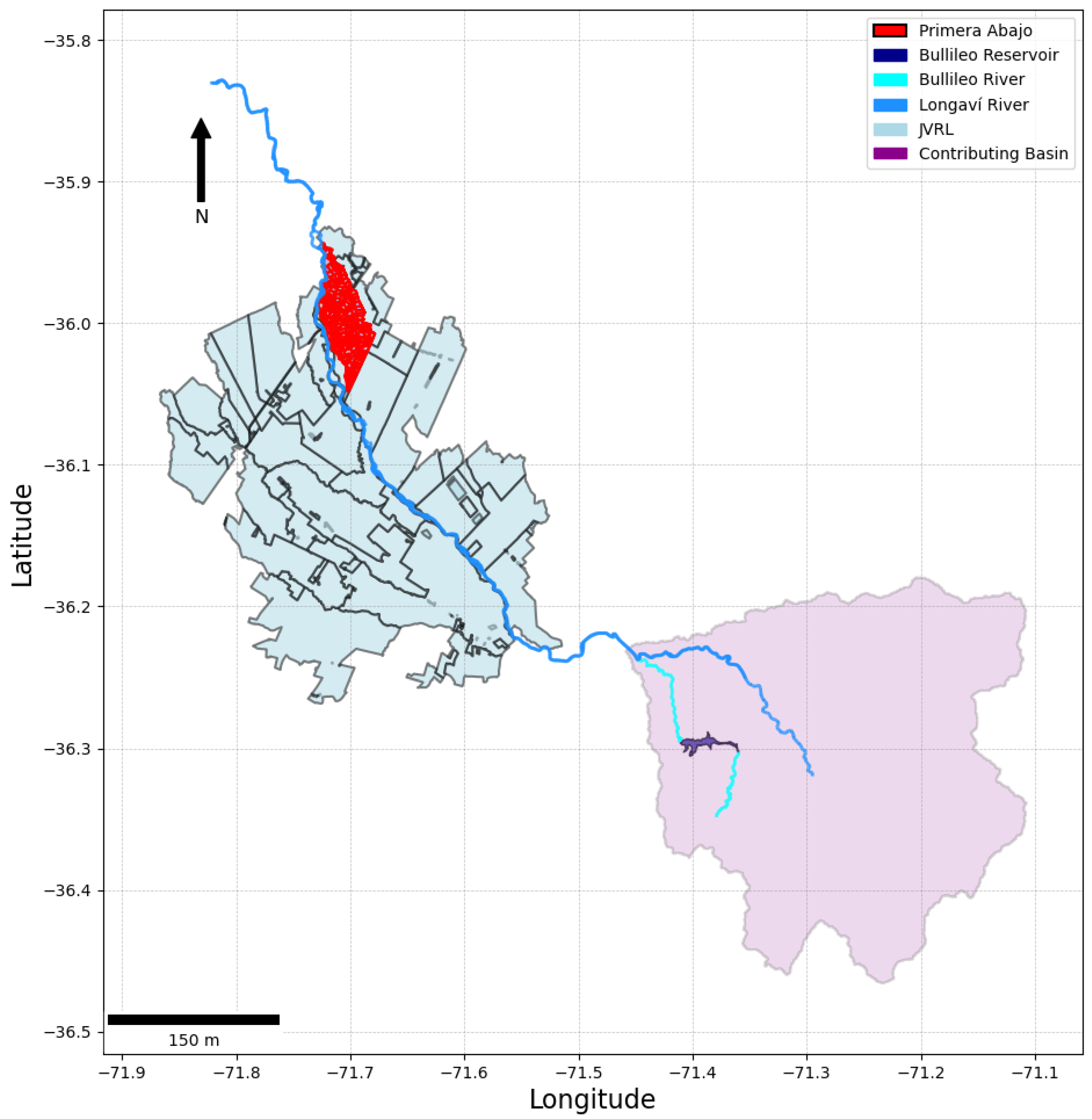
Figure 2.
Dynamics of water flow at an intake structure and its distribution among users. The key actors in the system are illustrated: the Water Board (WB), the Canal Administrator (CA), and the Farmers (F), along with the interactions between them in the allocation and utilization of the water resource.
Figure 2.
Dynamics of water flow at an intake structure and its distribution among users. The key actors in the system are illustrated: the Water Board (WB), the Canal Administrator (CA), and the Farmers (F), along with the interactions between them in the allocation and utilization of the water resource.
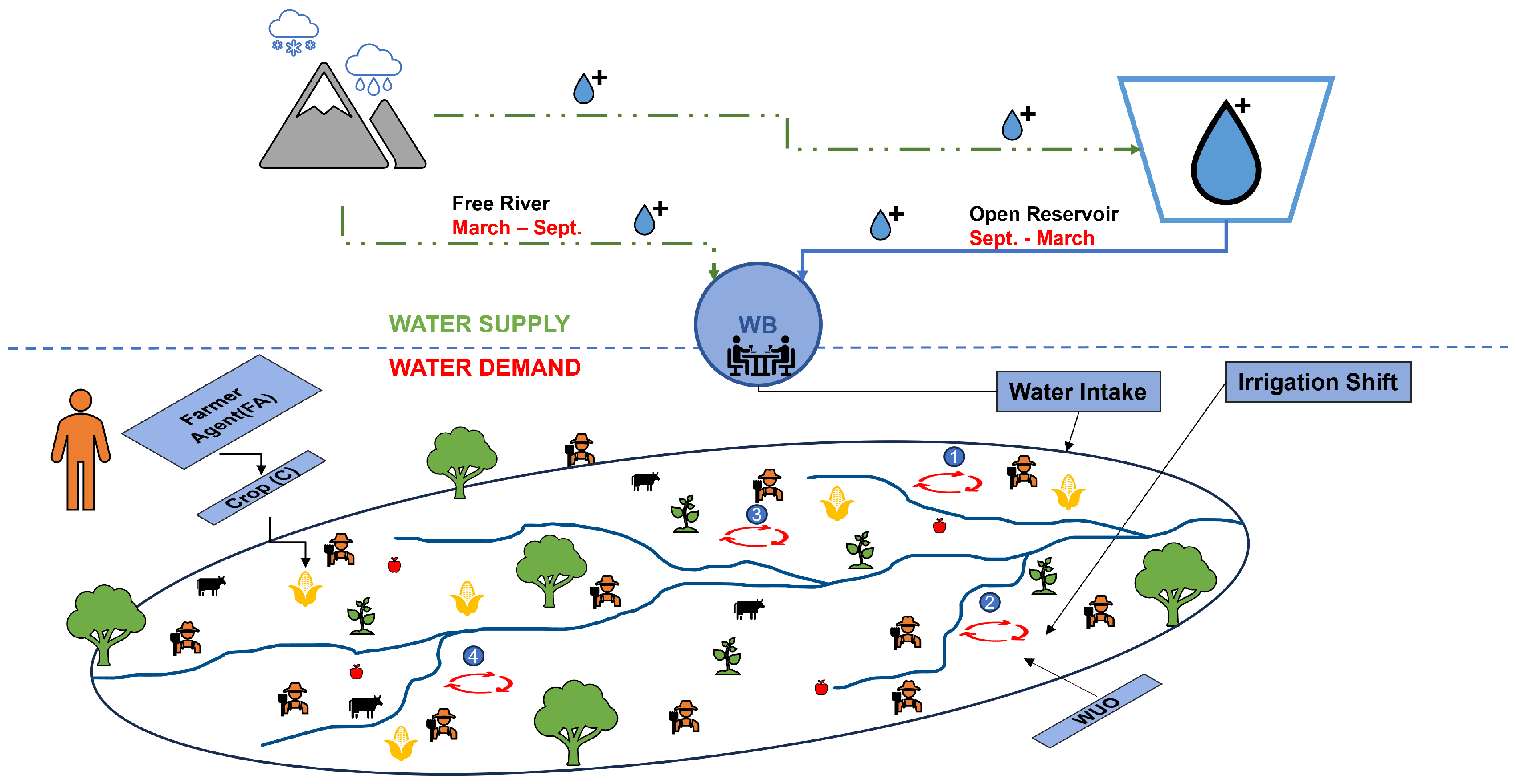
Figure 3.
The WOUs, belonging to the main canal “Primera Abajo”, where the proposed SHABM model was applied.
Figure 3.
The WOUs, belonging to the main canal “Primera Abajo”, where the proposed SHABM model was applied.
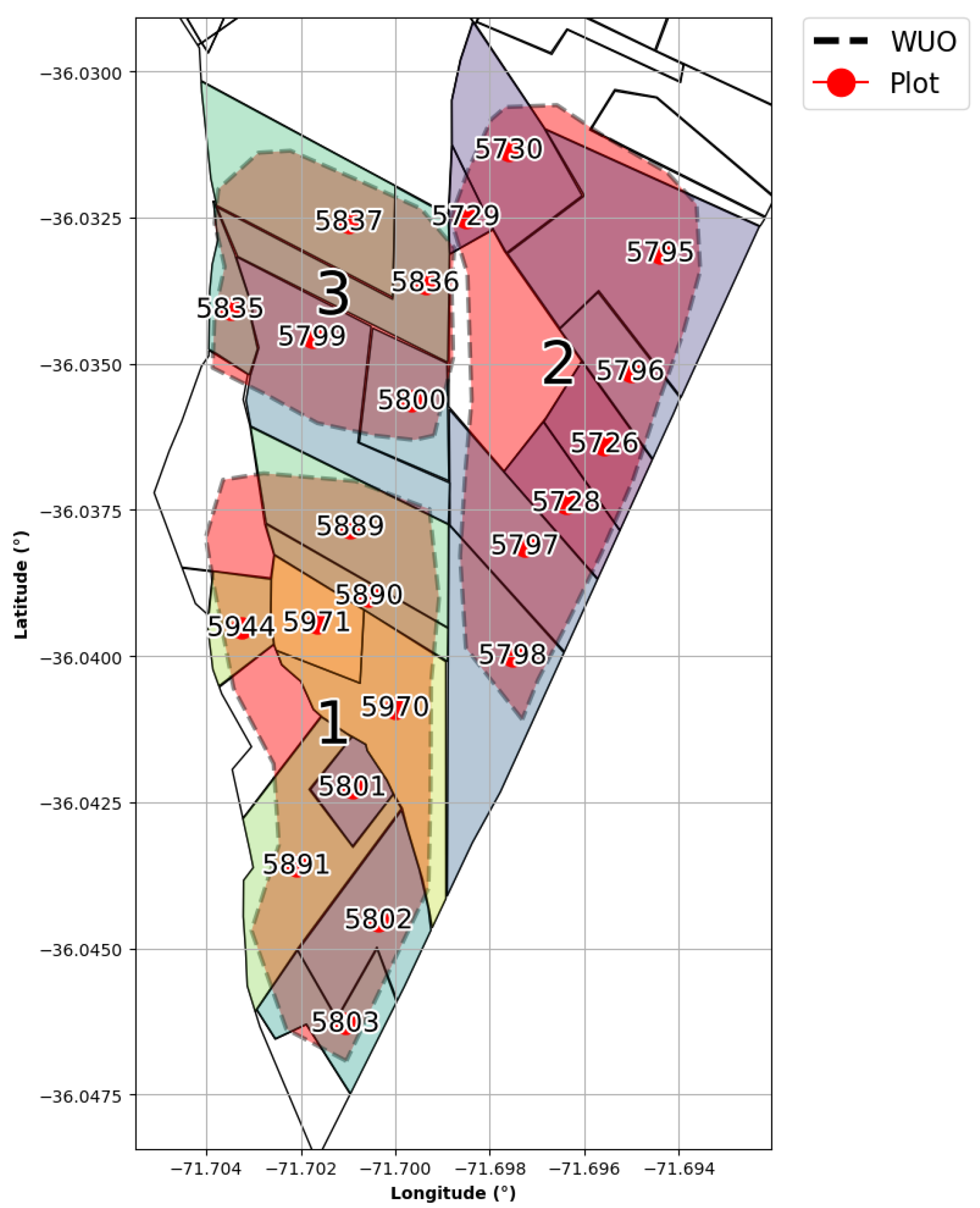
Figure 4.
Temporal evolution of available flow and potential water demand (PWD) for all crops in each of the studied WOUs.
Figure 4.
Temporal evolution of available flow and potential water demand (PWD) for all crops in each of the studied WOUs.
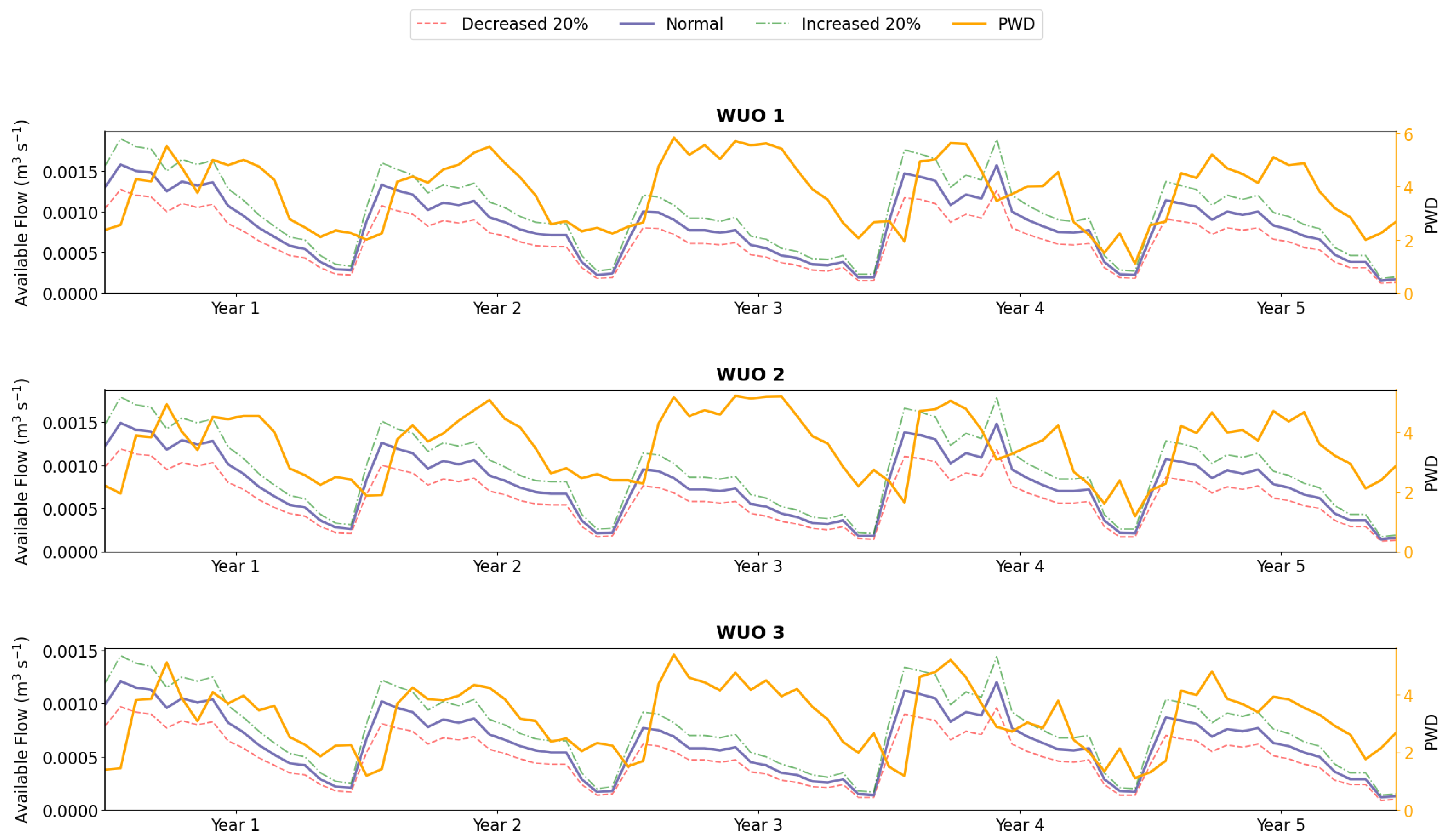
Figure 5.
Distribution of F agents’ decisions (to respect or ignore irrigation turns) based on supervision levels and water availability, disaggregated by prosocial behavior classification type (Selfish, Neutral, Cooperative).
Figure 5.
Distribution of F agents’ decisions (to respect or ignore irrigation turns) based on supervision levels and water availability, disaggregated by prosocial behavior classification type (Selfish, Neutral, Cooperative).
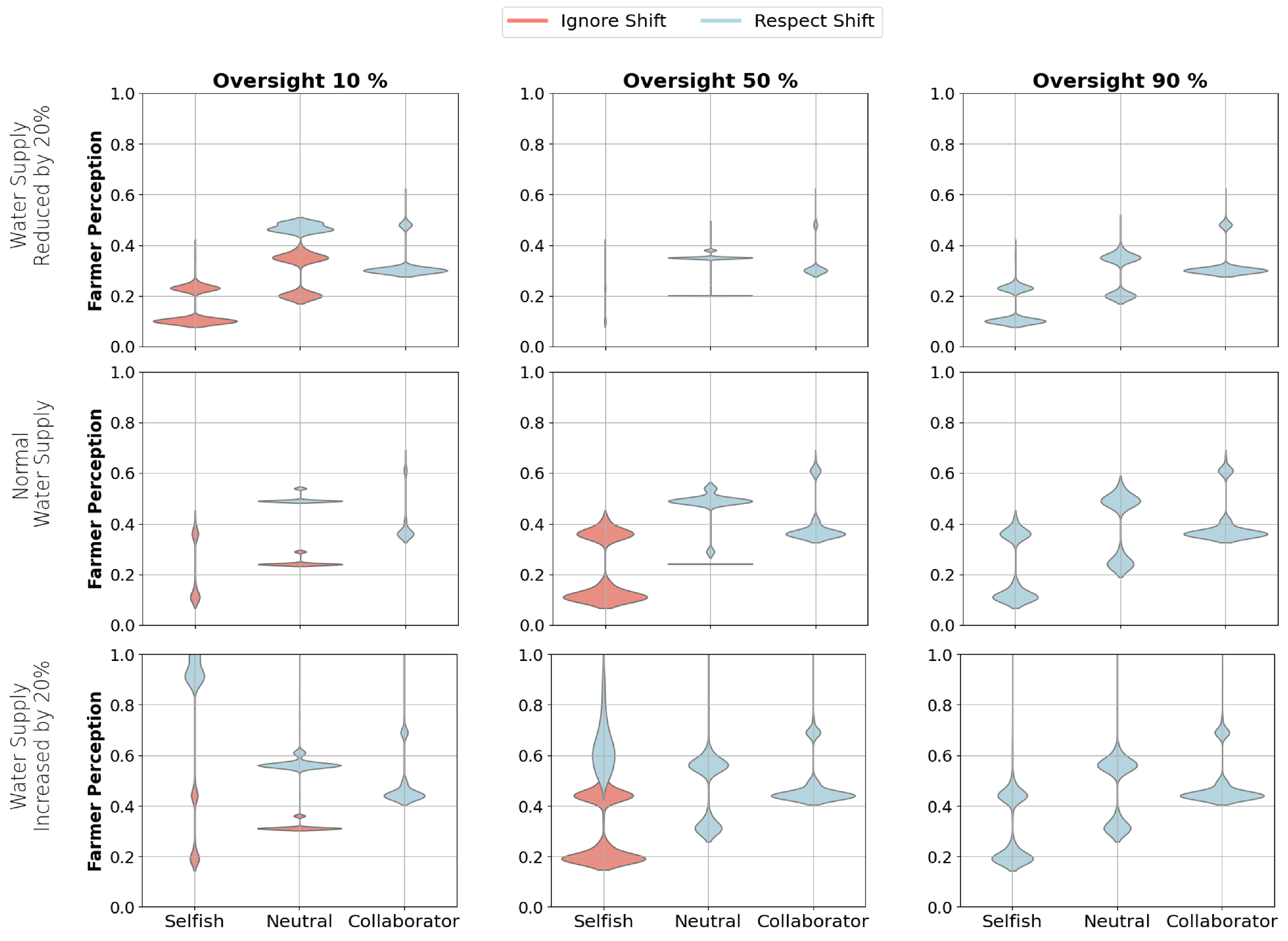
Figure 6.
A comparative analysis of the number of F agents ignoring irrigation turns over the five-year study period, under different levels of supervision (10%–90%) and three water availability conditions: a 20% reduction from actual levels, actual levels, and a 20% increase from actual levels.
Figure 6.
A comparative analysis of the number of F agents ignoring irrigation turns over the five-year study period, under different levels of supervision (10%–90%) and three water availability conditions: a 20% reduction from actual levels, actual levels, and a 20% increase from actual levels.
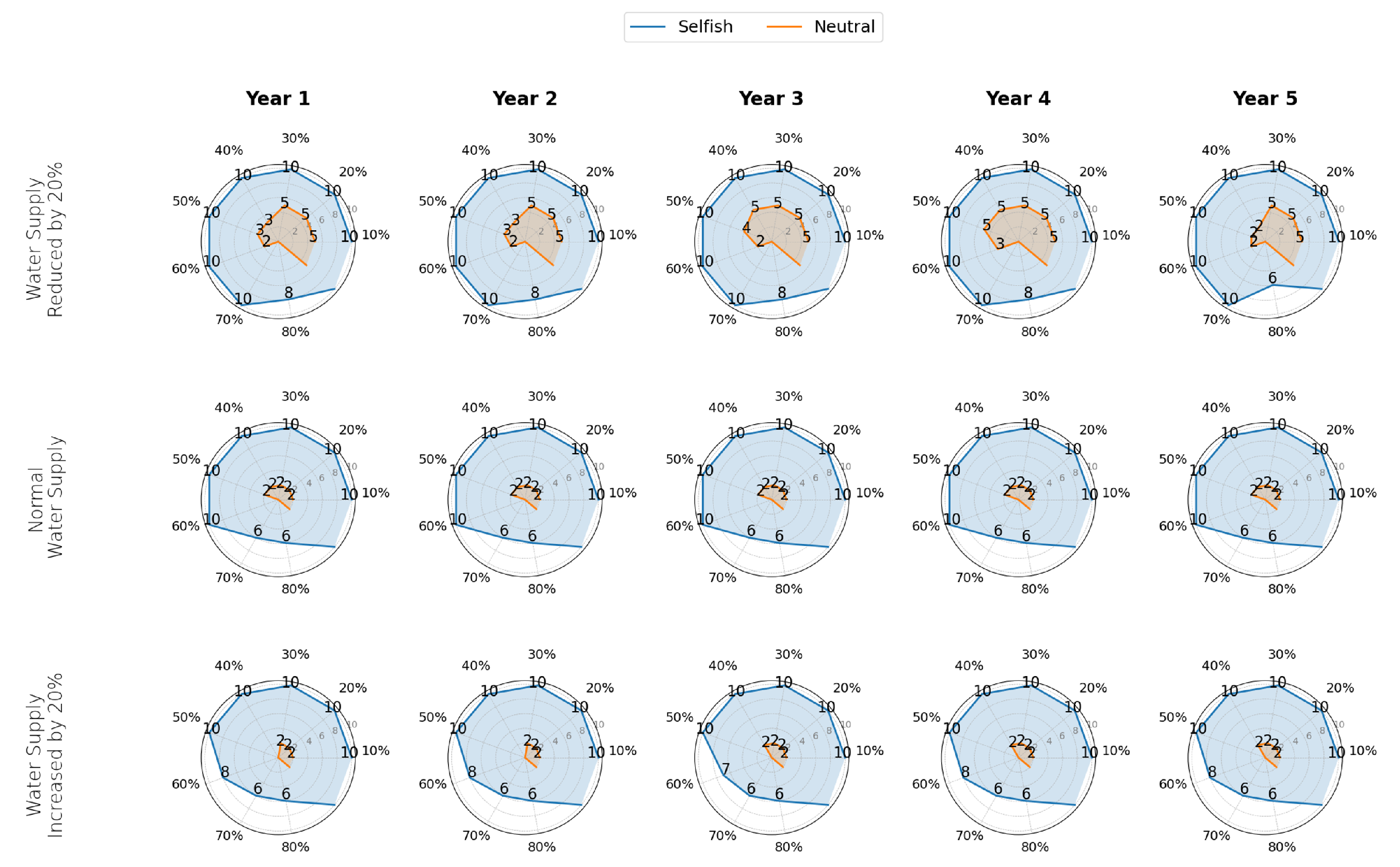
Figure 7.
Density of irrigation turns ignored by Selfish (red) and Neutral (green) agents in WUO 1 during the fifth year, under varying levels of supervision (10%, 50%, 90%) and water availability (20% reduction compared to real, real, 20% increase compared to real). The color scale indicates the number of turns ignored per plot, with darker shades representing higher densities.
Figure 7.
Density of irrigation turns ignored by Selfish (red) and Neutral (green) agents in WUO 1 during the fifth year, under varying levels of supervision (10%, 50%, 90%) and water availability (20% reduction compared to real, real, 20% increase compared to real). The color scale indicates the number of turns ignored per plot, with darker shades representing higher densities.
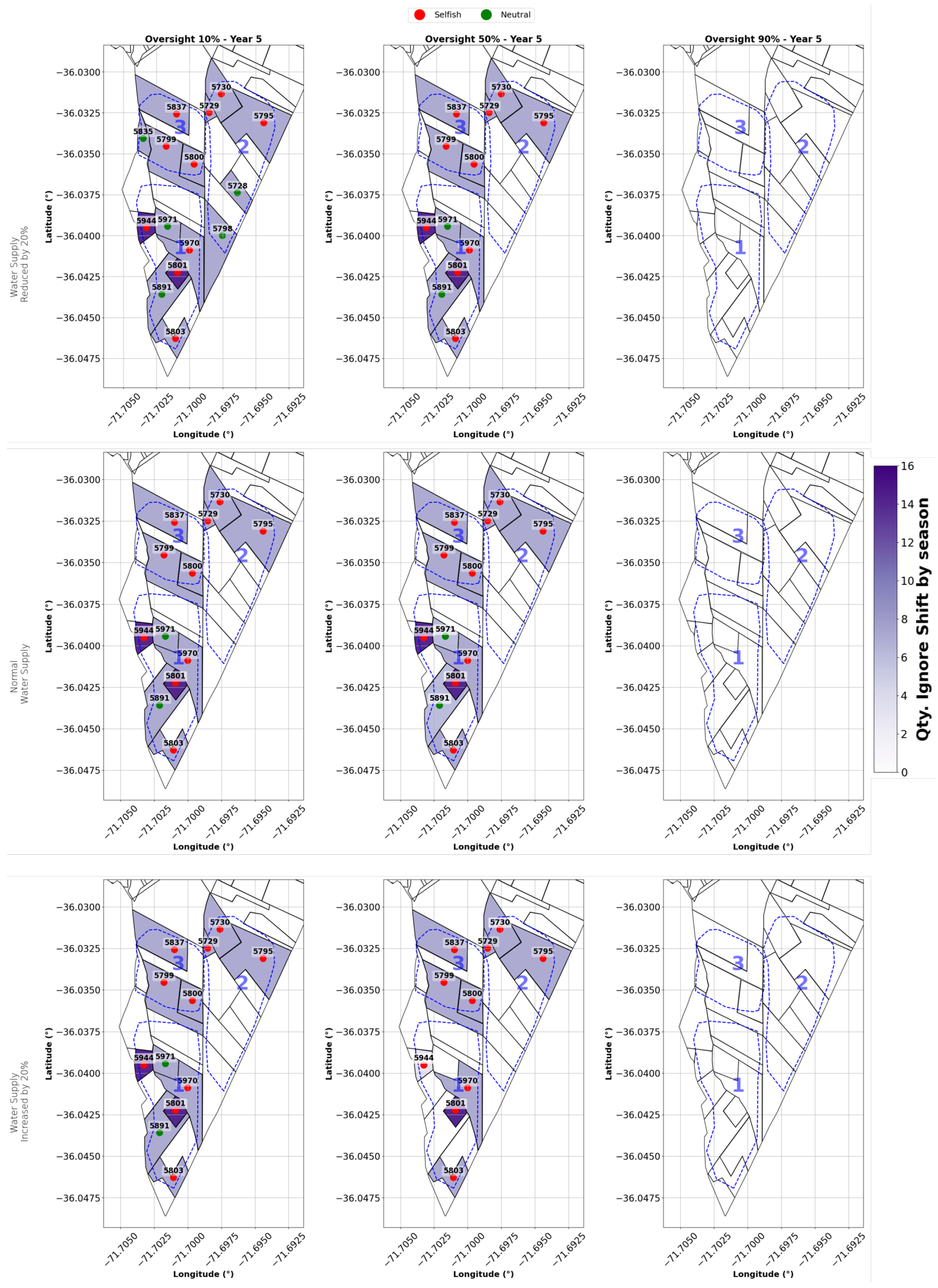

Table 1.
Cropping pattern used for the 5-year simulation period for each of the WOUs.
| WOU | Maize | Wheat | Blueberry | Alfalfa | Asparagus | Total Area (ha) |
| 1 | 51% | 41% | 2% | 6% | - | 289 |
| 2 | 8% | 14% | 40% | 22% | 15% | 367 |
| 3 | 43% | 50% | - | 7% | - | 259 |
Table 2.
Crop Economic and Production Aspects Summary
| Crop | Market Price $ USD |
Production Cost $ |
Yield kg · |
Irrigation |
|---|---|---|---|---|
| Maize | 1,470 | 14,000 | furrow | |
| Wheat | 861 | 7,500 | flood | |
| Blueberries | 1,96 | 19,236 | 11,500 | drip |
| Alfalfa | 100 | 1,341 | 18,000 | flood |
| Asparagus | 0,95 | 3,277 | 5,000 | forrow |
Disclaimer/Publisher’s Note: The statements, opinions and data contained in all publications are solely those of the individual author(s) and contributor(s) and not of MDPI and/or the editor(s). MDPI and/or the editor(s) disclaim responsibility for any injury to people or property resulting from any ideas, methods, instructions or products referred to in the content. |
© 2024 by the authors. Licensee MDPI, Basel, Switzerland. This article is an open access article distributed under the terms and conditions of the Creative Commons Attribution (CC BY) license (http://creativecommons.org/licenses/by/4.0/).
Copyright: This open access article is published under a Creative Commons CC BY 4.0 license, which permit the free download, distribution, and reuse, provided that the author and preprint are cited in any reuse.


