

Submitted:
16 October 2024
Posted:
17 October 2024
Read the latest preprint version here
Abstract
The increasing energy consumption and industrial activities that release carbon dioxide (CO2) emissions into the atmosphere have become one of the most serious environmental issues of today. This article discusses the current status in Azerbaijan regarding the development of effective approaches to reduce carbon emissions and ensure sustainable development, and it proposes relevant strategies for managing the carbon footprint. By exploring the interrelationship between the economy and the environment, it aims to contribute to the formation of more effective policies for managing CO2 emissions in Azerbaijan. According to the results of the econometric model established within the research for the period of 1990-2023, as the Azerbaijan economy grows, per capita CO2 emissions tend to increase, which can be linked to rising industrial activity, energy consumption, and other factors driving economic growth. The presence of a positive long-term relationship between population growth and per capita CO2 emissions can be attributed to higher overall energy consumption, increased demand for goods and services, and rising transportation needs. The strong correlation between economic growth and CO2 emissions suggests that it may be too early to assert the validity of the Kuznets curve for Azerbaijan economy as a developing country.
Keywords:
2. Introduction
3. Carbon Footprint: International Outlook
4. Carbon Footprint: Literature Review
5. Econometric Assessment of Carbon Footprints ın Azerbaijan: Methodology
6. Conclusıon and Suggestıons
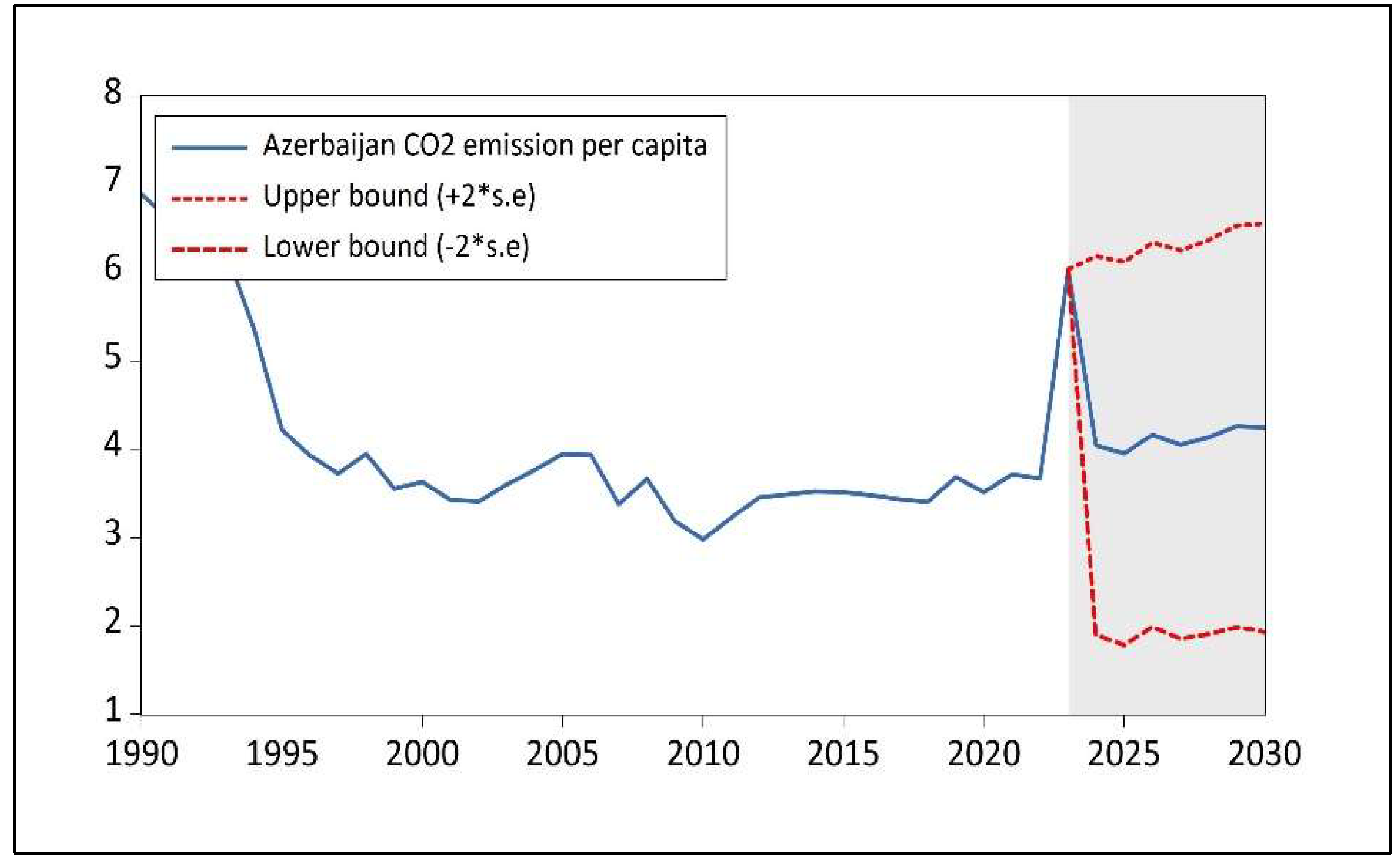
- 1)
- The positive relationship between GDP growth and CO2 emissions indicates a trade-off between economic growth and environmental sustainability. Policymakers should consider strategies that decouple economic growth from CO2 emissions, including investing in green technologies, promoting energy efficiency and transitioning to renewable energy sources.
- 2)
- The positive association between population growth and CO2 emissions means that efforts to manage population growth or reduce its impact on emissions may be crucial to controlling CO2 levels. This can include urban planning, promoting sustainable living practices and improving public transport systems.
- 3)
- In the long term, the weak relationship between fossil fuel consumption and CO2 emissions suggests that energy policy should focus on improving energy efficiency and increasing the share of renewable energy in the energy mix. This can help reduce environmental impact without directly reducing fossil fuel consumption.
- 4)
- The quick reversion of CO2 emissions and fossil fuel consumption to their own trend suggests that these variables are relatively stable and predictable in the long run. This stability can be used by policymakers to develop long-term strategies for reducing emissions.
| 1 | Decoupling is when economic growth happens without increasing environmental harm or resource use, especially in terms of carbon emissions. |
References
- Begum, R.A. , Sohag, K., Abdullah, S.M.S. and Jaafor, M. CO2 emissions, energy consumption, economic and pollution growth in Malaysia. Renewable and Sustainable Energy Reviews 2015, 41, 594–607. [Google Scholar] [CrossRef]
- Chang, N. Changing industrial structure to reduce carbon dioxide emissions: a Chinese application. Journal of Cleaner Production 2015, 103, 40–48. [Google Scholar] [CrossRef]
- Chen, J.H. and Huang, Y.-F. Nonlinear environment and economic growth nexus: a panel smooth transition regression approach. Journal of International and Global Economic Studies 2014, 7, 1–16. [Google Scholar]
- Coondoo, D. , & Dinda, S. Causality between income and emission: a country group-specific econometric analysis. Ecological Economics 2002, 40, 351–367. [Google Scholar] [CrossRef]
- Dinda, S. , & Coondoo, D. Income and emission: a panel data-based cointegration analysis. Ecological Economics 2006, 57, 167–181. [Google Scholar] [CrossRef]
- Dogru, T. , Bulut, U., Kocak, E., Isik, C., Suess, C., & Sirakaya-Turk, E. The nexus between tourism, economic growth, renewable energy consumption, and carbon dioxide emissions: contemporary evidence from OECD countries. Environmental Science and Pollution Research 2020, 27, 40930–40948. [Google Scholar] [CrossRef] [PubMed]
- Dong, B. , Ma, X., Zhang, Z., Zhang, H., Chen, R., Song, Y.,... & Xiang, R. Carbon emissions, the industrial structure and economic growth: Evidence from heterogeneous industries in China. Environmental Pollution 2020, 262, 114322. [Google Scholar] [CrossRef] [PubMed]
- EDGAR (2022). CO2 emissions of all world countries, 2022 report. EDGAR - Emissions Database for Global Atmospheric Research. European Commission. https://edgar.jrc.ec.europa.eu/report_2022.
- EDGAR (2024). GHG emissions of all world countries 2024 report. European Commission. https://edgar.jrc.ec.europa.eu/report_2024.
- EEA (2023) Total net greenhouse gas emission trends and projections in Europe, published 24 Oct 2023, European Environment Agency. https://www.eea.europa.eu/en/analysis/indicators/total-greenhouse-gas- emission-trends.
- Grossman G, Krueger A. (1991). Environmental impacts of a North American Free Trade Agreement. Working paper no. 3914. Cambridge: National Bureau of Economics Research; 1991.
- Hossain, S. “Multivariate granger causality between economic growth, electricity consumption, exports and remittance for the panel of three SAARC countries. European Scientific Journal 2014, 8, 349–376. [Google Scholar]
- Hasanov, F. J. , Mikayilov, J. I., Mukhtarov, S., & Suleymanov, E. Does CO2 emissions–economic growth relationship reveal EKC in developing countries? Evidence from Kazakhstan. Environmental Science and Pollution Research 2019, 26, 30229–30241. [Google Scholar] [CrossRef] [PubMed]
- Hasanov, F. , Bulut, C., & Suleymanov, E. ‘Review of energy growth nexus: A panel analysis for ten Eurasian oil exporting countries. Renewable and Sustainable Energy Review 2017, 73, 369–386. [Google Scholar] [CrossRef]
- IEA (2021) Net Zero by 2050: A Roadmap for the Global Energy Sector, INTERNATIONAL ENERGY AGENCY https://www.iea.org/reports/net-zero-by-2050.
- IEA (2024), The relationship between growth in GDP and CO2 has loosened; it needs to be cut completely, IEA, Paris https://www.iea.org/commentaries/the-relationship-between-growth-in-gdp-and-co2-has-loosened-it-needs-to-be-cut-completely, Licence: CC BY 4.0 17.
- Lee, J. W. , & Brahmasrene, T. Investigating the influence of tourism on economic growth and carbon emissions: Evidence from panel analysis of the European Union. Tourism management 2013, 38, 69–76. [Google Scholar] [CrossRef]
- Liddle, B. “What are the carbon emissions elasticities for income and population? Bridging STIRPAT and EKC via robust heterogeneous panel estimates. Global Environment Change 2015, 31, 62–73. [Google Scholar] [CrossRef]
- Lotfalipour, M. R. , Falahi, M. A., & Ashena, M. Economic growth, CO2 emissions, and fossil fuels consumption in Iran. Energy 2010, 35, 5115–5120. [Google Scholar] [CrossRef]
- Meadows, D.H. , Meadows, D.L., Randers, J. and Behrens, W.W. III (1972), The Limits to Growth: A Report for the Club of Rome’s Project on the Predicament of Mankind, Universe Books, New York, ISBN 0876631650.
- Nordin, S. K. B. S. , & Sek, S. K. Investigating the relationship on CO2, energy consumption and economic growth: A panel data approach. Journal of Reviews on Global Economics 2019, 8, 637–642. [Google Scholar] [CrossRef]
- Obama, B. The irreversible momentum of clean energy. Science 2017, 355, 126–129. [Google Scholar] [CrossRef] [PubMed]
- Ramos-Meza, C. S. , Flores-Arocutipa, J. P., Jinchuña-Huallpa, J., Corzo-Palomo, E. E., Gamero-Huarcaya, V. K., Gutiérrez-Acuña, Y., & Valencia-Martinez, J. C. Does environment quality affect the health care spending? Nexus among CO2 emissions, non-renewable energy production, financial development, and health care spending. Environmental Science and Pollution Research 2023, 30, 48903–48910. [Google Scholar] [CrossRef] [PubMed]
- Saleem, H. , Khan, M. B., Shabbir, M. S., Khan, G. Y., & Usman, M. Nexus between non-renewable energy production, CO2 emissions, and healthcare spending in OECD economies. Environmental Science and Pollution Research 2022, 29, 47286–47297. [Google Scholar] [CrossRef] [PubMed]
- Tiseo (2024a) Global CO₂ emissions change 1990-2023, by country, Published on Sep 6, 2024. https://www.statista.com/statistics/270500/percentage-change-in-co2-emissions-in-selected-countries/.
- Tiseo (2024b) Global annual GHG emissions shares 2023, by country. published on Sep 5, 2024 https://www.statista.com/statistics/500524/worldwide-annual-carbon-dioxide-emissions-by-select-country/.
- Tiseo, Ian (2023) Global cumulative CO₂ emissions from fossil fuel combustion 1750-2022, by country. Published on Dec 12, 2023, statista. https://www.statista.com/statistics/1007454/cumulative-co2-emissions-worldwide-by-country/.
- Tiseo, Ian (2024) Annual global emissions of carbon dioxide 1940-2023, Published Jun 13, 2024. https://www.statista.com/statistics/276629/global-co2-emissions/.
- UNCC (2016) The Paris Agreement. https://unfccc.int/process-and-meetings/the-paris-agreement https://unfccc.int/process-and-meetings/the-paris-agreement.
- WMO (2023) The Global Climate 2011-2020: A decade of accelerating climate change, WMO-No. 1338, Geneva, World Meteorological Organization.

| Level | 1st difference | |||||||
| Intercept | Intercept & Trend | None | Intercept | Intercept & Trend | None | |||
| ADF | t | -2.954021 | -1.863301 | -1.752988 | -4.996442 | -5.516533 | -4.870561 | |
| p | (0.0676) | (0.6505) | (0.0756) | (0.0003)* | (0.0004)* | (0.0000)* | ||
| Phillips-Perron | t | -3.358348 | -1.750662 | -1.752988 | -4.996442 | -5.586607 | -4.866480 | |
| p | (0.0201)* | (0.7054) | (0.0756) | (0.0003)* | (0.0004)* | (0.0000)* | ||
| KPSS | LM stat | 0.473833* | 0.169328* | - | 0.401535 | 0.088744 | - | |
| LM crit | 0.463000 | 0.146000 | - | 0.463000 | 0.146000 | - | ||
| Level | 1st difference | |||||||
| Intercept | Intercept & Trend | None | Intercept | Intercept & Trend | None | |||
| ADF | t | 0.126502 | -0.886014 | -0.969255 | -4.917985 | -5.311521 | -4.812110 | |
| p | (0.9631) | (0.9458) | (0.2904) | (0.0004)* | (0.0008)* | (0.0000)* | ||
| Phillips-Perron | t | 0.373326 | -0.826182 | -0.966817 | -5.125394 | -5.344690 | -5.126759 | |
| p | (0.9787) | (0.9527) | (0.2914) | (0.0002)* | (0.0007)* | (0.0000)* | ||
| KPSS | LM stat | 0.389779 | 0.132822 | - | 0.348070 | 0.115364 | - | |
| LM crit | 0.463000 | 0.146000 | - | 0.463000 | 0.146000 | - | ||
| Level | 1st difference | |||||||
| Intercept | Intercept & Trend | None | Intercept | Intercept & Trend | None | |||
| ADF | t | -1.961510 | -1.873430 | -1.812933 | -4.730110 | -4.681350 | -4.807541 | |
| p | (0.3015) | (0.6454) | (0.0669) | (0.0006)* | (0.0037)* | (0.0000)* | ||
| Phillips-Perron | t | -2.061285 | -1.914568 | -1.915739 | -4.728673 | -5.099046 | -4.837864 | |
| p | (0.2608) | (0.6244) | (0.0539) | (0.0006)* | (0.0013)* | (0.0000)* | ||
| KPSS | LM stat | 0.174450 | 0.152080* | - | 0.159896 | 0.120303 | - | |
| LM crit | 0.463000 | 0.146000 | - | 0.463000 | 0.146000 | - | ||
| Level | 1st difference | |||||||
| Intercept | Intercept & Trend | None | Intercept | Intercept & Trend | None | |||
| ADF | t | -3.559267 | -3.057327 | -1.053065 | -3.100454 | -4.103805 | -3.143778 | |
| p | (0.0126)* | (0.1334) | (0.2578) | (0.0366)* | (0.0149)* | (0.0027)* | ||
| Phillips-Perron | t | -3.272940 | -2.275362 | -0.764131 | -3.099765 | -4.103805 | -3.143778 | |
| p | (0.0245)* | (0.4349) | (0.3776) | (0.0366)* | (0.0149)* | (0.0027)* | ||
| KPSS | LM stat | 0.274653 | 0.173118* | - | 0.528631* | 0.089619 | - | |
| LM crit | 0.463000 | 0.146000 | - | 0.463000 | 0.146000 | - | ||
| Unrestricted Cointegration Rank Test (Trace) | |||||||
| Hypothesized | Trace | 0.05 | |||||
| No. of CE(s) | Eigenvalue | Statistic | Critical Value | Prob.** | |||
| None * | 0.668957 | 56.75869 | 47.85613 | 0.0059 | |||
| At most 1 | 0.405870 | 22.48795 | 29.79707 | 0.2721 | |||
| At most 2 | 0.168765 | 6.347567 | 15.49471 | 0.6544 | |||
| At most 3 | 0.019721 | 0.617453 | 3.841465 | 0.4320 | |||
| Unrestricted Cointegration Rank Test (Maximum Eigenvalue) | |||||||
| Hypothesized | Max-Eigen | 0.05 | |||||
| No. of CE(s) | Eigenvalue | Statistic | Critical Value | Prob.** | |||
| None * | 0.668957 | 34.27074 | 27.58434 | 0.0060 | |||
| At most 1 | 0.405870 | 16.14039 | 21.13162 | 0.2168 | |||
| At most 2 | 0.168765 | 5.730115 | 14.26460 | 0.6481 | |||
| At most 3 | 0.019721 | 0.617453 | 3.841465 | 0.4320 | |||
| Error Correction: | D(LN(CO2PC)) | |||||
| Coefficients | standard error | t statistics | ||||
| CointEq1 | -0.451368 | -0.09865 | [-4.57563] | R-squared: | 0.680853 | |
| D(LN(CO2PC(-1))) | 0.184074 | -0.17355 | [ 1.06062] | Adj. R-squared: | 0.544075 | |
| D(LN(CO2PC(-2))) | 0.294477 | -0.17587 | [ 1.67436] | Sum sq. resids: | 0.064482 | |
| D(GDPGH(-1)) | 0.002158 | -0.00161 | [ 1.33696] | S.E. equation: | 0.055413 | |
| D(GDPGH(-2)) | 0.003372 | -0.00139 | [ 2.43258] | F-statistic: | 4.977818 | |
| D(POPGH(-1)) | 0.072188 | -0.07797 | [ 0.92588] | Log likelihood: | 51.73102 | |
| D(POPGH(-2)) | 0.136825 | -0.07617 | [ 1.79627] | Akaike AIC: | -2.692324 | |
| D(LN(FOSS(-1))) | -0.016275 | -0.19728 | [-0.08250] | Schwarz SC: | -2.229748 | |
| D(LN(FOSS(-2))) | -0.363351 | -0.20895 | [-1.73893] | Mean dependent: | -0.02236 | |
| C | -0.018151 | -0.01054 | [-1.72247] | S.D. dependent: | 0.082066 |
Disclaimer/Publisher’s Note: The statements, opinions and data contained in all publications are solely those of the individual author(s) and contributor(s) and not of MDPI and/or the editor(s). MDPI and/or the editor(s) disclaim responsibility for any injury to people or property resulting from any ideas, methods, instructions or products referred to in the content. |
© 2024 by the authors. Licensee MDPI, Basel, Switzerland. This article is an open access article distributed under the terms and conditions of the Creative Commons Attribution (CC BY) license (http://creativecommons.org/licenses/by/4.0/).


