

Submitted:
15 October 2024
Posted:
16 October 2024
Read the latest preprint version here
Preprints on COVID-19 and SARS-CoV-2
Abstract
During the Covid-19 pandemic, although the experience of workers and managers was examined, the role, experiences and functions of supervisors was relatively underexplored, with no investigation into their changing health and safety responsibilities. This project attempted to fill this gap. Twenty supervisors across Canada were interviewed for an hour. A Framework Method guided the study. We used a conceptual framework of 10 supervisor functions to help direct the data collection, identify codes, manage and organize the data analysis, and identify major themes which were highlighted in the findings. What was found was that since supervisors did not have access to workers’ homes, they could not execute most of their OHS functions. They were obliged to give workers more control over how and when they worked. They Increased their communications with their workers in response to workers’ psychological health concerns. Notably, supervisors reported that they were under extreme stress. A hybrid work environment, with workers sometimes working at home, has become the new norm. Supervisor stress will continue to escalate unless upper management provides more support, supervisors get training on how to deal with the psychological health and safety of workers, and supervisors’ responsibilities are re-defined for at-home workers.
Keywords:
Supervisors
; working from home
; psychological health and safety
; stress
; hybrid work
; occupational health & safety
; supervisor responsibilities
; qualitative research
; Covid-19
1. Introduction
1.1. Background
In early 2020, the health, safety and wellbeing of workers was thrust into the limelight as the COVID-19 pandemic became global. In March 2020, Canadian workers were sent home and a large part of the workforce started working virtually, while also trying to cope with the stress of home-schooling, caring for their ill, aging parents, and managing their sense of isolation and fear. It brought to the fore an exceptional emphasis on physical as well as psychological health and safety [1].
The pandemic disrupted the day-to-day operations of work, the nature of work, and the relationship between supervisors and workers. When this research was initiated in mid-2020, Canada had adopted a “new normal” of workers working remotely [2] with some saying that “work from anywhere” would be the future of work [3]. Statistics Canada report that in May 2020 (at the height of the initial wave and lockdown), 37% of the Canadian workforce worked at home and by December 2021, this remained at 22% [4].
What has emerged is a hybrid arrangement of work, with workers working some days remotely and other days on-site. Having had the experience of working from home, many workers are reluctant to work on-site full time [5]. Interestingly, this potential trend was predicted as early as 2020 [6]. There are many reasons for workers wishing to continue working from home, at least some days of the week: convenience, shorter commute times, flexibility, more time with family and hence improved work-life balance, autonomy, and more control and discretion over their work. Some initial research found that performance is maintained during hybrid work [7].
During the pandemic, although the experiences of workers and managers were examined [8,9,10], the role and experience of supervisors was relatively underexplored [11]. Moreover, there was research on the health and safety of workers working remotely [9,10,11,12,13,14,15,16]. There was also some research on the health (especially psychological health) of upper management during the shutdown of the pandemic [17].
However, there was a significant dearth of studies on supervisors. This absence of research on supervisors initiated our inquiry. Our project attempted to fill this gap by examining the changing role and functions of supervisors, particularly in regard to their OHS functions and responsibilities – a topic which had not previously been investigated.
Supervisors can be front-line supervisors, small team leaders, senior managers or directors. The central position of supervisors is defined by the key relationships they have, in relation to whom they report, and who reports to them [18]. Supervisors are placed between trying to meet the demands of their upper management while trying to provide social and practical support to the workers that report to them. The role of being in the “middle of the sandwich” has often led to role dissonance and emotional exhaustion as supervisors try to navigate these often-opposing demands and bear the brunt of major workplace change [8,19,20].
Regarding occupational health and safety (OHS), a supervisor’s responsibilities are outlined in most provincial OHS legislation in Canada. Supervisors have unique responsibilities, authority, resources, knowledge, experience, and accountability [21,22]. These include ensuring and providing: the flow of information about work; the allocation of work; what work is done by workers; and training, so that workers can safety execute their work; as well as overseeing and determining how the work is done, when the work is done, what materials to use; and the resources needed to do the work [23,24,25].
However, OHS legislation has historically assumed a physical workplace under the control of an employer, and hence the role and responsibilities of supervisors has been dependent on having workers working within this controlled physical environment [21,22]. When workers are working from, and have control over, their own home workplaces, the role of supervisors changes substantially. This study focused on the role of supervisors in the context of this changed life of workers who were now working remotely [17].
The study also investigated how supervisors provided social support for the psychological health of their workers working from home, despite having no control over the at-home environment of their workers. This study’s consideration of social support as a mitigator of the stress and potential illness that can result from high demand and low control over work, is based on the well-established research on the Karasek and Theorell job strain model [26,27,28,29].
As there is strong support for continued at-home/virtual/hybrid work arrangements, with an estimated 39% of Canadian jobs able to be feasibly completed from home [30], there is a need to understand how OHS legislation effectively responds to these work arrangements, as well as to understand the relationship between employers, supervisors, and their workers within this new context. As such, in this project we have examined how supervisors adapted their OHS functions and obligations; we have considered the potential impact this has had on OHS legislation, as well as on worker health and safety while working at home; and have examined how supervisors have tried to fulfil their obligations and responsibilities despite the unique constraints they were working under.
1.2. Changing from Research Questions to Purpose
This study was initiated with the intent that it would inform policy development for the supervision of at-home (virtual and remote) workers. To this end, the researchers set out to answer two research questions:
- How can we adequately protect the health and safety of workers who work from home?
- How can supervisors effectively comply with their OHS responsibilities for at-home workers?
However, having conducted 20 interviews with supervisors from across the country from multiple industries, we saw the necessity of inductively responding to what we heard from the supervisors. We have identified patterns, similarities, recurring themes, and strong differences in their responses. What has emerged are concepts and ideas -- some of which are different from those predicted by either the theories or research questions.
Despite not being able to directly answer the two initial research questions, we believe the study has identified two major problems facing supervisors with at-home workers. These findings can themselves lead to recommendations that have policy implications for the future of workers working from home and the supervisors who are supervising them.
- Firstly, we have added to our understanding of the unique and complex experiences of supervisors because of the critical – but often uncomfortable -- role they play in most organizations. Supervisors hold a unique place in the hierarchy of a workplace. They are obliged to respond to workers’ needs, including being realistic about workloads and making demands, but they also need to respond to the requirements of upper management. This has led to a unique set of problems, challenges and issues faced by supervisors.
- Second, we have examined and improved our understanding of how supervisors have tried to continue to take responsibility for and execute their major occupational health and safety functions. Our study examined the stressors encountered by supervisors, the constraints they work under, and the distractions they encounter, all of which may be negatively affecting their ability to fulfil their OHS functions.
From these findings we have met the initial objective of arriving at policy implications for supervisors with virtual and remote workers. We have noted the implied and real impacts this has had on the Internal Responsibility System (IRS), which is the philosophy that underlies all occupational health and safety legislation. We have also noted that workers working from home have more control and knowledge of their at-home or remote workplaces, and hence need to adopt an increased occupational health and safety role for themselves. This has implications for the changing role of supervisors who may need to increase their efforts to educate and encourage workers.
1.3. Project Description
A qualitative approach was taken to add to our understanding of the unique and complex role of supervisors because of the critical – but often uncomfortable -- function they hold in most organizations. The goal of qualitative research is not to arrive at generalizable trends, but rather to gain a deep understanding of people’s interactions with each other [31].
This project consisted of three phases: (1) During January and February 2022, hour-long virtual interviews were conducted with 20 supervisors across Canada focusing on their perspectives and experiences; (2) in August 2022 a focus group of eight supervisors reviewed the initial findings from the interviews and discussed what the key issues moving forward were, and what resources supervisors needed; and (3) a workshop and facilitator guide was developed to give supervisors the opportunity to share and discuss their ongoing experiences and problems, and to support and help each other. This has been trialed with a group of supervisors and adaptations have been made.
Ethics approval for the study was provided by the Toronto Metropolitan University (formally known as Ryerson University) Research Ethics Board (REB file number 2021-325). The participants gave informed consent for the interviews, and informed consent to participate in the focus group. None of the participants’ names or the organizations they work for have been identified.
The objective of this project was to learn from supervisors, during a particularly difficult time when both supervisors and workers were working from home, about their unique and complex experiences because of the critical – but often uncomfortable -- role they hold in most organizations. We wanted to learn how – or whether -- they had continued to take responsibility for and executed their major occupational health and safety functions. Our study examined the stressors encountered by supervisors, the constraints they lived under, and the distractions they encountered, all of which may have reduced their ability to fulfil their OHS functions.
1.4. Search Strategy for Evidence
To assist with preparing for the participant interviews (i.e. preparing the interview schedule/questions), a comprehensive search was undertaken of the literature regarding at-home work during the pandemic and prior to the pandemic. This was to understand the current experiences of employees, supervisors and managers, and to explore relevant OHS issues identified in the literature. These searches included reviews of government documents from organizations such as Statistics Canada, the World Health Organization (WHO), the International Labour Organization (ILO), and the Health and Safety Executive (in the United Kingdom), along with academic (peer-reviewed) literature and grey literature (e.g. non-peer-reviewed magazines, media reports). The searches focused on understanding: (1) the broad range of issues associated with working at home; (2) hazards and risks identified with at-home, hybrid, remote and virtual workers; and (3) resources currently available for at-home workers.
2. Methods
A qualitative approach was taken to add to our understanding of the unique and complex role of supervisors. This project consisted of three phases: (1) during January and February 2022, hour-long virtual interviews were conducted with 20 supervisors across Canada, from 20 different companies or organizations, focusing on their perspectives and experiences; (2) in August 2022 a focus group of 8 supervisors (who had been previously interviewed) reviewed the initial findings from the interviews and discussed what the key issues moving forward were, and what resources supervisors needed; and (3) a workshop and facilitator guide was developed to give supervisors the opportunity to share and discuss their ongoing experiences and problems, and to support and help each other.
2.1. Phases 1 and 2
Recruitment of the participants for the interviews and focus group was relatively easy in comparison to previous workplace-based studies conducted by the research team [32,33,34,35]. The recruitment only took a month. We approached people who had been participants in the team’s previous studies in municipalities and industry, and people in the researchers’ personal networks that included unions, occupational health and safety associations, provincial government ministries, and private-sector organizations. The largest number of interviewees came from a network of occupational health and safety professionals from across Canada, who were part of a large, current, mailing list maintained by one of the research team members.
All the supervisors had workers (a minimum of three) reporting to them who were working remotely due to the COVID-19 epidemic. There were eight men and 12 women, 10 from Ontario, six from British Columbia, and four from Nova Scotia. They had multiple different titles from supervisor to director, but all had workers reporting to them. Out of the 20 participants, eight were occupational health and safety professionals. The rest came from diverse sectors (see Table 1).
During the year of data collection, there were weekly, hour-long, meetings of the academic members of the research team (T.T., D.K. L.H., P.S.) to discuss the conceptual framework, the evolving findings, discuss sub-themes and identify informative quotes. The conceptual framework evolved in the early phases of the interview period, with the first five interviews acting as the pilot for the study trialing the usefulness of the conceptual framework. These meetings were mostly conducted virtually, but there were three face-to-face meetings over the year. Notes were taken at these meetings.
The interviews and the focus group were conducted through synchronous online, face-to-face contact using the software platform Zoom by one of the researchers (for consistency). The interviews lasted about an hour (46 minutes to 75 minutes each). The focus group was two hours long. The interviews and focus group were audio recorded and transcribed verbatim. Detailed field notes were taken at every interview and at the focus group.
A conceptual framework, based upon theory and existing research, was created following the Framework Method [36,37] at the initiation of the study. It helped us create the interview schedules, directed the data collection, and when it came to the analysis, it guided the data reduction and synthesis as well as data display leading to the creation of codes and key factors. It helped us deductively manage and organize the data analysis (see Figure 1).
The conceptual framework included the standard descriptions of the major responsibilities of supervisors as mentioned in most of the legislation across the country under the Internal Responsibility System [22]. These included 10 functions: job planning, staffing, job observations, workplace inspections, investigations, discipline, resource allocation, training/worker instruction, responding to worker concerns, and leadership [23,25]. Training included onboarding, teaching new work, refresher training, and hazard communication. The interviews also included follow-up questions where the supervisors were asked how they had built virtual relationships with their workers and responded to their concerns, explored their relationship with upper management, and were asked about the stress and concerns they had personally experienced. These follow-up questions emerged as very important in the interviews.
Although the deductive analysis of the interviews was based on the pre-conceived conceptual framework, the 20 interviews with the supervisors also demanded an inductive response to what we heard as we identified patterns, similarities, recurring themes, and strong differences. What emerged were concepts and ideas; some of which were different from those predicted by either the theories, the original research questions, or the conceptual framework. This inductive thematic analysis was useful in exploring concepts, processes and themes that perhaps would not have emerged through the deductive process. It also led to the changes in the original research questions. Those questions emerged as not as relevant to the supervisors as were their more intense virtual experiences with workers working from home, their relationship with upper management, and their personal stressors and concerns.
Coding was conducted by all members of the research team. The initial synthesis was discussed and deliberated upon, and a consensus was reached on the most relevant and important themes. The analysis also included feedback received from an external expert group from a regulatory agency, and the two-hour follow-up feedback from the focus group. This feedback and guidance on the results, as well as OHS documentation provided by supervisors from their organizations, were incorporated into the final interpretation of the findings. The interviews, the feedback from the groups and the focus group, and the documentation provided triangulation of the data on the experience of supervisors [38].
2.1. Phase 3
Based on the key thematic outcomes of phases 1 and 2, a workshop (slide deck) and facilitator guide was developed to give supervisors the opportunity to share and discuss their ongoing experiences and problems, and to support and help each other. This has been trialed with a group of supervisors, was discussed as part of a presentation at the Atlantic Workplace Health and Safety Conference, and based on the combination of this feedback, adaptations have been made. The resources will be made available via a website (https://www.torontomu.ca/ohs-support-for-supervisors). Note: the website is not currently live) but it will be circulated widely among the research team’s industry contacts.
3. Results
The primary goal of the study was to identify, from the supervisor’s perspective, the role of supervisors, and how this role, and their occupational health and safety (OHS) functions, changed with workers working from home or remotely due to the COVID-19 shutdown. We wanted to learn how supervisors ensured worker wellness in this very special context, and the impact that this change in role has had on supervisors. This study had two main purposes, the first was to add to our understanding of the unique and complex role of supervisors because of the critical – but often uncomfortable -- function they hold in most organizations. The second was to examine how, or whether, supervisors continued to take responsibility for their major OHS functions, under these very difficult circumstances.
Below we synthesize five key findings: (1) supervisors found it very difficult to fulfill their standard OHS functions when people were working remotely. Job observations, inspections, investigations, and disciplining were hardly done; (2) supervisors did try and meet some OHS needs virtually, such as providing help with resources, worker instruction, and onboarding; (3) the major worker concern that supervisors were responding to was worker psychological health and safety; (4) supervisors adopted a different management style and took on different functions. They took on intense support for their workers, reduced their micro-management of workers’ activities, and allowed workers more control over scheduling of their work; and (5) supervisors were under enormous stress, and there was very little support provided to them.
Supporting each finding is a quote from one or two of the supervisors that typifies the finding. The number at the end of each quote refers to the supervisor number as found in Table 1: Description of participants.
2.1. Standard Supervisor Functions – What Could Not Be Done?
A significant finding was that the first six of the traditional occupational health and safety supervisory functions that were in the conceptual framework, were mostly not fulfilled by either supervisors or organizations’ health and safety committees during this time. Job planning, staffing, job observations, workplace inspections, investigations, and disciplining of workers mostly did not happen with workers working from home. Although the legislation is applied contextually, supervisors believed it was not possible to have any control over workers’ workspace at home. They stated the need to trust their workers that they would find a conducive workspace and take care of themselves.
In my head, it works like this. It's your house. We're telling you to do your job from your home. It should be a safe environment for you to do so. You know, we all have other things going on in our life, but it should be a safe location for you. So I think at one point we sent out [information on electrical safety -- like don't overload your plugs and crap like that, right? And don't run to any fire. [Don’t have too] many cords. Don't run them under your carpet, and stuff like that. But the adult who is employed by the employer should take some responsibility for their work environment, whether it is working in the workplace, or at home. We can give you guidelines to manage it. But it's really up to you to do it. (20)
Moreover, traditional hazards or incidents such as trips and falls were not reported to the supervisors who were interviewed. However, some supervisors noted that if workers indicated they may have a musculoskeletal issue or needed assistance with the ergonomic set-up of their home workplace, they could have a consultation with an ergonomist, who in-turn conducted a virtual investigation and offered advice. What mostly occurred was that supervisors or their organizations (usually from the HR department) sent workers an electronic brief outline on how to set up their home-office workspace ergonomically.
Nobody has had an injury though. Nobody has said I've got a problem with my wrist, or I've got a specific problem, because you're making me sit at this awkward angle at my computer. I didn't have any. I didn't have any physical issues really that I can remember. (10)
There were some issues that supervisors had to deal with that were unique to the pandemic environment. A few workers refused to come back to the workplace because of the fear of getting infected, and some refused to work with a colleague who was not vaccinated. Alternatively, there were workers who refused to be vaccinated. These issues became the responsibility of the supervisors to navigate with sensitivity.
In the field, there have been some job refusals, where people want to know if others in the group have been vaccinated, because they don't want to be in a cohort with someone who's not vaccinated. (8)
The supervisors were obliged to turn over most of the job planning functions to the discretion of the individual workers. Some found it very difficult to get their workers to share the most basic information about what work they were doing. After nearly two years since the start of the pandemic, many workers were very reluctant to give up their freedom from being accountable to supervisors.
We're still in this moment of sort of lock down. We are not quite out of it. And I'm still trying to work with my community service staff. They always say, ‘Well, we're out in the community.’ Well, what does that mean, you're out in the community? ‘Are you working with a homeless person? Are you just out in the park checking on an opioid overdose, which we have lots of on the property? Like what are you actually doing?’ And then they look stressed and they say “We're doing really good work.” (10)
Even basic supervisor functions such as performance reviews and keeping track of productivity proved to be difficult during the pandemic and has continued to be so.
From a performance point, I find it exceptionally challenging. The tools that we have in place to track productivity, and how people move throughout their day aren't there. So when work is not to the quality that I expect it to be, I have lots of questions. One is: ‘Are you capable of doing it? Are you managing your time well? Is there a time management issue because you're working from home?’ I had a performance meeting with an employee last week. I actually gave her a letter of warning. I've never met her in person. I've met her on camera a couple of times. That is an instance where on a number of occasions I have asked her: ‘What have you been doing?’ And the response back hasn't been really reasonable, or she hasn't provided a reasonable explanation to how she's working or why the productivity isn't there. So I find that challenging as a manager, that's not something that would happen normally. Typically, in the same role when I was working in person, I could see people all the time and see when their productivity drops. (16)
As full lockdown ended and pressure mounted for workers to return to the workplace, a number of the supervisors mentioned that they thought that workers were not reporting health or safety issues because they did not want to return to the workplace. They believed that workers thought that if they complained, they would be obliged to return.
I think, and I don't want to read people's minds, but I think that they believe that if they make it too difficult, I will say, ‘Oh, you can't work from home because it's too difficult’. [So they say:] “Oh, no, I'm fine. Everything's perfect. I feel no stress. I'm all good. It's all good.’ That's what I think. They are thinking, ‘Oh, well, if I say I need this, or if I say I fell, they're gonna say, well, it's not safe for you to work at home.’ I might be wrong. I don't think so though. I think that people are so keen on not wanting to go back to the office … [so they say:] ‘Everything's perfect.’ (17)
2.2. Standard Supervisory Functions – What Could Be Done?
The conceptual framework (see Figure 1) included some functions that supervisors managed to maintain during lockdown such as resource allocation, worker instruction, and onboarding, even if supervisors needed original ways of fulfilling the function.
Resource allocation was a critical issue right at the beginning of the pandemic when people were sent home with office equipment and pandemic-related personal protective equipment (PPE). It was a chaotic process at the beginning but sorted itself out as the pandemic progressed. Multiple solutions were tried: some organizations gave workers permission to take whatever they wanted; some supervisors were driving around dropping off printers at workers’ homes; others gave workers a budget to set up their home offices. Yet others said that if workers wanted something special (such as a game chair), workers needed to submit a proposal to the supervisors for review.
So when the shift happened to go work at home, it was very quick and employees…took things from their office and brought them home. Many of us took our office chairs for example, and foot rests, and risers for monitors, and things of that nature…. And if they needed a mouse, for example … we'd look at getting that for them. The only thing was, if they wanted something fancy, like a sit-stand desk, they were probably on the hook to deal with that themselves. (1)
There was no clear distinction made between the equipment and resources that were given to workers for production, or for health and safety. The office equipment that was taken to set up home offices were chairs, mice, footrests, plastic for the floor, big-screen monitors, laptops, docking stations, special keyboards, printers, cell phones, and stationery. One supervisor mentioned noise-cancelling headsets. The safety equipment included masks, sanitizers, and sometimes face shields and plastic gloves.
Initially, most of the organizations did not pay for internet access; there was a presumption that everyone had internet, but it was not always so. The cost of Wi-Fi mostly ended up being the responsibility of the worker.
It was a challenge to outfit them at home, technology-wise…. for most people that have been working for 35 years prior to the pandemic…their Wi-Fi was only for, you know, Facebook, or basic leisure activities. It wasn't really set up for working or getting the signal that you need to get into our financial database…. So it was a challenge to get them outfitted with the technology they required, from laptops to tablets to cell phones. (19)
There was a time-lag at the beginning of the pandemic before workers could access their organization’s data. At the corporate level, workers faced problems with access to data, the inability to merge data, problems keeping data private, software incompatibility, firewalls that could not be breached, and having no access to IT support. Unique to the pandemic was that supervisors needed to help workers navigate the virtual technology. Two of the supervisors mentioned that they had to dissuade workers from resigning who were so overwhelmed by the technological demands of working from home. This was an additional source of stress that was added to the general environment of heightened uncertainty and anxiety.
And so they got to a point where it became so frustrating for them that my worry was, you know, I didn't want to have a problem of turnover on my hands…. This one person, was saying, “No, I'm not into this technology. I just don’t want to do it”. I said, “Well, the reality is I can't come to your house and show you this thing, so we have to learn. Everybody's learning.” So it took a lot of patience. It took a lot of patience to work with this one particular staff, to walk her through how to use it. (4)
When training took place, it took place virtually, but it was minimal. General training on policies and procedures, ergonomic self-assessments, or short, online, awareness training (such as harassment training or Workplace Hazardous Materials Information System training) was possible to conduct virtually. However, training that included mentoring, took a lot of negotiating and organizing. The major difficulty with virtual training was the inability to evaluate body language or understanding, and there was no follow up job observation.
I'm here to coach and mentor him. [But] I can't sit down with him at the table and say, ‘This is what I want’, and have him look me in the eye so I could see that he understood what I was saying. His camera doesn't work on this computer. So I can't tell. I don't know if he understands me. I have no idea. Body language and eye contact are extremely important for me to understand if [workers] understand what I'm saying. And hearing ‘Uh huh.’ [is not enough for me] to think he got it. (15)
Face-to-face training remained the preference for most supervisors, especially for job-specific training on a practical skill.
One of the big challenges [with virtual training] is that a competency check from an [online] exam does not equate to knowledge transfer. That's very obvious when it's a piece of equipment. And it's, “Hey, here's the auto scrubber. Here's how you use it.” Not that we had that on a digital video, but if we did, it still wouldn't translate to the same sort of competency check and kinesthetic learning.…And so I would say that that was a big transition. (6)
Related to training, was onboarding, which went well if the supervisors already knew the person. However, it was not easy to onboard someone who had been hired without the supervisors’ involvement, or whom they had never met face-to-face.
Horrible! I'm not doing a good job at [onboarding]. I’m just not. I just throw them to the wolves and hope that somebody is helping them with stuff. I mean, we have orientation checklists, but that’s not the same thing, right? …I don't know how, in a virtual world, to orient better. I just don't know. The connections are less easy to make, I guess. It’s hard to meet people. How do you get to know people? It's hard enough to make those connections with people who already know one another, let alone people who have not…. In that regard, I would say “Fail.” Like…it hasn't been easy for them. …And it's going to take them a longer time to get oriented because of just so many reasons. (13)
However, a couple of supervisors mentioned that onboarding without having met the candidate could be positive, since it potentially removed some systemic bias. Some candidates were interviewed only by phone, and in that case, these supervisors felt that many potential causes of bias had been removed.
I'm a white heterosexual male. I know all the privilege that gives me today. And I mean, I'm learning as much as anybody, but I think there is value in trying to…test people objectively as much as possible by removing the bias that I know I have…I love having phone interviews. I never meet the person. (16)
2.3. Providing Workers with Social Support
The study found that the years of the pandemic strongly highlighted that work-life balance is a health and safety concern. Supervisors reported that most of their workers’ concerns were not about traditional OHS hazards and risks; they were about the workers’ psychological health. Supervisors quickly realized that workers’ psychological health needed to become part of their supervisory obligations. Their workers’ concerns were complex, and nuanced.
Supervisors noted that they had to pay attention to how workers organized their time, focused on their work, and managed their distractions. They also needed to consider that workers were additionally stressed because they were now responsible for their home-schooled children, and for vulnerable elderly relatives. The pandemic left many people feeling anxious, depressed, lonely, worried, and generally stressed. Workers spoke about eating too much and not getting enough exercise. Supervisors needed to include and broaden the concept of “accommodation” to include stress and isolation, as well as workers’ obligation to care for children and parents.
I guess the stressors were the unknown. …or the mental health pieces. I knew some staff were maybe struggling with issues, either at home, issues because of children or ageing parents, parents getting sick. So a lot of it was the mental health piece, and some of my staff are more vulnerable to the mental health part of it perhaps. So understanding that people need more as we say, ‘Grace’. Or they need more time…. And I'd say “Just call me if there's something.” (10)
To meet this need, most of the supervisors chose to be in frequent communication with their team. Meetings through Zoom, Teams, emails, texts, and via phone were constant. This communication took place sometimes as a group, but a lot of the time, supervisors were connecting with workers one-on-one.
And then weekly, throughout the week, I connect with each person. I try and connect with everybody every day. So this morning I've already connected with six. So sometimes there's two or three people on a call together and we're talking about a specific business instance. But at least we're getting that interconnection. I'll text them to say, “You know what, I'm sorry, I didn't get to see you or connect today. Hope you had a great day.” So I’m really trying to keep in contact with them every day, just to let them know that I continue to be here, and to connect with each other as well, to keep that interconnection and support, team support going……(14)
The virtual meetings were often not work-focused but were based on team building and peoples’ mental health. Many of the supervisors prided themselves on how much time they were spending with icebreakers, fun and games, and Friday (virtual) pub-nights. A few supervisors in British Columbia (where the weather is milder) managed to organize in-person outside social events where people could meet each other but still be socially distanced.
We do icebreaker activities at the start of all of our meetings. I mean, for our team meetings, our staff meetings. Our billable time has gone down a little bit, because we're spending more time consciously and intentionally connecting, right. Whereas in the past I would do one staff meeting a month, now I do them weekly. So it takes more time. And it takes more effort, because you need to make sure your team is mentally okay. Like that's my number one priority….(2)
Some workers with pre-existing mental health challenges needed a lot of attention.
I'm in constant contact. I spoke with him this morning, I talked to him, I try to talk to him every day. I try to help him solve issues or problems he's going to be running into. I try to keep him as positive as I can. And I try to -- oftentimes he ends up making a bigger issue than what the issue actually is -- so my job really is just to make it simple and say, ‘Okay, here's what the issue is, and here's what I think you should be doing. Just don't look at anything else’…. And he’s like, ‘Okay, yeah, okay, thank you for that. I see what you mean’. (9)
Despite the often-mentioned stress experienced by workers, after two years of adjusting to the change, supervisors have now been told by their workers that they would prefer to continue working from home. For many workers, and many supervisors, working from home provides them with flexibility, and saves them commuting time and travel expenses. It means they can spend more time with their families, have better work-life balance, and higher control over their work.
2.4. From Supervision to Leadership
Being a good leader is not mentioned specifically in occupational health and safety legislation as a responsibility of a supervisor. This is not surprising since there is no way to judge directly whether a supervisor is effectively motivating their workers to internalize safety procedures. The legislation focuses on other more tangible functions of supervision, such as training, that is an outcome of good leadership.
What was most notable in the discussion with the supervisors is that nearly all mentioned that they needed to change their leadership style during the pandemic lockdown. Most thought they had become better leaders. They acquired new skills during this time. They had developed empathy and had a more holistic view of the people that reported to them. They had learned more creative techniques of interacting with people. They had “pivoted” to becoming more supportive, caring, and aware of their workers’ individual needs, their home environments, and their health and well-being, especially their psychological health needs.
It was just the reality of the environment that we're working in. We needed to shift. And so the takeaway I would say is that it doesn't matter what level, how experienced you are, if anyone says they haven't shifted at all, or changed their leadership style or the way in which they're really engaging with their folks, I would say then, I don't really get that…..(11)
The supervisors changed their leadership style from closely supervising workers, to allowing them more control. The supervisors were obliged by the virtual environment to trust their workers with more control over how they accomplished their objectives and take control over their work. The supervisors continued to outline the final deliverables, but the workers were given much more control of the process, and how they achieved those objectives.
A learning for me was the big step change when [I realized] that you don't have to look over someone's shoulder for them to be productive. We can trust the person in a virtual environment. And when I say trust and credibility, I mean you have to build that…. But once you have that, it's up to them to break it, right? …. So what I'm saying is, my big learning is you can trust people in a remote workspace…. (5)
Supervisors gave workers considerable discretion on the hours they worked, and workers determined when they could be contacted. The supervisors did prompt their workers when they needed to talk to them, but the timing of the video or telephone call was the worker’s decision. Workers took the lead in scheduling meetings to fit their home-life demands. They asked supervisors not to call them during mealtime, or when the children were being home schooled. This demanded a lot of flexibility from the supervisors, and often extended their hours significantly.
The other thing we have had to allow for is more flexibility of scheduling while working from home. So some of it is re-identifying what is okay and [what is] not okay as far as those time limits on work. Because I now have staff that work different hours.… Sometimes I've called them and because they see me as their leader calling, they answer the phone. But it's really not their work time. Like they're making dinner for their kids. Or they're doing a lesson with their kids. And I'm like, ‘Oh, I'm sorry’. I have to try to remember what are all their best work schedules. (11)
Participation was a strong theme that emerged in all the interviews. Supervisors emphasized how essential they found participation to be for motivation and engagement, as well as workers taking the initiative.
At the bi-weekly, we have a team meeting….And it's really just “ Ok, what's on the docket this week? What are you working on? What did get done? What are your plans for the next two weeks? And we sort of chat about priorities, and maybe course calibrate, or I share with them, you know, things that are new and hot off the press that they're not aware of…(8)
I give them the freedom to do what they need to do, to be treated as the experts. I'm like, “You guys tell me what you need and I'm here to support you.” And they value that. They're adults, they're educated, they're informed, they're responsible, and I think they respect that. And I hear that from them often. (14)
However, not all supervisors were comfortable with the amount of control that workers were able to exercise while they were working from home.
My staff want the flexibility to come to work sort of when they want to come to work. They want to be, I guess, self empowered to get their jobs done. And they don't want to really be questioned about what they're doing. That's the downside. They're very defensive, like: ‘I'm not telling you anything. I'm going to manage my world, and you're not going to ask me anything.’ (10)
Many of the supervisors mentioned how difficult it was to monitor performance and productivity, and many thought the group creativity had gone down. They found it harder to evaluate the quality of work now that they were separated from their workers. Some mentioned that working from home gave workers the opportunity to “hide” from them with no consequences.
I do find remotely, it is harder to get a sense of how productive people are, because you don't want to evaluate people purely on production. Some people on my team are like, overly productive. Like they're too quick to just jump into action and get things done without actually thinking things through or doing a proper assessment. And then I have the other range of people who I'm like, ‘Hello? Any movement on this one tiny thing? Like, can you close off on it?’ And I think because my team is so big, it's hard for me to follow every action through to completion. (18)
Not all the supervisors felt they had dealt well with the changing demands on their leadership style. A couple experienced a sense of failure.
I feel like I lost that human connection piece, and the biggest challenge has been trying to replicate that in a virtual world. And now almost two years later, [it is hard to keep] that momentum going, times 12, in a workday, and being there to let them know that I'm here every moment of every day to support them…..(13)
2.5. Supervisors under Stress
The most unexpected finding from this study was although the supervisors answered the questions on their occupational health and safety functions and role, what they really wanted to talk about was how stressed they had been and were. The supervisors were working in a constantly changing environment as the guidelines on Covid-19 evolved. They had to be flexible; they had to “go with the flow”; they had to be constantly “pivoting” (a buzz word that was used often). Although most managed to negotiate the constant change, a significant source of stress was the uncertainty, the job insecurity, and the constant need for flexibility. Their role, sandwiched between the needs of their workers and fulfilling the initiatives of upper management, was also a significant source of stress.
I think one of the things that we lack is concern for the supervisor and some of the stress we've been under. When it comes to our psychological stress, how do supervisors manage that? I care about my team, and when I know that something is upsetting to them -- and over the pandemic a lot has been upsetting to them -- they've contacted me. And it's been emotionally exhausting for me, because I know how much they've struggled…. But being there for them meant sometimes I was on the phone until six o'clock at night, you know, walking them off the ledge…. How do we protect our supervisors psychologically? (Focus group)
Supervisors would do the workers’ work if they thought their workers were overloaded. They adjusted their lives to always being available and taking meetings or calls when it suited the workers’ schedule (but not necessarily their own schedule).
I'm picking up the slack for my team from being overburdened…. They have been crazy busy. ….So I was working around the clock to say, “Oh my god. They have 100 emails in there.” And so I would work until 10 o'clock, responding to those messages, so that when they came in in the morning, they wouldn't feel that, ‘Oh my gosh. Look at all these messages. I can't do this.’ (17)
The supervisors were the ones that were always at the end of the line if a worker was feeling anxious or lonely. Some of the supervisors even made the time to meet with workers face-to-face (outdoors) when they were particularly concerned. The responsibility of trying to provide this social support was often exhausting. A few supervisors expressed the wish that workers could find the support they needed elsewhere.
You're doing a meeting with people who have this much weight on them, right? And how do you individually flex or manage those people with whatever they have on their plate, [with so much in] their heads? It's exhausting. Yeah. And you're trying to make connections when you're tired of trying to make that happen in your home, let alone make it happen in the workplace. I've been making fake proms, fake grads, fake get-togethers, fake Christmases, fake Easters for [months]…. You’re trying to do that at work, and you're trying to [do that at home]. But you can't make people happy…. I think in reality I know I can't make it. I didn't create the global pandemic, right? I can't make it go away. But you do what you can to give people joy, right? And to motivate and you’re a leader. And yeah, it's hard…. It's exhausting! (13)
None of the supervisors said they had received personal support from upper management. The supervisors did not feel they had access to management to help them solve even those problems that they felt they did not have the experience, authority, or resources to resolve.
I don't know how to explain. He [the manager] was never really available. Unfortunately, he was quite busy. Same with the vice president now. Trying to get time to speak with someone is difficult because they're in meeting after meeting after meeting. So my interaction with him was very minimal, and then he retired in May, and then we didn't have the current VP until the end of June, and she was new to [our] industry completely. So it's been, it's been, fun! (3)
A couple of the supervisors mentioned that morale amongst the workers was lower than it had ever been at their workplace due to the inflexible management policies that did not consider individual workers’ needs.
I've heard from some of the folks that I've worked with closest over the years, [who] have directly said, even just as late as Monday of this week, that this is probably the lowest morale, yeah, the lowest morale that they have felt in their workplace in the decade that they've been part of the team. And yeah, so extremely alarming, right? It's like, “Whoa what? What is going on? How does this end up in the ditch that far?” (7)
Communication from upper management was often confusing, especially in the first year of the pandemic, and it was up to supervisors to try and navigate the constantly changing environment and public health guidelines.
[They tried to make] policies and procedures about what it is that we as a workplace were supposed to do. … But then there was the corporate US office, trying to tell us what to do and not do. I think corporate US was also distracted, because they couldn't have one solidified answer. Their rules differed from state to state. So they had a struggle trying to level the playing field for everyone. …So there was a mishmash of a lot of different areas to look at for getting information. But you know, I stuck to the Ontario rules, federal rules, and then if CDC provided us with some additional guidance, that was great. But really, I just stuck to what was Canadian. So there was confusion. (20)
Moreover, as the pandemic extended for more than a year, a few said they thought that senior management seemed to have disengaged. These supervisors said they were very much left in a vacuum to manage their teams alone as the pandemic progressed.
At the start of the pandemic, we had a few meetings with our leadership with: ‘Okay. Stay the course. We're here’, and ‘Mental health [is important]’, and you know, ‘We’ll keep in contact with everyone.’ And then eventually that stopped. So it's been probably over a year since we've had any sort of meaningful staff meetings with our President…(7)
In the spring and summer of 2022, government policy indicated that returning to the office was possible, and then employers decided that workers could and should come back to the workplace. When employers asked supervisors to talk to their workers about returning to the workplace, most of the supervisors were reluctant to do so. After two years of working from home, workers had adapted and changed their lives. Some of them had moved considerable distances away from the workplace. Many did not wish to come back to working at a central office or plant.
They now love working from home. They love it. They don't want to go back to the office. That's been kind of the struggle. Every time we talk, and I think the longer we stayed home, the harder it's been to anticipate going back to the office. And I understand that because I'm feeling it too now. I love working from home. I miss seeing my office people. I do go in maybe once a month to the office, and I like it when I'm there. But for them, I would say 80% don't ever want to go to the office again, and the other 20% would like to go in maybe once every couple of weeks, or once a week. (17)
Not all the supervisors supported the workers’ wish to continue working from home. Due to the pressure that they had been experiencing from trying to supervise their at-home workers, some supervisors were very keen that workers return to the workplace.
I don't want to open it up to be people's choice. I think as an employer of choice, we will accommodate people who need to work from home for whatever reason. But my opinion on that is that when people work from home, yeah, it might make their life better, but it's disrupting other’s [lives]. So that's another Zoom call that we need to take, that's another phone call. I can't just walk across the hallway. I lose something when my staff is working from home. Even though they may be comfortable, I'm inconvenienced, and they have to look at the other side. (15)
4. Discussion
The COVID-19 epidemic was a unique worldwide epidemic that had huge implications for how work is conducted. This study examined the impact on supervisors with workers reporting to them from home. In this section, we offer some policy implications and recommendations.
- There were precursors to the COVID-19 pandemic such as SARS (that occurred in Canada in 2003), which emphasized the need for isolation, personal protective equipment, and vaccines. However, the shutdown during COVID-19 has highlighted the need to not only provide these physical protections, but also provide social support for the psychological health of supervisors and workers working from home.
- This study was conducted when workers and supervisors were still working from home all the time, and on the cusp of the change to beginning to come back to work. It is important to learn what we can from that time. However, we equally need to acknowledge that many workplaces have changed by adopting a hybrid work environment. What we learned during the intense shutdown period about the importance of the psychological health of workers working from home, continues to be very applicable to the hybrid work environment.
-
The Internal Responsibility System (IRS), which is the philosophical underpinnings to the Canadian occupational health and safety legislation, was challenged during the time of the COVID-19 shutdown. The challenge was primarily because supervisors did not have control over workers’ homes, and hence were unable to perform many of their OHS functions. The IRS needs to be reinterpreted and reconsidered within this current context, with the following recommendations:
- ○
- Increase and expand the OHS responsibilities of workers working from home since they have knowledge about and control over their home workspace.
- ○
- Make more explicit the OHS responsibilities of workers when they are not working in an employer-controlled workplace.
- ○
- Make more explicit supervisors’ responsibilities and limitation over all remote workers, whether they are working from home, or visiting clients.
- ○
- Expand the OHS responsibility of supervisors to emphasize their role in responding to workers’ needs whether that is educational or motivational.
4.1. Implications for Further Research
The implications of the findings from this study need more exploration. However, the most obvious changes that may need to be made are:
- Supervisors have challenges with the psychological health and safety (both of their employees and their own), and do not feel they are supported. The responsibility of upper management to be supportive of supervisors needs to be emphasized.
- Upper management should provide supervisors with the needed resources and training to be competent in dealing with workers who have psychological health and safety issues.
- The psychological health and safety of workers working from home, and supervisors’ responsibilities in this regard, may need to be explicitly outlined in OHS legislation, in the same way as violence and harassment have been.
- Hybrid work arrangements should be written into company policy, so that there are explicit expectations and enforcement of “anchor days” when workers need to come into the workplace. It should not be the supervisors’ responsibility to tell workers to come into the office.
- Difficult functions which could not effectively be done during the time of virtual work, such as training, onboarding, job performance and evaluation, and disciplining, are best handled in person during these “anchor days”.
4.2. Future Work
Supervisors bridge the gap between upper management and workers. They have a pivotal role in risk reduction by OHS legislation. We have been closely monitoring this area of research during the pandemic (2020-2023), and we have found no other research in this period that has focused on the experience of supervisors. The scope of the issue is wide. Future work needs to explore the ways supervisors are trying to meet the changing demands of the workplace.
The sources and causes of stress for supervisors, the ways they have tried to handle conflicting and changing demands, and the potential best practices that have emerged, need further exploration. Supervisors have not been able to fulfil most of their OHS supervisory functions with remote workers. Moreover, supervisors’ high rate of stress has potentially led to inattention, disengagement, and distraction. This creates a higher risk for the workers that report to them and the potential for injuries and accidents. Future work needs to focus on the knowledge gap that exists between how stressed supervisors have been and the impact this has had on the occupational health and safety of workers.
The insights that supervisors have gained into the importance of the psychological health of workers working from home during this unique period of time, could be applied to on-site workplaces going forward. The psychological health of workers should be given a higher profile and priority should be given to the experience of supervisors during the pandemic. The impact of this change needs to be evaluated.
The study has also brought into focus the deeper question of what it means to supervise effectively. During this time of remote work, supervisors shifted from micromanaging their workers to empowering them to control much of their own work environment. The impact of this change on potentially an improvement in performance, and hence a reduction in risk, needs to be evaluated.
There is also a strong need to further examine the overall experience of supervisors and how their mental health was compromised by the increase in work demand, how this affected their ability to fulfill their occupational health and safety obligations, and how these changes may have impacted worker health and safety.
5. Conclusions
This study focused on the experience of supervisors during the pandemic. We examined how they dealt with the health and safety of their workers working from home, including their psychological health and safety, despite having little-to-no control over the at-home environment of their workers. We focused on supervisors since they have received very little attention during the pandemic. Supervisors are in an uncomfortable, complex role of trying to meet both managements and workers’ needs. They have specific roles and functions under occupational health and safety legislation that are difficult to execute when workers work from home, and during this time, their responsibilities required more emphasis on psychological health and safety.
There was concern that the finding from this study would become irrelevant and be relegated to being a historical account of a unique period when supervisors had workers working from home. However, a new trend in hybrid work, with workers working some days a week on-site and others at home, has established itself as the new normal. For the foreseeable future, many workers will be working some of their time at home, and this will continue to affect the way they are supervised and how supervisors fulfil their occupational health and safety functions and obligations.
This study found that supervisors were able to fulfil some of their OHS functions but not others. Job planning, staffing, job observations, workplace inspections, investigations, and disciplining were difficult to execute with workers working from home. These functions could not easily be performed since workers had primary control over their at-home workplace environment. Even basic supervisor functions such as performance reviews and keeping track of productivity proved to be difficult during the pandemic. However, supervisors maintained their functions of resource allocation, worker instruction, and onboarding, although much flexibility and creativity was required to fulfil these functions.
The study found that the pandemic highlighted that work-life balance is a health and safety concern. Supervisors reported that most of their workers’ concerns were not about traditional OHS hazards and risks but were about the workers’ psychological health and safety. The pandemic left many people feeling anxious, depressed, lonely, worried, and generally stressed. Supervisors quickly realized that workers’ psychological health had to become part of their supervisory obligations.
By necessity, many of the supervisors changed their leadership style and developed new skills. Many supervisors mentioned the significant increase in the amount of contact they had with their workers who were working from home, the need to be very aware of their workers’ psychological health, and the necessity to provide intense support to them. Many supervisors were working long hours to accommodate their workers’ needs. Supervisors also found that it had been necessary to “pivot” from micro-managing to adopting a more participative, goals-driven, style with their workers. This was a significant learning for many of them. The supervisors gave their people significantly more control over their work. Workers were the ones to schedule virtual meetings to accommodate their home responsibilities. Workers participated in job planning and in determining project deliverables.
The notable increase in workload during the pandemic may be a reason for the major finding of the study that supervisors were experiencing a very high level of stress. They were exhausted, often had little time for their families, experienced overwhelming work demands and complained that their high workload was seldom acknowledged. The latter was because virtual work is mostly invisible, especially to the rest of the organization. A couple of the supervisors mentioned that they needed to go off on stress leave. A small number spoke about their own burnout as the pandemic dragged into the second and the third year. They felt deeply fatigued, and some expressed that they felt that they no longer had the capacity to maintain the intensive engagement that they had had with their workers.
Author Contributions
Conceptualization, T.T., D.M.K., P.S., and D.L.H.; methodology, T.T., D.M.K., P.S. and D.L.H.; validation, T.T., D.M.K., P.S., and D.L.H.; formal analysis, D.M.K.; investigation, T.T., D.M.K., P.S. and D.L.H.; resources, T.T.; data curation, D.M.K.; writing—original draft preparation, D.M.K. and T.T.; writing—review and editing, T.T., D.M.K., P.S., and D.L.H.; visualization, T.T.; supervision, T.T.; project administration, T.T.; funding acquisition, T.T. All authors have read and agreed to the published version of the manuscript.
Funding
This research was funded by WorkSafeBC, Vancouver, British Columbia, grant number RS2021-IG10.
Institutional Review Board Statement
Ethics approval for the study was provided by the Toronto Metropolitan University (formally known as Ryerson University) Research Ethics Board (REB file number 2021-325).
Informed Consent Statement
Informed consent was obtained from all participants for the interviews and for participation in the focus group. As agreed with the participants, none of their names or the names of the organizations they work for have been identified.
Data Availability Statement
As stated in the Letter of Information attached to the consent form: all transcripts of the interviews and the transcripts of the focus groups are stored in a locked secure office at the Toronto Metropolitan University for five years.
Acknowledgements
Dr. Thomas Tenkate, the lead researcher and author on this paper, tragically and unexpectedly died on July 27th, 2024. He was the Director of the School of Occupational and Public Health at Toronto Metropolitan University (formally known as Ryerson university), Toronto, Canada. Dr. Tenkate taught, consulted widely, and conducted workplace-based occupational health research. He collaborated with researchers across Canada, industry, and workplaces to ensure the relevance of his research. His studies were on sun exposure, workplace chemical exposure, and starting with the pandemic, research on supervisors and their stress, related to workers working from home. He was a kind, collaborative, creative, brilliant man who will be sorely missed by his family, friends and colleagues. For this study, we gratefully acknowledge the involvement of the participants and their workplaces.
Conflicts of Interest
The authors declare that the research was conducted in the absence of any commercial or financial relationships that could be construed as a potential conflict of interest.
References
- Coronavirus: How the world of work may change forever. 2020. BBC, Oct 25. Available online: https://www.bbc.com/worklife/article/20201023-coronavirus-how-will-the-pandemic-change-the-way-we-work (accessed on 19 December 2022).
- MacLeod, M. 2020. Is the great shift to working from home here to stay? CTV News, June 15. Available online: https://www.ctvnews.ca/health/coronavirus/is-the-great-shift-to-working-from-home-here-to-stay-1.4981456 (accessed on 19 December 2022).
- Choudhury, P. 2020. Our Work-from-Anywhere Future: Best practices for all-remote organizations. Harvard Bus Rev, Nov-Dec. Available online: https://hbr.org/2020/11/our-work-from-anywhere-future (accessed on 5 December 2022).
- Clarke, S.; Hardy, V. Working from home during the COVID-19 pandemic: How rates in Canada and the United Sates compare. Economic and Social Reports 2022, 2, 1-8. [CrossRef]
- Nixon, G. 2022. COVID-19 changed office work. Here's what the 'next normal' looks like as people return. CBC News, Sept 4. Available online: https://www.cbc.ca/news/business/canada-return-office-wfh-fall-pandemic-1.6570575 (accessed on 19 December 2022).
- Faulds, D.J.; Raju, P.S. The work-from-home trend: An interview with Brian Kropp. Bus Horiz 2021, 64, 29-35. [CrossRef]
- Choudhury, P.; Khanna, T.; Makridis, C.; Schirmann, K. 2022. Is Hybrid Work the Best of Both Worlds? Evidence from a Field Experiment. Harvard Business School Technology & Operations Mgt. Unit Working Paper No. 22-063, Harvard Business School Strategy Unit Working Paper No. 22-063. Available online: http://dx.doi.org/10.2139/ssrn.4068741 (accessed 19 December 2022).
- Constantz, J. 2022. Middle managers are not alright. Caught in the crossfire over remote work, they’re the most at risk of burnout. Fortune, Oct 20. Available online: https://fortune.com/2022/10/20/middle-managers-greatest-burnout-risk-return-to-work/ (accessed on 24 November 2022).
- Chu, A.M.Y.; Chan; T.W.C.; So, M.K.P. Learning from work-from-home issues during the COVID-19 pandemic: Balance speaks louder than words. PLOS ONE 2022, 17, e0261969. [CrossRef]
- Manroop, L.; Petrovski, D. Exploring layers of context-related work-from-home demands during COVID-19. Pers Rev 2023, 52, 1708-1727. [CrossRef]
- Eichenauer, C.J.; Ryan, A.M.; Alanis, J. M. Leadership During Crisis: An Examination of Supervisory Leadership Behavior and Gender During COVID-19. J Leadersh Org Stud 2021, 29, 190-207. [CrossRef]
- Charalampous, M.; Grant, C.A.; Tramontano, C. “It needs to be the right blend”: a qualitative exploration of remote e-workers’ experience and well-being at work. Empl Relat 2022, 44, 335-355. [CrossRef]
- Crawford, J.O.; MacCalman, L.; Jackson, C.A. The health and well-being of remote and mobile workers. Occup Med-C 2011; 61, 385–394. [CrossRef]
- Guidetti, G.; Cortini, M.; Fantinelli, S.; Di Fiore, T.; Galanti, T. Safety Management and Wellbeing during COVID-19: A Pilot Study in the Manufactory Sector. Int J Environ Res Public Health 2022, 19, 3981. [CrossRef]
- Mihalache, M.; Mihalache, O.R. How workplace support for the COVID-19 pandemic and personality traits affect changes in employees' affective commitment to the organization and job-related well-being. Hum Resour Manage 2022, 61, 295–314. [CrossRef]
- Parker, S.K.; Axtell, C.M.; Turner, N. Designing a safer workplace: Importance of job autonomy, communication quality, and supportive supervisors. J Occup Health Psychol 2001, 6, 211–228. [CrossRef]
- Urbaniec, M.; Małkowska, A.; Włodarkiewicz-Klimek, H. The Impact of Technological Developments on Remote Working: Insights from the Polish Managers’ Perspective. Sustainability 2022, 14, 552. [CrossRef]
- Gjerde, S.; Alvesson, M. Sandwiched: Exploring role and identity of middle managers in the genuine middle. Hum Relat2020, 73, 124-151. [CrossRef]
- McConville, T.; Holden, L. The filling in the sandwich: HRM and middle managers in the health sector. Pers Rev 1999, 28, 406-424. [CrossRef]
- de Jong, J.P.; Clinton, M.; Bal, M.; Van Der Heijden, B. Caught in the Middle: How and When Psychological Contract Breach by Subordinates Relates to Weekly Emotional Exhaustion of Supervisors. Front Psychol 2021, 11, 464774. [CrossRef]
- Plummer, I.M.; Strahlendorf, P.W.; Holliday, M.G. The Internal Responsibility System in Ontario Mines: Final Report. Queen’s Printer for Ontario: Toronto, ON, Canada, 2000.
- Strahlendorf, P.W. The Internal Responsibility System. Occupational Health and Safety Canada 2001; March: 30-42.
- Strahlendorf, P.W. What Supervisors Need to Know. Occupational Health and Safety Canada, January/February, 1996.
- Strahlendorf, P.W. Doomed if You Don't: Supervisory Due Diligence. Occupational Health & Safety Canada 1998, 14, 34-42.
- Strahlendorf, P.W. Do You Know Your Responsibilities as a Supervisor? Workplace Environment Health & Safety Reporter, Nov 1999, p. 942.
- Karasek, R.; Theorell, T. Healthy Work: Stress, Productivity, and the Reconstruction of Working Life. Basic Books: New York, NY, USA, 1990.
- Kramer, D.M.; Cole, D.C.; Leithwood, K. Doing Knowledge Transfer: Engaging management and labour with research on employee health and safety. B Sci Technol Soc 2004, 24, 316-330. [CrossRef]
- Sargent, L.D.; Terry, D.J. The moderating role of social support in Karasek's job strain model. Work Stress 2000, 14, 245-261. [CrossRef]
- Van der Doef, M.; Maes, S. The job demand-control(-support) model and physical health outcomes: A review of the strain and buffer hypotheses. Psychol Health 1998, 13, 909-936. [CrossRef]
- Mehdi, T.; Morissette, R. Working from home in Canada: what have we learned so far? Economic and Social Reports 2021, 1, 1-5. [CrossRef]
- Needleman, C.; Needleman, M.L. Qualitative methods for intervention research. Am J Ind Med 1996, 29, 329-337. [CrossRef]
- Haynes, E.; Kramer, D.M.; Strahlendorf, P.; Holness, D.L.; Kushner, R.; Tenkate, T. A cross-Canada knowledge transfer and exchange workplace intervention targeting the adoption of sun safety programs and practices: Sun Safety at Work Canada. Safety Sci 2018, 102, 238-250. [CrossRef]
- Kramer, D.M.; Haynes, E.; McMillan, K.; Lightfoot, N.E.; Holness, D.L. 2018. Iterative method of analysis of 90 interviews from two communities: Understanding how Sudbury and Sarnia reduced occupational exposures and industrial pollution. In Sage Research Methods Cases Part 2. SAGE Publications Ltd. Available online: https://dx.doi.org/10.4135/9781526443779 (accessed on 20 December 2022).
- Kushner, R.; Kramer, D.M.; Holness, D.L. Feasibility of clinicians asking patients about their exposure to occupational hazards: An intervention at five primary care health centres. Work 2018, 60, 365-384. [CrossRef]
- Tenkate, T.; Kramer, D.M.; Strahlendorf, P.; Szymanski, T. Setting priorities: Testing a tool to assess and prioritize workplace chemical hazards. Work 2021, 70, 85-98. [CrossRef]
- Gale, N.K.; Heath, G.; Cameron, E.; Rashid, S.; Redwood, S. Using the framework method for the analysis of qualitative data in multi-disciplinary health research. BMC Med Res Methodol 2013, 13, 117. [CrossRef]
- Miles, M.B.; Huberman, A.M. Qualitative Data Analysis: A Sourcebook of New Methods. Sage Publications: Newbury Park, CA, USA, 1984.
- Seale, C. Quality in Qualitative Research. Qual Inq 1999, 5, 465-478. [CrossRef]
Figure 1.
Conceptual Framework.
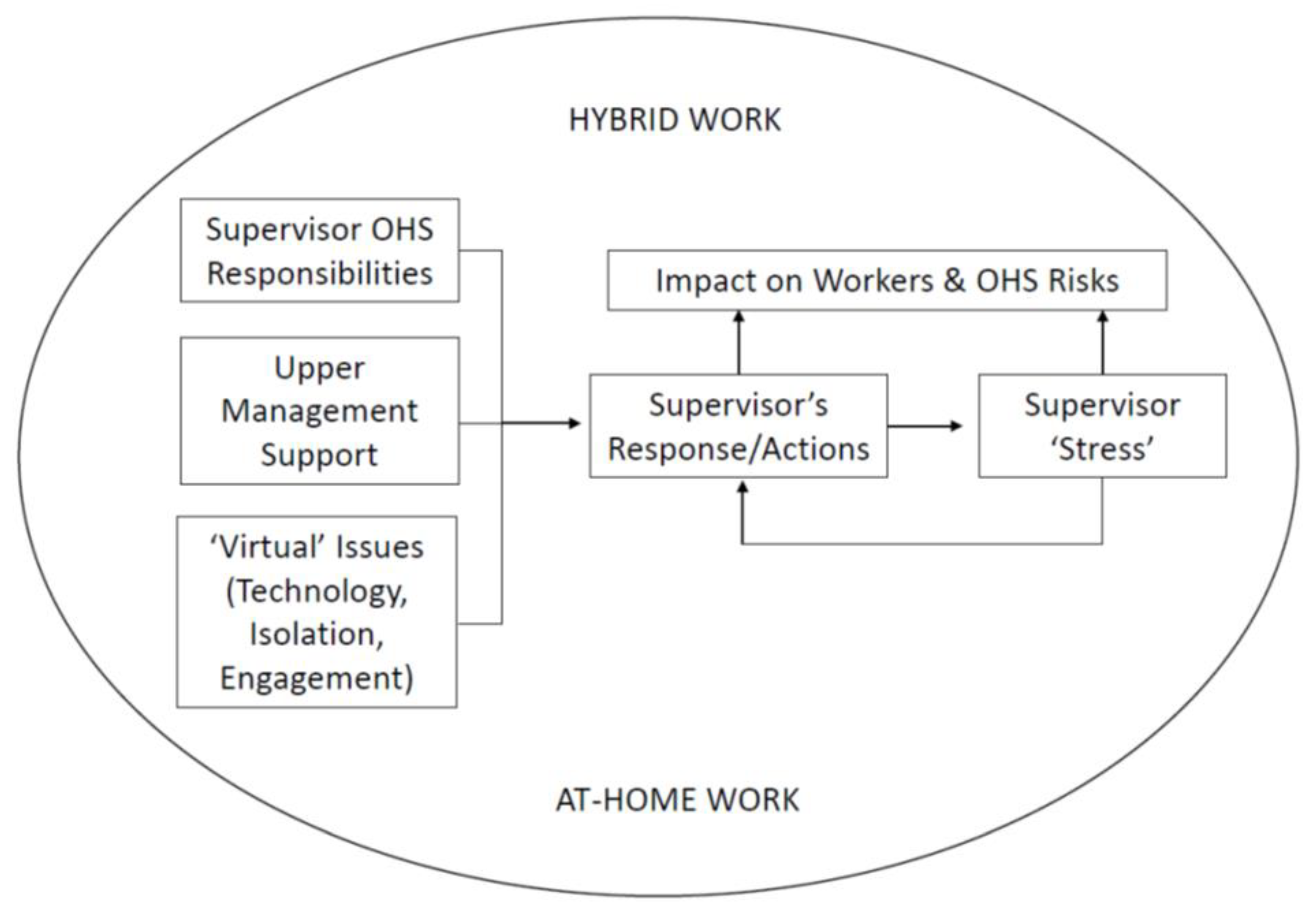

Table 1.
Description of participants.
| Participant Number |
Gender | Title | # people WFH reporting to them | Industry | Province |
| 1 | F | Manager of training and standards | 3 | Forestry | B.C. |
| 2 | M | Manager procurement | 14 | Federal Public Sector | B.C. |
| 3 | F | Freight claims | 3 | Trucking | N.S. |
| 4 | M | Integrated facilities managers | 8 | Healthcare | Ontario |
| 5 | M | Safety and Assurance | 25 | Utilities | B.C. |
| 6 | M | Director OHS | 4 | Education | B.C. |
| 7 | M | Director OHS | 7 | Education/OHS | B.C. |
| 8 | F | Snr Manager, National Training | 8 | Manufacturing | Ontario |
| 9 | M | Manager Strategic Programs | 5 | Education/OHS | Ontario |
| 10 | F | Director of Administration | 11 | Charitable/Religious | Ontario |
| 11 | F | VP Human Resources | 5 | Insurance | Ontario |
| 12 | F | Owner | 15 | OHS Consulting | B.C. |
| 13 | F | Director | 12 | NGO/Healthcare | Ontario |
| 14 | F | Managing Coordinator | 14 | Municipal Public Sector | Ontario |
| 15 | F | Manager, Safety and Compliance | 4 | Maritime Services, Energy | Newfoundland |
| 16 | M | Manager, Central Staffing | 18 | Healthcare | Nova Scotia |
| 17 | F | Manager, Customer Care | 10 | Education/OHS | Ontario |
| 18 | F | Director, Marketing | 9 | Education/OHS | Ontario |
| 19 | M | Public Works Manager | 7 | Municipal Public Sector | N.S. |
| 20 | F | Director OHS | 20 | Utilities | Ontario |
Disclaimer/Publisher’s Note: The statements, opinions and data contained in all publications are solely those of the individual author(s) and contributor(s) and not of MDPI and/or the editor(s). MDPI and/or the editor(s) disclaim responsibility for any injury to people or property resulting from any ideas, methods, instructions or products referred to in the content. |
© 2024 by the authors. Licensee MDPI, Basel, Switzerland. This article is an open access article distributed under the terms and conditions of the Creative Commons Attribution (CC BY) license (http://creativecommons.org/licenses/by/4.0/).
Copyright: This open access article is published under a Creative Commons CC BY 4.0 license, which permit the free download, distribution, and reuse, provided that the author and preprint are cited in any reuse.