
Submitted:
15 October 2024
Posted:
16 October 2024
Read the latest preprint version here
Abstract
By the strong relation between ξ function and the Riemann ζ function, we will prove the Riemann hypothesis which states that ”All non-trivial zeros z = x+y i of ζ must lie on the critical line x = 1/2". ”.
Keywords:
Complex numbers
; Riemann zeta function
; Riemann hypothesis
; Xi function
1. Introduction
This work is only concerned with proving the Riemann Hypothesis ([1]), so it is very short and focuses on the proof only. The Riemann Hypothesis concerns about the Riemann zeta function ([2,3]) which is defined for by the following infinite sum:
Riemann does not refer to analytic continuation of the function beyond the half plane Instead, he focuses on finding a formula that applies to all First, he derives his formula for which is valid for every he achieved this by relating the function to the function with the following relation
Next, Riemann derives his formula to remains valid for all by the relation
where
The functional equation of the zeta function is demonstrated by the fact that the right side of (3) remains unchanged when
In the symmetric form of the functional equation, the function has removable poles at and Riemann multiplies it by and define
2. Main Results
Lemma 1.
Ifandthen
- I.
- and
- II.
- III.
- IV.
- V.
- Ifthen
- VI.
- The non-trivial zeros of is the same the non-trivial zeros of
Proof.
- I.
-
First we prove thatSimilarly, we can prove that
- II.
- By the definition of and using I., we have
- III.
- It is obvious from (4) that
- IV.
- From II. and III., we obtain IV.
- VI.
-
Let By substitute in the definition of and using (3), we havewhere andAfter simplification, we obtainthis is true only if for all which implies to
- VI.
- Since and have no zeros, then,V. is verified.
Theorem 1.
Ifand then is real if and only if
Proof.
First, let and From IV. in Lemma 1, then From V. in Lemma 1,
Second, this complete the proof. Since zero is a real number, then from Theorem 1, we have the following corollary:
Corrolary 1.
All non-trivial zeros of must lie on the critical line
From Lemma 1, VI., we obtain:
Corrolary 2.
(Riemann Hypothesis) All non-trivial zeros of must lie on the critical line
3. Conclusion
We have proven a very important principle for the function that is is real if and only if have a real part equal From this principle and the relation between the zeros of and functions, the Riemann hypothesis have been verified.
Conflicts of Interest
The author declare that he has no conflict of interest.
References
- P.Borwein, S.Choi, B.Rooney and A.Weirathmueller The Riemann Hypothesis, A Resource for the Afficionado and Virtuoso Alike. Springer, New York, 2008.
- H.M. Edwards, Riemann’s Zeta function, Academic Pres New York,Francisco London 1974.
- A.Anatoly, Karatsuba and S. M. Voronin, The Riemann Zeta-Function, De Gruyter, 1992.
- R. van der Meer J. Top and A.E. SterkH.M. Edwards, Zeros of the Zeta Function, Bachelor’s Project Mathematics, faculty of Science and Engineering, University of Gronningen, 2020.
Figure 1.
.
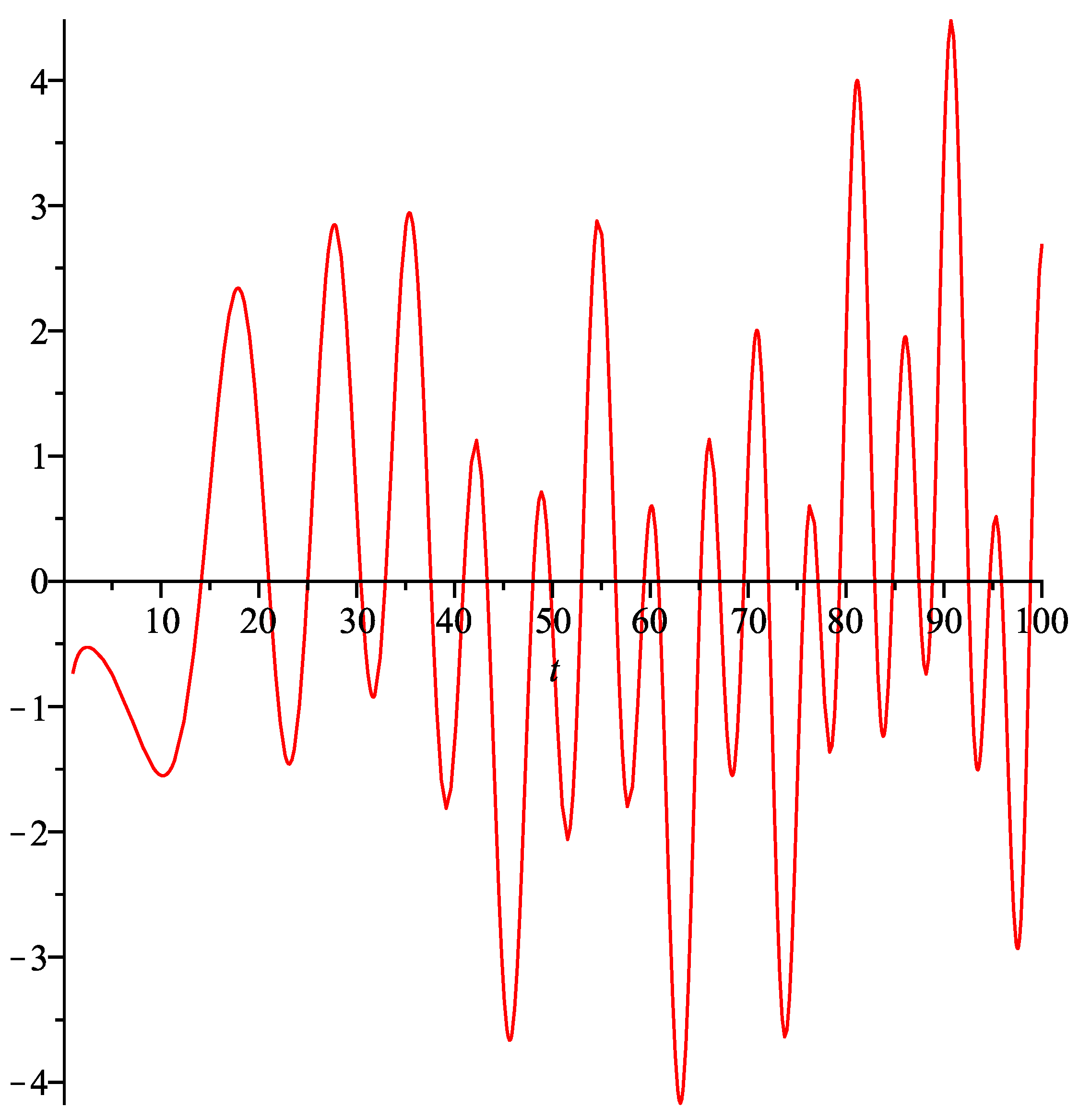
Figure 2.
.
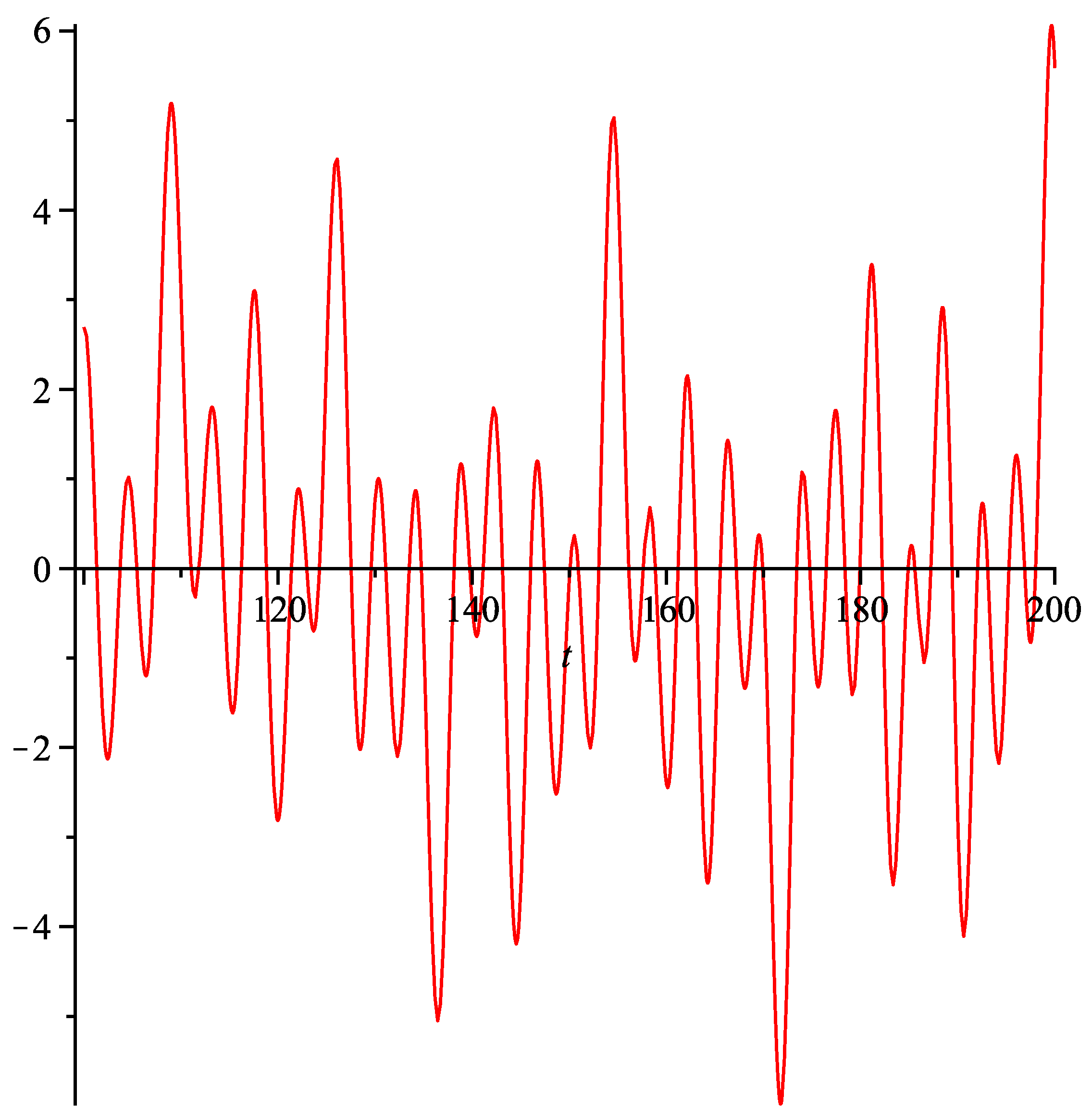

Table 1.
The zeros .
| 14.13472514 | 21.02203964 | 25.01085758 | 30.42487613 |
|---|---|---|---|
| 32.93506159 | 37.58617816 | 40.91871901 | 43.32707328 |
| 48.00515088 | 49.77383248 | 52.97032148 | 56.44624770 |
| 59.34704400 | 60.83177852 | 65.11254405 | 67.07981053 |
| 69.54640171 | 72.06715767 | 75.70469070 | 77.14484007 |
| 79.33737502 | 82.91038085 | 84.73549298 | 87.4252746 |
| 88.80911121 | 92.49189927 | 94.65134404 | 95.87063423 |
| 98.83119422 |
Table 2.
The zeros .
| 101.33 | 103.72 | 25.01 | 105.21 |
|---|---|---|---|
| 107.15 | 110.88 | 114.02 | 115.96 |
| 118.65 | 121.19 | 122.83 | 124.02 |
| 127.16 | 129.25 | 130.89 | 133.28 |
| 134.62 | 137.91 | 139.70 | 140.74 |
| 142.83 | 145.82 | 147.16 | 149.95 |
| 150.76 | 152.88 | 155.92 | 157.43 |
| 158.75 | 161.07 | 162.89 | 165.42 |
| 167.14 | 168.96 | 169.77 | 173.31 |
| 174.72 | 176.36 | 178.32 | 179.86 |
| 182.12 | 184.69 | 185.41 | 186.95 |
| 189.21 | 191.88 | 192.91 | 195.17 |
| 196.71 | 197.95 |
Disclaimer/Publisher’s Note: The statements, opinions and data contained in all publications are solely those of the individual author(s) and contributor(s) and not of MDPI and/or the editor(s). MDPI and/or the editor(s) disclaim responsibility for any injury to people or property resulting from any ideas, methods, instructions or products referred to in the content. |
© 2024 by the authors. Licensee MDPI, Basel, Switzerland. This article is an open access article distributed under the terms and conditions of the Creative Commons Attribution (CC BY) license (http://creativecommons.org/licenses/by/4.0/).
Copyright: This open access article is published under a Creative Commons CC BY 4.0 license, which permit the free download, distribution, and reuse, provided that the author and preprint are cited in any reuse.