
Submitted:
28 April 2025
Posted:
30 April 2025
Read the latest preprint version here
Abstract
In this article the proof of the binary Goldbach conjecture is established ( Any integer greater than one is the mean arithmetic of two positive primes ) . To this end the weak Chen conjecture is proved ( Any even integer greater than One is the difference of two positive primes ) and a " located " algorithm is developed for the construction of two recurrent sequences of primes () and ( ), ( ( ) dependent of ( ) ) such that for each integer n their sum is equal to 2n . To form this a third sequence of primes () is defined for any integer n by = Sup ( p ∈ : p ≤ 2n - 3 ) , being the infinite set of positive primes. The Goldbach conjecture has been proved for all even integers 2n between 4 and 4. In the table of terms of Goldbach sequences given in Appendix 12 values of the order of 2n = are reached. An analogous proof by recurrence « finite ascent and descent method » is developed and a majorization of by 0.7 ( 2n ) is justified.. In addition, the Lagrange-Lemoine-Levy conjecture and its generalization called ’’ Bezout-Goldbach ’’ conjecture are proven by the same type of algorithm.
Keywords:
Prime numbers
; Prime Number Theorem
; binary Goldbach conjecture
; Lagrange-Lemoine-Levy conjecture
; Bezout-Goldbach conjecture
; gaps between consecutive primes
; Weak Chen or Goldbach( - ) conjecture
1. Overview
Number theory " the queen of mathematics " studies the structures and properties defined on integers and primes ( Euclid [13], Hadamard [15], Hardy and Wright [16], Landau [22], Tchebychev [35] ). Numerous problems have been raised and conjectures made, the statements of which are often simple but very difficult to prove. These main components include
● Elementary arithmetic .
___ ˽Determination and properties of primes, operations on integers
( Basic operations, congruence, gcd, lcm, ………..).
___ Decomposition of integers into products or sums of primes
( Fundamental theorem of arithmetic, decomposition of large numbers, cryptography and Goldbach's conjecture).
● Analytical number theory .
___ Distribution of primes ( Prime Number Theorem, Hadamard [15], De la Vallée-Poussin [36], Littlewood [25] and Erdos [12], the Riemann hypothesis,.....).
___ Gaps between consecutive primes ( Bombieri,Davenport [3], Cramer [8], Baker,Harmann,Iwaniec, Pintz [4,5,20], Granville [14], Maynard [27], Tao [34], Shanks [30], Tchebychev [35] and Zhang [39] ).
● Algebraic, probabilistic, combinatorial and algorithmic number theories .
___ Modular arithmetic.
___ Diophantine approximations and equations
___ Arithmetic and algebraic functions.
___ Diophantine and number geometry.
2. Definitions Notations and Background
The integers n, k, p, q, r,……..... used in this article are always positive. (2.1)
The symbol ‘‘ / ‘’ means " in relation to". (2.2)
Let be the infinite set of positive primes ( called simply primes ) (2.3)
( = 2 ; = 3 ; = 5 ; = 7 ; = 11 ; = 13 ; ......... )
For any integer K ≥ 1 = { p ∈ : p ≤ 2K } (2.4)
The writing of large numbers (see appendix 12) is simplified using the following constants
M = ; R = 4. ; G = ; S = ; T = 10 1000 (2.5)
ln(x) denotes the neperian logarithm of the real x > 0 (2.6)
Let () be the sequence of primes defined by
∀ n ∈ ℕ + 3 = Sup( p ∈ : p ≤ 2n - 3 ) (2.7)
Any sequence denoted by () = () verifying (2.8) is called a Goldbach sequence.
∀ n ∈ ℕ + 2 , ∈ and + = 2n (2.8)
and are also known as " Goldbach decomponents ".
Iwaniec,Pintz [20] have shown that for a sufficiently large integer n there is always a prime between n − and n . Baker and Harman [4,5] concluded that there is a prime in the interval [ n ; n + o ( Thus this results provides an increase of the gap between two consecutive primes and of the form
> 0 ∈ / ∀ k ∈ ℕ k ≥ - < (2.9)
The results obtained on the Cramer-Granville-Maier-Nicely conjecture [1,3,8,14,26,28] imply the following majorization.
For any real c > 2 and for any integer k ≥ 500
- ≤ 0.7 () ( with probability one ) (2.10)
3. Introduction
Chen [6], Hardy,Littlewood [17], Hegfollt,Platt [18], Ramaré,Saouter [29], Tao [34], Tchebychev [35] and Vinogradov [37] have taken important steps and obtained promising results on the Goldbach conjecture ( Any integer n ≥ 2 is the mean arithmetic of two primes ).
Indeed, Helfgott,Platt [18] proved the weak Goldbach conjecture in 2013.
Silva,Herzog,Pardi [32] held the record for calculating the terms of Goldbach sequences after determining pairs of primes ( ) verifying
∀ n ∈ ℕ / 4 ≤ 2n ≤ 4.1018 + = 2n (3.1)
In previous research work there is no explicit construction of recurrent Goldbach sequences. In this article two sequences of primes are developed using a simple, efficient and « located » algorithm to compute for any integer n by successive iterations any term and .
Using Maxima scientific software on a personal computer Silva's record is broken and the values 2n = 10500 and even 2n = 101000 are reached. The binary Goldbach conjecture can be established on the same principle by recurrence by using the weak Chen or Goldbach( - ) conjecture ( Any even integer greater than three is the difference of two primes) demonstrated in Teorem 4.
● Remark.
1. Chen conjecture̲: For any integer K ≥ 1 there are infinitely many pairs of primes with a difference equal to 2K.
2. De Polignac conjecture : Same as Chen, but with consecutive pairs of primes.
3. What we know :
April 2013, Yitang Zhang [39] demonstrates that the smallest even integer 2K verifying the conjecture is greater than 70 million.
We validate weak Chen or Goldbach( - ) conjecture by verifying directly in the prime number tables that all even gaps from 2 to 246 are possible between primes.
In addition, the Lagrange-Lemoine-Lévy conjectures [9,19,21,26,28,33,38] and its generalization called ‘’ Bezout-Goldbach « conjecture’ are validated.
Using case disjunction reasoning we construct two recurrent sequences of primes () and () according to the sequence ( ) by the following process
For any integer n ≥ 2
= 2 and = 2 (3.2)
Let n ∈ ℕ + 3
● Either
( 2n - ) is a prime
then and are defined directly in terms of .
● Either
( 2n - ) is a composite number
then and are determined from the previous terms of the sequence ().
4. Theorem ( Weak Chen or Goldbach( - ) Conjecture )
∀ K ∈ ℕ* p , q ∈ /
p - q = 2K 3 ≤ q ≤ 2K and 3 + 2K ≤ p ≤ 4K if K ≥ 2 (4.1)
Practical method on some examples:
First of all ( 5 - 3 = 2 ), then we begin the process at ( 7 - 3 = 4 ), we will select the smallest primes for which the difference is precisely 6 ( 11 - 5 = 6 ) then 8 ( 11 - 3 = 8 ) then 10 (13 - 3 = 10),......... then 2K , then 2(K + 1) ( demonstration established by strong recurrence, by the asurd and feedback ).
All pairs of Goldbach( - ) decomponents obtained by this method for K between 2 and 123 are listed in the table in Appendix 13.
Proof . The proof is established by strong recurrence on K . Let ( K ) be the following property
« ∀ K ∈ ℕ* p, q ∈ / p - q = 2K 3 ≤ q ≤ 2K and 2K + 3 ≤ p ≤ 4K « (4.2)
► ( 2 ) is true : 7 - 3 = 4 ; q = 3 ≤ 4 and p = 7 ≤ 4 x 2 = 8
► Let’s show
∀ M ∈ ℕ / M ≤ K then ( M ) ( K + 1 )
We reason through the absurd
∀ p , q ∈ / p ≥ q ∀ h, m ∈ ℕ / p + 2h and q + 2m ∈ we assume that
p + 2h - q - 2m ≠ 2(K + 1) (4.3)
Therefore
p - q ≠ 2(K + 1 - h + m). (4.4)
You can always choose h ≥ m and h - m ≤ K + 1 .
However the strong recurrence hypothesis asserts that
∀ ∈ ℕ / M ≤ K p, q ∈ / p - q = 2M (4.5)
By choosing M = K + 1 - h + m
t (4.4).
So
h,m ∈ ℕ / p + 2h - q - 2m = 2(K + 1) (4.6)
knowing
p, p+2h, q, q+2m ∈ h ≥ m and h - m ≤ K + 1
Thus validating the heredity of property (K ).
The property (K ) is therefore true. As a result Goldbach( - )’s conjecture is validated.
● Remark. Using the same method as in Theorem 4, we can demonstrate the following equivalent property by strong recurrence ::
For any integer n greater than 48
(n) : « There exists an integer K such that 2K + (4.7)
To this end, (49) is true and the heredity of the property (n ) can be proved by the absurd and returning to the previous terms by noting that there is at least one integer /
2K + = 2( K + ) + = 2P + (4.8)
by posing P = K + and ≤ n
Now, according to the recurrence hypothesis on (n) there exists an integer P /
2P + ∈ (4.9)
then there exists an integer K /
2K + ∈ (4.10)
5. Corollary
Let ) and ) two sequences of primes determined by
= Inf ( p ∈ : p - 2K ∈ ) and ̲= Inf ( p ∈ : 2K + p ∈ ) = - 2K (5.1)
They are defined for any integer K ∈ * and satisfy
lim = + (5.2)
, ̲∈ and - = 2K (5.3)
/ 2 ≤ K ≤ 16 3 ≤ ̲≤ 2K and 2K + 3 ≤ ≤ 4K (5.4)
For any integer K ≥ 16
3 ≤ ̲≤ 2 and 2K + 3 ≤ ≤ 2K + (5.5)
Proof.
(5.1) : According to the previous theorem, the sequences ( ) and (Q2k) are defined by
strong recurrence and finite descent.
(5.2) : ≥ 2K ⇒ lim = +(5.3) : By construction, these sequences thus verify - = 2K
(5.4) : The property can be verified directly term-to-term by examining the sequence proposed above.
(5.5) : This property is verified up to 2K = 246 by calculations on the previous list.
We prove this result by recurrence
First of all we order the Goldbach( - ) decomponents at a fixed prime Q,
So as to obtain the estimate (5.5) more easily.
We examine the following sequences of primes ( PQ( K )).
P3(K ) = 2K + 3
(P3(K ) ; 2K ) → (5;2);(7;4);(11;8);(13;10);(17;14);(19;16);(23;20);(29;26);(29;28);..........
P5(K ) = 2K + 5
(P5(K ) ; 2K ) → (7;2) ; (11;6) ; (13;8) ; (17;12) ; (19;14) ; (23;18) ; (29;24) ; (31;26) ; (37;32)................................
P7(K ) = 2K + 7
(P7(K ) ; 2K ) → (11;4) ; (13;6) ; (17;10) ; (19;12) ; (23;16) ; (29;22) ; (31;24) ; (37;30)...........
P11(K ) = 2K + 11
(P11(K ) ; 2K ) → (13;2) ; (17;6) ; (19;8) ; (23;12) ; (29;18) ; (31;20) ; (37;26) ; (41;30) ; (43;34)......
(P13(K ) ; 2K ) → (17;4) ; (19;6) ; (23;10) ;(29;16) ; (31;18) ; (37;24) ; (41;28) ; (43;30 ; (47;34)......
PQ(K ) = 2K + Q ( K ∈ : PQ(K ) and Q are primes ) ( see the table in Appendix 14 )
For any integer K satisfying 2 > Q the property holds for PQ( K ).
Therefore it is generally validated for all K > 15, since we obtain all possible cases of
Chen's weak conjecture starting with P3(K ), then P5(K ), then P7(K ) ...... for 2 ≤ Q .
( can be proved by strong recurrence using the same method as inTheorem 4 by “finite descent» ).
Let = and Pr(K ) be the following property
« For any integer M < , there exists at least a prime Q < such that
2 M + Q is a prime «
▶ Pr(15) is true ( see Appendix 14 ).
▶ Let’s show : Pr(K) ⇒ Pr(K + 1)
≤ + (5.6)
It is assumed thatM /
- ≠ 2M M < = p + 2h and = q +2s (5.7)
then
p - q ≠ 2(M + s - h) (5.8)
which is impossible according to the hypothesis of strong recurrence since
2(M + s - h) is less than and that all primes p, q satisfy the recurrence hypothesis.
We deduce that Pr(K) ⇒ Pr(K + 1)
Thus the property (5.5) is true.
6. Principle of Proof
To determine pairs of primes that verify Goldbach’s conjecture three sequences of primes
( ( ), ( are defined and they verify the following properties
lim = + (6.1)
∀ n ∈ ℕ + 2 is defined as a function of = Sup( p ∈ Ƥ : p ≤ 2n - 3 ) 6.2)
( ) is an increasing sequence of primes that contains all primes except = 2 (6.3)
lim (6.4)
() is a complementary sequence of negligible primes with respect to 2n (6.5)
For any integer n (6.6)
●If ( 2n -)is a prime
then and are defined by
(6.7) = and = 2n - ● Otherwise, if ( 2n - ) is a composite number
we search for two previous terms of the sequence (), ) and satisfying the following conditions
(6.8) , and + 2k are primes + = 2(n - k )
which is always possible (see Theorem 4)
So by setting
= and = + 2k (6.9)
two new primes and satisfying (4.10) are generated .
+ = 2n (6.10)
This process is then repeated incrementing n by one unit (n → n + 1).
7. Theorem
There exists a recurrent sequence ( ) = ( of primes satisfying the following conditions.
For any integer n ≥ , and + = 2n (7.1)
( Any integer n ≥ is the mean arithmetic of two primes )
An algorithm can be used to explicitly compute any termand. (7.2)
Proof .
□ FIRST METHOD :
For any integer n ● If (2n - ) is a prime
then and are defined by
= and = 2n - (7.3)
●Otherwise, if (2n -)is a composite number
we use the previous terms of the sequence ( ).
For any integer q such that 1 ≤ q ≤ n - 3 we have
3 ≤ ≤ n .
Then, there exists an integer k / 1 ≤ k ≤ n - 3 following the Bertrand principle and Theorem 4 since all primes smaller than 2k are represented by , ( if there were no such primes, we would have a contradiction with the Theorem 4 , even if it means transforming the indexing of the sequence () . In fact, in an equivalent way ( see the remark following Theorem 4 ) we can copy the proof of Teorem 4 by performing a similar strong recurrence “ finite descent return and absurd ” directly on the set { : k ≤ n } such that
= + 2k ∈ Ƥ (7.4)
The smallest integer k / ∈ Ƥ is denoted by .
So
= + 2 and = (7.5)
( These two terms are primes )
In the previous steps two primes and whose sum is equal to 2(n - ) were determined.
+ = 2(n -) (7.6)
By adding the term to each member of the equality (5.6), it follows
+ 2 + = 2(n - ) + 2 (7.7)
+ 2] + = 2n (7.8)
+ = 2n (7.9)
Finally for any integer n ≥ 3 this algorithm determines two sequences of primes ( ) and ( ) verifying Goldbach's conjecture.
□ SECOND METHOD :
The proof can be made using the following strong recurrence principle.
Let P(n) be the property defined for any integer n ≥ 2 by
P(n) : “ For any integer p satisfying 2 ≤ p ≤ n there exists two primes and such their sum is equal to 2p “ .
( ∀ p ∈ ℕ / 2 ≤ p ≤ n , and + = 2p )
Let's show by strong recurrence that P(n) is true for any integer n ≥ 2
a) P(2) is true : it suffices to choose = = 2 .
b) Let's show that the property P(n) is hereditary : ∀ k ∈ ℕ + 2 P(n) (n+ 1)
Assume property P(n ) is true.
●If (2(n + 1) -)is a prime
then and are defined by
= and = 2(n+1) - (7.10)
●Otherwise, if (2(n+1) -)is a composite number
there exists an integer k to obtain two terms ) and satisfying the following conditions
, and + 2k are primes (7.11) + = 2( n +1- k )
( which is always possible : see FIRST METHOD and Theorem 4 ).
Thus by setting
= and = + 2k (7.12)
Two new primes and satisfying ( + = 2(n + 1) ) are generated.
It follows that P(n + 1) is true. Then the property P(n ) is hereditary : P(n) => P(n + 1).
Therefore for any integer n ≥ 2 the property P(n) is true.
it follows
n ∈ ℕ+2 there are two primes and and such their sum is 2n : + = 2n
8. Lemma
The sequence () verifies the following majorization
For any integer n ≥ 65
≤ (2 (8.1)
Proof . According to the programm 11.2 and appendix 12 the majorization (8.1) is verified
For any integer n such that 65 ≤ n ≤ 2000 . For any integer n > 2000 the proof is established by recurrence. For this purpose let P1(n ) be the following property
P1(n ) : “ There exists a strictly increasing sequence of positive numbers () such that
≤ “ . (8.2)
▶ P1(2000) is true according to program 11.2 and the table in appendix 12.
▶ For any integer n ≥ 2000 let’s show that P1(n ) is hereditary : P1(n ) ⇒ P1(n + 1).
Assume that P1(n ) is true : then
●If (2(n + 1) -)is a prime
then and are defined by
= and = 2(n + 1) - (8.3)
(n + 1) - K . < < 2(n + 1)
⇒ < K ⇒ ≤ ● Otherwise, if (2(n + 1) - ) is a composite number
p ∈ / = + 2p (8.4)
2p < K.[ and < (8.5)
It follows
< K . + (8.6)
Then
< (8.7)
and by setting = It follows
< (8.8)
P1(n + 1) is true then P1(n ) is hereditary.
So for any integer n ≥ 2000 the property P1(n ) is true.
(The inequality (6.7) is verified with the aid of the software Maple studying the functions of the type f : x a + b . increased by g : x a and b being two strictly positive real parameters).
9. Theorem
For any integer n 3 it is easy to check
() is a positive increasing sequence of primes. (9.1)
{ : n IN + 3 } = (9.2)
lim = +oo (9.3)
( ) and () are sequences of primes and the set { : k ≤ n} contains all primes less than ln( n ) (9.4)
(9.5) n ≤ (9.6) 3n
(9.7) lim = +oo
Proof .
(9.1) For any integer n ≥ 2 .Therefore, ≤ . So the sequence ()
is increasing.
(9.2) Any prime except = 2 is odd, hence the result.
(9.3) lim = lim = +oo
(9.4) By definition = or there exits an integer k ≤ n - 2 such that = ;
so the terms of the sequence ( ) are primes.
(9.5) According to Lemma 6, for any integer n ≥ 65
< therefore
< < n
and
= 2n - > 2n - n > n
For any integer n / 3 ≤ n ≤ 65 verification is carried out according to the computer program in paragraph 11.2 and the table in appendix 12.
We can also see that by construction ≥ because if we assume the opposite then is not the largest prime number verifying ( + ) = n .
So
≥ n
According to (9.5) n ⇒ = 2n - ≤ 2n - n ≤ n (9.6)
therefore
≤ ⇒ 2n - ≤ 2n - = (9.7) By (9.5) for any integer n ≥ 2 : n So
lim = +oo .
10. Remarks
10.1 For any integer k ≥ 2 there are infinitely many integers n such that = .
10.2 ~ 2n for (n +oo) .
10.3 For any sufficiently large integer n / n ≥ 5000
and lim ( ) = 0.
10.4 The smallest integer n such that
2n - is obtained for n = 49 and = ( 79 ; 19 ).
( This type of terms increases in the Goldbach sequence () as n increases in the sense of the Schnirelmann density and there are an infinite number of them; their proportion per interval can be computed using the results given in [29] ).
10.5 If q is an odd integer greater than four we could generalize this algorithm with sequences ()
defined by
(10.5.1) n ∈ / n ≥ = Sup( p ∈ : p ≤ 2n - q )
Other Goldbach’s sequencesindependent of () are thus generated.
10.6 The sequence ( ) is ‘‘extremal’’ in the sense that for any integer n and are the largest and smallest possible primes such that + = 2n.
is verified with probability one. It leads to the following majorization
For any integer p ≥ 500
(10.7.1) ≤ 0.7 [ (with probability one )
The proof is similar to that of lemma 8 and is validated by the studying functions of the type
f : x a .g (x) + b ( a,b > 0 ; c > 2) with
g : x 0.7 [l and h : x 0.7 using Maple software.
10.8 According to Bombieri [3] and using the same method as in the proof of Lemma 8, on average, we obtain the following estimate of (10.8.1) > 0 = O ( )) ( on average )
11. Algorithm
11.1. Algorithm Written in Natural Language
Inputs :
Input four integer variables : k, N, n, P
Input : = 2 , = 3 , = 5 , 7 , ................., the first N primes.
: n = 3
: P = M, R, G, S or T as indicated in paragraph 2
Algorithm body :
Compute : = Sup( p : p ≤ 2n - 3 )
If= (2n -) is a prime
Let :
(11.1.1) = and = otherwise
Ifis a composite number
Let : k = 1
B.1) While + 2k is a composite number
assign to k the value k + 1 ( k k + 1 ).
return to B1)
End while
Assign to k the value ( k )
(11.1.2) Let :
= + 2 and = Assign to n the value n + 1 ( n and return to A)
End :
Outputs for integers less thanPrint ( 2n = ● ; 2n - 3 = ● ; = ● ; = ● ; = ● ; = ● )
Outputs for large integers :
Print ( 2n - P = ● ; 2n - 3 - P = ● ; - P = ● ; = ● ; = ● )
11.2. Program Written with Maxima Software for 2n =
n1 : 10**500 ; for n :5*10**499 + 10000 thru 5*10**499 + 10010 do
( a :2*n , c :a - 3 , test : 0 , b : prev_prime(a - 1) ,d :a - b ,
if primep(d )
then print(a - n1 , c - n1 , b - n1 , d , b - n1 , d )
else ( while test = 0 do (e :a - c , if ( primep(c ) and primep(e ) )
then ( test:1 , print(a - n1 , b - n1 , d , c - n1 , e ," ** " ))
else ( test : 0 , c : c - 2 ))) ;
15. Perspectives and Generalizations
15.1 Other Goldbach sequences () and () independent of may be studied using the increasing sequences of primes ( and () defined by
For any integer n = Sup( p f (n) )
f is a function defined on the interval I = [3 ; +[ and satisfying the following conditions
● f is strictly increasing on the interval I
● f (3) = 3 and = +● For example, one of the following functions defined on I can be selected.
□ f : x a x + 3 - 3a ( a : 0 < a□ g : x[ 49 ] ( [ x ] is the integer part of the real number x )
□ h : x + 3
15.2 Using this method it would be interesting to study the Schnirelmann density [31] of primes
3 , 5 , 7, 11 ,........ ... in the sequence ( ) on variable intervals .
15.3 It is possible to exceed the values shown in the table of 2n = by perfecting this algorithm starting from n , exploiting the fact that one of Goldbach's decomponents can be chosen
equal to 12p + 1,
( the set of Goldbach decomponents consists of primes of the form 6p +/- 1 ) using Cipolla-Axler-Dusart type functions [2,7,10,11] to better identify the terms of ( a Maple.
15.4 Diophantine equations and conjectures of the same nature ( Lagrange-Lemoine-Levy conjecture [9,19,21,23,24,33] ) can be processed using similar reasoning and algorithms.
1) To validate the Lagrange_Lemoine-Levy conjecture we study the following sequences of primes ( W ), ( (= Sup( p ● If = (2n + 1 - 2 ) is a prime
then let
= and = ● If is a composite number
then there exists an integer k / 1 such hat
+ 2k is a prime
then let
= and =+ 2k
Using the same type of reasoning a generalization called «Bezout-Goldbach conjecture» of the following form can be validated
● Let K and Q be two odd integers prime to each other :
For any integer n / 2n(K + Q ) there exist two primes and verifying
K . + Q. = 2n
● Let K and Q be two integers of different parity prime to each other :
For any integer n such that 2n (K + Q ) there are two primes and verifying
K + Q . = 2n + 1.
15.5. Remark
GOLDBACH( - ) :
= Inf ( p ∈ : p - 2K ∈ ) and ̲= Inf ( p ∈ : 2K + p ∈ ) = - 2K
GOLDBACH( + ) :
= Sup ( p ∈ : 2K - p ∈ ) and ̲= Inf ( p ∈ : 2K - p ∈ ) = 2K - ( Is it possible to envisage a symmetry in the Goldbach triangle parametrized by arithmetic sequences between the representations of primes and even integers ? )
16. Conclusion
16.1 A recurrent and explicit Goldbach sequence () = (; ) verifying
n ∈ and are primes += 2n
has been developed using an simple and efficient "located" algorithm.
16.2 The record of Silva [29] is beaten on a personal computer and ten Goldbach decomponents
and are obtained for values of the order 2n = for a computation time of less than
three hours.
16.3 For a given integer n ≥ 49 the evaluation of the terms and does not require the computing of all previous terms and / 1 k < n - 1 . We just need to know the primes and such that
(16.3.1) ≤ 7. and 2n - 7.(2n) ≤ ≤ 2n (on average )
This property allows quick computing of and .
16.4 Therefore the Lagrange-Lemoine-Levy and the binary Goldbach( - & + ) conjectures,
« Any even integer greater than three is the sum and difference of two primes » are true.
In fact, these two conjectures are intertwined.
12. Appendix
Application of Algorithm 11 : Table ofandterms of the Goldbach sequence () computed from program 11.2 ( 2 ≤ 2n ≤+4020).
The ** sign in the table below indicates the results given by the algorithm 11 in case B) of return to the previous terms of the sequence (. WATCH OUT ! For large integers n ( 2n > for example ), to simplify the display of large numbers the results are entered as follows
2n - P , (2n - 3) - P ,- P ,,- P and with
P = M, R, G, S, orTconstants defined in (2.3)
 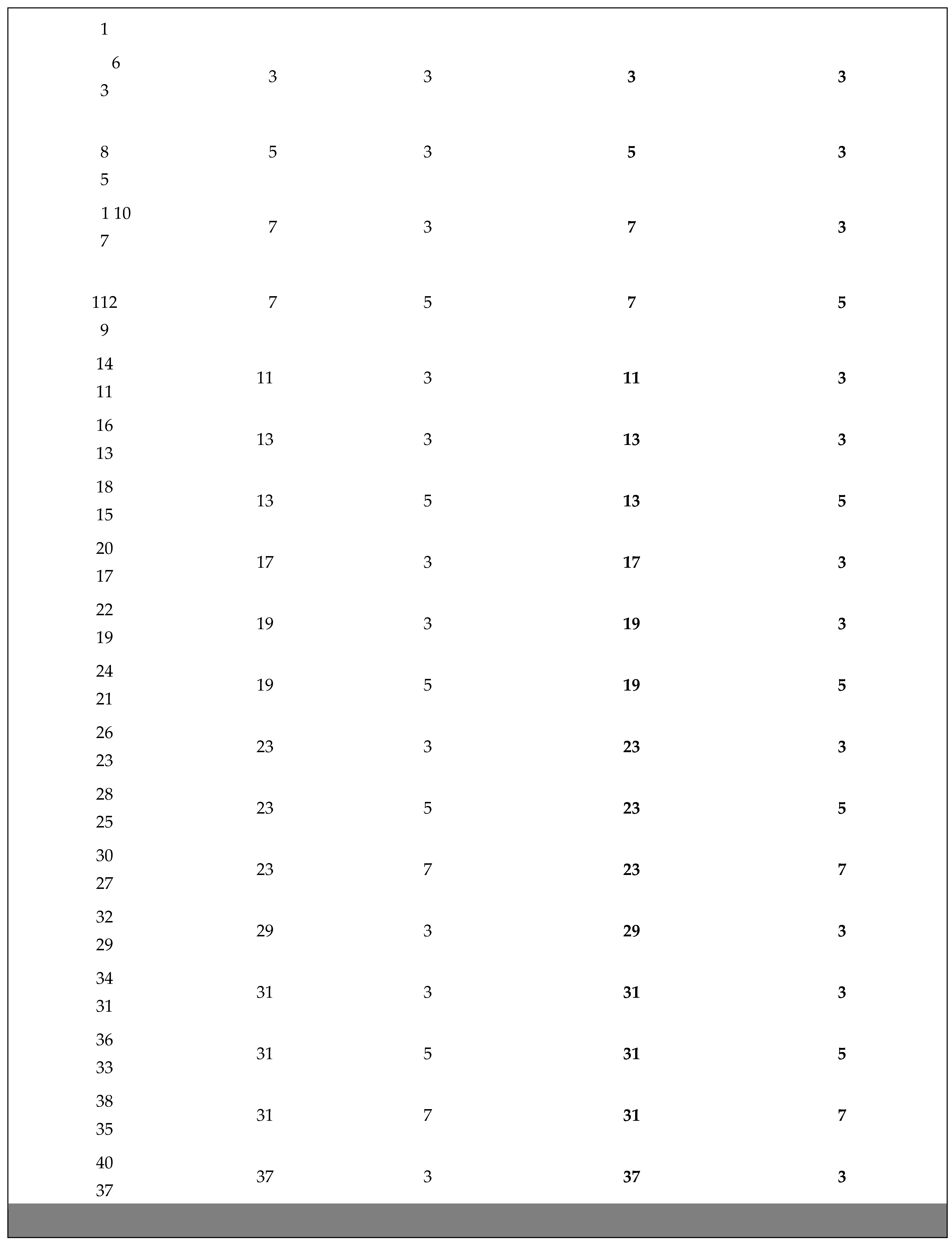 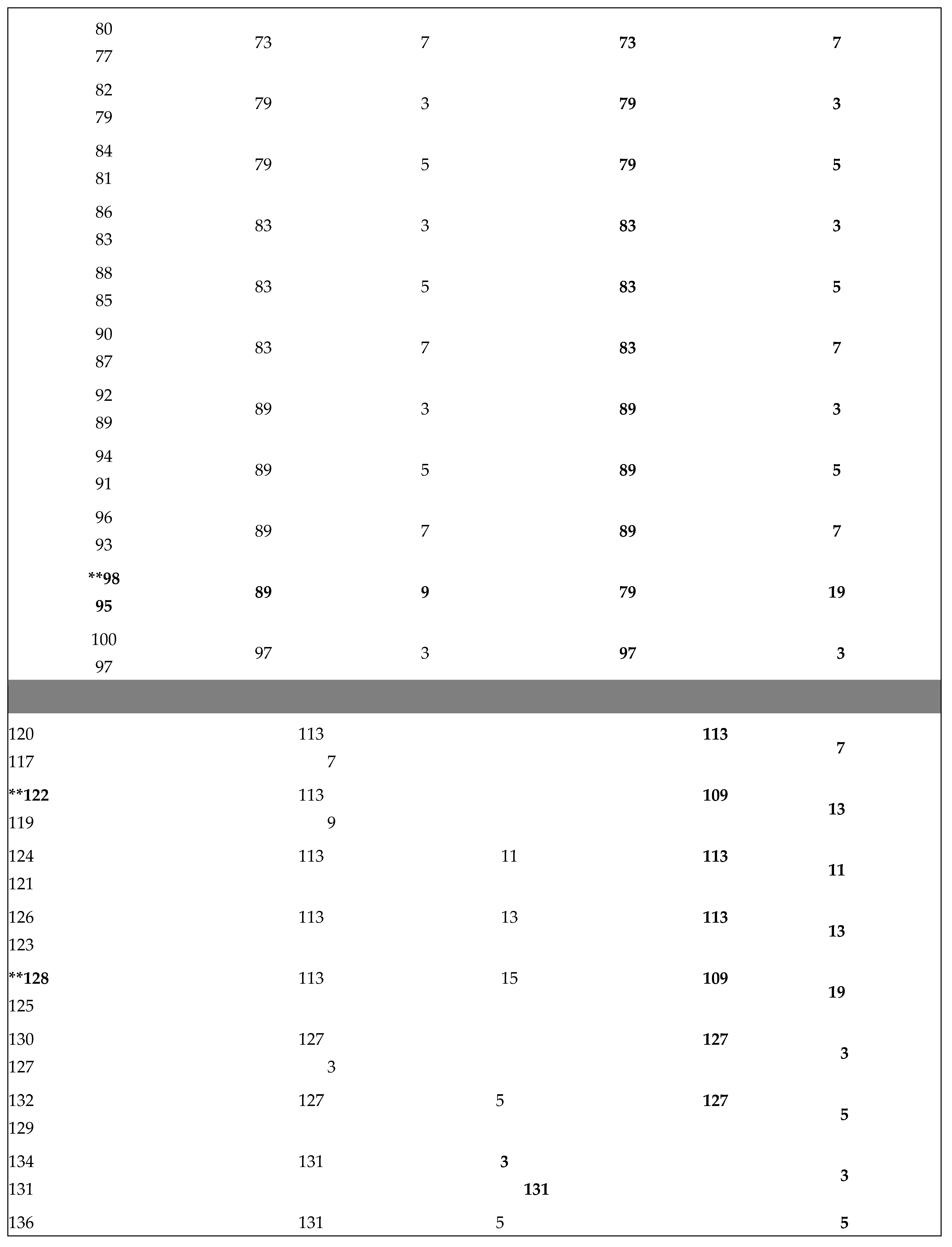 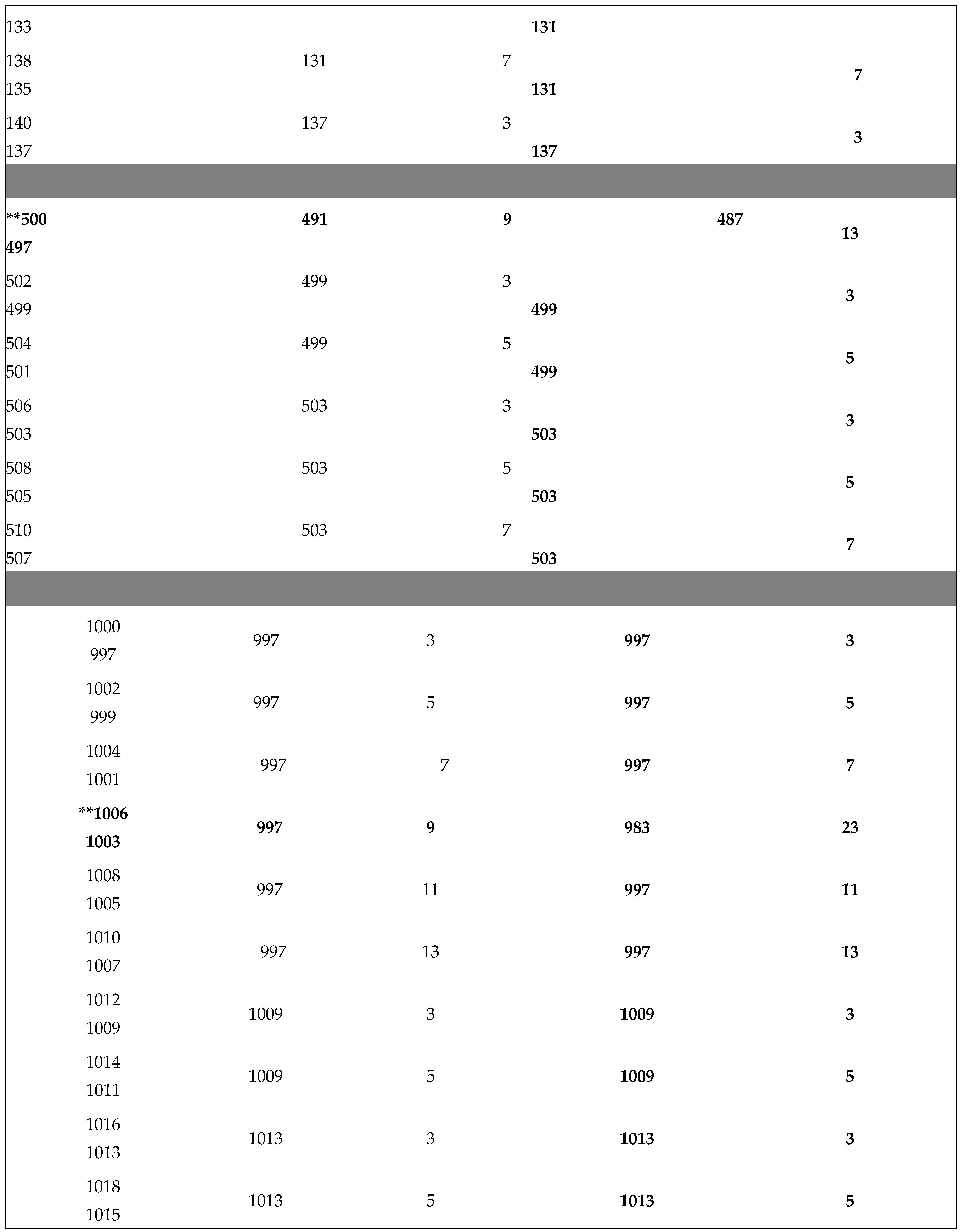 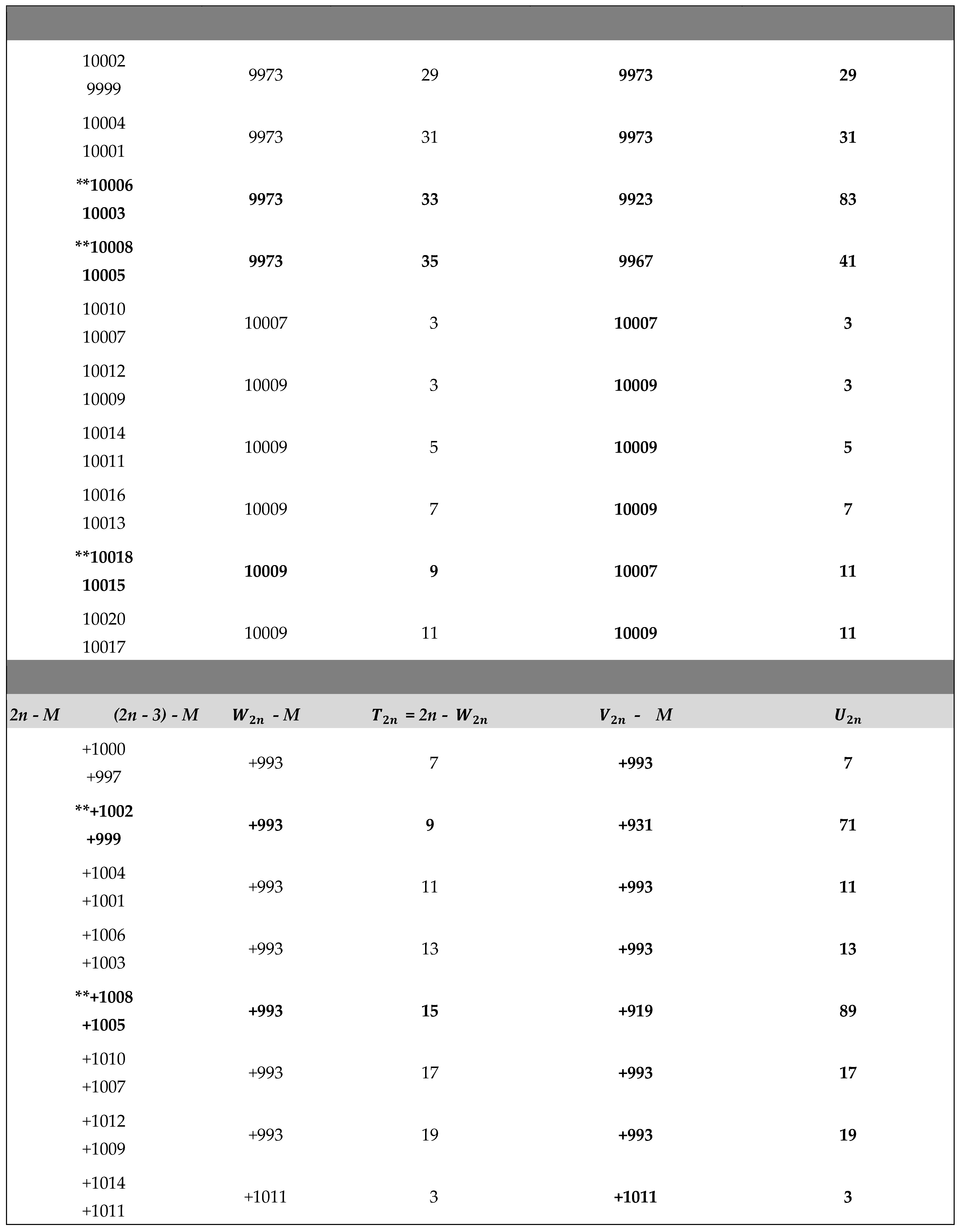 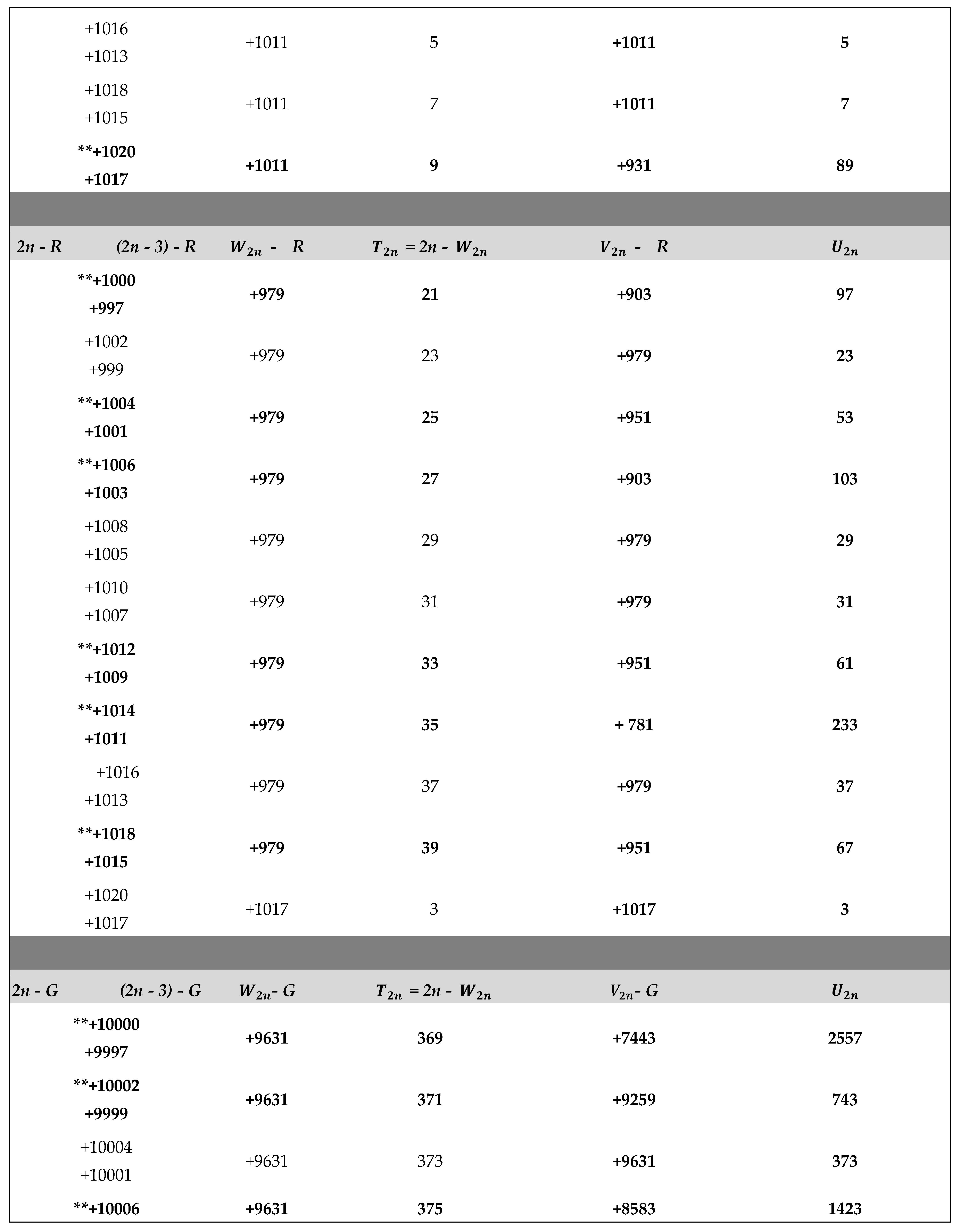 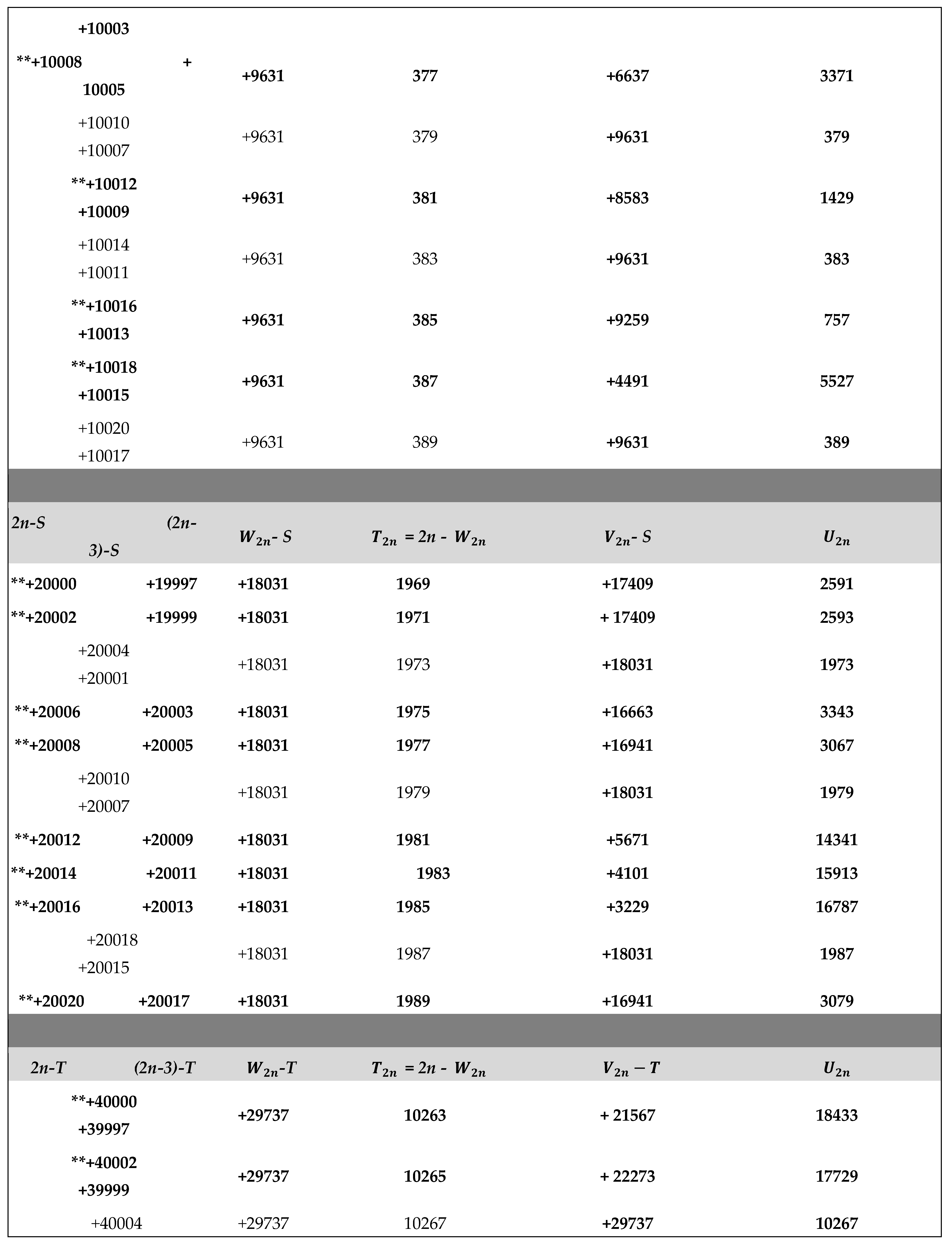 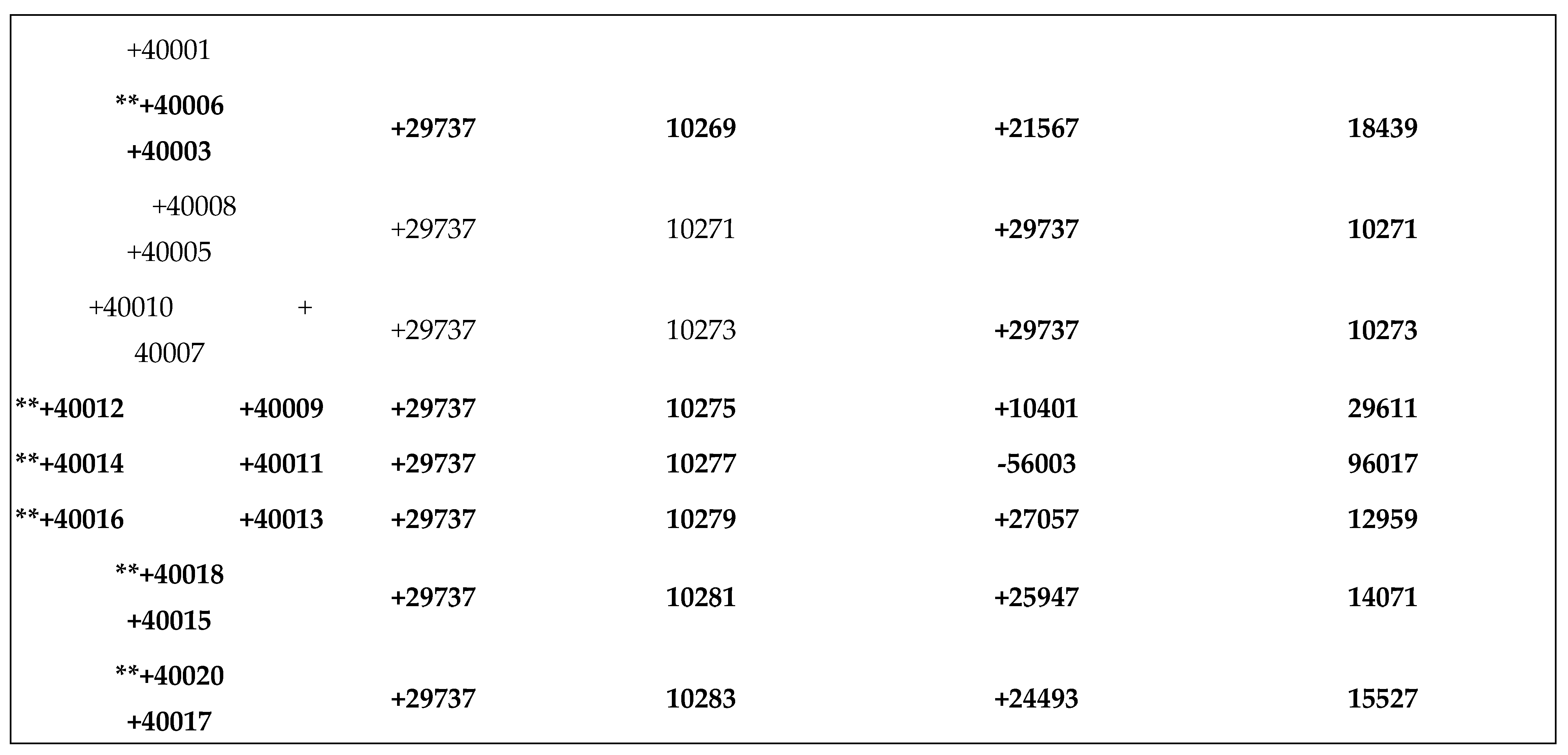 |
13. Appendix
| 7-3=4 | 11-5=6 | 11-3=8 | 13-3=10 | 17-5=12 | 17-3=14 | 19-3=16 | 23-5=18 |
| 23-3=20 | 29-7=22 | 29-5=24 | 29-3=26 | 31-3=28 | 37-7=30 | 37-5=32 | 37-3=34 |
| 41-5=36 | 41-3=38 | 43-3=40 | 47-5=42 | 47-3=44 | 53-7=46 | 53-5=48 | 53-3=50 |
| 59-7=52 | 59-5=54 | 59-3=56 | 61-3=58 | 67-7=60 | 67-5=62 | 67-3=64 | 71-5=66 |
| 71-3=68 | 73-3=70 | 79-7=72 | 79-5=74 | 79-3=76 | 83-5=78 | 83-3=80 | 89-7=82 |
| 89-5=84 | 89-3=86 | 101-13=88 | 97-7=90 | 97-5=92 | 97-3=94 | 101-5=96 | 101-3=98 |
| 103-3=100 | 107-5=102 | 107-3=104 | 109-3=106 | 113-5=108 | 113-3=110 | 131-19=112 | 127-13=114 |
| 127-11=116 | 131-13=118 | 127-7=120 | 127-5=122 | 127-3=124 | 131-5=126 | 131-3=128 | 137-7=130 |
| 137-5=132 | 137-3=134 | 139-3=136 | 149-11=138 | 151-11=140 | 149-7=142 | 149-5=144 | 149-3=146 |
| 151-3=148 | 157-7=150 | 157-5=152 | 157-3=154 | 163-7=156 | 163-5=158 | 163-3=160 | 167-5=162 |
| 167-3=164 | 173-7=166 | 173-5=168 | 173-3=170 | 179-7=172 | 179-5=174 | 179-3=176 | 181-3=178 |
| 191-11=180 | 193-11=182 | 191-7=184 | 191-5=186 | 191-3=188 | 193-3=190 | 197-5=192 | 197-3=194 |
| 199-3=196 | 211-13=198 | 211-11=200 | 233-31=202 | 211-7=204 | 211-5=206 | 211-3=208 | 223-13=210 |
| 229-17=212 | 227-13=214 | 223-7=216 | 223-5=218 | 223-3=220 | 227-5=222 | 227-3=224 | 229-3=226 |
| 233-5=228 | 233-3=230 | 239-7=232 | 239-5=234 | 239-3=236 | 241-3=238 | 251-11=240 | 271-29=242 |
| 251-7=244 | 251-5=246 |
14. Appendix
( PQ( K ) ; 2K )
| Q= 3 | Q= 5 | Q= 7 | Q= 11 | Q= 13 | Q= 17 | Q= 19 | Q= 23 | Q= 29 | Q= 31 |
| 5;2 | 7;2 | 13;2 | 19;2 | 31;2 | |||||
| 7;4 | 11;4 | 17;4 | 23;4 | ||||||
| 11;6 | 13;6 | 17;6 | 19;6 | 23;6 | 29;6 | 37;6 | |||
| 11;8 | 13;8 | 19;8 | 31;8 | 37;8 | |||||
| 13;10 | 23;10 | 29;10 | 41;10 | ||||||
| 17;12 | 19;12 | 23;12 | 29;12 | 31;12 | 41;12 | 43;12 | |||
| 17;14 | 19;14 | 31;14 | 37;14 | 43;14 | |||||
| 19;16 | 23;16 | 29;16 | 47;16 | ||||||
| 23;18 | 29;18 | 31;18 | 37;18 | 41;18 | 47;18 | ||||
| 23;20 | 31;20 | 37;20 | 43;20 | ||||||
| 29;22 | 41;22 | 53;22 | |||||||
| 29;24 | 31;24 | 37;24 | 41;24 | 43;24 | 47;24 | 53;24 | |||
| 29;26 | 31;26 | 37;26 | 43;26 | ||||||
| 31;28 | 41;28 | 47;28 | 59;28 | ||||||
| 37;30 | 41;30 | 43;30 | 47;30 | 53;30 | 59;30 | 61;30 | |||
| 37;32 | 43;32 | 61;32 | |||||||
| 37;34 | 41;34 | 47;34 | 53;34 | ||||||
| 41;36 | 43;36 | 47;36 | 53;36 | 59;36 | 67;36 | ||||
| 41;38 | 43;38 | 61;38 | 67;38 | ||||||
| 43;40 | 47;40 | 53;40 | 59;40 | 71;40 | |||||
| 47;42 | 53;42 | 59;42 | 61;42 | 71;42 | 73;42 | ||||
| 47;44 | 61;44 | 67;44 | 73;44 | ||||||
| 53;46 | 59;46 | ||||||||
| 53;48 | 59;48 | 61;48 | 67;48 | 71;48 | 79;48 | ||||
| 53;50 | 61;50 | 67;50 | 73;50 | 79;50 | |||||
| 59;52 | 71;52 | 83;52 | |||||||
| 59;54 | 61;54 | 67;54 | 71;54 | 73;54 | 83;54 | ||||
| 59;56 | 61;56 | 67;56 | 73;56 | 79;56 | |||||
| 61;58 | 71;58 | 89;58 | |||||||
| 67;60 | 71;60 | 73;60 | 79;60 | 83;60 | 89;60 |
References
- L. Adleman, K. Mc Curley, «Open Problems in Number Theoretic Complexity», «II. Algorithmic number theory» (Ithaca, NY,1994), 291–322, Lecture Notes in Comput. Sci., 877, Springer, Berlin, (1994).
- C. Axler, “New Estimates for the nth Prime” 19.4.2 2 Journal of Integer Sequences, Vol. 22, 30 p, (2019),.
- E. Bombieri, Davenport, "Small differences between prime numbers", Proc. Roy. Soc. Ser. A293, pp. 1-18, (1966).
- R. C. Baker, Harman, G. “The difference between consecutive primes”. Proc. London Math. Soc. (3) 72, 2 (1996), 261–280.
- R. C. Baker, Harman, G., and Pintz, J. “The difference between consecutive primes”. II. Proc. London Math. Soc. (3) 83, 3 (2001), 532–562.
- J. R. Chen, "On the representation of a large even integer as the sum of a prime and the product of at most two primes". Kexue Tongbao 17 (1966), pp. 385-386 (Chinese).
- M. Cipolla, “La determinazione assintotica dell n imo numero primo”, Rend. Acad. Sci. Fis. Mat. Napoli 8(3) (1902).
- H. Cramer, "On the order of magnitude of the difference between consecutive prime numbers", Acta Arithmetica vol. 2, (1986), p.23-46.
- N. Dawar, “Lemoine's Conjecture: A Limited Solution Using Computers”, TechRxiv [ Archive online ] (2023).
- P. Dusart, ”About the prime counting function π ” , PhD Thesis. University of Limoges, France, (1998).
- P. Dusart, «HDR : Estimations explicites en théorie des nombres», HDR, University of Limoges, France, (2022).
- P. Erdos, "On a new method in elementary number theory which leads to an elementary proof of the prime number theorem", Proc. Natl. Acad. Sci. USA 36, pp. 374-384 (1949).
- Euclid, (trans. Bernard Vitrac), "Les éléments d'Euclide", Ed. PUF Paris, vol.2, p. 444-446 and p. 339-341, (1994).
- Granville, "Harald Cramér and the distribution of prime numbers", Scandinavian Actuarial Journal, 1: 12–28,(1995).
- J. Hadamard, "On the zeros of the function ζ(s) of Riemann". C. R. 122, p.1470-1473 (1896), and "On the distribution of zeros of the function ζ'(s) and its arithmetical consequences". S. M. F. Bull. 24, pp. 199-220 (1896).
- G. H. Hardy, Wright , "An introduction to the Theory of numbers", Oxford : Oxford University Press 621 p. (2008).
- G. H. Hardy, J. E. Littlewood: »Some problems of 'partitio numerorum’» ; III: «On the expression of a number as a sum of primes« (Acta Math. Vol. 44: pp. 1 – 70, (1922).
- H. Helfgott, Platt, "The ternary Goldbach conjecture", Gaz. Math. Soc. Math. Fr. 140, pp. 5-18 (2014). "The weak Goldbach conjecture", Gac. R. Soc. Mat. Esp. 16, no. 4, 709-726 (2013). "Numerical verification of the ternary Goldbach conjecture up to 8.875.1030", Exp. Math. 22, n° 4, 406-409 (2013).
- L. Hodges, "A lesser-known Goldbach conjecture", Math. Mag., 66 (1993): 45–47.
- H. Iwaniec, Pintz, "Primes in short intervals". Monatsh. Math. 98, pp. 115-143 (1984).
- J. O. Kiltinen and P. B. Young, "Goldbach, Lemoine, and a Know/Don't Know Problem", Mathematics Magazine, 58(4) (Sep., 1985), p. 195–203.
- E. Landau, "Handbuch der Lehre von der Verteiligung der Primzahlen", vol. 1 and vol. 2 (1909), published by Chelsea Publishing Company (1953).
- E. Lemoine, “L’intermédiaire de mathématiciens”, vol. 1, 1894, p. 179, vol. 3, 1896, p. 151.
- H. Levy, “On Goldbach’s conjecture”, Math. Gaz." 47 (1963): 274.
- J. Littlewood, "Sur la distribution des nombres premiers", CRAS Paris, vol. 158, (1914), p. 1869-1875.
- H. Maier, ”Primes in short intervals”. Michigan Math. J., 32(2):221–225, 1985.
- J. Maynard, « Small gaps between primes », Annals of Mathematics, vol. 181, 2015, p. 383–413 (arXiv 1311.4600).
- T. R. Nicely, "New maximal prime gaps and first occurrences", Mathematics of Computation, 68 (227): 1311–1315, (1999).
- O. Ramaré, Saouter, "Short effective intervals containing primes", J. Number theory, 98, No. 1, p..10-33 (2003).
- D. Shanks, "On Maximal Gaps between Successive Primes", Mathematics of Computation, American Mathematical Society, 18 (88): 646–651, (1964).
- L. Schnirelmann, "Schnirelmann density", Wikipedia, (on line, internet) and "A proof of the fundamental theorem on the density of sums of sets of positive integers", Annals of Math, 2nd series, vol. 43, no. 3, (1942), pp. 523-527.
- T. O. e Silva, Herzog, Pardi, "Empirical verification of the even Goldbach conjecture and computation of prime gaps up to 4.1018”。 Math. Comput. 83, no. 288, pp. 2033-2060 (2014).
- Z-W. Sun, "On sums of primes and triangular numbers" » [archive], arXiv, 2008 (arXiv 0803.3737).
- T. Tao, "Every odd number greater than 1 is the sum of at most five primes", Math. Comput. 83, no. 286, p.997-1038(2014).
- P. Tchebychev, "Mémoire sur les nombres premiers" J. math. pures et appliquées, 1ère série, t.17, p. 366-390 et p. 381-382, (1852).
- C.- J. de La Vallée-Poussin, "Recherches analytiques sur la théorie des nombres premiers", Brux. S. sc. 21 B, pp. 183-256, 281-362, 363-397, vol.21 B, pp. 351-368, (1896).
- Vinogradov, "Representation of an odd number as a sum of three primes". Dokl. Akad.Nauk. SSR, 15:291-294, (1937).
- E.W. Weisstein, "Levy's Conjecture" » [archive], sur MathWorld, CRC Concise Encyclopédie de mathématiques (CRC Press, ), 733-4, (1999).
- Y. Zhang, "Bounded gaps between primes", Ann. Math. (2) 179, no. 3, pp.1121-1174 (2014).
Disclaimer/Publisher’s Note: The statements, opinions and data contained in all publications are solely those of the individual author(s) and contributor(s) and not of MDPI and/or the editor(s). MDPI and/or the editor(s) disclaim responsibility for any injury to people or property resulting from any ideas, methods, instructions or products referred to in the content. |
© 2025 by the authors. Licensee MDPI, Basel, Switzerland. This article is an open access article distributed under the terms and conditions of the Creative Commons Attribution (CC BY) license (http://creativecommons.org/licenses/by/4.0/).
Copyright: This open access article is published under a Creative Commons CC BY 4.0 license, which permit the free download, distribution, and reuse, provided that the author and preprint are cited in any reuse.


