
Submitted:
14 October 2024
Posted:
15 October 2024
You are already at the latest version
Abstract
The establishment of protected areas and the practice of ecotourism are generally considered to be one of the crucial means for achieving sustainable development. This study focused on the development of ecotourism in oceanic island national parks, applying System Dynamics theory to explore the core mechanisms, system behaviors, and promotion strategies of sustainable development. We adopted the driving force–state–response (DSR) indicator framework and combined it with System Dynamics theory to construct a sustainable development model for ecotourism in oceanic island national parks. Through this model, we discovered that the intricate causal relationships between indicator factors form three dominant causal feedback loops that drive system behavior. The three causal feedback loops comprise one reinforcing loop and two balancing loops. Through the interaction and mutual regulation between these three loops, preliminary estimates can be made regarding the specific behavioral trends that promote ecotourism in oceanic island national parks. In addition, we further investigated whether the implementation of fee-based policies in oceanic island national parks contributes to these parks’ sustainability goals. Subsequently, this model could be developed into a numerical simulation program based on System Dynamics theory, thereby enabling the computer simulation of system behavior under various scenarios and conditions.
Keywords:
ecotourism
; oceanic island national parks
; sustainable development indicator framework
; system dynamics
; conservation fee
1. Introduction
Sustainable development is a goal for countries worldwide, and it has long been a crucial indicator monitored by various international organizations, institutions, and countries. The sustainable development of islands, in particular, is gradually gaining attention [1,2,3,4]. Marine islands, hereinafter referred to “islands,” play a pivotal role in raising awareness, enhancing understanding, and conducting feasibility assessments regarding various global sustainable development issues. This is because islands, similar to Earth as a whole, have finite space and ecosystem resources for supporting life. Therefore, islands serve as exemplary models for discussing sustainability issues such as resource utilization and waste management within small-scale environments that mimic that of Earth [1].
However, because of the inherent vulnerability of islands and their lack of geographical, economic, and social resources, their capacity to adapt to environmental changes is limited, making it more challenging to maintain sustainable development on islands than in terrestrial areas [2,3]. The establishment of marine protected areas serve as an instrument of regional governance for protecting the biodiversity of marine resources, and such areas are often established to manage sustainable development on marine islands. Nonetheless, in island countries such as Taiwan, constraints pertaining to natural resources, economic development, and spatial utilization have greatly marginalized sustainable development efforts within these protected areas [4]. Literature findings have indicated that both terrestrial and marine protected areas are affected by similar challenges and dilemmas regardless of their status, budget, or size [5]. To support the practice of island sustainable development, international advocacy for ecotourism (also referred to as responsible travel) has been proposed as an alternative method for using natural resources on islands, thereby increasing the attainability of island sustainability goals [6,7,8]. The significance of tourism development for islands is evident, and numerous integrated frameworks for tourism development on islands have already been proposed [9].
Protected areas exist in various forms. After the establishment of Yellowstone National Park, the world’s first national park, in the United States in 1882, national parks have been regarded as one of the most innovative concepts developed in U.S. history, and they are regarded as an ideal and visionary practice not only in the United States but also globally. Therefore, national parks have become the premier reference model for establishing protected areas in countries worldwide [10,11]. In particular, Yellowstone National Park has provided an excellent model for modern park management [12]. Subsequently, almost all terrestrial and marine protected areas draw from the experiences of Yellowstone National Park and its management body, the National Park Service of the United States [13]. With the United States having the longest history and experience in establishing and managing national parks [14,15,16], this model is referred to as the American model or Yellowstone model [17,18,19,20].
The Yellowstone model is suitable for countries with vast territory, populations distant from protected areas, and governments capable of investing substantial resources. Research has indicated that maintaining protected areas incurs considerable costs, often necessitating support from national fiscal budgets for sustainability. Furthermore, a country’s level of budget allocation correlates positively with its level of development and population density [21]. Developing countries with limited land resources and rapid population growth and regions in Europe where land resources have been extensively developed over time may encounter obstacles when attempting to directly adopt the Yellowstone model. Therefore, various countries have made modifications and incorporated creativity on the basis of their unique conditions, resulting in the development of diverse models such as those implemented in Australia [22,23], Canada [24], Costa Rica [25], and the United Kingdom [26,27].
According to the International Union for Conservation of Nature (IUCN) classification system for protected areas, marine and terrestrial protected areas are classified in the same category. However, most countries lack the understanding or experience necessary to implement marine protected areas, leading to inaccuracies or inconsistencies in the naming of these areas across countries. For example, names such as national parks or marine sanctuaries may both be used. This is because countries tend to decide on the name of a marine protected area before determining the specific type of protected area they intend to establish on the basis of their management objectives. Therefore, in 2008, the IUCN published the Supplementary to the 2008 Guidelines to ensure the accurate classification of marine protected areas and enhance the effectiveness of conservation efforts [28].
Accordingly, island-type protected areas encounter greater challenges than terrestrial protected areas in implementing sustainable management. Additionally, if sufficient resources (particularly financial resources) are not invested and a protected area is allowed to develop autonomously without substantive management and enforcement, it often becomes a “paper park” in name only [29]. Because of the outbreak of the 2008 financial crisis, government fiscal budgets have been considerably constrained [30]. Therefore, various measures have been proposed to simultaneously address the various development needs of protected areas. These include the privatization of protected areas, implementation of entrance fees policies, and establishment of relevant conservation fund policies. Consequently, these measures have garnered increased attention and discussion [31,32,33].
After the outbreak of the COVID-19 pandemic in 2020, countries experienced increased fiscal budget pressures, which posed a major challenge to the sustainable management and maintenance of protected areas [34]. Sustainable ecotourism then emerges as a viable model and an essential component of environmental sustainability management [35]. Through policy advocacy and implementation, along with the enforcement of user fees in parks, sustainable ecotourism can promote economic development in tourist destinations and increase domestic gross domestic product (GDP), thereby alleviating fiscal budget constraints, particularly those of developing countries. Additionally, it underscores the intrinsic cost value of environmental resources [36]. Therefore, in the post-COVID-19 era, the development of the sustainable ecotourism industry serves not only as a crucial instrument for driving economic recovery but for achieving the sustainability of island-type protected areas amid the new global landscape.
The achievement of sustainable development goals requires comprehensive and systematic evaluation [37]. In the 1970s, the Organization for Economic Cooperation and Development (OECD) introduced the pressure–state–response (PSR) model as an evaluation framework for sustainable development [38,39,40]. Given that human activities have adverse effects on the environment, the PSR model aims to reduce these effects. Its framework is based on selecting and measuring indicators for each category. Initially, the model was developed to assist in integrating environmental and economic decision-making at the national level and assessing the environmental performance of countries [38]. Therefore, the indicators are divided into 14 distinct issues or themes [41]. This framework was subsequently expanded into the more detailed driver–pressure–state–impact–response (DPSIR) model, which has been applied at departmental or regional levels for planning and for research purposes [41].
In 1995, the United Nations Commission on Sustainable Development approved a work program for a set of sustainable development indicators, transforming the PSR model into the driving force–state–response (DSR) model and establishing 134 indicators for the new framework. The driving force indicators represent human activities, processes, and patterns that affect sustainable development; the state indicators indicate the “state” of sustainable development; and the response indicators represent policy options and other measures implemented in response to changes in the state of sustainable development [42]. This framework for sustainable development indicators allows countries to monitor and assess the achievement of sustainable development [43]. Therefore, in the present study, we employed the DSR framework to evaluate the sustainable development of oceanic island national parks. Furthermore, we constructed a System Dynamics model on the basis of this framework to explore the effects of ecotourism on the sustainable development of oceanic island national parks.
We first conducted a literature review to identify the individual factors influencing the driving force, state, and response indicators in the DSR framework for oceanic island national parks. System Dynamics methodology (SDm) was then employed to establish links between the causal relationships and feedback interactions between these factors, forming a System Dynamics model with a networked structure. Follow-up studies can be conducted to further establish numerical models for scenario simulations and simulate the development trends of oceanic island national parks. This can facilitate the formulation of relevant sustainable development policies and enable the preassessment of the potential effectiveness of strategy implementation. The present study also incorporated the national park fee policy into its model to explore the possible effects of park ticket revenue on the sustainable development of oceanic island national parks, thereby highlighting the value of System Dynamics in policy discourse.
Islands have long served as experimental fields for simulating Earth’s sustainability, and this concept has been widely employed by researchers. Although the present study focuses solely on modeling for oceanic island national parks, we posit that this model can be applied to various global sustainability issues and can contribute to achieving global sustainability value and benefits.
2. Methodology
2.1. Evolution of Thoughts on Sustainable Development
Trends in contemporary environmental philosophy can be divided into anthropocentric and non-anthropocentric trends. Within the framework of anthropocentric ethics, the rate at which natural environmental resources are exploited and destroyed has intensified, leading to challenges and criticisms from advocates of non-anthropocentrism. In contrast to radical anthropocentric perspectives, Leopold [18] proposed a new environmental ethic in his work The Land Ethic, asserting that nature has intrinsic value beyond its utility to humans. This concept is termed as neo-anthropocentrism [44,45].
Numerous recent criticisms of anthropocentrism have centered on Bran Norton’s convergence hypothesis, which posits that both anthropocentric and non-anthropocentric ethics endorse similar responsible behaviors and policies toward the environment [46]. In Norton’s discourse, the unsustainable anthropocentrism of modernity is based on “felt preferences,” which is referred to as “strong anthropocentrism” by Norton. By contrast, weak anthropocentric environmental ethics is based on the concept of “considered preferences.” Norton defined considered preferences as desires, intensions, or values expressed from a scientific perspective, which humans incorporate into their expectations, intentions, and value systems after thoughtful consideration. These preferences are not limited to needs related to material consumption and production but also encompass moral, aesthetic, and religious values. The fundamental assumption of weak anthropocentric environmental ethics is that undisturbed natural settings and non-human animals may possess moral, aesthetic, and religious values beyond their value as material resources [47]. Norton believed that strong anthropocentrism aligns more with traditional anthropocentric views, whereas weak anthropocentrism leans more toward neo-anthropocentric views. Notably, weak anthropocentrism does not exclusively focus on environmental ethics but instead emphasizes some level of respect toward non-human entities in the environment. This is why weak anthropocentrism has been adopted as a mechanism for both environmental ethics and environmental sustainability [48]. Weak anthropocentrism harmonizes conflicting views between human resource utilization and environmental conservation, indicating that sustainable development is the result of the transition from anthropocentrism toward non-anthropocentrism.
The term “sustainable development” has gained popularity both in academia and the business world. In the past few decades, sustainability has been prevalent in academic papers, college course syllabuses, the boardrooms of local authorities and companies, and public relations offices. However, although sustainability has become a popular concept in theory, its implementation is perceived as extremely costly by major corporations, firms, and national governments [49]. In fact, sustainability is a straightforward concept that can be explained in purely descriptive terms as the ability of any given system to exist and recover in the long term. Development introduces a value judgment by suggesting a preferred direction for the progression of human society [50].
The resolution document Our Common Future, issued by the United Nations Commission on the Environment and Development in 1987, provided the first unified definition for sustainable development, that is, “development that meets the needs of the present without compromising the ability of future generations to meet their own needs” [51,52,53,54]. Furthermore, the United Nations established the three pillars of sustainable development: (1) independency, (2) inter-relation/inter-connection, and (3) equality [55]. This document, known as the Brundtland Report [56], was named after Mrs. Brundtland, the then-Prime Minister of Norway, who chaired the commission. Hence, the commission is also referred to as the Brundtland Commission [50].
The extensive use of resources is primarily attributed to industrialized countries, contributing to a widening gap in resource consumption and welfare between industrial and developing countries. In 1992, at the United Nations Earth Summit held in Rio de Janeiro, sustainable development emerged as one of the most pressing subjects for international policy [57]. Subsequent reports, such as those issued by the United Nations Conference on Environment and Development (1992) and by Mitchell et al. [58], established four key principles for sustainable development, namely (1) equity, (2) futurity, (3) environment, and (4) public participation [55].
In economic terms, “development” is synonymous with “increased utility.” Therefore, sustainable development is perceived as a development path where per capita utility does not decrease over time [59]. However, determining the sustainability of development outcomes necessitates assessments beyond GDP indicators alone. Consequently, numerous frameworks for sustainable development indicators have been proposed since the 1992 Earth Summit [60]. Stakeholders and researchers have adopted various assessment methods to evaluate the effectiveness of promoting sustainable development. For example, Brandon and Lombardi [61] identified a series of basic and generic methods for assessing sustainable development, such as the natural step, the concept of community capital, the ecological footprint, the monetary (capital) approach, the DSR model, issue- or theme-based frameworks, accounting frameworks, and frameworks that incorporate assessment methods toolkits [61,62]. Additionally, various integrated approaches and assessment perspectives have been proposed [62,63], and the effectiveness and adaptability of their indicator frameworks have been continuously explored and improved [64,65,66]. Most researchers believe that the assessment of sustainable development can be conducted by quantifying individual factors in terms of capital for comparative evaluation, which would be the most appropriate and accessible method. However, the greatest challenge lies in how to quantify all indicator information in terms of capital and how to equitably convert multiple information indicators [67].
3.1. Assessment of Sustainable Development in Island National Parks Through DSR Framework
Ensuring the well-being of both present and future generations by pursuing sustainable development has become the greatest challenge of our time. To address this challenge, establishing a credible set of metrics—sustainable indicators and indices—is essential. It enables us to position our current condition relative to past conditions and form relevant perspectives for future actions [68]. Researchers have proposed various definitions for indicator sets, and even the same researcher may have conflicting definitions for indicator sets pertaining to different contexts. Such conflicts arise not only within the environmental domain but also in the definitions and applications of indicator sets across other domains. Generally, indicator sets comprise a series of parameters, each carrying significant meaning and contributing to the behavior of perception systems. However, a comprehensive survey of publications related to environmental indicator sets suggested that the concept of indicator sets should encompass wider implications. A single indicator can be defined as a variable, a parameter, a measure, a statistical measure, a value, a meter, or a proxy for a measurement instrument [69]. An indicator set describes the behavior of a system through a series of individual indicators and involves a comprehensive assessment.
Various indicators have been simultaneously proposed (but not aggregated) to describe environmental conditions, and this type of indicator set is defined as an “environmental quality profile” [70]. A multi-aspect indicator set enables the formation of a holistic view on a particular issue, assisting decision-makers in identifying suitable management strategies [71]. For example, Holmberg and Karlsson [72] developed the concept of socioecological indicators to construct links between ecology and the environment. Another major development is the PSR indicator framework developed by the OECD. This framework is primarily based on the concept of causality and defines the “pressure” that human activities exert on the environment and how it leads to changes in environmental conditions (the “state”) in terms of quality and quantity. Society adapts to these changes by introducing environmental, economic, and sectoral policies (“social responses”) [38], and such responses serve as feedback to “pressure” segments through human activities [73].
The United Nations Sustainable Development Commission based its indicator set on the PSR framework, and in 1995, it introduced the DSR framework (Organization for Economic & Development, 2006), which is now widely used in sustainable development assessments conducted worldwide. The PSR framework holds a pivotal position among sustainable development assessment frameworks, and it was subsequently expanded into the DPSIR framework [74].
In the present study, the DSR framework was used as the theoretical basis for establishing a sustainable development model for oceanic island national parks. The DSR framework was selected because it is currently the most widely used indicator framework for assessing sustainable development [69,75], and its indicators can be conveniently presented using computer programs [76]. Other assessment frameworks are generally modifications of the DSR framework. Studies that used the DSR indicator framework to investigate sustainable development [77,78,79] have emphasized the importance of identifying the relevant variables for each aspect in the indicator set.
The World Tourism Organization asserted that ecotourism is a vital means of fostering sustainable development in tourist destinations [80] and defines sustainable ecotourism as “tourism that takes full account of its current and future economic, social, and environmental impacts, addressing the needs of visitors, the industry, the environment, and host communities”1 [80]. Therefore, how oceanic island national parks promote ecotourism can be regarded as a core issue for their sustainable development.
Through a literature review, the present study organized and categorized the relevant variables and factors influencing the sustainable development of ecotourism in marine island national parks on the basis of the DSR indicator framework (Table 1): (1) the driving force aspect includes variables such as the publicity effect, travel convenience, and ecotourism attractiveness; (2) the state aspect includes variables such as the number of tourists, number of satisfied tourists, richness of tourism resources, tourism pressure, and annual budget of oceanic island national park; and (3) the response aspect include variables such as tourist carrying capacity, the carrying capacity of travel convenience, social media, and commercial media.
3. Construction of a Sustainable Development Model for Ecotourism in Island National Parks
The SDm, developed by Forrester in the 1960s, is a research method that integrates systems theory from sociology with complex computer simulations to establish numerical models for analyzing system behavior. It is used to explore solutions to dynamic and complex issues (e.g., business competition, environmental sustainability, urban development, and public affairs) through scenario simulations and to assist decision-making. The SDm combines the benefits of qualitative research and quantitative analysis, aligning closely with the perspectives of systems thinking, holistic views, and evidence-based approaches emphasized in modern research theories. However, compared with other research methods, the SDm emphasizes the dynamic evolution of issues, which involves the effects and feedback of causal relationships between variables in a system over time. The presence of varying time delay effects across different causal relationships can impede the evaluation of the effectiveness of strategy implementation through intuitive or linear thinking.
Sustainable development is a dynamically complex issue that is closely intertwined with the progression of time. Traditional methods mostly focus on the static analysis of events at a specific point in time or attempt to solve complex systems by simplifying them. Consequently, they cannot effectively address sustainable development issues characterized by complexity, self-organization, and self-innovation. The SDm, however, offers a new approach for exploring such issues. Meadows et al. began using the SDm in the 1970s to explore sustainable development issues concerning Earth’s environment and proposed evaluations of corresponding solutions [103]. Other literature on the application of the SDm to study sustainable development is described in Randers’ [104] retrospective literature review [104].
Sustainability science emerges as a response to the crises of human development, aiming to address conflicts arising from the interaction between natural and social systems. It seeks to economically reconcile these conflicts to achieve the goals of sustainable development [105,106]. To bridge the longstanding research gaps between natural and social sciences, multiple potential causal mechanisms underlying observed natural and social events must be clarified and distinguished. Additionally, to achieve integration between natural and social sciences, true causal effects must be separated from spurious correlations generated by unobserved, confounding variables [107]. This concept aligns with the emphasis of the SDm, that is, understanding the essence of events instead of superficial false relationships [108,109]. For explanations on how the SDm presents the true causal relationships of events instead of superficial false ones, please refer to the literature references provided [110,111,112,113,114,115].
In the initial stages of model construction, causal loop diagrams can be used to facilitate qualitative research and systems thinking. The system boundary of the discussion topic, the causal relationships between factors, and the influence of the causal loops formed by feedback relationships between factors must first be established. After the blueprint of the model is constructed using causal feedback diagrams, the intricate relationships between variables can be transformed into computer simulations to quantify the dynamic behavior of the system over time. Subsequently, scenario simulations selected by distinct response strategies can be employed to compare the advantages and disadvantages of various trends, thereby providing decision-makers with feedback supported by empirical evidence and facilitating assessment, strategy formulation, and policy improvement [116,117,118,119,120].
In the present study, the model established for the sustainable development of ecotourism in oceanic island national parks was based on the factors derived from the DSR indicators (Table 1). Through the SDm causal feedback diagram (Figure 1), the causal relationships between variables were connected to form the main structure of the system. In Figure 1, the causal chains between two variables are represented by arrows indicating the direction of causality, with positive or negative signs indicating whether two variables are changing in the same direction or opposite directions. For example, a decrease/increase in travel convenience will lead to a decrease/increase in the number of tourists, indicating that the effect of travel convenience on the number of tourists is positive and that the causal chain between them is positive. Conversely, an increase/decrease in the number of tourists will lead to a decrease/increase in travel convenience, implying that the effect of the number of tourists on travel convenience is negative and that the causal chain between them is negative.
Table 1 lists three “driving-force” factors, each of which influences the “state” of the sustainable development of ecotourism in oceanic island national parks. These effects directly or indirectly feed back into the driving force factors to form three main feedback loops (Figure 1). The three main feedback loops comprise one positive feedback loop for publicity effect (represented by the blue causal chain) and two negative feedback loops, one of which is for ecotourism attractiveness (represented by the red causal chain) and the other is for travel convenience (represented by the green causal chain) (Figure 1). On the basis of the causal relationships between the factors in the system and the feedback effects of each loop, a preliminary estimation of the system’s operational dynamics over time and potential behavioral trends can be made, as explained in the subsequent subsection.
3.1. Ecotourism Attractiveness Loop
Lew [121] posited that without tourism attractiveness, tourism cannot exist, and without tourism, tourism attractiveness cannot emerge [121], highlighting the mutual causality between the two. This perspective underscores the importance of tourism attractiveness to tourism. Walean and Mandagi [122] further indicated that the attractiveness of tourist destinations and the overall perception of tourists are the dominant factors that motivate tourists to visit a destination [122]. The attractiveness of a tourist destination reflects the perceptions and views of tourists regarding whether a destination can meet their travel needs. Therefore, tourist destination attractiveness is a crucial indicator of tourism attractiveness [123]. Without attractiveness, tourists would not visit a destination; without tourists, crowds would not grow, which impedes their transformation into economic capital that benefits local residents, thereby jeopardizing the sustainability of the destination.
Kiper [124] suggested that ecotourism is a component of sustainable tourism and that sustainable tourism reflects the relationship between ecotourism and sustainable development in numerous aspects [125]. Because of the ambiguity associated with the historical origins of ecotourism, various definitions of ecotourism exist, particularly regarding the link between nature tourism (or nature-oriented tourism) and ecotourism [126]. The present study adopted the definition provided by The International Ecotourism Society (http://www.ecotourism.org/what-is-ecotourism), which defined ecotourism as “responsible travel to natural areas that conserve the environment and improve the well-being of local people.”
The potential of ecotourism is dependent on the conditions of the resources suitable for maintaining local uniqueness, which emphasizes the importance of local ecosystems or cultures and their level of attractiveness [123]. That is, the level of ecotourism attractiveness significantly influences the potential development of ecotourism. National parks often serve as primary ecotourism destinations from which visitors expect sensory and spiritual experiences. Mihanyar et al. [127] contended that among the factors influencing tourist visits to national parks, the importance of sensory and spiritual experiences gained from the destination is a major factor. They also cited the findings of Newsom and Moore [128], who reported that the key tourist attractions in many tourist destinations were natural areas, as it had risen approximately from 2% in the late1980s to approximately of 20% by 2012. That is, national parks, with their abundant natural resources, can enhance the attractiveness of ecotourism, thereby attracting more ecotourists. Therefore, ecotourism attractiveness plays a driving-force role in the system framework depicted in Figure 1. For an island or an island-type national park, the richness and quality of both natural and cultural ecosystems on the island and the surrounding marine environment are among the components of ecotourism attractiveness. These components directly influence the intention of visitors to visit, thereby contributing positively to fluctuations in tourist numbers. When ecotourism attractiveness is high, the number of tourists increases; conversely, if ecotourism attractiveness decreases, the intention of visitors to visit declines, resulting in a decrease in tourist numbers. Accordingly, in the ecotourism attractiveness feedback loop depicted in Figure 1, a positive causal relationship exists between ecotourism attractiveness and the number of tourists.
Neto [129] stated that the tourism industry is among the largest and fastest-growing industries in the world. However, the rapid and vigorous development of tourism will lead to intensified detrimental effects on both natural and cultural environments. Without appropriate protective measures in place, the sudden influx of large numbers of tourists can put immense pressure on tourist destinations [129], which is referred to as “tourism pressure” in the present study. Han and Li [130] revealed a positive correlation between tourism pressure and its resulting effect on the tourism environment [130]. Ribeiro et al. [131] also noted that when the number of visitors to beach areas increased, the pressure on the local ecosystem also increased. Although enhancing ecotourism attractiveness can increase tourist numbers, it also results in increased tourism pressure. Uncontrolled growth in tourist numbers can diminish the environmental value of a destination and increase the time and financial costs required for conservation and restoration efforts [125]. Conversely, with fewer tourists, the environmental exposure to tourist pressure decreases, as does the detrimental effect. Hence, in the ecotourism attractiveness loop (Figure 1), a positive causal relationship exists between the number of tourists and tourism pressure.
A sudden influx of tourists during vacations puts severe pressure on tourist destinations and damages their environmental quality [132]. The concept of accommodating the maximum number of tourists in a given space–time without compromising environmental quality is referred to as physical carrying capacity (PCC)) [131]. Island environments are more sensitive than terrestrial environments to environmental degradation, and the deterioration of island environmental quality becomes more evident with a surge in tourist numbers. Therefore, the effect of PCC on the sustainable tourism of islands should be given more consideration. On the basis of the perspective of Ribeiro et al. [131] regarding tourism pressure and carrying capacity, the present study simplified PCC as tourist carrying capacity. Additionally, given the limited adaptive and recovery capabilities of island ecotourism, we defined tourism pressure as the ratio of the total number of tourists to tourist carrying capacity.
Kiper [124] cited the ecotourism standards proposed by Weaver and Lawton [133], among which the primary standard is the maintenance of the ecosystems of ecotourism sites. This viewpoint suggests that when tourism pressure experienced by a destination exceeds its PCC, the destination’s ecosystem, the core attraction of ecotourism, will be inevitably damaged, leading to a decline in ecotourism attractiveness. Accordingly, in the ecotourism attractiveness loop (Figure 1), tourism pressure is negatively and causally related to ecotourism attractiveness. The increase in tourism pressure reduces ecotourism attractiveness; conversely, a decrease in tourism pressure allows ecotourism attractiveness to gradually improve.
In brief, the causal relationships between ecotourism attractiveness, the number of tourists, and tourism pressure form a negative feedback loop, as depicted by the red causal chain in Figure 1. This loop stabilizes the factors involved, thereby resulting in a convergence of system behavior. Hence, it is also referred to as a balancing loop. Specifically, when the number of tourists increases, tourism pressure increases correspondingly. When tourism pressure reaches a threshold, ecotourism attractiveness diminishes because of environmental degradation, leading to a decrease in the number of tourists. When the number of tourists decline to the pressure threshold, the environment gradually recovers; at this point, ecotourism attractiveness increases again, thereby driving the recovery of tourist numbers.
3.2. Travel Convenience Loop
Tian [134] asserted that reliable transportation is an essential component of tourism development and that the improvement of transportation facilities is closely related to tourism attractiveness. The improvement of transportation facilities represents the convenience of transportation. Crockett and Hounsell [135] argued that travel convenience is mainly related to factors such as congestion within a transportation space, frequency of services, and the cost. Cross and Nutley [136] indicated that regardless of the type of tourism, travel convenience is a key factor, particularly for offshore island destinations that rely considerably on external transport links. Therefore, the influence of travel convenience on island tourism is particularly pronounced.
When travel convenience improves, the number of tourists visiting a destination also increases; conversely, when travel convenience declines, tourists’ intention to visit the destination decreases. Therefore, in Figure 1, a positive causal relationship exists between travel convenience and the number of tourists, and this relationship plays a driving-force role in the travel convenience loop. However, when the number of tourists increases, the congestion within island transportation spaces increases. According to Crockett and Hounsell [135], when congestion reaches a threshold, the travel convenience of the island decreases. Conversely, when the number of tourists decreases, travel convenience improves, thereby increasing tourists’ intention to visit. Hence, Figure 1 depicts a negative causal relationship between the number of tourists and travel convenience. In summary, a mutual causal relationship exists between travel convenience and the number of tourists. That is, within an island tourism system, the number of tourists and travel convenience form a balancing loop through feedback mechanisms, regulating the unrestricted growth of tourist numbers. This leads to the stabilization of factors within the loop, resulting in the travel convenience loop having a convergence effect on system behavior.
3.3. Publicity Effect Loop
National parks are often promoted as must-visit destinations in mass media and travel guides. Research has indicated that the widespread promotion of a tourist destination increases the likelihood of visitors visiting the destination after they are exposed to information about it from newspapers [136]. However, in addition to traditional commercial advertisements, social media has also become a crucial promotional tool. Di Pietro et al. [137] stated that social media and social networking sites have become essential tools for quickly accessing detailed information about a tourist destination. Živković et al. [138] also argued that a tourism system promotes tourism activities and develops relationships with consumers through information and communication technology. Nevertheless, when tourists ultimately decide on a destination to visit, the most crucial driving factor is online interpersonal influence, particularly online word-of-mouth (eWOM). Furthermore, research has indicated that compared with other online user-generated content (eWOM), tourists are still more influenced by the comments and opinions of friends and relatives (word-of-mouth, WOM) when planning their trips [139]. Martini et al. [140] reported that both traditional WOM opinions and eWOM opinions influenced the destination image of shopping tourism in Indonesia, with traditional WOM opinions having a greater effect than eWOM opinions.
Kaplan and Horizons [141] defined social media as “a group of Internet-based applications that build on the ideological and technological foundations of Web 2.0, and that allow the creation and exchange of user-generated content.” Carr and Hayes [142] defined social media as “Internet-based, disentrained, and persistent channels of masspersonal communication facilitating perceptions of interactions among users, deriving value primarily from user-generated content.” Social media is often used as a primary tool for tourism promotion and marketing. Without incurring extra promotional expenses [143], social media can effectively attract visitors, particularly for regions with limited accessibility [144]. Given the widespread use of social media in the tourism industry, it can assist travelers in organizing their trips and influence their travel behavior and decisions [145]. A study has demonstrated the growing significance of social media in tourism development [146]. When visitors have a positive travel experience at a destination (satisfaction), they are inclined to promote the destination, and their intention to do so can surpass their intention to revisit (social media effect) [144]. That is, the satisfaction generated from the travel experiences of tourists can drive social media promotion. Therefore, in the publicity effect loop (Figure 1), a positive causal relationship exists between the number of satisfied tourists and social media promotion. When the level of tourist satisfaction associated with a destination is higher, previous visitors also tend to promote the destination through social media to a greater extent; conversely, when the level of tourist satisfaction is lower, the extent of social media promotion tends to decrease.
Firman et al. [147] discovered that social media can positively influence the growth of sustainable tourism and that, during the early developmental stages of a tourism destination, the publicity effect of WOM is comparable to that of commercial advertising. Baggio et al. (2009) compared the influence of social media and commercial advertising on travel behavior, reporting that social media outperformed paid advertising in the short term, with a maximum reach of 74% in publicity; by contrast, commercial advertising required more resources in the short term to achieve an effect comparable to that of social media [148]. Efforts to implement ecotourism in island national parks rarely have sufficient funds to invest in media promotion. Because most visitors are influenced by social media or traditional WOM, the publicity effect in the publicity effect loop for island national parks is mainly generated through social media (including WOM or e-WOM) promotion. A higher publicity volume leads to a greater publicity effect, whereas a lower volume results in a reduced effect. Hence, a positive causal relationship exists between social media promotion and the publicity effect.
Zeng and Gerritsen [101] indicated that social media can serve as a powerful source of positive word-of-mouth for tourism promotion but may also be a source of negative WOM from dissatisfied tourists. Therefore, today’s tourism industry faces the potential risk of negative effects resulting from improperly managed social media. In Figure 1, social media promotion originates from the number of satisfied tourists, thereby leading to a positive publicity effect. When the positive publicity effect of a tourism destination increases, the number of visiting tourists increases; in the converse situation, the number of visiting tourists decreases. Hence, a positive causal relationship exists between publicity effect and the number of tourists. When the number of tourists increases without influencing travel convenience and ecotourism attractiveness, the number of satisfied tourists also tends to increase; conversely, the number of satisfied tourists decreases. Thus, a positive causal relationship exists between the number of tourists and the number of satisfied tourists.
The pairwise causal relationships between the variables indicate that when the number of satisfied tourists who are willing to promote national parks through social media (including traditional WOM) increases, the publicity effect amplifies, leading to an increase in the number of visiting tourists. This forms a positive feedback loop (blue causal chain in Figure 1), in which publicity effect serves as the driving force, causing this positive feedback loop to have a diverging effect on the dynamic behavior of the system; therefore, this loop is also referred to as a reinforcing loop, which is similar to the snowball effect and grows with each circulation.
If the number of tourists continue to stay within carrying capacity limits, future efforts could include incorporating commercial media promotion outside the publicity effect loop, as depicted by the dashed line connecting “commercial media” to “publicity effect” in Figure 1. This would further enhance the self-reinforcing effect of the publicity effect loop and contribute to the achievement of the environmental education objectives of national parks. Millhäusler et al. [149] reported that Swiss national park management agencies invested considerably in media promotion in 2014 to raise public awareness of park and conservation issues, noting that this promotion positively affected visitor numbers [149].
3.4. Carrying Capacity of Island National Parks
In the model depicted in Figure 1, the three main loops interact with each other through the shared variable, “number of tourists,” resulting in the complex dynamic behavior of the overall system. Additionally, other crucial exogenous variables can restrict or alter the development of the entire system, with the most crucial being carrying capacity. The concept of carrying capacity originated from the fields of biology and ecology, where, in specific cases, it can provide a reasonable estimate of the sustainable upper limit for a species population in the short to medium term [150]. Subsequently, the concept of carrying capacity was applied to study various human activities. In the context of tourism, carrying capacity refers to the maximum number of visitors that may simultaneously visit a tourist destination without causing damage to its natural, economic, and sociocultural environments, and without reducing service quality or visitor satisfaction to an unacceptable level [151].
Carrying capacity is dependent on the specified goals for each development project. For example, parks designated as “nature reserves” should have a density lower than those used as amusement parks; thus, the desired density varies depending on the purpose of the development project [152]. Nature reserves are typically required to simultaneously support both conservation and tourism development. Estimating the carrying capacity of ecosystems and setting limits on the number of visitors are common measures to maximize resource utilization and prevent environmental degradation. An increase in tourism pressure can have negative effects on the social, cultural, and natural environments of island destinations. Thus, the use of tourism carrying capacity as a tool for environmental management must be further studied. It aids in maintaining the ratio between exploitation and conservation on islands [153]. Introduced into the model in Figure 1, this concept involves establishing a positive causal relationship between tourist carrying capacity and the number of tourists to directly limit the total number of visitors that a park can accommodate. Additionally, a negative causal relationship exists between tourist carrying capacity and tourism pressure, which further affects ecotourism attractiveness and then indirectly affects the number of tourists. When the tourist carrying capacity of a destination is higher, tourists perceive less tourism pressure, resulting in higher ecotourism attractiveness and, therefore, an increase in the number of tourists visiting the destination. Conversely, when the destination’s tourist carrying capacity is lower, the number of tourists decreases. Therefore, tourist carrying capacity has both direct and indirect positive causal relationships with the number of tourists.
Travel convenience often influences tourists’ intention to visit a destination. Cheong [154] noted that travelers often encounter inconveniences when traveling to destinations, such as long queues at airport customs, passenger harassment, and possible flight delays, all of which can offset the rejuvenating effects of travel. Research has revealed that both on- and off-island transportation in Penghu, Taiwan, encounter problems such as unsynchronized information across platforms and difficulties in accessing information. Bus services operating in the urban areas of Penghu are not frequent, and boats ferrying visitors to surrounding islands operate even less frequently [155]. The convenience of island transportation not only influences tourist visit intention but also directly limits tourist growth. To improve accessibility and tourist visit intention, funding is required from the relevant authorities that manage island national parks. Therefore, in the model depicted in Figure 1, we introduced the factor “carrying capacity of travel convenience,” which not only directly affects the number of tourists but also has a direct causal relationship with travel convenience. This, in turn, indirectly influences the number of tourists. Hence, the carrying capacity of travel convenience has both direct and indirect positive causal relationships with the number of tourists.
As carrying capacity factors, tourist carrying capacity and the carrying capacity of travel convenience both play crucial roles in increasing or reducing the number of visitors to island national parks. Enhancing carrying capacity through management strategies is a key issue. An effective management strategy is ensuring the adequate and reasonable allocation of financial support. In the present study, we only discussed this aspect. Therefore, the factor, “annual budget of oceanic island nation park,” was introduced into the model in Figure 1. Increased and proper budget allocation, specifically directed toward improving the carrying capacity of travel convenience and the richness of tourism resources, can increase ecotourism development. Further details are discussed in the subsequent subsection.
The DSR framework was employed to summarize the crucial variables and factors influencing sustainable ecotourism in island national parks. After confirming the causal relationships between variables on the basis of literature findings and using the number of tourists as an indicator for observing sustainable ecotourism development, we developed and proposed a dynamic development model (Figure 1). The model comprises three main causal feedback loops (i.e., ecotourism attractiveness loop, travel convenience loop, and publicity effect loop) that form the core of the system structure, and these loops are complemented by two key carrying capacity factors that contribute to the sustainable development of ecotourism. The ecotourism attractiveness loop and travel convenience loop form negative feedback loops, whereas the publicity effect loop forms a positive feedback loop. The dynamic behavior of the overall system is driven by the interactions of these three positive and negative feedback loops and regulated by the two carrying capacity factors, leading to self-organizing and self-generating behavior within the system. Subsequently, System Dynamics modeling techniques can be applied to establish causal relationships between variables through mathematical formulas and computer calculations, thereby linking macro patterns with interactions at a micro level. This link provides a unique perspective on the autonomous characteristics of various phenomena that cannot be fully explored by solely focusing on causal pathways or trajectories because the methods involved often do not clearly depict the relationships between a system and its components [156].
3.5. Sustainable Development Strategy
The establishment of a sustainable development fund (SDF) is recognized internationally as a means for assisting national parks in achieving their various goals, including sustainable development and financial profitability [157]. For example, as of the time of writing, the United Kingdom has implemented the SDF policy for nearly 29 years. In 1995, the National Park Authority of the United Kingdom integrated the SDF policy into Section 12 of the UK Environment Act and completed the required legislative procedures. In 2002, Alun Michael, who was serving as the Minister of State for Rural Affairs in the U.K. government, claimed that the SDF would assist national parks in achieving sustainable development goals. The SDF encourages individuals, community groups, and businesses to collaborate in developing practical and sustainable solutions to manage their activities, thereby helping to achieve the sustainable development of national parks [158]. Further research on SDFs related to national parks can be found in other articles [27,158].
In addition to government budget allocations, the establishment of SDFs relies on the revenue generated from ecotourism activities conducted by private entities or the parks themselves. After the outbreak of the global financial crisis in 2008, the implementation of fee-based models by national parks for sustainable management has gained increasing attention and discussion. Fee-based policies for national parks or protected areas have been practiced successfully in the United Kingdom for years [159]. Although such approaches have sparked numerous discussions and debates among countries, almost all national parks worldwide currently offer free admission [160]. Therefore, most SDFs are supported by government budgets [161,162]. However, the substantial funding required to sustain the operational development of national parks often imposes financial burdens on national or local governments, diverting resources for other policies. Consequently, numerous national parks have become “paper parks”, meaning that there is no real means of management after it is designated, and this situation has exacerbated in the post-pandemic era. Therefore, fee-based models are regarded as an effective management method that can help national parks to sustain their operations.
Charging for ecotourism promotes responsible tourism [163,164,165] and can serve as a stable source of conservation funds. Literature findings have indicated that implementing fee-based policies in national parks lead to various benefits, such as (1) helping to alleviate the increasing operational and management costs of parks [166], (2) reducing the financial burden on the government for constructing and managing national parks [167], and (3) helping to balance domestic economic profits and promote internal economic development and social infrastructure, particularly for developing countries with small island economies [168].
On the basis of the aforementioned discussion, we incorporated the collection and utilization of conservation fees into the original sustainable development model (Figure 1), and becomes a sustainable development management framework as shown in Figure 2. The amount of SDFs established by the conservation fee is related to the number of tourists. That is, the greater the number of tourists, the more conservation funds can be accumulated. These funds can be used to enhance the richness of resources in ecotourism destinations (parks) and to address the challenges associated with accessing remote islands. However, because the expenses required to improve transportation accessibility are high, they are indicated by a time delay symbol in our model. Additionally, when the carrying capacity of a tourism destination increases on account of conservation fees, a portion of the conservation funds can also be invested in commercial media to enhance the effectiveness of the publicity effect loop. Increasing the number of tourists not only achieves the goal of environmental education but also increases the income to conservation funds through positive feedback. In the model depicted in Figure 2, improvements that increase travel convenience can be facilitated by using a portion of the revenue generated by conservation fees. However, this measure is primarily dependent on the allocation and sufficient investment of funds by central and local governments, which promote travel convenience within national parks, thereby effectively increasing the carrying capacity of travel convenience.
4. Conclusion and Suggestions
In the IUCN classification system for protected areas, national parks are a mandatory form of protected area. Although terrestrial protected areas were predominant in the early stages, marine protected areas were also included in its guidelines in 2012. However, the sustainable operation of protected areas requires substantial and consistent financial support. Otherwise, they often become paper parks without practical implementation. Traditionally, the operation of national parks is mainly supported by fiscal budgets allocated by national governments. However, after the 2008 global financial crisis, the fiscal budgets of most governments were severely affected, further marginalizing the already insufficient operational funding for national parks. To assist in the practical implementation of sustainable development in island national parks, the international community has called for the implementation of sustainable ecotourism as a development means to facilitate the pursuit of island sustainability goals.
The present study adopted the United Nations DSR sustainable development indicator set as the foundational framework for assessing the sustainable development of ecotourism in oceanic island national parks. Through meta-analysis, we identified 12 key factors influencing the sustainable development of ecotourism in oceanic island national parks. These factors were categorized into three driving forces (publicity effect, travel convenience, and ecotourism attractiveness), five status factors (number of tourists, number of satisfied tourists, richness of tourism resources, tourism pressure, and annual budget of oceanic island national park), and four response factors (tourist carrying capacity, carrying capacity of travel convenience, social media promotion, and commercial media) on the basis of the DSR framework. Subsequently, system thinking and System Dynamics theory were applied and the relevant literature discussing the causal relationships between indicator factors was referenced to construct a causal feedback diagram depicting the relationships between indicator factors (Figure 1). This serves as a foundational model for the sustainable development of ecotourism in oceanic island national parks. Regarding whether ecotourism in oceanic island national parks can be sustainable, which is explored in the preceding discussion on the framework depicted in Figure 1, the intricate causal relationships between indicator factors naturally form three dominant causal feedback loops that drive system behavior. The loops comprise one reinforcing loop (publicity effect loop) and two balancing loops (ecotourism attractiveness loop and travel convenience loop). Through long-term interactions and mutual adjustments, these three loops lead to the development of specific behavioral trends. Subsequently, System Dynamics theory can be applied to transform the framework (Figure 1) into a numerical model, allowing for computer simulations of system behavior under various conditions.
To achieve sustainable development in national parks, the establishment of an SDF is an internationally recognized and implemented practice. SDFs are supported not only by government budgets but also by the revenue generated by the ecotourism conducted within parks or by the user-pay strategies adopted by national parks (e.g., conservation fees and entrance tickets). This addresses the challenges associated with government financial constraints. Therefore, on the basis of the model framework depicted in Figure 1, we incorporated the factor of conservation fee into our model (Figure 2) to investigate whether the implementation of fee-based strategies by oceanic island national parks contributes to the achievement of park sustainability goals. In contrast to terrestrial national parks, accessibility to oceanic island national parks is limited. According to literature recommendations and deductions based on the proposed model, we discovered that, in addition to government budget allocations aimed at improving park accessibility, sufficient promotion through social media and commercial media is necessary to increase tourists’ intention to visit. Interpretations derived from the causal relationships depicted in Figure 2 indicate that conservation funds established through fee-based strategies not only serve to increase the diversity of tourism resources, thereby increasing ecotourism attractiveness and attracting more visitors, but also to incentivize visiting tourists to engage in more impactful promotion efforts on social media. Additionally, conservation funds can be used to improve transportation to remote islands, supplementing the insufficient government funding in this area. An increase in travel convenience naturally leads to an increase in the number of visitors, which substantially increases the effectiveness of environmental education. However, further discussion and evaluation are required to determine the appropriate timing and methods for oceanic island national parks to implement fee-based policies and use funds. Our key findings are as follows.
- We recommend implementing fee-based policies (e.g., conservation fees, or entrance tickets) and establishing conservation funds only after a park has achieved a baseline number of ecotourism visitors and provided sufficient local ecological education for visitors to understand the significance and purpose of ecotourism. This approach will contribute to the achievement of the park’s sustainable operation and management goals. Otherwise, the premature implementation of fee-based policies may hinder the growth of park visitor numbers, thereby undermining the purpose of accumulating conservation funds and preventing oceanic island national parks from fulfilling their environmental education objectives.
- Promoting ecotourism is more challenging for oceanic island national parks than for terrestrial national parks mainly because of insufficient accessibility, resulting in low tourist visit intention. With fewer visitors leading to insufficient promotion on social media, the challenge of maintaining the sustainability of ecotourism is increased. To overcome the vicious cycle formed by the publicity effect loop, the conservation funds established through fee-based strategies should first be used to enhance the richness of tourism resources and increase travel convenience. Once these improvements are achieved, a portion of the conservation funds can be allocated to commercial media promotion to attract more visitors. This strategy is required to reverse the vicious cycle of the publicity effect loop and create a virtuous cycle that gradually increases the number of visitors. When the publicity effect loop forms a virtuous cycle, it accelerates the increase in visitors, allowing for the reduction or cessation of commercial medial promotion. Additionally, the rate at which visitor numbers increase will gradually be regulated by the travel convenience loop and the ecotourism attractiveness loop when it approaches carrying capacity limits, thereby preventing ecotourism development from spiraling out of control. This model demonstrates that when conservation fee strategies are effectively implemented, the resulting balancing mechanisms enable oceanic island national parks to shift toward multi-goal sustainable development and pursue the goals of resource self-regeneration and reinvestment.
- The conservation fee policy embodies substantial degrees of idealism, vision, and value for the achievement of sustainable development goals in national parks. When the ecological diversity and richness of such parks have considerably improved and the number of tourists is steadily increasing following the implementation of fees, a portion of conservation funds can be allocated to benefit local communities. This can be achieved through community participation and co-management models [169]. Enhancing the infrastructure and construction on islands and improving their physical facilities and transportation capacity will further increase the effectiveness of sustainable management practices in oceanic island national parks.
The present study established a sustainable development model for oceanic island national parks on the basis of the DSR framework and the System Dynamics methodology. Through extensive literature review and theoretical analysis, the rigor, inferability, and explicability of this model were validated. Although the model was built for oceanic island national parks and explores the dynamics of sustainable ecotourism development, the factors selected from the DSR framework and the causal relationships between variables can potentially be modified and applied to other types of protected areas or developing island nations. Furthermore, discussions can be extended to the sustainable development of Earth to broaden the value and impact of the present study.
Author Contributions
The conceptualization and methodology of the System Dynamics model were provided by Professor L.Z.-H.C. Data collection was contributed by PhD candidate E.L.-H., who also completed the model development and related verification using Vensim® software. PhD candidate E.L.H. C. initially drafted the full article, while Professor L.Z.H.C. later edited the manuscript. Professor L.Z.-H.C. also reviewed the academic ethics of the original paper. The research project was fully funded by Professor L.Z.-H.C. All authors have read and approved the final version of the manuscript for publication.
Funding
This research was funded by the National Science and Technology Council, Taiwan, NSTC 112--2221-E-006-148.
Institutional Review Board Statement
This research does not involve human and animal ethical issues, so that does not need to be reviewed by the academic ethics committee.
Informed Consent Statement
This research does not involve human and animal ethical issues, so that does not need providing the Informed Consent Statement.
Data Availability Statement
This study is a qualitative research project. The model was developed through a review and synthesis of relevant literature. Additionally, the data on marine reserves referenced in this study primarily comes from publications by the International Union for Conservation of Nature (IUCN) and the Republic of China (Taiwanese) government.
Acknowledgments
The completion of this original paper is greatly indebted to the National Science and Technology Commission of the Republic of China (Taiwan) and the National Parks and Marine National Park Headquarters, of the Ministry of the Interior of the Republic of China (Taiwan), for their invaluable assistance.
Conflicts of Interest
The authors declare no conflicts of interest.
References
- Redclift, M.; Springett, D. Routledge International Handbook of Sustainable Development, Routledge: London, UK, 2015.
- Ghina, F. Sustainable development in small island developing states. Environ. Dev. Sustain. 2003, 5, 139–165. [Google Scholar] [CrossRef]
- Robinson, S.-A. A commentary on national adaptation drivers: The case of small island developing states. Clim. Change 2019, 154, 303–313. [Google Scholar] [CrossRef]
- Chung, H.-S.E.; Jao, J.-C. Improving marine protected area governance: Concerns and possible solutions from Taiwan’s practice. Mar. Policy 2022, 140, 105078. [Google Scholar] [CrossRef]
- King, C.; Adhuri, D.S.; Clifton, J. Marine reserves and resilience in the era of COVID-19. Mar. Policy 2022, 141, 105093. [Google Scholar] [CrossRef]
- Sharpley, R.; Ussi, M. Tourism and governance in small island developing states (SIDS): The case of Zanzibar. Int. J. Tour. Res. 2014, 16, 87–96. [Google Scholar] [CrossRef]
- Singh, E.; Milne, S.; Hull, J. Use of mixed-methods case study to research sustainable tourism development in South Pacific SIDS. In Field Guide to Case Study Research in Tourism, Hospitality and Leisure, Hyde, K.F., Ryan, C., Woodside, A.G., Eds.; Emerald Group Publishing Limited: Leeds, England, 2012; pp. 457–478. [Google Scholar]
- Walker, T.B.; Lee, T.J. Contributions to sustainable tourism in small islands: An analysis of the Cittàslow movement. In Island Tourism Sustainability and Resiliency, Routledge: London, UK, 2022; pp. 54–74.
- Boyd, S.W. Tourism, national parks and sustainability. In Tourism and National Parks: Issues and Implications, Butler, R.W., Boyd, S.W. Eds.; John Wiley & Sons Ltd.: Chichester, UK, 2000; pp. 161–186. [Google Scholar]
- Halstead, B.J.; Ray, A.M.; Muths, E.; Grant, E.H.C.; Grasso, R.; Adams, M.J.; Delaney, K.S.; Carlson, J.; Hossack, B.R. Looking ahead, guided by the past: The role of US national parks in amphibian research and conservation. Ecol. Indic. 2022, 136, 108631. [Google Scholar] [CrossRef]
- Jarvis, J.B.; Jarvis, T.D. Introduction and a brief history of the national parks: 1872–1972. In National Parks Forever, University of Chicago Press: Chicago, IL, USA, 2022; pp. 1–14.
- Varley, J.D. Managing Yellowstone National Park into the Twenty-First Century: The Park as an Aquarium, 1988. Managing Yellowstone National Park into the twenty-first century: the park as an aquarium, in JK Agee and DR Johnson eds., Ecosystem management for parks and wilderness. Seattle, University of Washington Press, Institute of Forest Resources Contribution No. 65, p.216-225.
- Prato, T.; Fagre, D.B. Protected area management. In Landscape and Land Capacity, CRC Press: Boca Raton, FL, USA, 2020; pp. 69–73.
- Grönholm, S. Governing national parks in Finland: The illusion of public involvement. Local Environ. 2009, 14, 233–243. [Google Scholar] [CrossRef]
- Machlis, G.E.; Tichnell, D.L. The State of the World’s Parks: An International Assessment for Resource Management, Policy, and Research, Routledge: London, UK, 2019.
- Rettie, D.F. Our National Park System: Caring for America’s Greatest Natural and Historic Treasures, University of Illinois Press: IL, USA, 1996.
- Dolan, R.; Hayden, B.P.; Soucie, G. Environmental dynamics and resource management in the US National Parks. Environ. Manag. 1978, 2, 249–258. [Google Scholar] [CrossRef]
- Leopold, A.S. Wildlife Management in the National Parks, US National Park Service: Washingtonian, DC, USA, 1963.
- Miller, N.P. US National parks and management of park soundscapes: A review. Appl. Acoust. 2008, 69, 77–92. [Google Scholar] [CrossRef]
- Schelhas, J. The USA national parks in international perspective: Have we learned the wrong lesson? Environ. Conserv. 2001, 28, 300–304. [Google Scholar] [CrossRef]
- No, W.B.S. A Global Review of Protected Area Budgets and Staff, WCMC –World Conservation Press: Cambridge, UK, 1999.
- Smyth, D. Joint management of national parks in Australia. Working on Country–Contemporary Indigenous Management of Australia’s Lands and Coastal Regions, O: University Press, 2001. [Google Scholar]
- Wescott, G.C. Australia’s distinctive national parks system. Environ. Conserv. 1991, 18, 331–340. [Google Scholar] [CrossRef]
- Graham, R.; Nilsen, P.; Payne, R. Visitor management in Canadian national parks. Tour. Manag. 1988, 9, 44–61. [Google Scholar] [CrossRef]
- Boza, M.A. Conservation in action: Past, present, and future of the national park system of Costa Rica. Conserv. Biol. 1993, 7, 239–247. [Google Scholar] [CrossRef]
- Kendal, J.; Ison, S.; Enoch, M. UK National Parks: A role for road-pricing? Int. J. Sustain. Transp. 2011, 5, 25–42. [Google Scholar] [CrossRef]
- Sharpley, R.; Pearce, T. Tourism, marketing and sustainable development in the English National Parks: The role of national park authorities. J. Sustain. Tour. 2007, 15, 557–573. [Google Scholar] [CrossRef]
- Day, J.; Dudley, N.; Hockings, M.; Holmes, G.; Laffoley, D.D.A.; Stolton, S.; Wells, S.M. Guidelines for Applying the IUCN Protected Area Management Categories to Marine Protected Areas, IUCN: Gland, Switzerland, 2012.
- Rife, A.N.; Erisman, B.; Sanchez, A.; Aburto-Oropeza, O. When good intentions are not enough… Insights on networks of “paper park” marine protected areas. Conserv. Lett. 2013, 6, 200–212. [Google Scholar] [CrossRef]
- Walls, M. Private Funding of Public Parks: Assessing the Role of Philanthropy, Resources for the Future: Washington, DC, USA, 2014.
- Groce, J.E.; Cook, C.N. Maintaining landholder satisfaction and management of private protected areas established under conservation agreements. J. Environ. Manag. 2022, 305, 114355. [Google Scholar] [CrossRef]
- Lessmann, J.; Geldmann, J.; Fajardo, J.; Marquet, P.A. Does money matter? The role of funding in the performance of Latin American protected areas. Strengthening Area-Based Conservation to Support Biodiversity and People’s Wellbeing: A Perspective from Tropical Regions,Proceedings of the National Academy of Sciences: PNAS: Proceedings of the National Academy of Sciences, 2021; p. 21.
- Nguyen, M.-H.; Jones, T.E. Building eco-surplus culture among urban residents as a novel strategy to improve finance for conservation in protected areas. Human. Soc. Sci. Commun. 2022, 9, 1–15. [Google Scholar] [CrossRef]
- Sumanapala, D.; Wolf, I.D. The changing face of wildlife tourism during the COVID-19 pandemic: An opportunity to strive towards sustainability? Current Issues Tour. 2022, 25, 357–362. [Google Scholar] [CrossRef]
- Isomiddinovich, A.O.; Nosirjonovna, D.M. Tourism potential of protected natural areas and problems of its use. Texas J. Multidiscip. Stud. 2022, 9, 162–166. [Google Scholar]
- Admasu, S. Ecotourism as a tool to substantially funding conservation endeavors in Ethiopia. J. Tour. Hospit. 2020, 9, 432. [Google Scholar]
- Stame, N. Program, complexity, and system when evaluating sustainable development. Evaluation 2022, 28, 58–71. [Google Scholar] [CrossRef]
- OECD, P. OECD core set of indicators for environmental performance reviews. OEDC Environment Monographs,Organisation for Economic Co-operation and Development: Paris, France, 1993.
- Esterby, S. Trend analysis methods for environmental data. Environmetrics 1993, 4, 459–481. [Google Scholar] [CrossRef]
- Duan, T.; Feng, J.; Chang, X.; Li, Y. Watershed health assessment using the coupled integrated multistatistic analyses and PSIR framework. Sci. Total Environ. 2022, 847, 157523. [Google Scholar] [CrossRef]
- Neri, A.C.; Dupin, P.; Sánchez, L.E. A pressure–state–response approach to cumulative impact assessment. J. Clean. Prod. 2016, 126, 288–298. [Google Scholar] [CrossRef]
- Hens, L. Key approaches for sustainable development measurement. Екoнoміка Рoзвитку Систем 2019, 2, 4–9. [Google Scholar]
- Hass, J.L.; Brunvoll, F.; Hoie, H. Overview of sustainable development indicators used by national and international agencies. 2002.
- Kaputa, V.; Lapin, K.; Leregger, F.; Gekic, H. Economic dimensions of environmental citizenship. Conceptualizing Environmental Citizenship for 21st Century Education, SpringerOpen: London, England, 2020; pp. 29–48.
- Sætra, H.S. Challenging the neo-anthropocentric relational approach to robot rights. Front. Robot. AI 2021, 8, 744426. [Google Scholar] [CrossRef]
- McShane, K. Anthropocentrism vs. nonanthropocentrism: Why should we care? Environ. Values 2007, 16, 169–185. [Google Scholar] [CrossRef]
- Brasovan, N.S. Considerations for a confucian ecological humanism. Philosophy East West 2016, 66, 842–860. [Google Scholar] [CrossRef]
- Bassey, S.A. Technology, environmental sustainability and the ethics of anthropoholism. Przestrzeń Społeczna 2020, 2, (2/2020 (20)). [Google Scholar]
- Paul, B.D. A history of the concept of sustainable development: Literature review. Ann. Univ. Oradea Econ. Sci. Ser. 2008, 17, 576–580. [Google Scholar]
- Borowy, I. Defining Sustainable Development for Our Common Future: A History of the World Commission on Environment and Development (Brundtland Commission), Routledge: London, UK, 2013.
- Brundtland, G.H. Our common future—Call for action. Environ. Conserv. 1987, 14, 291–294. [Google Scholar] [CrossRef]
- Brundtland, G.H. Global change and our common future. Environ. Sci. Policy Sustain. Dev. 1989, 31, 16–43. [Google Scholar] [CrossRef]
- Burton, I. Report on reports: Our common future: The world commission on environment and development. Environ. Sci. Policy Sustain. Dev. 1987, 29, 25–29. [Google Scholar] [CrossRef]
- Keeble, B.R. The brundtland report:‘Our common future’. Med. War 1988, 4, 17–25. [Google Scholar] [CrossRef]
- Poveda, C.A. Assessment approaches, frameworks and other tools. In Sustainability Assessment, Emerald Publishing Limited: Bingley, United Kingdom, 2017; pp. 3–36.
- Beckerman, W. ‘Sustainable development’: Is it a useful concept? In The Economics of Sustainability, Routledge: London, UK, 2017; pp. 161–179.
- Chichilnisky, G. What is sustainable development? Land Econ. 1997, 73, 467–491. [Google Scholar] [CrossRef]
- Mitchell, G.; May, A.; McDONALD, A. PICABUE: a methodological framework for the development of indicators of sustainable development. Int. J. Sustain. Dev. World Ecol. 1995, 2, 104–123. [Google Scholar] [CrossRef]
- Pearce, D.; Atkinson, G. The concept of sustainable development: An evaluation of its usefulness ten years after Brundtland. Revue Suisse d Economie Politique et de Statistique 1998, 134, 251–270. [Google Scholar] [CrossRef]
- Mitchell, G. Problems and fundamentals of sustainable development indicators. Sustain. Dev. 1996, 4, 1–11. [Google Scholar] [CrossRef]
- Brandon, P.S.; Lombardi, P. Evaluating Sustainable Development in the Built Environment, John Wiley & Sons: New York, USA, 2010.
- Poveda, C.A. Sustainability Assessment: A Rating System Framework for Best Practices, Emerald Publishing Limited: Bingley, United Kingdom, 2017.
- Dooyeweerd, H. Roots of Western Culture: Pagan, Secular, and Christian Options, Edwin Mellen Press: New York, NY, USA, 2003.
- Hák, T.; Janoušková, S.; Moldan, B. Sustainable development goals: A need for relevant indicators. Ecol. Indic. 2016, 60, 565–573. [Google Scholar] [CrossRef]
- Lyytimäki, J.; Rosenström, U. Skeletons out of the closet: Effectiveness of conceptual frameworks for communicating sustainable development indicators. Sustain. Dev. 2008, 16, 301–313. [Google Scholar] [CrossRef]
- Nathan, H.S.K.; Reddy, B.S. A Conceptual Framework for Development of Sustainable Development Indicators. Indira Gandhi Institute of Development Research (IGIDR), Working Paper, WP-2008-003, 2008.
- Economic, D.O.; Nations, S.A.U. Indicators of Sustainable Development: Guidelines and Methodologies, United Nations: New York, NY, USA, 2007.
- Wu, J.; Wu, T. Sustainability indicators and indices: An overview. In Handbook of Sustainability Management, World Scientific: Singapore, 2012; pp. 65–86.
- Gallopin, G.C. Environmental and sustainability indicators and the concept of situational indicators. A systems approach. Environ. Model. Assess. 1996, 1, 101–117. [Google Scholar] [CrossRef]
- Ott, W.R. Environmental Indices: Theory and Practice, Ann Arbor Science Publishers Inc.: Ann Arbor, United States, 1978.
- Tan, W.-J.; Yang, C.-F.; Château, P.-A.; Lee, M.-T.; Chang, Y.-C. Integrated coastal-zone management for sustainable tourism using a decision support system based on system dynamics: A case study of Cijin, Kaohsiung, Taiwan. Ocean Coast. Manag. 2018, 153, 131–139. [Google Scholar] [CrossRef]
- Holmberg, J.; Karlsson, S. On designing socio-ecological indicators. In Society and the Environment: A Swedish Research Perspective, Dordrecht: Springer Netherlands, 1992; pp. 89–106.
- Singh, R.K.; Murty, H.R.; Gupta, S.K.; Dikshit, A.K. An overview of sustainability assessment methodologies. Ecol. Indic. 2012, 15, 281–299. [Google Scholar] [CrossRef]
- Smeets, E.; Weterings, R. Environmental Indicators: Typology and Overview, European Environment Agency: Copenhagen, Denmark, 1999.
- Trigo, A.; Marta-Costa, A.; Fragoso, R. Sustainability assessment: A tool to build resilience in the face of future crisis. In Business Under Crisis, Volume III: Avenues for Innovation, Entrepreneurship and Sustainability, Vrontis, D., Thrassou, A., Weber, Y., Shams, S.M.R., Tsoukatos, E., Efthymiou, L., Eds.; Palgrave Macmillan: Cham, 2022; pp. 47–86. [Google Scholar]
- Fadil, A.; Malaainine, M.E.I.; Kharchaf, Y. Implementing an environmental information system in data-scarce countries: issues and guidelines. In Agro-Environmental Sustainability in MENA Regions, Abu-hashim, M., Khebour Allouche, F., Negm, A., Eds.; Springer: Cham, 2021; pp. 155–177. [Google Scholar]
- Ling, G.H.T.; Leng, P.C.; Rusli, N.; Shin, W. A DSR methodology for conceptual solution development of public open space governance. J. Reg. City Plan. 2021, 32, 16–35. [Google Scholar] [CrossRef]
- Tung, H.; Tsai, H.-T.; Lee, C.-M. A study of DSR indicator framework for sustainable development in Taiwan. J. Human. Soc. Sci. 2005, 1, 29–39. [Google Scholar]
- Tung, H.-L.; Tsai, H.-T.; Wei, Y.-M.; Wei, D.; Lee, C.-M. Using DSR indicator system to evaluate Taiwan’s sustainable development. Int. J. Glob. Energy Issues 2004, 22, 242–258. [Google Scholar] [CrossRef]
- Sobhani, P.; Esmaeilzadeh, H.; Sadeghi, S.M.M.; Marcu, M.V. Estimation of ecotourism carrying capacity for sustainable development of protected areas in iran. Int. J. Environ. Res. Public Health 2022, 19, 1059. [Google Scholar] [CrossRef]
- Liu, Z. A study on English translation of tourism publicity in coastal cities from the perspective of cross-cultural communication. J. Coast. Res. 2020, 115, 87–89. [Google Scholar] [CrossRef]
- Dickinson, J.E.; Robbins, D. Representations of tourism transport problems in a rural destination. Tour. Manag. 2008, 29, 1110–1121. [Google Scholar] [CrossRef]
- Pellegrino, F. Tourism, Transport and Sustainability. In Tourism in the Mediterranean Sea: An Italian Perspective, Emerald Publishing Limited: Bingley, United Kingdom, 2021; pp. 279–289.
- Abdurahman, A.Z.A.; Ali, J.K.; Khedif, L.Y.B.; Bohari, Z.; Ahmad, J.A.; Kibat, S.A. Ecotourism product attributes and tourist attractions: UiTM undergraduate studies. Procedia Soc. Behav. Sci. 2016, 224, 360–367. [Google Scholar] [CrossRef]
- Ceballos, L. The potential of ecotourism. Revista Intercontinental de Turismo, 1991, 2, 107–110. [Google Scholar]
- Ceballos-Lascurain, H. Tourism, Ecotourism, and Protected Areas: The State of Nature-Based Tourism Around the World and Guidelines for its Development, IUCN: Cambridge, UK, 1996.
- Tsounta, M.E. What Attracts Tourists to Paradise?, International Monetary Fund: Washington, DC, USA, 2008.
- Shibasaki, S.; Nagata, S. Estimation of the number of tourists to Yakushima Island. J. For. Econ. 1999, 45, 33–38. [Google Scholar]
- Gnanapala, W. Tourists perception and satisfaction: Implications for destination management. Am. J. Mark. Res. 2015, 1, 7–19. [Google Scholar]
- Supitchayangkool, S. The differences between satisfied/dissatisfied tourists towards service quality and revisiting Pattaya, Thailand. Int. J. Bus. Manag. 2012, 7, 30. [Google Scholar] [CrossRef]
- Uriely, N.; Reichel, A.; Shani, A. Ecological orientation of tourists: An empirical investigation. Tour. Hosp. Res. 2007, 7, 161–175. [Google Scholar] [CrossRef]
- Gomes, H.; de Castro, E.; Azevedo, P.; Loureiro, F. The contribution of UNESCO global geoparks in the promotion of sustainable tourism: The example of Estrela UGGp. In Challenges and New Opportunities for Tourism in Inland Territories: Ecocultural Resources and Sustainable Initiatives, IGI Global: Hershey, PA, USA, 2022; pp. 17–29.
- McMahan, K.K. Studies in outdoor recreation: Search and research for satisfaction. J. Leis. Res. 2011, 43, 589. [Google Scholar]
- Lukina, T.S.; Patlasov, O.Y. In Model for Assessing the Effectiveness of Rural Authorities for a Given Financial Security of the Rural Budget, SHS Web of Conferences, 2021 SAHD 2021 - 5th International Scientific and Practical Conference 2021 “Modern Science: Problems and Development Prospects (Social and Humanitarian Directions)”, EDP Sciences, 2021, p. 02028.
- Mota, L.; Franco, M.; Santos, R. Island tourism carrying capacity in the UNESCO Site Laurisilva of Madeira. Isl. Stud. J. 2021, 16, 255–269. [Google Scholar] [CrossRef]
- Naranjo-Arriola, A. Tourist carrying capacity as a sustainability management tool for coral reefs in Caño Island Biological Reserve, Costa Rica. Ocean Coast. Manag. 2021, 212, 105857. [Google Scholar] [CrossRef]
- Pásková, M.; Wall, G.; Zejda, D.; Zelenka, J. Tourism carrying capacity reconceptualization: Modelling and management of destinations. J. Destin. Mark. Manag. 2021, 21, 100638. [Google Scholar] [CrossRef]
- Kiráľová, A.; Pavlíčeka, A. Development of social media strategies in tourism destination. Procedia Soc. Behav. Sci. 2015, 175, 358–366. [Google Scholar] [CrossRef]
- Leung, D.; Law, R.; Van Hoof, H.; Buhalis, D. Social media in tourism and hospitality: A literature review. J. Travel Tour. Mark. 2013, 30, 3–22. [Google Scholar] [CrossRef]
- Minazzi, R. Social Media Marketing in Tourism and Hospitality, Springer: Switzerland, 2015.
- Zeng, B.; Gerritsen, R. What do we know about social media in tourism? A review. Tour. Manage. Perspect. 2014, 10, 27–36. [Google Scholar] [CrossRef]
- Chigora, F.; Ndlovu, J.; Zvavahera, P. Zimbabwe tourism destination brand positioning and identity through media: A tourist’s perspective. J. Sustain. Tour. Entrep. 2021, 2, 133–146. [Google Scholar] [CrossRef]
- Meadows, D.H.; Meadows, D.H.; Randers, J.; Behrens, W.W., III. The Limits to Growth: A Report to the Club of Rome, Club of Rome: Switzerland, 1972; p. 91.
- Randers, J. From limits to growth to sustainable development or SD (sustainable development) in a SD (system dynamics) perspective. Syst. Dyn. Rev. J. Syst. Dyn. Soc. 2000, 16, 213–224. [Google Scholar] [CrossRef]
- Fang, X.; Zhou, B.; Tu, X.; Ma, Q.; Wu, J. “What kind of a science is sustainability science?” An evidence-based reexamination. Sustainability 2018, 10, 1478. [Google Scholar] [CrossRef]
- Kates, R.W. What kind of a science is sustainability science? Proc. Natl. Acad. Sci. 2011, 108, 19449–19450. [Google Scholar] [CrossRef]
- Barrett, C.B. On design-based empirical research and its interpretation and ethics in sustainability science. Proc. Natl. Acad. Sci. 2021, 118, e2023343118. [Google Scholar] [CrossRef]
- Karnopp, D.C.; Margolis, D.L.; Rosenberg, R.C. System Dynamics: Modeling, Simulation, and Control of Mechatronic Systems, John Wiley & Sons: Hoboken, NJ, 2012.
- Ogata, K. System Dynamics, Prentice-Hall: Englewood Cliffs, NJ, USA, 1978.
- Barlas, Y. System dynamics: Systemic feedback modeling for policy analysis. System 2007, 1, 1–68. [Google Scholar]
- Castro, C.V. In Exploring Causal Connections and System Dynamics between Society and Nature-Based Solutions, AGU Fall Meeting Abstracts, American Geophysical Union: Washington, D.C., USA, 2020; pp. H110–0007.
- Greene, V.L. An algorithm for total and indirect causal effects. Pol. Anal. 1977, 4, 369–381. [Google Scholar]
- Mobaseri, M.; Mousavi, S.N.; Mousavi Haghighi, M.H. Causal effects of population growth on energy utilization and environmental pollution: A system dynamics approach. Caspian J. Environ. Sci. 2021, 19, 601–618. [Google Scholar]
- Reynolds, M.; Holwell, S. Systems Approaches to Making Change: A Practical Guide, Springer: London, UK, 2020.
- Stephan, K.E.; Harrison, L.M.; Kiebel, S.J.; David, O.; Penny, W.D.; Friston, K.J. Dynamic causal models of neural system dynamics: current state and future extensions. J. Biosci. 2007, 32, 129–144. [Google Scholar] [CrossRef] [PubMed]
- Forrester, J.W. From the ranch to system dynamics. In Management Laureates, Routledge: London, UK, 2018; pp. 335–370.
- Forrester, J.W. System dynamics—a personal view of the first fifty years. Syst. Dyn. Rev. J. Syst. Dyn. Soc. 2007, 23, 345–358. [Google Scholar] [CrossRef]
- Forrester, J.W. System dynamics and the lessons of 35 years. In A Systems-Based Approach to Policymaking, Springer: London, UK, 1993; pp. 199–240.
- Forrester, J.W. World Dynamics—, Wright-Allen-Press: Cambridge, UK, 1971.
- Forrester, J.W. Urban dynamics. IMR; Ind. Manag. Rev. (pre-1986) 1970, 11, 67. [Google Scholar] [CrossRef]
- Lew, A.A. A framework of tourist attraction research. Ann. Tour. Res. 1987, 14, 553–575. [Google Scholar] [CrossRef]
- Walean, R.H.; Mandagi, D.W. Factors influencing perceived attractiveness of the ecotourism city. Int. Bus. Manag. 2017, 11, 1374–1378. [Google Scholar]
- Kiper, T. Role of Ecotourism in Sustainable Development, InTech: London, Greater London, United Kingdom, 2013.
- Piriyawatthana, W.; Siriyanun, S.; Klommeung, P. In the Potential of Eco-Tourism Management of Ban Hat Som Paen Community, Ranong Province, International Academic Multidisciplinary Research Conference in Amsterdam 2023; pp. 170–178.
- Puri, M.; Karanth, K.K.; Thapa, B. Trends and pathways for ecotourism research in India. J. Ecotourism 2019, 18, 122–141. [Google Scholar] [CrossRef]
- Fennell, D. A. Ecotourism, Routledge: London, UK, 2020.
- Mihanyar, P.; Rahman, S.; Aminudin, N. The influence of generic and specific features of destination attractiveness on behavioural intentions: Taman Negara National Park. Theory and Practice in Hospitality and Tourism Research, 2014; p. 243.
- Moore, W.R. The impact of climate change on Caribbean tourism demand. Current Issues Tour. 2010, 13, 495–505. [Google Scholar] [CrossRef]
- Neto, F. A new approach to sustainable tourism development: moving beyond environmental protection. In Natural Resources Forum, Online Library: Oxford, UK, 2003; pp. 212–222.
- Han, F.; Li, C. Environmental impact of tourism activities on ecological nature reserves. Appl. Ecol. Environ. Res. 2019, 17, 9483–9492. [Google Scholar] [CrossRef]
- Ribeiro, M.; Ferreira, J.; Silva, C. The sustainable carrying capacity as a tool for environmental beach management. J. Coast. Res. 2011, 1411–1414. [Google Scholar]
- Tsaur, S.-H.; Lin, Y.-C.; Lin, J.-H. Evaluating ecotourism sustainability from the integrated perspective of resource, community and tourism. Tour. Manag. 2006, 27, 640–653. [Google Scholar] [CrossRef]
- Weaver, D.B.; Lawton, L.J. Twenty years on: The state of contemporary ecotourism research. Tour. Manage. 2007, 28, 1168–1179. [Google Scholar] [CrossRef]
- Tian, X. Analysis of the impact of tourism traffic on tourist destinations. Int. J. Educ. Econ. 2020, 3, 146–147. [Google Scholar]
- Crockett, J.; Hounsell, N. Role of the travel factor convenience in rail travel and a framework for its assessment. Transp. Rev. 2005, 25, 535–555. [Google Scholar] [CrossRef]
- Cross, M.; Nutley, S. Insularity and accessibility: The small island communities of Western Ireland. J. Rural Stud. 1999, 15, 317–330. [Google Scholar] [CrossRef]
- Di Pietro, L.; Di Virgilio, F.; Pantano, E. Social network for the choice of tourist destination: Attitude and behavioural intention. J. Hosp. Tour. Technol. 2012, 3, 60–76. [Google Scholar] [CrossRef]
- Živković, R.; Gajić, J.; Brdar, I. The impact of social media on tourism. Singidunum J. Appl. Sci. 2014, 758–761. [Google Scholar]
- Hernández-Méndez, J.; Muñoz-Leiva, F.; Sánchez-Fernández, J. The influence of e-word-of-mouth on travel decision-making: Consumer profiles. Current Issues Tour. 2015, 18, 1001–1021. [Google Scholar] [CrossRef]
- Martini, E. Impact of e-WOM and WOM on destination image in shopping tourism business. JDM (Jurnal Dinamika Manajemen) 2022, 13, 66–77. [Google Scholar] [CrossRef]
- Kaplan, A.M.; Haenlein, M. Users of the world, unite! The challenges and opportunities of social media. Bus. Horiz. 2010, 53, 59–68. [Google Scholar] [CrossRef]
- Carr, C.T.; Hayes, R.A. Social media: Defining, developing, and divining. Atl. J. Commun. 2015, 23, 46–65. [Google Scholar] [CrossRef]
- Subramanian, K. Social media and the word of mouth publicity. Int. Res. J. Adv. Eng. Sci. 2018, 3, 95–100. [Google Scholar]
- Phillips, W.J.; Wolfe, K.; Hodur, N.; Leistritz, F.L. Tourist word of mouth and revisit intentions to rural tourism destinations: A case of North Dakota, USA. Int. J. Tour. Res. 2013, 15, 93–104. [Google Scholar] [CrossRef]
- Javed, M.; Tučková, Z.; Jibril, A.B. The role of social media on tourists’ behavior: An empirical analysis of millennials from the Czech Republic. Sustainability 2020, 12, 7735. [Google Scholar] [CrossRef]
- Briciu, A.; Briciu, V.-A. In Participatory Culture and Tourist Experience: Promoting Destinations Through YouTube, Strategic Innovative Marketing and Tourism: 8th ICSIMAT, Northern Aegean, Greece, 2019, Springer, 2020; pp. 425–433.
- Firman, A.; Moslehpour, M.; Qiu, R.; Lin, P.-K.; Ismail, T.; Rahman, F.F. The impact of eco-innovation, ecotourism policy and social media on sustainable tourism development: Evidence from the tourism sector of Indonesia. Econ. Res.-Ekon. Istraž. 2023, 36, 2143847. [Google Scholar] [CrossRef]
- Baggio, R.; Cooper, C.; Scott, N.; Corigliano, M.A. Advertising and word of mouth in tourism, a simulation study. Mark. innov. Sustain. Destinations 2009, 44, 13–22. [Google Scholar]
- Millhäusler, A.; Anderwald, P.; Haeni, M.; Haller, R.M. Publicity, economics and weather–Changes in visitor numbers to a European National Park over 8 years. J. Outdoor Recreat. Tour. 2016, 16, 50–57. [Google Scholar] [CrossRef]
- Seidl, I.; Tisdell, C.A. Carrying capacity reconsidered: From Malthus’ population theory to cultural carrying capacity. Ecol. Econ. 1999, 31, 395–408. [Google Scholar] [CrossRef]
- Organization, W.T. Technical Handbook on the Collection and the Presentation of Domestic and International Tourism Statistics, World Tourism Organization: Mardid, USA, 1981.
- O’Reilly, A.M. Tourism carrying capacity: Concept and issues. Tour. Manag. 1986, 7, 254–258. [Google Scholar] [CrossRef]
- Raheem, P.; Vincy, M.; Brilliant, R.; Jude, E. Estiation of beach carrying capacity for Lakshadweep Island South India. Glob. J. Cur. Res.Vincy MV et al. 2017, 5, 120–127. [Google Scholar]
- Cheong, R. The virtual threat to travel and tourism. Tour. Manag. 1995, 16, 417–422. [Google Scholar] [CrossRef]
- Kao, Y.-L.; Yang, A.-H. Upgrade of Public Transportation Services for Outlying Island Tourism and Shared Transportation, 2023 International Conference on Consumer Electronics-Taiwan (ICCE-Taiwan), 2023; IEEE, 2023; pp. 625–626.
- Anzola, D.; Barbrook-Johnson, P.; Cano, J.I. Self-organization and social science. Comput. Math. Organ. Theory 2017, 23, 221–257. [Google Scholar] [CrossRef]
- Clarke, R. Evaluation of the National Parks Sustainable Development Fund, University of London: London, UK, 2004.
- Clark, J.; Clarke, R. Local sustainability initiatives in English National Parks: What role for adaptive governance? Land Use Policy 2011, 28, 314–324. [Google Scholar] [CrossRef]
- Carter, J.; Wood, C.; Baker, M. The environmental appraisal of national park management plans in England and Wales. J. Environ. Plan. Manag. 2003, 46, 271–288. [Google Scholar] [CrossRef]
- Wilson, C.; Tisdell, C.A. Attitudes to Entry Fees to National Parks: Results and Policy Implications from a Queensland Case Study, The University of Queensland: Australia, 2003.
- McNeely, J.A. Economics and Biological Diversity: Executive Summary and Guidelines for Using Incentives, IUCN: Gland, Switzerland, 1988, p. 39.
- Runte, A. National Parks: The American Experience, U of Nebraska Press: USA, 1997.
- Boo, E. The Ecotourism Boom: Planning for Development and Management, Wildlands and Human Needs Program: Washington, DC, 1992.
- Giannecchini, J. Ecotourism: New partners, new relationships. Conserv. Biol. 1993, 7, 429–432. [Google Scholar] [CrossRef]
- Goodwin, H. In Pursuit of Ecotourism, Biodiversityand Conservation, Springer: Netherland, 1996.
- Walpole, M.J.; Goodwin, H.J.; Ward, K.G. Pricing policy for tourism in protected areas: Lessons from Komodo National Park, Indonesia. Conserv. Biol. 2001, 15, 218–227. [Google Scholar] [CrossRef]
- Azahari, O. The Perception of Visitors of the New Entrance Fees to National Parks and Wildlife Centers, Ol”I/hNI, 5, I1n-nn. 2001. Available online: http://www.mered.org.uk/Hornbill/Azllhari.htm.
- Peters, J. Sharing national park entrance fees: Forging new partnerships in madagascar. Soc. Nat. Resour. 1998, 11, 517–530. [Google Scholar] [CrossRef]
- Chen, L.H.; Chen, Y.S.; L. Z.-H.C.; Fang, W.T. Buildng Augo Wetland protected areas possible? Opportunities and challenges (Tranditional Chinese version). J. Wetlands (Tranditional Chinese version) 2021, 10, 85–104. [Google Scholar]
Figure 1.
Causal loop diagram of sustainable ecotourism in oceanic island national parks.
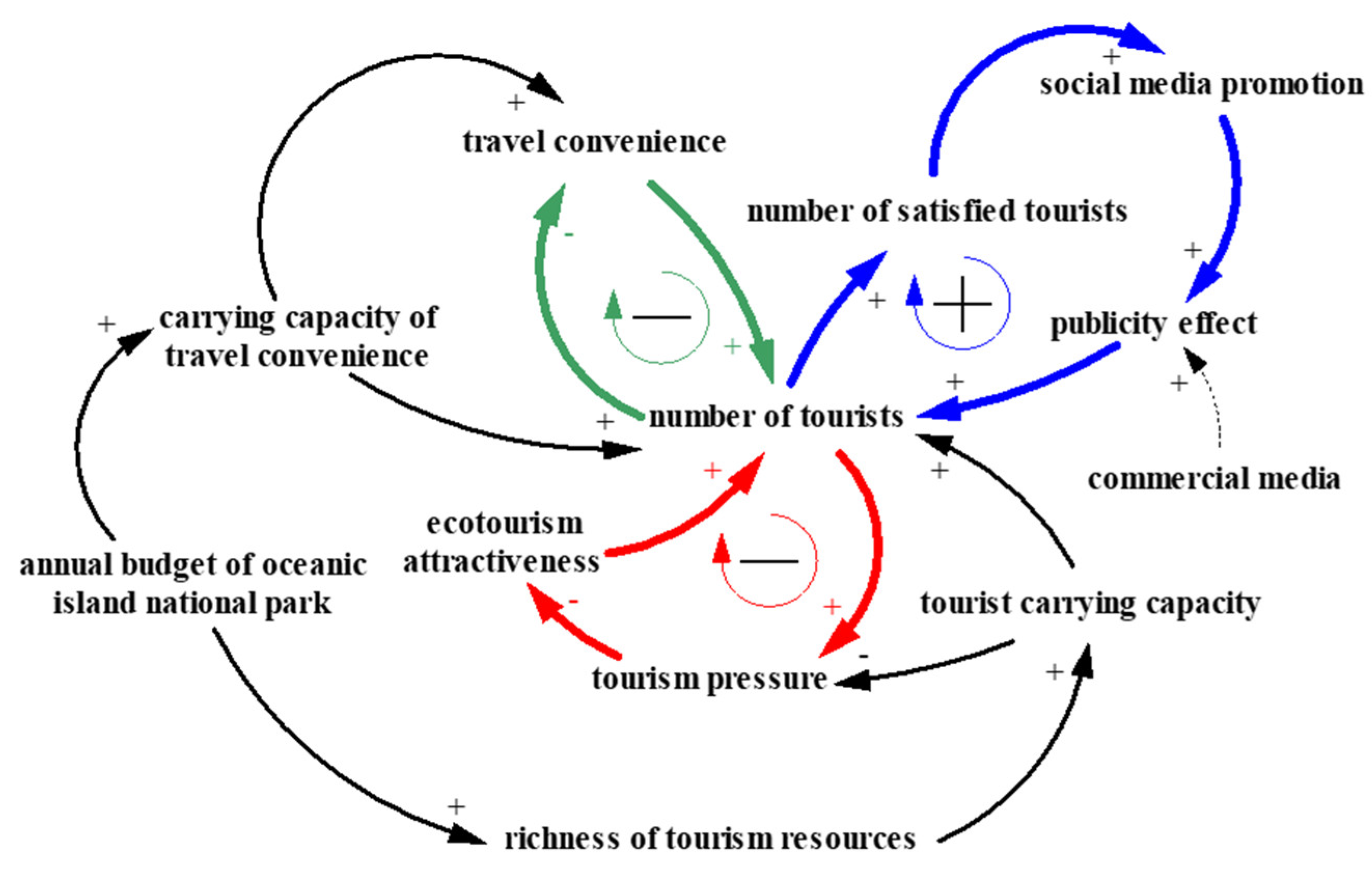
Figure 2.
Sustainable development model framework of fee-based ecotourism in oceanic island national parks.
Figure 2.
Sustainable development model framework of fee-based ecotourism in oceanic island national parks.
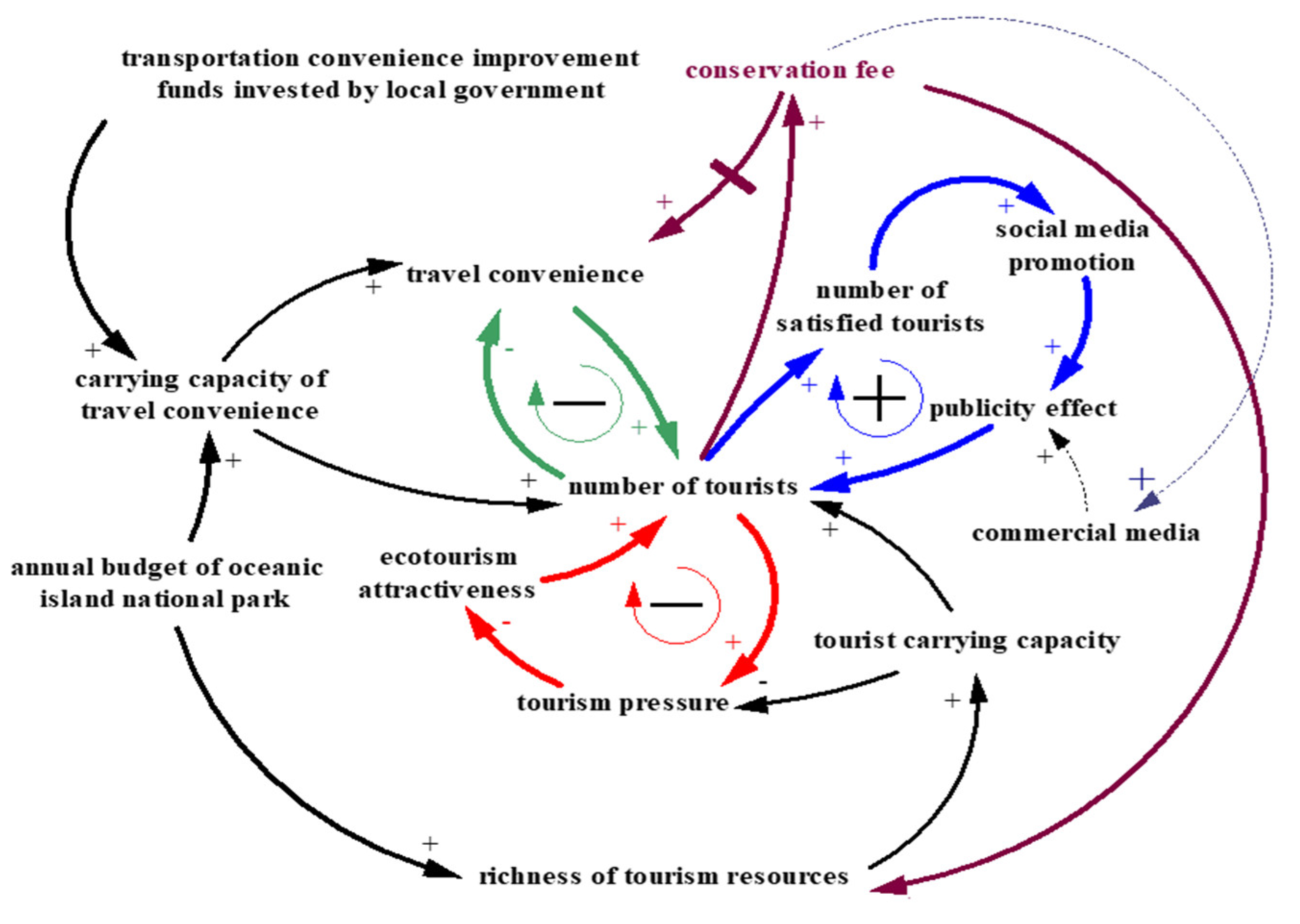

Table 1.
This is a table. Tables should be placed in the main text near to the first time they are cited.
Table 1.
This is a table. Tables should be placed in the main text near to the first time they are cited.
| Aspect | Variables can be used as indicators | Reference |
| driving forces | publicity effect | [81] |
| travel convenience | [82,83] | |
| ecotourism attractiveness | [84,85,86,87] | |
| states | number of tourists | [88] |
| number of satisfied tourists | [89,90,91] | |
| richness of tourism resources | [92] | |
| tourism pressure | [93] | |
| annual budget of oceanic island national park | [94] | |
| responses | tourist carrying capacity | [95,96,97] |
| carrying capacity of travel convenience | [72] | |
| social media promotion | [98,99,100,101] | |
| commercial media | [102] |
Short Biography of Authors
Laurence Zsu-Hsin Chuang received the Ph.D. degree in civil engineering from the Department of Civil Engineering of North Carolina State University, Raleigh, NC, USA, in 1992. He was the Deputy Director with the Coastal Ocean Monitoring Center, National Cheng Kung University. He is currently a Professor with the Institute of Ocean Technology and Marine Affairs, National Cheng Kung University, Tainan, Taiwan. His research activities are mostly concentrated in the domain of meteoceanic observation (systems integration, data quality control), radar monitoring, statistical analysis, system dynamics, marine tourism and recreation management, information management.
Eric Li- Hau Chen is currently a PhD candidate at the Institute of Ocean Technology and Marine Affairs, National Cheng Kung University. The author earned his Master’s degree from the same institute and his Bachelor’s degree from the Department of Environmental Biology and Fisheries Science at National Taiwan Ocean University. His undergraduate research focused on environmental toxicology, specifically on how heavy metals affect fish organisms and their metabolic processes. Additionally, the author conducted an impact assessment of oil pollution events on the environment and ecology, and estimated the cost of ecosystem restoration. For the author Master’s degree, the author specialized in Wetland Ecology, where the author primary research explored zoning and management strategies for wetland reserves. The author PhD research is centered on the planning and management of oceanic national parks, utilizing system dynamics as a tool for holistic, systematic thinking. During his PhD studies, the author served as the project lead for a commission by the Marine National Park Headquarters under Taiwan’s Ministry of the Interior’s National Park Administration. The author was awarded the prestigious Humanities Doctoral Candidate Scholarship from Taiwan’s National Science and Technology Council. Additionally, the author earned first place in the Wetland Talent Development Program selection by Taiwan’s Construction and Planning Agency for two consecutive years. In addition to his academic work, the author is also a biology teacher at a junior high school in Taiwan. The author main research interests include the application of system dynamics in sustainable science, the planning, construction, and management of oceanic and wetland reserves, as well as the implementation and evaluation of environmental and science education at the junior high school level students in Taiwan. The author has published numerous journal articles in Taiwan on education and wetland field. The author has also presented at various international academic conferences and co-authored a university textbook titled English-Medium Instruction (EMI) in Higher Education: Challenges and Prospects, published in traditional Chinese by Angle Press in Taiwan
| 1 | Website: UNWTO: SUSTAINABLE DEVELOPMENT, URL: https://www.unwto.org/sustainable-development, Date accessed: February 23, 2022. |
Disclaimer/Publisher’s Note: The statements, opinions and data contained in all publications are solely those of the individual author(s) and contributor(s) and not of MDPI and/or the editor(s). MDPI and/or the editor(s) disclaim responsibility for any injury to people or property resulting from any ideas, methods, instructions or products referred to in the content. |
© 2024 by the authors. Licensee MDPI, Basel, Switzerland. This article is an open access article distributed under the terms and conditions of the Creative Commons Attribution (CC BY) license (http://creativecommons.org/licenses/by/4.0/).
Copyright: This open access article is published under a Creative Commons CC BY 4.0 license, which permit the free download, distribution, and reuse, provided that the author and preprint are cited in any reuse.


