

Submitted:
08 October 2024
Posted:
09 October 2024
You are already at the latest version
Abstract
Atherosclerosis remains a major driver for cardiovascular disease (CVD), despite advancements in traditional risk factor management therapies. Recent evidence emphasizes the crucial role of the gut microbiome in the progression of atherosclerosis and plaque rupture, highlighting a promising therapeutic avenue. This review focuses on the intertwined relationship between the gut microbiome, its metabolites, and atherosclerosis and CVD, also highlighting the potential therapeutic role of probiotics and prebiotics.
Given the diverse and unique gut microbiota signatures among individuals, a one-size-fits-all therapeutic approach is unlikely to be effective. Personalized treatment strategies are therefore necessary. Here we discussed how Artificial Intelligence (AI) can be leveraged to analyze individual gut microbiome profiles from microbiome sequencing, predict treatment response, and optimize therapeutic strategies based on individual patients which would significantly improve outcomes of the treatment for atherosclerosis/CVD patients.
Keywords:
Atherosclerosis
; probiotics
; gut microbiome
; cardiovascular disease
; Artificial Intelligence (AI)
; Machine learning (ML)
; Deep learning (DL)
1. Introduction
Atherosclerosis, a leading cause of cardiovascular disease (CVD), remains a compelling global health issue, contributing to substantial morbidity and mortality across the globe [1,2],. Atherosclerosis is characterized by the build-up of plaques within the arterial walls, comprising lipids, complex sugars, and other blood components. This degenerative chronic vascular disease is a precursor to numerous cardiovascular conditions, such as coronary artery disease, stroke, and peripheral artery disease. [3]. The progression of atherosclerosis involves a complex interplay of factors, including lipid metabolism disorders [4], inflammation [5], oxidative stress [6], endothelial [7] and smooth muscle cell dysfunction. Traditional risk factors, such as diabetes, hypertension, obesity, and smoking as further exacerbate this condition [9]. In addition, there are genetic variants which are reported to predispose to early onset Atherosclerosis in the absence of the traditional risk factors [10,11,12],. In addition, there are genetic variants which are reported to predispose to early onset Atherosclerosis in the absence of the traditional risk factors [10,11,12],
Recent scientific advancements have revealed a significant relationship between the gut microbiota and CVD, particularly in relation to atherosclerosis [13,14]. The gut microbiota, a diverse ecosystem comprising approximately 10^14 microorganisms, predominantly from the phyla Bacteroidetes and Firmicutes, plays a crucial role in regulating homeostasis in human gut and impact overall health [15]. Disruptions of microbial balance, known as gut dysbiosis, have been implicated in the development of various diseases, including Atherosclerotic CVD [16,17] and atherosclerotic plaque stability [18,19,20. Studies have shown that gut microbiota and their metabolites are intricately involves in influencing major risk factors of atherosclerosis [21,22] highlighting the critical relationship between diet, gut health, and Atherosclerosis outcomes [23]. Studies have shown that gut microbiota and their metabolites are intricately involves in influencing major risk factors of atherosclerosis [21,22] highlighting the critical relationship between diet, gut health, and Atherosclerosis outcomes [23].
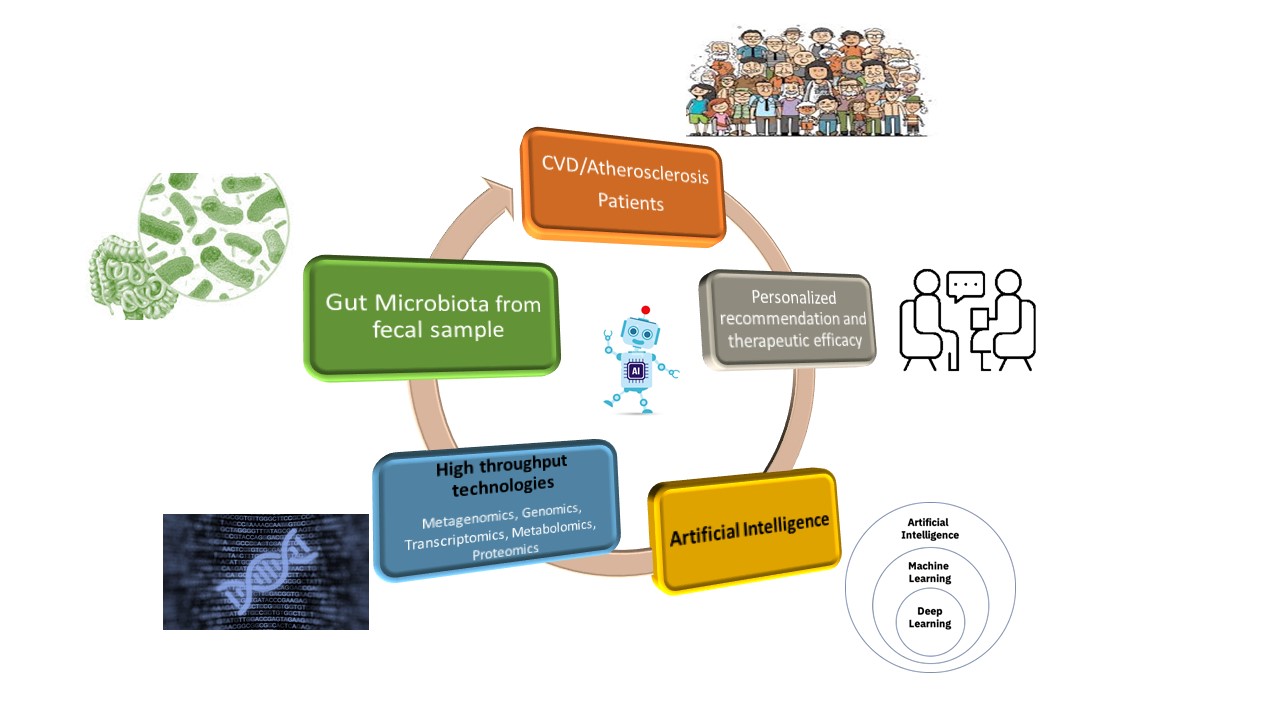
In light of these findings, this Mini-Review, we consider The Role of the Gut Microbiome in Atherosclerosis Development and Progression discussion on the most used AI/ML approaches and their application for CAD risk prediction AI and ML approaches in Atherosclerosis and CAD risk prediction based on gut microbiome signatures, predict treatment responses, and optimize therapeutic strategies. Finally, we provide an outlook (refer to Figure 1 and Table 1) for putting it all together for using AI/ML approaches to predict Atherosclerosis risk predictions and its future potential in offering personalized therapy.
2. The Role of the Gut Microbiome in Atherosclerosis Development and Progression
Gut-dysbiosis refers to an imbalance in the microbial communities within the gut, often associated with alterations in microbial composition or the disruption of the mucosal barrier. This disproportion can be triggered by various factors, including high-fat diets, certain diseases, and overuse of antibiotics. Such changes in gut microbiota composition results in compromised gut permeability, allowing bacterial DNA, metabolites, and endotoxins to enter the bloodstream and other organs [24,25]. Under normal conditions, the gut maintains a strong barrier system such as single-layered intestinal epithelial cells, linked by tight junction proteins, two mucus layers that protect against harmful substances entering circulation [26,27,28]; The adult gut microbiome is primarily composed of five phyla: Bacteroidetes, Firmicutes, Actinobacteria, Proteobacteria, and Verrucomicrobia. Among these, Bacteroidetes and Firmicutes together constitute over 90% of the bacterial species in the gut of healthy individuals [15]. As the dominant genera, Bacteroidetes and Firmicutes are generally resistant to acute disruptions. However, aleterations in their populations are often linked to various pathological conditions in the human body [29].
Recent findings underscore an obvious connection between gut microbiota and the development of atherosclerotic plaque development and rupture. [30]. Experimental studies have shown that atherosclerosis is linked to gut microbiota dysbiosis, characterized by an increased Firmicutes-to-Bacteroidetes (F/B) ratio [31,32,17,33,90].
Particularly, specific bacterial strains have emerged as potential indicators or contributors to atherosclerosis. Escherichia coli and Acidaminococcus have been found in higher concentrations in patients with subclinical carotid atherosclerosis (SCA) and coronary artery disease (CAD) [34,35]. Notably, Acidaminococcus, associated with several inflammatory diseases and a proinflammatory diet, suggests its role as a marker of inflammation in atherosclerosis [36]. Conversely, beneficial bacteria such as Faecalibacterium prausnitzii, known for its anti-inflammatory properties, are more abundant in individuals without subclinical atherosclerosis, emphasizing the protective role of certain gut microbes [37,17].
It's worth noting that several promising animal studies have investigated the diverse role of the gut microbiome and its metabolites in atherosclerosis diseases progression, though a detailed discussion of these studies is beyond the scope of this mini review. Furthermore, lipid lowering and therapeutic probiotics supplementation, gut microbiota modulation, [38,39,40,41,42,43,38] and fecal transplantation have shown promise in managing Atherosclerosis and CVD [44,32,45,46].
3. AI and ML in Gut Microbiome Analysis: Applications in Disease, and Cardiovascular Health Risk Prediction
3.1. AI and ML for Multi-Dimensional Gut Microbiome Data Analysis and disease prediction
To investigate the correlation between the gut microbiota and human diseases, advanced sequencing techniques such as amplicon-based and whole genome shotgun sequencing are used to characterize microbial communities and their functions. Large-scale projects like the Metagenomics of the Human Intestinal Tract (MetaHIT) [15,47] the Human Microbiome Project (HMP) [48], and the TEDDY study have significantly expanded our knowledge of the gut microbiome’s impact on human health. These initiatives have produced extensive genomic data, including resources like the Integrated Gene Catalog (IGC) and the Unified Human Gastrointestinal Genome (UHGG) and Protein (UHGP) catalogs, which provide detailed information on thousands of microbial genomes [49,50,51].
With advancements in high-throughput technologies, there has been a shift towards longitudinal multi-omics profiling, integrating data from metabolomics, proteomics, genomics, and transcriptomics by using highly efficient computational system [52,53,54,55,56] This comprehensive approach offers a more detailed understanding of how the gut microbiota interacts with the host, influenced by factors such as genetics, age, diet, medications, geography, and physical activity [57].
Given the intricacy and volume of multi-omics data, advanced computational techniques are essential to efficiently analyze and process this information to identify significant patterns for disease prediction. AI and machine learning (ML) have emerged as powerful tools for analyzing and integrating multi-omics data, enabling the discovery of hidden patterns and the development of predictive models for phenotypes [58,59,60,61]. These models can help identify potential biomarkers associated with human diseases, providing new insights into various disease mechanism and guiding therapeutic strategies including CVD [62,63,64].
ML techniques enhance our ability to manage, analyze, and interpret large, multidimensional datasets, including omics data by offering robust tools for data storage, management, classification, pattern recognition, and optimization. These ML methods are invaluable for exploring the complex nature of the human microbiome signature, discovering novel genes and metabolic markers, examining signaling pathways, assessing microbial activity and functional dysbiosis, analyzing bacterial populations, conducting correlation studies, assigning metagenomic taxonomy and function, and performing resistome analysis that has made significant advancement in the CVD research [65].
There are multiple ML algorithms that have been used in various diseases including CVD and Atherosclerosis which are being discussed in detail in the following sections. One of the most employed algorithms is Random Forest, a supervised ML method that combines multiple decision trees to boost prediction accuracy [66]. In one study with Mexican population, Random Forest (RF) was utilized to classify individuals into categories such as healthy, prediabetic, or Type 2 diabetes (T2D) by analysing their individual gut microbiota profiles. The model successfully distinguished the gut microbiomes of hyperglycemic individuals with T2D from those of prediabetic and normoglycemic individuals, identifying specific bacterial species linked to T2D [67]. In another study using LASSO-based logistic regression, key operational taxonomic units (OTUs) were identified to predict the severity of irritable bowel syndrome (IBS). Random Forest was also applied to classify IBS patients with high sensitivity and specificity [68]. Similarly, ML methods were used to classify fecal samples from individuals with inflammatory bowel disease (IBD) using shotgun metagenomic data. Various models, including Random Forest, Adaboost, and k-NN + LogitBoost, were trained, with k-NN + LogitBoost showing the best performance after feature selection and cross-validation, demonstrating the power of ML in microbiome-based disease classification [69]. Other ML techniques, such as Naïve Bayes (NB), which assumes class conditional independence, and Gradient Boosting (GB), which identifies nonlinear relationships between features, have been effectively used in microbiome analysis. For example, GB has been employed to integrate host genetics, dietary data, and microbiome profiles, enhancing the accuracy of classification and prediction in complex datasets [70].
Unsupervised ML methods are key exploratory tools used to uncover patterns in data without predefined labels. These techniques help identify underlying data structures and correlation patterns, such as using hierarchical clustering to explore the relationship between microbiota and host-associated disease changes, which aids in disease prediction [71]. For example, in one study, researchers used transcriptomic signatures (RNA-seq) from colonocytes and 16S rRNA data from gut microbiota. They treated colonic epithelial cells with live microbiota from healthy individuals, demonstrating the significant role of the gut microbiota in regulating host gene expression. These findings suggest that manipulating the microbiome could hold therapeutic potential in the future [72]. A novel method, aMiSPU, has been introduced to analyze the association between microbiota composition and human health. This data-driven approach utilizes a sum of powered score (SPU) tests combined with adaptive variable weighting, which integrates microbial abundance with phylogenetic information. This reduces reliance on phylogenetic distance, addressing limitations seen in previous approaches [73]. Additionally, biclustering algorithms, traditionally used in gene expression analysis, are now being applied to detect disease marker, specific genera within the gut microbiome. These methods are particularly effective in identifying overlapping clusters in both microbial and host data, further enhancing their utility in microbiome research and disease diagnostics [74].
Deep learning (DL), a subset of ML, uses artificial neural networks (ANNs) with multiple hidden layers to process large datasets with high abstraction and performance. Unlike traditional ML, DL automatically learns features from raw data, removing the need for manual feature engineering. This makes it a highly advanced and versatile technique for various applications [75].
DL excels in managing vast, high-dimensional data and identifying complex patterns, addressing challenges like missing data and the "curse of dimensionality," where increased input dimensions complicate processing [76]. It can be applied in both supervised and unsupervised settings, making it a powerful tool for complex data analysis [77]. Researchers have recently use advanced ML techniques to enhance the analysis of OTU abundance matrices by integrating spatial data with convolutional neural networks (CNNs). Known for their ability to detect local patterns, CNNs are particularly suited for analyzing spatial microbiome data. In one example, researchers utilized the ResNet-50 model to classify microbiome data from individuals with type 2 diabetes (T2D), transforming OTU tables into visual representations based on evolutionary relationships. This method significantly outperformed traditional ML approaches in predicting host phenotypes, demonstrating the power of CNNs in microbiome research [78]. In a recent study addressing the growing challenge of antibiotic resistance, researchers developed two deep learning models, DeepARG-SS and DeepARG-LS, to enhance the detection of antibiotic resistance genes (ARGs). These models were designed to analyze both short read sequences and full gene-length sequences. When evaluated across 30 categories of antibiotic resistance, the models demonstrated high precision and recall significantly outperforming traditional sequence search methods, which often yield high false-negative rates. The DeepARG models, coupled with a newly curated database (DeepARG-DB), expanded the identification of ARGs by leveraging deep learning's capacity to detect a broader range of ARGs without relying on strict cutoffs, offering a more comprehensive and accurate approach to antimicrobial resistance monitoring [79]. A DL framework called Graph-SAGE has been applied to create metagenomic disease graphs, where each sample is represented as a node. The links between nodes are based on a closeness metric, allowing the framework to predict disease states in conditions like IBD and colorectal cancer (CRC). Graph-SAGE outperformed existing ML and DL models in accuracy, and explainable AI was employed to identify specific microbial taxa associated with each condition [80].
Other ML models, iMic and gMic, to enhance microbiome data analysis by addressing issues like data sparsity and limited sample sizes. iMic translates microbial data into images, utilizing cCNNs to significantly improve prediction accuracy compared to traditional methods. By organizing taxa based on their evolutionary relationships, iMic offers greater precision and robustness, especially in static microbiome datasets. gMic, a graph-based model, focuses on the relationships between taxa using cladogram structures, allowing for accurate predictions even without frequency data. Both models employ explainable AI techniques to identify key microbial taxa linked to health conditions, making them powerful tools for biomarker discovery and advancing microbiome research [81]. DL has also been employed in the identification of antimicrobial peptides (AMPs) from gut microbiota. Researchers integrated various neural network models, including Long Short-Term Memory (LSTM), Attention, and Bidirectional Encoder Representations from Transformers (BERT), to create a pipeline for detecting potential AMPs. By analyzing thousands of metagenomic samples, they identified numerous AMP candidates, several of which were shown to be effective against antibiotic-resistant bacteria in animal models [82].
Moreover, a new computational tool named Back-Propagation Neural Network Human-Microbe Disease Association (BPNNHMDA) has been introduced to predict connections between microorganisms and human diseases. This tool employs a back-propagation neural network with an optimized activation function and starting weights to predict microbe-disease associations. BPNNHMDA has demonstrated superior performance in case studies involving diseases such as IBD, asthma, and obesity, further highlighting its potential in microbiome-based disease research [82]. In a recent study, researchers applied ML techniques to uncover the connection between gut microbiome features and immunotherapy response in cancer patients. By integrating 16S rRNA gene sequencing data from multiple cancer cohorts, they identified specific bacterial taxa linked to treatment success. Utilizing a multivariate selbal analysis, the study differentiated bacterial genera associated with responders and non-responders, demonstrating the power of ML in predicting immunotherapy outcomes. In short, all these models demonstrated robust predictive accuracy, even when cross-validated across different sequencing platforms, including shotgun metagenomics. This highlights the potential of AI approaches in identifying microbiome-based biomarkers, offering a promising strategy for enhancing treatment efficacy across a range of health conditions [83].
3.2. AI and ML in Predicting Cardiovascular Health and Atherosclerosis Through Gut Microbiome signature
The use of ML and AI in metagenomics and multi-omics is advancing the understanding of the gut microbiome's role in CVD, particularly atherosclerosis. By applying ML algorithms like Random Forest and support vector machines, large metagenomic datasets can be analyzed to detect microbial signatures linked to disease progression [64]. Researchers have applied ML to investigate the role of gut microbiota in CVD. In a recent study, researchers leveraged 16S ribosomal RNA sequencing data from the American Gut Project to explore gut microbiota variations between individuals with CVD and healthy controls. Taxonomic analysis was carried out using the Naive Bayes classifier with the Greengenes database and enhanced by Linear Discriminant Analysis Effect Size (LEfSe) to pinpoint significant microbial differences. To further dissect these differences, the study employed a range of machine learning techniques including decision trees, elastic net, neural networks, random forests, and support vector machines and revealed that distinctive microbial profiles were associated with CVD. Specifically, individuals with CVD had higher levels of genera such as Bacteroides, Subdoligranulum, and Clostridium. In contrast, healthy controls exhibited greater abundances of Faecalibacterium, Ruminococcus, and Lachnospira [91,92,93]. Another study applied ML and single-cell analysis to investigate the relationship between the gut microbiome and macrophage activity in atherosclerosis and identified key macrophage-related transcriptomics signature that are significantly associated with the gut microbiota and upregulated in atherosclerotic plaques [84].
Moreover, using the Random Forest algorithm, these genes were pinpointed as critical markers, and their biological significance was further explored through Non-negative Matrix Factorization (NMF) clustering. Single-cell RNA sequencing confirmed the expression of these genes specifically in macrophages, and elevated levels of PLEK were observed in unstable plaques, suggesting its potential as a biomarker for disease progression. A predictive nomogram based on these genes demonstrated strong potential for assessing atherosclerosis risk, highlighting the effectiveness of AI and ML in identifying novel biomarkers and advancing our understanding of the gut microbiome's role in CVD [84]. A recent study investigated the relationship between gut microbiota composition and CVD risk in a multi-ethnic cohort using advanced machine learning (XGBoost) and Mendelian randomization. The researchers predicted the Framingham risk score based on gut microbiota data, identifying protective bacteria such as Akkermansia muciniphila and Ruminococcaceae UCG-002, particularly against ischemic heart disease, a condition linked to atherosclerosis. A microbial cluster comprising Christensenellaceae, Methanobrevibacter, and Ruminococcaceae (CMR cluster) was inversely associated with blood lipid levels and CVD risk, particularly by reducing triglycerides, a key factor in atherosclerosis. The study emphasized the importance of ethnic-specific microbiome profiles, suggesting that personalized interventions tailored to an individual's gut microbiota could be more effective for managing atherosclerosis and overall cardiovascular health. [85]. In a similar study researchers applied bidirectional two-sample Mendelian Randomization to investigate the causal relationships between gut microbiota and blood lipid levels. They analyzed summary statistics from genome-wide association studies (GWAS) for the 211 intestinal fora and blood lipid traits,using advanced MR techniques The findings revealed a potential causal link between specific gut microbiota and dyslipidemia. For instance, genera such as Ruminococcaceae, Christensenellaceae, Parasutterella, and Erysipelotrichaceae were associated with increased dyslipidemia, whereas Oscillospira, Peptococcus, and Desulfovibrionaceae were linked to lower dyslipidemia levels. After correcting for multiple comparisons, only Desulfovibrionaceae showed a significant negative association with ApoB levels. Additionally, the inverse MR analysis did not find significant causal effects of blood lipids on gut microbiota. These findings highlight the intricate relationship between gut microbiota and lipid metabolism, offering insights into potential interventions for managing dyslipidemia and addressing atherosclerosis [86]. Another study examining the association between habitual dairy consumption, gut microbial composition, and cardiometabolic risk factors in aged individuals (40 to 70 years) found a significant links between increased dairy consumption, particularly milk and yogurt, and favorable changes in gut microbial diversity. Higher dairy intake was associated with lower blood triglyceride levels and higher HDL cholesterol, indicating potential cardioprotective effects. ML-based metabolomic profiling identified key metabolites, such as 2-hydroxy-3-methylbutyric acid, 2-hydroxybutyric acid, and L-alanine, which were inversely related to the dairy-microbial profile but positively associated with triglycerides. Triglycerides correlated negatively with bacterial genera like Ruminococcaceae_other and Haemophilus and positively with Cetobacterium and Fusobacterium. HDL cholesterol was inversely associated with Enterobacteriaceae, which was more prevalent in individuals with lower dairy intake. [87].
Researchers evaluated the effects of chronic statin therapy on the gut microbiome and serum metabolites in ACS patients and healthy controls. It employed 16S rRNA sequencing and serum metabolomics, utilizing ML and PICRUSt2 (Phylogenetic Investigation of Communities by Reconstruction of Unobserved States) for functional predictions, to examine how statin treatment influences microbial composition and related metabolic pathways. Statin therapy notably improved the gut microbiome in ACS patients. Specifically, it reduced harmful bacteria like Parabacteroides merdae and boosted beneficial species such as Bifidobacterium longum subsp. longum, Anaerostipes hadrus, and Ruminococcus obeum. These shifts in microbial composition were linked to better health outcomes for patients. This multi-omics approach revealed that these microbial changes were connected to disease severity and patient outcomes, largely through their effects on key metabolites like fatty acids and prenol lipids. In summary, statin treatment appears to positively influence the gut microbiome, leading to improved metabolite profiles and reduced metabolic risk in ACS patients [88]. A recent study explored the effects of gut microbiota alterations and metabolic disruptions on atherosclerosis, with a focus on antibiotic treatment. Using male Apolipoprotein E knockout mice, the researchers applied advanced ML techniques, such as WGCNA, RF to examine metabolic changes and found that antibiotic treatment led to disturbances in tryptophan and lipid metabolism, resulting in decreased microbial diversity. Specifically, reductions were noted in bacterial families such as Ruminococcaceae and Lachnospiraceae from Clostridia, and Porphyromonadaceae from Bacteroidetes, which correlated with increased atherosclerosis severity. Similar patterns were observed in a human cohort, where lower serum tryptophan levels and diminished gut microbiome diversity were associated with atherosclerotic conditions [89].
4. Conclusions and Future direction
AI and ML have revolutionized gut microbiome research, providing unprecedented opportunities to predict and potentially prevent CVD, including atherosclerosis. The gut microbiome's pivotal role in metabolic and immune regulation underscores its direct influence on cardiovascular health. AI-driven analysis of multi-omics data (metagenomics, genomics, transcriptomics, proteomics, metabolomics) has significantly advanced our understanding of gut dysbiosis and its links to disease. ML models and deep learning techniques have identified key microbial biomarkers and predicted disease risks with greater accuracy than traditional methods. In the context of cardiovascular health, AI has unveiled associations between microbial metabolites, and CVD risk, enabling the prediction of precise risk profiles and facilitating personalized treatment strategies. Future research should focus on expanding multi-omics integration to further unravel the complexities of the gut microbiome's role in Atherosclerosis and CVD. Developing advanced models capable of handling diverse high throughput sequence data and providing explainable insights will be crucial for translating AI predictions into actionable clinical research and practice. Additionally, AI can be instrumental in identifying microbiome-based individualized therapies, such as designing and recommending specific probiotic composition based on individualized data, to restore gut balance, preventing gut dysbiosis and mitigate Atherosclerosis and CVD risk. Efforts should also prioritize refining predictive models for earlier diagnoses and developing personalized treatments that improve cardiovascular outcomes on a global scale.
Supplementary Materials
The following supporting information can be downloaded at: www.mdpi.com/xxx/s1, Table S1.
References
- Roth, G.A.; Mensah, G.A.; Johnson, C.O.; Addolorato, G.; Ammirati, E.; Baddour, L.M.; Barengo, N.C.; Beaton, A.Z.; Benjamin, E.J.; Benziger, C.P.; Bonny, A.; Brauer, M.; Brodmann, M.; Cahill, T.J.; Carapetis, J.; Catapano, A.L.; Chugh, S.S.; Cooper, L.T.; Coresh, J.; Criqui, M. Global Burden of Cardiovascular Diseases and Risk Factors, 1990-2019: Update from the GBD 2019 Study. Journal of the American College of Cardiology 2020, 76, 2982–3021. [Google Scholar] [CrossRef] [PubMed]
- Amini, M.; Zayeri, F.; Salehi, M. Trend Analysis of Cardiovascular Disease Mortality, Incidence, and Mortality-To-Incidence Ratio: Results from Global Burden of Disease Study 2017. BMC Public Health 2021, 21. [Google Scholar] [CrossRef]
- Libby, P.; Buring, J.E.; Badimon, L.; Hansson, G.K.; Deanfield, J.; Bittencourt, M.S.; Tokgözoğlu, L.; Lewis, E.F. Atherosclerosis. Nature Reviews Disease Primers 2019, 5. [Google Scholar] [CrossRef]
- Wang, H.H.; Garruti, G.; Liu, M.; Portincasa, P.; Wang, D.Q.-H. . Cholesterol and Lipoprotein Metabolism and Atherosclerosis: Recent Advances in Reverse Cholesterol Transport. Annals of Hepatology 2017, 16, S27–S42. [Google Scholar] [CrossRef]
- Kong, P.; Cui, Z.-Y.; Huang, X.-F.; Zhang, D.-D.; Guo, R.-J.; Han, M. Inflammation and Atherosclerosis: Signaling Pathways and Therapeutic Intervention. Signal Transduction and Targeted Therapy 2022, 7. [Google Scholar] [CrossRef]
- Batty, M.; Bennett, M.R.; Yu, E. The Role of Oxidative Stress in Atherosclerosis. Cells 2022, 11, 3843. [Google Scholar] [CrossRef]
- Gimbrone, M.A.; García-Cardeña, G. Endothelial Cell Dysfunction and the Pathobiology of Atherosclerosis. Circulation Research 2016, 118, 620–636. [Google Scholar] [CrossRef]
- Doran, A.C.; Meller, N.; McNamara, C.A. Role of Smooth Muscle Cells in the Initiation and Early Progression of Atherosclerosis. Arteriosclerosis, Thrombosis, and Vascular Biology 2008, 28, 812–819. [Google Scholar] [CrossRef]
- Kong, P.; Cui, Z.-Y.; Huang, X.-F.; Zhang, D.-D.; Guo, R.-J.; Han, M. Inflammation and Atherosclerosis: Signaling Pathways and Therapeutic Intervention. Signal Transduction and Targeted Therapy 2022, 7. [Google Scholar] [CrossRef]
- Chattopadhyay, A.; Guan, P.; Majumder, S.; Kaw, K.; Zhou, Z.; Zhang, C.; Prakash, S.K.; Kaw, A.; L. Maximillian Buja; Kwartler, C.S.; Milewicz, D.M. Preventing Cholesterol-Induced Perk (Protein Kinase RNA-like Endoplasmic Reticulum Kinase) Signaling in Smooth Muscle Cells Blocks Atherosclerotic Plaque Formation. Arteriosclerosis Thrombosis and Vascular Biology 2022, 42, 1005–1022. [Google Scholar] [CrossRef]
- Majumder, S.; Chattopadhyay, A.; Wright, J.M.; Guan, P.; L Maximilian Buja; Kwartler, C. S.; Milewicz, D.M. Pericentrin Deficiency in Smooth Muscle Cells Augments Atherosclerosis through HSF1-Driven Cholesterol Biosynthesis and PERK Activation. JCI Insight 2023, 8. [Google Scholar] [CrossRef] [PubMed]
- Kaw, K.; Chattopadhyay, A.; Guan, P.; Chen, J.; Majumder, S.; Duan, X.; Ma, S.; Zhang, C.; Kwartler, C.S.; Milewicz, D.M. Smooth Muscle α-Actin Missense Variant Promotes Atherosclerosis through Modulation of Intracellular Cholesterol in Smooth Muscle Cells. European Heart Journal 2023, 44, 2713–2726. [Google Scholar] [CrossRef] [PubMed]
- Jonsson, A.L.; Bäckhed, F. Role of Gut Microbiota in Atherosclerosis. Nature Reviews Cardiology 2016, 14, 79–87. [Google Scholar] [CrossRef]
- Trøseid, M.; Andersen, G.Ø.; Broch, K.; Hov, J.R. The Gut Microbiome in Coronary Artery Disease and Heart Failure: Current Knowledge and Future Directions. EBioMedicine 2020, 52, 102649. [Google Scholar] [CrossRef]
- Qin, J.; Li, R.; Raes, J.; Arumugam, M.; Burgdorf, K.S.; Manichanh, C.; Nielsen, T.; Pons, N.; Levenez, F.; Yamada, T.; Mende, D.R.; Li, J.; Xu, J.; Li, S.; Li, D.; Cao, J.; Wang, B.; Liang, H.; Zheng, H.; Xie, Y. A Human Gut Microbial Gene Catalogue Established by Metagenomic Sequencing. Nature 2010, 464, 59–65. [Google Scholar] [CrossRef]
- Yoo, J.Y.; Sniffen, S.; McGill Percy, K.C.; Pallaval, V.B.; Chidipi, B. Gut Dysbiosis and Immune System in Atherosclerotic Cardiovascular Disease (ACVD). Microorganisms 2022, 10, 108. [Google Scholar] [CrossRef]
- Jie, Z.; Xia, H.; Zhong, S.-L.; Feng, Q.; Li, S.; Liang, S.; Zhong, H.; Liu, Z.; Gao, Y.; Zhao, H.; Zhang, D.; Su, Z.; Fang, Z.; Lan, Z.; Li, J.; Xiao, L.; Li, J.; Li, R.; Li, X.; Li, F. The Gut Microbiome in Atherosclerotic Cardiovascular Disease. Nature Communications 2017, 8. [Google Scholar] [CrossRef]
- Shen, X.; Li, L.; Sun, Z.; Zang, G.; Zhang, L.; Shao, C.; Wang, Z. Gut Microbiota and Atherosclerosis—Focusing on the Plaque Stability. Frontiers in Cardiovascular Medicine 2021, 8. [Google Scholar] [CrossRef]
- Zheng, S.; Liu, Z.; Liu, H. ; Jie Ying Lim; Wong, D.; Zhang, S.; Luo, F.; Wang, X.; Sun, C.; Tang, R.; Zheng, W.; Xie, Q. Research Development on Gut Microbiota and Vulnerable Atherosclerotic Plaque. Heliyon 2024, e25186–e25186. [Google Scholar] [CrossRef]
- Nakajima, A.; Satoru Mitomo; Yuki, H. ; Araki, M.; Lena Marie Seegers; McNulty, I.; Lee, H.; Kuter, D.; Ishibashi, M.; Kobayashi, K.; Jouke Dijkstra; Onishi, H.; Hiroto Yabushita; Matsuoka, S.; Kawamoto, H.; Watanabe, Y.; Tanaka, K.; Chou, S.; Naganuma, T.; Masaaki Okutsu. Gut Microbiota and Coronary Plaque Characteristics. Journal of the American Heart Association 2022, 11. [Google Scholar] [CrossRef]
- Lau, K.; Srivatsav, V.; Rizwan, A.; Nashed, A.; Liu, R.; Shen, R.; Akhtar, M. Bridging the Gap between Gut Microbial Dysbiosis and Cardiovascular Diseases. Nutrients 2017, 9, 859. [Google Scholar] [CrossRef] [PubMed]
- Cao, H.; Zhu, Y.; Hu, G.; Zhang, Q.; Zheng, L. Gut Microbiome and Metabolites, the Future Direction of Diagnosis and Treatment of Atherosclerosis? Pharmacological Research 2023, 187, 106586. [Google Scholar] [CrossRef]
- Ma, J.; Li, H. The Role of Gut Microbiota in Atherosclerosis and Hypertension. Frontiers in Pharmacology 2018, 9. [Google Scholar] [CrossRef]
- Bäckhed, F.; Fraser, Claire M. ; Ringel, Y.; Sanders, M.; Sartor, R. Balfour; Sherman, Philip M.; Versalovic, J.; Young, V.; Finlay, B. Brett. Defining a Healthy Human Gut Microbiome: Current Concepts, Future Directions, and Clinical Applications. Cell Host & Microbe 2012, 12, 611–622. [Google Scholar] [CrossRef]
- Robles Alonso, V.; Guarner, F. Linking the Gut Microbiota to Human Health. British Journal of Nutrition 2013, 109, S21–S26. [Google Scholar] [CrossRef]
- Camilleri, M. Leaky Gut: Mechanisms, Measurement and Clinical Implications in Humans. Gut 2019, 68, 1516–1526. [Google Scholar] [CrossRef]
- Mu, Q.; Kirby, J.; Reilly, C.M.; Luo, X.M. Leaky Gut as a Danger Signal for Autoimmune Diseases. Frontiers in Immunology 2017, 8. [Google Scholar] [CrossRef]
- Quigley, E.M. M. Leaky Gut – Concept or Clinical Entity? Current Opinion in Gastroenterology 2016, 32, 74–79. [Google Scholar] [CrossRef]
- Magne, F.; Gotteland, M.; Gauthier, L.; Zazueta, A.; Pesoa, S.; Navarrete, P.; Balamurugan, R. The Firmicutes/Bacteroidetes Ratio: A Relevant Marker of Gut Dysbiosis in Obese Patients? Nutrients 2020, 12, 1474. [Google Scholar] [CrossRef]
- Ott, S.J.; El Mokhtari, N.E.; Musfeldt, M.; Hellmig, S.; Freitag, S.; Rehman, A.; KühbacherT. ; Nikolaus, S.; Namsolleck, P.; Blaut, M.; Hampe, J.; Sahly, H.; Reinecke, A.; Haake, N.; GüntherR.; KrügerD.; Lins, M.; Herrmann, G.; FölschU. R.; SimonR. Detection of Diverse Bacterial Signatures in Atherosclerotic Lesions of Patients with Coronary Heart Disease. Circulation 2006, 113, 929–937. [Google Scholar] [CrossRef]
- Drosos, I.; Tavridou, A.; Kolios, G. New Aspects on the Metabolic Role of Intestinal Microbiota in the Development of Atherosclerosis. Metabolism 2015, 64, 476–481. [Google Scholar] [CrossRef] [PubMed]
- Gregory, J.C.; Buffa, J.A.; Org, E.; Wang, Z.; Levison, B.S.; Zhu, W.; Wagner, M.A.; Bennett, B.J.; Li, L.; DiDonato, J.A.; Lusis, A.J.; Hazen, S.L. Transmission of Atherosclerosis Susceptibility with Gut Microbial Transplantation. The Journal of Biological Chemistry 2015, 290, 5647–5660. [Google Scholar] [CrossRef] [PubMed]
- Ludivine Laurans; Mouttoulingam Nirmala; Mouna Chajadine; Bacquer, E. ; Lavelle, A.; Esposito, B.; Alain Tedgui; Hafid Ait Oufella; Zitvogel, L.; Sokol, H.; Taleb, S. Obesogenic Diet Increases Atherosclerosis through Promoting Microbiota Dysbiosis-Induced Gut Lymphocyte Trafficking into Periphery. Archives of cardiovascular diseases 2024, 117, S162–S162. [Google Scholar] [CrossRef]
- Zhu, Q.; Gao, R.; Zhang, Y.; Pan, D.; Zhu, Y.; Zhang, X.; Yang, R.; Jiang, R.; Xu, Y.; Qin, H. Dysbiosis Signatures of Gut Microbiota in Coronary Artery Disease. Physiological Genomics 2018, 50, 893–903. [Google Scholar] [CrossRef] [PubMed]
- Baragetti, A.; Severgnini, M.; Olmastroni, E.; Dioguardi, C.C.; Mattavelli, E.; Angius, A.; Rotta, L.; Cibella, J.; Caredda, G.; Consolandi, C.; Grigore, L.; Pellegatta, F.; Giavarini, F.; Caruso, D.; Norata, G.D.; Catapano, A.L.; Peano, C. Gut Microbiota Functional Dysbiosis Relates to Individual Diet in Subclinical Carotid Atherosclerosis. Nutrients 2021, 13, 304. [Google Scholar] [CrossRef]
- Ji, L.; Chen, S.; Gu, G.; Zhou, J.; Wang, W.; Ren, J.; Wu, J.; Yang, D.; Zheng, Y. Exploration of Crucial Mediators for Carotid Atherosclerosis Pathogenesis through Integration of Microbiome, Metabolome, and Transcriptome. Frontiers in Physiology 2021, 12. [Google Scholar] [CrossRef]
- Cui, X.; Ye, L.; Li, J.; Jin, L.; Wang, W.; Li, S.; Bao, M.; Wu, S.; Li, L.; Geng, B.; Zhou, X.; Zhang, J.; Cai, J. Metagenomic and Metabolomic Analyses Unveil Dysbiosis of Gut Microbiota in Chronic Heart Failure Patients. Scientific Reports 2018, 8. [Google Scholar] [CrossRef]
- Zhai, T.; Wang, P.; Hu, X.; Zheng, L. Probiotics Bring New Hope for Atherosclerosis Prevention and Treatment. Oxidative Medicine and Cellular Longevity 2022, 2022, 1–13. [Google Scholar] [CrossRef]
- Saadh, M.J.; Bazghandi, B.; Jamialahmdi, H.; Rahimzadeh-Bajgiran, F.; Forouzanfar, F.; Esmaeili, S.-A.; Saburi, E. Therapeutic Potential of Lipid-Lowering Probiotics on the Atherosclerosis Development. European Journal of Pharmacology 2024, 971, 176527. [Google Scholar] [CrossRef]
- Khalili, L.; Centner, A.M.; Salazar, G. Effects of Berries, Phytochemicals, and Probiotics on Atherosclerosis through Gut Microbiota Modification: A Meta-Analysis of Animal Studies. International Journal of Molecular Sciences 2023, 24, 3084. [Google Scholar] [CrossRef]
- O’Morain, V.L.; Ramji, D.P. The Potential of Probiotics in the Prevention and Treatment of Atherosclerosis. Molecular Nutrition & Food Research 2020, 64, e1900797. [Google Scholar] [CrossRef]
- Mahdavi-Roshan, M.; Salari, A.; Kheirkhah, J.; Ghorbani, Z. The Effects of Probiotics on Inflammation, Endothelial Dysfunction, and Atherosclerosis Progression: A Mechanistic Overview. Heart, Lung and Circulation 2022. [Google Scholar] [CrossRef] [PubMed]
- Hassan, A.; Luqman, A.; Zhang, K.; Ullah, M.; Din, A.U.; Xiaoling, L.; Wang, G. Impact of Probiotic Lactiplantibacillus Plantarum ATCC 14917 on Atherosclerotic Plaque and Its Mechanism. World Journal of Microbiology and Biotechnology 2024, 40. [Google Scholar] [CrossRef]
- Eun Sil Kim; Bo Hyun Yoon; Seung Min Lee; Myoung Hwan Choi; Eun Hye Kim; Lee, B. -W.; Kim, S.; Pack, C.; Young Hoon Sung; Baek, I.-J.; Chang Hee Jung; Kim, T.; Jeong, J.; Chang Hoon Ha. Fecal Microbiota Transplantation Ameliorates Atherosclerosis in Mice with C1q/TNF-Related Protein 9 Genetic Deficiency. Experimental & Molecular Medicine 2022, 54, 103–114. [Google Scholar] [CrossRef]
- Leshem, A.; Horesh, N.; Elinav, E. Fecal Microbial Transplantation and Its Potential Application in Cardiometabolic Syndrome. Frontiers in Immunology 2019, 10. [Google Scholar] [CrossRef]
- Garshick, M.S.; Nikain, C.; Tawil, M.; Pena, S.; Barrett, T.J.; Wu, B.G.; Gao, Z.; Blaser, M.J.; Fisher, E.A. Reshaping of the Gastrointestinal Microbiome Alters Atherosclerotic Plaque Inflammation Resolution in Mice. Scientific Reports 2021, 11, 8966. [Google Scholar] [CrossRef]
- Pedersen, H.K.; Gudmundsdottir, V.; Nielsen, H.B.; Hyotylainen, T.; Nielsen, T.; Jensen, B.A. H.; Forslund, K.; Hildebrand, F.; Prifti, E.; Falony, G.; Le Chatelier, E.; Levenez, F.; Doré, J.; Mattila, I.; Plichta, D.R.; Pöhö, P.; Hellgren, L.I.; Arumugam, M.; Sunagawa, S.; Vieira-Silva, S. Human Gut Microbes Impact Host Serum Metabolome and Insulin Sensitivity. Nature 2016, 535, 376–381. [Google Scholar] [CrossRef]
- Lloyd-Price, J.; Arze, C.; Ananthakrishnan, A.N.; Schirmer, M.; Avila-Pacheco, J.; Poon, T.W.; Andrews, E.; Ajami, N.J.; Bonham, K.S.; Brislawn, C.J.; Casero, D.; Courtney, H.; Gonzalez, A.; Graeber, T.G.; Hall, A.B.; Lake, K.; Landers, C.J.; Mallick, H.; Plichta, D.R.; Prasad, M. Multi-Omics of the Gut Microbial Ecosystem in Inflammatory Bowel Diseases. Nature 2019, 569, 655–662. [Google Scholar] [CrossRef]
- Almeida, A.; Nayfach, S.; Boland, M.; Strozzi, F.; Beracochea, M.; Shi, Z.J.; Pollard, K.S.; Sakharova, E.; Parks, D.H.; Hugenholtz, P.; Segata, N.; Kyrpides, N.C.; Finn, R.D. A Unified Catalog of 204,938 Reference Genomes from the Human Gut Microbiome. Nature Biotechnology 2020. [Google Scholar] [CrossRef]
- Pasolli, E.; Asnicar, F.; Manara, S.; Zolfo, M.; Karcher, N.; Armanini, F.; Beghini, F.; Manghi, P.; Tett, A.; Ghensi, P.; Collado, M.C.; Rice, B.L.; DuLong, C.; Morgan, X.C.; Golden, C.D.; Quince, C.; Huttenhower, C.; Segata, N. Extensive Unexplored Human Microbiome Diversity Revealed by over 150,000 Genomes from Metagenomes Spanning Age, Geography, and Lifestyle. Cell 2019, 176, 649–662.e20. [Google Scholar] [CrossRef]
- Nayfach, S.; Shi, Z.J.; Seshadri, R.; Pollard, K.S.; Kyrpides, N.C. New Insights from Uncultivated Genomes of the Global Human Gut Microbiome. Nature 2019, 568, 505–510. [Google Scholar] [CrossRef] [PubMed]
- Sopic, M.; Vilne, B.; Gerdts, E.; Trindade, F.; Uchida, S.; Khatib, S.; Wettinger, S.B.; Devaux, Y.; Magni, P. Multiomics Tools for Improved Atherosclerotic Cardiovascular Disease Management. Trends in Molecular Medicine 2023, 29, 983–995. [Google Scholar] [CrossRef] [PubMed]
- Wu, X.; Zhang, H. Omics Approaches Unveiling the Biology of Human Atherosclerotic Plaques. ˜The œAmerican journal of pathology 2024, 194, 482–498. [Google Scholar] [CrossRef] [PubMed]
- Amalie Lykkemark Møller; Vasan, R. S.; Levy, D.; Andersson, C.; Lin, H. Integrated Omics Analysis of Coronary Artery Calcifications and Myocardial Infarction: The Framingham Heart Study. Scientific reports 2023, 13. [Google Scholar] [CrossRef]
- Raju, S.; Turner, M.E.; Cao, C. ; Majed Abdul-Samad; Punwasi, N.; Blaser, M.C.; Rachel ME Cahalane; Botts, S.R. C.; Prajapati, K.; Patel, S.; Wu, R.; Gustafson, D.; Galant, N.J.; Fiddes, L.; Chemaly, M.; Hedin, U.; Matic, L.; Seidman, M.; Vallijah Subasri; Singh, S.A. Multi-Omic Landscape of Extracellular Vesicles in Human Carotid Atherosclerotic Plaque Reveals Endothelial Communication Networks. bioRxiv (Cold Spring Harbor Laboratory) 2024. [Google Scholar] [CrossRef]
- Pekayvaz, K.; Losert, C.; Viktoria Knottenberg; Gold, C. ; Irene; Oelen, R.; Groot, H.E.; Jan Walter Benjamins; Brambs, S.; Kaiser, R.; Gottschlich, A.; Gordon Victor Hoffmann; Eivers, L.; Martinez-Navarro, A.; Bruns, N.; Stiller, S.; Sezer Akgöl; Yue, K.; Polewka, V.; Escaig, R. Multiomic Analyses Uncover Immunological Signatures in Acute and Chronic Coronary Syndromes. Nature Medicine 2024, 30, 1696–1710. [Google Scholar] [CrossRef]
- Li, P.; Luo, H.; Ji, B.; Nielsen, J. Machine Learning for Data Integration in Human Gut Microbiome. Microbial Cell Factories 2022, 21. [Google Scholar] [CrossRef]
- Beam, A.L.; Kohane, I.S. Big Data and Machine Learning in Health Care. JAMA 2018, 319, 1317. [Google Scholar] [CrossRef]
- Camacho, D.M.; Collins, K.M.; Powers, R.K.; Costello, J.C.; Collins, J.J. Next-Generation Machine Learning for Biological Networks. Cell 2018, 173, 1581–1592. [Google Scholar] [CrossRef]
- Malakar, S.; Sutaoney, P.; Madhyastha, H.; Shah, K.; Chauhan, N.S.; Banerjee, P. Understanding Gut Microbiome-Based Machine Learning Platforms: A Review on Therapeutic Approaches Using Deep Learning. Chemical Biology & Drug Design 2024, 103, e14505. [Google Scholar] [CrossRef]
- Machine Learning for Integrating Data in Biology and Medicine: Principles, Practice, and Opportunities. Information Fusion 2019, 50, 71–91. [CrossRef] [PubMed]
- Carrieri, A.P.; Haiminen, N.; Maudsley-Barton, S.; Gardiner, L.-J.; Murphy, B.; Mayes, A.E.; Paterson, S.; Grimshaw, S.; Winn, M.; Shand, C.; Hadjidoukas, P.; Rowe, W.P. M.; Hawkins, S.; MacGuire-Flanagan, A.; Tazzioli, J.; Kenny, J.G.; Parida, L.; Hoptroff, M.; Pyzer-Knapp, E.O. Explainable AI Reveals Changes in Skin Microbiome Composition Linked to Phenotypic Differences. Scientific Reports 2021, 11, 4565. [Google Scholar] [CrossRef] [PubMed]
- Gou, W.; Ling, C.; He, Y.; Jiang, Z.; Fu, Y.; Xu, F.; Miao, Z.; Sun, T.; Lin, J.; Zhu, H.; Zhou, H.; Chen, Y.; Zheng, J.-S. Interpretable Machine Learning Framework Reveals Robust Gut Microbiome Features Associated with Type 2 Diabetes. Diabetes Care 2020, 44, 358–366. [Google Scholar] [CrossRef]
- Aryal, S.; Alimadadi, A.; Manandhar, I.; Joe, B.; Cheng, X. Machine Learning Strategy for Gut Microbiome-Based Diagnostic Screening of Cardiovascular Disease. Hypertension 2020. [Google Scholar] [CrossRef] [PubMed]
- Kumar, P.; Sinha, R.; Shukla, P. Artificial Intelligence and Synthetic Biology Approaches for Human Gut Microbiome. Critical Reviews in Food Science and Nutrition 2020, 1–19. [Google Scholar] [CrossRef]
- Topçuoğlu, B.D.; Lesniak, N.A.; Ruffin, M.T.; Wiens, J.; Schloss, P.D. A Framework for Effective Application of Machine Learning to Microbiome-Based Classification Problems. mBio 2020, 11. [Google Scholar] [CrossRef]
- Neri-Rosario, D.; Martínez-López, Y.E.; Esquivel-Hernández, D.A.; Sánchez-Castañeda, J.P.; Padron-Manrique, C.; Vázquez-Jiménez, A.; Giron-Villalobos, D.; Resendis-Antonio, O. Dysbiosis Signatures of Gut Microbiota and the Progression of Type 2 Diabetes: A Machine Learning Approach in a Mexican Cohort. Frontiers in Endocrinology 2023, 14, 1170459. [Google Scholar] [CrossRef]
- Fukui, H.; Nishida, A.; Matsuda, S.; Kira, F.; Watanabe, S.; Kuriyama, M.; Kawakami, K.; Aikawa, Y.; Oda, N.; Arai, K.; Matsunaga, A.; Nonaka, M.; Nakai, K.; Shinmura, W.; Matsumoto, M.; Morishita, S.; Takeda, A.K.; Miwa, H. Usefulness of Machine Learning-Based Gut Microbiome Analysis for Identifying Patients with Irritable Bowels Syndrome. Journal of Clinical Medicine 2020, 9, 2403. [Google Scholar] [CrossRef]
- Hacılar, H.; Nalbantoğlu, O.U.; Bakir-Güngör, B. Machine Learning Analysis of Inflammatory Bowel Disease-Associated Metagenomics Dataset. IEEE Xplore. [CrossRef]
- Marcos-Zambrano, L.J.; Karaduzovic-Hadziabdic, K.; Loncar Turukalo, T.; Przymus, P.; Trajkovik, V.; Aasmets, O.; Berland, M.; Gruca, A.; Hasic, J.; Hron, K.; Klammsteiner, T.; Kolev, M.; Lahti, L.; Lopes, M.B.; Moreno, V.; Naskinova, I.; Org, E.; Paciência, I.; Papoutsoglou, G.; Shigdel, R. Applications of Machine Learning in Human Microbiome Studies: A Review on Feature Selection, Biomarker Identification, Disease Prediction and Treatment. Frontiers in Microbiology 2021, 12. [Google Scholar] [CrossRef]
- Asnicar, F.; Thomas, A.M.; Passerini, A.; Waldron, L.; Segata, N. Machine Learning for Microbiologists. Nature Reviews Microbiology 2023, 1–15. [Google Scholar] [CrossRef]
- Richards, A.L.; Muehlbauer, A.L.; Alazizi, A.; Burns, M.B.; Findley, A.; Messina, F.; Gould, T.J.; Cascardo, C.; Pique-Regi, R.; Blekhman, R.; Luca, F. Gut Microbiota Has a Widespread and Modifiable Effect on Host Gene Regulation. mSystems 2019, 4. [Google Scholar] [CrossRef] [PubMed]
- Wu, C.; Chen, J.; Kim, J.; Pan, W. An Adaptive Association Test for Microbiome Data. Genome Medicine 2016, 8. [Google Scholar] [CrossRef] [PubMed]
- Zhu, Q.; Li, B.; He, T.; Li, G.; Jiang, X. Robust Biomarker Discovery for Microbiome-Wide Association Studies. Methods (San Diego, Calif.) 2020, 173, 44–51. [Google Scholar] [CrossRef] [PubMed]
- Laterza, L.; Putignani, L.; Settanni, C.R.; Petito, V.; Varca, S.; De Maio, F.; Macari, G.; Guarrasi, V.; Gremese, E.; Tolusso, B.; Wlderk, G.; Pirro, M.A.; Fanali, C.; Scaldaferri, F.; Turchini, L.; Amatucci, V.; Sanguinetti, M.; Gasbarrini, A. Ecology and Machine Learning-Based Classification Models of Gut Microbiota and Inflammatory Markers May Evaluate the Effects of Probiotic Supplementation in Patients Recently Recovered from COVID-19. International Journal of Molecular Sciences 2023, 24, 6623. [Google Scholar] [CrossRef]
- Chen, S.; Xu, C. Handling High-Dimensional Data with Missing Values by Modern Machine Learning Techniques. Journal of Applied Statistics 2022, 1–19. [Google Scholar] [CrossRef]
- Konishi, Y.; Okumura, S.; Matsumoto, T.; Itatani, Y.; Nishiyama, T.; Okazaki, Y.; Shibutani, M.; Ohtani, N.; Nagahara, H.; Obama, K.; Ohira, M.; Sakai, Y.; Nagayama, S.; Hara, E. Development and Evaluation of a Colorectal Cancer Screening Method Using Machine Learning-Based Gut Microbiota Analysis. Cancer Medicine 2022, 11, 3194–3206. [Google Scholar] [CrossRef]
- Pfeil, J.; Siptroth, J.; Pospisil, H.; Frohme, M.; Hufert, F.T.; Moskalenko, O.; Murad Yateem; Nechyporenko, A. Classification of Microbiome Data from Type 2 Diabetes Mellitus Individuals with Deep Learning Image Recognition. Big Data and Cognitive Computing 2023, 7, 51–51. [Google Scholar] [CrossRef]
- Arango-Argoty, G.; Garner, E.; Pruden, A.; Heath, L.S.; Vikesland, P.; Zhang, L. DeepARG: A Deep Learning Approach for Predicting Antibiotic Resistance Genes from Metagenomic Data. Microbiome 2018, 6. [Google Scholar] [CrossRef]
- K. Syama; Arul, A.; Khanna, N. Automatic Disease Prediction from Human Gut Metagenomic Data Using Boosting GraphSAGE. BMC bioinformatics 2023, 24. [Google Scholar] [CrossRef]
- Oshrit Shtossel; Isakov, H. ; Turjeman, S.; Koren, O.; Yoram Louzoun. Ordering Taxa in Image Convolution Networks Improves Microbiome-Based Machine Learning Accuracy. Gut Microbes 2023, 15. [Google Scholar] [CrossRef]
- Ma, Y.; Guo, Z.; Xia, B.; Zhang, Y.; Liu, X.; Yu, Y.; Tang, N.; Tong, X.; Wang, M.; Ye, X.; Feng, J.; Chen, Y.; Wang, J. Identification of Antimicrobial Peptides from the Human Gut Microbiome Using Deep Learning. Nature Biotechnology 2022, 40, 921–931. [Google Scholar] [CrossRef] [PubMed]
- Liang, H.; Jo, J.-H.; Zhang, Z.; MacGibeny, M.A.; Han, J.; Proctor, D.M.; Taylor, M.E.; Che, Y.; Juneau, P.; Apolo, A.B.; McCulloch, J.A.; Davar, D.; Zarour, H.M.; Dzutsev, A.K.; Brownell, I.; Trinchieri, G.; Gulley, J.L.; Kong, H.H. Predicting Cancer Immunotherapy Response from Gut Microbiomes Using Machine Learning Models. Oncotarget 2022, 13, 876–889. [Google Scholar] [CrossRef] [PubMed]
- Ke, Y.; Yue, J.; He, J.; Liu, G. Integrating Machine Learning Algorithms and Single-Cell Analysis to Identify Gut Microbiota-Related Macrophage Biomarkers in Atherosclerotic Plaques. Frontiers in Cellular and Infection Microbiology 2024, 14. [Google Scholar] [CrossRef]
- Warmbrunn, M.V. ; U Boulund; J Aron-Wisnewsky; de, C.; Abeka, R.E.; Davids, M.; Bresser, L.R. F.; Levin, E.; Clement, K.; H Galenkamp; Ferwerda, B.; van; A Kurilshikov; Fu, J.; Zwinderman, A.H.; Soeters, M.R.; Raalte, van; Herrema, H.; Groen, A.K.; M Nieuwdorp. Networks of Gut Bacteria Relate to Cardiovascular Disease in a Multi-Ethnic Population: The HELIUS Study. Cardiovascular research 2024. [Google Scholar] [CrossRef]
- Teng, D.; Jia, W.; Wang, W.; Liao, L.; Xu, B.; Gong, L.; Dong, H.; Zhong, L.; Yang, J. Causality of the Gut Microbiome and Atherosclerosis-Related Lipids: A Bidirectional Mendelian Randomization Study. BMC Cardiovascular Disorders 2024, 24. [Google Scholar] [CrossRef]
- Menglei Shuai; Zuo, L. -S.-Y.; Miao, Z.; Gou, W.; Xu, F.; Jiang, Z.; Ling, C.; Fu, Y.; Xiong, F.; Chen, Y.; Zheng, J.-S. Multi-Omics Analyses Reveal Relationships among Dairy Consumption. Gut Microbiota and Cardiometabolic Health. 2021, 66, 103284–103284. [Google Scholar] [CrossRef]
- Hu, X.; Li, H.; Zhao, X.; Zhou, R.; Liu, H.; Sun, Y.; Fan, Y.; Shi, Y.; Qiao, S.; Liu, S.; Liu, H.; Zhang, S. Multi-Omics Study Reveals That Statin Therapy Is Associated with Restoration of Gut Microbiota Homeostasis and Improvement in Outcomes in Patients with Acute Coronary Syndrome. Theranostics 2021, 11, 5778–5793. [Google Scholar] [CrossRef]
- Kappel, B.A.; De Angelis, L.; Heiser, M.; Ballanti, M.; Stoehr, R.; Goettsch, C.; Mavilio, M.; Artati, A.; Paoluzi, O.A.; Adamski, J.; Mingrone, G.; Staels, B.; Burcelin, R.; Monteleone, G.; Menghini, R.; Marx, N.; Federici, M. Cross-Omics Analysis Revealed Gut Microbiome-Related Metabolic Pathways Underlying Atherosclerosis Development after Antibiotics Treatment. Molecular Metabolism 2020, 36, 100976. [Google Scholar] [CrossRef]
- Majumder, S.; Pushpakumar, S.B.; Hebah Almarshood; Ouseph, R. ; Gondim, D.D.; Jala, V.R.; Sen, U. Toll-like Receptor 4 Mutation Mitigates Gut Microbiota-Mediated Hypertensive Kidney Injury. Pharmacological Research 2024, 206, 107303–107303. [Google Scholar] [CrossRef]
- Szabó, H.; Hernyes, A.; Marton Piroska; Balázs Ligeti; Fussy, P. ; Luca Zoldi; Szonja Galyasz; Nóra Makra; Dóra Szabó; Ádám Domonkos Tárnoki; Dávid László Tárnoki. Association between Gut Microbial Diversity and Carotid Intima-Media Thickness. Medicina-lithuania 2021, 57, 195–195. [Google Scholar] [CrossRef]
- Zhang, X.; Gérard, P. Diet-Gut Microbiota Interactions on Cardiovascular Disease. Computational and Structural Biotechnology Journal 2022, 20, 1528–1540. [Google Scholar] [CrossRef] [PubMed]
- Murphy, K.; O’Donovan, A.N.; Caplice, N.M.; Ross, R.P.; Stanton, C. Exploring the Gut Microbiota and Cardiovascular Disease. Metabolites 2021, 11, 493. [Google Scholar] [CrossRef]
Figure 1.
The graphical representation of AI based personalised therapy for Atherosclerotic/CVD patients by using gut microbiota signature.
Figure 1.
The graphical representation of AI based personalised therapy for Atherosclerotic/CVD patients by using gut microbiota signature.

Disclaimer/Publisher’s Note: The statements, opinions and data contained in all publications are solely those of the individual author(s) and contributor(s) and not of MDPI and/or the editor(s). MDPI and/or the editor(s) disclaim responsibility for any injury to people or property resulting from any ideas, methods, instructions or products referred to in the content. |
© 2024 by the authors. Licensee MDPI, Basel, Switzerland. This article is an open access article distributed under the terms and conditions of the Creative Commons Attribution (CC BY) license (http://creativecommons.org/licenses/by/4.0/).
Copyright: This open access article is published under a Creative Commons CC BY 4.0 license, which permit the free download, distribution, and reuse, provided that the author and preprint are cited in any reuse.


