

Submitted:
01 October 2024
Posted:
02 October 2024
You are already at the latest version
Abstract
The Internet of Medical Things (IoMT) represents a transformative technology that connects medical devices, sensors, and healthcare systems to enable real-time monitor-ing, data sharing, and advanced decision-making in healthcare. While the technical and clinical potential of IoMT has been explored extensively, research on the funding patterns and their implications remains sparse. This paper analyzes funding in IoMT research using bibliometric methods to assess the spatial dimensions of funded and non-funded research across different countries and regions. By employing Synthetic Knowledge Synthesis (SKS), the study triangulates quantitative and qualitative ap-proaches to provide insight into research trends, thematic differences, and the rela-tionship between funding and healthcare outcomes such as the Global Health Index (GHI). The results reveal that funded research exhibits higher publication rates in high-impact journals and is more concentrated in countries with stronger healthcare systems and higher R&D expenditures. However, countries with lower healthcare in-vestments are also increasingly contributing to IoMT research, likely in pursuit of im-proving healthcare outcomes. Thematic analysis shows that funded projects empha-size artificial intelligence applications in e-health and telemedicine, while non-funded research tends to focus on IoMT's role in pandemic management. These findings pro-vide insights into the global landscape of IoMT research funding and its impact on public health advancements.
Keywords:
Internet of Medical Things
; IoMT
; research funding
; bibliometrics
; Synthetic Knowledge Synthesis
1. Introduction
New health paradigms advocate the idea that human health is a public good and that the health system’s primary goal is to effectively and efficiently manage this good [1]. To achieve this goal, modern health professionals should benefit from significant advancements in medical technology and treatment methods, including innovations in diagnostics, medical imaging, and preventive health care. Remote health status monitoring and therapeutic techniques enabled by the digital and agile health revolution [2,3,4,5]. Researchers and healthcare innovators hope that emerging technologies will significantly enhance the efficiency and capacity of health systems, helping them to better meet the healthcare needs of populations worldwide [6]. One of the promising technologies that can be widely used in healthcare for all of the above purposes is the Internet of Things (IoT) [7]. While the Internet mainly connects people, IoT connects not only people but different entities in the physical world, including people and objects. The IoT has made remarkable progress across many fields, including medicine, where IoT is called the Internet of Medical Things (IoMT) [8,9,10]. The IoMT refers to the interconnected network of medical devices, sensors, software applications, and healthcare systems that communicate through the internet, enabling real-time data sharing, remote monitoring, and enhanced decision-making [11], supporting the patient-centric approach [12].
While IoMT emergence has been researched from various aspects and viewpoints, the scope and extent of research funding have not yet been analysed. Research funding is believed to be a catalyst for the science and technology progress. As global increase in research expenditure has been noted in last years, analysing the effectiveness or return of research funding has become an important topic of interest [13]. In addition, to being an indicator of a research area importance, impact, maturity and visibility, funding information might be used to identify funding possibilities, research patterns, and most probable topics and themes to be funded [14]. The aim of this paper is to fill this gap and answer the following research questions:
- -
- What are the spatial bibliometrics dimensions of funded and non-funded IoMT research in relation to country determinants?
- -
- What are the characteristics of funding patterns and its relation to country determinants?
- -
- Which are the most prolific themes of funded and non-funded IoMT research?
- -
- What is the impact of funded research on the Global Health Index?
2. Materials and Methods
Scopus (Elsevier, The Netherlands) was used as the bibliographic database due to the fact that Scopus is regarded as the largest scientific bibliographic database of the reviewed research literature. In addition to providing powerful analytics services, Scopus also enables 20,000 records to be exported simultaneously, enabling more effective and efficient bibliometric analyses. Another strength of Scopus is its completeness in covering funding information [14,15]. The search query was formed by analysis and synthesis search strategies used in published IoT/IoMT review papers. The search was performed on September 8th, 2024. Zipf’s law was used to calculate the number of relevant keywords to be used in Synthetic Knowledge Synthesis (SKS). The following search string was used for funded publications (FPs):
TITLE-ABS-KEY(“Internet of Medical Things”) and FUND-SPONSOR(a* or b* or c* or d* or e* or f* or g* or h* or i* or j* or k* or l* or m* or n* or o* or p* or q* or r* or s* or t* or u* or v* or z* or x* or y* or w* or 1* or 2* or 3* or 4* or 5* or 6* or 7* or 8* or 9* or 0*)
and
TITLE-ABS-KEY(“Internet of Medical Things”) and NOT FUND-SPONSOR(a* or b* or c* or d* or e* or f* or g* or h* or i* or j* or k* or l* or m* or n* or o* or p* or q* or r* or s* or t* or u* or v* or z* or x* or y* or w* or 1* or 2* or 3* or 4* or 5* or 6* or 7* or 8* or 9* or 0*)
for non-funded publications (NFPs).
Equally structured search string, but with different search terms were used to calculate the percentage of FPs in the fields of Information and Communication Technologies (ICT) and Medicine and Health.
Spatial bibliometric dimensions analysis was performed using Scopus’s built-in functionality and the Bibliometrics software [16]. The country ranks in Medicine and Computer networks and communications was obtained from Scimago [17]. As country determinants important for our study, we selected Health systems ranking 2023 [18], Health Expenditure as % of GDP - 2021/22, Current R&D Expenditure as % of GDP - 2021/22[19] CR&D Expenditure as % of GDP - 2021/22 [19] and Bloomberg Global Health Index (BGHI) [20]. BGHI accounts for a variety of factors that contribute to the populational health of countries. It is based on the premise that the residents of developed countries tend to be healthier due to a higher quality of life, lower pollution rates, better infrastructure, access to quality healthcare, education, better nutrition, and good-paying jobs. On the contrary, residents of other developing countries frequently lack adequate access to these same benefits. The associations between bibliometric dimensions and country determinants were analysed by a framework developed by Kokol et al. [21].
Thematic analysis was performed by Synthetic Knowledge Synthesis (SKS). SKS was developed to face challenges in synthesizing research evidence due to exponential rates of knowledge development, enabling the analysis and synthesis of vast amounts of publications. SKS triangulates quantitative and qualitative approaches by combining descriptive bibliometrics, bibliometric mapping, and content analysis [22].
3. Results
The search resulted in 1978 NFPs and 842 FPs. FPs were written by 2995 authors coming from 74 countries and were published in 337 source titles. FPs contained 2443 author keywords. NFPs were written by 5366 authors coming from 106 countries and were published in 905 source titles. NFPs contained 4241 author keywords. The percentage of FPs was 29.8%, which is higher than in related disciplines (ICT (25.5%) and Medicine and Health (20.9%)), but lower than in IoT use in preventive health (37.0%) [7].
3.1. Spatial Bibliometric Dimensions of IoMT Research and Country Determinants
The publication types are shown in Table 1. Comparison between the share of different types of publications between NFPs and FPs show that perceptually more original articles and reviews are funded than nonfunded. In all other types percentages of NFPs are prevailing. It is interesting to note that none of FPs was retracted or updated with errata.
Figure 1 shows a steady growth in the number of papers in the domain of IoMT, for both NFPs and FPs, from 2016 to 2024. The slight decline observed in 2024 can be attributed to the timing of data collection, which occurred in September 2024. Early in the observed period, there was a significant discrepancy between the number of NFPs and FPs, as can be observed for the year 2017. However, a spike in 2019 brought the distribution closer to parity, with FPs accounting for 44.4% of total publications. After this peak in 2019, the proportion of FPs gradually decreased, stabilizing around 30% in subsequent years.
Most of the original titles publishing research on IoMT are ranked in the top two quartiles according to SCIMago JCR (Table 2). Scimago JCR ranges from 0.15 to 4.42. Five source titles published, both FPs and NFPs, IEEE Access being the only journal publishing more FPs than NFPs. FPs were published only in journals, whereas NFPs were also published as book chapters. In general, FPs were published in higher-ranked source titles according to H-Index and JCR queries; however, the average JCR was slightly higher for NFP publishing source titles mainly due to the very high JCR of IEEE Transaction on Industrial Informatics.
Table 4 reveals that the country productivity ranks of both NFPs, and FPs differs from the country productivity ranks in subjects Medicine and Computer networks and communications. Three most productive countries in above two subjects are still among 10 top productive countries, but top productive countries like Germany, Japan, France and Canada are missing. On the other hand, countries which don’t belong to top 30 most productive countries like Saudi Arabia, Pakistan and Malaysia are among top 10 productive countries in IoMT research. Eight countries are in both NFP and FP list, however the rankings differ slightly, India and United States being the most productive regarding NFPs and China and Saudi Arabia regarding FPs. Australia and Iraq are only ranked among top 10 NFPs countries and South Korea and Egypt only among FPs countries. The average percentage of funded papers in top 10 countries is 44.2% with South Korea having the largest percentage of funded papers (69.3%) and India the smallest percentage (20.0%).
According to Organisation for Economic Co-operation and Development (OECD) [23] the average health spending related to GPD in 2022 in OECD countries is about 9.2%.Thereafter it is surprising to observe that only three countries in the top 10 NFPs or FPs countries are above that limit. Similarly, the most of top ranked countries in Health and Health systems ranking like Singapore, Japan, Taiwan, Scandinavian Countries, etc. are also not in the below lists. It seems that countries with low health expenditures and not so well ranked health systems are investing in the research in IoMT as a possible technology to improve health services. Similar observation can be made regarding the R&D expenditures. According to OECD [19] an appropriate spending in percentages of GPD is above 2% and only four of top 10 countries reached that limit. Data reveals that countries highly above or highly below 2% expenditure in R&D GPD are the most productive regarding both NFPs and FPs. A comparison of country determinants between the most productive countries in the NFP and FP lists reveals that the countries on the FP list rank higher on average in all three rankings, have a higher percentage of investments in healthcare and research and higher Global Health Index.
3.2. Thematic Analysis
According to Zipf bibliometric law [24], 65 most popular author keywords from NFPs and 49 from FPs were taken into VOSViewer analysis. The research landscapes are shown in Figure 3 and Figure 4. SKS performed on those two landscapes resulted in the themes presented in Table 5. SKS analysis of FPs and NFPs author keywords landscapes did not show big thematic differences except two cases. Namely, FPs are more concerned with using AI IoMT applications in e-health and telemedicine, while NFPs are more concerned with using IoMT in pandemic management. Other differences are mainly in the fact that author keywords representing semantically similar topics are differently related, whether funded or unfunded, appear in different topics or differ in popularity.
3.3. IoMT Impact: Bloomberg Global Health Index in Relation to the Number of Funded Published Papers on IoMT
Figure 6 represents the BGHI in association with the number of papers published per 1M residents. The association is not strong; however, the trend line (dotted line in Figure 2) shows that the BGHI is increasing with the number of published FPs. The graph is very scattered in the area of less than 0.4 FPs/1M residents, but most of the countries on right of that limit have in general higher BGHI than 80. On the other hand, countries with the lowest BGHIs are all on the left side of the 0.4 FPs/1M residents limit. From the bibliometric point of view the 0.4 FPs/1M residents limit also indicates the point after which the number of FPs do not affect the BGHI in a significant manner. Nevertheless the above patterns might indicate that the investments in IoMT research have positive effect on populational health status.
4. Discussion
Our study revealed that the proportion of funded projects (FPs) in the Internet of Medical Things (IoMT) research literature was higher than in the fields of Medicine, Health, and Information and Communication Technology (ICT), yet lower than in the Internet of Things (IoT) research focused on preventive health. This variation in the percentage of FPs can be attributed to several key factors. Firstly, the interdisciplinary nature of IoMT, which merges healthcare and technological innovation, makes it a significant area of interest for both public and private funding agencies. Its potential to revolutionize patient care and healthcare systems drives increased funding compared to more traditional research areas like Medicine, Health, and ICT. IoMT offers the promise of groundbreaking advancements, particularly in diagnostics, treatment, and patient monitoring, making it a high-priority area for innovation-driven investment. In contrast, IoT-based preventive health research, which emphasizes early detection and cost-effective management of chronic diseases, attracts even greater funding. Preventive health solutions using IoT technologies are often viewed as long-term strategies with the potential to reduce healthcare costs and improve population health outcomes, thereby garnering substantial support from stakeholders invested in sustainable healthcare solutions [65]. These approaches are particularly attractive to funders as they help alleviate the burdens on healthcare systems and align with public health initiatives aimed at reducing the prevalence of non-communicable diseases (NCDs). Additionally, IoMT, as an emerging field, often requires substantial technological investment [66], making it more likely to attract funding compared to more established fields like general Medicine or ICT research. Furthermore, funding agencies may prioritize preventive health due to its proven effectiveness in reducing the incidence of chronic diseases, thereby highlighting the significance of IoT applications in this area [67].
The higher percentage of funded original articles and reviews compared to non-funded ones can be attributed to the primary goals of funding, which focus on supporting innovation and original research. Such research often begins with a synthesis of existing knowledge, typically presented in review articles, laying the groundwork for subsequent innovation.
The trend in IoMT research literature production has been positive, reflecting the broader upward trends in literature production across most modern scientific and research fields [68].
In contrast to some other studies [68,69,70], our analysis did not reveal a regional concentration in research and literature production. The most productive countries in both non-funded projects (NFPs) and funded projects (FPs) include not only well-developed and wealthy nations but also developing countries with less successful economies and healthcare systems. This may be because IoMT-based health solutions can help mitigate workforce shortages in healthcare, address the effects of climate and demographic changes, and improve access to healthcare in remote areas of larger, less developed countries more efficiently than traditional methods [20,71,72,73]. The lack of regional concentration in IoMT research may also explain why the ranking of the 10 most productive countries in this field differs from their rankings in more general research areas.
Our study also revealed that up to a certain threshold (0.4 FPs per 1 million residents), the BGHI is increasing with the number of funded papers, suggesting that IoMT research funding may contribute to improved healthcare delivery.. This finding aligns with other studies that have analyzed the association between research grants and health indices [74,75,76].
The funding patterns identified in our study can assist researchers in pinpointing suitable research themes for funding, identifying funding institutions, and locating productive countries for potential research collaborations. Additionally, these findings may be valuable to research managers, funding body administrators, government decision-makers, and policymakers.
This article has both strengths and limitations. One strength is the use of SKS, a well-established knowledge synthesis method that allowed for a comprehensive thematic analysis of IoT research. Another key strength is that our study is the first to thoroughly examine funding patterns and the impact of funding in IoMT research. However, a major limitation is the reliance on a single database, which may have excluded some literature, particularly studies published on various preprint platforms.
5. Conclusions
The trend of the IoMT research literature production regarding both funded and nonfunded papers is positive, however the percentage of funded papers is decreasing, but seems to stabilise in 2022. The percentage of funding is higher than in healthcare or medicine in general but lower than in ICT related disciplines. Contrary to some others, our study didn’t reveal regionally research concentration and literature production, meaning that even less developed, and less “rich” countries produce comparable amount of publications. Similarly, government spending in health and research and the health system rank didn’t seem to be associated with research literature production or funding. Nevertheless, funded papers seem to be published in slightly higher ranked journals, and more funded papers are affiliated to scientifically higher ranked countries and country with better country determinants. The research funding expressed with the number funding papers per capita, shows a positive trend with the BGHI.
Author Contributions
Conceptualization, P.K.; methodology, P.K.; validation, P.K., B.Ž.; formal analysis, P.K., B.Ž.; investigation, U.Š., H.B.V.; resources, J.Z.; data curation P.K., B.Ž.; writing, All; writing—review and editing, All.; visualization, B.Ž..; supervision, J.Z., H.V. B. All authors have read and agreed to the published version of the manuscript.
Funding
This research received no external funding.
Data Availability Statement
No new data were created or analyzed in this study. Data sharing is not applicable to this article.
Conflicts of Interest
The authors declare no conflicts of interest.
References
- Heimburg, D.V.; Prilleltensky, I.; Ness, O.; Ytterhus, B. From Public Health to Public Good: Toward Universal Wellbeing. Scand J Public Health 2022, 50, 1062–1070. [CrossRef]
- Awad, A.; Trenfield, S.J.; Pollard, T.D.; Ong, J.J.; Elbadawi, M.; McCoubrey, L.E.; Goyanes, A.; Gaisford, S.; Basit, A.W. Connected Healthcare: Improving Patient Care Using Digital Health Technologies. Advanced Drug Delivery Reviews 2021, 178, 113958. [CrossRef]
- Satam, H.; Joshi, K.; Mangrolia, U.; Waghoo, S.; Zaidi, G.; Rawool, S.; Thakare, R.P.; Banday, S.; Mishra, A.K.; Das, G.; et al. Next-Generation Sequencing Technology: Current Trends and Advancements. Biology 2023, 12, 997. [CrossRef]
- Kokol, P.; Blažun Vošner, H.; Kokol, M.; Završnik, J. Role of Agile in Digital Public Health Transformation. Front Public Health 2022, 10, 899874. [CrossRef]
- Kokol, P. Agile Software Development in Healthcare: A Synthetic Scoping Review. Applied Sciences 2022, 12, 9462. [CrossRef]
- Khang, A.; Rana, G.; Tailor, R.K.; Abdullayev, V. Data-Centric AI Solutions and Emerging Technologies in the Healthcare Ecosystem; CRC Press, 2023; ISBN 978-1-00-092774-0.
- Šajnović, U.; Vošner, H.B.; Završnik, J.; Žlahtič, B.; Kokol, P. Internet of Things and Big Data Analytics in Preventive Healthcare: A Synthetic Review. Electronics 2024, 13, 3642. [CrossRef]
- El-Saleh, A.A.; Sheikh, A.M.; Albreem, M.A.M.; Honnurvali, M.S. The Internet of Medical Things (IoMT): Opportunities and Challenges. Wireless Netw 2024. [CrossRef]
- Osama, M.; Ateya, A.A.; Sayed, M.S.; Hammad, M.; Pławiak, P.; Abd El-Latif, A.A.; Elsayed, R.A. Internet of Medical Things and Healthcare 4.0: Trends, Requirements, Challenges, and Research Directions. Sensors 2023, 23. [CrossRef]
- Razdan, S.; Sharma, S. Internet of Medical Things (IoMT): Overview, Emerging Technologies, and Case Studies. IETE Technical Review 2022, 39, 775–788. [CrossRef]
- Manickam, P.; Mariappan, S.A.; Murugesan, S.M.; Hansda, S.; Kaushik, A.; Shinde, R.; Thipperudraswamy, S.P. Artificial Intelligence (AI) and Internet of Medical Things (IoMT) Assisted Biomedical Systems for Intelligent Healthcare. Biosensors 2022, 12, 562. [CrossRef]
- Shah, V.; Khang, A. Internet of Medical Things (IoMT) Driving the Digital Transformation of the Healthcare Sector. In Data-Centric AI Solutions and Emerging Technologies in the Healthcare Ecosystem; CRC Press, 2023 ISBN 978-1-00-335618-9.
- Effects of Research Funding on the Academic Impact and Societal Visibility of Scientific Research - ScienceDirect Available online: https://www-sciencedirect-com.ezproxy.lib.ukm.si/science/article/pii/S1751157724001044?via%3Dihub (accessed on 30 September 2024).
- Kokol, P. Discrepancies among Scopus and Web of Science, Coverage of Funding Information in Medical Journal Articles: A Follow-up Study. Journal of the Medical Library Association 2023, 111, 703–709. [CrossRef]
- Kokol, P.; Blažun Vošner, H. Discrepancies among Scopus, Web of Science, and PubMed Coverage of Funding Information in Medical Journal Articles. J Med Libr Assoc 2018, 106, 81–86. [CrossRef]
- Aria, M.; Cuccurullo, C. Bibliometrix: An R-Tool for Comprehensive Science Mapping Analysis. Journal of Informetrics 2017, 11, 959–975. [CrossRef]
- Scimago Journal & Country Rank Available online: https://www.scimagojr.com/ (accessed on 26 January 2023).
- Health and Health System Ranking of Countries Worldwide in 2023 Available online: https://www.statista.com/statistics/1376359/health-and-health-system-ranking-of-countries-worldwide/ (accessed on 17 August 2024).
- World Development Indicators | DataBank Available online: https://databank.worldbank.org/source/world-development-indicators/Series/GB.XPD.RSDV.GD.ZS# (accessed on 17 August 2024).
- Healthiest Countries 2024 Available online: https://worldpopulationreview.com/country-rankings/healthiest-countries (accessed on 23 August 2024).
- Kokol, P.; Železnik, D.; Završnik, J.; Blažun Vošner, H. Nursing Research Literature Production in Terms of the Scope of Country and Health Determinants: A Bibliometric Study. Journal of Nursing Scholarship 2019, 51, 590–598. [CrossRef]
- Kokol, P. Synthetic Knowledge Synthesis in Hospital Libraries. Journal of Hospital Librarianship 2023, 0, 1–8. [CrossRef]
- Health Available online: https://www.oecd.org/en/topics/policy-areas/health.html (accessed on 17 August 2024).
- Zipf, G.K. The Psycho-Biology of Language; The psycho-biology of language; Houghton, Mifflin: Oxford, England, 1935;
- Scrugli, M.A.; Loi, D.; Raffo, L.; Meloni, P. An Adaptive Cognitive Sensor Node for ECG Monitoring in the Internet of Medical Things. IEEE Access 2022, 10, 1688–1705. [CrossRef]
- Ahila, A.; Dahan, F.; Alroobaea, R.; Alghamdi, W.Y.; Mustafa, K.M.; Hajjej, F.; Deema, mohammed alsekait; Raahemifar, K. A Smart IoMT Based Architecture for E-Healthcare Patient Monitoring System Using Artificial Intelligence Algorithms. Frontiers in Physiology 2023, 14. [CrossRef]
- Ghosh, S.; Ghosh, S.K. FEEL: FEderated LEarning Framework for ELderly Healthcare Using Edge-IoMT. IEEE Transactions on Computational Social Systems 2023, 10, 1800–1809. [CrossRef]
- Haghi, M.; Benis, A.; Deserno, T.M. Accident & Emergency Informatics and One Digital Health. Yearbook of Medical Informatics 2022, 31, 40–46. [CrossRef]
- Jain, S.; Nehra, M.; Kumar, R.; Dilbaghi, N.; Hu, TonyY.; Kumar, S.; Kaushik, A.; Li, C. Internet of Medical Things (IoMT)-Integrated Biosensors for Point-of-Care Testing of Infectious Diseases. Biosensors and Bioelectronics 2021, 179, 113074. [CrossRef]
- Swayamsiddha, S.; Mohanty, C. Application of Cognitive Internet of Medical Things for COVID-19 Pandemic. Diabetes & Metabolic Syndrome: Clinical Research & Reviews 2020, 14, 911–915. [CrossRef]
- Shoeibi, A.; Khodatars, M.; Jafari, M.; Ghassemi, N.; Sadeghi, D.; Moridian, P.; Khadem, A.; Alizadehsani, R.; Hussain, S.; Zare, A.; et al. Automated Detection and Forecasting of COVID-19 Using Deep Learning Techniques: A Review. Neurocomputing 2024, 577, 127317. [CrossRef]
- Samuel, O.; Omojo, A.B.; Onuja, A.M.; Sunday, Y.; Tiwari, P.; Gupta, D.; Hafeez, G.; Yahaya, A.S.; Fatoba, O.J.; Shamshirband, S. IoMT: A COVID-19 Healthcare System Driven by Federated Learning and Blockchain. IEEE Journal of Biomedical and Health Informatics 2023, 27, 823–834. [CrossRef]
- Hossen, M.N.; Panneerselvam, V.; Koundal, D.; Ahmed, K.; Bui, F.M.; Ibrahim, S.M. Federated Machine Learning for Detection of Skin Diseases and Enhancement of Internet of Medical Things (IoMT) Security. IEEE Journal of Biomedical and Health Informatics 2023, 27, 835–841. [CrossRef]
- Nguyen, D.C.; Pham, Q.-V.; Pathirana, P.N.; Ding, M.; Seneviratne, A.; Lin, Z.; Dobre, O.; Hwang, W.-J. Federated Learning for Smart Healthcare: A Survey. ACM Computing Surveys 2022, 55. [CrossRef]
- Cai, W.; Gao, M.; Jiang, Y.; Gu, X.; Ning, X.; Qian, P.; Ni, T. Hierarchical Domain Adaptation Projective Dictionary Pair Learning Model for EEG Classification in IoMT Systems. IEEE Transactions on Computational Social Systems 2023, 10, 1559–1567. [CrossRef]
- Rahmadika, S.; Astillo, P.V.; Choudhary, G.; Duguma, D.G.; Sharma, V.; You, I. Blockchain-Based Privacy Preservation Scheme for Misbehavior Detection in Lightweight IoMT Devices. IEEE Journal of Biomedical and Health Informatics 2023, 27, 710–721. [CrossRef]
- Yaqoob, M.M.; Nazir, M.; Yousafzai, A.; Khan, M.A.; Shaikh, A.A.; Algarni, A.D.; Elmannai, H. Modified Artificial Bee Colony Based Feature Optimized Federated Learning for Heart Disease Diagnosis in Healthcare. Applied Sciences 2022, 12, 12080. [CrossRef]
- Lakhan, A.; Mohammed, M.A.; Nedoma, J.; Martinek, R.; Tiwari, P.; Vidyarthi, A.; Alkhayyat, A.; Wang, W. Federated-Learning Based Privacy Preservation and Fraud-Enabled Blockchain IoMT System for Healthcare. IEEE Journal of Biomedical and Health Informatics 2023, 27, 664–672. [CrossRef]
- Ali, M.; Naeem, F.; Tariq, M.; Kaddoum, G. Federated Learning for Privacy Preservation in Smart Healthcare Systems: A Comprehensive Survey. IEEE Journal of Biomedical and Health Informatics 2023, 27, 778–789. [CrossRef]
- Si-Ahmed, A.; Al-Garadi, M.A.; Boustia, N. Survey of Machine Learning Based Intrusion Detection Methods for Internet of Medical Things. Applied Soft Computing 2023, 140, 110227. [CrossRef]
- Aouedi, O.; Sacco, A.; Piamrat, K.; Marchetto, G. Handling Privacy-Sensitive Medical Data With Federated Learning: Challenges and Future Directions. IEEE Journal of Biomedical and Health Informatics 2023, 27, 790–803. [CrossRef]
- Ali, A.; Almaiah, M.A.; Hajjej, F.; Pasha, M.F.; Fang, O.H.; Khan, R.; Teo, J.; Zakarya, M. An Industrial IoT-Based Blockchain-Enabled Secure Searchable Encryption Approach for Healthcare Systems Using Neural Network. Sensors 2022, 22. [CrossRef]
- Almaiah, M.A.; Hajjej, F.; Ali, A.; Pasha, M.F.; Almomani, O. An AI-Enabled Hybrid Lightweight Authentication Model for Digital Healthcare Using Industrial Internet of Things Cyber-Physical Systems. Sensors 2022, 22. [CrossRef]
- Khan, I.A.; Moustafa, N.; Razzak, I.; Tanveer, M.; Pi, D.; Pan, Y.; Ali, B.S. XSRU-IoMT: Explainable Simple Recurrent Units for Threat Detection in Internet of Medical Things Networks. Future Generation Computer Systems 2022, 127, 181–193. [CrossRef]
- Chaudhary, V.; Khanna, V.; Ahmed Awan, H.T.; Singh, K.; Khalid, M.; Mishra, Y.K.; Bhansali, S.; Li, C.-Z.; Kaushik, A. Towards Hospital-on-Chip Supported by 2D MXenes-Based 5th Generation Intelligent Biosensors. Biosensors and Bioelectronics 2023, 220. [CrossRef]
- Rehman, A.; Abbas, S.; Khan, M.A.; Ghazal, T.M.; Adnan, K.M.; Mosavi, A. A Secure Healthcare 5.0 System Based on Blockchain Technology Entangled with Federated Learning Technique. Computers in Biology and Medicine 2022, 150, 106019. [CrossRef]
- Khan, I.A.; Razzak, I.; Pi, D.; Khan, N.; Hussain, Y.; Li, B.; Kousar, T. Fed-Inforce-Fusion: A Federated Reinforcement-Based Fusion Model for Security and Privacy Protection of IoMT Networks against Cyber-Attacks. Information Fusion 2024, 101, 102002. [CrossRef]
- Gupta, K.; Sharma, D.K.; Datta Gupta, K.; Kumar, A. A Tree Classifier Based Network Intrusion Detection Model for Internet of Medical Things. Computers and Electrical Engineering 2022, 102, 108158. [CrossRef]
- Firat Kilincer, I.; Ertam, F.; Sengur, A.; Tan, R.-S.; Rajendra Acharya, U. Automated Detection of Cybersecurity Attacks in Healthcare Systems with Recursive Feature Elimination and Multilayer Perceptron Optimization. Biocybernetics and Biomedical Engineering 2023, 43, 30–41. [CrossRef]
- Hasan, M.K.; Ghazal, T.M.; Saeed, R.A.; Pandey, B.; Gohel, H.; Eshmawi, A.A.; Abdel-Khalek, S.; Alkhassawneh, H.M. A Review on Security Threats, Vulnerabilities, and Counter Measures of 5G Enabled Internet-of-Medical-Things. IET Communications 2022, 16, 421–432. [CrossRef]
- Abbas, A.; Alroobaea, R.; Krichen, M.; Rubaiee, S.; Vimal, S.; Almansour, F.M. Blockchain-Assisted Secured Data Management Framework for Health Information Analysis Based on Internet of Medical Things. Personal and Ubiquitous Computing 2024, 28, 59–72. [CrossRef]
- Mishra, P.; Singh, G. Internet of Medical Things Healthcare for Sustainable Smart Cities: Current Status and Future Prospects. Applied Sciences (Switzerland) 2023, 13. [CrossRef]
- Syed, L.; Jabeen, S.; S., M.; Alsaeedi, A. Smart Healthcare Framework for Ambient Assisted Living Using IoMT and Big Data Analytics Techniques. Future Generation Computer Systems 2019, 101, 136–151. [CrossRef]
- AlShorman, O.; AlShorman, B.; Al-khassaweneh, M.; Alkahtani, F. A Review of Internet of Medical Things (IoMT) - Based Remote Health Monitoring through Wearable Sensors: A Case Study for Diabetic Patients. Indonesian Journal of Electrical Engineering and Computer Science 2020, 20, 414–422. [CrossRef]
- Khamisy-Farah, R.; Furstenau, L.B.; Kong, J.D.; Wu, J.; Bragazzi, N.L. Gynecology Meets Big Data in the Disruptive Innovation Medical Era: State-of-Art and Future Prospects. International Journal of Environmental Research and Public Health 2021, 18, 5058. [CrossRef]
- Big Data-Based Smart Health Monitoring System: Using Deep Ensemble Learning | IEEE Journals & Magazine | IEEE Xplore Available online: https://ieeexplore-ieee-org.ezproxy.lib.ukm.si/document/10286815 (accessed on 17 September 2024).
- Lin, M.; Zhang, Z.; Gao, X.; Bian, Y.; Wu, R.S.; Park, G.; Lou, Z.; Zhang, Z.; Xu, X.; Chen, X.; et al. A Fully Integrated Wearable Ultrasound System to Monitor Deep Tissues in Moving Subjects. Nat Biotechnol 2024, 42, 448–457. [CrossRef]
- Wang, R.; Lai, J.; Zhang, Z.; Li, X.; Vijayakumar, P.; Karuppiah, M. Privacy-Preserving Federated Learning for Internet of Medical Things Under Edge Computing. IEEE Journal of Biomedical and Health Informatics 2023, 27, 854–865. [CrossRef]
- Han, B.; Jhaveri, R.H.; Wang, H.; Qiao, D.; Du, J. Application of Robust Zero-Watermarking Scheme Based on Federated Learning for Securing the Healthcare Data. IEEE Journal of Biomedical and Health Informatics 2023, 27, 804–813. [CrossRef]
- Sun, L.; Wu, J. A Scalable and Transferable Federated Learning System for Classifying Healthcare Sensor Data. IEEE Journal of Biomedical and Health Informatics 2023, 27, 866–877. [CrossRef]
- Abidi, M.H.; Umer, U.; Mian, S.H.; Al-Ahmari, A. Big Data-Based Smart Health Monitoring System: Using Deep Ensemble Learning. IEEE Access 2023, 11, 114880–114903. [CrossRef]
- Raj, E.F.I. Data-Driven Modern Health Care Systems with the Internet of Medical Things Combined with Big Data and Machine Learning. In AI-Enabled IoT for Smart Health Care Systems; 2022; pp. 123–145.
- Chen, Z. Lung Tumor Diagnosis Technology Based on 6G Wireless Network Sensors and Big Data Analysis. Wireless Pers Commun 2024. [CrossRef]
- Chatterjee, R.; Ray, R.; Dash, S.R.; Jena, O.P. Conceptualizing Tomorrow’s Healthcare Through Digitization. In Computational Intelligence and Healthcare Informatics; John Wiley & Sons, Ltd., 2021; pp. 359–376 ISBN 978-1-119-81871-7.
- Singh, S.; Sharma, S.; Bhadula, S.; Mohan, S. Industry 4.0 Internet of Medical Things Enabled Cost Effective Secure Smart Patient Care Medicine Pouch. In New Horizons for Industry 4.0 in Modern Business; Nayyar, A., Naved, M., Rameshwar, R., Eds.; Contributions to Environmental Sciences & Innovative Business Technology; Springer International Publishing: Cham, 2023; pp. 149–170 ISBN 978-3-031-20442-5.
- Ajagbe, S.A.; Awotunde, J.B.; Adesina, A.O.; Achimugu, P.; Kumar, T.A. Internet of Medical Things (IoMT): Applications, Challenges, and Prospects in a Data-Driven Technology. In Intelligent Healthcare; Chakraborty, C., Khosravi, M.R., Eds.; Springer Nature Singapore: Singapore, 2022; pp. 299–319 ISBN 9789811681493.
- Robles, S.C. A Public Health Framework for Chronic Disease Prevention and Control. Food Nutr Bull 2004, 25, 194–199. [CrossRef]
- Abis, S.; Veldkamp, L. The Changing Economics of Knowledge Production. The Review of Financial Studies 2024, 37, 89–118. [CrossRef]
Figure 1.
The literature production dynamics of FPs and NFPs in IoMT research.
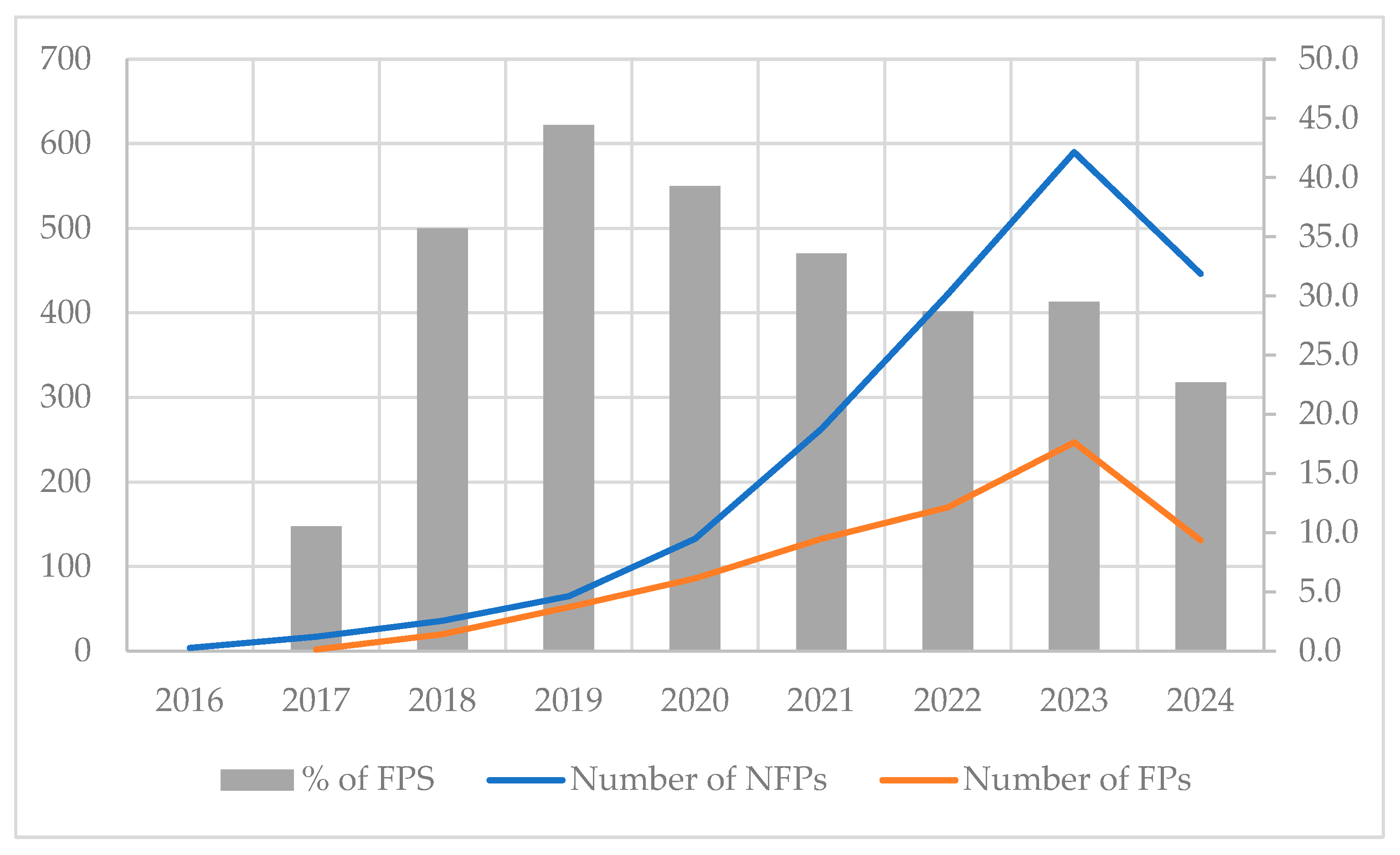
Figure 4.
The FPs author keywords landscape.
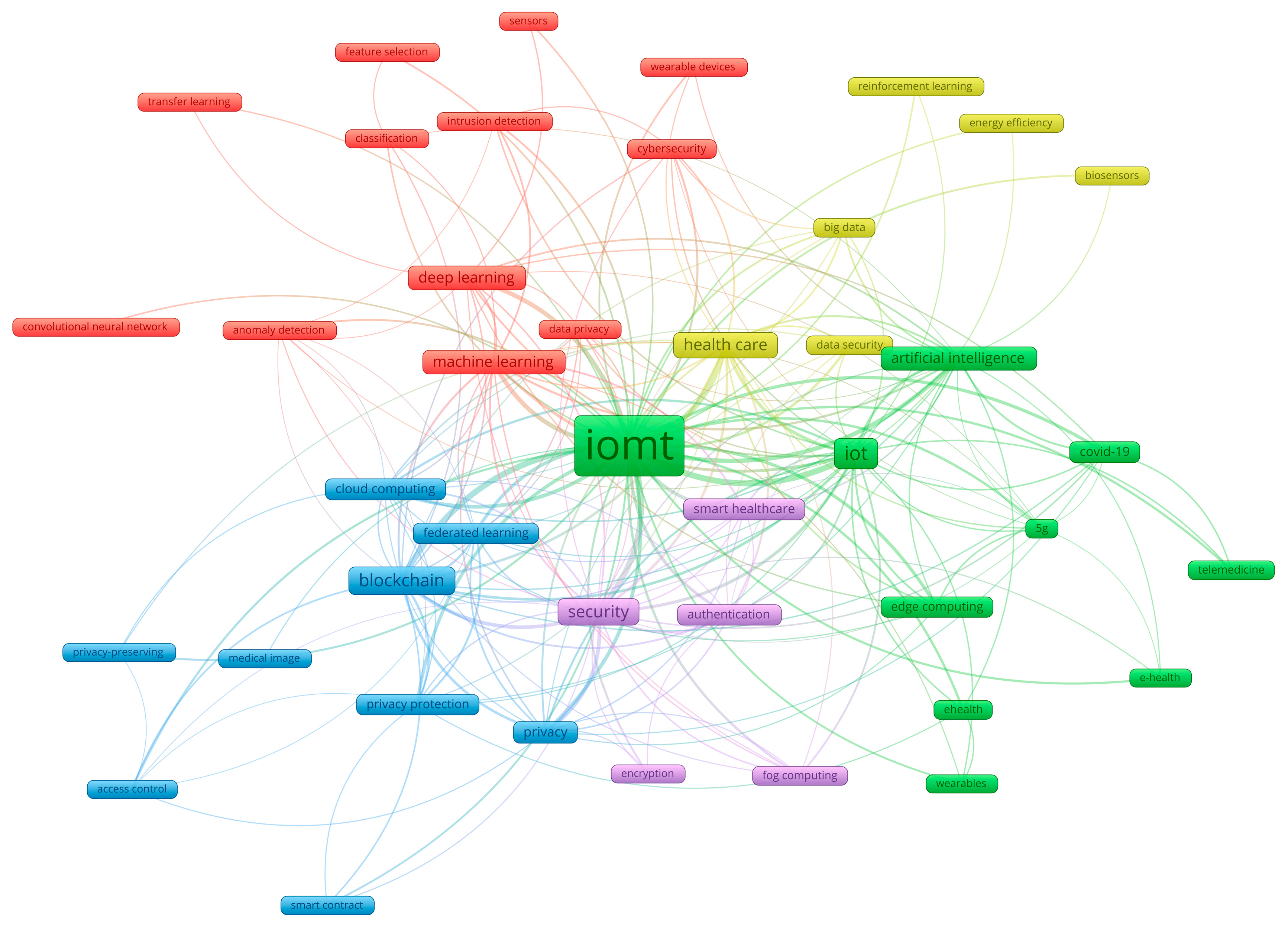
Figure 5.
The NFPs author keywords landscape.
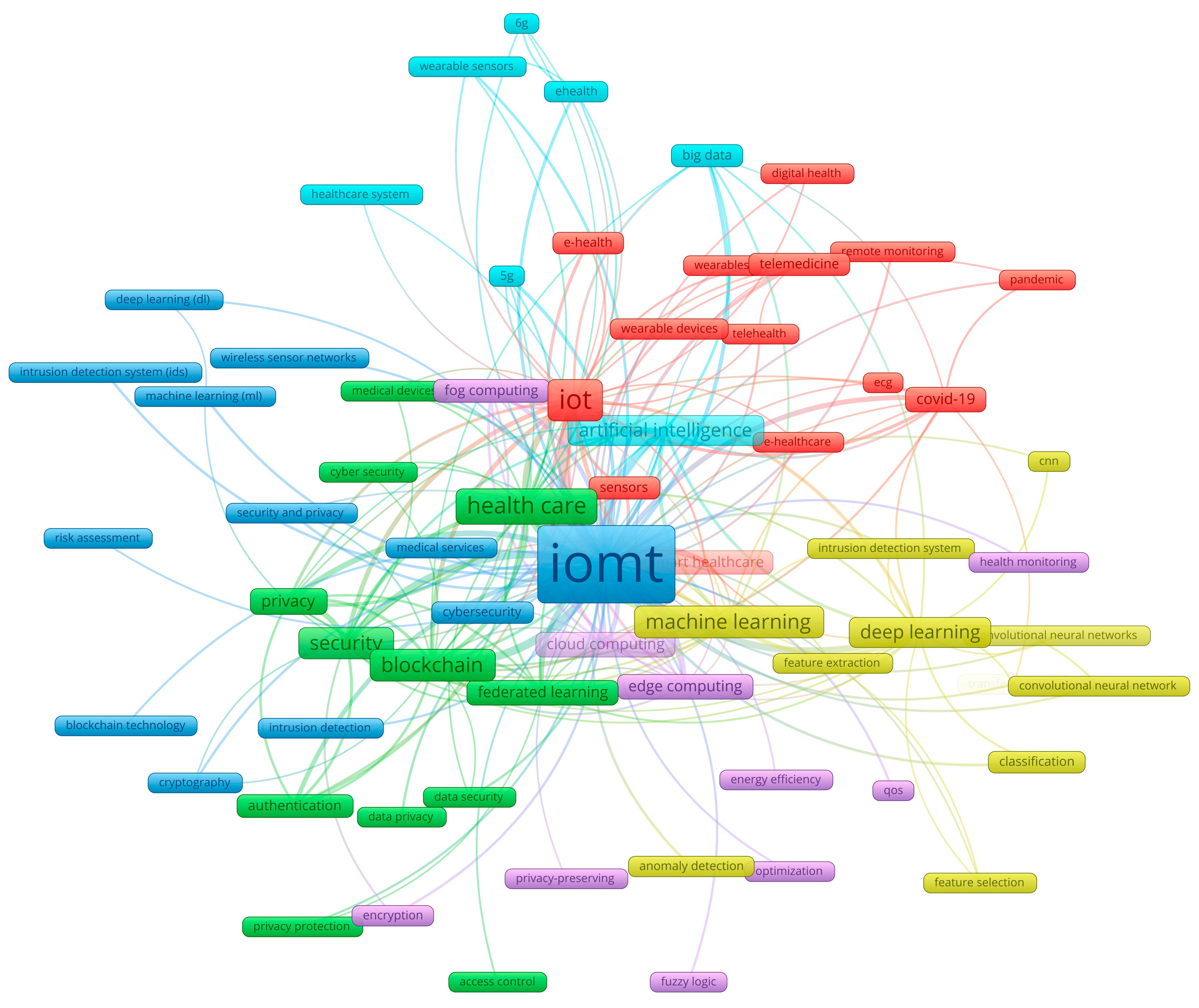
Figure 6.
The BGHI 2024 in association with the number of published FPs per capita on 1M residents.


Table 1.
Publication types.
| Document Type | Number of NFPs | % of NFPs | Number of FPs | % of FPs |
|---|---|---|---|---|
| Article | 910 | 46.0% | 602 | 71.5% |
| Conference Paper | 563 | 28.5% | 171 | 20.3% |
| Book Chapter | 300 | 15.2% | 9 | 1.1% |
| Review | 86 | 4.3% | 57 | 6.8% |
| Conference Review | 43 | 2.2% | 0 | 0.0% |
| Book | 33 | 1.7% | 0 | 0.0% |
| Editorial | 17 | 0.9% | 1 | 0.1% |
| Erratum | 11 | 0.6% | 0 | 0.0% |
| Retracted | 7 | 0.4% | 0 | 0.0% |
| Letter | 3 | 0.2% | 0 | 0.0% |
| Note | 3 | 0.2% | 1 | 0.1% |
| Short Survey | 2 | 0.1% | 1 | 0.1% |
Table 2.
Most prolific source titles publishing FPs and NFPs.
| SOURCE TITLE | Number of FPs | SJR | Quarter | H-index | SOURCE TITLE | Number of NFPs | SJR | Quarter | H-index |
|---|---|---|---|---|---|---|---|---|---|
| IEEE Access | 70 | 0.96 | 1 | 242 | IEEE Access | 59 | 0.96 | 1 | 242 |
| Sensors | 52 | 0.79 | 1 | 245 | Lecture Notes In Networks And Systems | 58 | 0.17 | 4 | 36 |
| IEEE Internet Of Things Journal | 43 | 3.38 | 1 | 179 | IEEE Internet Of Things Journal | 57 | 3.38 | 1 | 179 |
| Electronics Switzerland | 24 | 0.64 | 2 | 83 | IEEE Journal Of Biomedical And Health Informatics | 40 | 1.96 | 1 | 156 |
| IEEE Journal Of Biomedical And Health Informatics | 20 | 1.96 | 1 | 156 | Communications In Computer And Information Science | 27 | 0.2 | 4 | 69 |
| Future Generation Computer Systems | 19 | 1.95 | 1 | 164 | Internet Of Things | 24 | 1.64 | 1 | 52 |
| Computers Materials And Continua | 17 | 0.46 | 2 | 57 | Electronics Switzerland | 22 | 0.64 | 2 | 83 |
| Applied Sciences MDPI | 14 | 0.51 | 2 | 130 | IEEE Transactions On Industrial Informatics | 21 | 4.42 | 1 | 193 |
| Computer Communications | 13 | 1.40 | 1 | 128 | Lecture Notes In Electrical Engineering | 20 | 0.15 | 4 | 45 |
| Information Sciences | 12 | 2.24 | 1 | 227 | Sensors | 20 | 0.79 | 1 | 245 |
| Average | 1.43 | 1.3 | 161.1 | Average | 1.431 | 2 | 130 |
Table 3.
Most productive countries and their country determinants.
| Funded/Nonfunded publication | COUNTRY/TERRITORY | Number of NFPs | Scimago rank in subject Medicine | Scimago rank in sub-subject Computer networks and communications | Health systems ranking 2023 [18] | Current Health Expenditure as % of GDP - 2021/22 | Current R&D Expenditure as % of GDP - 2021/22 [19] | BGHI |
|---|---|---|---|---|---|---|---|---|
| NFP | India | 849 | 11 | 3 | 112 | 3.28 | 0.65 | 61.3 |
| NFP | United States | 213 | 1 | 2 | 69 | 16.57 | 3.45 | 79.5 |
| NFP | China | 192 | 2 | 1 | 5 | 5.38 | 2.43 | 46.3 |
| NFP | Saudi Arabia | 145 | 35 | 27 | 56 | 5.97 | 0.46 | 77.2 |
| NFP | Pakistan | 112 | 40 | 30 | 124 | 2.91 | 0.16 | 61.5 |
| NFP | United Kingdom | 93 | 3 | 6 | 34 | 11.34 | 2.91 | 88.8 |
| NFP | Australia | 73 | 9 | 13 | 21 | 10.54 | 3.25 | 90.9 |
| NFP | Iraq | 69 | 65 | 50 | 115 | 5.25 | 0.04 | 62.8 |
| NFP | Italy | 63 | 6 | 8 | 17 | 9.00 | 1.45 | 91.5 |
| NFP | Malaysia | 62 | 42 | 16 | 42 | 4.38 | 0.59 | 84.2 |
| AVERAGE | 21.4 | 15.6 | 59.5 | 7.462 | 1.539 | 74.4 | ||
| FP | China | 280 (57.1%) | 2 | 1 | 5 | 5.38 | 2.43 | 46.3 |
| FP | Saudi Arabia | 176 (52.1) | 35 | 27 | 56 | 5.97 | 0.46 | 77.2 |
| FP | India | 171 (20.0%) | 11 | 3 | 112 | 3.28 | 0.65 | 61.3 |
| FP | United States | 127 (36.3%) | 1 | 2 | 69 | 16.57 | 3.45 | 79.5 |
| FP | South Korea | 88 (69.3%) | 14 | 9 | 3 | 9.72 | 4.93 | 94.3 |
| FP | Pakistan | 75 (38.9%) | 40 | 30 | 124 | 2.91 | 0.16 | 61.5 |
| FP | United Kingdom | 66 (40.2%) | 3 | 6 | 34 | 11.34 | 2.91 | 88.8 |
| FP | Italy | 49 (42.2%) | 6 | 8 | 17 | 9 | 1.45 | 91.5 |
| FP | Egypt | 44 (48.4%) | 33 | 36 | 107 | 4.61 | 1.02 | 64.6 |
| FP | Malaysia | 42 (37.5%) | 42 | 16 | 42 | 4.38 | 0.59 | 84.2 |
| AVERAGE | 14 | 10.75 | 52.5 | 8.02125 | 2.055 | 74.9 |
Table 5.
Themes derived by using SKS.
| FPs Themes | Representative topics identified in prominent publications | NFPs themes | Representative topics identified in prominent publications |
|---|---|---|---|
| IoMT and AI use in e-health and telemedicine | ECG monitoring [25], e-health patient monitoring [26], elderly healthcare [27], Accident and emergency detection in One digital health [28] | Role of IoMT in pandemic management | Point of care testing of infectious diseases [29], Cognitive IoMT for pandemic management [30], Pandemic forecasting [31], Covid-19 management by federated learning [32] |
| Privacy in federated learning | Skin diseases [33], Smart healthcare [34], ECG classification [35], Misbehaviour detection [36], Heart disease diagnosing [37] | Privacy and security within federated learning | Privacy preservation with fraud enabled blockchain [38]. Privacy preservation in smart healthcare [39], Intrusion detection [40], Privacy sensitive federated learning [41] |
| Security in smart health care | Blockchain industrial secure encryption in healthcare [42], Hybrid authentication for digital healthcare [43], Threat detection in IoMT networks [44], Secure intelligent biosensors [45] | Machine learning detection of cybersecurity treads on IoMT applications | Cybersecurity of healthcare 5.0 systems using federated learning [46,47]. Tree classifier based intrusion detection in IoMT [48]. Multilayer perceptron optimisation for cybersecurity [49] |
| Secure big data analysis in healthcare | security threats, vulnerabilities, and counter measures [50], Blockchain, Blockchain assisted big data management [51], Healthcare in Smart Cities [52] | Big data analysis of data from wearable sensors for eHealth | Ambient assisted living [53], edge-stream computing for real time analysis of wearable data [54], big and wearable data in gynaecology [55], Big data based Smart Health Monitoring [56] |
| Advanced machine learning and data security in accessing data from wearables and sensors | Secure wearable ultrasound system [57], Privacy preserving federated learning [58], Robust zero watermarking for federated learning [59], Scalable transferable federated learning in classification of healthcare IoMT data [60] | Advanced machine learning | Remote patient monitoring [61,62]. Lung tumour diagnosing [63], Digitalization [64] |
Table 6.
The most prolific funding agencies.
| National Natural Science Foundation of China, China | 167 |
| National Science Foundation, USA | 45 |
| National Research Foundation of Korea,” Korea | 40 |
| National Key Research and Development Program of China, China | 36 |
| King Saud University, Saudi Arabia | 35 |
| Ministry of Science and Technology of the People’s Republic of China, China | 33 |
| Deanship of Scientific Research, King Saud University, Saudi Arabia | 32 |
| European Commission, EU | 29 |
| Ministry of Science, ICT and Future Planning, South Korea | 25 |
| Fundamental Research Funds for the Central Universities, China | 24 |
Disclaimer/Publisher’s Note: The statements, opinions and data contained in all publications are solely those of the individual author(s) and contributor(s) and not of MDPI and/or the editor(s). MDPI and/or the editor(s) disclaim responsibility for any injury to people or property resulting from any ideas, methods, instructions or products referred to in the content. |
© 2024 by the authors. Licensee MDPI, Basel, Switzerland. This article is an open access article distributed under the terms and conditions of the Creative Commons Attribution (CC BY) license (http://creativecommons.org/licenses/by/4.0/).
Copyright: This open access article is published under a Creative Commons CC BY 4.0 license, which permit the free download, distribution, and reuse, provided that the author and preprint are cited in any reuse.


