

Submitted:
30 September 2024
Posted:
30 September 2024
You are already at the latest version
Abstract
Soil carbon is newly refined as ~32,000 Gt C (gigatonnes) over ten times previous totals. Soil organic carbon (SOC) of ~22,000 Gt C plus plants at ~2,400 Gt C in both above- and below-ground stocks hold 99% of Earth’s biomass. Occupying a topographic surface area of 25 Gha with mean depth 21 m, soil has more organic carbon than all plants, oceans, fossil fuels, or the atmosphere combined. Soils are both the greatest biotic carbon store and the most active CO2 source. Basic inventory is required for proper understanding and utilization of Earth’s natural resources, especially with increasing soil degradation and species loss. Values are raised considerably, the disparity due to lack of full soil depth survey, neglect of terrain and of other omissions. Herein new totals are determined for mineral soils, permafrost, and peats (of all forms and ages), to full depth (easily doubling shallow values) and allowing for terrain that is ignored in all terrestrial models (doubling most values again), plus SOC in recalcitrant glomalins (~30%) and friable saprock (+26%). Additionally, soil inorganic carbon (SIC), aquatic sediments and dissolved fractions are factored in. Soil biota (e.g. fungi, bacteria and earthworms) are similarly upgraded. Primary productivity, also upped for terrain, is confirmed at 220 Gt C/yr on land supported by C/O isotope fluxes. Priority issues of species extinction, humic topsoil loss, and excess atmospheric CO2 are all remedied by SOC restoration and biomass recycling via (vermi-)compost for use in 100% organic husbandry and adoption of wider practices of Permaculture based upon scientific observation of Nature.
Keywords:
Organic C
; biogenic carbon
; stocks
; NPP
; circular economy
; CO2 drawdown
; climate
1. Introduction
Although this report focused on biomass stocks and losses, the issue of increasing biomass energy to replace fossil fuels is also briefly discussed in the context of other limitless energy systems such as terrestrial heat pumps, geothermal energy and restoration of compressed-air power from falling water in trompe systems or directly from deep subterranean sources. It seems a misguided policy or plan to redirect valuable crop residues or other organic sources from composts that need to be returned to soils, especially if this is under an argument to address climate issues related to CO2 increases. With realization that most emissions are from topsoil losses, then the priority should be return of carbon directly back to the soils in a circular economy, using appropriate organic farm practices.
Some data presented herein are well established, others are newly unearthed but, as always, it is proper and seemly to start revisions at the beginning – from “the ground up”.
Life on Earth is carbon-based, seemingly emerging in geothermal hot-springs, as in Darwin’s prescient “warm little pond” theory of origin, possibly with Montmorillonite clay catalysis evidenced by soils forming nearly 4 billion years ago and living entities on land for >3.5 billion years (Ferris and Ertem 1998, Follmann and Brownson 2009, Mulkidjanian et al. 2012, Djokic et al. 2017, Retallack and Noffke 2018, Dahmer and Deamer 2020).
Evolving organisms faced extreme challenges of radiation and resources that gradually resolved when land plants emerged spurring the Neoproterozoic Oxygenation Event (NOE) releasing sufficient oxygen O2 for ozone O3 to form, blocking the harmful radiation and fuelling a bountiful biomass turnover. Atmospheric oxygen O2 increase is stoichiometrically linked to carbon dioxide CO2 reduction in the classic photosynthesis equation:

Formula from the left is simplified photosynthesis; in reverse from the right is equal but opposite respiration/decomposition/incineration consuming the biomass (Figure 1).
Oxygen accumulated primarily due to land plants to a level of 21% O2 in the air we now breathe, it also fuels soil decomposition. The question is: Where did the carbon go?
The current study reviews and extends supporting evidence that, in the last 550 million years, Phanerozoic carbon was mainly sequestered on land; initially in living biomass, accumulating in primal soil organic matter (SOM, e.g. humus or Darwin’s “vegetable mould”), or sometimes fixed in anoxic sediments forming peats, coals, oils and other fossil fuels, with a concurrent and constant recycling on the land surfaces of the vital biomass, then as now.
How much carbon was fixed? Increasingly our understanding is SOM sequestration was substantial, given early carbon dioxide levels so much higher 550 Ma (Figure 2 and Figure 3).
As well as primordial chloroplasts and mitochondria as endosymbionts, early symbioses – as formed over 400 million years ago between fungi and cyanobacteria/algae in lichens of land’s biocrust – were partnerships between fungi and plants with mycorrhizal-like fungi emerging as early as ~500 Ma (Martin and van der Heijden 2024). This attests to biotic inter-reliance.
Related to fungi, particularly arbuscular mycorrhizal (AM) fungi, known previously as vesicular-arbuscular mycorrhiza (i.e., VAM), are now reported to consume up to 50% of the photosynthates from host plants. Such below-ground factors are often overlooked in biomass budgets and productivity model as discovery of the extent of ancient soil fungal syntheses are quite recent.
Hawkins et al. (2024) and Vlček and Pohanka (2020) show an estimate 10–50% of the carbon captured by photosynthesis is transferred underground to the AM fungi with earliest fossil symbioses from 250 to 400 million years ago (Rillig et al. 2001). Part of these nutrients are converted into glomalin, discovered only in the 1990s (Wright and Upadhyaya 1996), as a fungal hyphae/spore derived glycoprotein that is tightly bound to soil particles earning it the epithet of a “super glue”. Strictly it is part of a complex of difficult to extract compounds, including bacterial components and humic acids, all grouped under the term glomalin-related soil proteins (GRSP), that often contribute an extra 4–52% to SOC tallies: on average about a third more (Comis 2002). He et al. (2020) report that GRSP may account for 27% of total SOC, but in ancient soil (oxidized soil, >4 million years), GRSP was less at about 4–5% of total C, while in a peat soil, purified GRSP accounted for as high as 52% of the total SOC. Glomalin, or strictly GRSP, thus ranges between 4–52 %, but the means may converge with extra SOC around 25–30% in most mineral soils stocks. These large increases are gradually being accounted for in carbon cycles.
Omission of glomalin-like protein products alone from carbon cycle budgets substantially reduces reality and representativeness of models, invalidating many conclusions or policies based upon those incomplete reckonings.
1.1. Defining Biomass
The term biomass is the quantity of organic materials present in a habitat or biome. It generally refers to living or recently dead organisms, plus any byproducts of those organisms – virus, microbe, fungi, plant or animal. In a different though related sense, it is applied to plant matter or animal waste used or intended as a source of fuel. In a strict sense, it refers to a single species in a limited habitat or, in the broadest view, it encompasses all organism that are living or dormant, dead (sometimes labelled necromass), plus their specific products. In addition to plant, fungal or microbial exudates, products may include molluscs shells or earthworm calciferous secretions, plus bird eggs, animal bones, etc – which are generally (mis)classed as inorganic carbon in soil analyses. Biomass is usually expressed as mass for a defined area, or as density per unit area (for soil or land), or per unit volume (for aquatics and oceans) but often this is summarized per unit area too, these then are averaged out and multiplied by (planimetrically flat areas) for totals.
Measurements of biomass are obtained by two basic methods, direct sampling (cores or quadrats for perpendicularly “flat” surface areas in the field), and via remote sensing (e.g. towers, aircraft or satellites). Mean values per unit area are extrapolated for biomes based upon simplistic model assumptions. Although planimetrically flat surface areas are appropriate for aquatics, for terrestrial values a manifest reality is that terrain must be considered due to undulating topography of land and overlying rugosity of soils. Other, often underappreciated, factors are the true depth of soils (including friable saprock) and extraction of the recalcitrant glomalin/GRSP fraction in soils, as are detailed later.
Terrestrial values may be doubled for depth for inappropriately shallow samples, and more than doubled again for topographical terrain (Blakemore 2018b, 2020, 2023).
Thus, for example, Rodin et al. (1975) data already showed the Earth’s living organic matter (biomass) dominated by autotrophic and photosynthesizing organisms land. Land’s total biomass, for both above- and underground parts of plants as dry weight was 2,402 Gt (>99.9%), equivalent to 1,201 Gt C which, doubled for terrain, is indeed ~2,400 Gt C. Phytomass in the world’s oceans of 0.08 Gt C is 30,000 times smaller than that on land.
1.2. Soil Organic Carbon (SOC) as a Key Component
In addition to phytomass, Soil Organic Carbon (SOC), comprising approximately half of all the complex biochemicals in soil organic matter (SOM), is used as a standard measure of soil biomass. This is either rapidly recycled or is stored and progressively consumed, decomposed, eroded, burnt, thawed or drained; in Nature or via human activities. When considered in its entirety, SOC stock often accumulates over varying timescales and is held to depth in several interlinked and intergrading SOC storage sub-categories:
- Biomass that is actively living and is then mostly recycled within short time periods;
- Mineral soils (with <17 % SOC) that store humic carbon when there is insufficient nitrogen or other limiting factors for completed digestion by microbes (this inferred from poor agriculture that adds excess N rapidly depleting the humic SOM stocks);
- Permafrost that is seasonally frozen soil (partly with permafrost peatlands);
- Non-permafrost peat that is waterlogged and too oxygen deficient for decay;
- Fossil fuels formed from geological-scale, anoxic accumulation of SOM products;
- Sediments washed from watersheds, or in Dissolved Organic Carbon (DOC).
Jackson et al. (2017) demonstrated soils hold the largest biogeochemically active carbon pool on Earth, albeit they noted estimates of SOC have ranged by a factor at least six-fold, from 500 to 3,000 Gt C (and now by at least a factor of ten). Their six-fold SOC increase is interesting as it is less than the modest 4–6-fold increase invoked and as criticized in a study by Blakemore (2018b). Similar wide errors yet pertain to other biomass estimates and metrics, with ranges differing inordinately, thereby attesting to our ignorance of soil basics.
Blakemore (2023) summarized latest information thus: “Re-evaluation of topographical terrain on a non-flat Earth increases most soil dynamic inventories. Carbon credits of our neglected and disappearing SOC stocks are enumerated for mineral soils (~4,100 Gt C plus ca. 20–30% glomalin), Permafrost (>4,200 Gt C), peat (1,123 Gt C), plant roots (916 Gt C), litter (600 Gt C), microbes (200 Gt C), fungi (30 Gt C), biocrust (10–20 Gt C), earthworms (2.3–3.6 Gt C), termites (0.15 Gt C), nematodes (0.06 Gt C), ants (0.024 Gt C), and soil viruses (0.02–4.0 Gt C).” This sums to about >12,000 Gt C or up to 15,000 Gt C but these values are refined herein.
As Blakemore (2023) reported, soil ecological data are so remarkably obscure that values presented by different authors may differ by an order or two of magnitude, often subsequently revised upwards. For example, the global SOC stocks range reported by Scharlemann et al. (2014) was 504–3,000 Gt SOC; now it ranges 1,417–15,000 Gt SOC due to a statement by Hiederer and Kochy (2012) that: “the global SOC stock to 100cm soil depth is estimated at 1,417 Pg C” compared to best estimates (with terrain) for >10,000–15,000 Gt (Blakemore 2018b, 2020 - https://veop.files.wordpress.com/2020/06/veop-4-5.pdf, 2023). Already, without terrain, errors were manifest in mineral soil underestimations up to seven times (Harper and Tibbett 2013), Permafrost by 200% or three times (Shelef et al. 2017) – these base values since doubled by Blakemore (2018b, 2020c) – and total Peat SOC is further doubled (Loisel et al. 2021, Nichols and Peteet 2019, 2021). Roots are underestimated up to 100% (Robinson 2004), and for litter Brovkin et al. (2011) found: “litter stocks based on observations (68–97 Gt C) or models (47–196 Gt C)”. Mainly terrestrial Bacteria have uncertainty, as with most other soil biota, up to 10-fold (Bar-On et al. 2018). For Net Primary Productivity (NPP) estimates were 2–5 times higher accounting for belowground dynamics (Scurlock et al. 2002), and Running et al. (2004) discuss disparities in both satellite and model assumptions with: “range of two orders of magnitude in field-measured NPP”. Noting that “Soils provide humans with 98.8% of our food”, soil erosion has a rate of loss: “unsustainable at 10–1000 times higher than the rate at which soils form” (Kopittke et al. 2019). Winkler et al. (2021b) posited global land use change as × 4 greater than previously estimated. Koren et al. (2019) show soil<->air CO2 flux estimates vary from 25–450 Gt C/yr, and discrepancy of SOC loss oxidation fraction during erosion were 0–100% (Lal 2006: Table 3.3). Preindustrial SOC emissions before 1850 range 48–540 Gt C (e.g. van Oost et al. 2012, Kaplan et al. 2010: Table 3) while Post-industrial data also vary with conversion from natural ecosystems to SOC-depleting farmland supposedly releasing 50–200 Gt C to the atmosphere (Lal 2006, 2009, Blakemore 2023). Many other examples of wide uncertainties are found in such vitally important soil properties or rates of change showing a need for urgent review.
What is the cause of such uncertainty to most basic soil metrics? Despite recent initiatives such as GBIF, SoilBON, Global Fungi Database (https://globalfungi.com/) or Earth Microbiome Project (https://earthmicrobiome.org/), data deficits in soils is surely due to lack of a dedicated, peak “Soil Ecology Institute”, comparable to myriad Marine or Atmospheric Institutes, to compile or coordinate basic research/education in both natural and managed soils. This oversight is further highlighted in data deficiencies in this study.
1.3. Biotic and SOC Stock Status Review
Disparity in an unjustifiable overemphasis of marine compared to soil research is manifest in the most recent estimates of living abundance and biomass data (Figure 4).
Since plants are accepted as being soil-based, soil arguably supports most living biomass in the whole of the Biosphere. Biomass of >100 Gt C (>99%) is mostly terrestrial found almost entirely within soil or supported by soil; the lesser ~1 Gt C (<1%) biomass is partly marine: viz. Fish, Arthropods (marine), and Cnidarians (corals). While for viruses – by far the most numerous of any organism – the majority are also from soils (Blakemore 2024). Nematodes are mostly terrestrial, but not particularly abundant nor weighty having much lower biomass and influence than Annelids (earthworms), barely above meagre whales (with miniscule <0.01 Gt C - Fahttps://ourworldindata.org/grapher/global-whale-biomass).
In global carbon stock context, Biosphere is a relatively minor contributor (Figure 5).
1.4. Global Carbon Stocks and Cycles Review
Herein the global estimates of biomass in terms of carbon stocks from cyclical turnover and processing of atmospheric CO2 (i.e., NPP fixation and its decay), are updated from summaries provided of annual carbon cycle sources and sinks on a global level by the Global Carbon Project (https://globalcarbonbudget.org/), their most recent being published in December, 2023 (GCB 2023 – https://essd.copernicus.org/articles/15/5301/2023/). In addition, comparison is with the IPCC Working Group 1 that produces its own periodic Assessment Report, the two most recent being IPCC WG1 AR5 (2013) and AR6 (2021 – www.ipcc.ch/report/ar6/wg1/downloads/report/IPCC_AR6_WGI_Chapter05.pdf).
Biogenic carbon is stored for varying periods in biomass before re-circulation via three main active reservoirs: as gasses in the atmosphere; in solution (or debris) in the ocean; and as both gas or liquid but mainly solid matter in soils, summarized in Figure 6.
Global carbon stocks from latest GCB (2023) report are: Atmosphere – 885 Gt C; Ocean – 700 Gt C as dissolved organic carbon (also ~37,000 Gt in dissolved inorganic carbon being mainly deep, inaccessible and inactive); and Soil – 3,100 Gt C (1,400 Gt C in Permafrost plus 1,700 Gt C in “Soils”). Terrestrial Vegetation is cited as 450 Gt C and Marine biota 3.0 Gt C (i.e., only 0.5% of total living biomass), but this too needs revision.
Regarding primary productivity, it is notable that the unrepresentatively narrow arrows for land flux indicate 130 Gt C/yr in gross primary production drawdown with a matching 130 Gt C/yr in total respiration plus decomposition, mainly from soils. As explained later, this implies an NPP rate of (130/2 =) ~65 Gt C/yr. The further impression, that the ocean has a similar but lower exchange of 80 Gt C/yr, is not active photosynthesis nor respiration, rather it is passive Henry law gas exchange (as shown by the AR5 and AR6 report figures that follow below).
Ocean NPP is really quite low e.g. Rodin et al. (1975: Tables 1 and 2) have ocean at (60/2 =) 30 vs. land at (172.5/2 =) 86 Gt C/yr or about three times greater. Siegenthaler and Sarmiento (1993: Figure 1b – www.gfdl.noaa.gov/bibliography/related_files/us9301.pdf) showed marine biological production of just 10 Gt C/yr compared to terrestrial NPP of ~50 Gt C/yr converted into “soil and detritus”, or five times as much on land (they also clearly show soil decomposition plus deforestation releasing more than ten times emissions from fossil fuels). Moreover, tables in Gouldie and Cuff (2002: 105, 111) have marine NPP at ~55 and terrestrial or continental NPP double at ~116 Gt C/yr (from”Whittaker and Likens, 1975: Table 5.2”). These land NPP rates, doubled again for terrain (as is justified shortly), are (96 × 2 =) 172, (50 × 2 =) 100 Gt C/yr, and (116 × 2 =) ~232 Gt C/yr that is above the terrestrial NPP of 218 Gt C/yr in Blakemore (2018b: Table 11). Models that do not address or reflect such large deficits will surely fail.
Some other studies have indeed concluded that terrestrial NPP is undervalued. Welp, Keeling et al. (2011) stated: “Our analysis suggests that current estimates of global gross primary production, of 120 petagrams of carbon per year, may be too low, and that a best guess of 150–175 petagrams of carbon per year better reflects the observed rapid cycling of CO2”, i.e., NPP rate >80 Gt C/yr. Other “official” counts have higher NPP too, e.g. IPBES (2018: 245) has “a total global terrestrial NPP of around 100 PgC yr-1”. And Liang et al. (2023) now have terrestrial NPP greater than 85–100 Gt C/yr (as is remarked on further below). As is also noted later, Sanderman et al. (2010) also inadvertently advocate increasing NPP for glomalin.
Original and latest isotope “best guess” studies using ¹³C/¹²C, 18O/16O or 18OCO, and 17O/ 16O support raised GPP/NPP estimates (e.g. Welp, Keeling et al. 2011, van der Velde et al. 2014, Liang et al. 2017 and Laskar et al. 2019). With a passive, self-cancelling ocean exchange at ±80–90 Gt C/yr, isotopes indicate global carbon exchange scaled up to 772, 779.2 or as high as 897 Gt C/yr. Koren et al. (2019: Figures 1 and 4b) model NPP at 114 Gt C/yr and air↔leaf flux of -400–750 Gt C (i.e., ±350 Gt C/yr). All these studies support the need to raise land NPP which is easily justified since they all ignore terrain in their models.
An especially significant note in Siegenthaler and Sarmiento (1993, Figure 1a,b) is global carbon changes from pre-industrial to 1990s levels with a cumulative land-use effect deficit of -120 Gt C divided equally between loss of vegetation and soil carbon, accounting for most atmospheric CO2 increase from 600 then to 750 Gt C, or +150 Gt C, thus 80% likely due to poor soil management. This relates land clearing for crops and pastures, and agrichemicals which are the major cause of soil depletion and CO2 accumulation.
Soils are thus already “officially” demonstrated as the greatest organic carbon stock (>3,000 Gt C) and the greatest sink and source of CO2 from respiration + decomposition balancing GPP (~130 Gt C/yr GPP according to the GCB and IPCC), an order of magnitude above the fossil fuel emissions now around 9.6 Gt C/yr. However, the present study confirms soil SOC stock and terrestrial NPP values are inordinately underestimated. Blakemore (2018b: Tables 8 and 11; 2023) has values of >8,580–15,000 Gt SOC and ~220 Gt C/yr NPP, both confirmed and further refined herein.
Data in GCB (2023) report is compared with an earlier IPCC (2021) report (Figure 7).
As just noted for the IPCC (2021) figure, intimate ocean NPP is better represented at 11 Gt C/yr while their NPP on land of ~71 Gt C/yr corresponds to the value implied in Laskar et al. (2019) and in Haverd et al. (2020: Figure 2a https://onlinelibrary.wiley.com/doi/full/10.1111/gcb.14950) with 142 Gt C/yr terrestrial GPP they say represents a 35% increase since 1900 due mainly to the CO2 greening effect. A corresponding rapid increase in atmospheric CO2 estimated in this same period (1900–2020) is from 280 ppm to 412 ppm, which is a similar 32% rise. The inability of NPP to accommodate this rise is attributable in a large part, and as is argued herein, to the net loss of topsoil and humus erosion with other limiting factors reducing the foundation and ability for plants to adapt to and fully utilize this otherwise limiting resource.
Concomitantly, global loss of topsoil biomass emits more carbon per year than do fossil fuels. Interestingly, the IPCC AR6 (2021) report accepts that current melting of ancient permafrost adds CO2 also depleted in isotopic carbon to the atmosphere just as burning of fossil fuels does when they say “thawing soils due to anthropogenic warming are losing carbon from the decomposition of old frozen organic matter, as found via carbon 14 (14C) signature of respiration at sites undergoing rapid permafrost thaw..”. It is an oversight for IPCC to not also readily accept that the rapid erosion and loss of ancient mineral soils, formed over billions of years and similarly depleted in 14C isotopes, contributes to the atmosphere too.
Jackson et al. (2017) noted that additional complication is that ∼300 Pg of the permafrost region soil carbon is stored in peatlands, which must not be counted twice when summing separate peatland estimates (Jackson et al. 2017, Treat et al. 2024). Permafrost AR6 divided into surface or deep plus some non-permafrost soil in the boreal region (of 280–340 Gt C with median value around 300 Gt C), possibly alluding to peatlands that are mostly excluded from the IPCC report for some reason, as will be discussed further in this study. Yet they do accede that “Peat soils, where thick organic layers build up due to saturated and anoxic conditions, represent another possible source of carbon to the atmosphere. Peats could dry, and decompose or burn as a result of climate change in both high (Chaudhary et al., 2020) and tropical (Cobb et al., 2017) latitudes, and in combination with anthropogenic drainage of peatlands (Warren et al., 2017). Peat carbon dynamics are not included in the majority of CMIP6 ESMs.” This is confirmed by GCB (2023 supplement - https://essd.copernicus.org/articles/15/5301/2023/essd-15-5301-2023-supplement.pdf): “Bookkeeping models do not directly capture carbon emissions from the organic layers of drained peat soils nor from peat fires. Particularly the latter can create large emissions..”.
The AR6 summary compares to an earlier AR5 report (IPCC 2013) that, although the ocean values are the same, had soil, permafrost and vegetation much higher (Figure 8).
Note that the natural gas “reserves” in this IPCC report differ too, ranging 383–1,135 Gt C, mainly in methane (CH4) that is also a biomass breakdown product. Schuur et al. (2022) have methane emissions from thawing permafrost at around ∼0.5–2 Gt C/yr which is a sizable contribution and may itself possibly be doubled to account for terrain factors. Nevertheless, despite its substantial importance, natural gas is not considered further in this current carbon study.
For Ocean carbon Wikipedia – https://en.wikipedia.org/wiki/Oceanic_carbon_cycle claims that the total active pool of carbon at the Earth’s surface for durations of less than 10,000 years is roughly 40,000 gigatons C with about 95% (~38,000 Gt C) stored in the ocean, mostly as dissolved inorganic carbon from erosion and not actively related to NPP. Thus, it too is not a major consideration for practical and active carbon stocks and cycles.
The reasons why the ocean inventory includes dissolved organic carbon (DOC at 700 Gt C) and dissolved inorganic carbon (DIC at ~38,000 Gt C) but not for soils is unclear as soil inorganic carbon (SIC) plus DOC and DIC as well as being substantial are reactive.
As noted in Blakemore (2024 – https://vermecology.wordpress.com/2024/07/30/soc/), Raza et al. (2024) have “Inorganic C as soil carbonate (2255 Pg C down to 2 m depth) and as bicarbonate in groundwater (1400 Pg C) together surpass SOC (2400 Pg C) as the largest terrestrial C pool”. An update by Huang et al. (2024) claims soil inorganic carbon is slightly higher, but only by about 50 Gt C, at 2,305 ± 636 (±1 SD) Gt SIC to 2 m soil depth.
Arguably these are doubled again, at least for depth if not for terrain, as in Results.
In addition to inorganic carbon, dissolved organic carbon (DOC) component has a global budget estimate of 7.20 Gt in the top 0–30 cm and 12.97 Gt in the 0–100 cm soil profile that will increase as permafrost melts further (Guo et al. 2020, Heffernan et al. 2024). For soils >1 m, this total value likely more than doubles to >26 Gt DOC and a possible terrain factor doubles this value again to around 52 Gt DOC. Nevertheless, it is likely that DOC is already included in the SOC results presented, depending upon sampling, treatment and measurement regimes of actual soil samples, so its addition is ambiguous.
1.5. Soil Depth and Sampling Considerations
Unlike the atmospheric or oceanic inventories that are entire, soil carbon stocks are often inexplicably and unrealistically measured in only the top 20–30 cm or perhaps the top metre or so, and the Soil Survey soil depth was often to just 1 or 2 m. This is unrepresentative as peats can be 200 m deep, permafrost 1.6 km, and mineral soils up to 3.1 km with global mean soil depth 13.1 m blending into underlying bedrock often with several metres (mean ~8 m?) of friable saprock (Shangguan et al. 2017: Table 1, Hicks-Pries et al. 2023, Blakemore 2024 – https://vermecology.wordpress.com/2024/02/20/dtb-2/). Pettier et al. (2014) noted that sedimentary deposits in lowlands generally exceed the 2 m depth limit of most soil surveys.
Moreover, soil samples cores are taken perpendicular to the centre of the Earth and values extrapolated based upon planimetrically flat land biomes. Whereas actual land is sloping and hilly at macro-scale and the soil is bumpy and rugose at micro-scales.
Factoring in full soil depth and terrain, ups soil carbon stocks and rates considerably.
Stones are removed or sieved from soil samples and are reported separately, as are visible roots, earthworms and other larger biotic inclusion that may or may not be measured. For this reason, estimates of both roots and earthworms are provided in this report.
As a starting point for review, are unrefined soil data in the reports in Table 1.

Table 1.
Summary of terrestrial organic carbon stocks and cycles (in Gt C or Gt C/yr).
| Entity (Gt C) /Citation | IPCC (2013)* | Blakemore (2018b, 2023) | (IPCC 2021)* | GCB (2023)* |
|---|---|---|---|---|
| Soil Organic Carbon (SOC) | ~1,950 | >8,580 | 1,700 | 1,700 |
| Permafrost (SOC) | 1,700 | (included) | 1,200 | 1,400 |
| Total soil SUC | ~3,650 | >8,580–15,000 | 2,900 | 3,100 |
| Vegetation biomass | 550 | ~2,000* | 450 | 450* |
| NPP Gt C/yr | 61.5 | >220** | 71*** | 65** |
* Prior reports based upon non-desert, non-ice, flat land surface of ~12 Gha, rather than 24 Gha as per Blakemore (2018b), have only been modified slightly in the last decade. Most plant measurements are of above-ground parts, almost aways ignoring below-ground roots and exudates that likely double biomass and NPP data, plus terrain and soil relief that double values again. **Doubled for soil depth factors, 65 NPP is 130 Gt C/yr; doubled again for ignored terrain is 260 Gt C/yr. ***Rodin et al. (1975) NPP was 71 Gt C/yr.
1.6. Previous SOC Stock Studies
The “official” SOC stock inTable 1 of IPCC (2021) and GCB (2023) are 2,900 and 3,100 Gt SOC that gives a median and a mean total global value of around ~3,000 Gt SOC.
A comprehensive study by Jackson et al. (2017: Table 2) had the following categories:
- Mineral soils (0–2 m deep) – 1,263 Gt SOC;
- Permafrost (0–2 m) – 466 Gt SOC;
- Peatland (in permafrost region, 0–2 m) – 116 Gt SOC;
- Peatland (non-permafrost, 0–2m) – 427 Gt SOC.
- Soils, permafrost, and peat (at 2–3 m depth) – 498 Gt SOC allocated thus: 199 for mineral soils, 207 for permafrost region (with half peat?), ~92 for peatland;
- Additional SOC deposits (deeper than 3 m) – 330–550 Gt, median 440 Gt, allocated thus: 300–500 (median ~400 Gt) in permafrost region (ambiguous about including peat that they limited to mean depth of 2.3 m?), ∼30–50 (~40) in tropical peatlands;
- Sediments to depth elsewhere e.g., deltas, floodplains, loess deposits – unknown.
Although their data are complex, they may be summarized as mineral soils (0–3 m) with (1,263 + 199 =) 1,462 Gt SOC; permafrost (0 to >3 m) with (466 + 116 + 207 + ~400 =) 1,189 Gt SOC; and non-permafrost peat (0–2?) with (427 + 92 + ~ 40 =) 559 Gt SOC. Total soil carbon was thus 3,210 Gt SOC to 3 m depth, excluding substantial deep sediments. Comparably, Wang et al. (2022: Table 1) to just 0–2 m was 1,100 higher at 4,305 Gt SOC.
For the vast permafrost region alone, Tarnocai et al. (2009) reported deeper sediments with 407 Gt C in the 3–25 m Yedoma deposits and 241 Gt C in permafrost delta alluvia >3 m to add another (407 + 241 =) 648 Gt SOC. This is greater by 248 Gt C than the ~400 Gt C Jackson et al. estimated for deeper than 3 m. Added to Jackson et al.’s permafrost total this gives in the permafrost region in total to depth about (1,189 + 248 =) 1,437 Gt SOC.
Furthermore, Jackson et al. (2014) note ∼300 Gt of the permafrost region soil carbon is stored in peatlands, so their non-peat permafrost becomes (1,437 - 300 =) 1,137 Gt SOC.
In effect this also removes about 300 Gt C of peats in permafrost soils in peatlands and some tundra region that are claimed by Treat et al. (2023) to total 1,307 Gt SOC to depth; albeit they state just 185 ± 66 Gt C of peat is located in permafrost peatlands.
For total peat, Jackson et al. may have limited depth for northern peatlands to 2.3 m (as per Gorham 1991: Table 1), totalling peatlands plus permafrost peat as (559 + 300 =) ~590 Gt C approximately agreeing with other peat tallies elsewhere converging at ~600 Gt C.
Concerning peat and permafrost, Tarnocai et al. (2009) had 1,672 Gt of organic carbon to >3 m depth for total permafrost, of which approximately 1,466 Gt was in perennially frozen soils and deposits (proper permafrost), suggesting the remaining 206 Gt C is in permafrost peat alone, albeit Jackson et al. had 300 Gt permafrost peat, or about 100 Gt more. The 1,672 Gt C in Tarnocai et al. is 500 Gt higher than Jackson et al. total permafrost >3 m of 1,189 Gt C. Both are lower than recent permafrost estimate of 2,000 Gt C in Schuur et al. (2022) that for some reason seems to ignored in latest IPCC and GCB reports.
An important point is that these lower Permafrost totals of 1,672 or 1,189 Gt Gt SOC in the boreal region are close to the 1,700 or 1,200 Gt SOC reported in permafrost by IPCC (2014, 2021) thus seemingly including boreal peat in permafrost, yet apparently omitting non-permafrost peat as a separate entity. This is a major oversight as will be shown by the revision of the extent of global peatland carbon stocks. As a crosscheck, the areas of peatlands or bogs in permafrost or in the tropics are defined separately in Rodin et al. (1974: Table 3), in their extensive, yet often overlooked, study of Earth’s total phytomass and NPP.
Nevertheless, in summary, Jackson et al. (2017) total SOC pool to 3 m is 2,800 Gt C, plus >3 m adds >500 Gt, to total >3,300 Gt SOC (possibly extra 500 Gt for permafrost SOC).
As all their data are based upon planimetrically flat biome areas, when properly doubled for terrain and topography (except for waterlogged peats and deltas), the total approximates as ((3,300 - 675) × 2 + 675 =) ~6,000 Gt SOC. Doubled again to allow for subsequent calculations to deeper mean depths for soil, permafrost and peat (noted later) this is 12,000 Gt SOC, plus a reasonable third for glomalin (as explained later), is closer to 15,000 Gt SOC. Wang et al. (2022: Table 1) of 4,305 Gt SOC, if treated similarly, is higher yet.
Upper values of 12,000–15,000 total global SOC were already demonstrated in Blakemore 2018, 2020c, 2023: Table 5), but these publications are mostly overlooked in reviews.
1.7. Comparison of Current Total SOC Estimates and Erosion Losses and “Best Guess” Total
An “official” GCB (2018 or Le Quere et al. 2018: Figure 2) had 1,700 Gt C in “Permafrost” and 1,500–2,400 Gt C in “Soils” to total between 3,200-4,100 Gt SOC, the same as IPCC (2021) but about half that in Blakemore (2018). However, GCG (2023) from IPCC (2021) data had just 1,700 + (1,200 or 1,400, respectively) to give a mean total ~3,000 Gt C. This is at odds with a contemporary summary of other accepted, “official” values by Wang et al. (2022: Table 1) with 4,305.5 Gt SOC to just 2 m depth from latest estimates of WISE and SoilGrids data sets. These may be multiplied for depth and terrain with other additions and this study attempts such soil revaluation refinements in the Results sections.
Their 3,000 Gt total SOC stock doubled for terrain is ~6,000 Gt C as per Blakemore (2018) but is not fixed as it is subjected to constant, and increasing, net erosion. Lal (2020) said: “The global magnitude of SOC erosion may be 1.3 Pg C/yr. by water and 1.0 Pg C/yr. by wind erosion..” (total 2.3 Gt SOC/yr that, likely doubled for terrain, is possibly over 4.6 Gt C/yr, approximately the same as annual Fossil Fuel emissions). Nevertheless, GCB (2023) admits their budget “is incomplete and uncertain because SOC erosion is not accounted for.”
Most simplistically, as a “Fermi Estimation” that will be reviewed in more detail in this study, from “official” baseline SOC estimates to a couple of metres depth of ~3,000 Gt SOC, adding a third glomalin/GRSP is ~4,000 Gt, saprock adds 25% for ~5,000 Gt; doubled for depth and then again for terrain gives a mean best-guess value of about 20,000 Gt SOC.
1.8. Comparison of Current Total Biota Estimates and Extinction Losses
For Vegetation, rather than 450 Gt C as reported by AR6 (IPCC 2021) and GCB (2023) the AR5 (IPCC 2013) median was 550 Gt C that almost corresponds to Scharlemann et al. (2014) and Crowther et al. (2019: Figure 2A) that are both explicit that this is for “aboveground” vegetation at 500–560 Gt C which, as pointed out by Blakemore (2019 – Science eLetters Dec. 2, 2019 RE: Soil Carbon and Biomass: Flat Out Wrong?). When properly doubled for terrain this is >1,100 Gt C. In addition, belowground plant roots are also substantial, almost equivalent to aboveground plant biomass also at around 916 Gt C (as justified in Blakemore 2018b, or - https://vermecology.wordpress.com/2023/08/31/not-unreasonable-new-global-biotic-total/ and https://vermecology.wordpress.com/2023/11/06/up-2-c/). This gives about 2,000 Gt C in our global plant standing stock, mainly on land which almost agrees with the earlier full-depth value modified from Rodin et al. (1975) data of 2,400 Gt C that is the most properly justified. Comparably, all these reports show Oceans combined biota amounts at most to only 3 Gt C biomass (0.15% of total and much less than this when soil biota and terrestrial animals are fully corrected and included for land).
Correct and thorough inventories of global biomass abundance and biodiversity are important for understanding basics of important ecological and hence economic realities of production and consumption, but also to track changes or threat of extinction events.
Five of these major global extinction events have occurred, prior to our current situation of mass biotic loss, this time mainly from the soil due to bad agriculture, excessive meat consumption, and soil acidification from fertilizer overuse, plus general poisoning of our soils, and hence food, and secondarily of air and water, with toxic agrichemicals and other pollutants. Soil erosion and loss of soil organic matter is a global issue of concern as is soil acidification – also mostly from agrichemical excess – as a major, albeit mostly ignored, problem (Raza et al. 2021, Zamanian et al. 2021, Blakemore 2022 - https://vermecology.wordpress.com/2022/02/24/sock). Acidic mineral soils support less SOC and biota.
That there is an extinction crisis and loss of life (and thus also biomass) may be realized in the Living Planet Index showing a -69% decline in populations of certain species since 1970 (https://ourworldindata.org/grapher/global-living-planet-index). Albeit species loss mostly applies to soil organisms being subject to most intense threats or pressures, they are also most ignored, especially plants, invertebrates and microbes (Blakemore 2018a). Issues of biomass and biodiversity loss will be discussed, with proposals on how to reverse and restore these, mainly via restoration of 100% organic husbandry, under the principals and practices of Permaculture (Mollison 1988) and a circular economy.
1.9. Mystique of Historical Marine vs. Land NPP Speculations
For the overestimated ocean NPP values noted above, seemingly all ocean estimates (e.g., IPCC, ESSD, etc.) track back to Revelle and Suess (1957: Table 2) based “in part after HUTCHINSON (1954)” that was “too uncertain to allow any definite conclusions”. Hutchinson (1954: 380) had NPP on land just 20 ± 5 Gt C/yr saying these figures were too low as they failed to account for tropical rainforests(!). Ocean NPP claimed six time greater at 126 ± 82 Gt C/yr he said was likely “an order of magnitude too high” or, as Neilsen (1952) said, “incredible” and the latter author found ocean indeed just ~15 Gt C/yr. These mystical, widely speculative NPP figures (126 or 155 vs. 20 Gt C/yr ocean vs. land) appear to originate from Riley (1944: 134) tracking back to as early as Shroeder (1919).
Field et al. (1998), as an oft quoted source, had similar NPP contributions from terrestrial [56.4 Gt C/yr (53.8%)] and oceanic [48.5 Gt C/yr (46.2%)] components, with ocean productivity nearly halved in estimates made before 1970s satellite data. Their average NPP on land was 426 g C/m2/yr, whereas ocean almost a quarter of this at 140 g C/m2/yr. Land calculations for their flat surface, properly doubled for terrain, amount to ~113 Gt C/yr. Alternatively, since NPP is now shown to be around 220 Gt C/yr then a four-fold increase is warranted. These authors also cogently note: “Because of the rapid turnover of oceanic plant biomass, even large increases in ocean NPP will not result in substantial carbon storage”.
Moreover, in a comprehensive study, Rodin et al. (1975: Table 1) refined Ocean NPP to 30 Gt C/yr and Continental NPP to 86 Gt C/yr (which when doubled is 162 Gt C/yr). Woodwell et al. (1978: Table 1) had marine NPP as 24.8 Gt C/yr and land just 52.8 Gt C/yr, whereas Siegenthaler & Sarmiento (1993) gave new marine biological production of 10 Gt C/yr compared to terrestrial NPP of 50 Gt C/yr, or five times greater.
Land NPP is now much higher as the current report demonstrates, due mainly to new data for soil respiration plus the terrain facto, at ~220 Gt C/yr. Compared to this, there is little evidence for ocean NPP much above 10–30 Gt C/yr supporting its total biomass of only around ~3 Gt C, nor of any direct interaction between the atmosphere and marine photosynthesis gas exchange. As Duursma & Boisson (1994: 124, 134–5) for oceans state: “The turnover time of water masses, which transport CO2 into the deep sea in polar regions, where the CO2 is released at lower latitudes, is of the order of a thousand years (650 year in the Atlantic to 2000 in the Pacific)… Increased atmospheric CO2 will only slightly affect the CO2 level in the oceans, since the latter contain 55 times more CO2 than the atmosphere. Thus there will be no feedback based on increased atmospheric CO2, or at most very little)... The average annual primary production of the world oceans of 30 gigatons carbon”.
Reports of lower ocean NPP of just 15–25 Gt DOC/yr and an Oceanic DOC pool of only 0.2 Gt C, however, Hansell and Carlson (2015) citing 660 Gt DOC in the Ocean say: “With this fast turnover, the pool’s contribution to carbon sequestration is inconsequential.” Moreover, sea<->air gas exchanges are passive and instantaneous as governed by Henry’s Law. Hence, Ocean’s overstated importance to global CO2 or O2 cycles are in truth relatively minor and highly speculative. As Koren et al. (2019) explain: “the gross ocean fluxes largely cancel out” (just around net ∼±3 Gt C/yr globally). Hence much promoted “Blue Carbon” ocean climate proposals are similarly unrealistic and impractical or speculative solutions without any grounding, as is noted by Johannessen and Christian (2023).
1.10. Turnover Time (τ) for Atmospheric Carbon Support Higher Land NPP
Further support for higher terrestrial NPP also come from isotopic studies of the atmosphere and the turnover time to recycle all atmospheric CO2 carbon of 890 Gt C. Most recently, Liang et al. (2023) have admitted wide underestimation with their latest “best estimate” of terrestrial GPP of ~ 170–200 Gt C/yr (= NPP on land of 85–100 Gt C/yr and median ~93 Gt C/yr!) plus their turnover time for atmospheric CO2 was just (890 Gt C/560 Gt C/yr NPP=) 1.5 years. Despite ignoring terrain, their table 2 shows that Hoffman et al. (2004) had already calculated land GPP (200 Gt C/yr) as more than twice ocean GPP (91 Gt C/yr) or NPP 100 vs. 46 Gt C/yr.
Their ocean component claimed as 90–120 Gt C/yr GPP (or 45–120 Gt C/yr NPP) is likely overestimated since, as noted above in detail, there is little evidence for ocean NPP much above 10–30 Gt C/yr. Thus, their ocean NPP estimates maybe overblown by 35–90 Gt C/yr which, when logically carried over to land, ups the land NPP ranges to 120–190 Gt C/yr approaching the 218 Gt C/yr land NPP from Blakemore (2018).
That the land is the major influence is confirmed by their turnover times being 1.2 yr vs. 1.8 yr in the North vs. the South; or 50% more rapid where there is most land, viz. the South having 50% less land than the North.
Earlier, Welp, Keeling et al. (2011) said: “Our analysis suggests that current estimates of global gross primary production, of 120 petagrams [Gt] of carbon per year, may be too low, and that a best guess of 150–175 petagrams of carbon per year better reflects the observed rapid cycling of CO2”, i.e., giving approximate NPP, PR, and SR rates of >80 Gt C/yr with fossil fuel (FF) contribution only ~11%. Other “official” counts are also of higher NPP, e.g. IPBES (2018: 245) has “a total global terrestrial NPP of around 100 PgC yr-1” trending towards an estimate, with terrain, of 218 Gt C/yr (Blakemore 2018b), that reduces fossil fuel emission to 4–5%.
Using C and O isotopes, Welp, Keeling et al. (2011), Liang et al. (2017), Laskar et al. (2019), and now Liang et al. (2023), give CO2 carbon turnover times of 0.9–2.8 yrs (median ~1.8 yrs), mainly due to terrestrial activity. Compared to Liang et al. (2023), the earlier figures by Welp, Keeling et al. (2011) estimated 475–897 Gt C/yr and atmospheric C turnover time of 0.9–1.7 yrs (mean 1.3 yrs). With just ±80 Gt C/yr passive exchange from oceans, then presumably 395–817 Gt C/yr (mean ~600) is on land and all 875 Gt C CO2 processed in ~1.5 yrs. As they say: “plausibly, the fast response can be accounted for by revising global GPP upwards.”
Indeed, these studies confirm the trend to up GPP as in Blakemore (2020c, 2023). Concomitant with an increase in realistic NPP is upping of global terrestrial biomass stocks, SOC, and other carbon rates, as are refined in revisions below.
2. Methods
Land measurements are often at large scale, often hectares or, at most refined, perhaps at m2. As justification for terrain measurements at progressively finer scales, it is noted that many biological processes act at the cellular or microbial level, and solar irradiance is measured in the langley (1 gram-calorie/cm2), a sun (100 mW/cm2), or in kcal/cm2 corresponding to individual photosynthetic leaf surface areas that are also on average at the cm scale. Soil aggregate particles are at the micro scale and soil microbial assays also.
Reasonable assumptions for most biotic samples are that moisture content is about half (i.e., 50% for dry weight but often hydration is much higher), for dry samples a carbon content is about half again. For soil organic matter (SOM), this follows the Van Bemmelen factor modified by Pribyl (2010) based on the determination that organic matter in most cases is ~50% carbon. Biomass carbon Whitman et al. (1998) took as half average soil prokaryotic dry cell weight. This is tolerable as Bratbak and Dundas (1984: Table 1) showed bacterial dry weight was about half the cell weight, and C content about half again.
Net primary productivity (NPP) on land – sometimes called biomass productivity – is about half gross productivity (GPP) to allow for respiration both from plants (PR) and respiration/decomposition from soils (SR). Expressed in terms of carbon amassed or exhaled per year (Gt C/yr), the formulas, when Nature is in balance, are:
NPP = GPP – PR; NPP ≈ SR and SR ≈ PR; thus NPP ≈ GPP - (PR + SR)
Rather than Pg C as in some other sources, the current report standardizes carbon in gigatonnes (109 tonnes) which is expressed as Gt C or Gt C/yr, as per GCB (2023).
A conversion factor of 2.12 Gt C per ppm atmospheric CO2 complies with IPCC (2021: Figure 6-1) after Prather et al. (2012). Thus the 420 ppm today in 2024, is about 890 Gt C total.
3. Results and Discussion
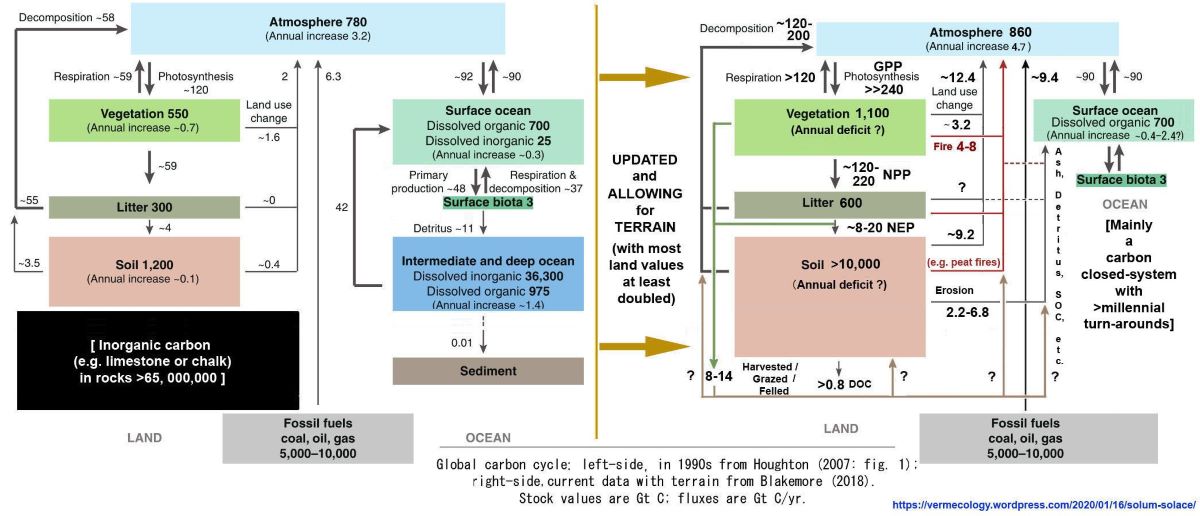
This report aims to refine, update, and correct omissions in data in Blakemore (2018b, 2023) as summarized in the Introduction and as shown graphically here (Figure 9).
3.1. Soil Respiration Upgraded
Soil/litter respiration/decomposition (SR) is through root (autotrophic ~50%) and microbial (heterotrophic ~50%) respiration calculated by Nissan et al. (2023) at ~110 Gt CO2 C/yr they said is about ten times the fossil fuel emission. This is the same as 111 Gt C/yr that Koren et al. (2019: Figure 1) modelled for total soil respiration. More recent range of values have been 68–101 Gt C/yr (Hashimoto et al. 2023), or 78–108 Gt C/yr (Huang et al. 2020), these latter authors found the total SR at around 107 Gt C/yr. Reasonably doubled for neglected terrain, SR is then in the bounds of 220 Gt C/yr, with possibly 50:50 from root respiration vs. microbial decomposition. This is more than twenty times the release of CO2 carbon from burning of fossil fuels at around ~10 Gt C/yr. Also, as NPP ≈ SR, then NPP is presumably also supported at around~220 Gt C/yr.
Total Soil Respiration of ~100–220 Gt C/yr implies similar ~100–220 Gt C/yr Plant Respiration (PR) to total ~200–440 Gt C/yr balancing GPP in formula NPP = GPP – (PR + SR). The mostly natural soil respiration/decomposition (SR) rate of 220 Gt C/yr, as noted, is >20 × fossil fuel emissions of 9.4 Gt C/yr, matched by 9.2 Gt C/yr SOC loss (median of ~9 Gt SOC/yr in Blakemore (2023: Table 4) largely from (bad) farming methods, plus 3.2 from Vegetation = ~12.4 Gt C/yr. Adding Fire (4–8 Gt C) to LUC (~12.4 Gt C) gives net Land emissions of ~16–20 Gt C/yr, about twice that released from burning fossil fuels.
3.2. Biomass Refinements (Carbon Budget Increases in Vegetation, Litter and in Soils)
Biomass stocks or turnover rates are verified from on-the-ground sample measurements, but insight into the origin might also be derived from estimates of geological inventory of atmospheric carbon and oxygen levels in the primal atmosphere. Plausibility of higher land carbon stocks determinations are calibrated based upon carbon drawdown.
Is higher soil carbon plausibly justifiable? As noted in the Introduction, early atmospheric levels changed due to carbon drawdown of the Neoproterozoic Oxygenation Event. Published studies update error values, with a range of 1,500–20,000 ppm and a median value of ~8,000 ppm CO2 around 550 million years ago (Ma), when fungi and other microbes were likely abundant, but land plants barely established a toehold (Figure 10A).
Torsvik et al. (2024: Figures 1–13) had higher median CO2 of 8,000–10,000 ppm, 550 Ma.
At current CO2 values near 420 ppm the difference from a median range 8,000–10,000 ppm converted to mass (× 2.12), implies 16,000–20,000 Gt C removed in toto. This would be a likely minimum value as CO2 has been constantly added during the last 500 million years from volcanic and other processes that would have also been drawn down by land plants. IPCC (2013: Figure 6.1) show volcanic emissions of 0.1 Gt C/yr (or strictly 0.02 to 0.05 Gt C/yr due to vulcanism) that, if constantly multiplied through millennia, would amass an enormous amount of excess carbon, albeit this is more than offset by “rock weathering” with a 0.4 Gt C/yr flux of dissolved inorganic carbon (DIC) derived from the weathering of CaCO3, which takes up CO2 from the atmosphere in a 1:1 ratio. Both these fluxes are themselves possibly cancelled out by net loss from soils to rivers of 1.7 Gt C/yr, and then from rivers to sea of ~0.8 Gt C/yr of which estimated as about half organic and half inorganic carbon. Therefore, net ~20,000 Gt SOC fixation since 550 Ma ago is likely a most modest receptacle evaluation.
A simple stoichiometric cross-check is O2 level in Figure 10B. After the ocean and rock sinks were saturated, this gas began to fluctuate with net accumulation in the atmosphere. From 550 Ma starting values shown about 18% and current level are about 21% This is a 3% increase or, proportionately, +16%. Since the mass of atmospheric oxygen today is about 1.1 million Gt this 16% would equate to about 150,000 Gt O2 added following the photosynthetic removal of the carbon atoms from CO2. Since carbon is about 0.27 of total CO2, then the presumed corresponding drawdown of carbon would roughly equate to (150,000 × 0.27 =) 40,500Gt C.
This implies a likely range of carbon sequestered from the CO2 and O2 inventories of between 16,000–40,500 Gt C, giving a median drawdown value around 30,000 Gt C in toto.
Given that total fossil fuel stocks (coal, oil, gas) are estimated at 5,000–10,000 Gt C (Haughton 2007 and from https://earthobservatory.nasa.gov/features/CarbonCycle) the balance is about 18,000–23,000 Gt C and this is arguably stored in ancient soils, peat, permafrost and also in current biomass stocks, mainly on land, plus carbon sediments variously eroded from soils on land as now found in freshwater (or as net loss to the ocean).
This lower value of 18,000 Gt C nearly corresponds to land SOC (16,016) and sediment SeOC (2,460) (from https://vermecology.wordpress.com/2023/11/06/up-2-c/) that total about 18,500 Gt C supporting these revised estimates as being reasonably justified.
Compounding factors are a standing stock of global biota of about 2,400 Gt C in above-ground (mainly in plants) and below-ground roots plus >200–400 Gt C in soil biota (as in https://vermecology.wordpress.com/2023/11/06/up-2-c/). This gives about 2,700 Gt C in a living global biotic standing stock, mainly on land compared to 3 Gt C of ocean biota that itself was doubled from previous estimates due to revision by Bar-On et al. (2018) to 6 Gt C, yet still just 0.1-0.2% of total global standing stock biomass.
3.3. GPP and NPP Consideration
Global Gross Primary Productivity is mainly on land at around 440 Gt C/year which, less plant respiration, gives about 220 Gt C/yr Net Primary Productivity (with only around 20 Gt C/yr in Ocean, or just ~8%) after Blakemore (2018, 2023). This also implies that ~890 Gt C currently in atmospheric CO2 is recycled in (890/440 =) ~2-year cycles on land via land-plant photosynthesis fixation and soil respiration/decomposition by the soil biota.
Outcomes, for the total fixed 28,250 SOC stock, are being either stored, eroded to ocean, and/or fossilized. As also noted, various past and present extinction events return some stored biomass SOC to atmospheric CO2 from decay, as does topsoil erosion today.
Before soil fulfilled its potential, oxidation saturation of ocean and atmosphere occurred; analogous is the current research effort situation needing to be redirected to soils.
3.4. Correction Factors for Soil Carbon Stocks (Terrain, Depth, Glomalin, Saprock)
Major refinement of biomass C stocks are for terrain, depth, glomalin and saprock.
Terrain increases those terrestrial values mostly presented as planimetrically flat biomes (Blakemore 2018b). Other considerations are the biomass stored at depth in soil and the effect of soil depth on the estimations of NPP or respiration, plus contributions of glomalin and other difficult to extract biotic protein products. Almost always overlooked, these are beginning to be factored in, both to biomass stock and primary production rates.
3.5. Soil Depth Considerations
It is becoming increasingly realized that soils are extraordinarily ancient and deep. Richter and Markewitz (1995) questioned: “How Deep Is Soil?” and, on page 601, noted: “The lower boundary of soil is difficult to determine precisely, so the Soil Survey Staff (1992) recommended that, for convenience, the lower limit of soil be considered to be at a depth of 2 meters.” [My bolding]. Yet most samples are still for only 30 cm or at most a metre or so.
This is manifestly inadequate as Jobbágy and Jackson (2000) estimated 56% more SOC storage in the top 3 m of soil than in just the first meter. Rolando et al. (2021), in soils up to 5 m deep, found that the layers below 90 cm accounted for approximately 80%, while the 0–30 cm layer represented only 10% of the total SOC stored. As already noted in the Introduction, in Western Australia, Harper and Tibbett (2013) had SOC values up to five times greater in soils at depth >1 m down to 35 m.
Although often assumed or reported that soils are only a metre or two deep, a summary by Shangguan et al.11 (2017: Table 1) has: “The mean absolute DTB [Depth to Bedrock] predicted was 33.6 m” but a Mean and Maximum Absolute DtB was 13.1 m and up to 3.1 km depth in two USA samples for mineral soils, not for peats nor permafrost (see Blakemore 2024 - https://vermecology.wordpress.com/2024/02/20/dtb-2/ for details).
For peat/lignite, the deepest known is in Phillipi, Greece, reported to be 190 m and dating largely from the Pleistocene (Parish et al. 2008). Permafrosts are known to extend as much as 1.6 km and also date to the Pleistocene (often referred as the Ice Age) from 2.5 Ma or the Holocene from about 11, 000 years ago. Mineral soils are much more ancient, some fossilized in rocks, from over 4 billion years old (Rillig et al. 2001) but mostly forming since about 500 million years ago. Thus, soils are shown as much older and deeper than commonly believed.
Although Jackson et al. (2017) had a caveat that their ~3,300 Gt total SOC estimates could be as much as 700 Gt C smaller due to a revised depth to bedrock (DtB) by Pelletier et al. (2016), this may be a wide underestimation. Jackson et al. do not give their DtB estimates, but, for China alone mean DtB was 42.20 m in a study by Yan et al. (2020), whereas mean values predicted by Pelletier et al.10 (2016) and Shangguan et al.11 (2017, Figure 10b) were just 11.81 m and 26.64 m, respectively. This suggests Pelletier model DtB is about half of Shangguan model, itself about half of the Yan model. Thus, Jackson et al.’s figure may truly be doubled (or possibly quadrupled?), for greater depth, to >6,600 Gt SOC!
An interesting but rather confusing study by Scharlemann et al. (2014) had peat in tundra and tropics >3 m deep with 1,672 Gt C and 11 m deep with 89 Gt C, respectively.
However, errors in Scharlemann et al. is their "peat soils" in tundra from Tarnocai et al. (2009), when checked, are possibly for permafrost. What Tornocai et al. actually said is: "In total, the northern permafrost region contains approximately 1672 Pg of organic carbon". They do attempt to differentiate, noting "Histels (perennially frozen peatland soils, Gelisols) and Histosols (unfrozen peatland soils)" with Gelisols (from Latin gelare, "to freeze") being soils of very cold climates that contain permafrost within two meters of the surface. Nevertheless, the domains of peat and permafrost are somewhat intermixed and confused. Furthermore, Page et al. (2011) tropical peat depth of 11 m are only for Rwanda; other depths average 4-5 m with a mean ~4.5 m tropical peat depth (as Ribeiro et al. 2021 noted below).
An effective depth of peat vs. permafrost peat is discussed further in the Peat section.
Yost and Hartemink (2020) discovered that soil depth is lacking from about half of the papers they surveyed. Moreover, the depth of the soil studied halved in the past 30 years. As they say, for a more complete understanding of soil processes, soil properties, and microbial communities, soils should be studied to a greater depth.
Hence extrapolation from superficial results, to account for full depth of the soil profiles, seems entirely appropriate and reasonable albeit water tables influence deeper soils.
Now soils are known to be tens or thousands of metres deep, shallow samples are no longer tenable. As with terrain, the mere doubling for soil depth may be a most modest outcome although it is routinely practiced herein in the present work, it is quite justified.
3.6. Glomalin and Glomalin Related Soil Proteins (GRSP)
A summary paper by Irving et al. (2021) confirmed that glomalin-related soil proteins (GRSPs) are thought to represent c. 20% of the soil organic carbon and aid carbon sequestration by stabilising soil aggregates. For farmlands, USDA (www.ars.usda.gov/ARSUserFiles/30640500/Glomalin/Glomalinbrochure.pdf) say: “Glomalin accounts for a large amount (about 15 to 20%) of the organic carbon in undisturbed soils.” As noted in the introduction, He et al. (2020) report that GRSP may account for around 27% of total SOC but in ancient, oxidized soil (>4 million years old), GRSP was less at about 4% of total C, whereas in a peat soil, purified GRSP was as high as 52% of the total SOC. The "Rillig et al. 2000" reference from He et al. (2020) appears to be mistaken, but another paper by Schindler et al. (2007) does have 52% glomalin in peat, viz.: "GRSP accounted for 25% and 52% of total C in the mineral soils and organic soil [peat], respectively." This implies that to account for difficult-to-extract glomalin, measured peat SOC may (always?) be doubled. It has been shown that GRSP can contribute about 27% of SOC while soil humus may contribute only about 8% of carbon, thus the carbon contribution capacity of GRSP is 2–24 times that of soil humus (Rillig et al. 2001). The GRSP status of permafrost is uncertain and urgently requires more study as its contribution may be substantial.
Conversely, Sanderman et al. (2010) while admitting that some studies at that time indicated glomalin as high as +27% in SOC, claimed 0.7 to 2.4% appear more common for agroecosystems which may be partly true for intensive, agrichemical fields which are depleted in both humus and soil biota (as in Blakemore 20218a). Their understanding at that time suggested values much above 2% of SOC were unreasonable based on the NPP they calculated would be needed to support AMF hyphal growth (in their Appendix II). In other words, if glomalin was as high as reported they would need to change their NPP models. This is not a proper Scientific approach as the data should speak for itself, regardless of ideals. Since glomalin is measured up to 30 or 52% of SOC, what they have unwittingly done is support the need for NPP models to be substantially increased, as herein, up to 220 Gt C/yr.
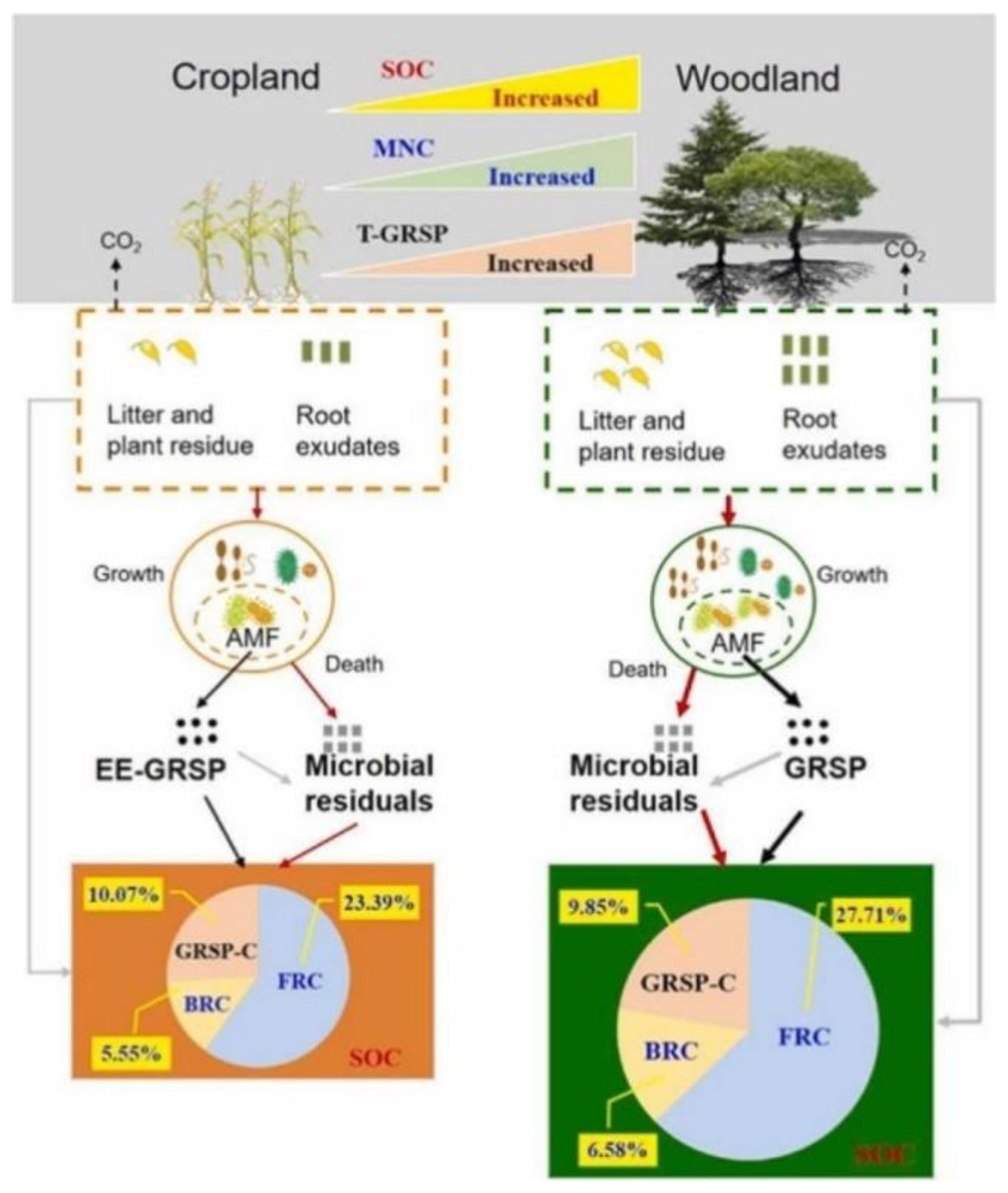
Current information is scant and based upon few studies, but confirmation of importance and contribution of GRSP to total SOC as outlined in Irving et al. (2021) are found in a study by Zhang et al. (2023) showing GRSP (in total?) in cropland and forests making up 24% and 18% of the 20–25 g/kg SOC, respectively. They reported that total GRSP accounted for 8.19%–73.70% of SOC in the forest soils and 4.33%–86.11% in croplands, while easily extracted GRSP was obviously less, at 1.00%–10.38% or 1.09%–12.37%, respectively, of SOC totals. This demonstrates that glomalin is a non-trivial SOC addition. Their summary figure gives an indication of respective fungal and bacterial components (Figure 11).
Figure 11.
From Zhang et al. (2023: Figure 8) of SOC with abbreviation of MNC for Microbial necromass-C; EE- and T-GRSP for easily extractable and total Glomalin Related Soil Proteins; AMF for Arbuscular mycorrhizal fungi; BRC and FRC for Bacterial and Fungal Residual carbon. GRSP made up 24% or 18% of 20.4 or 25.1 g/kg SOC stocks, respectively. Of note, outside GRSP, bacterial BRC contributes about 15% of total SOC carbon.
Figure 11.
From Zhang et al. (2023: Figure 8) of SOC with abbreviation of MNC for Microbial necromass-C; EE- and T-GRSP for easily extractable and total Glomalin Related Soil Proteins; AMF for Arbuscular mycorrhizal fungi; BRC and FRC for Bacterial and Fungal Residual carbon. GRSP made up 24% or 18% of 20.4 or 25.1 g/kg SOC stocks, respectively. Of note, outside GRSP, bacterial BRC contributes about 15% of total SOC carbon.
Moreover, Cisse et al. (2023) recently found glomalin particularly important in (fungal dominated?) acid soils of coniferous forests which are abundant in the boreal North.
3.7. Bedrock/Saprock Adds to Soil Depth and Carbon Reserves
Taking a global mean soil Depth to Bedrock (DtB) ~13 m, a recent study by Hick-Pries et al. (2023 - see https://vermecology.wordpress.com/2023/11/06/up-2-c/) says friable Saprock may extend soil profiles +8 m deeper, possibly giving a new total (13+8 =) 21 m.
Recent reports by Moreland et al. (2021) and Hicks-Pries et al. (2023) estimated an extra 26–30% of carbon stored in weathered bedrock beneath soil these latter authors said “can be up to 8 m, for a total soil depth of more than 10 m”. It seems, however, that they were misled by the assumption soil is only 2 m deep, rather than 13.1 m deep on average as herein. Moreland et al. (2021) who found “up to 30% of OC was stored in saprock (friable weakly weathered bedrock)”. These authors suggest an extra 200 Gt or more land carbon which may be a minimum, and may be doubled for terrain to at least 400 Gt SOC. However, if mineral SOC is up to 16,000 Gt, adding 26% for saprock gives an extra ~4,000; in other words 400–4,000 Gt SOC is a wide range of saprock values that needs refinement.
Relevance of saprock for permafrost or peat overlying lignite/coal beds is unknown.
3.8. Case Study of SOC Underestimation: Australia Increases × 30 (25 Gt C to >750 Gt C)
Of especial note, for “Oceania” (i.e., mainly Australia), Shangguan et al. (2017: Table 1) mean DtB is 33.36 m just as Harper and Tibbett (2013) found in WA (see Blakemore 2018). Sangmanee et al. (2023) also in SW Australia sampled carbon up to 29 m deep. Then a question is: How much carbon is in Australian soils? The CSIRO’s Soil Carbon Mapping Project (Rossel et al. 2014) provides national scale representation of an average amount of organic carbon of Australian soil at 29.7 t/ha and total for the continent at 24.98 Gt SOC, but only in the top 30 cm. Doubled for depth (at least!) then again for neglected terrain is 100 Gt SOC stock, plus 25% GRSP and 25% saprock would total ~150 Gt SOC. The flaws in the argument by Sanderman et al. (2010) for dismissing glomalin are already explained.
Although much higher, this is a minimum value if Rolando et al. (2021) are correct that the 0–30 cm layer represented only 10% of the total SOC, hence the true figure may be >750 Gt SOC! Moreover, this is remnant soil as Chan and McCoy (2010) estimated >50% of original SOC stock lost in intensive Australian cropping systems; essentially, SOC has been mined. Australian agricultural soil 0.3 m deep of 12.7 Gt SOC, doubled for depth then terrain alone is ~52 Gt SOC remaining. If proper organic farming restored this back to 100 Gt SOC in agricultural soils, SOC would be stabilized with equivalent drawdown of -25 ppm CO2. Further details on re-greening Australia and/or Tasmania are in Blakemore (2022 - https://www.preprints.org/manuscript/202212.0258/v2, Blakemore 2023).
3.9. Total Global Soil SOC Refined
As noted in the Introduction, estimations for global soils differ widely, due in part to overlap between precise biomes definitions, due too to inadequate allowance for full soil depth (now >13 m on average), and neither for terrain factors nor errors from analyses.
Soils occupy about 12 Gha on a conventionally flat landscape of 15 Gha that is not ice-covered nor arid desert, now raised up to 24 Gha soil on 32 Gha total (Blakemore 2018).
Estimates of global SOC generally range around ~3,000 (IPCC or GCB in figures above) or as FAO (2022) summarize: "The global SOC stock of ice-free land contains about 1500-2400 Pg C (1 Pg = 1 Gt) in the top 1 m, 2300 Pg C in the top 3 m, and 3000 Pg C in the soil profiles.” Higher figures by Crowther et al. (2019: Figure 2C) have SoilGrid values to 4,595 Gt C (not 1,500 Gt C as stated) and Wang et al. (2022: Table 1) had SOC stock 0–2 m depth from latest WISE and SoilGrids data sets of 2,815–5,796 Gt C with median value of 4,305.5 Gt C.
Although almost any interim value from the wide range given could be taken as a starting point for refinement, a moderate median value is perhaps around 3,600 Gt SOC.
Doubled for depth and then again for terrain gives 14,400 Gt SOC, plus a third glomalin to total more than 19,000 Gt SOC plus +25% saprock sums up to ~23,750 Gt SOC.
Conversely, since glomalin and saprock are calculated as additions to baseline value, from ~3,600 Gt SOC, adding a third for glomalin/GRSP is 4,800 Gt, plus +25% for saprock is 6,000 Gt, then doubling for both depth and terrain gives approximately 24,000 Gt SOC.
For proper analysis, total values may to be divided into major soil constituents. In particular, SOC stocks are broadly sub-divided between mineral soils, Permafrost, peats, plus soil biota. Following is separate treatment for each component to compare outcomes.
3.9.1. Mineral Soils
Mineral soils are formed from biotic weathering of parent rocks and are primarily composed of inorganic material usually defined as having less than 17% living SOC compared to “Organic soils” like peat (not to be confused with the carbon enriched soils as found on organic farms). According to the Soil Classification Working Group, organic soil horizons may contain >17% SOC (or >30% of SOM) by weight, and these occur in Organic soils, or may be present at the surface of mineral soils. All soils are living entities, and a precise definition of a mineral soil is: “A soil consisting predominantly of, and having its properties predominantly determined by, mineral matter. It usually contains <20% organic matter [i.e., <10% SOC] but may contain an organic surface horizon up to 30 cm thick”. Permafrosts are perhaps entirely (or mostly?) excluded from this definition except where they are discontinuous or sporadic intergrades that may overlap with other soil types.
Mineral soils are the most productive for forest and farmland. Total mineral soil SOC is difficult to determine accurately but can be calculated from best current estimates, or deduced from total soil SOC less the peat and permafrost components.
Perhaps a reasonable starting point is Jackson et al. (2017) who explicitly account for mineral soils with 1,263 Gt SOC up to two metres depth and 199 Gt SOC in 2–3 m deep soil (with zero below this, thus omitting deeper delta, alluvia or loess) to total (1,263 + 199 =) 1,462 Gt SOC. Doubled for depth, and again for terrain is 5,848 Gt SOC. Adding 25–30% glomalin/GRSP is ~7,000 Gt SOC plus 26% saprock C possibly sums to 8,650 Gt SOC total.
This is the most conservative total as other calculations of basic mineral soil SOC are higher. For example, Georgiou et al. (2022: supplementary tables 1 and 2) for global “mineral soil” (excluding tundra, peatlands, and deserts) for what they call “topsoil” (<0.3 m) plus “subsoil” (0.3–1.0 m depth only!) of (700 + 701 =) had 1,401–1,765 Gt SOC from SoilGrids, with median value about 1,583 Gt SOC. This is above the mineral soils Jackson et al. to fully 3 m depth (1,462 Gt SOC) but seems to ignore Jackson et al.’s 199 Gt SOC in 2–3 m.
Surprisingly, Sokol et al. (2022: Figure 1) had higher SOC values (of Mineral Associated OM and Particulate OM) to just 1 m depth from various data set range 1,390–2,470 Gt SOC excluding peats, but, again, contribution of permafrost to these values is unclear (if at all).
Jobbágy and Jackson (2000) for all soil types found “Global SOC storage in the top 3 m of soil was 2344 Pg C, or 56% more than the 1502 Pg estimated for the first meter (which is similar to the total SOC estimates of 1500–1600 Pg made by other researchers). Global totals for the second and third meters were 491 and 351 Pg C, and the biomes with the most SOC at 1–3 m depth were tropical evergreen forests (158 Pg C) and tropical grasslands/savannas (146 Pg C).” Therefore, it may reasonably be assumed that SOC values are more than doubled for depth. There is some ambiguity if the forested permafrost is involved in “mineral soils” although tundra, the treeless land with underlying permafrost in the Arctic North, is explicitly excluded.
In summary, mineral soils of ~1,500 Gt SOC, doubled for terrain then full depth (× 4), is ~6,000 Gt SOC; adding ~25% glomalin/GRSP and ~25% saprock C, totals ~9,000 Gt SOC.
Conversely, 1,500 Gt plus 30% GRSP and 25% saprock is 2,500 Gt × 4 = 10,000 Gt SOC.
3.9.2. Permafrost
Permafrost, occupying 11–15% of land area, is a major soil SOC store and carbon cycle contributor. It is both remarkably old (>2.5 million years) and deep – areas with continuous permafrost are often >100 meters thick and the deepest in Siberia extends down 1,650 meters (https://nsidc.org/learn/parts-cryosphere/frozen-ground-permafrost/science-frozen-ground). It is treated in some detail already, also in Blakemore (2023) – “3.2.1 Biotic Boreal Permafrosts Reconsidered but Not Reconciled”. It is not intended herein to repeat all information provided there, rather just an updated summary.
Schuur et al. (2022), somewhat ambiguously, separated “waterlogged peatlands” from “organic carbon stored deep in permafrost mineral soils” within the northern circumpolar permafrost region they said was “tripled to 1,460–1,600 petagrams of carbon” (median 1,530 Gt C) including Yedoma and deeper delta deposits. They divided permafrost carbon thus:
- 1
- Near-surface permafrost soils (0–3 m) – 1,035 Gt SOC;
- 2
- Yedoma deposits of Siberia and Alaska (>3 m) – 327–466 (median 397 Gt C);
- 3
- Arctic river deltas (at soil depth >3 and up to 60 m deep) – ~96 Gt C;
- 4
- Qinghai-Xizang (Tibet) Plateau and northern China (to full depth?) – ~36 Gt C;
- 5
- Deep deposits outside the Yedoma region (to > 3 m?) – 350–465 (median 408 Gt C);
- 6
- [Subsea permafrost ∼560 Gt C herein ignored in the current terrestrial C stocks].
Strangely only including 1 to 3 categories, rather than median 1,530 Gt C, their new median value for permafrost to depth is (1,035 + 397 + ~96 + ~36 + 408 =) ~1,972 Gt SOC.
A surprising omission is citation of Shelef et al. (2017) who added 2,000 Gt C.
In brief, rather than ~1,972 as per Schuur et al. (2022) given above, the “official” IPCC and GCB data (Figures and Table in Introduction) show between 1,200–1,700 Gt SOC (median ~1,450 Gt SOC). But it was unclear whether or not this included peat. As noted, although Tarnocai et al. (2009) implied about 200 Gt C in permafrost peat, Jackson et al. (2017) estimated ∼300 Gt in the boreal region, whereas Hugelius et al. (2020) had Northern peatland store of 415 ± 147 Gt C, of which just 185 ± 66 Gt C is in permafrost-affected peatlands. Thus, a most conservative permafrost value would be about (1,450 - 300 =) 1,150 Gt SOC that is about the same as Jackson et al. figure, less peat, to >3 m depth. However, Tarnocai et al. (2009) higher permafrost figure to greater depth (3–25 m) of 1,672 Gt, of which 1,466 Gt was permafrost (i.e., ~206 Gt peat?). A baseline permafrost mineral soil is ~1,500–2,000 Gt SOC.
The baseline estimated in Shelef et al. (2017) was 1,300 Gt SOC for which: “Northern circumpolar permafrost soils contain more than a third of the global soil organic carbon pool (SOC).” Their study combined topographic models with (full?) soil profile data and topographic analysis to evaluate the quantity of permafrost SOC deposits finding an approximate >200% uncertainty that may also pertain at a circumpolar scale. For perennially frozen soil in the upper 3 m of circumpolar permafrost terrain, from an initial overall estimate of 822 Gt C, their uncertainty was up to >200% (or × 3 times) the prior estimates of SOC mass. They said: “SOC mass stored in perennially frozen hill toe deposits alone vary from few percents to more than double of current SOC estimates.” They indicate mean values of ∼550 and ∼720 Gt C for the linear and sigmoidal profile geometries, respectively, with a maximal uncertainty of >2,000 Gt C they said was similar to estimates of “global SOC mass” in 0–3 m depths amounting to 2000–3000 Gt SOC.
Their study somewhat validates the rationale to double soil samples for both depth and terrain. Moreover, their distinction between linear and sigmoid models (Shelef et al. 2017: Figure 3f–g) endorses the argument for using curved arc lengths rather than straight lines in Blakemore (2018: Figure 9). They found volume of ∼530 and ∼790 km3 for the linear and sigmoidal profile geometries (difference +49%). Their new mean carbon values were 25 vs. 25 and ∼550 vs. ∼720 Gt C for the linear and sigmoidal models (+31–40% different) indicating the importance of realistic and representative curves to topographic or terrain models, at all scales (as per Blakemore 2018).
Notwithstanding general terrain considerations, permafrost SOC has large uncertainties for proper depth sampling are perhaps slowly being resolved, thereby increasing SOC totals. Thus, rather than multiplying current estimates for both depth and terrain, it is perhaps more circumspect to combine almost certain underestimations (mainly for terrain rather than depth).
Adding to prior boreal Permafrost median value from Schuur et al. (2022) of ~1,972 Gt C to depth >3 would then possibly be doubled mainly for terrain, not extra depth, to ~4,000 Gt SOC.
It is unlikely deep permafrosts would gain much from saprock, but initial indications are of glomalin/GRSP achieves at least 25%, thereby possibly adding >1,000 Gt SOC.
This would be expected since research has shown a directly positive relationship (r=0.62) between GRSP and soil organic C content (Lovelock et al., 2004) and since glomalin, as a fungal derived product, is likely highest in the boreal peat and permafrost realms as per Hu et al. (2000: Tables 1–2, Figure 3a). There is preliminary evidence of glomalin/GRSP in boreal region (Vlček and Pohanka 2020, Wang et al. 2021) and frozen permafrost may have relatively undecomposed GRSP compared to typical soils. Despite evidence of importance, few reports are on GRSP in permafrost (nor peats!), an open arena that may merit greater research effort.
Thus, in conclusion, a refined evaluation of permafrost mineral soils is >5,000 Gt SOC.
3.9.2. Peat – Mired in Speculation
Despite occupying only about 2–4 % of land surface area (now, due to terrain, reduced to 1–2 %), peatland peat habitat potentially holds the single most abundant organic carbon stock on Earth, this without factoring in terrain due to them being waterlogged.
For peatlands, as was noted in the Introduction, Jackson et al. (2017), assuming a maximum depth (or mean depth?) of 2.3 m, summed ~675 Gt SOC. A subsequent Global Peatlands Assessment (UN 2022 https://globalpeatlands.org/resource-library/global-peatlands-assessment-state-worlds-peatlands-main-report) had a lower global peat total "in the range of 450,000 to 650,000 megatons [Mt] (FAO 2020)" (= 450–650 Gt C). This seemingly also ignored the >1,000 Gt C from Nichols and Peteet (2019, 2021) and global Peatlands with 1,123 Gt C from Loisel et al. (2021: Tables S4–S5). These latter authors stated: "The post-LGM C stocks estimated via expert elicitation (Tables S4 and S5) add up to 808 GtC and 315 GtC for high-latitude and tropical peatlands, respectively (based on arithmetic mean values)".
Strangely, Almesbury et al. (2019) had already arrived at this conclusion stating: "Northern peatlands store over 1000 Gt carbon, almost double previous estimates". This is more than double some other estimates of Northern peatland at 415 ± 147 Pg C in peat, of which 185 ± 66 Pg C is located in permafrost-affected peatlands (Hugelius et al., 2020).
Since Nicols & Peteet (2019, 2021) increased estimates of total northern peat carbon stocks from 545 Gt C to between 995–1,055 Gt, if Loisel et al.’s (2021) 315 Gt C of tropical peatland and UN-EP's 15 Gt C in southern peatlands are added to their northern peat values, the global peat total is 1,325–1,375 Gt C. This is more than twice an official 600 Gt C and slightly above the more modest 1,123 figure in Blakemore (2023), but this too is low.
Often peats are measured to only 30 cm or possibly a meter, with a weighted depth for northern peatlands of 2.3 m (Gorham 1991: Table 1). This is likely an underestimate. Hugelis et al. (2020 Table 1) had all peatland area of just 3.7 million km2 and mean peat depth slightly more at 2.5 m. Yet, Nichols & Peteet (2021: Figure 2B,C) show mean depth about 4 m and area up to 5 million km2 (just in the north), so possibly doubling of 1,325-1,375 Gt C for extent and depth may comply as being a reasonably correct adjustment.
Moreover, on tropical peat depth and carbon stocks, Verwer and van der Meer (2010) had: "The best estimate of average peat thickness was 5.5 m and 7 m for Indonesia and Malaysia respectively" and Page et al. (2011) expand on this: "The thickest peat deposits in this assessment are in Africa with best estimates of mean peat thickness of 11 m in Rwanda, 8 m in Burundi, 7.5 m in Congo, 5 m in Nigeria and 4 m in both Democratic Republic of Congo and Uganda. In Southeast Asia the thickest peat is in Malaysia and Brunei (7 m) followed by Indonesia (5.5 m). In Central America and the Caribbean, peat is thickest in Panama with a best estimate of 6 m, followed by Jamaica (5 m), Cuba (1.8 m) and Trinidad and Tobago (1.3 m). There is no information on peat thickness for most other countries in this region and the default best estimate of 0.5 m has been applied to them. South American peats seem to be shallower with a mean thickness of 4 m in Venezuela, 2 m in Brazil and 1.75 m in Peru." Their total tropical peat tally was 88.6 Gt C, as already noted, but Dargie (2015) revised tropical peats up to 115.8 Gt C, but this is lower than Ribeiro et al. (2021) with tropical peat, to mean depth around 3.5 m of up to 220 Gt C, yet lower than Loisel et al. (2021) with 315 Gt C in tropical peatlands. Gumbricht et al. (2017) found more tropical peatland in South America than in SE Asia, and to greater depths than previously estimated, they "report 350 GtC, more than three times current estimates" of 88 Gt C by Page et al. (2011). Ricardo et al. (2022) have: "Tropical peatlands play an important role in the global carbon cycle due to their immense storage capacity, preserving between 469 and 694 Gt C in a relatively small area (90–170 Mha), equivalent to one third of the total global carbon pool" but I cannot trace all their sources.
Omar et al. (2022) expand on SE Asia data but a summary in their report is elusive.
Scharlemann et al. (2014) clearly stated: "many peat soils in both the tundra and tropics have been reported to be, respectively, over 3 m deep containing 1672 Pg C and up to 11 m deep containing 89 Pg C, effectively doubling the global SOC stock estimates based on profiles to only 1 m depth. Jobbágy and Jackson report that measurements to 3 m depth yielded estimates of SOC stocks 1.5-times larger than those to 1 m depth”. Total peat in Scharlemann et al. (2014) is 1,683 Gt SOC, but errors regarding their peat depths are remarked on in the Introduction.
Additionally, Ribeiro et al. (2021) have tropical peat, to mean depth around 3.5 m, of up to 220 Gt C that although shallower, is twice Scharlemann et al.'s estimated 89 Gt C.
Therefore, assuming ~2 m peat depth seems unrepresentative so an estimated 1,325–1,375 Gt C, doubled for true depth ranges in boreal and tropical peats, is 2,246–2,750 Gt C.
However, if Nichols & Peteet (2019) value of ~1,030 Gt C in Northern peatlands does allow total depth, the additional 315 + 15 = 330 Gt C in other regions, doubled (or quadrupled?) for depth of 2 m (or 4 m?) to 660 (or 1,320?), when added, totals >1,690 Gt C (or 2,350 Gt C?), plus ~10-30% glomalin may round up to >2,400 Gt C in peat. But if missed glomalin is truly ~50% then total range is 2,535–3,525 with a median value ~3,030 Gt SOC.
Alternatively, Nichols & Peteet (2021: Figure 2) imply, mean boreal peat depth of 4 m rather than 3 m, then seemingly 25% may be added to this tundra peat to give about 2,230 Gt with 220 Gt in tropics and another 15 Gt in the southern peatlands, also doubled for depth to 30 Gt, to now total about 2,350 Gt C. If the missed 10-50% glomalin (upper value 1,175 Gt C?) is added a grand total is raised again, possibly as high as up to 3,525 Gt SOC.
Due to being waterlogged, peat does gain from terrain, and a recent report (Blakemore 2023 - https://vermecology.wordpress.com/2023/06/14/missed-peat//) summarizes peat carbon issues, noting the oft citation of a mere 600 Gt C in peatlands, yet the best guess answer to date from official “experts” is 1,325-1,375 Gt C global peat; at least doubled for peat > 1–2 metres (as justified in detail) to about 2,700 Gt C plus glomalin (as noted above) that may add 50% (2,700 + 1,350 =) then a new grand total is~4,050 Gt C.
A further consideration in broader view of total carbon is peat-derived fossil lignite.
Extending the issue and accepting OurWorldinData data ratio of lignite as ~30% of all coal totals, then lignite is around 3,000 Gt C which may be added to my global fresh peat estimate above of up to 4,500 Gt C. Global peat or peat products then sum as Earth’s largest single organic carbon store with total peat/product (4,500 + 3,000=) ~7,500 Gt C.
Difficulties are that lignite usually measured in fossil fuel inventory, thus is excluded, and glomalin likely reduced with depth/age, to restore a reasonable value 4,050 Gt C.
It was noted in a report from Exeter University around 2021 (https://web.archive.org/web/20211105134124/http://www.exeter.ac.uk/news/research/title_829842_en.html) that: "Peatlands are currently excluded from the main Earth System Models used for climate change projections – something the researchers say must be urgently addressed”. This is borne out by the current report enlarging peat biomass more than tenfold from 600 Gt to over 6,000 Gt with lignite, or a median value around for peat alone of 3,500 C.
In conclusion, peat of all ages or depths is >7,500 Gt C, less lignite is ~4,050 Gt SOC.
3.9.3. Sediment Organic Carbon (SeOC) Stocks
Landlocked aquatic or semi-aquatic systems are said to occupy 1–2% of land surface, now halved, as, unlike soils, they do not gain from terrain, and neither do their C budgets.
Herein the intermittently inundated areas, such as floodplains, thaw lakes, or paddy, are not included yet the carbon stored in permanent waterways and non-marine sediments is not trivial. Lake sediments alone are estimated to contain 820 Gt of organic carbon (SeOC) (Cole et al. 2007: 176, Tranvik et al. 2009: 2301). River storage is unknown but is probably at least as large (consider Mekong, Amazon, Yangzi, Congo or Indus, e.g. (Williams 2012). From Cole et al. (2007: Table 1) a rough estimate based upon carbon efflux rates may be twice the lake storage, or ~1,640 Gt SeOC riverine storage. The global total then best guessed around ~2,500 Gt SeOC.
This is relevant as a partial and rapid remedy for loss of topsoil, also a traditional practice, is to dredge waterways and lakes (after determining that levels of toxic metals and other poisons in the sediments are within tolerable levels. Like any other biological intervention, it does not need to be complete dredging, just a reasonable proportion to allow restoration of as much of the sediment, litterfall and dissolved organic matter (DOC) that originates in the topsoil before it is eroded/leached. Howard (1935) notes King’s mention of ancient Chinese practice of mixing fresh organic/leguminous plants with dredged canal mud silts for fertile composts.
3.9.4. Litter/Log Stock Biomass
Estimates of global litter carbon are scarce often, but not always, included in the total SOC. However, IPCC (2001: Figure 3.1d) and Houghton et al. (2007: Figure 1) separate soil “litter” at 300 Gt C and an annual input is supposedly ~60 Gt C/yr in NPP residues. Their 300 Gt C in soil litter (and logs?) was possibly derived from Matthews (1997) report of (160 fine + 150 coarse =) 310 Gt “dm = dry matter” with “rarely included” belowground litter. This value should properly be halved for carbon to 155 Gt C but doubled again for terrain to 310 Gt C. Matthews also noted “including standing and fallen dead wood may increase estimates of the fine litter pool by ~40%”. Compare this to Reiners (1973 from “Bolin 1970”) that has humus, mulch, etc. “detritus” at ~700 Gt C. Yet, if reasonably assuming Houghton’s 300 Gt C value was correct, as adopted herein, the updated total, doubled for terrain, remains as ~600 Gt C as per Blakemore (2020a, 2020c: Figure 3).
Interestingly, Bar-On et al. (2018) estimates based on global field observations of plant litter at about ≈80 Gt C. They say the microbe biomass (of bacteria, archaea, fungi and protists) is less than 1% of total organic carbon mass in litter, meaning microbial biomass in litter would not surpass 1 Gt C. However, if, as here, litter is 600 Gt C, its microbe biomass is ~6 Gt C.
As already noted, forest litter and logs have better estimates as being 73 Gt and 43 Gt, respectively, to total 116 Gt C. Often unrecorded are the below-ground dead root stock and root litter that may themselves possibly amount to at least half as much as the above-ground stocks, say ~60 Gt C. It may be assumed that the remaining 60% of non-forested land surface has a considerable stock too, possibly at least as large as the above-and below-ground forest litter, say (73 + 60 =) 133Gt C. The forest and non-forest, litter/logs then total (116 + 133 =) ~250 Gt C. In addition, crop residues and smaller inputs from animal herbivory and manuring contribute to a total validating the 300 Gt C as a reasonable amount. This estimated value is reasonably doubled for terrain, justifying the total global litter and log stock of ~600 Gt C.
3.9.5. Biocrust and Phytomenon – Biomass and Contribution to NPP
Biomass of biocrust and phytomenon (e.g. soil algae and cyanobacteria), although amounting to 10–20 Gt C (Blakemore 2023), are often ignored as relatively trivial components of the terrestrial biome. Yet their biomass exceeds the ocean’s and NPP also nears ocean NPP. Being surficial, they gain little for soil depth, but as they are ubiquitous in arid and frozen lands too, their multiplication for neglected terrain, not to mention microtopography, is entirely valid.
Biomass of cyanobacteria, including much proclaimed Prochlorococcus and Synechococcus, in arid land soil crusts alone is estimated to reach 0.054 Gt C and in endolithic communities an additional 0.014 Gt C to total 0.068 Gt C; comparatively, in lakes just 0.003 Gt C (Garcia-Pichel et al. 2003). As arid land makes up just about a third of total land area, this value may be easily doubled, and when doubled again for terrain the land cyanobacteria component is 0.27 Gt C on land vs. <0.17 Gt C in all the oceans (and 0.003 Gt C in aquatics). Moreover, these authors admit theirs was a conservative estimate excluding significant land reservoirs such as polar or subarctic areas and subhumid topsoils(!). Microbial biomass in biocrust and phytomeneon on land may far exceed that of all the ocean phytoplankton, at 10–30 Gt SOC.
Utilization of soil algae for fertilizer in the tropics is discussed by Howard and Wad (1931).
As well as tropical blooms, studies often miss algal blooms of the biocrust on polar or subarctic rocks, snow and ice (Underwood 2019) which may contribute to both biomass and productivity.
Jassey et al. (2022) found an average 5.5 million micro algae inhabit each gram of surface soil. They concluded that soil algae added a “so far not considered additional” 3.6 Gt C/yr NPP. This, they said, is slightly higher than the value reported for soil cryptogams, including bryophytes and lichens, of 0.34–3.3 Gt C/yr. However, Raich et al. (2002: Table 2) included cryptogamic “bare” earth biocrust and “Mosses and lichens” respiration (= NPP) as 2.76 and 1.73 Gt C/yr, respectively, to total 4.5 Gt C/yr. Moreover, Yuan et al. (2012) have photoautotrophic microbes comprised of bacteria and algae sequestration of 0.6 to 4.9 Gt C year-1 based upon a surface area of 14 Gha. If Jassey et al. terrestrial soil algal additional of 3.6 Gt C/yr is correct the combined sum is up to ~8.5 Gt C/yr NPP for a flat-land surface area.
Doubled for terrain (not yet for microtopography) biocrust is ~17.0 Gt C/yr NPP.
3.9.6. Dissolved Organic Carbon (DOC) in Soils
A DOC estimate of ~13 Gt DOC in soils to 1 m depth (Guo et al. 2020, Xu et al. 2021) doubled at least for depth and possibly again for terrain would raise this to 52 Gt DOC. Subsequently, Guo et al. (2024) estimated annual carbon release from DOC as 27.98 Gt C/yr they say is three times greater than global fossil fuel carbon emissions from IPCC (~9 Gt C/yr). Moreover, Langeveld et al. (2022) has ~2–5 Gt/yr DOC/DIC processed by water.These will increase as permafrost melts further (Xu et al. 2020, Heffernan et al. 2024).
DOC intergrades with Soil Inorganic and Dissolved Inorganic C: (SIC) and (DIC).
3.9.7. Soil Inorganic Carbon (SIC) and Dissolved Inorganic Carbon (DIC)
Earlier studies by Monger et al., (2015) were updated by Raza et al. (2024) who have “Inorganic C as soil carbonate (2255 Pg C down to 2 m depth) and as bicarbonate in groundwater (1400 Pg C) together surpass SOC (2400 Pg C) as the largest terrestrial C pool”. A recent report by Huang et al. (2024) claims soil inorganic carbon is slightly higher at 2,305 ± 636 (±1 SD) Gt SIC to 2 m soil depth. Doubled for depth and/or terrain ups values (2,305 + 1,400 =) 3,705 ×2 = 7,410 Gt SIC/DIC.
It is possible that those portions of SIC and DIC within the water-table are not so obviously increased, being at their own levels as is summarized in Figure 12.
Figure 12.
Soil carbon to from Raza et al. (2024: Figure 1 - https://ars.els-cdn.com/content/image/1-s2.0-S0016706124000600-gr1_lrg.jpg). Note the depth (in blue) for DIC starts below 1 m but is only to 2.5 m whereas global average soil depth is >13 m plus 8 m saprock thus doubling for deeper soil seems entirely justified, not so much a terrain factor.
Figure 12.
Soil carbon to from Raza et al. (2024: Figure 1 - https://ars.els-cdn.com/content/image/1-s2.0-S0016706124000600-gr1_lrg.jpg). Note the depth (in blue) for DIC starts below 1 m but is only to 2.5 m whereas global average soil depth is >13 m plus 8 m saprock thus doubling for deeper soil seems entirely justified, not so much a terrain factor.
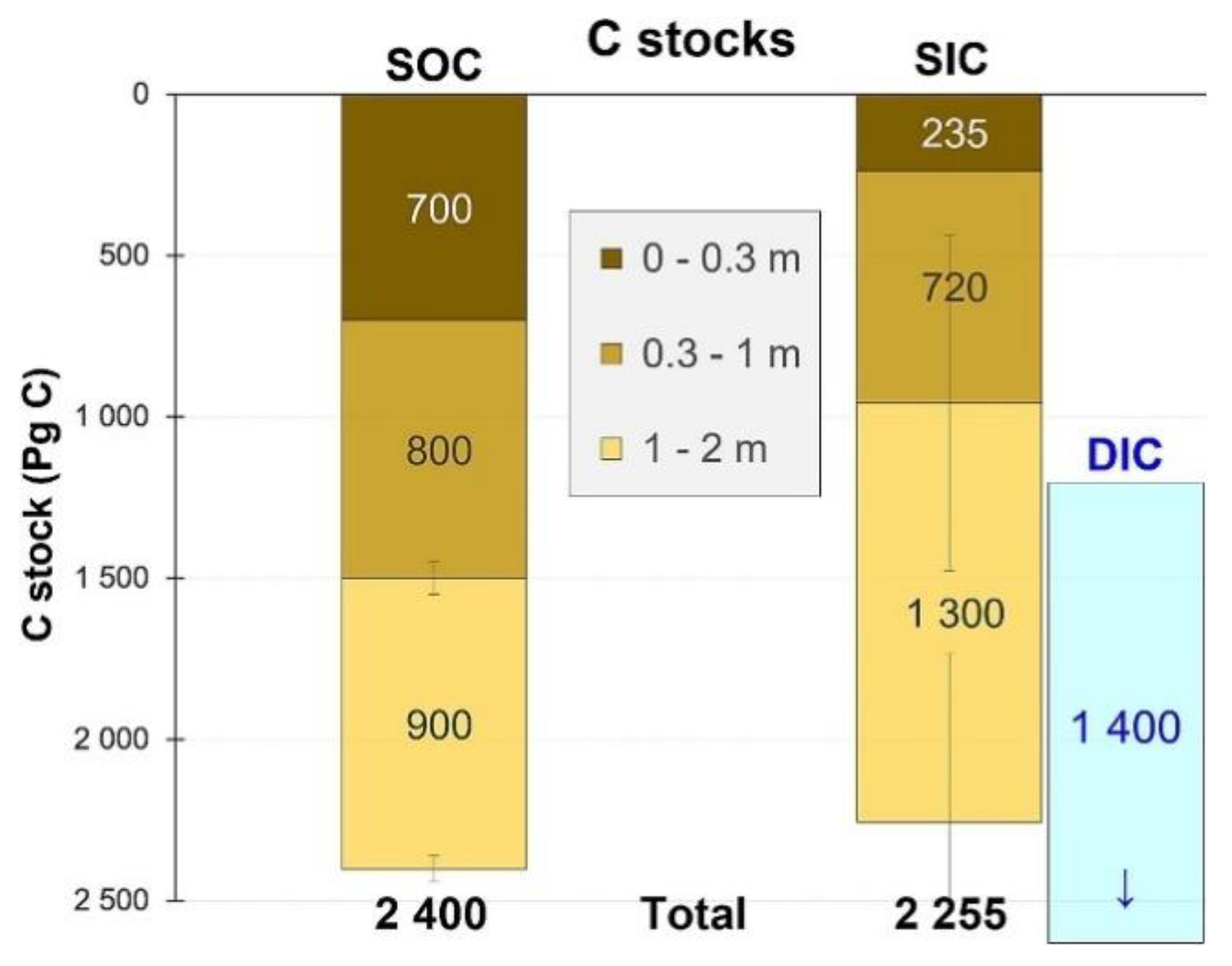
As already noted, a mean soil depth of >13–21 m is six or eight times deeper than 2.5 m thus these values may truly be much higher; moreover, terrain may factor in yet higher.
Calcite (crystaline CaCO3) that contains about 12% carbon, may be included in soil inorganic totals as a minor but valid earthworm exudate mainly from atmospheric CO2. Blakemore (2019 https://vermecology.wordpress.com/2019/11/11/earthworm-cast-carbon-storage-eccs/ ), estimated about 1 Gt C/yr earthworm calcite which is more than all the solid CaCO3 in shells of all marine organisms, of just 0.7 Gt C/yr (IPCC 2001: 198). Over the millennia this would be a sizeable contribution from earthworms to inorganic carbon in soils and solutions, especially since IPCC WG1 AR5 (2013: Figure 6.1) show rock-weathering at 0.1–0.3 Gt C/yr.
In addition to inorganic carbon, the dissolved organic component is ~52 Gt DOC.
Combined, these estimates for SIC/DIC/DOC add to (>7,410 + 52 =) >7,462 Gt C.
3.9.8. Summary of Soil Carbon Stocks Refinement
From a total global baseline of ~24,000 Gt SOC calculated above we may add sediment carbon in lakes and rivers (820 + 1,640 = 2,460 Gt SeOC). Then SOC total is (24,000 + 2,460 =) ~26,460 Gt SOC. Adding dissolved carbon in soils (SIC/DIC/DOC of approximately 7,462 Gt C as noted above), a grand land total is 33,922, or nearly 34,000 Gt C for all forms of soil carbon (approaching the 38,000 Gt C in ocean stock).
Disparity of terrestrial soil carbon stocks, ranging from 3,000 as noted in the Introduction, to 34,000 Gt C indicates the inadequacy of our basic knowledge of soils, their carbon stocks, and natural processes. To provide clarity in terms of a full soil biome inventory requires that living biomass, Dissolved Organic Carbon (DOC), and Sediment Organic Carbon (SeOC) and other factors be added for full depth and allowing for terrain.
Additional factors, as well as glomalin and saprock, are amounts of terrestrial biomass lost to the oceans each year. Siegenthaler and Sarmiento (1993: Figure 1b) had 0.8 Gt C/yr transported to ocean via rivers. Lower values were provided by Hedges et al. (1997) who estimated 0.25 Gt C of dissolved (<0.5 μm) organic carbon (DOC) and another 0.15 Gt C of particulate (>0.5 μm) organic carbon (POC) from lost from continents each year. Although tree logs and other larger woody materials appear substantial, current information indicates they are a minor contributor. An annual driftwood export to oceans of 4.7 million m3 equates to 1.41 Mt of carbon or just 0.0014 Gt C/yr (Wohl and Iskin 2021), compared to 0.4–0.8 Gt DOC/POC. Moreover, Lal (2006: Figure 3.2, Tables 3.4–3.5) showed 0.4–0.6 Gt C/yr (or about 10% of total soil erosion) flowing to the ocean via rivers which may be doubled for terrain (depending on data source or to allow for coastal erosion)) to over 1 Gt C/yr. Conversely, IPCC (2013: Figure 6.1) and IPCC (2021) already have 0.8–0.9 Gt C/yr, export of carbon to oceans that, depending upon source of data and calculations, may truly represent a substantial contribution to the ocean as well as a large value lost from land NPP and soil erosion.
3.10. Total Living Biomass
As noted in the introduction, for vegetation an above-ground component was estimated as >1,100 Gt C; in addition, belowground plant roots at around 916 Gt C gave about 2,016 Gt C in the global plant standing stock. However, extrapolation of an earlier full-depth value from Rodin et al. (1975) data of 1,200 Gt plant carbon to depth, when doubled, totalled 2,400 Gt C.
Thus vegetation, has 1,100 Gt C standing, 916 Gt C in roots, combined as 2,400 Gt C.
Adding other terrestrial biotic components from the current study, plus a minor marine contribution, gives a total living biomass of ~3,000 Gt C, mostly on land in soil biota. This is not preposterous as global living biomass estimate was 4,000 Gt C ( https://web.archive.org/web/20151224194748/http:/www.agci.org/classroom/biosphere/index.php).
Comparatively, Bar-On et al. (2018) claimed above-ground biomass of only (≈320 Gt C) represents ≈60% of global biomass, with belowground biomass composed mainly of plant roots (≈130 Gt C) and microbes residing in the soil. For plant biomass they included ≈70% stems and tree trunks, which are mostly woody, and relatively metabolically inert.
Although fungi, as with other microbes, are often include in the soil SOC calculations, earthworms, as with roots, are usually deliberately removed or sieved out and excluded.
All three values – for Bacteria, fungi and earthworms – are revised below.
3.10.1. Forest Biomass as Part of Total Global Vegetation
Forests occupy about a third of total land area but support 80% of above-ground biomass and 40% of soil organic carbon bio-/necro-mass (Hoover and Riddle 2020). Tropical forests, in particular, constitute 12.2% of the Earth's land area, have high NPP, and their soils, long thought to be SOM deficient, are now known with high SOC content of 692 Gt C to 3 m (Paul 2016). Doubled for terrain this component alone is about 1,284 Gt SOC.
Relevant to an earlier wood/log question, Pan et al. (2011) estimated carbon stocks in the world’s forests as 861 Gt C, with 383 Gt C (44%) in soil (to 1 m depth), 363 Gt C (42%) in live biomass (above and below ground, although their root components may be underestimated), 73 Gt C (8%) in deadwood (e.g. logs and sticks), and 43 Gt C (5%) in superficial litter (these last two “litter” categories adding up to about 116 Gt C just for forests). The soil component may be doubled for depth, then all values doubled again for terrain to give a total forest inventory of ~2,250 Gt C. These authors provided estimates of regional production in various components albeit many forests are being clear-felled or burned.
Hoover and Riddle (2020: figs. 2, 3) show carbon allocation in boreal forests in USA compared to the global differences in tropical, temperate and boreal forests where below-ground allocations differ markedly. The importance of the often neglected below-ground allocation of NPP is shown by Davidson et al. (2002) summarizing that, on average, soil respiration is three times aboveground litterfall-C, which further implies that total below ground carbon allocation (to roots, exudates, etc.) is roughly twice annual aboveground litterfall-C (often erroneously equated to global NPP). A recent study by Hawkins et al. (2023) found up to 50% of plant NPP was allocated to soil fungi (as is discussed below).
Indeed, Davidson et al. (2002) said allocation of carbon to belowground plant structures often equals or exceeds aboveground litterfall and aboveground respiration in forest ecosystems, making soil the single most important fate for gross primary productivity. Despite its importance, total forest carbon allocation remains poorly understood because of difficulties quantifying root and mycorrhizal processes by any single method. Nevertheless, they described soil as the single largest biochemically active carbon flux in forest ecosystems aside from canopy assimilation, and thus likely the largest carbon exchange system in the whole biosphere.
Forest biomass above- and below-ground of 363 Gt C × 2 for terrain, is 726 Gt C.
3.10.2. Fungal-SOC (f-SOC) Biomass Mushrooms from 12 Gt to 300–3,760 Gt C
Bar-On et al. (2018: supplement), as with Whitman et al. (1998), average soil depths between 0–1 m and 0–8 m saying that microbial biomass below 1 m averages between ≈2–30% of the total microbial biomass as found in the top 1 metre of soil. Then they took a geometric mean of the fraction of fungal biomass from total biomass of soil microbes they estimated as ≈60% that translated to an estimate for the biomass of soil fungi of ≈12 Gt C.
For Bacteria (and Archaea), Bar-On et al. (2018), had 8 Gt to give a Fungal:Bacteria ratio in soil of 12:8, or about 1.5:1. Although He et al. (2020) mostly agreed with a global biomass carbon budget of 12 Gt C for fungi they had a lower value of just 4 Gt C for bacteria in topsoil for an F:B ratio of 12:4 or about 3:1. A revised bacterial estimate in Blakemore (2022, 2023: Table 1) has bacteria at about 200 Gt C; if the same ratios apply then the fungal biomass in soil would be truly be × 25–50 higher at about 300–600 Gt f-SOC.
He et al. (2020) for “Global stocks of living microbial biomass” estimated fungi as 12.56 Gt C. However, this is only “in 0–30 cm topsoil”, and their global estimate of SOC (684–724 Gt C in 0–30 cm), thus they said about 1.8% of their total SOC is stored in soil fungi.
This contrasts to Hu et al. (2024) who say: “AMF biomass accounts for 20–30% of the total soil microbial biomass, and roughly 15% of the SOC pool in diverse terrestrial ecosystems”, this is about ten times greater proportion. But perhaps Arbuscular Mycorrhizal Fungi (AMF) are only about half of the total fungi in which case this ≈60% of total biomass in Bar-On et al. (2018) may well be correct? But it is difficult to reconcile the Hu et al.’s 15% of SOC with He et al.’s (2020) mere 1.8% of SOC, unless fungal biomass estimated are out by factorials.
Bar-On et al. (2018: Figure 5) estimated contributions of Ectomycorrhiza [EM] as roughly ≈0.2 Gt C and Arbuscular Mycorrhiza (AM) as ≈2 Gt C, rather than total 12 Gt C biomass as they claim. Yet Robinson (2004) found 15 Gt C in [Ecto-]mycorrhizal hyphae alone.
If Bar-On et al.’s EM + AM fungi are 0.2 + 2.0 Gt (or 1.6 +16.7% = 18.3%) of total 12 Gt C (100%). Then, should Robinson be correct, and EM alone are 15 Gt, as just 1.6% this gives total fungi 1,880 Gt C! If reasonably doubled for terrain, a total would be 3,760 Gt C global soil Fungi biomass which is much higher than soil Bacteria (at ~200 Gt C as shown below).
An initial problem with He et al. (2020) value is that it is only for “living microbial biomass” and, for example, Burkert et al. (2019) have “In temperate soils, up to 40% of DNA is from dead or compromised cells. In permafrost, the amount of relic DNA may be even higher because frozen conditions preserve DNA from dead cells.” They cited just 25–26% viable cells in some Permafrosts suggesting about 75% were dead or dormant. Other authors have similar or higher estimates, e.g., Sorensen and Shade (2020) say: “Furthermore, a majority of the microbial cells or richness in soil is dormant, reportedly as high as 80%, representing a considerable pool of microbial functional potential. Finally, across heterogeneous soils, an average of 40% of the microbiome DNA was necromass that existed extracellularly. This suggests that DNA-based methods of determining microbiome dynamics include both inactive and necromass reservoirs…”.
Thus, it is not unreasonable to at least double He et al.’s value.
12.56 Gt C × ~2 for dormant/dead microbial cells = 25.12 Gt C.
Also, He et al. only measure microbes in the top 30 cm while SOC averages are of around 828 Gt and 1,873 Gt, for 0-30 cm and 0-100 cm soil depths, respectively, or about double. And, as Harper and Tibbett (2013) found: 50–75 % of the SOC occurred within the top 5 m of soil profiles, with mean SOC mass densities at least 2–5 times greater at depth, this too may be doubled. Thus an argument can be posed for quadrupling a depth factor.
25.12 × ~4 for soil to full depths >>30 cm = 100.48 Gt C
This is about 8× He et al. (2020) initial value (which may partly account for their 1.8% discrepancy vs. fungi being “roughly 15% of the SOC pool”?). GRSP glomalin of AMF origin may increase all SOC values by 10–50% (the actual figures range about 5–52% so 30% is a reasonable median, albeit diminishing with depth).
100.48 × ~30% median for GRSP glomalin = 130 Gt C.
Deep saprock may also increase SOC by ~30%, or add ~30 Gt C in fungal exudates?
130 + ~30 for saprock/bedrock fungal carbon = 170 Gt C.
Finally, terrain (Blakemore 2018, 2023) likely doubles all soil values, including fungi.
170 × ~2 for terrain = ~340 Gt C as a new f-SOC total.
This is about 27 times He et al.’s initial 12.6 Gt C value. Furthermore, from Blakemore (2023 - https://vermecology.wordpress.com/2023/11/06/up-2-c/) in all its forms, SOC totals 15,000–25,000 Gt, with mean ~20,000 Gt C thus, if fungi truly are “15% of the SOC pool”, = ~3,000 Gt C. This may be compared to the total of 3,760 Gt C noted above.
Finally, given Soil Organic Carbon (SOC) in topsoil alone may total 8,000-12,000 Gt (from Blakemore 2018, 2023), say, a mean of ~10,000 Gt C, and that mainly fungal-derived glomalin adds 10-52% to this, median ~30%, then a value of 3,000 Gt C proxy for total global fungal-C may not be unreasonable supporting higher fungal product values.
Further information was presented in an informal study by Blakemore (2024 - https://vermecology.wordpress.com/2024/02/01/fsoc/) with the range ~300–3,760 Gt C. However it is likely that the lower figure is most correct as these newly revised data have a F:B biomass ratio of 300:200 or about 1.5 which appears within bounds or earlier ratios. Notwithstanding a bacterial tally may be similarly raised for its GRSP products that are often substantial, yet missed from most soil carbon analyses. More work is clearly needed.
Justification for higher fungal carbon stocks is from a recent study by Hawkins et al. (2023), as discussed in Blakemore (2024 - https://vermecology.wordpress.com/2024/02/01/fsoc/), that shows up to 50% allocation of plant NPP to below-ground fungi, their average (table 1) is >22.8% that they show for total NPP of just 53.58 Gt C/yr, in other words about 12.2 Gt C/yr allocated. However, when NPP is realized at 220 Gt C/yr, a 23% allocation is closer to 50 Gt C/yr supplied to fungi, a massive amount of biomass-C. This supports not just the validity of increased NPP but also a much greater fungal C stock. See comments on Sanderman et al. too.
Regardless of outcome, it is now up for debate and refinement noting that a 10-fold f-SOC margin of error (~340–3,760 Gt C) is like Bar-On et al. (2018) soil microbes error.
Note that fungal biomass is often a component of other estimates of SOC so does not necessarily add to the total global SOC stock. However, it seems that glomalin, the fungal glycoprotein that has until recently been difficult to extract or measure, is an important soil addition that may account for up to 52% total SOC and represent a proxy for the abundance and activity of AM or VAM fungi in soils. Glomalin added to a fungal tally again raises total living, dormant, dead or products to well over 3,000 Gt C, as speculated above.
3.10.3. Bacteria, Archaea and Lesser Microbes
Bacteria and other microbes are also mostly counted in the total SOC values, but their actual contribution is important for understanding the processing rates and also other soil factors. To a depth of 1 m total soil microbe biomass in Bar-On et al. (2018: Table S1) was ≈20 Gt C comprised of ≈0.5 Gt C of soil Archaea, and ≈7 Gt C of Bacteria to total ≈8 Gt C compared to a total soil fungi value of ≈12 Gt C. Their soil microbial error margin was 10-fold (i.e., a possible biomass range 2–200 Gt C?). Bar-On et al. (2018) also stated “≈98% of the total microbial biomass is found in the top 1 meter of soil” further validating new microbial estimates to 1 m depth of global soils. Blakemore (2022, 2023: Table 1) confirmed global biota dominated by Bacteria then Archaea with minor contributions (<1–2 %?) from other microbes with a biomass estimate, coinciding with Bar-On et al’s. upper range, is ~210 Gt C.
3.10.4. Earthworm Biomass and Their Processing of Topsoil Humus
Earthworms are intimately associated with soil microbes, increasing abundance up to 1,000 times during passage of soil through their intestines to form casts; furthermore, they disperse fungal propagules throughout the soil profile (Lee 1985, Blakemore 2023).
Purschke (1999) suggested a primary terrestrial origin of detritivorous Annelida, plus it is inferred early diversification of (mainly marine) annelids occured before Lower Cambrian (Wiegert et al. 2022). Earliest Annelida may have emerged in the Cambrian around 518 million years ago and some late Ediacaran fossils may be even older. This suggests annelids are equally likely to have originated on land or in muddy sediments and subsequently colonized littoral habitats as much as vice versa, thereby in synchrony with and accompanying plants during their co-evolution with soils, fungi and microbes on land.
For earthworms (terrestrial Annelida) Bar-On et al. (2018) had just ≈0.2 Gt C based on 10 mg of dry weight for a “characteristic” earthworm (from Fierer et al. 2009). However, studies by Blakemore (2018, 2023) based on Lee (1985) had 20 × greater of up to 4.0.
A recent article by Miller et al. (2024) suggested 900 million tonnes of earthworm dry matter available globally but these authors note: “An illustration of the academic uncertainty is a report by Blakemore, which concluded that the global earthworm dry biomass amounts to 4.5 gigatonnes, fivefold higher than the estimate calculated above.” At 50% carbon content this is 2.25 Gt C in earthworms. However, subsequent values ranged 2.3–3.6 Gt C (Blakemore 2003) and a latest estimated mean value is 3.8 Gt C earthworm biomass (Blakemore 2024: Table 5) that noted: “Earthworm biomass at 3.8 Gt C and Microbes at 209.6 Gt C are slightly higher than 2.3–3.6 Gt C and 200 Gt C, respectively, estimated by Blakemore (2023: Table 2) confirming importance of both groups to Soil Ecology.”
It is interesting that as well as the biomass of earthworm in figure above now being much more than fishes, with new values of ~4 Gt C vs. ≈0.7 Gt C Gt C, earthworm abundance and biodiversity (~35,000 expected earthworm species) also much higher than fishes indicating a need for a shift in focus. The fish value of ≈0.7 Gt C from Bar-On et al. (2018) compares to their estimate of the total global biomass of fish before human civilization across all depths at ≈0.8 Gt C. This suggests there is not the ocean emergency as much as is implied. Conversely worms are dying. If earthworms under global agrichemical (Blakemore 2018a) and UK forest habitats (Barnes et al. 2023 as commented on by Blakemore 2023 - https://vermecology.wordpress.com/2023/05/27/wd22/) are, respectively, -83% and -77%, then their policies and practices for their restoration may offer practical solution to soil loss and Carbon Capture and Storage (CCS). This was Soil/Earthworm solution was proposed in S/ECCS (Blakemore 2019 - https://vermecology.wordpress.com/2019/11/11/earthworm-cast-carbon-storage-eccs/).
Revisiting Darwin’s (1881) work a Century later, Lee (1985: Tables 18 and 21) has mean earthworm surface casts dry mass of 105 t/ha/yr and about equal subsoil casting gives 210 t/ha/yr. With a 26 Gha topsoil mantle this is 5,460 Gt/yr humus processing. At an average cast carbon content of ~4% gives 218.4 Gt C/yr, or the entire terrestrial NPP, as to be expected for balanced Nature.
Inorganic C, although often of biotic origin (e.g. earthworm CaCO3) are often excluded but should now be considered as biotic biomass products as are defined above.
3.11. Soil and Biota Summary Data
Summary of the global SOC status prior to the current paper is provided in Blakemore (2024 - https://vermecology.wordpress.com/2024/07/30/soc/). Updated herein, new values are shown below for the global SOC and Biota Biomass calculation (those in braces are included in SOC):
Mineral soil (~1,500 Gt C + 20–30% glomalin , 26% for saprock, × 4 =) – 10,000 Gt SOC.
Permafrost (>4,200 Gt C plus glomalin that may add up to 50%?) - >5,000 Gt SOC.
Peat (total 4,050 + 3,000 lignite = 7,050 Gt but just peat alone to depth =) 4,050 Gt SOC.
Sediment Carbon in Lakes & Rivers (820 + 1,640 =) 2,460 Gt SeOC.
Litter/logs often included with SOC or, more usually, ignored - 600 Gt C.
Biocrust and Phytomenon rarely included with SOC, mostly ignored - 17 Gt C.
DOC sometimes included in superficial SOC, for depth possibly added – 52 Gt DOC.
SIC and DIC (?4,600–7,400 Gt C); 2,300 and 1,400 doubled – 7,410 Gt SIC/DIC.
Above-ground Vegetation – >1,100 Gt C plus roots (~916 Gt C) = 2,016–2,400 Gt C.
Fungi typically included in total f-SOC (>300–3,000 Gt C).
Bacteria and Similar Microbes also usually included in SOC (~210 Gt C)
Earthworms these are almost always removed from soil samples – ~4 Gt C.
Thus, 10,000 mineral, >5,000 permfrost, 4,000 peat, 2,500 SeOC, 600 litter, 17 biocrust, 52 DOC = >22,169 Gt SOC total (slightly less than the initial 24,000 rough Fermi guess). If the 7,400 SIC/DIC are added, then the total approaches 30,000 Gt as alluded to in the Abstract, which is about ten times SOC plus SIC totals of 3,000 Gt as in Naorem et al. (2022).
Additionally, 2,400 in above- and below-ground vegetation plus 5,000–10,000 Gt fossil fuels, gives a total (22,200 + 2,400 + 5,000–10,000 =) ~32,000 Gt SOC and Biotic C stocks. This corresponds well to NOE drawdown estimated above of ~30,000 Gt carbon. (Q.E.D.).
3.12. Primary Productivity (NPP), Soil Respiration (SR) and CO2 Drawdown
Despite an “official” estimates of around 60–70 Gt C/yr NPP on land (as in Table 1), evidence indicates rates may be much higher, and Liang et al. (2023) have terrestrial NPP likely at 120–190 Gt C/yr approaching the 218 Gt C/yr land NPP from Blakemore (2018). Support for these higher values is summarized in self-explanatory figures (Blakemore 2022 - https://vermecology.wordpress.com/2022/01/13/fossil-fuel-fallacy) (Figure 13 and Figure 14).
Figure 13.
A rapid increase in atmospheric CO2 estimated in the period 1900–2020 is from 280 ppm to 412 ppm, which is about a 32% rise while terrestrial GPP increased 35% over the same period, mainly due to a CO2 greening effect. Inability of plants to drawdown excess CO2 is likely due to forest clearance for crops and stock, erosion and topsoil loss.
Figure 13.
A rapid increase in atmospheric CO2 estimated in the period 1900–2020 is from 280 ppm to 412 ppm, which is about a 32% rise while terrestrial GPP increased 35% over the same period, mainly due to a CO2 greening effect. Inability of plants to drawdown excess CO2 is likely due to forest clearance for crops and stock, erosion and topsoil loss.
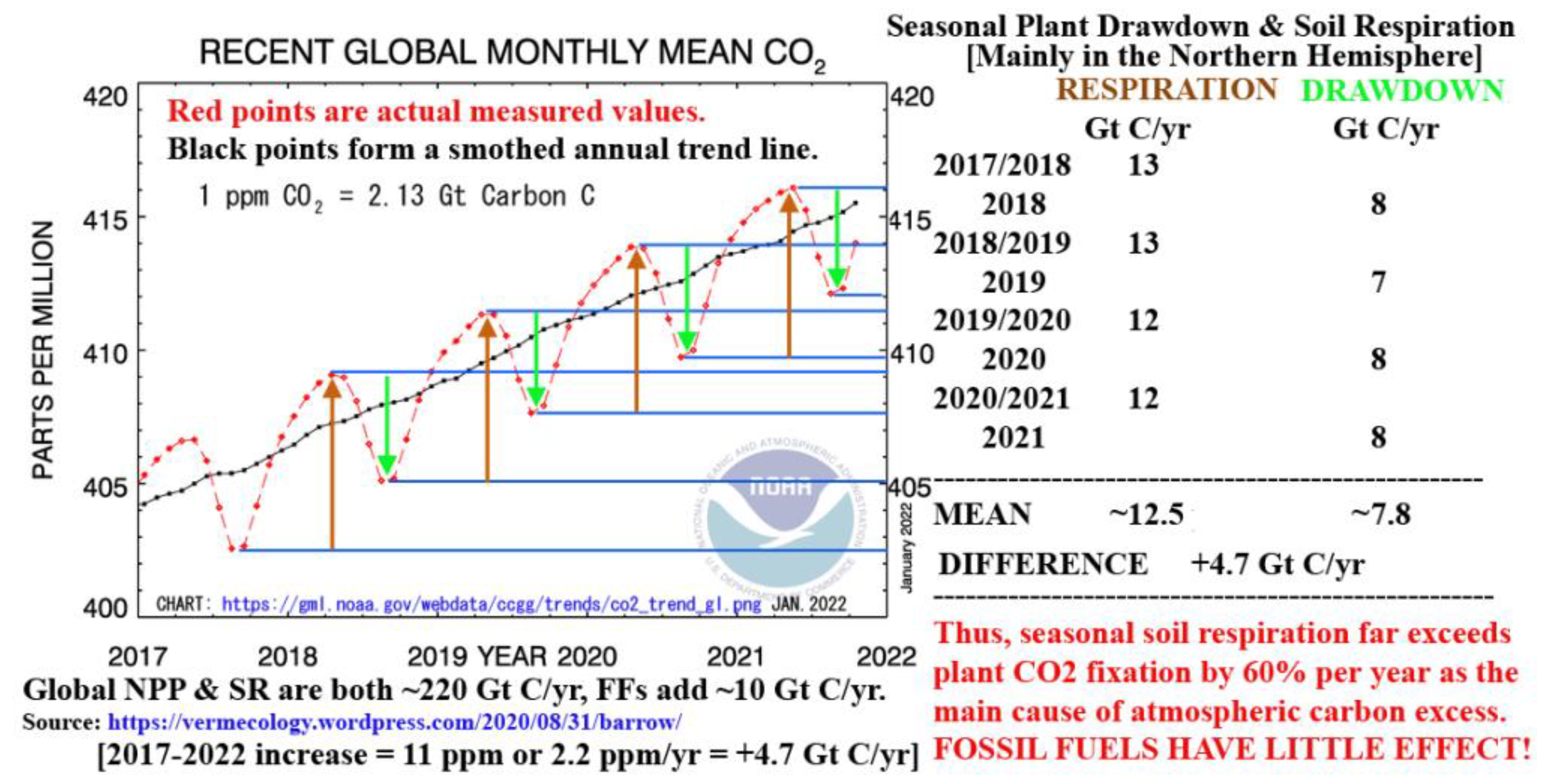
Is higher NPP justifiable? Evidence for the Northern Extra-Tropics (30–90∘ N), or boreal region, are of 60–80 Gt C/yr, (median ~70 Gt C/yr) (Blakemore 2020 - https://vermecology.wordpress.com/2020/08/31/barrow/). This is supported as Bartsev et al. (2012: Figure 3) model a boreal flux of ±62 Gt C/yr mainly from the steppe then from forest, so the whole temperate North may be higher, at least 100 Gt C, and if this flux is about half, then global NPP comes out at well over 200 Gt C/yr. Indeed, Haverd et al. (2020) claim: “land north of 35°N contributes less than 25% to global GPP” then total may be at least (4 × 62 =) 248 Gt C/yr for global NPP. Comparatively, Ronin et al. (1975: Table 1) have proportion of NPP in polar, boreal and temperate/sub-boreal zones combined as just 14.8% (vs. 60% in tropics) for global or, for Continental NPP alone, this is 20% (vs. 80% in tropics). This northern contribution of just a fifth suggests a much higher (5 × 62 =) >310 Gt C/yr total land NPP.
Field et al. (1998; Table 1) estimated seasonal NPP flux on (flat!) land of 33.7 Gt C (or 60%) in northern summers (April to Sept) and 22.7 (or 40%) for the rest of the year in the rest of the world; thus, their summer spike accounts for about (33.7-22.7 =) 11.0 Gt C (or 20%) above background NPP. As Barrow measures a real 20 ppm summer drawdown equating to an NPP spike of ~40 Gt C, perhaps doubled for simultaneous soil respiration to ~80 Gt. Thus, logically, if this represents at most 20% of total annual NPP, then global total NPP is at least 5 × 40 = >200 Gt C/yr, possibly much higher (5 × 80 = 400 Gt C/yr?), and this yet again heralds a need to revise NPP estimates upwards as per Blakemore (2018, 2020 - https://veop.files.wordpress.com/2020/06/veop-4-5.pdf).
With atmospheric carbon values at the time of their publication, Welp, Keeling et al. (2011) CO2 turnover was “approximately every 2 yr” implying (885/2 Gt C =) 443 Gt C/yr processed mostly on land. This can be explained by supporting higher NPP values of 220 Gt C/yr, or near the same as Blakemore (2018: Table 11) NPP for × 2 terrain of 218 Gt C/yr.
Liang et al. (2023) concur with a shorter turnover time at 1.5 yrs requiring (890/1.5 Gt C=) 593 Gt C/yr GPP that would correspond with a higher NPP of 296 Gt C/yr. This is lower than Blakemore (2018: Table 11) for × 4 terrain of 436 Gt C/yr, but similar to Ronin et al. (1975: Table 1) and Bartsev et al. (2012: Figure 3) data calculated above of NPP >310 Gt C/yr.
Furthermore, as noted above, this NPP is processed constantly, mainly through the intestines of earthworms and via microbial decomposition, supporting an entire atmospheric CO2 turnover in about 2–4 yrs cycles via these agents in litter layers, the topsoil humus and deeper in subsoils. Maintaining this vital workforce of synergistic interactions between earthworms, microbes and fungi in healthy soils should be seen as a priority.
4. Summary, Conclusions, and Recommendations
The summary of total soil and terrestrial biomass stocks show them to be the greatest global repository for active organic carbon. It may be further realized that as these stocks are ancient and are being lost at increasing rates then they likely contribute more to CO2 increase than do fossil fuels. Bartsev et al. (2012: Figure 3) noted: “measures taken by the world community to reduce greenhouse gas emissions are of less importance than preservation of wild natural resources.” If emissions stopped tomorrow (as they indeed were during Covid Lockdowns) the green-house gasses (GHGs) yet remain. The Drawdown Review (2020: 13) supports soil as the only feasible way to remove excess CO2 (98.5%), compared to costly and un-natural CCS carbon capture and storage (1.1%) or overhyped oceans (0.4%).
Although decomposition and microbial respiration from compost releases large amounts of CO2, the net product is high in SOM/SOC and, moreover, were shown by Howard (1935, 1945) to be enriched in nitrogen above the input levels due to activity of N-fixing microbes. Carbon loss from composting averages 26–44% based on a recent meta-analysis (Ye et al., 2023) implying more than half or three quarters is preserved in resilient carbon compounds, e.g. in humus which as early as 1881, Darwin showed was so important for soils, plants and food. Earthworm processed vermi-compost is more enhanced.
Food production is intrinsically linked to soils as manifest by an estimated 98.8% of daily calories consumed by humans from soils, whereas only 1.2% is from aquatic sources (FAO, 2018). At the same time, soil is eroding at unsustainable levels (Kopitte et al. 2019).
Certainties are CO2 is rising, land is not flat, and our ignorance of soil outweighs knowledge. Although not definitive, this study is more realistic than claims by proponents of just 60 Gt C/yr NPP, 15 Gha terrain, or 1,500 Gt SOC, who must raise their low values.
Throwing more light on basic soil factors like global carbon stocks and cycles is required, especially when it realized that very few, if any, of the compilers of AR6 nor GCB reports are affiliated with soil research institutions; this partly because – unlike the myriad well-funded marine, aquatic or air research facilities – not a single, dedicate Soil Ecology Institute exists anywhere on Earth. This deficit needs be urgently redressed as a priority.
Our global triage imperative is to halt species extinctions mainly due to poor agricultural practices and overconsumption in some countries of meat products. Proven solution to poisoning and increasing erosion, acidification and desertification of soil is restoration of organic husbandry under practices of Permaculture (Mollison 1988). Permaculture supports efficiency in food production and housing design (solar passive, heat pumps, and insulation) as well as appropriate energy sources such as geothermal (direct, enhanced or binary systems) and trompe (compressed air). A brief summary of these energy sources is found in Blakemore (2020 - https://vermecology.wordpress.com/2020/07/30/ame-power/)/. These complement or may replace fossil/biomass energy in a circular economy.
A supposed limitation to organics is the stock of biomass that is the foundation of composts but is often redirected for fuel source, either for heating or electricity generation. However, as the current study shows, annual biomass production (NPP) and global stores are massively underestimated. These conclusions are now open for testing on local and wider scales. For example, an argument has been made for the re-greening of Australia by implementing soil restoration policies (Drawdown Review 2020, Blakemore 2023).
Valid criticisms and corrections to the work presented here are encouraged to help progress these salient issues. Detractors, however, who fail to provide their estimate of land surface area or depth of soil are automatically invalidated, unless they can prove the Earth is flat, soil is shallow, and Darwin was wrong to consider earthworms important.
Funding
This research received no external funding.
Acknowledgments
Sebastian Angus and Elena kindly provided accommodations for the duration.
Conflicts of Interest
The author declares no conflicts of interest.
References
- Amesbury, M.J., Gallego-Sala, A., Loisel, J. Peatlands as prolific carbon sinks. Nat. Geosci. 12, 880–881 (2019) https://ore.exeter.ac.uk/repository/handle/10871/39306 ; https://www.nature.com/articles/s41561-019-0455-y.
- Bahn, M., et al. 2010. Soil respiration at mean annual temperature predicts annual total across vegetation types and biomes. Biogeoscience. 7 (7): 2147–2157. https://bg.copernicus.org/articles/7/2147/2010/bg-7-2147-2010.pdf.
- Bar-On, Y.M.; Phillips, R.; Milo, R. (2018). The biomass distribution on Earth. Proc. Natl. Acad. Sci. USA 2018. https://www.pnas.org/doi/abs/10.1073/pnas.1711842115.
- Barnes AE, Robinson RA, Pearce-Higgins JW. Collation of a century of soil invertebrate abundance data suggests long-term declines in earthworms but not tipulids. PLoS One. 2023. 18(4):e0282069. [CrossRef]
- Bartsev S.I., Degermendzhi A, Ivanova Y, Shchemel A, Tchernetsky M. 2012. Boreal forests contribution to global seasonal dynamic of carbon dioxide in the atmosphere. Procedia Environ Sci. 13:194–201. 10.1016/j.proenv.2012.01.018. https://core.ac.uk/download/pdf/82433487.pdf.
- Blakemore, R.J. (2018a). Blakemore, R.J. Critical Decline of Earthworms from Organic Origins under Intensive, Humic SOM-Depleting Agriculture. Soil Syst. 2018, 2, 33. http://www.mdpi.com/2571-8789/2/2/33/htm.
- Blakemore, R.J. (2018b). Non-Flat Earth Recalibrated for Terrain and Topsoil. Soil Syst, 2, 64. [CrossRef]
- Blakemore (2019 – Science eLetters Dec. 2, 2019 RE: Soil Carbon and Biomass: Flat Out Wrong?).
- Blakemore, R.J. 2019. https://vermecology.wordpress.com/2019/11/11/earthworm-cast-carbon-storage-eccs/.
- Blakemore, R.J. 2020. Global SOC, Annual NPP & CO2 Turnover Time (τ). Veop. 4: 1–8. Online: https://veop.files.wordpress.com/2020/06/veop-4-5.pdf. https://orgprints.org/id/eprint/38139/1/Veop-4.pdf.
- Blakemore, R.J. 2022. New Global Species Biodiversity: Soil soars, Ocean flounders. Veop. 5: 1–9. Online: https://veop.wordpress.com/2022/09/10/volume-5/. Online: https://veop.files.wordpress.com/2022/09/new-addendum-file.pdf. [CrossRef]
- Blakemore, R.J. (2023). Biotic SOC Stock: What We Had & What We Lost. Veop. 6: 1-59. https://veop.wordpress.com/new-publications/. Veop-6-pdf. [CrossRef]
- Blakemore, R.J. (2024). Diversity Restated: >99.9% of Global Species in Soil Biota. Preprints. 2024041921. [CrossRef]
- Blakemore 2024 – https://vermecology.wordpress.com/2024/02/20/dtb-2/.
- Bratbak, G, Dundas I. Bacterial dry matter content and biomass estimations. Appl Environ Microbiol. 1984 Oct;48(4):755-7. [CrossRef]
- Brovkin, V. et al. 2011. Plant-driven variation in decomposition rates improves projections of global litter stock distribution. Biogeosciences Discuss. 8: 8817–8844. www.biogeosciences-discuss.net/8/8817/2011/. [CrossRef]
- Burkert A, Douglas TA, Waldrop MP, Mackelprang R. Changes in the Active, Dead, and Dormant Microbial Community Structure across a Pleistocene Permafrost Chronosequence. Appl Environ Microbiol. 2019 Mar 22;85(7):e02646-18. [CrossRef]
- Chan, Y.K., McCoy, D. 2010. Soil carbon storage potential under perennial pastures in the mid-north coast of New South Wales, Australia. Tropical Grasslands. 44: 184–191.
- Cissé, G. Essi, M. Kedi, B. Nicolas, M. Staunton, S. Accumulation and vertical distribution of glomalin-related soil protein in French temperate forest soils as a function of tree type, climate and soil properties, CATENA, Volume 220, Part A, 2023, 106635. (https://www.sciencedirect.com/science/article/pii/S034181622200621X). [CrossRef]
- Cole, J., Prairie, Y., Caraco, N., Mcdowell, W., Tranvik, L., Striegl, R., Duarte, C., Kortelainen, P., Downing, J., Middleburg, J., & Melack, J. (2007). Plumbing the global carbon cycle: Integrating inland waters into the terrestrial carbon budget. Ecosystems, 10(1), 171-184. [CrossRef]
- Comis, D. 2002. Glomalin: hiding place for a third of the world's stored soil carbon. Agricultural Research USDA-ARS Sep 2002: 4–7. Available at: http://www.ars.usda.gov/is/AR/archive/sep02/soil0902.htm.
- Crowther T.W., et al. 2019. The global soil community and its influence on biogeochemistry. Science. 365(6455):eaav0550. [CrossRef]
- Damer, B. and Deamer, D. The hot spring hypothesis for an origin of life. Astrobiology. Vol. 20: 429. 2020. [CrossRef]
- Darwin, C.R. (1881). The formation of vegetable mould, through the action of worms, with observations on their habits. London: John Murray. Pp. 315.
- Davidson, E., Savage, K., Bolstad, P., Clark, D., Curtis, P., Ellsworth, D., Hanson, P., Law, B., Luo, Y., Pregitzer, K., Randolph, J., Zak, D. (2002). Belowground Carbon Allocation In Forests Estimated From Litterfall And IRGA-Based Soil Respiration Measurements, Agricultural And Forest Meteorology, 113(1-4), 39-51. https://harvardforest1.fas.harvard.edu/publications/pdfs/Davidson_AgriForestMeterology_2002b.pdf. [CrossRef]
- Drawdown Review (2020). https://drawdown.org/sites/default/files/pdfs/TheDrawdownReview%E2%80%932020%E2%80%93Download.pdf.
- Djokic, T., Van Kranendonk, M., Campbell, K. et al. Earliest signs of life on land preserved in ca. 3.5 Ga hot spring deposits. Nat Commun. 8: 15263 (2017). [CrossRef]
- Duursma, E.K., Boisson, M.P.R.M. 1994. Global oceanic and atmospheric oxygen stability considered in relation to the carbon-cycle and to different time scales. Oceanol. Acta 1994, 17, 117–141.
- FAO (2018). Statistical Databases. http://apps.fao.org/.
- FAO. 2022. Global Soil Organic Carbon Sequestration Potential Map – GSOCseq v.1.1. Technical report. Rome. [CrossRef]
- Ferris, J., Ertem, G. 1998). Montmorillonite catalysis of RNA oligomer formation in aqueous solution. A model for the prebiotic formation of RNA.. Journal of the American Chemical Society, 115(26), 12270-5.
- Field, C.B., Behrenfeld, M.J., Randerson, J.T., Falkowski, P. 1998. Primary production of the Biosphere: Integrating Terrestrial and Oceanic Components. Science. 281(5374): 237–240. https://escholarship.org/uc/item/9gm7074q. [CrossRef]
- Follett CL, Repeta DJ, Rothman DH, Xu L, Santinelli C. Hidden cycle of dissolved organic carbon in the deep ocean. Proc Natl Acad Sci U S A. 2014 Nov 25;111(47):16706-11. [CrossRef]
- Follmann, H. Brownson, C. (2009). Darwin’s warm little pond revisited: from molecules to the origin of life. , 96(11), 1265–1292. [CrossRef]
- Garcia-Pichel, Ferran; Belnap, Jayne; Neuer, Susanne; Schanz, Ferdinand . (2003). Estimates of global cyanobacterial biomass and its distribution. Algological Studies, 109(1), 213–227. [CrossRef]
- GCB (2023). Friedlingstein, P., O'Sullivan, M., Jones, M. W., Andrew, R. M., Bakker, D. C. E., Hauck, J., Landschützer, P., Le Quéré, C., Luijkx, I. T., Peters, G. P., Peters, W., Pongratz, J., Schwingshackl, C., Sitch, S., Canadell, J. G., Ciais, P., Jackson, R. B., Alin, S. R., Anthoni, P., Barbero, L., Bates, N. R., Becker, M., Bellouin, N., Decharme, B., Bopp, L., Brasika, I. B. M., Cadule, P., Chamberlain, M. A., Chandra, N., Chau, T.-T.-T., Chevallier, F., Chini, L. P., Cronin, M., Dou, X., Enyo, K., Evans, W., Falk, S., Feely, R. A., Feng, L., Ford, D. J., Gasser, T., Ghattas, J., Gkritzalis, T., Grassi, G., Gregor, L., Gruber, N., Gürses, Ö., Harris, I., Hefner, M., Heinke, J., Houghton, R. A., Hurtt, G. C., Iida, Y., Ilyina, T., Jacobson, A. R., Jain, A., Jarníková, T., Jersild, A., Jiang, F., Jin, Z., Joos, F., Kato, E., Keeling, R. F., Kennedy, D., Klein Goldewijk, K., Knauer, J., Korsbakken, J. I., Körtzinger, A., Lan, X., Lefèvre, N., Li, H., Liu, J., Liu, Z., Ma, L., Marland, G., Mayot, N., McGuire, P. C., McKinley, G. A., Meyer, G., Morgan, E. J., Munro, D. R., Nakaoka, S.-I., Niwa, Y., O'Brien, K. M., Olsen, A., Omar, A. M., Ono, T., Paulsen, M., Pierrot, D., Pocock, K., Poulter, B., Powis, C. M., Rehder, G., Resplandy, L., Robertson, E., Rödenbeck, C., Rosan, T. M., Schwinger, J., Séférian, R., Smallman, T. L., Smith, S. M., Sospedra-Alfonso, R., Sun, Q., Sutton, A. J., Sweeney, C., Takao, S., Tans, P. P., Tian, H., Tilbrook, B., Tsujino, H., Tubiello, F., van der Werf, G. R., van Ooijen, E., Wanninkhof, R., Watanabe, M., Wimart-Rousseau, C., Yang, D., Yang, X., Yuan, W., Yue, X., Zaehle, S., Zeng, J., and Zheng, B.: Global Carbon Budget 2023, Earth Syst. Sci. Data, 15, 5301–5369, 2023. [CrossRef]
- Georgiou, K., Jackson, R.B., Vindušková, O. et al. Global stocks and capacity of mineral-associated soil organic carbon. Nat Commun 13, 3797 (2022). [CrossRef]
- Gorham, E. (1991), Northern Peatlands: Role in the Carbon Cycle and Probable Responses to Climatic Warming. Ecological Applications, 1: 182-195. [CrossRef]
- Gouldie, A.S. and Cuff, D.J. (eds.). (2002). Encyclopedia of Global Change: Environmental Change and Human Society, Oxford, Oxford University Press. Pp. 1406. ISBN: 9780195108255.
- Guo, Z., Wang, Y., Wan, Z., Zuo, Y., He, L., Li, D., Yuan, F., Wang, N., Liu, J., Song, Y., Song, C., and Xu, X.: Soil dissolved organic carbon in terrestrial ecosystems: Global budget, spatial distribution and controls, Global Ecol. Biogeogr., 29, 2159–2175, 2020. [CrossRef]
- Guo, Z., Wang, Y., Liu, J., He, L., Zhu, X., Zuo, Y., Wang, N., Yuan, F., Sun, Y., Zhang, L., Song, Y., Song, C., Xu, X. (2024). Mapping turnover of dissolved organic carbon in global topsoil Science of the Total Environment, 906, 167621–167621. [CrossRef]
- Gumbricht T, Roman-Cuesta RM, Verchot L, et al. An expert system model for mapping tropical wetlands and peatlands reveals South America as the largest contributor. Glob Change Biol. 2017; 23: 3581–3599. [CrossRef]
- Hansell, D.A., Carlson, C.A. 2001. Marine dissolved organic matter and the carbon cycle. Oceanography 14(4):41–49. [CrossRef]
- Harper, R.J., Tibbett, M. 2013. The hidden organic carbon in deep mineral soils. Plant Soil. 368: 641–648. [CrossRef]
- Hashimoto, S., Ito, A. & Nishina, K. Divergent data-driven estimates of global soil respiration. Commun Earth Environ 4, 460 (2023). [CrossRef]
- Haverd V., Smith B., Canadell J.G., et al. 2020. Higher than expected CO2 fertilization inferred from leaf toglobal observations. Glob Change Biol. 2020;26:2390–2402. https://onlinelibrary.wiley.com/doi/full/10.1111/gcb.14950. [CrossRef]
- Hawkins HJ, Cargill RIM, Van Nuland ME, Hagen SC, Field KJ, Sheldrake M, Soudzilovskaia NA, Kiers ET. Mycorrhizal mycelium as a global carbon pool. Curr Biol. 2023 Jun 5;33(11):R560-R573. [CrossRef]
- He J. D., Chi G. G., Zou Y. N., Shu B., Wu Q. S., Srivastava A. K., et al. (2020). Contribution of glomalin-related soil proteins to soil organic carbon in trifoliate orange. Appl. Soil Ecol. 154:103592. 10.1016/j.apsoil.2020.103592.
- He, L. et al. (2020), Global biogeography of fungal and bacterial biomass carbon in topsoil, Soil Biology and Biochemistry, Journal-article. [CrossRef]
- He, L. Rodrigues, J. Soudzilovskaia, N. et al. Global Biogeography of Fungal and Bacterial Biomass Carbon in Topsoil. Authorea. 2020. [CrossRef]
- Hedges, J. I., R. G. Keil, and R. Benner. 1997. What happens to terrestrial organic matter in the ocean? Org. GeMartin WF, Allen JF. An Algal Greening of Land. Cell. 2018 Jul;174(2):256-258. PMID: 30007415. https://www.cell.com/cell/pdf/S0092-8674(18)30802-X.pdf. [CrossRef]
- Heffernan, L., Kothawala, D. N., and Tranvik, L. J.: Review article: Terrestrial dissolved organic carbon in northern permafrost, The Cryosphere, 18, 1443–1465, 2024. [CrossRef]
- Hicks Pries, C.E., Ryals, R., Zhu, B., Min, K., Cooper, A.et al. (2023) The deep soil organic carbon response to global change. Annual Review of Ecology, Evolution, and Systematics 54, 375–401.
- Hiederer, R., Köchy, M., 2012. Global soil organic carbon estimates and the harmonized world soil database. EU Joint Research Centre, Institute for Environment and Sustainability Publications Office. https://data.europa.eu/doi/10.2788/13267.
- Hoffmann, G. et al. A model of the Earth’s Dole effect. Glob. Biogeochem. Cycles 18, 1008 (2004). [CrossRef]
- Hoover, K.; Riddle, A.A. Forest Carbon Primer; CRS R46312; Congressional Research Service: Washington, DC USA, 2020; 34p.
- Houghton, R.A. 2007. Balancing the Global Carbon Budget. Annual Review of Earth and Planetary Sciences. 35: 1, 313-347. https://www.annualreviews.org/doi/abs/10.1146/annurev.earth.35.031306.140057.
- Howard, A. Wad Y.D. 1931. The Waste Products of Agriculture : their Utilization as. Humus, Oxford University Press, 1931. http://journeytoforever.org/farm_library/HowardWPA/WPAtoc.html.
- Howard, A. (1933). THE WASTE PRODUCTS OF AGRICULTURE: THEIR UTILIZATION AS HUMUS. Journal of the Royal Society of Arts, 82(4229), 84–121. http://www.jstor.org/stable/41360014.
- Howard, A. 1945. An Agricultural Testament. UK: Oxford University Press. https://web.archive.org/web/20100702222720/http:/ps-survival.com/PS/Agriculture/An_Agricultural_Testament_1943.pdf. http://journeytoforever.org/farm_library/HowardWPA/WPA3.html.
- Huang, N., Wang, L., Song, X.-P., Black, T. A., Jassal, R. S., Myneni, R. B., Wu, C., Wang, L., Song, W., and Ji, D.: Spatial and temporal variations in global soil respiration and their relationships with climate and land cover, Sci. Adv., 6, eabb8508. 2020. [CrossRef]
- Huang, Y., Song, X., Wang, Y.-P., Canadell, J.G., Luo, Y., Ciais, P., Chen, A., Hong, S., et al. (2024). Size, distribution, and vulnerability of the global soil inorganic carbon. Science. 384 (6692) 233-239. [CrossRef]
- Hugelius, G., Loisel, J., Chadburn, S., Jackson, R. B., Jones, M., MacDonald, G., et al. (2020). Large stocks of peatland carbon and nitrogen are vulnerable to permafrost thaw. Proceedings of the National Academy of Sciences, 117(34), 20438–20446. [CrossRef]
- Hutchinson, G.E. 1954. The Biochemistry of the Terrestrial Atmosphere. In: G. P. Kuiper (Ed.): The Earth as a Planet. Pp. 371–433. Chicago: University of Chicago Press. https://articles.adsabs.harvard.edu/full/1954eap..book..371H.
- IPBES 2018. Chapter 4: Status and trends of land degradation and restoration and associated changes in biodiversity and ecosystem fundtions. In: IPBES assessment report on land degradation and restoration. Secretariat of the Intergovernmental Science-Policy Platform on Biodiversity and Ecosystem services, Bonn, Germany. Pp. 317-426. https://horizon.documentation.ird.fr/exl-doc/pleins_textes/divers19-02/010075051.pdf.
- IPCC (2021) Canadell, J.G., P.M.S. Monteiro, M.H. Costa, L. Cotrim da Cunha, P.M. Cox, A.V. Eliseev, S. Henson, M. Ishii, S. Jaccard, C. Koven, A. Lohila, P.K. Patra, S. Piao, J. Rogelj, S. Syampungani, S. Zaehle, and K. Zickfeld, 2021: Global Carbon and other Biogeochemical Cycles and Feedbacks. In Climate Change 2021: The Physical Science Basis. Contribution of Working Group I to the Sixth Assessment Report of the Intergovernmental Panel on Climate Change [Masson-Delmotte, V., P. Zhai, A. Pirani, S.L. Connors, C. Péan, S. Berger, N. Caud, Y. Chen, L. Goldfarb, M.I. Gomis, M. Huang, K. Leitzell, E. Lonnoy, J.B.R. Matthews, T.K. Maycock, T. Waterfield, O. Yelekçi, R. Yu, and B. Zhou (eds.)]. Cambridge University Press, Cambridge, United Kingdom and New York, NY, USA, pp. 673–816. https://www.ipcc.ch/site/assets/uploads/2018/02/TAR-03.pdf. [CrossRef]
- Irving, T.B., Alptekin, B., Kleven, B. and Ané, J.-M. (2021). A critical review of 25 years of glomalin research: a better mechanical understanding and robust quantification techniques are required. New Phytol. 232: 1572-1581. [CrossRef]
- Jackson, R. B., K. Lajtha, S. E. Crow, G. Hugelius, M. G. Kramer, and G. Piñeiro. 2017. The ecology of soil carbon: Pools, vulnerabilities, and biotic and abiotic controls. Annual Review of Ecology, Evolution, and Systematics 48: 419–445. https://jacksonlab.stanford.edu/sites/g/files/sbiybj20871/files/media/file/jackson_et_al._arees_2017.pdf.
- Jassey, V. E. J., Walcker, R., Kardol, P., Geisen, S., Heger, T., Lamentowicz, M., Hamard, S., Lara, E. (2022). Contribution of soil algae to the global carbon cycle. The New Phytologist, 234, 64–76. [CrossRef]
- Jobbágy, E.G., Jackson, R.B. 2000. The Vertical Distribution of Soil Organic Carbon and Its Relation to Climate and Vegetation. Ecological Applications. 10: 423-436. [CrossRef]
- Johannessen, S.C., Christian, J.R. Why blue carbon cannot truly offset fossil fuel emissions. Commun Earth Environ 4, 411 (2023). [CrossRef]
- Kaplan, J.O., et al. 2010. Holocene carbon emissions as a result of anthropogenic land cover change. The Holocene. 21(5): 775–791. [CrossRef]
- Kopittke PM, Menzies NW, Wang P, McKenna BA, Lombi E. 2019. Soil and the intensification of agriculture for global food security. Environ Int. 132:105078. [CrossRef]
- Koren, G., et al. 2019. Global 3-D simulations of the triple oxygen isotope signature Δ17O in atmospheric CO2. Journal of Geophysical Research: Atmospheres. 124. Online: https://edepot.wur.nl/498192. [CrossRef]
- Lal, R. 2006. Influence of Soil Erosion on Carbon Dynamics in the Wold. Chapter 3. In: Science in Soil Science SOIL EROSION AND CARBON DYNAMICS Edited by Eric J. Roose, Rattan Lal, Christian Feller, Bernard Barthes, Bobby A. Stewart (2006). Pp 23-35. Online: https://library.oapen.org/bitstream/20.500.12657/41645/1/9781135460556.pdf.
- Lal, R. 2009. Sequestering atmospheric carbon dioxide. Critical Reviews in Plant Science. 28: 90-96.
- Lal, R. 2020. Soil Erosion and Gaseous Emissions. Appl. Sci. 2020, 10: 2784. [CrossRef]
- Langeveld, J., Bouwman, A.F., van Hoek, W.J. et al. Estimating dissolved carbon concentrations in global soils: a global database and model. SN Appl. Sci. 2, 1626 (2020). [CrossRef]
- Laskar, A.H. et al. 2019. Triple oxygen and clumped isotope compositions of CO2 in the middle troposphere. Earth & Space Science. 6: 1205–1219. [CrossRef]
- Le Quéré, C., Andrew, R. M., Friedlingstein, P., Sitch, S., Hauck, J., Pongratz, J., Pickers, P. A., Korsbakken, J. I., Peters, G. P., Canadell, J. G., Arneth, A., Arora, V. K., Barbero, L., Bastos, A., Bopp, L., Chevallier, F., Chini, L. P., Ciais, P., Doney, S. C., Gkritzalis, T., Goll, D. S., Harris, I., Haverd, V., Hoffman, F. M., Hoppema, M., Houghton, R. A., Hurtt, G., Ilyina, T., Jain, A. K., Johannessen, T., Jones, C. D., Kato, E., Keeling, R. F., Goldewijk, K. K., Landschützer, P., Lefèvre, N., Lienert, S., Liu, Z., Lombardozzi, D., Metzl, N., Munro, D. R., Nabel, J. E. M. S., Nakaoka, S., Neill, C., Olsen, A., Ono, T., Patra, P., Peregon, A., Peters, W., Peylin, P., Pfeil, B., Pierrot, D., Poulter, B., Rehder, G., Resplandy, L., Robertson, E., Rocher, M., Rödenbeck, C., Schuster, U., Schwinger, J., Séférian, R., Skjelvan, I., Steinhoff, T., Sutton, A., Tans, P. P., Tian, H., Tilbrook, B., Tubiello, F. N., van der Laan-Luijkx, I. T., van der Werf, G. R., Viovy, N., Walker, A. P., Wiltshire, A. J., Wright, R., Zaehle, S., and Zheng, B.: Global Carbon Budget 2018, Earth Syst. Sci. Data, 10, 2141–2194, 2018. [CrossRef]
- Lee, K.E. (1985). Earthworms: their ecology and relationships with soils and land use. Sydney: Academic Press. Pp. 411. ISBN 978-0-12-440860-9.
- Liang, M.C., Mahata, S., Laskar, A.H. et al. 2017. Oxygen isotope anomaly in tropospheric CO2 and implications for CO2 residence time in the atmosphere and gross primary productivity. Sci Rep. 7: 13180 (2017). [CrossRef]
- Liang MC, Laskar AH, Barkan E, Newman S, Thiemens MH, Rangarajan R. 2023. New constraints of terrestrial and oceanic global gross primary productions from the triple oxygen isotopic composition of atmospheric CO2 and O2. Sci Rep. 2023 Feb 7;13(1):2162. [CrossRef]
- Loisel, J., et al. 2021. Expert assessment of future vulnerability of the global peatland carbon sink. Nat. Clim. Chang. 11: 70–77 (2021). [CrossRef]
- Loisel, J., Gallego-Sala, A.V., Amesbury, M.J. et al. Expert assessment of future vulnerability of the global peatland carbon sink. Nat. Clim. Chang. 11, 70–77 (2021). https://climatehomes.unibe.ch/~joos/papers/loisel20ncc.pdf.). [CrossRef]
- Lovelock, C.E., Wright, S.F., Clark, D.A., Ruess, R.W., 2004a. Soil stocks of glomalin produced by arbuscular mycorrhizal fungi across a tropical rain forest landscape. Journal of Ecology, 92, 278-287.
- Martin, W.F. Allen, J.F. An algal greening of land. Cell, 174 pp. 256-258. (2018). [CrossRef]
- Martin FM, van der Heijden MGA. 2024. The mycorrhizal symbiosis: research frontiers in genomics, ecology, and agricultural application. New Phytologist 242: 1486–1506. [CrossRef]
- Matthews, E. 1997. Global litter production, pools, and turnover times: Estimates from measurement data and regression models, J. Geophys. Res. 102: 18771–18800. agupubs.onlinelibrary.wiley.com/doi/pdf/10.1029/97JD02956. [CrossRef]
- Miller, H.; Mulhall, J.; Pfau, L.A.; Palm, R.; Denkenberger, D.C. Can Foraging for Earthworms Significantly Reduce Global Famine in a Catastrophe? Biomass 2024, 4, 765-783.Mollison, B.C. 1988. Permaculture: A Designers’ Manual. Tagari Publications, Tyalgum. Pp. 576. [CrossRef]
- Monger, H.C. et al. 2015. Sequestration of inorganic carbon in soil and groundwater. Geology. 43 (5): 375–378. [CrossRef]
- Moreland K, Tian Z, Berhe AA, McFarlane KJ, Hartsough P, Hart SC, Bales R, O’Geen AT (2021) Deep in the Sierra Nevada critical zone: saprock represents a large terrestrial organic carbon stock. Environ Res Lett 16:124059. [CrossRef]
- Mulkidjanian AY, Bychkov AY, Dibrova DV, Galperin MY, Koonin EV. Origin of first cells at terrestrial, anoxic geothermal fields. Proc Natl Acad Sci U S A. 2012 Apr 3;109(14):E821-30. [CrossRef]
- Naorem, A.; Jayaraman, S.; Dalal, R.C.; Patra, A.; Rao, C.S.; Lal, R. Soil Inorganic Carbon as a Potential Sink in Carbon Storage in Dryland Soils—A Review. Agriculture 2022, 12, 1256. [CrossRef]
- Nichols, J.E., Peteet, D.M. 2019. Rapid expansion of northern peatlands and doubled estimate of carbon storage. Nat. Geosci. 12: 917–921 (2019). [CrossRef]
- Nichols, J.E., Peteet, D.M. 2021. J. E. Nichols & D. M. Peteet reply. Nat. Geosci. 14: 470–472. [CrossRef]
- Nielsen, E.S. (1952). 1952. The Use of Radio-active Carbon (C14) for Measuring Organic Production in the Sea, ICES Journal of Marine Science. 18(2): 117–140. [CrossRef]
- Nissan, A., Alcolombri, U., Peleg, N. et al. Global warming accelerates soil heterotrophic respiration. Nat Commun 14, 3452 (2023). [CrossRef]
- Omar, M. S., Ifandi, E., Sukri, R. S., Kalaitzidis, S., Christanis, K., Lai, D. T. C., et al. (2022). Peatlands in southeast Asia: A comprehensive geological review. Earth-Science Rev. 232, 104149. [CrossRef]
- Page, S., Rieley, J.O. and Banks, C.J. (2011) Global and regional importance of the tropical peatland carbon pool. Global Change Biology, 17 (2), 798-818. [CrossRef]
- Pan, Y.; Birdsey, R. A.; Fang, J.; Houghton, R.; Kauppi, P. E.; Kurz, W. A.; Phillips, O. L.; Shvidenko, A.; Lewis, S. L.; Canadell, J. G.; Ciais, P.; Jackson, R. B.; Pacala, S. W.; McGuire, A. D.; Piao, S.; Rautiainen, A.; Sitch, S.; Hayes, D. . (2011). A Large and Persistent Carbon Sink in the World's Forests. Science, 333(6045), 988–993. [CrossRef]
- Parish, F., Sirin, A., Charman, D., Joosten, H., Minayeva, T., Silvius, M. and Stringer, L. (Eds.) 2008. Assessment on Peatlands, Biodiversity and Climate Change: Main Report. Global Environment Centre, Kuala Lumpur and Wetlands International, Wageningen. Available at: http://www.imcg.net/media/download_gallery/books/assessment_peatland.pdf.
- Paul, E.A. 2016. The nature and dynamics of soil organic matter: Plant inputs, microbial transformations, and organic matter stabilization. Soil Biology and Biochemistry 98:109-126. Pdf.: https://lter.kbs.msu.edu/pub/3636. [CrossRef]
- Pelletier, J. D., P. D. Broxton, P. Hazenberg, X. Zeng, P. A. Troch, G.-Y. Niu, Z. Williams, M. A. Brunke, and D. Gochis (2016), A gridded global data set of soil, immobile regolith, and sedimentary deposit thicknesses for regional and global land surface modeling, J. Adv. Model. Earth Syst., 8, 41–65. [CrossRef]
- Pribyl, D.W. A critical review of the conventional SOC to SOM conversion factor, Geoderma, Volume 156, Issues 3–4, 2010, Pages 75-83, ISSN 0016-7061. (https://www.sciencedirect.com/science/article/pii/S0016706110000388). [CrossRef]
- Purschke, G. Terrestrial polychaetes – models for the evolution of the Clitellata (Annelida)?. Hydrobiologia 406, 87–99 (1999). [CrossRef]
- Raich, J.W.et al. 2002. Interannual variability in global soil respiration, 1980-94. Glob Chang Biol. 8:800–812.
- Raza, S., Irshad, A., Margenot, A., Zamanian, K., Li, N., Ullah, S., …Kuzyakov, Y. (2024). Inorganic carbon is overlooked in global soil carbon research: A bibliometric analysis. Geoderma, 443, Article 116831. [CrossRef]
- Reiners, W.A. 1973. Terrestrial detritus and the carbon cycle. Brookhaven Symp Biol. 30: 303-27.
- Retallack, G.J., Noffke, N. Are there ancient soils in the 3.7 Ga Isua Greenstone Belt, Greenland?, Palaeogeography, Palaeoclimatology, Palaeoecology (2018). [CrossRef]
- Revelle R., Suess, H.E. 1957. Carbon Dioxide Exchange Between Atmosphere and Ocean and the Question of an Increase of Atmospheric CO2 during the Past Decades. Tellus. 9(1): 18-27. https://www.tandfonline.com/doi/pdf/10.3402/tellusa.v9i1.9075. [CrossRef]
- Ricardo, S.-M., Paola, G.-A., Rolando, S.-G. et al. Exploring Dissolved Organic Carbon Variations in a High Elevation Tropical Peatland Ecosystem: Cerro de la Muerte, Costa Rica. Frontiers in Water, 2022. [CrossRef]
- Richter, D.D. Markewitz, D. 1995. How Deep Is Soil? Soil, the zone of the earth's crust that is biologically active, is much deeper than has been thought by many ecologists, BioScience, Volume 45, Issue 9, October 1995, Pages 600–609. [CrossRef]
- Riley, G.A. 1944. The carbon metabolism and photosynthetic efficiency of the earth as a whole. American Scientist. 32: 129–34.
- Rillig, M.C.; Wright, S.F.; Nichols, K.A.; Schmidt, W.F.; Torn, M.S. Large contribution of arbuscular mycorrhizal fungi to soil carbon pools in tropical forest soils. Plant Soil. 2001, 233, 167–177. [CrossRef]
- Robinson, D.: Scaling the depths: below-ground allocation in plants, forests and biomes, Funct. Ecol., 18, 290–295, 2004. [CrossRef]
- Rodin L.E., Bazilevich N.I., Rozov N.N. 1975. Productivity of the world’s main ecosystems. In D. E. Reichle, J. F. Franklin, and D. W. Goodall (Eds.): Productivity of World Ecosystems. Pp. 13–26. Washington, D.C.: Natl. Acad. Sci. https://nap.nationalacademies.org/read/20114/chapter/3.
- Rolando, J.L., Dubeux, J.C.B., Souza, T.C.D., Mackowiak, C., Wright, D.et al. (2021) Organic carbon is mostly stored in deep soil and only affected by land use in its superficial layers: A case study. Agrosystems, Geosciences and Environment 4(1), e20135. Rossel, R. A. et al. The australian three-dimensional soil grid: Australia’s contribution to the GlobalSoilMap project. Soil Research 53, 845–864 (2014). https://doi.org/10.1111/gcb.12569. [CrossRef]
- Royer, D. L., Donnadieu, Y., Park, J., Kowalczyk, J., & Goddéris, Y. (2014). Error analysis of CO2 and O2 estimates from the long-term geochemical model GEOCARBSULF. American Journal of Science, 314(9), 1259–1283. [CrossRef]
- Running, S.W. et al. 2004. A Continuous Satellite-Derived Measure of Global Terrestrial Primary Production, BioScience. 54(6): 547–560. [CrossRef]
- Sanderman, J.; Farquharson, R.; Baldock, J. 2010. Soil carbon sequestration potential: A review for Australian agriculture. Urrbrae, S.A.: CSIRO; csiro:EP10121. [CrossRef]
- Sangmanee, P., Dell, B., Harper, R.J. et al. Organic carbon compounds associated with deep soil carbon stores. Plant Soil 488, 83–99 (2023). [CrossRef]
- Shelef, E., et al. 2017. Large uncertainty in permafrost carbon stocks due to hillslope soil deposits. Geophys. Res. Lett. 44: 6134–6144. https://agupubs.onlinelibrary.wiley.com/doi/full/10.1002/2017gl073823. [CrossRef]
- Scharlemann, J. P., Tanner, E. V., Hiederer, R., & Kapos, V. (2014). Global soil carbon: understanding and managing the largest terrestrial carbon pool. Carbon Management, 5(1), 81–91. [CrossRef]
- Schindler FV, Mercer EJ, Rice JA. 2007. Chemical characteristics of glomalin related soil protein (GRSP) extracted from soils of varying organic matter content. Soil Biology & Biochemistry 39: 320–329. [CrossRef]
- Schreiber M, Rensing SA, Gould SB. The greening ashore. Trends Plant Sci. 2022 Sep;27(9):847-857. [CrossRef]
- Schroeder, H., 1919: Die jahrliche Gesamtproduktion der grunen Pflanzendecke der Erde. Naturwissenschaften. 7: 8.
- Schuur, E. A. G., Abbott, B., Commane, R., Ernakovich, J., Euskirchen, E., Hugelius, G., et al. (2022). Permafrost and climate change: Carbon cycle feedbacks from a warming Arctic. Annual Review of Environment and Resources, 47: 28.1–28.29. [CrossRef]
- Scurlock J.M.O., Johnson K. and Olson R.J. 2002. Estimating net primary productivity from grassland biomass dynamics measurements. Global Change Biology. 8: 736–753. https://onlinelibrary.wiley.com/doi/abs/10.1046/j.1365-2486.2002.00512.x.
- Shangguan, W., T. Hengl, J. Mendes deJesus, H. Yuan, and Y. Dai (2017). Mapping the global depth to bedrock for land surface modeling, J. Adv.Model. Earth Syst., 9, 65–88. [CrossRef]
- Siegenthaler, U. and Sarmiento, J.L. (1993) Atmospheric Carbon Dioxide and the Ocean. Nature, 365, 119-125. www.gfdl.noaa.gov/bibliography/related_files/us9301.pdf. [CrossRef]
- Sokol NW, Whalen ED, Jilling A, Kallenbach C, Pett-Ridge J, Georgiou K. 2022. Global distribution, formation and fate of mineral-associated soil organic matter under a changing climate: A trait-based perspective. Functional Ecology 36 (6), 1411-1429. [CrossRef]
- Sorensen J.W., Shade A. 2020. Dormancy dynamics and dispersal contribute to soil microbiome resilience. Phil. Trans. R. Soc. B37520190255. [CrossRef]
- Tarnocai C, Canadell JG, Schuur EAG, Kuhry P, Mazhitova G, Zimov S. 2009. Soil organic carbon pools in the northern circumpolar permafrost region. Glob. Biogeochem. Cycles 23(2):GB2023. [CrossRef]
- Torsvik, TH, Royer, DL, Marcilly, CM, Werner, SC. User-friendly carbon-cycle modelling and aspects of Phanerozoic climate change. Applied Computing and Geosciences, Volume 23, 2024, 100180, ISSN 2590-1974. (https://www.sciencedirect.com/science/article/pii/S2590197424000272). [CrossRef]
- Tranvik, L. J., Downing, J. A., Cotner, J. B., Loiselle, S. A., Striegl, R. G., Ballatore, T. J., Dillon, P., Finlay, K., Fortino, K., Knoll, L. B., Kortelainen, P. L., Kutser, T., Larsen, S., Laurion, I., Leech, D. M., Leigh McCallister, S., McKnight, D. M., Melack, J. M., Overholt, E., ... Weyhenmeyer, G. A. (2009). Lakes and reservoirs as regulators of carbon cycling and climate. Limnology and Oceanography, 54(6 PART 2), 2298-2314. [CrossRef]
- Treat, C. C., Virkkala, A.-M., Burke, E., Bruhwiler, L., Chatterjee, A., Fisher, J. B., et al. (2024). Permafrost carbon: Progress in understanding stocks and fluxes across northern terrestrial ecosystems. Journal of Geophysical Research: Biogeosciences, 129, e2023JG007638. [CrossRef]
- UN 2022 https://globalpeatlands.org/resource-library/global-peatlands-assessment-state-worlds-peatlands-main-report).
- Underwood, E. (2019), Mapping ice algal blooms from space. Eos: 100. 2019. [CrossRef]
- van der Velde, I. R., Miller, J. B., Schaefer, K., van der Werf, G. R., Krol, M. C., Peters, W. (2014). Terrestrial cycling of 13CO2 by photosynthesis, respiration, and biomass burning in SiBCASA. Biogeosciences, 11(23), 6553–6571. [CrossRef]
- van Oost, K., et al. 2012. Legacy of human-induced C erosion and burial on soil-atmosphere C exchange. PNAS. 109(47): 19492-7. https://bg.copernicus.org/articles/8/69/2011/bg-8-69-2011.pdf. [CrossRef]
- Verwer, C. C., van der Meer, P. J. (2010). Carbon pools in tropical peat forest: towards a reference value for forest biomass carbon in relatively undisturbed peat swamp forests in Southeast Asia. (Alterra-report; No. 2108). Alterra. https://edepot.wur.nl/160910.
- Vlček V, Pohanka M. Glomalin - an interesting protein part of the soil organic matter. Soil & Water Res.. 2020;15(2):67-74. [CrossRef]
- Wang, Q., et al. Glomalin-related soil protein: The particle aggregation mechanism and its insight into coastal environment improvement, Ecotoxicology and Environmental Safety, Volume 227, 2021112940. [CrossRef]
- Wang, M., Guo, X., Zhang, S. et al. 2022. Global soil profiles indicate depth-dependent soil carbon losses under a warmer climate. Nat Commun. 13: 5514 (2022). [CrossRef]
- Weigert, A. et a. 2014. Illuminating the Base of the Annelid Tree Using Transcriptomics, Molecular Biology and Evolution, Volume 31, Issue 6, June 2014, Pages 1391–1401. [CrossRef]
- Welp, L., Keeling, R., Meijer, H. et al. 2011. Interannual variability in the oxygen isotopes of atmospheric CO2 driven by El Niño. Nature. 477: 579–582 (2011). [CrossRef]
- Whitman, W.B., Coleman, D.C. & Wiebe, W.J. (1998). Prokaryotes: The unseen majority. Proc Natl Acad Sci USA, 95, 6578–6583. https://www.pnas.org/doi/pdf/10.1073/pnas.95.12.6578.
- Williams M. 2012. River sediments. Phil. Trans. R. Soc. A.3702093–2122. [CrossRef]
- Winkler, K., Fuchs, R., et al. 2021. Global land use changes are four times greater than previously estimated. Nat Commun. 12: 2501 (2021). doi:/10.1038/s41467-021-22702-2.
- Wohl, E. Iskin. E.P. Damming the wood falls. Science Advances, 2021; 7 (50). [CrossRef]
- Woodwell, G.M., R.H. Whitaker, W.A. Reiners, G.E. Likens, C.C. Delwiche, and D.B. Botkin, The Biota and the World Carbon Budget, Science, 199 (1978), 141. [CrossRef]
- Wright, S.F. and Upadhyaya, A. (1996) Extraction of an Abundant and Unusual Protein from Soil and Comparison with Hyphal Protein of Arbuscular Mycorrhizal Fungi. Soil Science, 161, 575-586. [CrossRef]
- Xu, X,; Guo, Z;. Wang, Y.; Wan, Z. (2021). Soil dissolved organic carbon in terrestrial ecosystems: global budget, spatial distribution and controls [Dataset]. Dryad. [CrossRef]
- Yan, F., Shangguan, W., Zhang, J. et al. Depth-to-bedrock map of China at a spatial resolution of 100 meters. Sci Data 7, 2 (2020). [CrossRef]
- Ye P, Fang L, Song D, Zhang M, Li R, Awasthi MK, Zhang Z, Xiao R, Chen X. Insights into carbon loss reduction during aerobic composting of organic solid waste: A meta-analysis and comprehensive literature review. Sci Total Environ. 2023 Mar 1;862:160787. [CrossRef]
- Yost, J.L., Hartemink, A.E. How deep is the soil studied – an analysis of four soil science journals. Plant Soil 452, 5–18 (2020). [CrossRef]
- Yuan, H., Ge, T., Chen, C., O'Donnell, A. G., & Wu, J. (2012). Significant role for microbial autotrophy in the sequestration of soil carbon. Applied and Environmental Microbiology, 78, 2328-2336. [CrossRef]
- Zamanian, K. et al. 2021. Soil carbonates: the unaccounted, irrecoverable carbon source. Geoderma, 384 (2021): 114817. [CrossRef]
- Zhang, M., Che, R., Cheng, Z., Zhao, H., Wu, C., Hu, J., Zhang, S., Liu, D., Cui, X., Wu, Y. Decades of reforestation significantly change microbial necromass, glomalin, and their contributions to soil organic carbon, Agriculture, Ecosystems & Environment, Volume 346, 2023, 108362. Available at SSRN https://ssrn.com/abstract=4239406. [CrossRef]
Figure 1.
Interlinked exchange recycling between endosymbiotic plant Chloroplasts and eukaryote Mitochondria in both autotrophic plants, and in heterotrophic fungi and animals. (Source: https://old-ib.bioninja.com.au/higher-level/topic-8-metabolism-cell/untitled-2/photosynthesis-vs-respirati.html). Mechanisms of microbial decomposition and burning of biomass have essentially the same formula as does respiration with net release of carbon dioxide (CO2) and water (H2O).
Figure 1.
Interlinked exchange recycling between endosymbiotic plant Chloroplasts and eukaryote Mitochondria in both autotrophic plants, and in heterotrophic fungi and animals. (Source: https://old-ib.bioninja.com.au/higher-level/topic-8-metabolism-cell/untitled-2/photosynthesis-vs-respirati.html). Mechanisms of microbial decomposition and burning of biomass have essentially the same formula as does respiration with net release of carbon dioxide (CO2) and water (H2O).
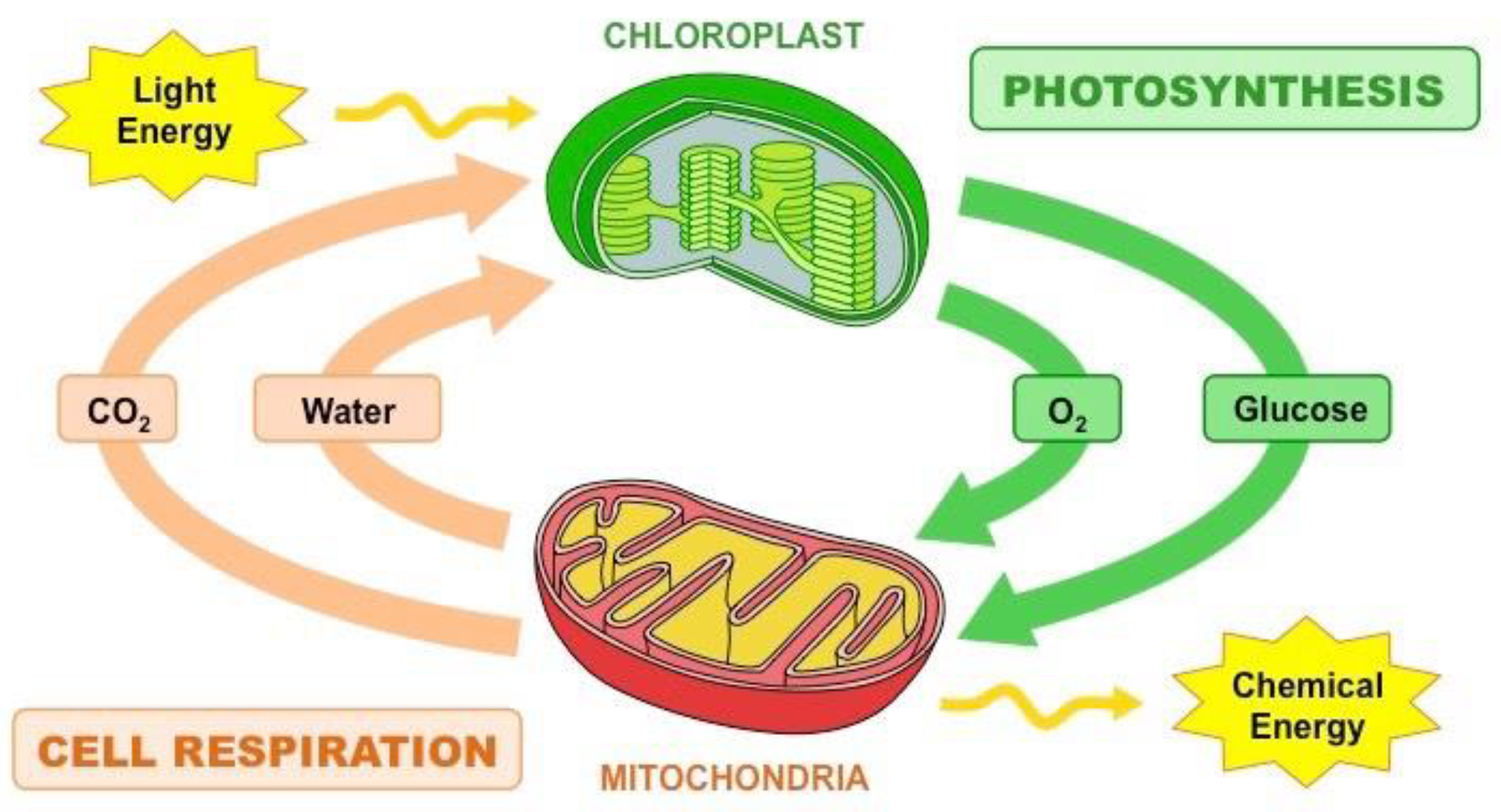
Figure 2.
Different models have different CO2 values, but 550 Ma when submerged plants emerged, the estimates range (yellow) from about 2,500 ppm to over 18,000 ppm and, as discussed later in Results, this implies >5,000–36,000 Gt C active drawdown via living biomass. (https://en.wikipedia.org/wiki/File:Phanerozoic_Carbon_Dioxide.png).
Figure 2.
Different models have different CO2 values, but 550 Ma when submerged plants emerged, the estimates range (yellow) from about 2,500 ppm to over 18,000 ppm and, as discussed later in Results, this implies >5,000–36,000 Gt C active drawdown via living biomass. (https://en.wikipedia.org/wiki/File:Phanerozoic_Carbon_Dioxide.png).
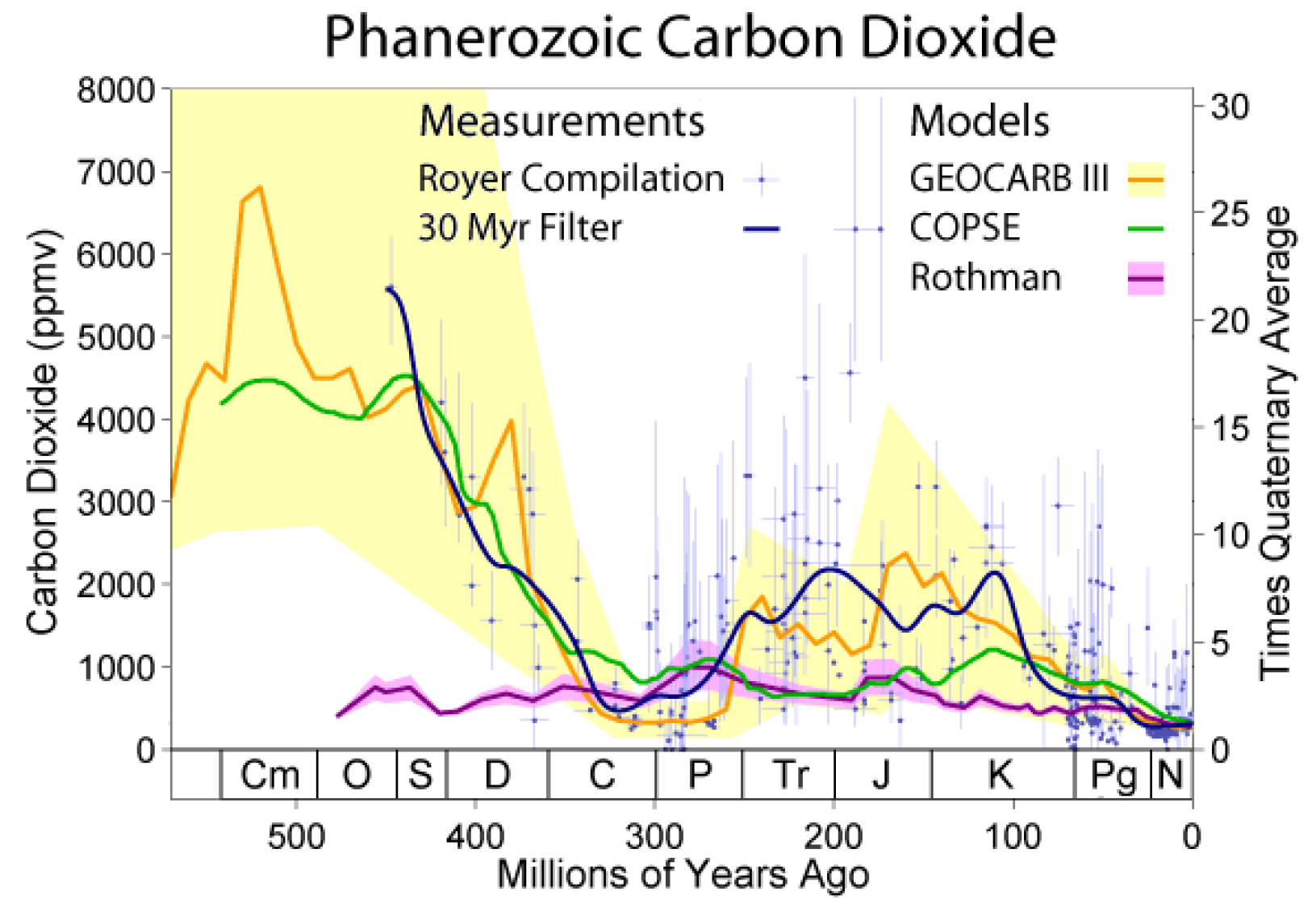
Figure 3.
Drawdown of atmospheric CO2 followed invasion and expansion of land plants releasing current levels of O2. Schreiber et al. (2022) extend the theory, having “plant evolution from fresh water to salt water and, at least 500 million years ago, to land”. Source: Martin & Allen (2018: Figure 1) who stated: “The first land plants buried so much [soil organic] carbon that O2 accumulated in the atmosphere to roughly present levels”. Most biomass and organic matter are yet found in soils, especially as most recent studies include terrestrial plants that seed or root as being soil-based so included in a soil inventory.
Figure 3.
Drawdown of atmospheric CO2 followed invasion and expansion of land plants releasing current levels of O2. Schreiber et al. (2022) extend the theory, having “plant evolution from fresh water to salt water and, at least 500 million years ago, to land”. Source: Martin & Allen (2018: Figure 1) who stated: “The first land plants buried so much [soil organic] carbon that O2 accumulated in the atmosphere to roughly present levels”. Most biomass and organic matter are yet found in soils, especially as most recent studies include terrestrial plants that seed or root as being soil-based so included in a soil inventory.
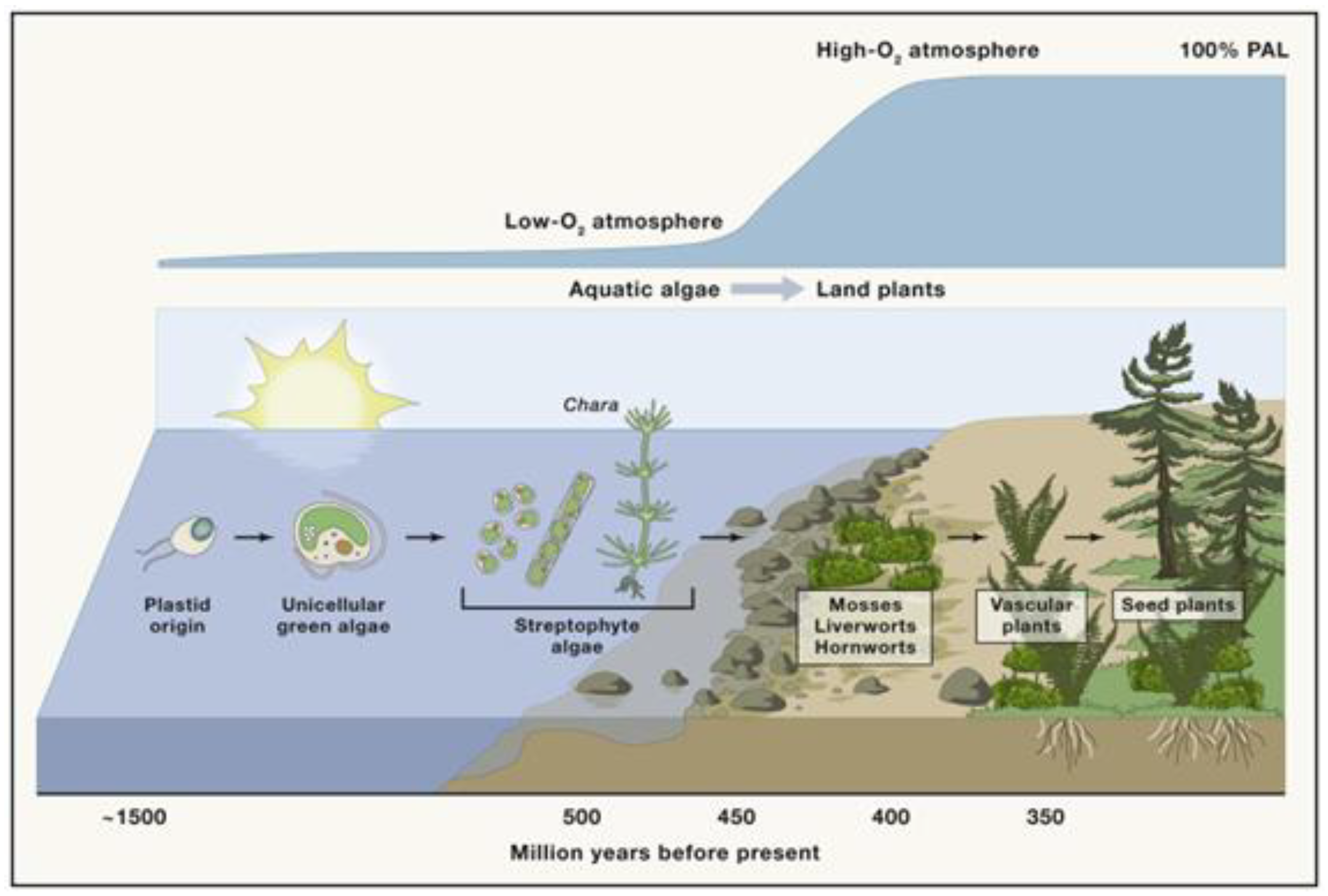
Figure 4.
Countering the common misconception that ocean supports most abundance, biodiversity, or biomass (and productivity) is this recent summary is from OurWorldinData.org (https://ourworldindata.org/grapher/biomass-vs-abundance-taxa).
Figure 4.
Countering the common misconception that ocean supports most abundance, biodiversity, or biomass (and productivity) is this recent summary is from OurWorldinData.org (https://ourworldindata.org/grapher/biomass-vs-abundance-taxa).
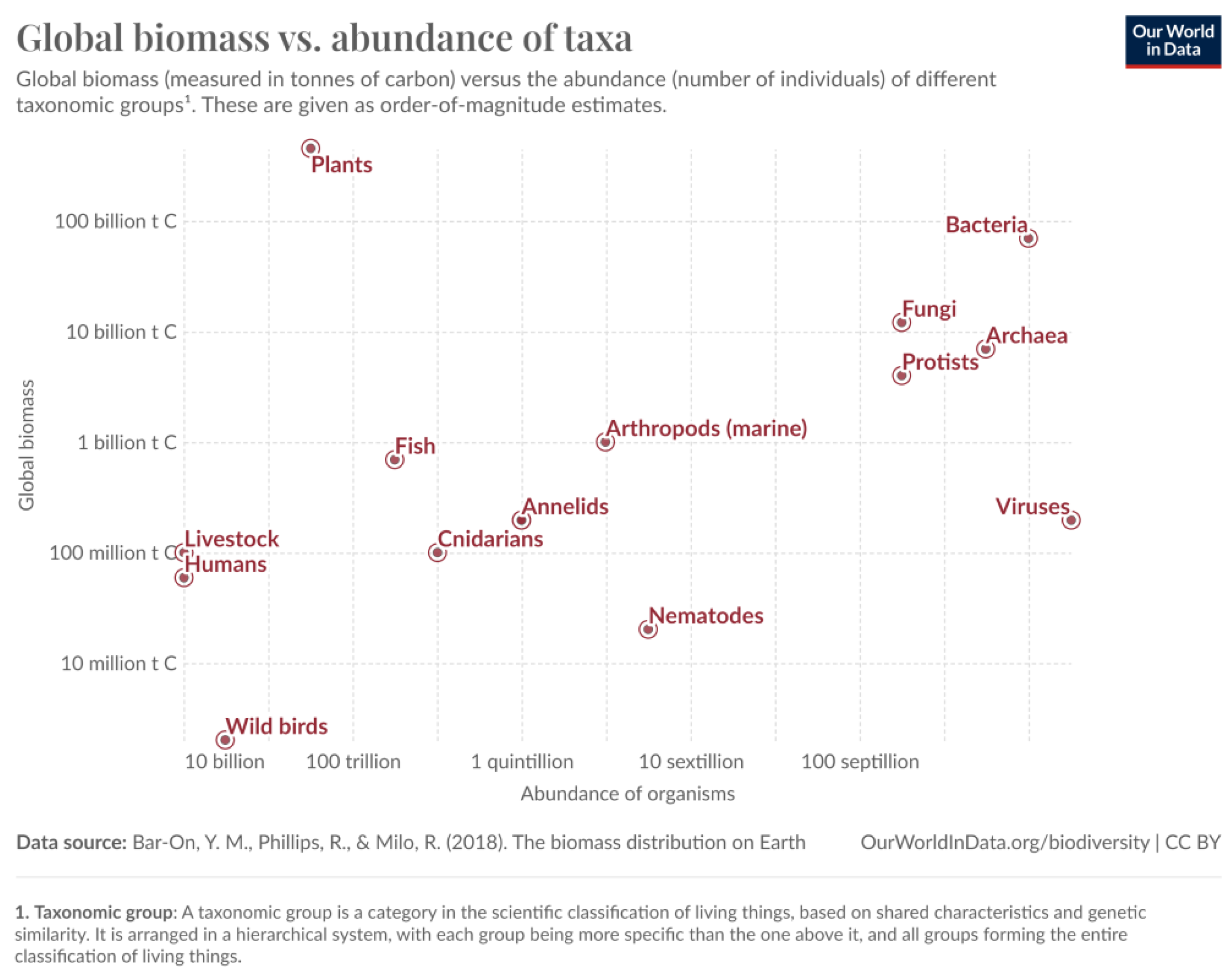
Figure 5.
Major global carbon stores prior to current Biosphere and Soil Carbon revisions. Lithosphere is the rocky mantle with cacitic or dolomitic rocks such as dolomite, limestone, chalk, or marble. Note their SOC + SIC are ~3,000 Gt C whereas the current study concludes ~30,000 Gt C approaching the Ocean carbon totals (much eroded or washed off from soil, as much today as prehistorically). (From Naorem et al. 2022: Figure 1). (Pg = Gt C).
Figure 5.
Major global carbon stores prior to current Biosphere and Soil Carbon revisions. Lithosphere is the rocky mantle with cacitic or dolomitic rocks such as dolomite, limestone, chalk, or marble. Note their SOC + SIC are ~3,000 Gt C whereas the current study concludes ~30,000 Gt C approaching the Ocean carbon totals (much eroded or washed off from soil, as much today as prehistorically). (From Naorem et al. 2022: Figure 1). (Pg = Gt C).
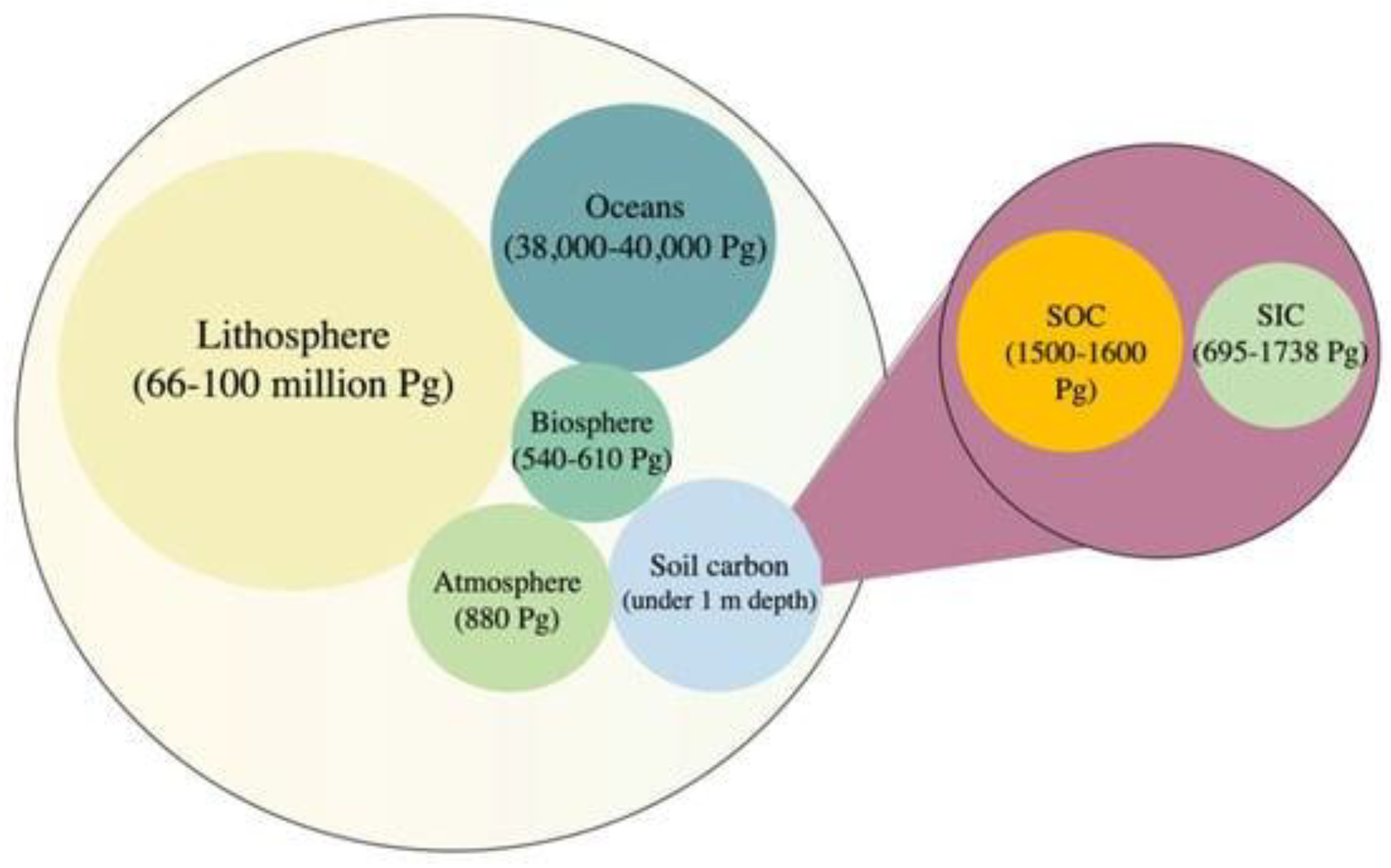
Figure 6.
GCB (2023: Figure 2) with data taken from IPCC (2021) (viz. Canadell et al. 2021). Conventional summary of carbon stocks and sources that are reviewed in the current study. Note ocean’s dissolved inorganic carbon (DIC) is shown, but neither soil inorganic carbon (SIC + DIC) nor enormous inorganic carbon in rocks on land as shown in Figure 5 from Naorem et al. (2022: Figure 1).
Figure 6.
GCB (2023: Figure 2) with data taken from IPCC (2021) (viz. Canadell et al. 2021). Conventional summary of carbon stocks and sources that are reviewed in the current study. Note ocean’s dissolved inorganic carbon (DIC) is shown, but neither soil inorganic carbon (SIC + DIC) nor enormous inorganic carbon in rocks on land as shown in Figure 5 from Naorem et al. (2022: Figure 1).
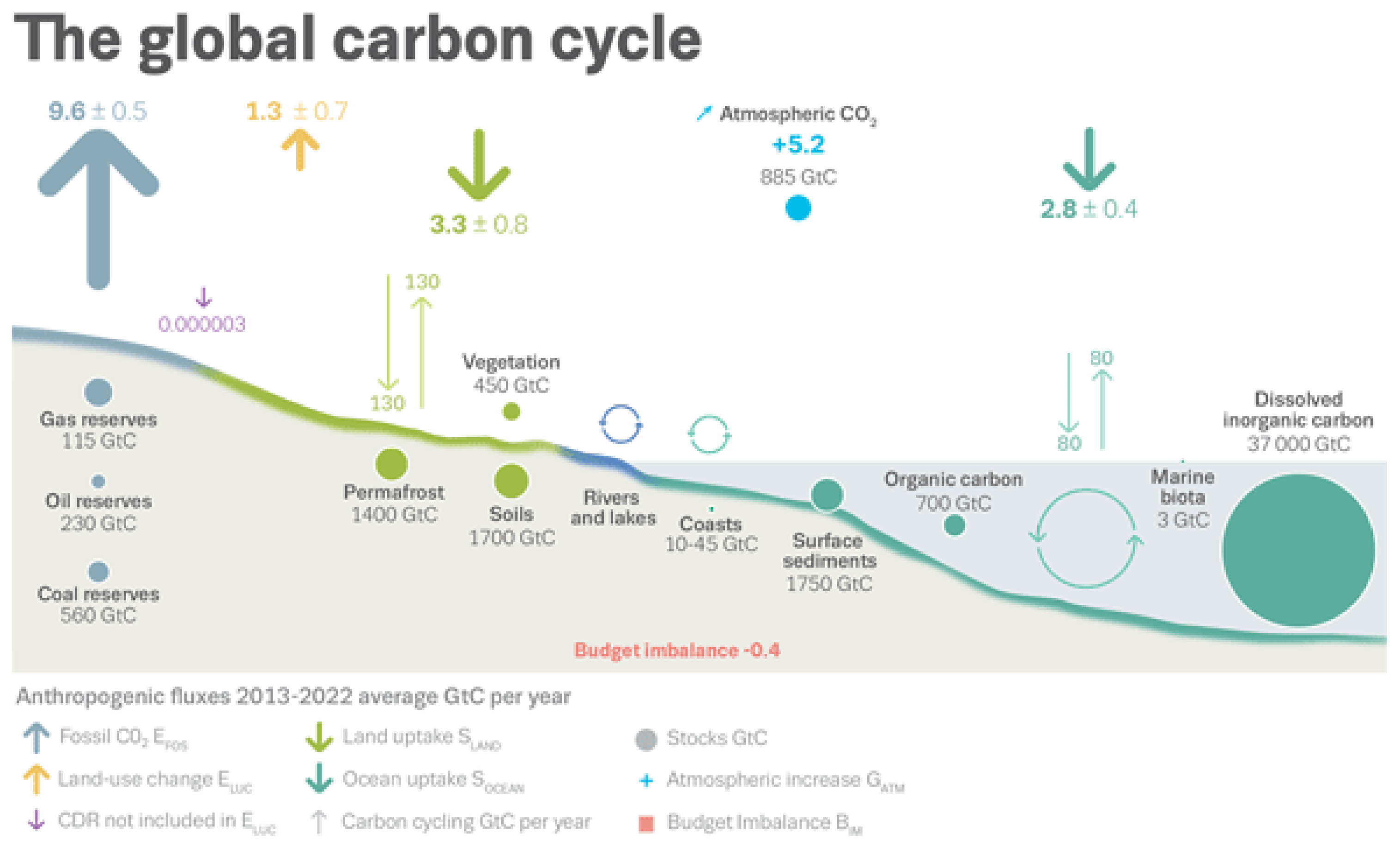
Figure 7.
IPCC (2021: Figure 5.12). Compared to GCB (2023), the total soil (2,900 Gt C) is less by 200 Gt C (in permafrost) and NPP is a bit higher at (142/2 =) 71 Gt C/yr. The dissolved organic carbon (DOC) in the ocean amounting to about 660–680 Gt C, is spread throughout its depth, and may be relatively ancient and non-reactive (Follet et al. 2014). IPCC (2021) say the vertical transfer of DOC create a downward flux of organic carbon from the upper ocean known as “export production” of roughly 11 Gt C/yr that may better represent Ocean “NPP”, yet again diminishing the marine importance.
Figure 7.
IPCC (2021: Figure 5.12). Compared to GCB (2023), the total soil (2,900 Gt C) is less by 200 Gt C (in permafrost) and NPP is a bit higher at (142/2 =) 71 Gt C/yr. The dissolved organic carbon (DOC) in the ocean amounting to about 660–680 Gt C, is spread throughout its depth, and may be relatively ancient and non-reactive (Follet et al. 2014). IPCC (2021) say the vertical transfer of DOC create a downward flux of organic carbon from the upper ocean known as “export production” of roughly 11 Gt C/yr that may better represent Ocean “NPP”, yet again diminishing the marine importance.
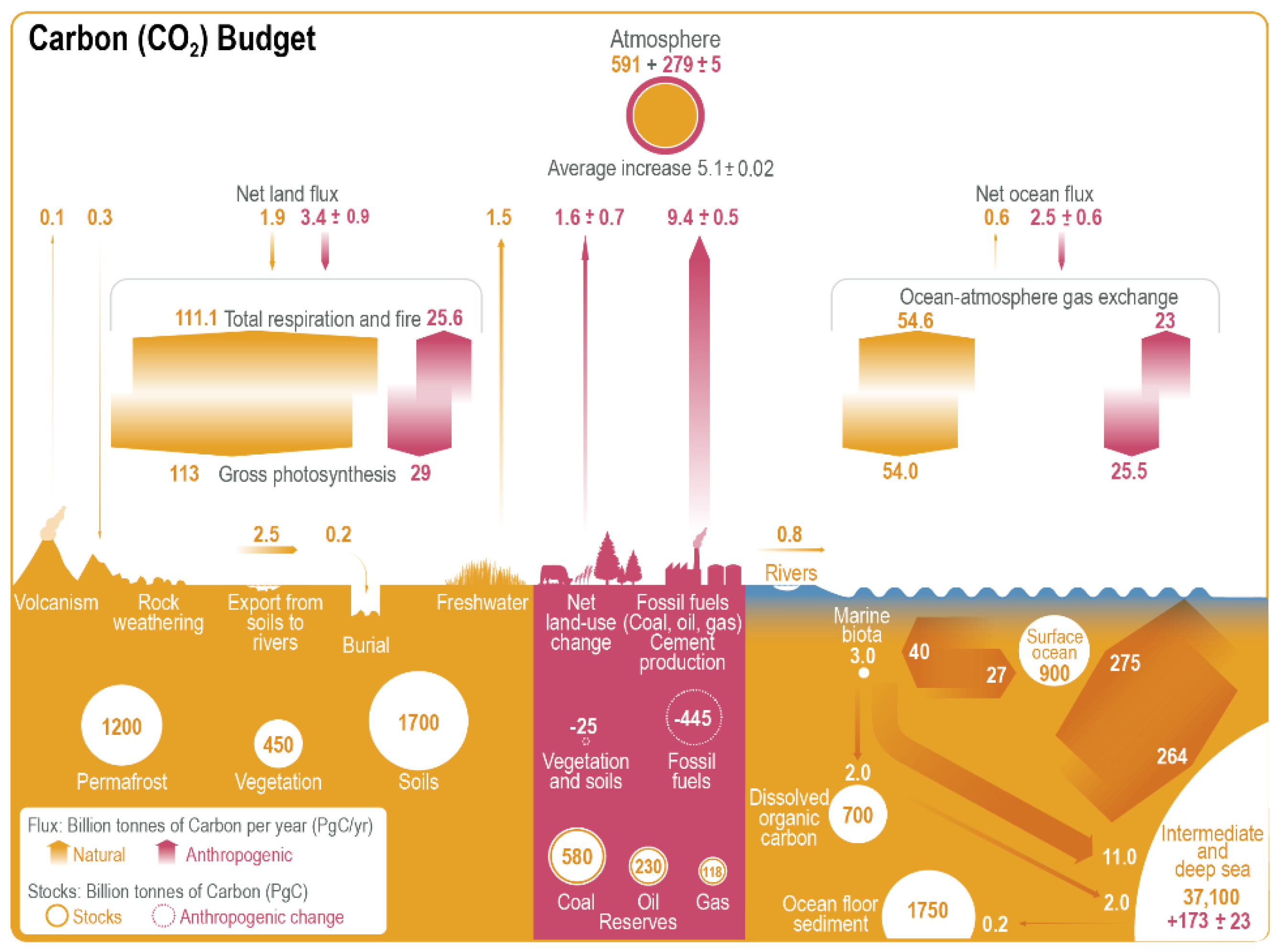
Figure 8.
IPCC WG1 AR5 (2013: Figure 6.1) with the same ocean values as IPCC WG1 AR6 (2024: Figure 5.12) but with all the terrestrial values different, viz. Vegetation 450-650, median 550 vs. 450; Soils 1,500-2,400, median 1,950 vs. 1,700; Permafrost ~1,700 vs. 1,200 Gt C.
Figure 8.
IPCC WG1 AR5 (2013: Figure 6.1) with the same ocean values as IPCC WG1 AR6 (2024: Figure 5.12) but with all the terrestrial values different, viz. Vegetation 450-650, median 550 vs. 450; Soils 1,500-2,400, median 1,950 vs. 1,700; Permafrost ~1,700 vs. 1,200 Gt C.
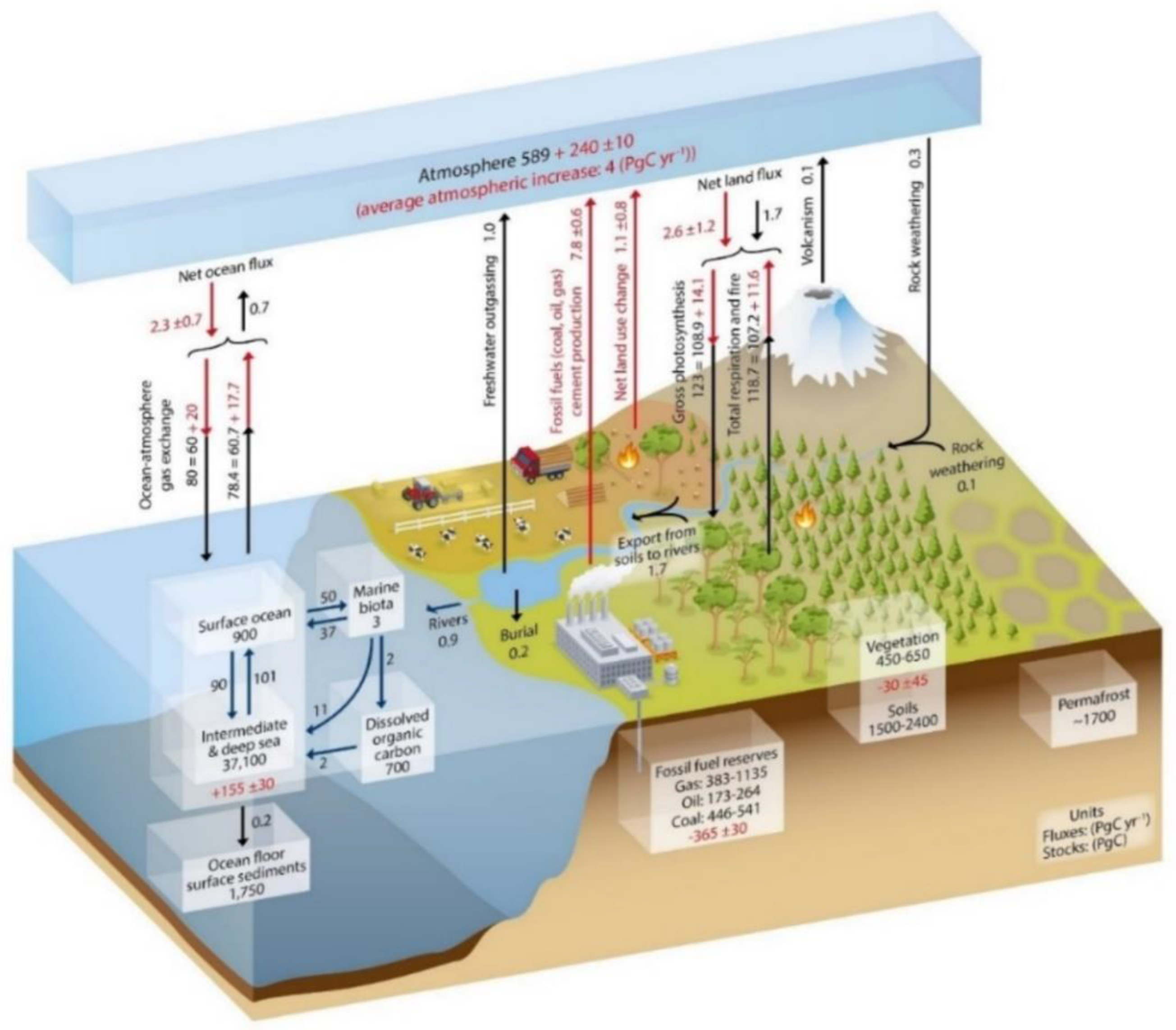
Figure 9.
Organic Carbon cycle modified from Houghton (2007: Figure 1) after Blakemore (2020 - https://vermecology.wordpress.com/2020/01/16/solum-solace/).
Figure 9.
Organic Carbon cycle modified from Houghton (2007: Figure 1) after Blakemore (2020 - https://vermecology.wordpress.com/2020/01/16/solum-solace/).
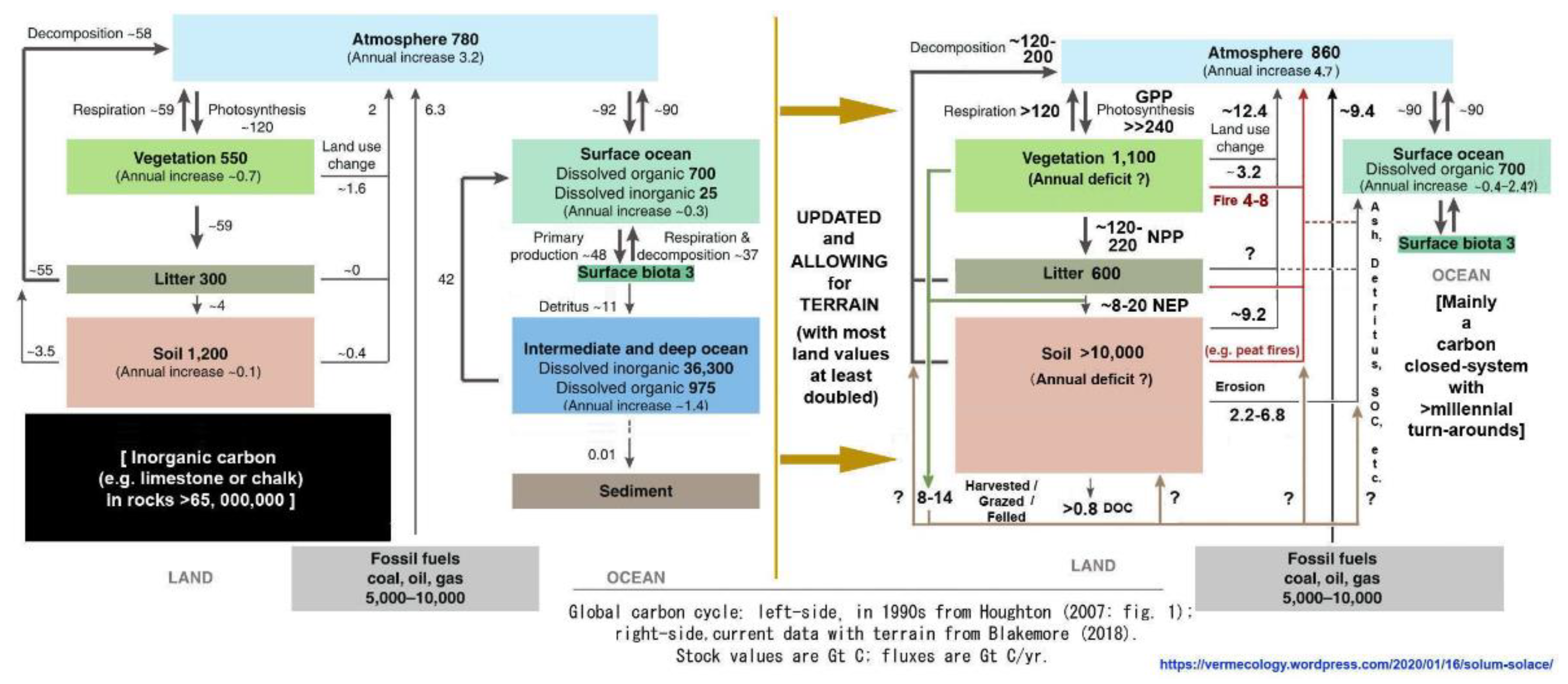
Figure 10.
Atmospheric CO2 (log scale) and O2 (linear) correlations modelled through time with black lines medians and confidence intervals shaded. Fluctuations from climatic events and previous mass extinctions reduce global biomass stocks, re-releasing CO2. (Royer et al. 2014: Figure 2).
Figure 10.
Atmospheric CO2 (log scale) and O2 (linear) correlations modelled through time with black lines medians and confidence intervals shaded. Fluctuations from climatic events and previous mass extinctions reduce global biomass stocks, re-releasing CO2. (Royer et al. 2014: Figure 2).
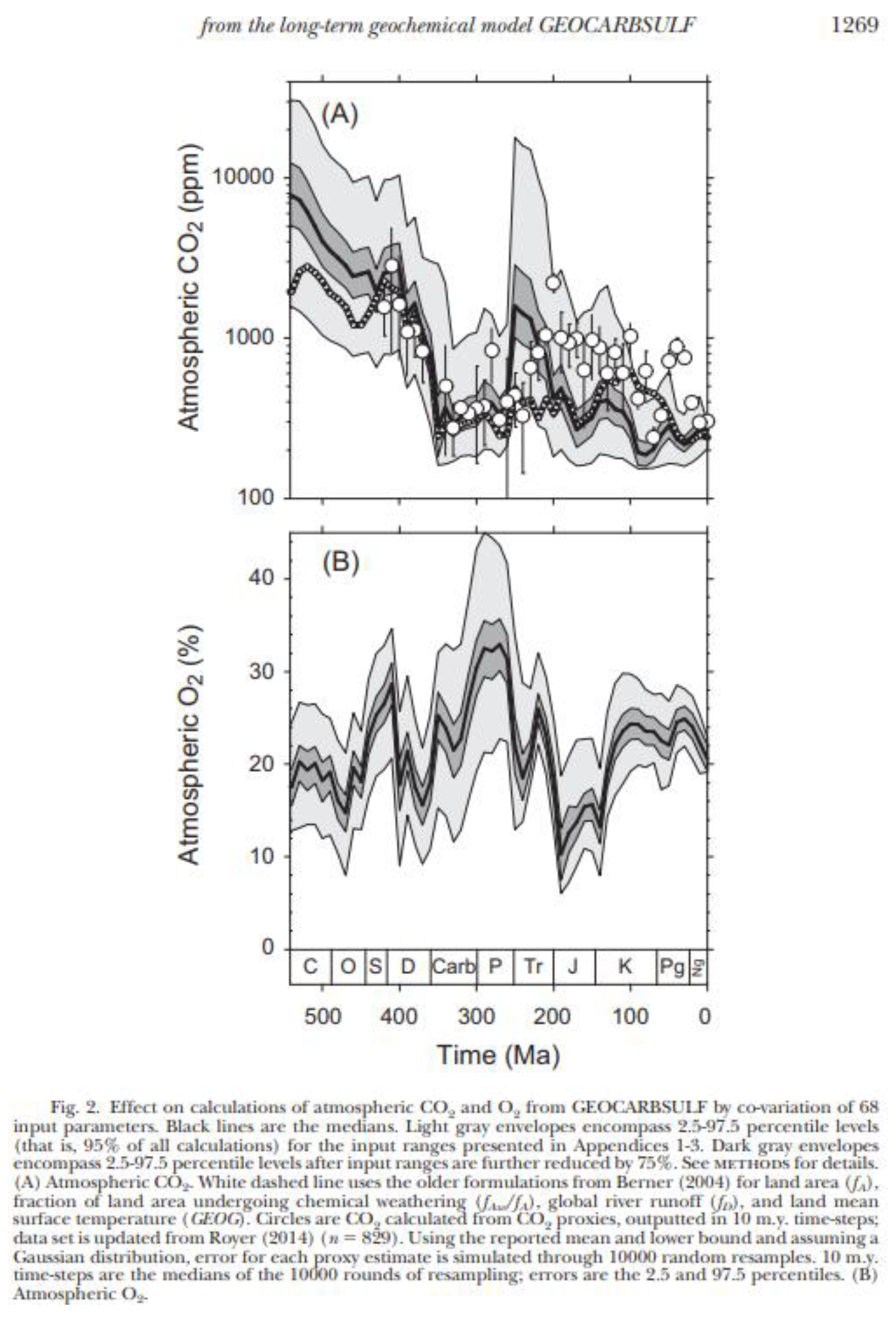
Figure 14.
NOAA’s Barrow site in Alaska is a northernmost monitoring station yielding seasonally fluctuating blue curve with 60–80 Gt C/yr flux, much higher than fossil fuel emissions and far in excess of Carbon Capture Storage (BECCS/CCS) schemes. Revised terrestrial NPP (green) and soil respiration SR (brown) almost balance out, more or less.
Figure 14.
NOAA’s Barrow site in Alaska is a northernmost monitoring station yielding seasonally fluctuating blue curve with 60–80 Gt C/yr flux, much higher than fossil fuel emissions and far in excess of Carbon Capture Storage (BECCS/CCS) schemes. Revised terrestrial NPP (green) and soil respiration SR (brown) almost balance out, more or less.
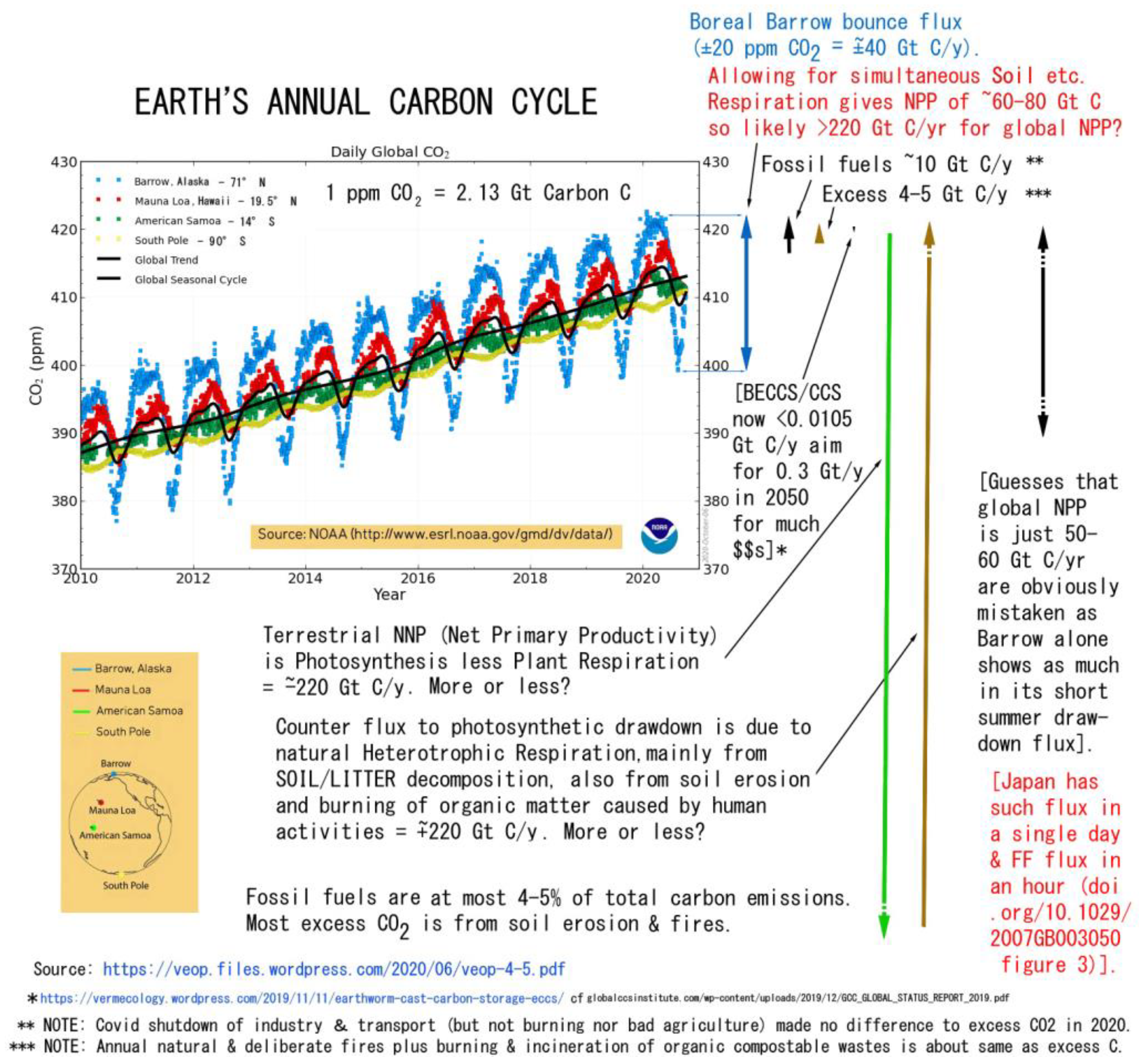
Disclaimer/Publisher’s Note: The statements, opinions and data contained in all publications are solely those of the individual author(s) and contributor(s) and not of MDPI and/or the editor(s). MDPI and/or the editor(s) disclaim responsibility for any injury to people or property resulting from any ideas, methods, instructions or products referred to in the content. |
© 2024 by the authors. Licensee MDPI, Basel, Switzerland. This article is an open access article distributed under the terms and conditions of the Creative Commons Attribution (CC BY) license (http://creativecommons.org/licenses/by/4.0/).
Copyright: This open access article is published under a Creative Commons CC BY 4.0 license, which permit the free download, distribution, and reuse, provided that the author and preprint are cited in any reuse.