

Submitted:
10 October 2024
Posted:
11 October 2024
Read the latest preprint version here
Abstract
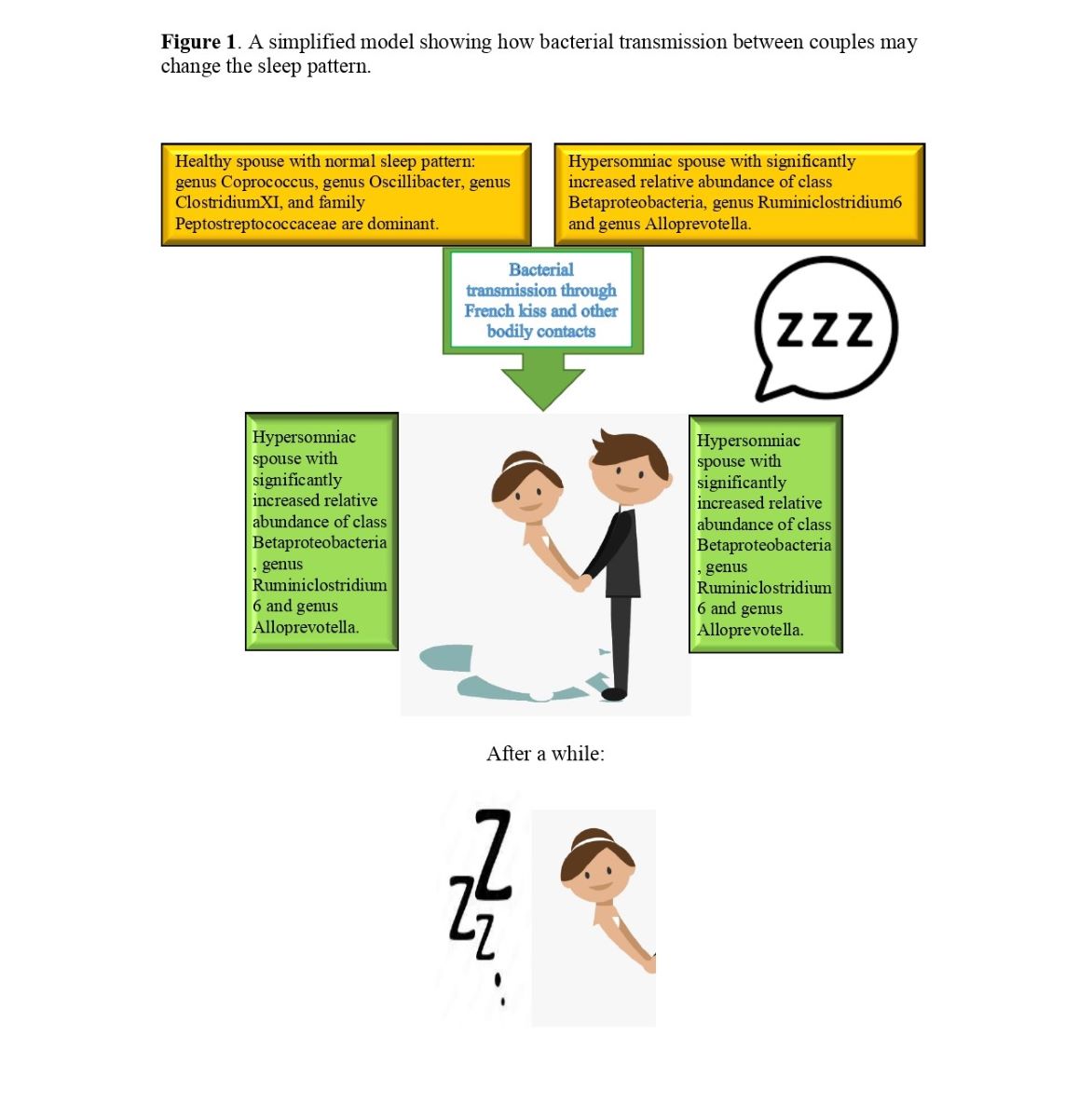
The composition of the gut microbiota varies significantly among healthy individuals and insomniacs, hypersomniacs and healthy people. On the other hand, there is a substantial bacterial strain shared across these populations with distinct intra-population, mother-to-infant and intra-household transmission patterns. Based on these premises, we propose a hypothesis stating that person-to-person bacterial transmission can change the sleep pattern in couples. In this pilot study, 157 couples who had been married and living together for an average of 5.91 months were enrolled. A wide range of questionnaires were administered to participants to measure sleep patterns. Gut microbiota composition was analyzed at two time points: baseline and 3 months. We found that sleep disturbances in couples can be partially explained by changes in gut microbiota.
Keywords:
1. Introduction
2. Method
2.1. Participants
2.2. Sample Collection
2.3. Sleep Study
3. Results
4. Discussion
5. Conclusions
Author Contributions
Data Availability Statement
Informed Consent and Ethics Approval
Acknowledgments
Conflicts of Interest
References
- Wang, Z.; Wang, Z.; Lu, T.; Chen, W.; Yan, W.; Yuan, K.; Shi, L.; Liu, X.; Zhou, X.; Shi, J.; Vitiello, M.V.; Han, Y.; Lu, L. The microbiota-gut-brain axis in sleep disorders. Sleep. Med. Rev. 2022, 65, 101691. [Google Scholar] [CrossRef] [PubMed]
- Busch, A.; Roy, S.; Helbing, D.L.; Colic, L.; Opel, N.; Besteher, B.; Walter, M.; Bauer, M.; Refisch, A. Gut microbiome in atypical depression. J. Affect. Disord. 2024, 349, 277–285. [Google Scholar] [CrossRef]
- Rakoff-Nahoum, S.; Foster, K.R.; Comstock, L.E. The evolution of cooperation within the gut microbiota. Nature 2016, 533, 255–259. [Google Scholar] [CrossRef]
- Sheng, D.; Li, P.; Xiao, Z.; Li, X.; Liu, J.; Xiao, B.; Liu, W.; Zhou, L. Identification of bidirectional causal links between gut microbiota and narcolepsy type 1 using Mendelian randomization. Sleep. 2024, 47. [Google Scholar] [CrossRef]
- Valles-Colomer, M.; Blanco-Miguez, A.; Manghi, P.; Asnicar, F.; Dubois, L.; Golzato, D.; Armanini, F.; Cumbo, F.; Huang, K.D.; Manara, S.; Masetti, G.; Pinto, F.; Piperni, E.; Puncochar, M.; Ricci, L.; Zolfo, M.; Farrant, O.; Goncalves, A.; Selma-Royo, M.; Binetti, A.G.; Becerra, J.E.; Han, B.; Lusingu, J.; Amuasi, J.; Amoroso, L.; Visconti, A.; Steves, C.M.; Falchi, M.; Filosi, M.; Tett, A.; Last, A.; Xu, Q.; Qin, N.; Qin, H.; May, J.; Eibach, D.; Corrias, M.V.; Ponzoni, M.; Pasolli, E.; Spector, T.D.; Domenici, E.; Collado, M.C.; Segata, N. The person-to-person transmission landscape of the gut and oral microbiomes. Nature 2023, 614, 125–135. [Google Scholar] [CrossRef] [PubMed]
- Chehri, A.; Goldaste, N.; Ahmadi, S.; Khazaie, H.; Jalali, A. Psychometric properties of insomnia severity index in Iranian adolescents. Sleep. Sci. 2021, 14, 101–106. [Google Scholar] [PubMed]
- Itani, O.; Kaneita, Y.; Munezawa, T.; Mishima, K.; Jike, M.; Nakagome, S.; Tokiya, M.; Ohida, T. Nationwide epidemiological study of insomnia in Japan. Sleep. Med. 2016, 25, 130–138. [Google Scholar] [CrossRef] [PubMed]
- Evangelista, E.; Lopez, R.; Barateau, L.; Chenini, S.; Bosco, A.; Jaussent, I.; Dauvilliers, Y. Alternative diagnostic criteria for idiopathic hypersomnia: A 32-hour protocol. Ann. Neurol. 2018, 83, 235–247. [Google Scholar] [CrossRef] [PubMed]
- Liu, S.; Rovine, M.J.; Cousino Klein, L.; Almeida, D.M. Synchrony of diurnal cortisol pattern in couples. J. Fam. Psychol. 2013, 27, 579. [Google Scholar] [CrossRef] [PubMed]
- Coutinho, J.; Pereira, A.; Oliveira-Silva, P.; Meier, D.; Lourenço, V.; Tschacher, W. When our hearts beat together: Cardiac synchrony as an entry point to understand dyadic co-regulation in couples. Psychophysiology 2021, 58, e13739. [Google Scholar] [CrossRef] [PubMed]
- Gunn, H.E.; Buysse, D.J.; Hasler, B.P.; Begley, A.; Troxel, W.M. Sleep concordance in couples is associated with relationship characteristics. Sleep 2015, 38, 933–939. [Google Scholar] [CrossRef] [PubMed]
- Roberts, N.A.; Burleson, M.H.; Pituch, K.; Flores, M.; Woodward, C.; Shahid, S.; Todd, M.; Davis, M.C. Affective Experience and Regulation via Sleep, Touch, and "Sleep-Touch" Among Couples. Affect. Sci. 2022, 3, 353–369. [Google Scholar] [CrossRef] [PubMed]
- Saini, E.K.; Keiley, M.K.; Fuller-Rowell, T.E.; Duke, A.M.; El-Sheikh, M. Socioeconomic Status and Sleep among Couples. Behav. Sleep. Med. 2021, 19, 159–177. [Google Scholar] [CrossRef] [PubMed]
- Chen, J.H. Couples’ Sleep and Psychological Distress: A Dyadic Perspective. J. Gerontol. B Psychol. Sci. Soc. Sci. 2017, 73, 30–39. [Google Scholar] [CrossRef] [PubMed]
- Walters, E.M.; Phillips, A.J.; Hamill, K.; Norton, P.J.; Drummond, S.P. Anxiety predicts dyadic sleep characteristics in couples experiencing insomnia but not in couples without sleep disorders. J. Affect. Disord. 2020, 273, 122–130. [Google Scholar] [CrossRef] [PubMed]

| Sleep Pattern | |||
|---|---|---|---|
| Gender | Healthy Sleep Pattern | Insomniac Pattern | Hypersomniac Pattern |
|
Men |
Baseline€: 28 (28.28) [0.00] GMT⃰: Normal |
26 (24.07) [0.16] GMT: Insomniacs had significantly decreased family Ruminococcaceae, family Bacteroidaceae, and genus Bacteroides, along with significantly increased family Prevotellaceae and genus Prevotella, compared with healthy participants. Genus Fusicatenibacter and genus Gemmiger were dominant in insomniacs, while genus Clostridium XI, genus Oscillibacter, genus Coprococcus, and family Peptostreptococcaceae were dominant in healthy participants. |
20 (21.66) [0.13] GMT: Hypersomnics had significantly increased relative abundance of class Betaproteobacteria, genus Ruminiclostridium6 and genus Alloprevotella. |
|
Three months later £: 7 (13.38) [3.04] GMT: Normal |
Three months later 83 (71.56) [1.83] GMT: As above |
Three months later: 15 (20.06) [1.28] GMT: As above |
|
|
Women |
Baseline: 19 (18.72) [0.00] GMT: Normal |
14 (15.93) [0.23] GMT: As above |
16 (14.34) [0.19] GMT: As above |
|
Three months later 13 (6.62) [6.14] GMT: Normal |
Three months later 24 (35.44) [3.69] GMT: As above |
Three months later: 15 (9.94) [2.58] GMT: As above |
|
Disclaimer/Publisher’s Note: The statements, opinions and data contained in all publications are solely those of the individual author(s) and contributor(s) and not of MDPI and/or the editor(s). MDPI and/or the editor(s) disclaim responsibility for any injury to people or property resulting from any ideas, methods, instructions or products referred to in the content. |
© 2024 by the authors. Licensee MDPI, Basel, Switzerland. This article is an open access article distributed under the terms and conditions of the Creative Commons Attribution (CC BY) license (https://creativecommons.org/licenses/by/4.0/).


