

Submitted:
28 September 2024
Posted:
29 September 2024
You are already at the latest version
Abstract
Digital transformation, powered by technologies like AI, IoT, and big data, is reshaping industries and societies at an unprecedented pace. While these innovations promise smarter energy management, precision agriculture, and efficient resource utilization, they also introduce serious environmental challenges. This paper examines the dual impact of digital technologies, highlighting key threats such as rising energy consumption, growing e-waste, and increased extraction of raw materials. For instance, global e-waste reached 62 million metric tons in 2022, and data centers alone accounted for nearly 1% of the world's electricity demand in 2019. The review synthesizes findings from studies on topics like the energy use of blockchain technologies and the environmental costs of raw material extraction in the smartphone industry. Moreover, it identifies critical research gaps, particularly in understanding the environmental impact of digital usage at individual and household levels. Practical strategies such as integrating circular economy principles, promoting renewable energy, and green computing are proposed to balance technological advancement with sustainability goals. This study highlights the need for a holistic approach, suggesting future research directions to minimize digital transformation’s environmental footprint while maximizing its sustainability benefits.
Keywords:
digital transformation
; sustainability
; circular economy
; e-waste
; energy consumption
1. Introduction
In this technological age, digital transformation has become the face of the future. It has transformed the way industries operate, governments work, and individual communicate or interact. Digital transformation, driven by technologies such as AI, IoT, blockchain, and big data analytics, has played a major role in improving the efficiency, productivity, and innovation in businesses. It is a force shaping not only industry practices but also the lives of individuals and the broader society by redefining social interactions, employment patterns, education, and even healthcare [1]. However, this rapid digital transformation has resulted into a very critical and often overlooked issue i.e. its environmental impact.
One of the most important developments in the global fight against environmental degradation is the meeting of environmental sustainability and digital transformation. There may be a lot of bright sides to the digital economy, but it does have its drawbacks, such as higher energy usage, resource depletion, and an ever-growing amount of electronic waste, or "e-waste." The International Energy Agency estimated that the data centers and data transmission networks accounted for approximately 1% of the world's electricity demand in 2019. This percentage is only projected to rise as the rate of digital transformation continues to rise [2]. The manufacturing of digital devices, ranging from smartphones to servers, uses huge amounts of raw materials, including rare earth elements, that are normally extracted through environmentally degrading processes [3].
The environmental challenges of digital transformation must be overcome for a number of reasons. First, there will be an increasing environmental footprint from the digital economy as more digital technologies get integrated into daily life. For example, with an estimated 75.44 billion IoT devices by 2025, a rapid rise in IoT devices would not only increase energy demand but also significantly add to e-waste production [4]. Second, the effect of digital technologies on the environment does not stay local but is global in scope and may magnify current environmental problems associated with climate change, pollution, and resource depletion [5].
1.1. The Importance of Addressing Environmental Challenges
It is very important for us to resolve the environmental matters that the DT has brought about. In fact, if left unaddressed, such problems might even reverse the very same benefits that digital technologies have in the first place. For instance, AI and big data analytics, while holding future potential to optimize resource use and stimulate environmental monitoring, demand huge computing resources, thus increasing energy use and in turn greenhouse gases [6]. It is like a paradox, which needs a harmonious approach, i.e. allow people to benefit from the DT, while lessening the environmental degradation caused by it.
The environmental challenges of digital transformations also have a direct connection to the larger, socio-economic sustainability issues. The gap between those with and without access to digital technology is known as the "digital divide," and it has the potential to worsen inequality and obstruct the achievement of the Sustainable Development Goals (SDGs) [7]. For example, digital infrastructure expansion could increase fossil fuel use in places where renewable energy is not easily accessible, thereby increasing the rate of environmental degradation and climate change [8]
The urgency of acting on these challenges comes out even more strongly in the face of growing awareness by policymakers, businesses, and civil society regarding the transition to a more sustainable digital economy. According to the European Green Deal, on one hand, digital technologies are instrumental in the attainment of the climate neutrality goals of the EU by 2050; on the other hand, their impacts are equally a reason for concern (European Commission, 2019). Similarly, the United Nations has also called for a "green digital transformation" that has principles of environmental sustainability and social equity within it [9].
1.2. The Need for Balance Between Progress and Sustainability
Finding the right balance between technological progress and environmental sustainability is becoming more challenging. To achieve a sustainable DT, we need to consider the environment at every stage—starting from how digital technologies are designed and developed, all the way through their use and disposal. This means taking a life cycle approach, which involves looking at the entire process from the extraction of raw materials to manufacturing, usage, and eventual disposal to minimize environmental harm. This balance demands a change in mindset and way of governance. Although technology on its own can balance these two facets, there lies a role for policymakers, businesses, and consumers in encouraging sustainable DT. Policymakers can, for example, adopt regulations that would encourage the use of renewable energy in digital infrastructure, while businesses adopt the circular economy principles with reduced e-waste and use of resources [10]. Consumers can make informed decisions by selecting the best environmentally friendly digital products and services and also support companies following the best sustainable development practices.
In a digital economy, global supply chains are highly interconnected and complex, which increases the difficulty of attaining progress and sustainability. Mostly, the production cycle of digital devices involves several stages of manufacturing across countries with different environmental standards and practices [11]. Hence it is a challenge to distribute and address the environmental impact evenly at each supply chain stage. Also, due to the continuous new and improved digital products in demand, there is a possibility of shorter product cycles, increasing resource use, and increased e-waste generation [12].
Considering the criticality of this current issue, very few reviews and studies are found to present a holistic approach to the issue focusing on all the aspects. In a study by Belkhir & Elmeligi [13] global carbon footprint of Information and Communication Technology (ICT) sectors are accessed projecting trends up to 2040. It provides a detailed analysis of the carbon emissions associated with various digital technologies, including smartphones, data centers, and networks.
A review by Feroz et al. [14] focuses on how digital transformation impacts environmental sustainability, identifying disruptions in pollution control, waste management, sustainable production, and urban sustainability. The authors conduct a systematic literature review to categorize these impacts and propose a research agenda centered on the capabilities required for sustainable digital transformation. Another review by Truong [15] investigates the impacts of digital transformation on environmental sustainability, focusing on three main areas: waste management and handling, pollution prevention and control, and sustainable resource management. It examines both the positive and negative effects of digital technologies like AI, big data, IoT, and blockchain on the environment, providing a comprehensive understanding of their implications. While Alojail & Khan [16] highlighted that aligning digital transformation with sustainability principles enhances environmental, social, and economic performance, providing organizations with a competitive advantage and improving long-term outcomes through effective governance, stakeholder engagement, and strategic resource allocation.
While this extensive literature provides information on the impacts of digital transformation, a holistic review considering all the aspects of opportunities, threats, and mitigation strategies to attain environmental sustainability while enjoying the benefits of digital transformation is missing. The present review is built on this foundation by providing a more holistic analysis, covering areas such as the opportunities and threats of digital technologies, and practical mitigation strategies to address the environmental challenges posed by digital transformation. The review also explores the long-term and systemic impacts of digital transformation on environmental sustainability, including more detailed assessments of the resource demands and broader ecological effects of digital technologies. It also provides new insights into the mitigation strategies required to manage these impacts, fulfilling a critical need in the current literature.
Specifically, the review seeks to:
- Critical analysis of the existing literature on the environmental footprint of the digital economy, with a focus on both the positive and negative impacts of digital transformation.
- Identify and evaluate strategies for mitigating the environmental impact of digital transformation.
- Identify gaps in the existing literature and suggest areas for future research.
2. Theoretical Framework
2.1. Understanding Digital Transformation
Digital transformation refers to the integration of digital technologies into all areas of a business or society, fundamentally changing how organizations operate and deliver value to customers. It is not merely about implementing new technologies but involves a cultural shift that requires organizations, governments, and individuals to continually challenge the status quo, experiment, and adapt to new realities [17,18].
For organizations, digital transformation means rethinking how they do business, engage with customers, and run their operations. This often involves using new technologies like artificial intelligence (AI), cloud computing, the Internet of Things (IoT), and big data analytics. The main goals are to boost efficiency, find new ways to make money and improve customer experiences. Companies that embrace digital transformation usually see big gains in how they operate and make decisions [19].
For governments, digital transformation means using technology to improve public services, increase transparency, and connect with citizens more effectively. Examples include e-governance, digital ID systems, and smart city projects. Digital transformation can lead to more efficient government operations and better service delivery. At the societal level, digital transformation involves changes in how people interact, communicate, work, and access information. The rise of social media, digital learning platforms, and telehealth services are key examples. It is a global phenomenon that affects all sectors of society. It has the potential to drive economic growth, improve social welfare, and address global challenges such as climate change.
2.2 Understanding Environmental Sustainability
Environmental sustainability means using natural resources wisely to prevent their depletion and avoid harming the environment, ensuring it stays healthy for the long term. It involves protecting ecosystems, conserving wildlife, and cutting down on pollution and waste. The goal is to meet our needs today without making it harder for future generations to meet theirs, balancing economic growth, social well-being, and environmental health.
As digital technologies become more common, the importance of environmental sustainability grows. On the positive side, these technologies can help use resources more efficiently, cut down on emissions with smart tech, and support efforts to monitor and manage the environment. But there's a downside too: the rapid growth of digitalization can lead to higher energy use, more electronic waste, and worsen existing environmental problems. Experts stress that it's crucial to consider sustainability when designing and implementing digital solutions, so that progress in technology doesn't come at the expense of environmental health [20,21].
3. Materials and Methods
To address the objectives of this review, a qualitative literature review approach was selected. This method was chosen for its balance between providing a comprehensive overview of relation between digital technologies and environmental sustainability and build a comprehensive theoretical framework around the opportunities and threats posed by digital transformation [22]. The process followed for the review is shown in Figure 1.
3.1 Literature Review and Data Collection
The literature search was conducted using multiple reputable academic databases, including Google Scholar, IEEE Xplore, Scopus, SpringerLink, and ScienceDirect. These databases were selected for their extensive collections of peer-reviewed journal articles, conference papers, and industry reports, ensuring comprehensive coverage of the relevant research. The search involved a combination of keywords related to digital transformation and environmental impact. The primary keywords used included: Digital transformation, Environmental impact, Sustainability, IoT, AI, Big data, E-waste, Energy consumption, Smart grids, Cryptocurrency, Bitcoin, GHG, Internet usage.
An initial search was conducted using the primary keywords in each database to identify a broad range of relevant studies. The search results were refined by adding more specific keywords to the search. The titles and abstracts of the retrieved articles were screened to assess their relevance to the research objectives.
Articles were included if they met the following criteria: a. Studies that focused on digital transformation’s opportunities, threats, and mitigation strategies in relation to environmental sustainability. b. Only peer-reviewed journal articles, conference papers, and well-regarded industry reports were included to ensure the credibility of the findings. c. The review included studies published between 2011 and 2024 to capture the latest developments and trends in the field. d. Only studies published in English were considered to maintain consistency and ease of analysis.
3.2 Data Analysis
The selected literature was analyzed using a thematic analysis approach to identify recurring themes and patterns related to the environmental impact of digital transformation. The analysis focused on understanding how digital technologies influence environmental outcomes, both positively and negatively, across various sectors. Key themes identified included:
Opportunities for Environmental Sustainability: Digital technologies such as AI, IoT, and big data analytics can optimize resource use, enhance energy efficiency, and support sustainable practices in sectors like agriculture, manufacturing, and energy management.
Environmental Risks: The proliferation of digital technologies also presents significant challenges, including increased e-waste, high energy consumption, and the environmental cost of raw material extraction.
Mitigation Strategies: The literature highlighted various strategies to mitigate the environmental impact of digital transformation, such as adopting circular economy principles, promoting green computing practices, and integrating renewable energy sources into digital infrastructure.
3.3 Synthesis and Results Description
The synthesis and theoretical framework of this review are constructed to provide a comprehensive understanding of the dual nature of digital transformation in relation to environmental sustainability. While technologies like AI, IoT, and blockchain can enhance resource management and monitoring, they also contribute to higher energy consumption, e-waste, and carbon emissions. The theoretical framework highlights the need for a balanced approach, integrating policy, corporate responsibility, and public awareness to mitigate negative impacts and optimize benefits.
4. Opportunities for Environmental Sustainability Through Digitalization
Digitalization is a powerful tool for environmental sustainability in all sectors. Digital technologies in the environment sector, agriculture, energy systems, and resource optimization can definitively achieve strides toward a more sustainable future. This section will look into the opportunities for digital technologies, in particular, how they can drive sustainability in the critical areas of smart grids and energy management, digital agriculture, the role of AI in resource-use optimization, reduction in physical resource usage, and environmental monitoring.
4.1 Smart Grids and Energy Management
Smart grid is an important advancement tool in energy management for better, more reliable, and more sustainable energy distribution. A smart grid integrates digital communication technology with the electrical grid as a whole to monitor and control energy flows in real-time. Digitalization of this sector can significantly reduce carbon emissions and greatly improve the share of renewable energies [23,24].
Smart grids allow for the implementation of demand response programs, where consumers are incentivized to reduce or shift their energy use during peak periods, further decreasing the strain on the grid and reducing emissions [25]. In addition to these benefits, smart meters, a key component of smart grids, provide consumers with real-time data on their energy usage, empowering them to make more informed decisions and adopt energy-saving practices. Studies have shown that households with smart meters can reduce their energy consumption by up to 15% [26]. This reduction in energy use leads to lower greenhouse gas (GHG) emissions, and hence contributing to overall environmental sustainability. Table 1 provides a comparative analysis of traditional grids and smart grids.
Smart grids also allow the incorporation of renewable energy sources like wind and solar energy into the power grid by dynamically balancing the supply and demand, thereby reducing dependence on fossil fuel sources [27]. A study by Rehman et al. [24] demonstrates that the integration of renewable energy sources into smart grids not only reduces carbon emissions but also enhances grid stability. Smart grids bring clean energy sources into the system, contributing to the reduction of greenhouse gases and enhancing the security of energy.
4.2 Digital Agriculture for Sustainable Farming
Digital agriculture has huge potential to deliver improved sustainable agricultural practices due to the essential role digital technologies play in farming. With the global population projected to reach 9.7 billion by 2050 [28], ensuring food security while minimizing environmental impact is a key challenge. Digital agriculture offers solutions through precision farming, smart irrigation, and data-driven decision-making [29].
Precision farming involves the use of GPS, IoT sensors, and drones to monitor crop health, soil conditions, and weather patterns. This real-time data allows farmers to optimize the use of water, fertilizers, and pesticides, reducing waste and minimizing the environmental impact of farming [30]. For instance, smart irrigation systems that adjust water delivery based on soil moisture levels can reduce water usage by up to 40% compared to traditional irrigation methods [31]. According to Bwambale et al. [32] combining soil-based, plant, and weather-based monitoring methods in a modelling environment with model predictive control can significantly improve water use efficiency. The use of precision irrigation water-saving systems (PISs) for efficient water management under climate change is also highly recommended approach by researchers [31,33,34].
Digital platforms and apps also provide farmers with access to critical information, such as weather forecasts, market prices, and best practices, enabling them to make informed decisions that enhance productivity and sustainability [35,36]. In addition to improving resource efficiency, digital agriculture also supports sustainable land management by allowing the farmers to track and manage soil health over time [37,38].
4.3 The Role of AI in Optimizing Resource Use
Artificial Intelligence (AI) is viewed as a great optimization tool in the use of resources across various industries. By analyzing large datasets and identifying patterns, AI can help reduce waste, improve efficiency, and minimize the environmental footprint of production processes [39,40]. Kristian et al. [41] suggests that AI models significantly enhance efficiency and sustainability by providing accurate predictions and automation recommendations. Table 2 lists the applications of AI in Resource Optimization in various industries.
AI-driven predictive maintenance systems in manufacturing can reduce downtime and minimize energy consumption by identifying the indicators of potential failures and help prevent some production stops from happening [42]. This not only extends the lifespan of machinery but also reduces the need for new equipment, thereby lowering resource consumption [43,44]. Similarly, AI algorithms can optimize supply chain operations, reducing the environmental impact of transportation by identifying the most efficient routes and minimizing empty miles [45].
AI also plays a critical role in the energy sector, where it is used to optimize the operation of power plants, manage energy storage systems, and integrate renewable energy sources into the grid [46,47]. For example, AI algorithms can predict energy demand and adjust the output of power plants accordingly, reducing waste and enhancing the efficiency of energy production [48,49].
Besides, AI is used within agriculture to optimize inputs, in activities related to water or fertilizers, and monitoring and predicting outputs of certain crops; thereby, helping farmers to maximize productivity [50].
4.4 Environmental Monitoring
Digital technologies have revolutionized environmental monitoring, providing tools for real-time data collection, analysis, and reporting [51]. These technologies enable more accurate and comprehensive monitoring of environmental parameters such as air and water quality, deforestation, and wildlife populations [52].
Remote sensing technologies, including satellite imagery and drones [53], are used to monitor deforestation, land use changes, and the health of ecosystems [54]. These technologies provide critical data that can inform conservation efforts and policy decisions. For example, the use of satellite data to monitor deforestation in the Amazon has enabled more effective enforcement of conservation laws and the identification of illegal logging activities [55]. Another study by Hadi et al. [56] successfully utilized the Landsat Time Series data to demonstrate effective sub-annual deforestation detection in Kalimantan, Indonesia, showing the potential of remote sensing for high spatial accuracy in monitoring forest changes under persistent cloud cover.
In addition to remote sensing, IoT sensors are increasingly being used to monitor environmental conditions in real-time [57]. These sensors can be deployed in various settings, from urban areas to remote wilderness, to track air and water quality [58,59], soil moisture levels [60,61], and other environmental parameters. The data collected by these sensors can be analyzed using AI and big data analytics to identify trends, predict future conditions, and inform environmental management strategies [62]. Table 3 gives the list of studies in the area of opportunities for digital transformation.
5. Threats to the Environment from Digital Transformation
Digital transformation offers a lot of potential for environmental sustainability, but it also brings significant threats that can't be ignored. The rapid spread of digital technologies leads to more electronic waste, higher energy consumption from data centers and blockchain technologies, large-scale raw material extraction, heavy water use in digital production, and rising carbon emissions from digital activities. This section takes a closer look at these risks, drawing on recent studies to explore their impact on the environment.
5.1 E-Waste and Its Environmental Impact
The rapid rise of digital technologies has increased e-waste to unprecedented levels, earning it a place among the fastest-growing waste streams in the world. According to the [64], global e-waste generation reached 62 million tonnes (Mt) in 2022, up 82% from 2010, and only 22.3% of this was recycled properly. E-waste contains hazardous substances like lead, mercury, cadmium, and brominated flame retardants, which can leach into the environment, further polluting land and water sources [65]. The improper ways of e-waste disposal and recycling pose a serious threat to the environment and health [66], particularly in developing countries where much of this waste is shipped.
A large portion of e-waste comes from electronic gadgets that are dumped, like computers, smart phones, tablets, and other forms of digital devices. The rapid pace of technological innovation results in shorter product life cycles, which leads to rapid replacement of the gadgets; hence, e-waste tremendously increases [67]. This has further been driven by the global digitalization shift, based on the rapid adoption of devices, including devices such as Internet of Things (IoT) gadgets and smart home technologies, which have further intensified the issue at hand [68,69]. Another area overlooked is the growing popularity of bitcoin. According to De Vries & Stoll [70], bitcoin mining is an extremely significant generator of global electronic waste, estimated at 30.7 metric kilotons annually, comparable to the electronic waste output of countries like the Netherlands, and possibly going up to 64.4 metric kilotons with the rising bitcoin prices.
The environmental and health impacts of e-waste are huge [71]. A huge amount of e-waste is exported from developed nations to developing countries, where it is processed using rudimentary and unsafe methods. Abalansa et al. [72] emphasized that in developing countries, the landfilling and incineration of e-waste cause severe environmental harm, such as aquatic ecotoxicity and global warming, and while formal recycling can reduce these effects, the high costs make it impractical in developing nations. Only 22.3.4% of total global e-waste is known to have been collected and properly recycled and this figure is estimated to drop to 20% by 2030 due to escalating differences in the recycling efforts and the rate at which the e-waste generation is increasing [64]. Figure 2 shows the global rate of e-waste generation and recycling percentage.
The potential impact of e-waste on soil and water quality has also been extensively studied. For instance, a study by Cao et al. [73] in Ghana's Agbogbloshie area, one of the largest dumping sites for e-waste in the world, detected high levels of heavy metals that pose serious risks to soil agriculture and human health. A similar study conducted in China by Hashmi et al. [74] established that e-waste recycling activities had contaminated the local water bodies with highly toxic and Persistent Organic Pollutants (POPs), which accumulate in the food chain. Lin et al. [75] have further reported that open-field incineration of e-waste releases emissions that are highly toxic, emitting dioxins and furans, posing a serious problem to air pollution, and increasing the potential for respiratory diseases in communities near such facilities.
The health impacts of the of the hazardous substances found in e-waste are many. The toxic elements, such as lead, mercury, cadmium, and brominated flame retardants, can lead to severe health issues ranging from neurotoxicity and developmental delays to carcinogenic effects [76]. Table 4 shows the health implications of various hazardous components found in e-waste.
5.2 Energy Consumption of Data Centers and Blockchain Technologies
Data centers and blockchain technologies are the integral part of the digital economy; they, however, are also among the most power-intensive infrastructures. The energy demands of these technologies have significant environmental implications, particularly in terms of carbon emissions and resource use.
Data centers, which house vast amounts of computing hardware, are essential for supporting cloud computing, big data analytics, and other digital services. They, however, use vast amounts of electricity i.e. about 1% of global electricity consumption and this figure likely to rise sharply in the coming years [93]. According to a report the data centers consumed 460TWh in 2022, a figure that could rise to more than 1,000TWh by 2026 in a worst-case scenario [94]. A typical data center may consume as much energy as 25,000 households while data center spaces may consume up to 100 to 200 times as much electricity as standard office space [95]. The energy use by data centers is primarily driven by the continuous demand for power supplies to servers and cooling systems as a vital factor which are critical to maintaining optimal operating conditions [96]. There are currently more than 8000 data centers globally, with about 33% of these located in the United States, 16% in Europe and close to 10% in China [94]. Figure 3 shows the increasing trend in the global electricity demand from data centers, AI, and cryptocurrencies for the years 2019-2026.
Blockchain has also gained a lot of attention for its high energy consumption, particularly in the areas of cryptocurrencies like Bitcoin. One of the core mechanisms behind blockchain is a decentralized network of computers, making it possible for the respective cryptocurrency transactions to be confirmed, a process known as mining. Mining requires solving complex cryptographic puzzles, which requires enormous computational power, which in turn leads to high energy consumption. A study by Mora et al. [97] estimates that Bitcoin mining alone could push global warming beyond the 2°C threshold set by the Paris Agreement within a few decades if left unchecked. Similarly, Stoll et al. [98] reported that Bitcoin's annual energy consumption was comparable to that of countries like Austria, with a carbon footprint equivalent to that of a major global city. These results emphasize the environmental effects of blockchain technologies, particularly in their present energy-intensive formulations.
5.3 Raw Material Extraction and Environmental Impact
The production of digital devices requires extracting raw materials like rare earth elements, metals, and minerals, which often comes from areas rich in natural resources. Unfortunately, this process can lead to the destruction of habitats, loss of biodiversity, and pollution. Rare earth elements (REE) are critical components in digital devices, such as smartphones, computers, and renewable energy technologies [99]. Table 5 shows the world reserves of REE by principal countries. Smartphones and tablets are highly resource-intensive due to their significant use of critical raw materials, large-scale global shipments, and short lifespans, leading to frequent replacements [100]. These devices account for substantial portions of the global demand for cobalt (9.4%) and palladium (8.9%), as well as notable shares of tantalum, silver, gold, indium, and magnesium. The total material inventory of all active smartphones and tablets globally is estimated to be around 1 million tons [101,102], highlighting their substantial impact on resource consumption and the need for improved recycling and collection practices.
But the extraction of rare earth elements is an extremely environmentally destructive process, which includes large-scale land disturbance, water pollution, and the emission of toxic waste [3]. Table 6 shows the environmental impacts of raw material extraction of 3 major materials required in digital devices.
Several studies have documented the environmental impact of raw material extraction for digital technologies. Zheng et al. [104] emphasize that the extraction and refining of rare earth elements, which are essential for the production of high-tech devices, result in significant ecological damage. They found that the processing of rare earths generates large amounts of toxic waste, including radioactive materials, which can contaminate surrounding ecosystems. Similarly, a study by Ali [105] highlights that the mining of lithium, a key component in rechargeable batteries, particularly in regions like the Atacama Desert in Chile, leads to severe water depletion and desertification, threatening local communities and ecosystems. Cobalt mining, predominantly in the Democratic Republic of Congo (DRC), has also come under scrutiny due to its environmental and social impacts [106]. Weng et al. [107] have also highlighted the environmental impacts of REE mining, including issues related to radioactive elements (U-Th), the use of harmful chemicals during processing, and greenhouse gas emissions emphasizing the need to address these risks in future REE supply. Table 7 summarizes few studies on impact of rare earth elements (REEs) mining on human health and the environment.
5.4 Water Usage in Digital Manufacturing
Digital manufacturing water use is another area of the environmental footprint that goes with digital change. More specifically, producing semiconductors, fundamental parts of digital devices, is actually very water-intensive. Semiconductor manufacturing requires ultrapure water (UPW) for various stages, including wafer fabrication, cleaning, and cooling processes. A single semiconductor manufacturing plant can consume as much as 10 million gallons of water every day, depending on the size and production capacity of that facility [115]. Ultrapure water consumption for semiconductor manufacturing was predicted to be 5.51 x 10⁸ m3 worldwide in 2022 [8]. Due to this huge demand for water in digital manufacturing, there is a resulting over-exploitation of freshwater resources, more specifically in countries that already have low water availability.
Recent studies have explored the environmental implications of water usage in digital manufacturing, underlining not just the scale of water use but also the potential for pollution. According to Chamanara et al. [116], the global Bitcoin mining network had a water footprint of 1.65 km³ during 2020-21, exceeding the domestic water needs of about 300 million people living in rural Sub-Saharan Africa. While, Li et al. [117] suggests that training GPT-3 in Microsoft's U.S. data centers can evaporate 700,000 liters of fresh water, and with global AI demands, it can reach 4.2 – 6.6 billion cubic meters of water withdrawal by 2027, equivalent to the annual water use of 4-6 countries like Denmark or half of the United Kingdom.
The increase in internet usage over recent years, especially during the COVID-19 pandemic, has led to a surge in data center (DC) operations [118]. This expansion has significantly escalated energy demands and, consequently, water usage for cooling and power generation. Data centers consume about 9.1 liters of water per kWh of energy, resulting in an annual consumption of around 660 billion liters in the U.S. alone [119]. Microsoft used 3.96 Gigalitres (GL) of water in 2020, up from 1.91 GL in 2017, while Google utilized 21.5 GL in 2021, up from 11.62 GL in 2017 [118].
5.5 Carbon Emissions from Digital Activities
Digital activities, including everything from the production and use of devices to data storage and transmission, have become a significant contributor to global carbon emissions. As our dependence on digital technologies grows, the impact on the environmental also grows which has been often overlooked in the context of digital transformation. The digital sector is a significant contributor to global carbon emissions, with activities ranging from the use of devices to the operation of data centers and blockchain technologies. According to Belkhir & Elmeligi [13] the global greenhouse gas emissions (GHGE) footprint of the ICT industry has more than doubled from 2007 to 2020, increasing from a minimum of 1.06% to over 3% of total global emissions. The biggest contributors to this rise are smartphones, which by 2020 accounted for over 50% of the total ICT footprint, and data centers, which grew from 33% to 45% during the same period. Projections indicate that if current trends continue, the ICT sector could account for up to 14% of global emissions by 2040, potentially surpassing the agriculture sector's footprint.
The production and usage of digital devices contribute to carbon emissions at various stages of their lifecycle. Malmodin and Lundén [120] note that the carbon footprint of all digital devices, including smartphones, tablets, and laptops, is highly remarkable, considering not just the energy they consume during operation but also the emissions generated during production. This includes emissions from raw material extraction, manufacturing, transportation, usage, and eventual disposal. The short life of digital devices further aggravates the carbon footprint arising from digital activities. Since devices are changed very frequently with the advent of newer versions, the cost of production and waste generated is adding up. Table 8 provides the CO2 emission data for the key digital devices computed by Belkhir & Elmeligi [13] in their study.
Another significant contributor to these emissions is the energy-intensive nature of the data-transmission and storage process. According to [121], data centers alone generated nearly 0.5% CO2 emissions globally only due to their activities. The energy needed to cool and power these centers holding tens of millions of servers is huge, and as the consumption of digital data rises exponentially, so does the need for these facilities. Carbon emissions from global DCs have increased significantly since 2018 and are expected to account for 3.2% of the global carbon emissions in 2025 and 14% in 2040 [122]. Moreover, the increasing use of cloud computing has also been identified as a significant contributor to digital carbon emissions. Research by Andrae and Edler [123] suggests that the shift towards cloud-based services is leading to higher energy consumption, as more businesses and individuals store their data in the cloud, relying on massive data centers that require constant power and cooling. Masanet et al. [93] highlighted that while the energy efficiency of data centers has improved, their overall carbon emissions have not decreased proportionally due to the rapid growth in digital data traffic.
Other big contributors to digital carbon emissions are video streaming services. According to an estimate in a report prepared by The Shift Project [124], video streaming emits over 300 million tons of CO2 every year, which accounts for about 1% of total global emissions. In particular, the energy needed to continuously stream high-definition video content, and lately, the demand for data center capacity in support of this has driven these emissions even higher. Even the everyday use of the internet also contributes to this environmental burden. According to a study by Jones [6], the average email, including those that are spam, can generate approximately 4 grams of CO2 per message. When multiplied by the billions of emails sent daily, the carbon impact becomes substantial.
Blockchain technologies, particularly cryptocurrency mining, are also becoming a topic of discussion for their high energy consumption and resultant carbon emissions. De Vries [70] noted that Bitcoin mining alone could produce an estimated 22.9 to 22.9 Mt CO₂ annually, equivalent to the carbon emissions of countries like Jordan or Sri Lanka. The decentralized nature of blockchain, coupled with its energy-intensive proof-of-work consensus mechanism, makes it a significant contributor to global carbon emissions.
6. Mitigation Strategies for Reducing Environmental Impact of Digital Transformation
In the previous sections, we have discussed the various environmental impacts of the digital transformation. The rapid expansion of data centers, the proliferation of electronic devices, and the increasing demand for energy have resulted in a substantial carbon footprint. This emphasizes on the urgent need for mitigation strategies to reduce the environmental impact of digitalization.
The primary goal of mitigation is to reduce the environmental footprint of digital technologies while maintaining the benefits of digital transformation. This involves enhancing energy efficiency, promoting the use of renewable energy, reducing electronic waste, and integrating sustainable practices throughout the digital value chain. Effective mitigation strategies aim to balance technological advancement with environmental sustainability, ensuring that digital growth does not come at the expense of the planet.
6.1 Energy Efficiency and Sustainable Computing
The need for data centers is increasing due to the exponential rise in data gathering and consumption. For instance, cloud computing uses a large number of data centers and servers to service a big number of clients using a pay-per-use model [125].
Green data centers have emerged as a sustainable alternative to traditional data centers, focusing on reducing energy consumption and environmental impact through innovative technologies and practices. Green data centers employ strategies such as energy-efficient hardware, advanced cooling systems, virtualization, and renewable energy sources like wind, solar, and hydroelectric power [126]. The implementation of these practices not only decreases operational costs but also reduces the carbon footprint. Table 9 presents high level comparison of the green data center versus the traditional ones.
Studies have highlighted various methods for improving energy efficiency in data centers. One of the most critical areas for improvement is the cooling system, which typically accounts for a significant portion of a data center's energy consumption. According to Zhu et al. [127] data center energy consumption can be reduced by about 20–40% and 15–27% through IT equipment optimization and cooling technology improvements, respectively. Techniques such as optimized airflow management, which includes hot aisle/cold aisle containment and the use of raised floors, can prevent the mixing of hot and cold air, thereby enhancing cooling efficiency [128,129,130]. The adoption of liquid cooling systems, which use water or other coolants to remove heat directly from hardware, offers a more efficient alternative to traditional air-cooling methods [131,132,133]. Free cooling, which uses the natural environment to cool data centers by using outside air or water, also represents a promising strategy for reducing reliance on energy-intensive mechanical cooling systems [134,135].
Another critical approach to enhancing energy efficiency in data centers is the use of virtualization and server consolidation. Virtualization allows multiple virtual machines to run on a single physical server, thereby maximizing server resource utilization and reducing the total number of physical servers required [136]. This not only cuts energy consumption but also optimizes the use of existing hardware. Server consolidation, which involves centralizing workloads onto fewer, more powerful servers, further reduces the number of servers and the associated energy use [137,138].
The use of Data Center Infrastructure Management (DCIM) tools is also crucial for monitoring and managing energy use in real-time [139]. These tools enable better oversight and control, allowing data center operators to identify inefficiencies and make necessary adjustments promptly. Automated controls, integrated with DCIM systems, can optimize power and cooling based on current conditions, reducing energy waste and improving overall efficiency [140].
Lastly, the adoption of edge computing (EC) offers a distributed approach to processing that reduces the need to transmit large amounts of data to central data centers. EC is a model in which computing and storage utilities are in proximity to data sources. By processing data closer to the source, edge computing not only decreases latency but also reduces the energy consumption of central data centers by minimizing their load [141,142].
6.2 Adopting Circular Economy Principles in the Digital Sector
The integration of circular economy principles into the digital sector represents a transformative approach to reducing the environmental impact of technology. The main pillars of circular economy are based on reducing waste, reusing materials, and recycling products to create a closed-loop system [143]. This approach contrasts with the traditional linear economy, which follows a 'take, make, dispose' model. According to a report by the World Economic Forum [144], the digital sector generates approximately 50 million metric tons of e-waste annually, with less than 20% being recycled responsibly.
Designing electronic products having long life in mind is a fundamental principle of CE. Products that are easier to repair and upgrade can reduce the frequency of replacements and minimize e-waste [145]. A study by Bakker et al. [146] found that modular smartphone designs, which allow for easy replacement of individual components, can extend the product life by 30-50%. Refurbishment and remanufacturing of electronic devices have also gained attention as viable strategies to extend product lifecycles. Forti [67] reported that refurbishing just 10% of e-waste could save approximately 1.2 million metric tons of CO2 emissions annually. Remanufactured electronics not only reduce waste but also provide cost-effective alternatives for consumers, driving a shift towards more sustainable consumption patterns.
By implementing robust recycling programs, digital companies can recover valuable materials like gold, silver, and rare earth metals from discarded electronics, reducing the need for new mining activities. The main benefits of recycling metals from e-waste are that, in e-waste, copper, tin, nickel, silver, gold, and palladium can all be concentrated at levels much higher than in minerals ores [147]. Recycling elements from electrical and electronic waste equipment is more cost-effective than mining [148].
Eco-design plays a crucial role in developing sustainable digital devices that align with circular economy principles. Eco-design involves creating products with a focus on minimizing environmental impact throughout their entire life cycle, from production to disposal [149,150]. This includes designing devices that are easier to disassemble, repair, and upgrade, which can significantly extend their usable life and reduce the frequency of replacements. Moreover, using sustainable materials, such as biodegradable plastics or recycled metals, in the manufacturing process can further reduce the environmental impact [151]. Companies are also exploring modular designs, where individual components can be easily replaced or upgraded, rather than discarding the entire device when a single part fails or becomes obsolete [152,153]. This approach not only reduces waste but also encourages a shift in consumer behavior towards more sustainable consumption patterns.
Despite the potential benefits, adopting CE principles in the digital sector is also facing a lot of challenges. Table 10 lists some of the challenges that need to be overcome to adopt the CE in the digital sector.
6.3 Renewable Energy Integration
Integrating renewable energy sources, such as solar, wind, and hydroelectric power, into the digital infrastructure is essential for reducing the carbon footprint of digital transformation. Many data centers are now adopting on-site renewable energy solutions like solar panels and wind turbines to directly power their facilities with clean energy [126,166]. This shift towards renewable energy not only significantly reduces greenhouse gas emissions but also leads to long-term cost savings due to the decreasing costs of renewable technologies [167,168,169].
Several IT companies have already begun integrating renewable energy into their data centers. Google and Microsoft, for instance, have committed to powering their data centers entirely with renewable energy, demonstrating the feasibility and benefits of such an approach [170]. Apple has constructed a 40 MW solar array to power its North Carolina data center, while Facebook has built a solar-powered data center in Oregon and plans to expand its renewable energy projects in Utah and New Mexico [171]. Additionally, HP has utilized a bio-fuel-based gas turbine in its net-zero data center to minimize reliance on fossil fuels [172]. The use of renewable energy not only reduces greenhouse gas emissions but also supports the transition to a low-carbon economy.
Despite these advancements, integrating renewable energy into data centers is not without challenges. For instance, Sheme et al. [173] explored the feasibility of powering data centers located at 60° north latitude with renewable energy and highlighted the difficulty of relying solely on solar power due to its variability, which often leads to a fallback on fossil fuels. They found that combining solar and wind energy sources provided a more consistent surplus compared to relying on just one renewable source. To address such challenges, advanced demand controllers and job schedulers have been developed to optimize data center operations based on the availability of green energy, thereby reducing dependence on fossil fuels. For example, the GreenSlot scheduler by Goiri et al. [174] predicts near-future solar energy generation and schedules data center workloads to maximize green energy use, significantly reducing grey energy costs.
Ghamkhari & Mohsenian-Rad, H. [175] proposed an optimization-based framework for distributing workloads across the internet and cloud computing data centers equipped with behind-the-meter renewable energy generators. The primary goal of this design is to allow data centers to dynamically adjust their power consumption to align with the fluctuating availability of renewable energy, while simultaneously ensuring that the number of service requests in the data center queues remains manageable, thus maintaining the quality of service.
These studies highlight both the potential and the challenges of integrating renewable energy into data centers. Table 11 provides a synthesized overview of the key challenges identified in the literature.
6.4 Green Computing
Green computing, also known as green IT, refers to the practices and technologies aimed at reducing the environmental impact of computing systems by improving energy efficiency and reducing resource consumption [184]. As the digital revolution intensifies, the energy demand for data centers, personal devices, and the broader IT infrastructure has grown substantially.
One significant development in green computing is the design of energy-efficient hardware [185]. Technologies such as low-power processors, solid-state drives (SSDs), and smart cooling systems are being incorporated into data centers to reduce energy usage [186]. For instance, Google's data centers, widely considered among the most energy-efficient globally, operate using machine-learning algorithms to optimize cooling, reducing the energy required for temperature control by up to 40% [187]. These innovations not only lower carbon footprints but also reduce operational costs, making green IT an attractive solution for both businesses and the environment.
Cloud computing has also emerged as a critical player in green IT by enabling resource optimization. Research shows that cloud services can reduce energy use by over 60% compared to traditional on-premise servers [188]. This is largely due to cloud providers' ability to dynamically allocate resources, which minimizes idle computing power. Additionally, many cloud service providers, such as Amazon Web Services (AWS) and Microsoft Azure, are moving toward using renewable energy to power their infrastructure, further reducing environmental impact [189].
Advancements in software development also contribute to green computing. The concept of "green software engineering" encourages developers to write code that optimizes power consumption [190,191]. Green coding practices include reducing memory use, optimizing algorithms to require fewer processing resources, and minimizing background activities on devices. These efforts can significantly extend the battery life of mobile devices and decrease the overall energy footprint of applications. The integration of AI and machine learning in software development is playing a key role in identifying inefficiencies in code, allowing developers to create software that is both powerful and energy-efficient [125,192].
Table 12 provides some examples of the latest research in green computing, showcasing a broad range of studies from energy-efficient hardware design to advanced software methodologies for reducing energy consumption in high-performance computing environments.
7. Discussion
The primary research question of this review was to determine whether digital transformation can align with environmental sustainability while minimizing its adverse impacts. The findings suggest that although digital technologies provide substantial benefits—such as optimizing resource use, enhancing energy efficiency, and enabling better environmental monitoring—they also pose significant challenges, including increased e-waste, higher energy consumption, and intensive resource extraction. This dual impact highlights the need for a balanced approach to harness digital transformation in achieving sustainability goals.
An unexpected finding was the high environmental costs associated with technologies like AI and blockchain. Despite their potential for operational optimization, the energy demands for training AI models and cryptocurrency mining are significantly high, which can offset the environmental benefits these technologies are meant to provide. This paradox suggests that while digital solutions are promoted as environmentally friendly, their implementation must be carefully managed to avoid increasing the environmental issues.
Comparing this review with previous studies [13,14,15], it is clear that while there is a consensus on the environmental risks posed by digital technologies, few studies offer a holistic view that integrates both the opportunities and threats of digital transformation. Also, a critical gap in the existing literature is identified in the lack of studies exploring the environmental impacts of digital transformation at the individual or household level. The influence of personal digital consumption such as the proliferation of smart devices, increased internet usage, and data storage is an underexplored area that requires more attention. Understanding how individual behaviors contribute to digitalization's overall environmental footprint is essential for developing targeted mitigation strategies.
8. Conclusion
This review aimed to critically assess the dual impact of digital transformation on environmental sustainability, addressing a significant gap in the literature that often overlooks the holistic implications of digitalization. While digital technologies offer promising solutions for optimizing resource use, reducing emissions, and enhancing environmental monitoring, they also contribute to increased energy consumption, e-waste, and resource depletion. The purpose of this article was to provide a comprehensive synthesis of these opportunities and challenges, offering insights into how digital transformation can be aligned with sustainability goals.
The findings highlight the complexity of balancing technological advancement with environmental health. While there are clear benefits to integrating digital technologies in sectors such as energy, agriculture, and manufacturing, their implementation must be carefully managed to prevent unintended negative consequences. Moreover, most existing studies focused at enterprise level, neglecting the role of individual digital consumption patterns in contributing to environmental degradation. This gap highlights the need for more research at the individual level, exploring how personal technology use and behaviors affect the environment.
The implications of these findings are significant for both policymakers and researchers. Policymakers need to develop frameworks that encourage sustainable digital practices at all levels from industry to individual users, while researchers should focus on developing standardized metrics and methodologies to assess the environmental impacts of digital transformation comprehensively. Longitudinal studies are particularly necessary to understand the long-term effects of digitalization on the environment and to track changes in technology adoption and usage over time. By addressing these gaps, future research can provide a more detailed understanding of how digital transformation can support a sustainable future, ensuring that technological progress does not come at the expense of environmental health.
Funding
This research received no external funding.
Data Availability Statement
The data presented in this study are available on request from the corresponding authors.
Conflicts of Interest
The authors declare no conflict of interest.
References
- Iivari, N.; Sharma, S.; Ventä-Olkkonen, L. Digital Transformation of Everyday Life–How COVID-19 Pandemic Transformed the Basic Education of the Young Generation and Why Information Management Research Should Care? Int. J. Inf. Manag. 2020, 55, 102183. [Google Scholar] [CrossRef] [PubMed]
- IEA Data Centres and Data Transmission Networks. IEEE Trans Power Syst 2020, 8, 420–438.
- Diao, H.; Yang, H.; Tan, T.; Ren, G.; You, M.; Wu, L.; Yang, M.; Bai, Y.; Xia, S.; Song, S.; et al. Navigating the Rare Earth Elements Landscape: Challenges, Innovations, and Sustainability. Miner. Eng. 2024, 216, 108889. [Google Scholar] [CrossRef]
- Statista Number of IoT Connected Devices Worldwide 2019–2025 2020.
- Gartner Gartner Predicts 75% of Global Organizations Will Be Using AI by 2022 2019.
- Jones, N. How to Stop Data Centres from Gobbling up the World’s Electricity. Nature 2018, 561, 163–166. [Google Scholar] [CrossRef]
- UNCTAD Digital Economy Report 2021 2021.
- Wang, Q.; Huang, N.; Chen, Z.; Chen, X.; Cai, H.; Wu, Y. Environmental Data and Facts in the Semiconductor Manufacturing Industry: An Unexpected High Water and Energy Consumption Situation. Water Cycle 2023, 4, 47–54. [Google Scholar] [CrossRef]
- UNEP Digital Transformation: Harnessing Digital Technologies for a Sustainable Future 2020.
- OECD Going Digital: Shaping Policies, Improving Lives 2019.
- Gereffi, G.; Lee, J. Why the World Suddenly Cares about Global Supply Chains. J. Supply Chain Manag. 2012, 48, 24–32. [Google Scholar] [CrossRef]
- Ongondo, F.O.; Williams, I.D.; Cherrett, T.J. How Are WEEE Doing? A Global Review of the Management of Electrical and Electronic Wastes. Waste Manag. 2011, 31, 714–730. [Google Scholar] [CrossRef] [PubMed]
- Belkhir, L.; Elmeligi, A. Assessing ICT Global Emissions Footprint: Trends to 2040 & Recommendations. J. Clean. Prod. 2018, 177, 448–463. [Google Scholar]
- Feroz, A.K.; Zo, H.; Chiravuri, A. Digital Transformation and Environmental Sustainability: A Review and Research Agenda. Sustainability 2021, 13, 1530. [Google Scholar] [CrossRef]
- Truong, T.C. The Impact of Digital Transformation on Environmental Sustainability. Adv. Multimed. 2022, 1–12. [Google Scholar] [CrossRef]
- Alojail, M.; Khan, S.B. Impact of Digital Transformation toward Sustainable Development. Sustainability 2023, 15, 14697. [Google Scholar] [CrossRef]
- Plekhanov, D.; Franke, H.; Netland, T.H. Digital Transformation: A Review and Research Agenda. Eur. Manag. J. 2022. [Google Scholar] [CrossRef]
- Gong, C.; Ribiere, V. Developing a Unified Definition of Digital Transformation. Technovation 2021, 102, 102217. [Google Scholar] [CrossRef]
- Vial, G. Understanding Digital Transformation: A Review and a Research Agenda. J. Strateg. Inf. Syst. 2019, 28, 118–144. [Google Scholar] [CrossRef]
- Hilty, L.M.; Aebischer, B. ICT for Sustainability: An Emerging Research Field. In ICT innovations for Sustainability; 2015; pp. 3–36.
- Geissdoerfer, M.; Savaget, P.; Bocken, N.M.; Hultink, E.J. The Circular Economy–A New Sustainability Paradigm? J. Clean. Prod. 2017, 143, 757–768. [Google Scholar] [CrossRef]
- Snyder, H. Literature Review as a Research Methodology: An Overview and Guidelines. J. Bus. Res. 2019, 104, 333–339. [Google Scholar] [CrossRef]
- Ahsan, F.; Dana, N.H.; Sarker, S.K.; Li, L.; Muyeen, S.M.; Ali, M.F.; Tasneem, Z.; Hasan, M.M.; Abhi, S.H.; Islam, M.R.; et al. Data-Driven next-Generation Smart Grid towards Sustainable Energy Evolution: Techniques and Technology Review. Prot. Control Mod. Power Syst. 2023, 8, 1–42. [Google Scholar] [CrossRef]
- Rehman, A.U.; Hafeez, G.; Albogamy, F.R.; Wadud, Z.; Ali, F.; Khan, I.; Rukh, G.; Khan, S. Efficient Energy Management in Smart Grid Considering Demand Response Program and Renewable Energy Sources. IEEE Access 2021, 9, 148821–148844. [Google Scholar] [CrossRef]
- Alotaibi, I.; Abido, M.A.; Khalid, M.; Savkin, A.V. A Comprehensive Review of Recent Advances in Smart Grids: A Sustainable Future with Renewable Energy Resources. Energies 2020, 13, 6269. [Google Scholar] [CrossRef]
- Mogles, N.; Walker, I.; Ramallo-González, A.P.; Lee, J.; Natarajan, S.; Padget, J.; Gabe-Thomas, E.; Lovett, T.; Ren, G.; Hyniewska, S.; et al. How Smart Do Smart Meters Need to Be? Build. Environ. 2017, 125, 439–450. [Google Scholar] [CrossRef]
- Murdan, A.P. Powering the Future: IoT-Enabled Smart Grids for Sustainable Energy Systems. In International Conference on Electrical and Electronics Engineering; Springer Nature Singapore, 2023; pp. 273–285.
- United Nations Department of Economic and Social Affairs World Population Projected to Reach 9.7 Billion by 2050 2015.
- Wolfert, S.; Ge, L.; Verdouw, C.; Bogaardt, M.-J. Big Data in Smart Farming–a Review. Agric. Syst. 2017, 153, 69–80. [Google Scholar] [CrossRef]
- Soussi, A.; Zero, E.; Sacile, R.; Trinchero, D.; Fossa, M. Smart Sensors and Smart Data for Precision Agriculture: A Review. Sensors 2024, 24, 2647. [Google Scholar] [CrossRef] [PubMed]
- Lakhiar, I.A.; Yan, H.; Zhang, C.; Wang, G.; He, B.; Hao, B.; Han, Y.; Wang, B.; Bao, R.; Syed, T.N.; et al. A Review of Precision Irrigation Water-Saving Technology under Changing Climate for Enhancing Water Use Efficiency, Crop Yield, and Environmental Footprints. Agriculture 2024, 14, 1141. [Google Scholar] [CrossRef]
- Bwambale, E.; Abagale, F.K.; Anornu, G.K. Smart Irrigation Monitoring and Control Strategies for Improving Water Use Efficiency in Precision Agriculture: A Review. Agric. Water Manag. 2022, 260, 107324. [Google Scholar] [CrossRef]
- Brahmanand, P.S.; Singh, A.K. Precision Irrigation Water Management-Current Status, Scope and Challenges. Indian J Fertil 2022, 18, 372–380. [Google Scholar]
- Peng, Y.; Xiao, Y.; Fu, Z.; Dong, Y.; Zheng, Y.; Yan, H.; Li, X. Precision Irrigation Perspectives on the Sustainable Water-Saving of Field Crop Production in China: Water Demand Prediction and Irrigation Scheme Optimization. J. Clean. Prod. 2019, 230, 365–377. [Google Scholar] [CrossRef]
- Rose, D.C.; Wheeler, R.; Winter, M.; Lobley, M.; Chivers, C.A. Agriculture 4.0: Making It Work for People, Production, and the Planet. Land Use Policy 2021, 100, 104933. [Google Scholar] [CrossRef]
- Caine, A.; Dorward, P.; Clarkson, G.; Evans, N.; Canales, C.; Stern, D.; Stern, R. Mobile Applications for Weather and Climate Information: Their Use and Potential for Smallholder Farmers 2015.
- Walter, A.; Finger, R.; Huber, R.; Buchmann, N. Smart Farming Is Key to Developing Sustainable Agriculture. Proc. Natl. Acad. Sci. 2017, 114, 6148–6150. [Google Scholar] [CrossRef]
- Dayıoğlu, M.A.; Turker, U. Digital Transformation for Sustainable Future-Agriculture 4.0: A Review. J. Agric. Sci. 2021, 27, 373–399. [Google Scholar] [CrossRef]
- Tao, F.; Qi, Q.; Wang, L.; Nee, A.Y.C. Digital Twins and Cyber–Physical Systems toward Smart Manufacturing and Industry 4.0: Correlation and Comparison. Engineering 2019, 5, 653–661. [Google Scholar] [CrossRef]
- Chauhan, M.; Sahoo, D.R. Towards a Greener Tomorrow: Exploring the Potential of AI, Blockchain, and IoT in Sustainable Development. Nat. Environ. Pollut. Technol. 2024, 23, 1105–1113. [Google Scholar] [CrossRef]
- Kristian, A.; Goh, T.S.; Ramadan, A.; Erica, A.; Sihotang, S.V. Application of AI in Optimizing Energy and Resource Management: Effectiveness of Deep Learning Models. Int. Trans. Artif. Intell. 2024, 2, 99–105. [Google Scholar] [CrossRef]
- Ayvaz, S.; Alpay, K. Predictive Maintenance System for Production Lines in Manufacturing: A Machine Learning Approach Using IoT Data in Real-Time. Expert Syst. Appl. 2021, 173, 114598. [Google Scholar] [CrossRef]
- Lee, J.; Bagheri, B.; Kao, H.A. A Cyber-Physical Systems Architecture for Industry 4.0-Based Manufacturing Systems. Manuf. Lett. 2015, 3, 18–23. [Google Scholar] [CrossRef]
- Scaife, A.D. Improve Predictive Maintenance through the Application of Artificial Intelligence: A Systematic Review. Results Eng. 2023, 101645. [Google Scholar] [CrossRef]
- Qu, C.; Kim, E. Reviewing the Roles of AI-Integrated Technologies in Sustainable Supply Chain Management: Research Propositions and a Framework for Future Directions. Sustain. 2071-1050 2024, 16. [Google Scholar] [CrossRef]
- Abdalla, A.N.; Nazir, M.S.; Tao, H.; Cao, S.; Ji, R.; Jiang, M.; Yao, L. Integration of Energy Storage System and Renewable Energy Sources Based on Artificial Intelligence: An Overview. J. Energy Storage 2021, 40, 102811. [Google Scholar] [CrossRef]
- Boza, P.; Evgeniou, T. Artificial Intelligence to Support the Integration of Variable Renewable Energy Sources to the Power System. Appl. Energy 2021, 290, 116754. [Google Scholar] [CrossRef]
- Rangel-Martinez, D.; Nigam, K.D.P.; Ricardez-Sandoval, L.A. Machine Learning on Sustainable Energy: A Review and Outlook on Renewable Energy Systems, Catalysis, Smart Grid and Energy Storage. Chem. Eng. Res. Des. 2021, 174, 414–441. [Google Scholar] [CrossRef]
- Cheng, L.; Yu, T. A New Generation of AI: A Review and Perspective on Machine Learning Technologies Applied to Smart Energy and Electric Power Systems. Int. J. Energy Res. 2019, 43, 1928–1973. [Google Scholar] [CrossRef]
- Kamilaris, A.; Prenafeta-Boldú, F.X. Deep Learning in Agriculture: A Survey. Comput. Electron. Agric. 2018, 147, 70–90. [Google Scholar] [CrossRef]
- Bakker, K.; Ritts, M. Smart Earth: A Meta-Review and Implications for Environmental Governance. Glob. Environ. Change 2018, 52, 201–211. [Google Scholar] [CrossRef]
- Manfreda, S.; McCabe, M.F.; Miller, P.E.; Lucas, R.; Madrigal, V.P.; Mallinis, G.; Dor, E.B.; Helman, D.; Estes, L.; Ciraolo, G.; et al. On the Use of Unmanned Aerial Systems for Environmental Monitoring. Remote Sens. 2018, 10, 641. [Google Scholar] [CrossRef]
- López, J.J.; Mulero-Pázmány, M. Drones for Conservation in Protected Areas: Present and Future. Drones 2019, 3, 10. [Google Scholar] [CrossRef]
- Abad-Segura, E.; González-Zamar, M.D.; Vázquez-Cano, E.; López-Meneses, E. Remote Sensing Applied in Forest Management to Optimize Ecosystem Services: Advances in Research. Forests 2020, 11, 969. [Google Scholar] [CrossRef]
- Assunção, J.; Gandour, C.; Rocha, R. DETER-Ing Deforestation in the Amazon: Environmental Monitoring and Law Enforcement. Am. Econ. J. Appl. Econ. 2023, 15, 125–156. [Google Scholar] [CrossRef]
- Hadi; Krasovskii, A.; Maus, V.; Yowargana, P.; Pietsch, S.; Rautiainen, M. Monitoring Deforestation in Rainforests Using Satellite Data: A Pilot Study from Kalimantan, Indonesia. Forests 2018, 9, 389. [Google Scholar] [CrossRef]
- Ullo, S.L.; Sinha, G.R. Advances in Smart Environment Monitoring Systems Using IoT and Sensors. Sensors 2020, 20, 3113. [Google Scholar] [CrossRef]
- Park, J.; Kim, K.T.; Lee, W.H. Recent Advances in Information and Communications Technology (ICT) and Sensor Technology for Monitoring Water Quality. Water 2020, 12, 510. [Google Scholar] [CrossRef]
- Chowdury, M.S.U.; Emran, T.B.; Ghosh, S.; Pathak, A.; Alam, M.M.; Absar, N.; Andersson, K.; Hossain, M.S. IoT Based Real-Time River Water Quality Monitoring System. Procedia Comput. Sci. 2019, 155, 161–168. [Google Scholar] [CrossRef]
- Zhang, X.; Zhang, J.; Li, L.; Zhang, Y.; Yang, G. Monitoring Citrus Soil Moisture and Nutrients Using an IoT Based System. Sensors 2017, 17, 447. [Google Scholar] [CrossRef] [PubMed]
- Placidi, P.; Morbidelli, R.; Fortunati, D.; Papini, N.; Gobbi, F.; Scorzoni, A. Monitoring Soil and Ambient Parameters in the IoT Precision Agriculture Scenario: An Original Modeling Approach Dedicated to Low-Cost Soil Water Content Sensors. Sensors 2021, 21, 5110. [Google Scholar] [CrossRef]
- Hassan, Z.; Hossain, G.J.; Islam, M.M. Internet of Things (IoT) Based Water Quality Monitoring System. Educ Res 2020, 2, 168–180. [Google Scholar]
- López, J.J.; Mulero-Pázmány, M. Drones for Conservation in Protected Areas: Present and Future. Drones 2019, 3, 10. [Google Scholar] [CrossRef]
- Global e-Waste Monitor The Global E-Waste Monitor 2024 – Electronic Waste Rising Five Times Faster than Documented E-Waste Recycling: UN 2024.
- Rawat, S.; Verma, L.; Singh, J. Environmental Hazards and Management of E-Waste. In Environmental Concerns and Sustainable Development: Volume 2: Biodiversity, Soil and Waste Management; 2020; pp. 381–398.
- Alabi, O.A.; Adeoluwa, Y.M.; Huo, X.; Xu, X.; Bakare, A.A. Environmental Contamination and Public Health Effects of Electronic Waste: An Overview. J. Environ. Health Sci. Eng. 2021, 19, 1209–1227. [Google Scholar] [CrossRef]
- Forti, V.; Balde, C.P.; Kuehr, R.; Bel, G. The Global E-Waste Monitor 2020: Quantities, Flows and the Circular Economy Potential; United Nations University (UNU), International Telecommunication Union (ITU), & International Solid Waste Association (ISWA), 2020;
- Parajuly, K.; Fitzpatrick, C.; Muldoon, O.; Kuehr, R. Behavioral Change for the Circular Economy: A Review with Focus on Electronic Waste Management in the EU. Resour. Conserv. Recycl. X 2020, 6, 100035. [Google Scholar] [CrossRef]
- Fathi, B.M.; Ansari, A.; Ansari, A. Threats of Internet-of-Thing on Environmental Sustainability by E-Waste. Sustainability 2022, 14, 10161. [Google Scholar] [CrossRef]
- Vries, A.D.; Stoll, C. Bitcoin’s Growing e-Waste Problem. Resour. Conserv. Recycl. 2021, 175, 105901. [Google Scholar] [CrossRef]
- Awasthi, A.K.; Cucchiella, F.; D’Adamo, I.; Li, J.; Rosa, P.; Terzi, S.; Wei, G.; Zeng, X. Modelling the Correlations of E-Waste Quantity with Economic Increase. Sci. Total Environ. 2018, 613, 46–53. [Google Scholar] [CrossRef] [PubMed]
- Abalansa, S.; Mahrad, B.E.; Icely, J.; Newton, A. Electronic Waste, an Environmental Problem Exported to Developing Countries: The GOOD, the BAD and the UGLY. Sustainability 2021, 13, 5302. [Google Scholar] [CrossRef]
- Cao, P.; Fujimori, T.; Juhasz, A.; Takaoka, M.; Oshita, K. Bioaccessibility and Human Health Risk Assessment of Metal (Loid) s in Soil from an e-Waste Open Burning Site in Agbogbloshie, Accra, Ghana. Chemosphere 2020, 240, 124909. [Google Scholar] [CrossRef] [PubMed]
- Hashmi, M.Z.; Chen, K.; Khalid, F.; Yu, C.; Tang, X.; Li, A.; Shen, C. Forty Years Studies on Polychlorinated Biphenyls Pollution, Food Safety, Health Risk, and Human Health in an e-Waste Recycling Area from Taizhou City, China: A Review. Environ. Sci. Pollut. Res. 2022, 1–15. [Google Scholar] [CrossRef] [PubMed]
- Lin, S.; Ali, M.U.; Zheng, C.; Cai, Z.; Wong, M.H. Toxic Chemicals from Uncontrolled E-Waste Recycling: Exposure, Body Burden, Health Impact. J. Hazard. Mater. 2022, 426, 127792. [Google Scholar] [CrossRef] [PubMed]
- Saha, L.; Kumar, V.; Tiwari, J.; Rawat, S.; Singh, J.; Bauddh, K. Electronic Waste and Their Leachates Impact on Human Health and Environment: Global Ecological Threat and Management. Environ. Technol. Innov. 2021, 24, 102049. [Google Scholar]
- Grant, K.; Goldizen, F.C.; Sly, P.D.; Brune, M.N.; Neira, M.; Berg, M. van den; Norman, R.E. Health Consequences of Exposure to E-Waste: A Systematic Review. Lancet Glob. Health 2013, 1, e350–e361. [Google Scholar] [CrossRef]
- Han, Y.; Tang, Z.; Sun, J.; Xing, X.; Zhang, M.; Cheng, J. Heavy Metals in Soil Contaminated through E-Waste Processing Activities in a Recycling Area: Implications for Risk Management. Process Saf. Environ. Prot. 2019, 125, 189–196. [Google Scholar] [CrossRef]
- Padmanabhan, S.; Joel, C.; Mahalingam, S.; Deepak, J.R.; Kumar, T.V.; Raj, D. An Overview of the Need for Circular Economy on Electric Vehicle Batteries. Nat. Environ. Pollut. Technol. 2024, 23. [Google Scholar] [CrossRef]
- Heacock, M.; Kelly, C.B.; Asante, K.A.; Birnbaum, L.S.; Bergman, Å.L.; Bruné, M.N.; Buka, I.; Carpenter, D.O.; Chen, A.; Huo, X.; et al. E-Waste and Harm to Vulnerable Populations: A Growing Global Problem. Environ. Health Perspect. 2016, 124, 550–555. [Google Scholar] [CrossRef]
- Amponsah, L.O.; Sørensen, P.B.; Nkansah, M.A.; Vorkamp, K.; Yevugah, L.L.; Darko, G. Mercury Contamination of Two E-Waste Recycling Sites in Ghana: An Investigation into Mercury Pollution at Dagomba Line (Kumasi) and Agbogbloshie (Accra). Environ. Geochem. Health 2023, 45, 1723–1737. [Google Scholar] [CrossRef]
- Chen, Y.; Xu, X.; Zeng, Z.; Lin, X.; Qin, Q.; Huo, X. Blood Lead and Cadmium Levels Associated with Hematological and Hepatic Functions in Patients from an E-Waste-Polluted Area. Chemosphere 2019, 220, 531–538. [Google Scholar] [CrossRef] [PubMed]
- Zeng, X.; Xu, X.; Boezen, H.M.; Huo, X. Children with Health Impairments by Heavy Metals in an E-Waste Recycling Area. Chemosphere 2016, 148, 408–415. [Google Scholar] [CrossRef] [PubMed]
- Dong, L.; Wang, S.; Qu, J.; You, H.; Liu, D. New Understanding of Novel Brominated Flame Retardants (NBFRs): Neuro (Endocrine) Toxicity. Ecotoxicol. Environ. Saf. 2021, 208, 111570. [Google Scholar] [CrossRef] [PubMed]
- Khan, M.U.; Besis, A.; Malik, R.N. Environmental and Health Effects: Exposure to e-Waste Pollution. In Electronic waste pollution: Environmental occurrence and treatment technologies; 2019; pp. 111–137.
- Montano, L.; Pironti, C.; Pinto, G.; Ricciardi, M.; Buono, A.; Brogna, C.; Venier, M.; Piscopo, M.; Amoresano, A.; Motta, O. Polychlorinated Biphenyls (PCBs) in the Environment: Occupational and Exposure Events, Effects on Human Health and Fertility. Toxics 2022, 10, 365. [Google Scholar] [CrossRef]
- Senthilnathan, J.; Philip, L. Persistent Toxic Substances Released from Uncontrolled E-Waste Recycling and Action for the Future. In Conversion of Electronic Waste in to Sustainable Products; Springer Nature Singapore, 2022; pp. 103–126.
- Singh, N.; Duan, H.; Ogunseitan, O.A.; Li, J.; Tang, Y. Toxicity Trends in E-Waste: A Comparative Analysis of Metals in Discarded Mobile Phones. J. Hazard. Mater. 2019, 380, 120898. [Google Scholar] [CrossRef]
- Ni, W.; Huang, Y.; Wang, X.; Zhang, J.; Wu, K. Associations of Neonatal Lead, Cadmium, Chromium and Nickel Co-Exposure with DNA Oxidative Damage in an Electronic Waste Recycling Town. Sci. Total Environ. 2014, 472, 354–362. [Google Scholar] [CrossRef] [PubMed]
- Eneh, O.C.; Eneh, C.A.; Eneonwo, C.I.; Okosun, A.; Emenuga, V.; Obi, N.I.; Egbenta, I.R.; Oloto, M.C.; Ubani, O.; Akah, P.A. Mitigating Potential Public Health Risks and Challenges from Hazardous Materials Contained in Electronic Waste Items in a Developing Country Setting. Environ. Anal. Health Toxicol. 2023, 38. [Google Scholar] [CrossRef]
- Xu, X.; Yekeen, T.A.; Liu, J.; Zhuang, B.; Li, W.; Huo, X. Chromium Exposure among Children from an Electronic Waste Recycling Town of China. Environ. Sci. Pollut. Res. 2015, 22, 1778–1785. [Google Scholar] [CrossRef] [PubMed]
- Vaish, B.; Sharma, B.; Singh, P.; Singh, R.P. E-Waste and Their Implications on the Environment and Human Health. In E-waste Recycling and Management: Present Scenarios and Environmental Issues; 2020; pp. 219–232.
- Masanet, E.; Shehabi, A.; Lei, N.; Smith, S.; Koomey, J. Recalibrating Global Data Center Energy-Use Estimates. Science 2020, 367, 984–986. [Google Scholar] [CrossRef]
- IEA Analysis and Forecast to 2026 2024.
- Liu, Y.; Wei, X.; Xiao, J.; Liu, Z.; Xu, Y.; Tian, Y. Energy Consumption and Emission Mitigation Prediction Based on Data Center Traffic and PUE for Global Data Centers. Glob. Energy Interconnect. 2020, 3, 272–282. [Google Scholar] [CrossRef]
- Capozzoli, A.; Primiceri, G. Cooling Systems in Data Centers: State of Art and Emerging Technologies. Energy Procedia 2015, 83, 484–493. [Google Scholar] [CrossRef]
- Mora, C.; Rollins, R.L.; Taladay, K.; Kantar, M.B.; Chock, M.K.; Shimada, M.; Franklin, E.C. Bitcoin Emissions Alone Could Push Global Warming above 2 C. Nat. Clim. Change 2018, 8, 931–933. [Google Scholar] [CrossRef]
- Stoll, C.; Klaaßen, L.; Gallersdörfer, U. The Carbon Footprint of Bitcoin. Joule 2019, 3, 1647–1661. [Google Scholar] [CrossRef]
- Balaram, V. Rare Earth Elements: A Review of Applications, Occurrence, Exploration, Analysis, Recycling, and Environmental Impact. Geosci. Front. 2019, 10, 1285–1303. [Google Scholar] [CrossRef]
- Manhart, A.; Blepp, M.; Fischer, C.; Graulich, K.; Prakash, S.; Priess, R.; Schleicher, T.; Tür, M. Resource Efficiency in the ICT Sector 2016.
- Statista Number of Smartphone Users Worldwide from 2016 to 2021 (in Billions) 2019.
- Statista Number of Tablet Users Worldwide from 2013 to 2021 (in Billions) 2019.
- PBL Environmental Impacts of Extraction and Processing of Raw Materials for the Energy Transition 2024.
- Zheng, X.; Zhu, Z.; Lin, X.; Zhang, Y.; He, Y.; Cao, H.; Sun, Z. A Mini-Review on Metal Recycling from Spent Lithium Ion Batteries. Engineering 2018, 4, 361–370. [Google Scholar] [CrossRef]
- Ali, S.H. Social and Environmental Impact of the Rare Earth Industries. Resources 2014, 3, 123–134. [Google Scholar] [CrossRef]
- Sovacool, B.K. The Precarious Political Economy of Cobalt: Balancing Prosperity, Poverty, and Brutality in Artisanal and Industrial Mining in the Democratic Republic of the Congo. Extr. Ind. Soc. 2019, 6, 915–939. [Google Scholar] [CrossRef]
- Weng, Z.; Jowitt, S.M.; Mudd, G.M.; Haque, N. A Detailed Assessment of Global Rare Earth Element Resources: Opportunities and Challenges. Econ. Geol. 2015, 110, 1925–1952. [Google Scholar] [CrossRef]
- Haque, N.; Hughes, A.; Lim, S.; Vernon, C. Rare Earth Elements: Overview of Mining, Mineralogy, Uses, Sustainability and Environmental Impact. Resources 2014, 3, 614–635. [Google Scholar] [CrossRef]
- Binnemans, K.; Jones, P.T.; Blanpain, B.; Gerven, T.V.; Yang, Y.; Walton, A.; Buchert, M. Recycling of Rare Earths: A Critical Review. J. Clean. Prod. 2013, 51, 1–22. [Google Scholar] [CrossRef]
- Gkika, D.A.; Chalaris, M.; Kyzas, G.Z. Review of Methods for Obtaining Rare Earth Elements from Recycling and Their Impact on the Environment and Human Health. Processes 2024, 12, 1235. [Google Scholar] [CrossRef]
- Ambaye, T.G.; Vaccari, M.; Castro, F.D.; Prasad, S.; Rtimi, S. Emerging Technologies for the Recovery of Rare Earth Elements (REEs) from the End-of-Life Electronic Wastes: A Review. Environ. Sci. Pollut. Res. 2020, 27, 36052–36074. [Google Scholar] [CrossRef] [PubMed]
- Jouini, M.; Royer-Lavallée, A.; Pabst, T.; Chung, E.; Kim, R.; Cheong, Y.W.; Neculita, C.M. Sustainable Production of Rare Earth Elements from Mine Waste and Geoethics. Minerals 2022, 12, 809. [Google Scholar] [CrossRef]
- Pyrgaki, K.; Gemeni, V.; Karkalis, C.; Koukouzas, N.; Koutsovitis, P.; Petrounias, P. Geochemical Occurrence of Rare Earth Elements in Mining Waste and Mine Water: A Review. Minerals 2021, 11, 860. [Google Scholar] [CrossRef]
- Zapp, P.; Schreiber, A.; Marx, J.; Kuckshinrichs, W. Environmental Impacts of Rare Earth Production. MRS Bull. 2022, 47, 267–275. [Google Scholar] [CrossRef] [PubMed]
- IBM Water Use and Conservation 2020.
- Chamanara, S.; Ghaffarizadeh, S.A.; Madani, K. The Environmental Footprint of Bitcoin Mining across the Globe: Call for Urgent Action. Earths Future 2023, 11, e2023EF003871. [Google Scholar] [CrossRef]
- Li, P.; Yang, J.; Islam, M.A.; Ren, S. Making AI Less “Thirsty”: Uncovering and Addressing the Secret Water Footprint of AI Models. ArXiv Prepr. ArXiv230403271 2023. [Google Scholar]
- Kez, D.A.; Foley, A.M.; Laverty, D.; Rio, D.F.D.; Sovacool, B. Exploring the Sustainability Challenges Facing Digitalization and Internet Data Centers. J. Clean. Prod. 2022, 371, 133633. [Google Scholar] [CrossRef]
- Shehabi, A.; Smith, S.; Sartor, D.; Brown, R.; Herrlin, M.; Koomey, J.; Masanet, E.; Horner, N.; Azevedo, I.; Lintner, W. United States Data Center Energy Usage Report 2016.
- Malmodin, J.; Lundén, D. The Energy and Carbon Footprint of the Global ICT and E&M Sectors 2010–2015. Sustainability 2018, 10, 3027. [Google Scholar] [CrossRef]
- Hintemann, R.; Hinterholzer, S. Energy Consumption of Data Centers Worldwide. Bus. Comput. Sci. ICT4S 2019. [Google Scholar]
- Trueman, C. Why Data Centres Are the New Frontier in the Fight against Climate Change 2024.
- Andrae, A.S.; Edler, T. On Global Electricity Usage of Communication Technology: Trends to 2030. Challenges 2015, 6, 117–157. [Google Scholar] [CrossRef]
- The Shift Project Climate Crisis: The Unsustainable Use of Online Video 2019.
- Katal, A.; Dahiya, S.; Choudhury, T. Energy Efficiency in Cloud Computing Data Centers: A Survey on Software Technologies. Clust. Comput. 2023, 26, 1845–1875. [Google Scholar] [CrossRef] [PubMed]
- Channi, H.K.; Kumar, P. Green Data Centers and Renewable Energy. In AI Applications for Clean Energy and Sustainability; IGI Global, 2024; pp. 161–186.
- Zhu, H.; Zhang, D.; Goh, H.H.; Wang, S.; Ahmad, T.; Mao, D.; Liu, T.; Zhao, H.; Wu, T. Future Data Center Energy-Conservation and Emission-Reduction Technologies in the Context of Smart and Low-Carbon City Construction. Sustain. Cities Soc. 2023, 89, 104322. [Google Scholar] [CrossRef]
- Yuan, X.; Xu, X.; Wang, Y.; Liu, J.; Kosonen, R.; Cai, H. Design and Validation of an Airflow Management System in Data Center with Tilted Server Placement. Appl. Therm. Eng. 2020, 164, 114444. [Google Scholar] [CrossRef]
- Cho, J.; Kim, Y. Development of Modular Air Containment System: Thermal Performance Optimization of Row-Based Cooling for High-Density Data Centers. Energy 2021, 231, 120838. [Google Scholar] [CrossRef]
- Song, Z. Numerical Cooling Performance Evaluation of Fan-Assisted Perforations in a Raised-Floor Data Center. Int. J. Heat Mass Transf. 2016, 95, 833–842. [Google Scholar] [CrossRef]
- Deng, Y.; Feng, C.; Jiaqiang, E.; Zhu, H.; Chen, J.; Wen, M.; Yin, H. Effects of Different Coolants and Cooling Strategies on the Cooling Performance of the Power Lithium Ion Battery System: A Review. Appl. Therm. Eng. 2018, 142, 10–29. [Google Scholar] [CrossRef]
- Gao, T.; Shao, S.; Cui, Y.; Espiritu, B.; Ingalz, C.; Tang, H.; Heydari, A. A Study of Direct Liquid Cooling for High-Density Chips and Accelerators. In Proceedings of the 2017 16th IEEE Intersociety Conference on Thermal and Thermomechanical Phenomena in Electronic Systems (ITherm); IEEE, May 2017; pp. 565–573.
- Angel, N.A.; Ravindran, D.; Vincent, P.D.R.; Srinivasan, K.; Hu, Y.C. Recent Advances in Evolving Computing Paradigms: Cloud, Edge, and Fog Technologies. Sensors 2021, 22, 196. [Google Scholar] [CrossRef]
- Daraghmeh, H.M.; Wang, C.C. A Review of Current Status of Free Cooling in Datacenters. Appl. Therm. Eng. 2017, 114, 1224–1239. [Google Scholar] [CrossRef]
- Khalaj, A.H.; Abdulla, K.; Halgamuge, S.K. Towards the Stand-Alone Operation of Data Centers with Free Cooling and Optimally Sized Hybrid Renewable Power Generation and Energy Storage. Renew. Sustain. Energy Rev. 2018, 93, 451–472. [Google Scholar] [CrossRef]
- Anand, A.; Chaudhary, A.; Arvindhan, M. The Need for Virtualization: When and Why Virtualization Took over Physical Servers. In Advances in Communication and Computational Technology: Select Proceedings of ICACCT 2019; Springer Singapore, 2021; pp. 1351–1359.
- Uddin, M.; Hamdi, M.; Alghamdi, A.; Alrizq, M.; Memon, M.S.; Abdelhaq, M.; Alsaqour, R. Server Consolidation: A Technique to Enhance Cloud Data Center Power Efficiency and Overall Cost of Ownership. Int. J. Distrib. Sens. Netw. 2021, 17, 1550147721997218. [Google Scholar] [CrossRef]
- Marotta, A.; Avallone, S.; Kassler, A. A Joint Power Efficient Server and Network Consolidation Approach for Virtualized Data Centers. Comput. Netw. 2018, 130, 65–80. [Google Scholar] [CrossRef]
- Huang, D. Data Center Infrastructure Management. In Data Center Handbook: Plan, Design, Build, and Operations of a Smart Data Center; 2021; pp. 627–644.
- Murino, T.; Monaco, R.; Nielsen, P.S.; Liu, X.; Esposito, G.; Scognamiglio, C. Sustainable Energy Data Centres: A Holistic Conceptual Framework for Design and Operations. Energies 2023, 16, 5764. [Google Scholar] [CrossRef]
- Simić, M.; Prokić, I.; Dedeić, J.; Sladić, G.; Milosavljević, B. Towards Edge Computing as a Service: Dynamic Formation of the Micro Data-Centers. IEEE Access 2021, 9, 114468–114484. [Google Scholar] [CrossRef]
- Yu, W.; Liang, F.; He, X.; Hatcher, W.G.; Lu, C.; Lin, J.; Yang, X. A Survey on the Edge Computing for the Internet of Things. IEEE Access 2017, 6, 6900–6919. [Google Scholar] [CrossRef]
- Goel, A. Application of Circular Economy in E-Waste Management–a Review with an Indian Perspective. In Strategies toward Green Deal Implementation; 2021; p. 70.
- World Economic Forum A New Circular Vision for Electronics: Time for a Global Reboot 2019.
- Berge, R.B.R. van den Product Lifetime Extension through Design: Encouraging Consumers to Repair Electronic Products in a Circular Economy 2024.
- Bakker, C.A.; Hollander, M.C.D.; Hinte, E.V.; Zijlstra, Y. Products That Last: Product Design for Circular Business Models; TU Delft Library, 2014.
- Kumar, A.; Holuszko, M.; Espinosa, D.C.R. E-Waste: An Overview on Generation, Collection, Legislation and Recycling Practices. Resour. Conserv. Recycl. 2017, 122, 32–42. [Google Scholar] [CrossRef]
- He, L.P.; Sun, S.Y.; Song, X.F.; Yu, J.G. Leaching Process for Recovering Valuable Metals from the LiNi1/3Co1/3Mn1/3O2 Cathode of Lithium-Ion Batteries. Waste Manag. 2017, 64, 171–181. [Google Scholar] [CrossRef]
- Garcia-Muiña, F.E.; González-Sánchez, R.; Ferrari, A.M.; Volpi, L.; Pini, M.; Siligardi, C.; Settembre-Blundo, D. Identifying the Equilibrium Point between Sustainability Goals and Circular Economy Practices in an Industry 4.0 Manufacturing Context Using Eco-Design. Soc. Sci. 2019, 8, 241. [Google Scholar] [CrossRef]
- Andrae, A.S.; Xia, M.; Zhang, J.; Tang, X. Practical Eco-Design and Eco-Innovation of Consumer Electronics—The Case of Mobile Phones. Challenges 2016, 7, 3. [Google Scholar] [CrossRef]
- Moshood, T.D.; Nawanir, G.; Mahmud, F.; Mohamad, F.; Ahmad, M.H.; AbdulGhani, A.; Kumar, S. Green Product Innovation: A Means towards Achieving Global Sustainable Product within Biodegradable Plastic Industry. J. Clean. Prod. 2022, 363, 132506. [Google Scholar] [CrossRef]
- Amend, C.; Revellio, F.; Tenner, I.; Schaltegger, S. The Potential of Modular Product Design on Repair Behavior and User Experience–Evidence from the Smartphone Industry. J. Clean. Prod. 2022, 367, 132770. [Google Scholar] [CrossRef]
- Proske, M.; Jaeger-Erben, M. Decreasing Obsolescence with Modular Smartphones?–An Interdisciplinary Perspective on Lifecycles. J. Clean. Prod. 2019, 223, 57–66. [Google Scholar] [CrossRef]
- Baldé, C.P.; Forti, V.; Gray, V.; Kuehr, R.; Stegmann, P. The Global E-Waste Monitor 2017: Quantities, Flows and Resources; United Nations University, International Telecommunication Union, and International Solid Waste Association, 2017;
- Das, J.; Ghosh, A. Recycling Practices of E-Waste and Associated Challenges: A Research Trends Analysis. Nat. Environ. Pollut. Technol. 2023, 22, 1169–1182. [Google Scholar] [CrossRef]
- Cucchiella, F.; D’Adamo, I.; Koh, S.L.; Rosa, P. Recycling of WEEEs: An Economic Assessment of Present and Future e-Waste Streams. Renew. Sustain. Energy Rev. 2015, 51, 263–272. [Google Scholar] [CrossRef]
- Chancerel, P.; Meskers, C.E.; Hagelüken, C.; Rotter, V.S. Assessment of Precious Metal Flows during Preprocessing of Waste Electrical and Electronic Equipment. J. Ind. Ecol. 2009, 13, 791–810. [Google Scholar] [CrossRef]
- Bocken, N.M.; Pauw, I.D.; Bakker, C.; Grinten, B.V.D. Product Design and Business Model Strategies for a Circular Economy. J. Ind. Prod. Eng. 2016, 33, 308–320. [Google Scholar] [CrossRef]
- Ghisellini, P.; Cialani, C.; Ulgiati, S. A Review on Circular Economy: The Expected Transition to a Balanced Interplay of Environmental and Economic Systems. J. Clean. Prod. 2016, 114, 11–32. [Google Scholar] [CrossRef]
- Shevchenko, T.; Laitala, K.; Danko, Y. Understanding Consumer E-Waste Recycling Behavior: Introducing a New Economic Incentive to Increase the Collection Rates. Sustainability 2019, 11, 2656. [Google Scholar] [CrossRef]
- Rene, E.R.; Sethurajan, M.; Ponnusamy, V.K.; Kumar, G.; Dung, T.N.B.; Brindhadevi, K.; Pugazhendhi, A. Electronic Waste Generation, Recycling and Resource Recovery: Technological Perspectives and Trends. J. Hazard. Mater. 2021, 416, 125664. [Google Scholar] [CrossRef]
- Korhonen, J.; Honkasalo, A.; Seppälä, J. Circular Economy: The Concept and Its Limitations. Ecol. Econ. 2018, 143, 37–46. [Google Scholar] [CrossRef]
- Geng, Y.; Sarkis, J.; Bleischwitz, R. How to Globalize the Circular Economy. Nature 2019, 565, 153–155. [Google Scholar] [CrossRef]
- Griso, D.F.; Moldes, L.N.; Álvarez, D.L.; Bustamante, X.; Lamora, S. Breaking Barriers on Reuse of Digital Devices Ensuring Final Recycling. In Proceedings of the 29th International Conference on Informatics for Environmental Protection and the 3rd International Conference ICT for Sustainability (EnviroInfo & ICT4S 2015); Atlantis Press, 2015; pp. 281–288.
- Victor, A.; Arunkumar, G.; Rajkumar, S.; Selvanambi, R. Survey on Effective Disposal of E-Waste to Prevent Data Leakage. Comput. Assist. Methods Eng. Sci. 2024, 31, 187–212. [Google Scholar]
- Rostirolla, G.; Grange, L.; Minh-Thuyen, T.; Stolf, P.; Pierson, J.M.; Costa, G.D.; Baudic, G.; Haddad, M.; Kassab, A.; Nicod, J.M.; et al. A Survey of Challenges and Solutions for the Integration of Renewable Energy in Datacenters. Renew. Sustain. Energy Rev. 2022, 155, 111787. [Google Scholar] [CrossRef]
- Kwon, S. Ensuring Renewable Energy Utilization with Quality of Service Guarantee for Energy-Efficient Data Center Operations. Appl. Energy 2020, 276, 115424. [Google Scholar] [CrossRef]
- Grange, L.; Costa, G.D.; Stolf, P. Green IT Scheduling for Data Center Powered with Renewable Energy. Future Gener. Comput. Syst. 2018, 86, 99–120. [Google Scholar] [CrossRef]
- Laganà, D.; Mastroianni, C.; Meo, M.; Renga, D. Reducing the Operational Cost of Cloud Data Centers through Renewable Energy. Algorithms 2018, Algorithm 11 and Algorithm 145.
- Glassmire, J.; Bitaraf, H.; Papadakis, S.; Oudalov, A. Accelerating Data Center Decarbonization and Maximizing Renewable Usage with Grid Edge Solutions. In Proceedings of the 2021 Design, Automation & Test in Europe Conference & Exhibition (DATE); IEEE, February 2021; pp. 288–293.
- Zhang, X.; Huang, P. Data Centers as Prosumers in Urban Energy Systems. In Future Urban Energy System for Buildings: The Pathway Towards Flexibility, Resilience and Optimization; Springer Nature Singapore, 2023; pp. 89–124.
- Chang, F.J.; Chang, L.C.; Chen, J.F. Artificial Intelligence Techniques in Hydrology and Water Resources Management. Water 2023, 15, 1846. [Google Scholar] [CrossRef]
- Sheme, E.; Holmbacka, S.; Lafond, S.; Lučanin, D.; Frashëri, N. Feasibility of Using Renewable Energy to Supply Data Centers in 60 North Latitude. Sustain. Comput. Inform. Syst. 2018, 17, 96–106. [Google Scholar] [CrossRef]
- Goiri, Í.; Haque, M.E.; Le, K.; Beauchea, R.; Nguyen, T.D.; Guitart, J.; Torres, J.; Bianchini, R. Matching Renewable Energy Supply and Demand in Green Datacenters. Ad Hoc Netw. 2015, 25, 520–534. [Google Scholar] [CrossRef]
- Ghamkhari, M.; Mohsenian-Rad, H. Optimal Integration of Renewable Energy Resources in Data Centers with Behind-the-Meter Renewable Generator. In Proceedings of the 2012 IEEE international conference on communications (ICC); IEEE, June 2012; pp. 3340–3344.
- Malkamäki, T.; Ovaska, S.J. Solar Energy and Free Cooling Potential in European Data Centers. Procedia Comput. Sci. 2012, 10, 1004–1009. [Google Scholar] [CrossRef]
- Ellabban, O.; Abu-Rub, H.; Blaabjerg, F. Renewable Energy Resources: Current Status, Future Prospects and Their Enabling Technology. Renew. Sustain. Energy Rev. 2014, 39, 748–764. [Google Scholar] [CrossRef]
- Kabir, E.; Kumar, P.; Kumar, S.; Adelodun, A.A.; Kim, K.H. Solar Energy: Potential and Future Prospects. Renew. Sustain. Energy Rev. 2018, 82, 894–900. [Google Scholar] [CrossRef]
- Strielkowski, W.; Civín, L.; Tarkhanova, E.; Tvaronavičienė, M.; Petrenko, Y. Renewable Energy in the Sustainable Development of Electrical Power Sector: A Review. Energies 2021, 14, 8240. [Google Scholar] [CrossRef]
- Deng, W.; Liu, F.; Jin, H.; Li, B.; Li, D. Harnessing Renewable Energy in Cloud Datacenters: Opportunities and Challenges. IEEE Netw. 2014, 28, 48–55. [Google Scholar] [CrossRef]
- Satish, S.; Meduri, S.S. Integrating Renewable Energy Sources into Cloud Computing Data Centers: Challenges and Solutions. Int. J. Res. Publ. Rev. 2024, 5, 1598–1608. [Google Scholar] [CrossRef]
- Yang, Y.; Bremner, S.; Menictas, C.; Kay, M. Battery Energy Storage System Size Determination in Renewable Energy Systems: A Review. Renew. Sustain. Energy Rev. 2018, 91, 109–125. [Google Scholar] [CrossRef]
- Shaqsi, A.Z.A.; Sopian, K.; Al-Hinai, A. Review of Energy Storage Services, Applications, Limitations, and Benefits. Energy Rep. 2020, 6, 288–306. [Google Scholar] [CrossRef]
- Verdecchia, R.; Sallou, J.; Cruz, L. A Systematic Review of Green AI. Wiley Interdiscip. Rev. Data Min. Knowl. Discov. 2023, 13, e1507. [Google Scholar] [CrossRef]
- Butt, S.; Ahmadi, M.; Razavi, M. Green Computing: Sustainable Design and Technologies. Proceedings of the 2020 5th International Conference on Innovative Technologies in Intelligent Systems and Industrial Applications (CITISIA); IEEE, November 2020; pp. 1–7.
- Rong, H.; Zhang, H.; Xiao, S.; Li, C.; Hu, C. Optimizing Energy Consumption for Data Centers. Renew. Sustain. Energy Rev. 2016, 58, 674–691. [Google Scholar] [CrossRef]
- Isaev, E.A.E.; Kornilov, V.V.; Grigor’ev, A.A. Data Center Efficiency Model: A New Approach and the Role of Artificial Intelligence. Математическая Биoлoгия И Биoинфoрматика 2023, 18, 215–227. [Google Scholar] [CrossRef]
- Kumar, S.; Buyya, R. Green Cloud Computing and Environmental Sustainability. In Harnessing green IT: principles and practices; 2012; pp. 315–339.
- Amendola, C.; Savastano, M.; Gorelova, I. Green Cloud Computing for Sustainable Energy Management: A Comparison of Innovative Strategies for Implementing the Green Economy. Int. J. Environ. Policy Decis. Mak. 2021, 3, 77–96. [Google Scholar] [CrossRef]
- Kern, E.; Dick, M.; Naumann, S.; Guldner, A.; Johann, T. Green Software and Green Software Engineering–Definitions, Measurements, and Quality Aspects. In Proceedings of the First International Conference on Information and Communication Technologies for Sustainability (ICT4S2013); ETH Zurich, February 2013; pp. 87–91.
- Manotas, I.; Bird, C.; Zhang, R.; Shepherd, D.; Jaspan, C.; Sadowski, C.; Pollock, L.; Clause, J. An Empirical Study of Practitioners’ Perspectives on Green Software Engineering. In Proceedings of the Proceedings of the 38th international conference on software engineering; May 2016; pp. 237–248.
- Kelechi, A.H.; Alsharif, M.H.; Bameyi, O.J.; Ezra, P.J.; Joseph, I.K.; Atayero, A.A.; Geem, Z.W.; Hong, J. Artificial Intelligence: An Energy Efficiency Tool for Enhanced High Performance Computing. Symmetry 2020, 12, 1029. [Google Scholar] [CrossRef]
- Czarnul, P.; Proficz, J.; Krzywaniak, A. Energy-aware High-performance Computing: Survey of State-of-the-art Tools, Techniques, and Environments. Sci. Program. 2019, 2019, 8348791. [Google Scholar] [CrossRef]
- Diouri, M.E.; Chetsa, G.L.T.; Glück, O.; Lefevre, L.; Pierson, J.M.; Stolf, P.; Costa, G.D. Energy Efficiency in High-Performance Computing with and without Knowledge of Applications and Services. Int. J. High Perform. Comput. Appl. 2013, 27, 232–243. [Google Scholar] [CrossRef]
- Andújar, F.J.; Coll, S.; Alonso, M.; Martínez, J.M.; López, P.; Sánchez, J.L.; Alfaro, F.J. Energy Efficient HPC Network Topologies with on/off Links. Future Gener. Comput. Syst. 2023, 139, 126–138. [Google Scholar] [CrossRef]
- Flórez, E.; Pecero, J.E.; Emeras, J.; Barrios, C.J. Energy Model for Low-Power Cluster. In Proceedings of the 2017 17th IEEE/ACM International Symposium on Cluster, Cloud and Grid Computing (CCGRID); IEEE, May 2017; pp. 1009–1016.
- Hussain, S.M.; Wahid, A.; Shah, M.A.; Akhunzada, A.; Khan, F.; Amin, N.U.; Arshad, S.; Ali, I. Seven Pillars to Achieve Energy Efficiency in High-Performance Computing Data Centers. In Recent Trends and Advances in Wireless and IoT-enabled Networks; 2019; pp. 93–105.
- Jiang, Z.; Gao, W.; Wang, L.; Xiong, X.; Zhang, Y.; Wen, X.; Luo, C.; Ye, H.; Lu, X.; Zhang, Y.; et al. HPC AI500: A Benchmark Suite for HPC AI Systems. In Benchmarking, Measuring, and Optimizing: First BenchCouncil International Symposium, Bench 2018, Seattle, WA, USA, December 10-13, 2018, Revised Selected Papers 1; Springer International Publishing, 2019; pp. 10–22.
- Labasan, S. Energy-Efficient and Power-Constrained Techniques for Exascale Computing 2016.
- Lu, C.P. AI, Native Supercomputing and the Revival of Moore’s Law. APSIPA Trans. Signal Inf. Process. 2017, 6, e9. [Google Scholar] [CrossRef]
- Tan, L.; Song, S.L.; Wu, P.; Chen, Z.; Ge, R.; Kerbyson, D.J. Investigating the Interplay between Energy Efficiency and Resilience in High Performance Computing. In Proceedings of the 2015 IEEE International Parallel and Distributed Processing Symposium; IEEE, May 2015; pp. 786–796.
- Wlotzka, M.; Heuveline, V. Energy-Efficient Multigrid Smoothers and Grid Transfer Operators on Multi-Core and GPU Clusters. J. Parallel Distrib. Comput. 2017, 100, 181–192. [Google Scholar] [CrossRef]
- Yi, G.; Loia, V. High-Performance Computing Systems and Applications for AI. J. Supercomput. 2019, 75, 4248–4251. [Google Scholar] [CrossRef]
- Imes, C.; Hofmeyr, S.; Hofmann, H. Energy Efficiency in HPC with Machine Learning and Control Theory 2017.
- García-Martín, E.; Rodrigues, C.F.; Riley, G.; Grahn, H. Estimation of Energy Consumption in Machine Learning. J. Parallel Distrib. Comput. 2019, 134, 75–88. [Google Scholar] [CrossRef]
Figure 1.
Process followed for the review.
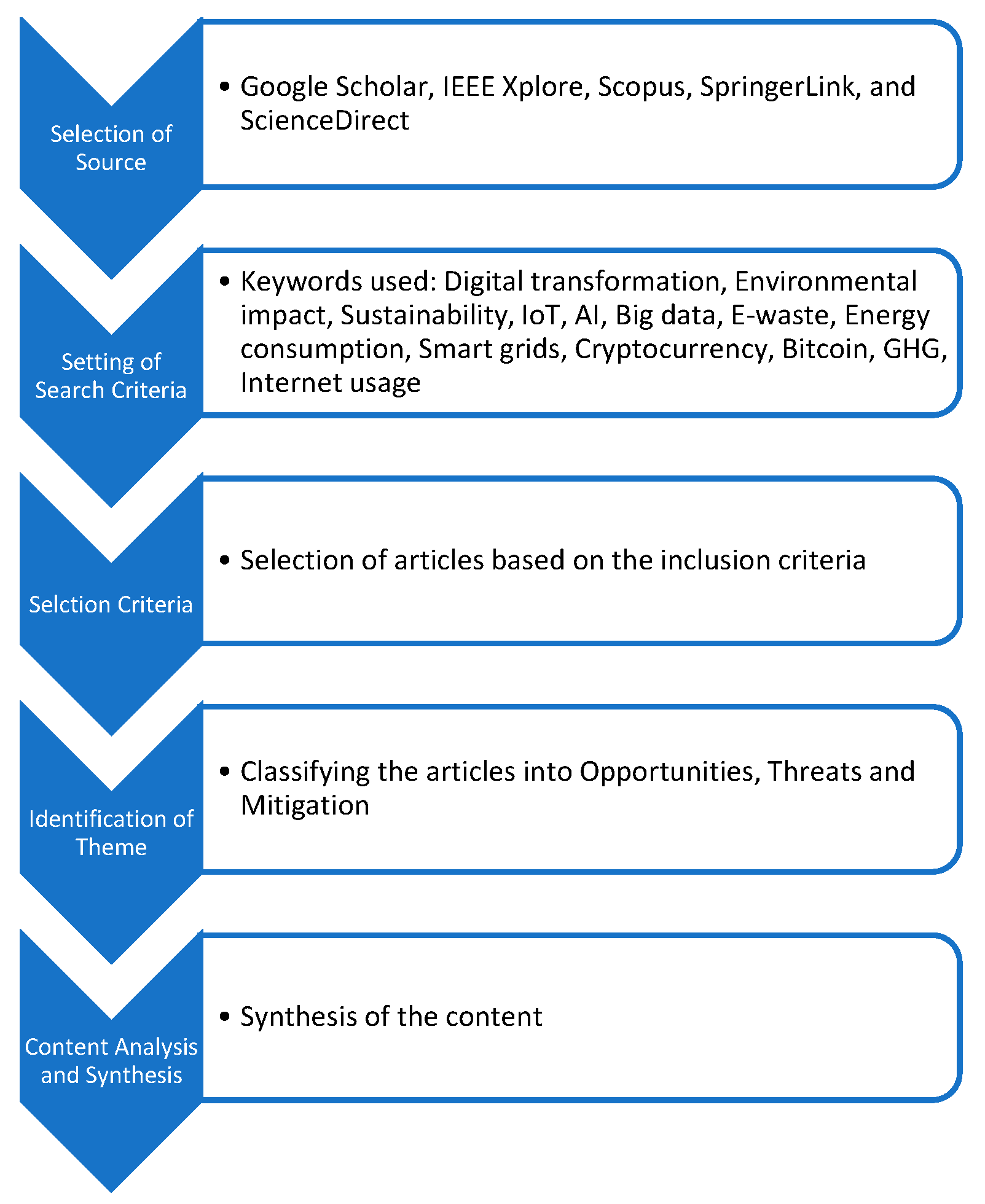
Figure 2.
Global E-Waste Generation and Recycling Rates (Source: Global E-waste Monitor 2024 [64])
Figure 2.
Global E-Waste Generation and Recycling Rates (Source: Global E-waste Monitor 2024 [64])
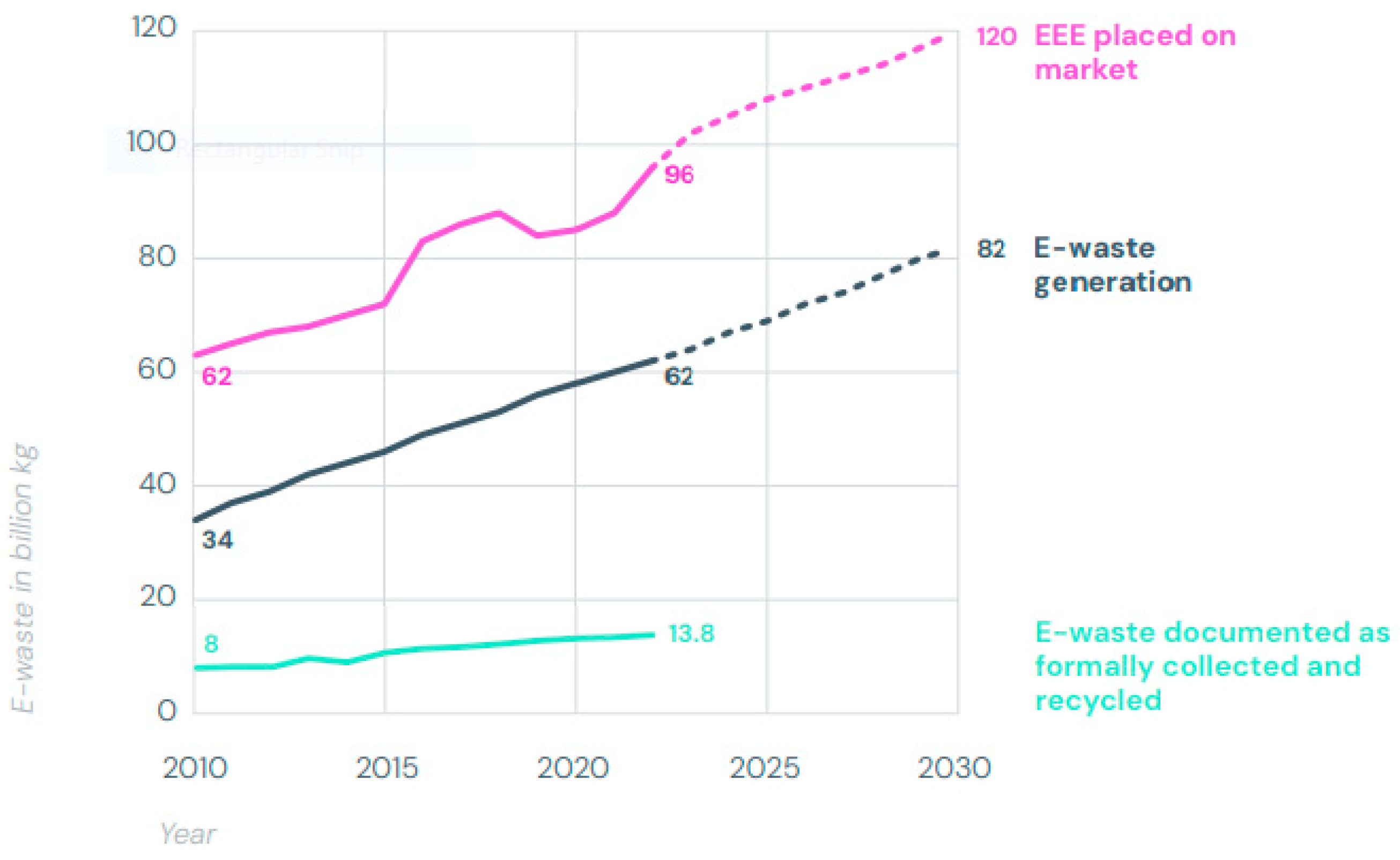
Figure 3.
Global electricity demand from data centers, AI, and cryptocurrencies for the years 2019-2026 [94].
Figure 3.
Global electricity demand from data centers, AI, and cryptocurrencies for the years 2019-2026 [94].
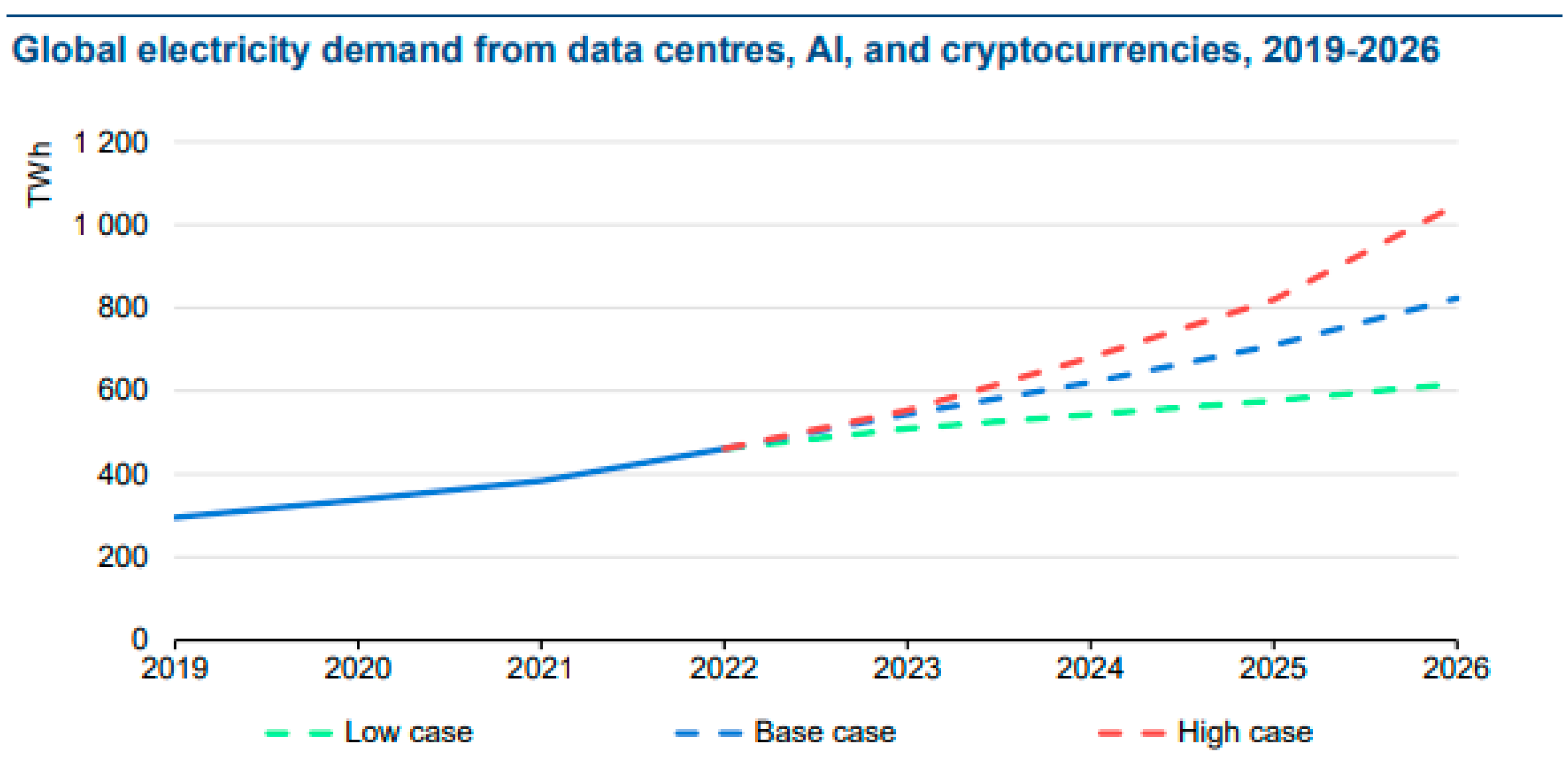

Table 1.
Comparative Analysis of Traditional Grids vs. Smart Grids
| Feature | Traditional Grid | Smart Grid |
| Energy Source | Centralized, fossil fuels | Decentralized, renewable and fossil fuels |
| Energy Management | Reactive | Proactive |
| Consumer Participation | Passive | Active, informed |
| Emission Levels | High | Reduced |
| Reliability | Moderate | High |
Table 2.
Applications of AI in Resource Optimization
| Industry | Application | Environmental Impact |
|---|---|---|
| Manufacturing | Predictive maintenance | Reduced energy consumption and waste |
| Transportation | Supply chain optimization | Lower carbon emissions |
| Energy | Demand forecasting and energy management | Enhanced efficiency, integration of renewables |
| Agriculture | Precision farming | Optimized use of water and fertilizers |
Table 3.
Key Studies on Smart Grids, Energy Management, and Digital Technologies in Sustainability
| Area of Study | Key Findings | Contribution to Sustainability | Author(s) |
|---|---|---|---|
| Remote Sensing | Remote sensing technologies monitor ecosystem health and land use changes | Informs conservation strategies and supports ecosystem protection through precise environmental data. | [54] |
| AI in Energy | AI optimizes energy operations and integrates renewable energy into the grid | Enhances energy management efficiency and increases the share of renewables, reducing carbon emissions. | [46] |
| Smart Grids | Smart grids reduce carbon emissions and increase the share of renewable energy through digitalization | Enables energy efficiency, reduces reliance on fossil fuels, and promotes renewable energy sources. | [23] |
| Environmental Monitoring | Digital technologies enable accurate monitoring of environmental parameters such as air and water quality, deforestation, and wildlife populations | Supports comprehensive environmental assessments, crucial for sustainability efforts and conservation. | [52] |
| Smart Grids | Demand response programs in smart grids reduce energy usage during peak periods | Encourages consumer participation in reducing emissions and alleviating grid strain during high-demand times. | [25] |
| AI in Manufacturing | AI-driven predictive maintenance systems reduce downtime and minimize energy consumption in manufacturing | Extends machinery lifespan, reduces the need for new equipment, and lowers overall resource consumption. | [42] |
| Environmental Monitoring | Digital technologies provide tools for real-time data collection, analysis, and reporting for environmental monitoring | Enhances accuracy and comprehensiveness of environmental monitoring, aiding in better decision-making. | [51] |
| AI in Energy | AI models predict energy demand and optimize energy production | Minimizes energy waste and ensures optimal use of resources in energy production. | [47] |
| Precision Agriculture | Precision irrigation systems enhance water-saving and adaptation to climate change | Supports water conservation and sustainable farming under changing climate conditions. | [33] |
| Precision Agriculture | Monitoring soil, plant, and weather data in precision farming improves water-use efficiency | Contributes to sustainable agriculture by optimizing water management under climate change conditions. | [32] |
| AI in Energy | AI models optimize energy production by predicting energy demand and adjusting power output accordingly | Promotes sustainable energy management and reduces waste in energy production. | [49] |
| Environmental Monitoring | IoT-based environmental monitoring provides data on air and water quality in real-time | Supports decision-making in pollution management and improves environmental protection strategies. | [59] |
| Sustainable Land Management | Sustainable land management is supported through digital technologies that monitor soil health | Helps maintain soil quality, contributing to long-term agricultural sustainability. | [38] |
| AI in Supply Chain | AI algorithms optimize supply chains by identifying efficient routes and reducing empty miles | Reduces the environmental impact of transportation, cutting down carbon emissions and fuel usage. | [45] |
| Remote Sensing | Utilized Landsat Time Series data for sub-annual deforestation detection in Kalimantan, Indonesia | Demonstrates the potential of remote sensing for high spatial accuracy in forest change monitoring under challenging conditions. | [56] |
| Remote Sensing | Remote sensing technologies like satellite imagery and drones are used to monitor deforestation and land use changes | Provides critical data for conservation and land management efforts, improving policy-making and enforcement. | [63] |
| AI in Agriculture | AI optimizes inputs in agriculture, improving productivity while minimizing environmental impact | Maximizes crop yields and resource use efficiency, supporting sustainable farming practices. | [50] |
| AI in Industry | AI models enhance efficiency and sustainability by providing accurate predictions and automation recommendations | Improves operational sustainability by reducing resource use and increasing efficiency across industries. | [41] |
| Smart Irrigation | Smart irrigation reduces water usage by up to 40% compared to traditional methods | Optimizes water resources in agriculture, supporting efficient water management and reducing wastage. | [31] |
| AI in Predictive Maintenance | AI in predictive maintenance reduces resource consumption by preventing production stops | Enhances sustainability by lowering the need for new equipment and reducing waste in manufacturing. | [43] |
| Smart Meters | Smart meters can reduce household energy consumption by up to 15% | Promotes energy conservation and lowers greenhouse gas emissions, contributing to a sustainable energy future. | [26] |
| IoT in Environmental Monitoring | IoT sensors effectively track air and water quality in diverse environments | Enhances environmental monitoring efforts by providing timely data on pollution levels and water quality. | [58] |
| IoT in Agriculture | Soil moisture monitoring using IoT sensors helps inform water management strategies | Promotes efficient water usage in agriculture, minimizing wastage and enhancing resource sustainability. | [61] |
| AI in Energy | AI predicts energy demand and optimizes energy production | Reduces energy waste and enhances the efficiency of power generation, supporting sustainability. | [48] |
| Smart Grids | Integration of renewable energy into smart grids enhances grid stability and reduces emissions | Supports clean energy integration, leading to a decrease in greenhouse gases and enhanced grid reliability. | [24] |
| Digital Agriculture | Digital platforms provide farmers with real-time information on market conditions and best practices | Enhances productivity and sustainability in agriculture by improving decision-making processes. | [35] |
| AI and Big Data | AI and big data analytics analyze environmental data from IoT sensors to predict trends and inform management strategies | Supports proactive environmental management by predicting future conditions and optimizing resource use. | [62] |
| AI in Industry | AI helps optimize resource use across industries by reducing waste and improving efficiency | Reduces energy consumption and waste across sectors, enhancing resource sustainability. | [39] |
| IoT in Environmental Monitoring | IoT sensors monitor environmental conditions, providing real-time data on air and water quality | Enables data-driven environmental management, reducing pollution and improving resource use. | [57] |
| Digital Agriculture | Digital agriculture improves resource efficiency through precision farming and smart irrigation | Reduces environmental impact in agriculture by minimizing waste and optimizing resource use. | [29] |
| IoT in Agriculture | IoT sensors monitor soil moisture levels, providing essential data for optimizing irrigation practices | Helps improve water use efficiency in agriculture, contributing to sustainable farming practices. | [60] |
| Smart Grids | Smart grids facilitate the incorporation of renewable energy sources like wind and solar into the grid | Promotes clean energy usage, reducing dependency on fossil fuels and advancing environmental sustainability. | [27] |
Table 4.
Health Implications of Hazardous Components in E-Waste.
| Hazardous Component | Health Implications | Digital Equipment Found | References |
|---|---|---|---|
| Lead | Neurotoxicity, cognitive decline, developmental delays in children, kidney damage, and anemia | Cathode Ray Tubes (CRTs), solder in printed circuit boards, batteries | [77,78,79] |
| Mercury | Damage to the central nervous system, kidneys, and immune system, as well as neurological and behavioral disorders | Fluorescent lamps, flat panel displays, switches, and thermostats | [80,81] |
| Cadmium | Carcinogenic, causes kidney damage, bone damage, respiratory issues, and is known for its accumulation in human body tissues | Rechargeable batteries (NiCd batteries), semiconductors, resistors, infrared detectors | [82,83] |
| Brominated Flame Retardants (BFRs) | Disruption of endocrine system, neurodevelopmental disorders, reproductive system damage, and potential carcinogenic effects | Printed circuit boards, plastic casings of computers, TVs, mobile phones, and other electronics | [84,85] |
| Polychlorinated Biphenyls (PCBs) | Carcinogenic, immunotoxicity, liver damage, skin conditions (chloracne), reproductive system damage, and neurotoxicity | Capacitors, transformers, older electrical equipment, and insulation fluids | [86,87] |
| Nickel | Respiratory issues, skin dermatitis, potential carcinogen, and allergic reactions | Batteries, circuit boards, computer casings, and mobile phones | [88,89] |
| Beryllium | Carcinogenic, chronic beryllium disease (berylliosis), lung damage, and skin irritation. | Motherboards, connectors, spring contacts, and some power supply boxes | [88,90] |
| Chromium VI (Hexavalent Chromium) | Carcinogenic, causes respiratory tract issues, allergic reactions, and dermatitis | Data center equipment, metal coatings, corrosion protection in electronics, and dyes for certain plastics | [91] |
| Polyvinyl Chloride (PVC) | Release of dioxins and furans when burned, which are highly toxic and carcinogenic. Causes respiratory issues, skin problems, and endocrine disruption | Cables, casings, and housings for various electronic devices | [92] |
Table 5.
World reserves of Rare Earth Elements (REEs) by principal countries based on data from the U.S. Geological Survey (2018)
Table 5.
World reserves of Rare Earth Elements (REEs) by principal countries based on data from the U.S. Geological Survey (2018)
| Country | Reserves (Metric Tons) | % Share of Global Reserves |
|---|---|---|
| China | 44,000,000 | 33.33% |
| Brazil | 22,000,000 | 16.67% |
| Vietnam | 22,000,000 | 16.67% |
| Russia | 18,000,000 | 13.64% |
| India | 6,900,000 | 5.23% |
| Australia | 3,400,000 | 2.56% |
| United States | 1,400,000 | 1.06% |
| Others | 2,800,000 | ~2% |
Table 6.
Environmental Impacts of Raw Material Extraction [103].
Table 6.
Environmental Impacts of Raw Material Extraction [103].
| Impact Category | Lithium | Cobalt | Rare Earth Elements |
|---|---|---|---|
| Land Use | High | Moderate | High |
| Water Pollution | High | High | Moderate |
| Carbon Emissions | Moderate | High | High |
Table 7.
Impact of rare earth element (REE) mining on the environment and human health.
| Focus | Environmental Impact | Human Health Impact | Key Findings | Study | |
|---|---|---|---|---|---|
| Mining and sustainability of REEs | - Deforestation and habitat destruction- Soil erosion- Water contamination from mining by-products | - Respiratory issues from dust exposure- Heavy metal contamination leading to neurological and developmental issues | - Mining of REEs contributes to significant ecological degradation, especially water pollution affecting agriculture. | [108] | |
| Environmental impact of REE extraction | - Radioactive waste- Acidification of water bodies due to chemicals used in processing | - Increased risk of cancer in communities near mining sites due to radioactive exposure | - REE mining generates substantial hazardous waste, posing long-term risks to ecosystems and human populations. | [105] | |
| Recycling of REEs and environmental benefits | - Recycling reduces the need for primary mining, lowering environmental destruction | - Reducing human exposure to mining-related toxic materials | - Promotes recycling as a sustainable alternative to mining, reducing environmental and health risks. | [109] | |
| Sustainable mining practices for REEs | - Less environmental degradation through improved mining techniques - Reduced water contamination through wastewater management |
- Decreased community health risks by reducing exposure to toxic chemicals | - Advocates for improved, sustainable mining techniques to minimize both environmental and human health impacts. | [107] | |
| REE recycling methods and their impacts | - Reduction in environmental degradation through recycling - Lower raw material extraction requirements |
- Reduced human exposure to toxic mining processes - Occupational safety risks during recycling processes |
- Recycling methods can significantly reduce REE extraction's environmental footprint but pose new occupational risks. | [110] | |
| Recovery of REEs from e-waste | - Reduces primary mining - Lowers environmental degradation through alternative recovery techniques |
- Mitigates human exposure to hazardous mining chemicals - Potential health risks in recovery processes |
- Promotes emerging technologies like bioleaching and electrochemical processes as environmentally safer alternatives. | [111] | |
| Sustainable production of rare earth elements from mine waste | Soil contamination, water pollution, and deforestation due to REE mining processes | Increased exposure to toxic metals, leading to respiratory and neurological disorders | Sustainable practices in REE mining could mitigate environmental and health impacts but require global collaboration and new technologies. | [112] | |
| Geochemical occurrence of REEs in mining waste and mine water | Accumulation of REEs in mine tailings, contributing to water and soil contamination | Potential exposure to heavy metals through water contamination, causing health risks | REE mining waste contains significant amounts of toxic metals, necessitating better waste management strategies to reduce environmental and health hazards. | [113] | |
| Life cycle assessment (LCA) of REE production | High environmental impacts due to chemical usage, tailings generation, and radioactive waste | Potential health risks from exposure to radioactive elements (232Th, 238U) in waste | Identifies major environmental impacts in REE production, including chemical waste and radioactive emissions, emphasizing the need for improved recycling and emission treatment technologies. | [114] |
Table 8.
Overview of the greenhouse gas emissions (GHGE) across the production, use phase, and lifecycle annual footprint for various digital devices [13].
Table 8.
Overview of the greenhouse gas emissions (GHGE) across the production, use phase, and lifecycle annual footprint for various digital devices [13].
| Device Type | Useful Life (years) | Production Energy (kg CO2-e) | Use Phase Energy (kg CO2-e/yr) | Lifecycle Annual Footprint (kg CO2-e/yr) |
|---|---|---|---|---|
| Desktops (Home) | 5 - 7 | 218 - 628 | 93 - 116 | 124 - 241 |
| Desktops (Office) | 5 - 7 | 218 - 628 | 69 - 75 | 100 - 200 |
| Notebooks (Home) | 5 - 7 | 281 - 468 | 27 - 35 | 67 - 129 |
| Notebooks (Office) | 5 - 7 | 281 - 468 | 20 - 23 | 60 - 117 |
| CRT Displays | 5 - 7 | 200 - 200 | 51 - 95 | 79 - 135 |
| LCD Displays | 5 - 7 | 95 - 95 | 23 - 43 | 37 - 62 |
| Tablets | 3 - 8 | 80 - 116 | 4.50 - 5.25 | 14.5 - 43.9 |
| Smartphones | 2 | 40 - 80 | 4.50 - 5.25 | 24.5 - 45.3 |
Table 9.
Comparison of Traditional vs. Green Data Centers.
| Aspect | Traditional Data Centers | Green Data Centers |
|---|---|---|
| Energy Source | Primarily rely on fossil fuels (coal, gas). High carbon emissions. |
Embrace renewable energy (solar, wind, hydro). Lower carbon footprint. |
| Cooling Systems | Air cooling (inefficient). Energy-intensive chillers. |
Liquid cooling (more efficient). Free cooling using outside air (in cooler climates). |
| Server Utilization | Often underutilized servers. | Optimize server usage (virtualization, load balancing). |
| Infrastructure Design | Conventional layouts. | Modular designs for scalability and efficiency. |
| Environmental Impact | High energy consumption. | Reduced impact on climate and ecosystems. |
| Cost Efficiency | Higher operational costs. | Lower energy bills and operational expenses. |
Table 10.
List of challenges in the adoption of the CE principles in the digital sector.
| Challenge | Description | References |
|---|---|---|
| Lack of Standardization in E-Waste Management | No globally accepted standard for e-waste recycling and management, leading to inefficiencies and improper handling of electronic waste. | [67,154,155] |
| High Cost of Recycling Processes | The cost of recycling electronics often exceeds disposal costs, particularly for complex devices, making them less economically attractive. | [156,157] |
| Design Complexity and Material Use | Increasingly complex digital devices, with mixed materials, complicate efforts to design products that are easy to disassemble and recycle. | [158,159] |
| Consumer Behavior and Awareness | Consumers often lack awareness or motivation to recycle electronics, leading to low collection rates for e-waste. | [160] |
| Short Product Lifecycles | Rapid technological advancements shorten product lifecycles, increasing the volume of e-waste. | [154,161] |
| Regulatory Barriers | Inconsistent regulations across different regions challenge the global implementation of circular economy practices. | [162,163] |
| Data Security Concerns | Data security fears hinder the reuse and refurbishment of digital devices, as users worry about data breaches even after deletion. | [164,165] |
Table 11.
Challenges in adopting renewable energy for data centers.
| Challenge | Description | References |
|---|---|---|
| Intermittency of Renewable Energy | Renewable energy sources like solar and wind are not consistently available, leading to reliance on grid power or fossil fuels during low production periods. | [176,177] |
| High Initial Capital Costs | The installation of renewable energy systems, such as photovoltaic panels and wind turbines, requires significant upfront investment, which can be a barrier for many data centers. | [178] |
| Large Area Requirements for Solar Panels | Solar energy systems need a vast area to install enough panels to generate the required power for high-density data centers, which is often impractical. | [179] |
| Variability in Energy Output | The output from renewable sources can vary greatly due to environmental conditions, making it challenging to match energy supply with data center demand consistently. | [180,181] |
| Energy Storage Limitations | Effective storage solutions are necessary to store excess energy generated during peak production times, but current battery technology is expensive and has limited capacity. | [182,183] |
| Cooling Challenges in Hot Climates | Data centers located in regions with high solar potential often face cooling challenges due to the high ambient temperatures, which can negate the benefits of solar power. | [176] |
| Integration with Existing Infrastructure | Adapting existing data center infrastructure to integrate renewable energy sources can be complex and costly, requiring new systems for power management and load balancing. | [181] |
Table 12.
List of some studies in the area of Green Computing.
| Objectives | Category/Area | Reference |
|---|---|---|
| Addresses energy-aware computing, categorizing strategies, optimizing metrics, and energy management in modern HPC systems. | High-Performance Computing (HPC) | [193] |
| Discusses strategies for reducing energy consumption in large-scale systems supporting HPC software. | Energy Efficiency, HPC | [194] |
| Conducts an energy/performance analysis of HPC systems using energy-efficient interconnects for multi-job trace-based workloads across different network topologies (torus, fat-tree, Dragonfly), applying low-power modes. Results indicate significant energy savings with low-power mechanisms, with torus topology achieving the best energy-performance trade-off. | High-Performance Computing (HPC), Interconnection Networks, Energy Efficiency | [195] |
| Introduced an ARM-based cluster to estimate energy consumption using experimental findings from a real-life workload. | Low-Power Computing | [196] |
| Analyzed energy management issues faced by data centers and HPC environments from 2010-2016. | Data Centers, Energy Management | [197] |
| Introduced HPC AI500, a benchmark suite for scientific deep learning workloads to measure system accuracy and performance. | HPC, Artificial Intelligence (AI) | [198] |
| Surveyed energy-efficient and power-constrained computing techniques in HPC systems. | Energy Efficiency, HPC | [199] |
| Discussed AI’s impact on computing and how it could reinvent computation when Moore’s law ends. | AI, Future Computing Technologies | [200] |
| Presented an undervolting energy-saving strategy that could save up to 12.1% energy relative to baseline models. | Energy Efficiency, Resilience | [201] |
| Addressed energy-saving opportunities in scientific applications using profiling techniques for energy-aware computing. | HPC, Energy Profiling | [202] |
| Summarized emerging technologies in HPC and AI, recommending clean application solutions. | HPC, AI, Clean Technologies | [203] |
| Reviewed progress in energy-saving technologies for data centers, including renewable energy integration. | Data Centers, Renewable Energy | [186] |
| Proposed balancing performance and energy in HPC systems using closed-loop feedback designs based on the self-aware computing model. | HPC, Power Management | [204] |
| Argued the need for energy-efficient machine learning algorithms and why they are important in modern computing. | Machine Learning, Energy Efficiency | [205] |
Disclaimer/Publisher’s Note: The statements, opinions and data contained in all publications are solely those of the individual author(s) and contributor(s) and not of MDPI and/or the editor(s). MDPI and/or the editor(s) disclaim responsibility for any injury to people or property resulting from any ideas, methods, instructions or products referred to in the content. |
© 2024 by the authors. Licensee MDPI, Basel, Switzerland. This article is an open access article distributed under the terms and conditions of the Creative Commons Attribution (CC BY) license (http://creativecommons.org/licenses/by/4.0/).
Copyright: This open access article is published under a Creative Commons CC BY 4.0 license, which permit the free download, distribution, and reuse, provided that the author and preprint are cited in any reuse.


