

Submitted:
27 September 2024
Posted:
30 September 2024
You are already at the latest version
Abstract
Assessing the suitability of older adults with acute myeloid leukemia (AML) to intensive chemotherapy or stem cell transplantation remains a long-standing challenge. Geriatric assessment, which evaluates multiple dimensions of health, may influence a patient's ability to tolerate intensive or mild intensity approach, including treatment related mortality. Prospective studies are needed to validate different fitness criteria as well as to compare the effectiveness of geriatric assessment–based fitness against other criteria, in order to identify which aspects of the geriatric assessment are linked to treatment tolerance. Hopefully, validation studies should include different group of patients receiving either intensive or lower-intensity chemotherapy. At a minimum, the geriatric assessment should measure comorbidity burden, cognition, physical function, and emotional health—factors previously associated with mortality in AML. These assessments should be conducted before starting chemotherapy in order to minimize the treatment's impact on the results. While treatment tolerance has traditionally been evaluated through toxicity rates in solid tumor patients, AML treatment often results in high toxicity rates regardless of intensity. Therefore, early mortality should be the primary endpoint for assessing treatment tolerance, given its significant and clear implications. Other important endpoints might include declines in functional status, quality of life, and treatment adjustments or discontinuation due to toxicities. Validating these fitness criteria is essential for guiding treatment choices, improving supportive care, determining trial eligibility, interpreting study outcomes, and informing drug labeling.
Keywords:
fitness
; acute myeloid leukemia
; dynamic fitness
1. Introduction
Acute myeloid leukemia (AML) is a very heterogeneous disease characterized by the uncontrolled proliferation of clonal hematopoietic cells in bone marrow, blood and extramedullary sites. [1,2]. It is the most common form of acute leukemia in adults, with a median age at diagnosis of 68 years [3]. The prognosis is closely age-related with progressive worsening in the elderly patients [1,3]. Of note, in the age group with the highest incidence, 60-70 years, the prognosis is particularly poor, with a 5-year overall survival (OS) rate around 20%. Several factors account for short survival; unfavorable genetic features are more frequent in the advanced age and often the elderly patients have no chance of treatment apart from supportive therapy. However, in the next years, these data are expected to improve. The introduction of hypomethylating agents (HMAs) has revolutionized the treatment of patients considered unfit for chemotherapy. Indeed, novel drugs, alone or in combination with HMAs, have been approved and demonstrated high efficacy and favorable toxicity profile. Consequently, a growing body of interest has been to refine the treatment eligibility criteria. Nowadays, several international guidelines and expert groups have recommended a careful assessment of the patient's fitness rather than the chronological age, to tailor the appropriate treatment [4,5].
In this review, we first provided a brief overview of current non-intensive options for patients with AML, then focused on the assessment of fitness by analyzing the criteria used to evaluate it.
2. Non-intensive therapy for newly diagnosed patients
Before the introduction of HMAs, treatment strategies for AML were divided into intensive chemotherapy and supportive care, the latter specifically for elderly non-fit patients. The advent of azacitidine (AZA) and decitabine (DEC) represented a turning point in the treatment of AML, introducing the category of less-intensive strategy. In spite of limited activity as single agents, HMAs represented the platform for low-intensity combinations [6,7]. Over the years, with the advancement of the molecular background of AML, new targeted drugs with high efficacy and good safety profile have been developed. At the same time, the assessment of eligibility of elderly patients has been refined taking into account age, comorbidities and several multiparametric tools. Consequently, a greater number of elderly patients, previously considered unfit, were treated. Currently, for patients not eligible for intensive chemotherapy are available B-cell lymphoma 2 (BCL-2) inhibitors, FMS-like tyrosine kinase 3 (FLT3) inhibitors, isocitrate dehydrogenase 1 and 2 (IDH1/2) inhibitors and smoothened inhibitors (SMO). The BCL-2 inhibitor venetoclax, has been experimented in combination with HMAs or low dose cytarabine (LDAC) demonstrating high efficacy and low toxicity [8]. In the phase III VIALE-A trial, AZA plus venetoclax improved responses and OS compared with AZA alone in patients >75 years old or those with comorbidities (complete remission -CR- 66.4% vs. 28.3%, p < .001; median OS 14.7 vs. 9.7 months, HR 0.66, 95% CI 0.52–0.85, p < .001) [9]. In the VIALE-C trial, venetoclax was added to LDAC versus LDAC monotherapy. The trial demonstrated an OS advantage for venetoclax plus LDAC arm in a post hoc analysis with 6 months additional follow-up (8.4 vs. 4.1 months, HR 0.7, 95% CI 0.5–0.98, p = .04) [10]. The IDH1 inhibitor ivosidenib was tested in combination with AZA versus AZA alone in patients older than 75 years or with comorbidities in the phase III AGILE study [11]. The event-free survival (EFS) and the median OS was higher in patients who received ivosidenib. However, a comparison between ivosidenib plus AZA and HMAs plus venotoclax is not available. So, in elderly patients with IDH1 mutation the issue of whether to use AZA with either venetoclax or ivosidenib remains currently unsolved, especially considering that ivosidenib could be used as a salvage treatment in case of relapse. The IDH2 inhibitor enasidenib plus azacitidine was not approved but has been evaluated in the phase II AG221-AML-005 randomized trial demonstrated promising results [12]. Despite the success of gilteritinib in the setting of relapsed/refractory (R/R) FLT3+ AML as resulting in the ADMIRAL trial, in first line, in combination with AZA failed to demonstrate a superior OS as emerged in the phase III LACEWING. Finally, glasdegib and LDAC versus LDAC demonstrated superior OS in patients with AML ineligible for intensive chemotherapy (median OS was 8.3 versus 4.3 months) in the phase II BRIGHT AML 1003 trial [13].
These strategies have revolutionized the treatment of elderly patients and lastly improved their survival. It should also be considered that, for high-risk patients, these therapeutic options could represent a bridge to allogeneic stem cell transplantation (allo-SCT). In recent years, allo-SCT has also seen a radical change in the eligibility criteria, not considering only chronological age as an absolute parameter to access it. Indeed, with the introduction of reducing intensity conditioning (RIC), the improvement of prophylaxis for Graft-versus Host Disease (GvHD) and supportive care a greater number of elderly patients have undergone this potentially curative therapy.
3. Definition of fitness
Assessing the fitness of older patients with AML aims to determine whether they are candidates for curative therapy that can achieve a durable CR. This thorough evaluation is intended to rule out therapies that might: (1) exacerbate age-related frailties, (2) cause organ damage due to existing comorbidities, or (3) be difficult for the patient to adhere to because of their individual characteristics; 4) reduce treatment related mortality. Such risks could compromise short-term life expectancy more than the AML itself, thereby supporting the decision to opt for more conservative treatments, such as non-intensive or supportive care. Although there are an increasing number of scoring systems designed to assess eligibility for intensive chemotherapy, a universally accepted procedure for defining fitness is still lacking. In this context of ongoing uncertainty, factors related to the patient (such as age and performance status) and the disease (such as cytogenetics and blood count) continue to be integral to these systems, helping to distinguish which patients might benefit from an intensive approach and which may not.
4. Determination of ongoing criteria to evaluate fitness
4.1 Age and comorbidities
Traditionally, receiving intensive chemotherapy was thought to be contingent mostly on an individual's age. Age-related influence on the patient and disease-related factors are well-established; these effects lead to an increased risk of early death following induction chemotherapy as well as a decreased likelihood of full response and long-term survival [14]. The World Health Organization designates 65 as the age at which a patient becomes "elderly." Given the poor life expectancy of people living in underprivileged geographic locations, the United Nations deems the transition to occur at 60 years of age. However, age alone, cannot be an absolute factor for identifying which patients should be classified as unfit; even if fitness and age are often largely correlated. in the daily practice, there are cases where a younger patient with comorbidities performs worse than an older patient without comorbidities. The finding that chronological age should not be the primary criterion used to determine fitness or treatment selection, begs the important question of whether biological age and chronological age actually correlate [15]. In a retrospective cohort analysis, clinical practices related to AML treatment and outcomes were examined in patients with AML who were at least 66 years old. Data from Medicare enrollment and claims files, as well as the Surveillance, Epidemiology, and End Results (SEER) program database, were used. Forty percent of the 8336 eligible patients had AML treatment within three months of diagnosis [16]. From 35% in 2000 to 50% in 2009, treatment rates rose. Compared to patients who were not receiving therapy, those on treatment had a decreased prevalence of secondary AML, comorbidities, and poor performance indicators. Treatment lowered the risk of death during the observation period by 33%; patients receiving intensive therapy had a longer median OS (18.9 months) than those receiving HMAs (6.6 months) or receiving no treatment (1.5 months); patients under 75 years of age had a similar mortality risk reduction to those over 75 years of age. Comorbidities, low performance markers, and previous myelodysplastic syndrome (MDS) were all linked to early mortality. Conversely, a sizable (N = 980), retrospective, single-center study on AML patients who were diagnosed between 1995 and 2016 and who were at least 70 years old revealed that HMAs significantly improved survival (median OS = 14.4 months) when compared to supportive care (2.1 months), low-intensity therapy (5.9 months), and high-intensity therapy (10.8 months). In this study, 43% and 57% of patients had de novo AML and secondary AML, respectively [17,18]. Of the patients, 37% received high-intensity therapy, 26% received HMAs, 9% received low-intensity therapy, and 28% received supportive care. Clinical factors that have been found to affect OS include age, white blood cell count, platelet count, hemoglobin level at diagnosis, poor-risk cytogenetics, PS, front-line therapy, and secondary AML. These findings highlight the advantages of AML therapy and indicate some important variables to take into account when assessing older patients' fitness. More recently, Lazarevic et al. used information from the Swedish AML registry to present clinical and diagnostic aspects focusing on patients who were 80 years of age or older. Complex and monosomic karyotypes were more prevalent in this group of patients, despite the fact that older patients in this study tended to undergo less morphologic sub-classification and genetic screening. The prevalence of secondary AML was lowest in patients under the age of 85, but highest in those between the ages of 70 and 80 [19]. These findings point to slight variations in clinical AML subgroups between the ages of 70 and 100 years, and they support the gathering of molecular information on these patients, especially in light of the development of novel treatments, many of which may be advantageous to individuals with particular AML subtypes (such as secondary AML) or molecular characteristics.
The potential for comorbidities to impact toxicity and treatment response has been noted. In order to determine the overall suitability of a certain treatment, comorbidity assessment is helpful [20]. Etienne et al. identified comorbidities as an independent predictor of CR in after induction therapy [21]. The Charlson Comorbidity Index (CCI) and the Hematopoietic Cell Transplantation (HCT)–Specific Comorbidity Index (HCT-CI), have been historically validated in order to identify several potential outcomes in AML [22]. The HCT-CI contemplated objective criteria to identify comorbidities not only to summarize the number of conditions, but also to qualify their burden [23]. Comorbidities with highest scores (3 points) in the HCT-CI are pulmonary disease, hepatic abnormalities, heart valve disease (except mitral valve prolapse), and a prior solid tumor. Retrospectively analyzing 177 AML patients aged >60 years who received intensive chemotherapy, those having an HCT-CI score ≥3 showed an early mortality rate of 29% vs 3% and 11% in patients with scores of 0 and 1–2, respectively (P <.001). In view of this, intensive therapy may be appropriate for a patient who has well-managed comorbidities. Assessment of comorbidities may help to determine a patient's general suitability for intensive therapy, but it cannot provide a 100% guarantee on the acceptability of AML treatment because other aspects need to be taken into account.
4.2 Performance status
Regardless of age, oncology performance status (PS) measures like the ECOG PS or Karnofsky PS (KPS) can help to identify AML patients with higher-risk of early death or treatment related mortality following intensive chemotherapy. According to Kadia et al., poor PS appeared to be significantly more adversely relevant by increasing age .
Numerous researches have explore potential treatment approaches in patients with scarce PS. A study including 2767 AML patients belonging to the Swedish Acute Leukemia Registry assessed the influence of the decision to treat on outcomes [3]. The percentage of patients undergoing intensive therapy decreased as PS got worse. Age and PS both affected the thirty-day mortality rates; however, older patients with better PS had reduced early death rates, while patients with low PS had higher early death rates at all ages. The 36% of patients with a PS of 3-6 who had received intensive therapy reported an early death, compared to 52% of patients who received best supportive care (P =.023). Intensive therapy may be beneficial for certain patients, as there were some long-term survivors among patients with compromised PS, despite the fact that the early mortality rate was increased in all age categories.
These trials indicate that most older AML patients would benefit from treatment and that intensive approaches are most effective compared to low-intensity therapy (azacitidine or decitabine) and supportive care alone. Therefore, while PS and age are strongly correlated, they are not adequate on their own to determine fitness. In older AML patients, varying degrees of comorbidity—some of which may be best managed—highlight the need for improved methods of determining fitness. Therefore, more considerate methods are required to more accurately select patients for intense therapy.
4.3 Multi-parameter assessment tools
The use of geriatric assessment tools and multi-parameter assessments has been considered to provide additional prognostic information to define fitness in AML patients. Although there is currently no agreement on which health domains to include and how to best incorporate various factors, geriatric assessment tools evaluate multiple health domains to more comprehensively assess patient fitness. They may also help to improve risk stratification and personalize therapy for older AML patients.
The Geriatric Assessment in Hematology (GAH) was proposed as a rapid assessment of elderly patients affected by hematologic malignancies and comprises eight dimensions of performance, mental status, and health status that define a score of 0–8. It was validated after an analysis on 349 patients aged ≥65 years with hematologic malignancies, including AML [25]. The GAH score corresponded with ECOG PS and KPS, if excluded the comorbidities domain. Higher GAH score groups of ≤1, 2–6, and >6 appeared predictive of survival (P <.001).
In patients with newly diagnosed AML who were at least 60 years old and receiving intensive therapy, a prospective cohort study assessed the predictive value of geriatric assessments, which included measures of cognitive function, depressive symptoms, distress, physical function, and clinical characteristics, for OS [26]. Age or ECOG PS were not related to the OS; instead, it was related to the cytogenetic risk group, previous MDS, and baseline hemoglobin level. Low physical performance (Short Physical Performance Battery score <9) and poor cognitive function (Modified Mini-Mental State score <77) among geriatric assessment measures were linked to poor OS and boosted the prediction efficacy of the more common clinical indicators by 60%. Another study looked at quality-of-life and geriatric evaluations in 195 individuals with AML and MDS who were older than 60 [27]. PS, activities of daily living (ADLs), comorbidities, and illness features were among the patient-related parameters assessed in the study. The European Organization for Research and Treatment of Cancer Quality of Life Questionnaire C30 (QLQ-C30) fatigue score of 50 and signs of dependence (ADLs <100 and KPS <80) offered the strongest prognostic information in the final model, apart from the known disease-related factors of poor-risk cytogenetics and bone marrow blasts.
A prognostic model was developed in the study by Kantarjian et al. [28] to predict outcomes in older AML patients by classifying patients into risk groups based on a variety of patient- and disease-related characteristics. In comparison to the unfavorable-risk group, the OS and CR rates were greater in the favorable-risk and intermediate-risk groups. The predictive significance of prognostic variables, such as mutational status, on clinical outcomes was examined in a prospective trial with 909 AML patients who were above 60 years of age [29]. Age, karyotype, NPM1 mutation status, white blood cell count, LDH level, and CD34 expression were found to be independent prognostic predictors of OS by multivariate analysis; these variables were then given relative point values. Four prognostic profiles—favorable risk cytogenetics, intermediate risk cytogenetics with favorable risk features (score ≤3), intermediate risk cytogenetics with adverse risk features (score >3), and high risk cytogenetics—were identified based on the total points and a patient's cytogenetic risk. These groups' respective OS were 40%, 30%, 11%, and 3%.
It's possible that cytogenetic analysis results that indicate risk are not easily accessible to AML patients who need to start therapy right away. Thus, with or without knowledge of cytogenetic and molecular risk, risk scores were determined from standard clinical and laboratory factors, such as body temperature, age, hematologic measurements, LDH level, and AML subtype, using a web-based program [30]. These factors may help in treating these individuals, as they were found to be independently and strongly correlated with CR and early mortality (Table 1).
5. Fitness criteria
Ferrara and colleagues introduced for first time a definition of unfitness for both intensive and non-intensive chemotherapy in patients with AML. This definition was formulated through a Delphi consensus-based approach, which involved the Italian Society of Hematology (SIE), the Italian Society of Experimental Hematology (SIES), and the Italian Group for Bone Marrow Transplantation (GITMO) [5]. The process emphasized the importance of avoiding therapies that could exacerbate age-related frailty, cause organ intolerance, or shorten life expectancy due to existing comorbidities. These criteria specify that unfitness for intensive chemotherapy requires meeting at least one of nine conditions, while unfitness for non-intensive chemotherapy requires fulfilling at least one of six conceptual criteria. Additionally, the panel identified 15 operational criteria to further define unfitness for both intensive and non-intensive chemotherapy. These consensus-based definitions link geriatric and comorbidity factors to specific treatment decisions for AML patients, offering widely applicable criteria that help predict the benefit of varying treatment intensities across different patient fitness levels (fit, unfit, frail).
Recently Borlenghi et al, retrospectively applied the Ferrara criteria to a large cohort of 699 consecutive AML patients treated across eight hematologic centers in order to validate their clinical influence on clinical practice [31]. The criteria were functional on 98% of the patients, and fitness was found to be an independent and significant predictor of survival, as confirmed by univariate and multivariate analysis. The study stated that these straightforward criteria, when combined with biological risk assessment, could serve as an effective tool for tailoring treatment intensity to individual AML patients. In a further study, authors also explored the integration of European Leukemia Net (ELN) risk categories with the Ferrara criteria to identify subgroups with varying prognoses and to guide treatment decisions for patients with secondary AML, a diverse patient population. In a retrospective analysis of 280 consecutive secondary AML patients over the age of 64, diagnosed between 2008 and 2015, the median overall survival was 10.1 months for fit patients, compared to 4.2 and 1.8 months for unfit and frail patients, respectively [32]. This study demonstrated that fitness evaluation is a strong predictor of patient outcomes, leading the authors to recommend that, in addition to age, fitness assessment should be a standard practice for older AML patients.
In a retrospective analysis Palmieri et al. applied the Ferrara criteria to 180 consecutive AML patients (125 over 60 years old and 55 under 60 years old, with a median age of 66) treated at a single institution [33]. The analysis revealed that risk stratification did not vary between younger and older patients, indicating that risk is not solely determined by age. The study found a strong correlation between the operational criteria and patient outcomes, with overall survival rates of 15.3 months for fit patients, 8.6 months for unfit patients, and 1 month for frail patients. Subsequently Palmieri et al. applied the Ferrara criteria to retrospectively assess the fitness of 655 adults who received intensive chemotherapy for AML at a Fred Hutchinson Cancer Research Center of Seattle [34]. This evaluation aimed to determine the accuracy of these criteria in predicting early mortality and survival. The findings showed that the criteria had good to very good accuracy in forecasting 28-day and 100-day mortality, outperforming the treatment-related mortality score. The accuracy improved further when combined with additional factors such as albumin levels or PS. The authors concluded that the Ferrara criteria, when used alongside molecular and genetic data, can support informed decision-making for AML patients, particularly those who are older or have comorbidities (Table 2).
In clinical practice, allogeneic hematopoietic stem cell transplantation (HSCT) is increasingly utilized, though it remains associated with significant morbidity and mortality, particularly in elderly patients. The European Society for Blood and Marrow Transplantation (EBMT) score considers factors such as age, disease status, time from diagnosis to transplant, and donor-recipient sex combination to assist in HSCT candidate selection [35]. A 2021 study from Japan developed the NRM-J index, which incorporates age, sex, ECOG performance status, HCT-CI, and donor type to predict non-relapse mortality. This index proved to be significantly more accurate than the EBMT score in forecasting non-relapse mortality after HSCT, suggesting its potential value in treatment decision-making [36].
6. The concept of clinical dynamic fitness
In elderly patients with AML, it's crucial to continuously reassess a patient's clinical fitness during the course of treatment, especially when their clinical and biochemical parameters positively or negatively changes. These changes often appears adverse, typically due to severe complications associated with the treatment itself potentially causing infections or organ failures; however, improvements in the patient's functional status can also occur, especially in those patients whose health conditions was strongly affected by disease-related issues. For patients whose significant changes occur during the course of treatment, reassessing clinical fitness at specific time-points, is necessary to tailor the type or intensity of therapy accordingly, ensuring the treatment remains aligned with the patient's current fitness and the characteristics of their disease. An emblematic example of this situation is represented by the use of oral AZA; this small agent has been shown to improve survival when used as maintenance therapy in patients in complete remission after intensive induction and consolidation chemotherapy [37]. These patients are considered eligible for HSCT according to the biological prognostic risk of their disease, but they become unable to proceed for worsening conditions related to intensive therapies or logistical reasons.
On the other hand, during the course of lower-intensity treatments, patients initially considered unfit for intensive treatments may show significant improvements of their fitness conditions thereby becoming potential candidates to receive more intensive treatments. A post-hoc analysis of two multicenter trials involving adults with newly diagnosed AML who were considered ineligible for intensive chemotherapy showed that approximately 10% of these patients eventually underwent allogeneic HCT after achieving complete remission [9,38]. This suggests that the initial fitness status may have been significantly influenced by disease-related symptoms rather than pre-existing conditions unrelated to the disease. In such cases, reassessing the patient's fitness could support a change in treatment strategy, potentially leading to better outcomes for some patients (Figure 1).
7. The concept of biological dynamic fitness
At AML relapse or progression, it is not uncommon to identify leukemic clones harboring new occurring mutations which were not detected at baseline. Therefore, during the course of treatments, the status of AML biology necessitates of continuing assessments in order to monitor the potential evolution of the disease, either on its own or under the influence of AML therapies, which can determine crucial changes altering the clonal and sub-clonal pathways [39]. With the increased approval of targeted therapies in AML therapeutic scenario, the capability of detecting, through molecular retesting, an emerging leukemic clone at relapse or disease progression becomes a mandatory approach, not just for prognosis but also for guiding eventual salvage treatments.
As more targeted agents become available, initial treatments may be chosen based more on the characteristics of the disease rather than the patient’s medical fitness. Emerging data suggests that certain lower-intensity therapies (such as VEN combined with an azanucleoside) could be as effective as intensive chemotherapy while being better tolerated [40]. Looking forward, treatments tailored to the biological profile of AML rather than age or fitness could help minimize toxicity during remission induction, making it easier for patients to tolerate subsequent intensive therapies, including HSCT.
Conclusions
The range of frontline treatment options for AML has significantly broadened in recent years. Historically, treatments were limited to a choice between intensive induction chemotherapy and non-intensive options like supportive care, with patient fitness being the main factor in deciding between these approaches. Today, treatments vary in intensity and toxicity and are tailored more specifically to the disease's cytogenetic and mutational characteristics. Ongoing studies are eagerly anticipated, particularly those involving novel targeted therapies such as CD47 and e-selectin inhibitors, as well as triplet therapy combining venetoclax/HMAs with targeted treatments. Additionally, new agents are being incorporated into initial treatment plans to achieve deeper responses. However, there is a notable lack of prospective studies comparing intensive regimens like 7 + 3 or CPX-351 with venetoclax/AZA, which would clarify whether patients deemed fit for intensive chemotherapy might actually benefit more from the less intensive options now available. Tools like the Ferrara et al. consensus criteria [5] can help determine unfitness for intensive chemotherapy, but moving forward, it will be important to increasingly integrate functional and genomic biomarkers to guide treatment decisions, given the expanding array of effective therapies.
Author Contributions
M.M. ideated and wrote the paper; M.C. wrote the paper; F.F. critically revised the paper and approved the final version. All authors have read and agreed to the published version of the manuscript.
Funding
This research received no external funding.
Conflicts of Interest
The authors declare no conflict of interest concerning the materials or methods used in this study or the findings specified in this paper.
References
- Dohner H, Weisdorf DJ, Bloomfield CD. Acute myeloid leukemia. N Engl J Med. 2015;373(12):1136-1152.
- Papaemmanuil E, Gerstung M, Bullinger L, Gaidzik V, Paschka P, Roberts, N, Potter N, Campbell P. Genomic classification and prognosis in acute myeloid leukemia. N Engl J Med. 2016; 374(23):2209-2221.
- Juliusson G, Antunovic P, Derolf A, Lehmann S, Möllgård L, Stockelberg D, Tidefelt U, Wahlin A, Höglund M. Age and acute myeloid leukemia: real world data on decision to treat and outcomes from the Swedish Acute Leukemia Registry. Blood. 2009;113(18):4179-4187.
- Thein MS, Ershler WB, Jemal A, Yates JW, Baer MR. Outcome of older patients with acute myeloid leukemia: An Analysis of SEER Data Over 3 Decades. Cancer 2013; 119:2720-7.
- Ferrara F, Barosi G, Venditti A, Angelucci E, Gobbi M, Pane F, Tosi P, Zinzani P, Tura S. Consensus-based definition of unfitness to intensive and non-intensive chemotherapy in acute myeloid leukemia: a project of SIE, SIES and GITMO group on a new tool for therapy decision making. Leukemia 2013; Leukemia. 2013;27:997-9.
- Dombret H, Seymour JF, Butrym A, Wierzbowska A, Selleslag D, Jang JH, Kumar R, Cavenagh J, Schuh A, Candoni A, et al. International phase 3 study of azacitidine vs conventional care regimens in older patients with newly diagnosed AML with >30% blasts. Blood. 2015;126(3):291-299.
- Kantarjian HM, Thomas XG, Dmoszynska A, Wierzbowska A, Mazur G, Mayer J, Gau JP, ChouWC, Buckstein R, Cermak J, et al. Multicenter, randomized,open-label, phase III trial of Decitabine versus patient choice, with physician advice, of either supportive care or low-dose cytarabine for the treatment of older patients with newly diagnosed acute myeloid leukemia. J Clin Oncol. 2012;30(21):2670-2677.
- Pollyea DA, Pratz K, Letai A, Jonas B, Wei A, Pullarkat V, Konopleva M, Thirman MJ, Arellano M, Becke P, et al. Venetoclax with azacitidine or decitabine in patients with newly diagnosed acute myeloid leukemia: long term follow-up from a phase 1b study. Am J Hematol. 2021;96:208–217.
- DiNardo CD, Jonas BA, Pullarkat V,, Thirman MJ, Garcia J, Wei A, Konopleva M, Döhner H, Letai A, Fenaux P, et al. Azacitidine and venetoclax in previously untreated acute myeloid leukemia. N Engl J Med. 2020; 383(7):617-629.
- Wei AH, Montesinos P, Ivanov V, DiNardo C, Novak J, Laribi K, Kim I, Stevens D, Fiedler W, Pagoni M, et al. Venetoclax plus LDAC for newly diagnosed AML ineligible for intensive chemotherapy: a phase 3 randomized placebo-controlled trial. Blood. 2020;135(24):2137-2145.
- Montesinos P, Recher C, Vives S, Zarzycka E, Wang J, Bertani G, Heuser M, Calado R, Schuh A, Yeh SP, et al. Ivosidenib and azacitidine in IDH1-mutated acute myeloid leukemia. N Engl J Med. 2022;386(16): 1519-1531.
- DiNardo CD, Schuh AC, Stein EM, Montesinos P, Wei A, de Botton S, Zeidan A, Fathi A, Kantarjian H, Bennett J, et al. Enasidenib plus azacitidine versus azacitidine alone in patients with newly diagnosed, mutant- IDH2 acute myeloid leukaemia (AG221-AML-005): a single-arm, phase 1b and randomised, phase 2 trial. Lancet Oncol. 2021;22(11): 1597-1608.
- Heuser M, Smith BD, Fiedler W, Sekeres M, Montesinos P, Leber B, Merchant A, Papayannidis C, Pérez-Simón J, et al. Clinical benefit of glasdegib plus low-dose cytarabine in patients with de novo and secondary acute myeloid leukemia: long-term analysis of a phase II randomized trial. Ann Hematol. 2021;100:1181–1194.
- Appelbaum FR, Gundacker H, Head DR, Willman C, Godwin J, Anderson J, Petersdorf S. Age and acute myeloid leukemia. Blood. 2006;107:3481–3485.
- Mangaonkar AA, Patnaik MM. Patterns of care and survival for elderly acute myeloid leukemia-challenges and opportunities. Curr Hematol Malig Rep. 2017;12:290–299.
- Medeiros BC, Satram-Hoang S, Hurst D, Hoang KQ, Momin F, Reyes C. Big data analysis of treatment patterns and outcomes among elderly acute myeloid leukemia patients in the United States. Ann Hematol. 2015;94:1127-1138.
- Talati C, Dhulipala VC, Extermann MT, Ali N, Kim J, Komrokji R, Sweet K, Kuykendall A, Sehovic M, Reljic T, et al. Comparisons of commonly used front-line regimens on survival outcomes in patients aged 70 years and older with acute myeloid leukemia. Haematologica. 2020;105:398-406.
- Juliusson G, Hoglund M, Lehmann S. Hypo, hyper, or combo: new paradigm for treatment of acute myeloid leukemia in older people. Haematologica. 2020;105:249-251.
- Lazarevic VL, Bredberg A, Lorenz F, Öhlander E, Antunovic P, Cammenga J, Wennström L, Möllgård L, Deneberg S, Derolf A, et al. Acute myeloid leukemia in very old patients. Haematologica. 2018;103:e578-e580.
- Klepin, H.D. Geriatric perspective: how to assess fitness for chemotherapy in acute myeloid leukemia. Hematology Am Soc Hematol Educ Program. 2014;2014:8–13. 41.
- Etienne A, Esterni B, Charbonnier A, Mozziconacci M, Arnoulet C, Coso D, Puig B, Gastaut J, Maraninchi D, Vey N. Comorbidity is an independent predictor of complete remission in elderly patients receiving induction chemotherapy for acute myeloid leukemia. Cancer. 2007;109:1376–1383.
- Giles FJ, Borthakur G, Ravandi F, Faderl S, Verstovsek S, Thomas D, Wierda W, Ferrajoli A, Kornblau S, Pierce S, et al. The haematopoietic cell transplantation comorbidity index score is predictive of early death and survival in patients over 60 years of age receiving induction therapy for acute myeloid leukaemia. Br J Haematol. 2007;136:624-627.
- Sorror ML, Maris MB, Storb R, Baron F, Sandmaier B, Maloney D, Storer B. Hematopoietic cell transplantation (HCT)-specific comorbidity index: a new tool for risk assessment before allogeneic HCT. Blood. 2005;106:2912-2919.
- Kadia TM, Cortes J, Ravandi F, Jabbour E, Konopleva M, Benton C, Burger J, Sasaki K, Borthakur G, DiNardo C, et al. Cladribine and low-dose cytarabine alternating with decitabine as front-line therapy for elderly patients with acute myeloid leukaemia: a phase 2 single-arm trial. Lancet Haematol. 2018;5:e411–e421.
- Bonanad S, De la Rubia J, Gironella M, Persona E, González E, Lago C, Arnan M, Zudaire M, Hernández Rivas J, Soler A, et al. Development and psychometric validation of a brief comprehensive health status assessment scale in older patients with hematological malignancies: the GAH scale. J Geriatr Oncol. 2015;6:353-361.
- Klepin HD, Geiger AM, Tooze JA, Kritchevsky S, Williamson J, Pardee T, Ellis L, Powell B. Geriatric assessment predicts survival for older adults receiving induction chemotherapy for acute myelogenous leukemia. Blood. 2013;121:4287-4294.
- Deschler B, Ihorst G, Platzbecker U, Germing U, März E, de Figuerido M, Fritzsche K, Haas P, Salih H, Giagounidis A, et al. Parameters detected by geriatric and quality of life assessment in 195 older patients with myelodysplastic syndromes and acute myeloid leukemia are highly predictive for outcome. Haematologica. 2013;98:208-216.
- Kantarjian H, O'Brien S, Cortes J, Giles F, Faderl S, Jabbour E, Garcia-Manero G, Wierda W, Pierce S, Shan J, Estey E. Results of intensive chemotherapy in 998 patients age 65 years or older with acute myeloid leukemia or high-risk myelodysplastic syndrome: predictive prognostic models for outcome. Cancer. 2006;106:1090-1098.
- Röllig C, Thiede C, Gramatzki M, Aulitzky W, Bodenstein H, Bornhäuser M, Platzbecker U, Stuhlmann R, Schuler U, Soucek S, et al. A novel prognostic model in elderly patients with acute myeloid leukemia: results of 909 patients entered into the prospective AML96 trial. Blood. 2010;116:971-978.
- Krug U, Röllig C, Koschmieder A, Heinecke A, Sauerland MC, Schaich M, Thiede C, Kramer M, Braess J, Spiekermann K, et al. Complete remission and early death after intensive chemotherapy in patients aged 60 years or older with acute myeloid leukaemia: a web-based application for prediction of outcomes. Lancet. 2010;376:2000-2008.
- Borlenghi E, Pagani C, Zappasodi P, Bernardi M, Basilico C, Cairoli 6, Fracchiolla N, Todisco E, Turrini M, Cattaneo C, et al. Validation of the “fitness criteria” for the treatment of older patients with acute myeloid leukemia: a multicenter study on a series of 699 patients by the Network Rete Ematologica Lombarda (REL). J Geriatr Oncol. 2021;12:550–556.
- Borlenghi E, Pagani C, Zappasodi P, Bernardi M, Basilico C, Todisco E, Fracchiolla N, Mancini V, Turrini M, Da Vià M, Sala E, et al. Secondary acute myeloid leukaemia in elderly patients: patient’s fitness criteria and ELN prognostic stratification can be applied to guide treatment decisions. An analysis of 280 patients by the network rete ematologica lombarda (REL). Am J Hematol. 2018;93:E54–E57.
- Palmieri R, Paterno G, De Bellis E, Buzzatti E, Rossi V, Di Veroli A, Esposito F, Mercante L, Gurnari C, et al. Validation of SIE, Sies, GITMO operational criteria for the definition of fitness in elderly patients affected with acute myeloid leukemia: a six-years retrospective real-life experience. Blood. 2019;134:2150.
- Palmieri R, Othus M, Halpern AB, Percival ME, Godwin C, Becker P, Walter R. Accuracy of SIE/SIES/GITMO consensus criteria for unfitness to predict early mortality after intensive chemotherapy in adults with AML or other high-grade myeloid neoplasm. J Clin Oncol. 2020;38:4163–4174.
- Gratwohl, A. The EBMT risk score. Bone Marrow Transplant. 2012;47:749–756.
- Yanada M, Konuma T, Mizuno S, Saburi M, Shinohara A, Tanaka M, Marumo A, Sawa M, Uchida N, Ozawa Y, et al. Predicting non-relapse mortality following allogeneic hematopoietic cell transplantation during first remission of acute myeloid leukemia. Bone Marrow Transplant. 2021;56:387–394.
- Wei AH, Döhner H, Pocock C, Montesinos P, Afanasyev B, Dombret H, Ravandi F, Sayar H, Jang JH, Porkka K, et al. Oral Azacitidine Maintenance Therapy for Acute Myeloid Leukemia in First Remission. N. Engl. J. Med. 2020;383:2526–2537.
- Pratz KW, Dinardo C, Arellano ML, Letai AG, Thirman M, Pullarkat VA, Roboz GJ, Becker PS, Hong WJ, Jiang Q, et al. Outcomes after Stem Cell Transplant in Older Patients with Acute Myeloid Leukemia Treated with Venetoclax-Based Therapies. Blood. 2019;134:264. [CrossRef]
- Vosberg S, Greif PA. Clonal evolution of acute myeloid leukemia from diagnosis to relapse. Genes Chromosom. Cancer. 2019;58:839–849.
- Chen S, Xie J, Yang X, Shen H, Cen J, Yao L, Hu X, Wu Q, Zhang J, Qiu H, et al. Venetoclax Plus Decitabine for Young Adults with Newly Diagnosed ELN Adverse-Risk Acute Myeloid Leukemia: Interim Analysis of a Prospective, Multicenter, Single-Arm, Phase 2 Trial. Blood. 2021;138:35. [CrossRef]
Figure 1.
Visual representation of fitness improvement related to antileukemic therapy.
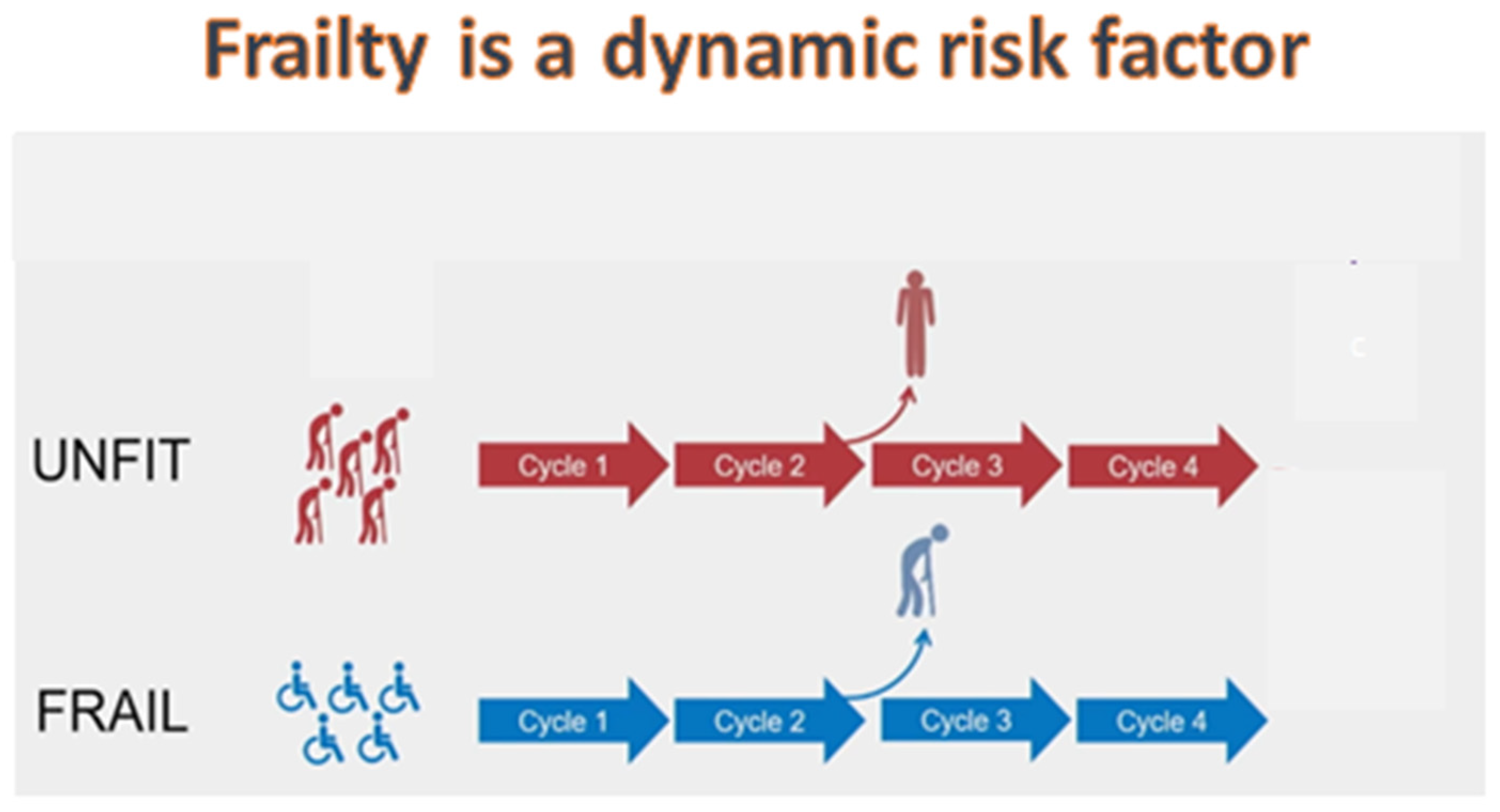

Table 1.
Different criteria and scores to evaluate patients’ fitness.
| Criteria | Tools | Findings |
|---|---|---|
| Age and comorbidities | CCI HCT-CI |
WHO: considered the chronological age of 65 years for the definition of elderly Menderios et al. patients under 75 years had similar mortality risk reduction to those over 75 years. Comordities, low PS, previous MDS were releted to early mortality Talti et al; Juliusson et al.: WBC, platelet count, hemoglobin level, poor-risk cytogenetics, PS, secondary AML. Lazarevic et al.: underlines the importance of a complete molecular study also in patients over 80 years for the therapeutic implications with targeted drugs. |
| Performance status | ECOG KPS | Kadia et al: PS does not correlated with age. Juliunsonn et al: older patients with better PS had reduced early death rates however age and PS do not determine the fitness of the patients |
| Multi -parameter assessment tools | GAH SSBP MMS ADLs |
Bonadad et al demonstrated that higher GAH score predictive of survival Klepin et al: showed that cytogenetic risk group, previous MDS, and baseline hemoglobin level, SPPB score <9 and MMS<77 were releted to poor OS. Kantarjian et al: developped a score system integrating patients’ and disease features demonstrated a good survival for favorable and intermediate risk group. Rollig et al: ideated a score integrating age, karyotype, NPM1 mutation status, WBC count, LDH level, and CD34 expression. Four prognostic profiles have been identify and associate dwith different prognosis. |
CCI: Charlson Comorbidity Index; HCT-CI: Hematopoietic Cell Transplantation–Specific Comorbidity Index; WHO: World Health Organization; MDS: myelodiplastic syndrome; WBC: white blood cell; PS performance status; AML: acute myelid leukemia; KPS: Karnofsky PS; GAH: Geriatric Assessment in Hematology; SPPB: Short Physical Performance Battery; Mini-Mental State; OS: overall survival; ADLs: activities of daily living;.
Table 2.
Ferrara criteria and subsequent validation studies.
| Criteria | Methodology | Findings |
|---|---|---|
| Ferrara et al, 2013 | Delphi consensus-based process involving a panel of Italian hematologists | Definition of patients not fit for intensive and non-intensive chemotherapy. The panel provide conceptual and operational criteria to evaluate the fitness of AML patients. These criteria resulted easily applicable in clinical practice determining three fitness groups: fit, unfit and frail. |
| Palmieri et al, 2019, 2020 | Retrospective and real-life studies | - In a cohort of 180 patients resulted a high concordance between fitness classes identified by the Ferrara criteria and overall survival. - In a retrospective study of 622 AML patients, Ferrara criteria showed a good accuracy in predicting 28-day and 100-day mortality. The authors conclude that the validity of the Ferrara criteria must be integrated with the molecular cytogenetic risk class of AML. |
| Borlenghi et al, 2018, 2021 | Retrospective and real-life studies | - In a retrospective analysis of 208 patients with secondry AML>64 years the authors integrated the Ferrara criteria with ELN risk classes. The Ferrara criteria correlated with survival of fit, unfit and frail subgroups. - The Ferrara criteria applied on 699 patients demonstrated to predict survival. However, these criteria should be integrated with biological risk classes. |
Disclaimer/Publisher’s Note: The statements, opinions and data contained in all publications are solely those of the individual author(s) and contributor(s) and not of MDPI and/or the editor(s). MDPI and/or the editor(s) disclaim responsibility for any injury to people or property resulting from any ideas, methods, instructions or products referred to in the content. |
© 2024 by the authors. Licensee MDPI, Basel, Switzerland. This article is an open access article distributed under the terms and conditions of the Creative Commons Attribution (CC BY) license (http://creativecommons.org/licenses/by/4.0/).
Copyright: This open access article is published under a Creative Commons CC BY 4.0 license, which permit the free download, distribution, and reuse, provided that the author and preprint are cited in any reuse.


