
Submitted:
26 September 2024
Posted:
29 September 2024
You are already at the latest version
Abstract
In a time of ecological and social crises, designing new institutions is crucial for meeting future challenges. Institutions emerge from the imaginations of individuals, moving into social movements and crystallizing in legal structures. As present movements seek to develop tomorrow’s governances, they turn to decentralized structures: distributed networks with little hierarchy, characterized by a diversity of actors and dynamics. While movements and technologies may seek to utilize decentralized ideas, they lack design principles: only recently has it been possible to decentralize at the national stage. Designs may come from biology and ecological networks; fungi, plants, and slime molds in soil to the neurons, glia, and blood vessels within our own bodies. This article blends these biological analogies with present technologies like blockchain and Web3 to posit future decentralized institutions, movements and legalities that give greater consideration to the more-than-human world.
Keywords:
Decentralized
; networks
; institutions
; more-than-human
; fungi
; social movements
; legalities
; neuroscience
1. Introduction
We need new stories. Past explorations on selfish, self-correcting markets have led to a worldwide emergence from poverty, but simultaneously brought calamitous climate change and biodiversity loss (Fricker, 2001; Goffman, 2020). The continued burning of fossil fuels threatens to disrupt the Earth-system balance for generations, potentially thousands of years (Archer, 2016). This has occurred alongside an existential loss of biodiversity, with an average vertebrate population decline of 69% in the last fifty years (WWF, 2022).
Stories are the first step in building institutions - the structures that guide our world. Stories grow to become movements, and movements fight for legalities.
Decentralization has emerged onto the movement stage, as past structures of hierarchy led to dominance; dominance leads to many being forgotten. One might feel that we have forgotten the rest of the world in our stories.
Yet stories of care and other flourish, reacting from trauma to build for better. A leader can be beheaded, but a movement may survive. The tendrils of oppression innervate society, so how best to meet this pervasiveness than with a distributed network of activists and artists, collaborations and novel governances?
These networks are young, finding their way in a hostile world. Yet they find solidarity, and compassion, in even the darkest of times. To help, we must devise structures for collective flourishing.
And if we seek stories of harmony and justice, we must envision systems that can accommodate. Systems with a plurality of actors, dynamics, and partnerships; ones that are resilient, reflexive, and efficient (Dryzek and Pickering, 2018).
So if we seek institutions that allow for more-than-human - the collection of human, non-human, and environmental - dynamics, where better than to pull design principles directly from ecosystems? We wish for structures without oppressive hierarchies, that allow a variety of metrics of wealth and health, that incorporate care, and flexibility; decentralization may provide a solution.
Internet technologies have risen to the mantle of designing decentralized structures. Yet these spaces are a tool within a broader array of techniques. They show promise in peer-to-peer governance, of promoting spaces for sharing and caring. Forged in the heat of a global pandemic, our web moves into a third iteration, with stories of creation, and revolution. But if we have structure, we also need to understand change.
In a world constrained by resource flows and capped with limits, the systems that have optimized flow alongside resilience are prized for the lessons they teach. Our sweeping soil networks and the incredible engineering of our bodies are prototypical lessons in designing decentralized networks for optimal resource management.
I draw from these systems, blending analogies with web3 technologies to devise structures and dynamics for future institutions. With this, we can construct blueprints that form from the ground-up, or consider what we’ll need to change present hierarchies into distributed networks. I posit a world that has learned these lessons, and incorporated them into design. A future, where we once-again live alongside others in a more-than-human realization.
The outline of this paper is as follows: I present findings on institutions and their formation alongside social movements, indicating a trend towards decentralization. To assist movements moving into legalities, I develop a theoretical design of decentralized networks, utilizing principles from web3 and biology; applying these to institutional formation. Finally, I apply a prospective lens to imagine the technical, legal, and political structures of tomorrow’s decentralized more-than-human world.
2. Institutional Theory and Social Movements
Institutions are broad, catch-all concepts; to structure institutions, we must make them tractable through theory. In a broad sense, institutions constrain and enable contexts for actors. They can emerge, evolve, and die, or they may persist, changing, indefinitely. Institutions are made by “people, materials, and ideas” (Roberts and Koskenniemi, 2017).
Institutions frequently consist of a concept (such as an idea, guiding principle, or doctrine) interlinked with layers of structure (Sumner, 1907). Roughly, these might be thought of as an institution’s reason and its action. We can speak of more-than-human institutions (and we will) with the caveat that constructing these ideas using language necessitates use of a human institution1.
As institutions grow, there are two main determinants of success: resources and structure. An effective structure allows for meeting present and future demands or purposes, while creating a home for a plurality of actors. Resources are the energy, the currency, the talent, that institutions need to maintain and grow. Failure to develop in either of these domains risks institutional death (Stark, 1996; Giugni, 1998).
The reader will forgive me for not providing a precise definition of institutions. It is my belief that institutions are useful concepts precisely because they are broadly defined: a single definition constrains said usefulness2. Instead of a single sentence, I will illustrate ideas on institutions within the following sections, through which I hope the reader will gain an appreciation of their diversity and functionality.
2.1. Imaginations, Norms, Laws
As a broad brushstroke, we might think of institutions as emerging from the imagination and actions of individuals, gaining legitimacy through social use and norms, and obtaining political power through enshrinement within governing structures3. In other words, institutions frequently pass from imagination to social movements to legalities. This matches ideas on the three dimensions of institutional organization: cognitive, normative, and regulative; or alternatively, myths, shared understanding, and rules (Scott, 2008).
2.1.1. Cognitive Imaginaries
Cognitive rules relate to how we think-of and frame reality; constraining or enabling what imaginations are possible - they are the stories we tell ourselves, and the first step in building institutions (Benford and Snow, 2000).
Homo economicus, ‘the economic man’ is an example of a cognitive institution, a frame around which we base behavior, experiments, and socio-economic norms (Patalano, 2007). These frames can be useful, but ought not to be taken too-literally, else we risk seeking the wrong goal: producing for economic man, rather than people and planet (Meadows, 2008).
Environmental services - valuing nature depending on the services we (i.e., humans) get - is another example of a cognitive frame (Gómez-Baggethun et al., 2010). This has encouraged restoration and conservation efforts - healthy ecosystems are more-capable to provide these services - yet this framework falls into an anthropocentric, dualist perspective: what we (humans, separate from nature) can obtain from an outside, separate world (Kolinjivadi, 2019; Kenter and O’Connor, 2022). This story posits a lack of agency to nature: an object that will only receive protections so-long as it affords instrumental value, falling short on considering diversity, future generations, or a plurality of values (Rühs and Jones, 2016; Spangenberg and Settele, 2016). Alternate stories have emerged, frameworks that emphasize a bi-directional4 living with or as nature, ones that seek to incorporate the plurality that characterizes the real world (Kenter and O’Connor, 2022; Willemen et al., 2023).
As we develop and locate new stories, we incorporate some of them within our practice and identity. As actors subsume these stories, a movement starts to form.
2.1.2. Norms and Movements
Norms are what actors follow. What seems right, permissible, or popular. We look to others and our environment to learn what is typically done; if we see compost bins out by the street, we might compost (Lounsbury, 2001; Kashima et al., 2013). If we see lots of wildlife gardens, we might build our own. Of course, we also seek to generate new norms, perhaps pulling from religion, fashion, or injustice to go against a local grain, hoping that our actions inspire others5.
If a norm is tested and accepted6, then it may develop into a social movement. The boundary between norms and movements is fuzzy; norms move to movements as they develop surrounding organizations with explicit goals. Injustice is a powerful catalyst. Social movements throughout history have galavanized and organized following collective outrage and perceived illegitimacy of those in power; recent examples being Black Lives Matter and the Arab Spring Movements (Edelman, 1990; Schneiberg and Lounsbury, 2008; Arafa and Armstrong, 2016; Chase, 2017).
Activists pull from a diversity of tactics and structures. Frequently, these networks are decentralized, with broad, public support, distributed information technologies, and grassroots funding (Helfgot, 1974; Vatn, 2015; Ho, 2024). Movements may seek to replace power structures, ensringe legal rights, or merely restore governance to the people (Arafa and Armstrong, 2016; Petrie, 2024).
A movement may arise from the ashes of past struggles. Institutions leave structural legacies, even if they have ‘failed’ - activists may seek to consolidate talent and resources that structured past movements, using lessons-learned to avoid past mistakes (Schneiberg and Lounsbury, 2008). Understanding these lasting legacies can be a powerful motivation: my efforts set the stage for those who come after.
Eventually, if a social movement obtains the critical-mass needed to snowball, legal structures start to form.
2.1.3. Legal crystallization
Enshrining norms and movements in policy is frequently the pinnacle of culminating social effort (Sumner, 1907).
Policy and legal decisions7 often arise from already existing norms, known as customary law, moving from a mutable landscape of normative rules and typical behaviors to legislation (Perreau-Saussine and Murphy, 2007; Diala, 2017). Of course, customs need not become enshrined, but do so with an impetus, particularly to punish violators, protect victims, or enact a philosophy of welfare8 (Sumner, 1907; Perreau-Saussine and Murphy, 2007).
Policies that match norms are ‘easy’ to enshrine, but those that oppose require long and patient effort to shape the normative landscape (Sumner, 1907). Reframing radical change in the language of traditional norms is a powerful tool to make said change socially-amenable.
Once a movement becomes legal, it frequently finds itself placed within a ‘liberal’ rights-based framework- what the rights of actors are, how they can exercise these rights, and where the boundaries of these rights occur.
Rights afford protection for actors, allowing them legal and political recourse when rights are violated. Rights can even be extended towards actors incapable of voicing injustices, such as rights of the unborn or ecosystems (Rühs and Jones, 2016).
But this framing possess difficulties, as it splits a complex world into localized individuals. It may run into trouble when considering an indefinite future of countless beings, a key feature of long-term stewardship (Weiss, 2017). Rights are not value-neutral, being based on (often Western) moral views, and thus are susceptible to politicization and bias9 (Kapoor, 2019; Kirilov, 2019). Rights-centered legalities also risk the same selfishness that characterizes neoclassical economics - humans as individuals “isolated from the rest of the universe” (Kapoor, 2019). Rights are a form of self-assertion, and thus go against ethe10 of care and community (Kapoor, 2019). Finally, they are inextricably tied with notions of sovereignty and territory: I am only afforded rights if a legal state recognizes me as an individual deserving of said rights (Peters, 2016).
For these reasons, legal theorists are looking to move beyond the paradigm of rights. Future institutions may still utilize rights-based approaches, but will likely broaden legalities to incorporate a plurality of practices, including ones that entangle the human and other in a shared world.
Now we have seen how institutions progress and form. Let us look where the self fits-in, and how power structures shape which dynamics can form.
2.2. To Be or Not To Be (Within)
Movements act within or rise against institutions (Schneiberg and Lounsbury, 2008).
By working within, actors are able to mobilize and utilize existing structures and pathways - information flow, talent, ideas. Working within also helps to identify the contradictions or “multiple logics” that are present and can be deployed in different settings (Schneiberg and Lounsbury, 2008). Participants may engage with the present, while imagining and mobilizing behind-the-scenes to create institutional futures.
A useful framework examining how actors decide to stay within or exit institutions is Albert Hirschman's Exit, Voice, and Loyalty (Wingrove and Hirschman, 1971). These three categories broadly describe the choices11 actors have when assessing their identification-with and impact-of a declining organization.
Loyalty is continuing to work within a system, without overt protest. This strategy is chosen especially in the presence of power imbalances: one is afraid for one’s life, livelihood, job, or family (Corrigall-Brown, 2016). One may still engage with protest movements, secretly, financially or morally supporting protesters and protest-backing organizations, engaging in ‘quiet quitting’ - only doing the bare-minimum, or secretly looking for opportunities elsewhere (Mahand and Caldwell, 2023; Ho, 2024).
Voice is using one’s position within a system as a change maker12. Voice can build solidarity and create change from-within, although it runs the risk of ostracism or loss-of-influence if positions are not popular or if others lack autonomy to voice solidarity (Thomson, 1973).
Voice and loyalty represent staying-within a system to differing degrees of rebellion; they allow participants to continue engaging with present structures while imaging alternatives or slowing destructive tendencies from within. Staying within a system also allows engaging moderates, who may not feel comfortable jumping-ship but can be persuaded by incremental change or rhetoric.
Exit leaves the system to attempt change from outside. It occurs through identification-with or seeing the benefits in a challenger movement (Biggart, 2002). Often an active, outside movement is needed to make a decision to exit; most actors don’t jump-ship if there’s not a viable alternative (Davis and Thompson, 1994). Exit allows for building new institutions or strengthening competitors; it allows one to become fully-devoted to institutional change13. An individual exit might be imagining new possibilities or practices, while a community change can involve novel forms of organization (Schneiberg and Lounsbury, 2008). A legal and political exit can be a coup, or merely a new law or political party gaining traction. Of course, exit runs the risk of losing power, prestige, contacts and influence that one has built up; it may be easier for younger or less-established actors (Thomson, 1973). Because of this high cost, exit is often an action of last-resort, when all other channels of autonomy have been exhausted (Thomson, 1973).
We noted how power shapes the decisions actors can make. Now, let us explicitly turn to understanding how activists shape power through resources and structures - the key determinants to institutional success (Giugni, 1998).
2.3. Resources
“Votes count, but resources decide” (Rokkan, 1966).
Resources are broad, including everything from informational, social, or financial capital to legitimacy, leaders, and land (Cress and Snow, 1996; Vatn, 2015; Corrigall-Brown, 2016). Resources arise from members, elites14, governments, corporations, and the general public (Corrigall-Brown, 2016).
Often, large outside resources, say from the government or a select-few donors, have a tendency to make organisations more centralized, with greater hierarchy and bureaucracy15 (Piven and Cloward, 1978). This concentrated funding may be intended to buy decision-making: one’s money has a clearer cause-and-effect through a centralized decision-making structure. When external funding seeks to change institutions (‘structural reforms’) this may lead to an institutional collapse and subsequent distrust, such as what happened in Haiti following the 2010 earthquake (Pierre-Louis, 2011; Brun, 2018; Biglaiser and McGauvran, 2022). International development has historically been guilty of destabilizing through centralized funding; loans contingent on ‘liberalizing’ developing economies have often entrenched poverty, worsened wealth inequality, and bolstered political violence (Abouharb and Cingranelli, 2006; Forster et al., 2019; Biglaiser and McGauvran, 2022). When change is forced, collapse often occurs.
Radical movements, poised against elites or a government, frequently must obtain resources from a broader base, and as such are less-resistant to centralizing tendencies (Ho, 2024). Movements may seek funding or personnel by unifying causes under a broader social justice lens - such as the explicit identification of Black Lives Matter with LGBTQ activism and the ties between labor and gender within civil rights movements (Chase, 2017). As such, social movements typically seek a decentralized funding and resource structure, reliant on informal, kinship, or community donors (Kriesi, 1996). To assist with managing decentralized resource flows, I will pull analogies from biological systems in a later section.
2.4. Structures
2.4.1. Power
Power is the ability to influence others, to determine “which perceptions and perspectives dominate”, and how resources ought to be allocated (Vatn, 2015). Power is the core struggle in social movements: to define the rules and procedures that determine future winners and losers (O’Donnel and Schmitter, 1986; Vatn, 2015). Typically these winners and losers fall along existing power structures; notable legal cases are those characterized by a radical redistribution of resources and power - a break from existing structures (Cover, 1986).
The power structure of institutions influences the actions actors can take. Oppressive or rigid cultures enforce absolute norm-compliance (i.e, the cost of norm-violation, regardless of severity, is high), so actors within these societies may choose to either fully conform or totally ignore norms16 (Esposito, 2015; Michaeli and Spiro, 2015). Actors without sufficient affluence or influence are hesitant to jeopardize the little they have, but if you have nothing you may feel you have nothing to lose (Corrigall-Brown, 2016).
Power structures of dominance and hierarchy, hallmarks of centralized, anthropocentric structures, bias behavior towards productivity above all else, encouraging the social problems which lead to ecological degradation (Akbulut et al., 2020; Bookchin, 2022). Changing power structures from hierarchical dominance to pluralized governance offers a solution for stronger actions on climate change and biodiversity loss (Dryzek and Pickering, 2018).
2.4.2. Change
To stay relevant in a changing political and environmental landscape, institutions must be capable of change. The National Women’s Party, established 1913, emerged as a militant suffrage organisation that intentionally provoked and solicited arrests. Following its goal - voting rights for women - being met, the National Woman’s Party shifted tactics and aims, disavowing militancy and pursuing the establishment of the Equal Rights Amendment (Minkoff, 1999). Mobilization for Youth, a professional reform organisation in the 1970s, underwent radical restructuring as the socio-cultural milieu in which it formed evolved: moving from a militant community action organisation to a bureaucratized job training agency (Helfgot, 1974).
Similarly, scientists in the 1970s shifted roles from objective fact-finders to passionate change advocates, using their respected positions to not only publicize anti-war and environmental concerns, but to create new public-science organizations to inform change-makers (Moore and Hala, 2002; Schneiberg and Lounsbury, 2008). This is a tendency that continues today, as scientists, particularly within environmental and social spheres17, are eschewing an imaginary objectivity to provide reason for research: attempting to build a better world. Restructuring brings in the human behind the research: enabling institutions, including academics, to change with a changing culture.
2.4.3. Diversity
To address a diversity of grievances necessitates a diversity of structures. The Kurdish guerilla movement separates men and women regiments to allow for independent organization and leadership; the women regiments in particular emphasize ecological stewardship alongside guerilla tactics (Akbulut et al., 2020). The largest social movement in latin America, the Movimento dos Trabalhadores Rurais Sem Terra (Brazil’s Landless Workers Movement) utilizes direct action, land encampments, and community governance in the struggle for a fairer society (Akbulut et al., 2020). Civilian militias in Myanmar integrate themselves with local communities, operating as a civilian construction force - building schools, hospitals, and communication infrastructure - when not engaged in conflict (Petrie, 2024). They have explicitly disavowed intentions to politics: after they take back control from the military, they aim to give power back to the people (Petrie, 2024).
Movements often feature a radical wing. These divisive actors play a role18 in calling attention to injustices, forming new imaginations, and shifting the window of acceptable discourse: politicians will typically not engage with radical movements, but may seek wins by engaging with moderates (Bell and Brigetti, no date; National Museum of African American History and Culture, no date; Mayhall, 1995).
Decentralized movements - those without formal hierarchies and relying on a host of resources and actors - have emerged as powerful organizing structures for change makers (Hall, 2011; Fontana, 2020). “The absence of … protest leaders and official mouthpieces for the [Arab Spring] uprisings made a top down approach to quelling dissent virtually impossible for dictators” (Arafa and Armstrong, 2016). Actors often viewed centralized, hierarchical institutions as oppressive or coercive; decentralizing networks allow for broader representation, greater resilience, and even more-than-human justice (Phelps, Webb and Agrawal, 2010; Hall, 2011; Aoun et al., 2024). Facilitated with information technologies, movements can rapidly and broadly organize, broadcast, and fundraise (Arafa and Armstrong, 2016; Chase, 2017; Ho, 2024).
Now, let’s meet some of these technologies.
3. Decentralized Technologies and the Web(3)
Decentralized manufacturing - say, networks of 3D printers and CNC machines - and supply-chain technologies emerged as an efficient way to develop medical devices (homemade masks, face-shields, etc.) during the COVID-19 pandemic, promoting resilience to shocks and shortages (see figure 1) (Alkhader et al., 2021; Ino et al., 2021). Open innovation - knowledge sharing where ideas, developments and technologies are immediately made available to all - allows broad access and use, while enhancing reliability, trust, and autonomy19 (Kwok and Gao, 2004). Blockchain (see below) and digital ledgers can further enhance trust for decentralized manufacturing by quickly verifying transactions and supply nodes (such as verifying a manufacture’s products as of sufficient, medical-grade quality), without needing to go through a lengthy certification and retail process (Alkhader et al., 2021). Networks of sensors can help record the manufacturing environment and ensure that quality standards are being met (Alkhader et al., 2021).
Open source, design, and innovation are prototypical decentralized technologies: they spread information across a network, don’t require hierarchies to access or produce, and can be concentrated to maximize equity. This is exemplified by open spaces and tools: makerspaces, community labs, learning factories, hostel kitchens, and public transportation. These spaces provide users, particularly from underrepresented backgrounds, a space where one can learn skills and turn open ideas into products and services (Koh, Abbas and Willett, 2018). They are typically more-efficient than privatization, as they can be used at all hours of the day, and spend minimal time idylling. They are the building blocks of a convivial society, where members are afforded autonomous action through shared tools (Illich and Lang, 1973).
Figure 1.
Traditional vs. decentralized manufacturing. From: (Alkhader et al., 2021).
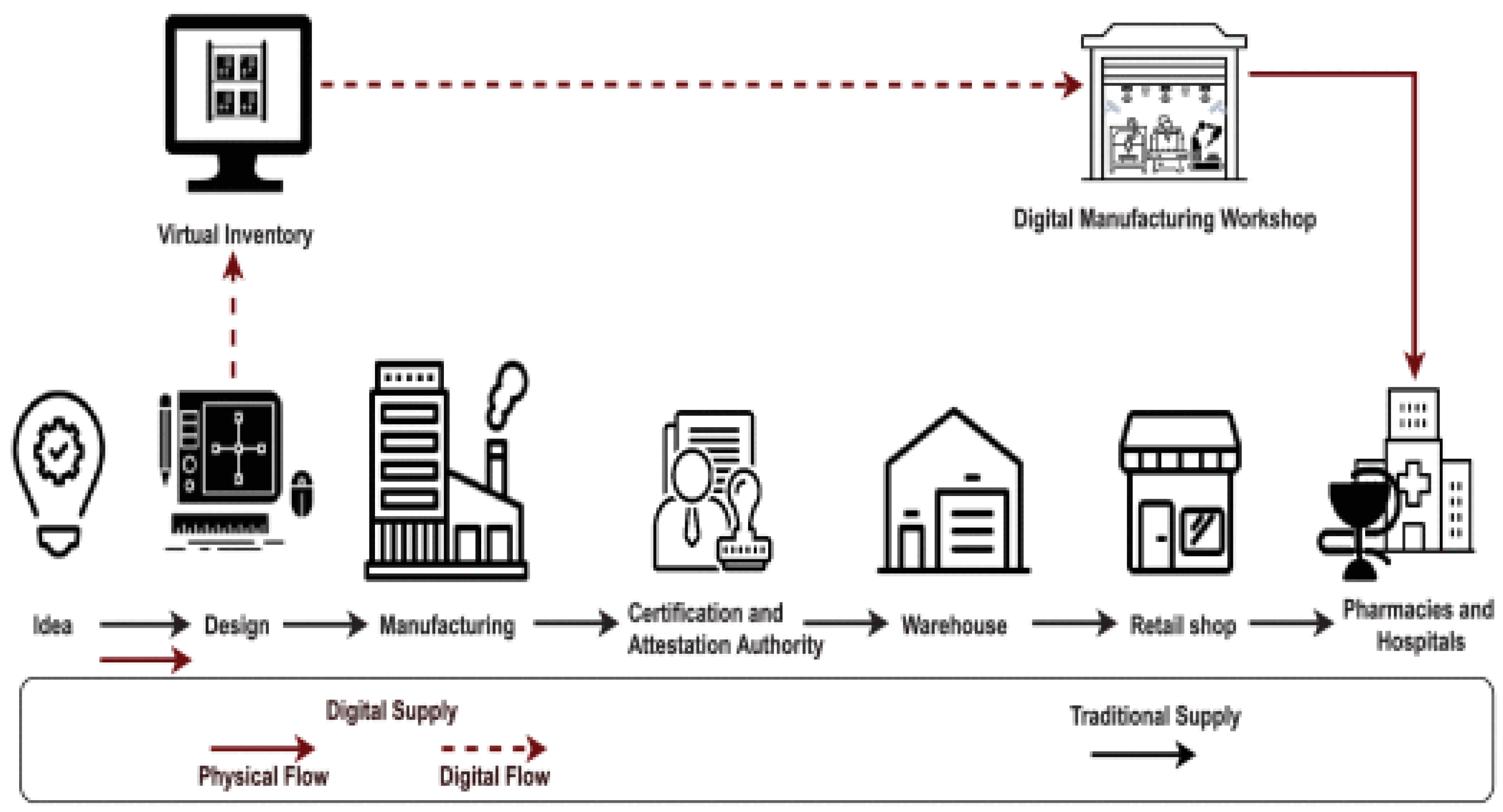
The COVID-19 pandemic was great for demonstrating the use, in rapidity and volume, and worries, such as unstandardized quality, of decentralized manufacturing20.
Decentralized manufacturing is related to the notion of the Internet of Things, the network of devices, linked by the internet, capable of coordinating and sharing data (Mukhopadhyay and Suryadevara, 2014). Similarly decentralized, this network is spread across users and facilitates local knowledge and autonomy. Enabling remarkable sensing capabilities - one can assess real-time impacts of climate change, migrations of biodiversity or communities, stocks and flows of waste streams, functioning of supply chains, or the transmission of infectious diseases and new technologies - the Internet of Things offers high potential for future climate adaption (Mukhopadhyay and Suryadevara, 2014).
Linking this monitoring with Artifical Intelligence technologies might allow connecting present data with historical archives, public comments, and causal factors (Superflux and Policy Lab UK, 2023). The Internet of Things is not without its flaws: real concerns on privacy and energy use abound, so extra care is needed to make these technologies sustainable and prevent bad actors from coopting them (Mukhopadhyay and Suryadevara, 2014; Henschke, 2020). Just because we can put the internet in technologies, does that mean we should21?
Cryptocurrencies, a prototypical decentralized technology, utilize a network of computer nodes that coordinate to verify, execute, and record transactions (Alkhader et al., 2021). These systems rely on a peer-to-peer authentication of transactions through a decentralized, distributed ledger, known as a blockchain - from the stacking of records ‘blocks’, linked by cryptography22 (Zoomers, no date). This ledger may be at the center of an institution, but it need not be centralized: it is created through the actions of all actors, and thus a record exists with every one - rendering it extremely-challenging to disrupt. Blockchain is powerful cognitive and technical institution, with an associated narrative of creation, connection, and revolution (Leiter, 2023).
Decentralized currencies like crypto allow for financing in the absence of existing financial institutions: I don’t need a central financial organization (like a bank) to authorize a transaction, hence why these technologies have received lots of attention in international development, where many individuals remain ‘unbanked’ (Zoomers, no date). Of course, great care must be taken to see that these technologies do not merely exacerbate existing power dynamics; that they heal, rather than deepen, scars of colonialism (Howson, 2020). To assuage this tendency, we might pull in participatory programming; allowing a diversity of voices to influence the design and implementation of decision-making algorithms (Blanchet, 2024)
Blockchain is marketed as a decentralized technology, but may feature hierarchical and centralized governance, particularly in initializing the technology (Schädler, Lustenberger and Spychiger, 2023). Actors seeking equity must pay attention to the formation, roles, communication, and decision-making that go into and constitute a blockchain (Schädler, Lustenberger and Spychiger, 2023). A centralized initialization is not in-itself an issue we will see that decentralized networks often start with a centralized core and governing idea. More-than-human institutions might form the same way: created by human actors, who then share control with artificial intelligence tecnologies and non-human actors. We must ensure that the flexibility is baked-into to a network’s dynamics, such that it is capable of becoming more-decentralized over time, when the need arises.
One type of asset in blockchain technologies is the non-fungible token (NFT). These tokens represent unique ownership of digital or physical objects, and are distinct from currencies, crypto or traditional, in that they are not mutually-interchangeable: the token and associated object are unique23 (Borri, Liu and Tsyvinski, 2022). NFT’s took online markets by storm in 2021, rapidly inflating in value before crashing (Huang and Goetzmann, 2023). While the hype may have burst, NFT’s still represent interesting technologies for ownership.
There has been a recent push towards using Blockchain to give ownership or consideration towards more-than-human actors. The Decentralized Ecological Economics Protocol gathers biodiversity data and links that data to a token, which can be traded to creatives for use in products or services (such as art, events, or stories) (Leiter, Mazzi and Smakhtin, 2023). Terra0 goes a step further, enabling a forest to own itself and lease its own land using Blockchain contracts for logging and tourism (Seidler, Kolling and Hampshire, 2017). With these funds, the forest can buy more land or hire maintenance or rewilding experts (Seidler, Kolling and Hampshire, 2017). This forest must be first bought by human investors (for whom the forest generates dividends), and varying levels of complexity allow the forest-governing network different levels of autonomy - from receiving manual adjustments to full, artificial intelligence sensing and decision-making (Seidler, Kolling and Hampshire, 2017). Future considerations of the more-than-human may require initialization by human actors, who then share or let-up control.
These arrangements are frequently described as decentralized autonomous organizations (DAOs) - communities, owned by members, where transactions and voting is carried out through a blockchain (Smith, no date; Han, Lee and Li, 2023). Once again, we must pay attention to the structure: who is given a vote, who decides which issues are brought-forth?
The above cases represent types of decentralized structures, but we must confront the other determinant of institutional longevity: resources. Devising systems that optimize resource management and flows is necessary for future success, especially as we move into legalities and politics. Biology may offer the analogies we need.
4. Decentralized Biology
The world is constrained in resources and mobility. Bandwidth determines your download speed, public transportation and road networks determine where you can and can’t go, our own bodies can only process so much information, speak at a certain rate24, or learn so-much in a day. This necessitates a clever optimizing of resource-use for a given task. Biological networks, from fungi and slime molds to the neural-vasculature coupling within our own bodies, have optimized over millienia for efficiency. These systems are anything-but static, constantly pruning and re-configuring to optimize resilience, resource flux, and information flow. Why not use these systems as inspiration for designing our institutions?
4.1. Soil Systems
Soil, the living breathing tangled web of interactions and mobilities, the foundation of health, wealth, and civilization. Agriculture cannot survive without healthy soil; soil provides the cycling, breakdown, re-use, and distribution of nutrients. It is characterized by countless species, innumerable dynamics, and a biogeography of classifications. Let’s look at a few key-players, and see what they can teach us.
4.1.1. Slime Molds
Biological networks, such as fungal mycelium or slime molds, have shown immense potential for designing decentralized infrastructure, such as electrical grids or transportation networks (See figure 2) (Tero, Kobayashi and Nakagaki, 2006). With models of subway systems - where piles of oats represent high population density - slime molds are able to devise extremely efficient (using fewer tracks and less resources) pathways, mimicking or exceeding real-world systems such as in Tokyo and New York City (Carino, 2023). Slime molds likewise outperform award-winning pedestrian-oriented urban design, a boon for creating walkable cities (Kale and Altun, 2024). Using biological systems can rapidly decrease computational requirements, where a handful of oats and a starting population, rather than thousands of CPU-hours, are needed to identify an optimal arrangement (Tero, Kobayashi and Nakagaki, 2006). These achievements are made all-the-more remarkable when considering that the slime mold is a single cell! With thousands of nuclei across one shared membrane, the slime mold can perform complex decisions in an uncertain environment, perfect for decentralized urban design.
Figure 2.
A slime mold rail-network on a model of the United States. From: (Parr, 2014).
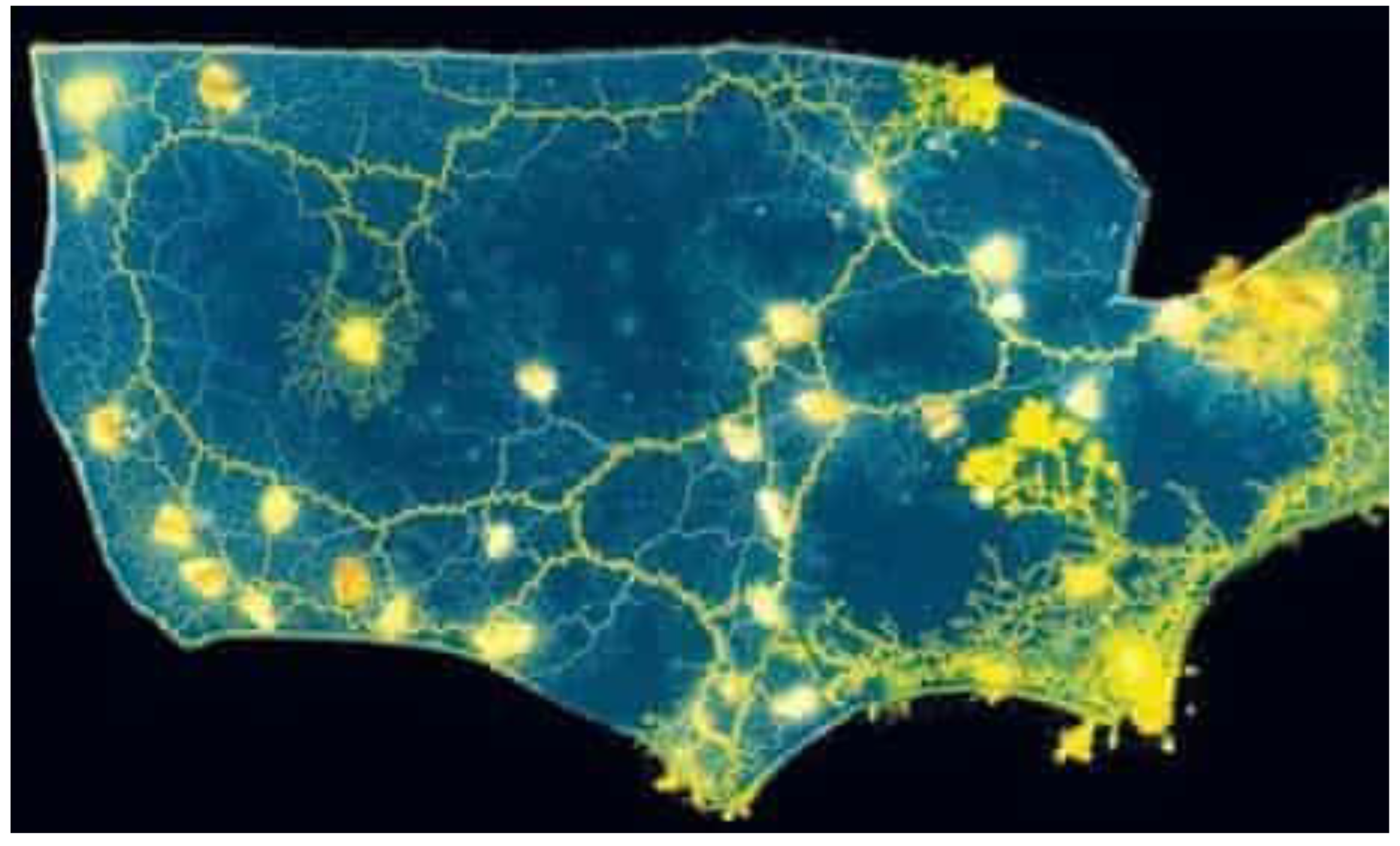
Yet decentralization is not a slime-molds-only tool. If the slime mold runs out of resources, the network undergoes a drastic change. It reverts to centralization, organizing around a central core and starts to build a stalk (Bonner, 1957). All the energy moves towards forming spores at the tip of the stalk, to be caught by passing animals or a gust of wind. The network sacrifices itself for the few, although a small residual population may remain, hoping for a rainfall of nutrients. We might imagine even future institutions capable of this last-ditch flexibility, briefly centralizing to coordinate dispersal of talent to the wind.
4.1.2. Fungi
Now we move into the domain of multicellular25 soil life. Fungal networks feature a labyrinth of tubes, cords, and further complex structures that allow rapid, bi-directional nutrient sharing (see figure 3) (Thompson and Rayner, 1982). Hyphae, the branching, filamentous segments that form mycelium (the network itself), show an impressive range of diversity of structures and functions. Together, they aggregate to form cords - thick, resilient tubes26 - rapidly shuttling resources and even allowing for above-ground exploration (Thompson and Rayner, 1982; Boddy, 1999). Networks are also filled with tiny threads, that are mostly used for sharing information and material between nodes.
Figure 3.
Superb complexity of hyphae, forming a tube. From (Thompson and Rayner, 1982).
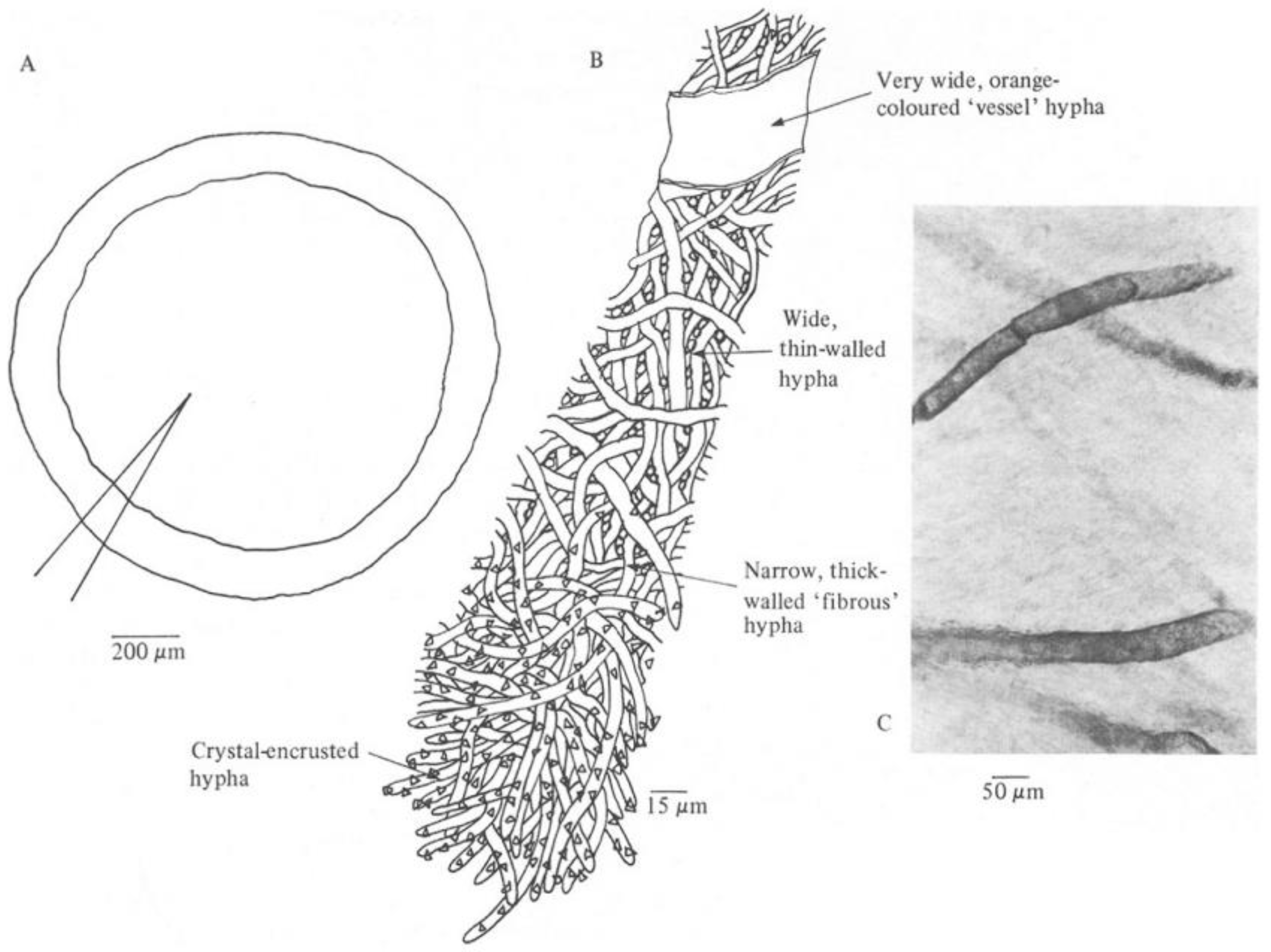
Low-power cross-section of a cord. B) High-power drawing of the section highlighted in (A). C) Some individual hyphae sections.
One of the simplest examples of fungi networks is fairy-rings, beautiful rings of mushrooms, often occurring in grassy fields27. Grass immediately outer and inner to the ring is unusually lush and luxuriant from fungal-unlocked nutrients (Darling, 2016). These structures form from a single spore, which radially spreads outward until it reaches sufficient size to trigger fruiting (the growth of mushrooms). As such, fairy rings are a useful demonstration of decentralized network growth, moving from a single fully-centralized ‘seed’, consuming resources radially outward, gradually becoming more centralized, and, when sufficiently large or having exhausted resources, ‘fruiting’- concentrating resources to build complex dispersal structures and mobilize to new territory. Lets take this network as our base, and start building upon it.
Figure 4.
A fairy ring. From: (Darling, 2016).
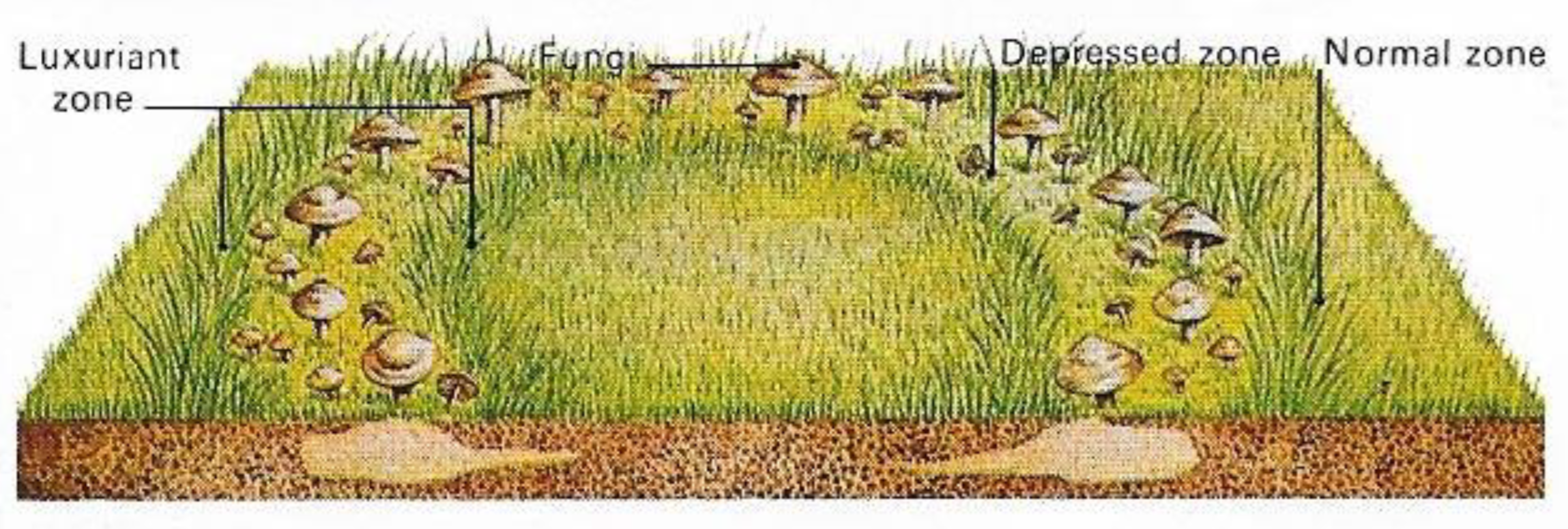
The hyphae we met previously can fuse together (anastomosis) to help distribute water, nutrients, and signaling molecules throughout a network (Shoji et al., 2015). This fusion can even occur between different ‘individuals’ - i.e., with different DNA! This naturally extends to institutions: sister organizations, aligned with similar goals, first share information through informal networks, and as ties strengthen opportunities for technology or talent sharing arise. Eventually, the organizations may be joined in solidarity; subsumed under a larger organization while maintaining individual character through specialization.
Our network prioritizes growth, so concentrates energy and resources at the the growing tips (Ruban-Ośmiałowska et al., 2006). These tips search by detecting signals in their environment, and communicate their findings with electrical activity to the rest of the network (Brand and Gow, 2009; Fukasawa et al., 2024). Tips preferentially grow away from other tips, and stop growing once sufficient crowding occurs (Sugai-Guérios et al., 2019). The network gains stability through prioritizing exploration.
A fungal network displays two main modes of behavior: exploration and extraction. Aerial hyphae grow away from remaining nutrient sources, while vegetative hyphae branch into the substrate to extract nutrients (Zambri, Williams and Elliot, 2022). The network looks to present and future forecasted (i.e., reflexive) resources, deciding whether to shift from a mainly-explorative to a mainly-extractive: squeezing every last drop out of a resource base. For now, lets say it stays within the explorative mode28, monitoring the situation to see if it a switch needs to occur.
Limiting resources like phosphorous and nitrogen are kept fluid, continually recycled so the network can continue exploring even in the absence of new resources (Maheshwari, 2005). These nutrients are stored within DNA that can be programmed to break down: these are liquid reserves, analogous to currencies (Maheshwari, 2005). Fungi build up these savings to liquidate when incomes dry up. During boon times, it helps to save.
All this happens without a brain or even a nervous system! Instead, fungal networks appear to synchronize their behavior using whole-system oscillations, a global pulsing29 that can range from a few times a minute to as long as weeks (López-Franco, Bartnicki-Garcia and Bracker, 1994; Fukasawa et al., 2024)! These pulsings allow for coordination across a network, and might be analogous to global cycles across the brain, such as seen during slow-wave sleep (Tlalka et al., 2007). If you’re wishing to coordinate behavior, it helps to have a clock. A decentralized institution will wish monitor itself; without a centralized power structure to keep tabs a network can may monitor itself through a web of communication. Periodically updating (and checking) a shared lecture might be analogous to these oscillations, as might regular peer-to-peer updates.
So if the network detects a change through consensus, say a slowing of expansion or a dwindling resource base, it may trigger a reorganization. Like a slime mold, this reorganization might involve a movement back to partial centralization, as resources start to aggregate near prominant nodes (dense clusters of threads known as ‘hyphal knots’; see figure 5). As pulses synchorize behavior in these concentrated nodes, hyphae join and stack, and begin forming complex structures like mushrooms (Maheshwari, 2005). Fungi can be quite difficult to cultivate30 as the signals that prompt the network to fruit are often a combination of factors, from available nutrients to CO2 levels. With a swell of rain or gust of wind the mushrooms release the spores, looking for richer fields abroad.
Figure 5.
The life cycle of a (mushroom-fruiting) fungi. Made by Zayir paing Soe with (BioRender, 2024).
Figure 5.
The life cycle of a (mushroom-fruiting) fungi. Made by Zayir paing Soe with (BioRender, 2024).
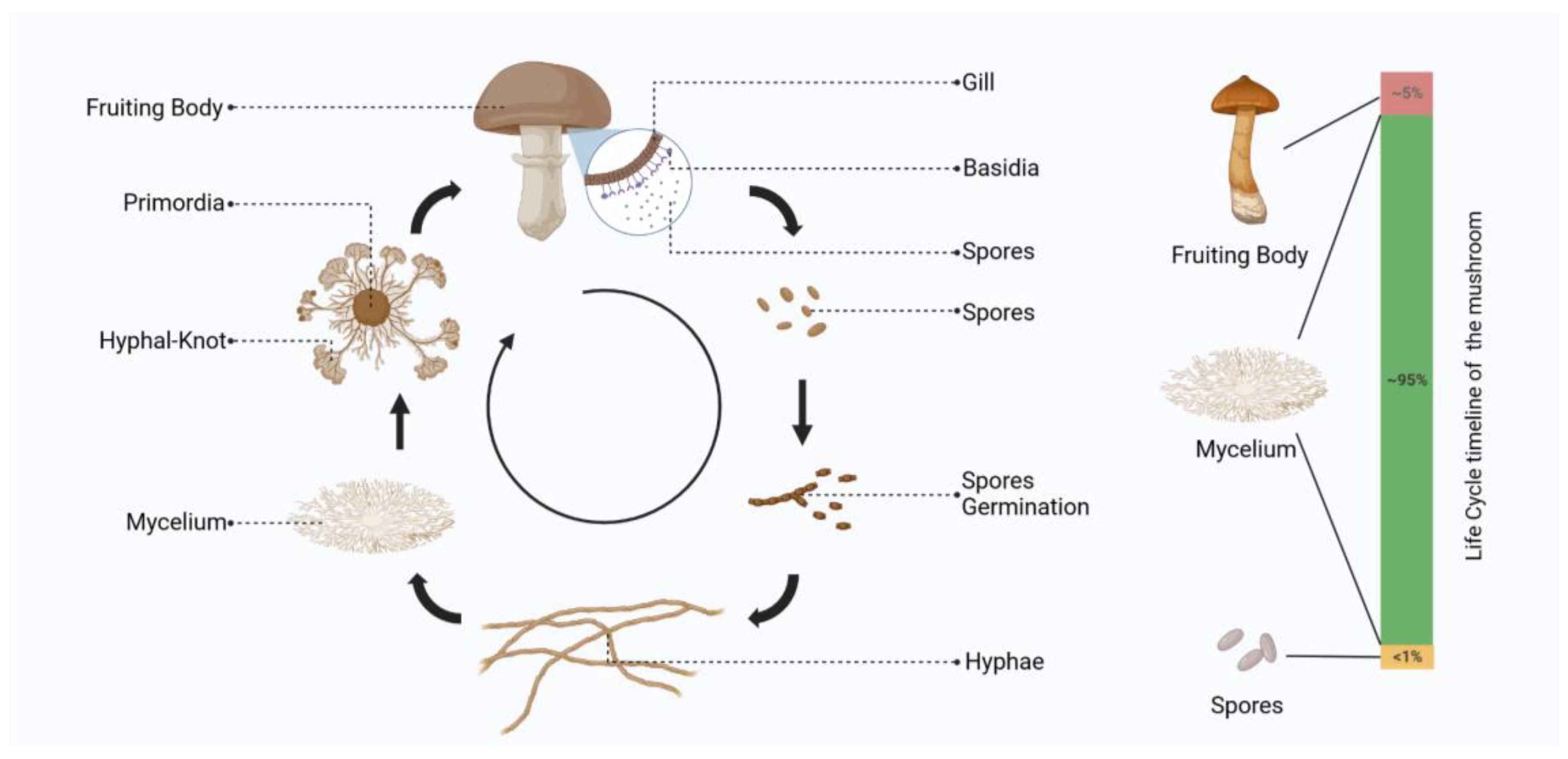
For around 95% of the time the network is in a decentralized configuration, but can undergo centralization to concentrate resources and follow top-down signals during fruiting and spore-release. Spores can occupy far-more of the lifecycle (some can germinate after thousands of years!), but are in a state of dormancy with little growth or change.
The flexible arrangements that characterize fungal networks are great for resource efficiency, hence our focus on using them to design institutions. As the network grows, poorly-performing hyphae are recycled back-into the mycelium or fused, so that the total material present increases very slowly (Bebber et al., 2007). Yet the network still prioritzes redundancy: there are many pathways that nodes can use to communicate with each other; you can remove 80% of the threads in a network without having a significant effect on global transport (Bebber et al., 2007)!
4.1.3. Phyto-Connections
We’ve talked of fungal ‘individuals’ fusing together, but the networks extend far beyond. Approximately 80% of vascular (having organized fluid transport systems) land plants form endomychorrizal partnerships - fungal symbionts live within their tissues, and often even mix within the plant’s own cells (Malloch, Pirozynski and Raven, 1980)! These partnerships faciliate trade: plants turn atmospheric carbon to sugars, which they trade for nutrients, like phosphorous, potassium, and nitrogen from the soil31 (Wipf et al., 2019).
This collaborative and trading network forms the basis for the Wood Wide Web, a frame that has emerged to regard, particularly forests, as an interconnected, information sharing system32. Plants use this network to share nutrients between themselves, especially from tall healthy individuals to their younger companions. Such dynamics even happen between different species: all benefit from a healthy ecosystem (Selby, 2016). This coupling between fungi, plants, and innumerable bacteria even allow ‘elder’ stumps to stay biologically active for decades: it appears that other plants are sharing nutrients through a fungal network to keep individuals alive long after they cease ‘producing’ - much like our own elder care networks (Wohlleben, 2016).
This coupling between networks, a tangled web of competitive and cooperative dynamics, is a powerful metaphor for our own institutions and social systems: institutions never occur in a vacuum, and so must seek partners and understand the environment in which they find themselves, and must have the flexibility to broaden their identity, and goals, to include others.
Soil networks can seem limitless, stretching over miles and across regions. But to design decentralized institutions we must also look at networks where the growth, and indeed resources, are far-more constrained. Let’s turn inward.
4.2. Neurons, Glia, and Blood Vessels
The brain is one of the most efficient, computationally-rich systems we know of. We run a network of billions of neurons and glia, with trillions of synapses, on the energy of a single lightbulb (Balasubramanian, 2021). We use this energy to perform superhuman feats in the Olympics, compose sweeping sonatas, devise distributed technologies, and write decentralized dissertations.
Let’s start with the players, then build to the networks.
4.2.1. Circuits, Ganglia, Glia
Our nervous system is composed of two main cell types: neurons and glia.
Glia represent the care economy to the neurons’ productive - they maintain the cellular environment, repair wounds, supply energy, and essentially everything else33 besides firing their action potentials34. Astrocytes, a star-shaped type of glia, have thick projections - ‘branchlets’- and thin threads - ‘leaflets’. Together these projections fill the space around neurons and synapses (Gavrilov et al., 2018). Astrocytes serve as the bridge between neurons and blood vessels (figure 6). They take in sugars and nutrients from blood vessels, repackage them into easy-to-digest forms (turning bread into candy) as rapid energy for neurons (Brigham Young University, 2024). Astrocytes also communicate with blood vessels, telling them to dilate, sending more oxygen, or constrict, sending less; this actively changes the flow of energy through the system (Koehler, Gebremedhin and Harder, 2006). Astrocytes have important modulatory and housekeeping roles in the synapse, across which the signal travels, so-important in-fact, that many neuroscientists regard their coupling with input-output neurons into a ‘tri-partite’ synapse (figure 7) to be the functional unit of the brain (Bradley, 2011).
Neurons, the flashy, cross-network signaling cells in the brain, are particularly useful for directional communication. They are composed of four main parts: the soma or cell body where most of the ‘thinking’ takes place, the dendrites, tree-like appendages that receive inputs, the axon, a long tail along which the electrical signal - ‘action potential’ – travels35, and the synapses, where chemical messengers are released to (possibly36) trigger an action potential in the next neuron-over (Sidiropoulou, Pissadaki and Poirazi, 2006).
Figure 6.
Coupling between astrocytes, blood vessels, and neurons. From: (Brigham Young University, 2024).
Figure 6.
Coupling between astrocytes, blood vessels, and neurons. From: (Brigham Young University, 2024).
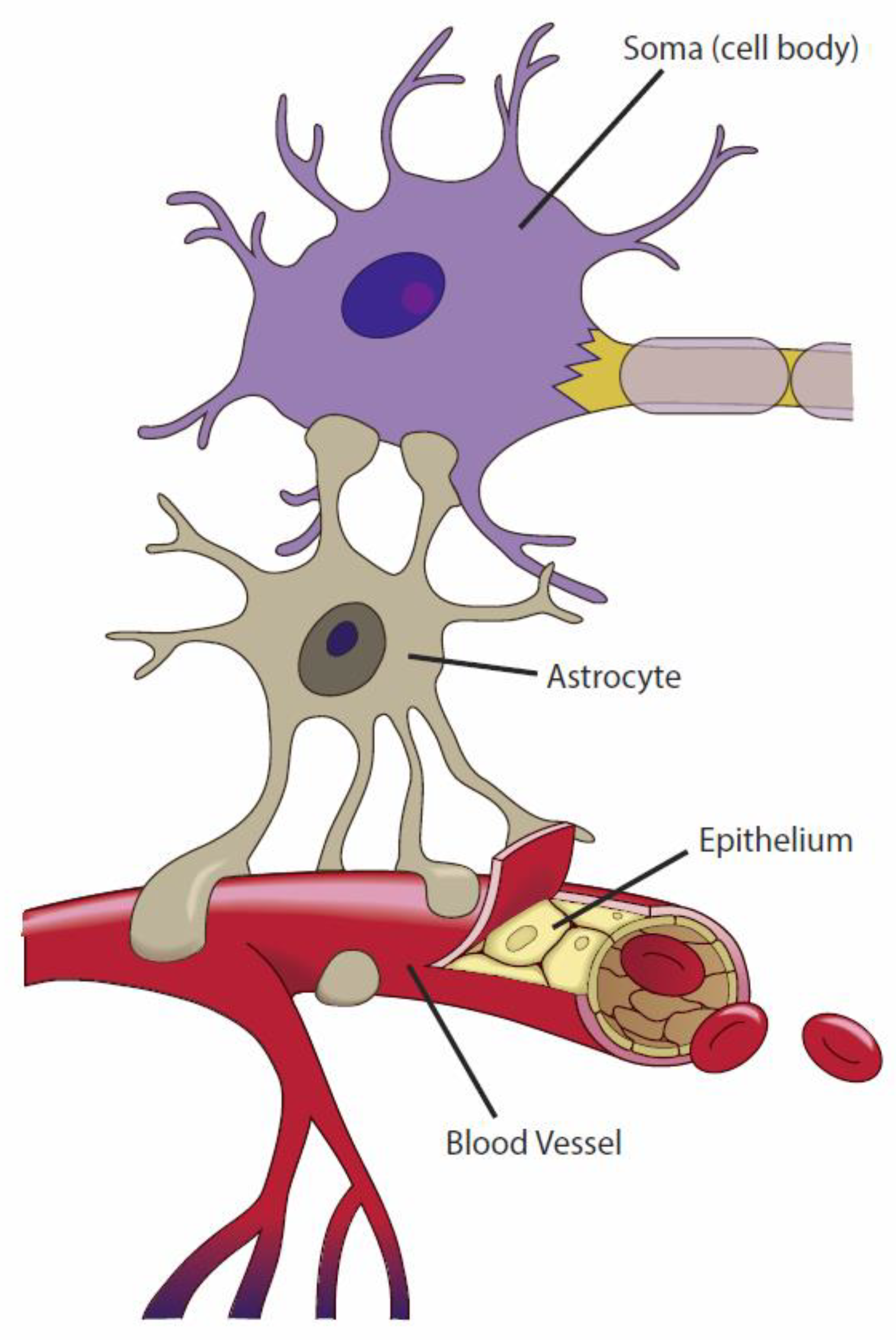
The neuron is the purple cell at the top. Astrocytes can attach their end-feet all over the neuron, from the cell body, to the axon, to the dendritic inputs or the synaptic outputs.
Figure 7.
Tripartite synapse between post- and pre-synaptic neurons and astrocytes. From (Bradley, 2011).
Figure 7.
Tripartite synapse between post- and pre-synaptic neurons and astrocytes. From (Bradley, 2011).
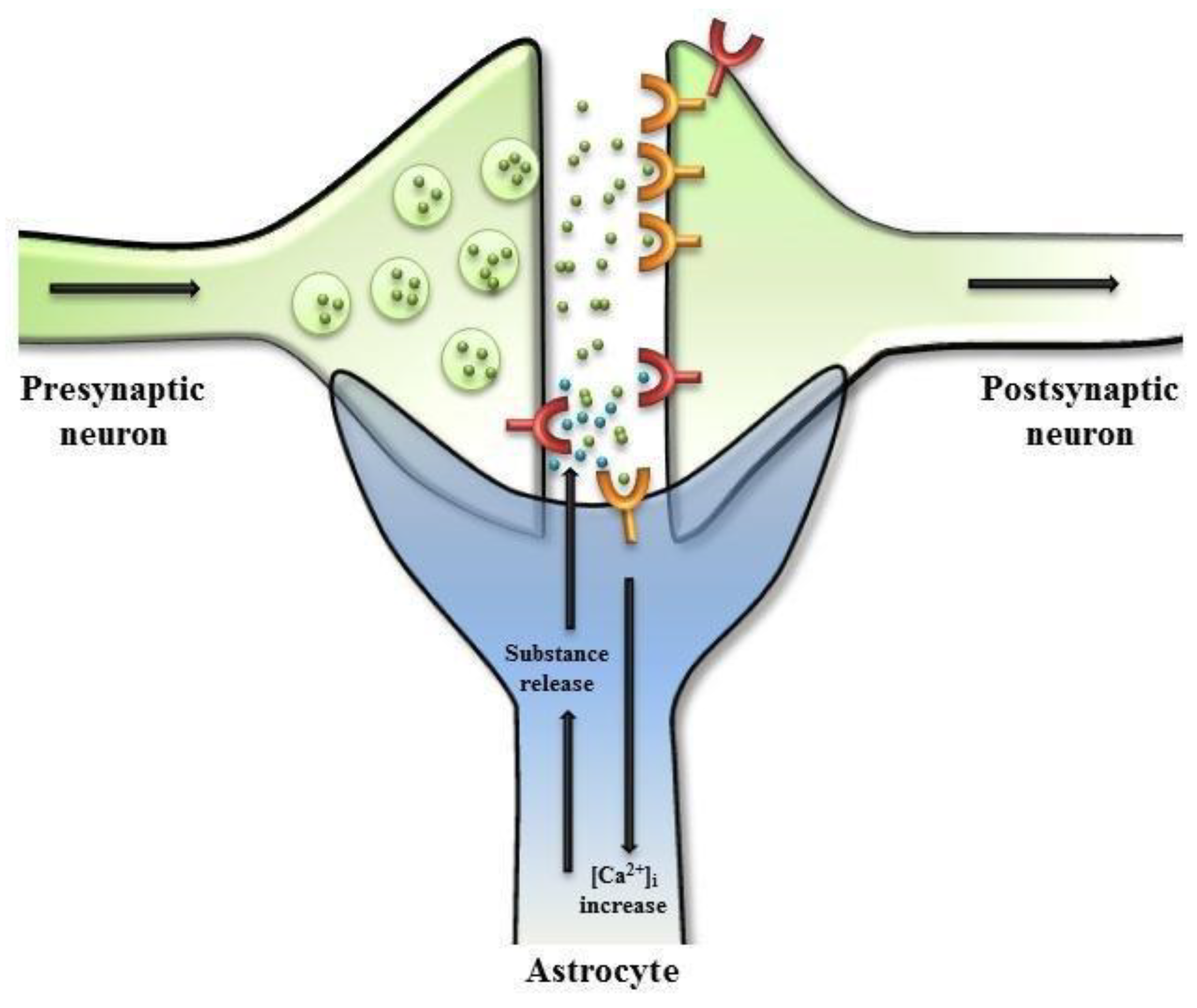
On the left is the synapse of the pre-synaptic neuron, on the right is the dendrite of a post-sysnaptic neuron. The astrocyte’s end-foot modulates and cleans the chemical environment of the synapse. The signal moves left-to right (presynaptic to postsynaptic). The astrocyte does not physically-connect with the neurons, but instead wraps-around like a bowl.
4.2.2. Neural Networks
Now let's put the players together into networks.
The brain organizes computation into ganglia, regions, and cortices; these form hierarchies of networks37. Some regulate others, such as the aptly-named control and attention networks, which inhibit non-task-specific processes (Beaty et al., 2016). If you’re driving a car, writing, or juggling bowling-pins, these are the actors that are keeping you on-task. Other networks operate independently or collaborate, such as Broca’s and Wernicke’s areas collaborating for the production and comprehension of language (Slobin, 1991).
These networks can couple together, split apart, share-information or work on-their own (Beaty et al., 2016). Structure and function interplay - structure determines what dynamics are presently possible, but more-or-less use in different parts of the network causes those regions to become physically more-or-less connected. This is known by the adage ‘neurons that fire together, wire together’ (Munakata and Pfaffly, 2004). As such, we see a blending of hierarchical, or centralized, computation, and decentralized sharing across networks.
Neural networks are known for their resilience. Redundancy and interconnectivity allow a network to recover from extreme trauma, and even come back stronger (Wieloch and Nikolich, 2006)!
Children in particular demonstrate remarkable plasticity. A hemispherectomy, where half of the brain is removed (figure 8) as a last-resort for treating ailments like epilepsy, is one of the most remarkable instances of this: children who receive a hemispherectomy might recover near-full functionality, indistinguishable from healthy adults (Sheikh, 2019).
Figure 8.
An MRI brain scan of an adult who had a hemispherectomy as a child. From: (Sheikh, 2019).

In the brains of these individuals we see complete functional rewiring of connections, new regions to pick up the tasks we see in the other hemisphere of healthy adults. There’s often more cross-talk, information sharing, and collaborative decision-making. In essence, the network appears to become more-decentralized, as it no-longer has enough space to specialize and must adapt for decisions shared across regions.
In adults, functional flexibility takes precedence over structural change, but structural rewiring, plasticity, and even the growth of new neurons still occurs throughout the lifespan (Ming and Song, 2005). The network structure, formed in childhood, remains mostly-rigid38, but the dynamics can greatly vary and the network itself can recover from all manner of trauma.
Connecting to institutions, we might imagine that, in development, a network plans a rough organizational structure, what tasks will be carried out and by whom, where the main roads and power lines will be. Then, it starts building, and of course, many unforeseen dynamics occur. Maybe we need to devote more resources to R&D, less to hierarchical organization. We build a denser web of grid structures, maybe develop new specialized nodes. Bring some chapters together, move some apart. As the network comes into being most changes are functional, rather than structural. We might not need new roads, but we can relocate teams.
4.2.3. Blood Vessels
The nervous system is useful for understanding decentralized computational structures, but we’ll likewise need resources delivered. Enter the conduits.
Blood vessels carry nutrients throughout the body, exchanging resources and representing a shared network through which all organ systems connect. Nutrients from digestion, oxygen from respiration; waste processing, energetic needs, warming and cooling.
In adults, angiogenesis - the growth of new blood vessels - proceeds in stages (figure 9). (Endothelial) Cells in the wall of blood vessels are activated and the membrane that separates blood vessels and connective tissue becomes permeable. Proteins leak out of these permeable vessels, which start forming construction scaffolding. The activated cells attach to and ‘climb’ up the scaffolding, and once evenly-spaced start forming new blood vessels (Senger and Davis, 2011). The cells can signal to one-another by ‘tugging’ on the scaffold39; allowing for coordination to form complex cord-like structures (Senger and Davis, 2011).
Figure 9.
Development of blood vessels. From: (Drake and Little, 1999).
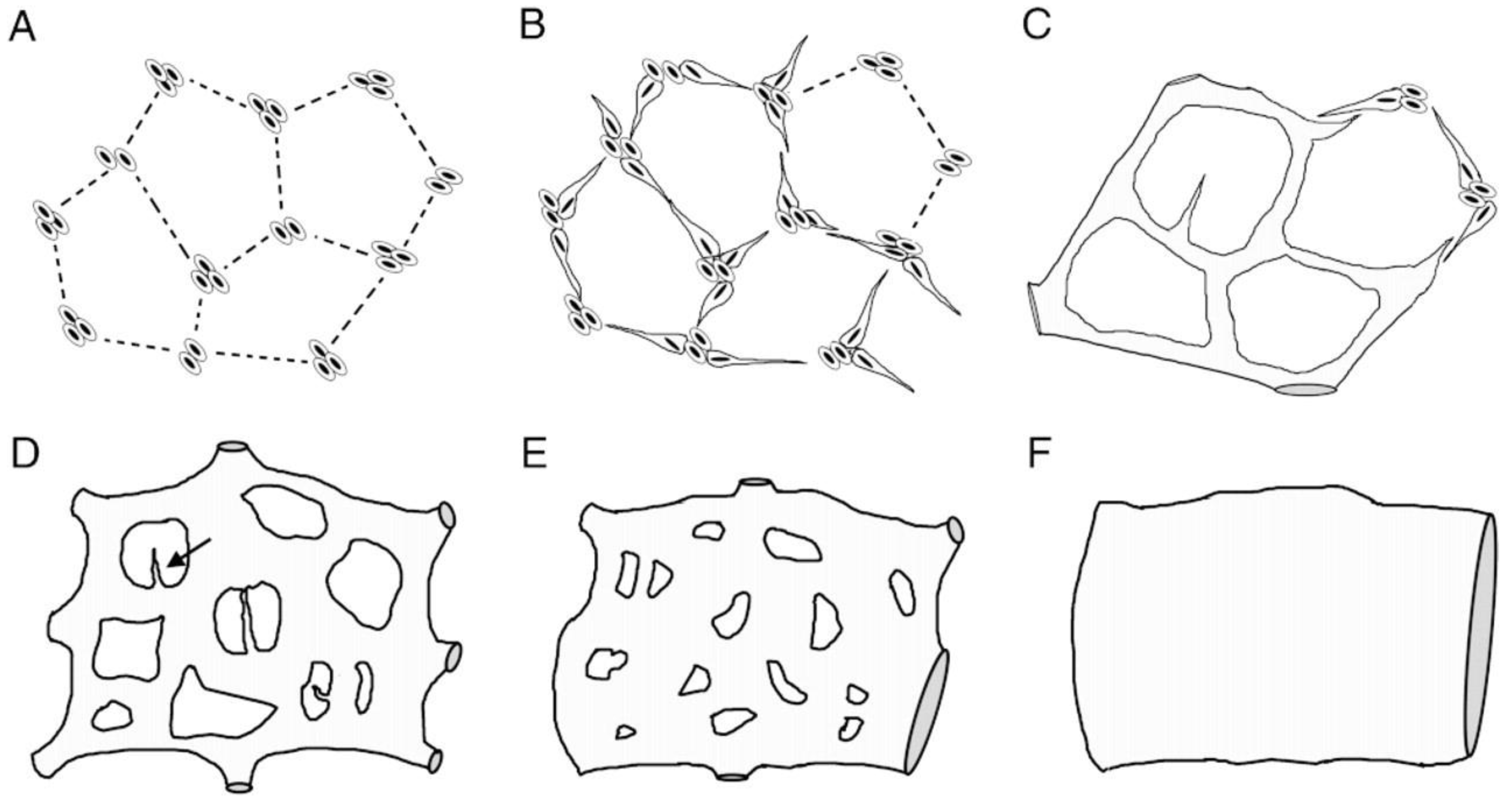
A) Endothelial cells move through the extracellular scaffolding, anchor, and form small clusters, regularly spaced. B) These clusters branch towards each other. C) The spindles become connecting tubes, allowing material flow through the network. D-E) the tubes widen and fuse, as an empty space (lumen) forms in the middle40. F) the end result is a cord, seen here oriented left-right, the birth of a new blood vessel. Quite evocative of Figure 3.
Blood vessels can widen or shrink to meet demand; this is often done by glial cells, whom we met in the last section, who widen vessels to allow more nutrients to active areas, and contract vessels in less-active areas (Drake and Little, 1999; Metea and Newman, 2006). This not only keeps the energy-balance of the body within a tight range, it also enhances the signal-to-noise ratio of activated regions by lowering activation elsewhere; signals stand-out against a quieted background of electrical activity (Metea and Newman, 2006).
Like fungal hyphae, blood vessels can fuse (also, unsurprisingly, called anastomosis) or split. Endothelial cells can undergo collective migration, proliferate and differentiate into different cell types, form communication channels between them, and form tubes and webs (Kulikauskas, X and Bautch, 2022).
So our pathways between nodes need to be adaptive, vary in capacity, and be capable of many modes of transportation. We ought to sometimes construct high-capacity passageways, directly between nodes, but often we just need thin threads, connecting individuals across the network. Our channels can merge, split, and change their bandwidth, often to help out other parts of the system. A decentralized network often has bidirectional flow - resources can move from explorative nodes to operational, or vice-versa. We can construct our channels to be ‘leaky’ allowing a variety of actors to hear the news, or direct, going to a specific location, person, or purpose.
5. Designing a Decentralized Network
We’ve already looked at some design principles that characterize decentralized networks. Now, let’s put them together into a speculative blueprint.
Our network starts as an idea, a seed, an imagination. It finds fertile soil, and starts to spread. It mobilizes other actors, starts to develop norms of practice and purpose. Our idea becomes a movement.
When small, it’s best for this movement to remain centralized, unified around a common framework or ideal, with a clear goal and resource base. Like a fairy-ring, an institution starts from a single ‘spore’ and spreads outward (Bayliss Elliott, 1926). A little hierarchy might be present, but seldom more than a layer or two, retaining a great deal of actor autonomy. Initial institutions find themselves in an uncertain environment, facing an uncertain market and weaving-together an uncertain network of collaborators (Moogk, 2012).
5.1. Baby Steps
Once the core is sufficiently established41 and the institution has secured a tenuous footing, it can start to lean into explorative dynamics. Resources can be diverted from core stability to R&D and outreach42. New ‘nodes’- chapters and cliques - can be established, often around open spaces such as library makerspaces, and solidarity with partners become subsumed under a single whole. In searching, new resources are noted, and the network starts to strengthen the conversion of these into structure and capital (hiring or recruiting members, leasing land, developing information lines). Information, talent, and material highways develop between nodes, enabling peer-to-peer supply chains that allow all nodes to benefit from success, and weather hard-times.
Once a number of new nodes are established, the connections between these and the core can be strengthened. The network must now make a choice: does it develop further hierarchy, using the newfound resource-base to expand the core upward, or does it start the journey towards decentralization? The former arrangement is commonly seen in theory and practice, so we will focus on the latter.
This is also where we might wish to bring in existing institutions who seek a change in network structure. Changing an organization’s structure is dangerous, risking collapse, but often necessary to meet changing socio-political or environmental conditions (Minkoff, 1999).
It helps for organizations to realize rigidity is not a necessary fate (Zald and Ash, 1966). Said in the language of ecological economics, organizations may or may not allow themselves to be constrained by path dependency. Let us imagine that an organization has built-in flexibility and a degree of foresight - maybe it already has decentralized technologies at its core, or relies on open spaces and manufacturing for some capabilities - it is feasible to make a gradual shift from centralized, hierarchical structures to decentralized, plural forms of governance (Dryzek and Pickering, 2018).
Multiple factors influence the decision to change organisational structure: available political or environmental opportunities, trade-offs43, resource stocks and flows, personnel and capital capabilities (Minkoff, 1999). Social organisations may consider the role of cycles, such as protest or business. The final decision may rest in a collective ‘intuition’, where the whole network, through informal sentiment or formal voting, decides that a switch is possible, and needed. This is where a shared ledger is particularly important - actors can all access the same information to make an informed decision.
So our network has decided to change, or at least continue on its process of decentralization. Its first step ought to be redistributive: gradually moving resources from a centralized core to peripheral processes or chapters. This shift in resources ought to correspond with enhanced autonomy of chapters. The core is not relinquishing control; instead, it is learning to share (Fricker, 2001).
5.2. A Decentralized Adolescent - Growing Fast!
Exploration expands. The resource flow throughout the network gains a bi-directional character - the core and established nodes draw on their resource base to help grow the network, and receive structural support and information in return. Trading occurs with network and outside partners, taking the form of tokens that can be easily linked with physical objects and shuttled digitally.
To facilitate this expansion, we might cap growing nodes at a certain level of development. Once nodes reach sufficient complexity, allowing autonomy and communication, with enough internal resilience to protect against stressors, resources ought to move from establishing structure to exploration.
Parts of the network specialize for explorative and exploitative modes: some teams perform outreach, others turn capital to R&D or services, others strengthen governance structures. With a distributed governance and localized community hubs, these specialities are autonomous and flexible, capable of shifting with changing political winds (Arafa and Armstrong, 2016).
This autonomy may necessitate going against the guiding principles of a network: including decentralization! Autonomy means that local partners can choose governance structures that suit local conditions, and so might explicitly disavowe top-down ordinances (Schädler, Lustenberger and Spychiger, 2023). This might create rifts with the dwindling core, or the network as a whole, but our institution may mediate this by developing a common identity and sense of meaning44 - like encouraging stewardship through partnership - for solidarity (Fricker, 2001). If the network can accommodate a plurality of governances, these rifts will enable tackling a broader array of problems with a diversity of thought (Aoun et al., 2024).
Our early decentralized network can promote some healthy node-on-node competition, alongside the already-existing cooperation. Competition can drive innovation through forcing efficiency or mobility of resources and talent, while the whole network monitors distributive justice to make sure all nodes do well (Muijs and Rumyantseva, 2014).
The growing network should periodically check-in with itself; self-care is important. The network can sense what regions are doing well or poorly through periodic check-ins or peer-to-peer communications, and devote resources accordingly. If a sudden stressor appears - a landmark political decision, a climate disaster, a downed electrical-grid - the network can temporarily halt exploration and move towards structural strengthening - bolstering nodes and the connections between them. To know where a stressor is, the system links a verified network actor to an associated location; this prohibits bad-actors from seeking to manufacture crises for political gain. Our network has foresight. It can read public sentiment, see an upcoming El Niño cycle, note an industry subsidy. Nodes that are assessed as vulnerable or advantageous - with political ties, in a choice location, or amidst affected actors - can be strengthened or relocated ahead-of-time.
When times are good, a network develops savings - currency reserves: liquid cash, ownership through non-fungible tokens, or embodied within technical structures and tools.
5.3. Limits in Adulthood
Of course, a physical system cannot continue growing indefinitely in a physical world, something economists would do well to remember (Robinson, 1973).
Our movement may struggle to find new resources; explorations come back dry or crowd with others. The network must start to slow its youthful expansion. The network begins to crystallize, pushing for legal and political dynamics that protect it as expansion once did.
Reserves are liquidated, tokens are exchanged, and some of the technical structure is converted to attempt further exploration. Nodes, too, go searching45 attempting to find any remaining resources. In this phase, connections between nodes take priority, whereby communicative and resource channels are maintained even as organizational structure or location varies.
If a searching node is unable to find new resources it may be reabsorbed within the network. Personnel can move to chapters that continue to do well, a small team may stay - if outposts remain energetically favorable - or exit to search for greener pastures. We can envision merging ownership, noting in our ledger that two tokens become part of a greater object.
If nodes across the network start encountering difficulties expanding, and exploration is not yielding new resources, the network may have to restructure for exit - to spread capital and talent wherever the winds may take them46. An organization that cares for its members will thus form optimal structures for dispersal.
5.4. Into the Great Beyond
Like slime molds organizing around fruiting bodies, an institution can restructure to help actors find their footing when they leave. The network halts exploration and starts to revert toward centralized structures. Linkages with partners are strengthened, and information reserves allow the network to identify feasible destinations for talent. Currency reserves continue to be liquidated, and the network’s computations and deliberations go towards organizing ‘propagules,’ concentrations of talent, energy, and technologies that may find fruitful ground elsewhere. These propagules ought to be capable of autonomous operation, containing everything a small team needs to start anew and quickly establish networks should they land in a fortuitous industry.
As the network shrinks and talent flies with the wind, a small, low-energy core may remain, with dwindling stocks, hoping for an influx of capital. A great deal of memory and experience rests in this core, and we might liken it to the captain of a ship, who does not embark until all others are accounted for. The propagules go with their own memory, and in human institutions can continue to coordinate with the core through weakened information networks. In extreme cases the core will dwindle to the ledger - a lasting memory consisting of past actions, partners, and goals - while all the talent leaves to attempt change elsewhere.
Our network’s identity goes with the wind to make change. Movements will rise from the ashes of lasting legacies; lessons learned will develop solutions to tomorrow’s crises.
6. More-Than-Human Institutions
In the last chapter we built decentralized networks. Now, let us direct them towards our goal of having them work for people and planet. I will outline these institutions as I described them in the first chapter, moving through imaginations, movements, and into legal structures.
6.1. Imaginations and the Self
We form worlds through interactions with other beings and things (Warkentin, 2009). As Claude Lévi-Strauss noted, animals are bonne à penser - good to think with (Hénaff, 2004). In a world where our computers run on biologically-inspired neural networks, I find that ecologies are the same; fruitful analogies for storytelling47.
Care is a central frame within feminist theory (de La Bellacasa, 2017). Beautifully described as “everything we do to maintain, continue, and repair our world,” care forms the foundation for our lives (Tronto, 2020). Care overlaps all levels of decentralized institutions: it is the web of ideas, activists, and stewards found in every field. It can be peer-to-peer or occur through a mediating context, like a hospital. It is an easy step to extend care to a more-than-human context, something ecofeminists have been practicing since time immemorial (de La Bellacasa, 2017).
Thinking through others extends the self outwards. Haraway’s writings on the cyborg, an amalgamation of technical and biotic, exemplifies: “why should our bodies end at the skin?” (Haraway, 1991). Our imaginations and selves broaden to encompass wider circles, integrating technology and other into one’s stories and body. Entanglement, co-opted from physics, likewise illustrates the inseparable ties that link organisms with others and their environment (Brandon, 2016; Bear, 2017; Hamilton, 2017; Barry, 2019). The microbiome is a key example: we contain more non-human cells than human, which contribute immensely towards gut and brain health (Schneider, 2021). Ecological networks blur the boundaries between selves.
Therianthropy, the belief that one’s identify is inexplicably tied to non-humans, is a resounding example of this blurring, a movement forming through solidarity within online - and occasionally in situ48 - communities (Robertson, 2013). Thereianothropes, or ‘therians’, often view their role as “in-between” human and natural communities to redress the balance between humanity and the rest of nature (Robertson, 2013). This, often-spiritual, identification-with non-human actors or communities may make therians good representatives for non-humans and ecosystems (Bricker, 2016).
Stewardship alongside care not-only promotes structure aligned with common interests, it is a powerful cognitive institution, providing individuals and communities a path towards greater meaning, something urgently needed in our world (Fricker, 2001). It’s nice to feel that one has a purpose.
6.2. Norm and Movements
So, with a bedrock of more-than-human imaginations and analogies, we form our movements. We’ve already seen a flowering of structures dedicated towards ecological stewardship, from underground guerilla gardening efforts (‘greening forgotten spaces’) to popular rain or wildlife gardens. It’s becoming quite trendy to care for one’s local environment. Citizen science and monitoring initiatives abound as online communities diversify in a love of nature49. Exchanges frequently occur without the need for a mediating party: an explosion of technologies, from Venmo to Blockchain, allow individuals to coordinate through fewer intermediaries.
Stream cleanups, community rewilding, composting, freecycling. Fences fall to join gardens into a park. Makerspaces and learning factories teach skills, as open innovation allows anyone with an internet connection to access a wold of knowledge. Communities self-organize, forming decentralized governance with solutions to common-resource dilemmas, including the infamous ‘tragedy of the commons’ (Ostrom, 2009). Norms of cruelty-free purchases evolve into organic farming, diets move from flexitarian to vegan. Movements arise caring for ecosystems with few connections to our own. A global outcry against mining deep sea ecosystems50 has activists hopeful that “momentum is on the side of a moratorium” (Greenpeace International, 2024).
Through decentralized norms, we see an explosion of community governance and wealth-building, where the community has direct ownership and control of their assets, allowing a proliferation of resilience, growth, and autonomy (McKinley and McInroy, 2023). These local structures are likewise more-capable of exploratory and “experimental governance,” less-constrained by the rigidity that characterizes ‘higher’ institutions (Dryzek and Pickering, 2018).
6.3. Legal and Technical
Now, into an uncertain future. More-than-human legalities emerge, deliberating on whether rights-based approaches are up-to-the task of incorporating a diversity of other. Stewardship appears as a useful framework, and the tricky bit arises with how to attach this to ownership. For my own part, I would wish to see stewardship as a necessary component; attaching a responsibility to land. This likewise opens up the door for redistribution: if an owner, such as a corporation, could be legally demonstrated to have a detrimental effect on the health and diversity of its land, the token to this land could be opened (or, in extreme cases, re-allocated) towards more-responsible stewards (who would themselves be subject to the same laws, and so on)51. To remove the influence of the mediator, we might collectively enact an ‘oracle’, an artificial sensing system that mediates conflicts and enacts regulations, and is based on the ledger shared across the network (Smith, no date).
Stewardship tied to land is reminiscent of the notion of connecting rights with obligations52, including an obligation to future generations (Peters, 2016; Weiss, 2017).
Our legal institutions will encounter a plurality of stressors, from the extreme weather foretold by climate change to the volatility of markets and politics. As such, they ought to display a diversity of context-specific legalities, working for future generations, the marginalized, Western and non-Western perspectives, queer legalities, transnational actors, and, of course, the more-than-human (Kotzé et al., 2022). They ought to bake-in flexibility - prioritizing the “process of change” to be capable of changing organizational structures - even moving between centralized and decentralized frameworks - as they see fit (Dryzek and Pickering, 2018).
A plurality of polycentric governance structures alongside peer-to-peer coordination brings trust back into political landscapes (Ostrom, 2009). And from these plurality of structures arise a plurality of metrics, allowing us a greater repertoire of what ‘health’ or ‘wealth’ looks like.
New methods of valuation may emerge. Treating more-than-human assemblages as actors with goals brings them a stall at the market, and representation, from citizens, therians, and technologies, helps make these markets work in their interest. If I have a voice, I can protest injustice.
Individuals shift to assemblages, where one’s identity is distributed to encompass land and other (Neely, 2021). Ownership can be shared, and perhaps my having-of-rights need-not be dependent on the authority that dictates me.
Where rights-based frameworks still exist, we might see a turn towards Earth jurisprudence or ‘wild law’, the enshrinement of the constitutional rights of nature through international environmental governance (Maloney and Burdon, 2014; Rühs and Jones, 2016). Rights may be conferred to a broader array of actors, and perhaps even extended through representation to actors such as the unborn and the nonhuman (Kotzé et al., 2022). These frameworks posit greater objectivity, unified around a common goal that allows for “solving”, rather than merely “shifting” problems (Kim and Bosselmann, 2013; Kirilov, 2019).
For legal systems that move beyond a focus of rights, the priority may instead move to responsibilities and obligations: if I am linked to land or property it is because I have a responsibility of caring for it. Instead of focusing on the rights of individuals, we might place the ultimate moral value on the “biotic community” or ecosystem - the interconnected relationships that construct land (Cavalieri, 2003; Braverman, 2018).
Of course, future legalities will likely blend rights-based and non-rights legalities. Like the spectrum between centralization and decentralization, different arrangements work for different tasks. Rights can protect the marginalized and set a stage for legal representation. Non-rights approaches might promote stewardship and care, more-capable of considering assemblages or the distributed actors that characterize our ecosystems.
7. Discussion and Conclusions
Institutions move from imaginations to movements to laws. Our stories determine future actions and an Anthropocene of ecological crises necessitates a garden of imaginations. We work to heal a more-than-human world through stories on pluralities, governance, and care.
Individuals connect selves to or oppose institutions. For long-term success, we must consider resources and structures, and note how these constrain or enable through power. Actors are faced with difficult questions when assessing whether to leave, or speak up. If they do, they might lose prestige, but fully devote to change.
The internet emerges onto a stage of movements. Technologies have never been so shared, so open. We must learn the mistakes of past traumas if we are to make these truly equitable.
Systems evolve, and are capable of far-greater flexibility than path dependency indicates. Characterized by remarkable resilience and foresight, decentralized institutions arise through a network of interactions, rather than top-down ordinances. The natural world is replete with fruitful analogies, of complicated flows and fusions, of specialization and synchonization. A plurality of actors, and a multiplicity of roles. We do not need central governance to form complex structures, we need only give our players autonomy to collaborate.
Institutions may fall, but this is no cause for despair. Lasting legacies form the soil from which new ideas may spring. Caring institutions sacrifice themselves for their members, rather than sacrificing members for themselves.
We move into a world of legalities, of policies that attempt rules. Rules that protect a commingled stage, foster a collaborative future. We consider rights, alongside responsibilities. Entanglements, alongside individuals. We utilize a plurality of strategies, specializing amidst consensus. The best of the past shapes changes for the future.
We work to build a better world.
And as we design the movements of tomorrow, our stories grow to action.
| 1 | For example, we might say language is an institution of communicative grammar |
| 2 | This is to avoid a tendency towards incorrigible categorization - putting things in neat boxes to understand them (see writings by Natalie Angier). This tendency can be useful for organization, but also necessarily limits the dynamism of the real-world. |
| 3 | The legal and political institutions of yesterday often provide the impetus for the imaginations of today. Actors may also create imaginations that break-free from prior institutional constraints. These actors are often those marginalized by existing institutions, but may run into difficulties mobilizing due to power imbalances (Clemens 1993). See the section on power and institutions. |
| 4 | This allows us to ask: how does nature live as-human? Power is central to this analysis, through the privilege of personhood and agency that being human affords. I propose a term: embodied representation. Adapted from cognitive science’s embodied cognition (‘thinking through a body’), embodied representation encapsulates the recognition that having a human body means having power, a power that allows one to uniquely create and shape spaces for non-human others. There is agency in non-humans, but this agency is frequently relegated to the spaces we allow. The first step towards devising more-equitable structures is identifying where the power lies, and presently the power lies with us. Many thanks to Marie Petersmann for helping clarify my thinking on these matters, see say (Petersmann 2021). |
| 5 | My collecting leaf-litter and discarded christmas trees around the neighborhood to build wildlife-friendly earthworks inspired conversations with neighbors, who donated rabbit bedding or time to chat. I’m waiting to see if terrace roof gardens catch on… |
| 6 | Like Darwinian evolution, norms change through reproduction and use. And like Darwinian evolution, this change may occur gradually or in sudden jumps (Sarkar 1999; Gould 2010). Variation occurs through random effects along (or against!) societal trendlines. Powerful, shocking, or eventful protest can trigger these sudden changes, reminiscent of the notion of critical/ tipping points within physics and ecosystems (della Porta 2018; Dakos et al. 2019). Like in ecology, prior to tipping, social norms might first undergo a rich diversity of dynamics before ‘settling’ into a particular arrangement (Rietkerk et al. 2021). |
| 7 | For the purposes of this dissertation I group legalities and policies as two forms of crystallized institutions, although these processes are often separated to provide checks-and-balances. |
| 8 | For example, fashion is a social norm that may or may-not receive legal recognition. Violation of fashion mores is often regulated by mob-justice, morality laws, or sumptuary laws on conspicuous consumption (Sumner 1907; Ahituv n.d.; Daston 2022). |
| 9 | Rights-based approaches are also centralized, or at least hierarchical. Rights are localized on a single individual at a particular time and space, and different rights subside, supersede, or even conflict with others (Kirilov 2019). Does a right to prosperity trump a right to a healthy environment? |
| 10 | The plural of ethos! |
| 11 | Although not an exhaustive list, and we can imagine different combinations occurring. For example, I might petition a representative to enact change to the system in which I am working, in which my identity or power may preclude speaking up. This represents a combination of exit (petitioning a superior, seperate power) and loyalty. |
| 12 | An illustration of voice is ecological economists critiquing the notion of ecosystem services; calls for change from within (Farley et al. 2024)
|
| 13 | If I exit, I also might be able to use my influence and existing connections to influence others still-within to join me. |
| 14 | Although you’ll likely not see much elite funding for radical social change, as elites rely on existing power structures that are threatened by radical movements (Corrigall-Brown 2016). |
| 15 | This centralizing tendency is not guaranteed, particularly if the organization is capable of maintaining independence from funding sources through identification with a movement’s cause or guiding principles (Corrigall-Brown 2016). |
| 16 | The US’s prohibition on alcohol in the 1920s and 1930s is a good example of this. Either you do not sell alcohol at all, or you develop underground speakeasies that engage with a clandestine market. If you’re going to be punished anyway, might as well go all the way. This also incentives greater potency of product, encourages associated criminal activity, and can even increase overall consumption (Thornton 1991). Similar cases have played out for other drugs, such as marijuana. |
| 17 | Although by no means exclusionary. The natural sciences are not exempt from care, as green and sustainable chemistry, mathematical ecology, and the flowering of analogies arriving from physics, including entanglement, show (Barad 2007). |
| 18 |
18. This is especially true for issues with broad support, but that may be missing mobilization. Radical protests force moderates to ‘choose-a-side’ via divisive actions, and so might split the public into a larger camp of supporters, and a smaller camp of opponents. A modern, divisive environmental movement, Just Stop Oil, appears to be counting on this strategy, and may have had some successes (Bell and Brigetti n.d.; JamesÖz and Glover 2022)
|
| 19 | For example, Thingiverse is one of many platforms for sharing digital designs, which can be accessed by anyone and sent to fabricators (3D printers, laser cutting, etc.) for mass- or home production. Users can also tweak existing designs to meet new specifications, rapidly expediting the production pathway. |
| 20 | The Makerspace director for my undergraduate would Zoom into our classes with the hum of 3D printers behind him: he was hard at work printing medical face shields. |
| 21 | Does your refrigerator really need a microphone and an internet connection? |
| 22 | Each block contains a link to the previous block - sticking them together, a timestamp, and a record of transaction. The transaction might be financial or legal; an action between parties, to strengthen the network, or to voice a concern. |
| 23 | For example, a picture of a particularly-ostentacious ape, a real tree, or the genetics of the Etruscan shrew. |
| 24 | Fascinatingly, while languages differ in spoken-rate, the actual information transferred per second is approximately the same (Coupé et al. 2019). Languages with faster rates mean that each sound or word contributes less to overall content (more filler), while languages with slower rates contain mich more information-per-utterance (such as chaining together object, place, and action into a single word) |
| 25 | Although many fungi, as well as plants, are unicellular. Many unicellular organisms form filamentous networks similar to slime molds, demonstrating specialization and complex structures. But multicellularity enables a broader array of actors and dynamics, so we’ll mostly look at it here. |
| 26 | The highways - information and material - of the fungal world. |
| 27 | They’re fun to search for in fields! Even if the mushrooms aren’t fruiting it’ll look like a dark ring-segment or full circle. |
| 28 | Both explorative and extractive modes are always occurring, but when a network is small it can priortize growing fast, identifying resources, establishing early outposts, and moving on. As a network runs into constraints it might start to fall-back on these resource outposts, spending more energy to extract every last bit of available resources. Private companies during the heyday or capitalism may have felt that the world was boundless, allowing them to prioritize expansion over comprehensively extracting value from existing populations. But the world grew bounds, and now capitalists may be unable to find new markets, so must work to squeeze value from already-established ones. |
| 29 | In addition to global pulsing, different regions of the mycelium turn off-and-on synchronization across sub-networks (Fricker et al. 2007). This allows for local specialization and coordination, reminiscint of what’s occurring in neural networks (see next section). |
| 30 | There are many (tasty!) exceptions to this rule. If you drill some holes in a bucket and fill it with straw and spawn (innoculated grains), you can grow choice oyster mushrooms in a closet! Similarly, underground communities of ‘psychonauts’ offer tips for growing psilocybe species using vacuum-dried rice packets. |
| 31 | Fungal hyhae are often much-smaller than plant roots, so they can spread over a wider area and obtain nutrients from hard-to-reach locations. This impressively expands the volume from which a plant can extract nutrients, so it is no surprise that plants often grow far-better when they have fungal partners (Abbott and Robson 2018). |
| 32 | Of course, if ecologies are fairy tales, they can certainly be Grimm. We see everything from mutualism to parasitism, to cutthroat trading that would put Wall Street to shame (Abbott and Robson 2018). Soil systems cleverly evaluate options, and will switch partners if it seems beneficial. But you trust a partner you’ve worked with, even if they short you once, and might even help them out if they fall on tough times: it’s a good investment for the future (Steidinger and Bever 2014). |
| 33 | And like the care economy, astrocytes have historically been neglected: they lack the ‘flashiness’ of neurons. Thankfully this is changing rapidly. I had the experience to go to the world’s largest neuroscience conference, where I noted that the vast majority of posters were looking at glial cells. I remarked to my advisor that perhaps we ought to change ‘neuroscience’ to ‘glioscience’! Now if only a similar shift could occur in economics… |
| 34 | Glial cells do release chemical messengers like neurotransmitters (glutamate, dopamine, adrenalin, etc.), aptly titled ‘gliotransmitters’ |
| 35 | Like fungal hyphae, these axons can vary in diameter, allowing for more-or-less information flow and requiring more-or-less energy use (Perge et al. 2012). |
| 36 | Neurons do a complicated calculation, often involving thousands of inputs from cells near and far. And, like our own bodies after a sudden, enjoyable release, need a bit of time before ‘firing’ again. |
| 37 | Neurons and glia - like astrocytes - couple together, but also cluster in different and overlapping networks. |
| 38 | Psychedelic therapy has received recent attention for it’s ability to promote the formation of new connections in the adult brain, offering relief from ailments such as depression, addiction, eating disorders, and crises of meaning (Hartogsohn 2018; Ly et al. 2018; Shao et al. 2021). Trauma and significant life-events, such as the birth of a child, likewise promote a burst of neural plasticity (Barba-Müller et al. 2019; Wieloch and Nikolich 2006). |
| 39 | It’s like spiders ‘listening’ through the vibrations in their webs, or perhaps elephants knowing the position of others by feeling tremors moving through the ground. Like spiders, these cells can also tune the stiffness of the surrounding web, allowing for different signals and signal speeds (Senger and Davis 2011). |
| 40 | The network can halt at an intermediate step. Stopping around steps D-E, forms a network of small tubes, such as for capillaries. Proceeding to F) is for large-caliber vessels. Vessels can also fully-seal, or stay-permeable, for continuous ‘leaking’ of nutrients into the extracellular space (Senger and Davis 2011). |
| 41 | This establishment might be realized by a variety of qualitative or quantitative indicators: what is the general feel of the organization? Are the day-to-day dynamics becoming more forward-looking? Have resource streams or partners stabilized somewhat? |
| 42 | In a world already-filled with institutions, this exploration is necessarily going to impinge on established spaces. Great care ought to be taken that decentralized networks go-alongside local cultures and perspective - not only is this better for long-term success, it helps avoid creating oppresive power structures - like colonialism, patriarchy, and imperialism (Howson 2020). In our rush to create climate action, we must not trample the local, and the little. |
| 43 | These tradeoffs could include new or lost partners: a shift from service to protest (or vice versa) may lose the support of governments or elites while obtaining public or moral support. |
| 44 | When we consider an independent node as separate from the network that ‘birthed’ it is a tricky problem, reminiscent of trying to break an ecosystem into individual species. |
| 45 | Of course, nodes and chapters are limited in mobility, which is why maintaining a small-size is critical. People, small tools, and money can relocate, but larger infrastructure, such as buildings and electrical grids must stay. Luckily, there are plenty of these ‘harder’ infrastructures to be found in other places, and the internet is incredible for facilitating mobility. |
| 46 |
46. Reflexivity is important in this regard, analogous to ‘reading the winds’ before one jumps into them (Dryzek and Pickering 2018)
|
| 47 |
47. We’ve seen an explosion of new stories that consider the more-than-human. From the interconnected Wood Wide Web to incredible findings from biosemiotics - communication and meaning-making in non-humans; there’s even been an emergence of a whole new subgenre of literature - cli-fi (Wohlleben 2016; Yong 2022)
|
| 48 | Out of respect for the therian community, who have historically faced discrimination for expressing identities they feel is central to themselves, I pull in the latin ‘on-site’ to convey a similar meaning to in-person, which has a distinctly-human connotation. |
| 49 | I just came across the subreddit r/WeevilTime on Reddit. Recognition leads to love, love leads to care. |
| 50 | Fascinating habitats, where a diversity of exotic life relies on slow-growing metallic-rich nodules. In addition to the novel biochemistries that are present, a recent paper in Nature showed that these nodules appear to be functioning as underwater batteries, producing huge amounts of ‘dark oxygen’ (Sweetman et al. 2024)! Oxygen production without photosynthesis! |
| 51 | Naturally, mechanisms would have to be in-place to prohibit power grabs, such as an actor utilizing the legal system to accuse others of poor stewardship to consolidate. |
| 52 | But might occur within a legal system that is less-based on rights. |
References
- Abouharb, M.R. and Cingranelli, D.L. (2006) “The Human Rights Effects of World Bank Structural Adjustment, 1981-2000,” International Studies Quarterly, 50(2), pp. 233–262. [CrossRef]
- Akbulut, B.; et al. (2020) Agropoetics Reader. Edited by E. Agudio, M. Boschen, and L. Sandoval.
- Alkhader, W.; et al. (2021) “Blockchain-Based Decentralized Digital Manufacturing and Supply for COVID-19 Medical Devices and Supplies.,” IEEE access : practical innovations, open solutions, 9, pp. 137923–137940. [CrossRef]
- Aoun, A.; et al. (2024) “Centralized vs. decentralized electric grid resilience analysis using leontief’s input–output model,” Energies, 17(6), p. 1321. [CrossRef]
- Arafa, M. and Armstrong, C. (2016) “‘Facebook to Mobilize, Twitter to Coordinate Protests, and YouTube to Tell the World’: New Media, Cyberactivism, and the Arab Spring ,” Journal of Global Initiatives: Policy, Pedagogy, Perspective, 10(1).
- Archer, D. (2016) The long thaw: how humans are changing the next 100,000 years of earth’s climate. Princeton: Princeton University Press. [CrossRef]
- Balasubramanian, V. (2021) “Brain power.,” Proceedings of the National Academy of Sciences of the United States of America, 118(32). [CrossRef]
- Barry, K. (2019) “More-than-human entanglements of walking on a pedestrian bridge,” Geoforum, 106, pp. 370–377. [CrossRef]
- Bayliss Elliott, J.S. (1926) “Concerning ‘fairy rings’ in pastures,” The Annals of applied biology, 13(2), pp. 277–288.
- Bear, C. (2017) “Assembling ocean life,” Dialogues in Human Geography, 7(1), pp. 27–31. [CrossRef]
- Beaty, R.E.; et al. (2016) “Creative cognition and brain network dynamics.,” Trends in Cognitive Sciences, 20(2), pp. 87–95. [CrossRef]
- Bebber, D.P.; et al. (2007) “Biological solutions to transport network design.,” Proceedings. Biological Sciences / the Royal Society, 274(1623), pp. 2307–2315. [CrossRef]
- Bell, O. and Brigetti, L. (no date) “Assessing the Effectiveness Protest Tactics in Light.
- Benford, R.D. and Snow, D.A. (2000) “Framing Processes and Social Movements: An Overview and Assessment,” Annual review of sociology, 26(1), pp. 611–639. [CrossRef]
- Biggart, N.W. (ed.) (2002) Readings in economic sociology. Oxford, UK: Blackwell Publishers Ltd. [CrossRef]
- Biglaiser, G. and McGauvran, R.J. (2022) “The effects of IMF loan conditions on poverty in the developing world.,” Journal of International Relations and Development, 25(3), pp. 806–833. [CrossRef]
- BioRender (2024) Scientific Image and Illustration Software. Available online: https://www.biorender.com/ (accessed on 22 July 2024).
- Blanchet, A. (2024) Lessons from Latin America on the impact of platform cooperativism and collective bargaining on algorithmic management, Equal Times. Available online: https://www.equaltimes.org/lessons-from-latin-america-on-the?lang=fr (accessed on 16 July 2024).
- Boddy, L. (1999) “Saprotrophic cord-forming fungi: meeting the challenge of heterogeneous environments,” Mycologia, 91(1), pp. 13–32. [CrossRef]
- Bonner, J.T. (1957) “A theory of the control of differentiation in the cellular slime molds,” The Quarterly Review of Biology, 32(3), pp. 232–246. [CrossRef]
- Bookchin, M. (2022) “The philosophy of social ecology: Essays on dialectical naturalism.
- Borri, N. , Liu, Y. and Tsyvinski, A. (2022) “The Economics of Non-Fungible Tokens,” SSRN Electronic Journal [Preprint]. [CrossRef]
- Bradley, S.J. (2011) “Regulation and Pharmacological Manipulation of the Type 5 Metabotropic Glutamate (mGlu5) Receptor,” University of Leicester [Preprint].
- Brandon, P. (2016) “Body and self: an entangled narrative,” Phenomenology and the Cognitive Sciences, 15(1), pp. 67–83. [CrossRef]
- Brand, A. and Gow, N.A.R. (2009) “Mechanisms of hypha orientation of fungi.,” Current Opinion in Microbiology, 12(4), pp. 350–357. [CrossRef]
- Braverman, I. (2018) “Law’s Underdog: A Call for More-than-Human Legalities,” Annual Review of Law and Social Science, 14(1), pp. 127–144. [CrossRef]
- Bricker, N. (2016) “Life Stories of Therianthropes: An Analysis of Nonhuman Identity in a Narrative Identity Model,” Life [Preprint].
- Brigham Young University (2024) GLIAL CELLS, Introduction to the Nervous System. Available online: https://content.byui.edu/file/a236934c-3c60-4fe9-90aa-d343b3e3a640/1/module6/readings/glial_cells.html (accessed on 23 July 2024).
- Brun, A. (2018) “Haiti: The Relationship Between Political Instability and Post-Disaster Response.
- Carino, Z. (2023) “Analysis of the New York Subway System using an Adaptive Network Model,” Journal of Student Research, 12(3). [CrossRef]
- Cavalieri, P. (2003) “The Animal Question: Why Nonhuman Animals Deserve Human Rights: Why Nonhuman Animals Deserve Human Rights.
- Chase, G. (2017) “The Early History of the Black Lives Matter Movement, and the Implications Thereof,” 18, p. 1091.
- Corrigall-Brown, C. (2016) “Funding for social movements,” Sociology compass, 10(4), pp. 330–339. [CrossRef]
- Cover, R.M. (1986) “Violence and the Word,” Yale Lj [Preprint].
- Cress, D.M. and Snow, D.A. (1996) “Mobilization at the margins: resources, benefactors, and the viability of homeless social movement organizations,” American Sociological Review, 61(6), p. 1089. [CrossRef]
- Darling, D. Darling, D. (2016) fairy ring. Available online: https://www.daviddarling.info/encyclopedia/F/fairy_ring.html (accessed on 15 July 2024).
- Davis, G.F. and Thompson, T.A. (1994) “A social movement perspective on corporate control,” Administrative science quarterly, 39(1), p. 141. [CrossRef]
- Diala, A.C. (2017) “The concept of living customary law: a critique,” The Journal of Legal Pluralism and Unofficial Law, 49(2), pp. 143–165. [CrossRef]
- Drake, C.J. and Little, C.D. (1999) “VEGF and vascular fusion: implications for normal and pathological vessels.,” The Journal of Histochemistry and Cytochemistry, 47(11), pp. 1351–1356. [CrossRef]
- Dryzek, J.S. and Pickering, J. (2018) The politics of the anthropocene. Oxford University Press. [CrossRef]
- Edelman, L.B. (1990) “Legal environments and organizational governance: the expansion of due process in the american workplace,” American Journal of Sociology, 95(6), pp. 1401–1440. [CrossRef]
- Esposito, J. (2015) “Islam and political violence,” Religions, 6(3), pp. 1067–1081. [CrossRef]
- Fontana, D. (2020) “Destructive Federal Decentralization,” 29, p. 619.
- Forster, T.; et al. (2019) “How structural adjustment programs affect inequality: A disaggregated analysis of IMF conditionality, 1980-2014.,” Social science research, 80, pp. 83–113. [CrossRef]
- Fricker, A. (2001) “The hunger for meaning,” Futures, 33(2), pp. 171–180. [CrossRef]
- Fukasawa, Y.; et al. (2024) “Electrical integrity and week-long oscillation in fungal mycelia.,” Scientific Reports, 14(1), p. 15601. [CrossRef]
- Gavrilov, N.; et al. (2018) “Astrocytic coverage of dendritic spines, dendritic shafts, and axonal boutons in hippocampal neuropil.,” Frontiers in Cellular Neuroscience, 12, p. 248. [CrossRef]
- Giugni, M.G. (1998) “Was it worth the effort? the outcomes and consequences of social movements,” Annual review of sociology, 24(1), pp. 371–393. [CrossRef]
- Goffman, E. (2020) “In the wake of COVID-19, is glocalization our sustainability future?,” Sustainability: Science, Practice, and Policy, 16(1), pp. 48–52.
- Gómez-Baggethun, E.; et al. (2010) “The history of ecosystem services in economic theory and practice: From early notions to markets and payment schemes,” Ecological Economics, 69(6), pp. 1209–1218. [CrossRef]
- Greenpeace International (2024) “Stop deep sea mining, not protests”, Greenpeace demands regulator. Available online: https://www.greenpeace.org/international/press-release/65866/stop-deep-sea-mining-not-protests-greenpeace-demands-regulator/ (accessed on 2 August 2024).
- Hall, M. (2011) “Beyond the human: extending ecological anarchism,” Environmental politics, 20(3), pp. 374–390. [CrossRef]
- Hamilton, S. (2017) “Securing ourselves from ourselves? The paradox of ‘entanglement’ in the Anthropocene,” Crime, law, and social change, pp. 1–17. [CrossRef]
- Han, J. , Lee, J. and Li, T. (2023) “DAO Governance,” SSRN Electronic Journal [Preprint]. [CrossRef]
- Haraway, D. (1991) “An ironic dream of a common language for women in the integrated circuit,” Philosophy of Technology. Blackwell Publishing Ltd [Preprint].
- Helfgot, J. (1974) “Professional reform organizations and the symbolic representation of the poor,” American Sociological Review, 39(4), p. 475. [CrossRef]
- Hénaff, M. (2004) “Claude Lévi-Strauss: une anthropologie «bonne à penser»,” Esprit (1940-) [Preprint].
- Henschke, A. (2020) “Privacy, the Internet of Things and State Surveillance: Handling Personal Information within an Inhuman System,” Moral Philosophy and Politics, 7(1), pp. 123–149. [CrossRef]
- Howson, P. (2020) “Climate Crises and Crypto-Colonialism: Conjuring Value on the Blockchain Frontiers of the Global South,” Frontiers in Blockchain, 3. [CrossRef]
- Ho, M. (2024) “Movement meaning of money: Monetary mobilization in Hong Kong’s prodemocracy movement,” The Sociological review, 72(2), pp. 432–450. [CrossRef]
- Huang, D. and Goetzmann, W. (2023) Selection-Neglect in the NFT Bubble. Cambridge, MA: National Bureau of Economic Research. [CrossRef]
- Illich, I. and Lang, A. (1973) “Tools for conviviality.
- Ino, E.; et al. (2021) “The Impact of COVID-19 on the Global Supply Chain: A Discussion on Decentralization of the Supply Chain and Ensuring Interoperability,” J. of Design Research, 16(1), pp. 56–60. [CrossRef]
- Kale, İ. and Altun, T.D. (2024) “The use of slime molds as a design guide in urban design, A case of Turkey/İzmir/Karabağlar,” Environment and Planning B: Urban Analytics and City Science [Preprint]. [CrossRef]
- Kapoor, R. (2019) “What Is Wrong with a Rights-based Approach to Morality?,” Journal of National Law University Delhi, 6(1), pp. 1–11. [CrossRef]
- Kashima, Y.; et al. (2013) “The acquisition of perceived descriptive norms as social category learning in social networks,” Social networks, 35(4), pp. 711–719. [CrossRef]
- Kenter, J.O. and O’Connor, S. (2022) “The Life Framework of Values and living as nature; towards a full recognition of holistic and relational ontologies,” Sustainability Science [Preprint]. [CrossRef]
- Kim, R.E. and Bosselmann, K. (2013) “International environmental law in the anthropocene: towards a purposive system of multilateral environmental agreements,” Theoretical Economics Letters, 2(2), pp. 285–309. [CrossRef]
- Kirilov, K. (2019) “A human rights-based approach to protecting the environment: status, critique and alternatives.
- Koehler, R.C. , Gebremedhin, D. and Harder, D.R. (2006) “Role of astrocytes in cerebrovascular regulation.,” Journal of Applied Physiology, 100(1), pp. 307–317. [CrossRef]
- Koh, K. , Abbas, J. and Willett, R. (2018) “Makerspaces in Libraries,” in Lee, V.R. and Phillips, A.L. (eds.) Reconceptualizing Libraries: Perspectives from the Information and Learning Sciences. New York, NY : Routledge, 2019.: Routledge, pp. 17–36. [CrossRef]
- Kolinjivadi, V. (2019) “Avoiding dualisms in ecological economics: Towards a dialectically-informed understanding of co-produced socionatures,” Ecological Economics, 163, pp. 32–41. [CrossRef]
- Kotzé, L.J. et al. (2022) “Earth system law: Exploring new frontiers in legal science,” Earth System Governance, 11, p. 100126. [CrossRef]
- Kriesi, H. (1996) “The organizational structure of new social movements in a political context,” in McAdam, D., McCarthy, J.D., and Zald, M.N. (eds.) Comparative perspectives on social movements: political opportunities, mobilizing structures, and cultural framings. Cambridge University Press, pp. 152–184. [CrossRef]
- Kulikauskas, M.R. , X, S. and Bautch, V.L. (2022) “The versatility and paradox of BMP signaling in endothelial cell behaviors and blood vessel function.,” Cellular and Molecular Life Sciences, 79(2), p. 77. [CrossRef]
- Kwok, J.S.H. and Gao, S. (2004) “Knowledge sharing community in P2P network: a study of motivational perspective,” Journal of Knowledge Management, 8(1), pp. 94–102. [CrossRef]
- de La Bellacasa, M.P. (2017) “Matters of care: Speculative ethics in more than human worlds.
- Leiter, A., Mazzi, A. and Smakhtin, V. (2023) Introducing DEEP: A Pathway to Flipping the Economics of Ecology, Soverign Nature Initiative. Available online: https://sovereignnature.com/features/deep-whitepaper (accessed on 29 July 2024).
- Leiter, A. (2023) “Life in Blocks: How Blockchain Technology Narrates the World,” Published [Preprint], (2023).
- López-Franco, R. , Bartnicki-Garcia, S. and Bracker, C.E. (1994) “Pulsed growth of fungal hyphal tips.,” Proceedings of the National Academy of Sciences of the United States of America, 91(25), pp. 12228–12232. [CrossRef]
- Lounsbury, M. (2001) “Institutional Sources of Practice Variation: Staffing College and University Recycling Programs,” Administrative science quarterly, 46(1), p. 29. [CrossRef]
- Mahand, T. and Caldwell, C. (2023) “Quiet quitting – causes and opportunities,” Business and Management Research, 12(1), p. 9. [CrossRef]
- Maheshwari, R. (2005) “Nuclear behavior in fungal hyphae.,” FEMS Microbiology Letters, 249(1), pp. 7–14. [CrossRef]
- Malloch, D.W. , Pirozynski, K.A. and Raven, P.H. (1980) “Ecological and evolutionary significance of mycorrhizal symbioses in vascular plants (A Review).,” Proceedings of the National Academy of Sciences of the United States of America, 77(4), pp. 2113–2118. [CrossRef]
- Maloney, M. and Burdon, P. (eds.) (2014) Wild law — in practice. Routledge. [CrossRef]
- Mayhall, L. (1995) “Creating the ‘suffragette spirit’: British feminism and the historical imagination 1,” Women’s history review, 4(3), pp. 319–344. [CrossRef]
- McKinley, S. and McInroy, N. (2023) Action guide for advancing Community Wealth Building in the United States, The Democracy Collaborative. Available online: https://democracycollaborative.org/publications/community-wealth-building-action-guide (accessed on 16 July 2024).
- Meadows, D.H. (2008) “Thinking in systems: A primer.
- Metea, M.R. and Newman, E.A. (2006) “Glial cells dilate and constrict blood vessels: a mechanism of neurovascular coupling.,” The Journal of Neuroscience, 26(11), pp. 2862–2870. [CrossRef]
- Michaeli, M. and Spiro, D. (2015) “Norm conformity across societies,” Journal of public economics, 132, pp. 51–65. [CrossRef]
- Ming, G. and Song, H. (2005) “Adult neurogenesis in the mammalian central nervous system.,” Annual Review of Neuroscience, 28, pp. 223–250. [CrossRef]
- Minkoff, D.C. (1999) “Bending with the Wind: Strategic Change and Adaptation by Women’s and Racial Minority Organizations,” American Journal of Sociology, 104(6), pp. 1666–1703. [CrossRef]
- Moogk, D.R. (2012) “Minimum viable product and the importance of experimentation in technology startups,” Technology Innovation Management Review [Preprint].
- Moore, K. and Hala, N. (2002) “10. Organizing identity: The creation of science for the people,” in Social structure and organizations revisited. Bingley: Emerald (MCB UP ) (Research in the sociology of organizations), pp. 309–335. [CrossRef]
- Muijs, D. and Rumyantseva, N. (2014) “Coopetition in education: Collaborating in a competitive environment,” Journal of Educational Change, 15(1), pp. 1–18. [CrossRef]
- Mukhopadhyay, S.C. and Suryadevara, N.K. (2014) “Internet of things: challenges and opportunities,” in Mukhopadhyay, Subhas Chandra (ed.) Internet of Things. Cham: Springer International Publishing (Smart sensors, measurement and instrumentation), pp. 1–17. [CrossRef]
- Munakata, Y. and Pfaffly, J. (2004) “Hebbian learning and development.,” Developmental Science, 7(2), pp. 141–148. [CrossRef]
- National Museum of African American History and Culture (no date) The Black Panther Party: Challenging Police and Promoting Social Change, Smithsonian. Available online: https://nmaahc.si.edu/explore/stories/black-panther-party-challenging-police-and-promoting-social-change (accessed on 3 August 2024).
- Neely, A.H. (2021) “Entangled agencies: Rethinking causality and health in political-ecology,” Environment and Planning E: Nature and Space, 4(3), pp. 966–984. [CrossRef]
- O’Donnel, G.A. and Schmitter, P.C. (1986) Transitions from Authoritarian Rule: Tentative conclusions about uncertain democracies. Johns Hopkins University Press.
- Ostrom, E. (2009) Understanding Institutional Diversity. Princeton University Press. [CrossRef]
- Parr, D. (2014) Cities in motion: how slime mould can redraw our rail and road maps, The Guardian. Available online: https://www.theguardian.com/cities/2014/feb/18/slime-mould-rail-road-transport-routes (accessed on 30 July 2024).
- Patalano, R. (2007) “Imagination and society. The affective side of institutions,” Constitutional Political Economy, 18(4), pp. 223–241. [CrossRef]
- Perreau-Saussine, A. and Murphy, J.B. (eds.) (2007) The nature of customary law: legal, historical and philosophical perspectives. Cambridge University Press. [CrossRef]
- Peters, A. (2016) Beyond human rights: the legal status of the individual in international law. Cambridge University Press. [CrossRef]
- Petrie, C. (2024) A Journey Into Rebel-Held Myanmar, NOEMA. Available online: https://www.noemamag.com/a-journey-into-rebel-held-myanmar/?utm_source=noematwitter&utm_medium=noemasocial (accessed on 24 July 2024).
- Phelps, J. , Webb, E.L. and Agrawal, A. (2010) “Land use. Does REDD+ threaten to recentralize forest governance?,” Science, 328(5976), pp. 312–313. [CrossRef]
- Pierre-Louis, F. (2011) “Earthquakes, nongovernmental organizations, and governance in haiti,” Journal of black studies, 42(2), pp. 186–202. [CrossRef]
- Piven, F.F. and Cloward, R. (1978) “Poor people’s movements: Why they succeed, how they fail.
- Robertson, V.L.D. (2013) “The Beast Within,” Nova Religio: The Journal of Alternative and Emergent Religions, 16(3), pp. 7–30. [CrossRef]
- Roberts, A. and Koskenniemi, M. (2017) Is international law international? Oxford University Press (Oxford Scholarship Online). [CrossRef]
- Robinson, W.C. (1973) “The Limits to Growth: A Report for the Club of Rome’s Project on the Predicament of Mankind.
- Rokkan, S. (1966) “9. electoral mobilization, party competition, and national integration,” in Political Parties and Political Development. (SPD-6). Princeton University Press, pp. 241–266. [CrossRef]
- Ruban-Ośmiałowska, B.; et al. (2006) “Replisome localization in vegetative and aerial hyphae of Streptomyces coelicolor.,” Journal of Bacteriology, 188(20), pp. 7311–7316. [CrossRef]
- Rühs, N. and Jones, A. (2016) “The Implementation of Earth Jurisprudence through Substantive Constitutional Rights of Nature,” Sustainability, 8(2), p. 174. [CrossRef]
- Schädler, L. , Lustenberger, M. and Spychiger, F. (2023) “Analyzing decision-making in blockchain governance,” Frontiers in Blockchain, 6. [CrossRef]
- Schneiberg, M. and Lounsbury, M. (2008) “Social Movements and Institutional Analysis,” in The SAGE Handbook of Organizational Institutionalism. 1 Oliver’s Yard, 55 City Road, London EC1Y 1SP United Kingdom : SAGE Publications Ltd, pp. 650–672. [CrossRef]
- Schneider, T. (2021) “The holobiont self: understanding immunity in context.,” History and philosophy of the life sciences, 43(3), p. 99. [CrossRef]
- Scott, W.R. (2008) “Approaching adulthood: the maturing of institutional theory,” Theory and society, 37(5), pp. 427–442. [CrossRef]
- Seidler, P. , Kolling, P. and Hampshire, M. (2017) “terra0–can an Augmented Forest Own and Utilize Itself?,” Artists Re: Thinking the … [Preprint].
- Selby, C. (2016) Trees share carbon: new discovery may be key to saving trees in a warming world, Mongabay. Available online: https://news.mongabay.com/2016/08/trees-share-carbon-new-discovery-may-be-key-to-saving-trees-in-a-warming-world/ (accessed on 3 August 2024).
- Senger, D.R. and Davis, G.E. (2011) “Angiogenesis.,” Cold Spring Harbor Perspectives in Biology, 3(8), p. a005090. [CrossRef]
- Sheikh, K. (2019) How the Brain Can Rewire Itself After Half of It Is Removed, The New York Times. Available online: https://www.nytimes.com/2019/11/19/health/brain-removal-hemispherectomies-scans.html (accessed on 30 July 2024).
- Shoji, J.-Y.; et al. (2015) “Vegetative hyphal fusion and subsequent nuclear behavior in Epichloë grass endophytes.,” Plos One, 10(4), p. e0121875. [CrossRef]
- Sidiropoulou, K. , Pissadaki, E.K. and Poirazi, P. (2006) “Inside the brain of a neuron.,” EMBO Reports, 7(9), pp. 886–892. [CrossRef]
- Slobin, D.I. (1991) “Aphasia in Turkish: speech production in Broca’s and Wernicke’s patients.,” Brain and Language, 41(2), pp. 149–164. [CrossRef]
- Smith, A.W. (no date) Ecological Institutions: Protocols to Grow Autonomous and Convivial Ecological Actors. Available online: https://mirror.xyz/austinwadesmith.eth/tv9z1XXrtqQxDIxE8FygZ_W39NpkQJkVfrtjCtdbzA8 (accessed on 29 July 2024).
- Spangenberg, J.H. and Settele, J. (2016) “Value pluralism and economic valuation – defendable if well done,” Ecosystem Services, 18, pp. 100–109. [CrossRef]
- Stark, R. (1996) “Why religious movements succeed or fail: A revised general model,” Journal of Contemporary Religion, 11(2), pp. 133–146. [CrossRef]
- Sugai-Guérios, M.H.; et al. (2019) “More random-walk than autotropism: A model-based study on how aerial hyphae of Rhizopus oligosporus grow in solid-state fermentation,” Biochemical engineering journal, 141, pp. 49–59. [CrossRef]
- Sumner, W.G. (1907) “Folkways: A study of mores, manners, customs and morals,” Yale University [Preprint].
- Superflux and Policy Lab UK (2023) The Ecological Intelligence Agency. Available at: https://superflux.in/index.php/work/the-ecological-intelligence-agency/# (Accessed: , 2024). 29 July.
- Tero, A. , Kobayashi, R. and Nakagaki, T. (2006) “Physarum solver: A biologically inspired method of road-network navigation,” Physica A: Statistical Mechanics and its Applications, 363(1), pp. 115–119. [CrossRef]
- Thompson, W. and Rayner, A.D.M. (1982) “Structure and development of mycelial cord systems of Phanerochaete laevis in soil,” Transactions of the British Mycological Society, 78(2), pp. 193–200. [CrossRef]
- Thomson, J.C. (1973) “Getting out and speaking out,” Foreign policy, (13), p. 49. [CrossRef]
- Tlalka, M.; et al. (2007) “Emergence of self-organised oscillatory domains in fungal mycelia.,” Fungal Genetics and Biology, 44(11), pp. 1085–1095. [CrossRef]
- Tronto, J.C. (2020) “An ethic of care,” in Moral boundaries: A political argument for an ethic of care. Routledge, pp. 125–155. [CrossRef]
- Vatn, A. (2015) “Environmental governance: institutions, policies and actions.
- Warkentin, T. (2009) “Whale agency: affordances and acts of resistance in captive environments,” in Animals and agency: an interdisciplinary exploration. BRILL, pp. 21–43. [CrossRef]
- Weiss, E.B. (2017) “Our rights and obligations to future generations for the environment,” in Vanderheiden, S. (ed.) Environmental Rights. Routledge, pp. 385–394. [CrossRef]
- Wieloch, T. and Nikolich, K. (2006) “Mechanisms of neural plasticity following brain injury.,” Current Opinion in Neurobiology, 16(3), pp. 258–264. [CrossRef]
- Willemen, L. et al. (2023) “Nature living in, from, with, and as people: exploring a mirrored use of the Life Framework of Values,” Current Opinion in Environmental Sustainability, 63, p. 101317. [CrossRef]
- Wingrove, C.R. and Hirschman, A.O. (1971) “Exit, voice, and loyalty: responses to decline in firms, organizations, and states,” Social Forces, 49(3), p. 502. [CrossRef]
- Wipf, D.; et al. (2019) “Trading on the arbuscular mycorrhiza market: from arbuscules to common mycorrhizal networks.,” The New Phytologist, 223(3), pp. 1127–1142. [CrossRef]
- Wohlleben, P. (2016) “The hidden life of trees: What they feel, how they communicate—Discoveries from a secret world.
- WWF (2022) Living Planet Report 2022. 9 July. Available online: https://livingplanet.panda.org/en-GB/ (accessed on 9 July 2024).
- Zald, M.N. and Ash, R. (1966) “Social movement organizations: growth, decay and change,” Social Forces, 44(3), pp. 327–341. [CrossRef]
- Zambri, M.P. , Williams, M.A. and Elliot, M.A. (2022) “How Streptomyces thrive: Advancing our understanding of classical development and uncovering new behaviors.,” Advances in Microbial Physiology, 80, pp. 203–236. [CrossRef]
- Zoomers, A. (no date) “Blockchain and cryptocurrencies in international development.
Disclaimer/Publisher’s Note: The statements, opinions and data contained in all publications are solely those of the individual author(s) and contributor(s) and not of MDPI and/or the editor(s). MDPI and/or the editor(s) disclaim responsibility for any injury to people or property resulting from any ideas, methods, instructions or products referred to in the content. |
© 2024 by the authors. Licensee MDPI, Basel, Switzerland. This article is an open access article distributed under the terms and conditions of the Creative Commons Attribution (CC BY) license (http://creativecommons.org/licenses/by/4.0/).
Copyright: This open access article is published under a Creative Commons CC BY 4.0 license, which permit the free download, distribution, and reuse, provided that the author and preprint are cited in any reuse.