
Submitted:
25 September 2024
Posted:
26 September 2024
You are already at the latest version
Abstract
The study provides a comprehensive and detailed analysis of the existing key policies and considerations in Taiwan's Other Effective Area-Based Conservation Measures (OECMs), with the objective of providing useful evidence-based insights for formulating new effective environmental-friendly policies and promoting the existing policies. The study adopts a mixed research methodology that entails the combination of qualitative and quantitative research methodological frameworks. The primary source of the quantitative data for the study is the World Database on Protected Areas (WDPA) which provides variable data on OECMs and a component of databases of the Protected Planet Initiative (PPI) which is the joint product of UNEP and IUCN, managed by UNEP-WCMC and the IUCN working with governments, communities and collaborating partners. The qualitative methodological framework for the research adopted a technical systematic review approach based on the three-step framework for systematic reviews that involved planning, conducting and reporting the review. The review was based on the Preferred Reporting Items for Systematic Reviews and Meta-Analyses (PRISMA) guidelines. The sources that were included in the review included scientific research materials that focused on the policies related to OECMs. Taiwan has a total of 92 individual areas that are designated as national protected areas (PAs) and OECMs and formally recognized by the World Database on Protected Areas (WDPA). Out of the 92 designated areas, only seven are managed by the Construction and Planning Agency while the remaining 85 areas are managed by the Forestry Bureau. In terms of designation, 37 areas are designated as major wildlife habitats, 21 areas are designated as nature reserves, 20 areas are designated as wildlife refuges, eight areas are designated as national parks and six areas are designated as forest reserves. The primary themes that were identified were associated with marine spatial planning, environmental impact assessment (EIA) and marine scientific research and included biodiversity, protected area consideration, geographically defined areas, coastal resources and marine ecosystems. Other Effective Area-Based Conservation Measures (OECMs) have not been widely implemented yet, but most countries, including Taiwan, are increasingly aligning their existing policies with the strategies outlined in the OECMs policies to achieve large area-based conservation targets and reduce biodiversity loss.
Keywords:
biodiversity
; protected areas
; marine spatial planning
; in-situ conservation
; marine environment
1. Introduction
The implementation of the concept of Other Effective Area-Based Conservation Measures (OECMs) is gradually taking pace with most countries adopting policies and considerations that promote the objectives of the latest blueprint in environmental protection and marine conservation. The concept of OECMs emerged as a global environmental protection policy in 2010 and was formally defined under the CBD Decision 14/8 as strategies and guidelines that define and outline the protective measures for geographically defined areas that are governed and managed with an objective of achieving positive and sustained long-term outcomes for the in-situ conservation of biodiversity as well as the related and applicable ecosystem functions and services that align with the existing cultural, spiritual, socio–economic, and other locally relevant values (Sharma et al., 2023). As probably the latest blueprints in environmental and marine conservation, OECMs have not been widely implemented yet but most countries are increasingly aligning their existing policies with the strategies outlined in the OECMs policies to achieve large area-based conservation targets and reduce biodiversity loss (Fitzsimons et al., 2024; Sharma et al., 2023). However, it is further important to note that OECMs designated geographical regions are not entirely similar to the protected areas (PAs) policies considering that OECMs requires that conservation does not necessarily have to be a primary objective while the PA polices outlines conservation as a primary objective. In essence, therefore, the OECMs policies cover and incorporate the existing PA strategies for formulation of an inclusive single blueprint that incorporates the existing policies with the newly formulated strategies for conservation of environmental and marine environment and biodiversity.
The status of implementation of the Other Effective Area-Based Conservation Measures (OECMs) in Asia is presently being considered as a template for the global adoption of the blueprint with nearly two-thirds of the countries in the region partially or fully legislating and implementing the related frameworks. According to a technical report on the status of OECMs in Asia, Sharma et al. (2023) highlight the presence of the notable Asian economies including Japan, China, Republic of Korea, Maldives and Taiwan in adoption of the OECMs policies within their environmental governance structures. While Taiwan has often been politically associated with China, the country is still formulating independent marine conservation and environmental policies considering its geographical positions, most of which are aligned with the existing global blueprints of which China is a significant contributor. Taiwan is an urban concentrated island with a population density of average 649 people/km2 that is actively legislating and adopting marine diversity and environmental conservation policies as a means of mitigating the emerging environmental dynamics attributed to the effects of the global climatic change that is directly affecting weather patterns within the regions. In Taiwan, the marine spatial planning (MSP) policies have been at the forefront of implementation of the Other Effective Area-Based Conservation Measures (OECMs) and Protected Areas (PAs) conservational guidelines for marine biodiversity conservation. According to Shih et al. (2023), Taiwan houses more than ten percent of the global marine species in its coastal waters, and the management of the OECMs designated areas requires multi-sectoral approaches that incorporates different policies to provide a practical framework for the protection and strengthening of the diversity of marine resources.
While the existing academic research has focused on addressing coastal environmental concerns, very few of them have investigated the implementation of the Other Effective Area-Based Conservation Measures (OECMs) within the Asian region which has created a research gap on the topic, especially in Taiwan which is increasingly becoming a policy benchmark for legislation and implementation of marine environment conservation. Research on the status of OECMs have provided an opportunity for recognition and support of areas of high biodiversity importance that do not fall within the current formal environmental and marine conservation policies as well as a reason for conservation of more types of areas under diverse governance and management systems. However, there is no present study that has extensively conducted a research review on key considerations and policies in Taiwan's Other Effective Area-Based Conservation Measures (OECMs), with the only existing studies on the topic focused on Australia and Colombia by Fitzsimons et al. (2024) and Arenas-Castro et al. (2024) respectively. In Asia, a technical report by Sharma et al. (2023) is a pioneer research that has provided insightful information on the implementation of OECMs across the region with a focus on major economies including China, Japan and the Republic of Korea. While Taiwan is increasingly becoming a significant actor in marine environment conservation within the region, there has never been a conclusive research study or a technical report on the status of the implementation of OECMs within its boundaries which has left a wide research gap in marine spatial planning (MSP) in the country. The present research study aims to provide a comprehensive and detailed analysis of the existing key policies and considerations in Taiwanese OECMs with the objective of providing useful evidence-based insights for the formulation of new effective, environmentally friendly policies and promotion of the existing policies.
2. Methodology
To achieve the intended objectives, the present research study adopts a mixed research methodology that entails the combination of the qualitative and quantitative research findings to provide a detailed comprehension of the policies and considerations for implementation of Other Effective Area-Based Conservation Measures (OECMs) in Taiwan. The mixed research methodology is designed to effectively collect information associated with the variables of interest and inform the development of effective recommendations for promoting marine environment conservation in Taiwan. Apart from the achievement of objectives, the research methodology is an important tool for removing any ambiguity, inconsistencies, and lack of comprehensiveness in the report. The primary objective of the quantitative research methodology in the research was to provide statistical information on the status of OECMs including the number of regional areas protected under its statutes, the geographical area of the country under marine conservational management policies, the marine area in square kilometers and the existing local statistical factors. On the other hand, the qualitative research methodology aims to provide a qualitative analytical perspective of the policies and considerations for implementation of the OECMs-related strategies that are currently being legislated or adopted by Taiwan to meet the set objectives by the global environmental blueprint. The present chapter of the report outlines the detailed qualitative and quantitative frameworks employed to achieve the study objectives including the source and collection of statistical and systematic review data, data synthesis and analysis, and reporting of study findings.
The qualitative methodological framework for the research adopted a technical systematic review approach based on the three-step framework by Kraus et al. (2020) that involved planning, conducting and reporting the review. Considering the topic of interest was a policy issue, the methodology focused on analysis of existing perspectives of policies associated with protected areas and Other Effective Area-Based Conservation Measures (OECMs). The qualitative policy analytical research methodology entailed a detailed analysis of existing policies related to the topic using both primary and secondary sources involving bibliographic databases containing journals, government documents, think-tank statistics patents, as well as the sources of cited references to provide detailed information on the topic of research. Further, to ensure the validity and reliability of the research, the researcher complemented the Kraus et al. (2020) framework with the Joanna Briggs Institute (2015) framework and O’Malley’s (2005) approach of summary and dissemination of research findings. The review was based on the Preferred Reporting Items for Systematic Reviews and Meta-Analyses (PRISMA) guidelines. The sources that were included in the review included scientific research materials that focused on the policies related to OECMs. The articles were identified using search terms and phrases that were related to the keywords of the review, and their selection was based on literature quality and reliability. The final step of the methodological framework was data extraction and reporting the findings.
The primary source of the quantitative data for the study is the World Database on Protected Areas (WDPA) which is the only existing global database that provides variable data on OECMs and a component of databases of the Protected Planet Initiative (PPI) which is the joint product of UNEP and IUCN, managed by UNEP-WCMC and the IUCN working with governments, communities and collaborating partners. The data used for the study can be directly accessed and/or downloaded from http://www.protectedplanet.net/ that effectively integrates timely information and data on OECMs based on monthly submissions from governments, non-governmental organizations, and associated environmental stakeholders. The data is directly sourced from OECM database which has been available on the PPI website from late-2019 and directly links to the sources of data and information on area-based conservation as outlined in Figure 1 below. Considering the novelty of the concept of OECMs, the data and records submitted to the WPDA and equally employed in the present research might not meet the IUCN or CBD definition of an OECM protected area and it cannot be guaranteed that data-providers consistently follow the set definition standard. Partly, the data limitations can be further attributed to the fact that different countries have different definitions of protected areas that might not completely align with the set IUCN or CBD definition. Therefore, the study does not necessarily assume that all the WDPA records and data meet the IUCN or CBD definition but assumes the accuracy of the data found within the databases. However, the research takes into consideration the wide range of similarities between protected areas (PAs) and the OECMs which further validates the study findings. The description of the data variables of the research are outlined in Table 1 below.
3. Findings
The mixed methodological framework produced both qualitative and quantitative findings. The qualitative methodology framework produced a total of 83 related scientific research papers that focused on policies and key considerations for Other Effective Area-Based Conservation Measures (OECMs) including policy papers, white papers, government documents and scientific academic literature associated with the topic. There were 25 duplicated papers while 35 papers had irrelevant titles and focused on other regions apart from Taiwan. Also, eight papers had abstracts that did not align with the research objectives and those that were considered to be editorials or commentaries, and only 25 papers were included for analysis. The qualitative findings were classified into primary themes that were further classified into sub-themes that focused on the topic. The primary themes that were identified included protected areas (PAs) and Other Effective Area-Based Conservation Measures (OECMs), and policies and key considerations for OECMs. It is important to note that there is a slight difference between protected areas (PAs) and Other Effective Area-Based Conservation Measures (OECMs) but the two themes share a lot of similarities and are, therefore, classified under a single theme. The sub-themes under the PAs and OECMs included biodiversity, protected area consideration, geographically defined areas, coastal resources and marine ecosystems. On the other hand, the sub-themes under policies and key considerations for the PAs and OECMs included marine spatial planning (MSP), marine environmental impact assessment (EIA) mechanisms, and marine scientific research policies. However, it is important to note that there is a wide range of other related sub-themes that are associated with PAs and OECMs policies that covers other related environmental aspects and activities. The identified themes and sub-themes are shown in Table 2.
The quantitative research methodology provided statistical information related to the Other Effective Area-Based Conservation Measures (OECMs) in Taiwan. According to the findings, Taiwan has a total of 92 individual areas that are designated as national protected areas (PAs) and OECMs and formally recognized by the World Database on Protected Areas (WDPA). Out of the 92 designated areas, only seven are managed by the Construction and Planning Agency while the remaining 85 areas are managed by the Forestry Bureau. In terms of designation, 37 areas are designated as major wildlife habitats, 21 areas are designated as nature reserves, 20 areas are designated as wildlife refuges, eight areas are designated as national parks and six areas are designated as forest reserves as shown in Table 3.
The total area in square kilometers that are formally recognized as OECM is 11524.59631 km2 with the largest area being the Dongsha National Park with a total area of 3600.316241 km2 and the smallest area being the Hokutolite Nature Reserve with a total area of 0.002036 km2. The total area under marine environment is 3690.302238 km2 with 60 areas being categorized as coastal, marine and terrestrial while 25 areas are categorized as predominantly or entirely terrestrial. Only seven areas are categorized as predominantly or entirely marine. National parks account for 99.9 percent of marine PAs and OECMs total area while the remaining designations account for the remaining negligible areas as shown in Table 4.
4. Discussion
The International Union for Conservation of Nature (IUCN) and the Convention on Biological Diversity (CBD) Strategic Plan 2011 - 2020 formulated a consensus definition of protected areas and the Other Effective Area-Based Conservation Measures (OECMs) to ensure uniformity of data that are submitted to the World Database on Protected Areas (WDPA) for achievement of set global environmental objectives. According to UNEP-WCMC (2019), the definition of OECM is based on the wording of Aichi Biodiversity Target 11 and is formally used in reference to any geographically defined area that is not a protected area but is governed and managed with an objective of achieving positive and sustained long-term outcomes for the in-situ conservation of biodiversity as well as the related and applicable ecosystem functions and services that align with the existing cultural, spiritual, socio–economic, and other locally relevant values. Further, there is an additional voluntary guidance for identification of OECMs which are compiled and managed by UNEP-WCMC, in collaboration with governments, non-governmental organisations and related stakeholders and incorporated into the OECM database. Taiwan has a total of 92 individual areas that are designated as national protected areas (PAs) and OECMs and formally recognized by the World Database on Protected Areas (WDPA). The country’s designated OECMs areas are predominantly managed by the Forestry Bureau and the Construction and Planning Agency, all under the national government and are classified as either major wildlife habitats, nature reserves, wildlife refuges, national parks or forest reserves. The OECMs regions are also categorized as either coastal, marine or terrestrial with a majority of them being marine environment. As a result, the OECMs key policies and considerations revolved around the country’s marine environment.
Taiwan's Other Effective Area-Based Conservation Measures (OECMs) key considerations and policies are centered on marine spatial planning (MSP), marine environmental impact assessment (EIA) mechanisms, and marine scientific research. As a strategy for implementation of the Other Effective Area-Based Conservation Measures (OECMs) and becoming an ocean country, Taiwan is actively adopting marine spatial planning (MSP) policies considering the country has one of the highest concentrations of marine biodiversity (Shih et al., 2020). Presently, marine ecosystem activities in Taiwan that fall within the protected areas and OECMs areas are tightly regulated by different laws and regulations that align with the MSP governance objectives and requires the approval of governance agencies and authorities (Lin et al., 2020). Under the existing marine spatial planning policies, sea use management is regulated by a permit system that is governed by different laws, acts and regulations as well as competent government agencies and authorities including ministries, local government and administrative bodies (Lee et al., 2014). A critical policy related with the adoption of the OECMs is the zoning policy that incorporates sea areas and offshore sea areas into regional planning zones with the sea jurisdictional areas being included into the Land Law which proclaims the baseline, territorial sea, contiguous zone, exclusive economic zone (EEZ), and continental shelves (Lee et al., 2014; Lin et al., 2020; Shih et al., 2020). Also, the Taiwanese MSP principles and policies are based on the selection of appropriate protection measures for reduction of risks related to environmental impacts associated with operation of offshore wind projects that directly affects the biological aspects of the OECMs and related marine ecosystems (Tsai et al., 2022). The findings highlight the significance of the MSP policies in implementation of OECMs in Taiwan.
The environmental impact assessments (EIA) mechanisms are a crucial consideration for formulation and implementation of OECMs in marine environments in Taiwan. The formulation of marine spatial planning (MSP) policies is based environment impact assessment frameworks that provide a better understanding of the increasing complexities associated with the spatial conflict claims between the different marine sectors engaging in economic activities and the environment directly affect the geographically defined OECMs areas in Taiwan (Hammar et al., 2020). The conservational policies for OECMs in Taiwan are focused on reducing the pressures of human activities on the marine ecosystem that can be quantified based on environmental impact assessment mechanisms that can express the degree and impact of an activity on the environment in form of intensity maps and the ecosystem components in terms of value maps (Halpern et al., 2019). On the same note, marine scientific research and environmental educational activities have played a crucial role in the adoption of environmental friendly policies that are important in understanding the significance of the role of personal behaviour in the creation and resolution of related issues and promotion of pro-environmental behavioral choices (Wu, 2021). The integration of marine research and related academia can involve a wide range of activities including environmental assessments, monitoring programs and formulation of environmental indicators that are directly used by government authorities and stakeholders to develop laws and regulations for protected areas (PAs) and OECMs (Shih et al., 2023). As an emerging blue economy, the protection of the OECMs designated areas requires an understanding of the marine and coastal issues through scientific research that improves awareness of the associated natural environmental processes and problems (Gan et al., 2022). Alongside marine spatial planning and environment assessment mechanisms, marine scientific research is a key consideration for establishing effective OECMs policies through the dimensions of environmental attitude, knowledge and behaviour.
5. Conclusions
Research on the status of OECMs have provided an opportunity for recognition and support of areas of high biodiversity importance that do not fall within the current formal environmental and marine conservation policies as well as a reason for conservation of more types of areas under diverse governance and management systems. In Taiwan, the marine spatial planning (MSP) policies have been at the forefront of implementation of the Other Effective Area-Based Conservation Measures (OECMs) and Protected Areas (PAs) conservational guidelines for marine biodiversity conservation. OECMs have not been widely implemented yet but most countries are increasingly aligning their existing policies with the strategies outlined in the OECMs policies to achieve large area-based conservation targets and reduce biodiversity loss. In Taiwan, marine ecosystem activities that fall within the protected areas and OECMs areas are tightly regulated by different laws and regulations that align with the MSP governance objectives and requires the approval of governance agencies and authorities. The conservational policies for OECMs in Taiwan are focused on reducing the pressures of human activities on the marine ecosystem and are reliant on marine spatial planning, environmental impact assessments and marine scientific research, all of which provide a better understanding of the increasing complexities associated with the spatial conflict claims between the different marine sectors engaging in economic activities and the environment directly affect the geographically defined OECMs areas.
References
- Alves-Pinto, H., Geldmann, J., Jonas, H., Maioli, V., Balmford, A., Ewa Latawiec, A.
- Crouzeilles, R., & Strassburg, B. (2021). Opportunities and challenges of other effective area-based conservation measures (Oecms) for biodiversity conservation. Perspectives in Ecology and Conservation, 19(2), 115–120. [CrossRef]
- Chen, H. S., & Kuo, H. Y. (2022). Green Energy and Water Resource Management: A Case Study of Fishery and Solar Power Symbiosis in Taiwan. Water, 14(8), 1299. [CrossRef]
- Chen, T. A. P., & Shih, Y. C. (2021). Blue economy based on local DNA in Taiwan: Marine regional revitalisation under the collaboration of the local and central government. Marine Policy, 132, 104668. [CrossRef]
- Cheng Liao, V.T. (2018) ‘The analysis of maintaining biodiversity, Integrated Coastal Zone Management and Environmental Impact Assessment for Marine Spatial Planning’, Journal of Marine Science: Research & Development, 08(05). [CrossRef]
- Chung, H. S. E., & Jao, J. C. (2022). Improving marine protected area governance: Concerns and possible solutions from Taiwan’s practice. Marine Policy, 140, 105078. [CrossRef]
- Fitzsimons, J. A., Partridge, T., & Keen, R. (2024). Other effective area-based conservation measures (Oecms) in australia: Key considerations for assessment and implementation. Conservation, 4(2), 176–200. [CrossRef]
- Gan, Y., Gao, J., Zhang, J., Wu, X., Zhang, T., & Shao, M. (2022). University Students’ Knowledge, Attitudes, and Behaviors Related to Marine Environment Pollution. International Journal of Environmental Research and Public Health, 19(24), 16671. [CrossRef]
- Declerck, M. et al. (2023) ‘Cumulative effects of offshore renewables: From pragmatic policies to Holistic Marine Spatial Planning Tools’, Environmental Impact Assessment Review, 101, p. 107153. [CrossRef]
- Hammar, L. et al. (2020) ‘Cumulative impact assessment for ecosystem-based Marine Spatial Planning’, Science of The Total Environment, 734, p. 139024. [CrossRef]
- Halpern, B.S. et al. (2019) ‘Recent pace of change in human impact on the world’s Ocean’, Scientific Reports, 9(1). [CrossRef]
- Huang, W. P. (2022). Impact of coastal development on coastal morphology of Taiwan: Case studies and proposed countermeasures. Journal of Sea Research, 186, 102234.
- Hung, L. Y., Wang, S. M., & Yeh, T. K. (2022). Collaboration between the government and environmental non-governmental organisations for marine debris policy development: The Taiwan experience. Marine Policy, 135, 104849.
- Hung, Y. P., Chang, Y., Truong, M. P. N., Yang, J. H., Hsu, T. Y., & Hsiao, S. C. (2021). Improving marine protected area with coordination platform: Mud shrimp conservation in Taiwan case study. Marine Policy, 131, 104607.
- Hsu, K., & Peng, L. P. (2023). Understanding vulnerability and sustainable livelihood factors from coastal residents in Taiwan. Marine Policy, 155, 105793. [CrossRef]
- Lee, M.-T. et al. (2014) ‘Towards Marine Spatial Planning in southern Taiwan’, Sustainability, 6(12), pp. 8466–8484. [CrossRef]
- Liang, C.-P. et al. (2022) ‘Comprehensive assessment of the impact of land use and hydrogeological properties on the groundwater quality in Taiwan using factor and cluster analyses’, Science of The Total Environment, 851, p. 158135. [CrossRef]
- Liao, V.T. (2023) ‘Marine Spatial Planning identifies solutions for offshore wind farms at fishery and environment in taiwan territorial waters’, Energy & Environment [Preprint]. [CrossRef]
- Lin, C. et al. (2020) ‘Ecological risk assessment of species impacted by fisheries in waters off Eastern Taiwan’, Fisheries Management and Ecology, 27(4), pp. 345–356. [CrossRef]
- Petza, D., Amorim, E., Ben Lamine, E., Colloca, F., Dominguez Crisóstomo, E., Fabbrizzi, E.
- Fraschetti, S., Galparsoro, I., Giakoumi, S., Kruse, M., Stelzenmüller, V., & Katsanevakis, S. (2024). Assessing the potential of Other Effective area-based Conservation Measures (Oecms) for contributing to conservation targets: A global scoping review protocol. Open Research Europe, 3, 118. [CrossRef]
- Shih, Y. C., Chen, W. C., Chen, T. A. P., & Chang, C. W. (2023). The development of ocean governance for marine environment protection: Current legal system in Taiwan. Frontiers in Marine Science, 10, 1106813.
- Shih, Y.-C. (2020). Taiwan’s progress towards becoming an ocean country. Marine Policy, 111, 103725. [CrossRef]
- Sharma, M., Pasha, M. K. S., Nightingale, M., & MacKinnon, K. (2023). Status of other effective area-based conservation measures (OECMs) in Asia. IUCN Asia Regional Office: Bangkok, Thailand.
- Tsai, H.-H. et al. (2022) ‘Review on the conflicts between Offshore Wind Power and Fishery Rights: Marine Spatial Planning in Taiwan’, Energies, 15(22), p. 8768. [CrossRef]
- UNEP-WCMC and IUCN (2024), Protected Planet: The World Database on Protected Areas (WDPA) and World Database on Other Effective Area-based Conservation Measures (WD-OECM) [Online], September 2024, Cambridge, UK: UNEP-WCMC and IUCN. Available at: www.protectedplanet.net.
- Wu, C. H. (2021). Research on the coastal marine environment and rural sustainable development strategy of island countries—taking the Penghu Islands as an example. Water, 13(10), 1434.
- Yang, J.-H., Chang, Y. and Hsiao, S.-C. (2024) Finding harmony in the sea: Resolving conflicts by Regional Marine Spatial Planning [Preprint]. [CrossRef]
Figure 1.
The World Database on Protected Areas (WDPA) data sources. (Source: Created by this Research).
Figure 1.
The World Database on Protected Areas (WDPA) data sources. (Source: Created by this Research).
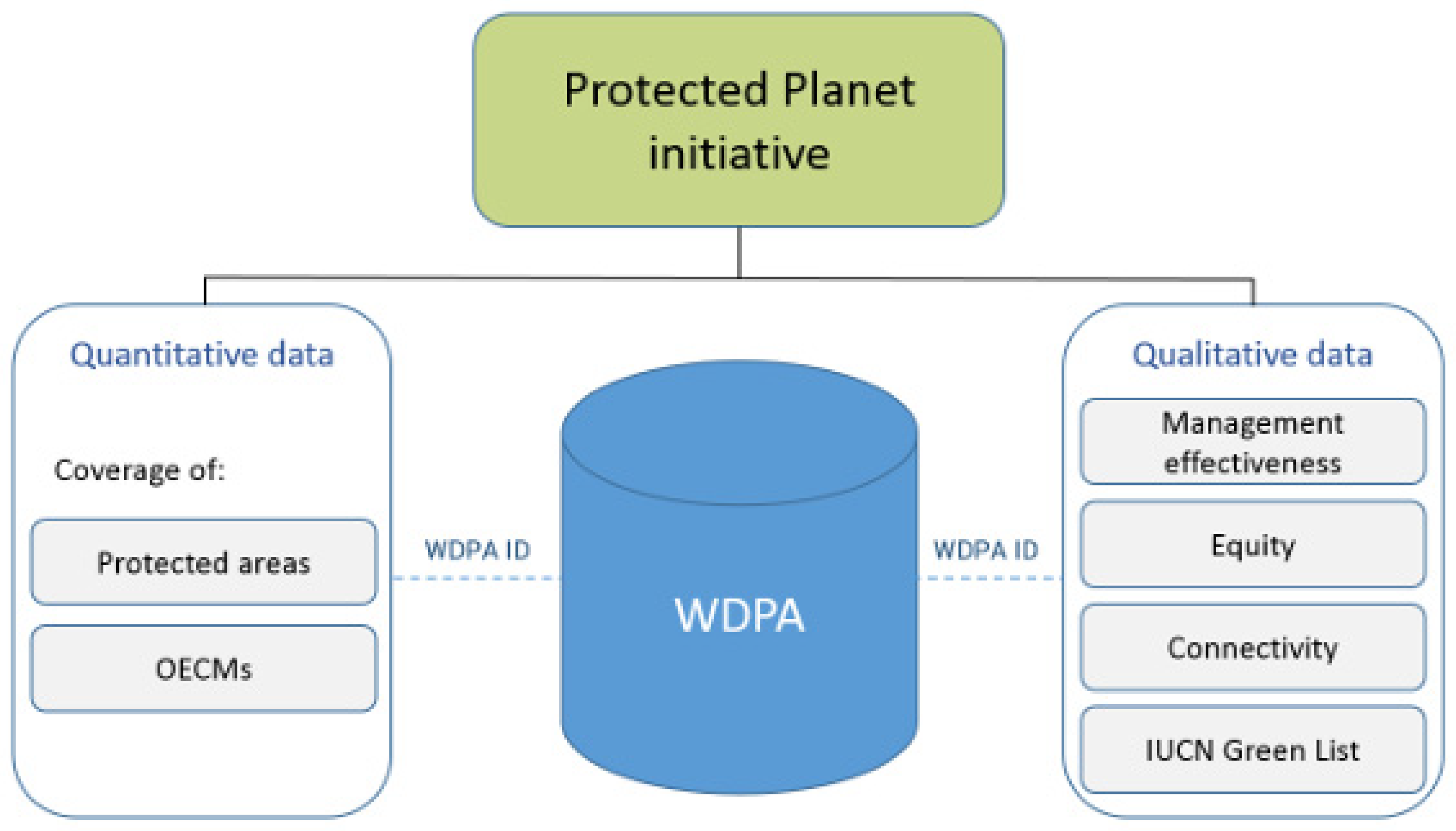

Table 1.
Description of Variables.
| Variable Field Name | Data Type | Data Provider | Length | WDPA Accepted Values | OECM Database Accepted Values |
| PA_DEF | Text (String) | National Government. | 20 | 1 (meets IUCN and CBD protected area definitions) | 0 (meets the CBD definition of an OECM) |
| NAME | Text (String) | National Government | 254 | Name of the protected area (PA) | Same as WDPA. |
| ORIG_NAME | Text (String) | National Government | 254 | Name of the protected area in original language. | Same as WDPA |
| DESIG TYPE | Text (String) | National Government | 254 | Name of designation. | Same as WDPA |
| DESIG_ENG | Text (String) | International, Regional and National data providers. | 254 | International, Regional and National designations. | Designations in English. |
| IUCN_CAT | Text (String) | International data providers. | 20 | Ia, Ib, II, III, IV, V, VI, Not Applicable, Not Assigned, Not Reported | N/A |
| MARINE | Text (String) | UNEP-WCMC | 20 | 0 (predominantly or entirely terrestrial), 1 (Coastal: marine and terrestrial), and 2 (predominantly or entirely marine). | Same as WPDA |
| REP_M__AREA | Number (Double | National Government | N/A | Marine area in square kilometers. | Same as WPDA. |
| GIS_M_AREA | Number (Double) | UNEP-WCMC | N/A | Assigned by UNEP-WCMC. | Same as WPDA. |
| MANG_AUTH | Text (String) | National Government | 254 | Agency that manages the protected area. | Same as WPDA |
(Source: Created by this Research).
Table 2.
Thematic classification of qualitative findings.
| Theme | Sub-Themes |
| Protected Areas (PAs) and Other Effective Area-Based Conservation Measures (OECMs) | Biodiversity, Protected area consideration, Geographically defined areas, Coastal resources and Marine ecosystems. |
| Policies and key considerations for the PAs and OECMs | Marine spatial planning (MSP), Marine environmental impact assessment (EIA) mechanisms, and Marine scientific research policies. |
(Source: Created by this Research).
Table 3.
Designation of PA and OECMs areas in Taiwan.
| Designation | Count of DESIG_ENG | Percent |
| Forest Reserve | 6 | 0.065217 |
| Major Wildlife Habitat | 37 | 0.402174 |
| National Park | 8 | 0.086957 |
| Nature Reserve | 21 | 0.228261 |
| Wildlife Refuge | 20 | 0.217391 |
| Grand Total | 92 | 1 |
(Source: Created by this Research).
Table 4.
PA and OECMs marine area in square kilometers in terms of area designation in Taiwan.
| Designation | Sum of REP_M_AREA | Percent |
| Forest Reserve | 0 | 0.0000% |
| Major Wildlife Habitat | 0.229306 | 0.0062% |
| National Park | 3687.0507 | 99.9119% |
| Nature Reserve | 1.93411 | 0.0524% |
| Wildlife Refuge | 1.088122 | 0.0295% |
| Grand Total | 3690.302238 | 100.0000% |
(Source: Created by this Research).
Disclaimer/Publisher’s Note: The statements, opinions and data contained in all publications are solely those of the individual author(s) and contributor(s) and not of MDPI and/or the editor(s). MDPI and/or the editor(s) disclaim responsibility for any injury to people or property resulting from any ideas, methods, instructions or products referred to in the content. |
© 2024 by the authors. Licensee MDPI, Basel, Switzerland. This article is an open access article distributed under the terms and conditions of the Creative Commons Attribution (CC BY) license (http://creativecommons.org/licenses/by/4.0/).
Copyright: This open access article is published under a Creative Commons CC BY 4.0 license, which permit the free download, distribution, and reuse, provided that the author and preprint are cited in any reuse.


