

Submitted:
25 September 2024
Posted:
26 September 2024
You are already at the latest version
Abstract
Physical inactivity is a leading risk factor for non-communicable diseases. Climate change is now regarded as the biggest threat to global public health. Electric micromobility (e-micromobility, including e-bikes e-cargo bikes and e-scooters) has the potential to simultaneously increase people’s overall physical activity while decreasing greenhouse gas emissions where it substitutes for motorised transport. The ELEVATE study aims to understand the impacts of e-micromobility, including identifying the people, places and circumstances where they will be most beneficial in terms of improving people’s health while also reducing mobility-related energy demand and carbon emissions. A complex mixed methods design collected detailed quantitative and qualitative data from multiple UK cities. First, a nationally representative (n=2000), city-wide (n = 1200) and targeted study area surveys have collected data on travel behaviour, levels of physical activity, vehicle ownership and use as well as attitudes towards e-micromobility. Then, to provide insights on an understudied type of e-micromobility, 49 households have been recruited to take part in e-cargo bike one-month trials. Self-reported data from participants are validated with objective data using methods such as GPS trackers and smartwatches recording of routes and activities. CO2 impacts of e-micromobility use are also calculated. Participant interviews provided detailed information on preferences, expectations, experiences, barriers and enablers of e-micromobility.
Keywords:
e-micromobility
; health
; decarbonisation
; physical activity
; active mobility
; study protocol
1. Background
E-micromobility (EMM), encompassing electrically-assisted and light-weight two-, three- or four-wheelers such as e-scooters, e-bikes and e-cargo bikes[1,2] is increasingly recognized in policy and academic debates as a potential catalyst for a shift away from private car usage, especially for short distances and in combination with public transport, as well as a way to improve both physical and mental health[3,4,5]. However, EMM’s benefits are also often debated, for example in terms of impact on environmental sustainability [6,7].
The evidence on the effects of EMM on physical activity (PA) and public health is complex. Health benefits depend on the type of EMM used as they require different levels of physical activity. The use of pedalec e-bikes1, for instance, has been shown to be a form of active mobility, which provides lower intensity PA than a conventional bicycle but people tend to travel further so that overall PA levels are similar[8,9,10]. E-scooters and skateboards require some pushing, walking and standing but their contribution to PA is lower than traditional forms of active travel. However, they may open up new possibilities for multi-modal trips which do include an active travel element, a second important (public) health aspect. A third aspect refers to mode shift. When car use is replaced by active mobility[12], this can bring benefits by providing a sufficient level of physical activity to improve health and well-being [13](Davies et al., 2019), which is increasingly being recognised by public health agendas across the world[14,15,16] . In terms of wellbeing and mental health, sufficient physical activity has shown to reduce symptoms of depression and anxiety, enhance mood, increase self-esteem, and improve overall cognitive function [17,18]. Climate change is now regarded as the biggest threat to global public health[19]. The picture around EMM and reducing mobility-related carbon emissions is also complex. Within current strategies aiming at achieving net-zero emissions in the transportation sector, EMM has great potential for carbon reduction in terms of its ability to reduce car use [20,21,22]. For the UK context, the Climate Change Committee has stated a need to reduce car use, seeing EMM as part of the solution [26]. However, where EMM replaces traditional active modes, carbon emissions can also slightly increase. Also, shared schemes can have carbon implications, e.g. around the short lifespan of vehicles and their re-distribution[27]. Environmental benefits of EMM go beyond reductions in carbon emissions to include lower occupation of public space [1,27]. Despite these complexities, overall, compared to car ownership and use (both electric and conventional), EMM has significant benefits [28]. While various trials and pilot programs have explored the potential of EMM in terms of health and reducing car use, few use multiple research methods. Furthermore, existing research [22] largely focuses on shared rather than private ownership usage models, and geographically on city centres,
The ELEVATE project (https://environment.leeds.ac.uk/transport-social-political-sciences/dir-record/research-projects/1690/elevate) is focussed on suburbs and peri-urban areas in medium sized cities, which are generally more car-dependent, than previously studied urban centres due partly to spatial accessibility, proximity to services and also the practices of car dependence[29]. The ELEVATE project focuses on three EMM modes: e-bikes, e-cargo bikes and e-scooters which see increasing uptake. E-bikes and e-cargo bikes have legal basis for use in the UK, while e-scooters are currently limited only to some specific trial areas.
For its more detailed work, the project has an emphasis on e-cargo bike use in a domestic ownership / long term lease context rather than as a share scheme context and uses trial loans to households. The research provides in-depth understandings of the state and potential of EMM in the UK to contribute to improved public health and decarbonisation.
The research hypothesis and objectives are as follows:
Main hypothesis: EMM has potential to play a key role in improving physical and mental health while reducing mobility-related energy demand and carbon emissions.
Project research objectives are to:
Objective 1. Assess current and possible future uptake of EMM. This includes assessing the use, ownership, and attitudes towards e-bikes, e-cargo bikes and e-scooters, but also identifying the current landscape of policy and governance concerning EMM in the UK.
Objective 2. Understand barriers and enablers of EMM uptake and more specifically the uptake of e-cargobikes in a suburban domestic use setting. This includes developing a better understanding of: skills required, use purposes, range anxiety, cost, safety, storage and perceptions, general ease of use, routine integration into daily life, social norms and views of significant others.
Objective 3. Understand the impact of EMM (particularly e-cargo bikes) ownership and use on physical and mental health as well as well-being.
Objective 4. Establish the impact of EMM (particularly e-cargo bikes) ownership and use on energy consumption and lifecycle carbon emissions.
Objective 5. Provide insights into EMM implications for industry, policy, and end users.
2. Methods/Design
To address the objectives of the ELEVATE project, a complex mixed-methods research approach has been employed. This involves quantitative and qualitative data collection and analysis conducted at different levels. In this section we provide an overview of the approach and then provide some additional detail about individual components.
First, stakeholder interviews were conducted to assess the current policy and governance landscape concerning EMM within the UK. This step was critical for identifying the roles and perspectives of key actors within the industry. This along with analysis of the literature informed design of the other data collection activities.
Second, quantitative methods, specifically structured surveys, were utilized to gather data on the existing ownership, usage patterns, and demand for EMM. This approach provided a broad scale understanding of current engagement with these transport modes.
We then, adopted a mixed-methods approach to explore the potential uptake of e-cargo bikes for suburban domestic use (not as part of a share scheme) through surveys and a trial intervention. Recognizing that early adoption is likely skewed towards suburban geo-demographic segments, and that these groups live in more car dependent areas and have car dependent practices, this nuanced approach enabled an investigation into how e-cargo bikes could facilitate a modal shift towards reduced car use and carbon emissions and increased overall PA. This approach analyses not only individual behaviours but also the geographic, social, structural, and governance contexts that influence adoption patterns. The field trials conducted in Brighton, Leeds, and Oxford integrated various data collection methods—including GPS tracking, physical activity monitoring, semi-structured interviews, travel diaries and user surveys. This comprehensive data collection facilitated an in-depth analysis of the end-user perspective on using e-cargo bikes.
The ELEVATE study design builds on protocols of similar studies in the field of micromobility, active travel and associated health impacts[30,31,32] as well as empirical studies on e-bikes[34]. The study design involves the following key components (see Figure 2). The study protocol has been approved by the University of Leeds’s Institutional Ethics Committee (Reference FREC 2023-0477-1198).
2.1. Stakeholder Interviews
Aim: to obtain qualitative data and insights into the opportunities, barriers and issues associated with EMM amongst policy stakeholders, transport planning practitioners, and those involved in the EMM industry.
Data Collection: online and face-to-face semi-structured interviews with approximately 20 stakeholder organisations. These included city, county, and parish councillors, sustainable mobility and active travel officers and planners, local and regional micromobility providers, bike shops managers, cycling instructors, and members of cycling and active travel charities, clubs, and NGOs. Interviews were tailored to each organisation.
We also had meetings and attended events, and conferences organised for industry bodies and policy makers.
2.2. Nationally Representative Survey (NRS) and City Representative Surveys
Aim: To assess current awareness, ownership, and use of, attitudes towards, and potential adoption of EMM (RQ2), and the physical activity of respondents on a national scale (RQ3).
Data Collection: A nationally representative sample of 2000 English adults was obtained, with representation based on age, gender, region, ethnicity and social grade. The survey was administered by the online panel company Yougov. Data collection took place between 31st May and 18th July 2023. The survey has focused on socio-demographic characteristics, existing travel behaviour and vehicle ownership, and perceptions and attitudes that may influence EMM awareness and adoption. Physical activity behaviour was measured by (1) a PA single item[35] and (2) the Global Physical Activity Questionnaire (GPAQ) with walking, cycling and e-biking separated[36]. This survey was also run in three distinct UK cities (Brighton, Leeds and Oxford) for which a representative sample was collected (n= 400 each).
2.3. Intervention: Household E-Cargo Bike Trials
2.3.1. Study areas Selection
Suburbs of provincial cities are more car-dependent than metropolitan urban centres. Therefore, three different suburb types were chosen in cities where the research teams are located (Leeds, Brighton and Oxford). Key selection criteria were that they contained some LSOAs2 with high levels of car ownership (based on census data, as a proxy for car dependence) and property types with storage such as garages (based on census data combined with visual inspection of Google satellite and Streetview images). For practical reasons, study areas had to be easily accessible to members of the research team. We also discussed study area selection with local stakeholders. Beyond this we sought variety in terms of physical capability to substitute car use with e-cargo bike use [24], , total household energy use [37], levels of deprivation and accessibility to jobs, services and activities.
2.3.2. Study Area Survey (SAS)
Aims: To carry out a baseline survey of the study area that is comparable to the national survey and reach potential trial participants.
Data Collection: Our survey was an abridged version of the NRS, designed to assess neighbourhood-specific variations in EMM perceptions and potential barriers to adoption. Additionally, this survey asked if respondents wished to take part in an e-cargo bike trial, as part of the trials’ recruitment. Data collection took place between 24th April and 30th September 2023 (n= 996). A follow-up survey will be run after one year to record any changes.
Recruitment: The promotion strategy was initially to use Meta (then and henceforth, Facebook) to advertise the SAS survey. We created Business pages for each of the three locales to create targeted adverts and to be able to join local Facebook groups and advertise our survey within them. Additional promotion was via contacting schools, placement of flyers on community noticeboards and contacting local stakeholders. We also anticipated some potential for snowballing – where a participant would encourage others to take part.
2.3.3. Household Trial Recruitment and Implementation
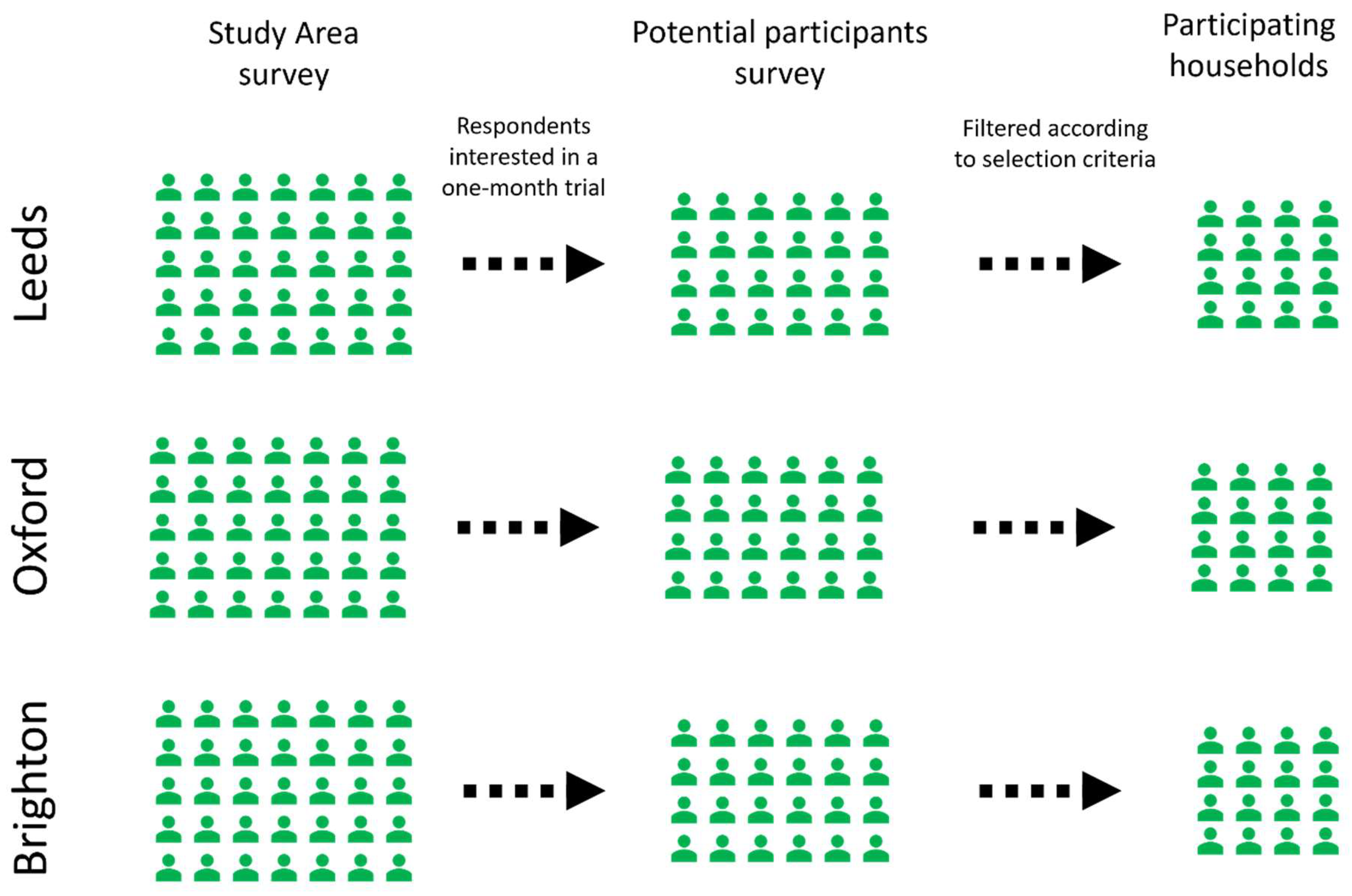
Participants were recruited from the baseline survey of the study areas (3.3.2), using a follow up survey then a consent discussion. This process is summarised in Figure 1.
- Potential Participants Survey (PPS)
Aim: To recruit participants for e-cargo bike trial loans in the study areas.
Recruitment: Potential trial participants were initially identified from the SAS. They were sent this Potential Participant Survey (PPS) within a week of filling in the SAS with no obligation to become a trial participant.
Data Collection: PPS respondents were asked for details regarding storage, availability to take part and further information about their intended use of the e-cargobike.
- Participant Selection and Consent
Participants were shortlisted followed the PPS survey. (see Figure 1). The selection criteria are as follows:
- Availability of both a bike and the participant for a specific month/cohort: the focus was to give bikes to households which would not abandon the bike during summer holidays due to travelling or other commitments;
- Availability of a safe and secure storage place: either inside the house or in a locked shed or garage;
- Expressed intended use for the bike: households who expressed an intention to use the bike frequently and for multiple purposes were preferred;
- Expressed intention to reduce and/or replace car journeys;
- Availability of preferred e-cargo bike type in Leeds. Oxford and Brighton offered only one type of bike; and
- Attempted diversity of the sample: the aim was to recruit households of different structures and socio-economic characteristics.
Then, project information and consent forms were shared with participants prior to a discussion with a researcher and participants given time to decide on participation.
- E-Cargo Bike Loan
Participants were loaned the e-cargo bikes for one month for their household use, for free. The trials comprised four 1-month-cohorts between June and mid-October 2023. Summer months are associated with higher levels of cycling due to more cycle-friendly weather [38]. The selected trial months covered both regular traffic months and the summer holiday period. Each city had 4 e-cargobikes available for loan. Leeds secured free loan of a fifth e-cargo bike for a short period.
Participants were encouraged to use the bikes as they needed or desired, and the researchers did not impose specific usage targets in terms of cycling distance, frequency, timing, or purpose. However, participants were expected to report on reasons or barriers that deterred them from using them plus arising technical issues or incidents.
The intervention was not simply the provision of a bike but contained several hard and soft measures. Participants were 1) supported in their use, including being given training 2) provided with locks, 3) given helmets if they required them, 4) given accessories such as child seats and rain-covers to meet their needs. Some residents needed a ramp to enable storage up steps. Support included weekly contact where researchers discussed emerging issues and potential solutions – i.e., extra training or equipment – as early as possible. During the last two weeks, participants were invited to participate in a voluntary challenge; living as a car-free household and adjusting their travel behaviour and/or transport mode choice and decisions accordingly.
Researchers arranged for a bike hand-over session with each household to introduce the bike: its operation modes, techniques, components, and accessories. General cycling tips and knowledge were communicated, and participants’ queries were answered.
Each household had one mandatory training session, a condition of the project’s insurance and risk assessment. Follow up sessions were also offered on a voluntary basis. Training was delivered by a city-based qualified National Standard cycling instructor. This was to boost households’ familiarity with the bike and its operation as early as possible and to encourage them to use the bike through addressing any pre-existing use fears and worries.
2.3.4. Household Trial Data Collection
In total, the data collection ran in four cohorts with 4 e-cargobikes available in each of the three cities. During their trials, the following data were collected (see Figure 2):
Figure 2.
trial timeline and collected data .
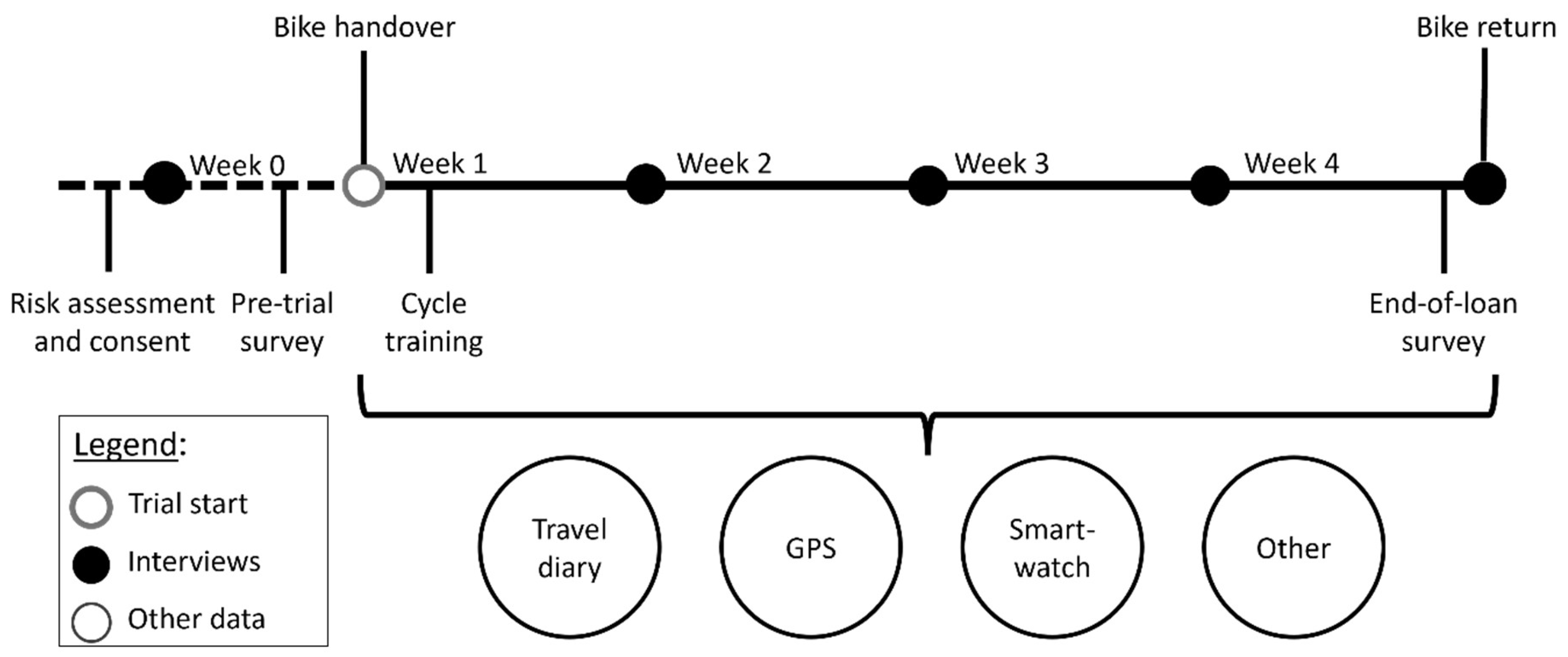
- Pre-Loan and End-Of-Loan Surveys
Aim: To evaluate the impact of EMM on trial participants' attitudes towards e-cargo bikes but also to assess changes in physical activity.
Data Collection: each participating household was asked to complete a pre-trial survey one week before the trial and an end-of-loan survey during the last week of the trial. For PA, GPAQ was administered for each wave.
- Semi-Structured Participant Interviews
Aim: To obtain in-depth insights into participants’ experiences, expectations, hopes, concerns, and perceptions about e-cargo bike adoption and use, physical and mental health to develop an understanding of the enablers and barriers to use. It also brought weekly contact with participants to support them.
Data Collection: The interviews were conducted and recorded, as appropriate, face-to-face (with voice recordings) or online (recorded via Teams or Zoom). The interview schedule was to conduct an interview with each participant a week before the trial, and at the end of each week during the trial.
A. The pre-trial interviews established data to augment the PPS data, gathered details on existing travel habits and further explored motivations to participate. Baseline data was collected to allow comparison of expected versus actual usage and pre and post-trial expectations. It also confirmed participations, after a pre-trial consent discussion took place.
B. Weekly interviews discussed e-cargo bike use. Crucially, non-use was also discussed; addressing the reasons and influences underlying this; vital data on subjective and objective barriers to use. Participants were also asked to describe some of the non-cargo bike journeys they made. It also contributes to building a picture of the practices involved in 'e-cargo bike citizenship', and to look at the physical and mental health impacts that these practices entrained.
C. End-of-loan interviews delved into how – if at all – the bike changed participants’ and/or their households’ travel habits, mode choice, and whether it was incorporated in their day-to-day travel decision making. Further, the bike’s impact on physical activity patterns and mental wellbeing was examined. Logistical problems with operating the bike covering storage, security, parking around town, ease of use, cycling infrastructure, and the cities’ readiness to accommodate e-cargo bikes – and what the participants felt would improve this, were also discussed. Finally, the final weekly interview explored participants’ willingness to use/buy an e-cargo bike in the future and whether they could see it replacing/reducing their car use.
- Travel Diaries
Aim: to collect data on the use of the e-cargo bikes in the trials, and to record car use before during and after trial participation.
Data Collection: Paper travel diaries were used to record e-cargo bike usage. Data fields include: journey dates, times, duration, number of passengers, weather, purpose, level of need and whether the journey substituted another mode of travel and reasons for doing so. Odometer (mileage) readings were taken for all participant cars before during and after the trial to record any change in vehicle usage. Diaries were collected and digitised.
- Smart Fitness Watches
Aim: To collect objective data indicators of the exercise intensity (indirect measures using heart rate) observed when participants used e-cargobikes.
Data Collection: trial participants were equipped (voluntary) with a smart mobile phone and a smartwatch – FitBit Sense – to monitor their physical activity[39,40]. These devices captured heart rate and other data such as location and route data. Those who already had a smartwatch were invited to download and share their exercise data.
- GPS Tracking
Aim: to capture objective data on the use of the e-cargo bikes in the trials, relating to journey origins and destinations, routes, distances, durations, and each bike’s live location. The trackers aided managing the fleet and boosted its security. They also helped in matching/triangulating the recorded journeys with those documented on the paper travel diaries.
Data Collection: e-bike GPS tracking units – BikeTrax by PowUnity – were installed and activated on the bikes before the trials. The trackers automatically recorded almost all participants’ trips without the need for intervention or action from participants.
- Other
Aim: to gather other forms of evidence about participant experience during the e-cargo bike trials, and to gain reflections from the wider community about EMM use.
Data collection: participants, on voluntary basis sent photos, videos and reflections via emails and WhatsApp. Researchers also recorded their own observations.
3. Discussion
The ELEVATE project addresses a crucial gap in the literature by focusing on the potential of e-micromobility (EMM) to enhance public health and reduce carbon emissions specifically by domestic users in suburban and peri-urban areas. This study aims to offer a nuanced understanding of EMM’s impacts through a comprehensive and mixed-methods approach, including stakeholder interviews, surveys, and household trials.
ELEVATE's design is innovative, targeting suburban regions with high car dependency. This focus diverges from existing studies that primarily investigate core urban settings, thereby broadening the understanding of EMM’s applicability and benefits. By examining areas in Leeds, Brighton, and Oxford in the UK, the study encompasses a range of physical and socio-economic suburban contexts, which is critical for generating generalizable insights.
The mixed-methods approach integrates quantitative data from surveys, GPS tracking and health monitoring with detailed qualitative insights from interviews and travel diaries. This combination is robust[41], allowing for a detailed examination of both measurable outcomes and personal experiences. The use of smart fitness watches and GPS technology provides precise data on physical activity and travel behaviour, enhancing the reliability of findings.
ELEVATE is poised to contribute significantly to the existing literature by assessing EMM uptake, identifying barriers and enablers, evaluating health impacts, and measuring environmental impact. The study will identify current usage patterns and future adoption potential, filling a gap in understanding EMM’s appeal in non-urban areas. By exploring factors such as cost, convenience, safety, attitudes and social norms, the research will provide a comprehensive view of what influences EMM adoption and use, extending beyond the urban-centric insights prevalent in current studies. The project will measure EMM’s effects on physical activity and mental well-being, contributing to public health literature that often overlooks the transportation-health nexus in suburban contexts. Additionally, by analysing changes in car ownership and use and potential corresponding decreases in carbon emissions, ELEVATE will offer empirical data to support EMM’s role in achieving environmental sustainability goals. The findings will provide actionable insights for policymakers and stakeholders, guiding the development of strategies to promote EMM in similar settings.
While ELEVATE’s approach is comprehensive, the reliance on self-reported data and the potential for selection bias in household trials must be acknowledged. Additionally, the study’s suburban focus, while novel, may limit the applicability of findings to more densely populated urban areas. However, the project’s rigorous methodology and targeted scope are strengths that address significant gaps in the current literature, particularly regarding the intersection of transportation, public health, and environmental sustainability in suburban contexts.
In conclusion, the ELEVATE project is set to make a substantial contribution to understanding the role of EMM in promoting public health and reducing carbon emissions in suburban and peri-urban areas. Its methodological rigor and focus on under-researched settings position it as a critical study that can inform future transportation policies and public health initiatives. By addressing the specific needs and barriers of suburban populations, ELEVATE will provide valuable insights into the broader applicability of EMM beyond urban centres.
Ethics approval: consent to participate and publish
The study has ethical approval from the University of Leeds, UK, Business, Environment, Social Sciences Faculty Research Ethics Committee (FREC). (Reference FREC 2023-0477-1198). This includes consent to work with human participants and to publish results.
Funding declaration
The research is funded by UKRI, Grant reference: UKRI EP/S030700/1.
Author Contributions declaration
Author contributions are as follows: Ian Philips, Labib Azzouz, Alice de Sejournet & Christian Brand wrote the main manuscript.
Competing interests
The authors have no known conflicts of interest.
Data Availability
This manuscript does not report data generation or analysis.
Acknowledgments
We would like to acknowledge Pirjo Johnson and Dr Theresa Nelson for the support roles they have contributed to this project.
References
- F. Behrendt et al., ‘Conceptualising Micromobility: The Multi-Dimensional and Socio-Technical Perspective’, Jun. 28, 2023, Preprints: 2022090386. [CrossRef]
- SAE, ‘J3194_201911: Taxonomy and Classification of Powered Micromobility Vehicles - SAE International’, 2019. [Online]. Available: https://www.sae.org/standards/content/j3194_201911/.
- G. Oeschger, P. Carroll, and B. Caulfield, ‘Micromobility and public transport integration: The current state of knowledge’, Transportation Research Part D: Transport and Environment, vol. 89, p. 102628, Dec. 2020. [CrossRef]
- R. L. Sanders, M. Branion-Calles, and T. A. Nelson, ‘To scoot or not to scoot: Findings from a recent survey about the benefits and barriers of using E-scooters for riders and non-riders’, Transportation Research Part A: Policy and Practice, vol. 139, pp. 217–227, Sep. 2020. [CrossRef]
- B. Şengül and H. Mostofi, ‘Impacts of E-Micromobility on the Sustainability of Urban Transportation—A Systematic Review’, Applied Sciences, vol. 11, no. 13, Art. no. 13, Jan. 2021. [CrossRef]
- R. L. Abduljabbar, S. Liyanage, and H. Dia, ‘The role of micro-mobility in shaping sustainable cities: A systematic literature review’, Transportation Research Part D: Transport and Environment, vol. 92, p. 102734, Mar. 2021. [CrossRef]
- J. Hollingsworth, B. Copeland, and J. X. Johnson, ‘Are e-scooters polluters? The environmental impacts of shared dockless electric scooters’, Environ. Res. Lett., vol. 14, no. 8, p. 084031, Aug. 2019. [CrossRef]
- C. Höchsmann et al., ‘Effect of E-Bike Versus Bike Commuting on Cardiorespiratory Fitness in Overweight Adults: A 4-Week Randomized Pilot Study’, Clinical Journal of Sport Medicine, vol. 28, no. 3, p. 255, May 2018. [CrossRef]
- A. Castro et al., ‘Physical activity of electric bicycle users compared to conventional bicycle users and non-cyclists: Insights based on health and transport data from an online survey in seven European cities’, Transportation Research Interdisciplinary Perspectives, vol. 1, p. 100017, Jun. 2019. [CrossRef]
- B. C. Langford, C. R. Cherry, D. R. Bassett, E. C. Fitzhugh, and N. Dhakal, ‘Comparing physical activity of pedal-assist electric bikes with walking and conventional bicycles’, Journal of Transport & Health, vol. 6, pp. 463–473, Sep. 2017. [CrossRef]
- H. B. Sundfør and A. Fyhri, ‘A push for public health: the effect of e-bikes on physical activity levels’, BMC Public Health, vol. 17, no. 1, p. 809, Oct. 2017. [CrossRef]
- P. Miner, B. M. Smith, A. Jani, G. McNeill, and A. Gathorne-Hardy, ‘Car harm: A global review of automobility’s harm to people and the environment’, Journal of Transport Geography, vol. 115, p. 103817, Feb. 2024. [CrossRef]
- S. Davies, F. Atherton, and C. Calderwood, ‘UK Chief Medical Officers’ Physical Activity Guidelines’, GOV.UK, 2019. [Online]. Available: https://assets.publishing.service.gov.uk/media/5d839543ed915d52428dc134/uk-chief-medical-officers-physical-activity-guidelines.pdf.
- P. J. Landrigan et al., ‘The Lancet Commission on pollution and health’, The Lancet, vol. 391, no. 10119, pp. 462–512, Feb. 2018. [CrossRef]
- O. Arseni, F. Racioppi, N. Bonvoisin, V. Fusé, G. Georgiadis, and N. Sharashidze, Making THE (Transport, Health and Environment) link: Transport, Health and Environment Pan-European Programme and the Sustainable Development Goals. World Health Organization. Regional Office for Europe, 2018. Accessed: Aug. 19, 2024. [Online]. Available: https://iris.who.int/handle/10665/342213.
- C. Shaw, S. Hales, P. Howden-Chapman, and R. Edwards, ‘Health co-benefits of climate change mitigation policies in the transport sector’, Nature Clim Change, vol. 4, no. 6, pp. 427–433, Jun. 2014. [CrossRef]
- A. Mahindru, P. Patil, V. Agrawal, A. Mahindru, P. Patil, and V. Agrawal, ‘Role of Physical Activity on Mental Health and Well-Being: A Review’, Cureus, vol. 15, Jan. 2023. [CrossRef]
- A. Sharma, ‘Exercise for Mental Health’, Prim Care Companion CNS Disord, vol. 8, no. 2, p. 24919, Apr. 2006. [CrossRef]
- The Lancet Respiratory Medicine, ‘Climate change crisis goes critical’, The Lancet Respiratory Medicine, vol. 11, no. 3, p. 213, Mar. 2023. [CrossRef]
- L. Blazejewski, G. Sherriff, and N. Davies, ‘Delivering the last mile : scoping the potential for E-cargo bikes’. Accessed: Nov. 05, 2022. [Online]. Available: https://blogs.salford.ac.uk/healthyactivecities/cargo-pedal-harnessing-the-potential-of-e-cargo-bikes/.
- C. Brand et al., ‘The climate change mitigation impacts of active travel: Evidence from a longitudinal panel study in seven European cities’, Global Environmental Change, vol. 67, p. 102224, Mar. 2021. [CrossRef]
- E. Chaniotakis, D. Johnson, and M. Kamargianni, ‘Emissions Savings Estimation for Shared E-Scooters: Analysis and Case Study’, UCL, 2023. [Online]. Available: https://media.graphassets.com/aSJeIIcNQyvXWUrN0C7w.
- L. Gebhardt, M. Brost, and R. Seiffert, ‘What Potential Do Light Electric Vehicles Have to Reduce Car Trips?’, Future Transportation, vol. 3, no. 3, Art. no. 3, Sep. 2023. [CrossRef]
- I. Philips, J. Anable, and T. Chatterton, ‘E-bikes and their capability to reduce car CO2 emissions’, Transport Policy, vol. 116, pp. 11–23, Feb. 2022. [CrossRef]
- P. Roy, ‘Environmental Life Cycle Assessment of family/cargo E-bike: A cleaner solution for urban mobility’, 2022, Accessed: Oct. 31, 2023. [Online]. Available: http://unipub.uni-graz.at/obvugrhs/8285669.
- Climate Change Committee, ‘2022 Progress Report to Parliament’, London, Report to Parliament (E02752095), 2022. Accessed: Aug. 19, 2024. [Online]. Available: https://www.theccc.org.uk/publication/2022-progress-report-to-parliament/.
- C. Brand, H.-J. Dekker, and F. Behrendt, ‘Chapter Eleven - Cycling, climate change and air pollution’, in Advances in Transport Policy and Planning, vol. 10, E. Heinen and T. Götschi, Eds., in Cycling, vol. 10. , Academic Press, 2022, pp. 235–264. [CrossRef]
- ITF, ‘Good to Go? Assessing the Environmental Performance of New Mobility’, Text, 2020. Accessed: Aug. 19, 2024. [Online]. Available: https://www.itf-oecd.org/good-go-assessing-environmental-performance-new-mobility.
- G. Mattioli, J. Anable, and K. Vrotsou, ‘Car dependent practices: Findings from a sequence pattern mining study of UK time use data’, Transportation Research Part A: Policy and Practice, vol. 89, pp. 56–72, Jul. 2016. [CrossRef]
- H. B. Bjørnarå et al., ‘From cars to bikes – the feasibility and effect of using e-bikes, longtail bikes and traditional bikes for transportation among parents of children attending kindergarten: design of a randomized cross-over trial’, BMC Public Health, vol. 17, no. 1, p. 981, Dec. 2017. [CrossRef]
- J. E. Bourne et al., ‘Study protocol for two pilot randomised controlled trials aimed at increasing physical activity using electrically assisted bicycles to enhance prostate or breast cancer survival’, Pilot and Feasibility Studies, vol. 9, no. 1, p. 68, Apr. 2023. [CrossRef]
- E. Dons et al., ‘Physical Activity through Sustainable Transport Approaches (PASTA): protocol for a multi-centre, longitudinal study’, BMC Public Health, vol. 15, no. 1, p. 1126, Nov. 2015. [CrossRef]
- R. Gerike et al., ‘Physical Activity through Sustainable Transport Approaches (PASTA): a study protocol for a multicentre project’, BMJ Open, vol. 6, no. 1, p. e009924, Jan. 2016. [CrossRef]
- S. Cairns, F. Behrendt, D. Raffo, C. Beaumont, and C. Kiefer, ‘Electrically-assisted bikes: Potential impacts on travel behaviour’, Transportation Research Part A: Policy and Practice, vol. 103, pp. 327–342, Sep. 2017. [CrossRef]
- M. Wanner, N. Probst-Hensch, S. Kriemler, F. Meier, A. Bauman, and B. W. Martin, ‘What physical activity surveillance needs: validity of a single-item questionnaire’, Br J Sports Med, vol. 48, no. 21, pp. 1570–1576, Nov. 2014. [CrossRef]
- WHO, ‘Physical activity surveillance’. Accessed: Aug. 19, 2024. [Online]. Available: https://www.who.int/teams/noncommunicable-diseases/surveillance/systems-tools/physical-activity-surveillance.
- M. Morgan, J. Anable, and K. Lucas, ‘A place-based carbon calculator for England’, in 29th Annual GIS Research UK Conference (GISRUK), Virtual: GISRUK, Apr. 2021. Accessed: Aug. 19, 2024. [Online]. Available: https://eprints.whiterose.ac.uk/181887/.
- L. Böcker, M. Dijst, and J. Faber, ‘Weather, transport mode choices and emotional travel experiences’, Transportation Research Part A: Policy and Practice, vol. 94, pp. 360–373, Dec. 2016. [CrossRef]
- M. A. Case, H. A. Burwick, K. G. Volpp, and M. S. Patel, ‘Accuracy of smartphone applications and wearable devices for tracking physical activity data’, JAMA, vol. 313, no. 6, pp. 625–626, Feb. 2015. [CrossRef]
- G. Hajj-Boutros, M.-A. Landry-Duval, A. S. Comtois, G. Gouspillou, and A. D. Karelis, ‘Wrist-worn devices for the measurement of heart rate and energy expenditure: A validation study for the Apple Watch 6, Polar Vantage V and Fitbit Sense’, European Journal of Sport Science, vol. 23, no. 2, pp. 165–177, 2023. [CrossRef]
- J. W. Creswell and V. L. Plano Clark, Designing and conducting mixed methods research, Third edition, International student edition. Los Angeles London New Delhi Singapore Washington DC Melbourne: Sage, 2018.
| 1. | Pedelec in the UK has a maximum assistance speed of 15mph (25km/hr) and maximum continuous power of 250W, see Department for Transport. (2015). Electrically assisted pedal cycles (EAPCs) in Great Britain: information sheet. Retrieved 24/06/2024 from https://www.gov.uk/government/publications/electrically-assisted-pedal-cycles-eapcs/electrically-assisted-pedal-cycles-eapcs-in-great-britain-information-sheet
|
| 2. | LSOA (Lower Layer Super Output Areas) are UK census data dissemination units containing an average of approximately 700 households. |
Disclaimer/Publisher’s Note: The statements, opinions and data contained in all publications are solely those of the individual author(s) and contributor(s) and not of MDPI and/or the editor(s). MDPI and/or the editor(s) disclaim responsibility for any injury to people or property resulting from any ideas, methods, instructions or products referred to in the content. |
© 2024 by the authors. Licensee MDPI, Basel, Switzerland. This article is an open access article distributed under the terms and conditions of the Creative Commons Attribution (CC BY) license (http://creativecommons.org/licenses/by/4.0/).
Copyright: This open access article is published under a Creative Commons CC BY 4.0 license, which permit the free download, distribution, and reuse, provided that the author and preprint are cited in any reuse.