

Submitted:
23 September 2024
Posted:
24 September 2024
You are already at the latest version
Abstract
This case study explores the impact of moderate-intensity exercise on a 35-year-old male novice runner diagnosed with Crohn's Disease (CD). Initially, his symptoms were managed with probiotics and rifaximin, but he experienced a resurgence after a COVID-19 infection, leading to treatment with budesonide. Despite initial hesitation, the patient resumed moderate-intensity running (60-80% VO2 max) after achieving remission. His bowel function, energy levels, and overall well-being improved significantly with exercise. This case suggests that structured physical activity can be beneficial for managing CD and maintaining remission, even amidst fluctuating symptoms and inflammatory markers. It supports the idea that moderate-intensity exercise, when carefully managed, does not inherently worsen the condition and can enhance quality of life. These findings advocate for personalized exercise programs as part of CD management, though further research is needed to establish comprehensive guidelines and evaluate the long-term effects of different exercise intensities on Crohn's Disease.
Keywords:
Inflammatory Bowel Disease
; Crohn's Disease
; Therapeutic Exercise
1. Introduction
The progression from a few isolated instances of inflammatory bowel disease (IBD) to millions of affected individuals has spanned 250 years, beginning with the industrial revolution [1]. Initially, IBD was believed to be confined by ethnicity and geography, primarily impacting those of Western European descent[1]. However, by the close of the twentieth century, these limitations had been surpassed, with the disease being documented on every inhabited continent[1]. While the incidence of IBD rose in the Western world during the twentieth century, a similar increase began to appear in newly industrialized countries as the twenty-first century approached [1,2].
In 1998, Ball suggested for the first time that patients with IBD should follow exercise programs that incorporate 20–60 minutes of aerobic activity at 50%–85% of maximum oxygen uptake (VO2 max) for 3–5 days per week, along with resistance training at least twice a week[3]. Safety guidelines emphasized avoiding exercise during an acute flare-up of IBD and advised waiting at least two days after symptoms have subsided before resuming physical activity[1,4,5]. It was also recommended to stay within the targeted training range and avoid exceeding intensity limits[4]. This advice was the first to highlight the potential harmful effects of high-intensity exercise for IBD patients, although no specific biological explanation was provided[5].
The British Society of Gastroenterology noted that while it is challenging to make precise recommendations regarding bone health for IBD patients, exercise should be considered a valuable tool for the prevention and management of osteoporosis in this population[5]. National organizations, such as the Crohn’s & Colitis Foundation and Crohn’s and Colitis Canada, generally advocate for low-to-moderate exercise types, including walking, treadmill running, bicycling, and swimming[6]. Despite these recommendations, many individuals with IBD are not meeting the suggested physical activity guidelines. An online survey of UK adults with IBD found that only 17% reported high levels of physical activity, while 50% and 33% described themselves as minimally active or inactive, respectively[5,6]. Objective assessments using accelerometry data also revealed that Crohn’s disease patients were more sedentary (97.7% vs. 96.2%) and participated in significantly fewer moderate-to-vigorous intensity exercise sessions (1.0 vs. 5.0) over a seven-day period compared to healthy matched controls[5].
Unlike other chronic disease groups that receive specific, tailored exercise recommendations, people with IBD are generally given guidance that matches the standard recommendations for the general population. For individuals with IBD aiming to exercise for improved health outcomes, the general advice is to engage in low-to-moderate-intensity aerobic activities, combined with other exercise types like strength training, stretching, and yoga[5]. However, there is limited guidance on higher-intensity or even moderate-intensity exercise for IBD patients in terms of safety, potential benefits, and risks, likely due to caution or the lack of sufficient published studies in this area[5]. Consequently, exercise specialists remain cautious on recommending any form of exercise for patients with active Crohn’s disease due to concerns that it might worsen the condition or result in no benefit at all.
2. Case Report
The current report focuses on a 35-year-old novice male runner who was diagnosed with CD in 2023. This condition impacted his performance and reduced his motivation to attend training sessions in the sport he began in 2015 and continues to pursue. Initially, in September 2023, during a challenging period due to occupational commitments, he experienced intermittent morning diarrhoea (Type 6 - Bristol Stool Form Scale). He consulted a gastroenterologist that suggested that it was functional disorder due to his highly stressful everyday life at the moment and prescribed probiotics (1 per day) and rifaximin (6 per day) for 10 days. The patient had a complete resolution of his symptoms at the 4th day that remained for at least 2 months. Following this treatment, he resumed his training and daily routine as usual.
In November 2023, after he was diagnosed with COVID-19, he experienced severe lethargy and dehydration, followed by morning diarrhoea (Type 6 and 7- Bristol Stool Form Scale). The patient had an episode of fainting which based on the consultant’s discretion was due to dehydration that led to severe hypotension. Patient’s temperature was between 38 to 38.8 C for two days. After these two days he remained with low levels of energy but he was functional and could return to his daily activities. The morning diarrhoea remained and he also noticed a significant weight loss (7 kg) that made him worried and consulted his gastroenterologist again.
Based on his clinical condition, the doctor initially attributed the diarrhoea to the COVID-19 infection and recommended a diet plan that mainly avoided high-fat foods and prescribed again probiotics (1 per day) and rifaximin (6 per day) for 10 days. The patient felt that he could return to work but not back to training. The patient also consulted a cardiologist due to his fainting to ensure that this was not related to the COVID-19 infection. The cardiologist examined the patient and found no problems related to his heart (Holter heart monitor was used as well for 24 hours). His blood tests results were unremarkable with normal levels of C-Reactive Protein (CRP) levels, a biomarker used to detect potential inflammation[7].
After 7 days his condition improved with mild diarrhoea leading to type 5 stool Bristol Stool Form Scale. His appetite improved but that lasted only two weeks. After, this period he experienced again similar symptoms of morning diarrhoea without any other symptom that led him to see his gastroenterologist again. Also his bowel moment frequency increased to 5 times per day. The doctor advised a calprotectin test to measure intestinal inflammation and procedural endoscopies using a colonoscopy as well as a gastroscopy. The gastroscopy was unremarkable with no signs of active inflammation but the colonoscopy showed oedema in the descending, transverse, ascending and cecum parts of the colon (Figure 1). Biopsy results showed moderate increase of chronic inflammatory cells with moderate number of eosinophils, neutrophils and evidence of diverculitis. Moreover, the biopsy concluded that there are signs of active inflammation. The calprotectin levels were also high (1100 mg/gr). Based on the clinical and endoscopic evaluation, the gastroenterologist suggested that signs of CD were evident. Magnetic resonance enterography of the small intestine was unremarkable. The doctor prescribed an anti-inflammatory cortisone regimen of budesonide, with one tablet per day for 2 months. The patient was hesitant to start his training again and remained mildly active.
After discontinuation of budesonide in February 2024, the patient was in remission. Calprotectin levels were within normal range (41 mg/gr) and colonoscopy showed mucosal healing. However, in April 2024 the patient experienced frequent episodes of diarrhoea again that ranged from type 5 and up to 7 in the Bristol Stool Chart. Calprotectin increased again significantly (375 mg/gr). The consultant prescribed budesonide again for two months. The patient experience a complete resolution of diarrhoea after 5 days with some mild rare episodes of diarrhoea (type 6). His bowel movement were frequent in the morning (2-3 times). After 1 month, the patient decided to start his running training again in order to improve his functional and fitness capacity.
The patient completed his treatment with budesonide and continued his running training that were of moderate intensity (60-80 % of VO2 max) until now (September 2024). Intensity was characterized as moderate based on previous research[8]. He also combined swimming occasionally but that was unstructured in terms of intensity and duration. Patient’s status improved as his bowel movements improved in terms of form and frequency (1 per day). His appetite improved and his energy levels remain high even after training. The lack of diarrhoea, defecation frequency and his stable body weight indicated that the patient was in remission although his exercise intensity was high again after more than 12 months. Moreover, his feeling of anxiety reduced and his social engagement improved further (Table 1).
4. Discussion
This case study highlights the potential benefits of moderate-intensity aerobic exercise, specifically running, for a novice athlete diagnosed with Crohn’s Disease (CD) in Greece. The findings suggest that structured physical activity can be a viable adjunct therapy for managing CD symptoms, even in the context of disease flare-ups and remission periods. The patient’s experience illustrates that while moderate exercise can support remission and improve quality of life, it requires careful management of exercise intensity and ongoing monitoring of symptoms and inflammatory markers.
Initially, the patient experienced significant symptoms, including diarrhoea, lethargy, and weight loss, which were exacerbated by a concurrent COVID-19 infection as previously noted in other autoimmune conditions[9]. Medical management with dietary modifications, probiotics, and anti-inflammatory medication, such as budesonide, helped bring the patient into remission. However, his hesitancy to resume training immediately after the initial improvement highlights a common concern among CD patients and healthcare providers: the fear that physical activity might worsen symptoms or provoke a relapse[10].
Upon returning to moderate-intensity running after a period of remission, the patient noted improvements in bowel function, energy levels, appetite, and overall well-being, including reductions in anxiety and enhanced social engagement. These positive outcomes align with previous research suggesting that exercise can reduce inflammation, enhance immune function, and improve mental health in individuals with chronic diseases, including IBD[5,11,12,13] (Table 2).
While there is still a lack of robust clinical guidelines specifically tailored for exercise in CD patients[5], this case supports the idea that personalized, moderate-intensity aerobic exercise can be beneficial. The patient’s ability to maintain remission and improve his fitness without exacerbating CD symptoms suggests that exercise, when carefully managed, does not inherently pose a risk of relapse. Instead, it may serve as a protective factor against the disease’s progression by promoting overall physical and mental health.
The variability in the patient’s symptoms, such as intermittent diarrhoea and fluctuating calprotectin levels, underscores the need for individualized exercise recommendations and close monitoring. Exercise regimens should be adaptable to the patient’s current clinical status, with intensity adjustments as needed to prevent symptom exacerbation[14]. Furthermore, collaboration between healthcare providers, including gastroenterologists, physiotherapists, and exercise specialists, is crucial to optimize the management of CD through exercise[15].
5. Conclusion
This case study demonstrates that moderate-intensity aerobic exercise, such as running, can play a significant role in managing symptoms and maintaining remission in a novice athlete with Crohn’s Disease. Despite initial concerns regarding the impact of exercise on active CD, the patient’s experience indicates that structured physical activity, combined with medical management, can contribute positively to disease control and overall quality of life.
These findings suggest that exercise should not be universally discouraged in patients with CD, even during active phases of the disease. Instead, individualized exercise programs tailored to the patient’s current health status and adjusted as needed can provide a valuable, non-pharmacological approach to managing Crohn’s Disease. Further research is warranted to establish clear exercise guidelines and to explore the long-term effects of different types and intensities of exercise on CD progression and remission.
Funding
This research received no external funding.
Institutional Review Board Statement
Not applicable.
Informed Consent Statement
Permission to publish clinical reports.
Data Availability Statement
Not applicable.
Acknowledgments
The author would like to thank the medical personnel of the hospital for providing the aforementioned documents.
Conflicts of Interest
The author declares no conflict of interest.
References
- Kaplan, G.G.; Windsor, J.W. The four epidemiological stages in the global evolution of inflammatory bowel disease. Nature Reviews Gastroenterology & Hepatology 2021, 18, 56–66. [Google Scholar] [CrossRef]
- Ng, W.K.; Wong, S.H.; Ng, S.C. Changing epidemiological trends of inflammatory bowel disease in Asia. Intest Res 2016, 14, 111–119. [Google Scholar] [CrossRef] [PubMed]
- BALL, E. Exercise guidelines for patients with inflammatory bowel disease. Gastroenterology Nursing 1998, 21, 108–111. [Google Scholar] [CrossRef] [PubMed]
- Scott, E.M.; Gaywood, I.; Scott, B.B. Guidelines for osteoporosis in coeliac disease and inflammatory bowel disease. Gut 2000, 46, I1–I8. [Google Scholar] [CrossRef] [PubMed]
- Ordille, A.J.; Phadtare, S. Intensity-specific considerations for exercise for patients with inflammatory bowel disease. Gastroenterology Report 2023, 11. [Google Scholar] [CrossRef] [PubMed]
- Fagan, G.; Osborne, H.; Schultz, M. Physical activity in patients with inflammatory bowel disease: a cross-sectional study. Inflammatory Intestinal Diseases 2021, 6, 61–69. [Google Scholar] [CrossRef] [PubMed]
- Kushner, I. C-reactive protein–My perspective on its first half century, 1930-1982. Frontiers in immunology 2023, 14, 1150103. [Google Scholar] [CrossRef] [PubMed]
- Paraskevopoulos, E.; Koumantakis, G.A.; Papandreou, M. A Systematic Review of the Aerobic Exercise Program Variables for Patients with Non-Specific Neck Pain: Effectiveness and Clinical Applications. Healthcare (Basel) 2023, 11. [Google Scholar] [CrossRef]
- Ishay, Y.; Kenig, A.; Rubin, L.; Shamriz, O.; Kharouf, F. Autoimmune Diseases Induced or Exacerbated by COVID-19: A Single Center Experience. Autoimmune Dis 2022, 2022, 9171284. [Google Scholar] [CrossRef]
- Stafie, R.; Singeap, A.M.; Rotaru, A.; Stanciu, C.; Trifan, A. Bridging the gap: Unveiling the crisis of physical inactivity in inflammatory bowel diseases. World J Gastroenterol 2024, 30, 1261–1265. [Google Scholar] [CrossRef]
- Engels, M.; Cross, R.K.; Long, M.D. Exercise in patients with inflammatory bowel diseases: current perspectives. Clin Exp Gastroenterol 2018, 11, 1–11. [Google Scholar] [CrossRef]
- Protano, C.; Gallè, F.; Volpini, V.; De Giorgi, A.; Mazzeo, E.; Ubaldi, F.; Romano Spica, V.; Vitali, M.; Valeriani, F. Physical activity in the prevention and management of inflammatory bowel disease: a systematic review. Journal of Public Health 2024. [CrossRef]
- Lamers, C.R.; de Roos, N.M.; Koppelman, L.J.M.; Hopman, M.T.E.; Witteman, B.J.M. Patient experiences with the role of physical activity in inflammatory bowel disease: results from a survey and interviews. BMC Gastroenterology 2021, 21, 172. [Google Scholar] [CrossRef]
- Bilski, J.; Brzozowski, B.; Mazur-Bialy, A.; Sliwowski, Z.; Brzozowski, T. The role of physical exercise in inflammatory bowel disease. Biomed Res Int 2014, 2014, 429031. [Google Scholar] [CrossRef] [PubMed]
- Tomaschek, R.; Lampart, P.; Scheel-Sailer, A.; Gemperli, A.; Merlo, C.; Essig, S. Improvement Strategies for the Challenging Collaboration of General Practitioners and Specialists for Patients with Complex Chronic Conditions: A Scoping Review. Int J Integr Care 2022, 22, 4. [Google Scholar] [CrossRef] [PubMed]
Figure 1.
Colonoscopy images showing moderate inflammation. A) Descending colon with mucosal edema and local exudate, B) Transverse colon with mucosal edema and local exudate, C) Ascending colon with mucosal edema and local exudate.
Figure 1.
Colonoscopy images showing moderate inflammation. A) Descending colon with mucosal edema and local exudate, B) Transverse colon with mucosal edema and local exudate, C) Ascending colon with mucosal edema and local exudate.
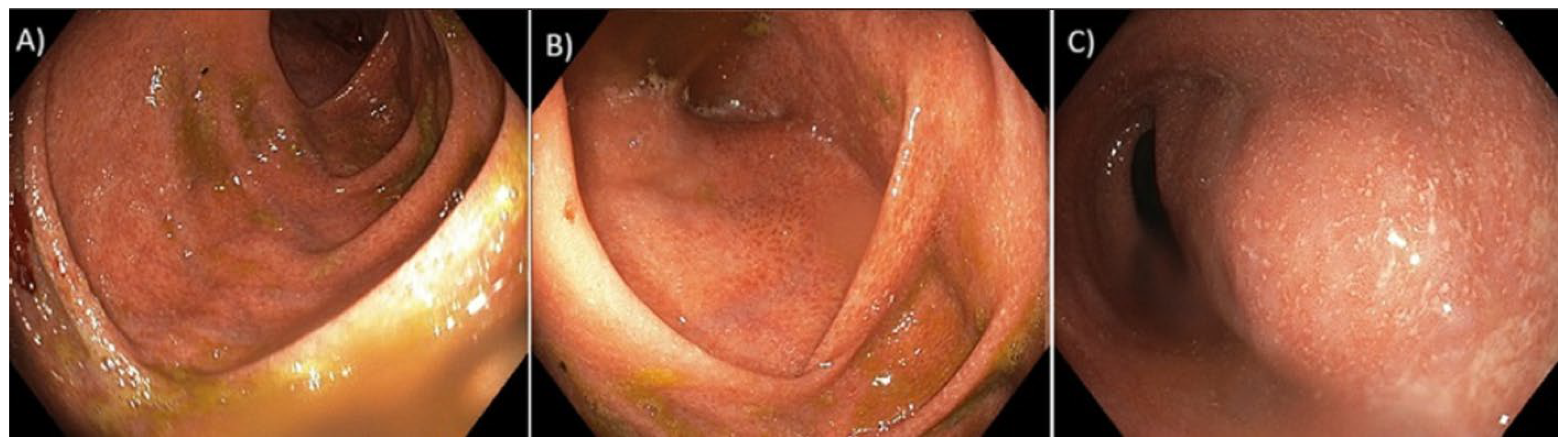

Table 1.
Timeline that summarizes the key events, treatments, and exercise activities followed by the patient.
Table 1.
Timeline that summarizes the key events, treatments, and exercise activities followed by the patient.
| Date | Event/Status | Treatment/Action | Exercise Program |
|---|---|---|---|
| September 2023 | Intermittent morning diarrhea; consulted gastroenterologist. | Prescribed probiotics and rifaximin; symptoms resolved by the 4th day. | Resumed normal training and daily routine. |
| November 2023 | Diagnosed with COVID-19; experienced lethargy, dehydration, morning diarrhea, and weight loss (7 kg). | Dietary adjustments; probiotics and rifaximin prescribed again; consultation with cardiologist. | No training; remained mildly active. |
| February 2024 | In remission after budesonide treatment; calprotectin levels normalized; mucosal healing observed. | Continued budesonide treatment until remission achieved. | Hesitant to resume training; remained mildly active. |
| April 2024 | Recurrence of diarrhea (Type 5 to 7 Bristol Stool Scale); increased calprotectin levels. | Prescribed budesonide for two months; symptoms resolved after 5 days. | Resumed moderate-intensity running. |
| September 2024 | Stable bowel movements, improved appetite, high energy, reduced anxiety, and increased social engagement. | Continued budesonide treatment completed; patient in remission. | Moderate-intensity running (60-80% VO2 max) 3-4 times per week; occasional unstructured swimming. |
Table 2.
Table that summarizes the patient’s condition before and after starting the exercise regimen, emphasizing improvements in physical health, such as bowel movement stability and energy levels, as well as psychological benefits like reduced anxiety and increased social engagement.
Table 2.
Table that summarizes the patient’s condition before and after starting the exercise regimen, emphasizing improvements in physical health, such as bowel movement stability and energy levels, as well as psychological benefits like reduced anxiety and increased social engagement.
| Aspect | Before Exercise Regimen | After Exercise Regimen |
|---|---|---|
| Date | September 2023 - April 2024 | April 2024 - September 2024 |
| Bowel Movements | Intermittent diarrhea (Type 6-7) | Stable bowel movements (Type 1-2) |
| Calprotectin Levels | Elevated (1100 mg/gr) during active phase | Normal (41 mg/gr) during remission; increased (375 mg/gr) before resuming exercise |
| Weight | Significant weight loss (7 kg) | Stable body weight |
| Energy Levels | Low energy, fatigue, lethargy | High energy, stable even after training |
| Appetite | Reduced appetite | Improved appetite |
| Diarrhea Frequency | Frequent (up to 5 times per day) | Reduced (1-2 times per day) |
| Training Status | Limited activity; resumed mildly active | Moderate-intensity running (60-80% VO2 max) 3-4 times per week; occasional swimming |
| Psychological Well-being | Anxiety, reduced social engagement | Reduced anxiety, increased social engagement |
| Physical Activity | Minimal; cautious due to fear of worsening symptoms | Regular moderate-intensity exercise, improved fitness and functional capacity |
| Overall Disease Status | Active Crohn’s disease with intermittent symptoms | Remission with stable disease status and symptom control |
Disclaimer/Publisher’s Note: The statements, opinions and data contained in all publications are solely those of the individual author(s) and contributor(s) and not of MDPI and/or the editor(s). MDPI and/or the editor(s) disclaim responsibility for any injury to people or property resulting from any ideas, methods, instructions or products referred to in the content. |
© 2024 by the authors. Licensee MDPI, Basel, Switzerland. This article is an open access article distributed under the terms and conditions of the Creative Commons Attribution (CC BY) license (http://creativecommons.org/licenses/by/4.0/).
Copyright: This open access article is published under a Creative Commons CC BY 4.0 license, which permit the free download, distribution, and reuse, provided that the author and preprint are cited in any reuse.


