

Submitted:
22 September 2024
Posted:
23 September 2024
You are already at the latest version
Abstract
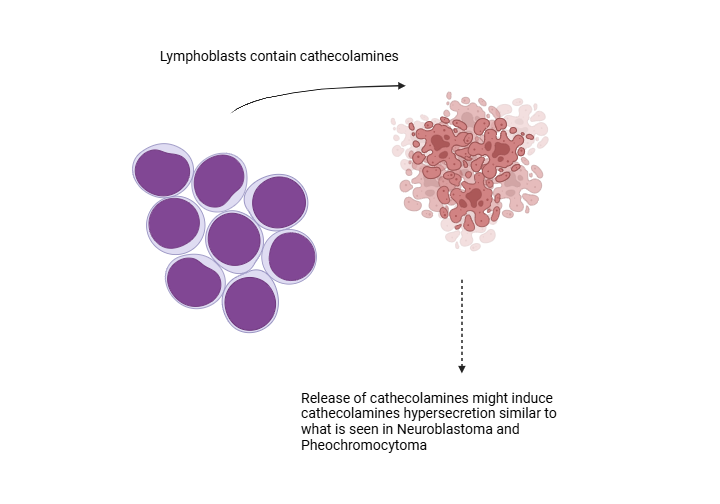
Patients with Acute lymphoblastic leukemia (ALL) commonly present with tachycardia and or hypertension. There is little focus in the literature on the pathogenesis of this duet. It is currently established that ALL are catecholamine-secreting cells, and this means that ALL might induce hypertension and tachycardia via catecholamine hypersecretion. Proving the latter hypothesis can help in better treatment of ALL associated inappropriate tachycardia and systemic hypertension using combined alpha and beta blockers.
Keywords:
ALL
; catecholamine hypersecretion
; Tachycardia-hypertension
Combined Hypertension and Tachycardia in Acute Lymphoblastic Leukemia: An Overlooked Problem in Literature
Acute lymphoblastic leukemia (ALL) is the most common malignancy diagnosed in children, representing more than a quarter of all pediatric cancers. The incidence of ALL follows a bimodal distribution, with the first peak occurring in childhood and a second peak occurring around the age of 50. [1]
Literature particularly focuses on hypertension in ALL patients, stating that 45% of patients with ALL develop hypertension after initiation of therapy. They attribute this hypertension to either steroid therapy or acute kidney injury. [2]
While systemic hypertension can be justifiable by steroid use, tachycardia, commonly accompanying hypertension in ALL patients, is less commonly understood. Pulse steroid therapy is known to induce sinus bradycardia, as it is speculated that steroids reduce myocardial cell sensitivity to catecholamines thus leading to sinus bradycardia.[3]
Few studies have focused on sinus tachycardia prevalence in ALL patients and none of them have considered its cohabitation with systemic hypertension. Some of the proposed pathogeneses include anemia, infection, and third-space loss. [4]
A recent large systematic review by Bertrand and colleagues, reported that only five studies have focused on heart rate abnormalities in ALL, and two of them reported an unrealistically wide range, 8-505, of prevalence of tachycardia in ALL patients. But this article does not discuss if this tachycardia was associated with blood pressure abnormalities or not. [4,5,6]
There is a gap in the literature regarding the prevalence of tachycardia-hypertension syndrome, which largely resembles the catecholamine syndrome seen in neuroblastoma.
Catecholamine Levels and Paracrine Regulation in ALL
On a molecular basis, catecholamines are increasingly recognized as paracrine mediators between different subsets of lymphocytes. Lymphocytes secrete catecholamines and these catecholamines are used to modulate their functions. [7,8,9,10]
Of note, Hanns and colleagues have highlighted the importance of use of catecholamines for regulation of tumorigenesis in blood malignancies, catecholamines’ receptors are expressed by immune cells, more abundantly on T-lymphocytes. [11]
Another interesting study by Paczulla et al. showed how catecholamines have the potential to induce tumorigenesis and facilitates bone marrow colonization by leukemic cells and inhibiting retention of healthy cells.[12]
Despite the above data on the paracrine and autocrine role of catecholamines in lymphocytes and in leukemic cells regulation, no study to date investigated if serum and urinary catecholamines are significantly increased in leukemia overall and particularly in acute lymphoblastic leukemia.
Choice of Antihypertensives in Cancer-Related Hypertension and Implications of This Hypothesis
The drug group of choice in guidelines of antihypertensive treatment in cancer-related hypertension are RAAS blockers (renin-angiotensin-aldosterone system), whether angiotensin converting enzyme inhibitors or angiotensin receptor blockers; except in cases with a known association to high catecholamines yield.[13]
This observation and hypothesis are not only of academic interest but can potentially tailor better treatments for inappropriate tachycardia and hypertension in ALL. Proving the presence of catecholamine hypersecretion in such patients may render beta-blockers a more favorable treatment modality in ALL.
Therefore, more studies are needed to determine the circulating catecholamine levels in ALL and to rule out or confirm this hypothesis.
Author Contributions
Conceptualization, AFA; Methodology, AFA, BK, CS; software, AFA, BK, CS; investigation, AFA, BK, CS; resources, AFA, BK, CS, data curation, AFA, BK, CS; writing—original draft preparation, AFA, BK, CS; writing—review and editing, AFA, BK, CS; supervision, AFA; project administration, AFA; funding acquisition, (none). All authors have read and agreed to the published version of the manuscript.
Institutional Review Board Statement
not applicable as this study is a hypothesis/Review article.
Informed Consent Statement
not applicable as this study is a viewpoint/editorial.
Data Availability Statement
All data is made available within the manuscript.
Acknowledgments
To the peacekeepers in every part of the world, in every community, every family and every tiny relationship. Peace keeping might sometimes look like weakness, but it requires utmost strength.
Conflicts of Interest
The authors declare no conflict of interest.
Abbreviations
ALL: acute lymphoblastic leukemia
References
- Bhojwani D, Yang JJ, Pui C-H (2015) Biology of Childhood Acute Lymphoblastic Leukemia. Pediatr Clin North Am 62:47–60. [CrossRef]
- Murphy L, Maloney K, Gore L, Blanchette E (2022) Hypertension in Pediatric Acute Lymphoblastic Leukemia Patients: Prevalence, Impact, and Management Strategies. Integr Blood Press Control 15:1–10. [CrossRef]
- Khandelwal K, Madathala RR, Chennaiahgari N, Yousuffuddin M (2021) Steroid-Induced Sinus Bradycardia. Cureus. [CrossRef]
- Bertrand É, Caru M, Harvey A, Dodin P, Jacquemet V, Curnier D (2023) Cardiac electrical abnormalities in childhood acute lymphoblastic leukemia survivors: a systematic review. Cardio-Oncology 9:1–23. [CrossRef]
- Lipshultz SE, Colan SD, Gelber RD, Perez-Atayde AR, Sallan SE, Sanders SP (1991) Late Cardiac Effects of Doxorubicin Therapy for Acute Lymphoblastic Leukemia in Childhood. N Engl J Med 324:808–815. [CrossRef]
- Steinherz LJ, Steinherz PG, Tan C (1995) Cardiac Failure and Dysrhythmias 6–19 Years After Anthracycline Therapy: A Series of 15 Patients. Med Pediatr Oncol 24:352–361. [CrossRef]
- Rajda C, Bencsik K, Vécsei L L, Bergquist J (2002) Catecholamine levels in peripheral blood lymphocytes from multiple sclerosis patients. J Neuroimmunol 124:93–100. [CrossRef]
- Flierl MA, Rittirsch D, Huber-Lang M, Vidya Sarma J, Award P (2008) Catecholamines - Crafty weapons in the inflammatory arsenal of immune/inflammatory cells or opening Pandora’s box§? Mol Med 14:195–204. [CrossRef]
- Bergquist J, Tarkowski A, Ekman R, Ewing A (1994) Discovery of endogenous catecholamines in lymphocytes and evidence for catecholamine regulation of lymphocyte function via an autocrine loop. Proc Natl Acad Sci U S A 91:12912–12916. [CrossRef]
- Eisenhofer G, Peitzsch M, Bechmann N, Huebner A (2022) Biochemical Diagnosis of Catecholamine-Producing Tumors of Childhood: Neuroblastoma, Pheochromocytoma and Paraganglioma. Front Endocrinol (Lausanne) 13:1–15. [CrossRef]
- Hanns P, Paczulla AM, Medinger M, Konantz M, Lengerke C (2019) Stress and catecholamines modulate the bone marrow microenvironment to promote tumorigenesis. Cell Stress 3:221–235. [CrossRef]
- Paczulla AM, Hanns P, Konantz M, Lundberg P, Dirnhofer S, Lengerke C (2018) Catecholamine Exposure Accelerates In Vivo Leukemogenesis in Acute Myeloid Leukemia Patient Derived Xenografts. Blood 132:1475–1475. [CrossRef]
- Askarinejad A, Alizadehasl A, Jolfayi AG, Adimi S (2023) Hypertension in Cardio-Oncology Clinic: an update on etiology, assessment, and management. Cardio-Oncology 9:1–13. [CrossRef]
Disclaimer/Publisher’s Note: The statements, opinions and data contained in all publications are solely those of the individual author(s) and contributor(s) and not of MDPI and/or the editor(s). MDPI and/or the editor(s) disclaim responsibility for any injury to people or property resulting from any ideas, methods, instructions or products referred to in the content. |
© 2024 by the authors. Licensee MDPI, Basel, Switzerland. This article is an open access article distributed under the terms and conditions of the Creative Commons Attribution (CC BY) license (http://creativecommons.org/licenses/by/4.0/).
Copyright: This open access article is published under a Creative Commons CC BY 4.0 license, which permit the free download, distribution, and reuse, provided that the author and preprint are cited in any reuse.


