

Submitted:
19 September 2024
Posted:
20 September 2024
You are already at the latest version
Abstract
Treatment with herbal medicine continues to enjoy widespread popularity not only in the developing world, because of low costs, easy availability, and low risk of adverse effects. One such plant is Curcumin longa L., or turmeric, which has a long history of both culinary and medicinal uses throughout Asia, spanning thousands of years. In addition to traditionally being used as a dye, as a flavouring and colouring agent in foods, and, e.g., marriage rituals, turmeric is also notable for its long history of use to treat a variety of medical conditions, including inflammatory, bacterial, and fungal diseases and infections, jaundice, tumours, and ulcers among others. In light of this long history of use, it is not surprising to find that also modern biochemistry and clinical research studies show that a significant component of turmeric, curcumin, may have a multitude of therapeutic benefits, much of it attributed to the herb’s antioxidant qualities which are crucial for the prevention and treatment of, e.g., chronic inflammatory illnesses, conditions that often act as precursors for other serious diseases, including cancer and neurological disorders, such as Parkinsons and Alzheimer’s. Furthermore, investigations on the safety profile and toxicity of curcumin have shown that it is generally safe even at large dosages, although caution is necessary as curcumin also have documented anticoagulant effects. This article is focused on providing a better perspective into molecular mechanisms for possible actions along with an in-depth review of recent studies of curcumin, its beneficial role and therapeutic applications in chronic health conditions, with a focus on its cancer, inflammatory bowel disease, osteoarthritis, atherosclerosis, peptic ulcer, Covid19, psoriasis, vitiligo, and depression.
Keywords:
Curcumin
; turmeric
; anti-inflammatory
; anticancer
; antibacterial
; antifungal
; antioxidant
Introduction
Throughout human history, the use of plants as remedies to prevent or heal from ailments befalling man and animals, spanning from inflammatory and bacterial infections to insect borne diseases, ulcers and tumours, as well as, more recently, managing diabetes and combating cancers, is common to all human societies and civilizations [1,2].
Among the wide range of medicinal plants known to man, Curcuma longa (C. longa), or turmeric, has come to enjoy global popularity, well beyond the regions this plant is native to. A well-known rhizomatous perennial herb of the Zingiberaceae family, indigenous to tropical South Asian countries, commonly known as haldi. It has a rich tradition of being used as a dye, a cleansing agent (e.g., before marriage), as a food additive (spice), and medicine [3]. Modern studies have shown that turmeric is very rich in antioxidants, which is in line with its historically known anti-inflammatory properties. Turmeric and its main component, curcumin, has over the past decades gained widespread popularity globally as an over-the-counter prophylactic and supplement, due to its effectiveness, and low cost in the prevention or treatment of a wide range of illnesses, including inflammatory diseases, cancer, diabetes, bacterial, fungal and protozoal infections, ulcers, disorders of the liver and circulatory system, and is a proven anticoagulant agent [4,5,6,7]. A range of therapeutically active curcuminoids (curcumin, dihydrocurcumin, tetrahydrocurcumin, bis-demethoxycurcumin, and demethoxycurcumin) (Figure 1), natural polyphenol compounds derived from the plant rhizome, have been isolated and are being extensively explored for their potential therapeutic benefits also in treating, e.g., neurological and endocrine disorders, thus expanding the potential ranges of medicinal uses of this ancient remedy [5,8]. Curcumin has been tested in clinical studies both alone and in conjunction with several other medications, including sulfasalazine, quercetin, piperine, lactoferrin, docetaxel, prednisone, gemcitabine, and pantoprazole [9].
For instance, a study published in 2012 assessed the health-promoting effects of liposomal curcumin through clinical trials on middle-aged healthy volunteers (40-60 years old). Participants were given either 80 mg of placebo or liposomal curcumin daily for four weeks. It was shown that curcumin decreased salivary amylase, triglycerides, beta amyloid, alanine amino transferase, and soluble intercellular adhesion molecule (sICAM) in plasma when compared to placebo. Furthermore, curcumin administration enhanced these people’s plasma catalase, myeloperoxidase, nitric oxide synthesis, and salivary radical scavenging capacities. Overall, these results showed that middle-aged, healthy people can benefit from lipidated curcumin [10]. Further studies have also highlighted the therapeutic benefits of curcumin, with the most important ones being improved circulation [11], metal chelation [12,13], treatment of cancer [11,14], playing the role of an anti-oxidant [9] and anti-inflammatory agent [15,16], while also assisting neurogenesis [17]. Still more clinical trials have demonstrated the effectiveness of turmeric against diabetes, fibrosis, irritable bowel syndrome, acne, and lupus nephritis [18]. Since the US FDA in 2018 classified curcumin as “generally recognized as safe” (GRAS), it has become widely used as a supplement in many countries also outside the US [19].
The following sections thoroughly examine curcumin’s pharmacological impact in the treatment of human illnesses, as well as a thorough analysis of the reported actions, synergistic responses, and implications of curcumin in diverse pathogenesis by modulating a variety of biomolecules and mediators.
Probable Mechanisms of Action of Curcumin
Curcumin’s efficacy in preventing the development of disease is shown, e.g., by its ability to efficiently counteract effects of reactive oxygen species (ROS) and nitrogen species [20]. Curcumin inhibits lipid peroxidation and peroxide-induced DNA damage via inhibition of oxidative stress by reducing the production of ROS, including the generation of highly reactive free radicals such as hydroxyl groups, univalent anion oxygen, and singlet oxygen, etc. [21]. Nevertheless, the inflammatory response can be induced by oxidative stress, which in turn generates a greater proportion of free radicals that can further exacerbate oxidative stress. Cardiovascular ailments, diabetes, and arthritic conditions are among the conditions that can result from this cycle, as chronic inflammation can be induced by oxidative stress [22]. Curcumin modulates many signalling molecules to exert powerful anti-inflammatory and anti-carcinogenic effects [23]. Numerous crucial elements in cellular signal transduction pathways connected to proliferation, differentiation, and malignant transformations have been demonstrated to be inhibited by curcumin [24].
Furthermore, a multitude of studies have reported the implications of increased prostaglandin biosynthesis following upregulated cyclooxygenase-2 (COX-2) expression, which leads to activation of c-Jun/AP-1 and protein kinases in inflammatory conditions [25]. However, reports suggest that curcumin’s anti-inflammatory properties contribute to its inhibitory effect on enzymes like 5-lipooxygenase and COX-2 [26]. In addition, curcumin has been reported to suppresses lipopolysaccharide induced increased expression of inflammatory genes such as COX-2 and iNOS in RAW 264.7 macrophages cells [27]. Furthermore, Curcumin alleviated the carrageenan-induced increase in inflammatory cytokines such as IFN-γ, IL-1β, IL-6, IL-13, and IL-17 through suppressing the NF-κB/COX-2 pathway and inhibiting iNOS expression [28].
Figure 2, below, illustrates action mechanisms of curcumin in diverse pathologic conditions. Nuclear factor-kappa B (NF-kB) is a transcription factor that regulates the expression of numerous genes, including proinflammatory genes. It is a critical mediator between inflammation and the development of a variety of human diseases. Its activity is strictly regulated by a variety of mechanisms (Figure 2) and functions in regulation, activation, and maintenance of innate white blood cells such as T- and B- lymphocytes. [29]. Tumour necrosis factor alpha (TNF-α) is a pleiotropic cytokine that is a significant regulator of inflammatory processes [30]. It is implicated in the pathogenesis of a wide range of pathologic conditions, including neurologic [31], autoimmune [32], endocrine disorders [33], and obesity [34]. As shown in Figure 2, curcumin inhibits the expression of inflammatory genes by direct inhibitory action on NF-κB [35] and also by inhibiting TNFα signal transduction pathway [36]. The inhibition of NF-κB pathways exerts modulatory action on cellular oxidative stress by regulating the production of cytokines, adhesion molecules, COX-2, iNOS [37], HO-1, and NQO-1 [38] which is crucial for the adipocyte hyperplasia and hypertrophy leading to obesity. NAD(P)H:quinone oxidoreductase 1 (NQO1) is a key enzyme in the antioxidative system, catalysing the reduction of two-electrons which takes place in different endogenous and exogenous quinones where flavin adenine nucleotides (FAD) acts as a cofactor. The promoter domain of the NQO1 gene encodes antioxidant response element (ARE) sequences, which have been shown to be regulated by nuclear factor (erythroid-derived 2)-like 2 (NRF2) [39]. Curcumin may activate the NRF2 pathway, which may reduce the expression of cytokines that promote inflammation, such as MCP-1, TNF-a, IL-6, and IL-1β, and induce antioxidant enzymes [40,41]. Furthermore, curcumin exerts direct inhibitory action on adipocyte hyperplasia and hypertrophy [42]. The vast majority of tumour therapies rely on the direct destruction of cancer cells or promoting the action of antitumor immune cells, such as natural killer (NK) cells and cytotoxic CD8+ T lymphocytes (CTLs) [43]. Interestingly, curcumin exerts direct antitumour and cytotoxic action by elevating NK cells [44], cytotoxic CD8+ T cells [45], and INFγ [46], and reducing the activity of Tregs and MDSC in tumour cells [47]. Also, curcumin suppresses tumour progression by reducing Tregs and MDSC [48]. It directly suppresses the phosphorylation of AKT, leading to a reduction in cellular survival, differentiation, and angiogenesis through inhibition of GSK3β-mediated stabilization of β-catenin. Further inhibition of AKT activation leads to inhibition of transcription factors for inflammatory genes through TSC1/2 and mTORC1 inhibition, thus contributing to the immunomodulatory, anti-inflammatory, and neuroprotective actions of curcumin [49].
Furthermore, curcumin has been shown to inhibit the adherence of Streptococcus mutants to human dental surfaces and the extracellular matrix protein [50]. Curcumin also appears to have positive synergistic effects when administrated together with common anti-infection agents, for example, cefixime, vancomycin, and other antibiotic medication to treat Staphylococcus aureus S. aureus) infections [51,52,53]. Curcumin suppresses the expression of Pseudomonas aeruginosa (PAO1) virulence factors, including biofilm formation, pyocyanin biosynthesis, elastase/protease activity, and acyl homoserine lactone (HSL) production. As a result, the pathogenicity of P. aeruginosa is diminished in both C. elegans and A. thaliana infection models [54]. The antimicrobial action of curcumin is multifactorial including, disruption of cell membrane function , inhibits bacterial cell division by binding to microtubulins, induction of bacterial apoptosis, and induction of phototoxicity due to photosensitizer under blue light irradiation [55].
Preclinical and Clinical Evidences for Therapeutic Applications of Curcumin
Therapy for Cancer
Curcumin’s anti-cancer properties have been evidenced through its ability to inhibit a variety of molecular signalling pathways, thereby inducing apoptosis and reducing tumour multiplication and metastasis [56]. Curcumin has long been recognised for its critical function in regulating the interaction of immune and inflammatory responses (Figure 3), which is achieved by inhibiting IkBs, which in turn suppresses NF-kB. In recent years, their dual role in cancer has been revealed, as they can function as both promoters and suppressors of tumorigenesis [57]. It suppresses NF-κB, a major transcription factor, which in turn reduces the expression of genes (TNF-α), responsible for inflammation [58]. It has also been demonstrated that curcumin also inhibited the expression of AP-1, a gene that is linked to anti-apoptotic proteins [59]. Moreover, curcumin suppresses IL-6, which is related either directly or indirectly to the control of the oncogenesis-promoting protein STAT3 [60]. When used alone or in conjunction with other drugs, curcumin may have therapeutic benefits in the treatment of pancreatic cancer, prostate cancer, breast cancer, oral cancer, lung cancer, head cancer, colorectal cancer, as well as multiple myeloma [61,62,63].
Colorectal Cancer
As with other cancers, the aetiology of colorectal cancer is complex and includes a combination of genetic predispositions, environmental variables (such as food), and inflammatory diseases, here, of the digestive system [64,65]. Currently there is no viable therapy available except early-stage resection and chemotherapy. Curcumin has shown promise against colorectal cancer in several clinical trials. In a dose-escalation pilot study, a standardized curcuma extract comprising of 20 mg of curcuminoids (18 mg of curcumin and 2 mg of desmethoxycurcumin) suspended in 200 mg of essential oils (a mixture of turmerone, atlantone, and zingiberene) derived from Curcuma spp. in a proprietary capsule form with 36-180mg of curcumin was administrated to evaluate the pharmacokinetic and pharmacodynamic of the therapeutic agent [9]. The curcuma extract, which contained 36-180 mg of curcumin per day, was administered to fifteen patients with advanced colorectal cancer who had not responded to conventional chemotherapy for a maximum of four months. Marker for the production of DNA adduct, such as M1G level and Glutathione S-transferase enzyme activity were measured in the blood cells of the patients following 29 days curcuma extract administration. No reports of dose-limiting-toxicity were associated with the oral administration of Curcuma extract. However, the study reported traces of curcumin sulphate in one of the patient’s faeces out of fifteen samples. The lymphocytic glutathione S-transferase activity decreased by 59% as a result of the ingestion of 440 mg of curcuma extract for 29 days. Nevertheless, this effect was not observed at larger dose levels. Each patient’s leukocytic M(1)G levels remained constant and were not influenced by the treatment [9]. In various doses, involving 15 patients with advanced colorectal cancer, who had not responded to traditional chemotherapies, took capsules at dosages of 0.45 to 3.6g per day for up to four months [12]. Presence of curcumin as well as its metabolites were detected in urine, faeces, and plasma of these patients. The study also documented the amounts of curcumin along with its glucuronide and sulphate metabolites present in urine and plasma samples (10 nmol/L or more). Further, a study assessed the curcumin level in colorectal tissue wherein it was reported that ingestion of curcumin capsules for a week at three varying amounts (3.6, 1.8, and 0.45 g/day) resulted in achievement of pharmacologically active level of curcumin in the human colorectum. Furthermore, those who received 3.6 g of curcumin showed 12.7 ± 5.7 nmol/gm and 7.7 ± 1.8 nmol/gm curcumin concentrations in normal and cancerous colorectal tissues, respectively. Additionally, curcumin sulphate and curcumin glucuronide, two byproducts of curcumin, were found in the tissue samples of the participants, along with a few trace amounts in the bloodstream. Curcumin treatment in malignant colorectal tissue resulted in decreased M1G levels, yet it did not affect COX-2 levels. In conclusion, this study shows that a daily dose of 3.6 g of curcumin causes pharmacologically effective levels in the colorectum, but not much curcumin to be found in other parts of the body [66]. In a study conducted by Cruz-Correa, a combination of curcumin (480 mg) and quercetin (20 mg) was given orally three times daily to patients with familial adenomatous polyposis (FAP) who had undergone colectomy. After six months of therapy, patients showed a reduction in both the number and size of polyps, with no reported adverse effects [16]. Additionally, in another trial, varying doses of curcumin (2 or 4 g per day) was administered orally to 44 smokers for a month. Lower dosages of curcumin had no impact on the levels of prostaglandin E2, 5-hydroxyeicosatetraenoic acid, or pro-carcinogenic eicosanoids in either antecubital fossa (ACF) or normal flat mucosa. However, 4 g/day of curcumin greatly decreased the development of ACF. Curcumin inhibited ACF formation and significantly increased post-treatment plasma curcumin/conjugate levels by a factor of five. Both amounts of curcumin were well tolerated. These results reveal curcumin’s ability to prevent ACF development in smokers [67]. Curcumin, given in pill form at a dosage 360 mg thrice daily for a period of 10 to 30 days, demonstrated significant effects. The administration of curcumin through injections resulted in increased body weight and reduced levels of TNF-α in the bloodstream [15]. The reported study, like other studies presented above, prove how safe and efficient the said drug is for colorectal cancer patients, but also draw attention to the need for larger, randomized, and closely monitored clinical trials to validate its therapeutic benefits against colorectal cancer.
Inflammatory Bowel Disease
As mentioned above, curcumin has anti-inflammatory qualities because of its ability to interact with toll-like receptors, a crucial step for innate immunity [68]. It regulates the production of inflammatory mediators such as MAPK and NF-κB [69]. Inflammatory bowel disease (IBD) is commonly managed with TNF-α blockers, immunosuppressants, and anti-inflammatory drugs. Due to expensive costs and side effects, such medicines are not exactly safe for use and hence, exploring other alternative therapeutic modalities. A clinical trial evaluated the effectiveness of curcumin in a remission induction trial with ten patients of which five with ulcerative proctitis, an idiopathic mucosal inflammatory disease (Figure 3) anatomically limited form of ulcerative colitis and five with Crohn’s disease. A dose of 550 mg of the drug was given to patients suffering from ulcerative proctitis twice a day for one month, followed by a second dose of the same amount for three times a day a month. Likewise, patients suffering from Crohn’s disease were given doses, albeit in different amounts, with 360mg three times daily for a month, followed by the same amount four times daily for another month. Following curcumin administration, a significant reduction in ESR and CRP was observed in all ulcerative proctitis patients.. Though, only four of the five Crohn’s disease patients completed the study. Due to such reduced levels (ESR and CRP), 55 points were decreased on an average in the Crohn disease activity index [70]. Further, another controlled clinical trial on eighty-nine patients with quiescent ulcerative colitis investigated the effectiveness of curcumin maintenance therapy. The patient groups received a combination of curcumin plus sulfasalazine/mesalamine and a placebo plus sulfasalazine/mesalamine for 6 months. The participants were administered 1 g of curcumin following their morning and evening meals, along with sulfasalazine (SZ) or mesalamine. The group receiving curcumin demonstrated a relatively lower recurrence rate of 4.65%, whereas those on placebo had a higher recurrence rate of 20.51% [71]. Additionally, in clinical case report, a 60-years-old woman with left-sided ulcerative colitis achieved both clinical and endoscopic remission by consuming 500 mg/day of oral curcumin alongside prednisone [72]. The patient previously showed no improvement with various forms of mesalamine, sulfasalazine, and steroid treatments, requiring multiple courses of steroids to manage the worsening condition. The patient was prescribed a daily dose of 500 mg curcumin alongside 40 mg prednisone, and after one year of combined therapy, bowel movements subsided to two-per-day and were free of blood [72]. This case study suggests that curcumin could serve as a promising complementary or alternative treatment for persistent ulcerative colitis. In accordance with these results, another properly conducted double clinical trial based on randomized selection of patients with ulcerative colitis of varying degrees, from mild to moderate, assessed the clinical outcomes by determining quality of life and inflammatory markers, including TNF-α, high-sensitivity CRP in serum, ESR, and complete blood count, following curcumin (1,500 mg per day) was administered for 8 weeks. The study’s findings demonstrated that curcumin supplementation, in conjunction with medication therapy, significantly improves clinical conditions, health, hs-CRP, and ESR in individuals with mild-to-moderate UC [73].
A separate study focused on analysing the anti-inflammatory property of curcumin by assessing the levels of inflammatory markers such as IL-1β, IL-10, MAPK, and MMP-3 in the intestinal tracts. The effects were dose-dependent and were shown by lower levels of MAPK, NF-kB, and MMP3, increased levels of IL-10, and reduced levels of IL-1 beta [74]. Research conducted in vivo indicates the potential for curcumin to act as an inhibitor of the NLRP3 inflammasome, supporting the notion proposed by Karthikeyan et al. that this could represent a promising approach to treating IBD [75]. Anaemia, a common extraintestinal manifestation of IBD, primarily arises from gastrointestinal blood loss and, at least partially, from impaired iron absorption due to tissue inflammation [76]. In addition, curcumin inhibits the production of hepcidin, a peptide involved in iron balance, and has the potential to cause an iron deficit in the presence of preexisting subclinical iron insufficiency [77], which may lead to further aggravation of anaemic conditions in IBD patients. Therefore, it is crucial to monitor these aspects carefully in clinical settings, as a relatively higher percentage (about two-thirds) of IBD patients showed anaemia at diagnosis, which needs equal attention to that for the management of diarrhoea to improve the overall quality of life.
Osteoarthritis
Osteoarthritis (OA) is a chronic inflammatory condition affecting one or more joints, characterized by the presence of adhesion molecules along with matrix metalloproteinases which is followed by an exacerbated inflammation resulting in cartilage damage. It typically arises from the dysregulation of pro-inflammatory markers, cytokines (such as IL-1, TNFα), enzymes promoting the production of prostaglandins, and leukotrienes. There is currently no known cure for this illness or availability of therapeutic agents that can stop the disease progression. Many preclinical investigations have demonstrated beneficial effects of curcumin on inflammatory and catabolic markers in OA rat models [78,79]. Several studies have demonstrated a significantly elevated NLRP3 inflammasome in the synvium, where monocytes or macrophages infiltrate, in both arthritic patients and animals with collagen-induced arthritis [80,81]. Curcumin’s protective effect against destabilization of the medial meniscus (DMM) surgery-induced osteoarthritis, as well as its ability to prevent disease progression, was demonstrated in a study on rodents. The results of the study have shown that it reduced the expression of proinflammatory cytokines in arthrodial cartilage in lipopolysaccharide (LPS)/ATP-induced THP-1 macrophage cells [79]. A different study explained the protective effect of curcumin (50 mg/kg orally once daily for 60 days) to articular cartilage in zymosan (1mg intra-articular injection)-induced osteoarthritis in rats. Curcumin treatment appears to have a protecting impact on cartilage, as it did not result in any increase in cartilage thickening or matrix metalloproteinase-8 and 13 (MMP-8 and MMP-13) expression. Nevertheless, it did lead to a rise in the quantity of chondrocytes and the expression of Indian Hedgehog (IHH), Collagen type-II (Col2), and Sex-determining region Y (SRY)-box 5 (SOX-5) [82]. In accordance with this, Advanced Ultrasol Curcumin (AUC), a highly bioavailable dosage form (20 and 40 mg/kg of total curcuminoids), demonstrated antioxidant and anti-inflammatory activity in the synovial tissue of rats affected by sodium monoiodoacetate (MIA)-induced osteoarthritis and associated markers, such as Col2 and MMP3 levels [83]. Furthermore, curcumin loaded PLGA nanoparticles preserve the tissue alterations evidenced by x-rays and biopsies of knee with OA. There was significant reduction of inflammatory markers in blood such as interleukin-1β (IL-1β), TNF-α, IL-6, and transforming growth factor-beta (TGF-β) whereas prevented the decline in blood IL-10 levels. In addition, nanoparticles loaded with curcumin alleviated type II collagen loss which in turn resulted in reversal of raised malondialdehyde levels in monosodium iodoacetate-induced knee OA in rodents [84]. Recently it has been demonstrated that administration of curcumin (200 mg/kg, p.o.) for 4 weeks following monosodium iodoacetate (MIA)-induced OA in rats produced reduction in joint pain and stiffness. Additionally, the combination of curcumin and the exercise modality of swimming (20 minutes per session) resulted in a more significant reduction in pain and stiffness. This was further substantiated by the restoration of miR-130a and HDAC3 expression, as well as the upregulation of PPAR-γ and decreased expression of NF-κB and its inflammatory mediator targets TNF-α [85].
Beyond preclinical studies, the positive effects of curcumin have also been documented in clinical and medical settings. It has been demonstrated that MerivaTM, a proprietary curcumin-phosphatidylcholine phytosome complex exerted beneficial effects in 50 osteoarthritis (OA) patients following three months administration at a dosage equivalent to 200 mg curcumin daily [86]. Therefore, the study demonstrated substantial enhancements in both clinical endpoints, including the Western Ontario and McMaster Universities (WOMAC) score, Karnofsky Performance Scale Index, and treadmill walking performance, as well as biochemical parameters, including IL-1β, IL-6, soluble CD40 ligand (sCD40L), soluble vascular cell adhesion molecule (sVCAM)-1, and erythrocyte sedimentation rate (ESR) [86]. Further, Meriva’s efficacy and safety in the treatment of osteoarthritis were further examined by same team in an 8-months study involving 100 patients [87]. Additionally, after receiving Meriva treatment, patients’ usage of NSAIDs, distal oedema, and gastrointestinal problems were significantly decreased. Patients required fewer hospital stays, appointments, and testing after receiving Meriva therapy [87]. Furthermore, the safety and therapeutic potential of curcumin (500 mg) alone and in combination with diclofenac sodium (50 mg) were evaluated in forty-five patients with active rheumatoid arthritis, showing improvement in disease activity score [88]. A relatively recent systematic review and meta-analysis reported that curcumin is as advantageous and safe for individuals with osteoarthritis in terms of both improvement of pain and knee function from baseline [89].
Atherosclerosis
Atherosclerosis is a chronic inflammatory condition of the vascular tissues and is recognized as a significant risk factor for cardiovascular diseases. Among its complex etiopathogenesis, oxidative stress is a key factor in the damage to the vascular endothelium, which subsequently triggers the development of atherosclerosis [90]. Several reports have demonstrated that curcumin exerts its anti-inflammatory effect possibly by influencing inflammatory cells and enzymes involved in inflammation processes [91]. Curcumin has the potential to delay cellular degeneration and mitigate aging-associated oxidative stress, both of which contribute to vascular dysfunction [92]. An in vitro study has demonstrated that a 24-hour curcumin pretreatment suppresses hydrogen peroxide-induced endothelial senescence by reducing ROS generation and increasing eNOS and NO production [93]. Curcumin exerts direct antioxidant effect through multiple pathways, including scavenging reactive oxygen species (ROS) [94], hydrogen donors [95], the presence of ferulic acid and vanillin acting as powerful antioxidants [96], and chelating ferrous ions through its carbonyl group [94]. Curcumin has the ability to prevent oxidative stress in cells through its indirect actions. High-dose curcumin administration in albino rats has demonstrated enhanced activity of antioxidant enzymes in many organs, including glutathione peroxidase, catalase, superoxide dismutase, and glutathione-S-transferase (GST) [97]. In animal studies, the anti-inflammatory properties of curcumin have shown effectiveness in preventing atherosclerosis. This compound is known to reduce the activity of M1 macrophages [98]. Curcumin modulates TLR4/MAPK/NF-B pathway, which controls macrophage polarization and plasticity and helps lower atherosclerosis [99,100]. Curcumin hinders the movement of vascular smooth cells. In addition, curcumin reduces blood pressure, vascular inflammation, and cellular remodelling by blocking NF-κB-mediated NLRP3 expression in spontaneously hypertensive rats. This is useful for cardiovascular illnesses such as atherosclerosis [101]. Curcumin supplementation was found to effectively inhibit NF-κB activation in the aorta [100]. Additionally, a meta-analysis involving 1427 participants revealed that curcumin led to a significant rise in high-density lipoprotein cholesterol (HDL-C) in the plasma and a notable decrease in plasma triglyceride (TGs) concentrations [102]. Conversely, another meta-analysis indicated that curcumin supplementation did not produce significant changes in serum total cholesterol, TGs, LDL-C or HDL-C levels [103]. To paint a clearer picture of curcumin’s benefits for individuals with atherosclerosis, more comprehensive clinical trials are needed due to the shortage of relevant studies and the variability in outcomes.
Furthermore, numerous clinical investigations have corroborated preclinical data that indicate the positive impact of curcumin on atherosclerosis and associated cardiovascular diseases. A controlled trial was taken (based on randomized selection) to study the impact of curcumin supplementation at varying concentrations (15 mg/kg, 30 mg/kg, and 60 mg/kg) three times per day on the total cholesterol level, LDL cholesterol (LDL-C) level, HDL-C level, and TGs level in 75 patients with acute coronary syndrome (ACS). The study showed that the lower dose of curcumin (15 mg/kg) exhibited beneficial effects on lipid profiles, including total cholesterol and LDL-C levels, in ACS patients [104]. Another study demonstrated that the administration of curcuminoid preparations (NCB-02) containing 150 mg curcumin twice daily for 8 weeks had a beneficial impact on diabetes-induced endothelial dysfunction, inflammatory markers, and oxidative stress in patients with type 2 diabetes mellitus [105]. Atherosclerosis is a condition that is commonly linked to the metabolic syndrome, particularly in cases of visceral obesity and metabolic imbalances. Further, a randomised controlled clinical study on 65 patients with metabolic syndrome reported significant increase in HDL-C, and reduction in LDL-C and triglycerides following administration of capsule containing curcumin extract (630 mg) three times in a day for 12 weeks as compared to placebo control [106]. Furthermore, dosage of the drug(500 mg) four times daily for 8 weeks to patients with coronary artery disease produced a significant decrease in TGs, LDL-C, and VLDL-C compared to their baseline; however, there was no significant change in total cholesterol, HDL-C, blood sugar, and high-sensitive C-reactive protein (hs-CRP) [107]. However, patients with COPD experienced a substantial decrease in atherosclerotic LDL-C levels following the administration of a highly absorbable curcumin (Theracurmin®) in comparison to placebo control [108].
Peptic Ulcer
Peptic ulcer disease is caused by a breakdown of the inner protective barrier of the gastrointestinal (GI) tract as a result of increased gastric acid secretion or reduced duodenal bicarbonate secretions. Curcumin suppresses the gastric mucosal injury by inhibiting the secretion of gastric acid, an aggressive factor implicated in the pathogenesis of peptic ulcer, by blocking the activity of caspase-3 [109]. The findings here indicate that curcumin’s antiapoptotic properties and alleviation of oxidative stress strengthened the mucosal barrier of the gastrointestinal tract. In addition, the gastroprotective effects against NSAIDs may be attributable to the antisecretory activity of curcumin [110]. Additionally, curcumin and bisdemethoxycurcumin inhibited gastric acid secretion in rats by decreasing the increased protein expression levels of iNOS induced by pylorus ligation, but not TNF-α [111]. Further, curcumin (20, 40, and 80 mg/kg) demonstrated antiulcer activity in pylorus ligation-induced ulcers in rats. This was demonstrated by a decrease in total gastric juice pH, neutrophil activity, mitochondrial function, oxidative stress, paraoxonase (PON 1)/arylesterase, and total peroxides in gastric mucosal cells [112]. Topical application of alcohol free 1% chitosan-curcumin in oral ulcer has produced reduction in ulcer severity and improved ulcer healing activity [113]. In turn, a research study was conducted to examine the efficiency of a chitosan (150 mg)-curcumin (20 mg) mixture in the treatment of indomethacin-induced gastric ulcers in rodents. The results of the study indicated that the orally administered chitosan-curcumin mixture exhibited greater efficacy compared to curcumin, chitosan, and lansoprazole. This was demonstrated by its superior anti-oxidant, anti-inflammatory, and gastric mucus-producing activities, as well as its outstanding potency in suppressing the expression of pro-inflammatory COX-2 and iNOS expression and increasing the expression of cytoprotective COX-1, nNOS, and eNOS in gastric cells [114]. Recently, a study investigated the anti-ulcer effects of omeprazole-curcumin-loaded hydrogel beads coated with chitosan (OMP/CURC) against indomethacin-induced widespread hemorrhagic lesions in rats, wherein the OMP/CURC-loaded beads exhibited higher efficacy in alleviating indomethacin-induced infiltration of lymphoplasmacytic, neutrophilic activity on glands, area of atrophied glands, and interstitial metaplasia of stomach tissues [115]. Helicobacter pylori infection, one of the primary causative agents among the numerous etiopathogenic factors, was detected in approximately 10% of ulcer patients. A study showed that curcumin exhibited anti-H. pylori effects in mouse model evidenced by significant reduction in serum IL-4, IFN-γ, somatostatin, gastrin, lipid peroxide, myeloperoxidase, and bacterial counts and increased anti-H. pylori antibodies [116].
Antibiotics, histamine receptor blockers, and proton pump inhibitors are the preferred treatments for peptic ulcers. In a clinical trial involving 60 participants, half received turmeric (250 mg, four times daily), while the remaining 30 were given antacids (30 ml, four times daily). The course of therapy lasted for six to twelve weeks. Although antacids and turmeric helped patients with their gastrointestinal ulcers, the former was more effective at decreasing the ulcers [117]. In individuals with peptic ulcers, a phase II clinical research assessed the safety and effectiveness of curcumin. There were 24 males and 21 females among the 45 patients in the study, with an age range of 16 to 60 years. After undergoing an endoscopy, stomach (angulus) and duodenal bulb ulcers were found in 25 people (18 males and 7 females). There were twenty people who were missed but had gastritis, dyspepsia, and erosions instead of ulcers. Two turmeric capsules (300mg each) were consumed orally 5 times a day for a month. Findings after four weeks of therapy showed that 12 patients did not have ulcers; eight weeks later, 18 patients did not have ulcers; and twelve weeks later, 19 patients did not have ulcers. The residual patients’ symptoms improved after taking turmeric medicine [118].
COVID-19
Individuals with a diagnosis of COVID-19 display increased levels of colony-stimulating factors (G-CSF and GM-CSF), inflammatory markers (IL-1β, IL-6, IL-8 and TNF-α), and cytokine-tracing agents [119]. In addition, inflammasomes are cytoplasmic complexes of several proteins that are instrumental in innate immunity, which ultimately leads to pyroptosis, a form of cell death [29]. NOD-like receptor pyrin domain-containing 3 (NLRP3) is one of the most extensively investigated inflammasomes, having been related to inflammatory diseases caused by tissue damage, metabolic dysfunction, excessive cellular reactive oxygen species, and infection [29,120,121]. The activation of the inflammasome will probably result in the formation of a catastrophic “cytokine storm,” which ultimately leads to acute respiratory distress syndrome (ARDS) and death. Recent studies demonstrate that the NLRP3 inflammasome is crucial for the pathogenesis of severe COVID-19, particularly in patients with comorbid conditions like diabetes and obesity. Further, it has been demonstrated that patients with viral infections experience destructive and systemic inflammation as a result of an overactive inflammasome [122]. Likewise, the NLRP3 inflammasome has been shown to be vital in the development of viral illnesses[122,123,124]. There are numerous observations of direct and indirect inflammasome activation by other coronaviruses that can be coupled with the exponential growth of SARS-CoV-2 in a wide spectrum of cells.
Therefore, reducing the increased inflammatory response that occurs during COVID-19 could potentially help mitigate the severity of the illness. Curcumin may be used as a COVID-19 adjuvant medication [124]. Additionally, it has been reported that curcumin exerts regulatory role on inflammasomes in several other diseases. In COVID-19 individuals, curcumin might lower the numbers of Treg, Th17 cells, and their associated markers of inflammation compared to the placebo group [125,126]. Curcumin was reported to effectively alleviate monosodium urate crystal-induced gouty arthritis by inhibiting NF-κB signaling in vitro and in vivo through NLRP3 inflammasome mediation [127].
An oral form of curcumin in a nano formulation taken at a dose of 80 mg daily, has shown promising results in improving oxygen levels, reducing hospital stays when compared to a control group, and expediting the recovery time from COVID-19 induced symptoms in a non-randomized clinical trial [128]. Additionally, the oral intake of curcumin and piperine as adjunctive therapy for COVID-19 has significantly reduced both the severity of symptoms and the mortality rate, while also improving clinical outcomes [129]. Curcumin has anti-inflammatory properties, but it can also impede SARS-CoV-2 entrance into cells and stop the virus from proliferating. Curcumin is an adjuvant medication for the treatment of COVID-19 because of its wide range of pharmacological actions and great level of safety. Interestingly, a randomised controlled trial showed significant lowering of pro-inflammatory cytokine concentration following 4-week curcumin supplementation in individuals who cured from COVID-19 infection and were then fully vaccinated for COVID-19 [130].
A recent study investigated the antiviral, anti-inflammatory, and antioxidant effects of curcumin and curcuminoids (Me08 and Me23) on SARS-CoV-2 infection. The study reported that all substances had anti-inflammatory effects, reducing proinflammatory cytokines such as IL-6, TNF-α, and IL-17. According to observations made, it was believed that curcuminoid Me23 is a possible agent for reducing the effects of COVID-19, especially when the central nervous system is targeted. More specifically, the curcuminoid Me08 was found to decrease IFN-γ levels in SARS-CoV-2 infected neuroblastoma cells [131]. Curcumin has been shown to inhibit SARS-CoV-2 entry into cells, impede its replication within cells, and mitigate the enhanced inflammatory condition induced by the virus through immunomodulatory action, reduction of cytokine storm, and regulation of the renin-angiotensin system [132]. A randomized study investigated the effect of curcumin (500 mg) supplementation for four weeks on inflammatory markers in the serum of individuals who had been infected with COVID-19 and then received primary vaccination doses. The study found that curcumin significantly decreases IL-6 and Monocyte chemoattractant protein-1 (MCP-1) levels in individuals who have recovered from COVID-19 [130]. Recently, curcumin and curcuminoids (Me08 and Me23) have shown antiviral effects against SARS-CoV-2 infection in SH-SY5Y cells by suppressing their replication. Also, Me23 demonstrated antioxidant characteristics by upregulating NRF2 gene expression and preserving NQO1 activity following infection with SARS-CoV-2. In addition, curcumin and curcuminoids (Me08 and Me23) demonstrated anti-inflammatory properties by inhibiting the production of proinflammatory cytokines, including IL-6, TNF-α, and IL-17. Me23, on the other hand, specifically decreased the levels of INF-γ in SH-SY5Y neuroblastoma cells infected with SARS-CoV-2 [131].
Psoriasis
Psoriasis is a chronic inflammatory skin condition, that causes scaly, red and thick plaques on the surface of the skin, which can occur on any part of the body. The present treatment for psoriasis (UVB or psoralen + UVA therapy) is time-consuming and may be hazardous to some organs (methotrexate, acitretin, and cyclosporine). The anti-inflammatory, antioxidant, and antimicrobial characteristics of curcumin have rendered it to be a valuable medicinal herb for centuries. This is why it is regarded as an ideal herbal compound for acne, psoriasis, premature skin aging, and skin inflammation [133]. Several lines of evidence suggest that CUR has the potential to treat psoriasis in a variety of ways and has exceptional efficacy. Its use is also imperative for the improvement of the psoriasis phenotype and the reduction of the inflammatory milieu [134,135]. In the imiquimod-induced psoriatic plaque model in rodents, a study found that liposphere gels containing curcumin and tacrolimus exhibited an anti-psoriatic effect. This demonstrated by the reduced levels of TNF-α, IL-17, and IL-22 in comparison to the imiquimod group [136]. Likewise, curcumin nanoparticle gels demonstrated enhanced skin penetration compared to curcumin nanoparticles, resulting in improved anti-keratinization processes induced by miquimod in mice. Further, the formulated curcumin nanoparticle gel exhibited powerful anti-inflammatory action by suppressing the expression of pro-inflammatory cytokines such as TNF-α, NF-κB, and IL-6 [137]. Voltage-gated potassium (Kv) channels are essential for controlling the growth, specialization, and programmed cell death of effector memory T cells. Emerging evidence has highlighted the crucial role of Kv1.3 channels in the pathogenesis of psoriasis, in particular by regulating the activation and proliferation of T cells [138]. Curcumin appears as an inhibitor of the potassium channel subtype Kv1.3, which is predominantly expressed in T cells and plays a critical role in the development of psoriasis [139]. Further, curcumin has been shown to reduce the severity of psoriatic symptoms evident by alleviation of psoriasis indices such as redness of ear, weight, thickness, and lymph node weight in mice. Additionally, the study reported that application of curcumin (100 μM) produced a 50% reduction in T cell inflammatory cytokines in mouse serum as compared to pathogenic control [140]. The intestinal microbiome is critically involved in the development of psoriasis-like inflammatory conditions of the skin by increasing the Th17 response and decreasing regulatory T cell (Treg) levels in psoriasis patients [141]. It was reported from a study that dosage of curcumin within the stomach (100 mg/kg/day) alleviated psoriasis-like inflammatory states of the skin, evidenced by a decrease in the psoriasis area and severity index (PASI) score, which is widely used to quantify the severity of psoriatic lesions. Furthermore, PASI was associated with a substantial decrease in inflammatory cytokines levels, as well as an increase in IL-10 expression in mice with imiquimod-induced psoriasis [142]. Studies have demonstrated that transdermal preparations for psoriasis may be advantageous when they target the substantially elevated levels of CD44 protein expression in the psoriatic inflammatory epidermis [143]. It is intriguing that the topical drug delivery of curcumin by hyaluronic acid (HA)-linked propylene glycol-based ethosomes that target CD44 protein resulted in an amelioration of imiquimod-induced psoriasis-like inflammatory skin lesions in mice and a substantial decrease in pro-inflammatory markers in comparison to pathogenic mice [144]. Likewise, curcumin-loaded PLGA nanoparticle hydrogels exhibited enhanced skin penetration in in vitro studies and improved efficacy in alleviating imiquimod-induced psoriasis following topical application in mice [145]. SmartPearls is a cutting-edge technology that effectively stabilizes the amorphous state over an extended period of time and is regarded as an appropriate approach to the delivery of antipsoriatic drugs. According to a report, curcumin smartPearls with extra glycyrrhizic acid demonstrated improved tissue penetration efficacy and anti-psoriatic activity in mice with imiquimod-induced psoriasiform cutaneous inflammation [146].
Researchers have documented elevated levels of phosphorylase kinase (PhK) in the epidermis of psoriatic skin, which is in close correlation with an increased PASI score and increased phosphorylation. In both involved and uninvolved skin, PhK levels were substantially elevated in cases of active, untreated psoriasis. Therefore, psoriasis can be treated using substances that have the ability to suppress PhK activity. As years pass by, a new body of research specializing in underscoring the properties and benefits of curcumin, in the treatment of psoriasis has emerged. Moreover,thesaiddrug exhibited therapeutic efficacy in reducing the PASI score, which may be attributed to its capacity to inhibit the phosphorylase kinases that are elevated in psoriatic epidermis [147]. Additionally, the Lineweaver-Burk plot analysis demonstrated that curcumin is a non-competitive inhibitor of PhK with an inhibition constant (Ki) of 0.075 mM [147]. A different study looked into whether curcumin’s anti-psoriatic effects in patients were brought about by the inhibition of PhK activity [148]. This research investigated the activity of PhK in four groups of ten participants: (1) those with active, untreated psoriasis; (2) those whose psoriasis was resolving after treatment with calcipotriol, a vitamin D3 analogue and an indirect PhK inhibitor; (3) those receiving treatment with curcumin; and (4) those with normal, non-psoriatic skin. People with active, untreated psoriasis had the highest PhK activity, which progressively declined in those receiving calcipotriol, curcumin, and non-psoriatic individuals. PhK activity was found to be inversely correlated with keratinocyte transferrin receptor expression, parakeratosis worsening, and decreased density of epidermal CD8+ T lymphocytes in psoriasis patients on curcumin and calcipotriol therapy. An open-label phase II clinical trial, utilizing Simon’s two-stage methodology, was conducted to evaluate the effectiveness of curcumin in treating patients with psoriasis [149]. In this research, 4.5 g of curcumin was given daily to 12 patients with persistent plaque psoriasis for 12 weeks, after which there was a 4-week observation period. All subjects completed the trial, and curcumin was well-tolerated. However, the low response rate observed could be attributed to either the placebo effect or the natural course of psoriasis. Two patients, who responded positively to the treatment, showed significant recoveries ranging from 83% to 88% after 12 weeks. However, before recommending oral curcumin for psoriatic patients, further high-quality placebo-controlled trials are necessary.
Vitiligo
A skin condition called vitiligo causes the death of melanocytes, which give skin its colour. As a result, white patches of skin develop on various places of the body. Despite the fact that the exact mechanism causing melanocyte destruction is yet unknown, oxidative stress has been linked to the disease’s aetiology [150]. Currently, narrowband UVB (NB-UVB), which utilises the UVB spectrum’s range of wavelengths from 311 to 312 nm, is regarded as the most effective method of treating vitiligo [148]. Due to its antioxidant properties, curcumin presents itself as an effective option for managing vitiligo. One research looked into the possibility of synergistic therapeutic benefits against vitiligo when NB-UVB and tetrahydrocurcuminoid cream were used together [150]. Ten subjects in the study had vitiligo, either extensive or localized. Two similar lesions were treated with topical tetrahydrocurcuminoid cream in conjunction with NB-UVB. At the conclusion of the study, the results demonstrated that both treatment groups had significantly re-pigmentation compared with baseline. Furthermore, the tetrahydrocurcuminoid was well tolerated, at 8 and 12 weeks, the combination group showed somewhat higher total re-pigmentation [150]. A variety of studies have reported an increase in advanced oxidation protein products (AOPPs), advanced glycation end-products (AGEs), H2O2 in epidermal tissues, oxidative DNA damage, and a decrease in catalase as indicators of vitiligo that eventually worsens [151]. It is intriguing that curcumin has been reported to decrease the production of advanced glycation end products, probably by trapping methylglyoxal (MGO). This is supported by the fact that the expression levels of transforming growth factor-β1 and intercellular adhesion molecule (-1) in human umbilical vein endothelial cells have decreased following treatment with curcumin [152]. The epidermal oxidative stress results in increased levels of reactive oxygen species (ROS), causing cellular molecules and organelles to malfunction, triggering an immune response and ultimately the death of melanocytes. However, the persistent accumulation of ROS may activate the cellular NRF2 antioxidant pathway. Curcumin also enhances the NRF2 pathway, which increases antioxidant activity and activates genes that aid in toxins detoxification and protect cells from oxidative stress damage [153]. In a clinical trial involving 30 vitiligo patients, turmeric cream was applied twice daily for a period of four months. The results showed that it effectively reduced lesion size, vitiligo area scoring index (VASI), vitiligo noticeability scale (VNS), and physician global assessment (PGA) when compared with the placebo controls [154]. In addition, a case study has reported the spontaneous reversal of vitiligo in a 41-year-old man manifested as repigmentation of lesions after 3 years following consumption of a curcumin-based herbal remedy prepared in 200 mL of hot water with the addition of a quarter teaspoon of turmeric powder (curcuma longa) and 1 teaspoon of honey, and drank once the preparation cooled down [155].
Depression
Recent evidence strongly suggests a close connection between depression and inflammation [156]. It is widely recognized that inflammatory processes are essential in the defense against invading microorganisms by prompting adaptive immune responses. Additionally, the disruption of the innate and adaptive immune systems plays a crucial role in the onset of depressive disorders [157]. As a result, the use of medication with anti-inflammatory and anti-cytokine properties may prove beneficial in treating depression symptoms. Curcumin administration also inhibits the triggering of the NLRP3 inflammasome, resulting in a reduction in mRNA expression of proinflammatory cytokines [158]. The results indicate that the use of curcumin effectively enhanced the depressive-like behaviour in stressed rats [159,160]. The underlying cause of clinical depressive disorder comprises a wide range of pathophysiologic attributes including neurochemical, behavioural, and neuroendocrine changes, and the rodent olfactory bulbectomy model of depression closely resembles these processes [161]. It has been demonstrated olfactory bulbectomy produces reduction in serotonin, NA, and dopamine levels in the prefrontal cortex, and the chronic administration of curcumin (1.25, 2.5, 5, and 10 mg/kg, p.o.) produced reversal of these biochemical changes and also the depressive behaviour of forced swimming tests in rats [162]. Further, a study explored the potential role of serotonin (5-HT) receptors in the antidepressant effects of curcumin on a forced swimming model in rodents. Furthermore, the forced swimming test was blocked by the antagonists of 5-HT(1A/1B) and 5-HT(2A/2C) receptors, suggesting that curcumin’s antidepressant effect is mediated by the modulation of serotonergic systems, at least in part by 5-HT(1A/1B) and 5-HT(2C) receptors [163]. It is widely recognized that brain-derived neurotrophic factor (BDNF) is crucial in a variety of physiological processes, including neuronal survival and differentiation, synaptic plasticity, growth and protection of neurons. Furthermore, it functions in controlling mood swings, sustaining memory, learning capabilities along with other cognitive processes. BDNF and glutamate act as coregulators for each other, and a dysfunction in BDNF results in altered glutamatergic homeostasis, eventually leading to depressive behavior [164]. A study showed that chronic curcumin treatment (50, 100, and 200 mg/kg) resulted in a dose-dependent antidepressant effect by increasing the level of BDNF in the hippocampal region of Wistar Kyoto rats [165]. Curcumin’s therapeutic effect is limited by its reduced oral bioavailability, which may be attributed to its relatively low intestinal absorption, excessive metabolism, and excretion [166]. A study found that the co-administration of curcumin (20 and 40 mg/kg, i.p.) with a bioavailability enhancer, piperine (2.5 mg/kg, i.p.), for 21 days showed a massive improvement in anti-immobility, an increase in serotonin and dopamine levels, and an inhibition of monoamine oxidase (MAO-A) activity compared to curcumin alone [167]. Further, the administration of curcumin-coated iron oxide nanoparticles for two weeks in a reserpine-induced depression model in rats resulted in a substantial increase in swimming time, a reduction in immobility time, and an elevation of 5-HT, NE, and DA levels. Additionally, the oxidative stress markers MAO, AchE, and Na⁺/K⁺-ATPase were attenuated in the hippocampus [168]. Likewise, curcumin-conjugated zinc oxide nanoparticles demonstrated greater efficacy in alleviating the reserpine-induced behavioral changes in rats on forced swimming tests and open field tests. These nanoparticles produced reversal of reserpine-induced neurochemical changes [169]. Recent studies have reported the antidepressant effect of a curcumin analogue (CACN136), in a chronic unpredictable mild stress model in mice. This effect was demonstrated by a notable rise in the sucrose preference rate and a reduction in immobility time in the tail suspension test, which may be attributed to the stimulation of the Keap1-Nrf2/BDNF-TrkB signaling pathway [170].
In addition, a collective analysis of nine clinical trials revealed that the drug may have the potential to alleviate anxiety and depressive symptoms in individuals suffering from depression [171]. A supplementary treatment involving curcumin (with doses ranging from 500 mg/day to 1500 mg/day) reported to prove a significant distinction between curcumin and a placebo at weeks 12 and 16 in a double-blind, placebo-controlled study [172]. Although curcumin has demonstrated promising antidepressant effects in many animal models of depression, consistent, encouraging outcomes from clinical trials have not been observed. Hence, larger sample trials are required to confirm the drug’s therapeutic efficacy for depression.
Safety Profile of Curcumin
According to the results of safety investigations, curcumin is generally considered safe for human consumption. It has also been revealed by several studies that curcuminoids, including curcumin, and the extracts of Curcuma longa do not elevate the incidence of adverse events [173,174]. Curcumin is safe for human consumption, even at comparatively high doses, as support from studies conducted in humans indicate that healthy volunteers can tolerate doses of up to 8 g/d and even 12 g/d. Further, a meta-analysis of six human studies including 172 participants found that curcuminoids substantially reduced circulating C-reactive protein levels when compared to placebo, with no adverse effects [175]. Studies on its potential toxicity indicated that it is generally safe, even at larger quantities (up to 12 grams in human) [176,177]. According to toxicological studies, curcumin does not cause any discernible mutagenic, teratogenic, or sub-chronic toxicity damage [173,178]. Further, research conducted by a study group stated that the administration of 8 grams per day of curcumin plus gemcitabine to pancreatic cancer patients was found to be well-tolerated and safe [13,17]. However, curcumin and its derivative, bisdemethoxycurcumin has been reported to prolong the aPTT and PT, and inhibited the activity of thrombin and factor Xa [179]. Therefore, curcumin should be used cautiously in patient with bleeding disorder, pregnant and nursing women. Despite of the anti-inflammatory properties it has been recognised as an allergen causing contact dermatitis in some individuals [180]. Consequently, it is imperative that patients and dermatologists remain vigilant regarding potential allergic reactions.
Summary of Key Findings in Studies of Curcumin as a Therapeutic Agent
Furthermore, curcumin and its derivatives have demonstrated efficacy in alleviating numerous other ailments, in addition to the evidence previously mentioned that supports their therapeutic applications. In Table 1, the research findings pertaining the impacts of curcumin followed by its formulations on various health problems are thoroughly summarized.
Conclusions
The health-promoting effects of curcumin are well recognized and have been in practice in traditional medicine since ancient time. Curcumin is used in traditional system based medicinal products for diseases management because it is non-toxic and has low side effects. Numerous in vitro and in vivo laboratory based studies, as well as human clinical trials have demonstrated the effectiveness of turmeric and its constituents as a favourable modulator of biological processes. Curcumin has shown a diverse range of effects in inflammatory disorders, perhaps via influencing multiple genes, signalling molecules, and enzymes. However, additional research is necessary to enlighten ourselves with the knowledge of curcumin’s wide ranged benefits, efficiency, plausible uses, and working mechanisms, especially in its prevention and treatment of human illnesses. The combination of curcumin with other potential therapeutic reagents should further be explored and tested in controlled clinical studies.
Funding Sources
The manuscript was prepared without external funding.
Conflict of Interest Statement
The author has no conflicts of interest to declare.
References
- El-Saadony, M.T.; Yang, T.; Korma, S.A.; Sitohy, M.; Abd El-Mageed, T.A.; Selim, S.; Al Jaouni, S.K.; Salem, H.M.; Mahmmod, Y.; Soliman, S.M.; et al. Impacts of Turmeric and Its Principal Bioactive Curcumin on Human Health: Pharmaceutical, Medicinal, and Food Applications: A Comprehensive Review. Front. Nutr. 2022, 9, 1040259. [Google Scholar] [CrossRef] [PubMed]
- Hewlings, S.J.; Kalman, D.S. Curcumin: A Review of Its Effects on Human Health. Foods 2017, 6, 92. [Google Scholar] [CrossRef] [PubMed]
- Fuloria, S.; Mehta, J.; Chandel, A.; Sekar, M.; Rani, N.N.I.M.; Begum, M.Y.; Subramaniyan, V.; Chidambaram, K.; Thangavelu, L.; Nordin, R. A Comprehensive Review on the Therapeutic Potential of Curcuma Longa Linn. in Relation to Its Major Active Constituent Curcumin. Front. Pharmacol. 2022, 13, 820806. [Google Scholar] [CrossRef] [PubMed]
- Chattopadhyay, I.; Biswas, K.; Bandyopadhyay, U.; Banerjee, R.K. Turmeric and Curcumin: Biological Actions and Medicinal Applications. Curr. Sci. 2004, 44–53. [Google Scholar]
- Anand, P.; Thomas, S.G.; Kunnumakkara, A.B.; Sundaram, C.; Harikumar, K.B.; Sung, B.; Tharakan, S.T.; Misra, K.; Priyadarsini, I.K.; Rajasekharan, K.N. Biological Activities of Curcumin and Its Analogues (Congeners) Made by Man and Mother Nature. Biochem. Pharmacol. 2008, 76, 1590–1611. [Google Scholar] [CrossRef]
- Aggarwal, B.B.; Harikumar, K.B. Potential Therapeutic Effects of Curcumin, the Anti-Inflammatory Agent, against Neurodegenerative, Cardiovascular, Pulmonary, Metabolic, Autoimmune and Neoplastic Diseases. Int. J. Biochem. Cell Biol. 2009, 41, 40–59. [Google Scholar] [CrossRef] [PubMed]
- Witkin, J.M.; Li, X. Curcumin, an Active Constiuent of the Ancient Medicinal Herb Curcuma Longa L.: Some Uses and the Establishment and Biological Basis of Medical Efficacy. CNS Neurol. Disord. Targets (Formerly Curr. Drug Targets-CNS Neurol. Disord. 2013, 12, 487–497. [Google Scholar] [CrossRef]
- Aggarwal, B.B.; Sung, B. Pharmacological Basis for the Role of Curcumin in Chronic Diseases: An Age-Old Spice with Modern Targets. Trends Pharmacol. Sci. 2009, 30, 85–94. [Google Scholar] [CrossRef]
- Sharma, R.A.; McLelland, H.R.; Hill, K.A.; Ireson, C.R.; Euden, S.A.; Manson, M.M.; Pirmohamed, M.; Marnett, L.J.; Gescher, A.J.; Steward, W.P. Pharmacodynamic and Pharmacokinetic Study of Oral Curcuma Extract in Patients with Colorectal Cancer. Clin. Cancer Res. 2001, 7, 1894–1900. [Google Scholar]
- DiSilvestro, R.A.; Joseph, E.; Zhao, S.; Bomser, J. Diverse Effects of a Low Dose Supplement of Lipidated Curcumin in Healthy Middle Aged People. Nutr. J. 2012, 11, 1–8. [Google Scholar] [CrossRef]
- Ide, H.; Tokiwa, S.; Sakamaki, K.; Nishio, K.; Isotani, S.; Muto, S.; Hama, T.; Masuda, H.; Horie, S. Combined Inhibitory Effects of Soy Isoflavones and Curcumin on the Production of Prostate-specific Antigen. Prostate 2010, 70, 1127–1133. [Google Scholar] [CrossRef] [PubMed]
- Sharma, R.A.; Euden, S.A.; Platton, S.L.; Cooke, D.N.; Shafayat, A.; Hewitt, H.R.; Marczylo, T.H.; Morgan, B.; Hemingway, D.; Plummer, S.M. Phase I Clinical Trial of Oral Curcumin: Biomarkers of Systemic Activity and Compliance. Clin. cancer Res. 2004, 10, 6847–6854. [Google Scholar] [CrossRef] [PubMed]
- Dhillon, N.; Aggarwal, B.B.; Newman, R.A.; Wolff, R.A.; Kunnumakkara, A.B.; Abbruzzese, J.L.; Ng, C.S.; Badmaev, V.; Kurzrock, R. Phase II Trial of Curcumin in Patients with Advanced Pancreatic Cancer. Clin. cancer Res. 2008, 14, 4491–4499. [Google Scholar] [CrossRef] [PubMed]
- Golombick, T.; Diamond, T.H.; Badmaev, V.; Manoharan, A.; Ramakrishna, R. The Potential Role of Curcumin in Patients with Monoclonal Gammopathy of Undefined Significance—Its Effect on Paraproteinemia and the Urinary N-Telopeptide of Type I Collagen Bone Turnover Marker. Clin. Cancer Res. 2009, 15, 5917–5922. [Google Scholar] [CrossRef]
- He, Z.-Y.; Shi, C.-B.; Wen, H.; Li, F.-L.; Wang, B.-L.; Wang, J. Upregulation of P53 Expression in Patients with Colorectal Cancer by Administration of Curcumin. Cancer Invest. 2011, 29, 208–213. [Google Scholar] [CrossRef]
- Cruz–Correa, M.; Shoskes, D.A.; Sanchez, P.; Zhao, R.; Hylind, L.M.; Wexner, S.D.; Giardiello, F.M. Combination Treatment with Curcumin and Quercetin of Adenomas in Familial Adenomatous Polyposis. Clin. Gastroenterol. Hepatol. 2006, 4, 1035–1038. [Google Scholar] [CrossRef]
- Kanai, M.; Yoshimura, K.; Asada, M.; Imaizumi, A.; Suzuki, C.; Matsumoto, S.; Nishimura, T.; Mori, Y.; Masui, T.; Kawaguchi, Y. A Phase I/II Study of Gemcitabine-Based Chemotherapy plus Curcumin for Patients with Gemcitabine-Resistant Pancreatic Cancer. Cancer Chemother. Pharmacol. 2011, 68, 157–164. [Google Scholar] [CrossRef]
- Gupta, S.C.; Sung, B.; Kim, J.H.; Prasad, S.; Li, S.; Aggarwal, B.B. Multitargeting by Turmeric, the Golden Spice: From Kitchen to Clinic. Mol. Nutr. Food Res. 2013, 57, 1510–1528. [Google Scholar] [CrossRef]
- Bayet-Robert, M.; Kwiatowski, F.; Leheurteur, M.; Gachon, F.; Planchat, E.; Abrial, C.; Mouret-Reynier, M.-A.; Durando, X.; Barthomeuf, C.; Chollet, P. Phase I Dose Escalation Trial of Docetaxel plus Curcumin in Patients with Advanced and Metastatic Breast Cancer. Cancer Biol. Ther. 2010, 9, 8–14. [Google Scholar] [CrossRef]
- Sathyabhama, M.; Priya Dharshini, L.C.; Karthikeyan, A.; Kalaiselvi, S.; Min, T. The Credible Role of Curcumin in Oxidative Stress-Mediated Mitochondrial Dysfunction in Mammals. Biomolecules 2022, 12, 1405. [Google Scholar] [CrossRef]
- Barclay, L.R.C.; Vinqvist, M.R.; Mukai, K.; Goto, H.; Hashimoto, Y.; Tokunaga, A.; Uno, H. On the Antioxidant Mechanism of Curcumin: Classical Methods Are Needed to Determine Antioxidant Mechanism and Activity. Org. Lett. 2000, 2, 2841–2843. [Google Scholar] [CrossRef]
- Hussain, T.; Tan, B.; Yin, Y.; Blachier, F.; Tossou, M.C.B.; Rahu, N. Oxidative Stress and Inflammation: What Polyphenols Can Do for Us? Oxid. Med. Cell. Longev. 2016, 2016. [Google Scholar] [CrossRef]
- Paulraj, F.; Abas, F.; H. Lajis, N.; Othman, I.; Naidu, R. Molecular Pathways Modulated by Curcumin Analogue, Diarylpentanoids in Cancer. Biomolecules 2019, 9, 270. [Google Scholar] [CrossRef]
- Giordano, A.; Tommonaro, G. Curcumin and Cancer. Nutrients 2019, 11, 2376. [Google Scholar] [CrossRef]
- Zhou, H.; S Beevers, C.; Huang, S. The Targets of Curcumin. Curr. Drug Targets 2011, 12, 332–347. [Google Scholar] [CrossRef]
- Zhang, F.; Altorki, N.K.; Mestre, J.R.; Subbaramaiah, K.; Dannenberg, A.J. Curcumin Inhibits Cyclooxygenase-2 Transcription in Bile Acid-and Phorbol Ester-Treated Human Gastrointestinal Epithelial Cells. Carcinogenesis 1999, 20, 445–451. [Google Scholar] [CrossRef]
- Setyono, J.; Harini, I.M.; Sarmoko, S.; Rujito, L. Supplementation of Curcuma Domestica Extract Reduces Cox-2 and Inos Expression on Raw 264.7 Cells. J. Phys. Conf. Ser. 2019, 1246, 12059. [Google Scholar] [CrossRef]
- Lee, S.-Y.; Cho, S.-S.; Li, Y.; Bae, C.-S.; Park, K.M.; Park, D.-H. Anti-Inflammatory Effect of Curcuma Longa and Allium Hookeri Co-Treatment via NF-ΚB and COX-2 Pathways. Sci. Rep. 2020, 10, 5718. [Google Scholar] [CrossRef]
- Liu, T.; Zhang, L.; Joo, D.; Sun, S.-C. NF-ΚB Signaling in Inflammation. Signal Transduct. Target. Ther. 2017, 2, 1–9. [Google Scholar] [CrossRef]
- Bradley, J. TNF-mediated Inflammatory Disease. J. Pathol. A J. Pathol. Soc. Gt. Britain Irel. 2008, 214, 149–160. [Google Scholar] [CrossRef]
- Anwar, M.J.; Alenezi, S.K.; Alhowail, A.H. Molecular Insights into the Pathogenic Impact of Vitamin D Deficiency in Neurological Disorders. Biomed. Pharmacother. 2023, 162, 114718. [Google Scholar] [CrossRef] [PubMed]
- Jang, D.; Lee, A.-H.; Shin, H.-Y.; Song, H.-R.; Park, J.-H.; Kang, T.-B.; Lee, S.-R.; Yang, S.-H. The Role of Tumor Necrosis Factor Alpha (TNF-α) in Autoimmune Disease and Current TNF-α Inhibitors in Therapeutics. Int. J. Mol. Sci. 2021, 22, 2719. [Google Scholar] [CrossRef]
- Díez, J.J.; Hernanz, A.; Medina, S.; Bayón, C.; Iglesias, P. Serum Concentrations of Tumour Necrosis Factor-alpha (TNF-α) and Soluble TNF-α Receptor P55 in Patients with Hypothyroidism and Hyperthyroidism before and after Normalization of Thyroid Function. Clin. Endocrinol. (Oxf). 2002, 57, 515–521. [Google Scholar] [CrossRef]
- Tzanavari, T.; Giannogonas, P.; Karalis, K.P. TNF-α and Obesity. TNF Pathophysiol. 2010, 11, 145–156. [Google Scholar]
- Olivera, A.; Moore, T.W.; Hu, F.; Brown, A.P.; Sun, A.; Liotta, D.C.; Snyder, J.P.; Yoon, Y.; Shim, H.; Marcus, A.I. Inhibition of the NF-ΚB Signaling Pathway by the Curcumin Analog, 3, 5-Bis (2-Pyridinylmethylidene)-4-Piperidone (EF31): Anti-Inflammatory and Anti-Cancer Properties. Int. Immunopharmacol. 2012, 12, 368–377. [Google Scholar] [CrossRef] [PubMed]
- Wang ShaoLing, W.S.; Li Ying, L.Y.; Wen Ying, W.Y.; Chen YanFeng, C.Y.; Na LiXin, N.L.; Li SongTao, L.S.; Sun ChangHao, S.C. Curcumin, a Potential Inhibitor of up-Regulation of TNF-Alpha and IL-6 Induced by Palmitate in 3T3-L1 Adipocytes through NF-KappaB and JNK Pathway. 2009. [Google Scholar]
- Ben, P.; Liu, J.; Lu, C.; Xu, Y.; Xin, Y.; Fu, J.; Huang, H.; Zhang, Z.; Gao, Y.; Luo, L. Curcumin Promotes Degradation of Inducible Nitric Oxide Synthase and Suppresses Its Enzyme Activity in RAW 264.7 Cells. Int. Immunopharmacol. 2011, 11, 179–186. [Google Scholar] [CrossRef] [PubMed]
- Ghafouri-Fard, S.; Shoorei, H.; Bahroudi, Z.; Hussen, B.M.; Talebi, S.F.; Taheri, M.; Ayatollahi, S.A. Nrf2-Related Therapeutic Effects of Curcumin in Different Disorders. Biomolecules 2022, 12, 82. [Google Scholar] [CrossRef] [PubMed]
- Atiaa, A.; Abdullah, A. NQO1 Enzyme and Its Role in Cellular Protection; an Insight. Iberoam. J. Med. 2020, 2, 306–313. [Google Scholar] [CrossRef]
- Battino, M.; Giampieri, F.; Pistollato, F.; Sureda, A.; de Oliveira, M.R.; Pittalà, V.; Fallarino, F.; Nabavi, S.F.; Atanasov, A.G.; Nabavi, S.M. Nrf2 as Regulator of Innate Immunity: A Molecular Swiss Army Knife! Biotechnol. Adv. 2018, 36, 358–370. [Google Scholar] [CrossRef]
- Vomund, S.; Schäfer, A.; Parnham, M.J.; Brüne, B.; Von Knethen, A. Nrf2, the Master Regulator of Anti-Oxidative Responses. Int. J. Mol. Sci. 2017, 18, 2772. [Google Scholar] [CrossRef]
- Ferguson, B.S.; Nam, H.; Morrison, R.F. Curcumin Inhibits 3T3-L1 Preadipocyte Proliferation by Mechanisms Involving Post-Transcriptional P27 Regulation. Biochem. Biophys. reports 2016, 5, 16–21. [Google Scholar] [CrossRef] [PubMed]
- Yu, C.; Yang, B.; Najafi, M. Targeting of Cancer Cell Death Mechanisms by Curcumin: Implications to Cancer Therapy. Basic Clin. Pharmacol. Toxicol. 2021, 129, 397–415. [Google Scholar] [CrossRef] [PubMed]
- Shen, Q.; Hang, M.; Shi, Y. Curcumin Boosts Natural Killer Cell-Based Immunotherapy in Impeding Progression of Hepatocellular Carcinoma Through Androgen Receptor/UL16 Binding Protein-2 Signal. Sci. Adv. Mater. 2022, 14, 188–195. [Google Scholar] [CrossRef]
- Bhattacharyya, S.; Md Sakib Hossain, D.; Mohanty, S.; Sankar Sen, G.; Chattopadhyay, S.; Banerjee, S.; Chakraborty, J.; Das, K.; Sarkar, D.; Das, T.; et al. Curcumin Reverses T Cell-Mediated Adaptive Immune Dysfunctions in Tumor-Bearing Hosts. Cell. Mol. Immunol. 2010, 7, 306–315. [Google Scholar] [CrossRef] [PubMed]
- Alinejad, S.; Khademvatan, S.; Amani, S.; Asadi, N.; Tappeh, K.H.; Yousefi, E.; Miandoabi, T. The Effect of Curcumin on the Expression of INFγ, TNF-α, and INOS Genes in PBMCs Infected with Leishmania Major [MRHO/IR/75/ER]. Infect. Disord. Drug Targets 2022, 22, e040422203031. [Google Scholar] [CrossRef]
- Draghiciu, O.; Lubbers, J.; Nijman, H.W.; Daemen, T. Myeloid Derived Suppressor Cells-An Overview of Combat Strategies to Increase Immunotherapy Efficacy. Oncoimmunology 2015, 4, e954829. [Google Scholar] [CrossRef]
- Wang, T.; Wang, J.; Jiang, H.; Ni, M.; Zou, Y.; Chen, Y.; Wu, T.; Ding, D.; Xu, H.; Li, X. Targeted Regulation of Tumor Microenvironment through the Inhibition of MDSCs by Curcumin Loaded Self-Assembled Nano-Filaments. Mater. today. Bio 2022, 15, 100304. [Google Scholar] [CrossRef]
- Ahmad, I.; Hoque, M.; Alam, S.S.M.; Zughaibi, T.A.; Tabrez, S. Curcumin and Plumbagin Synergistically Target the PI3K/Akt/MTOR Pathway: A Prospective Role in Cancer Treatment. Int. J. Mol. Sci. 2023, 24, 6651. [Google Scholar] [CrossRef]
- Song, J.; Choi, B.; Jin, E.-J.; Yoon, Y.; Choi, K.-H. Curcumin Suppresses Streptococcus Mutans Adherence to Human Tooth Surfaces and Extracellular Matrix Proteins. Eur. J. Clin. Microbiol. Infect. Dis. 2012, 31, 1347–1352. [Google Scholar] [CrossRef]
- Betts, J.W.; Wareham, D.W. In Vitro Activity of Curcumin in Combination with Epigallocatechin Gallate (EGCG) versus Multidrug-Resistant Acinetobacter Baumannii. BMC Microbiol. 2014, 14, 1–5. [Google Scholar] [CrossRef]
- Mun, S.-H.; Joung, D.-K.; Kim, Y.-S.; Kang, O.-H.; Kim, S.-B.; Seo, Y.-S.; Kim, Y.-C.; Lee, D.-S.; Shin, D.-W.; Kweon, K.-T. Synergistic Antibacterial Effect of Curcumin against Methicillin-Resistant Staphylococcus Aureus. Phytomedicine 2013, 20, 714–718. [Google Scholar] [CrossRef] [PubMed]
- Moghaddam, K.M.; Iranshahi, M.; Yazdi, M.C.; Shahverdi, A.R. The Combination Effect of Curcumin with Different Antibiotics against Staphylococcus Aureus. Int. J. Green Pharm. 2009, 3. [Google Scholar]
- Rudrappa, T.; Bais, H.P. Curcumin, a Known Phenolic from Curcuma Longa, Attenuates the Virulence of Pseudomonas Aeruginosa PAO1 in Whole Plant and Animal Pathogenicity Models. J. Agric. Food Chem. 2008, 56, 1955–1962. [Google Scholar] [CrossRef] [PubMed]
- Dai, C.; Lin, J.; Li, H.; Shen, Z.; Wang, Y.; Velkov, T.; Shen, J. The Natural Product Curcumin as an Antibacterial Agent: Current Achievements and Problems. Antioxidants 2022, 11, 459. [Google Scholar] [CrossRef] [PubMed]
- Islam, M.R.; Rauf, A.; Akash, S.; Trisha, S.I.; Nasim, A.H.; Akter, M.; Dhar, P.S.; Ogaly, H.A.; Hemeg, H.A.; Wilairatana, P. Targeted Therapies of Curcumin Focus on Its Therapeutic Benefits in Cancers and Human Health: Molecular Signaling Pathway-Based Approaches and Future Perspectives. Biomed. Pharmacother. 2024, 170, 116034. [Google Scholar] [CrossRef] [PubMed]
- Moon, D.-O. Curcumin in Cancer and Inflammation: An In-Depth Exploration of Molecular Interactions, Therapeutic Potentials, and the Role in Disease Management. Int. J. Mol. Sci. 2024, 25, 2911. [Google Scholar] [CrossRef]
- Shanmugam, M.K.; Rane, G.; Kanchi, M.M.; Arfuso, F.; Chinnathambi, A.; Zayed, M.E.; Alharbi, S.A.; Tan, B.K.H.; Kumar, A.P.; Sethi, G. The Multifaceted Role of Curcumin in Cancer Prevention and Treatment. Molecules 2015, 20, 2728–2769. [Google Scholar] [CrossRef]
- Sivani, B.M.; Azzeh, M.; Patnaik, R.; Pantea Stoian, A.; Rizzo, M.; Banerjee, Y. Reconnoitering the Therapeutic Role of Curcumin in Disease Prevention and Treatment: Lessons Learnt and Future Directions. Metabolites 2022, 12. [Google Scholar] [CrossRef]
- Fetoni, A.R.; Paciello, F.; Mezzogori, D.; Rolesi, R.; Eramo, S.L.M.; Paludetti, G.; Troiani, D. Molecular Targets for Anticancer Redox Chemotherapy and Cisplatin-Induced Ototoxicity: The Role of Curcumin on PSTAT3 and Nrf-2 Signalling. Br. J. Cancer 2015, 113, 1434–1444. [Google Scholar] [CrossRef]
- Zoi, V.; Galani, V.; Lianos, G.D.; Voulgaris, S.; Kyritsis, A.P.; Alexiou, G.A. The Role of Curcumin in Cancer Treatment. Biomedicines 2021, 9, 1086. [Google Scholar] [CrossRef]
- Mansouri, K.; Rasoulpoor, S.; Daneshkhah, A.; Abolfathi, S.; Salari, N.; Mohammadi, M.; Rasoulpoor, S.; Shabani, S. Clinical Effects of Curcumin in Enhancing Cancer Therapy: A Systematic Review. BMC Cancer 2020, 20, 1–11. [Google Scholar] [CrossRef] [PubMed]
- Aggarwal, B.B.; Kumar, A.; Bharti, A.C. Anticancer Potential of Curcumin: Preclinical and Clinical Studies. Anticancer Res. 2003, 23, 363–398. [Google Scholar] [PubMed]
- Screening, P.D.Q.; Board, P.E. Colorectal Cancer Screening (PDQ®). In PDQ Cancer Information Summaries [Internet]; National Cancer Institute (US), 2023. [Google Scholar]
- Sharma, N.; Alam, M.S.; Sharma, A.; Garg, S.; Maity, M.K. Colorectal Cancer In Young Adults: Epidemiology, Risk Factors, Development, Symptoms, Traditional Herbal Therapy And Prevention. J. Pharm. Negat. Results 2022, 1370–1382. [Google Scholar]
- Garcea, G.; Berry, D.P.; Jones, D.J.L.; Singh, R.; Dennison, A.R.; Farmer, P.B.; Sharma, R.A.; Steward, W.P.; Gescher, A.J. Consumption of the Putative Chemopreventive Agent Curcumin by Cancer Patients: Assessment of Curcumin Levels in the Colorectum and Their Pharmacodynamic Consequences. Cancer Epidemiol. Biomarkers Prev. 2005, 14, 120–125. [Google Scholar] [CrossRef] [PubMed]
- Carroll, R.E.; Benya, R. V; Turgeon, D.K.; Vareed, S.; Neuman, M.; Rodriguez, L.; Kakarala, M.; Carpenter, P.M.; McLaren, C.; Meyskens Jr, F.L. Phase IIa Clinical Trial of Curcumin for the Prevention of Colorectal Neoplasia. Cancer Prev. Res. 2011, 4, 354–364. [Google Scholar] [CrossRef] [PubMed]
- Gao, Y.; Zhuang, Z.; Lu, Y.; Tao, T.; Zhou, Y.; Liu, G.; Wang, H.; Zhang, D.; Wu, L.; Dai, H. Curcumin Mitigates Neuro-Inflammation by Modulating Microglia Polarization through Inhibiting TLR4 Axis Signaling Pathway Following Experimental Subarachnoid Hemorrhage. Front. Neurosci. 2019, 13, 496029. [Google Scholar] [CrossRef]
- Zhang, J.; Zheng, Y.; Luo, Y.; Du, Y.; Zhang, X.; Fu, J. Curcumin Inhibits LPS-Induced Neuroinflammation by Promoting Microglial M2 Polarization via TREM2/TLR4/NF-ΚB Pathways in BV2 Cells. Mol. Immunol. 2019, 116, 29–37. [Google Scholar] [CrossRef]
- Holt, P.R.; Katz, S.; Kirshoff, R. Curcumin Therapy in Inflammatory Bowel Disease: A Pilot Study. Dig. Dis. Sci. 2005, 50, 2191–2193. [Google Scholar] [CrossRef]
- Hanai, H.; Iida, T.; Takeuchi, K.; Watanabe, F.; Maruyama, Y.; Andoh, A.; Tsujikawa, T.; Fujiyama, Y.; Mitsuyama, K.; Sata, M. Curcumin Maintenance Therapy for Ulcerative Colitis: Randomized, Multicenter, Double-Blind, Placebo-Controlled Trial. Clin. Gastroenterol. Hepatol. 2006, 4, 1502–1506. [Google Scholar] [CrossRef]
- Lahiff, C.; Moss, A.C. Curcumin for Clinical and Endoscopic Remission in Ulcerative Colitis. Inflamm. Bowel Dis. 2011, 17, E66. [Google Scholar] [CrossRef]
- Sadeghi, N.; Mansoori, A.; Shayesteh, A.; Hashemi, S.J. The Effect of Curcumin Supplementation on Clinical Outcomes and Inflammatory Markers in Patients with Ulcerative Colitis. Phyther. Res. 2020, 34, 1123–1133. [Google Scholar] [CrossRef] [PubMed]
- Epstein, J.; Docena, G.; MacDonald, T.T.; Sanderson, I.R. Curcumin Suppresses P38 Mitogen-Activated Protein Kinase Activation, Reduces IL-1β and Matrix Metalloproteinase-3 and Enhances IL-10 in the Mucosa of Children and Adults with Inflammatory Bowel Disease. Br. J. Nutr. 2010, 103, 824–832. [Google Scholar] [CrossRef] [PubMed]
- Karthikeyan, A.; Young, K.N.; Moniruzzaman, M.; Beyene, A.M.; Do, K.; Kalaiselvi, S.; Min, T. Curcumin and Its Modified Formulations on Inflammatory Bowel Disease (IBD): The Story so Far and Future Outlook. Pharmaceutics 2021, 13, 484. [Google Scholar] [CrossRef] [PubMed]
- Kaitha, S.; Bashir, M.; Ali, T. Iron Deficiency Anemia in Inflammatory Bowel Disease. World J. Gastrointest. Pathophysiol. 2015, 6, 62–72. [Google Scholar] [CrossRef]
- Jiao, Y.; Wilkinson IV, J.; Di, X.; Wang, W.; Hatcher, H.; Kock, N.D.; D’Agostino Jr, R.; Knovich, M.A.; Torti, F.M.; Torti, S. V Curcumin, a Cancer Chemopreventive and Chemotherapeutic Agent, Is a Biologically Active Iron Chelator. Blood, J. Am. Soc. Hematol. 2009, 113, 462–469. [Google Scholar] [CrossRef] [PubMed]
- Yan, D.; He, B.; Guo, J.; Li, S.; Wang, J. Involvement of TLR4 in the Protective Effect of Intra-Articular Administration of Curcumin on Rat Experimental Osteoarthritis. Acta Cirúrgica Bras. 2019, 34, e201900604. [Google Scholar] [CrossRef]
- Sun, Y.; Liu, W.; Zhang, H.; Li, H.; Liu, J.; Zhang, F.; Jiang, T.; Jiang, S. Curcumin Prevents Osteoarthritis by Inhibiting the Activation of Inflammasome NLRP3. J. Interf. Cytokine Res. 2017, 37, 449–455. [Google Scholar] [CrossRef]
- Guo, C.; Fu, R.; Wang, S.; Huang, Y.; Li, X.; Zhou, M.; Zhao, J.; Yang, N. NLRP3 Inflammasome Activation Contributes to the Pathogenesis of Rheumatoid Arthritis. Clin. Exp. Immunol. 2018, 194, 231–243. [Google Scholar] [CrossRef]
- Martinon, F.; Pétrilli, V.; Mayor, A.; Tardivel, A.; Tschopp, J. Gout-Associated Uric Acid Crystals Activate the NALP3 Inflammasome. Nature 2006, 440, 237–241. [Google Scholar] [CrossRef]
- Nicoliche, T.; Maldonado, D.C.; Faber, J.; Silva, M.C.P. da Evaluation of the Articular Cartilage in the Knees of Rats with Induced Arthritis Treated with Curcumin. PLoS One 2020, 15, e0230228. [Google Scholar] [CrossRef]
- Sahin, K.; Orhan, C.; Er, B.; Durmus, A.S.; Ozercan, I.H.; Sahin, N.; Padigaru, M.; Morde, A.; Rai, D. Protective Effect of a Novel Highly Bioavailable Formulation of Curcumin in Experimentally Induced Osteoarthritis Rat Model. Curr. Dev. Nutr. 2020, 4, 1765. [Google Scholar] [CrossRef]
- Hamdalla, H.M.; Ahmed, R.R.; Galaly, S.R.; Naguib, I.A.; Alghamdi, B.S.; Ahmed, O.M.; Farghali, A.; Abdul-Hamid, M. Ameliorative Effect of Curcumin Nanoparticles against Monosodium Iodoacetate-Induced Knee Osteoarthritis in Rats. Mediators Inflamm. 2022, 2022, 8353472. [Google Scholar] [CrossRef]
- Saber, M.M.; Mahmoud, M.M.; Amin, H.M.; Essam, R.M. Therapeutic Effects of Combining Curcumin and Swimming in Osteoarthritis Using a Rat Model. Biomed. Pharmacother. 2023, 166, 115309. [Google Scholar] [CrossRef] [PubMed]
- Belcaro, G.; Cesarone, M.R.; Dugall, M.; Pellegrini, L.; Ledda, A.; Grossi, M.G.; Togni, S.; Appendino, G. Product-Evaluation Registry of Meriva®, a Curcumin-Phosphatidylcholine Complex, for the Complementary Management of Osteoarthritis. Panminerva Med 2010, 52, 55–62. [Google Scholar] [PubMed]
- Belcaro, G.; Cesarone, M.R.; Dugall, M.; Pellegrini, L.; Ledda, A.; Grossi, M.G.; Togni, S.; Appendino, G. Efficacy and Safety of Meriva®, a Curcumin-Phosphatidylcholine Complex, during Extended Administration in Osteoarthritis Patients. Altern Med Rev 2010, 15, 337–344. [Google Scholar] [PubMed]
- Chandran, B.; Goel, A. A Randomized, Pilot Study to Assess the Efficacy and Safety of Curcumin in Patients with Active Rheumatoid Arthritis. Phyther. Res. 2012, 26, 1719–1725. [Google Scholar] [CrossRef]
- Paultre, K.; Cade, W.; Hernandez, D.; Reynolds, J.; Greif, D.; Best, T.M. Therapeutic Effects of Turmeric or Curcumin Extract on Pain and Function for Individuals with Knee Osteoarthritis: A Systematic Review. BMJ open Sport Exerc. Med. 2021, 7, e000935. [Google Scholar] [CrossRef]
- Singh, L.; Sharma, S.; Xu, S.; Tewari, D.; Fang, J. Curcumin as a Natural Remedy for Atherosclerosis: A Pharmacological Review. Molecules 2021, 26. [Google Scholar] [CrossRef]
- Chen, Y.; Chai, Y.; Xie, K.; Yu, F.; Wang, C.; Lin, S.; Yang, Y.; Xu, F. Curcumin Promotes the Expression of IL-35 by Regulating Regulatory T Cell Differentiation and Restrains Uncontrolled Inflammation and Lung Injury in Mice. Inflammation 2020, 43, 1913–1924. [Google Scholar] [CrossRef]
- Cox, F.F.; Misiou, A.; Vierkant, A.; Ale-Agha, N.; Grandoch, M.; Haendeler, J.; Altschmied, J. Protective Effects of Curcumin in Cardiovascular Diseases—Impact on Oxidative Stress and Mitochondria. Cells 2022, 11, 342. [Google Scholar] [CrossRef]
- Sun, Y.; Hu, X.; Hu, G.; Xu, C.; Jiang, H. Curcumin Attenuates Hydrogen Peroxide-Induced Premature Senescence via the Activation of SIRT1 in Human Umbilical Vein Endothelial Cells. Biol. Pharm. Bull. 2015, 38, 1134–1141. [Google Scholar] [CrossRef] [PubMed]
- Ak, T.; Gülçin, I. Antioxidant and Radical Scavenging Properties of Curcumin. Chem. Biol. Interact. 2008, 174, 27–37. [Google Scholar] [CrossRef] [PubMed]
- Jovanovic, S. V; Steenken, S.; Boone, C.W.; Simic, M.G. H-Atom Transfer Is a Preferred Antioxidant Mechanism of Curcumin. J. Am. Chem. Soc. 1999, 121, 9677–9681. [Google Scholar] [CrossRef]
- Menon, V.P.; Sudheer, A.R. Antioxidant and Anti-Inflammatory Properties of Curcumin. Mol. targets Ther. uses curcumin Heal. Dis. 2007, 105–125. [Google Scholar]
- Faten, R.A.; Ibrahim, A.E.; Khaled, A.E. Protective and Modulatory Effects of Curcumin and L-Carnitine against Methotrexate-Induced Oxidative Stress in Albino Rats. Res. J. Pharm. Biol. Chem. Sci 2013, 4, 744–754. [Google Scholar]
- Gao, S.; Zhang, W.; Zhao, Q.; Zhou, J.; Wu, Y.; Liu, Y.; Yuan, Z.; Wang, L. Curcumin Ameliorates Atherosclerosis in Apolipoprotein E Deficient Asthmatic Mice by Regulating the Balance of Th2/Treg Cells. Phytomedicine 2019, 52, 129–135. [Google Scholar] [CrossRef]
- Momtazi-Borojeni, A.A.; Abdollahi, E.; Nikfar, B.; Chaichian, S.; Ekhlasi-Hundrieser, M. Curcumin as a Potential Modulator of M1 and M2 Macrophages: New Insights in Atherosclerosis Therapy. Heart Fail. Rev. 2019, 24, 399–409. [Google Scholar] [CrossRef] [PubMed]
- Zhang, S.; Zou, J.; Li, P.; Zheng, X.; Feng, D. Curcumin Protects against Atherosclerosis in Apolipoprotein E-Knockout Mice by Inhibiting Toll-like Receptor 4 Expression. J. Agric. Food Chem. 2018, 66, 449–456. [Google Scholar] [CrossRef]
- Han, Y.; Sun, H.-J.; Tong, Y.; Chen, Y.-Z.; Ye, C.; Qiu, Y.; Zhang, F.; Chen, A.-D.; Qi, X.-H.; Chen, Q. Curcumin Attenuates Migration of Vascular Smooth Muscle Cells via Inhibiting NFκB-Mediated NLRP3 Expression in Spontaneously Hypertensive Rats. J. Nutr. Biochem. 2019, 72, 108212. [Google Scholar] [CrossRef]
- Simental-Mendía, L.E.; Pirro, M.; Gotto Jr, A.M.; Banach, M.; Atkin, S.L.; Majeed, M.; Sahebkar, A. Lipid-Modifying Activity of Curcuminoids: A Systematic Review and Meta-Analysis of Randomized Controlled Trials. Crit. Rev. Food Sci. Nutr. 2019, 59, 1178–1187. [Google Scholar] [CrossRef]
- Sahebkar, A. A Systematic Review and Meta-Analysis of Randomized Controlled Trials Investigating the Effects of Curcumin on Blood Lipid Levels. Clin. Nutr. 2014, 33, 406–414. [Google Scholar] [CrossRef] [PubMed]
- Alwi, I.; Santoso, T.; Suyono, S.; Sutrisna, B.; Suyatna, F.D.; Kresno, S.B.; Ernie, S. The Effect of Curcumin on Lipid Level in Patients with Acute Coronary Syndrome. Acta Med. Indones. 2008, 40, 201–210. [Google Scholar] [PubMed]
- Usharani, P.; Mateen, A.A.; Naidu, M.U.R.; Raju, Y.S.N.; Chandra, N. Effect of NCB-02, Atorvastatin and Placebo on Endothelial Function, Oxidative Stress and Inflammatory Markers in Patients with Type 2 Diabetes Mellitus: A Randomized, Parallel-Group, Placebo-Controlled, 8-Week Study. Drugs R. D. 2008, 9, 243–250. [Google Scholar] [CrossRef] [PubMed]
- Yang, Y.-S.; Su, Y.-F.; Yang, H.-W.; Lee, Y.-H.; Chou, J.I.; Ueng, K.-C. Lipid-Lowering Effects of Curcumin in Patients with Metabolic Syndrome: A Randomized, Double-Blind, Placebo-Controlled Trial. Phytother. Res. 2014, 28, 1770–1777. [Google Scholar] [CrossRef] [PubMed]
- Mirzabeigi, P.; Mohammadpour, A.H.; Salarifar, M.; Gholami, K.; Mojtahedzadeh, M.; Javadi, M.R. The Effect of Curcumin on Some of Traditional and Non-Traditional Cardiovascular Risk Factors: A Pilot Randomized, Double-Blind, Placebo-Controlled Trial. Iran. J. Pharm. Res. IJPR 2015, 14, 479–486. [Google Scholar] [PubMed]
- Funamoto, M.; Sunagawa, Y.; Katanasaka, Y.; Miyazaki, Y.; Imaizumi, A.; Kakeya, H.; Yamakage, H.; Satoh-Asahara, N.; Komiyama, M.; Wada, H.; et al. Highly Absorptive Curcumin Reduces Serum Atherosclerotic Low-Density Lipoprotein Levels in Patients with Mild COPD. Int. J. Chron. Obstruct. Pulmon. Dis. 2016, 11, 2029–2034. [Google Scholar] [CrossRef] [PubMed]
- Czekaj, R.; Majka, J.; Magierowska, K.; Sliwowski, Z.; Magierowski, M.; Pajdo, R.; Ptak-Belowska, A.; Surmiak, M.; Kwiecien, S.; Brzozowski, T. Mechanisms of Curcumin-Induced Gastroprotection against Ethanol-Induced Gastric Mucosal Lesions. J. Gastroenterol. 2018, 53, 618–630. [Google Scholar] [CrossRef] [PubMed]
- Mei, X.; Xu, D.; Xu, S.; Zheng, Y.; Xu, S. Novel Role of Zn (II)–Curcumin in Enhancing Cell Proliferation and Adjusting Proinflammatory Cytokine-Mediated Oxidative Damage of Ethanol-Induced Acute Gastric Ulcers. Chem. Biol. Interact. 2012, 197, 31–39. [Google Scholar] [CrossRef]
- Mahattanadul, S.; Nakamura, T.; Panichayupakaranant, P.; Phdoongsombut, N.; Tungsinmunkong, K.; Bouking, P. Comparative Antiulcer Effect of Bisdemethoxycurcumin and Curcumin in a Gastric Ulcer Model System. Phytomedicine 2009, 16, 342–351. [Google Scholar] [CrossRef]
- Tuorkey, M.; Karolin, K. Anti-Ulcer Activity of Curcumin on Experimental Gastric Ulcer in Rats and Its Effect on Oxidative Stress/Antioxidant, IL-6 and Enzyme Activities. Biomed. Environ. Sci. 2009, 22, 488–495. [Google Scholar] [CrossRef]
- Mahattanadul, S.; Mustafa, M.W.; Kuadkaew, S.; Pattharachayakul, S.; Ungphaiboon, S.; Sawanyawisuth, K. Oral Ulcer Healing and Anti-Candida Efficacy of an Alcohol-Free Chitosan-Curcumin Mouthwash. Eur Rev Med Pharmacol Sci 2018, 22, 7020–7023. [Google Scholar] [PubMed]
- Kuadkaew, S.; Ungphaiboon, S.; Phdoongsombut, N.; Kaewsuwan, S.; Mahattanadul, S. Efficacy of a Chitosan-Curcumin Mixture in Treating Indomethacininduced Acute Gastric Ulcer in Rats. Curr. Pharm. Biotechnol. 2021, 22, 1919–1931. [Google Scholar] [CrossRef] [PubMed]
- Heikal, E.J.; Kaoud, R.M.; Gad, S.; Mokhtar, H.I.; Aldahish, A.A.; Alzlaiq, W.A.; Zaitone, S.A.; Moustafa, Y.M.; Hammady, T.M. Design and Optimization of Omeprazole-Curcumin-Loaded Hydrogel Beads Coated with Chitosan for Treating Peptic Ulcers. Pharmaceuticals (Basel). 2023, 16. [Google Scholar] [CrossRef]
- Vetvicka, V.; Vetvickova, J.; Fernandez-Botran, R. Effects of Curcumin on Helicobacter Pylori Infection. Ann. Transl. Med. 2016, 4, 479. [Google Scholar] [CrossRef] [PubMed]
- Kositchaiwat, C.; Kositchaiwat, S.; Havanondha, J. Curcuma Longa Linn. in the Treatment of Gastric Ulcer Comparison to Liquid Antacid: A Controlled Clinical Trial. J. Med. Assoc. Thailand= Chotmaihet thangphaet 1993, 76, 601–605. [Google Scholar]
- Prucksunand, C.; Indrasukhsri, B.; Leethochawalit, M.; Hungspreugs, K. Phase II Clinical Trial on Effect of the Long Turmeric (Curcuma Longa Linn.) on Healing of Peptic Ulcer. Southeast Asian J. Trop. Med. Public Health 2001, 32, 208–215. [Google Scholar]
- Huang, C.; Wang, Y.; Li, X.; Ren, L.; Zhao, J.; Hu, Y.; Zhang, L.; Fan, G.; Xu, J.; Gu, X. Clinical Features of Patients Infected with 2019 Novel Coronavirus in Wuhan, China. Lancet 2020, 395, 497–506. [Google Scholar] [CrossRef]
- Jiang, H.; He, H.; Chen, Y.; Huang, W.; Cheng, J.; Ye, J.; Wang, A.; Tao, J.; Wang, C.; Liu, Q. Identification of a Selective and Direct NLRP3 Inhibitor to Treat Inflammatory Disorders. J. Exp. Med. 2017, 214, 3219. [Google Scholar] [CrossRef] [PubMed]
- Sahoo, M.; Ceballos-Olvera, I.; del Barrio, L.; Re, F. Role of the Inflammasome, IL-1beta, and IL-18 in Bacterial Infections. ScientificWorld-Journal 2011, 11, 2037–2050. [Google Scholar] [CrossRef] [PubMed]
- Marín-Palma, D.; Tabares-Guevara, J.H.; Zapata-Cardona, M.I.; Flórez-Álvarez, L.; Yepes, L.M.; Rugeles, M.T.; Zapata-Builes, W.; Hernandez, J.C.; Taborda, N.A. Curcumin Inhibits in Vitro SARS-CoV-2 Infection in Vero E6 Cells through Multiple Antiviral Mechanisms. Molecules 2021, 26, 6900. [Google Scholar] [CrossRef]
- Saeedi-Boroujeni, A.; Mahmoudian-Sani, M.; Bahadoram, M.; Alghasi, A. COVID-19: A Case for Inhibiting NLRP3 Inflammasome, Suppression of Inflammation with Curcumin? Basic Clin. Pharmacol. Toxicol. 2021, 128, 37–45. [Google Scholar] [CrossRef] [PubMed]
- Rattis, B.A.C.; Ramos, S.G.; Celes, M. Curcumin as a Potential Treatment for COVID-19. Front. Pharmacol. 2021, 12, 675287. [Google Scholar] [CrossRef] [PubMed]
- Tahmasebi, S.; Saeed, B.Q.; Temirgalieva, E.; Yumashev, A.V.; El-Esawi, M.A.; Navashenaq, J.G.; Valizadeh, H.; Sadeghi, A.; Aslani, S.; Yousefi, M. Nanocurcumin Improves Treg Cell Responses in Patients with Mild and Severe SARS-CoV2. Life Sci. 2021, 276, 119437. [Google Scholar] [CrossRef] [PubMed]
- Tahmasebi, S.; El-Esawi, M.A.; Mahmoud, Z.H.; Timoshin, A.; Valizadeh, H.; Roshangar, L.; Varshoch, M.; Vaez, A.; Aslani, S.; Navashenaq, J.G. Immunomodulatory Effects of Nanocurcumin on Th17 Cell Responses in Mild and Severe COVID-19 Patients. J. Cell. Physiol. 2021, 236, 5325–5338. [Google Scholar] [CrossRef]
- Li, X.; Xu, D.; Sun, D.; Zhang, T.; He, X.; Xiao, D. Curcumin Ameliorates Monosodium Urate-induced Gouty Arthritis through Nod-like Receptor 3 Inflammasome Mediation via Inhibiting Nuclear Factor-kappa B Signaling. J. Cell. Biochem. 2019, 120, 6718–6728. [Google Scholar] [CrossRef]
- Saber-Moghaddam, N.; Salari, S.; Hejazi, S.; Amini, M.; Taherzadeh, Z.; Eslami, S.; Rezayat, S.M.; Jaafari, M.R.; Elyasi, S. Oral Nano-curcumin Formulation Efficacy in Management of Mild to Moderate Hospitalized Coronavirus Disease-19 Patients: An Open Label Nonrandomized Clinical Trial. Phyther. Res. 2021, 35, 2616–2623. [Google Scholar] [CrossRef]
- Kahkhaie, K.R.; Mirhosseini, A.; Aliabadi, A.; Mohammadi, A.; Mousavi, M.J.; Haftcheshmeh, S.M.; Sathyapalan, T.; Sahebkar, A. Curcumin: A Modulator of Inflammatory Signaling Pathways in the Immune System. Inflammopharmacology 2019, 27, 885–900. [Google Scholar] [CrossRef] [PubMed]
- Fessler, S.N.; Chang, Y.; Liu, L.; Johnston, C.S. Curcumin Confers Anti-Inflammatory Effects in Adults Who Recovered from COVID-19 and Were Subsequently Vaccinated: A Randomized Controlled Trial. Nutrients 2023, 15. [Google Scholar] [CrossRef] [PubMed]
- Nicoliche, T.; Bartolomeo, C.S.; Lemes, R.M.R.; Pereira, G.C.; Nunes, T.A.; Oliveira, R.B.; Nicastro, A.L.M.; Soares, É.N.; da Cunha Lima, B.F.; Rodrigues, B.M. Antiviral, Anti-Inflammatory and Antioxidant Effects of Curcumin and Curcuminoids in SH-SY5Y Cells Infected by SARS-CoV-2. Sci. Rep. 2024, 14, 10696. [Google Scholar] [CrossRef]
- Golpour-Hamedani, S.; Pourmasoumi, M.; Askari, G.; Bagherniya, M.; Majeed, M.; Guest, P.C.; Sahebkar, A. Antiviral Mechanisms of Curcumin and Its Derivatives in Prevention and Treatment of COVID-19: A Review. Adv. Exp. Med. Biol. 2023, 1412, 397–411. [Google Scholar] [CrossRef]
- Kasprzak-Drozd, K.; Niziński, P.; Hawrył, A.; Gancarz, M.; Hawrył, D.; Oliwa, W.; Pałka, M.; Markowska, J.; Oniszczuk, A. Potential of Curcumin in the Management of Skin Diseases. Int. J. Mol. Sci. 2024, 25. [Google Scholar] [CrossRef] [PubMed]
- Bahraini, P.; Rajabi, M.; Mansouri, P.; Sarafian, G.; Chalangari, R.; Azizian, Z. Turmeric Tonic as a Treatment in Scalp Psoriasis: A Randomized Placebo-Control Clinical Trial. J. Cosmet. Dermatol. 2018, 17, 461–466. [Google Scholar] [CrossRef] [PubMed]
- Zhang, S.; Wang, J.; Liu, L.; Sun, X.; Zhou, Y.; Chen, S.; Lu, Y.; Cai, X.; Hu, M.; Yan, G.; et al. Efficacy and Safety of Curcumin in Psoriasis: Preclinical and Clinical Evidence and Possible Mechanisms. Front. Pharmacol. 2022, 13, 903160. [Google Scholar] [CrossRef] [PubMed]
- Jain, A.; Doppalapudi, S.; Domb, A.J.; Khan, W. Tacrolimus and Curcumin Co-Loaded Liposphere Gel: Synergistic Combination towards Management of Psoriasis. J. Control. release 2016, 243, 132–145. [Google Scholar] [CrossRef]
- Mao, K.-L.; Fan, Z.-L.; Yuan, J.-D.; Chen, P.-P.; Yang, J.-J.; Xu, J.; ZhuGe, D.-L.; Jin, B.-H.; Zhu, Q.-Y.; Shen, B.-X.; et al. Skin-Penetrating Polymeric Nanoparticles Incorporated in Silk Fibroin Hydrogel for Topical Delivery of Curcumin to Improve Its Therapeutic Effect on Psoriasis Mouse Model. Colloids Surf. B. Biointerfaces 2017, 160, 704–714. [Google Scholar] [CrossRef] [PubMed]
- Kim, H.; Choi, M.R.; Jeon, S.H.; Jang, Y.; Yang, Y.D. Pathophysiological Roles of Ion Channels in Epidermal Cells, Immune Cells, and Sensory Neurons in Psoriasis. Int. J. Mol. Sci. 2024, 25, 2756. [Google Scholar] [CrossRef]
- Tabeshpour, J.; Banaeeyeh, S.; Eisvand, F.; Sathyapalan, T.; Hashemzaei, M.; Sahebkar, A. Effects of Curcumin on Ion Channels and Pumps: A Review. IUBMB Life 2019, 71, 812–820. [Google Scholar] [CrossRef]
- Kang, D.; Li, B.; Luo, L.; Jiang, W.; Lu, Q.; Rong, M.; Lai, R. Curcumin Shows Excellent Therapeutic Effect on Psoriasis in Mouse Model. Biochimie 2016, 123, 73–80. [Google Scholar] [CrossRef]
- Chen, L.; Li, J.; Zhu, W.; Kuang, Y.; Liu, T.; Zhang, W.; Chen, X.; Peng, C. Skin and Gut Microbiome in Psoriasis: Gaining Insight Into the Pathophysiology of It and Finding Novel Therapeutic Strategies. Front. Microbiol. 2020, 11, 589726. [Google Scholar] [CrossRef]
- Cai, Z.; Wang, W.; Zhang, Y.; Zeng, Y. Curcumin Alleviates Imiquimod-Induced Psoriasis-like Inflammation and Regulates Gut Microbiota of Mice. Immunity, Inflamm. Dis. 2023, 11, e967. [Google Scholar] [CrossRef]
- Li, L.; Liu, C.; Fu, J.; Wang, Y.; Yang, D.; Peng, B.; Liu, X.; Han, X.; Meng, Y.; Feng, F.; et al. CD44 Targeted Indirubin Nanocrystal-Loaded Hyaluronic Acid Hydrogel for the Treatment of Psoriasis. Int. J. Biol. Macromol. 2023, 243, 125239. [Google Scholar] [CrossRef] [PubMed]
- Zhang, Y.; Xia, Q.; Li, Y.; He, Z.; Li, Z.; Guo, T.; Wu, Z.; Feng, N. CD44 Assists the Topical Anti-Psoriatic Efficacy of Curcumin-Loaded Hyaluronan-Modified Ethosomes: A New Strategy for Clustering Drug in Inflammatory Skin. Theranostics 2019, 9, 48–64. [Google Scholar] [CrossRef]
- Sun, L.; Liu, Z.; Wang, L.; Cun, D.; Tong, H.H.Y.; Yan, R.; Chen, X.; Wang, R.; Zheng, Y. Enhanced Topical Penetration, System Exposure and Anti-Psoriasis Activity of Two Particle-Sized, Curcumin-Loaded PLGA Nanoparticles in Hydrogel. J. Control. release Off. J. Control. Release Soc. 2017, 254, 44–54. [Google Scholar] [CrossRef] [PubMed]
- Jin, N.; Lin, J.; Yang, C.; Wu, C.; He, J.; Chen, Z.; Yang, Q.; Chen, J.; Zheng, G.; Lv, L.; et al. Enhanced Penetration and Anti-Psoriatic Efficacy of Curcumin by Improved SmartPearls Technology with the Addition of Glycyrrhizic Acid. Int. J. Pharm. 2020, 578, 119101. [Google Scholar] [CrossRef]
- Reddy, S.; Aggarwal, B.B. Curcumin Is a Non-Competitive and Selective Inhibitor of Phosphorylase Kinase. FEBS Lett. 1994, 341, 19–22. [Google Scholar] [CrossRef] [PubMed]
- Heng, M.C.Y.; Song, M.K.; Harker, J.; Heng, M.K. Drug-induced Suppression of Phosphorylase Kinase Activity Correlates with Resolution of Psoriasis as Assessed by Clinical, Histological and Immunohistochemical Parameters. Br. J. Dermatol. 2000, 143, 937–949. [Google Scholar] [CrossRef] [PubMed]
- Kurd, S.K.; Smith, N.; VanVoorhees, A.; Troxel, A.B.; Badmaev, V.; Seykora, J.T.; Gelfand, J.M. Oral Curcumin in the Treatment of Moderate to Severe Psoriasis Vulgaris: A Prospective Clinical Trial. J. Am. Acad. Dermatol. 2008, 58, 625–631. [Google Scholar] [CrossRef]
- Asawanonda, P.; Klahan, S.-O. Tetrahydrocurcuminoid Cream plus Targeted Narrowband UVB Phototherapy for Vitiligo: A Preliminary Randomized Controlled Study. Photomed. Laser Surg. 2010, 28, 679–684. [Google Scholar] [CrossRef]
- Vaccaro, M.; Bagnato, G.; Cristani, M.; Borgia, F.; Spatari, G.; Tigano, V.; Saja, A.; Guarneri, F.; Cannavò, S.P.; Gangemi, S. Oxidation Products Are Increased in Patients Affected by Non-Segmental Generalized Vitiligo. Arch. Dermatol. Res. 2017, 309, 485–490. [Google Scholar] [CrossRef]
- Sun, Y.P.; Gu, J.F.; Tan, X. Bin; Wang, C.F.; Jia, X. Bin; Feng, L.; Liu, J.P. Curcumin Inhibits Advanced Glycation End Product-Induced Oxidative Stress and Inflammatory Responses in Endothelial Cell Damage via Trapping Methylglyoxal. Mol. Med. Rep. 2016, 13, 1475–1486. [Google Scholar] [CrossRef]
- Ashrafizadeh, M.; Ahmadi, Z.; Mohammadinejad, R.; Farkhondeh, T.; Samarghandian, S. Curcumin Activates the Nrf2 Pathway and Induces Cellular Protection against Oxidative Injury. Curr. Mol. Med. 2020, 20, 116–133. [Google Scholar] [PubMed]
- Jalalmanesh, S.; Mansouri, P.; Rajabi, M.; Monji, F. Therapeutic Effects of Turmeric Topical Cream in Vitiligo: A Randomized, Double-Blind, Placebo-Controlled Pilot Study. J. Cosmet. Dermatol. 2022, 21, 4454–4461. [Google Scholar] [CrossRef] [PubMed]
- Alshaikh, A.A.; Bharti, R.K. Spontaneous Reversal of Vitiligo, a Rare Phenomenon Reported in a Case in Saudi Arabia with an Insight into Metabolic Biochemical Derangements. Medicina (Kaunas). 2023, 59. [Google Scholar] [CrossRef]
- Miller, A.H.; Raison, C.L. The Role of Inflammation in Depression: From Evolutionary Imperative to Modern Treatment Target. Nat. Rev. Immunol. 2016, 16, 22–34. [Google Scholar] [CrossRef]
- Beurel, E.; Toups, M.; Nemeroff, C.B. The Bidirectional Relationship of Depression and Inflammation: Double Trouble. Neuron 2020, 107, 234–256. [Google Scholar] [CrossRef]
- Rahimifard, M.; Maqbool, F.; Moeini-Nodeh, S.; Niaz, K.; Abdollahi, M.; Braidy, N.; Nabavi, S.M.; Nabavi, S.F. Targeting the TLR4 Signaling Pathway by Polyphenols: A Novel Therapeutic Strategy for Neuroinflammation. Ageing Res. Rev. 2017, 36, 11–19. [Google Scholar] [CrossRef] [PubMed]
- Fan, C.; Song, Q.; Wang, P.; Li, Y.; Yang, M.; Liu, B.; Yu, S.Y. Curcumin Protects against Chronic Stress-Induced Dysregulation of Neuroplasticity and Depression-like Behaviors via Suppressing IL-1β Pathway in Rats. Neuroscience 2018, 392, 92–106. [Google Scholar] [CrossRef]
- Zhang, W.; Guo, Y.; Han, W.; Yang, M.; Wen, L.; Wang, K.; Jiang, P. Curcumin Relieves Depressive-like Behaviors via Inhibition of the NLRP3 Inflammasome and Kynurenine Pathway in Rats Suffering from Chronic Unpredictable Mild Stress. Int. Immunopharmacol. 2019, 67, 138–144. [Google Scholar] [CrossRef]
- Fattore, L.; Amchova, P.; Fadda, P.; Ruda-Kucerova, J. Olfactory Bulbectomy Model of Depression Lowers Responding for Food in Male and Female Rats: The Modulating Role of Caloric Restriction and Response Requirement. Biomedicines 2023, 11. [Google Scholar] [CrossRef]
- Xu, Y.; Ku, B.-S.; Yao, H.-Y.; Lin, Y.-H.; Ma, X.; Zhang, Y.-H.; Li, X.-J. Antidepressant Effects of Curcumin in the Forced Swim Test and Olfactory Bulbectomy Models of Depression in Rats. Pharmacol. Biochem. Behav. 2005, 82, 200–206. [Google Scholar] [CrossRef]
- Wang, R.; Xu, Y.; Wu, H.-L.; Li, Y.-B.; Li, Y.-H.; Guo, J.-B.; Li, X.-J. The Antidepressant Effects of Curcumin in the Forced Swimming Test Involve 5-HT1 and 5-HT2 Receptors. Eur. J. Pharmacol. 2008, 578, 43–50. [Google Scholar] [CrossRef] [PubMed]
- Yang, T.; Nie, Z.; Shu, H.; Kuang, Y.; Chen, X.; Cheng, J.; Yu, S.; Liu, H. The Role of BDNF on Neural Plasticity in Depression. Front. Cell. Neurosci. 2020, 14, 82. [Google Scholar] [CrossRef] [PubMed]
- Hurley, L.L.; Akinfiresoye, L.; Nwulia, E.; Kamiya, A.; Kulkarni, A.A.; Tizabi, Y. Antidepressant-like Effects of Curcumin in WKY Rat Model of Depression Is Associated with an Increase in Hippocampal BDNF. Behav. Brain Res. 2013, 239, 27–30. [Google Scholar] [CrossRef]
- Heger, M.; van Golen, R.F.; Broekgaarden, M.; Michel, M.C. The Molecular Basis for the Pharmacokinetics and Pharmacodynamics of Curcumin and Its Metabolites in Relation to Cancer. Pharmacol. Rev. 2014, 66, 222–307. [Google Scholar] [CrossRef] [PubMed]
- Bhutani, M.K.; Bishnoi, M.; Kulkarni, S.K. Anti-Depressant like Effect of Curcumin and Its Combination with Piperine in Unpredictable Chronic Stress-Induced Behavioral, Biochemical and Neurochemical Changes. Pharmacol. Biochem. Behav. 2009, 92, 39–43. [Google Scholar] [CrossRef]
- Khadrawy, Y.A.; Hosny, E.N.; Magdy, M.; Mohammed, H.S. Antidepressant Effects of Curcumin-Coated Iron Oxide Nanoparticles in a Rat Model of Depression. Eur. J. Pharmacol. 2021, 908, 174384. [Google Scholar] [CrossRef] [PubMed]
- Fahmy, H.M.; Aboalasaad, F.A.; Mohamed, A.S.; Elhusseiny, F.A.; Khadrawy, Y.A.; Elmekawy, A. Evaluation of the Therapeutic Effect of Curcumin-Conjugated Zinc Oxide Nanoparticles on Reserpine-Induced Depression in Wistar Rats. Biol. Trace Elem. Res. 2024, 202, 2630–2644. [Google Scholar] [CrossRef]
- Chen, J.; Wei, Y.; Li, N.; Pi, C.; Zhao, W.; Zhong, Y.; Li, W.; Shen, H.; Yang, Y.; Zheng, W. Preliminary Investigation Into the Antidepressant Effects of a Novel Curcumin Analogue (CACN136) In Vitro and In Vivo. Mol. Neurobiol. 2024, 1–24. [Google Scholar] [CrossRef]
- Ng, Q.X.; Koh, S.S.H.; Chan, H.W.; Ho, C.Y.X. Clinical Use of Curcumin in Depression: A Meta-Analysis. J. Am. Med. Dir. Assoc. 2017, 18, 503–508. [Google Scholar] [CrossRef]
- Kanchanatawan, B.; Tangwongchai, S.; Sughondhabhirom, A.; Suppapitiporn, S.; Hemrunrojn, S.; Carvalho, A.F.; Maes, M. Add-on Treatment with Curcumin Has Antidepressive Effects in Thai Patients with Major Depression: Results of a Randomized Double-Blind Placebo-Controlled Study. Neurotox. Res. 2018, 33, 621–633. [Google Scholar] [CrossRef]
- Zeng, L.; Yang, T.; Yang, K.; Yu, G.; Li, J.; Xiang, W.; Chen, H. Efficacy and Safety of Curcumin and Curcuma Longa Extract in the Treatment of Arthritis: A Systematic Review and Meta-Analysis of Randomized Controlled Trial. Front. Immunol. 2022, 13, 891822. [Google Scholar] [CrossRef] [PubMed]
- Sharifi-Rad, J.; Rayess, Y. El; Rizk, A.A.; Sadaka, C.; Zgheib, R.; Zam, W.; Sestito, S.; Rapposelli, S.; Zielińska, D.; Setzer, W.N. Turmeric and Its Major Compound Curcumin on Health: Bioactive Effects and Safety Profiles for Food, Pharmaceutical, Biotechnological and Medicinal Applications. Front. Pharmacol. 2020, 11, 550909. [Google Scholar] [CrossRef] [PubMed]
- Sahebkar, A. Are Curcuminoids Effective C-Reactive Protein-Lowering Agents in Clinical Practice? Evidence from a Meta-Analysis. Phytother. Res. 2014, 28, 633–642. [Google Scholar] [CrossRef] [PubMed]
- Vogel, A.; Pelletier, J. Examen Chimique de La Racine de Curcuma. J. Pharm 1815, 1, 289–300. [Google Scholar]
- Gupta, S.C.; Patchva, S.; Koh, W.; Aggarwal, B.B. Discovery of Curcumin, a Component of Golden Spice, and Its Miraculous Biological Activities. Clin. Exp. Pharmacol. Physiol. 2012, 39, 283–299. [Google Scholar] [CrossRef]
- Liju, V.B.; Jeena, K.; Kuttan, R. Acute and Subchronic Toxicity as Well as Mutagenic Evaluation of Essential Oil from Turmeric (Curcuma Longa L). Food Chem. Toxicol. an Int. J. Publ. Br. Ind. Biol. Res. Assoc. 2013, 53, 52–61. [Google Scholar] [CrossRef]
- Kim, D.-C.; Ku, S.-K.; Bae, J.-S. Anticoagulant Activities of Curcumin and Its Derivative. BMB Rep. 2012, 45, 221–226. [Google Scholar] [CrossRef]
- Chaudhari, S.P.; Tam, A.Y.; Barr, J.A. Curcumin: A Contact Allergen. J. Clin. Aesthet. Dermatol. 2015, 8, 43–48. [Google Scholar]
- Sreejayan, N.; Rao, M.N. Free Radical Scavenging Activity of Curcuminoids. Arzneimittelforschung. 1996, 46, 169–171. [Google Scholar]
- Sreejayan, X.X.; Rao, M.N.A. Nitric Oxide Scavenging by Curcuminoids. J. Pharm. Pharmacol. 1997, 49, 105–107. [Google Scholar] [CrossRef]
- Lin, X.; Bai, D.; Wei, Z.; Zhang, Y.; Huang, Y.; Deng, H.; Huang, X. Curcumin Attenuates Oxidative Stress in RAW264. 7 Cells by Increasing the Activity of Antioxidant Enzymes and Activating the Nrf2-Keap1 Pathway. PLoS One 2019, 14, e0216711. [Google Scholar]
- Priyadarsini, K.I.; Maity, D.K.; Naik, G.H.; Kumar, M.S.; Unnikrishnan, M.K.; Satav, J.G.; Mohan, H. Role of Phenolic O-H and Methylene Hydrogen on the Free Radical Reactions and Antioxidant Activity of Curcumin. Free Radic. Biol. Med. 2003, 35, 475–484. [Google Scholar] [CrossRef] [PubMed]
- Jayaprakasha, G.K.; Rao, L.J.; Sakariah, K.K. Antioxidant Activities of Curcumin, Demethoxycurcumin and Bisdemethoxycurcumin. Food Chem. 2006, 98, 720–724. [Google Scholar] [CrossRef]
- Carvalho, D.d.M.; Takeuchi, K.P.; Geraldine, R.M.; Moura, C.J.d.; Torres, M.C.L. Production, Solubility and Antioxidant Activity of Curcumin Nanosuspension. Food Sci. Technol. 2015, 35, 115–119. [Google Scholar] [CrossRef]
- Galli, G.M.; Griss, L.G.; Fortuoso, B.F.; Silva, A.D.; Fracasso, M.; Lopes, T.F.; Schetinger, M.R.S.; Gundel, S.; Ourique, A.F.; Carneiro, C. Feed Contaminated by Fumonisin (Fusarium Spp.) in Chicks Has a Negative Influence on Oxidative Stress and Performance, and the Inclusion of Curcumin-Loaded Nanocapsules Minimizes These Effects. Microb. Pathog. 2020, 148, 104496. [Google Scholar] [CrossRef]
- Nawab, A.; Li, G.; Liu, W.; Lan, R.; Wu, J.; Zhao, Y.; Kang, K.; Kieser, B.; Sun, C.; Tang, S. Effect of Dietary Curcumin on the Antioxidant Status of Laying Hens under High-Temperature Conditions. Brazilian J. Poult. Sci. 2019, 21, eRBCA–2018. [Google Scholar]
- Damiano, S.; Longobardi, C.; Andretta, E.; Prisco, F.; Piegari, G.; Squillacioti, C.; Montagnaro, S.; Pagnini, F.; Badino, P.; Florio, S. Antioxidative Effects of Curcumin on the Hepatotoxicity Induced by Ochratoxin a in Rats. Antioxidants 2021, 10, 125. [Google Scholar] [CrossRef]
- Huang, M.-T.; Lysz, T.; Ferraro, T.; Abidi, T.F.; Laskin, J.D.; Conney, A.H. Inhibitory Effects of Curcumin on in Vitro Lipoxygenase and Cyclooxygenase Activities in Mouse Epidermis. Cancer Res. 1991, 51, 813–819. [Google Scholar]
- Srimal, R.C.; Dhawan, B.N. Pharmacology of Diferuloyl Methane (Curcumin), a Non-steroidal Anti-inflammatory Agent. J. Pharm. Pharmacol. 1973, 25, 447–452. [Google Scholar] [CrossRef]
- Panahi, Y.; Hosseini, M.S.; Khalili, N.; Naimi, E.; Simental-Mendía, L.E.; Majeed, M.; Sahebkar, A. Effects of Curcumin on Serum Cytokine Concentrations in Subjects with Metabolic Syndrome: A Post-Hoc Analysis of a Randomized Controlled Trial. Biomed. Pharmacother. 2016, 82, 578–582. [Google Scholar] [CrossRef]
- Zhu, T.; Chen, Z.; Chen, G.; Wang, D.; Tang, S.; Deng, H.; Wang, J.; Li, S.; Lan, J.; Tong, J. Curcumin Attenuates Asthmatic Airway Inflammation and Mucus Hypersecretion Involving a PPARγ-Dependent NF-ΚB Signaling Pathway in Vivo and in Vitro. Mediators Inflamm. 2019, 2019. [Google Scholar] [CrossRef] [PubMed]
- Li, Q.; Sun, J.; Mohammadtursun, N.; Wu, J.; Dong, J.; Li, L. Curcumin Inhibits Cigarette Smoke-Induced Inflammation via Modulating the PPARγ-NF-ΚB Signaling Pathway. Food Funct. 2019, 10, 7983–7994. [Google Scholar] [CrossRef] [PubMed]
- Cianciulli, A.; Calvello, R.; Porro, C.; Trotta, T.; Salvatore, R.; Panaro, M.A. PI3k/Akt Signalling Pathway Plays a Crucial Role in the Anti-Inflammatory Effects of Curcumin in LPS-Activated Microglia. Int. Immunopharmacol. 2016, 36, 282–290. [Google Scholar] [CrossRef] [PubMed]
- Edwards, R.L.; Luis, P.B.; Varuzza, P. V; Joseph, A.I.; Presley, S.H.; Chaturvedi, R.; Schneider, C. The Anti-Inflammatory Activity of Curcumin Is Mediated by Its Oxidative Metabolites. J. Biol. Chem. 2017, 292, 21243–21252. [Google Scholar] [CrossRef] [PubMed]
- Panahi, Y.; Rahimnia, A.; Sharafi, M.; Alishiri, G.; Saburi, A.; Sahebkar, A. Curcuminoid Treatment for Knee Osteoarthritis: A Randomized Double-blind Placebo-controlled Trial. Phyther. Res. 2014, 28, 1625–1631. [Google Scholar] [CrossRef]
- Panahi, Y.; Saadat, A.; Beiraghdar, F.; Sahebkar, A. Adjuvant Therapy with Bioavailability-Boosted Curcuminoids Suppresses Systemic Inflammation and Improves Quality of Life in Patients with Solid Tumors: A Randomized Double-Blind Placebo-Controlled Trial. Phytother. Res. 2014, 28, 1461–1467. [Google Scholar] [CrossRef] [PubMed]
- Machova Urdzikova, L.; Karova, K.; Ruzicka, J.; Kloudova, A.; Shannon, C.; Dubisova, J.; Murali, R.; Kubinova, S.; Sykova, E.; Jhanwar-Uniyal, M.; et al. The Anti-Inflammatory Compound Curcumin Enhances Locomotor and Sensory Recovery after Spinal Cord Injury in Rats by Immunomodulation. Int. J. Mol. Sci. 2015, 17. [Google Scholar] [CrossRef]
- Abdel Aziz, M.T.; El-Asmar, M.F.; Rezq, A.M.; Mahfouz, S.M.; Wassef, M.A.; Fouad, H.H.; Ahmed, H.H.; Taha, F.M. The Effect of a Novel Curcumin Derivative on Pancreatic Islet Regeneration in Experimental Type-1 Diabetes in Rats (Long Term Study). Diabetol. Metab. Syndr. 2013, 5, 1–14. [Google Scholar] [CrossRef]
- El-Bahr, S.M. Curcumin Regulates Gene Expression of Insulin like Growth Factor, B-Cell CLL/Lymphoma 2 and Antioxidant Enzymes in Streptozotocin Induced Diabetic Rats. BMC Complement. Altern. Med. 2013, 13, 1–11. [Google Scholar] [CrossRef]
- Ezati, M.; Ghavamipour, F.; Khosravi, N.; Sajedi, R.H.; Chalabi, M.; Farokhi, A.; Adibi, H.; Khodarahmi, R. Synthesis and Potential Antidiabetic Properties of Curcumin-Based Derivatives: An In Vitro and In Silico Study of α-Glucosidase and α-Amylase Inhibition. Med. Chem. 2022, 19, 99–117. [Google Scholar] [CrossRef]
- Sayeli, V.K.; Shenoy, A.K. Antidiabetic Effect of Bio-Enhanced Preparation of Turmeric in Streptozotocin-Nicotinamide Induced Type 2 Diabetic Wistar Rats. J. Ayurveda Integr. Med. 2021, 12, 474–479. [Google Scholar] [CrossRef]
- Xia, Z.; Zhang, S.; Chen, Y.; Li, K.; Chen, W.; Liu, Y. Curcumin Anti-Diabetic Effect Mainly Correlates with Its Anti-Apoptotic Actions and PI3K/Akt Signal Pathway Regulation in the Liver. Food Chem. Toxicol. 2020, 146, 111803. [Google Scholar] [CrossRef] [PubMed]
- Sarfraz, M.; Ullah, H.; Iqbal, R.; Shaheen, G.; Albalawi, M.A.; Alatawi, F.S.; Omran, A.; Alareefy, A.; Abdulsalam, N.M.; Khateeb, N.A. Antidiabetic Effect of Black Pepper, Turmeric, and Ajwa Date Pulp, Seed, and Their Mixtures as Antioxidants in Alloxan Diabetic Rats. J. Anim. Feed Sci. 2023, 33, 28–46. [Google Scholar] [CrossRef]
- Rai, D.; Singh, J.K.; Roy, N.; Panda, D. Curcumin Inhibits FtsZ Assembly: An Attractive Mechanism for Its Antibacterial Activity. Biochem. J. 2008, 410, 147–155. [Google Scholar] [CrossRef]
- De, R.; Kundu, P.; Swarnakar, S.; Ramamurthy, T.; Chowdhury, A.; Nair, G.B.; Mukhopadhyay, A.K. Antimicrobial Activity of Curcumin against Helicobacter Pylori Isolates from India and during Infections in Mice. Antimicrob. Agents Chemother. 2009, 53, 1592–1597. [Google Scholar] [CrossRef] [PubMed]
- Zandi, K.; Ramedani, E.; Mohammadi, K.; Tajbakhsh, S.; Deilami, I.; Rastian, Z.; Fouladvand, M.; Yousefi, F.; Farshadpour, F. Evaluation of Antiviral Activities of Curcumin Derivatives against HSV-1 in Vero Cell Line. Nat. Prod. Commun. 2010, 5, 1934578 × 1000501220. [Google Scholar] [CrossRef]
- Teow, S.-Y.; Ali, S.A. Synergistic Antibacterial Activity of Curcumin with Antibiotics against Staphylococcus Aureus. Pak. J. Pharm. Sci 2015, 28, 2109–2114. [Google Scholar]
- Tyagi, P.; Singh, M.; Kumari, H.; Kumari, A.; Mukhopadhyay, K. Bactericidal Activity of Curcumin I Is Associated with Damaging of Bacterial Membrane. PLoS One 2015, 10, e0121313. [Google Scholar] [CrossRef]
- Hettiarachchi, S.S.; Perera, Y.; Dunuweera, S.P.; Dunuweera, A.N.; Rajapakse, S.; Rajapakse, R.M.G. Comparison of Antibacterial Activity of Nanocurcumin with Bulk Curcumin. ACS omega 2022, 7, 46494–46500. [Google Scholar] [CrossRef]
- Milano, F.; Mari, L.; van de Luijtgaarden, W.; Parikh, K.; Calpe, S.; Krishnadath, K.K. Nano-Curcumin Inhibits Proliferation of Esophageal Adenocarcinoma Cells and Enhances the T Cell Mediated Immune Response. Front. Oncol. 2013, 3, 137. [Google Scholar] [CrossRef]
- Gholipour, F.; Amini, M.; Baradaran, B.; Mokhtarzadeh, A.; Eskandani, M. Anticancer Properties of Curcumin-Treated Lactobacillus Plantarum against the HT-29 Colorectal Adenocarcinoma Cells. Sci. Rep. 2023, 13, 2860. [Google Scholar] [CrossRef] [PubMed]
- Liao, S.; Xia, J.; Chen, Z.; Zhang, S.; Ahmad, A.; Miele, L.; Sarkar, F.H.; Wang, Z. Inhibitory Effect of Curcumin on Oral Carcinoma CAL-27 Cells via Suppression of Notch-1 and NF-κB Signaling Pathways. J. Cell. Biochem. 2011, 112, 1055–1065. [Google Scholar] [CrossRef]
- Liu, H.-T.; Ho, Y.-S. Anticancer Effect of Curcumin on Breast Cancer and Stem Cells. Food Sci. Hum. wellness 2018, 7, 134–137. [Google Scholar] [CrossRef]
- Wang, J.; Qi, L.; Zheng, S.; Wu, T. Curcumin Induces Apoptosis through the Mitochondria-Mediated Apoptotic Pathway in HT-29 Cells. J. Zhejiang Univ. Sci. B 2009, 10, 93–102. [Google Scholar] [CrossRef] [PubMed]
- Agarwal, A.; Kasinathan, A.; Ganesan, R.; Balasubramanian, A.; Bhaskaran, J.; Suresh, S.; Srinivasan, R.; Aravind, K.B.; Sivalingam, N. Curcumin Induces Apoptosis and Cell Cycle Arrest via the Activation of Reactive Oxygen Species-Independent Mitochondrial Apoptotic Pathway in Smad4 and P53 Mutated Colon Adenocarcinoma HT29 Cells. Nutr. Res. 2018, 51, 67–81. [Google Scholar] [CrossRef] [PubMed]
- Reddy, R.C.; Vatsala, P.G.; Keshamouni, V.G.; Padmanaban, G.; Rangarajan, P.N. Curcumin for Malaria Therapy. Biochem. Biophys. Res. Commun. 2005, 326, 472–474. [Google Scholar] [CrossRef]
- Cui, L.; Miao, J.; Cui, L. Cytotoxic Effect of Curcumin on Malaria Parasite Plasmodium Falciparum: Inhibition of Histone Acetylation and Generation of Reactive Oxygen Species. Antimicrob. Agents Chemother. 2007, 51, 488–494. [Google Scholar] [CrossRef]
- Chakrabarti, R.; Rawat, P.S.; Cooke, B.M.; Coppel, R.L.; Patankar, S. Cellular Effects of Curcumin on Plasmodium Falciparum Include Disruption of Microtubules. PLoS One 2013, 8, e57302. [Google Scholar] [CrossRef]
- Ali, A.H.; Sudi, S.; Basir, R.; Embi, N.; Sidek, H.M. The Antimalarial Effect of Curcumin Is Mediated by the Inhibition of Glycogen Synthase Kinase-3β. J. Med. Food 2017, 20, 152–161. [Google Scholar] [CrossRef]
- Busari, Z.A.; Dauda, K.A.; Morenikeji, O.A.; Afolayan, F.; Oyeyemi, O.T.; Meena, J.; Sahu, D.; Panda, A.K. Antiplasmodial Activity and Toxicological Assessment of Curcumin PLGA-Encapsulated Nanoparticles. Front. Pharmacol. 2017, 8, 622. [Google Scholar] [CrossRef]
- Kim, J.H.; Kim, O.-K.; Yoon, H.-G.; Park, J.; You, Y.; Kim, K.; Lee, Y.-H.; Choi, K.-C.; Lee, J.; Jun, W. Anti-Obesity Effect of Extract from Fermented Curcuma Longa L. through Regulation of Adipogenesis and Lipolysis Pathway in High-Fat Diet-Induced Obese Rats. Food Nutr. Res. 2016, 60, 30428. [Google Scholar] [CrossRef] [PubMed]
- Jaradat, N.; Hamayel, A.; Assaassa, A.; Hammad, F.; Mosa, A.; Nafaa, F.; Ghanim, M.; Dwikat, M.; AlQub, M.; Rahim, A.A. Hexane Extract of Curcuma Longa L. Inhibits the Activities of Key Enzymes and pro-Inflammatory Adipokines Linked to Obesity. Eur. J. Integr. Med. 2021, 48, 101400. [Google Scholar]
- Hassan, M.H.; Awadalla, E.A.; Abd El-Kader, A.E.-K.M.; Seifeldin, E.A.; Mahmoud, M.A.; Muddathir, A.R.M.; Abdelsadik, A. Antitoxic Effects of Curcumin against Obesity-Induced Multi-Organs’ Biochemical and Histopathological Abnormalities in an Animal Model. Evid. Based. Complement. Alternat. Med. 2022, 2022, 9707278. [Google Scholar] [CrossRef] [PubMed]
- Lee, Y.-S.; Kim, K.-W.; Jin, B.-R.; Lee, D.-S.; Ko, W.; Kim, H.-M.; Yang, C.Y.; Yoon, D.; Kim, G.-S.; An, H.-J. The Ethanolic Extract of Korean Curcuma Longa Rhizome Inhibits Adipogenesis in 3T3-L1 Adipocytes and High-Fat Diet-Induced Obese Mice via Activating AMPK Signaling Pathway. J. Funct. Foods 2023, 110, 105854. [Google Scholar] [CrossRef]
- Islam, T.; Scoggin, S.; Gong, X.; Zabet-Moghaddam, M.; Kalupahana, N.S.; Moustaid-Moussa, N. Anti-Inflammatory Mechanisms of Curcumin and Its Metabolites in White Adipose Tissue and Cultured Adipocytes. Nutrients 2023, 16. [Google Scholar] [CrossRef] [PubMed]
- Fan, C.; Song, Q.; Wang, P.; Li, Y.; Yang, M.; Yu, S.Y. Neuroprotective Effects of Curcumin on IL-1β-Induced Neuronal Apoptosis and Depression-like Behaviors Caused by Chronic Stress in Rats. Front. Cell. Neurosci. 2019, 12, 516. [Google Scholar] [CrossRef]
- Qi, X.-J.; Liu, X.-Y.; Tang, L.-M.-Y.; Li, P.-F.; Qiu, F.; Yang, A.-H. Anti-Depressant Effect of Curcumin-Loaded Guanidine-Chitosan Thermo-Sensitive Hydrogel by Nasal Delivery. Pharm. Dev. Technol. 2020, 25, 316–325. [Google Scholar] [CrossRef]
- Ye, J.; Zhang, Y. Curcumin Protects against Intracellular Amyloid Toxicity in Rat Primary Neurons. Int. J. Clin. Exp. Med. 2012, 5, 44–49. [Google Scholar]
- Wu, J.; Li, Q.; Wang, X.; Yu, S.; Li, L.; Wu, X.; Chen, Y.; Zhao, J.; Zhao, Y. Neuroprotection by Curcumin in Ischemic Brain Injury Involves the Akt/Nrf2 Pathway. PLoS One 2013, 8, e59843. [Google Scholar] [CrossRef]
- Song, S.; Nie, Q.; Li, Z.; Du, G. Curcumin Improves Neurofunctions of 6-OHDA-Induced Parkinsonian Rats. Pathol. Res. Pract. 2016, 212, 247–251. [Google Scholar] [CrossRef]
- Teter, B.; Morihara, T.; Lim, G.P.; Chu, T.; Jones, M.R.; Zuo, X.; Paul, R.M.; Frautschy, S.A.; Cole, G.M. Curcumin Restores Innate Immune Alzheimer’s Disease Risk Gene Expression to Ameliorate Alzheimer Pathogenesis. Neurobiol. Dis. 2019, 127, 432–448. [Google Scholar] [CrossRef]
- Yang, J.; Song, S.; Li, J.; Liang, T. Neuroprotective Effect of Curcumin on Hippocampal Injury in 6-OHDA-Induced Parkinson’s Disease Rat. Pathol. Res. Pract. 2014, 210, 357–362. [Google Scholar] [CrossRef]
- Dai, W.; Wang, H.; Fang, J.; Zhu, Y.; Zhou, J.; Wang, X.; Zhou, Y.; Zhou, M. Curcumin Provides Neuroprotection in Model of Traumatic Brain Injury via the Nrf2-ARE Signaling Pathway. Brain Res. Bull. 2018, 140, 65–71. [Google Scholar] [CrossRef] [PubMed]
- Huang, G.; Yang, Y.; Xu, Z.; Zhou, P.; Gong, W.; Li, Y.; Fan, J.; He, F. Downregulation of B Lymphocyte Stimulator Expression by Curcumin in B Lymphocyte via Suppressing Nuclear Translocation of NF-ΚB. Eur. J. Pharmacol. 2011, 650, 451–457. [Google Scholar] [CrossRef] [PubMed]
- Atabaki, M.; Shariati-Sarabi, Z.; Tavakkol-Afshari, J.; Mohammadi, M. Significant Immunomodulatory Properties of Curcumin in Patients with Osteoarthritis; a Successful Clinical Trial in Iran. Int. Immunopharmacol. 2020, 85, 106607. [Google Scholar] [CrossRef] [PubMed]
- Yadav, V.S.; Mishra, K.P.; Singh, D.P.; Mehrotra, S.; Singh, V.K. Immunomodulatory Effects of Curcumin. Immunopharmacol. Immunotoxicol. 2005, 27, 485–497. [Google Scholar] [CrossRef]
- Antony, S.; Kuttan, R.; Kuttan, G. Immunomodulatory Activity of Curcumin. Immunol. Invest. 1999, 28, 291–303. [Google Scholar] [CrossRef]
- Park, Y.-G.; Cho, J.-H.; Choi, J.; Ju, E.-M.; Adam, G.O.; Hwang, D.-I.; Lee, J.-H.; An, S.-Y.; Choi, H.-K.; Park, C.-B. Immunomodulatory Effects of Curcuma Longa L. and Carthamus Tinctorius L. on RAW 264.7 Macrophages and Cyclophosphamide-Induced Immunosuppression C57BL/6 Mouse Models. J. Funct. Foods 2022, 91, 105000. [Google Scholar] [CrossRef]
Figure 1.
Chemical structure of curcuminoids isolated from turmeric.
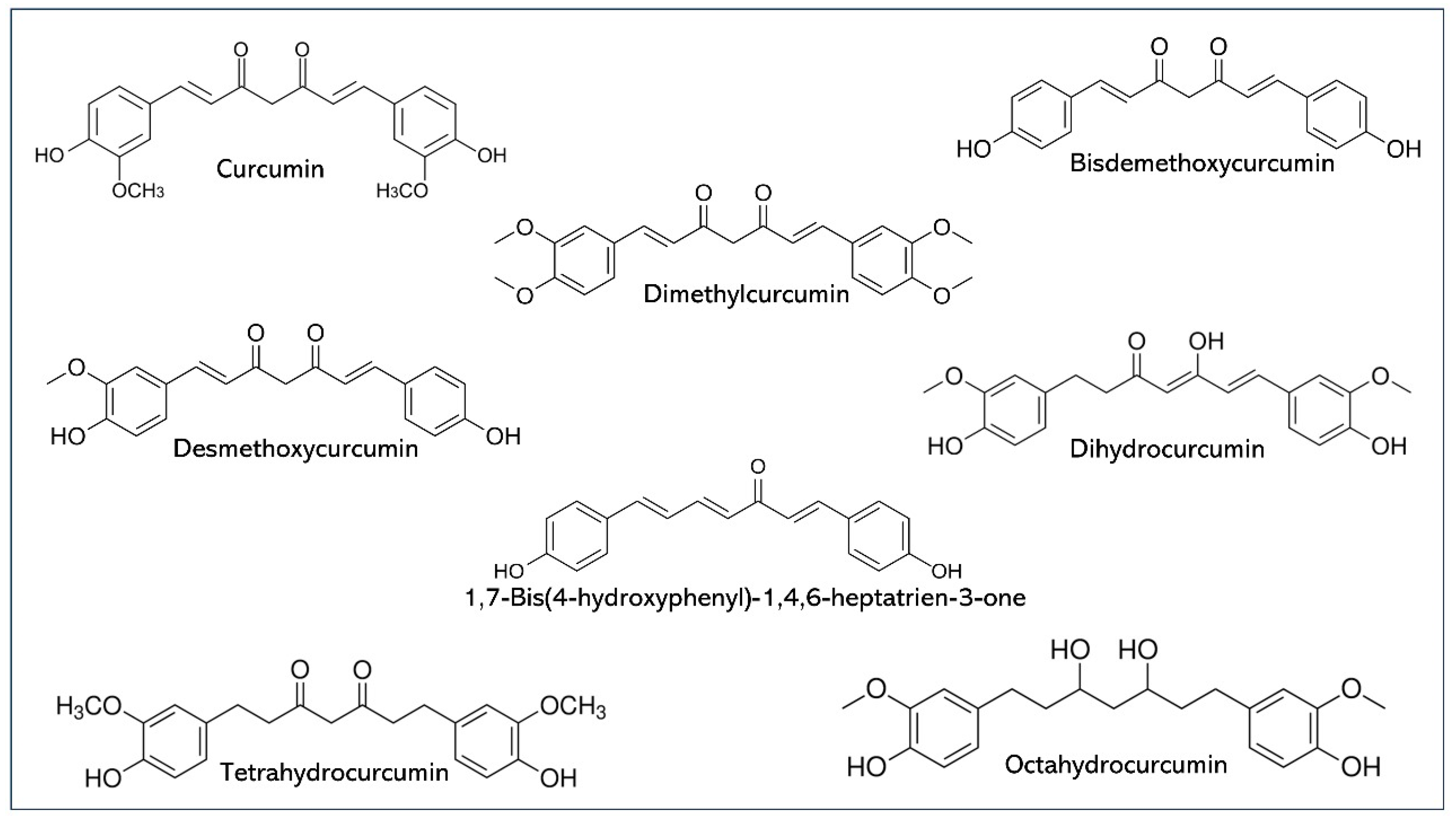
Figure 2.
Abbreviations: AKT: Protein kinase B; COX-2: Cyclooxygenase-2; GF: Growth factors; GSK 3β: Glycogen synthase kinase-3 beta; HO-1: Heme oxygenase-1; NQO-1: NAD(P)H quinone oxidoreductase 1; IL-1: Interleukin-1 family; INF-γ: Interferon gamma; iNOS: Inducible-nitric oxide synthase; LOX: Lipoxygenases; MDSC: Myeloid-derived suppressor cells; mTORC1: Mammalian target of rapamycin complex 1; NFκB: Nuclear factor kappa B; NK cells: Natural Killer cells; PI3K: Phosphoinositide 3-kinase; TRADD: TNFR1-associated death domain protein; TRAF1/2: TNF receptor associated factor 1 and 2; Tregs: Regulatory T cells; TSC1/2: Tuberous sclerosis proteins 1 and 2.
Figure 2.
Abbreviations: AKT: Protein kinase B; COX-2: Cyclooxygenase-2; GF: Growth factors; GSK 3β: Glycogen synthase kinase-3 beta; HO-1: Heme oxygenase-1; NQO-1: NAD(P)H quinone oxidoreductase 1; IL-1: Interleukin-1 family; INF-γ: Interferon gamma; iNOS: Inducible-nitric oxide synthase; LOX: Lipoxygenases; MDSC: Myeloid-derived suppressor cells; mTORC1: Mammalian target of rapamycin complex 1; NFκB: Nuclear factor kappa B; NK cells: Natural Killer cells; PI3K: Phosphoinositide 3-kinase; TRADD: TNFR1-associated death domain protein; TRAF1/2: TNF receptor associated factor 1 and 2; Tregs: Regulatory T cells; TSC1/2: Tuberous sclerosis proteins 1 and 2.
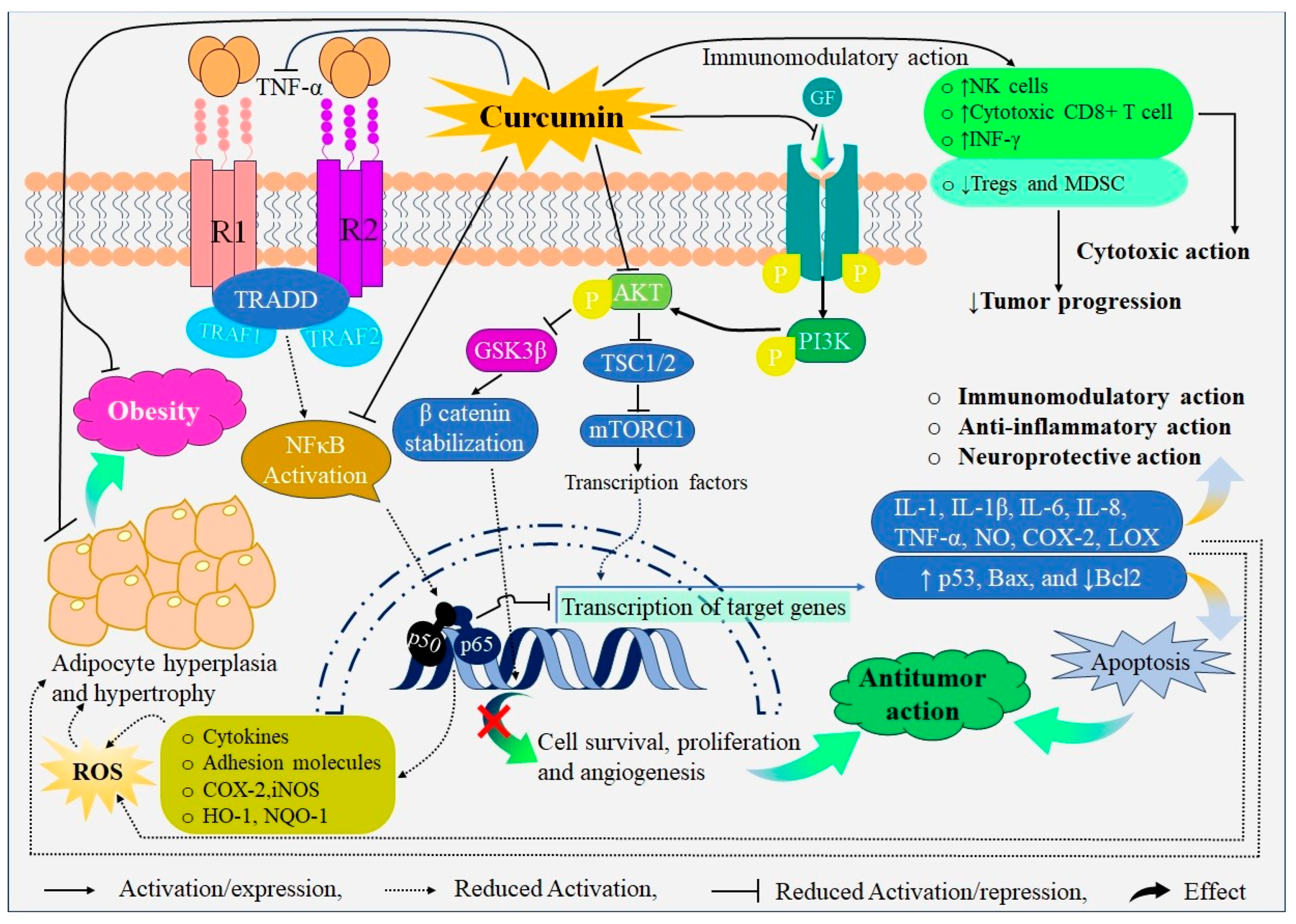
Figure 3.
Summary overview of pharmacological activities of curcumin.
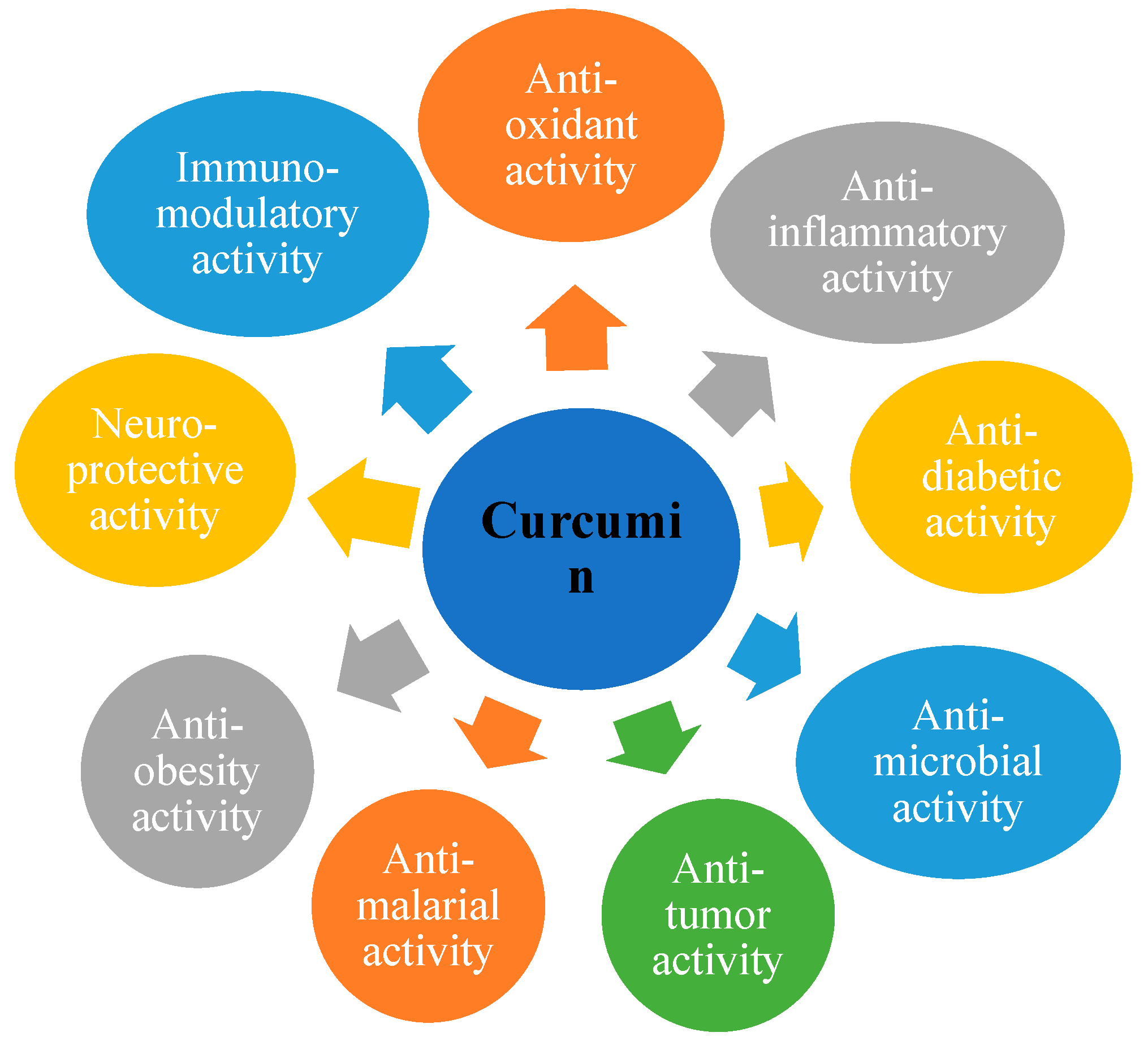

Table 1.
Summary of studies of therapeutic potential of curcumin.
| Activity | Study type | Subjects/Methods | Main findings | References |
|---|---|---|---|---|
| Anti-oxidant | In vitro | DPPH scavenging method | Curcumin exhibited more potency in scavenging of superoxide free radicals followed by demethoxycurcumin and bisdemethoxycurcumin. | [181,182] |
| In vitro | Styrene oxidation method | Curcumin showed phenolic chain-breaking antioxidant activity | [21] | |
| In vitro | RAW264.7 cells | Curcumin demonstrated resistance to oxidising agents by activating the Nrf2-Keap1 pathway and boosting the activity of antioxidant enzymes. | [183] | |
|
In vitro, In vivo & In silico |
DPPH scavenging method Radiation-induced peroxidation of lipid in liver microsomes of rats DFT studies |
Curcumin inhibited lipid peroxidation by 82% and dimethoxy curcumin by 24%. In curcumin, the hydrogen of -OH is more labile for separation than the hydrogen of -CH(2). |
[184] | |
| In vitro | Laser flash photolysis and pulse radiolysis | The donation of H-atom by curcumin is the preferred antioxidant mechanism over electron donation to free radicals. | [95] | |
| In vitro | DPPH scavenging method ABTS radical scavenging activity DMPD radical scavenging activity Total antioxidant activity |
Curcumin exhibited free radical scavenging activity against DPPH, ABTS, DMPD, superoxide anion free radical, and H2O2, as well as for ferrous (Fe2+) ion chelation and ferric ion (Fe3+) reduction. |
[94] | |
| In vitro | Phosphomolybdenum peroxidation method Linoleic acid peroxidation methods |
Curcumin showed maximum anti-oxidant activity followed by demethoxycurcumin and then bisdemethoxycurcumin | [185] | |
| In vitro | DPPH scavenging method | Curcumin nanosuspension samples exhibited similar anti-oxidant activity to simple curcumin mixture. | [186] | |
| In vivo | Fumonisin-induced oxidative stress in birds | Compared to curcumin, nanocurcumin (10 mg/kg) exhibits stronger antioxidant effects, as demonstrated by the reduction of thiobarbituric acid reactive substance (TBARS), ALT, AST, and ROS levels, as well as an increase in SOD and CAT concentrations. | [187] | |
| In vivo | Stress-induced oxidative in hens | Curcumin supplementation produces reversal of heat-induced increase in lipid peroxidation, and decrease in antioxidant profile. | [188] | |
| In vivo | Ochratoxin A-induced hepatotoxicity in rats | Curcumin restored the ochratoxin A-induced reduction in SOD, CAT, and GPx levels in liver tissues. | [189] | |
| Anti-inflammatory |
In vitro& In vivo |
Arachidonic acid metabolism 12-O-tetradecanoylphorbol-13-acetate (TPA)-induced epidermal inflammation and tumor progression in mice |
Addition of curcumin (5-10 microM) to epidermal microsomes produces inhibition of arachidonic acid metabolism into PGE2, PGF2α, and PGD2. Topically applied curcumin results in inhibition of the activity of LOX and COX in epidermal inflammation. |
[190] |
| In vivo | Carrageenan-induced oedema in rats, mouse, and cats. | Curcumin is less ulcerogenic than phenylbutazone and exerts anti-inflammatory activity that is comparable to that of phenylbutazone. It also impeded the increased levels of SGOT and SGPT that were induced by inflammation. | [191] | |
| In vivo | Patients with metabolic syndrome | In patients with metabolic syndrome, the administration of curcumin (1 g/day) once daily results in a substantial decrease in serum levels of inflammatory cytokines. | [192] | |
|
In vitro& In vivo |
BEAS-2B cells Ovalbumin (OVA) to induce chronic asthma in mice |
In vitro and in vivo models, curcumin suppresses PPAR activation, inhibits NF-κB p65 translocation, and improves the increased expression of MCP-1 and MUC5AC induced by OVA and IL-4. | [193] | |
| In vivo | Chronic unpredictable mild stress-induced inflammation in rats | Curcumin demonstrated an antidepressant effect by inhibiting the activation of NF-κB and reducing the expression of pro-inflammatory cytokines. | [160] | |
| In vitro | BV2 cells | Curcumin suppresses inflammation induced by LPS by controlling microglia polarization (M1/M2), balancing TREM2/TLR4, and inhibiting NF-κB activity. | [69] | |
|
In vitro& In vivo |
Beas-2B cells cigarette smoke (CS)-induced COPD in rats |
Curcumin prevents cigarette smoke-induced inflammation in both vivo and in vitro, possibly by regulating the PPARγ/NF-κB signaling pathway. | [194] | |
| In vivo | Ulcerative colitis patients | Combining drug therapy with curcumin supplementation significantly reduced serum high-sensitivity CRP and ESR levels in ulcerative colitis patients. | [73] | |
| In vitro | BV-2 microglia | Curcumin reduces LPS-induced NO and pro-inflammatory cytokine production in microglial cells. | [195] | |
| In vitro | HeLa and RAW264.7 cells | Curcumin’s oxidative intermediates blocked IKKβ, an activating kinase upstream of NF-κB. | [196] | |
| In vivo | Patients of knee osteoarthritis | Curcuminoids produced significant anti-inflammatory effect. | [197] | |
| In vivo | Patients with solid tumor | Curcuminoid preparation (180 mg/day) produces significant reduction in TNFα, IL-6, substance P, hs-CRP, CGRP and TGF-β as compared to placebo control. | [198] | |
| In vivo | Spinal cord injury-induced inflammation in rats | Curcumin inhibited the formation of glial scars by preventing the production of MIP1α, IL-2, and CCL5 and by reducing NF-κB activation. | [199] | |
| Antidiabetic | In vivo | Streptozotocin (STZ) model of diabetes in rats | The microstructural alterations of pancreatic tissue were restored, and plasma glucose, insulin, and C-peptide levels were significantly reduced in diabetic rats after 40 days of treatment with a novel curcumin derivative (NCD). | [200] |
| In vivo | STZ model of diabetes in rats | Curcumin restored the levels of TBARS and GSH in diabetic rats, thereby normalizing blood glucose and hepatic oxidative stress. Additionally, it upregulates the expression of the IGF-1, Bcl2, SOD, and GST genes in hepatic tissues. | [201] | |
|
In vitro & In Silico |
α-Glucosidase and α-Amylase Inhibition methods | Curcumin-based benzaldehyde derivatives (L8, L11, and L13) reduce the glycemic index and inhibit the primary pathways that generate reactive oxygen species (ROS). | [202] | |
| In vitro | Streptozotocin-Nicotinamide (STZ-NA) model in rats | In comparison to the diabetic control, turmeric extracts (bioenhanced turmeric extract, BTE; regular turmeric extract, RTE) resulted in a decrease in blood glucose and an increase in oral glucose tolerance. Additionally, it demonstrated improvements in pancreatic β cell function and insulin sensitivity, as well as a decrease in insulin resistance. | [203] | |
| In vivo | High fat diet and low dose STZ model of diabetes in rats | Curcumin (at a higher dose) resulted in a substantial decrease in the levels of fasting blood glucose, total cholesterol, TGs, LDL-C, HDL-C, ALT, and AST, as well as liver coefficient and MDA, and BCL2-associated X expression in rats with type 2 diabetes mellitus. | [204] | |
| In vivo | Alloxan-induced diabetes in rats | Turmeric, either alone or in combination with Ajwa date seed and black pepper, produced antihyperlipidemic and weight-stabilizing effects in alloxan-induced diabetic mice. | [205] | |
| Antimicrobial | In vitro | B. subtilis | The formation of the cytokinetic Z-ring in B. subtilis was significantly inhibited by curcumin. Additionally, impeded the assembly of FtsZ protofilaments and enhanced the GTPase activity of FtsZ. | [206] |
|
In vitro& In vivo |
Clinical isolates of H. pylori H. pylori infection in mice |
Curcumin showed promising anti H. pylori action against clinical isolates, with MIC ranging between 5 and 50 μg/ml. It exhibited high effectiveness in eradication of H. pylori from infected mice as well as in restoration of H. pylori-induced gastric damage. | [207] | |
| In vitro | HSV-1 in cell culture | Curcumin and its novel compounds exhibit considerable antiviral activity against HSV-1 in cell culture. | [208] | |
| In vitro | Broth microdilution method Checkerboard dilution test, and Time-kill assay |
The combination of oxacillin, ampicillin, ciprofloxacin, and norfloxacin with curcumin demonstrated synergistic activity against MRSA. | [52,209] | |
| In vitro | Human neutrophil peptide-1 (HNP-1) | Curcumin I demonstrated time and dose-dependent action against S. aureus and E. coli at concentrations as low as 25 μM, killing 50% of bacteria after 2 hours of incubation. The damage to the cell membrane may have contributed to the broad-spectrum antibacterial action. | [210] | |
| In vitro |
S. aureus E. coli |
Nanocurcumin cream demonstrated superior antibacterial efficacy against S. aureus and E. coli, with a broader zone of inhibition than curcumin cream. | [211] | |
| Antitumor and anticancer | In vitro | Esophageal adenocarcinoma (EAC) cells | Nanocurcumin therapy with T cells on EAC cells (OE19 and OE33) demonstrated potential by boosting T cell cytotoxicity. This could be because curcumin increases EAC sensitivity to T cells’ cytotoxic actions. | [212] |
| In vitro | HT-29 colorectal adenocarcinoma cells | Curcumin influences the metabolomics of probiotics in intestinal flora, with a particular emphasis on Lactobacillus plantarum. This, in turn, induces apoptosis, which may impact their anticancer properties. | [213] | |
| In vitro | Oral carcinoma CAL-27 cells | Curcumin therapy reduces cell viability by inducing apoptosis and down-regulating Notch-1 and NF-κB. | [214] | |
| In vitro | Breast cancer stem cells | Curcumin induces apoptosis and suppresses the proliferation of breast cancer stem cells (BCSCs) irrespective of the expression of hormone receptors. | [215] | |
| In vitro | HT-29 cells | Curcumin (10–80 mol/L) inhibits the proliferation of HT-29 cells and promotes apoptosis. In addition, it promotes the expression of Bax and Bad while simultaneously suppressing the expression of Bcl-2, Bcl-xL, and survivin. | [216] | |
| In vitro | HT-29 cells | Curcumin induces DNA fragmentation, chromatin condensation, nuclear shrinkage, and increased cellular death in HT-29 cells via producing ROS in a dose- and duration-dependent manner. | [217] | |
| Antimalarial |
In vitro & In vivo |
Plasmodium falciparum culture Plasmodium berghei-infected mice |
The growth of chloroquine-resistant Plasmodium falciparum in culture medium is suppressed in a dose-dependent manner by curcumin, with an IC50 of approximately 5 μM. Oral curcumin administration produced a reduction in blood parasitemia in Plasmodium berghei-infected mice. |
[218] |
| In vitro | P. falciparum culture | Curcumin treatment damages both mitochondrial and nuclear DNA, most likely due to an increase in intracellular ROS. It also inhibits PfGCN5 HAT activity by reducing histone H3 acetylation at K9 and K14. | [219] | |
|
In vitro & In silico |
P. falciparum culture Molecular docking by using homology modeling by SWISS-MODEL server |
Curcumin produces dose-dependent morphological changes and suppresses parasitic growth, as evidenced by changes in microtubule morphology compared to untreated. Both the diketo and enol forms of curcumin showed more than 250 binding positions, mostly at the alpha and beta subunit interfaces, which overlap with colchicine. |
[220] | |
| In vivo | Plasmodium berghei NK65-infected mice | Curcumin treatment (i.p.) inhibits the GSK3β, resulting in a dose-dependent reduction of parasitemia and levels of pro- and anti-inflammatory cytokines in the aftermath of P. berghei infection. | [221] | |
| In vitro & In vivo |
RAW 264.7 cell line Peter’s 4-day suppressive protocol in mice model |
Curcumin-loaded PLGA nanoparticles were more cytotoxic than free curcumin to the RAW 264.7 cell line. PLGA-encapsulated curcumin (5 and 10 mg/kg) effectively suppresses parasitic growth (56.8%) compared to free curcumin (40.5%), without causing significant alterations in serum markers of hematologic and liver toxicity. |
[222] | |
| Anti-obesity | In vivo | Animal model of obesity | The ethanolic extract of curcumin enhances lipid breakdown and β-oxidation by increasing the expression of lipases, including adipose triglyceride lipase, hormone-sensitive lipase, adiponectin, and AMP-activated protein kinase. | [223] |
| In vitro | Abdominal subcutaneous adipose tissue (ASAT) explants, and lLPS-induced-mononuclear cells (iMC) | The hexane extract of Curcuma longa, which contains a variety of curcuminoids, exhibits anti-obesity, significant inhibitory activity against lipase, α-amylase, and α-glucosidase. | [224] | |
| In vivo | High fat diet-induced obesity in rats | Curcumin demonstrated antitoxic, antioxidant, cytoprotective, and anti-obesity effects by reversing the effects of a high-fat diet on glucose, TAGs, and insulin, as well as DNA fragmentation, MPO, GSH, and SOD in hepatic tissue, and the expression of TLR4, IL-6, and TNF-α. | [225] | |
|
In vitro& In vivo |
3T3-L1 adipocytes High-fat diet (HFD)-induced obesity in mice |
The ethanolic extract of Curcuma longa (CLE) inhibited lipid accumulation and restored differentiation-induced alterations in adipogenesis and lipolysis-related proteins in 3T3-L1 cells by restoring AMPK phosphorylation. Furthermore, CLE reduced HFD-induced increases in body weight, AST, ALT, cholesterol, LDL, ACC, PPAR-g, SREBP1, FABP4, FAS, adiponectin, and leptin, as well as activation of AMPK. | [226] | |
|
In vitro& In vivo |
3T3-L1 adipocytes High-fat diet (HFD)-induced obesity in mice |
Curcumin upregulates the EIF2 and mTOR signaling pathways, thereby suppressing the LPS-induced increase in IL-6 in 3T3-L1 adipocytes. Furthermore, the administration of curcumin in HFD-induced obese mice led to the detection of metabolites such as tetrahydrocurcumin (THC) and curcumin-O-glucuronide (COG). | [227] | |
| Neuroprotective | In vivo | CUMS-induced depression in rats | The administration of chronic curcumin (40 mg/kg, i.p.) results in the suppression of neuronal apoptosis within neurons of the ventromedial prefrontal cortex (vmPFC), as well as the reduction of depression-like behaviors and the expression of interleukin-1β (IL-1β). | [228] |
| In vivo | FST and TST model of depression in mice | Curcumin-loaded thermos-sensitive hydrogel reduces immobility duration in FST and TST in mice and enhances neurotransmitters such as NE, DA, 5-HT, and their metabolites in the hippocampus and striatum. | [229] | |
| In vitro | Primary hippocampal neurons | Curcumin ameliorated the cellular oxidative stress in cultured primary hippocampal neurons of rats, thereby inhibiting the Aβ-mediated intracellular toxicity. | [230] | |
| In vivo | MCAO-induced ischemic brain injury in rats | Curcumin exhibited neuroprotective effects by inhibiting the intracellular transcription of NAD(P)H: quinone oxidoreductase1 (NQO1) and Akt phosphorylation, which in turn ensued in an increase in the binding of NRF2 with ARE. | [231] | |
| In vivo | 6-OHDA-induced Parkinson’s disease in rat | Curcumin has been observed to protect neurons from 6-OHDA-induced injury, as evidenced by improved memory function, which is achieved by reducing neuronal oxidative stress and increasing DA and ACh levels in the substantia nigra of rats. Additionally, subsequent to curcumin administration, there was a decrease in intercalatum heat shock protein 70 (HSP70) and an upsurge in the expression of basic fibroblast growth factor (bFGF), nerve growth factor (NGF), and receptor tyrosine kinase A (TrkA). | [232] | |
| In vivo | APPsw transgenic mice | Curcumin at a lower dose stimulated microglial migration to and phagocytosis of amyloid plaques, decreased miR-155-mediated neurodegenerative phenotype, and reduced amyloid stress in mouse brains. | [233] | |
| In vivo | 6-OHDA-induced Parkinson’s disease in rat | Curcumin reduced 6-OHDA-induced hippocampus damage by raising the expression of BDNF, TrkB, and PI3K, as well as elevating neurotransmitters like DA and NE in hippocampal neurons. | [234] | |
| In vivo | Traumatic brain injury in mice | Curcumin protects against TBI-induced secondary brain injury, as evidenced by reduced water content, reactive oxygen species (ROS), neurological impairment score, and cell death. This protection is accomplished by increasing Bcl-2 levels and translocating Nrf2, which prevents a decrease in antioxidant enzymes by increasing the expression of heme oxygenase 1 (HO1) and NAD(P)H: quinone oxidoreductase 1 (NQO1). | [235] | |
| Immunomodulatory | In vitro | Human B lymphocyte cell lines and HepG2 cell line | Curcumin inhibits the translocation of p65 into the nucleus, thereby inhibiting the activity of B lymphocytes, by diminishing the DNA binding to the promotor region of the B lymphocyte stimulator, thereby suppressing NF-κB signaling. |
[236] |
| In vivo | Patients with osteoarthritis | Osteoarthritis patients experience a decrease in the frequency of Visual Analog Score following administration of curcumin (80 mg). | [237] | |
| In vitro | RAW-264.7 cells of mouse | Curcumin suppresses PHA-induced T-cell growth, production of IL-2, NO generation, and LPS-induced NF-κB, while increasing NK cell cytotoxicity. | [238] | |
| In vivo | Balb/c mice | Administration of curcumin leads to elevated white blood cell count, circulating antibodies targeting sheep red blood cells, plaque-forming cells (PFC) in the spleen, and increased bone marrow cellularity in mice. | [239] | |
|
In vitro& In vivo |
RAW 264.7 macrophages CPA-induced immunosuppression in mice |
Curcumin treatment produces inhibition of NO production, reduced expression of iNOS and COX-2 by inhibiting ERK 1/2 and p38 activation in RAW 264.7 macrophages. Additionally, curcumin produces reversal of CPA-induced changes in body weight, immunoglobulins, and NK cell activity in mice. | [240] |
Abbreviations: CGRP, calcitonin gene-related peptide; hs-CRP, high-sensitivity C-reactive protein; MIP1α, Macrophage Inflammatory Protein-1 Alpha; AMPK, 5′ AMP-activated protein kinase; CUMS, chronic unpredictable mild stress; MCAO, middle cerebral artery occlusion; OGD, Oxygen and glucose deprivation; NRF2, nuclear factor-erythroid 2-related factor 2; ARE, antioxidant response element; 6-OHDA, 6-hydroxydopamine; BDNF, brain-derived neurotrophic factor; TrkB, tyrosine protein kinase gene; PI3K, phosphatidylinositide 3-kinases; DA, dopamine; NE, norepinephrine; CPA, cyclophosphamide; COX-2, Cyclooxygenase-2; iNOS, inducible nitric oxide synthase; PHA, phytohaemagglutinin.
Disclaimer/Publisher’s Note: The statements, opinions and data contained in all publications are solely those of the individual author(s) and contributor(s) and not of MDPI and/or the editor(s). MDPI and/or the editor(s) disclaim responsibility for any injury to people or property resulting from any ideas, methods, instructions or products referred to in the content. |
© 2024 by the authors. Licensee MDPI, Basel, Switzerland. This article is an open access article distributed under the terms and conditions of the Creative Commons Attribution (CC BY) license (http://creativecommons.org/licenses/by/4.0/).
Copyright: This open access article is published under a Creative Commons CC BY 4.0 license, which permit the free download, distribution, and reuse, provided that the author and preprint are cited in any reuse.