

Submitted:
18 September 2024
Posted:
19 September 2024
You are already at the latest version
Abstract
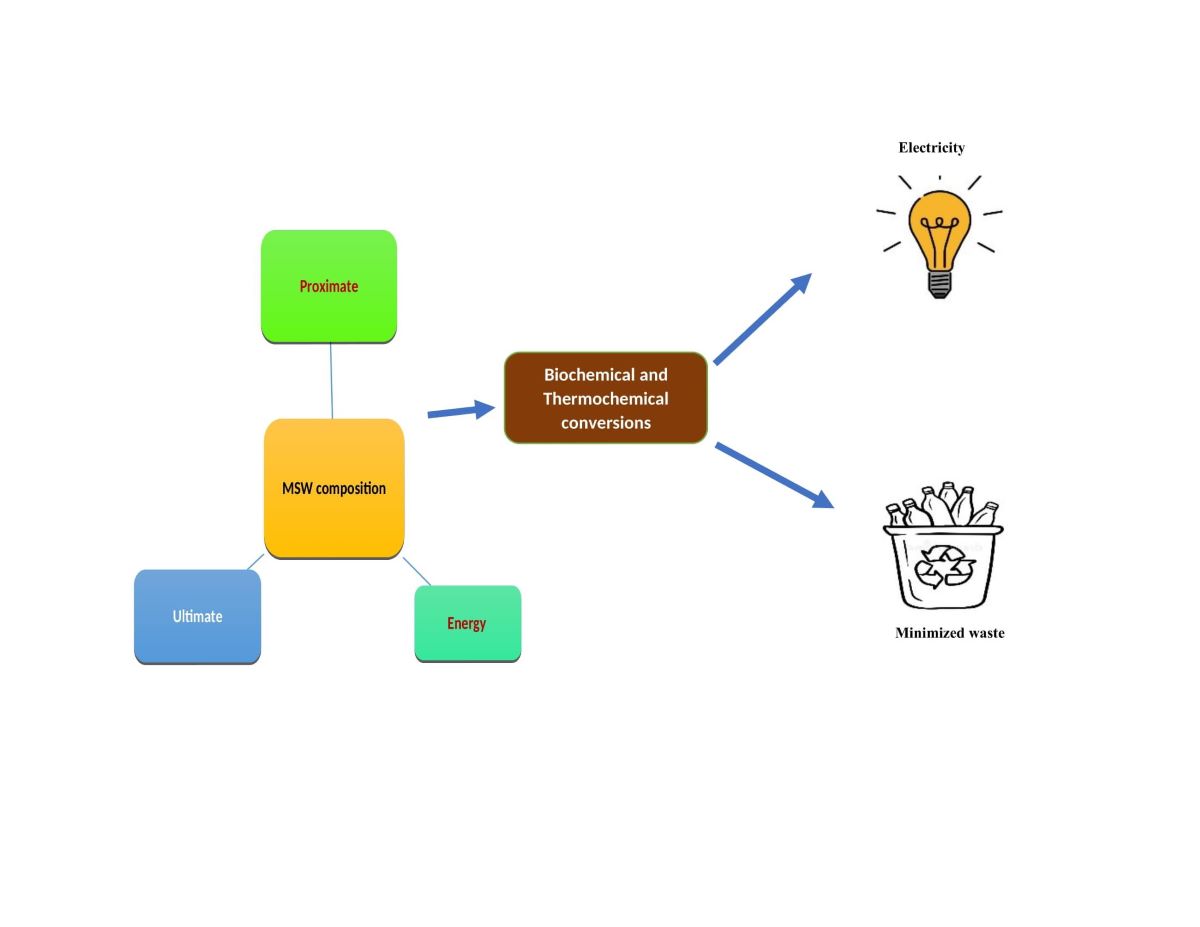
Ghana spends over $4000 (US dollars) annually managing municipal solid waste (MSW) with little improvement in regional sanitation. Energy demand in the country is also on the rise. Therefore, addressing waste problems via the waste-to-energy valorization approach is necessary for dual benefits. This paper thus seeks to comprehensively review Ghana's MSW's proximate and ultimate compositions for biological and thermochemical conversions. Studies between 2011 and 2024 were analyzed. The findings revealed that the organic fraction of Ghana’s MSW is currently about 10.47Kt per day. The proximate analysis reveals a moisture content from 13.55 – 61.9 %, volatile matter ranges from 6.24 - 80.25%, and the calorific value ranges from 14.96-21.46MJ/Kg. The ultimate analysis revealed that the carbon-to-nitrogen ratios range from 24.3-32.2, and the hydrogen content ranges from 5.53-22.8%. The sulphur and nitrogen contents were below 0.6 and 1.7% respectively. Approximately 2,534.65 GWh of electricity is estimated from the organic fraction. Ghana’s MSW is more suited for biochemical conversions.
Keywords:
waste valorization
; municipal solid waste management
; proximate analysis
; ultimate analysis
; biomethane potential
; waste composition
1. Introduction
In this present era of climate change mitigation, the subject of waste management cannot be overlooked. Solid waste naturally releases greenhouse gases such as carbon dioxide and methane through fermentation. However, indiscriminate burning and open dumping exacerbate the present crises. In developing countries, about 40% of municipal solid waste (MSW) is burned or dumped openly without appropriate measures [1]. The repercussions affect aquatic and terrestrial habitats [2,3]. Global waste generation is predicted to reach 27 million tonnes by 2050 [4]. The main driver, urbanization, will peak in the next 30 years culminating in a per capita generation rate of 1.42kg/day globally [5,6].
In a country with an evolving economy like Ghana, proper sanitation is certainly a public good but the resources available to adequately address MSW management problems are limited [7,8]. Waste management notwithstanding, local governments are burdened with other competitive necessities that require fiscal resources. The effect, therefore, is weak stakeholder participation underpinning a poor waste management system [9]. A subject, that was in the past regarded as a local management issue, has gradually assumed a national outlook due to escalating population and urban influx amidst revenue decline [10,11,12].
Recently, many emerging economies realizing that proper waste disposal cannot singlehandedly address the grandiose waste management issue, have embraced resource recovery. Waste-to-energy projects have been reported in South Africa, Mauritius, Namibia, Ethiopia, and Ghana. Unfortunately, due to inadequate MSW data, most African countries including Ghana have underutilized the energy locked up in their waste and have employed only composting and landfilling methods hitherto [13]. For instance, though some biogas plants operate in households and institutions, there are no commercially recognized biogas projects [14]. Nevertheless, Ghana’s Ministry of Energy has laid out a master plan for renewable energy to harness electric power in municipal biomass via biogas production [15].
Poor waste management and energy scarcity are interconnected [16]. The pair are twin issues besieging the Ghanaian economy in a vicious cycle. Ghana faces waste management [17] and energy crises [18]. The proportion of waste not collected outweighs the percentage collected and properly disposed of [19] leading to floods, water pollution, and the spread of diseases endangering human and animal life [20]. In the same vein, Ghana imported 38.35% of energy between 2000 and 2020 due to a 50% increase in Ghana’s energy needs [18]. Meanwhile, about 80% of MSW have the potential to be recovered and 63.6% can potentially undergo anaerobic digestion for energy production [21]. More so, studies reveal that Ghana’s crop residues can reduce reliance on wood fuel, LPG, and electricity [22]. Organics and plastics jointly form 75% with organics being the highest fraction (61%) [23]. Fortunately, food waste is inexhaustible and affordable offering an advantage for large-scale electricity production [24,25].
Ghana generates over 12.71Kt of MSW, on average [23], underpinning the fact that the necessary raw materials for waste-to-resource conversions are available. To circumvent the twin predicaments, it is expedient to evaluate Ghana’s MSW generated and consider the possibility of waste valorization. The selection of potential feedstocks for resource recovery depends on proximate, ultimate, and energy composition [26]. This review seeks to evaluate Ghana’s MSW characteristics and assess proximate and ultimate compositions, and energy potentials for valorization.
2. Methodology
The study centers on MSW from Ghana's various regions, highlighting the waste characteristics, proximate and ultimate compositions, and calorific values. Ghana’s solid waste is worth the study for many reasons. First and foremost, MSW is a real challenge for Metropolitan, Municipal, and District Assemblies [19]. There is inadequate infrastructure to manage the waste generated but rapid urbanization and indiscriminate dumping habits exacerbate the situation [27]. Secondly, the country’s electricity largely depends on thermal and hydropower with biomass sources representing a smaller fraction [28]. The energy demand keeps increasing with population growth [29] necessitating the waste-to-energy approaches. Finally, addressing Ghana’s MSW helps achieve sustainable development goals that include SDG 6 (Clean Water and Sanitation), SDG 3 (Good Health and Well-being), SDG 11 (Sustainable Cities and Communities), and SDG 12 (Responsible production and Consumption) [30].
To ensure the accuracy of the findings, careful selection criteria were employed. Only research conducted in Ghana on municipal solid waste, proximate and ultimate analysis, and energy potentials were considered. Countries outside Ghana were selected only to compare proximate and ultimate composition and calorific values. The paper considered the MSW generated, management practices, and MSW characteristics of the regions. The paper then zoomed into proximate, ultimate, and energy discourse. Studies had to be published between 2011 and 2024 to ensure recency. Studies that did not provide sufficient data were excluded. 85 published articles were obtained. Articles with enough data on the proximate, ultimate composition, and calorific contents strictly for MSW in Ghana were only 7, 6, and 5 respectively.
A comprehensive search strategy was employed. Scopus and Google Scholar were searched using the following keywords “municipal solid waste” AND “Ghana”, “MSW proximate analysis” AND “Ghana”, “MSW ultimate analysis” AND “Ghana” “MSW calorific value” AND “Ghana”, “MSW biomethane potential” AND “Ghana”. The search engine was limited to English papers. Data was extracted from tables and graphs, and key findings were grouped under common themes. The findings were summarized and synthesized comprehensively. The waste generated was estimated by population ×per capita waste generation [31]. The estimated organic waste = Total MSW×% organics. The estimated biogas, biomethane, electricity, and biodiesel potentials were calculated using conversion factors of 1.29,1.70, 4.13, and 13.69 respectively [32].
3. Results and Discussion
This section may be divided by subheadings. It should provide a concise and precise description of the experimental results, their interpretation, as well as the experimental conclusions that can be drawn.
3.1. MSW Management in Ghana
3.1.1. Population and Waste Generation
Using the 2021 Population and Housing Census growth rates and waste generation rates [21,31,33,34], Ghana’s MSW was estimated (Table 1). With a population of 27,043,093, Ghana produced 12.71Kt of waste per capita generation of 0.74kg daily. Each Ghanaian averagely produced 0.318kg of biodegradable and 0.096kg of recyclable waste daily [31]. The population has shot up to 30, 832,019 [35], and the waste produced has consequently increased to approximately 17.78 Kt per day. The sum of population percentages of Greater Accra (17.7%), Ashanti (17.6%), Central (9.2%), and Eastern regions (9.5%) exceeds half of the country’s population (Figure 1). The wastes generated from these regional capitals form 66.5% of total MSW. The coastal and forest zones contribute about 75% of Ghana’s waste whereas the savannah zone contributes about 6% with a per capita waste generation between 0.21-0.33kg/person/day [31]. Greater Accra, with the highest population, generates more than 3500 metric tonnes of waste per day with plastic forming one-tenth of the overall waste produced [36]. Besides the escalating population, economic status has also influenced the MSW generation rate. Cities with rapid socioeconomic growth produce waste in high quantities in most emerging nations [37]. Accra and Kumasi produce the highest waste in Ghana. Accra is about 85% urbanized with a population of 1,681.3 and Kumasi has a population of 443, 981 occupying an area of 68 km2 [38]. Both are estimated to generate over 4,000 tonnes of waste per day in 2010 [19] and about 8,117.56 tonnes presently.
3.2. MSW Management in Ghana’s Metropolitan Assemblies
Ghana has six metropolitan Assemblies; Kumasi Metropolitan Assembly (KMA), Cape Coast Metropolitan Assembly (CCMA), Accra Metropolitan Assembly (AMA), Tema Metropolitan Assembly (TMA), Tamale Metropolitan Assembly (TaMA), and Sekondi- Takoradi Metropolitan Assembly (STMA). Accra and Kumasi are Ghana's two most populated cities [39]. The Accra and Kumasi Metropolitan Assemblies generate about 501.9Kt and 440Kt of waste respectively [19]. Except for Accra and Tema, less than half of the waste dumped in containers is collected in the metropolitan assemblies (Figure 2). Due to the inadequate number of skip trucks [27] and bad roads [41], only 27.6% of MSW in Ghana is collected. Furthermore, due to the inadequate number of containers and bins [27], about 14.4% of waste generated is dumped openly, and about 3.2% is disposed of indiscriminately. Although Ghana spends over GH ¢34 million (equivalent to USD 4000) managing waste annually, the improvement is minimal [19].
Waste management is executed primarily by private contractors in collaboration with municipal assemblies [42]. In the Accra Metropolitan Assembly (AMA), while private companies carry out their waste services on the household level, the AMA collects waste from commercial centers.
Depending on the level of income of a particular area, the residents are mandated to pay waste disposal fees set by the AMA authority to the private contractors assigned to their jurisdiction [19]. Periodically, the AMA provides free waste bins to enhance waste collection. The AMA also registers waste-collecting operators in the informal sector who render services using tricycles commonly known as “borla taxis”. The informal sector’s contribution to waste services is, without doubt, a massive input though operators face discrimination. There are about 2000 “borla taxi” operators in Accra, rendering services in places that are inaccessible to waste-collecting trucks [43]. In the Kumasi Metropolitan Assembly, nine (9) service operators have been allocated to the ten sub-metros for five years. The fees are differentiated per residence type. High-income residents pay GH ¢10.00; middle-income earners pay GH ¢8.00 and low-income residents are charged GH¢ 5.00. The final destination of the collected waste is the Oti sanitary landfill. Although the Accra and Kumasi recycling plants have been recycling about 400 tonnes of waste daily [19], the percentage of MSW recycled so far is low compared to the quantity generated [44]. Inadequate fiscal resources, implementation of policy, and skilled personnel are key issues affecting Ghana’s MSW management [45].
3.1.3. Waste Typology
MSW emanates from households (55-80%), marketplaces (20-40%), industries, organizations, and streets [45,46] thereby exhibiting heterogeneity in composition, size, and rate of generation [47]). Table 2 displays the MSW characteristics of some regional capitals. The waste composition in Ghana includes organics, plastics, inert materials, papers, textiles, metals, glasses, leather, and rubber [31,37,48]. Organic waste occupies the highest fraction of municipal solid waste in developing countries [31] primarily from domestic and agricultural sources. Due to post-harvest losses and inadequate storage facilities, high organic waste is produced from Ghanaian markets [46]. Globally, the organic fraction of MSW is approximately 92 % [47]. Restaurants, “chop bars”, hotels, and markets contribute heavily to municipal solid waste [49]. Most metropolitan and municipal district assemblies in Ghana record organic waste fractions over 50% presenting the potential for use in composting and anaerobic digestion [31,33,37]. The organic fraction decreases approaching the northern savannah zones (Seshie et al., 2020). Some agroecological zones produce a lot of organic waste due to excess crop residues from farming activities [50]. Plastics are second to organic waste on the ratio scale forming 10- 14% of total waste [31,33,34,37]. More plastic wastes are generated in the Northern savannah compared to other zones [31]. The least generated waste is leather which occupies 1-2.1% of total waste. The population earnings, geographic regions, lifestyle, seasonal changes, and waste management systems influence the quantity and types of waste generated in a region [51,52].
Plastic waste is Ghana's second most produced waste due to the rampant use of plastic packages [31]. Polyethylene bags are free for any commodity purchased in shops or retail centers [56]. Ghana’s non-biodegradable portion forms about 30% of MSW with plastics constituting about 14% [31]. Ghana produces 22,000 tonnes of plastic waste yearly with only 2% being recycled [57]. Accra, the capital city, generates about 2,000 tonnes yearly. Unfortunately, only 60% is collected. Similarly, of the 1,200 tons of plastic waste generated in Kumasi, only 65% are collected [30]. The plastics from households are mainly LDPE, PET, HDPE, PP rigid, PS, and PVC [31].
Figure 3 shows the quantity of Ghana’s waste estimated from the 16 regions using growth rates from the 2021 Population and Housing Census [40] and organic percentages [31,33,34,37]. The results show that the Greater Accra region produces the highest organic waste though not a typical agrarian zone. However, according to [53], the Eastern region produces the highest amount of crop waste annually since it is an agrarian zone. It can be deduced from other studies that since the organic waste fraction of Accra’s MSW is about 65% [31], the organic portions emanate from market waste. The high quantities of organic waste generated from the region can be attributed to the influx of crops that are transported to Ghana’s capital city frequently by market women. Food waste from households, restaurants, and other commercial centers has been reported to contribute highly to Greater Accra’s organic waste fraction [54].
Figure 4 Shows the regional crop residue per annum as reported by [50]. Ghana has six agroecological zones [55] that generate about 10,322.7 kilotons (Kt) of crop residues per year [50]. The most crop residue (5,746.2 Kt), cassava, comes from the semi-deciduous and transitional zones amounting to 42% of the overall crop residue per year. Studies show that the MSW of the Eastern region is about 70% [33] traceable to post-harvest loss from farming activities. The Eastern region produces more than 40% of Ghana’s cassava annually whereas the grain, legume, vegetable, and fruit residues have mainly come from the Guinea and Sudan savannah zones [50]. Generally, Ghana’s food waste, yard waste, wood, manure, and paper waste constitute 49.45%, 8.9%, 1.3%, 0.29%, and 4.95 respectively of household wastes [31]. The biodegradable portion forms about 63.6 - 64. 9% and more than 80% hold the potential as energy and compost sources [31,37].
3.2. Proximate Analysis of MSW from Ghana
Proximate analysis involves the determination of moisture, ash, volatile matter, and fixed carbon contents [58]. Table 3 displays the proximate composition of Ghana’s MSW. The analysis reveals that the Ashanti region’s MSW has a high volatile matter (VM) [46,59,60]. The high VM is a result of the high market waste that forms the highest fraction of the MSW. Some authors have suggested the possibility of biogas production. Other characteristically agroecological regions such as Eastern and Brong Ahafo are also major hotspots for biogas production. Volatile matter is the combustible fraction of MSW released during thermal treatment. It has a significant influence on thermal decomposition [61]. Generally, 50-70% volatile matter content is suitable for incineration, gasification, and pyrolysis [4,62,63]. Ghana’s MSW has a volatile matter ranging from 6.24 - 87.4%.
Fixed carbon is the fraction that remains after the volatile matter has been driven off by heat. It is neither volatile nor ash [64]. For MSW bioenergy conversions, a fixed carbon content between 10-25 % is considered suitable [4]. The fixed carbon (FC) of MSW has been reported to range from 6.24 to 87.4 % for the Ashanti and Greater Accra regions [60]. High FC is an indication of high energy content although it could also imply slow combustion rates [65]. The volatile to fixed carbon (VM/FC) ratio of MSW from the Greater Accra and Ashanti regions is 1.52 indicating high reactivity. For optimal reactivity, the VM/FC ratio should range between 0.5-1.5% [66] since the volatile to fixed carbon (VM/FC) ratio regulates the level of solid fuel reactivity [64].
The moisture content of Ghana’s mixed MSW ranges between 13.55- 80.6 % highlighting their suitability for biochemical processes whereas the refuse-derived fraction (RDF) ranges from 8.11-13.27% which is more suited for thermochemical conversions. The moisture content of Ghana’s MSW also confers an advantage for conversion to compost. MSW with high moisture is not a suitable substrate for thermochemical conversions [67]. A moisture content between 60-90% is good for anaerobic digestion [68,69]; 40-60% is appropriate for composting [70,71], 30% moisture substrate can be incinerated; 20-25% can be incinerated and gasified [66,72,73] and less than 20% is suitable for pyrolysis [74]. Generally, the moisture content of MSW is high with some variations across the regions. The disparity in moisture contents is linked to the differences in waste composition, climatic conditions, and management practices [75].
Ash refers to the remaining portion after fixed carbon has been burnt off [64]. High ash contents are undesirable, resulting in low calorific value and less energy output. Ghana’s MSW contains ash content between 3.69-10.81% [13,76]. This range would not cause sloughing when the MSW is considered for thermal conversions in the future. Ash contents between 10-25% provide a good balance between energy content and ash-related concerns ensuring efficient energy conversion [77].
3.2.1. Proximate Composition of MSW- Ghana vs Other Countries
Figure 5 compares the proximate composition of Ghana’s waste to other countries. Ghana’s MSW has a higher volatile matter content than the MSW of South Africa, where small-scale biomass gasification initiatives exist [81], but lower than the MSW of the USA where plastics occupy a greater fraction of the MSW [82]. The moisture content is low relative to these countries except Ethiopia, Indonesia, and the USA. The Ash content of Ghana’s MSW is less than that of the USA indicating minimal ash-related concerns in the future. Ghana’s consideration of waste-to-energy technologies will be worthwhile.
3.3. Ultimate Analysis of MSW from Ghana
Assessment of Ghana’s MSW reveals that hydrogen contents fall between 5 and 25%, nitrogen contents are between 0.60 and 1.70%, and carbon contents fall between 36 and 45%. For thermo-chemical considerations, MSW carbon content should range between 40-55% [77], hydrogen con-tent 5-7%, sulphur content <1 % [66,72], oxygen content 20-35 [74,87] and nitrogen content 0.5-2% [88]. The sulphur and nitrogen contents of Ghana’s MSW will not cause problems associated with NOx and SO2 gas emissions should the country consider thermochemical conversions for re-fuse-derived fractions. Literature stipulates that for anaerobic digestion, a C/N ratio of 20-30 is ideal [89]. The C/N ratio of Ghana’s MSW is largely between 20-30% which satisfies the basic requirement for anaerobic digestion.

Table 4.
Ultimate analysis of MSW from some regional capitals in Ghana.
| Region | H (%) | N (%) | C (%) | S (%) | O (%) | C/N ratio | Reference |
| Ashanti Ashanti Ashanti |
6.01 | 1.49 | 41.90 | 0.10 | 50.5 | 28.12 | [13] |
| 5.53 | 1.70 | 45.20 | 0.55 | 47.02 | 26.59 | [76] | |
| 24.8 | 1.4 | 43 | 0.4 | - | 30.71 | [46] | |
| Greater Accra | 5.62 | 1.20 | 38.66 | 0.14 | 26.17 | 32.22 | [90] |
| Greater Accra | 6.1 | 1.5 | 36.4 | 0.1 | 29.6 | 24.27 | [92] |
| Greater Accra & Ashanti | 9.33 | 0.62 | 63.7 | 0.11 | - | 102.7 | [79] |
3.3.1. Ultimate Analysis of MSW Ghana vs Other Countries
The ultimate composition of Ghana’s MSW is similar to those of other countries mentioned in the study. For instance, the hydrogen, nitrogen, and sulphur percentages are identical to that of South Africa where gasification projects have begun on a small scale [81].
Table 5.
Ghana’s MSW ultimate composition versus other countries.
| Country | H (%) | N (%) | C (%) | S (%) | O (%) | C/N ratio | Reference |
| Ghana | 6.01 | 1.49 | 41.9 | 0.1 | 50.5 | 28.1 | [13] |
| South Africa | 6 | 2 | 45.32 | 0 | - | 22.7 | [86] |
| Nigeria | 6.98 | 1.56 | 50.09 | 1.23 | 30.15 | 30.1 | [91] |
| Tanzania | 5.29 | 2.36 | 54.8 | 0.3 | 34.6 | 23.2 | [83] |
| Ethiopia | 5.40 | 0.07 | 43.17 | 0.007 | 51.26 | 616.7 | [84] |
3.4. Calorific Value / Heating Value of MSW from Ghanaian Cities
Ghana’s MSW is rich in organic matter with a calorific value ranging from 14.96 - 21.46MJ/kg [78] for mixed waste type and 30.24 - 31.59 MJ/Kg [79] for refuse-derived fuels. Studies show that calorific values range between 8-12MJ/kg for a mixed MSW, 12-15MJ/kg for refuse-derived fuels (RDF), and 15-18MJ/kg for highly organic MSW [72,74]. Higher organic matter increases calorific value [88,93]. MSW with a calorific value between 10-18MJ/kg for thermochemical conversions is considered suitable [74,94]. MSW from most Ghanaian cities is suitable for energy generation
Table 6.
MSW Calorific value of some regional capitals in Ghana.
| Region | Waste type | Calorific Value (MJ/kg) | Reference |
| Ashanti | Mixed | 15.7 | [46] |
| Ashanti | Mixed | 14.79 | [76] |
| Ashanti & Greater Accra | RDF | 30.24 - 31.59 | [79] |
| Greater Accra | Mixed | 16.84 | [95] |
| Eastern | Mixed | 14.96 - 21.46 | [78] |
3.4.1. Calorific Value of Ghana and Other Countries
Ghana’s MSW has a lower calorific value compared to other countries, likely due to high moisture content [13]. High moisture content reduces the calorific value of fuels usually decreasing it by 0.2-0.4MJ/kg for every 1% increase in moisture content [72,77]. That notwithstanding, Ghana’s MSW is still useful for energy conversions since its low heating value (LHV) is between 10-18MJ/kg [46,76], [78] exceeding the minimum of 7MJ/Kg needed for waste to combust without adding a different fuel source [78].
3.5. Bioenergy Potential of MSW in Ghana
In Ghana, most food residue comes from cassava peels and stalks although rice and maize are consumed in all regions [53]. The country's MSW has considerable biofuel potential due to the high food waste fraction. Ghana’s biomethane potential is about 2,562.2TJ per annum with Eastern and Brong Ahafo regions contributing more to this quantity [53]. It is evident that even in places where crop production is relatively low, biogas and biomethane volumes are still substantial. In some mixed-income areas biomethane volume is estimated to reach 224,021.24m3/ year.
The theoretical biogas, biomethane, electricity, and diesel potentials of Ghana’s organic fraction of MSW (OFMSW) were estimated using Ghana’s 2021 Population and Housing Census report [35] and conversion factors derived from a study conducted by [32] on biogas and biomethane potentials from 2007 to 2021. It is projected that about 6,157.71mm3 of biomethane will be produced forming about 75.6 % of the overall biogas. This projection is higher in some areas [46]. The four most populated regions – Central, Eastern, Ashanti, and Greater Accra – produce the highest biomethane from their MSW. The study predicts that daily, 10.47Kt of organic waste would yield 2,534.65 GWh of electricity and 769.71ml of diesel.
Table 7.
Energy potential of food waste generated in some Ghanaian cities in 2021[32].
Table 7.
Energy potential of food waste generated in some Ghanaian cities in 2021[32].
| City | Food waste quantity (Kt) | Biogas (mm3) | Biomethane (mm3) | Electricity (GWh) | Diesel displaced (ml) |
| Accra | 245.32 | 190 | 143.83 | 59.34 | 17.92 |
| Kumasi | 339.35 | 262.83 | 198.96 | 82.09 | 24.79 |
| Tamale | 28.75 | 22.27 | 16.86 | 6.95 | 2.10 |
| Secondi -Takoradi | 89.94 | 69.66 | 52.73 | 21.76 | 6.57 |
| Total | 703.36 | 452.83 | 412.38 | 170.14 | 51.38 |
3.6. Implications to Ghana’s Energy Demands
Ghana’s energy demands are enormous and further exacerbated by rapid population growth. The electricity demand for 5,467,136 households in 2010 was 6329 GWh [53]. The 2021 Population and Housing Census (PHC) estimates 8,345,414 households [39] in Ghana culminating in an electricity demand of about 9,661.0 GWh. This implies that the estimated electric power of 2,534.65 GWh would offset approximately 26.2% of Ghana’s electricity. Ghana’s LPG demand is currently about 3,3470.9 TJ. Ghana’s crop residue can offset 20-30% of LPG for some regions notably, the Eastern, Brong Ahafo, Northern, and Upper West regions [53].
4. Conclusion
Ghana’s MSW proximate, ultimate, and energy compositions were successfully determined. The findings illuminate significant energy stored which can offset about 26% of electricity problems while addressing waste management problems. The waste characteristic is predominantly organic with moisture contents that are more suited for biological conversions, though other parameters suggest suitability for thermochemical conversions. Should Ghana consider thermochemical conversions in the future, the moisture content of MSW must be reduced. The nitrogen and sulphur contents will not pose serious NOx and SO2 emission problems.
Author Contributions
Conceptualization, S.K.K, I.M.B. and S.N.B; Methodology, S.K.K.; Data Curation, S.K.K; Investigation, S.K.K and I.M.B; Writing-Original Draft Preparation, S.K.K; Writing-Review & Editing, S.K.K, I.M.B., S.N.B. and G.B.A; Supervision, I.M.B.; Project Administration, S.K.K, I.M.B.
Funding
This research received no external funding.
Conflicts of Interest
The authors declare no conflicts of interest.
References
- X. Li, F. Lü, N. Liao, H. Zhang, N. Yang, and P. He, “Greenhouse gas emissions of municipal solid waste in Shanghai over the past 30 years: Dependent on the dynamic waste characteristics and treatment technologies,” Resour. Conserv. Recycl., vol. 201, 2024. [CrossRef]
- E. Kosior and I. Crescenzi, “Solutions to the plastic waste problem on land and in the oceans,” Plast. Waste Recycl. Environ. Impact, Soc. Issues, Prev. Solut., pp. 415–446, 2020. [CrossRef]
- S. Fletcher et al., “Policy Options to Eliminate Additional Marine Plastic Litter by 2050 Under the G20 Osaka Blue Ocean Vision,” An Int. Resour. Panel Think Piece, 2021. [CrossRef]
- S. Kaza, L. C. Yao, P. Bhada-Tata, and F. Van Woerden, “What a Waste 2.0: A Global Snapshot of Solid Waste Management to 2050,” What a Waste 2.0 A Glob. Snapshot Solid Waste Manag. to 2050, 2018. [CrossRef]
- R. D. Simkin, K. C. Seto, R. I. McDonald, and W. Jetz, “Biodiversity impacts and conservation implications of urban land expansion projected to 2050,” Proc. Natl. Acad. Sci. U. S. A., vol. 119, no. 12, 2022. [CrossRef]
- A.H. Khan et al., “Municipal solid waste generation and the current state of waste-to-energy potential: State of art review,” Energy Convers. Manag., vol. 267, 2022. [CrossRef]
- Murwendah, Inayati, H. Rosdiana, and L. Filberto Sardjono, “The challenges of providing safe sanitation as a public good in DKI Jakarta,” E3S Web Conf., vol. 211, 2020. [CrossRef]
- S. V. Vassilev, D. Baxter, L. K. Andersen, and C. G. Vassileva, “An overview of the chemical composition of biomass,” Fuel, vol. 89, no. 5, pp. 913–933, 2010. [CrossRef]
- S. Wahba and F. Ghesquiere, “Bridging the Gap in Solid Waste Management: governance requirements for results,” Bridg. Gap Solid Waste Manag., 2021, [Online]. Available: http://elibrary.worldbank.org/doi/book/10.1596/35703.
- Delmon, Essentials of an Effective Public-Private Partnerships Initiative:an essential guide for policy makers. Cambridge university press., 2017.
- M. Oteng-Ababio, “The quest for efficient waste management architecture in Ghana,” F. Actions Sci. Rep., vol. 2020, no. Special Issue 22, pp. 24–29, 2020.
- E. Volsuuri, E. Owusu-Sekyere, and A. Z. Imoro, “Rethinking solid waste governance in Ghana,” Heliyon, vol. 8, no. 12, 2022. [CrossRef]
- B. Amponsem et al., “Electricity generation from biogas as resource recovery potential from solid waste composition in a mixed-income municipality,” Clean. Waste Syst., vol. 4, no. December 2022, p. 100067, 2023. [CrossRef]
- K. Miezah et al., “Municipal Solid Waste Management in a Low-Income Economy Through Biogas and Bioethanol Production,” Waste and Biomass Valorization, vol. 8, no. 1, pp. 115–127, 2017. [CrossRef]
- B. Amponsem et al., “Electricity generation from biogas as resource recovery potential from solid waste composition in a mixed-income municipality,” Clean. Waste Syst., vol. 4, 2023. [CrossRef]
- S. Lehmann, “Conceptualizing the Urban Nexus Framework for a Circular Economy: Linking Energy, Water, Food, and Waste (EWFW) in Southeast-Asian cities,” Urban Energy Transit. Renew. Strateg. Cities Reg., pp. 371–398, 2018. [CrossRef]
- K. Anokye et al., “A systematic review of the impacts of open burning and open dumping of waste in Ghana : A way forward for sustainable waste management,” Clean. Waste Syst., vol. 8, no. June, p. 100152, 2024. [CrossRef]
- M. Takase, M. Aboah, and R. Kipkoech, “A review on renewable energy potentials and energy usage statistics in Ghana,” Fuel Commun., vol. 11, no. April, p. 100065, 2022. [CrossRef]
- E. M. Abalo, P. Peprah, J. Nyonyo, R. Ampomah-sarpong, and W. Agyemang-duah, “A Review of the Triple Gains of Waste and the Way Forward for Ghana,” vol. 2018, 2018.
- C. Gangwar, A. Chauhan, A. Kumar, A. Singh, A. Tripathi, and R. Choudhari, “Assessment of air pollution caused by illegal e-waste burning to evaluate the human health risk,” Environ. Int., 2019.
- V. I. Seshie, K. Obiri-Danso, and K. Miezah, “Municipal Solid Waste Characterisation and Quantification as a measure towards Effective Waste Management in the Takoradi Sub-Metro, Ghana,” Ghana Min. J., vol. 20, no. 2, pp. 86–98, 2020. [CrossRef]
- V. D. Azasi, F. Offei, F. Kemausuor, and L. Akpalu, “Bioenergy from crop residues: A regional analysis for heat and electricity applications in Ghana,” Biomass and Bioenergy, vol. 140, no. August, p. 105640, 2020. [CrossRef]
- K. Miezah, K. Obiri-danso, Z. Kádár, B. Fei-baffoe, and M. Y. Mensah, “Municipal solid waste characterization and quantification as a measure towards effective waste management in Ghana,” Waste Manag., vol. 46, pp. 15–27, 2015. [CrossRef]
- Y. W. Lee and J. Chung, “Bioproduction of hydrogen from food waste by pilot-scale combined hydrogen/methane fermentation,” Int. J. Hydrogen Energy, vol. 35, no. 21, pp. 11746–11755, 2010. [CrossRef]
- C. C. Chong, Y. W. Cheng, K. H. Ng, D. V. N. Vo, M. K. Lam, and J. W. Lim, “Bio-hydrogen production from steam reforming of liquid biomass wastes and biomass-derived oxygenates: A review,” Fuel, vol. 311, 2022. [CrossRef]
- A. Kumar and S. R. Samadder, “A review on technological options of waste to energy for effective management of municipal solid waste,” Waste Manag., vol. 69, pp. 407–422, 2017. [CrossRef]
- R. P. Singh and A. Sarkar, “Waste management: Challenges, threats and opportunities,” Waste Manag. Challenges, Threat. Oppor., pp. 1–271, 2015.
- B. Aboagye, S. Gyamfi, E. A. Ofosu, and S. Djordjevic, “Status of renewable energy resources for electricity supply in Ghana,” Sci. African, vol. 11, 2021. [CrossRef]
- M. Takase, M. Aboah, and R. Kipkoech, “A review on renewable energy potentials and energy usage statistics in Ghana,” Fuel Commun., vol. 11, no. March, p. 100065, 2022. [CrossRef]
- J. K. Debrah and D. G. Vidal, “Innovative Use of Plastic for a Clean and Sustainable Environmental Management : Learning Cases from,” pp. 1–11, 2021.
- K. Miezah, K. Obiri-Danso, Z. Kádár, B. Fei-Baffoe, and M. Y. Mensah, “Municipal solid waste characterization and quantification as a measure towards effective waste management in Ghana,” Waste Manag., vol. 46, pp. 15–27, 2015. [CrossRef]
- P. A. Seglah et al., “Utilization of food waste for hydrogen-based power generation: Evidence from four cities in Ghana,” Heliyon, vol. 9, no. 3, p. e14373, 2023. [CrossRef]
- E. Asamoah-Okyere, “Characterization and composting of solid waste generated in the Aburi Township,” 2011.
- P. A. Bowan and M. T. Tierobaar, “Characteristics And Management Of Solid Waste In Ghanaian Markets-A Study Of WA Municipality,” Civ. Environ. Res., vol. 6, no. 1, pp. 114–119, 2014.
- Ghana Statistical Service, “Municipal solid waste characterization and quantification as a measure towards effective waste management in Ghana,” 2021. [Online]. Available: https://www.statsghana.gov.gh/.
- N. Konadu-Agyeman, “Accra fishermen now landing ‘big catches’ of plastics.” Accessed: May 28, 2024. [Online]. Available: https://www.graphic.com.gh/features/features/accra-fishermen-now-landing-big-catches-of-plastics.html.
- V. I. Seshie, K. Miezah, and O.- Danso, “Municipal Solid Waste Characterisation and Quantification as a measure towards Effective Waste Management in the Takoradi,” no. 2, 2020.
- Energy Commission, “National Energy Statistics 2009-2018,” 2019.
- G. S. Service, “Ghana 2021 Population and Housng Census,” 2021.
- S. K. Annim, “Ghana 2021 Population and Housing Census,” Rev. Bras. Linguística Apl., vol. 5, no. 1, pp. 1689–1699, 2021.
- P. Gyimah, S. Mariwah, K. B. Antwi, and K. Ansah-Mensah, “Households’ solid waste separation practices in the Cape Coast Metropolitan area,” GeoJournal, vol. 86, no. 2, pp. 567–583, 2021.
- E. Yeboah-Assiamah, K. Asamoah, and T. A. Kyeremeh, “Decades of public-private partnership in solid waste management: a literature analysis of key lessons drawn from Ghana and India. Management of Environmental Quality,” An Int. J., vol. 28, no. 1, pp. 78-93., 2017.
- Plastic Foundation Revolution, “End-of-phase report,” 2013. [Online]. Available: https://www.revocean.org/wp content/uploads/2020/10/PRF-End-of-Phase-Report.pdf.
- Japan International Corporation Agency, “The Study on the Comprehensive Urban Development Plan for Greater Kumasi- Supporting Document,” 2013, [Online]. Available: https://openjicareport.jica.go.jp/pdf/1000014018_01.pdf.
- N. B. Douti, S. K. Abanyie, and S. Ampofo, “Solid waste management challenges in urban areas of Ghana: A case study of Bawku Municipality,” Int. J. Geosci., vol. 8, no. 4, pp. 494–513, 2017.
- G. Addae et al., “Market waste composition analysis and resource recovery potential in Kumasi , Ghana,” J. Air Waste Manage. Assoc., vol. 71, no. 12, pp. 1529–1544, 2021. [CrossRef]
- G. L. Tihin, K. H. Mo, C. C. Onn, H. C. Ong, Y. H. Taufiq-Yap, and H. V. Lee, “Overview of municipal solid wastes-derived refuse-derived fuels for cement co-processing,” Alexandria Eng. J., vol. 84, no. October, pp. 153–174, 2023. [CrossRef]
- G. Safo-adu and N. Owusu-adzorah, “Solid waste characterisation and recycling potential_ A study in secondary schools in Kumasi Metropolis, Ghana,” Clean. Waste Syst., vol. 4, no. September 2022, p. 100065, 2023. [CrossRef]
- P. Singh, Rajeev, P. Singh, A. S. F. Araujo, M. Hakimi Ibrahim, and O. Sulaiman, “Management of urban solid waste: Vermicomposting a sustainable option,” Resour. Conserv. Recycl., vol. 55, no. 7, pp. 719–729, 2011. [CrossRef]
- V. D. Azasi, F. Offei, F. Kemausuor, and L. Akpalu, “Bioenergy from crop residues: A regional analysis for heat and electricity applications in Ghana,” Biomass and Bioenergy, vol. 140, 2020. [CrossRef]
- H. I. Abdel-shafy and M. S. M. Mansour, “Solid waste issue : Sources , composition , disposal , recycling , and valorization,” Egypt. J. Pet., vol. 27, no. 4, pp. 1275–1290, 2018. [CrossRef]
- O. A. Adeleke, S. A. Akinlabi, T. C. Jen, and I. Dunmade, “An overview of factors affecting the rate of generation and Physical Composition of Municipal Solid Waste,”.
- V. D. Azasi, F. Offei, F. Kemausuor, and L. Akpalu, “Bioenergy from crop residues: A regional analysis for heat and electricity applications in Ghana,” Biomass and Bioenergy, vol. 140, no. July 2019, p. 105640, 2020. [CrossRef]
- Mensah, “Waste management practices of small hotels in Accra: An application of the waste management hierarchy model,” J. Glob. Bus. Insights, vol. 5, no. 1, pp. 33–46, 2020.
- F. B. Osei and A. Stein, “Spatio-temporal analysis of small-area intestinal parasites infections in Ghana,” Sci. Rep., vol. 7, no. 1, p. 12217, 2017.
- D. S. Madara, S. S. Namango, and C. Wetaka, “Consumer-perception on polyethylene-shopping-bags,” J. Environ. Earth Sci., vol. 11, pp. 12–36, 6AD.
- Lambrecht and S. Asare, “The complexity of local tenure systems: A smallholders’ perspective on tenure in Ghana,” Land use policy, vol. 58, pp. 251–263, 2016. [CrossRef]
- A. Durogbitan, “Evaluation of impact of solid wastes and its potential as a source of renewable energy: A case study from Minna and its environs, Nigeria,” Acta Sci Agric, vol. 3, pp. 145–152, 2019.
- A. Amponsem et al., “Electricity generation from biogas as resource recovery potential from solid waste composition in a mixed-income municipality,” Clean. Waste Syst., vol. 4, no. September 2022, p. 100067, 2023. [CrossRef]
- Darmey, J., Ahiekpor, J. C., Achaw, O. W., Narra, S., & Mensah, “Bioenergy: Physicochemical Properties and Energy Potential of Selected Wastes in Kumasi, Ghana,” in In Proceedings of the 38th International Conference on Advances in “Chemical, Biological and Environmental Sciences,” 2023.
- S. Sukarni, “Exploring the potential of municipal solid waste (MSW) as solid fuel for energy generation: Case study in the Malang City, Indonesia,” in In AIP Conference Proceedings (Vol. 1778, No. 1), AIP Publishing, 2016.
- P. R. Bhat, H. N. Chanakya, and N. H. Ravindranath, “Biomass conversion technologies: a case for decentralized energy plantation.,” Biomass and Bioenergy, vol. 22, no. 4, pp. 355–369, 2001.
- IPCC, “IPCC Guidelines for National Greenhouse Gas Inventories.” Accessed: Sep. 13, 2024. [Online]. Available: https://www.ipcc-nggip.iges.or.jp/public/2006gl/.
- S. Sukarni, “Exploring the Potential of Municipal Solid Waste ( MSW ) as,” 2016. [CrossRef]
- G. Liu, Y. Liao, S. Guo, X. Ma, C. Zeng, and J. Wu, “No Thermal behavior and kinetics of municipal solid waste during pyrolysis and combustion process,” Appl. Therm. Eng., vol. 98, pp. 400–408, 2016.
- P. Basu, Biomass Gasification, Pyrolysis and Torrefaction;: Practical Design and Theory. Academic Press, 2013.
- T. Chae, J. S., Kim, S. W., & In Ohm, “Combustion characteristics of solid refuse fuels from different waste sources,” J. Renew. Mater., vol. 8, no. 7, pp. 789–799, 2020.
- S. Mata-Alvarez, J., Dosta, J., Romero-Güiza, M. S., Fonoll, X., Peces, M., & Astals, “A critical review on anaerobic co-digestion achievements between 2010 and 2013,” Renew. Sustain. Energy Rev., vol. 32, pp. 412–427, 2014.
- N. B. D. Thi, G. Kumar, and C. Y. Lin, “An overview of food waste management in developing countries: current status and future perspective,” J. Environ. Manage., vol. 157, pp. 220–229, 2016.
- L. Chen, M. de Haro Marti, A. Moore, and C. Falen, “The composting process.,” Dairy Manure Compost Prod. Use Idahole, vol. 2, pp. 513–532, 2011.
- M. S. Ayilara, O. S. Olanrewaju, O. O. Babalola, and O. Odeyemi, “Waste Management through Composting : Challenges and Potentials Waste Management through Composting : Challenges”.
- M. S. Korai, R. B. Mahar, and M. A. Uqaili, “The feasibility of municipal solid waste for energy generation and its existing management practices in Pakistan,” Renew. Sustain. Energy Rev., vol. 72, pp. 338–353, 2017.
- Y. B. Yang, V. N. Sharifi, and J. Swithenbank, “Numerical simulation of municipal solid waste incineration in a moving-grate furnace and the effect of waste moisture content,” Prog. Comput. Fluid Dyn. an Int. J., vol. 7, no. 5, pp. 261–273, 2007.
- N. B. Klinghoffer and M. J. Castaldi, “Waste to Energy Conversion Technology,” Waste to Energy Convers. Technol., pp. 1–234, 2013. [CrossRef]
- D. Carboo and J. N. Fobil, “Physico-chemical analysis of municipal solid waste (MSW) in the Accra metropolis,” West African J. Appl. Ecol., vol. 1, 7AD.
- Darmey, J. C. Ahiekpor, O. Achaw, S. Narra, and I. Mensah, “Bioenergy : Physicochemical Properties and Energy Potential of Selected Wastes in Kumasi- Ghana,” pp. 4–8, 2023.
- P. H. Brunner, “Waste to energy – key element for sustainable waste management,” vol. 37, no. March, pp. 3–12, 2015.
- R. Kuleape, S. J. Cobbina, S. B. Dampare, A. B. Duwiejuah, E. E. Amoako, and W. Asare, “Assessment of the energy recovery potentials of solid waste generated in Akosombo,” African J. Environ. Sci. Technol., vol. 8, no. 5, pp. 297–305, 2014.
- Sarquah et al., “Characterization of Municipal Solid Waste and Assessment of Its Potential for Refuse- Derived Fuel ( RDF) Its Potential for Refuse-Derived Fuel ( RDF ) Valorization”.
- S. A. Anaglate, S. Rahmaputro, and C. Ruiz, “Comparison between Landfill Gas and Waste Incineration for Power Generation in Accra, Ghana,” vol. 2, no. 1998.
- G. Situmorang, Y. A., Zhao, Z., Yoshida, A., Abudula, A., & Guan, “Small-scale biomass gasification systems for power generation (< 200 kW class):A review,” Renew. Sustain. energy Rev., vol. 177, p. 109486, 2020.
- J. Tumuluru, J. S., Yancey, N. A., & Kane, “Pilot-scale grinding and briquetting studies on variable moisture content municipal solid waste bales–Impact on physical properties, chemical composition, and calorific value,” Waste Manag., vol. 125, pp. 316–327, 2021.
- A. Omari, B. Kichonge, G. John, K. Njau, and P. Mtui, “Potential of municipal solid waste, as renewable energy source: a case study of Arusha,Tanzania,” 2014.
- G. Gebreslassie, H. B. Gebreyesus, M. T. Gebretsadik, S. T. Bahta, and S. E. Birkie, “Characterization of Municipal Solid waste ’ s Potential for Power Generation at Mekelle City as a Waste Minimisation strategy Characterization of Municipal Solid waste ’s Potential for Power Generation at Mekelle City as a Waste Minimisation strategy,” vol. 7038, 2020. [CrossRef]
- O. A. Nwoke, W. I. Okonkwo, E. A. Echiegu, C. H. Okechukwu, and B. O. Ugwuishiwu, “Determination of the calorific value of municipal solid waste in enugu, nigeria and its potential for electricity generation,” vol. 22, no. 2, pp. 86–97, 2020.[86] F. Ayeleru, O. O., Okonta, F. N., & Ntuli, “Municipal solid waste generation and characterization in the City of Johannesburg: A pathway for the implementation of zero waste,” Waste Manag., vol. 79, pp. 87–97, 2018.
- S. V Vassilev, D. Baxter, L. K. Andersen, and C. G. Vassileva, “An overview of the chemical composition of biomass,” vol. 89, no. 5, pp. 913–933, 2010.
- W. Y. Deng, J. H. Yan, X. D. Li, F. Wang, S. Y. Lu, and K. F. Cen, “Measurement and simulation of the Effects of moisture content on microwave-assisted pyrolysis of municipal solid waste,” Chem. Eng. Sci., vol. 64, no. 2, pp. 4713–4720, 2009.
- A. Gil, J. A. Siles, A. Serrano, A. F. Chica, and M. A. Martín, “Effect of variation in the C/[N+P] ratio on anaerobic digestion,” Environ. Prog. Sustain. Energy, vol. 38, no. 1, pp. 228–236, 2019. [CrossRef]
- Magrinho and V. Semiao, “Estimation of residual MSW heating value as a function of waste component recycling,” Waste Manag., vol. 28, no. 12, pp. 2675–2683, 2008.
- S. Adeboye, M. O. Idris, W. O. Adedeji, A. A. Adefajo, T. F. Oyewusi, and A. Adelekun, “Characterization and energy potential of municipal solid waste in Osogbo metropolis,” Clean. Waste Syst., vol. 2, no. May, p. 100020, 2022. [CrossRef]
- R. (2012). Anaglate, S. A., Rahmaputro, S., Ruiz, C., & Rojas-Solórzano, “Comparison between landfill gas and waste incineration for power generation in Accra, Ghana,” Int. J. Environ. Sci. Eng. Res, vol. 3, pp. 1–7, 2012.
- R. M. Belgiorno, V., De Feo, G., Della Rocca, C., & Napoli, “Energy from gasification of solid wastes. Waste Management,” Waste Manag., vol. 23, no. 1, pp. 1–15, 2003.
- S. R. Shukla and A. N. Vaidya, Municipal solid waste management and conversion technologies. In Waste Valorization. CRC Press, 2019.
- Robert, O. A., & Reiner, “The use of organic waste as an eco-efficient energy source in Ghana,” J. Environ. Prot. (Irvine,. Calif)., vol. 2012, 2012.
- S. Tumuluru, N. A. Yancey, and J. J. Kane, “Pilot-scale grinding and briquetting studies on variable moisture content municipal solid waste bales – Impact on physical properties, chemical composition, and calorific value,” Waste Manag., vol. 125, pp. 316–327, 2021. [CrossRef]
Figure 1.
Percentage of regional population [39].
Figure 1.
Percentage of regional population [39].
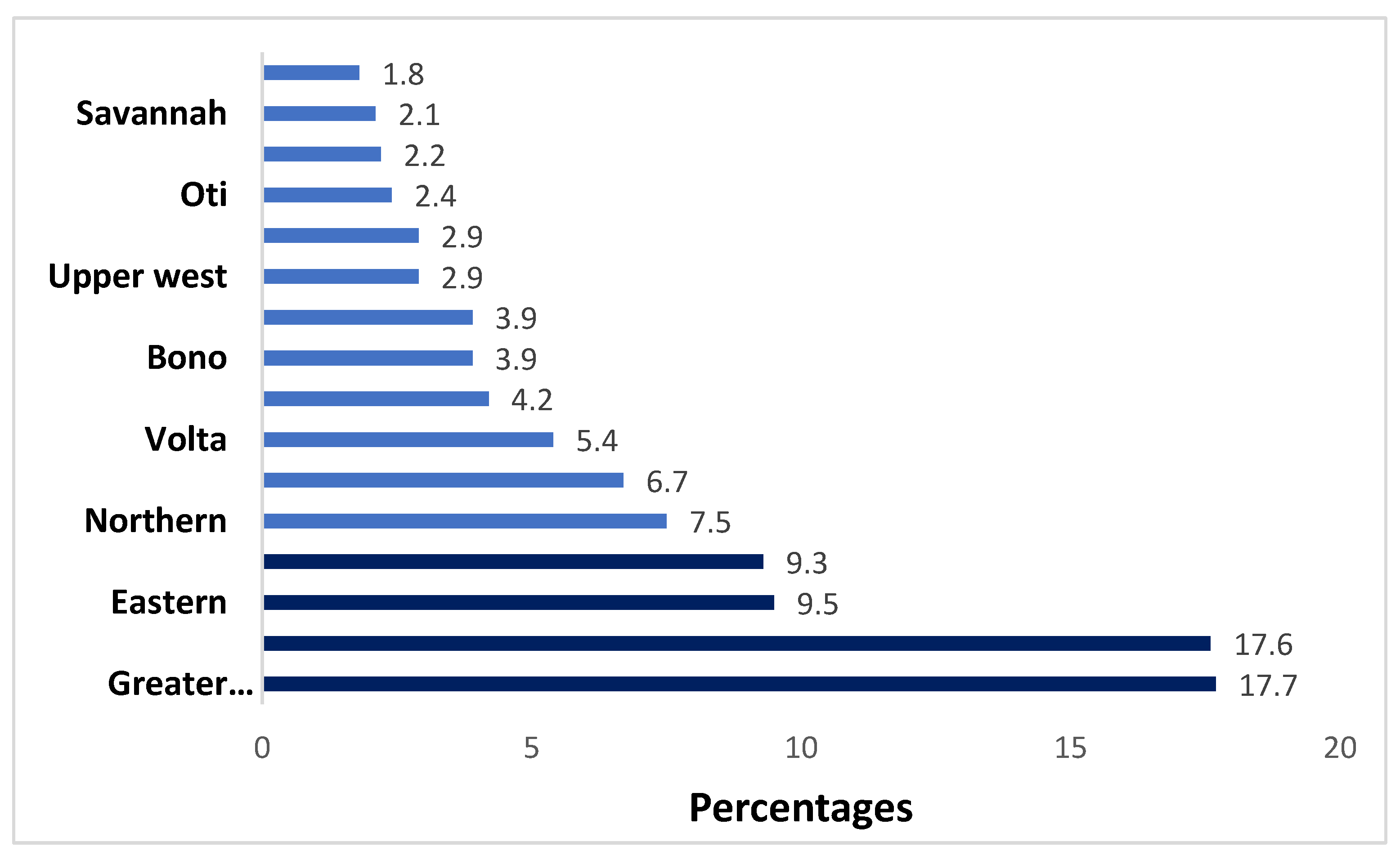
Figure 2.
This is a figure. Schemes follow the same formatting.
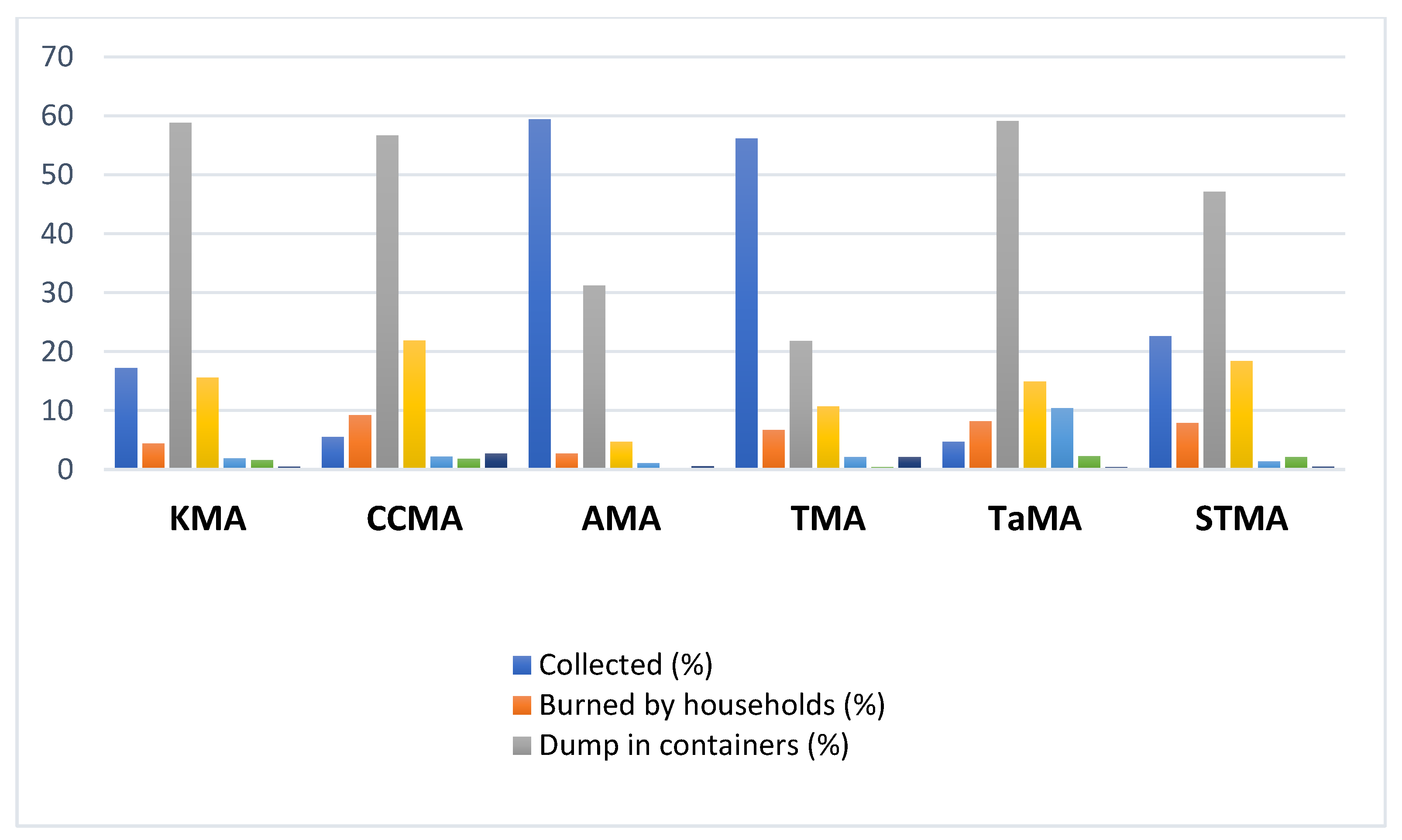
Figure 3.
Estimated MSW and organic fractions of the regions.
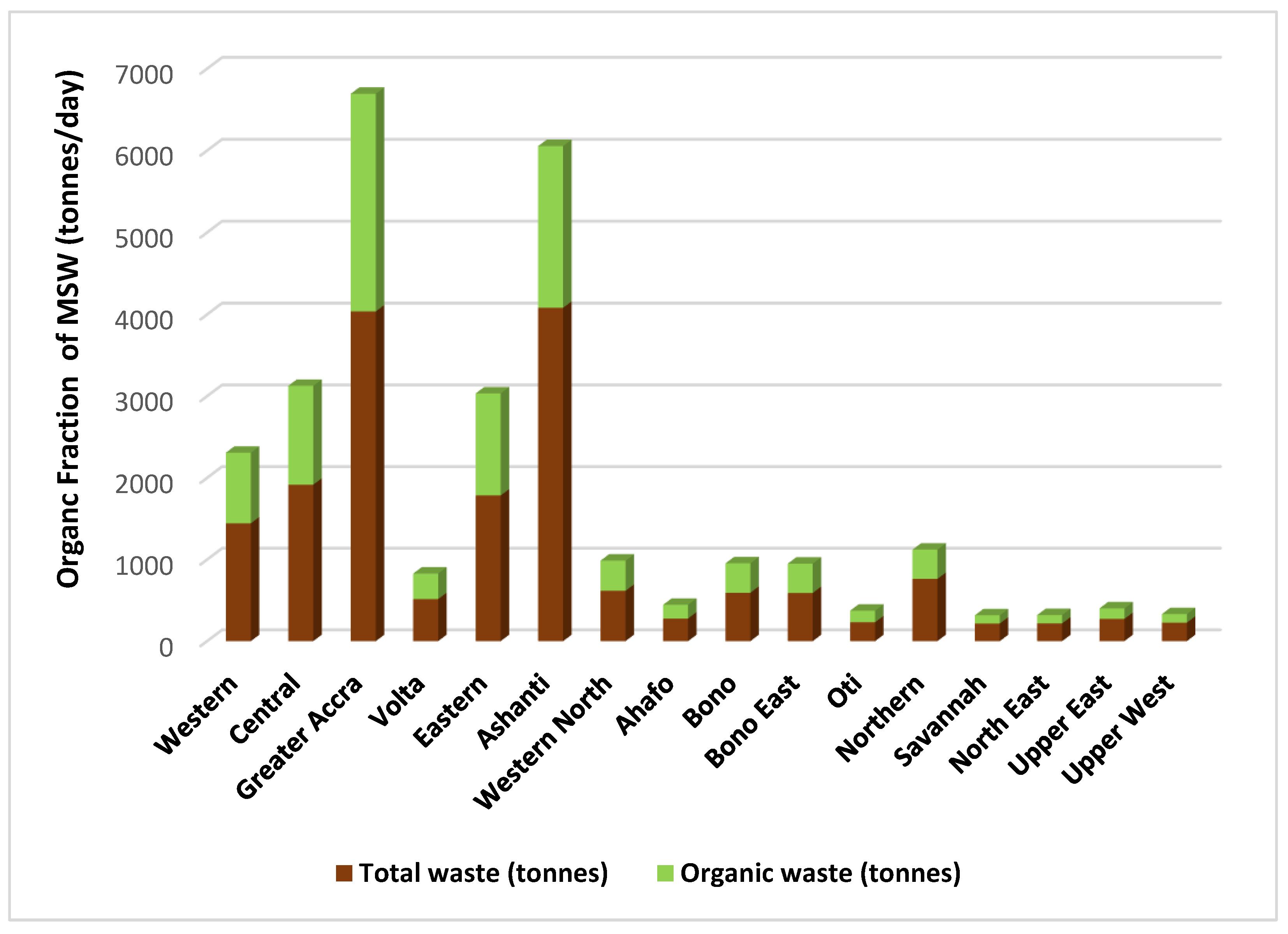
Figure 4.
Regional crop residue quantities [50].
Figure 4.
Regional crop residue quantities [50].
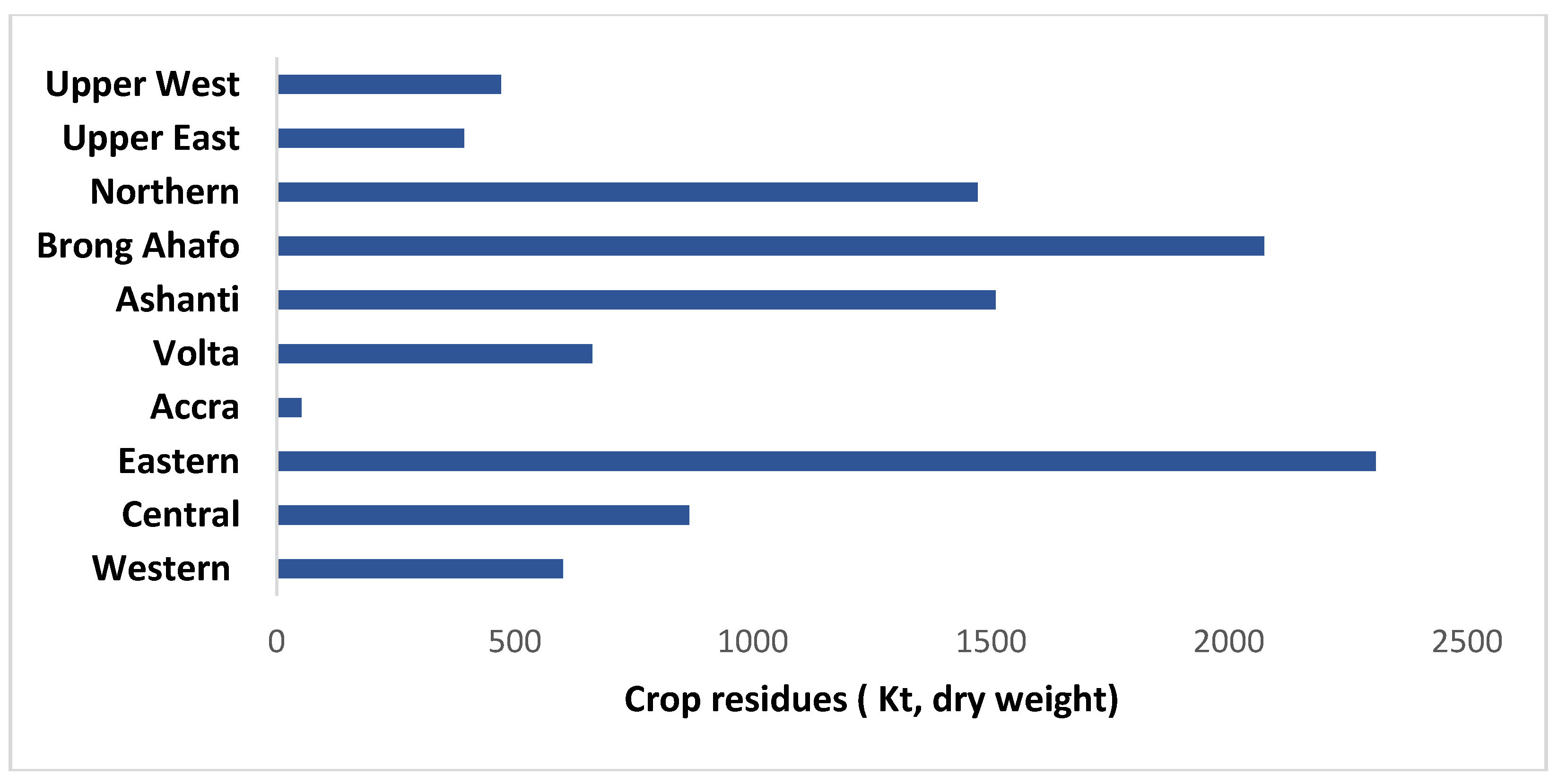
Figure 5.
Ghana’s MSW proximate composition compared with other countries. Ghana [13], Tanzania [83], Ethiopia [84], Nigeria [85], Indonesia [64], South Africa [86], USA [82].
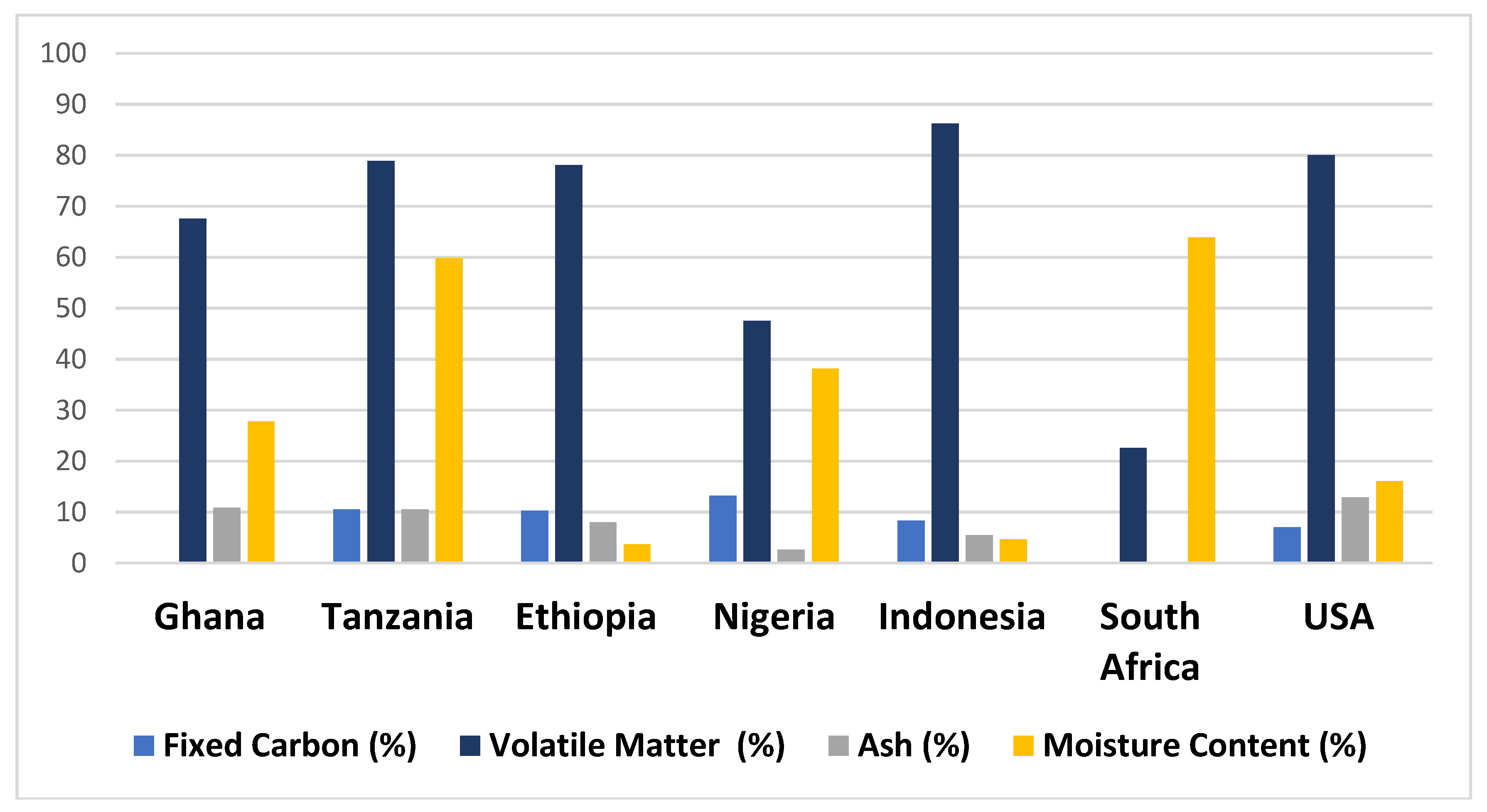
Table 1.
Estimated waste generation in the regions in 2021.
| Region | Population [40] | Waste (tonnes/day) | Percentage of waste (%) | Reference |
|---|---|---|---|---|
| Western | 2060585 | 1442.41 | 8.1 | [21] |
| Central | 2859821 | 1916.08 | 10.8 | [31] |
| Greater Accra | 5455692 | 4037.21 | 22.7 | [31] |
| Volta | 1659040 | 514.30 | 2.9 | [31] |
| Eastern | 2925653 | 1784.65 | 10.0 | [33] |
| Ashanti | 5440463 | 4080.35 | 23.0 | [31] |
| Western North | 880921 | 616.64 | 3.5 | [21] |
| Ahafo | 564668 | 276.69 | 1.6 | [31] |
| Bono | 1208649 | 592.24 | 3.3 | [31] |
| Bono East | 1203400 | 589.67 | 3.3 | [31] |
| Oti | 747248 | 231.65 | 1.3 | [31] |
| Northern | 2310939 | 762.61 | 4.3 | [34] |
| Savannah | 653266 | 215.58 | 1.2 | [34] |
| North East | 658946 | 217.45 | 1.2 | [34] |
| Upper East | 1301226 | 273.26 | 1.5 | [34] |
| Upper West | 901502 | 225.38 | 1.3 | [34] |
| Total | 30832019 | 17776.16 | 100 |
Table 2.
Physical characteristics of MSW in some regional capitals in Ghana.
| Municipality / Metropolis | Region | Organic (%) | Paper/ cardboard (%) | Plastic (%) | Metal (%) | Inert (%) | Textiles (%) | Glass (%) | Leather & rubber (%) | Others (%) | References |
| Accra | Greater Accra | 65.8 | 5.3 | 10.4 | 3.1 | 2.8 | 2.0 | 2.8 | 2.1 | 4.1 | [31] |
| Kumasi | Ashanti | 48.4 | 6.5 | 17.6 | 4.5 | 10.7 | 0.1 | 2.9 | 1.6 | 7.8 | [31] |
| Cape Coast | Central | 63.2 | 4.1 | 10.6 | 2.1 | 10.2 | 1.1 | 1.9 | 1.2 | 5.6 | [31] |
| Takoradi | Western | 60 | 7.1 | 11.5 | 2.4 | 8.0 | 29 | 1.5 | 1.2 | 5 | [37] |
| Tamale | Northern | 56 | 3.2 | 10.9 | 2.8 | 4.5 | 0.9 | 4.9 | 1.0 | 5.6 | [31] |
| Wa | Upper West | 47 | 13 | 5 | 3 | 2 | 3 | 29 | - | - | [34] |
| Aburi | Eastern | 70 | 6 | 16 | 3 | 5 | - | - | - | [33] |
Table 3.
Proximate analysis of MSW from some regional capitals in Ghana.
| Region | Waste type | FC | VM (%) | Ash (%) | MC (%) | Reference |
| Ashanti Ashanti Ashanti |
CR | - | 57- 80.25 | 10.81 | 15.5 - 40.89 | [13] |
| Mixed | 17.59- 29.65 | 45-67.55 | 3.69 | 13.55- 21.57 | [76] | |
| Mixed | 80-87.4 | - | 71.8 - 80.6 | [46] | ||
| Eastern | Mixed | - | 6.24 - 6.47 | 36 - 58 | [78] | |
| Greater Accra & Ashanti |
RDF | - | - | - | 8.11-13.27 | [79] |
| Greater Accra | Mixed | - | - | - | 55 | [80] |
| Central | Mixed | - | - | 44.1 – 61.9 | [37] |
CR= crop waste, RDF=refuse derived fraction, FC= fixed carbon VM=volatile matter; MC= moisture content.
Disclaimer/Publisher’s Note: The statements, opinions and data contained in all publications are solely those of the individual author(s) and contributor(s) and not of MDPI and/or the editor(s). MDPI and/or the editor(s) disclaim responsibility for any injury to people or property resulting from any ideas, methods, instructions or products referred to in the content. |
© 2024 by the authors. Licensee MDPI, Basel, Switzerland. This article is an open access article distributed under the terms and conditions of the Creative Commons Attribution (CC BY) license (http://creativecommons.org/licenses/by/4.0/).
Copyright: This open access article is published under a Creative Commons CC BY 4.0 license, which permit the free download, distribution, and reuse, provided that the author and preprint are cited in any reuse.