

Submitted:
17 September 2024
Posted:
17 September 2024
You are already at the latest version
Abstract
In an era where collaboration between academia and the EdTech industry is crucial for innovation, this study explores how academic profiles align with industry needs. In this study we examine the professional profiles available online of educational researchers from the Tallinn University School of Educational Sciences across the international LinkedIn, national ETIS and institutional TLU platforms, to identify how researchers market their skills that are relevant to the EdTech sector. Our findings indicate that some of the key areas such as instructional design, project management and technical proficiency that are vital for EdTech industry remain often underrepresented in academic profiles. While LinkedIn facilitates networking, it may not necessarily reach the depth needed for comprehensive representation, whereas the Estonian national research database ETIS provides rich academic details with limited industry appeal. Our suggestions call for strategic improvements in how researchers can present their expertise online, in order to improve industry-academia collaboration. By creating more precise and strategically targeted professional profiles, researchers will stand better chances to attract EdTech industry’s attention.
Keywords:
EdTech industry
; academic profiles
; open innovation
; professional development
; academia-industry collaboration
1. Introduction
Technological advances continue to emerge at an unprecedented rate, a trend described by Kurzweil [1] in his theory of accelerating returns. In the education sector, rapid pace of innovation requires the on-going integration of new technologies to ensure that education meets the continuously changing demands of the labor market. EdTech companies stand at the forefront of developing these technology-based education solutions. To remain competitive and responsive, companies increasingly rely on open innovation models that allow faster feedback, and the inclusion of real-world classroom needs in the development process [2,3]. One of the most effective open innovation strategies is the user innovation model, where end users, such as teachers or educational researchers, are actively involved in the development of new technologies. This approach ensures that the products developed remain both innovative as well as practical and adapted to the actual needs of teachers and students [4]. However, many EdTech companies are hesitant to implement this model. A significant obstacle is the difficulty of identifying and engaging educational researchers who have the necessary skills and expertise to effectively contribute to the development of new products [5]. Public platforms such as LinkedIn, national research databases like Estonia’s www.etis.ee (ETIS), and institutional information systems, such as www.tlu.ee (TLU), are often used to provide industry partners, including EdTech companies, with relevant information regarding researchers’ skills and areas of expertise [6]. These platforms allow educational researchers to showcase their expertise, facilitating connections with industry partners who can benefit from their knowledge [7]. However, the effectiveness of these platforms varies. Although widely used and accessible, due to its focus on networking and broad visibility, LinkedIn seems to be lacking the depth and specificity necessary to adequately represent researchers’ industry-relevant academic and practical expertise [8,9]. National research databases represent a higher potential to offer a more comprehensive overview of researchers’ academic contributions but may not appear as user-friendly or even be particularly known beyond the [10,11]. Institutional databases maintained by universities can provide detailed and regularly updated information but are often difficult to access or navigate by professionals outside of academia [12]. Due to these challenges, there is a felt need for researchers to present their skills and precisely defined areas of expertise in a manner that is clear, concise, and accessible to their industry partners. This article examines how educational researchers present information about their knowledge and skills on open platforms, using publicly accessible data from LinkedIn, the Estonian national research information system www.etis.ee (ETIS), and public profiles managed by the Tallinn University School of Education on www.tlu.ee (TLU). The research question to be addressed in this article is as follows:
RQ:
What skills and expertise relevant to EdTech companies are most commonly acknowledged by researchers at the Tallinn University School of Education in their public profiles?
The article is organized as follows: First, the theoretical background is presented, focusing on the role of technology in education and innovation models within the EdTech industry. The methodology section then outlines the approach used to analyze researcher profiles across the LinkedIn, ETIS, and TLU platforms. Next, the results of the analysis are presented, outlining the key gaps in representation of skills and expertise. The discussion section explores the implications of these findings for both academia and the EdTech industry, followed by recommendations for revising professional profiles for higher visibility and relevance. Finally, the article concludes with the study’s limitations and suggestions for future research.
2. Theoretical Background
2.1. Technologies in Education
The role technology plays in education is rapidly growing. This is driven by the need perceived in the educational sector to respond to the rapidly changing needs of the 21st-century labor market as well as the needs of the civil society. Educational technologies, or EdTech, have become integral to modern teaching methods, offering tools that enhance learning experiences, improve accessibility, and facilitate personalized education. As discussed by Kurzweil already back in 2005, the rapid pace of technological advancement, characterized by accelerating returns, has made it essential for educational institutions to incorporate these innovations swiftly to stay relevant [1]. Emerging technologies such as artificial intelligence (AI), virtual reality (VR), and data analytics are increasingly being integrated into educational frameworks, providing new ways for students to engage with content and for teachers to assess learning outcomes [9,13]. AI-driven platforms, for instance, carry the potential to personalize learning experience by analyzing student data and adapting content to the individual needs of each learner. VR and AR tools offer immersive experiences that can simulate real-world environments, making complex concepts easier to understand. Data analytics provide teachers with insights into student performance, making leading to better targeted interventions and improved educational outcomes. The current landscape of educational technology is marked by the emergence of many sophisticated technological tools designed to enhance the learning process. For example, AI-powered tutoring systems provide personalized feedback and support to students, while VR environments enable learners to safely explore historical sites or conduct experiments in a controlled virtual environment. Despite these advancements, the implementation of these technologies has its own challenges. Educational institutions need to address issues such as the high cost of technology, resistance to change among teachers, and the need for ongoing professional development to effectively integrate the use of new technologies into teaching [10,14]. One of the primary challenges in implementing new technologies in education is ensuring that these tools meet the practical needs of the teachers as well as the students. The gap between the capabilities of emerging technologies and the realities of classroom environments can lead to the underutilization or misapplication of these tools. For instance, a highly sophisticated AI tool may not be fully utilized if teachers are not adequately trained to integrate it into their teaching practices. This is where user involvement in the development process becomes crucial. By engaging educational researchers in the development of EdTech solutions, companies can create products that are not only innovative but also aligned with the actual needs and workflows of teachers and students [6]. Involvement of competent stakeholders allows for rapid and effective feedback, which can significantly enhance the usability and effectiveness of educational technologies, ensuring that these remain both practical and impactful in real-world educational settings. In this sense, researchers’ engagement in knowledge transfer and exchange activities plays a vital role in the effective adoption of emerging educational technologies, essential for aligning these technologies with the diverse needs of users and maximizing their impact in educational contexts.
2.2. Innovation Models in Education Technology
Innovation in EdTech can be understood through various models, each with its advantages and challenges. The traditional closed innovation model relies on internal resources and expertise within the organization that develops new products. This model can be effective in maintaining control over the development and the protection of intellectual property, as it limits external input and collaboration. However, this approach restricts the spread of diverse ideas and can slow down the process of innovation due to its self-contained, insulating, nature [15]. Closed innovation may also result in products that do not fully meet the needs of the users, as in this case development is primarily driven by internal perspectives rather than feedback from the external users. In contrast, in the educational context, the open innovation model encourages collaboration with external partners, such as researchers, teachers, students or even parents, to co-create technology-supported solutions. This model allows for a broader range of inputs and faster development cycles, making it particularly suited for the dynamic field of educational technology [4]. Open innovation can lead to more user-focused products that are better aligned with the actual market needs. However, the model also presents distinct challenges, such as managing intellectual property rights and coordinating contributions by multiple stakeholders. Next, user innovation is a specific form of open innovation where the actual end-users, such as teachers, are also directly involved in the development process. This model is highly effective in the educational context, as it ensures that the products developed are tailored to the specific needs of the users. For example, teachers can provide insights into how students interact with educational tools, which features are most effective, and what improvements are needed. In addition, as educational researchers are often higher education teachers, user innovation allows engagement of scientifically backed teacher experience, while providing EdTech companies with immediate feedback, enabling them to make iterative improvements to their products. And yet, many EdTech companies are still hesitant to fully embrace this model due to concerns about the complexity of coordinating with multiple stakeholders and the perceived risk of exposing their intellectual property to external parties [5]. These concerns are often exacerbated by the “Not Invented Here” (NIH) syndrome, a mindset that leads organizations to reject external ideas or innovations simply because they were not developed internally [16]. The NIH syndrome can stifle innovation and prevent companies from benefiting from the expertise of external collaborators. It creates a barrier to adopting potentially valuable technologies or processes that could enhance a company’s offerings. To overcome the mentioned fears, it is crucial for educational researchers to provide EdTech companies with easily graspable overviews of their skills’ profiles and areas expertise. One mechanism to achieve this is for educational researchers to publish detailed profiles that highlight their skills and expertise relevant to the development of educational technologies. By demonstrating their expertise in areas such as curriculum design, educational psychology, and classroom management, researchers can build trust with EdTech companies and alleviate concerns regarding the risks of external collaboration [3]. These detailed profiles can serve as a bridge between academic expertise and industry needs, fostering a more collaborative and innovative technological environment, and invigorate entire EdTech ecosystems.
2.3. Essential Skills Required in the EdTech Industry
EdTech companies often require sets of skills and profiles of expertise from their academic partners that are distinctly different from those traditionally emphasized in academic research organizations. While educational researchers typically focus on theoretical and methodological rigor, EdTech companies are more concerned with practical applications that can be scaled across diverse educational settings. Skills in instructional design, user experience research, and data analytics are particularly valuable in the EdTech industry, as they directly impact the usability and effectiveness of educational tools. In addition, knowledge of educational policies, standards, and compliance is essential for developing products that meet regulatory requirements and can be adopted by schools and institutions [12]. Kang and Ritzhaupt [17] analyzed 400 EdTech-related job announcements published in five international online job search databases and identified the most important skills and expertise required in the field of educational technology. They suggest that EdTech companies value most highly professionals with a strong foundation in instructional design, project management, and technical skills to use software tools such as learning management systems and eLearning development platforms. In addition, soft skills such as communication, collaboration, and interpersonal skills are critical as these roles often require working closely with different teams and stakeholders. The ability to manage multiple projects and effectively prioritize tasks emerged as key competencies in the field. Together, these skills highlight the need for a balanced mix of technical expertise and interpersonal skills to succeed in the education technology industry.
2.4. Platforms for Publishing Researchers’ Data
In the digital age, various platforms offer opportunities for researchers to publish and share their professional profiles. While platforms like Facebook and Twitter are popular for social networking, they are less suited for professional networking and collaboration [18,19]. LinkedIn, on the other hand, stands out as one of the best suitable platforms for connecting researchers with EdTech companies. LinkedIn allows researchers to create detailed profiles that include their academic achievements, skills, and professional experiences, making it easier for EdTech companies to identify potential collaborators [6]. LinkedIn has become an increasingly valuable platform for both researchers and professionals in the EdTech space, offering a powerful combination of professional networking and collaboration opportunities, and enhanced visibility within their respective communities. The platform’s features, such as endorsements, recommendations, and the ability to showcase publications and projects, make it an essential tool for professionals seeking to highlight their achievements and engage with broader audiences. For researchers, LinkedIn provides a space to connect with peers across disciplines, stay informed regarding the latest developments in their respective fields, and engage with industry professionals, potentially leading to fruitful collaborations and career advancements [20]. Similarly, in the EdTech sector, LinkedIn facilitates networking within specific interest groups, allowing educational researchers to connect with industry professionals who share similar interests or goals. This network-oriented structure encourages the building of professional relationships and the sharing of insights within industry-specific groups, fostering a collaborative environment that can drive innovation. By bridging the gap between academic research and its industrial application, LinkedIn serves as a crucial tool for both researchers and EdTech professionals, enabling them to expand their reach, influence, and impact in their respective fields [21]. Despite the advantages of social media platforms such as LinkedIn, national research information systems, for example national databases similar to the Estonian ETIS (www.etis.ee) and institutional information systems similar to that of Tallinn University (www.tlu.ee) remain relevant. These systems offer a level of validation and credibility that is critical in academic and professional contexts. Institutional information systems, typically managed by universities or research institutions, provide a controlled environment for presenting researchers’ profiles, while national systems are often linked to government agencies, constituting a reliable source of information regarding researchers’ qualifications and achievements. For example, ETIS is a comprehensive database that includes detailed records of publications, projects, and professional activities, which can be essential for establishing researchers’ credibility [10,11]. Furthermore, such platforms allow for the aggregation of research outputs and metrics, which can be useful for both academic evaluation and industry collaboration. These systems often include peer-reviewed publications, grant information, and other academic credentials that are crucial for validating a researcher’s expertise. By maintaining profiles on both LinkedIn and national research systems, researchers can ensure that their skills and knowledge remain visible to a wide audience while also benefiting from the credibility associated with institutional affiliations. This dual presence can help researchers making their expertise accessible and appealing to a broader range of potential partners from both the academia and industry. Even though national and institutional databases like ETIS are comprehensive and credible, researchers should also maintain an active presence on LinkedIn, as these databases, while containing detailed academic records, peer-reviewed publications, and verified credentials, are often underutilized by industry professionals. The reasons for this include the limited accessibility and specialized interfaces of these databases, focusing more on academic audiences rather than industry representatives [10,11]. In this sense, LinkedIn seems to be more accessible for industry professionals to discover and engage with researchers, as it functions as a widely recognized platform with the premise of effectively connecting academia and industry. Its user-friendly interface and networking capabilities make it easier for EdTech companies and other industry stakeholders to identify and connect with researchers who have the expertise they need [6]. By maintaining active and detailed LinkedIn profiles, researchers can ensure that their expertise is more visible and easily discoverable by industry professionals, thereby enhancing their opportunities for collaboration on innovative projects. This dual strategy, taking advantage of both LinkedIn and academic databases, should allow researchers, as a matter of principle, to benefit from the credibility and depth of institutional records while also making use of the networking and visibility that LinkedIn offers. In this way the circulation of their academic profiles is broadened in support of more effective partnerships with industry, leading ultimately to more effective innovation in the EdTech sector.
3. Resources and Methods
3.1. Data Sources
Our objective was to identify the skills and knowledge most commonly highlighted by education researchers on their public profiles, using the Tallinn University School of Educational Sciences as a case study. To achieve this, we analyzed the public profiles of researchers from the Tallinn University School of Educational Sciences across three platforms: LinkedIn (www.linkedin.com), the Estonian Research Information System (ETIS, www.etis.ee), and the Tallinn University homepage (TLU, www.tlu.ee). These platforms were selected because they represent the most relevant and publicly accessible online meeting places where researchers in Estonia, particularly those affiliated with Tallinn University, demonstrate their professional skills and academic achievements. LinkedIn is widely used for the purposes of professional networking and contacting prospective partners [22]; ETIS is the primary research information system for researchers in Estonia; and the Tallinn University homepage provides verified staff profiles.
3.2. Specific Aspects of ETIS and TLU
We set particular limits to our examination of ETIS data due to the latter’s specific focus on providing research-related information. ETIS is designed to hold the following aspects of a researcher’s profile: (a) general information, which includes name, contact details, links to Google Scholar and ORCID profiles, fields of research, and freely fillable “Description” and “Specification” fields; (b) career, listing academic positions held; (c) education, detailing the researcher’s academic background and degrees earned; (d) awards, listing any honors or recognitions received; (e) administrative work, detailing the researcher’s administrative roles; (f) projects, providing a list of research projects the researcher is involved in; (g) publications, listing the researcher’s scientific articles; and (h) supervision, indicating the researcher’s involvement in mentoring early career researchers and students. These sections contain mostly information that is related to the individuals’ research and offer only limited insight into their potential to collaborate with EdTech companies. Therefore, in our analysis of ETIS profiles, we focused on whether researchers had completed the “Description” and “Specification” fields in the General section, and whether these fields contained information relevant to EdTech companies, which falls outside the traditional academic context.
The TLU profiles include the staff members’ job titles, and their respective structural units of employment. In addition, the records include their contact information and a links to the ETIS profiles. Finally, the TLU profiles contain the “Introduction” field, where researchers can in a free form describe their relevant skills, knowledge, and expertise. For the purposes of our study, we focused primarily on the content of the “Introduction” field to determine whether researchers disclosed information that might be of interest to EdTech companies.
3.3. Sample and Data Analyses
We began by compiling a list of academic staff members from the School of Educational Sciences of Tallinn University, deliberately excluding junior researchers, understood as a rule as doctoral students, as they are less likely to have developed consistent professional profiles. In total, our selection included 40 researchers. Of these, 31 had LinkedIn accounts, and all had profiles on both the TLU and ETIS platforms. We then systematically recorded the content of the researchers’ profiles across the selected platforms and anonymized the data to ensure confidentiality.
To analyze the gathered data, two researchers first employed the open coding method, a qualitative analysis technique commonly used in grounded theory research [23], in order to identify possible patterns and themes [24]. This approach allowed us to identify the specific skills and knowledge highlighted in the profiles, facilitating a comprehensive understanding of the professional attributes that education researchers choose to emphasize in publicly accessible platforms. After examining the datasets, we located and counted the records that contained skills and expertise relevant to the EdTech industry, by comparing the identified data to the skills and expertise that Kang and Ritzhaupt [17] had outlined as needed for EdTech jobs. We relied on the general meaning (as jointly defined by involved researchers) of a skill or expertise if a direct match was not found.
4. Results
Our sample consisted of 40 researchers from the School of Educational Sciences at Tallinn University. Of these, 31 had public LinkedIn profiles, and 28 had filled in their skills and expertise sections. While all researchers had ETIS accounts, 34 had provided more detailed information regarding their skills and expertise in their ETIS profiles’ “Description” or “Specification” fields. Surprisingly enough, although all researchers had TLU accounts, only 12 of them had provided introductions of any sort about themselves, including their skills, and areas of expertise.
We found that only 7 LinkedIn profiles, 3 ETIS profiles, and 4 TLU profiles referred to the skills and areas of expertise relevant to the EdTech industry (Figure 1). The identified skills and expertise are listed in Table 1.
Our analysis indicates that researchers’ profiles usually miss several key skills and areas of expertise that are crucial from the perspective of the EdTech industry, as highlighted by Kang and Ritzhaupt [17]. For example, the researchers, as a rule, do not report their expertise in instructional design, particularly related to principles of operations and the application of models required for the development of digital and online learning environments, which remain central to the development of a variety of effective educational technologies. Although some curriculum development experience has been usually mentioned, specific attention to instructional design for digital platforms remains often underemphasized. In addition, while project management skills have been occasionally noted, they are generally associated with academic projects rather than technology-based initiatives. This would leave the potential partners uninformed regarding the researchers’ ability to manage multiple projects, meet tight deadlines, and lead technology-focused teams, although all these skills are indispensable in the fast-paced EdTech industry. Next, technical skills in the key areas such as learning management systems, authoring tools, and advanced multimedia production (such as video and audio editing or web development) remain underrepresented, despite being highly sought after by EdTech companies. In terms of soft skills, although communication and collaboration skills have been regularly mentioned, there is a lack of emphasis on the interpersonal and leadership skills required for effective teamwork in industry. The ability to lead teams, manage clients, and communicate with stakeholders is critical to successful EdTech collaborations, but yet it is insufficiently highlighted in the majority of the profiles. Finally, openness to new technologies, a trait highly valued in the EdTech sector, has not been sufficiently demonstrated. Addressing these gaps would allow better aligning researchers’ skills with the industry’s needs, greatly increasing their collaborative potential and impact in EdTech.
5. Discussion
Our aim in this study was to examine how well does educational researchers' presentations of their skills and the areas of expertise match with the needs of EdTech companies. To this end, we compared the online profiles from three different platforms: an international networking platform (LinkedIn), a national research database (ETIS), and an institutional database (TLU). These profiles were then compared to the skills and expertise needed by EdTech companies, as identified by Kang and Ritzhaupt [17]. The identified mismatch suggests that making available specific trainings and offering professional development opportunities could significantly increase the relevance of the researchers’ professional profiles for the purposes of the EdTech industry. For instance, Kang and Ritzhaupt [17] have highlighted instructional design, project management, and technical proficiency as essential skills required for the EdTech-related positions, yet these all remain often neglected describing academic profiles.
5.1. Platform Comparisons and Audience Considerations
Comparison of the three selected platforms (LinkedIn, ETIS and TLU) reveals that each of these offers distinct benefits that shape how researchers present their skills. First of all, as demonstrated in Figure 1, besides it being easily accessible for the EdTech professionals, LinkedIn is also the platform where the educational scientists show their EdTech-relevant skills and expertise most often. Researchers who effectively utilize LinkedIn (e.g., provide frequent updates, use strategically chosen keywords, and are engage actively) tend to emphasize their connections to industry and potential for collaboration, aligning their profiles with market demands. These approaches favor improvements in the visibility of their profiles to potential industry partners, as also suggested by [20].
In contrast, ETIS profiles apper generally more detailed and academically oriented, focusing on documenting research outputs and academic achievements. These profiles are typically completed by researchers aiming to present their academic contributions, including detailed descriptions of projects and methodologies. However, the focus on academic rigor may not necessarily align with the practical needs of EdTech companies, which often prioritize skills that can be applied directly to product development and implementation.
TLU profiles that focus on internal university roles, tend to highlight teaching responsibilities and administrative duties. While these profiles provide a comprehensive view of a researcher’s contributions within the academic context, they may not adequately emphasize skills relevant to the EdTech industry. This may be due to the profiles’ intended audience, which is primarily university’s employees and (prospective) students. However, due to the increasing importance of interdisciplinary collaboration, TLU profiles could benefit from a more strategic approach that also highlights industry-relevant expertise. As noted by [7], researchers should consider the diverse audiences of these platforms and tailor their profiles accordingly to maximize their professional opportunities.
5.2. Recommendations for Enhancing Profile Relevance
Educational researchers should make a more conscious effort to link their professional profiles to real-world applications in the interests of bridging the gap between academic research and industry needs, as similarly suggested also by [8,25]. For this purpose, researchers should enhance the relevance of their profiles across these platforms, and consider providing more detailed descriptions of their work, particularly its practical applications in the EdTech field.
On LinkedIn, including examples of industry collaboration and utilizing keywords aligned with current educational technology trends have the potential to increase both visibility and appeal. Researchers would also benefit from engaging more actively with LinkedIn’s professional groups and forums, which can further enhance their network and industry connections [21]. For ETIS, researchers might focus on explicitly linking their research outcomes to potential industry applications. This could involve detailing how their academic findings can inform product development or improve educational practices, making their profiles more attractive to EdTech companies. In addition, researchers should ensure that their profiles on ETIS are comprehensive, including all relevant skills and experiences that could be of interest to industry partners. Regarding the TLU profiles, we would recommend that researchers emphasize how their academic roles contribute to broader educational technology initiatives. This may involve highlighting involvement in EdTech projects, curriculum development for digital learning, or collaborations with industry partners.
5.3. Support Mechanisms and the Role of Intermediaries
To address the mentioned challenges, it is essential for educational institutions to provide measures of support that would help researchers revising their profiles [14,26]. For example, workshops can be used to discuss and practice profile development, the strategic use of keywords, and the integration of industry-relevant content. Also, institutions might use incentives to encourage researchers to maintain up-to-date profiles that reflect their full range of skills and experience. The role of intermediaries or knowledge brokers is also important in bridging the above-discussed gap between academia and industry. These professionals can help translating academic research into practical applications, making it more accessible and appealing to EdTech companies. As Chesbrough [15] discusses in their work on open innovation, such intermediaries can play a pivotal role in fostering collaboration between the academia and industry, ultimately driving innovation and the development of more effective educational technologies.
5.4. Conclusions
From a theoretical perspective, this study contributes to the understanding regarding the gap between educational research and the EdTech industry. It highlights how researchers tend to overlook the EdTech industry’s needs while presenting their skills and expertise in online platforms. From the practical perspective, the study offers actionable recommendations for researchers to better position themselves for industry collaboration. Educational researchers need to strategically refine their public profiles, particularly on LinkedIn, by incorporating skills directly relevant to EdTech companies, such as digital instructional design, project management, and technical capabilities. In addition, to provide relevant information in appropriate context, researchers should maintain unpretentious and clear, up to thousand character-long bios on platforms such as LinkedIn. These biographies should highlight skills and experiences directly related to the needs of the EdTech industry, making it easier for those companies to identify and partner with the suitable experts [7]. Universities and research institutions should offer training and support mechanisms to help researchers optimize their profiles across platforms, ensuring that their academic expertise is presented in a manner attractive to industry partners. Moreover, involving intermediaries or knowledge brokers should be considered to make professional information available for the use fostering innovations, i.e., make researchers more accessible to the EdTech industry – thus improving collaboration between the academia and EdTech industry, facilitating innovation and supporting educational technology development.
5.5. Limitations and Future Perspectives
In this study, we examined how the skills and knowledge presented by educational researchers align with the needs of the EdTech industry, focusing only on the content of their profiles. A further study is needed to explore which EdTech-relevant skills do educational researchers actually possess and how their professional profiles meet the industry’s needs, in order to offer recommendations regarding further trainings to be provided to researchers to better meet the EdTech companies’ needs for academic expertise.
The focus on LinkedIn, ETIS, and TLU profiles may not necessarily fully capture the breadth of researchers’ professional activities or their interactions with the EdTech industry. By excluding other platforms such as ResearchGate or Academia.edu, important aspects of researchers’ visibility and engagement might have been overlooked. In addition, the study concentrated on the content and structure of profiles without considering contextual factors, such as institutional policies or individual motivation, which may influence how researchers present themselves online. Also, our analysis was based on the findings of Kang and Ritzhaupt [17], who derived their results from 400 job offers. Including data from additional sources might yield different results and provide a broader perspective. To address these limitations, future research should include a wider range of platforms, examine the motivations behind profile creation, and quantify the impact of profile features on industry collaborations. Expanding the study to include multiple institutions and incorporating feedback from industry professionals would also enhance the robustness and applicability of the findings.
Finally, integrating social media analytics would provide further insights into how profiles are engaged with, particularly on LinkedIn, where content visibility plays a critical role in fostering collaborations.
Author Contributions
Conceptualization: JL, UM, LPS; methodology: JL, UM, VT; validation: JL, VT, MS; formal analysis: JL, KK, SR; investigation: JL, UM, SR, KK, SV; resources: JL; data curation: JL, SR, SV; writing—original draft preparation: JL; writing—review and editing: JL, UM, SR, KK, LPS, VT, MS, SV; visualization: JL; supervision: VT, MS; project administration: JL, SV. All authors have read and agreed to the published version of the manuscript.
Funding
This research received no external funding.
Ethics statement
Ethical review and approval was not required for the study on human participants in accordance with the local legislation and institutional requirements.
Data Availability Statement
Data is available upon request.
Conflicts of Interest
The authors declare no conflicts of interest.
References
- Kurzweil, R. The singularity is near: When humans transcend biology. Viking, 2005. [Google Scholar]
- Cañibano, C.; Otamendi, J.; Andújar, I. Measuring and assessing researcher mobility from CV analysis: The case of the Ramón y Cajal programme in Spain. Res. Eval. 2008, 17, 17–31. [Google Scholar] [CrossRef]
- Gaughan, M.; Bozeman, B. Faculty publication productivity, collaboration, and grants velocity: Impacts of grants and contracts. Res. Eval. 2008, 17, 103–110. [Google Scholar] [CrossRef]
- von Hippel, E. Democratizing innovation. MIT Press, 2005. [Google Scholar]
- Amador, F.; González, R. Sistemas de información curricular en Iberoamérica. Universidad de Pinar del Río, 2023. Available online: https://rc.upr.edu.cu/handle/DICT/3097 (accessed on 12 September 2024).
- Wang, Y.; Allouache, Y.; Joubert, C. Analysing CV corpus for finding suitable candidates using knowledge graph and BERT. In Proceedings of the Thirteenth International Conference on Advances in Databases, Knowledge, and Data Applications (DBKDA 2021), Valencia, Spain; 2021; pp. 16–21. [Google Scholar]
- Woolley, R.; Turpin, T. CV analysis as a complementary methodological approach: Investigating the mobility of Australian scientists. Res. Eval. 2009, 18, 143–151. [Google Scholar] [CrossRef]
- Hadzic, A. Value and limitations of LinkedIn. NYSORA J. 2023. Available online: https://www.nysora.com/industry-news/value-and-limitations-of-linkedin-op-ed-by-dr-hadzic/ (accessed on 12 September 2024).
- Sun, P.Y.; Scott, J.L. An investigation of barriers to knowledge transfer. J. Knowl. Manag. 2005, 9, 75–90. [Google Scholar] [CrossRef]
- Menekse Dalveren, G.G.; Peker, S. Accessibility and usability evaluation of digital library article pages. In App and Website Accessibility Developments and Compliance Strategies; IGI Global, 2021; pp. 58–76. [Google Scholar] [CrossRef]
- Shaw, M.L.; Gaines, B.R. KITTEN: Knowledge initiation and transfer tools for experts and novices. Int. J. Man-Mach. Stud. 1987, 27, 251–280. [Google Scholar] [CrossRef]
- Lin, M.W.; Bozeman, B. Researchers’ industry experience and productivity in university–industry research centers: A scientific and technical human capital explanation. J. Technol. Transf. 2006, 31, 269–290. [Google Scholar] [CrossRef]
- Davé, P. The revolutionary intersection of AI and immersive learning in higher education. Emerg. Technol. Columbia University, 2023. Available online: https://etc.cuit.columbia.edu/news/revolutionary-intersection-ai-and-immersive-learning-higher-education (accessed on 12 September 2024).
- Leoste, J.; Heidmets, M.; Ley, T.T.; Stepanova, J. Classroom innovation becoming sustainable: A study of technological innovation adoption by Estonian primary school teachers. IxD&A 2020, 47, 144–166. [Google Scholar] [CrossRef]
- Chesbrough, H.W. Open innovation: The new imperative for creating and profiting from technology. Harvard Business Press, 2003. [Google Scholar]
- Katz, R.; Allen, T.J. Investigating the not invented here (NIH) syndrome: A look at the performance, tenure, and communication patterns of 50 R&D project groups. R&D Manag. 1982, 12, 7–19. [Google Scholar] [CrossRef]
- Kang, Y.; Ritzhaupt, A.D. A job announcement analysis of educational technology professional positions: Knowledge, skills, and abilities. J. Educ. Technol. Syst. 2015, 43, 231–256. [Google Scholar] [CrossRef]
- Jordan, K. Separating and merging professional and personal selves online: The structure and processes that shape academics’ ego-networks on academic social networking sites and Twitter. J. Assoc. Inf. Sci. Technol. 2019, 70, 830–842. [Google Scholar] [CrossRef]
- Idoko, N. Understanding the different social networking platforms. 2023. Available online: https://nicholasidoko.com/blog/2023/06/08/understanding-the-different-social-networking-platforms/ (accessed on 12 September 2024).
- Van Noorden, R. Online collaboration: Scientists and the social network. Nature 2014, 512, 126–129. [Google Scholar] [CrossRef] [PubMed]
- Collins, K.; Shiffman, D.; Rock, J. How are scientists using social media in the workplace? PLoS ONE 2016, 11, e0162680. [Google Scholar] [CrossRef] [PubMed]
- EATRIS-ERIC. CORBEL academia-industry collaboration: Best practices guide. EATRIS-ERIC, 2019. Available online: https://eatris.eu/wp-content/uploads/2019/12/CORBEL_Academia_Industry_Collaboration_Best_Practices_Guide.pdf (accessed on 12 September 2024).
- Strauss, A.; Corbin, J. Basics of qualitative research techniques and procedures for developing grounded theory, 2nd ed.Sage Publications, 1998. [Google Scholar]
- Saldaña, J. The coding manual for qualitative researchers, 3rd ed.Sage Publications, 2016. [Google Scholar]
- Gaughan, M.; Bozeman, B. Using curriculum vitae to compare some impacts of NSF research center grants with research center funding. Res. Eval. 2002, 11, 17–26. [Google Scholar] [CrossRef]
- Llopis, O.; Sánchez-Barrioluengo, M.; Olmos-Peñuela, J.; Castro-Martínez, E. Scientists’ engagement in knowledge transfer and exchange: Individual factors, variety of mechanisms and users. Sci. Public Policy 2018, 45, 249–263. [Google Scholar] [CrossRef]
Figure 1.
The number of profiles on a platform vs the number of profiles relevant to the EdTech sector.
Figure 1.
The number of profiles on a platform vs the number of profiles relevant to the EdTech sector.
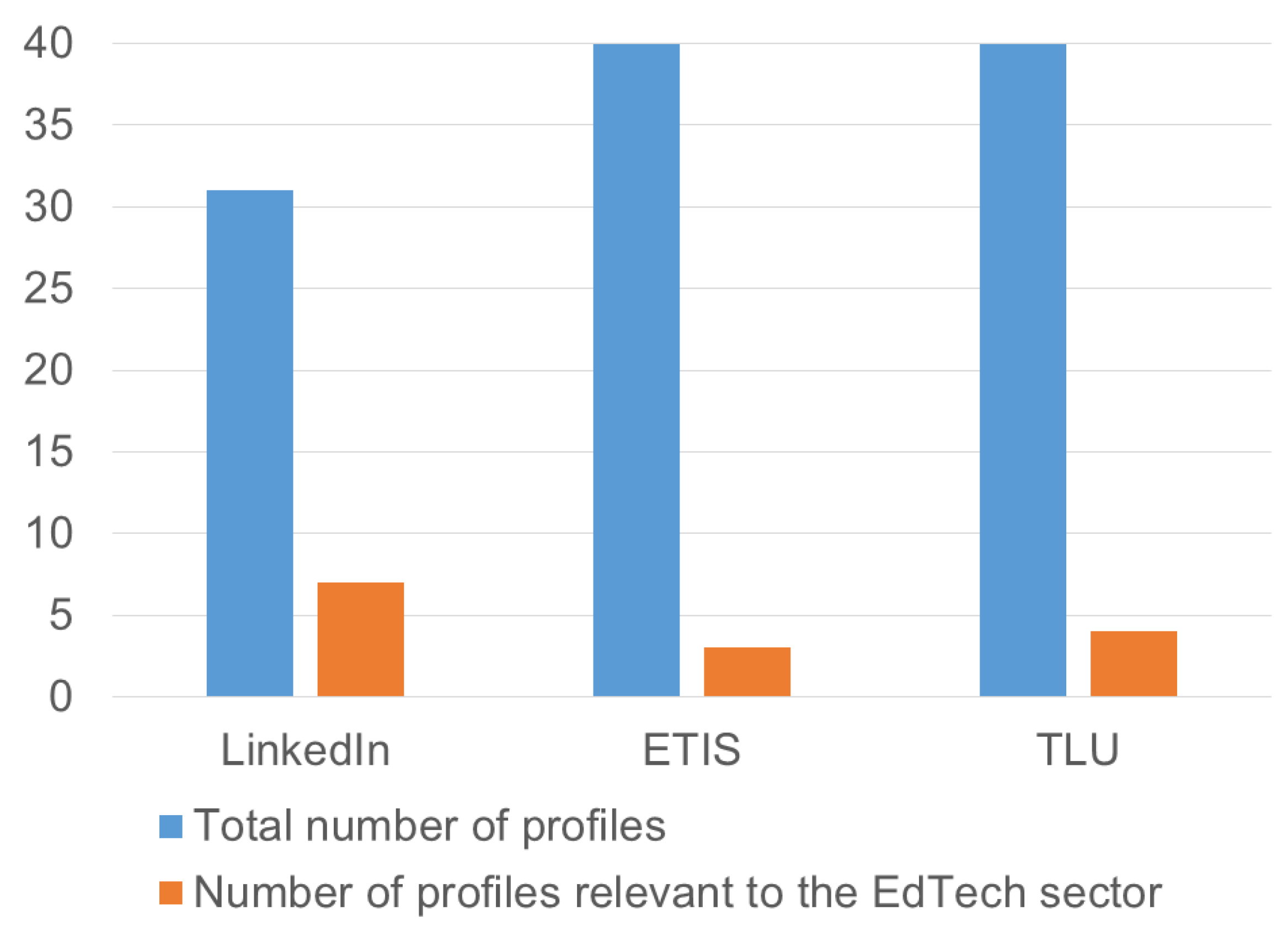

Table 1.
Skills and expertise identified in researchers’ LinkedIn, ETIS and TLU profiles.
| ETIS | TLU | |
|---|---|---|
| Digital ecosystems Digital transformation in education EdTech Hackathon organization Educational innovation Educational robotics E-learning Hybrid and blended learning Project management Social robotics STEAM education Telepresence robotics |
Adult learning Digital ecosystems Educational innovation Educational robotics Educational technology Hybrid and blended learning Socio-technological learning systems STEAM education Technology-enhanced workplace learning |
Digital transformation in education Educational robotics Educational technology Hybrid and blended learning STEAM education Technology in supporting special needs education |
Disclaimer/Publisher’s Note: The statements, opinions and data contained in all publications are solely those of the individual author(s) and contributor(s) and not of MDPI and/or the editor(s). MDPI and/or the editor(s) disclaim responsibility for any injury to people or property resulting from any ideas, methods, instructions or products referred to in the content. |
© 2024 by the authors. Licensee MDPI, Basel, Switzerland. This article is an open access article distributed under the terms and conditions of the Creative Commons Attribution (CC BY) license (http://creativecommons.org/licenses/by/4.0/).
Copyright: This open access article is published under a Creative Commons CC BY 4.0 license, which permit the free download, distribution, and reuse, provided that the author and preprint are cited in any reuse.