
Submitted:
09 October 2024
Posted:
10 October 2024
You are already at the latest version
Abstract
Large Language Models (LLMs) have emerged as powerful tools in the domain of artificial intelligence, specifically enhancing natural language processing capabilities. These models leverage extensive datasets and sophisticated algorithms to automate and enhance tasks traditionally performed by humans, thereby revolutionizing innovation and entrepreneurship. LLMs accelerate product development, streamline business operations, and enable precise and rapid decision-making, all of which are crucial for maintaining competitiveness in dynamic markets. This paper categorizes the applications of LLMs in innovation and entrepreneurship into three main areas: technological innovation, strategic decision-making, and process automation. By exploring various integrations of LLMs in entrepreneurial ventures, this work offers both theoretical insights and practical examples, underscoring the transformative impact of LLMs in shaping modern business landscapes.
Keywords:
Large Language Models
; Entrepreneurship
1. Introduction
Large Language Models (LLMs) represent a significant advancement in artificial intelligence, particularly in natural language processing capabilities. These models, equipped with vast amounts of data and sophisticated algorithms, are revolutionizing various sectors by automating complex tasks that traditionally require human intelligence [5,17]. In the context of innovation and entrepreneurship, LLMs facilitate the rapid development of new technologies and streamline business operations, thereby enhancing productivity and fostering innovation [40,101].
The impact of LLMs on innovation and entrepreneurship is profound. They accelerate the ideation and product development processes, enable smarter and faster decision-making, and improve customer interactions through personalized services [120,126]. By analyzing large datasets, LLMs provide insights that help businesses anticipate market trends and consumer needs more accurately [27,108]. This capability is crucial for maintaining competitiveness in fast-paced industries.
Currently, the application of LLMs in innovation and entrepreneurship can be categorized into several areas: technological innovation, strategic decision-making, and process automation [3,70,124]. Each category utilizes the strengths of LLMs to tackle specific challenges, from enhancing product design with rapid prototyping to optimizing strategic plans with predictive analytics. These applications demonstrate the versatile role of LLMs in driving business growth and operational efficiency.
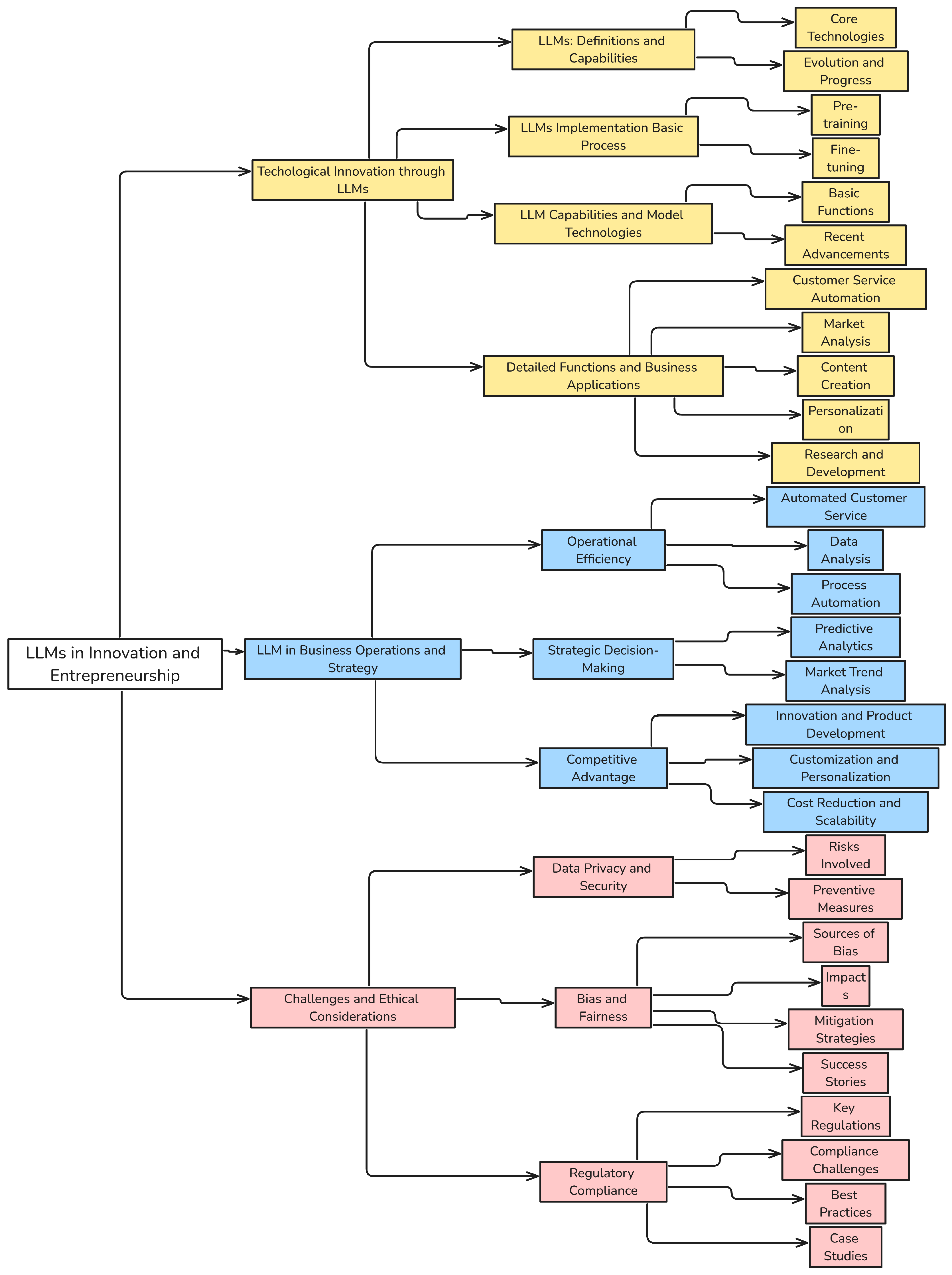
This article explores the integration of LLMs in various entrepreneurial ventures, following a structured approach. It begins by defining LLMs and discussing their core functionalities. Subsequent sections delve into the specific applications and benefits of LLMs in business settings, supported by case studies and examples that illustrate successful integrations. Overall, the contribution of this article lies in its comprehensive analysis of how LLMs are being employed to reshape the landscape of innovation and entrepreneurship, providing readers with both theoretical insights and practical examples of this transformative technology.
Figure 1.
LLMs in Innovation and Entrepreneurship
2. Technological Innovation through LLMs
2.1. LLMs: Definitions and Capabilities
Large Language Models (LLMs) represent a sophisticated advancement in Natural Language Processing (NLP) technology [9,49,82,136,154,168,172]. Built on deep learning neural network architectures, particularly the Transformer model, these models are engineered to perform various language understanding and generation tasks [127,169]. The defining features of LLMs are their scale and capability, which allow them to handle everything from simple text generation to complex language comprehension tasks [45,121].
LLMs leverage the Transformer architecture, which is highly efficient and powerful in processing language tasks. This architecture relies heavily on the self-attention mechanism, enabling the model to weigh the importance of different pieces of information during text generation or comprehension, thereby optimizing its processing pipeline [19,76,122,129,130]. Additionally, the training process of LLMs involves millions of diverse text examples, equipping the model to learn the extensive uses and complexities of language, thus enabling it to generate or comprehend text independently, without needing task-specific directions [32,59,80,125,168].
With their advanced technical features and training methodologies, LLMs excel in various NLP tasks such as summarization, translation, and sentiment analysis [1,7,72,166]. This broad applicability has made LLMs a critical tool not only in academic research but also in commercial and industrial applications [156]. Developers and businesses utilize LLMs to create chatbots, enhance content creation, and improve user interaction experiences, showcasing their substantial potential and value in practical applications [39,62,170].
2.2. LLMs Implementation Basic Process
LLMs are implemented through two main stages: pre-training and fine-tuning [8,89,113]. Together, these stages ensure that the model performs well on specific tasks and is applicable across various language processing scenarios.
Pre-training Stage.
During the pre-training phase, large language models are trained on a vast and diverse corpus of texts, which may include books, articles, and web pages [6,37,56,100]. The goal of pre-training is to enable the model to learn the basic structures of language, grammatical rules, and the relationships between vocabulary [14]. This stage does not rely on task-specific guidance. Instead, the model autonomously learns language features through self-generated methods, such as predicting the next word or reconstructing sentences.
Fine-tuning Stage.
After pre-training, LLMs typically undergo fine-tuning for specific tasks [9,135,165]. During this stage, the model is further trained on smaller, more focused datasets specific to the task at hand, often with annotated information like question-answer pairs or sentiment labels [172]. Fine-tuning allows the model to adjust its parameters to better respond to and optimize for specific tasks, such as sentiment analysis, text classification, or question-answering systems [81,161]. This stage ensures that while the model retains the linguistic knowledge acquired during pre-training, it can also adapt effectively to specific application scenarios.
2.3. LLM Capabilities and Model Technologies
Basic Functions.
LLMs often derive their core functionalities from early model innovations. For instance, the GPT (Generative Pre-trained Transformer) series first demonstrated robust text generation capabilities, autonomously creating coherent and logical text passages based on given prompts [74,79]. The BERT (Bidirectional Encoder Representations from Transformers) model achieved breakthroughs in language understanding by employing bidirectional training to comprehend language in context better. This approach has been widely applied to information retrieval and sentiment analysis tasks [73,103].
Recent Advancements.
As technology progresses, the development of new functionalities often closely aligns with specific model innovations. For example, OpenAI’s GPT-3.5 Turbo [95] has shown exceptional ability in automatic programming assistance, generating programming code from natural language instructions [47,106,162,164,171]. Additionally, BERT and its variants like RoBERTa excel in sentiment analysis, accurately identifying emotions and sentiments from text, which is extensively used in social media analysis and customer feedback systems [2,6,93]. Personalized content creation is driven by more advanced transformer models like T5 (Text-to-Text Transfer Transformer) [36,64,78,104] and the latest versions of GPT, which can tailor highly personalized content responses or suggestions based on user history.
2.4. Detailed Functions and Business Applications
LLMs are crucial tools in innovation and entrepreneurship due to their advanced language-processing capabilities [22,132,133,146,155,157,160]. These models automate and optimize business processes that require language understanding and generation, continuously evolving to provide state-of-the-art technological support and open new opportunities for businesses [51,142]. These abilities help companies maintain a competitive edge in a fiercely competitive market environment:
- Personalization. Personalizing user experiences on digital platforms based on user behavior and preferences [58]. This increases customer loyalty and potentially higher sales through personalized recommendations and communications.
3. LLMs in Business Operations and Strategy
3.1. Operational Efficiency
LLMs significantly enhance operational efficiency in businesses by automating complex language-based tasks. These AI-driven systems, adept in tasks ranging from customer service automation to sophisticated data analysis, allow businesses to handle customer inquiries, analyze vast amounts of unstructured data for strategic insights, and streamline processes like report generation and compliance monitoring [42,94,137,149,175]. The ability to perform these functions with high accuracy and consistency reduces the workload on human employees. It ensures that businesses can scale operations efficiently, thereby gaining a competitive advantage in their respective markets.
Automated Customer Service.
LLMs are transforming customer service by powering sophisticated chatbots and virtual assistants that offer 24/7 support, enhancing the customer experience and reducing operational costs [54]. For instance, Amazon has effectively utilized these technologies to create chatbots that help customers with everything from tracking orders to managing returns, streamlining the customer service process significantly. Similarly, Bank of America has integrated its virtual assistant “Erica”, which provides personalized banking advice and facilitates transactions autonomously [18,52,138,176]. These LLM applications improve service delivery efficiency and further bolster customer engagement through fast, reliable, and context-sensitive responses, setting a new industry standard for automated customer support.
Data Analysis.
LLMs can help businesses handle and interpret large datasets to refine their operations. These models extract meaningful insights from extensive unstructured data—customer feedback, transaction records, or market trends—enabling companies to make informed decisions quickly [53,75,83,150,167,177]. The application of these insights significantly impacts resource allocation; for example, LLMs can identify operational bottlenecks or underutilized assets, allowing businesses to reallocate resources more efficiently. Moreover, by predicting future trends and customer behaviors, LLMs enable companies to adjust their inventory levels strategically, optimize staffing, and better plan budget allocations [84,86]. This data-driven approach enhances operational efficiency and improves overall business agility and competitive edge in the market.
Process Automation.
LLMs are highly effective in enhancing business process automation and are particularly suited for handling repetitive tasks such as email filtering and report generation [4,34,151]. LLMs efficiently sift through and categorize vast quantities of emails, enabling companies to concentrate on high-priority communications and automatically respond to routine inquiries. In report generation, these models aggregate and synthesize data from multiple sources into coherent summaries, delivering clear and actionable reports that significantly reduce the need for manual labor [30]. Automating these tasks minimizes the demand for manual labor, thus lowering operational costs and increasing the accuracy and speed of business processes.
3.2. Strategic Decision-Making
LLMs significantly enhance strategic decision-making in organizations by leveraging their advanced analytical capabilities [61,91,111,118]. These models process and analyze extensive datasets, uncovering trends and patterns that are not easily detected by humans, which supports more informed and proactive strategic planning [12,105,152,174]. LLMs enable businesses to anticipate market shifts and consumer trends, facilitating a forward-thinking approach to decision-making. They also aid in scenario analysis, allowing executives to assess various strategic options’ implications and potential outcomes. These applications sharpen strategic insights and minimize risks, boosting the company’s agility and alignment with long-term goals [112,119,153].
Predictive Analytics with LLMs.
LLMs excel at leveraging historical data to forecast trends and support proactive decision-making, making them invaluable in dynamic sectors like finance and marketing [15,16]. In finance, LLMs predict market trends, evaluate credit risk, and automate trading strategies by analyzing vast amounts of financial data and market conditions, thus enhancing investment strategies and risk management for institutions [68]. In the realm of marketing, LLMs assess consumer behaviors, predict outcomes of campaigns, and gauge customer engagement, enabling marketers to devise precisely targeted strategies that optimize budget allocation and improve marketing efficacy [38]. This predictive prowess of LLMs helps businesses in these sectors anticipate future trends and strategically plan to maximize outcomes and efficiencies.
Market Trend Analysis.
In terms of market trend analysis, LLMs employ advanced data processing techniques to derive actionable insights from diverse sources such as social media, economic reports, and news articles [23,41]. For instance, by performing sentiment analysis, LLMs assess public opinions on products or brands, while topic modeling helps identify prevalent themes in market discussions. These capabilities have empowered businesses to strategically tailor their operations [123,159]. A notable example includes a retail giant that used LLM-driven insights from social media trends to adjust its inventory ahead of emerging fashion trends, significantly boosting sales by aligning offerings with consumer demands early on [25,87]. Similarly, there are studies utilizing LLMs to monitor regional technology adoption rates and strategically plan their product launches to maximize market penetration effectively.
3.3. Competitive Advantage
Innovation and Product Development.
Startups leveraging LLMs are gaining a competitive edge by accelerating and enhancing their product development cycles [35,144,148]. LLMs enable rapid prototyping and iterative testing by automating significant portions of the development process, from initial design to market readiness. This capability allows startups to bring innovative products to market much faster than traditional methods. For example, companies like Character.ai1 are using LLMs to develop advanced conversational AI, disrupting markets that were traditionally dominated by less interactive technologies. Innovations also include Google’s Gemini2, originally known as Bard, which showcases Google’s commitment to developing generative AI technologies in response to competitive advancements. Similarly, Google’s LaMDA3 represents a significant stride in conversational models, originally introduced as Meena and evolved into a more robust dialogue system. Meta’s Llama4, with its various versions offering different parameter sizes, demonstrates an expansive approach to AI scalability and accessibility. Additionally, ByteDance’s Doubao5 focuses on building industry-leading AI foundation models, highlighting the drive for technological and social progress. Lastly, Microsoft’s Copilot6, based on the Microsoft Prometheus model, integrates directly into consumer software, offering advanced AI functionalities directly from the Windows taskbar. These cases exemplify how LLMs are not only entering established markets but also creating entirely new niches, redefining consumer expectations and engagement.
Advanced Language Models in Industry.
Anthropic’s Claude series demonstrates the rapid evolution in LLM capabilities, with the latest version, Claude 3, introducing image analysis features in March 2024, broadening its utility in multimedia applications 7. Similarly, Google’s PaLM (Pathways Language Model), a 540 billion parameter model, showcases versatility across various tasks including reasoning and code generation, significantly enhanced when combined with chain-of-thought prompting to improve performance on complex datasets 8. These models exemplify how advanced training techniques and expansive parameter scaling are pushing the boundaries of what AI can achieve in practical settings.
Cohere and T5 from Google highlight the industry’s focus on generative AI for both consumer and enterprise applications. Cohere’s platform specializes in embedding large language models into enterprise solutions, enhancing functionalities like chatbots and content generation, and is known for its flexibility across various cloud services 9. Google’s T5 model, exploring transfer learning within a unified text-to-text framework, has set benchmarks across multiple NLP tasks, illustrating the effectiveness of large-scale datasets in training LLMs 10. Meanwhile, Falcon LLM introduces the Falcon Mamba 7B, an open-source State Space Language Model, which highlights advancements in AI architecture that reduce memory costs and enhance performance, marking significant progress in the field 11.
Emerging LLMs Showcasing Advanced Capabilities.
StableLM by Stability AI introduces the StableLM 3B 4E1T, a decoder-only model trained on a diverse dataset including English and code, demonstrating enhanced versatility with features like partial Rotary Position Embeddings and SwiGLU activation for optimized performance 12. NVIDIA’s Megatron-LM focuses on model parallelism to train multi-billion parameter models efficiently, showcasing a methodology that significantly advances NLP applications by enabling the handling of vast models without extensive system overhead [24,115]. These models exemplify the rapid advancements in hardware and training techniques that are pushing the boundaries of what LLMs can achieve.
In the realm of specialized and hybrid models, Jamba from AI21 Labs represents a novel approach by combining Transformer and Mamba architectures, adding mixture-of-experts to enhance model capacity while maintaining efficiency on standard benchmarks [66]. Meanwhile, DeepSeek-v2 develops upon its predecessor by incorporating a Mixture-of-Experts framework, which achieves substantial performance improvements and efficiency in training, proving the efficacy of MoE models in practical applications [69]. These developments not only highlight the innovative architectural evolutions in the field of LLMs but also underscore the ongoing efforts to refine and optimize AI systems for both general and specialized applications.
Customization and Personalization.
Customization and personalization are areas where LLMs significantly impact customer retention and market differentiation [11,139]. By analyzing customer data, LLMs enable companies to tailor experiences and products to individual preferences, enhancing customer satisfaction and loyalty. This personalization extends from customized marketing messages to personalized product recommendations, transforming how businesses interact with their customers [29,60,110]. The ability to deliver these personalized experiences efficiently helps businesses build a competitive advantage, as customers are more likely to return to services that resonate with their unique preferences and needs [173].
Cost Reduction and Scalability.
Furthermore, LLMs contribute to cost reduction and scalability within businesses by automating routine tasks and complex processes. This automation extends across various business functions, including customer service, content generation, and even complex decision-making processes, reducing the need for extensive human intervention [13,88]. As a result, businesses can scale their operations without a corresponding increase in costs. This scalability is crucial for startups and growing businesses that need to manage their resources wisely while expanding their market presence and operational capabilities. Through LLMs, companies not only save on operational costs but also enhance their agility and responsiveness to market dynamics.
4. Challenges and Ethical Considerations
4.1. Data Privacy and Security
In deploying LLMs, data privacy and security are crucial, especially given these systems’ frequent handling of sensitive business and customer data [48,50,96,99,154]. Risks include unauthorized data access, data leakage, and the misuse of personal information, potentially leading to significant financial and reputational damage [20,114]. To mitigate these risks, robust security measures are essential. Encrypting data both at rest and in transit protects sensitive information from interception. Access controls are critical for defining who can interact with the LLM and access specific data, while data anonymization techniques help reduce risks by ensuring personal identifiers are removed from datasets used for training and operating LLMs.
Additionally, newer technologies such as federated learning can enhance data privacy by allowing LLMs to be trained directly on user devices, ensuring that sensitive data does not leave the device [31,102,116]. Implementing advanced machine learning techniques like differential privacy during the training phase can also help in minimizing the risk of data exposure [10,44,46,77,96]. These preventive strategies are vital for maintaining data integrity, building user trust, and ensuring compliance with stringent data protection standards, making them indispensable in the responsible deployment of LLMs [134,163].
4.2. Bias and Fairness
Addressing bias in LLMs is essential for ensuring ethical AI deployment [26,39,65]. Bias in these models can lead to skewed outputs, affecting fairness and accuracy in applications ranging from hiring practices to loan approvals. To counteract this, organizations implement various strategies to detect and mitigate bias. One effective approach is to diversify the data used for training LLMs [21,90,145]. By incorporating a wide array of sources and demographics, models can learn a broader spectrum of language usage and context, reducing the risk of biased outcomes. Additionally, conducting thorough bias audits involves analyzing model decisions across different groups to identify any discrepancies that might disadvantage specific demographics.
Another crucial strategy is inclusive model training, which involves adjusting model parameters and training processes to accommodate and correctly interpret data from underrepresented groups [28,140]. This might include re-weighting training examples or modifying model architectures to improve fairness. Companies like Google and IBM have demonstrated commitment to these practices by developing tools and methodologies that enhance the transparency and fairness of their LLMs [67,109,154]. These efforts not only help in aligning AI technologies with societal norms but also improve customer trust and regulatory compliance, showcasing a proactive approach to managing AI ethics effectively [147].
4.3. Regulatory Compliance
Navigating the complex regulatory landscape for AI and LLMs is crucial for companies aiming to deploy these technologies responsibly. Key international regulations like the General Data Protection Regulation (GDPR) in Europe and the California Consumer Privacy Act (CCPA) set stringent guidelines on data privacy and the ethical use of AI [33,128]. These regulations require that companies handling personal data implement robust measures to protect it and ensure transparency in how AI systems make decisions. Compliance challenges often arise from the varying requirements across different jurisdictions, making it difficult for global companies to maintain a consistent approach to AI governance. To address these challenges, businesses must stay informed about new and evolving laws and adjust their compliance strategies accordingly [92,117].
To ensure adherence to these legal standards, companies should adopt best practices such as maintaining detailed documentation of data handling and AI decision processes, conducting regular audits to assess compliance, and implementing ongoing compliance training for employees. These steps help businesses not only meet regulatory requirements but also build trust with users and stakeholders. For instance, some leading tech companies have shared case studies showing how they navigate these challenges, providing valuable lessons on integrating compliance into their operations without stifling innovation. By proactively addressing regulatory compliance, companies can avoid significant penalties and foster an environment of ethical AI use.
5. Conclusion
Throughout this exploration of LLMs in the context of innovation and entrepreneurship, it’s evident that LLMs are not just technological tools, but transformative agents that redefine how businesses operate and innovate. From accelerating product development to enhancing strategic decision-making and automating routine processes, LLMs offer a range of applications that drive business efficiency and competitiveness. The insights gathered from various sectors underscore the adaptability and impact of LLMs, proving that they are instrumental in both responding to and shaping market demands.
In conclusion, as businesses continue to harness the capabilities of LLMs, the challenges of data privacy, bias, fairness, and regulatory compliance remain critical considerations. Successfully navigating these challenges will be essential for businesses to fully realize the potential of LLMs. The ongoing development and integration of LLMs in business practices not only enhance operational capabilities but also set new standards in the digital economy. The future of LLMs in innovation and entrepreneurship is poised to further evolve, promising even greater advancements and more refined applications in the coming years.
Acknowledgments
This work was supported by the Research Project on Graduate Education and Teaching Reform at Jilin University" (Project Name: Research on Graduate Innovation and Entrepreneurship Education Based on Mathematical Modeling, Project Number: 2021JGP02).
References
- Abd-Alrazaq, A., AlSaad, R., Alhuwail, D., Ahmed, A., Healy, P. M., Latifi, S., Aziz, S., Damseh, R., Alrazak, S. A., Sheikh, J., et al. (2023). Large language models in medical education: opportunities, challenges, and future directions. JMIR Medical Education, 9(1):e48291. [CrossRef]
- Adoma, A. F., Henry, N.-M., and Chen, W. (2020). Comparative analyses of bert, roberta, distilbert, and xlnet for text-based emotion recognition. In 2020 17th International Computer Conference on Wavelet Active Media Technology and Information Processing (ICCWAMTIP), pages 117–121. IEEE.
- Bahl, L. R., Brown, P. F., De Souza, P. V., and Mercer, R. L. (1989). A tree-based statistical language model for natural language speech recognition. IEEE Transactions on Acoustics, Speech, and Signal Processing, 37(7):1001–1008. [CrossRef]
- Bellan, P., Dragoni, M., and Ghidini, C. (2022). Extracting business process entities and relations from text using pre-trained language models and in-context learning. In International Conference on Enterprise Design, Operations, and Computing, pages 182–199. Springer.
- Bengio, Y., Ducharme, R., and Vincent, P. (2000). A neural probabilistic language model. Advances in neural information processing systems, 13.
- Bert, C. W. and Malik, M. (1996). Differential quadrature method in computational mechanics: a review. [CrossRef]
- Birhane, A., Kasirzadeh, A., Leslie, D., and Wachter, S. (2023). Science in the age of large language models. Nature Reviews Physics, 5(5):277–280. [CrossRef]
- Carlini, N., Tramer, F., Wallace, E., Jagielski, M., Herbert-Voss, A., Lee, K., Roberts, A., Brown, T., Song, D., Erlingsson, U., et al. (2021). Extracting training data from large language models. In 30th USENIX Security Symposium (USENIX Security 21), pages 2633–2650.
- Chang, Y., Wang, X., Wang, J., Wu, Y., Yang, L., Zhu, K., Chen, H., Yi, X., Wang, C., Wang, Y., et al. (2024). A survey on evaluation of large language models. ACM Transactions on Intelligent Systems and Technology, 15(3):1–45.
- Chen, H., Mo, F., Wang, Y., Chen, C., Nie, J.-Y., Wang, C., and Cui, J. (2022). A customized text sanitization mechanism with differential privacy. arXiv preprint arXiv:2207.01193.
- Chen, J., Liu, Z., Huang, X., Wu, C., Liu, Q., Jiang, G., Pu, Y., Lei, Y., Chen, X., Wang, X., et al. (2024). When large language models meet personalization: Perspectives of challenges and opportunities. World Wide Web, 27(4):42. [CrossRef]
- Chen, L., Zhang, Y., Ren, S., Zhao, H., Cai, Z., Wang, Y., Wang, P., Liu, T., and Chang, B. (2023). Towards end-to-end embodied decision making via multi-modal large language model: Explorations with gpt4-vision and beyond. arXiv preprint arXiv:2310.02071.
- Choromanski, K., Likhosherstov, V., Dohan, D., Song, X., Gane, A., Sarlos, T., Hawkins, P., Davis, J., Belanger, D., Colwell, L., et al. (2020). Masked language modeling for proteins via linearly scalable long-context transformers. arXiv preprint arXiv:2006.03555.
- Chowdhery, A., Narang, S., Devlin, J., Bosma, M., Mishra, G., Roberts, A., Barham, P., Chung, H. W., Sutton, C., Gehrmann, S., et al. (2023). Palm: Scaling language modeling with pathways. Journal of Machine Learning Research, 24(240):1–113.
- Chowdhury, R., Bouatta, N., Biswas, S., Floristean, C., Kharkar, A., Roy, K., Rochereau, C., Ahdritz, G., Zhang, J., Church, G. M., et al. (2022). Single-sequence protein structure prediction using a language model and deep learning. Nature Biotechnology, 40(11):1617–1623. [CrossRef]
- Christian, H., Suhartono, D., Chowanda, A., and Zamli, K. Z. (2021). Text based personality prediction from multiple social media data sources using pre-trained language model and model averaging. Journal of Big Data, 8(1):68. [CrossRef]
- Collobert, R., Weston, J., Bottou, L., Karlen, M., Kavukcuoglu, K., and Kuksa, P. (2011). Natural language processing (almost) from scratch. Journal of machine learning research, 12:2493–2537.
- Crosman, P. (2019). Banking 2025: The rise of the invisible bank. American Banker.
- Dai, Z., Yang, Z., Yang, Y., Carbonell, J., Le, Q. V., and Salakhutdinov, R. (2019). Transformer-xl: Attentive language models beyond a fixed-length context. arXiv preprint arXiv:1901.02860.
- Das, B. C., Amini, M. H., and Wu, Y. (2024). Security and privacy challenges of large language models: A survey. arXiv preprint arXiv:2402.00888.
- Delobelle, P., Tokpo, E. K., Calders, T., and Berendt, B. (2021). Measuring fairness with biased rulers: A survey on quantifying biases in pretrained language models. arXiv preprint arXiv:2112.07447.
- Ding, H., Li, Y., Wang, J., and Chen, H. (2024). Large language model agent in financial trading: A survey. arXiv preprint arXiv:2408.06361.
- Eloundou, T., Manning, S., Mishkin, P., and Rock, D. (2023). Gpts are gpts: An early look at the labor market impact potential of large language models. arXiv preprint arXiv:2303.10130.
- Fan, X. and Tao, C. (2024). Towards resilient and efficient llms: A comparative study of efficiency, performance, and adversarial robustness. arXiv preprint arXiv:2408.04585.
- Fan, X., Tao, C., and Zhao, J. (2024). Advanced stock price prediction with xlstm-based models: Improving long-term forecasting. Preprints.
- Gallegos, I. O., Rossi, R. A., Barrow, J., Tanjim, M. M., Kim, S., Dernoncourt, F., Yu, T., Zhang, R., and Ahmed, N. K. (2024). Bias and fairness in large language models: A survey. Computational Linguistics, pages 1–79. [CrossRef]
- Gao, J. and Lin, C.-Y. (2004). Introduction to the special issue on statistical language modeling. [CrossRef]
- Garrido-Muñoz, I., Montejo-Ráez, A., Martínez-Santiago, F., and Ureña-López, L. A. (2021). A survey on bias in deep nlp. Applied Sciences, 11(7):3184. [CrossRef]
- Geng, S., Liu, S., Fu, Z., Ge, Y., and Zhang, Y. (2022). Recommendation as language processing (rlp): A unified pretrain, personalized prompt & predict paradigm (p5). In Proceedings of the 16th ACM Conference on Recommender Systems, pages 299–315.
- George, A. S. and George, A. H. (2023). A review of chatgpt ai’s impact on several business sectors. Partners universal international innovation journal, 1(1):9–23.
- Geren, C., Board, A., Dagher, G. G., Andersen, T., and Zhuang, J. (2024). Blockchain for large language model security and safety: A holistic survey. arXiv preprint arXiv:2407.20181.
- Goldberg, A. (2024). Ai in finance: Leveraging large language models for enhanced decision-making and risk management. Social Science Journal for Advanced Research, 4(4):33–40.
- Goldman, E. (2020). An introduction to the california consumer privacy act (ccpa). Santa Clara Univ. Legal Studies Research Paper.
- Grohs, M., Abb, L., Elsayed, N., and Rehse, J.-R. (2023). Large language models can accomplish business process management tasks. In International Conference on Business Process Management, pages 453–465. Springer.
- Gu, W., Zhong, Y., Li, S., Wei, C., Dong, L., Wang, Z., and Yan, C. (2024). Predicting stock prices with finbert-lstm: Integrating news sentiment analysis. arXiv preprint arXiv:2407.16150.
- Guo, M., Ainslie, J., Uthus, D., Ontanon, S., Ni, J., Sung, Y.-H., and Yang, Y. (2021). Longt5: Efficient text-to-text transformer for long sequences. arXiv preprint arXiv:2112.07916.
- Gururangan, S., Marasović, A., Swayamdipta, S., Lo, K., Beltagy, I., Downey, D., and Smith, N. A. (2020). Don’t stop pretraining: Adapt language models to domains and tasks. arXiv preprint arXiv:2004.10964.
- Guu, K., Lee, K., Tung, Z., Pasupat, P., and Chang, M. (2020). Retrieval augmented language model pre-training. In International conference on machine learning, pages 3929–3938. PMLR.
- Hadi, M. U., Al Tashi, Q., Shah, A., Qureshi, R., Muneer, A., Irfan, M., Zafar, A., Shaikh, M. B., Akhtar, N., Wu, J., et al. (2024). Large language models: a comprehensive survey of its applications, challenges, limitations, and future prospects. Authorea Preprints.
- Hauser, M. D., Chomsky, N., and Fitch, W. T. (2002). The faculty of language: what is it, who has it, and how did it evolve? science, 298(5598):1569–1579.
- Horton, J. J. (2023). Large language models as simulated economic agents: What can we learn from homo silicus? Technical report, National Bureau of Economic Research.
- Hu, T., Zhu, W., and Yan, Y. (2023). Artificial intelligence aspect of transportation analysis using large scale systems. In Proceedings of the 2023 6th Artificial Intelligence and Cloud Computing Conference, pages 54–59.
- Huang, A. H., Wang, H., and Yang, Y. (2023). Finbert: A large language model for extracting information from financial text. Contemporary Accounting Research, 40(2):806–841. [CrossRef]
- Huang, K., Huang, D., Liu, Z., and Mo, F. (2020a). A joint multiple criteria model in transfer learning for cross-domain chinese word segmentation. In Proceedings of the 2020 conference on empirical methods in natural language processing (EMNLP), pages 3873–3882.
- Huang, K., Mo, F., Li, H., Li, Y., Zhang, Y., Yi, W., Mao, Y., Liu, J., Xu, Y., Xu, J., et al. (2024). A survey on large language models with multilingualism: Recent advances and new frontiers. arXiv preprint arXiv:2405.10936.
- Huang, K., Xiao, K., Mo, F., Jin, B., Liu, Z., and Huang, D. (2021). Domain-aware word segmentation for chinese language: A document-level context-aware model. Transactions on Asian and Low-Resource Language Information Processing, 21(2):1–16. [CrossRef]
- Huang, W., Abbeel, P., Pathak, D., and Mordatch, I. (2022). Language models as zero-shot planners: Extracting actionable knowledge for embodied agents. In International Conference on Machine Learning, pages 9118–9147. PMLR.
- Huang, Y., Song, Z., Chen, D., Li, K., and Arora, S. (2020b). Texthide: Tackling data privacy in language understanding tasks. In Findings of the Association for Computational Linguistics: EMNLP 2020, pages 1368–1382.
- Kalyan, K. S. (2023). A survey of gpt-3 family large language models including chatgpt and gpt-4. Natural Language Processing Journal, page 100048. [CrossRef]
- Kandpal, N., Wallace, E., and Raffel, C. (2022). Deduplicating training data mitigates privacy risks in language models. In International Conference on Machine Learning, pages 10697–10707. PMLR.
- Kang, H. and Liu, X.-Y. (2023). Deficiency of large language models in finance: An empirical examination of hallucination. In I Can’t Believe It’s Not Better Workshop: Failure Modes in the Age of Foundation Models.
- Kang, Y., Xu, Y., Chen, C. P., Li, G., and Cheng, Z. (2021). 6: Simultaneous tracking, tagging and mapping for augmented reality. In SID Symposium Digest of Technical Papers, volume 52, pages 31–33. Wiley Online Library.
- Kang, Y., Zhang, Z., Zhao, M., Yang, X., and Yang, X. (2022). Tie memories to e-souvenirs: Hybrid tangible ar souvenirs in the museum. In Adjunct Proceedings of the 35th Annual ACM Symposium on User Interface Software and Technology, pages 1–3.
- Khang, A., Jadhav, B., and Dave, T. (2024). Enhancing financial services. Synergy of AI and Fintech in the Digital Gig Economy, page 147.
- Kim, D., Lee, D., Park, J., Oh, S., Kwon, S., Lee, I., and Choi, D. (2022). Kb-bert: Training and application of korean pre-trained language model in financial domain. Journal of Intelligence and Information Systems, 28(2):191–206.
- orbak, T., Shi, K., Chen, A., Bhalerao, R. V., Buckley, C., Phang, J., Bowman, S. R., and Perez, E. (2023). Pretraining language models with human preferences. In International Conference on Machine Learning, pages 17506–17533. PMLR.
- Krause, D. (2023). Large language models and generative ai in finance: an analysis of chatgpt, bard, and bing ai. Bard, and Bing AI (July 15, 2023).
- Krumdick, M., Koncel-Kedziorski, R., Lai, V., Reddy, V., Lovering, C., and Tanner, C. (2024). Bizbench: A quantitative reasoning benchmark for business and finance. In Proceedings of the 62nd Annual Meeting of the Association for Computational Linguistics (Volume 1: Long Papers), pages 8309–8332.
- Li, H., Gao, H., Wu, C., and Vasarhelyi, M. A. (2023a). Extracting financial data from unstructured sources: Leveraging large language models. Journal of Information Systems, pages 1–22. [CrossRef]
- Li, L., Zhang, Y., and Chen, L. (2021). Personalized transformer for explainable recommendation. arXiv preprint arXiv:2105.11601.
- Li, S., Puig, X., Paxton, C., Du, Y., Wang, C., Fan, L., Chen, T., Huang, D.-A., Akyürek, E., Anandkumar, A., et al. (2022). Pre-trained language models for interactive decision-making. Advances in Neural Information Processing Systems, 35:31199–31212.
- Li, X. V. and Passino, F. S. (2024). Findkg: Dynamic knowledge graphs with large language models for detecting global trends in financial markets. arXiv preprint arXiv:2407.10909.
- Li, Y., Wang, S., Ding, H., and Chen, H. (2023b). Large language models in finance: A survey. In Proceedings of the fourth ACM international conference on AI in finance, pages 374–382.
- Li, Z., Guan, B., Wei, Y., Zhou, Y., Zhang, J., and Xu, J. (2024). Mapping new realities: Ground truth image creation with pix2pix image-to-image translation. arXiv preprint arXiv:2404.19265.
- Liang, P. P., Wu, C., Morency, L.-P., and Salakhutdinov, R. (2021). Towards understanding and mitigating social biases in language models. In International Conference on Machine Learning, pages 6565–6576. PMLR.
- Lieber, O., Lenz, B., Bata, H., Cohen, G., Osin, J., Dalmedigos, I., Safahi, E., Meirom, S., Belinkov, Y., Shalev-Shwartz, S., et al. (2024). Jamba: A hybrid transformer-mamba language model. arXiv preprint arXiv:2403.19887.
- Lin, L., Wang, L., Guo, J., and Wong, K.-F. (2024). Investigating bias in llm-based bias detection: Disparities between llms and human perception. arXiv preprint arXiv:2403.14896.
- Lin, Z., Akin, H., Rao, R., Hie, B., Zhu, Z., Lu, W., dos Santos Costa, A., Fazel-Zarandi, M., Sercu, T., Candido, S., et al. (2022). Language models of protein sequences at the scale of evolution enable accurate structure prediction. BioRxiv, 2022:500902.
- Liu, A., Feng, B., Wang, B., Wang, B., Liu, B., Zhao, C., Dengr, C., Ruan, C., Dai, D., Guo, D., et al. (2024). Deepseek-v2: A strong, economical, and efficient mixture-of-experts language model. arXiv preprint arXiv:2405.04434.
- Liu, X. and Croft, W. B. (2005). Statistical language modeling for information retrieval. Annu. Rev. Inf. Sci. Technol., 39(1):1–31. [CrossRef]
- Liu, X.-Y., Wang, G., Yang, H., and Zha, D. (2023a). Fingpt: Democratizing internet-scale data for financial large language models. arXiv preprint arXiv:2307.10485., and Zha, D. (2023a). Fingpt: Democratizing internet-scale data for financial large language models.
- Liu, Y., Han, T., Ma, S., Zhang, J., Yang, Y., Tian, J., He, H., Li, A., He, M., Liu, Z., et al. (2023b). Summary of chatgpt-related research and perspective towards the future of large language models. Meta-Radiology, page 100017.
- Madani, A., Krause, B., Greene, E. R., Subramanian, S., Mohr, B. P., Holton, J. M., Olmos, J. L., Xiong, C., Sun, Z. Z., Socher, R., et al. (2023). Large language models generate functional protein sequences across diverse families. Nature Biotechnology, 41(8):1099–1106. [CrossRef]
- Mahowald, K., Ivanova, A. A., Blank, I. A., Kanwisher, N., Tenenbaum, J. B., and Fedorenko, E. (2024). Dissociating language and thought in large language models. Trends in Cognitive Sciences. [CrossRef]
- Mao, K., Deng, C., Chen, H., Mo, F., Liu, Z., Sakai, T., and Dou, Z. (2024). Chatretriever: Adapting large language models for generalized and robust conversational dense retrieval. arXiv preprint arXiv:2404.13556.
- Mao, K., Dou, Z., Mo, F., Hou, J., Chen, H., and Qian, H. (2023a). Large language models know your contextual search intent: A prompting framework for conversational search. arXiv preprint arXiv:2303.06573.
- Mao, K., Qian, H., Mo, F., Dou, Z., Liu, B., Cheng, X., and Cao, Z. (2023b). Learning denoised and interpretable session representation for conversational search. In Proceedings of the ACM Web Conference 2023, pages 3193–3202.
- Mastropaolo, A., Scalabrino, S., Cooper, N., Palacio, D. N., Poshyvanyk, D., Oliveto, R., and Bavota, G. (2021). Studying the usage of text-to-text transfer transformer to support code-related tasks. In 2021 IEEE/ACM 43rd International Conference on Software Engineering (ICSE), pages 336–347. IEEE.
- Meier, J., Rao, R., Verkuil, R., Liu, J., Sercu, T., and Rives, A. (2021). Language models enable zero-shot prediction of the effects of mutations on protein function. Advances in neural information processing systems, 34:29287–29303.
- Meyer, J. G., Urbanowicz, R. J., Martin, P. C., O’Connor, K., Li, R., Peng, P.-C., Bright, T. J., Tatonetti, N., Won, K. J., Gonzalez-Hernandez, G., et al. (2023). Chatgpt and large language models in academia: opportunities and challenges. BioData Mining, 16(1):20. [CrossRef]
- Min, B., Ross, H., Sulem, E., Veyseh, A. P. B., Nguyen, T. H., Sainz, O., Agirre, E., Heintz, I., and Roth, D. (2023). Recent advances in natural language processing via large pre-trained language models: A survey. ACM Computing Surveys, 56(2):1–40. [CrossRef]
- Minaee, S., Mikolov, T., Nikzad, N., Chenaghlu, M., Socher, R., Amatriain, X., and Gao, J. (2024). Large language models: A survey. arXiv preprint arXiv:2402.06196.
- Mo, F., Mao, K., Zhu, Y., Wu, Y., Huang, K., and Nie, J.-Y. (2023a). Convgqr: generative query reformulation for conversational search. arXiv preprint arXiv:2305.15645.
- Mo, F., Nie, J.-Y., Huang, K., Mao, K., Zhu, Y., Li, P., and Liu, Y. (2023b). Learning to relate to previous turns in conversational search. In Proceedings of the 29th ACM SIGKDD Conference on Knowledge Discovery and Data Mining, pages 1722–1732.
- Mo, F., Qu, C., Mao, K., Zhu, T., Su, Z., Huang, K., and Nie, J.-Y. (2024a). History-aware conversational dense retrieval. arXiv preprint arXiv:2401.16659.
- Mo, F., Yi, B., Mao, K., Qu, C., Huang, K., and Nie, J.-Y. (2024b). Convsdg: Session data generation for conversational search. In Companion Proceedings of the ACM on Web Conference 2024, pages 1634–1642.
- Muhammad, T., Aftab, A. B., Ibrahim, M., Ahsan, M. M., Muhu, M. M., Khan, S. I., and Alam, M. S. (2023). Transformer-based deep learning model for stock price prediction: A case study on bangladesh stock market. International Journal of Computational Intelligence and Applications, 22(03):2350013. [CrossRef]
- Nasr, M., Carlini, N., Hayase, J., Jagielski, M., Cooper, A. F., Ippolito, D., Choquette-Choo, C. A., Wallace, E., Tramèr, F., and Lee, K. (2023). Scalable extraction of training data from (production) language models. arXiv preprint arXiv:2311.17035.
- Naveed, H., Khan, A. U., Qiu, S., Saqib, M., Anwar, S., Usman, M., Akhtar, N., Barnes, N., and Mian, A. (2023). A comprehensive overview of large language models. arXiv preprint arXiv:2307.06435.
- Navigli, R., Conia, S., and Ross, B. (2023). Biases in large language models: origins, inventory, and discussion. ACM Journal of Data and Information Quality, 15(2):1–21.
- Ni, H., Meng, S., Chen, X., Zhao, Z., Chen, A., Li, P., Zhang, S., Yin, Q., Wang, Y., and Chan, Y. (2024a). Harnessing earnings reports for stock predictions: A qlora-enhanced llm approach. arXiv preprint arXiv:2408.06634.
- Ni, H., Meng, S., Geng, X., Li, P., Li, Z., Chen, X., Wang, X., and Zhang, S. (2024b). Time series modeling for heart rate prediction: From arima to transformers. arXiv preprint arXiv:2406.12199.
- Noor, A. K., Burton, W. S., and Bert, C. W. (1996). Computational models for sandwich panels and shells. [CrossRef]
- Obschonka, M. and Audretsch, D. B. (2020). Artificial intelligence and big data in entrepreneurship: a new era has begun. Small Business Economics, 55:529–539. [CrossRef]
- OpenAI (2023). Gpt-3.5 turbo fine-tuning and api updates. https://openai.com/index/gpt-3-5-turbo-fine-tuning-and-api-updates/. Accessed: 2024-05-20.
- Pan, X., Zhang, M., Ji, S., and Yang, M. (2020). Privacy risks of general-purpose language models. In 2020 IEEE Symposium on Security and Privacy (SP), pages 1314–1331. IEEE.
- Park, T. (2024). Enhancing anomaly detection in financial markets with an llm-based multi-agent framework. arXiv preprint arXiv:2403.19735.
- Peng, C., Yang, X., Chen, A., Smith, K. E., PourNejatian, N., Costa, A. B., Martin, C., Flores, M. G., Zhang, Y., Magoc, T., et al. (2023). A study of generative large language model for medical research and healthcare. NPJ digital medicine, 6(1):210. [CrossRef]
- Peris, C., Dupuy, C., Majmudar, J., Parikh, R., Smaili, S., Zemel, R., and Gupta, R. (2023). Privacy in the time of language models. In Proceedings of the sixteenth ACM international conference on web search and data mining, pages 1291–1292.
- Petroni, F., Rocktäschel, T., Lewis, P., Bakhtin, A., Wu, Y., Miller, A. H., and Riedel, S. (2019). Language models as knowledge bases? arXiv preprint arXiv:1909.01066.
- Pinker, S. (2003). The language instinct: How the mind creates language. Penguin uK.
- Raeini, M. (2023). Privacy-preserving large language models (ppllms). Available at SSRN 4512071.
- Rafailov, R., Sharma, A., Mitchell, E., Manning, C. D., Ermon, S., and Finn, C. (2024). Direct preference optimization: Your language model is secretly a reward model. Advances in Neural Information Processing Systems, 36.
- Raffel, C., Shazeer, N., Roberts, A., Lee, K., Narang, S., Matena, M., Zhou, Y., Li, W., and Liu, P. J. (2020). Exploring the limits of transfer learning with a unified text-to-text transformer. Journal of machine learning research, 21(140):1–6.
- Rao, A., Kim, J., Kamineni, M., Pang, M., Lie, W., and Succi, M. D. (2023). Evaluating chatgpt as an adjunct for radiologic decision-making. MedRxiv, pages 2023–02.
- Renze, M. and Guven, E. (2024). Self-reflection in llm agents: Effects on problem-solving performance. arXiv preprint arXiv:2405.06682.
- Robles-Serrano, S., Rios-Perez, J., and Sanchez-Torres, G. (2024). Integration of large language models in mobile applications for statutory auditing and finance. Prospectiva (1692-8261), 22(1).
- Rosenfeld, R. (2000). Two decades of statistical language modeling: Where do we go from here? Proceedings of the IEEE, 88(8):1270–1278.
- Rubinstein, I. S. and Good, N. (2013). Privacy by design: A counterfactual analysis of google and facebook privacy incidents. Berkeley Tech. LJ, 28:1333.
- alemi, A., Mysore, S., Bendersky, M., and Zamani, H. (2023). Lamp: When large language models meet personalization. arXiv preprint arXiv:2304.11406.
- Sha, H., Mu, Y., Jiang, Y., Chen, L., Xu, C., Luo, P., Li, S. E., Tomizuka, M., Zhan, W., and Ding, M. (2023). Languagempc: Large language models as decision makers for autonomous driving. arXiv preprint arXiv:2310.03026.
- Shen, Y., Heacock, L., Elias, J., Hentel, K. D., Reig, B., Shih, G., and Moy, L. (2023). Chatgpt and other large language models are double-edged swords. [CrossRef]
- Shi, W., Ajith, A., Xia, M., Huang, Y., Liu, D., Blevins, T., Chen, D., and Zettlemoyer, L. (2023). Detecting pretraining data from large language models. arXiv preprint arXiv:2310.16789.
- Shi, W., Cui, A., Li, E., Jia, R., and Yu, Z. (2021). Selective differential privacy for language modeling. arXiv preprint arXiv:2108.12944.
- Shoeybi, M., Patwary, M., Puri, R., LeGresley, P., Casper, J., and Catanzaro, B. (2019). Megatron-lm: Training multi-billion parameter language models using model parallelism. arXiv preprint arXiv:1909.08053.
- Sommestad, T., Ekstedt, M., and Holm, H. (2012). The cyber security modeling language: A tool for assessing the vulnerability of enterprise system architectures. IEEE Systems Journal, 7(3):363–373. [CrossRef]
- Song, Y. (2019). Deep Learning Applications in the Medical Image Recognition. American Journal of Computer Science and Technology, 2(2):22–26.
- Song, Y., Arora, P., Singh, R., Varadharajan, S. T., Haynes, M., and Starner, T. (2023). Going Blank Comfortably: Positioning Monocular Head-Worn Displays When They are Inactive. In Proceedings of the 2023 International Symposium on Wearable Computers, pages 114–118, Cancun, Quintana Roo Mexico. ACM.
- Song, Y., Arora, P., Varadharajan, S. T., Singh, R., Haynes, M., and Starner, T. (2024). Looking From a Different Angle: Placing Head-Worn Displays Near the Nose. In Proceedings of the Augmented Humans International Conference 2024, pages 28–45, Melbourne VIC Australia. ACM.
- Stolcke, A. et al. (2002). Srilm-an extensible language modeling toolkit. In Interspeech, volume 2002, page 2002.
- Su, Z., Zhou, Y., Mo, F., and Simonsen, J. G. (2024). Language modeling using tensor trains. arXiv preprint arXiv:2405.04590.
- Sun, Y., Dong, L., Huang, S., Ma, S., Xia, Y., Xue, J., Wang, J., and Wei, F. (2023). Retentive network: A successor to transformer for large language models. arXiv preprint arXiv:2307.08621.
- Tang, X., Lei, N., Dong, M., and Ma, D. (2022). Stock price prediction based on natural language processing1. Complexity, 2022(1):9031900.
- Thede, S. M. and Harper, M. (1999). A second-order hidden markov model for part-of-speech tagging. In Proceedings of the 37th annual meeting of the Association for Computational Linguistics, pages 175–182.
- Thirunavukarasu, A. J., Ting, D. S. J., Elangovan, K., Gutierrez, L., Tan, T. F., and Ting, D. S. W. (2023). Large language models in medicine. Nature medicine, 29(8):1930–1940. [CrossRef]
- Turing, A. M. (2009). Computing machinery and intelligence. Springer. [CrossRef]
- Vaswani, A. (2017). Attention is all you need. Advances in Neural Information Processing Systems.
- Voigt, P. and Von dem Bussche, A. (2017). The eu general data protection regulation (gdpr). A Practical Guide, 1st Ed., Cham: Springer International Publishing, 10(3152676):10–5555. [CrossRef]
- Wang, C., Li, M., and Smola, A. J. (2019). Language models with transformers. arXiv preprint arXiv:1904.09408.
- Wang, J., Mo, F., Ma, W., Sun, P., Zhang, M., and Nie, J.-Y. (2024a). A user-centric benchmark for evaluating large language models. arXiv preprint arXiv:2404.13940.
- Wang, L., Ma, C., Feng, X., Zhang, Z., Yang, H., Zhang, J., Chen, Z., Tang, J., Chen, X., Lin, Y., et al. (2024b). A survey on large language model based autonomous agents. Frontiers of Computer Science, 18(6):186345. [CrossRef]
- Wang, L., Zhang, S., Mammadov, M., Li, K., Zhang, X., and Wu, S. (2022a). Semi-supervised weighting for averaged one-dependence estimators. Applied Intelligence, pages 1–17. [CrossRef]
- Wang, L., Zhang, X., Li, K., and Zhang, S. (2022b). Semi-supervised learning for k-dependence bayesian classifiers. Applied Intelligence, pages 1–19. [CrossRef]
- Wang, P., Fu, Y., Zhou, Y., Liu, K., Li, X., and Hua, K. A. (2020). Exploiting mutual information for substructure-aware graph representation learning. In IJCAI, pages 3415–3421.
- Wang, Y., Zhong, W., Li, L., Mi, F., Zeng, X., Huang, W., Shang, L., Jiang, X., and Liu, Q. (2023). Aligning large language models with human: A survey. arXiv preprint arXiv:2307.12966.
- Wang, Z., Wang, P., Liu, K., Wang, P., Fu, Y., Lu, C.-T., Aggarwal, C. C., Pei, J., and Zhou, Y. (2024c). A comprehensive survey on data augmentation. arXiv preprint arXiv:2405.09591.
- Weber, M., Beutter, M., Weking, J., Böhm, M., and Krcmar, H. (2022). Ai startup business models: Key characteristics and directions for entrepreneurship research. Business & Information Systems Engineering, 64(1):91–109.
- Wendlinger, B. (2022). The challenge of FinTech from the perspective of german incumbent banks: an exploratory study investigating industry trends and considering the future of banking. PhD thesis.
- Wu, J., Antonova, R., Kan, A., Lepert, M., Zeng, A., Song, S., Bohg, J., Rusinkiewicz, S., and Funkhouser, T. (2023a). Tidybot: Personalized robot assistance with large language models. Autonomous Robots, 47(8):1087–1102. [CrossRef]
- Wu, L., Zheng, Z., Qiu, Z., Wang, H., Gu, H., Shen, T., Qin, C., Zhu, C., Zhu, H., Liu, Q., et al. (2024). A survey on large language models for recommendation. World Wide Web, 27(5):60. [CrossRef]
- Wu, S., Irsoy, O., Lu, S., Dabravolski, V., Dredze, M., Gehrmann, S., Kambadur, P., Rosenberg, D., and Mann, G. (2023b). Bloomberggpt: A large language model for finance. arXiv preprint arXiv:2303.17564.
- Xie, Q., Han, W., Zhang, X., Lai, Y., Peng, M., Lopez-Lira, A., and Huang, J. (2023). Pixiu: A large language model, instruction data and evaluation benchmark for finance. arXiv preprint arXiv:2306.05443.
- Xie, Q., Huang, J., Li, D., Chen, Z., Xiang, R., Xiao, M., Yu, Y., Somasundaram, V., Yang, K., Yuan, C., et al. (2024). Finnlp-agentscen-2024 shared task: Financial challenges in large language models-finllms. In Proceedings of the Eighth Financial Technology and Natural Language Processing and the 1st Agent AI for Scenario Planning, pages 119–126.
- Xing, Y., Yan, C., and Xie, C. C. (2024). Predicting nvidia’s next-day stock price: A comparative analysis of lstm, mlp, arima, and arima-garch models. arXiv preprint arXiv:2405.08284.
- u, Y., Hu, L., Zhao, J., Qiu, Z., Ye, Y., and Gu, H. (2024). A survey on multilingual large language models: Corpora, alignment, and bias. arXiv preprint arXiv:2404.00929.
- Xue, L. (2020). mt5: A massively multilingual pre-trained text-to-text transformer. arXiv preprint arXiv:2010.11934. [CrossRef]
- Yan, B., Li, K., Xu, M., Dong, Y., Zhang, Y., Ren, Z., and Cheng, X. (2024). On protecting the data privacy of large language models (llms): A survey. arXiv preprint arXiv:2403.05156.
- Yan, C. (2019). Predict lightning location and movement with atmospherical electrical field instrument. In 2019 IEEE 10th Annual Information Technology, Electronics and Mobile Communication Conference (IEMCON), pages 0535–0537. IEEE.
- Yan, Y. (2022). Influencing factors of housing price in new york-analysis: Based on excel multi-regression model.
- Yang, X., Kang, Y., and Yang, X. (2022). Retargeting destinations of passive props for enhancing haptic feedback in virtual reality. In 2022 IEEE Conference on Virtual Reality and 3D User Interfaces Abstracts and Workshops (VRW), pages 618–619. IEEE.
- Yang, Y., Uy, M. C. S., and Huang, A. (2020). Finbert: A pretrained language model for financial communications. arXiv preprint arXiv:2006.08097.
- Yao, S., Yu, D., Zhao, J., Shafran, I., Griffiths, T., Cao, Y., and Narasimhan, K. (2024a). Tree of thoughts: Deliberate problem solving with large language models. Advances in Neural Information Processing Systems, 36.
- Yao, S., Zhao, J., Yu, D., Du, N., Shafran, I., Narasimhan, K., and Cao, Y. (2022). React: Synergizing reasoning and acting in language models. arXiv preprint arXiv:2210.03629.
- Yao, Y., Duan, J., Xu, K., Cai, Y., Sun, Z., and Zhang, Y. (2024b). A survey on large language model (llm) security and privacy: The good, the bad, and the ugly. High-Confidence Computing, page 100211. [CrossRef]
- Yuan, Y., Huang, Y., Ma, Y., Li, X., Li, Z., Shi, Y., and Zhou, H. (2024). Rhyme-aware chinese lyric generator based on gpt. arXiv preprint arXiv:2408.10130.
- Zeng, J., Chen, B., Deng, Y., Chen, W., Mao, Y., and Li, J. (2024). Fine-tuning of financial large language model and application at edge device. In Proceedings of the 3rd International Conference on Computer, Artificial Intelligence and Control Engineering, pages 42–47.
- Zhang, B., Yang, H., Zhou, T., Ali Babar, M., and Liu, X.-Y. (2023a). Enhancing financial sentiment analysis via retrieval augmented large language models. In Proceedings of the fourth ACM international conference on AI in finance, pages 349–356.
- Zhang, C., Liu, X., Jin, M., Zhang, Z., Li, L., Wang, Z., Hua, W., Shu, D., Zhu, S., Jin, X., et al. (2024a). When ai meets finance (stockagent): Large language model-based stock trading in simulated real-world environments. arXiv preprint arXiv:2407.18957.
- Zhang, H., Hua, F., Xu, C., Kong, H., Zuo, R., and Guo, J. (2023b). Unveiling the potential of sentiment: Can large language models predict chinese stock price movements? arXiv preprint arXiv:2306.14222.
- Zhang, J., Cao, J., Chang, J., Li, X., Liu, H., and Li, Z. (2024b). Research on the application of computer vision based on deep learning in autonomous driving technology. arXiv preprint arXiv:2406.00490.
- Zhang, J., Wang, X., Jin, Y., Chen, C., Zhang, X., and Liu, K. (2024c). Prototypical reward network for data-efficient rlhf. arXiv preprint arXiv:2406.06606.
- Zhang, J., Wang, X., Ren, W., Jiang, L., Wang, D., and Liu, K. (2024d). Ratt: Athought structure for coherent and correct llmreasoning. arXiv preprint arXiv:2406.02746.
- Zhang, L., Wu, Y., Mo, F., Nie, J.-Y., and Agrawal, A. (2023c). Moqagpt: Zero-shot multi-modal open-domain question answering with large language model. arXiv preprint arXiv:2310.13265.
- Zhang, S., Chen, Z., Shen, Y., Ding, M., Tenenbaum, J. B., and Gan, C. (2023d). Planning with large language models for code generation. arXiv preprint arXiv:2303.05510.
- Zhang, S., Dong, L., Li, X., Zhang, S., Sun, X., Wang, S., Li, J., Hu, R., Zhang, T., Wu, F., et al. (2023e). Instruction tuning for large language models: A survey. arXiv preprint arXiv:2308.10792.
- Zhang, X., Wang, Z., Jiang, L., Gao, W., Wang, P., and Liu, K. (2024e). Tfwt: Tabular feature weighting with transformer. arXiv preprint arXiv:2405.08403.
- Zhang, X., Zhang, J., Mo, F., Chen, Y., and Liu, K. (2024f). Tifg: Text-informed feature generation with large language models. arXiv preprint arXiv:2406.11177.
- Zhang, X., Zhang, J., Rekabdar, B., Zhou, Y., Wang, P., and Liu, K. (2024g). Dynamic and adaptive feature generation with llm. arXiv preprint arXiv:2406.03505.
- Zhao, H., Chen, H., Yang, F., Liu, N., Deng, H., Cai, H., Wang, S., Yin, D., and Du, M. (2024a). Explainability for large language models: A survey. ACM Transactions on Intelligent Systems and Technology, 15(2):1–38.
- Zhao, H., Liu, Z., Wu, Z., Li, Y., Yang, T., Shu, P., Xu, S., Dai, H., Zhao, L., Mai, G., et al. (2024b). Revolutionizing finance with llms: An overview of applications and insights. arXiv preprint arXiv:2401.11641.
- Zhao, P., Zhang, H., Yu, Q., Wang, Z., Geng, Y., Fu, F., Yang, L., Zhang, W., and Cui, B. (2024c). Retrieval-augmented generation for ai-generated content: A survey. arXiv preprint arXiv:2402.19473.
- Zhao, W. X., Zhou, K., Li, J., Tang, T., Wang, X., Hou, Y., Min, Y., Zhang, B., Zhang, J., Dong, Z., et al. (2023). A survey of large language models. arXiv preprint arXiv:2303.18223.
- Zheng, Y., Zhang, R., Huang, M., and Mao, X. (2020). A pre-training based personalized dialogue generation model with persona-sparse data. In Proceedings of the AAAI Conference on Artificial Intelligence, volume 34, pages 9693–9700. [CrossRef]
- Zhou, Y., Zeng, Z., Chen, A., Zhou, X., Ni, H., Zhang, S., Li, P., Liu, L., Zheng, M., and Chen, X. (2024). Evaluating modern approaches in 3d scene reconstruction: Nerf vs gaussian-based methods. arXiv preprint arXiv:2408.04268.
- Zhu, W. (2022). Optimizing distributed networking with big data scheduling and cloud computing. In International Conference on Cloud Computing, Internet of Things, and Computer Applications (CICA 2022), volume 12303, pages 23–28. SPIE.
- Zhu, W. and Hu, T. (2021). Twitter sentiment analysis of covid vaccines. In 2021 5th International Conference on Artificial Intelligence and Virtual Reality (AIVR), pages 118–122.
- Zhu, Y., Honnet, C., Kang, Y., Zhu, J., Zheng, A. J., Heinz, K., Tang, G., Musk, L., Wessely, M., and Mueller, S. (2023). Demonstration of chromocloth: Re-programmable multi-color textures through flexible and portable light source. In Adjunct Proceedings of the 36th Annual ACM Symposium on User Interface Software and Technology, pages 1–3.
| 1 | |
| 2 | |
| 3 | |
| 4 | |
| 5 | |
| 6 | |
| 7 | |
| 8 | |
| 9 | |
| 10 | |
| 11 | |
| 12 |
Disclaimer/Publisher’s Note: The statements, opinions and data contained in all publications are solely those of the individual author(s) and contributor(s) and not of MDPI and/or the editor(s). MDPI and/or the editor(s) disclaim responsibility for any injury to people or property resulting from any ideas, methods, instructions or products referred to in the content. |
© 2024 by the authors. Licensee MDPI, Basel, Switzerland. This article is an open access article distributed under the terms and conditions of the Creative Commons Attribution (CC BY) license (http://creativecommons.org/licenses/by/4.0/).
Copyright: This open access article is published under a Creative Commons CC BY 4.0 license, which permit the free download, distribution, and reuse, provided that the author and preprint are cited in any reuse.


