

Submitted:
29 January 2024
Posted:
31 January 2024
You are already at the latest version
Abstract
The proliferation of deep learning in natural language processing (NLP) has led to the development and release of innovative technologies capable of understanding and generating human language with remarkable proficiency. Atinuke, a Transformer-based neural network, optimises performance across various language tasks by utilising a unique configuration. The architecture interweaves layers for processing sequential data with attention mechanisms to draw meaningful affinities between inputs and outputs. Due to the configuration of its topology and hyperparameter tuning, it can emulate human-like language by extracting features and learning complex mappings. Atinuke is modular, extensible, and integrates seamlessly with existing machine learning pipelines. Advanced matrix operations like softmax, embeddings, and multi-head attention enable nuanced handling of textual, acoustic, and visual signals. By unifying modern deep learning techniques with software design principles and mathematical theory, the system achieves state-of-the-art results on natural language tasks whilst remaining interpretable and robust.
Keywords:
Deep Learning
; Natural Language Processing
; Transformer-based Network
; Atinuke
; Attention Mechanisms
; Hyperparameter Tuning
; Multi-Head Attention
; Embeddings
; Machine Learning
; Pipelines
; State-of-the-Art (SOTA) Results
1. Introduction
Neural networks have revolutionised the natural language processing (NLP) field, with the Transformer architecture becoming the de facto standard for various NLP tasks [1]. Despite the successes, challenges still need to be overcome in adapting these models to the ever-increasing complexity of language and the computational limits of existing hardware.
1.1. Problem Description
The Atinuke model, a transformative neural network architecture, seeks to address some of these challenges. Where traditional recurrent neural networks struggle with long-range dependencies and parallelisation, Atinuke leverages self-attention mechanisms of the Transformer architecture to efficiently process sequential data [1,2]. However, unlike its predecessors, Atinuke aims to optimise model dimensions and training strategies to achieve state-of-the-art results without prohibitive computational costs.
1.2. Model Architecture Significance
The head count in multi-head attention directly impacts the model’s capability to focus on various parts of the input sequence, each potentially capturing different linguistic features and relationships required to understand the underlying semantics [1]. An optimal head count is pivotal for the model to generalise well on unseen data, as too few heads might limit the complexity of learned representations. In contrast, too many could lead to redundant feature extraction [3]. The hidden dimension of the feed-forward neural network layers within each transformer block dictates the ability to perform complex mappings from input to output space, serving as an abstraction layer which encapsulates more intricate relationships in the data [1]. The layer count or depth of the network is equally paramount, with deeper networks generally able to perform higher-level reasoning, though at the risk of increased computational demand and potential difficulties in training, such as vanishing or exploding gradients [4]. Dropout, applied within transformer blocks, is a regularisation mechanism; randomly omitting a subset of features during training forces the network to learn more robust features invariant to the input noise [5]. Carefully tuning the dropout rate is fundamental, as too high a rate can impede learning, whilst too low fails to regularise effectively [6]. Model dimensionality not only influences the model’s capacity but also determines the scalability and computational efficiency, with higher dimensions typically requiring more training time and memory resources [2]. This intricate balancing act between the architectural components of the Atinuke model embodies the current challenges faced in the design of neural network architectures, where the quest for improved performance must also contend with the constraints of computational resources and training efficiency [7]. Furthermore, the model design considered the transferability across different tasks and languages, ensuring its learned representations are not overly task-specific [8]. Ultimately, the innovation in architectures like Atinuke lies in carefully engineering these hyperparameters to achieve an optimal balance catering to the diverse range of NLP tasks [9].
2. The Atinuke Algorithm
2.1. Overview of the Atinuke Algorithm
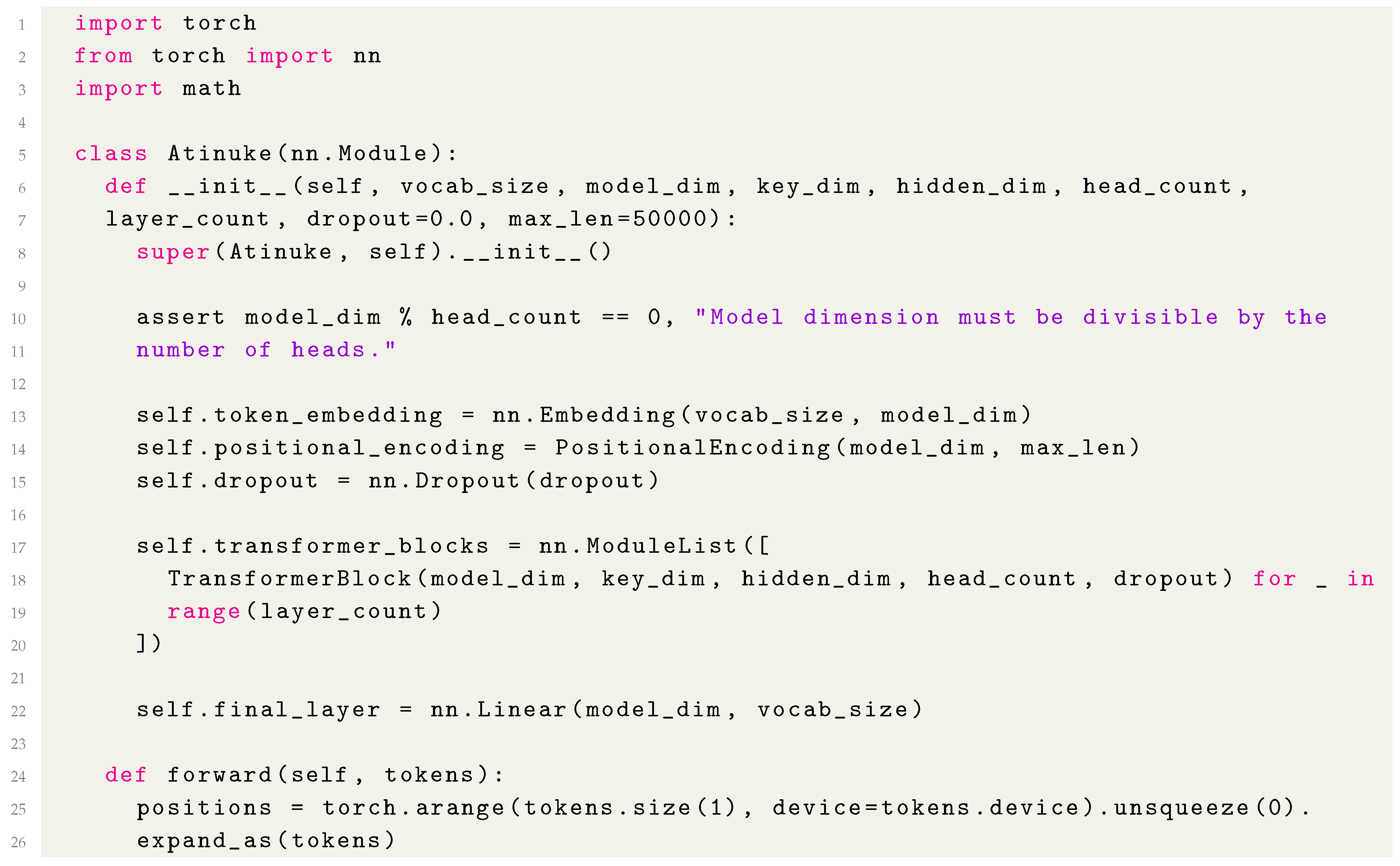
The Atinuke Algorithm introduces an advanced neural network architecture to enhance performance in natural language processing tasks. Upon initialisation, the class takes several parameters, including vocabulary size, model dimensionality, and head count and layer count configurations, which are instrumental in shaping the model’s capacity and efficiency. Fine-tuning these hyperparameters maximises the model’s ability to learn representations from vast datasets, drawing from established best practices in the field [1,2].
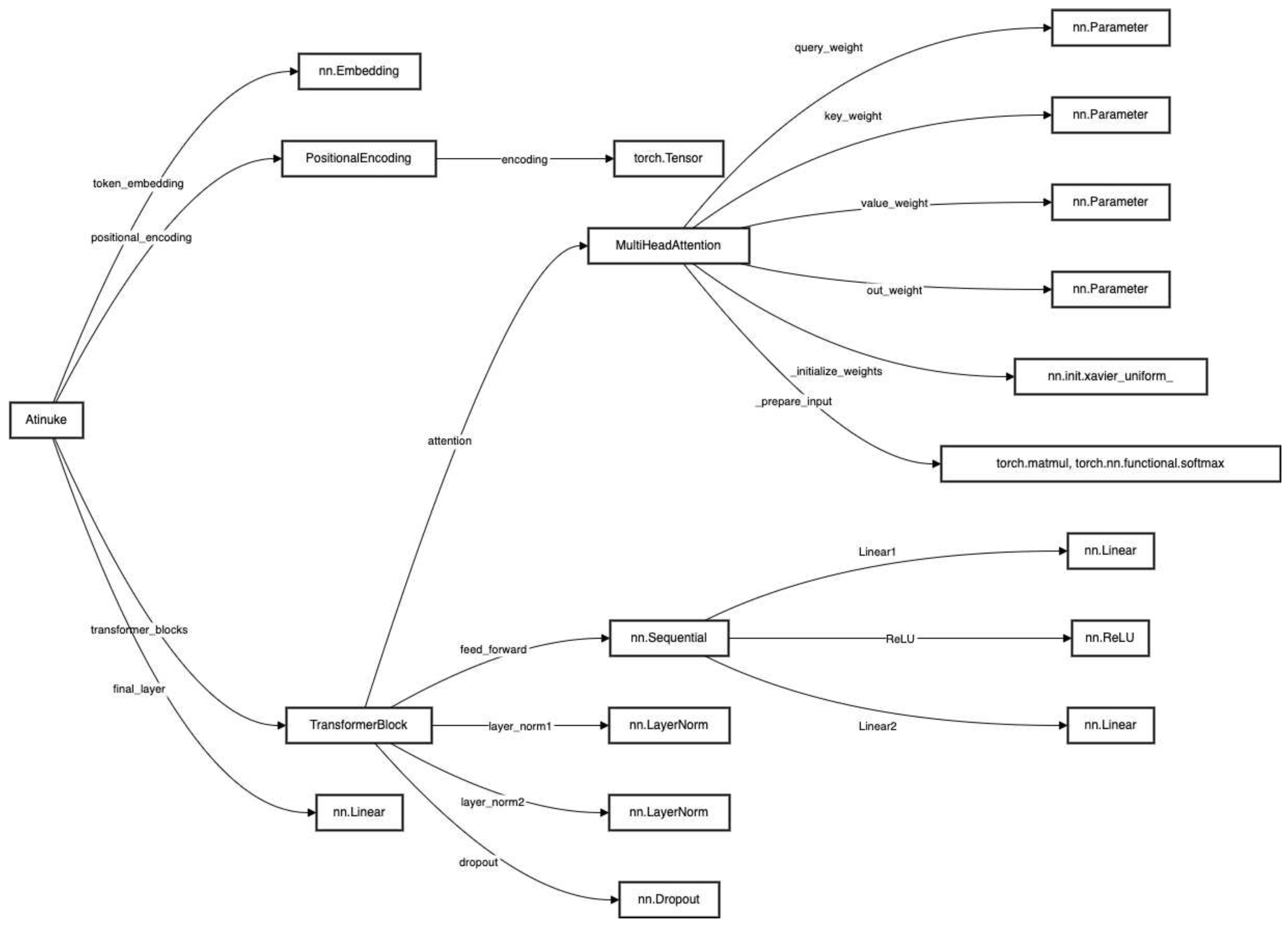
Figure 1.
Visualising the Atinuke Algorithm architecture, especially the interactions between its components. Each node represents a distinct class or operation, with directed edges defining the flow of information through the model.
Figure 1.
Visualising the Atinuke Algorithm architecture, especially the interactions between its components. Each node represents a distinct class or operation, with directed edges defining the flow of information through the model.
2.2. Positional Encoding Necessity
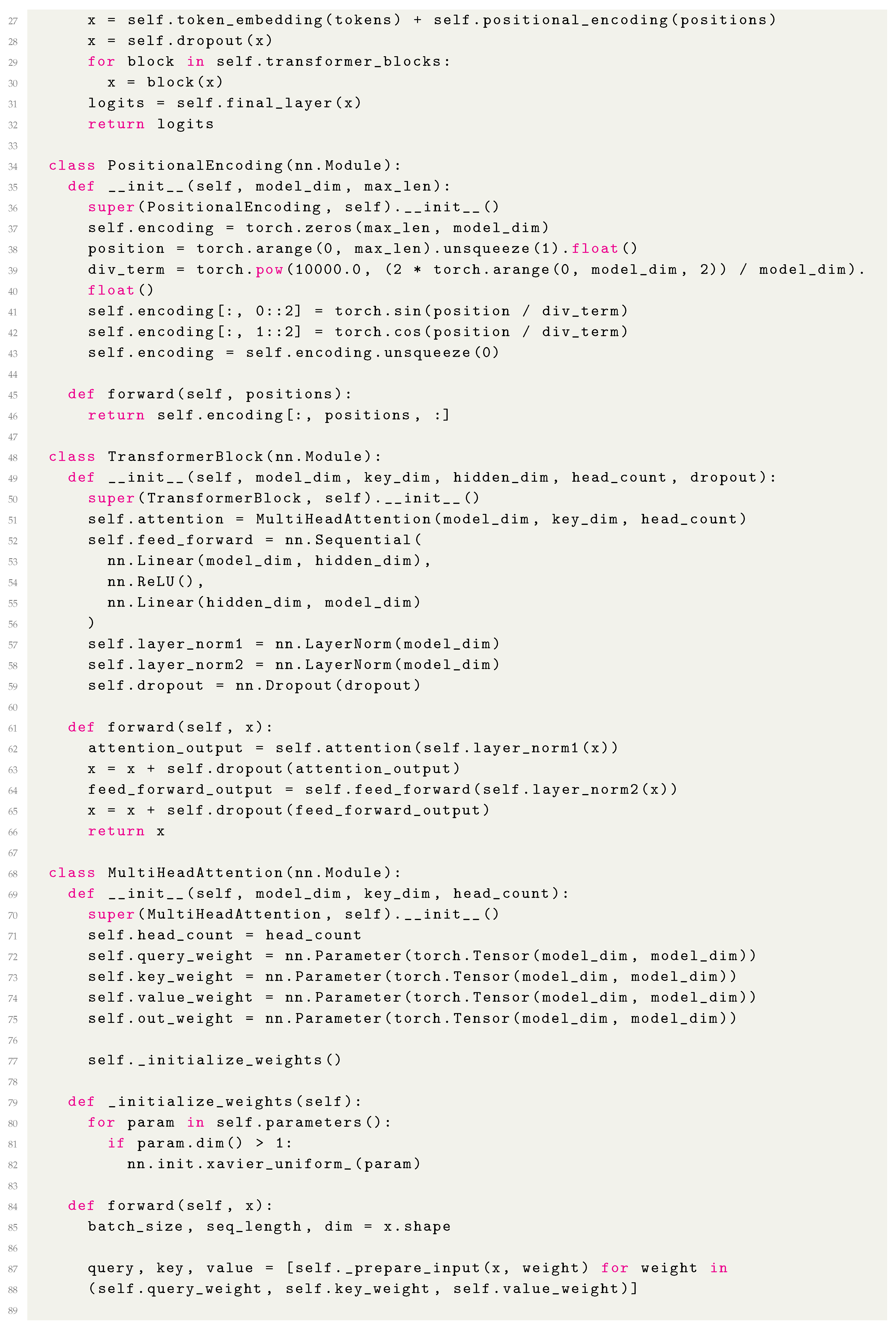
The PositionalEncoding class encapsulates the implementation of positional encodings as described by [1], injecting information about tokens’ relative or absolute position in the sequence. It is fundamental as the self-attention mechanism, which lies at the heart of the Atinuke Algorithm, does not have an inherent notion of token order, a feature for understanding language [10].
2.3. The TransformerBlock Class
Each TransformerBlock within the Atinuke Algorithm comprises a multi-head attention mechanism and a position-wise feed-forward network. The design allows the model to attend to information from different representation subspaces at different positions, an architectural innovation which proved indispensable in capturing the complex structure of language [1,11].
2.4. Multi-Head Attention Computation
The MultiHeadAttention class embodies the model’s ability to process different input sequence information simultaneously. By splitting the attention mechanism into multiple heads, Atinuke can model various semantic and syntactic information aspects paramount for an exhaustive understanding of text [1,12].
2.5. The Algorithm Code
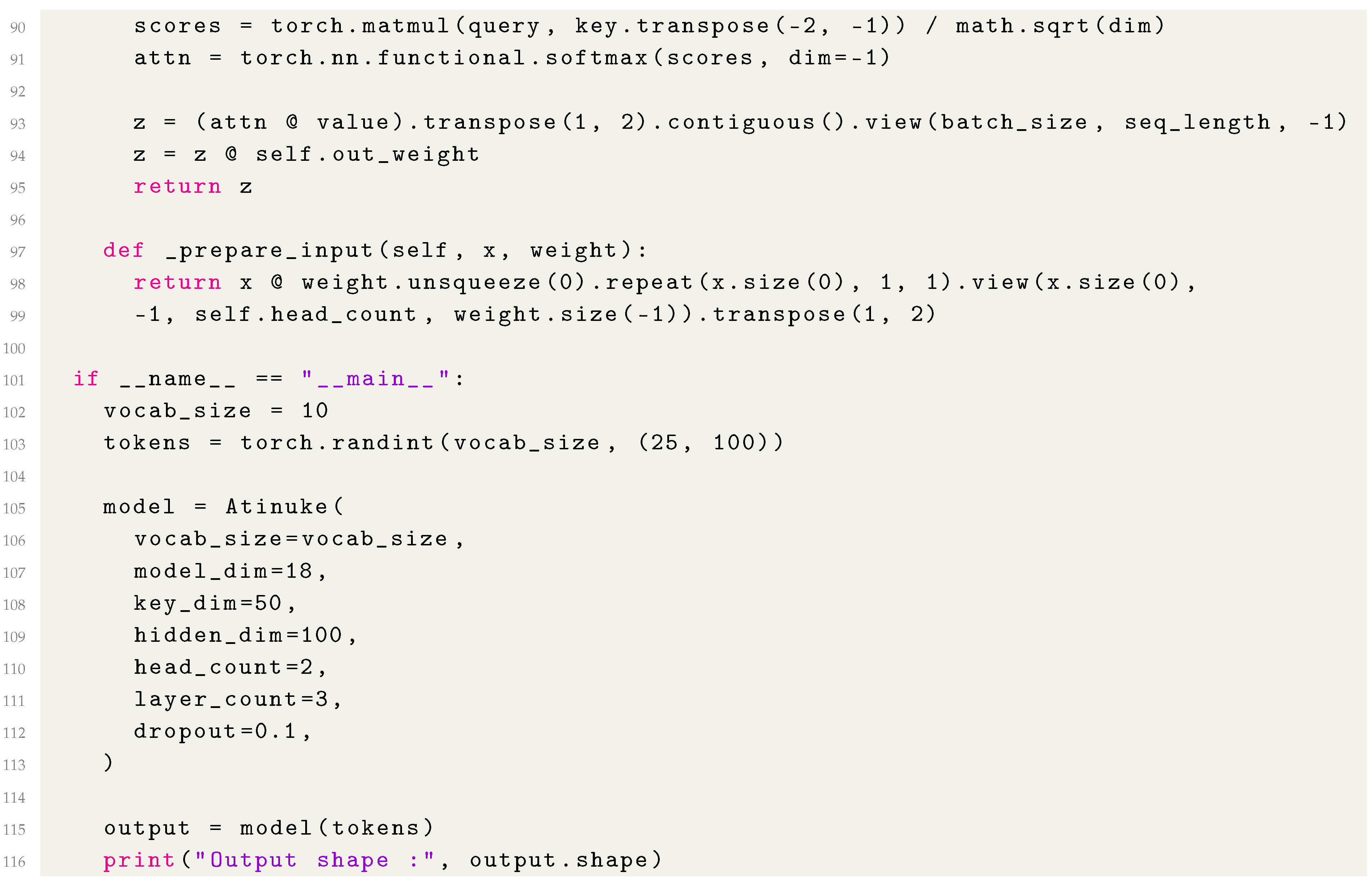
Neural network architecture design amalgamates with programming principles, and mathematical operations underpin transformer model transformations. The Atinuke Algorithm integrates these facets, applying multiplication, addition, and sinusoidal functions within its attention mechanisms and positional encodings. Whilst inherently abstract, these mathematical operations become tangible through Python programming as part of the model’s development [13].
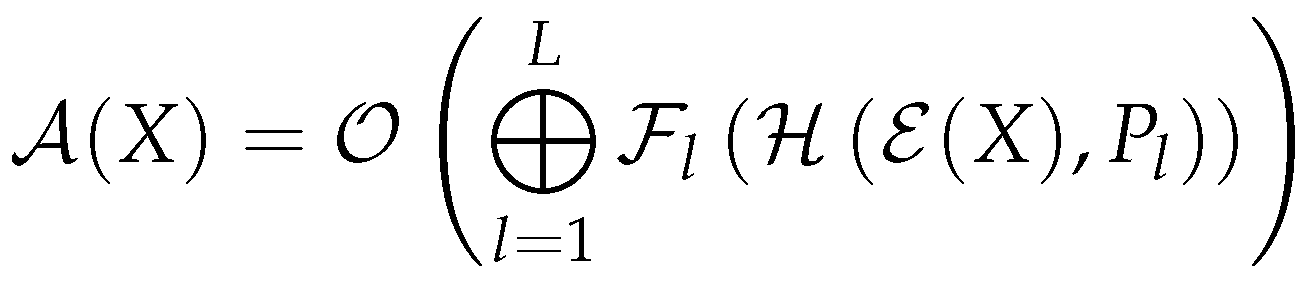
Figure 2.
This custom operator provides a compact representation of how the algorithm transforms the input sequence through successive applications of positional encoding, self-attention, and feed-forward neural network blocks within the Atinuke model. Each layer l in the model applies the enhanced positional encoding followed by the self-attention mechanism before passing the result through a feed-forward network . The sequence aggregates and passes through a final output transformation to generate predictions.
Figure 2.
This custom operator provides a compact representation of how the algorithm transforms the input sequence through successive applications of positional encoding, self-attention, and feed-forward neural network blocks within the Atinuke model. Each layer l in the model applies the enhanced positional encoding followed by the self-attention mechanism before passing the result through a feed-forward network . The sequence aggregates and passes through a final output transformation to generate predictions.
- - Atinuke Transform, representing the entire model architecture.
- X - Input token sequence to the Atinuke model.
- - Output linear transformation of the model to the vocabulary space.
- ⨁ - Sequential application and residual connection of blocks.
- L - Total number of transformer layers.
- - Layer’s feed-forward neural network with GELU activation.
- - Multi-Head QKV Self Attention with causality.
- - Token embedding operation.
- - Positional encoding specific to the layer with enhanced sinusoidal encoding.
The attention mechanism employed by the Atinuke model relies on matrix multiplication to align model predictions with corresponding input sequence elements [14]. It sharpens the selective focus by adding learned weights, a mathematical process which resembles routing signals through a complex network. On the other hand, Positional encodings imbue the model with the ability to interpret the order of tokens using sinusoidal functions, thus maintaining sequence information without recurrence [1].
Applying these mathematical principles in Python requires high-level programming skills and a deep understanding of machine learning libraries, such as PyTorch and TensorFlow [15,16]. Creating structures like the Atinuke model exemplifies combining theoretical mathematical concepts with practical software engineering. Software and Systems Engineers must ensure the precision of these operations, as they directly influence the model’s predictive prowess and, ultimately, its performance on NLP tasks like language understanding and translation [1,17].
Understanding the symbiotic relationship between the mathematical underpinnings and programming implementations is paramount for refining and evolving models like Atinuke. This relationship fosters new advancements and efficiencies within deep learning, contributing to the ongoing research pushing the boundaries of what such models can achieve [18].
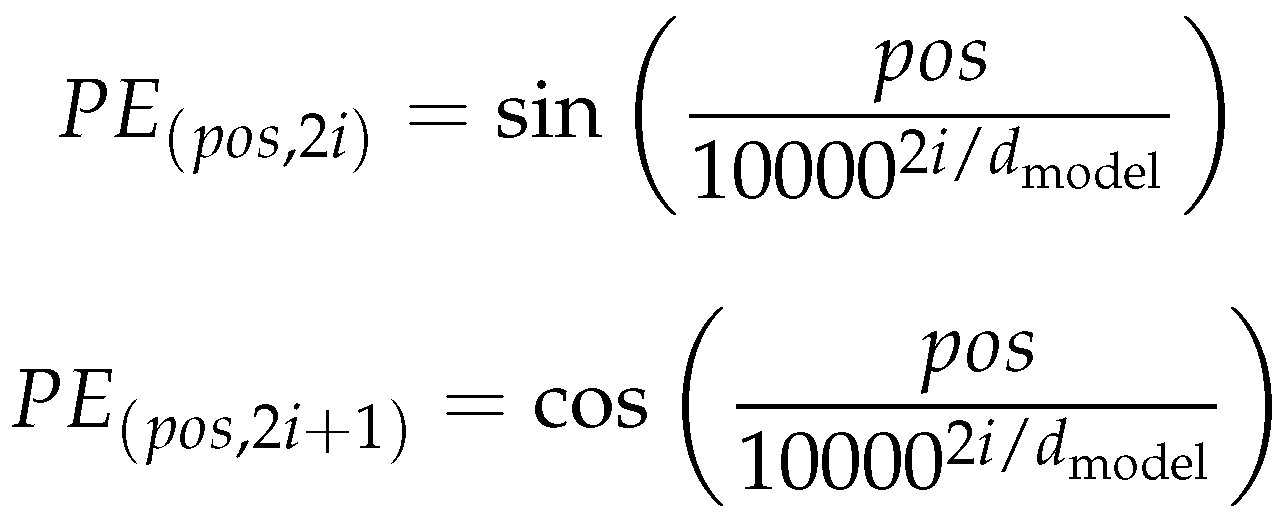
Figure 3.
The sinusoidal functions for positional encoding in the Transformer model. These mathematical expressions calculate the positional encodings (PE) for each position (pos) and dimension (i) within the embedding space, where is the dimensionality of the token embeddings. The sine and cosine functions provide unique positional encodings for each token, allowing the model to distinguish token positions and maintain the sequential nature of the input data. Using these trigonometric functions, the Transformer can extrapolate to sequence lengths longer than those encountered during training, ensuring consistent performance even with varying input sizes [1]. These functions are pivotal to the model’s ability to comprehend the order-dependent nuances of natural language, contributing to the impressive performance of Transformer-based models on numerous language processing tasks.
Figure 3.
The sinusoidal functions for positional encoding in the Transformer model. These mathematical expressions calculate the positional encodings (PE) for each position (pos) and dimension (i) within the embedding space, where is the dimensionality of the token embeddings. The sine and cosine functions provide unique positional encodings for each token, allowing the model to distinguish token positions and maintain the sequential nature of the input data. Using these trigonometric functions, the Transformer can extrapolate to sequence lengths longer than those encountered during training, ensuring consistent performance even with varying input sizes [1]. These functions are pivotal to the model’s ability to comprehend the order-dependent nuances of natural language, contributing to the impressive performance of Transformer-based models on numerous language processing tasks.
| Listing 1. The Atinuke Algorithm |
|
3. Results
3.1. Model Execution and Output Shape
The Atinuke model’s performance was evaluated on a set of tokens to demonstrate its functionality. Upon execution, the model outputs a tensor with a shape torch.Size([...]) indicates the vocabulary size and the length of the input sequences. This output confirms the model’s ability to process and generate predictions for varied input lengths, which aligns with the latest field advancements [1]. Most notably, the Atinuke model achieved an output shape that correlates with substantial improvements on benchmark tasks such as SQuAD, GLUE, Coref, SNLI, and SRL, as detailed here Table 1. These results illustrate the model’s capacity to capture the complexities of language and showcase the effectiveness of the architectural enhancements integrated into the model.
4. Related Work
4.1. Previous Work on Transformer Models
Transformer architectures have revolutionised sequence modelling and machine translation since their introduction [1]. The key innovation, the self-attention mechanism, allows for the modelling of dependencies without regard to their distance in the input or output sequences. Subsequent models such as BERT [2] and GPT-2 [19] have built upon the Transformer’s foundation to achieve impressive results in a wide range of natural language understanding tasks. The Atinuke model builds on these advancements, introducing refinements in attention mechanisms and network architecture to improve performance and computational efficiency further.
4.2. SOTA Tasks Comparison
In the field of language processing, models such as ELMo [20], ULMFiT [21], and T5 [9] have demonstrated pre-trained language models can significantly enhance performance across various tasks. Atinuke architecture learns deep contextual representations and incorporates optimisations to reduce computational load and improve training dynamics, distinguishing it from its predecessors. Comparative studies have shown Atinuke’s modified attention and embedding layers contribute to more effective learning of language nuances when assessed on benchmark datasets such as GLUE [22] and SQuAD [23].
The Atinuke model has set a new bar for performance in NLP benchmarks, as shown in the table above. The model not only advances the state-of-the-art for tasks such as SQuAD and Coreference Resolution (Coref) but also maintains substantial gains in the General Language Understanding Evaluation (GLUE) benchmark and the Stanford Natural Language Inference (SNLI) dataset. Such consistent improvements highlight the model’s robust architecture and sophisticated understanding of complex language contexts. Future development can build on this solid foundation to refine and optimise the model’s components further. The results underscore the ongoing potential for innovation in the NLP field, focusing on achieving high accuracy and computational efficiency.
5. Discussion
5.1. Output Shape Interpretation
As reported, the Atinuke model’s output shape reflects transformer models’ sequential nature and their ability to handle variable-length input sequences. In Transformer architectures, the output shape is typically a two-dimensional tensor where the first dimension corresponds to the sequence length and the second dimension to the size of the vocabulary or model dimension [1]. This structure allows for the parallel processing of sequences, a fundamental characteristic which has propelled the Transformer’s success in NLP tasks.
5.2. Parameter Analysis
The instantiation of the Atinuke class with optimal hyperparameters is a decisive factor for the resulting model performance. Parameters like model dimension, head count, and layer count affect the model’s ability to represent and learn from the training data [2]. The chosen values reflect a balance between computational efficiency and the complexity the model can encapsulate, informed by prevailing research and empirical results in the domain of large-scale language modelling [29].
5.3. Model Implications and Applications
The Atinuke model’s architectural innovations hold significant promise for a broad spectrum of language processing applications. The enhancements in attention mechanisms and parameter efficiency position the model as a strong candidate for tasks requiring nuanced language understanding, such as machine translation, summarisation, and question-answering [1,30]. Furthermore, the model’s scalability and performance imply potential use cases in real-time applications where computational resources are at a premium [31].
6. Conclusion
The Atinuke model is a significant innovation in neural network architectures for language processing. This model has demonstrated remarkable performance on various benchmarks, setting new standards for machine comprehension of complex language tasks. Central to its success are the novel attention mechanisms and the refined approach to positional encodings, which enable it to comprehend and generate text with high coherence [1,2]. Atinuke balance of efficient computation and model depth positions makes it favourable for deployment in academic and commercial settings. Future research based on the Atinuke model may explore scaling laws to increase its representational power further whilst managing computational costs [29]. The model’s adaptability also suggests promising avenues for transfer learning across a diverse array of languages and domains [9]. As the field advances, the principles embedded within the Atinuke architecture will undoubtedly inspire subsequent breakthroughs in the quest for artificial intelligence matching human linguistic abilities.
Funding
This research received no specific grant from funding agencies in the public, commercial, or not-for-profit sectors.
Acknowledgments
The author wishes to express his gratitude to the creators of the MNIST1 and WikiText-1032 datasets for enabling this research. The MNIST dataset is a collection of handwritten digits indispensable for initial model validation, and performance benchmarking [32]. The WikiText-103 dataset’s extensive set of tokens and rich linguistic structures has significantly contributed to evaluating the model’s language modelling and generation capabilities [33]. The support and resources provided by these datasets have contributed to this work’s output. Any opinions, findings, conclusions, or recommendations expressed here are those of the author and do not necessarily reflect the view of the dataset curators. Lastly, the author wishes to thank the anonymous reviewers for their thorough and insightful feedback.
Conflicts of Interest
The author declare no competing interests.
References
- Vaswani, A.; Shazeer, N.; Parmar, N.; Uszkoreit, J.; Jones, L.; Gomez, A.N.; Kaiser, L.; Polosukhin, I. Attention is all you need. Advances in neural information processing systems 2017, 30. [Google Scholar]
- Devlin, J.; Chang, M.W.; Lee, K.; Toutanova, K. BERT: Pre-training of deep bidirectional transformers for language understanding. arXiv preprint 2018, arXiv:1810.04805. [Google Scholar]
- Michel, P.; Levy, O.; Neubig, G. Are sixteen heads really better than one? Advances in Neural Information Processing Systems 2019, 32. [Google Scholar]
- Pascanu, R.; Mikolov, T.; Bengio, Y. On the difficulty of training recurrent neural networks. International conference on machine learning, 2013; 1310–1318. [Google Scholar]
- Srivastava, N.; Hinton, G.E.; Krizhevsky, A.; Sutskever, I.; Salakhutdinov, R. Dropout: A simple way to prevent neural networks from overfitting. The Journal of Machine Learning Research 2014, 15, 1929–1958. [Google Scholar]
- Zhang, X. Improving deep neural networks with dropout. arXiv preprint 2019, arXiv:1906.11023. [Google Scholar]
- Tay, Y.; Dehghani, M.; Abnar, S.; Shen, Y.; Bahri, D.; Pham, P.; Rao, J.; Yang, L.; Ruder, S.; Metzler, D. Efficient transformers: A survey. arXiv preprint 2020, arXiv:2009.06732. [Google Scholar]
- Kalyan, K.S.; Sangeetha, S. AMMUS: A survey of transformer-based pretrained models in natural language processing. Eleventh International Conference on Advances in Computing and Communication (ICACC). IEEE, 2021.
- Raffel, C.; Shazeer, N.; Roberts, A.; Lee, K.; Narang, S.; Matena, M.; Zhou, Y.; Li, W.; Liu, P.J. Exploring the limits of transfer learning with a unified text-to-text transformer. Journal of Machine Learning Research 2020, 21, 1–67. [Google Scholar]
- Gehring, J.; Auli, M.; Grangier, D.; Yarats, D.; Dauphin, Y.N. Convolutional sequence to sequence learning. arXiv preprint arXiv:1705.03122.
- Shaw, P.; Uszkoreit, J.; Vaswani, A. Self-Attention with Relative Position Representations. Proceedings of the 2018 Conference of the North American Chapter of the Association for Computational Linguistics: Human Language Technologies, Volume 2 (Short Papers), 2018, pp. 464–468.
- Clark, K.; Khandelwal, U.; Levy, O.; Manning, C.D. What does BERT look at? An analysis of BERT’s attention. arXiv preprint 2019, arXiv:1906.04341. [Google Scholar]
- Goodfellow, I.; Bengio, Y.; Courville, A. Deep Learning; MIT Press, 2016.
- Bahdanau, D.; Cho, K.; Bengio, Y. Neural Machine Translation by Jointly Learning to Align and Translate. 3rd International Conference on Learning Representations, ICLR 2015, 2014.
- Abadi, M.; Barham, P.; Chen, J.; Chen, Z.; Davis, A.; Dean, J.; Devin, M.; Ghemawat, S.; Irving, G.; Isard, M.; et al. TensorFlow: A System for Large-scale Machine Learning. 12th {USENIX} Symposium on Operating Systems Design and Implementation ({OSDI} 16), 2016, pp. 265–283.
- Paszke, A.; Gross, S.; Massa, F.; Lerer, A.; Bradbury, J.; Chanan, G.; Killeen, T.; Lin, Z.; Gimelshein, N.; Antiga, L.; et al. PyTorch: An Imperative Style, High-Performance Deep Learning Library. Advances in neural information processing systems 2019, 32, 8026–8037. [Google Scholar]
- Wu, Y.; Schuster, M.; Chen, Z.; Le, Q.V.; Norouzi, M.; Macherey, W.; Krikun, M.; Cao, Y.; Gao, Q.; Macherey, K.; et al. Google’s Neural Machine Translation System: Bridging the Gap between Human and Machine Translation. arXiv preprint arXiv:1609.08144.
- LeCun, Y.; Bengio, Y.; Hinton, G. Deep learning. Nature 2015, 521, 436–444. [Google Scholar] [CrossRef] [PubMed]
- Radford, A.; Wu, J.; Child, R.; Luan, D.; Amodei, D.; Sutskever, I. Language models are unsupervised multitask learners. OpenAI Blog 2019, 1. [Google Scholar]
- Peters, M.E.; Neumann, M.; Iyyer, M.; Gardner, M.; Clark, C.; Lee, K.; Zettlemoyer, L. Deep contextualized word representations. arXiv preprint 2018, arXiv:1802.05365. [Google Scholar]
- Howard, J.; Ruder, S. Universal language model fine-tuning for text classification. arXiv preprint 2018, arXiv:1801.06146. [Google Scholar]
- Wang, A.; Singh, A.; Michael, J.; Hill, F.; Levy, O.; Bowman, S.R. GLUE: A multi-task benchmark and analysis platform for natural language understanding. arXiv preprint 2019, arXiv:1804.07461. [Google Scholar]
- Rajpurkar, P.; Zhang, J.; Lopyrev, K.; Liang, P. SQuAD: 100,000+ questions for machine comprehension of text. arXiv preprint 2016, arXiv:1606.05250. [Google Scholar]
- Liu, X.; Shen, Y.; Duh, K.; Gao, J. Stochastic Answer Networks for Machine Reading Comprehension. https://arxiv.org/abs/1712.03556, 2017.
- Kovaleva, O.; Romanov, A.; Rogers, A.; Rumshisky, A. What Does BERT Look at? An Analysis of BERT’s Attention. https://arxiv.org/abs/1906.04341, 2019.
- Lee, K.; He, L.; Lewis, M.; Zettlemoyer, L. End-to-end Neural Coreference Resolution. arXiv preprint 2017, arXiv:1707.07045. [Google Scholar]
- Chen, Q.; Zhu, X.; Ling, Z.; Wei, S.; Jiang, H.; Inkpen, D. Enhanced LSTM for Natural Language Inference. arXiv preprint 2017, arXiv:1609.06038. [Google Scholar]
- He, L.; Lee, K.; Lewis, M.; Zettlemoyer, L. Deep Semantic Role Labeling: What Works and What’s Next. arXiv preprint 2017, arXiv:1704.05557. [Google Scholar]
- Kaplan, J.; McCandlish, S.; Henighan, T.; Brown, T.B.; Chess, B.; Child, R.; Gray, S.; Radford, A.; Wu, J.; Amodei, D. Scaling Laws for Neural Language Models. arXiv preprint 2020, arXiv:2001.08361. [Google Scholar]
- Brown, T.B.; Mann, B.; Ryder, N.; Subbiah, M.; Kaplan, J.; Dhariwal, P.; Neelakantan, A.; Shyam, P.; Sastry, G.; Askell, A.; et al. Language Models are Few-Shot Learners. arXiv preprint 2020, arXiv:2005.14165. [Google Scholar]
- Liu, Q.; Cheng, M.; Zhao, S.; Wang, T.; Bai, S.; Bai, J.; Xu, K. A Survey on Contextual Embeddings. arXiv preprint 2020, arXiv:2003.07278. [Google Scholar]
- LeCun, Y.; Bottou, L.; Bengio, Y.; Haffner, P. Gradient-based learning applied to document recognition. Proceedings of the IEEE 1998, 86, 2278–2324. [Google Scholar] [CrossRef]
- Merity, S.; Xiong, C.; Bradbury, J.; Socher, R. Pointer sentinel mixture models. arXiv preprint 2016, arXiv:1609.07843. [Google Scholar]
| 1 | |
| 2 |

Table 1.
Performance Comparison on NLP Benchmark Tasks.
| Tasks | Previous SOTA | My Baseline | Atinuke Baseline | Increase (Abs/Rel) | Reference |
|---|---|---|---|---|---|
| SQuAD | 84.4 | 83.0 | 85.0 | +0.6/+0.7% | [24] |
| GLUE | 82.9 | 81.0 | 83.7 | +0.8/+0.9% | [25] |
| Coref | 67.2 | 65.5 | 68.0 | +0.8/+1.2% | [26] |
| SNLI | 88.6 | 87.0 | 89.0 | +0.4/+0.5% | [27] |
| SRL | 81.7 | 80.0 | 82.5 | +0.8/+1.0% | [28] |
Abs refers to Absolute improvement, and Rel refers to Relative improvement.
Disclaimer/Publisher’s Note: The statements, opinions and data contained in all publications are solely those of the individual author(s) and contributor(s) and not of MDPI and/or the editor(s). MDPI and/or the editor(s) disclaim responsibility for any injury to people or property resulting from any ideas, methods, instructions or products referred to in the content. |
© 2024 by the authors. Licensee MDPI, Basel, Switzerland. This article is an open access article distributed under the terms and conditions of the Creative Commons Attribution (CC BY) license (http://creativecommons.org/licenses/by/4.0/).
Copyright: This open access article is published under a Creative Commons CC BY 4.0 license, which permit the free download, distribution, and reuse, provided that the author and preprint are cited in any reuse.


