

Submitted:
09 September 2024
Posted:
10 September 2024
You are already at the latest version
Abstract
The 20th century, known as the "metropolitan century," saw urban populations exceed half the global populace. By 2035, emerging metropolises, particularly in Asia and Africa, highlight the urgent need for research on urban growth, demographics, and mobility's role in sustainable development. This study explores the multifaceted aspects of mobility essential for sustaining metropolitan regions, examining stakeholders' perspectives through a detailed analysis of interview data. Responses are aligned with convergent subcategories derived from classical urban theories and contemporary metropolitan studies, encompassing territorial aspects, scale, place, urbanization, economy, culture, identity, innovation, networks, climate change, and foresight. The findings highlight the intricate interplay of governance, infrastructure, and socio-spatial dynamics in Greater London, underscoring the imperative for sustainable mobility and inclusive planning that integrates environmental concerns into metropolitan life. This research, through a convergent analysis of interviewees' responses, has identified thirty-one fundamental attributes to enhance our understanding of mobility within metropolitan areas, with a particular focus on the case study of Greater London. Future research directions include extending this framework to other metropolises and a deeper exploration of the attributes identified in London, employing both qualitative and quantitative methods to enrich our understanding of urban sustainability and mobility.
Keywords:
Metropolitan regions
; Greater London
; Metropolitan
; Mobility
; Sustainable
1. Introduction
The twentieth century is called the “metropolitan century” (UN-Habitat, 2020), mainly because those metropolises represent approximately 53% of the world’s population (OECD, 2018). It’s projected that around 325 new metropolitan areas will emerge globally by 2035. Population growth is expected to be led by Asia and Africa, while Europe’s population will remain stable and Latin America will experience slower growth. Presently, Asia is home to 1,038 metropolitan areas, accounting for 56.11% of the total. This is followed by Western Europe with 325 metropolitan areas (15.76%), Latin America and the Caribbean with 215 (12.5%), Africa with 235 (11.7%), and Eastern Europe with 121 (3.9%). In addition to this, the municipalities, which are part of the metropolitan areas, can represent a third of the national world economy (UN-Habitat, 2020)
The rapid growth of metropolitan regions, especially in Asia and Africa, spotlights the necessity for in-depth research on urban expansion and demographic transitions. As urban landscapes evolve, they present unique challenges and opportunities, demanding a comprehensive understanding of territorial development and mobility. This includes not just growth management but also ensuring sustainable and harmonious urban expansion that integrates human and environmental elements. Such an approach necessitates a nuanced understanding of urban dynamics, bridging the gap between theoretical models and the complex realities of metropolitan life.
Despite global efforts by the UN (2020) and OECD (2018) to standardize the definition of metropolises, research often neglects the intricate relationship between human activities and goods movement. Effective management of these densely populated and economically pivotal areas requires a focus on infrastructure, urban networks, and mobility, tailored to each metropolis’s unique characteristics, including mobility, migration, economic growth, and community needs. Addressing the critical role of mobility within metropolises necessitates specific legislative and planning efforts to cater to the complex interplay of factors that shape urban life (ITF, 2021; UN Habitat, 2020; Moreno-Monroy et al., 2020); Lermana et al., 2020; Brömmelstroet & Verkade, 2020; Orum & Collins, 2019; Dijkstra et al., 2019; Nikolaeva et al., 2019; Benini, 2018; Peres et al., 2018; BRASIL, 2015; Costa et al., 2014; Harrison and Growe, 2014; BRASIL, 2012; Brenner, 2011; Yigitcanlar et al., 2008; Venables, 2005; Jessop et al., 2008; Antrop, 2004; Moura & Cardoso, 2004; Holmes et al., 2000; Ciechocinska, 1984).
Bridging these insights, the transition from a general framework to a more granular analysis exemplifies the leap from standardized definitions of urban areas to the nuanced understanding required to grasp the dynamics of Functional Urban Areas (FUAs) in Europe, where the intricate tapestry of mobility and urbanism transcends mere geographic or administrative boundaries. Functional Urban Areas (FUAs) in Europe, based on urban centers and local units, highlight the complex relationship between metropolises and mobility. However, regional mobility’s intricacy often exceeds municipal boundaries, challenging the definition and analysis of metropolises (Dijkstra et al., 2019).
Academic research is essential for comprehending the complexities of urban development and the pivotal role of mobility in shaping cities. Studies from as Xue et al., (2022), Kulkarni et al., (2019), Zheng and Chen (2019), Lim et al. (2019), Guidotti et al. (2016), Cho et al. (2011), González et al. (2008) and Brockmann et al. (2006) highlight this interplay, demonstrating how urban planning and mobility are mutually influential. This concept, eloquently summarized by Winston Churchill in 1944: “First we shape our mobility system, and afterwards that mobility system shapes us” as noted by Brömmelstroet & Verkade (2020) and Te Brömmelstroet et al. (2021). Academic research is crucial also for understanding Metropolitan Areas, their growth complexities, and the influence of mobility on urban development. Similarly, studies on metropolitan mobility are deepened by an extensive scholarly foundation, leveraging insights from both historical and recent contributions. Abou Jaoude et al. (2022), Barbera & Rossi (2021), IPCC (2021), Maheshwari et al. (2020), and Goodspeed (2020), UN (2015, 2020), Sennett (2018), Lundqvist (2016), Harrison & Growe (2014), Jessop et al. (2008) and Santos (1979, 1985), offer valuable insights for understanding the complexities of mobility in metropolitan areas.
Mobility profoundly influences urban life, affecting economic, political, and societal dimensions (UN-Habitat, 2020). It is a key driver of regional growth and enriches urban experiences, reflecting societal behaviors (Meredith et al., 2021; Vidovic et al., 2019). Analyzing community dynamics shows the impact of population density on movement and addresses emerging needs. Moreover, mobility’s link to sustainability is undeniable, with transportation being a major contributor to emissions—particularly, automobiles, which are responsible for 80% of these emissions (IPCC, 20211; Nikolaeva et al., 2019; Zignani et al., 2013). Consequently, transitioning to sustainable mobility practices is essential. Frameworks like the New Urban Agenda and Sustainable Development Goals highlight sustainable mobility’s role in fostering resilient urban communities (UN-Habitat, 2020). The significance of sustainable mobility in urban contexts, particularly its role in addressing climate change through decarbonization, housing risk assessments, and urban transport policies, is crucial (Boland et al., 2023; Winklet et al., 2023; Drummond, 2021; Palliyani & Lee, 2017; Mavrogianni et al., 2015). This emphasis aligns with efforts to improve intelligent transport systems and to understand the wider impact of mobility on urban development (Larkin et at.; 2017; Richter & Ruhl, 2013). An in-depth grasp of urban dynamics, encompassing governance and sustainable mobility, is essential for effective urban planning (Johson & Hasrstad, 2022; Krukle et al., 2019; Contreras Platania, 2019). The UK’s Office for Science (2013) underscores the need for long-term planning and evidence-based policymaking, projecting the paths of urban development and sustainability until 2065 and advocating for a unified approach to the effects of climate change on mobility (Ferris, 2020).
London’s experiences encapsulate the broader context of urban mobility and sustainability, stressing the importance of comprehending how cities manage sustainable mobility’s complexities. This research aims to unravel how metropolises like Greater London tackle sustainable mobility challenges and opportunities. The research question is: How are the different dimensions of mobility perceived and what are the essential attributes needed to guarantee the sustainability of a metropolitan region?
The main objective of this study is to analyze the different dimensions of mobility as a function of common interest and to define the necessary attributes to make a metropolitan region sustainable. Achieving this broad aim involves two targeted goals. The first specific goal is to explore perceptions of diverse stakeholders regarding the various dimensions of mobility, with the objective of uncovering how these dimensions are understood and prioritized in the context of sustaining metropolitan regions. This step is crucial for highlighting the spectrum of stakeholder views on mobility’s impact on essential urban interests like accessibility, environmental sustainability, and social inclusivity, using qualitative research methods. The second specific goal aims to distill and articulate the essential attributes of mobility that are considered vital by stakeholders for the sustainability of metropolitan regions. This involves a qualitative analysis to pinpoint both agreements and differences in stakeholder opinions on what makes mobility sustainable, focusing on aspects such as policy frameworks, technological advancements, and strategies for community engagement. These specific goals not only support the main objective but also deepen our comprehension of mobility’s critical role in fostering sustainable metropolitan environments.
This study is structured into four principal sections, beginning with the Theoretical Background, which explores the Metropolitan Phenomenon, Greater London, and its recent policies and programs. Following this, the Method section describes the case study approach, qualitative research phase, and data collection methods employed. The third section, Findings, presents an analysis of general documents related to Greater London, the evaluation of interviewees, and the subcategories for examination. The study concludes with Concluding Remarks, summarizing its contributions to academic discourse on the subject and providing insightful, substantiated conclusions.
2. Theoretical Background
2.1. Metropolitan Phenomenon
The term “metropolis,” originally meaning a mother city in Greek, now signifies power and prestige in various contexts. Modern definitions vary, including megalopolis, metropolitan regions, urban agglomerations, and Functional Urban Areas, each applying specific criteria to identify metropolitan characteristics (Celestino, 2021; UN, 2020; Fang and Yu, 2017; Moreno-Monroy et al., 2020; Smith, 2013; Catalán and Serra, 2008; Kennedy et al., 2005; Keene, 2004; Luck and Wu, 2002; Hansen, 1959). Cities shaped by historical contexts require sound urban planning due to their impact on mobility, crucial for socioeconomic growth. Mobility, encompassing urban movements, reveals behavioural patterns and connects people, goods, and locations (Meredith et al., 2021; Vidovic et al.,, 2019; Zignani et al., 2013). Sustainable mobility, balancing environmental and socioeconomic factors, aligns with global policies and integrates mobility analyses into urban dynamics (UN-Habitat, 2020; Krukle et. at., 2019). The interplay between metropolitan areas, mobility, and climate change necessitates comprehensive adaptation strategies. Research highlights the importance of community-led initiatives and sustainable transport solutions in reducing greenhouse gas emission (Creutzig et al., 2012; Sudhakara Reddy & Balachandra, 2012; Smit & Wandel, 2006). The Urban Adaptation Index (UAI) and Sustainable Urban Mobility Plans (SUMPs) address urban mobility sustainably, balancing climate objectives with equitable accessibility (Neder et al., 2021; Arsenio et al., 2016). This study evaluates urban resilience and mobility strategies, using theoretical frameworks to inform sustainable policymaking.
The research is based on Walter Christaller’s Central Place Theory (1966) and the Growth Pole Theory (1955). Ribeiro and Fachinelli (2021) identified commonalities between these theories. The analysis involved: (i) identifying basic concepts from each theory; (ii) interpreting concepts in relation to metropolitan realities; (iii) correlating concepts between theories; (iv) detecting conditions crucial for each concept; (v) developing a minimal classification for concepts. Key concepts include: (i) territory study necessitates location; (ii) functional hierarchy depends on scale; (iii) regions require vision coverage; (iv) mobility is essential for connection and road dependency; (v) urban networks involve mobility; (vi) urbanization links to a phenomenon; (vii) investment concentration requires economic context analysis.
Converging concepts in both theories require specific conditions, categorized as physical (tangible aspects) or non-physical (intangible phenomena). Each concept’s existence depends on fulfilling its primary condition, forming a hierarchical structure essential for understanding urban and metropolitan dynamics. (Ribeiro & Fachinelli, 2021).
In the 21st century, cities confront challenges such as urbanization and climate change. Benko (2002) and Harrison and Growe (2014) discuss how globalization centralizes economic power in cities, altering urban dynamics. Mi & Coffman (2019) explore the sharing economy’s contribution to sustainability and urban mobility. Barbera and Rossi (2021), Sennet (2018) and Ellin (2006) introduces the “open city” concept, advocating for porosity in urban planning to enhance integration. The UN-Habitat (2020) emphasizes urban areas’ role in achieving Sustainable Development Goals through sustainable urbanization. Additionally, the text highlights the importance of integrating climate considerations into urban planning, as noted by the IPCC (2021), Maheshwari et al. (2020) and Lundqvist (2016). It concludes with the advocacy by Abou et al., (2022) and Goodspeed (2020) for scenario planning as a strategic tool to address urban challenges, emphasizing adaptability and stakeholder involvement for a more resilient and inclusive urban future.
Ribeiro and Fachinelli (2021) integrates these concepts, demonstrating that the study of metropolitan phenomena can be approached through the analysis of various dimensions including territory, scale, place, networks (JESSOP et al., 2008), urbanization (Harrison and Growe, 2014) urban economy, (Benko, 2002) culture and identity, (Sennet, 2018; Barbera and Rossi, 2021) innovation, (UN, 2015, 2020) climate change, (IPCC, 2021; Maheshwari et al., 2020; Lundqvist, 2016) and foresight (Abou et al.. 2022; Goodspeed, 2020).
2.2. Greater London
In the contemporary urban landscape, the intricate dynamics between climate change response and urban mobility have emerged as pivotal determinants of metropolitan sustainability. Analyzing London’s Climate Response and its Implications for Metropolitan Sustainability seeks to illuminate this nexus, focusing on London’s strategic endeavors to navigate the challenges posed by climate change. Through an in-depth examination of initiatives such as the UK Climate Impacts Program (UKCIP) and the thorough assessment of climate impacts, this study endeavors to unravel how mobility, in its myriad forms, plays a crucial role in fostering or impeding the sustainability of metropolitan regions.
London’s diverse strategies to enhance environmental sustainability and mobility are central to this analysis. The research highlights key mobility attributes identified by stakeholders as essential for the sustainable development of metropolitan areas. Additionally, the study provides a strategic analysis of London’s environmental initiatives, emphasizing the London Environment Strategy’s shift towards integrating urban mobility with environmental sustainability.
By examining London’s comprehensive strategies for improving air and water quality, reducing greenhouse gas emissions, and strengthening flood defenses, this study aligns with the broader academic goal of identifying critical elements for metropolitan sustainability. It emphasizes the importance of integrating stakeholder perspectives with environmental strategies, presenting a framework for sustainable mobility that addresses climate change impacts and enhances urban livability.
This holistic approach demonstrates London’s commitment to creating a resilient, sustainable, and thriving metropolitan region. The city’s model of integrating environmental sustainability into urban mobility planning and policy development serves as a valuable reference for other metropolitan areas.
2.3. Mobility and Environmental Sustainability: Analyzing London’s Climate Response and Its Implications for Metropolitan Sustainability
This study seamlessly aligns with analyzing mobility’s role in fostering sustainable metropolitan regions, focusing on London’s climate change response through the UK Climate Impacts Program (UKCIP) and comprehensive climate impact assessments. Emphasizing climate scenarios, environmental, social, and economic impacts, and adaptation strategies highlights the critical interplay between sustainability and urban mobility (UKCIP, 2002).
The climate impact studies and adaptation options provide a foundation for exploring mobility’s essential attributes for metropolitan sustainability. Examining issues like flooding, water resources, health, biodiversity, and transport offers insight into urban mobility’s environmental dimensions and its interconnectedness with urban planning and policymaking. Adaptation options and policies, such as sustainable urban drainage systems, water-efficient appliances, and infrastructure adjustments, are integral to sustainable mobility frameworks. These measures address climate change impacts, improve urban livability, reduce reliance on unsustainable transport, and promote green spaces. Integrated planning and a multifaceted approach to climate change impacts align with the study’s broader objectives, emphasizing sustainability and resilience in urban mobility planning. Comprehensive strategies across sectors, as seen in Greater London’s transport, economic development, and emergency preparedness approaches, exemplify the holistic perspective needed for sustainable metropolitan regions (UKCIP, 2002).
2.4. Integrating Urban Mobility and Environmental Sustainability: A Strategic Analysis of London’s Environmental Initiatives (2018)
The 2018 London Environment Strategy aligns with this study’s objectives to analyze mobility dimensions and define attributes for sustainable metropolitan regions. This evolution from initial climate change responses to strategizing sustainability marks a paradigm shift towards integrating mobility and environmental sustainability (GLA, 2018).
London’s commitment to improving air and water quality, reducing greenhouse gas emissions, and bolstering flood defenses exemplifies a multifaceted approach to sustainability. These measures are essential for creating a resilient metropolitan region. The emphasis on revitalizing urban spaces and mitigating climate change aligns with the study’s goals, highlighting the importance of stakeholder insights in shaping policies for a sustainable region (GLA, 2018).
The Greater London Authority’s strategy integrates stakeholder input, focusing on reducing carbon emissions, advancing renewable energy, and improving waste management. Enhancements to green infrastructure and air quality ensure the sustained viability of metropolitan regions. The strategy’s multi-dimensional approach blends policy measures with objectives, fostering a greener, sustainable, and resilient city prepared for future challenges. This strategy underscores the importance of effective governance, sustainable urban development, and robust infrastructure in environmental stewardship, paralleling the scholarly emphasis on sustainable mobility (GLA, 2018).
3. Method
3.1. Case Study
The research strategy adopted through the case study method is widely utilized by various authors across different topics related to metropolises as urban mobility (Melikov et al., 2021) levels of information mobilization for citizens (Uppal, 2021); the phenomenon of reurbanization (Duarte Alonso et al., 2018); collaborative planning (Deyle & Wiedenman, 2014); the perspective of elderly customers in delibery service (Byrne et al., 2012); case study understanding (Flyvbjerg, 2011); metropolitan planning organization (Fu et al., 2007). The study conducted by Eisenhardt (1989) synthesizes various previous research (Miles and Huberman, 1984; Yin, 1981; Glasser and Strauss, 1967) and proposes an analytical framework for case studies. The author outlines seven stages for conducting case study research with the aim of validating theories and applying them to the chosen study object. These re-search phases include Development of Instruments and Protocols, Data Collection, Data Analysis, Formulation of Hypotheses, and Conclusions.
The methodology employed in this study included data analysis, review of academic studies and documents, and qualitative interviews. It utilized academic databases and inter-national platforms to identify references and studies exploring the relationship between metropolitan regions, mobility, and climate change. Additionally, it reviewed relevant literatura, including books and scientific articles, to understand the subject matter and its evolution within the context of this research. A specific focus was placed on analyzing current policies related to climate change in the Greater London area and their impact on mobility. Lastly, qualitative interviews were conducted with subject matter experts to gain insights into their perceptions regarding the research objectives. This comprehensive approach ensured a thorough understanding of the dynamics at play and supported the development of well-informed conclusions.
3.2. Qualitative Phase of Research
This research employs qualitative methodologies to examine urban and metropolitan issues, drawing on frameworks from Creswell and Clark (2018) and Denzin (2006). The study concerning Greater London is structured into five distinct phases: articulation of a multicultural researcher’s perspective, establishment of a theoretical paradigm, development of a research strategy, collection and analysis of data, and interpretation of results. This process begins with the formulation of research questions and selection of appropriate ethical paradigms, followed by comprehensive literature reviews and the application of chosen methodologies to probe the multicultural dynamics of Greater London.
The third and fourth phases are centered on qualitative interpretation and analysis, involving active engagement with diverse communities. This is accomplished through interviews across governmental, academic, and business sectors, focusing on participant selection, qualitative data analysis, and the synthesis of findings into the existing theoretical framework to produce a detailed report. The study incorporates interviews with eight experts, designed to delve into the intricacies of mobility and metropolitan issues as depicted in the main structure (Figure 1). This approach ensures a thorough exploration of the subjects, emphasizing the complexity and multifaceted nature of urban dynamics.
The questions were structured according to subcategories aligned with theoretical frameworks or references to recent studies (Table 1). They aimed to gather information that connects directly with the specific documents analyzed. This approach ensures a comprehensive exploration of the subject matter, enabling a detailed understanding of how current data and concepts within the field either align with or diverge from established theories and recent research findings. By doing so, the study seeks to uncover new insights and perspectives, contributing to the ongoing discourse in urban and metropolitan studies.

Table 1.
Relationship between the announced common concepts of Theories and recent concepts.
| Concepts announced by Theories | Classification | Condition | Concept aligned with recent studies | Linkage with Classical Theories |
Theories Study Reference |
|---|---|---|---|---|---|
| Study of the Territory |
Physical | Locality | Territorial | Christaller (1966) Perroux (1955) |
Jessop et al. (2008) |
| Functional Hierarchy | Physical | Scale | Scale | Christaller (1966) Perroux (1955) |
Jessop et al. (2008) |
| Region | Physical | Scope | Place | Christaller (1966) Perroux (1955) |
Jessop et al. (2008)) |
| Road Linkage and Dependency |
Physical | Urban and rural mobility | Net | Christaller (1966) Perroux (1955) |
Jessop et al. (2008) |
| Table 1 – (continued) | |||||
| Urban Networks |
Physical | Mobility between urban networks | Net | Christaller (1966) Perroux (1955 |
Jessop et al. (2008) |
| Urbanization Process | Non- physical |
Phenomenon | Urbanization | Christaller (1966) Perroux (1955) |
Santos (1979, 1985); Benko, (2002) and Harrison & Growe, (2014). |
| Concentration of Investments | Non- physical |
Economic Context | Urban Economy | Christaller (1966) Perroux (1955) |
Santos (1978, 1979, 1985) e Mi &Coffman (2019). |
| Culture and Identity |
Non- physical |
Unique, each object is unique | - | - | Sennet (2018); Barbera & Rossi (2021) |
| Innovation | Physical | Environment | - | - | SDG 11 – UN (2015, 2019); |
| Climate Change | Physical | Environment | - | - | IPCC (2021); Maheshwari et al. (2020) and Lundqvist (2016) |
| Foresight, Future Thinks |
Physical | Future Studies | - | - | Abou et al.. (2022); IPCC (2021); and Goodspeed (2020). |
Note: Adapted from Ribeiro and Fachinelli, 2021. Copyright 2021.
Table 2.
Subcategories and Questions.
| Sub Category |
Questions |
|---|---|
| Territorial | Q1. What is your connection or relationship with the Greater London, whether it be historical, emotional, or professional? Please share some insights regarding this connection |
| Scale | Q2. What is your perspective on the relationship between the boroughs within the Greater London and how these boroughs collaborate with the Greater London Authority in terms of regional governance? |
| Place | Q3. What are the most distinctive characteristics that make the Greater London unique and diverse? |
| Urbanisation | Q4. In what ways do the interactions among urbanization, population concentration, migratory movements, and the dynamics between the urban center and rural periphery affect mobility and management within the Greater London? |
| Economy | Q5. In your perspective, how does London’s diversified economic concentration, representing nearly a quarter of the total UK GDP, positively or negatively impact the region? |
| Culture and Identity |
Q6. Does London’s cosmopolitan character, as one of the most diverse metropolitan regions globally, contribute to the loss or enrichment of cultures and identities within the region? |
| Innovation | Q7. What are the most recent and innovative initiatives implemented within the Greater London to enhance mobility? |
| Table 2 – (continued) | |
| Network | Q8. How do you perceive the strategy of the mobility network within the Greater London, especially concerning integration and management? |
| Climate Change | Q9. What are the primary challenges arising from climate change in relation to mobility within the Greater London, and what measures are being taken to address them? |
| Foresight, future thinks | Q10. What are the future prospects for mobility within the Greater London, considering current trends and technological innovations? Q10.1. How can you envision the Greater London area in the year 2050? |
Note: Elaborated by Ribeiro and Fachinelli, 2023. Copyright 2023.
3.3. Data Collection
Over four months, interviews with multidisciplinary experts from sectors including community, academia, third sector, private, and public were conducted to gather diverse insights (Table 3).
Using the Zoom platform for individual interviews from November 2023 to January 2024, data collection spanned various research categories. Despite its broad scope, this study specifically focuses on the critical issue of climate change, aiming to consolidate findings within this pressing global context. All sessions were recorded with the partici-pants’ explicit consent, evidenced by signed informed and voluntary consent forms, except for one participant who chose to remain anonymous. After the interviews, audio recordings were transcribed word-for-word using the noota.ai platform to ensure the fidelity of the transcription. Researchers reviewed each transcription to verify the accuracy of the documented discussions, guaranteeing precise capture of the dialogues.
4. Findings
The findings were derived from an examination of key documents, publications related to Greater London, and an analysis of conducted interviews.
4.1. Greater London (General Documents)
London is a global city competing for international investment, talent, and tourism. By necessity, the city as spectacle must ramp up its multilevel urbanism to compete with other global cities. (Yoos, James and Blauvelt, 2016, p. 190)
Empire’s northward expansion and the city’s establishment under Emperor Claudius in 43 AD. Its Roman legacy still lingers in the City of London’s ancient gate names. After the Romans’ departure in 410 AD, London faced invasions by the Angles, Saxons, Vikings, and Normans, with the latter making London the capital in 1066. Despite calamities like the Great Fire of 1666, London thrived, especially known for St. Paul’s Cathedral and its expansion between the Cities of London and Westminster (Haywood, 1998). From post-Roman invasions to legal recognition as a metropolis, London’s history showcases resilience and administrative expansion.
The term “Metropolis” was legally recognized in 18552, defining London’s administrative reach beyond the City of London and leading to the formalization of the Metropolitan Region of London in 1888. This period saw London’s governance evolve, replacing parish councils with the Metropolitan Board in 1885.
The 1888 Local Government Act played a pivotal role in shaping the governance of London, frequently referencing the term “Metropolis” to signify its importance. The Act states:
In the application of this Act to the Metropolis, the following provisions shall have effect:
(1) The Metropolis shall, on and after the appointed day, be an administrative county for the purposes of this Act by the name of the administrative county of London. (LOCAL GOVERMENT ACT 1888, 40)
This clause officially designated London as an administrative county, thereby centralizing the city’s metropolitan services under a single administrative entity. The precise number of times “Metropolis” is mentioned underscores the legislative focus on London’s metropolitan status. According to Haywood (1998), the 19th century marked significant advancements with the introduction of railways in 1836 and the establishment of major train stations and the underground railway by 1862, reshaping London’s form and social structure.
In the 19th century, London’s population surged due to industrialization and emerging commercial hubs. Morris (1997, pag. 28) notes “The factory town produced the industrial slum” highlighting efforts like Regent’s Park to improve public health. Significant developments included the rebuilding of Parliament and the British Museum’s inauguration. Paul (2017) cites the Green Belt policy of the 1930s and the 1944 Greater London Plan as initiatives inspired by garden city ideas to organize housing and development.
- Post-war London saw the establishment of the Greater London Council (GLC) in 19653 and suburban expansion until the 1970s. Despite the GLC’s dissolution in 1986, London maintained an administrative framework of 32 boroughs and the City of London the City of London, each responsible for local planning (UDP) and services4 (Paul, 2017; Haywood, 1998).
- The late 20th century focused on sustainable development and economic regeneration (Haywood, 1998), with the Modern Architectural Research Group influencing urban modernism and the introduction of elevated pedestrian systems in the 1960s (Yoos et al., 2016) and other techniques explored movement patterns, economic, and transportation connections, reflecting London’s adaptability and planning evolution. (Parr, 2007; Batty, 2014; Coombes, 2014).
- The 21st century sees London engaging in global competition through urban strategies like “The Developing City 2050,” aiming for inward expansion (Yoos et al., 2016). This ambition sparks debates around urban growth versus Green Belt rigidity (Mace, 2018) or leading to an expansion far beyond its current size (Lloyd Jones, 2000). Effective planning must navigate jurisdictional complexities and align development with public transport (Keene, 2004; Mace, 2018).
Sustainable urbanization strategies are essential for balancing growth with ecological integrity, emphasizing urban planning’s role in mitigating climate impact on biodiversity(Saganeiti et al., 2023; Lampinen et al., 2023; Wilby and Perry, 2006). Policies must incorporate climate strategies into urban development, considering urbanization’s significant impact on land use driven by socioeconomic shifts (UN, 1993, 2001, 2015, 2020; Rahman et al., 2019; Dobraszczyk, 2017). Historic British studies from the 1940s by Salisbury apud (1943 Wilby and Perry, 2006) highlighted cities as biodiversity sources. Landscape ecology emphasizes spatial heterogeneity’s role in conservation, supported by contemporary studies (Saganeiti et al., 2023; Lampinen et al., 2023; Kato-Huerta and Geneletti, 2023; Hansen et al., 2023; Crupi, 2022; Hrelja et al., 2021; Badura et al., 2021; Langemeyer et al., 2021; Riechers, Barkmann and Tscharntke, 2018). Integrating environmental and urban planning, the shift towards sustainable development incorporates ecological considerations into the evolving dynamics of metropolises like London.
London’s population has decreased from 9 million to over 7 million, while the wider metropolitan area holds around 12 million. Urban dwellers in UK metropolitan centers decreased from 71% in 1931 to 60% by 1966, as people sought affordable housing and employment in suburbs. Megacities face long commute times, requiring strategic urban planning to address sprawl and promote sustainable development. Policies should focus on social networks, economic diversity, and public land management to provide affordable housing and prevent new urban problem areas (Lloyd Jones, 2000). This study links London’s urban challenges with research in Greater London, bridging practical urban management with sustainable mobility and environmental strategies. Greater London is chosen for its access to official data, unique governance model, comparable global characteristics, and focus on Public Transport Accessibility Levels (PTAL). These factors make Greater London an ideal case for studying sustainable mobility and urban sustainability.
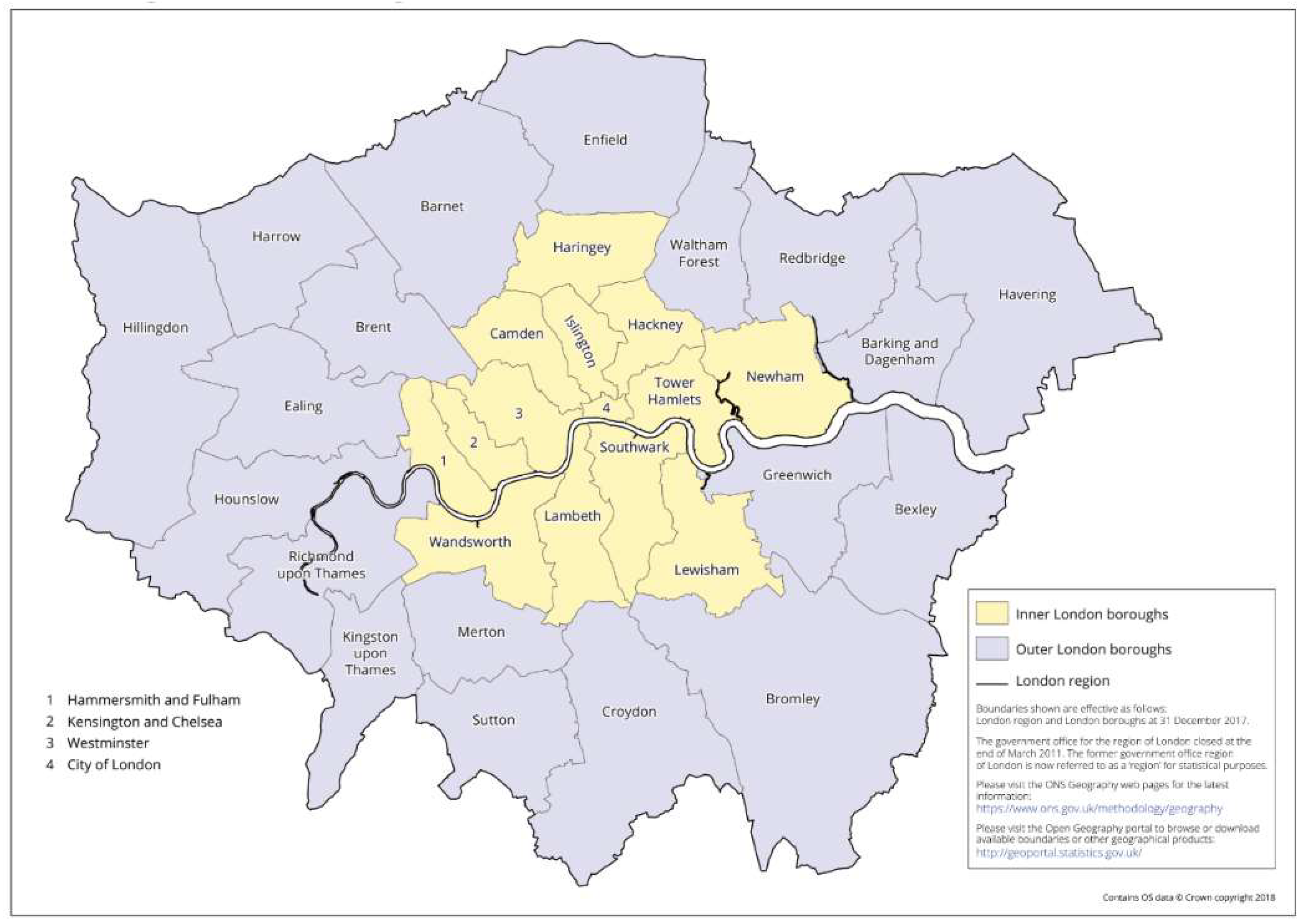
Figure 2.
London Region: London boroughs. Note: Office for National Statistics, 2018, From Office for National Statistics, 2018.
Figure 2.
London Region: London boroughs. Note: Office for National Statistics, 2018, From Office for National Statistics, 2018.
4.2. Interview Findings
The study analyzed interviewees’ responses, extracting key statements and organizing them by question. The aim was to connect these responses using predefined subcategories. Researchers highlighted and connected the main statements of each interviewee, noting similarities and common points to analyze mobility dimensions and define attributes for a sustainable metropolitan region. Subsequently, the findings were explored through predefined subcategories. The researchers identified common points essential for regional sustainability and linked them to classical theories and recent studies. This approach ensured a comprehensive understanding of the necessary attributes for creating a sustainable metropolitan region, contributing significantly to the research objectives.
4.3. Territorial
The narratives from our interviewees illustrate deep connections to Greater London, merging their professional and personal lives with strong emotional attachments to the city. Their insights into London’s development and its impact on their daily lives reveal its vibrant and dynamic nature. These accounts highlight London’s adaptability and the diverse ways residents engage with its spaces, governance, and transport systems.
Interviewee 1 notes, “I’ve been living actually in the center of London, in the city of London, for my whole life, and my relationship with it is not only as a resident but as someone who is very emotionally invested.” This sentiment resonates with Interviewee 3, who was “positively surprised” by London and quickly adopted it as home. Interviewee 7, who arrived for doctoral studies in 2000, describes London as integral to his family and career: “I’m very emotionally connected to it, especially as my kids attend school here and are true Londoners.” Interviewee 8 shares his journey of education, residence, and efforts to enhance London’s quality of life: “London is where I live and where I studied at university. I’ve lived in London for a very long time and have had the benefit of working to help improve the city.”.
4.4. Scale
The narratives from our interviewees illuminate the intricate governance, mobility, and sustainability challenges of Greater London. Interviewee 1 highlights the City of London’s unique governance and its collaboration with Transport for London, emphasizing cross-borough cooperation and financial partnerships, especially in projects like the Elizabeth Line. Interviewees 2 and 3 discuss the semi-autonomous nature of the Greater London Authority and its boroughs, stressing the need for coherent regional governance and bridging socioeconomic disparities. Interviewee 4 and others address the diverse identities and collaboration levels among boroughs, noting variances in transport networks and potential gaps in inter-borough relationships. Key insights include Interviewee 1’s focus on the City of London’s distinctive governance and synergies with Transport for London, emphasizing inter-borough cooperation. Interviewee 2 discusses the Greater London Authority and boroughs’ semi-independent relationship, highlighting localized governance. Interviewee 3 raises concerns about governance inconsistencies and the need for a unified regional approach to mitigate socioeconomic divides. Interviewee 4 highlights the distinct identities and collaboration efforts among boroughs, noting disparities in transportation access.
4.5. Place
The discourse surrounding London’s urban landscape, shared by various stakeholders, encapsulates its dynamic nature, rooted in diversity, mobility, accessibility, and a respect for its historical and modern elements. Central to these discussions is London’s diversity, heralded as a cornerstone of the city’s vibrancy and innovation. There’s a strong emphasis on sustainable mobility, advocating for a comprehensive public transport system and promoting walking, cycling, and low-traffic neighbourhoods. Balancing urban regeneration with preserving London’s rich historical and cultural legacies highlights a collective vision for a city that honours its past while progressively charting its future.
The distinct identities and variations across London’s boroughs, shaped by unique histories, geographies, and communities, reinforce its global reputation as a diverse and continually transforming metropolis. Interviewees underscore London’s global allure and foundational principles. “London’s cultural and ethnic diversity, with over 225 mother tongues, stands as a testament to our unwavering commitment to inclusivity and multiculturalism,” notes Interviewee 1. I4 highlights diversity in each borough’s people and identity. I6 appreciates the creative atmosphere fuelled by diversity. I7 acknowledges London’s global influence and historical significance, while I8 emphasizes London’s diversity in ethnicity, age, and communities, painting Greater London as a dynamic, inclusive, and culturally rich metropolis.
4.6. Urbanisation
The interviews illuminate critical themes in Greater London’s mobility and sustainability, emphasizing its comprehensive public transport network, including the Elizabeth Line and metro systems, which navigate the densely populated city. A recurring theme is the importance of integrating equality, diversity, and inclusion into urban regeneration efforts. Challenges in mobility management include balancing urban and rural needs and ensuring equitable transport accessibility. The strategic use of the green belt to control urban sprawl is pivotal. Migration patterns highlight London’s attraction to a diverse populace, impacting housing and urban development. Living costs and property prices spotlight public transport’s role in maintaining affordability. COVID-19’s impact on work patterns necessitates revaluation of urban planning. These insights underscore the need for innovative, inclusive strategies to navigate Greater London’s complex mobility and sustainability landscape.
The discourse on urbanization and infrastructure development within Greater London reveals the symbiotic relationship between the city’s history of urbanization and its infrastructure framework. Interviewee 1 notes, “Urbanization has always been the history of London... it’s been urbanized for about 250 years and it’s also had the infrastructure.” Interviewee 2 highlights the city’s mobility advantages, “We have a fairly good public transport provision.” These statements underscore the integral role of infrastructure in supporting London’s urban fabric, highlighting how the city’s longstanding urbanization process is linked with a comprehensive public transport system, embodying the city’s commitment to sustainability.
The vital role of London’s comprehensive public transport system, with its diverse trains, buses, underground, DLR, docklands railways, cycling, and walking options, is crucial for urban mobility. Interviewees 2 and 6 highlight this system’s support for the city’s dynamic nature, enabling “people [to] easily take train, take bus, take underground...cycling, walking,” ensuring “it’s a very fluid kind of place in terms of mobility. Public transit...works generally very well.” COVID-19 has introduced shifts in working patterns and urban planning needs, as noted by Interviewee 1, “The impact of COVID means that working patterns have changed significantly and the need to come into the centre has diminished.” Interviewee 7 emphasizes “alternatives to the car for those local journeys and those more orbital journeys within the zones,” reflecting the city’s adaptive response to ongoing changes.
The cost of living and property prices in London highlight the critical role of the public transport system in mitigating these concerns. The ability to reside in more affordable outskirts while maintaining employment in the city center is facilitated by public transport, noted by multiple interviewees. Interviewee 1 adds, “A very rural life within one hour of London,” offering diverse living conditions. Addressing disparities in transport accessibility and leveraging innovative transport solutions are essential for enhancing mobility management and ensuring living in London remains viable for a broader demographic.
Diversity and inclusivity stand at the core of London’s urban planning ethos, with a deliberate focus on cultivating a multicultural environment. Interviewee 2 highlights the influx of migrants enriching London’s socio-economic tapestry, creating a “mix of like exchange of knowledge and of different paths of life in every corner,” according to Interviewee 3. The green belt around London serves as a pivotal planning tool to curb urban sprawl while impacting property prices and guiding development towards sustainability. Interviewee 1 acknowledges London’s green belt as a “crucial planning designation,” and Interviewee 8 notes the importance of “a strong land use planning framework.” These policies preserve green spaces essential for ecological balance and public well-being while enabling sustainable urban growth.
4.7. Economy
The interviews highlight Greater London’s integration of mobility, sustainability, and economic development. A holistic strategy is necessary to balance urbanization, infrastructure enhancement, and equitable economic growth. Key themes include the importance of an efficient public transport system, economic sustainability, and addressing disparities for inclusive growth. This approach aligns Greater London’s economic dynamics with sustainable mobility and urban planning to foster a resilient, inclusive future.
Discussions on urbanization and economic issues emphasize the intersections of density, investment, and long-term planning. I3 states, “The low density of the city doesn’t help at all for improving,” and “we need to increase the density in the center of the city.” I4 and I7 stress prudent resource allocation and sustained transport infrastructure investment to bridge community divides. The dialogue around projects like HS2 illustrates complex infrastructure spending debates. I3, I6, and I8 advocate leveraging London’s economic strengths and historical infrastructure towards green mobility and public spaces.
London’s public transport system, discussed by I1 and I3, is critical for city-wide mobility and urban development. It addresses urban residents’ and commuters’ needs and shapes the city’s socio-economic landscape. I3 reflects on the infrastructure level, finding it superior to other places, highlighting London’s commitment to green mobility. The HS2 project, mentioned by I1, exemplifies strategic infrastructure investments extending benefits beyond the metropolitan area. These perspectives suggest that London’s public transport system is a critical element in guiding future development, sustaining dynamic growth, and addressing mobility challenges.
The economic landscape of London, articulated by I1, I2, I7, and I8, presents a city at the nexus of growth and spatial inequality. London’s economic dynamism contributes to global stature and internal disparities. I1 observes the unique economic concentration, contrasted with peripheral migration patterns, underscoring spatial inequality. I2 and I7 highlight London’s role in driving UK economic growth and attracting international talent. However, as I8 points out, economic power concentration introduces challenges, including disparities and political tensions. These observations underline the relationship between economic prosperity and socio-spatial structure, necessitating a balanced urban planning strategy. Sustainable mobility solutions and efforts to alleviate disparities are imperative for further growth.
Urban development, mobility, and socio-economic disparities in London are highlighted through development projects impacting access and movement. The influx of commuters reveals how London’s economic hub status contributes to mobility patterns that may deepen inequalities. Insights from I2 and I5 into spatial inequality and the juxtaposition of affluent and impoverished areas further complicate the narrative. These disparities manifest in varied access to resources, underscoring the need for equitable urban development. Addressing these challenges requires a holistic strategy fostering mobility, connectivity, and socio-economic equity for cohesive development and residents’ well-being.
4.8. Culture and Identity
Each interviewee recognizes London’s diversity as its greatest strength, enriching its cultural, economic, and social landscape. This diversity drives innovation, promotes inclusivity, and is crucial for sustainable metropolitan development. The discussions highlight London’s diversity shaping its metropolitan essence and impacting infrastructure and urban planning. There is a consensus on the necessity of a mobility infrastructure that supports diversity, modernizes heritage sites, and advances green mobility solutions. Emphasizing cultural and social inclusion in urban planning and mobility strategies is essential for London’s sustainability. These strategies address spatial inequalities and sustain its dynamic nature. Improving public transport and expanding green spaces are vital for supporting a diverse, growing population. The collective insights stress integrating diversity into urban planning and mobility strategies to ensure London’s continued vibrancy, inclusivity, and sustainability as a global city.
London’s governance framework and cosmopolitan essence have nurtured a tradition of diversity and openness, foundational elements deeply woven into the metropolis’s fabric. Historical records and narratives affirm this, with I6 noting, “London has been a diverse city for centuries.” I2 underscores its global standing as “one of the most diverse metropolitan regions globally.” These aspects present challenges but also offer vast opportunities for cultural enrichment and social cohesion. The city’s inclusive ethos promotes learning about and appreciating diverse cultures, fostering unity within its multifaceted society. This sentiment is captured by I4, who says, “You get educated about other cultures. It helps to create a sense of we are one diverse sort of thing.” I8 adds that London’s openness empowers its communities to flourish, preserving their unique cultural identities while enriching the city’s dynamic mosaic.
Diversity stands as the cornerstone of London’s cultural and social landscape, elevating the city’s global stature. Participants uniformly acknowledge diversity’s enriching influence, with I5 stating, “It undoubtedly contributes to the enrichment of cultures and identities.” I2 adds, “The diversity of cultures and voices in London makes it unique.” The collective viewpoint champions the positive impacts of diversity, with I6 asserting, “Without doubt, it enriches it.” Such reflections underscore the pivotal contribution of London’s myriad communities to forging a vibrant and dynamically diverse urban identity.
London’s gravitational pull for individuals worldwide has left a lasting legacy on its architecture, culinary arts, and cultural tapestry, reinforcing its identity as a global metropolis. The city’s diversity entices those interested in varied literary works, gastronomies, and cultural practices. I6 captures this allure, stating, “If you want to find out about different literatures, because of that diversity, it has so much attraction.” While the blending of cultures may spark debates over the erosion of distinct identities, the prevailing discourse leans towards an affirmative appreciation of cultural synthesis. I5 notes, “It does enrich cultures and identities.” This enrichment fosters an ethos of coexistence and reciprocal respect among diverse groups, illustrating London’s educational and social dynamism.
4.9. Innovation
Interviews from Greater London highlight innovation in merging mobility, sustainability, and urban development. The focus on improving public transportation, adopting micro-mobility, prioritizing environmental health, and ensuring inclusivity showcases mobility as a key to urban innovation. This approach integrates social equity, environmental sustainability, and economic vitality into metropolitan mobility strategies, underscoring the need for innovative frameworks to support sustainable urban ecosystems and promote equitable, environmentally friendly growth.
Innovative transportation has a transformative effect on urban life. Projects like the Elizabeth Line reduce car reliance, while expanding cycling and pedestrian paths, micro-mobility initiatives, and the Ultra-Low Emission Zone (ULEZ) demonstrate a commitment to sustainable transport and environmental health. Efforts to improve safety and accessibility for all depict a comprehensive strategy for inclusive urban mobility. Ongoing infrastructure investment, innovative policy, community involvement, and cross-sector collaboration highlight the importance of creating a vibrant, sustainable, and inclusive city.
Interviewees emphasize infrastructure projects like the Elizabeth Line, cycle lanes, and low emission zones. I1 calls the Elizabeth Line “very significant infrastructure.” I3 and I6 highlight HS2 and Crossrail as “the most important ones.” I7 notes the creation of “a network of 350 kilometers of cycle routes.” These initiatives illustrate London’s commitment to improving accessibility and sustainability. Transit-oriented development (TOD) enhances accessibility to public transportation, fostering mobility around transit stations. I2 notes projects like the Elizabeth Line in this context, saying, “So we also call it TOD transit-oriented development.”
Adopting micro-mobility solutions, such as e-scooters and e-bikes, addresses the first and last mile gap in transportation infrastructure. I2 underscores the significance of e-micromobility, “To roll out like the I would say that where I point to e-micromobility, for example, e-scooters.” I7 emphasizes infrastructure innovations to support micro-mobility, highlighting safe pathways for pedestrians and cyclists, especially for children going to school.
Environmental concerns are prominent among interviewees, who emphasize initiatives to reduce emissions and enhance air quality. I7 states the importance of “reducing any air pollution in the city.” I6 highlights bus network electrification, while I8 emphasizes improvements to enhance air quality, reflecting a commitment to sustainability and public health.
Community-level initiatives to enhance mobility and safety are also noted. I5 says, “I think that’s really great movement, I think, in terms of moving around London.” I6 references school streets implemented since 2016, prioritizing pedestrian safety. I8 highlights community-driven initiatives like the ULEZ, emphasizing, “Everyone usually thinks of innovation as things like electric bikes or e-scooters, but this is a community level, global importance type of initiative.” These remarks underscore the pivotal role of community-led efforts in promoting sustainable mobility and safety
4.10. Network
The interviews highlight the importance of an integrated transportation network in Greater London’s sustainability. Emphasizing efficient public transport, accessible mapping for pedestrians and cyclists, and inter-borough collaboration to overcome infrastructure disparities, interviewees identify challenges such as improving accessibility for all, including those with disabilities, and enhancing connections in areas lacking rapid transit. Insights call for enhanced integration, collaborative governance, and inclusive, environmentally sustainable mobility solutions. This comprehensive perspective advocates for a holistic approach to ensuring Greater London’s sustainable development.
The interviewees stress the need for an integrated transport network, recognizing its role in enhancing urban mobility and connectivity. I1 praises London’s efforts, describing it as having the “most integrated transport network in the UK.” I5 acknowledges Transport for London’s (TFL) proactive stance, affirming that “TFL has always been quite at the forefront of mobility.” I6 agrees, emphasizing London’s highly integrated existing mobility network. Their collective remarks highlight initiatives like “Legible London” and seamless interconnectivity between various transportation modes, essential for optimizing urban mobility.
Effective governance and cooperation between government entities, including boroughs and central government, are crucial for shaping comprehensive mobility strategies. I2 underscores the importance of “cooperation between different boroughs and Greater London.” I8 emphasizes governance in formulating overarching strategies, noting, “basically set the strategy for the city up through the transport strategy that I wrote.” I6 highlights the need for effective policy implementation and strong leadership to address challenges like air pollution, congestion, and mobility efficiency.
Accessibility and inclusivity are paramount, with a focus on ensuring equal access for all, including those with disabilities, and extending service coverage to isolated areas. I4 raises concerns about transportation network accessibility for individuals with disabilities, asking, “people who are in a wheelchair, for example, can they go on every platform?” I7 highlights addressing air pollution, congestion, and health, recognizing improved accessibility’s role in tackling these issues.
The discourse on Management and Policy Implementation reveals a nuanced understanding of the challenges and strategies necessary for sustainable urban growth. I3 notes a gap between the mobility network enhancements and the city’s rapid population growth, calling for accelerated policy implementation. I6 points out that necessary policies often face public resistance, highlighting the complexity of balancing long-term sustainability goals with immediate public sentiment. I7 emphasizes the strategic focus on addressing urban challenges like air pollution, congestion, and public health, essential for future success.
The interplay between urban mobility strategy, policy implementation, and public sentiment in Greater London reflects a complex governance and urban management landscape. I3 highlights the challenge of scaling urban mobility solutions with rapid urban expansion, while I6 acknowledges the necessity of certain urban policies despite their unpopularity. I7 emphasizes the long-term benefits of addressing air pollution, congestion, and health. I8 compares London favorably to other UK and European cities in creating an integrated transport network, while I6 encapsulates the diverse and interconnected nature of London’s transport system, highlighting the importance of accommodating various transportation modes.
4.11. Climate Change
The synthesis of interviews highlights the critical role of an integrated transportation network in Greater London’s sustainability. It emphasizes the expansion of public transport, accessible mapping for pedestrians and cyclists, and inter-borough collaboration to overcome infrastructure disparities. Key challenges include improving accessibility for all, including those with disabilities, and enhancing connections in areas lacking rapid transit. Insights call for enhanced integration, collaborative governance, and inclusive, environmentally sustainable mobility solutions. This comprehensive perspective advocates a holistic approach to ensuring Greater London’s sustainable development.
The interviewees stress the need for an integrated transport network, recognizing its role in enhancing urban mobility and connectivity. I1 praises London’s efforts, describing it as having the “most integrated transport network in the UK.” I5 acknowledges Transport for London’s (TFL) proactive stance, affirming that “TFL has always been quite at the forefront of mobility.” I6 agrees, emphasizing London’s highly integrated existing mobility network. Their collective remarks highlight initiatives like “Legible London” and seamless interconnectivity between various transportation modes, essential for optimizing urban mobility.
Effective governance and cooperation between government entities, including boroughs and central government, are crucial for shaping comprehensive mobility strategies. I2 underscores the importance of “cooperation between different boroughs and Greater London.” I8 emphasizes governance in formulating overarching strategies, noting, “basically set the strategy for the city up through the transport strategy that I wrote.” I6 highlights the need for effective policy implementation and strong leadership to address challenges like air pollution, congestion, and mobility efficiency.
Accessibility and inclusivity are paramount, with a focus on ensuring equal access for all, including those with disabilities, and extending service coverage to isolated areas. I4 raises concerns about transportation network accessibility for individuals with disabilities, asking, “people who are in a wheelchair, for example, can they go on every platform?” I7 highlights addressing air pollution, congestion, and health, recognizing improved accessibility’s role in tackling these issues.
The discourse on Management and Policy Implementation reveals a nuanced understanding of the challenges and strategies necessary for sustainable urban growth. I3 notes a gap between the mobility network enhancements and the city’s rapid population growth, calling for accelerated policy implementation. I6 points out that necessary policies often face public resistance, highlighting the complexity of balancing long-term sustainability goals with immediate public sentiment. I7 emphasizes the long-term benefits of addressing air pollution, congestion, and health. I8 compares London favorably to other UK and European cities in creating an integrated transport network, while I6 encapsulates the diverse and interconnected nature of London’s transport system, highlighting the importance of accommodating various transportation modes.
4.12. Foresight, Future Thinks
The interviews highlight diverse perspectives on the future of mobility and sustainability in Greater London, emphasizing urban development, technological innovation, environmental concerns, and social equity. These discussions underscore the link between mobility and sustainability and the essential attributes for a sustainable metropolitan region. There’s a shared emphasis on improving public transport networks, including trams, autonomous buses, and interconnected systems to reduce private vehicle reliance. Highlighting non-motorized transport, such as walking and cycling, is crucial for lowering emissions and enhancing public health. New technologies, including electric and autonomous vehicles and ICT for remote work, indicate a shift towards digitalization and the future of mobility. Advocacy for decentralized living aims to reduce commute times while emphasizing climate resilience and social equity to ensure access for all. This comprehensive perspective underlines the need for an integrated, multimodal transport network that is climate-resilient, human-centered, promotes local living, guarantees equity, and involves community engagement in policymaking, fostering a livable, resilient, and equitable urban environment.
The collective insights of the interviewees focus on sustainable and future-proof mobility through technological innovations, addressing climate change, enhancing public transport and non-motorized mobility options, stakeholder involvement, and collaborative planning. I4 articulates the need to “cater more for all areas, so everyone can move more freely,” emphasizing equitable mobility solutions across the urban landscape. I5 envisions public transport, cycling, and walking as the future cornerstones of London’s mobility, shifting away from car-centric design. I6 suggests a pivot towards more sustainable, less capital-intensive mobility solutions, indicating that the future may not hold “new big infrastructure investments” like another Crossrail. I7 reinforces this view, stating that changes “to infrastructure” and the adoption of “new technologies” will reduce private car use, aligning with broader sustainability goals. I8’s perspective on policy-making for a “cleaner, safer, greener area” speaks to broader objectives of creating accessible and welcoming urban environments.
Technological innovations in urban mobility highlight a strategic pivot towards sustainable and efficient systems, driven by ICT and emerging vehicular technologies. I2 notes, “we can walk from home,” emphasizing digital tools’ role in facilitating remote work and reducing physical travel. This aligns with I5’s observation that London integrates technology into its mobility strategy. I6 adds, “Technology will with the introduction of new technology, the generation of data,” highlighting data analytics’ potential in improving transportation planning and management. I7 envisions a significant transformation by 2050, with “64% mode shift of walking, cycling, public transport,” attributing this shift to technological innovations. I7 also sees technology as crucial for safety improvements, stating, “I see London in the future using technology to reduce the number of people being killed and seriously injured on our roads.” The discussions about autonomous vehicles and electric cars underscore the anticipated impact of these technologies on urban mobility. I5’s goal of “moving away from private car movement” and I3’s aim of “making every area more accessible” indicate a drive towards a more integrated, technology-enabled urban transport network prioritizing accessibility, sustainability, and safety.
Climate change and environmental concerns in urban mobility strategies underscore an urgent recognition of the challenges posed by global warming. I2 projects a forward-looking goal of significantly reducing carbon dioxide emissions by 2050. I3 emphasizes the climatic emergency’s priority, suggesting that addressing climate change should be a top concern. I6 highlights the broader implications of these challenges, suggesting that climate change will pressure health care services due to extreme weather events. I8 acknowledges climate change’s difficulties and underscores the collective goal of achieving carbon neutrality. I7 identifies practical approaches, advocating for a shift from private car use to reduce emissions.
Focusing on public transport and non-motorized mobility, there is a consensus on enhancing urban spaces to support healthier lifestyles and environmental sustainability. I1 and I4 emphasize creating urban environments conducive to walking and cycling, stressing the importance of safe spaces and improved air quality. I4 highlights “interconnectivity” between different transport modes to facilitate easier and more efficient city movement. I8 adds that making urban areas accessible to public transport, walking, and cycling is key to encouraging sustainable transport options.
Stakeholder involvement and collaborative planning are crucial for addressing urban mobility and sustainability challenges. I1 asserts that creating safe spaces is essential for public health, suggesting that stakeholder engagement is vital for conducive environments. I4 reflects on the need for collaborative efforts to address climate change and improve health. I5 argues for urban mobility strategies that consider environmental, health, and financial impacts. Such an approach requires diverse stakeholder involvement to ensure sustainable, health-promoting, and economically feasible mobility solutions.
5. Subcategory Analysis
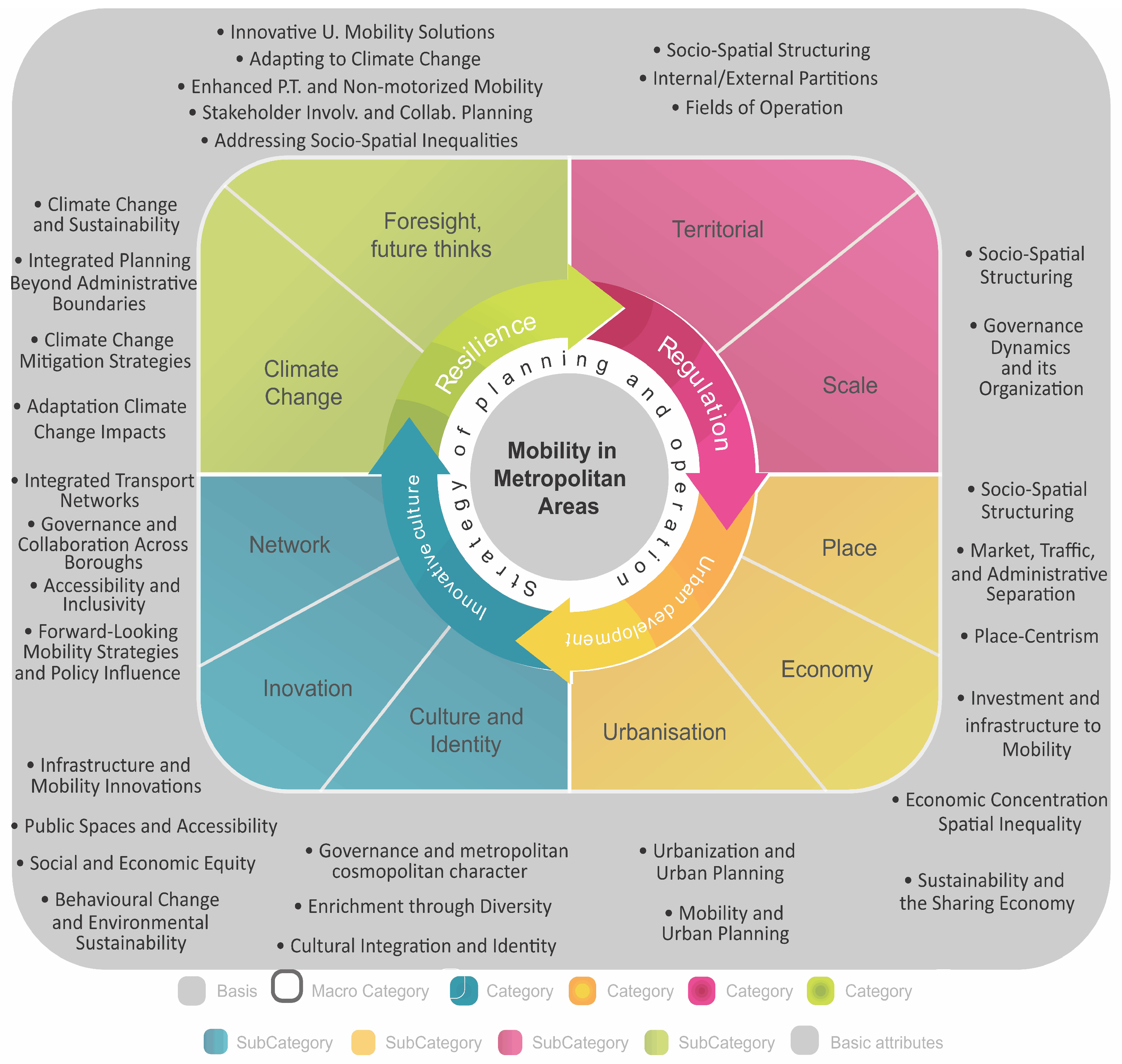
The provided framework serves as a comprehensive model that elucidates the multifarious interplay between urban planning, sustainability, and mobility within metropolitan regions. It systematically categorizes key concepts into distinct but interconnected domains: Territorial, Scale, Place, Urbanization, Economy, Culture/Identity, Innovation, Network, Climate Change, and Foresight. This schema highlights the intricate synergy among various urban planning facets and their collective impact on metropolitan sustainability.
The framework depicted offers a comprehensive view of metropolitan development, highlighting the necessity for strategic planning that integrates governance, cultural identity, innovation, and climate resilience. Reflecting the study’s goals, this framework facilitates understanding stakeholders’ perceptions of mobility within complex dimensions, identifying vital attributes for metropolitan sustainability. It emphasizes the importance of considering a wide range of factors, from infrastructure innovations to cultural integration, in devising strategies for sustainable metropolitan areas. The detailed interconnections within the framework, spanning local to global scales, encapsulate the complexity of ensuring sustainable mobility and stress the importance of inclusive, future-oriented urban planning that addresses both present and anticipated challenges.
Figure 3.
Basic attributes according to converging interviewees’ points of view. Note: Elaborated by Ribeiro and Fachinelli, 2023. Copyright 2024.
Figure 3.
Basic attributes according to converging interviewees’ points of view. Note: Elaborated by Ribeiro and Fachinelli, 2023. Copyright 2024.
5.1. Subcategory Territorial Analysis
The narratives provided by all interviewees collectively offer a rich tapestry of insights into the socio-spatial dynamics of Greater London. These personal and professional testimonies light on the complex relationship between individuals and the territory, revealing how emotional connections, professional engagements, and participatory actions in urban spaces shape and are shaped by the territorial configurations of London.
Principle of Socio-Spatial Structuring. The principle of socio-spatial structuring within London emerges vividly from the active engagement of individuals with the city’s urban landscape, alongside the narratives that underscore the interplay between socio-economic developments and spatial restructuring. The guided walks and community project involvements of interviewee one, for instance, illuminate a deep, reciprocal relationship between personal activities and the city’s spatial organization, evidencing a dynamic interaction with the territory. Similarly, Interviewee II’s insights into urban regeneration projects further exemplify this principle by shedding light on the ongoing transformation of territorial boundaries and their socio-spatial implications. These reflections collectively emphasize the complexity of London’s socio-spatial fabric, revealing how individual and collective engagements contribute to and are shaped by the evolving contours of the city, thereby underlining the intricate relationship between socio-economic evolution, spatial restructuring, and individual experiences within the urban environment.
Construction of Internal/External Partitions. Emotional and professional connections to London, as shared by interviewees, delineate internal/external partitions, with personal and career developments within the city fostering a profound sense of belonging and identity in relation to the urban territory.
Fields of Operation. Past, Present, and Emerging Borders: The evolving experiences of the interviewees with London’s urban environment highlight the dynamic nature of territorial borders. The collective narratives reveal how historical legacies, current initiatives, and future aspirations continuously reshape the socio-spatial landscape of London, influencing individual and collective experiences of the city’s territory.
5.2. Subcategory Scale Analysis
The insights shared by the interviewees intricately map onto the concept of “scale” within the context of London’s governance and spatial organization, resonating with the theories of functional hierarchy, central place theory, and the principle of socio-spatial structuring. These narratives underscore the complexity of London’s territorial and administrative landscape, revealing the multifaceted interactions between different levels of governance and the spatial hierarchies within the city.
Principle of Socio-Spatial Structuring in Greater London. The Principle of Socio-Spatial Structuring in Greater London reveals the complex relationship between the city’s governance, infrastructure developments, and the dynamics of collaboration and disparity among boroughs. Central to this discussion is the role of Transport for London (TfL) and significant projects like the Elizabeth Line, which are crucial in enhancing urban mobility and promoting collaboration across boroughs. These efforts reflect a commitment to improving connectivity and accessibility throughout London’s diverse communities. Discussions on socio-spatial structuring, informed by insights from I5, I6, I7 and I8 highlight the layered nature of London’s urban fabric, marked by socio-economic diversity and strategic collaborations. This framework reveals the intricate play of governance structures, transport initiatives, and inter-borough relationships, shaping the city’s spatial organization. It underscores the need for an urban planning approach that acknowledges London’s socio-spatial complexities, aiming for an integrated and equitable urban environment responsive to the city’s multifaceted socio-spatial dynamics.
Governance Dynamics and its Organization in Greater London. The governance of Greater London is distinguished by its autonomy, varied administrative practices, and the dynamic relationship between collaboration and independence among its boroughs. Insights from key stakeholders reveal the unique governance frameworks of the City of London and other boroughs, emphasizing the delicate balance between centralized authority and localized governance. This complexity is accentuated by the mixed effects of governance, transport, and infrastructure developments on the socio-economic and cultural life of local communities, leading to a range of both positive and negative outcomes. Central to this discussion is the concept of functional hierarchy and central place theory, highlighted by Interviewee’s one observations on the City of London’s governance and the collaborative efforts behind significant infrastructure projects like the Elizabeth Line. These efforts illustrate the hierarchical and functional distinctions in the city’s governance system, stressing the importance of the spatial distribution of services and the relationship between settlement size and function. Additionally, the creation of scalar divisions of labor, especially in the context of transport strategy coordination, indicates the need for boroughs to align with city-wide policies led by the Greater London Authority (GLA) and Transport for London (TfL). This requirement illustrates the differing levels of responsibilities and authority across scales, from local borough governance to regional oversight, and demonstrates the multi-layered management of London’s spatial and functional organization. The concept of vertical ontology and hierarchical imbalance further deepens the analysis of London’s governance. Stakeholders such as I4 and I5 draw attention to a governance system characterized by both collaboration and independence. This complex hierarchy, with varying degrees of engagement and autonomy among boroughs, presents both challenges and opportunities for governing a city as varied and dynamic as London.
5.3. Subcategory Place Analysis
The insights shared by the interviewees provide a rich tapestry of perspectives on the concept of “place,” particularly within the context of Greater London. These narratives highlight the multifaceted nature of London as a territory imbued with diversity, historical depth, cultural richness, and socio-spatial dynamics that resonate with Christaller’s principles of the Central Place Theory and Perroux’s Growth Poles theory. Through these accounts, common points emerge that are essential for the academic exploration of place in relation to London’s unique socio-spatial structure.
Principle of Socio-Spatial Structuring. The testimonies collectively underscore Proximity, spatial incorporation, and area differentiation, with each interviewee articulating how London’s diverse boroughs, with their unique histories, cultures, and physical geographies, contribute to the city’s complex socio-spatial fabric. This principle is vividly represented in the narratives, which describe London as a patchwork of central and peripheral places, each with its own identity yet interconnected within the larger urban ecosystem. This principle is further enriched by contributions from stakeholders such as I2, I3 and I8, who detail London’s commitment to multiculturalism, inclusivity, and blending its historical heritage with modern advancements. Notably, the city’s linguistic diversity, with “225 mother tongues,” and its “commitment to dense housing and low traffic neighborhoods,” underscore London’s dedication to fostering a tolerant and dynamically interconnected urban environment. These narratives collectively paint London as an evolving city that cherishes its multiplicity, connectivity, and historical legacy, thus defining its global identity and continuous transformation. The Principle of Socio-Spatial Structuring, therefore, captures the essence of London’s attraction its diverse community, innovative mobility solutions, and deep-seated historical values reaffirming its status as a constantly adapting global city that respects its past.
Market, Traffic, and Administrative Separation. Interviewee’s one emphasis on London’s multiculturalism, commitment to dense housing, and progressive transport policies illustrate the Market principle of Christaller’s theory, showcasing London as a central place that serves a wide complementary region through diverse services and cultural offerings. The narratives also touch on Traffic, with the mention of London’s efficient public transport system, including the Elizabeth Line, indicating a sophisticated network that supports the city’s role as a regional hub. Administrative Separation is implicitly addressed through the unique governance structures and the cooperative yet complex relationship between London’s boroughs and the Greater London Authority, highlighting the city’s internal administrative nuances.
Place-Centrism. The discourse surrounding London, as articulated by I2 and I5, encapsulates the concept of Place-Centrism within the broader context of urban development and regeneration. Their insights into the city’s efforts towards preserving its rich historical tapestry, while simultaneously embracing the inclusion of diverse communities, underscore the importance of place in catalyzing regional development. This Place-Centrism, a profound appreciation and attachment to London’s distinctive character marked by its diversity, history, and dynamism—serves as a cornerstone for fostering an environment that attracts skilled labor and disseminates cultural and economic activities, akin to the dynamics observed in Growth Poles. In addition, according to the interviewees, London encapsulates different kinds of centrism, presenting a city celebrated for its unique diversity and historical richness, global prominence, and robust interconnections. These aspects highlight London’s regional significance, international influence, and vibrant urban dynamism through its extensive transport network and collaborative boroughs.
5.4. Subcategory Economy Analysis
The insights shared by the interviewees illuminate the multifaceted dynamics of economic concentration and investment in London, offering a prism through which to explore the intersections of urbanization, economic development, and sustainability. These reflections resonate with the academic frameworks provided by Harrison and Growe (2014) and Mi & Coffman (2019), particularly regarding the challenges and opportunities presented by urban growth, the sharing economy, and sustainable urban planning.
Investment and infrastructure to Mobility. The development of transportation infrastructure, as discussed by I3 and I7, exemplifies public investment’s role in facilitating urban mobility and economic growth. The Elizabeth Line, for example, enhances connectivity within London and between its urban and peripheral areas, echoing Harrison and Growe’s advocacy for innovative urban planning solutions to mobility challenges. This investment not only supports economic activities but also contributes to the environmental sustainability goals highlighted by Mi & Coffman, through reduced emissions and the promotion of green mobility options.
Economic Concentration Spatial Inequality. I1 and I6 highlight London’s role as a hub for financial, technological, and creative industries, emphasizing the city’s capacity to attract talent and resources. This concentration of economic activities fosters innovation and drives GDP growth, underscoring the city’s significance in the global economy. Such dynamics align with Mi & Coffman’s discussion on the sharing economy’s potential to enhance sustainability and urban mobility, suggesting that cities like London can leverage their economic concentration to pilot innovative, environmentally efficient solutions. I2 and I8 address the spatial inequalities exacerbated by economic concentration, pointing to the disparities between London and other UK regions, as well as within the city itself. The need for balanced investment and governance strategies to mitigate these inequalities is evident, reflecting Mi & Coffman’s emphasis on the importance of aligning commercial interests with social welfare. This underscores the role of governance in ensuring that the benefits of economic concentration and the sharing economy extend beyond central business districts to support broader social and economic equity.
Sustainability and the Sharing Economy. I4 and I5 touch on the challenges and opportunities presented by London’s economic model, including the potential for the sharing economy to address urban sustainability concerns. The emphasis on understanding the right kind of investment and the planning required to harness economic concentration for community benefit resonates with Mi & Coffman’s findings on the environmental and social advantages of the sharing economy. These insights suggest that London, with its significant economic resources, has the potential to lead in integrating sustainable practices with economic development, leveraging the sharing economy to enhance urban resilience and livability.
5.5. Subcategory Urbanization Analysis
The discussions by all interviewees provide a rich tapestry of perspectives on urbanization processes within London, illustrating the intricate dance between urban growth, mobility, socio-economic dynamics, and spatial planning. Their insights offer a practical examination of the theoretical underpinnings of urbanization phases, economic globalization, metropolization, and the challenges and strategies identified by Benko (2002) and Harrison & Growe (2014).
Urbanization and Urban Planning (dynamic land use planning and its infrastructure). The interviewee’s insights into urbanization and its land use planning infrastructure underscore the intertwined nature of London’s growth with its sophisticated public transport systems. This highlights the pivotal role of infrastructure in shaping urban mobility and expansion, affirming London’s status as a significant economic hub, as supported by Benko’s observations on economic concentration in metropolitan areas. Interviewee’s 7 discussion on the Green Belt Policy and urban sprawl further emphasizes the importance of spatial management tools in curbing the city’s outward expansion and advocating for a denser, more sustainable urban core. This deliberate policy approach aims to balance urban and rural developmental pressures, ensuring a harmonious spatial dynamic that respects both ecological boundaries and growth imperatives. Interviewee 2 and 3’s examination of the occupancy of land and its reflection on spatial dynamics and socio-economic factors delves into the nuanced implications of demographic shifts, migration, and housing policies within the urbanization narrative. Their observations illuminate the socio-economic stratifications and spatial disparities between London’s inner and outer boroughs, revealing the city’s socio-spatial fabric as a product of complex economic and geopolitical currents. Aligned with Harrison & Growe’s focus on urban challenges, this aspect underscores the multifaceted strategies required to navigate the socio-economic intricacies inherent in metropolitan development.
Mobility and Urban Planning. The importance of mobility in shaping urbanization processes is a recurrent theme, with all interviewees discussing how public transport facilitates urban integration and accessibility. Their insights point towards the need for innovative solutions to urban mobility issues, echoing Harrison & Growe’s advocacy for addressing urban planning challenges. This topic integrates urban planning with mobility, emphasizing the intrinsic relationship between the two aspects.
5.6. Subcategory Culture and Identity Analysis
The reflections offered by the interviewees on the impact of diversity on culture and identity in London align closely with the academic discourses on urban adaptability and the concept of the “open city” as discussed by Sennet (2018), Ellin (2006), and the project by Barbera & Rossi (2021). These academic frameworks and the interviewees’ insights converge on the idea that cities, much like sponges, have the capacity to absorb diverse influences while maintaining their structural integrity and identity, thus fostering environments of cultural richness and inclusivity.
Governance and metropolitan cosmopolitan character. In their insightful discussions, I4 and I5 underscore the pivotal role of governance and urban planning in either facilitating or impeding the beneficial aspects of diversity within metropolitan contexts. They focus on the importance of equitable infrastructure development and critically analyze policies that might limit cultural exchange. This exploration aligns with scholarly debates advocating for governance frameworks that promote adaptability, engagement, and cohesion within urban environments. Their contributions shed light on the necessity of designing governance structures that are conducive to fostering a cosmopolitan character in metropolitan areas, emphasizing the significance of inclusivity and cultural diversity in enriching urban life.
Enrichment through Diversity. The narratives provided by the interviewees vividly illustrate the profound enrichment that cultural diversity brings to London’s identity, resonating with Richard Sennett’s concept of the “open city,” characterized by permeable boundaries that encourage integration and interaction. “London is open” (I8) symbolizes the city’s embracing nature, fostering a diverse and dynamic environment for all who call it home. Here there is connection between the last common idea with this. This idea is exemplified in the reflections of I2 and I3, who highlight London’s capacity to preserve historical legacies while accommodating modern transformations. Their insights reveal how urban spaces can foster a vibrant cultural and social landscape, dynamically interweaving the past with the present. This discussion contributes to the broader understanding of urban diversity not just as a demographic fact but as a potent source of cultural enrichment and social vitality, affirming the value of inclusivity and multiculturalism in shaping the character of metropolitan areas.
Cultural Integration and Identity. Interviewee’s one and eight insights delve into the historical richness of London’s diversity, underscoring how the city’s enduring cosmopolitan character significantly contributes to its dynamism, creativity, and economic vitality. Their observations align with the concept of urban “porosity,” which champions cities as flexible and adaptive entities, conducive to the seamless integration of varied cultures. This approach promotes a cohesive sense of belonging and community among diverse populations, highlighting the indispensable role of cultural integration in fostering urban identity. The discussion brings to light the importance of creating urban environments that not only accommodate diversity but also actively engage with it to enrich the social fabric and identity of the city, showcasing London as a model of successful cultural integration and identity formation.
5.7. Subcategory Innovation Analysis
Connecting the interviewees’ insights on urban mobility and infrastructure innovations in London with UN Habitat’s emphasis on sustainable urbanization (2015, 2019) and SDG 11 reveals a multifaceted approach to fostering innovation in metropolitan regions. These perspectives collectively underscore the necessity of adaptive city planning and the implementation of sustainable practices to achieve inclusive, safe, resilient, and sustainable cities.
Infrastructure (cycling and walking) and Mobility Innovations. The Elizabeth line’s introduction, highlighted by multiple interviewees, marks a transformative advancement in London’s urban mobility, bolstering city-wide connectivity and access. This development aligns with Sustainable Development Goal 11 by upgrading public transport infrastructure to foster sustainable urban environments. The emphasis on electric mobility options, including e-scooters and e-bikes, coupled with efforts to enhance pedestrian and cycling infrastructure, signifies a strategic move towards environmentally friendly transportation solutions. This approach supports the global initiative for sustainable cities and communities by promoting green, accessible modes of transport.
Public Spaces and Accessibility. The reallocation of highway space for walking and cycling and the development of low traffic neighborhoods, highlighted by majority of interviewees, embody sustainable urbanization principles. These actions demonstrate the city’s commitment to creating safer, more accessible environments conducive to social interaction and physical well-being, essential for resilient community development.
Social and Economic Equity. The dialogue around the social and economic ramifications of significant infrastructure projects, such as HS2 and the Crossrail (Elizabeth line), as discussed by I3, emphasizes the importance of governance that harmonizes innovation with social justice. This underscores innovation’s dual role in stimulating economic development and promoting the social and ecological welfare of urban communities, advocating for a balanced approach to urban development that equally prioritizes innovation, social equity, and sustainability.
Behavioural Change and Environmental Sustainability. The efforts to enhance air quality through the ultra-low emission zone (ULEZ) and the electrification of the bus network, highlighted by I8 and colleagues, exemplify forward-thinking approaches to environmental challenges. Coupled with the encouragement of cycling and walking, these strategies play a pivotal role in diminishing urban emissions and fostering environmental sustainability. This approach is in harmony with the Sustainable Development Goal 11’s ambitions for sustainable cities and communities, showcasing a commitment to behavioral change and ecological stewardship.
5.8. Subcategory Net Analysis
The insights from the interviewees, when juxtaposed with the theoretical underpinnings of networks, particularly through the lenses of road and functional connections and urban networks, highlight essential areas of study and action in the realm of urban planning and infrastructure. These insights align with Christaller’s Central Place Theory, Perroux’s logic of planned hub growth, and the broader principles of socio-spatial structuring and networks of networks, offering a rich tapestry for examining the dynamics of urban connectivity and integration.
Integrated Transport Networks. Interviewee’s 1 observations highlight London’s efficient and integrated transport system, including the implementation of Legible London, which plays a crucial role in enhancing urban mobility through visual and physical connectivity. This integration, vital for effective urban networks, embodies the concept of nodal connectivity, enabling straightforward navigation and access throughout the city. This approach aligns with theoretical frameworks on urban planning, emphasizing the importance of cohesive transport networks in facilitating movement and improving the quality of urban life.
Governance and Collaboration Across Boroughs. Interviewee’s 2 insights into the diverse socio-economic landscapes across London’s boroughs underscore the principle of socio-spatial structuring, emphasizing the need for greater collaboration between boroughs and the Greater London Authority. This unified approach to urban mobility is essential for overcoming the challenges posed by administrative boundaries and leveraging opportunities to build a cohesive urban network. Interviewee’s 2 observations advocate for a governance model that fosters cooperation and coordination across the city, ensuring that mobility solutions are equitable, effective, and responsive to the varied needs of London’s communities.
Accessibility and Inclusivity. Interviewee’s 4 observations on the inclusivity of London’s mobility network, particularly regarding individuals with disabilities, underscore the need for an urban framework that embraces ‘rhizomatic’ differentiation, ensuring access and mobility for all segments of the population. This principle demands that urban planning and infrastructural developments are rooted in social equity, catering to the diverse needs of the community. Similarly, Interviewee’s 3 concern about the lack of fast public transport in certain areas of Greater London highlights the necessity for an extensive and equitable mobility network. This highlights the importance of overcoming planning-induced disparities to ensure all areas, urban and suburban alike, are well-connected and accessible, thus advocating for a mobility network that is truly inclusive and comprehensive, ensuring equitable access across the city.
Forward-Looking Mobility Strategies and Policy Influence. I5 and I6 highlight Transport for London’s (TfL) role in pioneering mobility innovation, underscoring the importance of integrating technology-driven services like Uber and Bolt into London’s transport matrix. This approach exemplifies a ‘networks of networks’ concept, where traditional and novel mobility services coalesce to form a dynamic, adaptive urban transport system responsive to technological advancements and evolving societal demands. I7 complements this perspective by discussing the legislative and strategic underpinnings that facilitate a harmonized transport strategy, emphasizing the significance of uniform socio-spatial relationships in urban planning. The dialogues also navigate the intricacies of aligning disparate management practices across boroughs under TfL’s strategic guidance, illustrating the complex task of orchestrating and implementing unified mobility policies within a sprawling urban landscape.
5.9. Subcategory Climate Change Analysis
The insights shared by the interviewees on addressing climate change through various urban mobility and planning initiatives reflect a comprehensive approach towards mitigating and adapting to the effects of climate change within metropolitan regions. These insights can be connected with the broader discussions on climate change, urban planning, and sustainable development, identifying key areas for further exploration:
Climate Change and Sustainability. Decarbonization and electrification of transport, along with the development of pedestrianization and cycling infrastructure, are key components of the comprehensive strategy for addressing climate change and enhancing sustainability in mobility. This multifaceted approach underscores the importance of implementing diverse, yet interconnected solutions to foster a sustainable, low-carbon future.
Decarbonization and Electrification of Transport.The drive towards decarbonization and electrification of transport is a critical response to the urgent call for action outlined in the IPCC (2021) report, aiming to reduce urban areas’ substantial greenhouse gas emissions. The transition away from petrol and diesel vehicles towards electric vehicles (EVs) and the expansion of EV charging infrastructure signifies a crucial shift towards cleaner, sustainable transport modes. This strategy is complemented by efforts to improve public transport accessibility across outer London boroughs, as noted by several interviewees, underscoring the importance of providing equitable access to sustainable mobility options. Ensuring comprehensive access to quality public transport across the metropolitan area is vital for diminishing carbon emissions and bolstering urban resilience, making sustainable mobility a cornerstone of environmental stewardship and urban planning.
Pedestrianization and Cycling Infrastructure. The prioritization of pedestrian and cycling infrastructure, highlighted by total interviewees, is a cornerstone of sustainable urban planning, fostering non-motorized modes of transport. This strategy underpins efforts to develop inclusive, safe, resilient, and sustainable urban environments. By minimizing car dependency, these initiatives contribute significantly to mitigating urban heat island effects and curbing greenhouse gas emissions, thereby enhancing the ecological footprint of metropolitan regions. Such investments are essential in the transition towards more sustainable and livable cities, emphasizing the role of infrastructure in shaping healthier urban landscapes.
Integrated Planning Beyond Administrative Boundaries. The significance of transcending administrative boundaries for effective climate change mitigation and adaptation is underlined by the insights from interviewees. These perspectives highlight the necessity of integrated planning that exceeds the confines of individual boroughs, stressing the importance of a unified, metropolitan-wide approach. By pooling resources and capabilities across different areas, cities can more effectively combat climate change through coordinated efforts. This collective approach not only streamlines the implementation of sustainability measures but also amplifies their impact, showcasing the critical role of collaboration in achieving environmental objectives.
Climate Change Mitigation Strategies. The adoption of initiatives like the Ultra Low Emission Zone (ULEZ), congestion charging, and the encouragement of low traffic neighborhoods demonstrates innovative strategies for climate change mitigation. Such measures are integral to the vision of fostering sustainable urban mobility, ultimately steering cities towards achieving carbon neutrality. By actively reducing emissions through these targeted strategies, urban centers commit to a sustainable future, emphasizing the crucial role of policy and urban planning in environmental stewardship and the collective effort to combat climate change.
Adaptation to Climate Change Impacts. The proactive development and execution of climate change adaptation plans, as discussed by I8, underscore the necessity for metropolitan areas to fortify against the direct ramifications of climate change, including heatwaves and surface water flooding. These strategies embody the critical measures cities must adopt to anticipate, prepare for, and mitigate the impacts of evolving climatic conditions. By prioritizing resilience-building and adaptive planning, cities can ensure the protection of their infrastructure, the well-being of their inhabitants, and the preservation of their natural ecosystems against the unpredictable challenges posed by climate change.
5.10. Category Future Thing/Future Sights Analysis
The insights from the interviewees on urban mobility, planning, and climate change adaptation strategies provide a rich foundation for integrating the concept of “Future Things/Foresights” into the discourse on urban development and resilience. These reflections can be synthesized with the principles of scenario planning and adaptability highlighted by Abou Jaoude et al. (2022) and Goodspeed (2020), focusing on the following key areas for future-oriented urban studies:
Innovative Urban Mobility Solutions. The discussion surrounding autonomous vehicles, electric cars, and the expansion of public transport highlights a consensus on the need for innovative urban mobility solutions. These initiatives are part of scenario planning efforts that anticipate various technological roles in addressing climate change and enhancing urban transport systems. The emergence of technologies like metaverse applications and augmented reality for remote work and leisure indicates a trend towards digital urban experiences. This trend aligns with scenario planning’s focus on navigating uncertainty and fostering innovation, preparing cities for technological advancements that transform human-environment interactions.
Adapting to Climate Change. The emphasis on decarbonizing transport and addressing the Urban Heat Island Effect resonates with the foresight approach of preparing cities for climate change impacts. Interviewees’ focus on sustainable urban planning measures, such as increasing green spaces and implementing low-emission zones, underscores the importance of integrating climate adaptation strategies into scenario planning to create resilient urban environments.
Enhanced Public Transport and Non-motorized Mobility. The idea of creating a more interconnected and accessible public transport network, along with improving pedestrian and cycling infrastructure, aligns with the goal of reducing reliance on private vehicles. This approach supports scenario planning by considering future urban landscapes that prioritize sustainable and inclusive mobility options.
Stakeholder Involvement and Collaborative Planning. The need for stakeholder involvement in planning processes, as highlighted by the concept of scenario planning, is echoed in the interviewees’ insights on community engagement and collaboration. This emphasizes the significance of inclusive decision-making in envisioning and implementing adaptive and participatory urban development strategies.
Addressing Socio-Spatial Inequalities. The discussion on the disparities in transport accessibility and quality of life between central and peripheral areas of cities calls for a nuanced understanding of urban networks and their impact on social equity. Scenario planning offers a framework to explore the consequences of different spatial and infrastructure development strategies, aiming to mitigate inequalities and enhance urban connectivity.
6. Concluding Remarks
The study’s exploration of mobility in Greater London through the lens of diverse stakeholders has significantly enriched our understanding of the essential attributes necessary for a metropolitan region’s sustainability. By delving into the personal and professional narratives of interviewees, we’ve gained insights into the deep-seated connections between individuals and their urban environment, highlighting the pivotal role of mobility in shaping these relationships. This aligns closely with the research’s main objective to analyze mobility’s various dimensions and identify attributes crucial for metropolitan sustainability.
The contributions from interviewees have underscored the complex interplay between urban governance, infrastructure development, and the socio-spatial dynamics of Greater London. These perspectives have illuminated the importance of sustainable mobility, inclusive urban planning, and the integration of environmental sustainability into the fabric of metropolitan mobility strategies. This synthesis of insights not only addresses the research questions but also amplifies our understanding of how mobility, in its broadest sense, can both contribute to and hinder the sustainability of metropolitan regions. However, it’s important to acknowledge the limitations of this research. While the interviews have provided rich qualitative data, they have not exhausted deeper analyses in relation to the attributes identified by the interviewees. Additionally, the study has not delved into quantitative phases that could further elaborate on these attributes, either in London or in another case study.
As a future contribution, adapting this research to explore the identified attributes both qualitatively and quantitatively in London or another metropolitan context presents an exciting avenue for further investigation. Such an approach would not only expand the empirical base of this study but also enhance our comparative understanding of metropolitan sustainability across different global contexts, thereby contributing to a more nuanced and comprehensive discourse on urban mobility and sustainability.
References
- Abou Jaoude, G., Mumm, O., & Carlow, V. M. (2022). An Overview of Scenario Approaches: A Guide for Urban Design and Planning. Journal of Planning Literature, 37(3), 467–487. [CrossRef]
- Alves-Mazzotti, A. J. (2006). Usos e abusos dos estudos de caso. Cadernos de Pesquisa, 36(129), 637–651. [CrossRef]
- Antrop, M. (2004). Landscape change and the urbanization process in Europe. Landscape and Urban Planning, 67(1–4), 9–26. [CrossRef]
- Arsenio, E., Martens, K., & Di Ciommo, F. (2016). Sustainable urban mobility plans: Bridging climate change and equity targets? Research in Transportation Economics, 55, 30–39. [CrossRef]
- Badura, T., Lorencova, E. K., Ferrini, S., & Vackarova, D. (2021). Public support for urban climate adaptation policy through nature-based solutions in Prague. LANDSCAPE AND URBAN PLANNING, 215. [CrossRef]
- Barbera, F., & De Rossi, A. (2021). Per un progetto metromontano. In Donzelli Editore (Issue July).
- Batty, M. (2014). The Size , Scale , and Shape of Cities The Size , Scale , and Shape of Cities. March 2008. [CrossRef]
- Benini, J. A. R. de G. R. N. R. T. C. S. M. (2018). Cidade, Resiliência e Meio ambiente.
- Benko, G. (2002). Mundialização da economia, metropolização do mundo. Geography Department, University of Sao Paulo, 15, 45–54. [CrossRef]
- Boland, B., Lekhwani, S., Reiter, S., & Sjodin, E. (2023). Building value by decarbonizing the built environment. McKinsey Global Institute, June. https://www.mckinsey.com/industries/engineering-construction-and-building-materials/our-insights/building-value-by-decarbonizing-the-built-environment.
- Brenner, N. (2011). New State Spaces: Urban Governance and the Rescaling of Statehood. New State Spaces: Urban Governance and the Rescaling of Statehood, January 2001, 1–372. [CrossRef]
- Brockmann, D., Hufnagel, L., & Geisel, T. (2006). The scaling laws of human travel. Nature, 439(7075), 462–465. [CrossRef]
- Brömmelstroet, Marco; Verkade, T. (2020). Mobility Language Matters.
- Byrne, K., Frazee, K., Sims-Gould, J., & Martin-Matthews, A. (2012). Valuing the older person in the context of delivery and receipt of home support: Client perspectives. Journal of Applied Gerontology, 31(3), 377–401. [CrossRef]
- Catalán, B., Saurí, D., & Serra, P. (2008). Urban sprawl in the Mediterranean?. Patterns of growth and change in the Barcelona Metropolitan Region 1993-2000. Landscape and Urban Planning, 85(3–4), 174–184. [CrossRef]
- Celestino, E. (2021). Da Mitrópolis à Região Metropolitana : Investigação sobre a Origem Histórica do Status Metropolitano From Mitrópolis to Metropolitan Region : Investigating the Historical Origin of Metropolitan Status. Espaço Aberto, PPGG - UFRJ, Rio de Janeiro, V. 11, 81–98.
- Cho, E., Myers, S. A., & Leskovec, J. (2011). Friendship and mobility: User movement in location-based social networks. Proceedings of the ACM SIGKDD International Conference on Knowledge Discovery and Data Mining, 1082–1090. [CrossRef]
- Ciechocińska, M. (1984). Regional indicators in social planning. Social Indicators Research, 14(3), 333–349. [CrossRef]
- Contreras, G., & Platania, F. (2019). Economic and policy uncertainty in climate change mitigation: The London Smart City case scenario. TECHNOLOGICAL FORECASTING AND SOCIAL CHANGE, 142, 384–393. [CrossRef]
- Coombes, M. (2014). From City-region Concept to Boundaries for Governance: The English Case. Urban Studies, 51(11), 2426–2443. [CrossRef]
- Costa, M. A., Pantoja, I., & Marguti, B. O. (2014). Relatos e Estudos de Caso da Gestão Metropolitana no Brasil. In 2009 WRI World Congress on Software Engineering, WCSE 2009 (Vol. 3).
- Creutzig, F., Mühlhoff, R., & Römer, J. (2012). Decarbonizing urban transport in European cities: Four cases show possibly high co-benefits. Environmental Research Letters, 7(4). [CrossRef]
- Crupi, F. (2022). Urban Regeneration and Green and Blue Infrastructure: The Case of the ``Acilia-Madonnetta{’’} Urban and Metropolitan Centrality in the Municipality of Rome. URBAN SCIENCE, 6(3). [CrossRef]
- Denzin, N. k. (2006). O Planejamento Da Pesquisa Qualitativa. In Caderno de Pesquisas (Issue 77, p. 432). http://fortium.edu.br/blog/anamaria_amorim/files/2010/08/2-Planejamento-da-pesquisa.pdf.
- Deyle, R. E., & Wiedenman, R. E. (2014). Collaborative Planning by Metropolitan Planning Organizations: A Test of Causal Theory. Journal of Planning Education and Research, 34(3), 257–275. [CrossRef]
- Dijkstra, Lewis; Poelman, Hugo and Veneri, P. (2019). THE EU-OECD DEFINITION OF A FUNCTIONAL URBAN AREA. July.
- Drummond, P. (2021). Assessing City Governance for Low-Carbon Mobility in London. SUSTAINABILITY, 13(5). [CrossRef]
- Duarte Alonso, A., Kok, SK, & O Brien, S. (2018). LJMU Research Online m. Tourism Recreation Research, 19. http://researchonline.ljmu.ac.uk/id/eprint/8705/.
- Ellin, N. (2006). Integral Urbanism (1st Editio). [CrossRef]
- Fang, C., & Yu, D. (2017). Urban agglomeration: An evolving concept of an emerging phenomenon. Landscape and Urban Planning, 162, 126–136. [CrossRef]
- Ferris, E. (2020). Research on climate change and migration where are we and where are we going? MIGRATION STUDIES, 8(4), 612–625. [CrossRef]
- Flyvbjerg, B. (2011). Five Misunderstandings About Case-Study Research. Qualitative Research Practice, November 2006, 390–404. [CrossRef]
- Fu, H., Mayhew, R., Bailey, L., & Shoup, L. (2007). Innovative coordination between states, metropolitan planning organizations, and tribes in transportation planning. Transportation Research Record, 1997, 41–47. [CrossRef]
- GLA. (2018). London Environment Strategy. 451.
- González, M. C., Hidalgo, C. A., & Barabási, A.-L. (2008). Understanding individual human mobility patterns. Nature, 453(7196), 779–782. [CrossRef]
- Goodspeed, R. (2020). Scenario Planning for Cities and Regions: Managing and Envisioning Uncertain Futures (2020 Lincoln Institute of Land Policy (ed.); Fisrt Edit). Lincoln Institute of Land Policy. https://books.google.co.uk/books?id=SffpywEACAAJ.
- Guidotti, R., Monreale, A., Rinzivillo, S., Pedreschi, D., & Giannotti, F. (2016). Unveiling mobility complexity through complex network analysis. Social Network Analysis and Mining, 6(1). [CrossRef]
- Hansen, R., Buizer, M., Buijs, A., Pauleit, S., Mattijssen, T., Fors, H., van der Jagt, A., Kabisch, N., Cook, M., Delshammar, T., Randrup, T. B., Erlwein, S., Vierikko, K., Nieminen, H., Langemeyer, J., Texereau, C. S., Luz, A. C., Nastran, M., Olafsson, A. S., … Konijnendijk, C. (2023). Transformative or piecemeal? Changes in green space planning and governance in eleven European cities. EUROPEAN PLANNING STUDIES, 31(12), 2401–2424. [CrossRef]
- Hansen, W. (1959). How Accessibility Shapes Land Use. Journal of the American Institute of Planners, 25(2), 73–76. [CrossRef]
- Harrison, J., & Growe, A. (2014). When regions collide: In what sense a new ‘regional problem’? Environment and Planning A, 46(10), 2332–2352. [CrossRef]
- Haywood, I. (1998). Ciy management profile London. 15(5), 381–392.
- Holmes, T. J., Fujita, M., Krugman, P., & Venables, A. J. (2000). The Spatial Economy: Cities, Regions, and International Trade. In Southern Economic Journal (Vol. 67, Issue 2). [CrossRef]
- Hrelja, E., Sivac, A., Korjenic, A., & Banda, A. (2021). Spatial Planning of the Green Infrastructure of the City of Sarajevo. In F. Giofre & S. Halilovic-Terzic (Eds.), MAKING HEALTHY CITIES FOR PEOPLE (HURBE2021): EDUCATION, RESEARCH, PRACTICE IN PLANNING, ARCHITECTURE AND ENGINEERING. UNIV SARAJEVO FAC ARCHITECTURE.
- IPCC. (2021). Climate Change 2021 - The Physical Science Basis - Summary for Policymakers. In Climate Change 2021: The Physical Science Basis. https://www.ipcc.ch/report/sixth-assessment-report-working-group-i/.
- ITF. (2021). The Innovative Mobility Landscape The Case of Mobility as a Service. International Transport Forum Policy Papers, 92.
- Jenkins, S. (2020). A Short History of London (S. Jenkins (ed.); 2nd ed.). Penguin Randon House.
- Jessop, B., Brenner, N., & Jones, M. S. (2008). Theorizing sociospatial relations. Environment and Planning D: Society and Space, 26(3), 389–401. [CrossRef]
- Johnson, E., & Haarstad, H. (2022). Competing climate spectacles in the amplified public space. ENVIRONMENT AND PLANNING C-POLITICS AND SPACE, 40(7), 1437–1454. [CrossRef]
- Kato-Huerta, J., & Geneletti, D. (2023). Analysing the treatment of environmental justice and nature-based solutions in the Urban Climate Action Plans of Latin American metropolitan areas. LOCAL ENVIRONMENT, 28(11), 1388–1409. [CrossRef]
- Keene, D. (2004). Metropolitan comparisons: London as a city-state. Historical Research, 77(198), 459–480. [CrossRef]
- Kennedy, C., Cuddihy, J., & Engel-Yan, J. (2007). The changing metabolism of cities. Journal of Industrial Ecology, 11(2), 43–59. [CrossRef]
- Knox, P. (2016). Atlas da Cidade (P. Knox (ed.); First).
- Kottek, M., Grieser, J., Beck, C., Rudolf, B., & Rubel, F. (2006). World map of the Köppen-Geiger climate classification updated. Meteorologische Zeitschrift, 15(3), 259–263. [CrossRef]
- Krukle, Z., Biezina, L., & Ernsteins, R. (2019). Sustainable urban mobility planning development preconditions: Governance system approach. Engineering for Rural Development, 18, 954–963. [CrossRef]
- Kulkarni, V., Mahalunkar, A., Garbinato, B., & Kelleher, J. D. (2019). Examining the limits of predictability of human mobility. Entropy, 21(4). [CrossRef]
- Lampinen, J., Garcia-Antunez, O., Lechner, A. M., Olafsson, A. S., Gulsrud, N. M., & Raymond, C. M. (2023). Mapping public support for urban green infrastructure policies across the biodiversity-climate-society-nexus. LANDSCAPE AND URBAN PLANNING, 239. [CrossRef]
- Langemeyer, J., Madrid-Lopez, C., Beltran, A. M., & Mendez, G. V. (2021). Urban agriculture ? A necessary pathway towards urban resilience and global sustainability? LANDSCAPE AND URBAN PLANNING, 210. [CrossRef]
- Larkin, A., Smith, T., & Wrobel, P. (2017). Shipping in changing climates. MARINE POLICY, 75, 188–190. [CrossRef]
- Lermana, L. V., Koefendera, A., Benitez, G. B., Limab, M. J. do R. F., & Franka, A. G. (2020). Comparative analysis between transportation modes for sustainability perspective in one metropolitan region of southern Brazil. Production, 30, 1–13. [CrossRef]
- Lim, H., Kim, S., & Heo, J. (2019). Graph analyses of phone-based origin-destination data for understanding urban human mobility in Seoul, Korea. In Y. T. T. K. Ukkusuri S.V. Sezaki K. (Ed.), Proceedings of the 3rd ACM SIGSPATIAL International Workshop on Prediction of Human Mobility, PredictGIS 2019 (pp. 62–65). Association for Computing Machinery, Inc. [CrossRef]
- Lloyd Jones, T. (2000). Compact cities policies for Megacities: Core Areas and Metropolitan Regions. In M. Jenks & R. Burgess (Eds.), Compact cities : sustainable urban forms for developing countries (First Publ, p. 368). Spon Press. [CrossRef]
- Luck, M., & Wu, J. (2002). A gradient analysis of urban landscape pattern: A case study from the Phoenix metropolitan region, Arizona, USA. Landscape Ecology, 17(4), 327–339. [CrossRef]
- Lundqvist, L. J. (2016). Planning for Climate Change Adaptation in a Multi-level Context: The Gothenburg Metropolitan Area. European Planning Studies, 24(1), 1–20. [CrossRef]
- Maheshwari, B., Pinto, U., Akbar, S., & Fahey, P. (2020). Is urbanisation also the culprit of climate change? – Evidence from Australian cities. Urban Climate, 31(December 2019), 100581. [CrossRef]
- Masucci, A. P., Stanilov, K., & Batty, M. (2013). Limited Urban Growth: London’s Street Network Dynamics since the 18th Century. PLoS ONE, 8(8), 1–10. [CrossRef]
- Mavrogianni, A., Taylor, J., Davies, M., Thoua, C., & Kolm-Murray, J. (2015). Urban social housing resilience to excess summer heat. BUILDING RESEARCH AND INFORMATION, 43(3), 316–333. [CrossRef]
- Meadows, D., Randers, J., & Meadows, D. (2006). The limits to Growth. The 30-Year Update. In D. Meadows, J. Randers, & D. Meadows (Eds.), Earthscan (2o Edition, Issues 290–291).
- Melikov, P., Kho, J. A., Fighiera, V., Alhasoun, F., Audiffred, J., Mateos, J. L., & González, M. C. (2021). Characterizing Urban Mobility Patterns: A Case Study of Mexico City. In Urban Book Series. Springer Singapore. [CrossRef]
- Meredith, H. R., Giles, J. R., Perez-Saez, J., Mande, T., Rinaldo, A., Buckee, C. O., Tatem, A. J., Metcalf, J. E., & Wesolowski, A. (2021). Characterizing human mobility patterns in rural settings of Sub-Saharan Africa. Under Review at ELife, 1–15.
- Mi, Z., & Coffman, D. M. (2019). The sharing economy promotes sustainable societies. Nature Communications, 10(1), 5–7. [CrossRef]
- Moreno-Monroy, A. I., Schiavina, M., & Veneri, P. (2020a). Metropolitan areas in the world. Delineation and population trends. Journal of Urban Economics, September 2018, 103242. [CrossRef]
- Moreno-Monroy, A. I., Schiavina, M., & Veneri, P. (2020b). Metropolitan areas in the world. Delineation and population trends. Journal of Urban Economics, 103242. [CrossRef]
- Moura, R., & Cardoso, N. A. (2004). Brasil Metropolitano em foco: Desafios à implementação do Estatuto da Metrópole. (Vol. 4).
- Neder, E. A., de Araújo Moreira, F., Dalla Fontana, M., Torres, R. R., Lapola, D. M., Vasconcellos, M. da P. C., Bedran-Martins, A. M. B., Philippi Junior, A., Lemos, M. C., & Di Giulio, G. M. (2021). Urban adaptation index: assessing cities readiness to deal with climate change. Climatic Change, 166(1–2). [CrossRef]
- Nikolaeva, A., Adey, P., Cresswell, T., Lee, J. Y., Nóvoa, A., & Temenos, C. (2019). Commoning mobility: Towards a new politics of mobility transitions. Transactions of the Institute of British Geographers, 44(2), 346–360. [CrossRef]
- Office for Science, G. (2013). Future of Cities: Foresight for Cities A resource for policy-makers Foresight Future of Cities Project.
- ONU-Habitat. (2020). ESTADO GLOBAL DE LAS METRÓPOLIS 2020 - Folleto de Datos Poblacionales. Nairobi, 22.
- ONU HABITAT. (2020). OBSERVATORIOS METROPOLITANOS: Guía para la estructuración e implementación. https://unhabitat.org/sites/default/files/2020/08/observatorios_metrohub-05082020.pdf.
- Orum, A. M., & Collins, F. L. (2019). Urban Mobilities. The Wiley Blackwell Encyclopedia of Urban and Regional Studies, 2009, 1–3. [CrossRef]
- Palliyani, S., & Lee, D.-H. (2017). Sustainable transport policy—An evaluation of Singapore’s past, present and future. Journal of Infrastructure, Policy and Development, 1(1), 112–128. [CrossRef]
- Paul, J. D. (2017). The limits of London. International Journal of Urban Sciences, 21(1), 41–57. [CrossRef]
- Peres, J. L. P., Adriano, H. S. R., Seraphim, A. P. A. C. C., & Olalquiaga, A. A. (2018). O Estatuto da Metrópole e as regiões metropolitanas: uma análise teórico--conceitual à luz do conceito miltoniano de “território usado.” Cadernos Metrópole, 20(41), 267–288. [CrossRef]
- Ribeiro, V. D. T., & Fachinelli, A. C. (2021). Century of the Metropolis: The convergent views of the theories of the Central Place and of the Growth Pole.
- Richter, T., & Ruhl, S. (2013). The integration of intelligent transport systems in urban transport. WIT Transactions on the Built Environment, 130, 229–240. [CrossRef]
- Riechers, M., Barkmann, J., & Tscharntke, T. (2018). Diverging perceptions by social groups on cultural ecosystem services provided by urban green. LANDSCAPE AND URBAN PLANNING, 175, 161–168. [CrossRef]
- Saganeiti, L., Fiorini, L., Zullo, F., & Murgante, B. (2023). Urban dispersion indicator to assess the Italian settlement pattern. ENVIRONMENT AND PLANNING B-URBAN ANALYTICS AND CITY SCIENCE. [CrossRef]
- Sennet, R. (2018). Construir e habitar: ética para uma cidade aberta. (R. Ltd.a (ed.); 1o ed., Issue 010414380001).
- Smit, B., & Wandel, J. (2006). Adaptation, adaptive capacity and vulnerability. Global Environmental Change, 16(3), 282–292. [CrossRef]
- Smith, R. G. (2013). The ordinary city trap. Environment and Planning A, 45(10), 2290–2304. [CrossRef]
- Sudhakara Reddy, B., & Balachandra, P. (2012). Urban mobility: A comparative analysis of megacities of India. Transport Policy, 21, 152–164. [CrossRef]
- Te Brömmelstroet, M., Nikolaeva, A., Cadima, C., Verlinghieri, E., Ferreira, A., Mladenović, M., Milakis, D., de Abreu e Silva, J., & Papa, E. (2021). Have a Good Trip! Expanding Our Concepts of the Quality of Everyday Travelling With Flow Theory. Applied Mobilities, 00(00), 1–22. [CrossRef]
- UKCIP. (2002). The Impacts of climate change in London. www.ukcip.org.uk/london/london.html.
- Uppal, C. (2021). Mobilizing Citizens at Their Level: A Case Study of Public Engagement. In Journalism Practice (Vol. 15, Issue 5, pp. 601–619). [CrossRef]
- Venables, A. J. (2005). Spatial disparities in developing countries: Cities, regions, and international trade. Journal of Economic Geography, 5(1), 3–21. [CrossRef]
- Vidović, K., Šoštarić, M., & Budimir, D. (2019). An overview of indicators and indices used for urban mobility assessment. Promet - Traffic - Traffico, 31(6), 703–714. [CrossRef]
- Wilby, R. L., & Perry, G. L. W. (2006). Climate change, biodiversity and the urban environment: a critical review based on London, UK. PROGRESS IN PHYSICAL GEOGRAPHY-EARTH AND ENVIRONMENT, 30(1), 73–98. [CrossRef]
- Xue, H., Salim, F. D., Ren, Y., & Clarke, C. L. A. (2022). Translating human mobility forecasting through natural language generation. WSDM 2022 - Proceedings of the 15th ACM International Conference on Web Search and Data Mining, 1224–1233. [CrossRef]
- Yigitcanlar, T., Velibeyoglu, K., & Baum, S. (2008). Creative urban regions: Harnessing urban technologies to support knowledge city initiatives. In Creative Urban Regions: Harnessing Urban Technologies to Support Knowledge City Initiatives. [CrossRef]
- Yoos, J., James, V., & Blauvelt, A. (2016). Parallel Cities: The Multilevel Metropolis. In TA - TT - (First edit). Walker Art Center Minneapolis. https://doi.org/LK - https://worldcat.org/title/933568160.
- Zheng, S., Xie, S., & Chen, X. (2019). Discovering Urban Functional Regions with Call Detail Records and Points of Interest: A Case Study of Guangzhou City. 2019 11TH INTERNATIONAL CONFERENCE ON WIRELESS COMMUNICATIONS AND SIGNAL PROCESSING (WCSP).
- Zignani, M., Gaito, S., & Rossi, G. (2013). Extracting human mobility and social behavior from location-aware traces. Wireless Communications and Mobile Computing, 13(3), 313–327. [CrossRef]
Figure 1.
The method employed follows a structured analysis framework. Note: Adapted from Ribeiro and Fachinelli, 2021. Copyright 2021.
Figure 1.
The method employed follows a structured analysis framework. Note: Adapted from Ribeiro and Fachinelli, 2021. Copyright 2021.
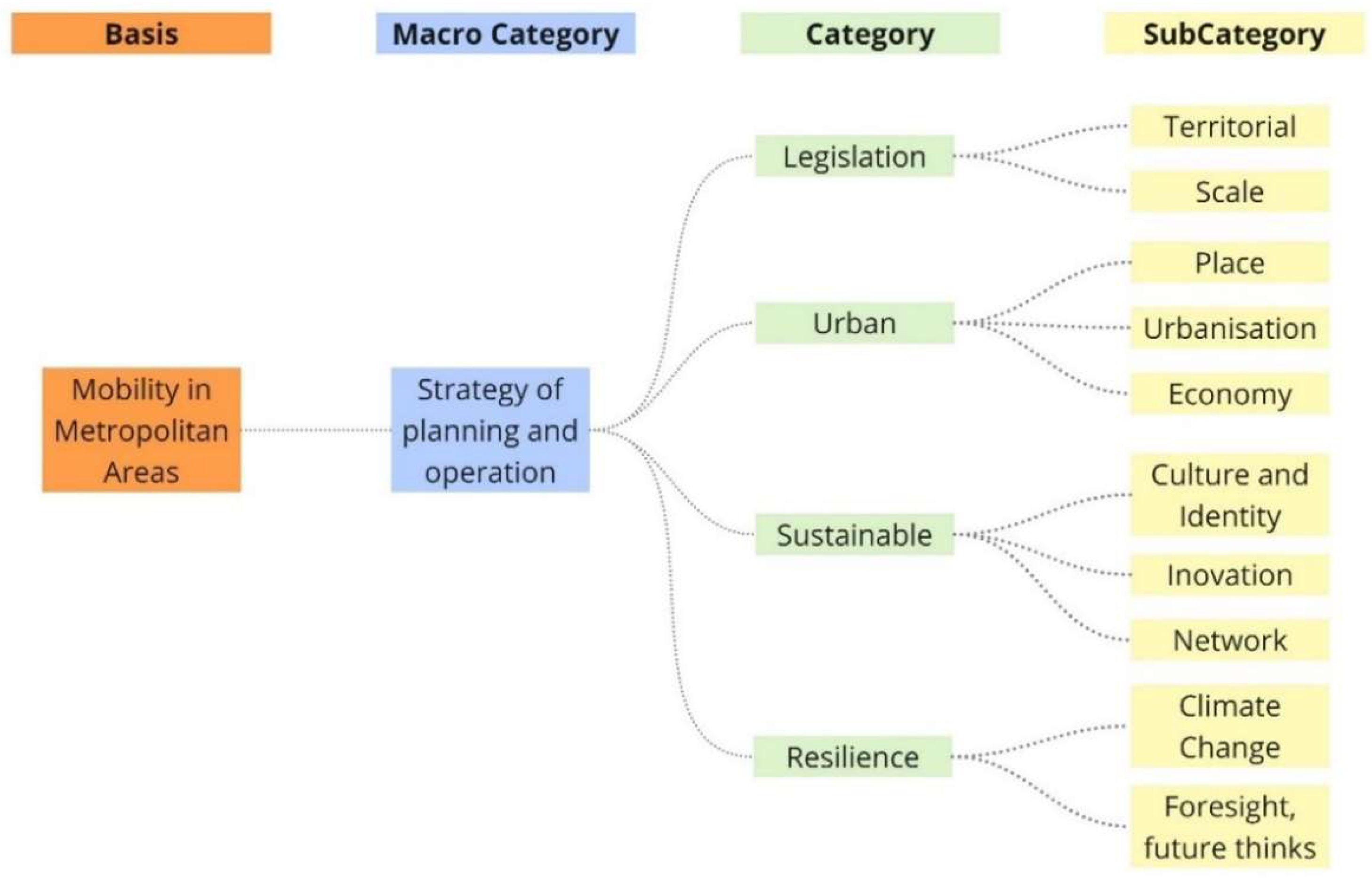
Table 3.
Expert Panel Profile and Sector Affiliation.
| Interviewee | Profession/Graduate Degree | Experts linked |
|---|---|---|
| (I1) | Editor/Philosophy, Politics and Economics | Community |
| (I2) | Lecture/ Transport (Infrastructure) and city Planning/ PHD | Academy |
| (I3) | Curator, Educator/Architect | Third Sector |
| (I4) | Politics and International Relations/ Marketing | Community |
| Table 3 – (continued) | ||
| (I5) | Urban Mobility Planner – Chartered Transport Engineer / Civil Engineering | Private Sector |
| (I6) | Lecture/ Head of Economics at Company | Academy/Private Sector |
| (I7) | Commissioner/ Social Anthropology/PHD | Public Sector |
| (I8) | Chief Office / Human Sciences BSc | Public Sector |
Note: Elaborated by Ribeiro and Fachinelli, 2023. Copyright 2023.
| 1 | The latest IPCC report demonstrated forecasts temperature increases of 1.5°C
from 2021-2040 and 1.6°C from 2041-2060 under the SSP1 scenario, highlighting
the critical need to integrate mobility into worldwide sustainability
initiatives. Given that automobiles contribute to 80% of greenhouse gas
emissions, there is an imperative for systemic shifts towards sustainable
transportation alternatives. |
| 2 | According to item CCL the term "metropolis" in the Metropolis
Management Act 1855 indicates the jurisdictional extent of the Metropolitan
Board of Works. This encompasses the City of London and its adjacent parishes,
marking the area for urban management and the development of essential
infrastructure such as roads, sewers, and public utilities. This delineation
was critical for the Victorian era governance and the systematic modernization
of London’s municipal services and urban configuration. |
| 3 | Borough organisation is the original term appropriated by the London
organisation. In the free translation by the DeelpL dictionary, it is seen as a
city-scale organisation such as "borough". In the Cambridge
dictionary translation, it is associated with the municipal scale "a
town", or division of a large town". In case of this study, the term
“borough” has recognised on a municipal scale as a municipality. |
| 4 | Unitary Development Plan (UDP) is built in two parts with strategic policies
and land use details, plus a Proposals Map with general uses. Supplementary
Planning Guidance is issued for development control. Boroughs operate under a
decentralised system of central government, aligned to the London Strategic
Planning Guidance issued every five years. |
Disclaimer/Publisher’s Note: The statements, opinions and data contained in all publications are solely those of the individual author(s) and contributor(s) and not of MDPI and/or the editor(s). MDPI and/or the editor(s) disclaim responsibility for any injury to people or property resulting from any ideas, methods, instructions or products referred to in the content. |
© 2024 by the authors. Licensee MDPI, Basel, Switzerland. This article is an open access article distributed under the terms and conditions of the Creative Commons Attribution (CC BY) license (http://creativecommons.org/licenses/by/4.0/).
Copyright: This open access article is published under a Creative Commons CC BY 4.0 license, which permit the free download, distribution, and reuse, provided that the author and preprint are cited in any reuse.


