

Submitted:
05 September 2024
Posted:
09 September 2024
Read the latest preprint version here
Abstract
This paper proposes an innovative postulate based on experimental observations, namely, that the speed of light can vary between two inertial reference systems. This postulate is defined as the principle of relative change in the speed of light, which refreshes the concept of absolute speed of light in traditional physics. By integrating the principle of the invariance of the speed of light with the principle of relativity in relativity theory, several important conclusions are derived: space and time must be capable of and proportionally expand and contract. Between two inertial reference systems with different relative speeds of light, objects have an energy difference of k^2 times, which induces a natural tendency for objects to move towards a state of lower energy. The acceleration is only related to the relative change rate of the speed of light in vacuum space and is independent of the mass of the object. The kinetic energy obtained by the object comes from the reduction of internal energy of the object, emphasizing the key role of energy conversion in this process. The paper provides a new theoretical perspective for explaining the physical mechanisms of universal gravitation and dark energy.
Keywords:
Dark energy
; light speed
; spacetime
; internal energy
; Self initiated force
; universal gravitation
Introduction:
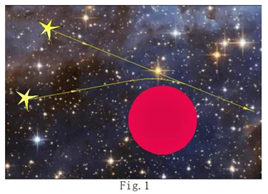
It is well known that when light passes near a massive object, its propagation direction will be significantly deflected, such as the gravitational lensing phenomenon and the refraction phenomenon when light passes near the sun [1,2,3,4,5,6]. As shown in Figures 1 and 2, light, as an electromagnetic wave, experiences refraction due to changes in its propagation speed (n_21=c_1⁄c_2). These refraction phenomena indicate that the speed of light slows down when it approaches a massive object. The radar echo delay experiment also confirms the physical phenomenon that the speed of electromagnetic waves slows down when they approach massive objects [7,8,9]. Therefore, two conclusions can be drawn: first, the speed of light is variable in vacuum; second, the speed of light slows down when it approaches a massive object. Based on this, we summarize the phenomenon of relative changes in the speed of light into a postulate, which states that the speed of light in another inertial reference frame that is relatively stationary with respect to our own can differ from the speed of light in our own reference frame. This postulate is called the principle of relative change in the speed of light. For example, regardless of whether light is measured in the Earth's reference frame or the Sun's reference frame, its speed is always 3.0×10^8 m/s. However, when measuring the speed of light in the Sun's reference frame from the Earth's reference frame, it is observed that the speed of light in the Sun's reference frame is slower relative to the speed of light in the Earth's reference frame, which is also a widely accepted observational result. Based on this postulate, combined with the principle of invariance of the speed of light [10,11,12,13,14,15] and the principle of relativity, we can propose new explanations for some physical problems, such as the physical reasons for the relative expansion [16,17,18,19,20,21,22,23] and contraction of spacetime, the energy difference in vacuum space, and the dynamical effects generated by this energy difference. This provides a new physical approach to the currently unresolved physical mechanism problems of universal gravitation and dark energy.

1. The Spacetime Conditions for the Compatibility of the Principle of the Constancy of the Speed of Light and the Principle of the Relative Change of the Speed of Light
The principle of the constancy of the speed of light states that the speed of light in a vacuum remains constant in any inertial reference frame, regardless of the motion state of the light source. This principle emphasizes that the speed of light is constant within an inertial reference frame, and the speed of light in a vacuum is equal in any inertial reference frame. However, the principle of the relative change of the speed of light suggests that although the speed of light is constant and equal in each inertial reference frame, the measured speed of light in the other reference frame may vary when measured between two inertial reference frames. So, do the principles of the constancy and relative change of the speed of light conflict with each other? The following discussion proves that under certain spatiotemporal conditions, these two principles are compatible.
Formula for calculating the speed of light c:
c represents the speed of light, Δs represents the distance traveled by light, and Δt represents the time taken by light to travel that distance.
Although this formula for calculating the speed of light seems simple, it relates two very important physical quantities: space and time. If we multiply both the numerator and denominator by the same scaling factor k, the speed of light remains unchanged.
From the above equation, it can be seen that if space and time expand or contract proportionally, the speed of light in vacuum will remain constant in any inertial reference frame. This means that no matter how space and time change, their expansion or contraction ratio must be the same, which is a necessary condition for the invariance of the speed of light. If the k values between different reference frames are equal, the speed of light between different reference frames must be equal to the speed of light in this reference frame, which obviously does not match the observational facts. Therefore, the k values between different reference frames should be unequal to conform to the principle of relative change of the speed of light. Therefore, it can be concluded that space and time must be scalable, and their changes must be proportional.
Experimental observations indicate that the radar echo delay phenomenon reveals the slowdown of the speed of light on the solar side. According to the principle of the invariance of the speed of light, the speed of light in the solar reference system is still 3.0×10^8 m/s, which indicates that the space-time in the solar reference system has undergone a contraction phenomenon relative to the Earth reference system. In other words, the slowdown of the speed of light on the solar side is caused by the contraction of space and the slowdown of time on the solar side. This observational phenomenon confirms that the relative change of the speed of light and the expansion and contraction of space-time are objectively existent.
2. The Relationship between the Scale Factor k of Space-Time Expansion and Contraction and the Relative Change of the Speed of Light
There are two relatively stationary inertial reference systems, A and B. When measuring each other's light speed, it is found to be different from the light speed in the reference system. According to the principle of the constancy of the speed of light, the speed of light in any two reference systems is constant and the same. Therefore, this can only be understood as a relative stretching phenomenon of space-time between the two reference systems. Now taking the A reference system as the benchmark for space-time comparison, if n seconds pass in the vacuum space of the A reference system, the distance of light propagation in the A reference system is measured as Sa. In the A reference system, the distance of light propagation in the B reference system is measured as Sb. The relative stretching proportionality coefficient k of the two spaces is:
Because the stretching coefficient k of time and space must be equal to satisfy the principle of the invariance of the speed of light, the time relationship between the two reference systems is:
Based on the principle that space-time must expand and contract in proportion, we have derived that the relative expansion and contraction of space-time between two reference systems is a function of the relative speed of light and the ratio of the speed of light.
As can be seen from equations (2-3) and (2-4), when k > 1, the spacetime of the B reference frame appears to expand relative to the A reference frame, and when k < 1, the spacetime of the B reference frame appears to contract relative to the A reference frame. For example, when and , we obtain k = 0.5. This means that the spacetime of the B reference frame contracts by a factor of 0.5 relative to the A reference frame. Therefore, 3×10⁸ m in the B reference frame is actually equivalent to 1.5×10⁸ m in the A reference frame. In the B reference frame, the passage of time is 0.5 times slower than in the A reference frame, meaning that one second in the B reference frame is equivalent to two seconds in the A reference frame.
If the speed of light in the A reference frame is observed from the perspective of the B reference frame, it will be found that the speed of light in the A reference frame is twice as fast as that in the B reference frame. That is to say, observing the speed of light in the Earth reference frame from the Sun reference frame will also result in a faster speed of light than that in the Sun reference frame. This "superluminal" phenomenon arises from the relative expansion between the two reference frames. However, within both reference frames, the speed of light remains constant. Therefore, this "superluminal" phenomenon does not contradict the principle of the invariance of the speed of light. It is precisely because of this "superluminal" phenomenon in the relative expansion of spacetime that opens up new imaginative spaces for the possibility of interstellar travel.
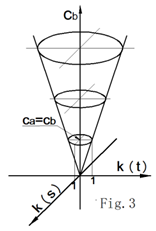
In an inertial reference frame, the speed of light in a vacuum remains constant. However, the speed of light is variable between different inertial reference frames. It can be said that the speed of light is constant in an absolute sense. But in a relative sense, it is variable. The so-called absolute invariance refers to the fact that the speed of light in a vacuum remains constant in any reference frame and at any position in the universe; while the so-called relative variability refers to the fact that the speed of light may be relatively different between two reference frames at any position in the universe. The relative difference in the speed of light leads to the relative difference in spacetime. This means that the time elapse or spatial interval between any two points in the universe may be different. As shown in Figure 3.
3. Energy Relationship between Reference Systems with Relative Changes in the Speed of Light
In a space where the speed of light continuously changes, selecting points A and B as reference frames, due to the relative difference in the speed of light between the two points, there is an energy difference between the two reference frames A and B
If there is a photon in the B reference frame, its frequency is , period is , and energy is .
In the A reference system, the observed frequency of this photon is , the period is , and the energy is .
Due to the difference in the speed of light between the two reference systems, the time progression in the two reference systems is different. According to equation (2-4), the relationship between Ta and Tb is:
Substituting equation (3-5) into equation (3-3) yields:
When k≠1, the observed frequency and energy of the same photon will exhibit differences in different reference frames. The occurrence of such differences is closely related to the chosen reference frame and has nothing to do with the photon itself. For example, the speed of light in the solar reference frame is slower than that in the Earth reference frame, so the clock in the solar reference frame runs slower than the Earth clock, which results in a decrease in the frequency of sunlight observed on Earth. This phenomenon is known as the red shift of light [24,25,26,27]. Obviously, this red shift phenomenon is caused by the difference in the flow rate of time between the two places. Therefore, this red shift phenomenon exists at the time of photon generation. The degree of difference in photon frequency depends on the difference between the speed of the solar clock and the Earth clock, and has nothing to do with gravity.
In the B reference system, there is an object with a mass of . According to the mass-energy equation [28], its internal energy is :
Due to the relative difference in the speed of light between the A reference frame and the B reference frame, we have:
Substituting the above expression into equation (3-9) yields:
The above equation (3-11) indicates that the internal energy of the same mass object between two inertial reference systems has a difference of times.
From the mass-energy formula, it can be known that the internal energy of an object is related to the speed of light. In any inertial reference frame, the internal energy of an object is always . However, when k≠1, there will be a situation where the same mass but different internal energies occur between two reference frames, as shown in equation (3-11), which means that the internal energy of 1J in the A reference frame is not equal to the internal energy of 1J in the B reference frame. In the universe, the speed of light always has relative variations, so the internal energy of an object in vacuum space may vary at different positions.
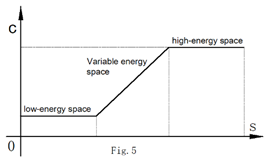
A vacuum space with a relatively high speed of light is defined as a high-energy space, while a vacuum space with a relatively low speed of light is defined as a low-energy space. The transitional space between the two is called a variable-energy space. In a space with a constant speed of light, whether it is a high-energy space or a low-energy space, spacetime remains unchanged, collectively referred to as inertial space or flat space. However, in a variable-energy space, the speed of light varies continuously with space, and spacetime expands or contracts continuously. This kind of space is called non-inertial space or curved space, as shown in Figure 5.
4. Kinetic Effects Produced by Objects in Vacuum Space
When an object is in a vacuum space with varying light speeds, it has different internal energy states at different spatial locations. The object will spontaneously move towards a space with a lower internal energy state to reduce its own internal energy state. Moving towards a lower energy direction is a natural property of all objects, which has been summarized as a principle, namely the "minimum energy principle" [29,30]. This principle states that the energy of an object or system always tends towards a minimum value.
Given that there is a relative speed difference of light () between the two reference systems A and B, an object will produce an internal energy difference in the two reference systems
According to the principle of minimum energy, objects will spontaneously move towards spaces with lower internal energy. In the absence of external work, the total energy change ∆E of an object is zero.
represents the change in kinetic energy
According to formula (3-5), the decrease in internal energy of an object is equivalent to the increase in kinetic energy of the object, a physical process that conforms to the law of conservation of energy. Since objects naturally move towards lower energy states, we can further derive the equivalent force based on the force calculation formula F=ma.
Let the work done on an object by a self-acting force after a distance of ∆s be denoted as A
Work A is equal to the kinetic energy obtained by the object:
The increase in the kinetic energy of this object is equal to the decrease in its internal energy. Substituting equation (4-5) into the aforementioned equation yields:
Substituting equation (3-1) into the above equation yields:
As can be seen from Equation (4-10), the difference in internal energy of an object in space is the reason for generating the self-force . The greater the difference in internal energy, the shorter the distance that produces this difference, and the stronger the self-force. The above Equation (4-11) shows that regardless of whether the object is moving or stationary, as long as there is a difference in the speed of light, this self-force of the object always exists.
Let the acceleration obtained by the object under the action of self-force be g:
Substituting equation (3-11) into the above equation gives:
Equation (3-13) indicates that the acceleration of an object is equal to the rate of change of the speed of light difference between two reference systems with respect to space. The acceleration obtained by the object is independent of its mass. In other words, when an object spontaneously accelerates towards a lower energy state, it does not feel any force acting on it, which is consistent with its natural motion state in inertial space. However, external observers find that the object is accelerating and its kinetic energy is indeed increasing. Then, where does the increased kinetic energy of the object come from? The kinetic energy of an object can only come from the reduction of its internal energy. Following the law of conservation of energy is a necessary condition for correctly describing a physical process.
Assuming a 1kg object is accelerated to 100 m/s, its kinetic energy is 5000J, and the internal energy of a 1kg object is J, the ratio of consumed internal energy to total internal energy is . Therefore, the reduction in internal energy of the object is negligible compared to the total internal energy.
From equation (3-13), we know that acceleration is determined by the rate of change of the square of the speed of light with respect to space. Assuming the acceleration to be g = 10 (m/s²), when ∆s is equal to 10m,= 299792458 (m/s), find the speed of light .
Relative change in the speed of light △C:
Relative change rate of the speed of light:
From the above calculation results, it can be seen that when the acceleration g = 10 (m/s²), within a range of 10m, the speed of light only changes by . Therefore, a very small change in the speed of light in vacuum can produce a considerable acceleration g and self-force for an object.
5. Conjectures on the Physical Mechanisms of Gravitational Force and Dark Energy
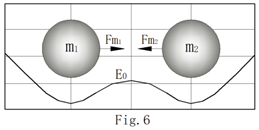
As mentioned earlier, light undergoes refraction when passing through a massive object, and the closer it gets to the object, the more pronounced the refraction becomes. This indicates that the closer the light is to the object, the slower its propagation speed. This means that the closer one gets to the object, the more pronounced the contraction of spacetime becomes, and the lower the energy state of space. Objects have a natural tendency to move towards lower energy states, so the gravitational force between objects can be understood as the natural tendency of objects to move towards lower energy states. The gravitational force between objects is actually the self-force of objects moving towards lower energy states, as shown in Figure 6. Therefore, from a physical mechanism perspective, the mass of an object changes the energy state of space, and the closer one gets to the object, the lower the energy state becomes. The greater the mass of an object, the lower the energy state of its space. The universal gravitational force between objects is essentially the self-force of objects moving towards lower energy states. There is no direct mutual attraction between objects. In other words, as long as there is a difference in energy states in space, objects will spontaneously move towards lower energy states, regardless of the cause of the difference in energy states. The kinetic energy added by this natural motion of objects comes from the reduction of internal energy of objects, and energy conservation is a fundamental law that must be observed in all physical.
The source of dark energy remains a mystery to this day. As the main driving force behind the accelerated expansion of the universe, the explanation of dark energy is closely related to the above theories. Since the vacuum has no mass and no continuous energy output, as mentioned above, the relative changes in spacetime in vacuum space can only provide conditions for energy conversion for objects. In this process, the vacuum neither absorbs energy nor releases energy. It can be inferred that the phenomenon of accelerated expansion of the universe is consistent with the above "gravitational" principle, which is due to the formation of a high-energy space inside the universe and a low-energy space at the edge by the Big Bang. Interstellar objects will spontaneously accelerate towards the outer edge of the universe. The kinetic energy of the accelerated motion of interstellar objects comes from the reduction of internal energy of the objects. Therefore, the source of dark energy is most likely to be the reduction of internal energy of objects accelerating in the universe. This natural accelerated expansion of the universe is also a concrete manifestation of the principle of minimum energy.
6. Conclusion:
Based on the observed phenomenon of relative changes in the speed of light, this article proposes a postulate of relative changes in the speed of light. Combining the principle of the invariance of the speed of light and the principle of relativity, several physical phenomena are studied, and some new understandings are obtained.
Time and space can both expansion and contract, but the expansion and contraction of spacetime must maintain a proportional relationship. When there is a difference in the speed of light between two reference systems, it will lead to relative expansion and contraction of spacetime between the reference systems, and create a difference between high-energy space and low-energy space between the two reference systems. This energy difference promotes the spontaneous movement of objects towards lower energy states, which not only conforms to the principle of minimum energy but also follows the law of conservation of energy. The self-force generated by the object provides a new physical explanation for the physical mechanism of universal gravitation. If the principle of relative change in the speed of light is established, then the above inference has important physical significance.
In a vacuum environment, the motion of an object does not depend on external forces. As long as there is a relative change in the speed of light in space, the object can spontaneously move. If we can master the technology to change the spatial distribution of the speed of light, it is possible to develop a new type of electromagnetic engine. This technology will lead all engine technologies into a new era.
In summary, the principle of relative change in the speed of light provides a new platform for thinking in physics research. It not only redefines our understanding of the invariance of the speed of light but also offers innovative theoretical tools for understanding core physical issues such as gravity, cosmic expansion, and dark energy. However, the comprehensive verification and application of this theory still require more experimental data support, as well as in-depth integration and revision of existing physical theories. The principle of relative change in the speed of light will play an important role in future physics and cosmology research.
References
- Shi, Yu. From 1919 to 2019: Two Great Tests of General Relativity by Ray Deflection. Science 2019, 71, 2–10+64+69. [Google Scholar]
- Cheng Yu, Wang Xueying, Sheng Weidong, et al. A method for estimating atmospheric refractive index based on stellar ray deflection. Acta Optica Sinica, 2019, 39, 9–15.
- Ren Jirong, Zhu Hui. A new method for calculating the deflection of light in gravitational fields. Acta Physica Sinica, 2009, 58, 690–694. [CrossRef]
- Gong Yanxiang. Geometric algorithm for light deflection in static spherically symmetric gravitational field. University Physics, 2008, 27, 27–29.
- Dai Hongxia, Shi Dongping, Long Bingwei Polarization of Proca rays in Schwarzschild gravitational field. Journal of Chongqing University (Natural Science Edition), 2003, 26, 54–57.
- Zhu Shitong, Shen Wenda. Ray Tracks in Geometric Optics and Metric Optics. Chinese Science Series A (Mathematical, Physical, Astronomical and Technical Sciences), 1997, 566–570.
- Gong Yanxiang, Li Feng. The influence of Hubble parameters on ray trajectories and radar echo delay correction in Robertson McVittie spacetime. Acta Physica Sinica, 2010, 59, 5261–5265.
- Chen Xiuwu. Deduction of Radar Echo Delay Time. Automation and Instrumentation, 2014; 135–136+139.
- Gong Yanxiang Post Newtonian correction of radar echo delay experiment in R-N field. Acta Astronomica Sinica, 2010, 51, 1–7.
- Liu Haijun. The principle of invariance of the speed of light and Lorentz transformation. Science and Technology Wind, 2020; 164–166.
- Wu Jiaqi. Research on the principle of invariance of the speed of light. Digital Communication World, 2017; 264.
- Wen Hailong. Mathematical Inference and Attempt on the Principle of Invariance of the Speed of Light. Science and Technology Wind, 2014; 95+97.
- Lin Jin, Li Zhigang, Fei Jinggao, et al. Decisive Experimental Test of Einstein's Hypothesis of Constant Speed of Light. Acta Astronautica Sinica, 2009, 30, 25–32.
- Li Xiaoniu, Bai Xinshi, Du Xuezhou. Discussion on the principle of invariance of the speed of light. Journal of Yan'an University (Natural Science Edition), 2007, 26, 45–48.
- Guo Songqing, Deng Li, Liang Yingxian, et al. The role of the principle of invariance of the speed of light in relativity. Journal of Shenyang Institute of Aeronautics and Astronautics, 2000; 64–66.
- Zhai Xianghua. Several unsolved mysteries of the expanding universe. World Science, 2021; 30–32.
- Cai, Lu. Cosmic Expansion, Time Acceleration. Scientific World, 2023; 5. [Google Scholar]
- Guan, Yi. American astronomers calculate new cosmic expansion rate. Nature, 2019, 41, 293. [Google Scholar]
- Zhong Cuixiang. The proof of Hubble's law and the truth about cosmic expansion, as well as dark matter and dark energy, Science and Technology Innovation, 2019; 15–17.
- Zhao Gongbo. Dark Energy and the Accelerating Expansion of the Universe. Scientific Bulletin, 2018, 63, 2422–2428.
- Zhang Xin. The Mystery of Dark Energy and the Accelerated Expansion of the Universe. Science, 2017, 69, 57–60.
- Zhang Yuexia, Zhang Xiaolong. In depth exploration of time dilation effect. University Physics, 2023, 42, 28–31.
- Zhu Jidong. How to correctly measure time dilation in a motion reference frame. Journal of Shanghai Electric Power University, 2013, 29, 501–506.
- Zhang Yuanzhong. Principle and accuracy of space gravity redshift experiment. Journal of Space Science, 2019, 39, 349–353.
- Cui Weiping, Su Jianfeng. Experimental study on spatial "gravitational redshift". Journal of Southwest University (Natural Science Edition), 2016, 38, 138–142.
- Yuan XinxiAn exploratory explanation for gravitational redshift. Basic Sciences of China. 2013, 15, 11–13.
- Zhu Linjie, Yao Liping, Zhang Meng. A Brief Discussion on the Gravitational Redshift of Spectral Lines. Science and Technology Information, 2011; 79–80.
- Guo Hanying. Formula of Quality and Energy and Scientific View. Science, 2008, 60, 26–29.
- Sun Anzhu, Lu Rongde. Application of the principle of minimum energy in capacitance analysis and estimation. University Physics, 2013, 32, 51–54.
- Zhu Qingbin. Reconsideration of the "Principle of Minimum Energy". Middle School Chemistry, 2010; 17–18.
Disclaimer/Publisher’s Note: The statements, opinions and data contained in all publications are solely those of the individual author(s) and contributor(s) and not of MDPI and/or the editor(s). MDPI and/or the editor(s) disclaim responsibility for any injury to people or property resulting from any ideas, methods, instructions or products referred to in the content. |
© 2024 by the authors. Licensee MDPI, Basel, Switzerland. This article is an open access article distributed under the terms and conditions of the Creative Commons Attribution (CC BY) license (http://creativecommons.org/licenses/by/4.0/).
Copyright: This open access article is published under a Creative Commons CC BY 4.0 license, which permit the free download, distribution, and reuse, provided that the author and preprint are cited in any reuse.


