

Submitted:
14 October 2024
Posted:
16 October 2024
Read the latest preprint version here
Abstract
Suppose n ∈ N. We wish to meaningfully average ‘sophisticated’ unbounded sets (i.e., sets with positive n-d Hausdorff measure, in any n-d box of the n-d plane, where the measures don’t equal the area of the boxes). We do this by taking the most generalized, satisfying extension of the expected value, w.r.t the Hausdorff measure in its dimension, on bounded sets which takes finite values only. As of now, I’m unable to solve this due to limited knowledge of advanced math and most people are too busy to help. Therefore, I’m wondering if anyone knows a research paper which solves my doubts. (Unlike previous versions with similar names, we add examples, motivations, and explanations to this version.)
Keywords:
Expected Values
; Sets
; Hausdorff measure
; Hausdorff dimension
; Discretization
; Segmentation
; Partitions
; Samples
; Euclidean Distance
; Choice Function
1. Intro
Let . Suppose is Borel and is the set of all unbounded A. Also, is the Hausdorff dimension and is the Hausdorff measure in its dimension on the Borel -algebra.
1.1. First Special Case of A
Suppose the n-dimensional box is B. How do we define explicit A, such that:
- 1
- for all B
- 2
- for all B?
This case of A is called .
1.1.1. Potential Answer
If , using this reddit post [1], define A such that:
Find a set , where the cardinality is and for every interval I, taking its cross product with to get the set desired.
Construct a subset of with this property (then copy and paste the set to get the desired subset of ):
Note, we do this by constructing a strange map from . Take a real number , expand that number in binary as and map the value to the series . It’s possible using Khintchine’s inequality [2] (pp. 187-205) to show the sum converges for a.e. . Thus, our desired set will just consist of those x for which the sum is positive.The fact this set works is a little bit annoying to prove, but relies on Khintchine’s inequality [2] (pp. 187–205) and the divergence of the Harmonic series. Essentially, we want to show that for any initial seqeuence of digits there is a positive probability that the final sum is positive and a positive probability that the final sum is negative.
Note, in case there is a research paper which can average into a finite number, consider the second example.
1.2. Second Special Case of A
Suppose the n-dimensional box is B. Is there an explicit A, such that:
- 1.
- for all B
- 2.
- for all B
- 3.
-
For all n-d boxes :
- (a)
- (b)
- (c)
- ?
If so, how do we define it? If not, how do we modify Section 1.2 so the answer is “yes"?
If such a set exists, this case of A is called . (Note, we haven’t found an example of such a set yet.)
1.3. Attempting to Analyze/Average A
The expected value of A, w.r.t the Hausdorff measure in its dimension, is:
Nevertheless, we have the following problems:
Note 1
(Problem 1). When (Section 1.1), is undefined.
1.3.1. Explanation of Problem 1
When , using Section 1.1 and Section 1.1.1, since for all B, we can see that and . This makes undefined due to division by infinity. (Note, the most obvious extension of or is also undefined: i.e., the following is false
since for all B.)
Note 2
(Problem 2). When is the set of all unbounded A with a finite , where the cardinality is , then (i.e., is “measure zero" in )
1.3.2. Explanation of Problem 2
Note, unbounded A has a finite mean when all lines of symmetry of A intersect at the same point. Thus, for any sequence of bounded sets whose set theoretic limit is A in the former sentence (Section 5.1), observe always exists:
and has the same value.
Since the cardinality of all unbounded sets with a line of symmetry is ; the cardinality of all unbounded sets where all lines of symmetry intersect at one point is less than or equal to . Hence, since the cardinality of all subsets of is ; the cardinality of all unbounded sets where there are no lines of symmetry, or the lines of symmetry intersect at multiple points is . Hence, since and , therefore , proving problem 2 is correct.
Next, consider the approach to solving problems 1 and 2.
1.3.3. Approach
We want an unique, satisfying extension of the expected value of A, w.r.t the Hausdorff measure in its dimension, on bounded sets to A, which takes finite values only, such that when is the set of all unbounded A with this extension:
- 1.
- (i.e., is “almost everywhere" in )
- 2.
- If (1) isn’t true, then
1.3.4. Explanation of Approach
Using Section 1.3.2 Equation (2) on several A, depending on the bounded sequence of sets (i.e., ) chosen, we have multiple . Here is an example:
Example 1.
Suppose . We define bounded sequence of sets and whose set theoretic limit is . Note, the center of , for all , is and the center of , for all , is . Thus, and . What’s more, depending on the chosen, can be any point in (when it exists).
1.4. Question
Is there a unique way to define “satisfying" & “extension" in the approach of Section 1.3.3, which solves problems 1 and 2 with applications?
For an example, keep reading.
2. Extending the Expected Value of A w.r.t the Hausdorff Measure
The following are two methods to finding the most generalized, satisfying extension of in Equation (1) which we later use to answer the question in Section 1.4:
- One way is defining a generalized, satisfying extension of the Hausdorff measure, on all A with positive & finite measure which takes positive, finite values for all Borel A. This can theoretically be done in the paper “A Multi-Fractal Formalism for New General Fractal Measures"[3], where in Equation (1) we replace the Hausdorff measure with the extended Hausdorff measure.
- Another way is finding generalized, satisfying average of all A in the fractal setting. This can be done with the papers “Analogues of the Lebesgue Density Theorem for Fractal Sets of Reals and Integers" [4] and “Ratio Geometry, Rigidity and the Scenery Process for Hyperbolic Cantor Sets" [5] where we take the expected value of A w.r.t the densities in [4,5].
Note, neither approach answers Section 1.4 since they can’t solve problems 1 and 2 (i.e., is the set of all unbounded A). Therefore, we ask a leading question using to guide the reader to an interesting solution to Section 1.4.
3. Attempt to Define “Unique and Satisfying" in The Approach of Section 1.3
3.1. Note
- “Set theoretic limit" (Section 5.1)
- “Expected value on sequences of bounded sets" (Section 5.2)
- “Equivelant sequences of bounded sets" (Section 5.3, Definition 1)
- “Nonequivelant sequences of bounded sets" (Section 5.3, Definition 2)
- The “measure" on a sequence of bounded sets which increases at a rate linear or superlinear to that of “non-equivelant" sequences of bounded sets (Section 5.4.1, Section 5.4.2)
- The “actual" rate of expansion on a sequence of bounded sets (Section 5.5)
3.2. Leading Question
To define unique and satisfying inside the approach of Section 1.3, we take the expected value of a sequence of bounded sets chosen by a choice function. To find the choice function, we ask the leading question...
If we make sure to:
- (A)
- See Section 3.1 and (C)-(E) when something is unclear
- (B)
- Take all sequences of bounded sets whose “set theoretic limit" is A
- (C)
- Define C to be chosen center point of
- (D)
- Define E to be the chosen, fixed rate of expansion of a sequence of bounded sets
- (E)
- Define to be actual rate of expansion of a sequence of bounded sets (Section 5.5)
Does there exist a unique choice function which chooses the set of all equivalent sequences of bounded sets where:
- 1.
- The chosen, equivelant sequences of bounded sets should satisfy (B).
- 2.
- The “measure" of all the chosen, equivalent sequences of bounded sets which satisfy (1) should increase at a rate linear or superlinear to that of non-equivalent sequences of bounded sets satisfying (B).
- 3.
- The expected values, defined in the papers of Section 2, for all equivalent sequences of bounded sets are equivalent and finite
- 4.
-
For the chosen, equivalent sequences of bounded sets satisfying (1), (2), and (3).
- The n-d Euclidean distance between criteria (3) and C is the less than or equal to that of all the non-equivalent sequences of bounded sets satisfying (1), (2), and (3)
- The “rate of divergence" [6] (pp. 275–322) of , using the absolute value , is less than or equal to that of all the non-equivalent sequences of bounded sets which satisfy (1), (2), and (3)
- 5.
-
When set is the set of all unbounded A, where the choice function chooses the set of all equivalent sequences of bounded sets satisfying (1), (2), (3) and (4), then:
- When , then
- 6.
- Out of all choice functions which satisfy (1), (2), (3), (4), and (5) we choose the one with the simplest form, meaning for each choice function fully expanded, we take the one with the fewest variables/numbers?
(In case this is unclear, see Section 5.)
3.2.1. Explaining Motivation Behind Section 3.2
- 1.
- When defining “the measure" (Section 5.4.1, Section 5.4.2) of an unbounded set, we want a set with a “high" entropic density (i.e., we aren’t sure if this is infact what the “measure" measures.) For example, when , the “measure" mostly chooses bounded sequences of symmetrical shapes whose lines of symmetry intersect at one point rather than non-symmetrical shapes Section 5.4.1-Section 6, Section 8.
- 2.
- Using ex. 1, when , depending on the bounded sequence of setschosen with a set theoretic limit of A: can be any point in (when it exists). To fix this, we take all , where has the smallest n-d Euclidean distance from a reference point (i.e., the center point ). The problem is there exists A, where the average of non-equivalent sequences (Section 5.3, Definition 2) of bounded sets have the same minimum Euclidean distance from C.
- 3.
- Hence, we take the sequence of sets whose actual rate of expansion from C (Section 5.5) “diverges" [6] (pp. 275-322) at the smallest rate from the chosen, fixed rate of expansion E from C (i.e., the “rate of divergence of , using the absolute value , is less than or equal to that of all the non-equivalent sequences of bounded sets which satisfy Section 3.2 criteria (1), (2), and (3)).
- 4.
- Finally, since there might still be non-equivalent sequences (Section 5.3, Definition 2) of bounded sets which satisfy Section 3.2.1 criteria (1), (2) and (3), but are congruent with different , we use equation T in Section 6.3 Equation (115) to choose a unique set of all equivalent sequences of bounded sets with the same expected value.
I’m convinced the expected values of the sequences of bounded sets chosen by a choice function which answers the leading question aren’t unique nor satisfying enough to answer problems 1 and 2. Still, adjustments are possible by changing the criteria or by adding new criteria to Section 3.2.
4. Question Regarding My Work
Most don’t have time to address everything in my research, hence I ask the following:
Is there a research paper which already solves the ideas I’m working on? (Non-published papers, such as mine [7], don’t count.)
Using AI, papers that might answer this question are “Prediction of dynamical systems from time-delayed measurements with self-intersections" [8] and “A Hausdorff measure boundary element method for acoustic scattering by fractal screens" [9].
Does either of these papers solve problems 1 and 2 with applications?
5. Clarifying Section 3
Let be an unbounded, Borel set. Suppose be the Hausdorff dimension and be the Hausdorff measure in its dimension on the Borel -algebra. See Section 3.2, once reading this section, and consider the following:
Is there a simpler version of the definitions below?
5.1. Set Theoretic Limit of a Sequence of Bounded Sets
Note the set theoretic limit of a sequence of sets of bounded set is A when:
where:
Example 2.
Using example 1, when , define bounded sequence of sets and . Notice, the set theoretic limit of the bounded of sequence of sets using Section 5.1 is . I don’t know how to prove this, but I assume readers should be able to verify whether I am correct.
5.2. Expected Value of Bounded Sequences of Sets
If is a sequence of bounded sets whose set-theoretic limit is A (Section 5.1), the expected value of A w.r.t is (when it exists) where:
Note, can be extended by using Section 2.
5.2.1. Example 1
Using example 2, suppose , , and . Note:
Since Equation (12) is true,
5.2.2. Example 2
Using example 2, suppose , , and . Note:
Since Equation (24) is true, .
5.3. Defining Equivelant and Non-Equivelant Sequences of Bounded Functions
Thus, we define:
Definition 1
(Equivelant Sequences of Bounded Sets). Suppose, is an arbitrary set. Note, the sequences of bounded sets in:
are equivalent, if for all , where , and are equivelant: i.e., there exists a , such for all , there is a , where:
and for all , there is a , where:
More, for each , we denote all equivalent sequences of bounded functions to using the notation
5.3.1. Explanation
We define and as equivalent, then for all sets , when either or exist (Section 5.2):
Hence, consider the following:
Theorem 3.
If the sequence of sets in:
are equivalent, then for all , where (Section 5.2):
Below, is an example of an equivalent sequence of bounded sets:
5.3.2. Example of Equivalent Sequences of Bounded Sets
Suppose
Note, using Definition 1, , , and . In other words, and . Now, suppose , where and . Then,
- 1.
-
For all , there exists a , where:We show this with the following:We also show:
- 2.
-
For all , there exists a , where:We show this with the following:
Since crit. (1) and (2) is true, using Definition 1, we have shown and are equivalent.
Note, there exists zero sets , where and have different values.
Definition 2
(Non-Equivalent Sequences of Bounded Sets). Again, suppose is an arbitrary set. Then, the sequences of bounded sets in:
are non-equivalent, if Definition 1 is false, meaning for some , where , and are non-equivelant: there is a , where for all , there is either a , where:
or for all , there is a , where
5.3.3. Explanation
We define and as non-equivalent, then there exists a set , such that when or exist (Section 5.2):
Hence, consider the following:
5.3.4. Example of Non-Equivalent Sequences of Bounded Sets
Suppose
Note, using Definition 1, , , and . In other words, and . Now, suppose , where and . Then,
- 1.
-
For all , there exists a , where:We show this with the following:Since is a 1-d interval, . Hence:
5.3.5. Question
When:
How do we find A, where (Section 5.2)?
I remember finding such a set in one of my previous papers, but I’m now unable to find it.
5.4. Defining the “Measure"
5.4.1. Preliminaries
We define the “measure" of in Section 5.4.2. To understand this “measure", keep reading. (In case the steps are unclear, see Section 8 for examples.)
- 1.
- For every , “over-cover" with minimal, pairwise disjoint sets of equal measure. (We denote the equal measures , where the former sentence is defined : i.e., enumerates all collections of these sets covering . In case this step is unclear, see Section 8.1.)
- 2.
- For every , r and , take a sample point from each set in . The set of these points is “the sample" which we define : i.e., enumerates all possible samples of . (In the case this is unclear, see Section 8.2.)
- 3.
-
For every , r, and ,
- (a)
- Take a “pathway” of line segments: we start with a line segment from arbitrary point of to the sample point with smallest n-dimensional Euclidean distance to (i.e., when more than one sample point has smallest n-dimensional Euclidean distance to , take either of those points). Next, repeat this process until the “pathway” intersects with every sample point once. (If this is unclear, see Section 8.3.1.)
- (b)
- Take the set of the length of all segments in (3a), except for lengths that are outliers [10] (i.e., for any constant , the outliers are more than C times the interquartile range of the length of all line segments as ). Define this . (In the case this is unclear, see Section 8.3.2.)
- (c)
- Multiply remaining lengths in the pathway by a constant so they add up to one (i.e., a probability distribution). This will be denoted . (In case this step is unclear, see Appendix 8.3.3.)
- (d)
- Take the shannon entropy [11] (pp. 61-95) of step (3c). We define this:which will be shortened to . (In case this is unclear, see Section 8.3.4)
- (e)
- Maximize the entropy w.r.t all "pathways". This we will denote:
(In case this step is unclear, see Section 8.3.5.) - 4.
- Therefore, the maximum entropy of w.r.t , using (1) and (2) is:
5.4.2. What Am I Measuring?
Suppose we define two sequences of bounded functions which have a set theoretic limit of A: e.g., and , where for constant and cardinality
- (a)
- (b)
- 1.
- If using and we have:then what I’m measuring from increases at a rate superlinear to that of .
- 2.
- If using equations and (where we swap and , in and , with and ) we get:then what I’m measuring from increases at a rate sublinear to that of .
- 3.
-
If using equations , , , and , we both have:
- (a)
- or are equal to zero, one or
- (b)
- or are equal to zero, one or
then what I’m measuring from increases at a rate linear to that of .
Now consider the following examples:
5.4.3. Example of the “measure" of converging super-linearly to that of
Using Section 5.4.2 consider the following:
Note 4.
Recall, if :
- When is the cardinality, for all and ,
-
For all and , the largest can be is
Now consider:
where:
Note 5.
The area of and are:
- Area
- Area
Hence, we maximize by doing the following:
Note 6
(Procedure to Maximize ). Consider the procedure below:
- 1.
- Cover the circle, with the same or larger-sized circle, which can be divided into minimum t “pie-slices" of equal area . Notice, .
- 2.
- Take the centroid of each slice
- 3.
- Out of all centroids in step 2, take the centroid with the largest x-coordinate: i.e., denote this point which is the start-point of the pathway of line segments in the resulting step
- 4.
- Take the distances between all pairs of consecutive centroids, starting with , rotating counter-clockwise or clockwise. Either-way, the end result should change by only a negligible amount.
- 5.
- Multiply the distances by a constant so they add up to 1 (i.e., a probability distribution)
- 6.
- Take the shannon entropy of the distribution using log base 2 in Section 5.4.1 (33d)-(33e). (Note, since the “pie-slices" of step 1 are congruent and the distances of step 4 are equal, the entropy of the distribution is the largest possible amount (i.e., note 4 crit. 2 & note 5 crit. 1):
Repeat, steps 1-6 with , where the circle is an ellipse (i.e., with this case the “pie-slices" of step 1 are non-congruent and the distances of step 4 are non-equivelant). Hence, we use programming:
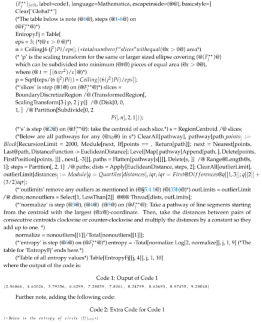
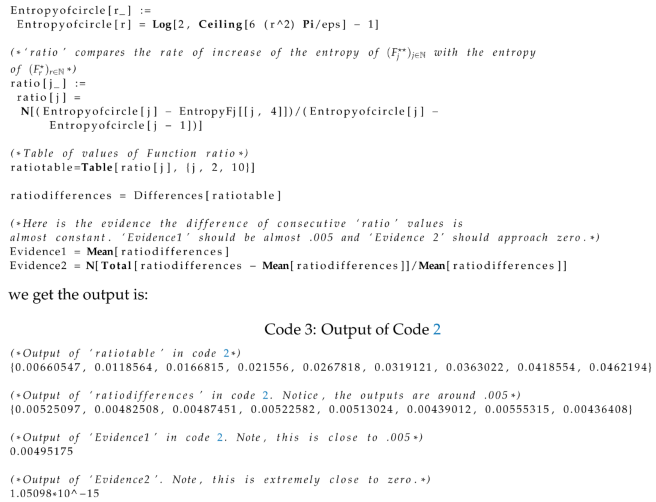
Note, the output of ratiotable in code 4 can be written as:
and is the same as:
Hence, with:
we solve for :
since:
Code 4: Limit of 51
- Limit[(.005 j - .004) Log[
- 2, (Ceiling[(6 (j^2) Pi)/eps] -
- 1)/(Ceiling[(6 ((j - 1)^2 ) Pi)/eps] - 1)], j -> Infinity]
- (*Output of code is .014427 if eps>0*)
Hence:
- For every , we find a , where , but the absolute value of is minimized. In other words, for every , we want where:
Finally, since , we wish to prove
within Section 5.4.2 crit. 1:
where using mathematica, we get the limit is greater than one:
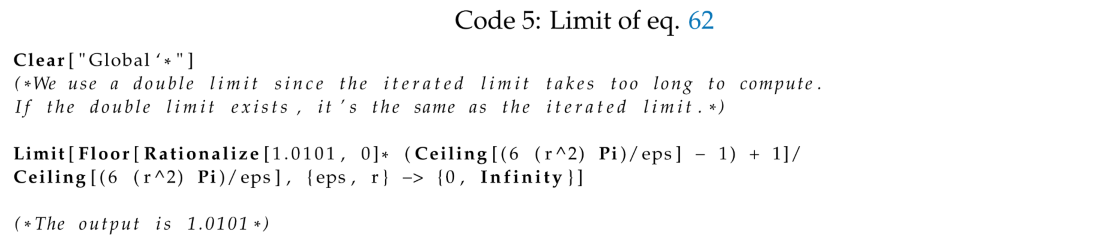
Also, using Section 5.4.2 (0b) and Section 5.4.2 (1), take and use 4 crit. 2 to compute the following:
where:
-
For every , we find a , where , but the absolute value of is minimized. In other words,for every , we want where:
Finally, since , we wish to prove
within Section 5.4.2 crit. 1:
where using mathematica, we get the limit is greater than one:
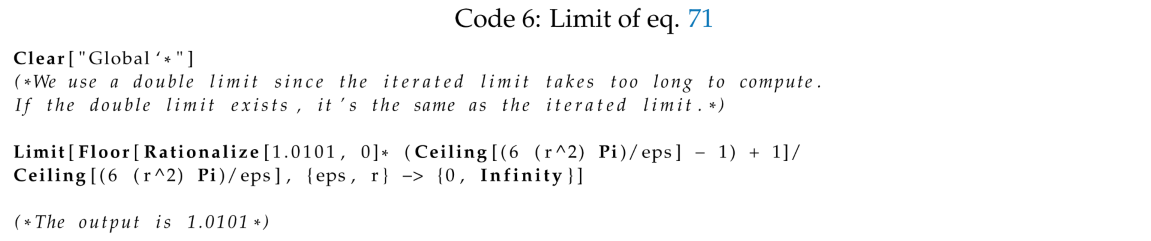
Hence, since the limits in Equation (62) and (71) are greater than one and less than : i.e.,
we have proven what we’re measuring from increases at a rate superlinear to that of (i.e., Section 5.4.2 crit. 1).
5.4.4. Example of The “Measure" from Increasing at a Rate Sub-Linear to that of
Using our previous example, we can use the following theorem:
Theorem 7.
If what we’re measuring from increases at a rate superlinear to that of , then what we’re measuring from increases at a rate sublinear to that of
Hence, in our definition of super-linear (Section 5.4.2 crit. 1), swap and for and within and (i.e., and ). Notice, Theorem 7 is true when:
5.4.5. Example of the “measure" of converging linearly to that of
Using Section 5.4.2 consider the following:
Note 8.
Recall, if :
- When is the cardinality, for all and ,
-
For all and , the largest can be is
Now consider:
where:
Note 9.
The area of and is:
Notice, since is a square, using note 8 crit. (2) and note 9 crit. (1), it’s simple to see:
Hence, using Section 5.4.2 (0a) and note 8 crit. (2):
Note, since is also a square, for all and
- For every , we find a , where , but the absolute value of is minimized. In other words, for every , we want where:
Hence Section 5.4.2 crit. 33a is true and then we prove Section 5.4.2 crit. 33b:
Note, since is a square, using note 8 crit. (2) and note 9 crit. (2), it’s simple to see:
Thus, using Section 5.4.2 (0a) and note 8 crit. (2):
Note, since is also a square, for all and
- For every , we find a , where , but the absolute value of is minimized. In other words, for every , we want a , where:
Hence:
and, using 8 crit. (1) and 8 crit. (1) with Equation (92): . Thus, we wish to prove Section 5.4.2 crit. 33a using Equation (93):
where Section 5.4.2 crit. 33b is true.
Therefore, since Section 5.4.2 crit. 3 is correct in this case, “the measure" of increases at a rate linear to that of
5.5. Defining The Actual Rate of Expansion of Sequence of Bounded Sets From C
In the next section, we will define the actual rate of expansion of sequence of bounded sets from C and give an example. (Note, the motivation for the definition is explained in Section 3.2.1).
5.5.1. Definition of Actual Rate of Expansion of Sequence of Bounded Sets
Suppose is a bounded sequence of subsets of , and is the Euclidean distance between points . Therefore, using the “chosen" center point , when:
the actual rate of expansion is:
Note, there are cases of when isn’t fixed and (i.e., the chosen, fixed rate of expansion).
5.5.2. Example
Suppose , , and . One can clearly see is the point on that is farthest from . Hence,
and the actual rate of expansion is:
5.6. Reminder
See if Section 3.2 is easier to understand?
6. My Attempt At Answering The Approach of Section 1.3
6.1. Choice Function
Suppose we define the following:
- is the sequence of bounded sets satisfying (1), (2), (3), (4), and (5) of the leading question in Section 3.2.
- is all sequences of bounded sets which satisfy (1) and (2) of the leading question
- but not in the set of equivelant sequences of bounded sets to . Note, using the end of Definition 1, we represent this criteria as:
Further note, from Section 5.4.2 (0b), if we take:
and from Section 5.4.2 (0a), we take:
then, using Section 5.4.1 (2), Equation (109), and Equation (110):
6.2. Approach
We manipulate the definitions of Section 5.4.2 (0a), (0b) and Section 5.4.2 (1) to solve Section 3.2 (1)-(5) of the leading question.
6.3. Potential Answer
6.3.1. Preliminaries (Definition of T in case of Section 3.2.1 (4))
When the difference of point and is:
the average of for every is:
and is the n-d Euclidean distance between points , we define an explicit injective such that:
- If , then
- If , then
- If , then
where using “chosen" center point :
6.3.2. Question
Does T exist? If so, how do we define it?
Thus, using , , , E, (Section 5.5), and with the absolute value function , ceiling function , and nearest integer function , we define:
the choice function, which answers the leading question in Section 3.2, could be the following, s.t. we explain the reason behind choosing the choice function in Section 6.4:
Theorem 10.
If we define:
where for , we define to be equivalent to when swapping “" with “" (for Equations (109) and (110) and sets with (for Equations (109–116), then for constant and variable , if:
and:
then for all (Definition 1), if:
where is the ceiling function, E is the fixed rate of expansion, Γ is the gamma function, n is the dimension of , is the Hausdorff dimension of set , and is area of the smallest n-dimensional box that contains , then
the choice function is:
such that (Definition 1) must satisfy Equations (121) and (122). (Note, we want , , and to answer the leading question of Section 3.2) where the answer to problems and 1 & 2 and the approach of Section 1.3 is (when it exists).
6.4. Explaining The Choice Function and Evidence The Choice Function Is Credible
Notice, before reading the programming in code , without the “c"-terms in Equations (121) and (122):
The choice function in Equations (121) and (122) is zero, when what I’m measuring from (Section 5.4.2 criteria 1) increases at a rate superlinear to that of , where .
When c does exist, suppose:
- (a)
- When , then:
- (b)
- When , then:
Hence, for each sub-criteria under crit. (iii), if we subtract one of their limits by their limit value, then Equations (121) and (122) is zero. (We do this by using the “c"-term in Equations (121) and (122). However, when the exponents of the “c"-terms aren’t equal to , the limits of Equations (121) and (122) aren’t equal to zero. We, infact, want this when we swap with . Moreover, we define function (i.e., Equation (120), where:
When then is zero, which makes Equation (121) and equal zero.
Here are some examples of the numerator of (Equation (120)):
- A.
- When , , and , the numerator of is
- B.
- When , , and , the numerator of is
- C.
- When , , and , the numerator of is ceiling of constant times the volume of an n-dimensional ball with finite radius: i.e.,
- D.
- When , , and , the numerator of is ceiling of the volume of the n-dimensional ball: i.e.,
Note 11.
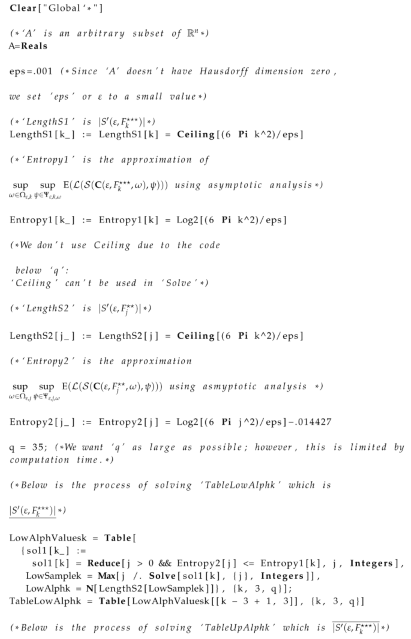
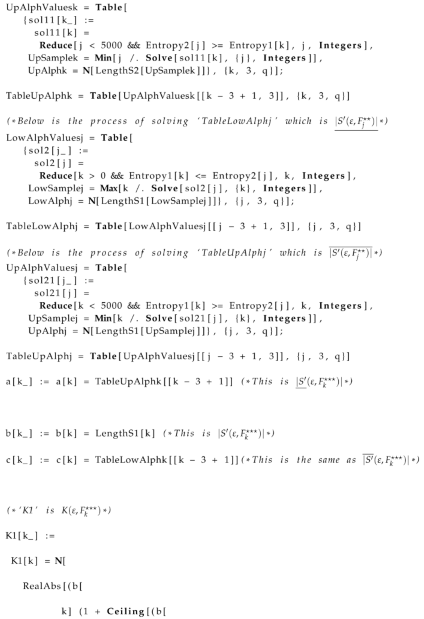
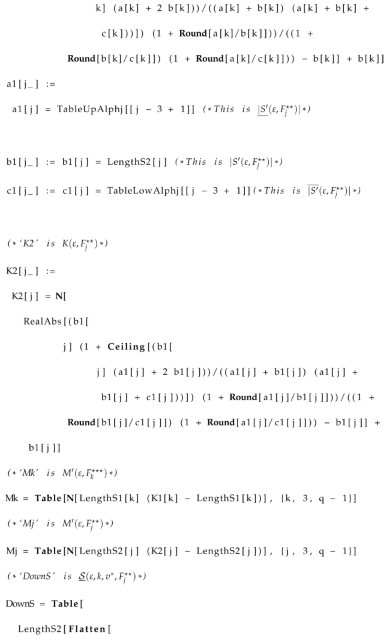
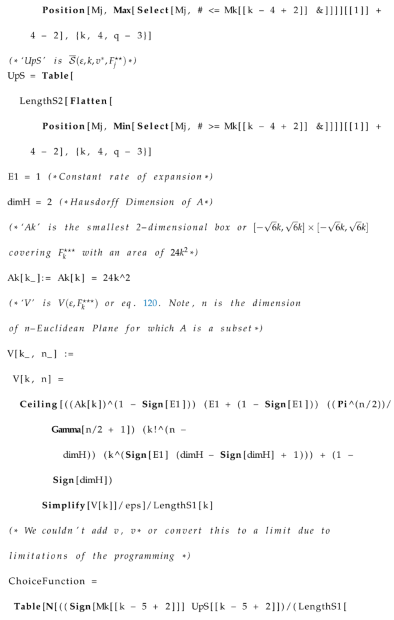
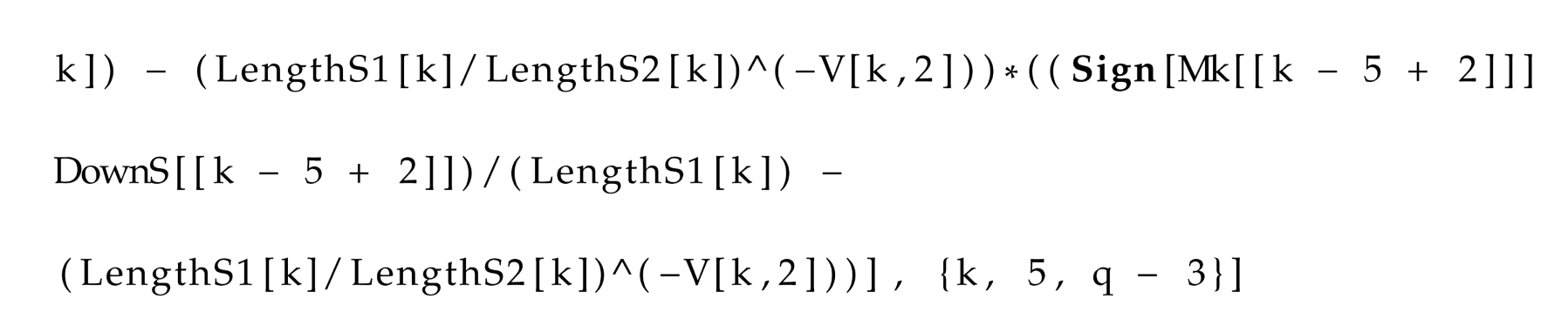
Now, consider the code for Equations (121) and (122). (Note, the set theoretic limit is set A. In this example, and:
We leave it to mathematicians to figure LengthS1, LengthS2, Entropy1 and Entropy2 for different A, , and .
Code 7: Code for Equations (121) and (122) on note 11
7. Questions
- Does Section 6 answer the in Section 3.2.
- Using Section 1.1 and Theorem 10, when does have a finite value?
- Using Section 1.2 and Theorem 10, when does have a finite value?
- If there’s no time to check questions 1 and 3, see Section 4.
8. Appendix of Section 5.4.1
8.1. Example of Section 5.4.1, step 1
Suppose
- 1.
- 2.
Then one example of , using Section 5.4.1 step 1, (where ) is:
Note, the area of each of the rectangles is , where the borders could be approximated as:
and we’ll illustrate this as purple rectangles covering (i.e., the red square).
(Note, the purple rectangles in Figure 1, satisfy step (1) of Section 5.4.1, since the Hausdorff measures in its dimension of the rectangles is and there is a minimum 8 covers over-covering : i.e.,
Definition 3
(Minimum Covers of Measure covering ).We can compute the minimum covers , using the formula:
where )
Figure 1.
Purple rectangles are the “covers" and the red square is . (Ignore the boundaries)

Note the covers in need not be rectangles. In fact, they could be any set as long as the “area" of those sets is , and is over-covered by the smallest number of sets possible. Here is an example:
Figure 2.
The eight purple sets are the “covers" and the red square is . (Ignore the boundaries)

To define this cover, start off with:
Then, for each in , we define:
except where:
such that an example of is:
In the case of , there are uncountably many of different shapes and sizes which we can use. However, these examples were the ones taken.
8.2. Example of Section 5.4.1, step 2
Suppose
Then, an example of is:
Below, is an illustration of the sample: i.e., the set of all black points in each purple rectangle of covering :
Figure 3.
The black points are the “sample points", the eight purple rectangles are the “covers", and the red square is . (Ignore the boundaries)
Figure 3.
The black points are the “sample points", the eight purple rectangles are the “covers", and the red square is . (Ignore the boundaries)

Note there are multiple samples we can take, as long as one sample point is taken from each cover in .
8.3. Example of Section 5.4.1, step iii
Suppose
Therefore, consider the following process:
8.3.1. Step 33a
If is:
suppose . Note, the following:
- is the next point in the “pathway" since it’s a point in with the smallest 2-d Euclidean distance to instead of .
- is the third point since it’s a point in with the smallest 2-d Euclidean distance to instead of and .
- is the fourth point since it’s a point in with the smallest 2-d Euclidean distance to instead of , , and .
- we continue this process, where the “pathway" of is:
Note 12.
If more than one point has the minimum 2-d Euclidean distance from , , , etc. take all potential pathways: e.g., using the sample in Equation (143), if , then since and have the smallest Euclidean distance from , and for point , since and have the smallest Euclidean distance from , we takethreepathways:
8.3.2. Step 33b
Take the length of all line segments in the pathway. In other words, suppose is the n-th dim.Euclidean distance between points . Using the pathway of Equation (145), we want:
Whose distances can be approximated as:
As we can see, the outlier [10] is (i.e., note these outliers become more prominent for ). Therefore, remove from the set of distances:
which we can illustrate with:
Figure 4.
is the start point in the pathway. The black line segments in the “pathway" have lengths which aren’t outliers. The length of the red line segment is an outlier.
Figure 4.
is the start point in the pathway. The black line segments in the “pathway" have lengths which aren’t outliers. The length of the red line segment is an outlier.

8.3.3. Step 33c
To convert the set of distances in Equation (148) into a probability distribution, we take:
Then divide each element in by 3.5
which gives us the probability distribution:
Hence,
8.3.4. Step 33d
Take the shannon entropy of Equation (150):
We shorten to , giving us:
8.3.5. Step 33e
Take the entropy w.r.t all pathways of:
In other words, we’ll compute:
We do this by repeating Section 8.3.1-Section 8.3.4 for different (i.e., in the equations with multiple values, see note 12)
References
- a.k.a u/Xixkdjfk, B.K. Is there a set with positive Lebesgue measure in any rectangle of the 2-d plane which is extremely non-uniform? https://www.reddit.com/r/mathematics/comments/1eedqbx/comment/lfdf9zb/?context=3.
- Garling, D.J.H., Inequalities: A Journey into Linear Analysis; Cambridge University Press, 2007; p. 187–205.
- Achour, R.; Li, Z.; Selmi, B.; Wang, T. A multifractal formalism for new general fractal measures. Chaos, Solitons & Fractals 2024, 181, 114655. [Google Scholar]
- Bedford, T.; Fisher, A.M. Analogues of the Lebesgue density theorem for fractal sets of reals and integers. Proceedings of the London Mathematical Society 1992, 3, 95–124. [Google Scholar] [CrossRef]
- Bedford, T.; Fisher, A.M. Ratio geometry, rigidity and the scenery process for hyperbolic Cantor sets. Ergodic Theory and Dynamical Systems 1997, 17, 531–564. [Google Scholar] [CrossRef]
- Sipser, M. Introduction to the Theory of Computation, 3 ed.; Cengage Learning, 2012; pp. 275–322.
- Krishnan, B. Bharath Krishnan’s ResearchGate Profile. https://www.researchgate.net/profile/Bharath-Krishnan-4.
- Barański, K.; Gutman, Y.; Śpiewak, A. Prediction of dynamical systems from time-delayed measurements with self-intersections. Journal de Mathématiques Pures et Appliquées 2024, 186, 103–149. [Google Scholar] [CrossRef]
- Caetano, A.M.; Chandler-Wilde, S.N.; Gibbs, A.; Hewett, D.P.; Moiola, A. A Hausdorff-measure boundary element method for acoustic scattering by fractal screens. Numerische Mathematik 2024, 156, 463–532. [Google Scholar] [CrossRef]
- John, R. Outlier. https://en.m.wikipedia.org/wiki/Outlier.
- M., G. Entropy and Information Theory, 2 ed.; Springer New York: New York [America];, 2011; pp. 61–95. https://ee.stanford.edu/~gray/it.pdf. [CrossRef]
Disclaimer/Publisher’s Note: The statements, opinions and data contained in all publications are solely those of the individual author(s) and contributor(s) and not of MDPI and/or the editor(s). MDPI and/or the editor(s) disclaim responsibility for any injury to people or property resulting from any ideas, methods, instructions or products referred to in the content. |
© 2024 by the author. Licensee MDPI, Basel, Switzerland. This article is an open access article distributed under the terms and conditions of the Creative Commons Attribution (CC BY) license (https://creativecommons.org/licenses/by/4.0/).
Copyright: This open access article is published under a Creative Commons CC BY 4.0 license, which permit the free download, distribution, and reuse, provided that the author and preprint are cited in any reuse.


