
Submitted:
01 September 2024
Posted:
03 September 2024
You are already at the latest version
Abstract
This theoretical study presents a novel perspective on the potential anti-inflammatory properties of Bromelain, a natural agent extracted from pineapple stems. The investigation explores the binding capabilities of Bromelain to Apoptosis-associated speck-like containing CARD (ASC), a crucial adapter molecule known for its involvement in inflammatory processes and inflammasome formation. For the first time, these findings suggest that Bromelain exhibits a notable affinity for ASC, indicating its promising role as a natural anti-inflammatory agent. This study sheds light on the molecular interactions that may contribute to Bromelain's therapeutic potential in modulating inflammatory responses.
Keywords:
Apoptosis-associated speck-like containing
; Bromelain
; HDOCK SERVER
1. Introduction
The Apoptosis-associated speck-like containing CARD (ASC), also known as PYCARD, is a crucial adapter molecule in inflammatory processes. Its primary role involves the formation of inflammasomes, multiprotein complexes that activate caspases, leading to inflammation and programmed cell death. ASC comprises PYD and CARD domains, facilitating interactions with similar domains in other proteins for inflammasome assembly [1,2,3]. While inflammasome activation is vital for the immune response against infections and cell damage, excessive activation can contribute to chronic inflammatory, autoimmune, or metabolic diseases. Consequently, understanding and regulating ASC and inflammasome activity are significant areas of research for potential therapeutic interventions in inflammation-related disorders [4,5]. The aim of this concise investigation is to examine the interplay between Apoptosis-associated speck-like containing CARD (ASC) and Bromelain through computational methods.Bromelain, known for its capacity to modulate inflammatory states, is composed of enzymes with proteolytic activity primarily extracted from pineapple stems [6,7,8].
The computational method employed to scrutinize potential binding and interactions between ASC and Bromelain at a molecular level was the HDOCK Server.
Broadly speaking, this is a protein-protein or protein-DNA/RNA docking approach based on a hybrid algorithm, incorporating template-based modeling and ab initio free docking [9,10].
Comprehending these interactions may offer insights into how Bromelain could impact ASC-mediated processes, such as inflammasome assembly and inflammation. Given Bromelain's recognized anti-inflammatory properties, investigating its influence on ASC through computational approaches may enhance our understanding of its therapeutic potential in modulating inflammatory responses.
2. Material and Methods
The HDOCK server was employed to predict the binding complexes between two molecules, specifically proteins represented by PDB Code 6U7D (Bromelain precursor used as the receptor) and PDB Code 2KN6 (Apoptosis-associated speck-like protein containing a CARD in CHAIN A used as the ligand). This prediction was carried out using a hybrid docking strategy.
3. Results and Discussion
The objective of this brief study is to explore the interaction between Apoptosis-associated speck-like containing CARD (ASC) and Bromelain using computational methods. Bromelain, recognized for its ability to regulate inflammatory states, is a group of enzymes with proteolytic activity primarily extracted from pineapple stems [6,7,8].
The computational method employed for the analysis of potential binding and interactions between ASC and Bromelain at a molecular level was the HDOCK Server [9,10]. The primary findings are presented in Figure 1, illustrating the outcomes of the interaction study. Table 1 provides the docking results by the HDOCK Server, demonstrating an excellent docking score and potential affinity between Bromelain and Apoptosis-associated speck-like containing CARD. Additionally, Table 2, Table 3 and Table 4 outlines the residues at the interface between the two targets.
4. Conclusions
This theoretical study presents a novel perspective on the potential anti-inflammatory properties of Bromelain, a natural agent extracted from pineapple stems. The investigation delves into Bromelain's binding capabilities with Apoptosis-associated speck-like containing CARD (ASC), a pivotal adapter molecule implicated in inflammatory processes and inflammasome formation. This study unveils molecular interactions that may underpin Bromelain's therapeutic potential in modulating inflammatory responses.
References
- Koizumi, M.; Watanabe, T.; Masumoto, J.; Sunago, K.; Imamura, Y.; Kanemitsu, K.; Hiasa, Y. (2021). Apoptosis-associated speck-like protein containing a CARD regulates the growth of pancreatic ductal adenocarcinoma. Scientific Reports, 11, 22351. [CrossRef]
- Tang, X.; Liu, X.; Wang, Z.; Chen, M.; Zhang, D. (2023). Molecular Characterization, Expression, and Regulatory Signal Pathway Analysis of Inflammasome Component Apoptosis-Associated Speck-like Protein Containing a CARD Domain (ASC) in Large Yellow Croaker (Larimichthys crocea). International Journal of Molecular Sciences, 24, 2175. [CrossRef]
- de Alba, E. (2009). Structure and interdomain dynamics of apoptosis-associated speck-like protein containing a CARD (ASC). Journal of Biological Chemistry, 284, 32932–32941. [CrossRef]
- Petrilli, V.; Papin, S.; Tschopp, J. (2005). The inflammasome. Current Biology, 15, R581.
- Man, S.M.; Kanneganti, T.D. (2015). Regulation of inflammasome activation. Immunological reviews, 265, 6–21. [CrossRef]
- Seligman, B. (1962). Bromelain: An anti-inflammatory agent. Angiology, 13, 508–510. [CrossRef]
- Pavan, R.; Jain, S.; Kumar, A. (2012). Properties and therapeutic application of bromelain: a review. Biotechnology research international, 2012. [CrossRef]
- Rathnavelu, V.; Alitheen, N.B.; Sohila, S.; Kanagesan, S.; Ramesh, R. (2016). Potential role of bromelain in clinical and therapeutic applications. Biomedical reports, 5, 283–288. [CrossRef]
- Yan, Y.; Tao, H.; He, J.; Huang, S.Y. (2020). The HDOCK server for integrated protein–protein docking. Nature protocols, 15, 1829–1852. [CrossRef]
- Yan, Y.; Zhang, D.; Zhou, P.; Li, B.; Huang, S.Y. (2017). HDOCK: a web server for protein–protein and protein–DNA/RNA docking based on a hybrid strategy. Nucleic acids research, 45, W365–W373. [CrossRef]
Figure 1.
shows the binding region, highlighting the interaction between Bromelain (as the receptor, represented in blue) and Apoptosis-associated speck-like containing CARD (as the ligand, depicted in red).
Figure 1.
shows the binding region, highlighting the interaction between Bromelain (as the receptor, represented in blue) and Apoptosis-associated speck-like containing CARD (as the ligand, depicted in red).
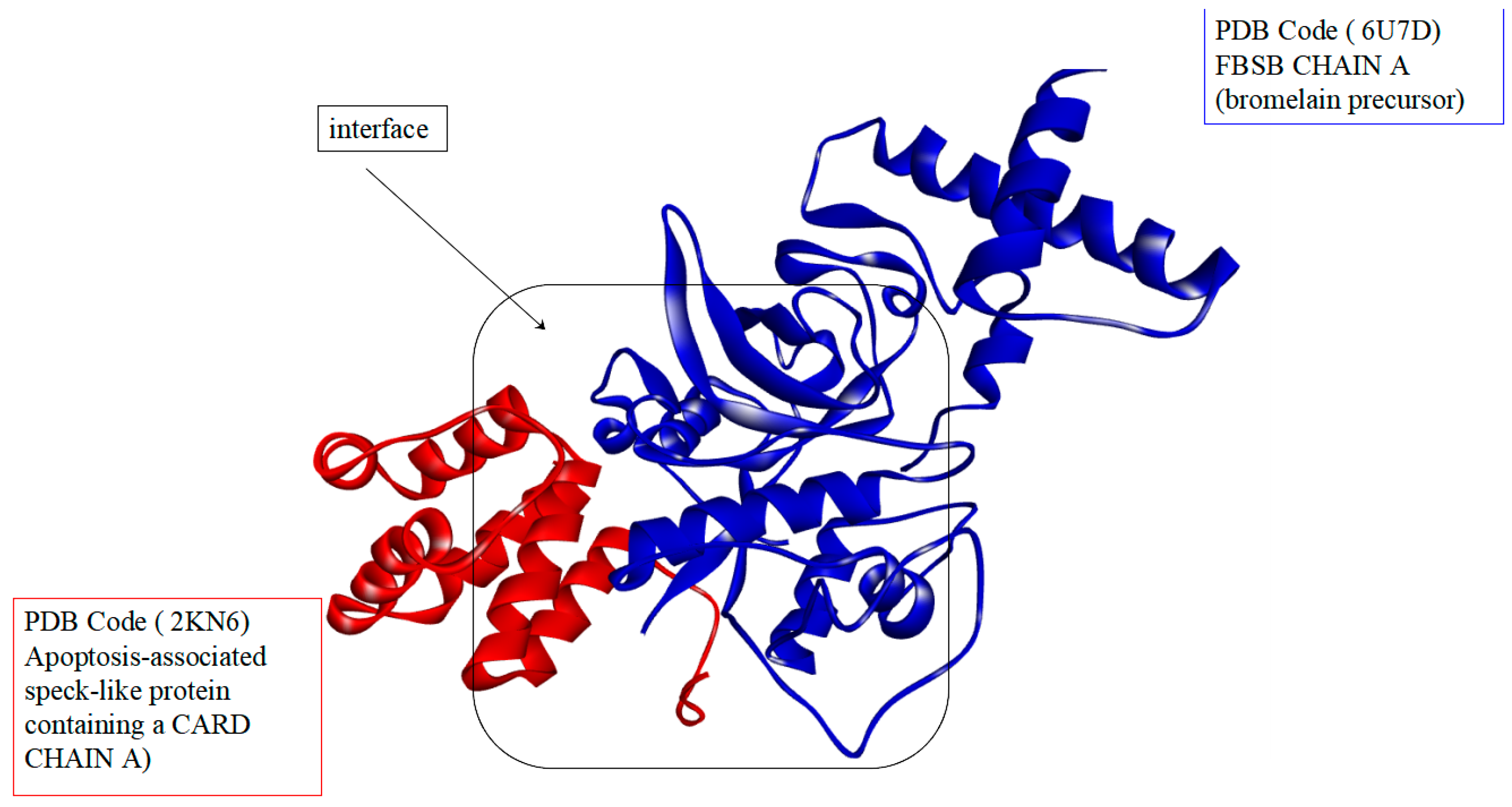

Table 1.
Shows the docking results analysis, by HDOCK Server highlighting the interaction between Bromelain and Apoptosis-associated speck-like containing CARD.
Table 1.
Shows the docking results analysis, by HDOCK Server highlighting the interaction between Bromelain and Apoptosis-associated speck-like containing CARD.
| Receptor (PDB ID: 6U7D-PDB Chain A ID:2KN6Chain A) |
Docking Score (kcal/mol) -208.89 |
Confidence Score 0.7646 |
Ligand rmsd(Å) 62.17 |
Table 2.
Shows Receptor interface residue(s).
| VAL 95A 2.149 |
| ASP 96A 3.921 |
| ALA 99A 2.707 |
| ILE 104A 4.247 |
| TRP 106A 3.988 |
| ARG 107A 4.026 |
| ASP 108A 2.023 |
| TYR 109A 0.923 |
| GLY 110A 2.807 |
| ILE 136A 4.971 |
| TYR 137A 1.729 |
| LYS 138A 2.182 |
| ILE 139A 1.108 |
| LYS 140A 2.984 |
| LYS 141A 4.059 |
| GLY 142A 4.302 |
| LEU 144A 4.118 |
| ILE 174A 4.776 |
| LYS 177A 3.584 |
| ASN 201A 3.677 |
| SER 202A 3.068 |
| ALA 203A 3.243 |
| TYR 204A 3.012 |
| THR 206A 2.833 |
| GLY 207A 3.447 |
| TYR 208A 4.345 |
| TYR 221A 0.946 |
| SER 224A 3.491 |
| LYS 225A 2.326 |
| GLN 226A 3.104 |
| TYR 310A 2.250 |
| PRO 311A 3.689 |
| THR 312A 2.204 |
| LEU 313A 4.328 |
| GLU 314A 2.966 |
| SER 315A 2.853 |
Table 3.
Shows Ligand interface residue(s).
| MET 1A 2.149 |
| GLY 2A 4.040 |
| ARG 3A 0.946 |
| ALA 4A 4.062 |
| ARG 33A 2.182 |
| GLU 34A 2.023 |
| TYR 36A 2.728 |
| TYR 60A 4.469 |
| LEU 61A 0.923 |
| GLU 62A 2.681 |
| THR 63A 2.326 |
| TYR 64A 3.020 |
| GLU 67A 1.108 |
| LEU 68A 5.000 |
| ASN 71A 3.297 |
| ARG 74A 4.048 |
| ALA 82A 4.754 |
| GLY 83A 3.277 |
| GLN 86A 2.853 |
| ALA 87A 4.392 |
| THR 89A 3.396 |
| HIS 90A 2.204 |
| GLN 91A 2.966 |
| GLY 92A 2.899 |
| SER 93A 3.447 |
| GLY 94A 2.833 |
| ALA 95A 3.422 |
| ALA 96A 4.451 |
| GLY 99A 3.584 |
| ILE 100A 3.054 |
| GLN 101A 3.012 |
| ALA 102A 3.909 |
| PRO 103A 1.729 |
Table 4.
Shows Receptor-ligand interface residue pair(s).
| 95A - 1A 2.149 |
| 95A - 2A 4.040 |
| 96A - 1A 4.397 |
| 96A - 2A 4.167 |
| 96A - 3A 3.921 |
| 99A - 1A 2.707 |
| 99A - 62A 3.792 |
| 104A - 61A 4.247 |
| 106A - 63A 4.365 |
| 106A - 64A 4.076 |
| 106A - 67A 3.988 |
| 107A - 34A 4.026 |
| 108A - 34A 2.023 |
| 108A - 36A 2.728 |
| 109A - 33A 4.188 |
| 109A - 34A 4.144 |
| 109A - 36A 3.403 |
| 109A - 60A 4.469 |
| 109A - 61A 0.923 |
| 109A - 64A 3.020 |
| 110A - 33A 2.807 |
| 110A - 34A 4.173 |
| 136A - 67A 4.971 |
| 137A - 103A 1.729 |
| 138A - 33A 2.182 |
| 138A - 64A 4.683 |
| 139A - 63A 4.681 |
| 139A - 67A 1.108 |
| 139A - 68A 5.000 |
| 139A - 71A 4.808 |
| 140A - 67A 3.532 |
| 140A - 71A 3.297 |
| 140A - 74A 4.048 |
| 140A - 86A 2.984 |
| 140A - 89A 3.396 |
| 140A - 90A 4.614 |
| 141A - 71A 4.518 |
| 141A - 74A 4.059 |
| 141A - 86A 4.584 |
| 142A - 33A 4.302 |
| 142A - 71A 4.416 |
| 144A - 33A 4.118 |
| 174A - 100A 4.776 |
| 177A - 99A 3.584 |
| 177A - 100A 3.687 |
| 201A - 103A 3.677 |
| 202A - 103A 3.068 |
| 203A - 103A 3.243 |
| 204A - 100A 3.054 |
| 204A - 101A 3.012 |
| 204A - 102A 3.909 |
| 204A - 103A 3.145 |
| 206A - 92A 4.127 |
| 206A - 93A 4.399 |
| 206A - 94A 2.833 |
| 206A - 95A 3.422 |
| 206A - 96A 4.451 |
| 207A - 93A 3.447 |
| 207A - 94A 4.592 |
| 207A - 95A 4.741 |
| 208A - 93A 4.345 |
| 221A - 3A 0.946 |
| 221A - 62A 4.666 |
| 224A - 63A 3.491 |
| 225A - 3A 2.779 |
| 225A - 4A 4.062 |
| 225A - 62A 2.681 |
| 225A - 63A 2.326 |
| 225A - 67A 4.109 |
| 225A - 89A 3.650 |
| 226A - 90A 3.104 |
| 310A - 90A 2.250 |
| 311A - 90A 3.689 |
| 312A - 90A 2.204 |
| 312A - 91A 4.804 |
| 312A - 92A 2.899 |
| 312A - 93A 4.147 |
| 313A - 86A 4.328 |
| 313A - 90A 4.368 |
| 313A - 92A 4.823 |
| 314A - 87A 4.392 |
| 314A - 90A 4.473 |
| 314A - 91A 2.966 |
| 314A - 92A 4.093 |
| 314A - 95A 4.088 |
| 315A - 74A 4.883 |
| 315A - 82A 4.754 |
| 315A - 83A 3.277 |
| 315A - 86A 2.853 |
Disclaimer/Publisher’s Note: The statements, opinions and data contained in all publications are solely those of the individual author(s) and contributor(s) and not of MDPI and/or the editor(s). MDPI and/or the editor(s) disclaim responsibility for any injury to people or property resulting from any ideas, methods, instructions or products referred to in the content. |
© 2024 by the authors. Licensee MDPI, Basel, Switzerland. This article is an open access article distributed under the terms and conditions of the Creative Commons Attribution (CC BY) license (http://creativecommons.org/licenses/by/4.0/).
Copyright: This open access article is published under a Creative Commons CC BY 4.0 license, which permit the free download, distribution, and reuse, provided that the author and preprint are cited in any reuse.


