

Submitted:
01 September 2024
Posted:
02 September 2024
You are already at the latest version
Abstract
Popular, industry, and academic attention is increasingly being paid to Electrically-Assisted Pedal Cycles (EAPCs), also known as electric bikes, or e-bikes. Attention has also begun to be given to ideas of the electric bicycle as a component of “electric velomobility” or “e-velomobility” and to the particular benefits of electric bicycles over conventional bicycles. We present here the effects of EAPCs on the tangible quantitative levels of greenhouse gas emission reductions, increased mobility performance, and greater accessibility of cycling; and the intangible qualitative level of perceptions of electric cycling and those who engage in it, harmonized with transhumanist lines of thought in order to articulate a sociotechnical imaginary of the electric bicycle as an augmentation to a cyclist’s physical body. Through a combination of original research and drawing on prior literature, we articulate the idea of a “cyborg cyclist” as a vision for present and future e-velomobilities, and emphasize the ability of appropriate technology to augment the capabilities of cyclists, viewing rider and machine as a single unit, while also warning of the possible risks of inappropriate types of electric bicycle. Such a view, we believe, adds a much-needed technology-positive view to present debates, and highlights especially the ability of the EAPC as a rehabilitative and augmentative mobility tool, and as a means of displacing more carbon-intensive means of transportation, particularly the private car.
Keywords:
velomobility
; e-velomobility
; bicycle
; EAPC
; e-bike
; transportation
; sociotechnical imaginary
EAPCs and the Mobility Status Quo
Responding to climate change requires a fundamental rethinking of present mobility realities, and our associated mobility imaginaries (Stoddard et al. 2021, IEA 2023). In particular, such rethinking should involve developing visions that further the displacement of the private car, which is energy-inefficient, wasteful of space, and remains heavily reliant on fossil fuel use, despite efforts made towards electrification (Braun & Randell 2022, Hawxwell et al. 2024). Part of this response, we suggest, should take the form of the electric bicycle, or e-bike. The electric bicycle is not a new invention, with roots dating back approximately to when bicycles first existed (Bolton 1895). Notable efforts in the past to produce what would today be classified as Electrically-Assisted Pedal Cycles (EAPCs) have occurred, in particular the efforts of the late Sir Clive Sinclair with the Sinclair C5, Zeta, and Zike (Dennis & Urry 2009, Ch. 5), however, these efforts at the time failed to achieve significant popularity, owing to technical limitations and a lack of public acceptance (Currie 2018). In short, EAPCs consist of a conventional bicycle with the addition of an electric powertrain that acts to augment the muscle power of the rider. Under EU law, the rider must provide at least some assistance to the motor, throttle controls are disallowed, and the maximum assisted speed is limited to 25kph (Regulation EU 168/2013). With lithium-ion battery technology becoming affordable and commonplace, the EAPC has seen significant growth in recent years, and accounts for, overall, a significant plurality of all bicycle sales, and in some locales, an outright majority.
We consider the EAPC here in particular. EAPCs share many of the advantages of conventional bicycles: embodied energy and energy consumption are low, resource demands are modest, and as the rider must contribute at least some of the tractive effort required, the exercise benefits of conventional bicycles also largely remain. It is this last point which we seek here to further explore. EAPCs are not mopeds, as by law the motor cannot operate without muscular power from the rider. EAPCs are also not conventional bicycles, as they possess a motor, and derive some (if not most) of their tractive effort from it. Ergo, the EAPC may be thought of as an assistive, or indeed, augmentative technology (Mitterwallner et al. 2021).
Extensive prior work has outlined the social benefits of cycling, in particular as part of “large-scale velomobilities” (Behrendt 2017) or as a mechanism for challenging the dominance of automobility (Cox 2022). Much of this work has noted in particular that the bicycle is a considerably more “social” and “personal” mode of transport than others, with the role of the machine being much less intrusive than for other modes, such as car travel (Monga & Sadhukhan 2023). This leads somewhat logically to a view that “man and machine are one” when it comes to cycling. When it comes to EAPCs, this view should take into account that an EAPC provides assistance to the rider through technological means. This brings us to transhumanist lines of thought. Transhumanism, in short, is a desire to augment the capabilities of human beings through technological means (Hopkins 2012, McDonald 2018). In popular culture, this often takes the form of a replacement of existing body parts with mechanical replacements, cybernetic implants to augment the natural functions of the brain, and so on. The implication is that such augmentation is fundamentally invasive, often leading to a negative framing of transhumanist ideologies and, in popular terms, a sentiment that cybernetics may “eat your soul” and detract from a fundamental sense of humanity (TV Tropes 2024).
We take, however, a more agnostic view; that augmentation need not be invasive, and is not ipso facto anti-human, in the sense that it may subsume or outcompete our own inherent humanity. Rather, we take a view that augmentation can positively extend the abilities of humans, leading us naturally back to the EAPC. Our framing of the EAPC as specifically an “augmentation” extends from the fact that, while electrically assisted, it requires human input to operate. The EAPC then extends and transforms this input into a more powerful output with the assistance of an electric motor. We find a term from a popular account describing the sensation of pedaling a mid-drive EAPC with a torque sensor to be useful: a that the rider has “bionic legs” due to the close level of biomechanical integration and feedback such a setup produces (Volt Bikes 2022). We, thus, argue that this augmentative understanding could lead to a useful and technology-positive view of EAPCs and their riders as, in totality, a “cyborg cyclist” capable of both exceeding the capabilities of regular cyclists, and displacing the use of the private car by augmenting the capabilities of an organic human to the extent that the relative utility of the private car versus such a “cyborg cyclist” is effectively diminished.
An Accepting Stance on Cyborgs
Of significant concern to us is a theme repeated often in present literature that seemingly takes a stance that “more technology” is ontologically a negative phenomenon (Stoddard et al. 2019), and that a “degrowth” mindset pulling us away from technological visions of the future is required (Cox 2022). We see this in particular in the field of transportation, where nebulous ideas around “technology” and “techno-fixes” can be framed negatively, and as drivers of climate change (Kronenberg et al. 2024, Te Brömmelstroet et al. 2022). While we are sympathetic to critiques of needlessly wasteful consumption of energy and a possible tendency towards techno-fetishism observed in prior literature, particularly literature utilizing the “degrowth” idea apropos of climate change, we feel it is important to highlight the potential positives of greater adoption of technology, where such technology may be considered appropriate, and indeed, not in itself incompatible with elements of degrowth thought. The term “cyborg” is defined as “a term blending the words cybernetic and organism [...] to describe a human being whose physiological functions are aided or enhanced by artificial means” (Britannica 2024, Clynes & Klein 1960). More broadly, this idea of a “cyborg” is itself positioned within a wider area of transhumanist thought, aiming to improve human capacities through the application of technology (Hopkins 2012, McDonald 2018), with a specifically positive vision of the future arising from such applications (More 2023). Transhumanist ideas have not been without critique, on both ethical and scientific bases (Galibert 2020).
Our use of the term “cyborg” is, in part, a deliberate exercise in provocation; empirically, the idea of becoming a “cyborg” has been observed previously as a cause for significant ambivalence. Apropos of the acceptance of another form of augmentation, a neural implant, a split of 33.5% who were ethically in favor has been observed, with 26.9% against, and 39.6% ambivalent (Reinares-Lara et al. 2018). While by no means comprehensive, this specific example does indicate that the idea of “becoming a cyborg” and thus attaining a “transhuman” state through such means is one in which a definitive answer on the acceptability thereof has yet to be reached. Considering that the EAPC effectively augments the capabilities of a human being, we wish, thus, to present a positive vision of what “becoming a cyborg” may mean apropos of ongoing problems of mobility in the built environment, as a desirable sociotechnical imaginary of urban cycling offering a potential solution to problems of high-carbon mobility through the philosophical lens of human augmentation.
The Cyborg Cyclist as Sociotechnical Imaginary
Again, we wish to stress that we consider the idea of a “cyborg cyclist” from an essentially technology-positive standpoint. Ergo, in the words of Jasanoff and Kim (2009), we consider this vision to be a positive and desirable vision, rather than a negative and frightening vision as the word “cyborg” may sometimes imply. We, thus, formulate a sociotechnical imaginary of “cyborg cyclists” as a desirable state. Through the appropriate application of technology, we offer a vision where the limitations of normal human biomechanics are overcome; where energy consumption is overall reduced; and where health and fitness are furthered by the application of technology, rather than hindered. We further suggest that stakeholders, particularly at the state level, should consider acceptance of such a vision, and to use the apparatus of the state to promote it. Nonetheless, we are not blind to the risks of (mis)application of technology, as Jasanoff and Kim (2009) suggest should also form part of such an imaginary:
“[Sociotechnical] imaginaries are instrumental and futuristic: they project visions of what is good, desirable, and worth attaining for a political community; they articulate feasible futures. Conversely, imaginaries also warn against risks or hazards that might accompany innovation if it is pushed too hard or too fast.”
-Jasanoff & Kim 2009, p.123
The risks we see specifically are a risk that the technology of electric cycling becomes a substitution rather than an augmentation - our use of the word “cyborg” is directly tied to this risk, since a cyborg is, in our conceptualization, a symbiosis of the human and the technological, rather than the latter being parasitical. In terms of positioning the “cyborg cyclist” we consider the work of Peter Cox (2022), and the concept of “velomobility” as an alternative to the dominant system of automobility. In effect, velomobility is an antithesis of automobility, in that automobility is hegemonic (Urry 2004, Cox 2022), dangerous to human life (Miner et al. 2024, Braun & Randell 2021), and dangerous to the stability of the climate system (IEA 2023).
In the broadest sense, velomobility refers to mobility centered on cycling as mobility mode.
Although the specific conceptualization thereof differs, this provides useful limiting bounds for what the “cyborg cyclist” can and should be, and thus, what the imaginary thereof should promote and caution against. In essence, the “cyborg cyclist” should be an extension to the practice of cycling, not a displacement of cycling. We thus consider our work as, essentially, building on the idea of “e-velomobility” from Rérat (2021), as an extension of velomobility itself, defined loosely as the systemic use of bicycles for mobility (Behrendt 2017, Eccarius et al. 2021). This has informed our focus on the EAPC, and, specifically, the European Union definition thereof.
The EAPC is usually faster than a non-electric bicycle, but not so fast that it is significantly more dangerous than a regular bicycle (Regulation EU 168/2013). It offers assistance, but cannot be operated without at least some mechanical input from the rider. Ergo, the EAPC occupies a particular point of balance: it is an augmentation but not a full replacement for human muscle power. It is an assistive aid that does not also expose the rider to excessive risk. Thus, the content of our imaginary is best summarized as the electric bicycle in symbiosis, both with the human rider, and with the wider mobility context and we seek, specifically, to caution against the use of electric bicycles with throttle controls (which require no muscular input and thus deliver no exercise benefits); with excessively high top speeds (with the attendant dangers thereof for both the rider and others around them); and to avoid the risk of the electric bicycle becoming hegemonic vis-a-vis other users on cycle infrastructure by deviating too far from the performance profile of a regular bicycle (which, we suggest, pushes them towards the problems of the car and of automobility).
Of particular note for us is the work of Cherrington and Black (2023) on the electric mountain bike (eMTB) as “pharmakon” - a term borrowed from Greek, which can mean a cure, a poison, or a scapegoat. Cherrington and Black (ibid. p.1001) note that the nature of the eMTB is a further development of an already contested mode (mountain biking), and may be, depending on specific individual usage and social parameters in given environments, either viewed positively or negatively. Our definition of a sociotechnical imaginary for the EAPC follows in this vein, albeit with a more theoretical, rather than practical, focus. We therefore set out a desirable future of the “cyborg cyclist” as an expansive mobility solution, and caution against an undesirable future where the mechanical element risks repeating the same failings (lack of exercise, danger to self and others, hegemonic positioning within mobility) that private cars, as part of a system and imaginary of automobility, has been noted for (Urry 2004; Braun & Randell 2022). We will detail this vision in practical terms in the following section.
Three Aspects of the Cyborg Cyclist
We view the “cyborg cyclist” as consisting fundamentally of three key aspects: Efficiency, Augmentation, and Accessibility. For each of these aspects, we draw data from prior work and appropriate primary sources in order to illustrate their contribution to the imaginary. The aspects are explored insofar as to provide a “sanity check” and indicate that it is plausible to form such an imaginary along these given lines. Ergo, our work for this section seeks to answer the questions of the contribution of the cyborg cyclist imaginary in a purely Boolean (true or false) manner, and our figures and calculations should be taken as indications of existence and of plausibility for this imaginary and not as comprehensive and definitive statements based on exhaustive quantitative data. We therefore wish to take the opportunity to welcome deeper empirical exploration on each of the three aspects detailed below.
Efficiency: Reduced Energy Consumption
To explore the plausibility of this first aspect, we utilized prior empirical data on electricity emissions for two reference modes, one low-emission and one high-emission; in addition to prior empirical data on the emissions intensities of four different common diets. We, further, considered prior empirical data on the embodied energy of regular bicycles and EAPCs (ITF 2024). We considered an omnivorous diet, a pescetarian diet, a vegetarian diet, and a vegan diet for the human nutritional component (O’Malley et al. 2023); and we considered electricity from nuclear power, and electricity from lignite-fired coal plants in order to provide a useful upper and lower bound for possible carbon intensities of electricity (UNECE 2022). In the real world, power grids are a mix of sources, but by taking these two extremes, we can indicate that the EAPC range for real-world electricity supplies falls somewhere between these bounds.
Figure 1.
Plotting energy consumption for regular bicycles versus EAPCs, with different electricity sources and different dietary types considered. See Appendix I for data tables, calculations, and sources. N.B! THIS GRAPH IS AWAITING CORRECTED CALCULATIONS! AT THIS PREPRINT STAGE IT IS AN INDICATION!
Figure 1.
Plotting energy consumption for regular bicycles versus EAPCs, with different electricity sources and different dietary types considered. See Appendix I for data tables, calculations, and sources. N.B! THIS GRAPH IS AWAITING CORRECTED CALCULATIONS! AT THIS PREPRINT STAGE IT IS AN INDICATION!
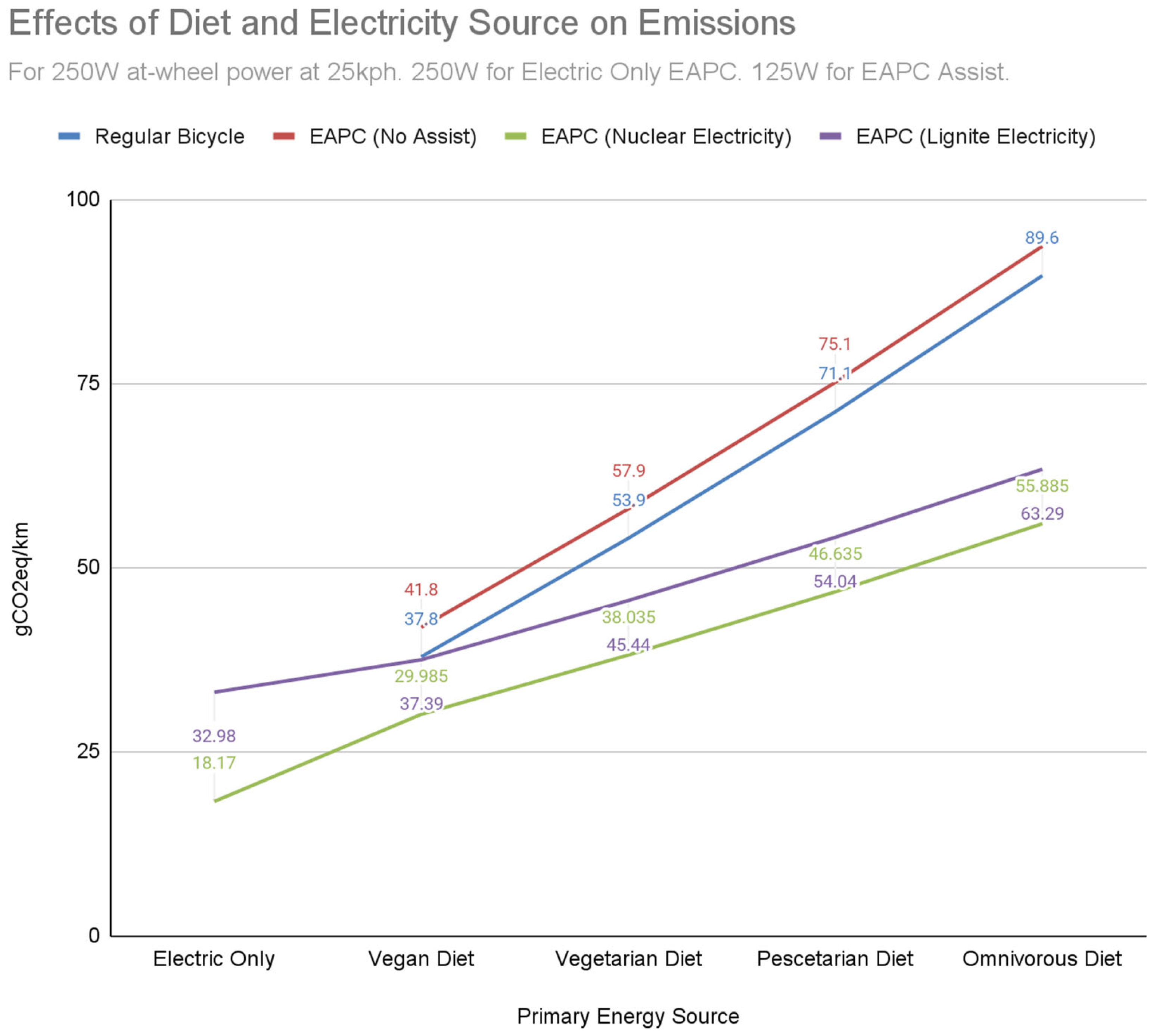
The above chart has been created to illustrate the difference in emissions (gCO2eq) between a regular bicycle, and a cyborg cyclist utilizing an EAPC. We have performed these calculations on the basis of primary energy: ergo, total conversion efficiency for human muscle power (~25%)1 from food energy, and for the electric drivetrain of an EAPC, assuming similar efficiency to other electric vehicles, and including charging losses and transmission losses (~70%) (ORNL 2011), and embodied energy of a regular bicycle and an EAPC respectively. What can be immediately noted is the strong influence of diet on overall emissions: a vegan cyclist on a regular bicycle produces fewer emissions per kilometer than an omnivorous cyclist on an EAPC. However, when compared like-for-like, the effect of the cyborg cyclist on emissions can be seen to a negligible-to-modest degree with a vegan diet, and to a very strong degree with an omnivorous diet. The cyborg cyclist produces fewer emissions in all assisted scenarios. Notably, if an EAPC is ridden as a regular bicycle (with no assistance), the situation is inverted: due to the additional embodied energy of an EAPC versus a regular bicycle, the emissions are higher than that of a regular cyclist on a regular bicycle. We use the above to demonstrate that the “cyborg effect” apropos of emissions per kilometer is nonetheless apparent.
At least some reduction, ranging from negligible to very strong, is observed across all scenarios where the electric assistance of an EAPC is active, indicating the symbiosis of human and machine power in these scenarios. However, we must admit that this simple “sanity check” analysis does not take possible confounding factors into account, and further, is limited by the scarcity of available data on thermodynamic efficiency of the human body. Previously noted is that EAPC riders tend to ride further and ride faster and ride more often than users of regular bicycles alone. While the “cyborg effect” is apparent when comparing exactly like-for-like, kilometer-to-kilometer at the same speed (in this case, an assumed combined at-wheel power of 250W; at an assumed speed of 25kph), this, arguably, does not reflect real-world conditions. The full articulation of these confounding factors is beyond the scope of this paper, however, is fertile ground for future exploration. Nonetheless, we seek to address this at least partially by noting the increased ability of the EAPC to displace travel by car, versus the conventional bicycle, given the augmentative ability thereof, which boosts the raw capabilities of a typical human rider to a level where competition with the private car (and by extension, with automobility) is not only plausible, but has been observed to occur in practice. This will be explored in the following section.
Augmentation: Expansion without Domination
Critical to the imaginary of the Cyborg Cyclist is that the relationship between rider and machine should, fundamentally, be symbiotic. Before we consider what the Cyborg Cyclist is in greater detail, it is worth considering first what the Cyborg Cyclist is not. Briefly, a Cyborg Cyclist is not:
- -
- A regular cyclist on an unassisted bicycle. While the bicycle itself could be argued to perform the role of transhumanist technology itself, and represents a substantial efficiency gain over walking in most scenarios, all the mechanical power to drive an unassisted bicycle comes from the rider. Thus, we consider this combination to be purely human effort.
- -
- A rider of an electric scooter, electric moped, or other similar micromobility devices where human power to produce motive effort is not present, or is present to such a degree that the contribution thereof is negligible. For example, we would not consider the case of a rider of an electric bicycle where spinning of the pedals alone drives the motor (cf. fatbikes and speed-pedelecs), since these commonly allow the rider to gear down, spin the pedals, and allow the freewheel to overrun, contributing no tractive effort, but activating the motor.
The above presents two extremes within the same domain: one where the cyclist contributes all of the tractive effort, and one case where the rider contributes no tractive effort. The Cyborg Cyclist thus sits in between these two extremes, where the electric assist is present, but it is not present to such a degree that the cyclist’s own power is irrelevant. Critical to the Cyborg Cyclist is that the benefits of cycling are retained: as prior literature has noted, the adoption of EAPCs in particular has produced a rebound effect: riders of EAPCs ride further, faster, and more often than riders of unassisted bicycles. The rebound effect, simply put, is where the greater efficiency of a given activity leads to more of that activity being carried out. Given the calculations in the Efficiency aspect, this may appear to be in conflict with the goal of reduced energy consumption. However, we argue that this is not the case. While it is true that a comparison between a regular cyclist and a Cyborg Cyclist purely on the basis of emissions from the cycling activity may indicate higher overall energy consumption (and thus, greenhouse gas emissions), in spite of the increased efficiency on a per-kilometer basis, we argue the augmentative effect of the Cyborg Cyclist renders this comparison of lesser importance.
Of greater importance is the effects that the Cyborg Cyclist generates outside of the realm of cycling itself: in particular, the displacement of car traffic. Observed in prior literature is that adopters of EAPCs tend to drive less (Yin et al. 2023), avoid the purchase of a second car, and in some cases, abandon car ownership outright (Jones et al. 2016, Söderberg et al. 2021). While some scholars in the field of transportation research argue (not without basis) that regular cycling is also capable of such displacement of driving, we argue, in contrast, that the expanded capabilities of the Cyborg Cyclist are more suited to such displacement. In this way, we align ourselves substantially with Rérat (2021) in his positioning of e-velomobility as an “extension” of the practice of cycling. As the Cyborg Cyclist expands the capabilities of cycling, it thus pushes the act of cycling more into the domain of the private car, allowing it to compete more effectively. Further, while it may be argued that the encroachment of the EAPC into the realm of the conventional bicycle is an unwanted negative effect (Kroesen 2017), we argue that the increased thermodynamic efficiency of the EAPC, as discussed in the first aspect above, negates this, conditional on such use meeting the standard that the human ride still contributes a non-negligible proportion of overall tractive effort.
This conditional element is one we consider crucial: as Nikolaeva et al. (2019) have noted, there exists at least a partial trend towards a potential “automobilisation” of cycling through application of smart technologies. While Nikolaeva et al. (2019) are primarily concerned with literature on infrastructure and safety aspects, we concern ourselves with a desire to avoid the full displacement of human energy with electrical energy via electric assist technology. While, as discussed in the efficiency aspect, electric drive is like-for-like more efficient than human drive, the total substitution of human energy for electric energy not only carries significant health penalties through replicating the physical inactivity inherent to automobility (Miner et al. 2024), but also, we suggest, leads to such “automobilisation” via the full replacement of human motive power with mechanical motive power, much like that of the engine of a car. As Urry (2004) notes, automobility does not, despite the name, require the use of a car for mobility. A simple substitution of cars for electric bicycles that do not fall within the Cyborg Cyclist envelope would, while alleviating some problems of automobility (e.g. energy consumption), leave others unchallenged (e.g. physical inactivity).
Regardless, we argue that a fixation on the possible downsides of technology in cycling (i.e. the EAPC) versus conventional bicycles misses a major point, which is the increased capability of the Cyborg Cyclist to compete with travel by car (Rérat et al. 2024). Such increased competition may well lead, overall, to reduced emissions in the transportation sector (Philips et al. 2022). Cars, whether powered by fossil fuels or by electricity, are large, heavy, and energetically inefficient, both in manufacture and in use, and their contribution to climate change is a well-established fact (Urry 2004, Braun & Randell 2022, IEA 2023). In terms of energy consumption per kilometer, and corresponding greenhouse gas emissions, the private car is deeply undesirable, vis-a-vis the Cyborg Cyclist, even ignoring other well-documented negative externalities of car travel (Braun & Randell 2021, Miner et al. 2024). In Europe, transportation as a sector is already a plurality of all emissions, and progress towards decarbonization of this sector has been marginal at best. We therefore consider the augmentative (but not hegemonic) application of electric-assist technology as part of the Cyborg Cyclist to be of the greatest importance of the three aspects discussed here, given the already-observed potential thereof to displace travel by car, at least partially.
Accessibility: The Cyborg Cyclist as Prosthesis
The previous two aspects have both touched upon the importance of symbiosis to the Cyborg Cyclist. Here, we expand on this aspect in greater detail, with a particular eye to accessibility, and the rehabilitative capabilities of the EAPC. This aspect is one that, while important, should be handled with sensitivity. Cherrington and Black (2023), in an exploration of the prosthetic effects of eMTBs, noted that such a view highlighted: “the fragility of human-technical bonds and the pharmacological qualities of technology, in that the e-mountain bike can be said to both enhance human capabilities—by making riders fitter, faster, and more skilful—whilst also (and often at the same time) exposing how these very same qualities are exclusively dependent on the presence of the bike itself”
In context, Cherrington and Black (2023) note that there can exist a level of defensiveness from cyclists around the perceived use of a “prosthesis” to enable them to undertake what are often viewed as purely “normal” cycling activities. Simultaneously, it was also noted that while an explicit view of an eMTB (or by extension, an EAPC)2 as prosthesis may invite negative reactions, the effects nonetheless remain: in particular, the ability of an eMTB to serve as a rehabilitative tool. In this respect, this third aspect may be thought of as essentially an extension of the second aspect of the Cyborg Cyclist, albeit with a different focus; as well as extending the capabilities of a “normal” cyclist, it is also possible to restore the capabilities of a disabled cyclist to a level considered “normal”
On a purely biomechanical level, the eMTB and the EAPC demand significantly less tractive effort from the rider than a conventional cyclist, and (dependent on the specific gearing) significantly less torque, which for those with (chronic or acute) disabilities, can be difficult to produce (Cooper et al. 2018, Mitterwallner et al. 2021, Wildish et al. 2024). Noted particularly by Wildish et al. (2024) is the role and importance of innovative assistive technology for expanding the capabilities of those with disabilities, in the case of their study, those with spinal cord injuries. Outside of injury, the natural aging process produces a reduction in physical capabilities. The role of the EAPC has been previously noted as a means of alleviating some of the effects of this decline, and allowing cycling to continue at older ages than would otherwise be possible or appropriate (Johnson & Rose 2015). Rey-Barth et al. (2022) further consider the use of the EAPC in the rehabilitation of those who have undergone treatment for breast cancer. Of particular interest were the accessibility thereof, and potential for integration of smart technology into an EAPC. By modulating the level of power-assist that the EAPC gives to the rider, it was possible to dynamically alter the riding conditions to suit the physical state of the rider, allowing individuals at different stages of rehabilitation and with different baseline levels of fitness to take part in a collective activity; a heterogenous group unified in an enjoyable group activity through the appropriate adoption of technology.
Taken together, the above cases indicate that accessibility, with a particular eye to rehabilitative aspects, should form a key component of the Cyborg Cyclist. The symbiotic integration of technology with the human form allows barriers to cycling to be overcome for those less physically able, and for cases where group cohesion is of importance, for individual differences in capabilities to be largely eliminated as a significant factor through tuning of the assistance level provided.
Conclusion: The Sociotechnical Imaginary of the Cyborg Cyclist
Through definition of the three key aspects above, we aimed to articulate a particular sociotechnical imaginary for the appropriate application of the electric bicycle, and suggest that it form a keystone for the wider adoption of (e-)velomobility in general. In our conception, the appropriate use of electric assist technology produces a Cyborg Cyclist where human and machine combine to form a symbiotic whole. The application of electric assist technology acts to further the capabilities of the human cyclist without supplanting them entirely. The cyborg cyclist enjoys lower emissions per kilometer cycled; an augmentation of capabilities enabling further displacement of the car versus the conventional cyclist; and an assistive technology that allows physical limitations of disabled and elderly cyclists to be (at least partially) negated. Crucial to this vision of Cyborg Cyclists is precisely this symbiosis.
The imaginary of the Cyborg Cyclist is one which aims to highlight the positive contributions that EAPC-class electric bicycles can make in the field of mobility, in multiple aspects, while at the same time acting as a cautionary brake against a replacement of conventional car travel with electric bicycles that do not meet the Cyborg Cyclist criteria. Crucial to emissions reduction is ensuring that tractive effort from electric assist remains within human-like parameters, otherwise, the increased power consumption negates the emissions advantages. Crucial to the augmentative aspect is that the electric assist remains electric assist and thus still requires a modest degree of exercise, with the benefits that this entails for regular riders. Crucial to the accessibility aspect is that the EAPC is a technology that can adapt to the specific circumstances of the rider in cases where physical capability falls below baseline due to disability, but which still offers rehabilitative potential. With this view, we suggest that policymakers and other stakeholders consider the above balance to form a critical part of understandings that drive wider adoption of velomobility, and to avoid the risk of replicating at least some of the problems of our extant automobility system.
Appendix I: Data Tables
https://docs.google.com/spreadsheets/d/1fp_Qpjs25Nt6bfzOWQ4OpyZrVFtzdd7wrUqvKGz4AHY/edit?usp=sharing
The data tables for the calculation of energy consumption for varying combinations of human and electrical power may be found in the above spreadsheet file.
| 1 | Present literature appears to contain a distressing lack of clarity apropos of the efficiency of the human body in converting food energy into useful mechanical output. Davis (2018, ch.80) gives 20% efficiency. Hill (1922) calculated it at 25% efficiency. Kumar-Patel & Rajput (2021) give 30% as the upper limit. We have thus decided to split the difference and assume 25% efficiency. |
| 2 | Noted in Cherrington and Black (2023) is that the eMTBs under consideration appeared to meet the criteria for an EAPC, in particular the augmentation (rather than displacement) of human muscular power, thus, we consider the eMTB to be an EAPC, and thus a valid example of the Cyborg Cyclist in practice, albeit applied to leisure applications rather than utilitarian transportation. |
References
- Behrendt, F. (2017) “Why cycling matters for electric mobility: towards diverse, active and sustainable e-mobilities: Mobilities, 13:1, 64-80, . [CrossRef]
- Bolton, O. (1895) “Electrical Bicycle” Patent File: US552271A.
- Braun, R. and Randell, R. (2021) ‘The vermin of the street: The politics of violence and the nomos of automobility’, Mobilities, 17(1), pp. 53–68. [CrossRef]
- Braun, R., Randell, R. (2022). Towards post-automobility: destituting automobility. Applied Mobilities. 8. 1-17. [CrossRef]
- Britannica [auth. Heckathorne, C] (2024). “cyborg” Encyclopedia Britannica. https://www.britannica.com/topic/cyborg (Accessed: 23/06/2024).
- Cherrington, J., & Black, J. (2023). The electric mountain bike as pharmakon: examining the problems and possibilities of an emerging technology. Mobilities, 18(6), 1000–1015. [CrossRef]
- Clynes, M. and Kline, N. (1960) Cyborgs and Space, Astronautics. Available at: https://archive.nytimes.com/www.nytimes.com/library/cyber/surf/022697surf-cyborg.html (Accessed: 23 August 2024).
- Cooper, A.R. et al. (2018) ‘Potential of electric bicycles to improve the health of people with type 2 diabetes: A feasibility study’, Diabetic Medicine, 35(9), pp. 1279–1282. [CrossRef]
- Cox, P. (2022). Vélomobility is to degrowth as automobility is to growth: prefigurative cycling imaginaries. Applied Mobilities, 8(3), 265–285. [CrossRef]
- Currie, G. (2018) “Lies, Damned Lies, AVs, Shared Mobility, and Urban Transit Futures” Journal of Public Transportation, Volume 21, Issue 1, Pages 19-30, ISSN 1077-291X,.
- . [CrossRef]
- Dennis, K., Urry, J. (2009) “After The Car” Polity Press, Cambridge, UK, ISBN: 978-0-7456-4422-6.
- Eccarius, T. et al. (2021) ‘Prospects for Shared Electric Velomobility: Profiling potential adopters at a multi-campus university’, Journal of Transport Geography, 96, p. 103190. [CrossRef]
- Galibert, F. (2020). Transhumanism: From dream to nightmare. Bulletin De L'Académie Nationale De Médecine, 204(9, Supplement), e160–e163. [CrossRef]
- Hawxwell, T., Hendriks, A. and Späth, P. (2024) ‘Transformative or incumbent futures? how the future of mobility is imagined in Sustainability Transitions Research’, Futures, 159, p. 103325. [CrossRef]
- Hopkins, P. D. (2012). Transhumanism. In R. Chadwick (Ed.), Encyclopedia of applied ethics (second edition) (pp. 414–422). San Diego: Academic Press. [CrossRef]
- IEA (2023) Tracking clean energy progress 2023 – analysis, IEA. Available at: https://www.iea.org/reports/ (23/08/2024).
- ITF (2024), “Greener Micromobility”, International Transport Forum Policy Papers, No. 131, OECD Publishing, Paris.
- Jasanoff, S., Kim, S.H. (2009) Containing the Atom: Sociotechnical Imaginaries and Nuclear Power in the United States and South Korea. Minerva 47, 119–146 . [CrossRef]
- Johnson, M. and Rose, G. (2015) ‘Extending life on the bike: Electric Bike use by older Australians’, Journal of Transport & Health, 2(2), pp. 276–283. [CrossRef]
- Jones, T., Harms, L. and Heinen, E. (2016) ‘Motives, perceptions and experiences of electric bicycle owners and implications for Health, wellbeing and Mobility’, Journal of Transport Geography, 53, pp. 41–49. [CrossRef]
- Kroesen, M. (2017) ‘To what extent do e-bikes substitute travel by other modes? evidence from the Netherlands’, Transportation Research Part D: Transport and Environment, 53, pp. 377–387. [CrossRef]
- Kronenberg, J., Andersson, E., Elmqvist, T., Łaszkiewicz, E., Xue, J., & Khmara, Y. (2024). Cities, planetary boundaries, and degrowth. The Lancet Planetary Health, 8(4), e234–e241. [CrossRef]
- McDonald, J. (2018). Transhumanism and posthumanism. In D. A. Dellasala, & M. I. Goldstein (Eds.), Encyclopedia of the anthropocene (pp. 67–74). Oxford: Elsevier. [CrossRef]
- Miner, P., Smith, B. M., Jani, A., McNeill, G., & Gathorne-Hardy, A. (2024). Car harm: A global review of automobility's harm to people and the environment. Journal of Transport Geography, 115, 103817. [CrossRef]
- Mitterwallner, V. et al. (2021) ‘Electrically assisted mountain biking: Riding faster, higher, farther in Natural Mountain Systems’, Journal of Outdoor Recreation and Tourism, 36, p. 100448. [CrossRef]
- Monga, M., Sadhukhan, S. (2023) “Quantifying perceived social benefit of bicycle-friendly infrastructure in Indian cities: Patna as a case study” Journal of Cycling and Micromobility Research, 100003, ISSN 2950-1059, . [CrossRef]
- More, M. (2023) Transhumanism: Toward a futurist philosophy, Transhumanism: Toward a Futurist Philosophy - by Max More. Available at: https://maxmore.substack.com/p/transhumanism-toward-a-futurist-philosophy (Accessed: 23 August 2024).
- Nikolaeva, A. et al. (2019) ‘Smart Cycling Futures: Charting a new terrain and moving towards a research agenda’, Journal of Transport Geography, 79, p. 102486. [CrossRef]
- O’Malley, K., Willits-Smith, A., & Rose, D. (2023). Popular diets as selected by adults in the United States show wide variation in carbon footprints and diet quality. The American Journal of Clinical Nutrition, 117(4), 701–708. [CrossRef]
- ORNL (2011) All-electric vehicles, www.fueleconomy.gov - the official government source for fuel economy information. Available at: https://www.fueleconomy.gov/feg/evtech.shtml (Accessed: 23 August 2024).
- Philips, I., Anable, J., & Chatterton, T. (2022). E-bikes and their capability to reduce car CO2 emissions. Transport Policy, 116, 11–23. [CrossRef]
- Regulation EU 168/2013 On the approval and market surveillance of two- or three-wheel vehicles and quadricycles http://data.europa.eu/eli/reg/2013/168/oj.
- Reinares-Lara, E., Olarte-Pascual, C. and Pelegrín-Borondo, J. (2018) ‘Do you want to be a cyborg? The moderating effect of ethics on neural implant acceptance’, Computers in Human Behavior, 85, pp. 43–53. [CrossRef]
- Rérat, P. (2021) ‘The rise of the e-bike: Towards an extension of the practice of cycling?’, Mobilities, 16(3), pp. 423–439. [CrossRef]
- Rérat, P., Marincek, D., & Ravalet, E. (2024). How do e-bikes compete with the other modes of transport? Investigating multiple dimensions of a modal shift. Applied Mobilities, 1–14. [CrossRef]
- Rey-Barth, S. et al. (2022) ‘A program centered on smart electrically assisted bicycle outings for rehabilitation after breast cancer: A pilot study’, Medical Engineering & Physics, 100, p. 103758. [CrossRef]
- Söderberg, A., Adell, E. and Winslott Hiselius, L. (2021) ‘What is the substitution effect of e-bikes? A randomised controlled trial’, Transportation Research Part D: Transport and Environment, 90, p. 102648. [CrossRef]
- Stoddard, I. et al. (2021) ‘Three decades of climate mitigation: Why haven’t we bent the global emissions curve?’, Annual Review of Environment and Resources, 46(1), pp. 653–689. [CrossRef]
- Te Brömmelstroet, M. et al. (2022) ‘Identifying, nurturing and empowering alternative mobility narratives’, Journal of Urban Mobility, 2, p. 100031. [CrossRef]
- TV Tropes (2024) “Cybernetics Eat Your Soul” Available at: https://tvtropes.org/pmwiki/pmwiki.php/Main/CyberneticsEatYourSoul (Accessed: 23/08/2024).
- UNECE: United Nations Economic Commission for Europe (2022) Carbon neutrality in the UNECE region: Integrated Life-Cycle Assessment of Electricity Sources, UN iLibrary. Available at: https://www.un-ilibrary.org/content/books/9789210014854 (Accessed: 23 August 2024).
- Urry, J. (2004). The ‘System’ of Automobility. Theory, Culture & Society, 21(4-5), 25-39. [CrossRef]
- Volt Bikes (2022) What does it feel like to have bionic legs? our brand new E-bike, reviewed, Volt News. Available at: https://voltbikes.co.uk/blog/press/what-does-it-feel-like-to-have-bionic-legs-our-brand-new-single-speed-e-bike-reviewed/ (Accessed: 27 June 2024).
- Wildish, S. et al. (2024) ‘Exploring the use of electric-assist handcycles to facilitate adapted mountain biking participation for people living with a spinal cord injury’, Journal of Cycling and Micromobility Research, 2, p. 100039. [CrossRef]
- Yin, A. et al. (2024) ‘How electric bikes reduce car use: A dual-mode ownership perspective’, Transportation Research Part D: Transport and Environment, 133, p. 104304. [CrossRef]
Disclaimer/Publisher’s Note: The statements, opinions and data contained in all publications are solely those of the individual author(s) and contributor(s) and not of MDPI and/or the editor(s). MDPI and/or the editor(s) disclaim responsibility for any injury to people or property resulting from any ideas, methods, instructions or products referred to in the content. |
© 2024 by the authors. Licensee MDPI, Basel, Switzerland. This article is an open access article distributed under the terms and conditions of the Creative Commons Attribution (CC BY) license (http://creativecommons.org/licenses/by/4.0/).
Copyright: This open access article is published under a Creative Commons CC BY 4.0 license, which permit the free download, distribution, and reuse, provided that the author and preprint are cited in any reuse.