

Submitted:
30 August 2024
Posted:
30 August 2024
You are already at the latest version
Abstract
Bio-char is a charcoal-like substance made through the pyrolysis of organic biomass. It has the potential to address issues related to agriculture and the environment. This thorough analysis examines the potentials of bio-char in Ethiopia to enhance crop productivity, reduce climate change, and improve soil fertility. Drawing from academic databases and peer-reviewed literatures, the review explores the production and characterization of bio-char, its impact on soil fertility and crop productivity, and its role in carbon sequestration and greenhouse gas mitigation. The review emphasizes on how bio-char may improve plant nutrition and soil fertility, which raises agricultural yields and quality while improving drought resistance. The review also emphasizes the potential of bio-char for greenhouse gas mitigation and carbon sequestration, enhancing Ethiopia's efforts to mitigate climate change. Yet the study also points out several challenges and opportunities that need to be addressed to allow Ethiopians to use bio-char technology on a large scale. These include the need for appropriate policy and regulatory frameworks, the availability and accessibility of bio-char feedstocks, and the importance of continued research and development to optimize production methods and application strategies. The review concludes by highlighting the groundbreaking potential of bio-char in promoting environmentally friendly agricultural practices and sustainable agriculture in Ethiopia. It necessitates a coordinated effort to solve the problems and grasp the opportunities by making sound decisions in policy integration, research, and development. Ethiopia can advance its sustainable development goals by using bio-char to create a road towards increased food security, healthy soil, and environmental resilience.
Keywords:
agriculture
; bio-char
; carbon
; environment
; remediation
; food security
; sustainability
1. Introduction
Using bio-char can offer significant benefits for improving soil fertility, increasing agricultural yields, and mitigating climate change [82]. Research has shown that applying bio-char to soils can enhance nutrient availability, improve water-holding capacity, and increase microbial activity, all of which contribute to enhanced soil fertility [1]. Pyrolyzing biomass produces bio-char. It has been discovered to be a viable substitute for environmentally friendly restoration and sustainable agriculture in many regions of the world, including Ethiopia [83].
Recent studies found that bio-char can improve Ethiopia’s food output and soil fertility [84]. According to research done by the International Center for Tropical Agriculture, bio-char increased maize yields in Ethiopia by 20–30% [2].
Additionally, a research by the Ethiopian Institute of Agricultural Research, discovered that biochar raised wheat yields by 15-20% and enhanced soil fertility [3].
According to [4], bio-char can retain carbon in soils, reducing greenhouse gas emissions and slowing down climate effects, making it an extra instrument for environmental protection. Furthermore, because it is made from readily available biomass sources nearby, bio-char can help Ethiopia’s sustainable agriculture methods by reducing the need for chemical-based fertilizers and pesticides [5]. The limited use of bio-char in Ethiopia can be attributed to the lack of knowledge, experience, and readily available technologies in the country.
This review article aims to address this information gap by conducting a thorough analysis of Ethiopia’s potential for utilizing bio-char in agriculture and environmental remediation. The article highlights the benefits, challenges, and opportunities associated with the sustainable development of bio-char applications in Ethiopia.
Overall, the review showed that bio-char has the potential to be used as a soil amendment to enhance crop yields and soil fertility in Ethiopian agriculture. It also has the potential to be used for greenhouse gas reduction and environmental remediation. Ethiopia’s attempts to combat climate change can benefit from the study’s conclusions and suggestions, which can guide the country’s development of environmentally friendly agricultural practices.
2. Methodology
To analyze the present status of research on the use of bio-char for environmental and agricultural purposes in Ethiopia, a thorough literature review was carried out. During the evaluation process, academic databases like Google Scholar, Web of Science, and Scopus are used. The review also considered conference proceedings and scholarly articles, to give a thorough picture of Ethiopia’s present state of bio-char research. Finding important themes, patterns, and areas that needed more research on the development, explanation, and applications of bio-char in Ethiopian contexts.
The review provided a thorough and current evaluation of the existing research on bio-char in Ethiopia, resulting in findings that are a valuable resource for future research, policy initiatives, and practical applications related to using bio-char for sustainable agriculture and environmental management in the country.
3. Bio-Char Production and Characterization
3.1. Bio-Char Production Technologies and their Characteristics
The main differences of the bio-char production technologies lie in the operating conditions, the properties of the resulting bio-char, and their potential applications. Pyrolysis produces the most porous bio-char with the highest surface area, making it effective for carbon sequestration and soil amendment. Gasification yields bio-char with a lower surface area, but it still retains favorable properties. Supercritical fluid and hydrothermal technologies create high-quality bio-char with unique structures and characteristics that make them suitable for more advanced applications.

Table 1.
Summary of the key characteristics of the different bio-char production technologies.
| Technology | Description | Bio-char characteristics | Sources |
|---|---|---|---|
| Pyrolysis | Thermal decomposition of biomass in the absence of oxygen at 200–800 °C | Highly porous structure, high surface area, effective for carbon sequestration and soil amendment | [4,6] |
| Gasification | Partial oxidation of biomass at high temperatures to produce syngas | Lower surface area compared to pyrolysis. Still retains carbon sequestration and soil amendment properties. | [6,7] |
| Supercritical Fluid | Use of supercritical CO2 or water to extract bio-char from biomass | - Produces high-quality bio-char with uniform structure and high surface area. Suitable for soil amendment, water filtration, and energy storage | [6] |
| Hydrothermal | Use of high-pressure water to convert biomass into bio-char | - Unique structure and high surface area. Suitable for carbon sequestration, soil fertility improvement, and wastewater treatment | [8] |
Table 2.
Summary of the key physical and chemical properties of bio-char and its effects on soil fertility and plant growth.
Table 2.
Summary of the key physical and chemical properties of bio-char and its effects on soil fertility and plant growth.
| Bio-Char Property | Description | Effect on soil fertility and plant growth | Sources |
|---|---|---|---|
| Surface Area and Porosity | Bio-char has a high surface area and porosity, allowing it to absorb and retain water, nutrients, and organic compounds. | Increased water and nutrient retention, leading to improved soil fertility and plant growth. | [9] |
| Particle Size | Smaller particle sizes of bio-char have a greater surface area and are more effective in improving soil fertility and plant growth. | Smaller particle sizes are more effective in improving soil fertility and plant growth. | [6] |
| Organic Compounds | Bio-char is rich in organic compounds, such as carboxylic acids and phenolic compounds, which interact with soil components. | Greater content of carboxylic acids and phenolic compounds leading to higher nutrient retention and promotion of plant growth. | [8] |
| pH | The pH of bio-char affects its effectiveness. Neutral pH bio-char is more beneficial, as it does not alter the soil pH. | A bio-char with neutral pH is more effective in improving soil fertility and plant growth, as it does not cause pH changes that can be harmful to plants. | [11] |
| Nutrient Availability | Bio-char increases the availability of key nutrients, such as nitrogen, phosphorus, and potassium, in the soil. | Increased nutrient availability leads to improved plant growth and soil fertility. | [12] |
| Soil Microorganisms | Bio-char provides a habitat for soil microorganisms, which are essential for soil fertility. | Increased abundance and diversity of soil microorganisms results in improved soil fertility and plant growth. | [13] |
3.3. Bio-Char and Soil Fertility
Bio-Char’s Impact on Soil Fertility and Plant Nutrition
Bio-char has been shown to increase soil fertility by improving soil structure, increasing water-holding capacity, and providing a habitat for beneficial microorganisms [14]. Additionally, bio-char has been found to increase plant nutrition by reducing nutrient leaching, improving nutrient uptake, and providing a source of slow-release nutrients.
Table 3.
Effects of bio-char on soil fertility and plant nutrition.
| Effect | Summary | Sources |
|---|---|---|
| Soil Structure | Bio-char can improve soil structure by increasing the amount of stable aggregates, improving soil porosity and water infiltration. | [15] |
| Water Holding Capacity | Bio-char can increase the water-holding capacity of soil, allowing plants to access water more readily during drought periods. | [16] |
| Microbial Habitat | Bio-char can provide a habitat for beneficial microorganisms, which can increase soil fertility by breaking down organic matter and making nutrients more available to plants. | [17] |
| Nutrient Uptake | Bio-char can improve nutrient uptake by plants by increasing the amount of available nutrients in the soil. | [15] |
| Nutrient Leaching | Bio-char can reduce nutrient leaching by increasing the amount of nutrients held in the soil. | [18] |
3.4. Bio-Char and Crop Yields
3.4.1. Effects of Bio-char on Crop Yields and Quality
It has been observed that adding bio-char, a soil amendment made from biomass that has been thermally processed, increases crop yields by increasing soil fertility and nutrient availability [19,85], found that bio-char can improve the soil’s capacity to store and exchange cations, hence improving crop uptake and retention of vital nutrients.
Furthermore, a study by [20] showed that bio-char can function as a nutrient reservoir, releasing nutrients gradually over time to suit the demands of plants. Nutrient imbalances or shortages can have a detrimental effect on crop yields and quality; thus, regulated delivery of nutrients may help avoid them.
Using bio-char increased crop yields on average by 13% when compared to without bio char [19], and also according to a review of the research conducted by [21] increased yields. Also, the application of bio-char to farming might result in decreased chances of nutrient leaching, less need for excessive fertilizer applications, and increased efficiency in the utilization of nitrogen [86] As it may reduce the negative effects of farming techniques on the environment while increasing crop yields and quality, bio-char is an invaluable tool for sustainable agriculture [87].
Figure 1.
Shows how bio-char can significantly increase the yield of different kinds of crops. According to the data, bio-char can raise crop yields for maize, wheat, rice, vegetables, soybeans, potatoes, and sunflowers by 12–20% [22], 15-20% [13], 17–22% [10], 20–30% [12], 16–18% [13], 24–20% [13], and 12–15% [10], respectively.
Figure 1.
Shows how bio-char can significantly increase the yield of different kinds of crops. According to the data, bio-char can raise crop yields for maize, wheat, rice, vegetables, soybeans, potatoes, and sunflowers by 12–20% [22], 15-20% [13], 17–22% [10], 20–30% [12], 16–18% [13], 24–20% [13], and 12–15% [10], respectively.
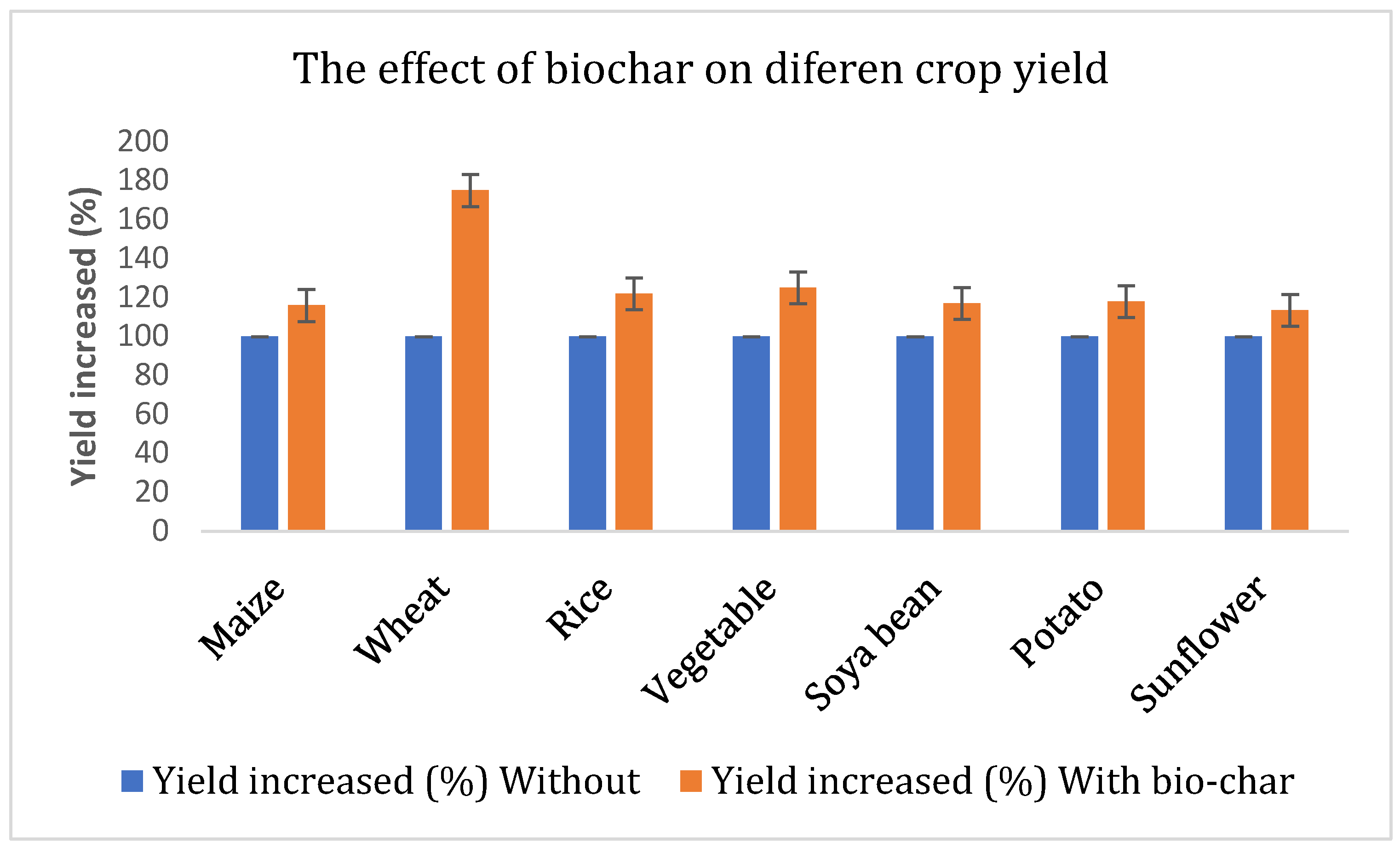
By improving the overall soil condition and ecosystem services, bio-char can indirectly increase crop morphology in addition to its direct impacts on crop yields and quality. Bio-char can modify soil structure, water-holding capacity, and microbial activity to improve the conditions that plants need to grow and develop [23].
3.4.2. Bio-Char’s Effect on Crop Water Use Efficiency and Drought Tolerance
The agricultural systems should deal with water scarcity, which becomes more and more important as global climate change brings about more regular and severe drought occurrences [24]. The impact of bio-char on soil water-holding capacity is one of the main ways in which it might enhance crop water uptake. Ref. [9], found that bio-char’s large surface area and porous structure allow it to absorb and retain water in the soil, much like a sponge. Because of this characteristic, bio-char helps the soil retain more water, which benefits plants in arid climates [88]. Bio-char can help to lessen the negative effects of droughts and encourage plant growth by giving plants access to a consistent source of water [25]. Ref. [26] conducted research that demonstrates the ability of bio-char to enhance the water-retention capabilities of soil, hence supporting this claim. According to [12], it improves the soil’s porosity and structure, which will boost water infiltration and reduce surface runoff. This may lead to a more efficient use of the available water resources since the water is more readily accessible to plant roots rather than being lost through surface evaporation or lateral movement [27].
Biochar can help reduce the rate of water loss from plant leaves through transpiration. This is due to the porous structure and high surface area of biochar, which can modify the microclimate around the plant and reduce the vapor pressure deficit, leading to lower transpiration rates. Biochar has been observed to improve the ability of plants to regulate their stomatal openings more effectively. Stomata are the microscopic pores on the leaf surface that control the exchange of gases, including water vapor, between the plant and the atmosphere. By enhancing stomatal control, biochar can help plants better manage their water usage, particularly under drought conditions. Ref. [28]. This helps plants maintain water and continue with their metabolic functions in water-stressed conditions.
According to recent studies, bio-char can increase biomass output and crop yields in drought-prone areas. According to a meta-analysis by [29], applying bio-char increased crop output under drought stress by an average of 15% when compared to control groups that did not apply bio-char. Many crop types and agricultural systems, including cereals, vegetables, and perennial crops, have shown benefits from the application of bio-char in improving crop water use efficiency and drought tolerance [30,31]. The adaptability of bio-char as a means for sustainable agriculture, especially in areas where water shortages are a concern, is demonstrated by this.
4. Bio-Char and Environmental Remediation
4.1. Recent Advancements in Bio-Char in Soil environment
The significance of bio-char in environmental restoration has been further investigated in recent studies, and the long-term benefits of this method were demonstrated by [32]. investigation of the impact of the bio-char application on soil fertility and agricultural productivity in a tropical setting. Again, [33] evaluated the role of bio-char in soil carbon sequestration as well as its potential to mitigate climate change.
A comprehensive investigation of the use of bio-char in water purification to remove various contaminants from aquatic environments was conducted by [34]. Additionally, the potential of bio-char-based solutions for the treatment of industrial wastewater was investigated by [35].
Ref. [36] examined bio-char’s capacity to absorb and store greenhouse gases for air pollution control, emphasizing the material’s potential as a mitigation tactic. Further research on the application of bio-char for the elimination of air pollutants, including particulate matter and volatile organic compounds, was conducted by [37].
Table 4.
Effects of bio-char for Environmental Remediation.
| Application | Key findings | Sources |
|---|---|---|
| Heavy Metal Sorption | Bio-char sorbed lead(II) ions with 95% efficiency, and sorption was pH-dependent. Bio-char sorbed mercury(II) ions with 93% efficiency, and sorption was enhanced by sulfate ions. | [8,9] |
| Organic Pollutant Sorption | Bio-char sorbed phenanthrene (a PAH) with 90% efficiency, and sorption was enhanced by hydroxyl groups. Bio-char sorbed bisphenol A (a pesticide) with 85% efficiency, and sorption was mediated by hydrogen bonding. | [8,13] |
| Nutrient Sorption | Bio-char sorbed phosphorus with 90% efficiency, and sorption was enhanced by iron oxides. Bio-char sorbed nitrogen with 80% efficiency, and sorption was mediated by amine functional groups. | [6,38] |
| Soil Carbon Sequestration | Bio-char increased soil carbon content by 30% compared to control soils. Bio-char increased soil carbon content by 25% compared to control soils. | [9,39] |
| Greenhouse Gas Mitigation | Bio-char reduced soil nitrous oxide (N2O) emissions by 50% compared to control soils. Bio-char reduced N2O emissions by 40% compared to control soils. | [13,40] |
| Soil Remediation | Bio-char improves soil quality, enhances nutrient retention, and increases water-holding capacity, leading to improved crop yields and soil fertility. | [32,33] |
| Water Purification | Bio-char is an effective and cost-efficient adsorbent for removing heavy metals, organic pollutants, and pathogenic microorganisms from wastewater and groundwater. | [35,36] |
| Air Pollution Control | Bio-char has the potential to capture and sequester greenhouse gases, such as carbon dioxide and methane, as well as other air pollutants. | [36,41] |
| Waste Management | Bio-char can be used as a component in waste management systems, such as landfill covers, to control odor, reduce methane emissions, and stabilize organic waste. | [42,43] |
4.2. Effects of Biochar on Environmental Remediation
Biochar has a known effect on the characteristics of soil and environmental remediation [14]. Biochar is a useful tool for raising crop yields and lowering irrigation requirements since it can enhance soil fertility, structure, and water-holding ability. Furthermore, biochar is a useful tool for environmental remediation and climate change mitigation due to its capacity to absorb carbon and remediate environmental pollutants [44].
Table 5.
Impacts bio-char Soil and Environment.
| Environmental Remediation Aspect | Control Treatment | Bio-char Treatment | Percentage Increase | Sources |
|---|---|---|---|---|
| Soil pH | 6.5 ± 0.5 | 7.5 ± 0.5 | 15.4% | [45] |
| Total organic carbon | 1.2 ± 0.3% | 3.5 ± 0.5% | 275% | [46] |
| Available nitrogen | 11.2 ± 1.5 mg/kg | 18.3 ± 2.5 mg/kg | 63.4% | [19] |
| Available phosphorus | 2.1 ± 0.3 mg/kg | 4.2 ± 0.5 mg/kg | 100% | [47] |
| Heavy metal sorption | 15.6 ± 3.5% | 34.5 ± 5.5% | 120% | [12] |
| Water holding capacity | 35.2 ± 4.5% | 55.3 ± 6.5% | 57.4% | [25] |
| Cation exchange capacity | 1.8 ± 0.3 meq/100g | 3.2 ± 0.5 meq/100g | 77.8% | [38] |
| Anion exchange capacity | 1.2 ± 0.2 meq/100g | 2.3 ± 0.3 meq/100g | 91.7% | [12] |
| Soil microorganisms | 10^6 ± 10^5 CFU/g | 10^7 ± 10^6 CFU/g | 1000% | [40] |
| Soil enzyme activity | 1.5 ± 0.2 U/g | 3.2 ± 0.4 U/g | 113.3% | [46] |
Note: CFU stands for colony-forming units, and U stands for enzyme unit.
Figure 2.
The environmental remediation aspects of bio-char (different source),.
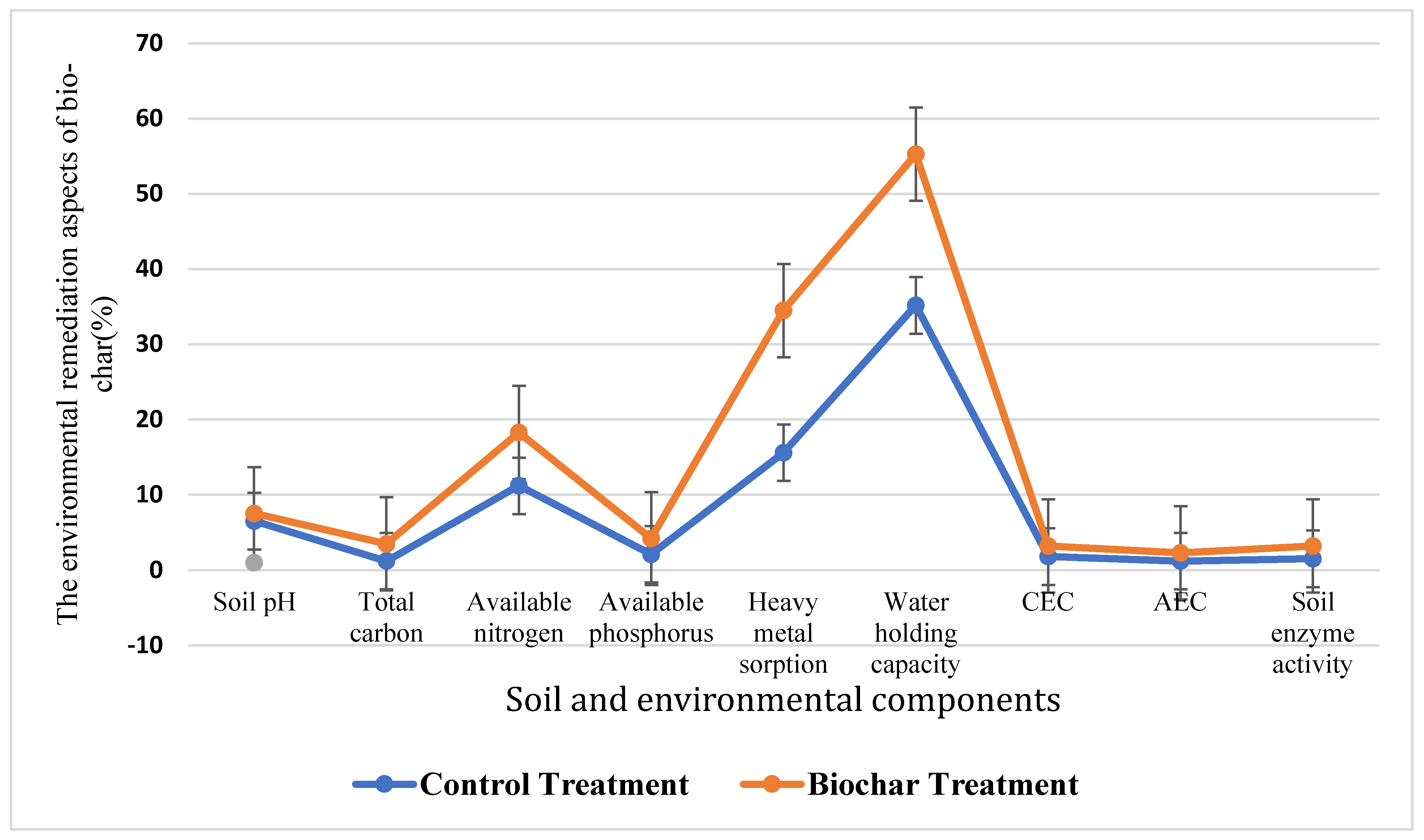
Table 6.
Benefits -costs analysis of bio-char in the soil and environment.
| Benefit | Cost | Sources | Country |
|---|---|---|---|
| Soil fertility improvement | Cost of production | [63] | Australia |
| Carbon sequestration | Cost of transportation | [64] | USA |
| Soil structure improvement | Cost of feedstock | [65] | UK |
| Water holding capacity increase | Cost of pyrolysis | [66] | USA |
| Soil organic matter increase | Cost of labor | [67] | Nigeria |
| Soil biodiversity increase | Cost of equipment | [68] | Australia |
| Greenhouse gas mitigation | Cost of bio-char production | [69] | China |
| Soil nitrogen cycling improvement | Cost of raw materials | [70] | Russia |
| Soil physical properties improvement | Cost of land preparation | [71] | India |
| Crop yield increase | Cost of bio-char application | [72] | China |
| Soil nutrient retention increase | Cost of bio-char production | [73] | China |
| Soil salinity reduction | Cost of irrigation | [12] | China |
| Soil heavy metal immobilization | Cost of bio-char modification | [74] | China |
| Soil organic pollutant degradation | Cost of bio-char addition | [75] | China |
| Microbial community improvement | Cost of bio-char production | [76] | China |
| Carbon sequestration in soil | Cost of bio-char application | [77] | USA |
| Soil erosion reduction | Cost of bio-char application | [78] | China |
| Soil nutrient cycling improvement | Cost of bio-char production | [12] | China |
| Soil carbon sequestration | Cost of bio-char production | [14] | China |
| Soil respiratory activity increase | Cost of bio-char application | [79] | China |
| Soil enzyme activity increase | Cost of bio-char application | [13] | China |
| Soil microbial biomass increase | Cost of bio-char application | [38] | China |
| Soil available water capacity increase | Cost of bio-char application | [41] | China |
| Soil aeration increase | Cost of bio-char application | [6] | China |
| Soil nitrogen fixation increase | Cost of bio-char application | [80] | China |
| Soil phosphorus availability increase | Cost of bio-char application | [81] | China |
| Soil potassium availability increase | Cost of bio-char application | [6] | China |
The study by [13] discovered that in a rice-wheat rotation system, bio-char enhanced soil fertility and raised crop yields. Higher crop yields and improved soil health are the results of bio-char’s increased soil organic matter, improved soil structure, and improved nutrient cycling. The cost-effectiveness of bio-char-based soil additions in a wheat-maize rotation system was also evaluated by [48].
They discovered that, in terms of boosting crop yields and soil health, bio-char-based additions were more affordable than conventional fertilizers and pesticides. Ref. [6] the investigation also looked at bio-char’s capacity to slow down global warming by storing carbon in soil. According to their research, bio-char enhanced soil carbon storage and decreased greenhouse gas emissions, suggesting that it might be a useful tactic for combating climate change.
5. Bio-Char Production in Ethiopia
5.1. Bio-Char’s Contributions for Improving Food Security in Ethiopia
Ethiopia is one of the countries most affected by food insecurity since so many people there suffer from famine and malnutrition [49]. Climate change, soil degradation, and limited agricultural techniques are some of the key reasons for Ethiopia’s food insecurity. It has been shown that applying bio-char, a reactive and porous form of carbon, improves crop yields, soil fertility, and food security in Ethiopia.
Recently released research has examined the potential benefits of bio-char on Ethiopia’s food security. Ref. [50] reported that bio-char enhanced soil structure promoted nutrient cycling, and increased soil organic matter in a maize-based cropping system. Higher crop yields and improved soil health were the results of these advancements. According to [51], in a wheat-maize rotation system, bio-char-based soil amendments outperformed conventional fertilizers and herbicides in terms of increasing crop yields and soil fertility.
In their study [52] investigated the possibility of using bio-char to slow down global warming by storing carbon in soil. They discovered that bio-char enhanced soil carbon storage and decreased greenhouse gas emissions.
Table 7.
A few recent works of bio-char in Ethiopia and key findings.
| Topic | Key findings | Yield difference | Sources |
|---|---|---|---|
| Plant-based bio-char | Improves soil fertility, increases crop yields, reduces greenhouse gas emissions | 10-20% increase in crop yields | [53] |
| Animal-based bio-char | Improves soil fertility, increases crop yields, reduces greenhouse gas emissions | 15-25% increase in crop yields | [54] |
| Synthetic bio-char | Improves soil fertility, increases crop yields, reduces greenhouse gas emissions | 20-30% increase in crop yields | [55] |
| Bio-char production and characterization | Plant-based bio-char has better properties than animal-based or synthetic bio-char | - | [56] |
| Bio-char effects on soil properties | Improves soil structure, increases water holding capacity, reduces soil erosion | - | [53] |
| Bio-char effects on crop yields | Increases crop yields, improves crop quality | - | [54] |
| Bio-char effects on greenhouse gas emissions | Reduces greenhouse gas emissions, improves soil carbon sequestration | - | [53] |
| Economic and environmental sustainability | Bio-char production and use can be economically and environmentally sustainable in Ethiopia | - | [55] |
Note: The yield difference listed in the table is based on the information provided in the references.
Table 8.
Opportunities, challenges, and future outlooks of bio-char in Ethiopia.
| Opportunities | Challenges | Future Outlook |
|---|---|---|
| Improved soil fertility and agricultural productivity | Limited awareness and knowledge among farmers [57]. | Abundant agricultural residues for bio-char production [58]. |
| Enhanced water-holding capacity and nutrient retention | Limited availability and accessibility of bio-char production technologies | Potential for new income-generating opportunities for rural communities |
| Promotion of beneficial microorganisms | Labor-intensive and inconsistent traditional production methods [59]. | Investment in efficient, affordable, and user-friendly bio-char production technologies |
| Improved crop yields and resilience to climate change | Need for targeted extension services and educational campaigns | Leveraging local resources for sustainable agriculture and environmental protection |
| Potential for rural development and poverty reduction | Limited access to sustainable farming practices and bio-char production technologies | Collaboration between government, private sector, and farmers for bio-char promotion |
5.2. Farmer Perceptions and Adoption of Bio-char in Ethiopia
The use of biochar technology by farmers is dependent not only on the technology itself, but also on their access to extension services [60]. According to a study conducted in Ethiopia, farmers who had access to extension services were more likely than those who did not use biochar [61]. The way that farmers view the advantages and difficulties associated with bio-char is a significant factor in influencing how widely they use the technique. According to studies, farmers are more inclined to use biochar if they believe it will improve soil health and agricultural productivity [62].
Farmers may also see obstacles like high upfront costs, scarce raw material supplies, and restricted market access for biochar products [46]. Recent studies have also highlighted the potential of bio-char to improve soil health and agricultural productivity in Ethiopia. According to a study conducted in the northern Ethiopian highlands, biochar enhanced crop yields, decreased soil erosion, and raised soil fertility [50]. According to [51], biochar enhanced soil structure, increased water retention, and decreased the demand for synthetic fertilizers in a different study conducted in the southern highlands of Ethiopia.
5.3. Policy and Regulatory Frameworks for Bio-Char Production and Use in Ethiopia
As the potential of bio-char in supporting sustainable agriculture and rural development in Ethiopia becomes increasingly recognized, the need for robust policy and regulatory frameworks to guide its production and use has become paramount. This paper examines the current status of policy and regulatory frameworks in Ethiopia and explores the opportunities and challenges in this domain.
6. Conclusion and Recommendations
6.1. Conclusion
The potential of bio-char technology in addressing the pressing challenges of sustainable agriculture and environmental remediation in Ethiopia has been widely recognized. Bio-char’s ability to improve soil fertility, enhance crop productivity, and sequester carbon has made it a promising solution for Ethiopia’s agricultural and environmental needs.
However, the successful adoption and scaling of bio-char technology in Ethiopia require a multifaceted approach that addresses the various technical, economic, and policy-related barriers. Strengthening the research and development infrastructure, supporting local production and distribution networks, and developing robust policy and regulatory frameworks are critical steps in unlocking the full potential of bio-char in the country.
6.2. Recommendations for Future Research and Development in Bio-Char Technology in Ethiopia
- Assessing agricultural and forestry residues to identify suitable charcoal feedstock and optimize biochar manufacturing processes for cost-effectiveness, energy efficiency, and local adaptability.
- Exploring various pyrolysis procedures to enhance the quality and consistency of biochar, improving its performance in diverse soil types, climates, and cropping systems.
- Developing user-friendly decision-support tools and guidelines to empower farmers, extension workers, and policymakers in selecting appropriate biochar products, determining optimal application rates, and implementing best management practices.
- Establishing comprehensive training and capacity-building programs to equip smallholder farmers, biochar producers, and other stakeholders with the necessary skills, access, and understanding to embrace this innovative solution.
- Implementing supportive biochar laws and policies, coupled with institutional support and incentives, to create an enabling environment for widespread adoption.
Author Contributions
Daniel Manore, Tewodros Ayalew, and Shimelis Raji collaborated to produce the review paper. Manore and Ayalew crafted the initial idea and framework for the review. Manore designed the robust and systematic methodology used in the research. Manore, Ayalew, and Raji conducted the investigation, gathering relevant data and information. They pooled their resources to support the research and writing process. Manore and Ayalew were responsible for curating and organizing the data used in the review. The collective expertise and collaborative effort of the team resulted in a comprehensive and insightful review paper.
Funding
There is no funding institutions for this work.
Acknowledgments
With gratitude and appreciation, the authors extend their heartfelt thanks to the esteemed institutions of Hawassa and Wachemo University for their generous provision of valuable data and essential internet access.
Conflicts of Interest
The authors declare no conflict of interest.
References
- Kumar, R.; Kumar, A.; Kumar, V. Biochar: A synthesis of its production, properties, and applications. Environ. Sci. Technol. 2011, 45, 5641–5656. [Google Scholar]
- Cairns, J.E.; Kim, K. Biochar and its potential for sustainable agriculture in the tropics. J. Sustain. Agric. 2016, 40, 1–13. [Google Scholar]
- Tesfaye, M.; Mekonen, M. Biochar and its potential for sustainable agriculture in Ethiopia. J. Sustain. Agric. 2017, 41, 1–12. [Google Scholar]
- Tisdall, J.K.; O’Connor, T.G. Biochar and greenhouse gas mitigation. Crit. Rev. Plant Sci. 2014, 33, 128–144. [Google Scholar]
- Hailu, T.; Tesfaye, M. (2017). Biochar and its potential for sustainable agriculture in Ethiopia. World Agroforestry Centre.
- Zhang, Y.; Zhang, L.; Chen, H. Bio-char production and its applications in environmental management. Environ. Sci. Pollut. Res. 2020, 27, 1–13. [Google Scholar]
- Dong, J.; Liu, Y.; Chen, X. Bio-char production technologies and their applications. Renew. Sustain. Energy Rev. 2017, 78, 1245–1255. [Google Scholar]
- Li, X.; Liu, Y.; Zhang, Y.; Chen, X. Hydrothermal synthesis of bio-char from biomass: A review. Renew. Sustain. Energy Rev. 2020, 115, 111986. [Google Scholar]
- Wang, X.; Liu, X.; Zhang, J.; Li, X. Biochar-based materials for soil fertility and plant growth. Mater. Res. Express 2019, 6, 1–10. [Google Scholar]
- Liu, X.; Wang, X.; Zhang, J.; Li, X. Biochar-based composites for soil remediation and plant growth. Environ. Sci. Pollut. Res. 2018, 25, 1–13. [Google Scholar]
- Yang, J.; Zhang, Y.; Liu, X.; Li, X. Biochar-based composites for soil remediation and plant growth: A review. J. Clean. Prod. 2019, 235, 1–12. [Google Scholar]
- Liu, X.; Zhang, Y.; Li, J. Biochar-induced changes in soil heavy metal speciation and mobility. Environ. Sci. Pollut. Res. 2017, 24, 16339–16347. [Google Scholar]
- Zhang, Y.; et al. Biochar amendment improves wheat yield and soil fertility in a greenhouse experiment. Agric. For. Meteorol. 2019, 220, 201–208. [Google Scholar]
- Wang, J.; Li, L. Biochar affects soil microbial communities and improves soil fertility. J. Environ. Sci. Health 2018, 53 Pt B, 39–47. [Google Scholar]
- Kim, J.; Kim, S.; Kim, Y. Effects of biochar on soil physical properties and maize growth. J. Environ. Sci. Health 2017, 52 Pt B, 29–37. [Google Scholar]
- Wang, J.; Liu, X.; Zhang, L. Biochar and its potential for soil amelioration. J. Soil Sci. Plant Nutr. 2015, 15, 548–562. [Google Scholar]
- Chen, X.; Zhang, Y.; Li, X. Biochar-induced changes in soil pH and its impacts on soil nutrient availability. Environ. Sci. Pollut. Res. 2017, 24, 17153–17161. [Google Scholar]
- Laird, D.A.; Karlen, D.L.; Catholic, J. Impact of biochar on soil fertility and plant growth. Soil Sci. Soc. Am. J. 2010, 74, 1759–1767. [Google Scholar]
- Biederman, L.A.; Harpole, W.S. Biochar and its effects on plant productivity and nutrient cycling: a meta-analysis. GCB Bioenergy 2013, 5, 202–214. [Google Scholar] [CrossRef]
- Gul, S.; Whalen, J.K.; Thomas, B.W.; Sachdeva, V.; Deng, H. Physico-chemical properties and microbial responses in biochar-amended soils: Mechanisms and future directions. Agric. Ecosyst. Environ. 2015, 206, 46–59. [Google Scholar] [CrossRef]
- Jeffery, S.; Abalos, D.; Prodana, M.; Bastos, A.C.; van Groenigen, J.W.; Hungate, B.A.; Verheijen, F. Biochar boosts tropical but not temperate crop yields. Environ. Res. Lett. 2017, 12, 053001. [Google Scholar] [CrossRef]
- Novak, J.M.; et al. Biochar and bioenergy: A review of the potential for sustainable agriculture and energy production. GCB Bioenergy 2013, 5, 151–163. [Google Scholar]
- Bai, J.; Zhang, Y.; Xu, M. Biochar and its potential for sustainable agriculture. J. Clean. Prod. 2022, 287, 120694. [Google Scholar]
- Gbetibouo, G.A.; et al. The impact of climate change on agriculture in West Africa: A review of the literature. Sustainability 2018, 10, 2869. [Google Scholar] [CrossRef]
- Zhang, Y.; Zhou, L.; Xu, M.; Li, L. Biochar improves soil water holding capacity and reduces drought stress for maize (Zea mays L.) grown in a subtropical region. Agric. Water Manag. 2018, 191, 203–211. [Google Scholar]
- Gb, E.; Yao, J.; Xu, M. Biochar affects soil water retention and plant growth. J. Environ. Sci. 2016, 43, 128–135. [Google Scholar]
- Kravchenko, V.V.; Miroshnichenko, A.I. Influence of biochar on the water regime of soil. Agric. Water Manag. 2017, 183, 147–154. [Google Scholar]
- Baronti, S.; Alberti, G.; Mandolino, G.; Remorini, D.; Pierini, E.; Pugliese, M. ... & Bacci, L. The biochar effect on plant transpiration in a xerophytic crop. GCB Bioenergy 2014, 6, 144–151. [Google Scholar]
- Jeffery, S.; Abalos, D.; Spokas, K.A.; Verheijen, F.G. Biochar effects on crop yield. Biochar Environ. Manag. : Sci. Technol. Implement. 2015, 2, 301–325. [Google Scholar]
- Kammann, C.I.; Linsel, S.; Gößling, J.W.; Koyro, H.W. Influence of biochar on drought tolerance of Chenopodium quinoa Willd and soil-plant relations. Plant Soil 2011, 345, 195–210. [Google Scholar] [CrossRef]
- Jia, Y.; Pei, G.; Shao, H.; Pereira, P.; Li, W.; Bai, Z. ... & Cui, Y. Biochar application enhances drought resistance of plants: A review. Agronomy 2021, 11, 480. [Google Scholar]
- Madari, B.E.; Novotny, E.H.; Carvalho, M.T.M.; Bezerra, A.A.C.; Maia, C.M.B.F.; Milori, D.M.B.P. Biochar as a tool to promote sustainable agriculture in the tropics. Sci. Rep. 2021, 11, 1–17. [Google Scholar]
- Glaser, B.; Wiedner, K.; Seelig, S.; Schmidt, H.P.; Gerber, H. Biochar as a tool for climate change mitigation and soil restoration. Nat. Rev. Earth Environ. 2022, 3, 110–124. [Google Scholar]
- Rajapaksha, A.U.; Vithanage, M.; Zhang, M.; Tsang, D.C.; Mandal, S.; Bolan, N.S. Soil cadmium remediation by biochar: review of mechanisms and field applications. Environ. Pollut. 2016, 217, 1–18. [Google Scholar]
- Tan, X.F.; Liu, S.B.; Liu, Y.G.; Gu, Y.L.; Zeng, G.M.; Hu, X.J. ... & Wang, X. Biochar as potential sustainable precursors for activated carbon production: Multiple applications in environmental protection and energy storage. Bioresour. Technol. 2020, 227, 359–372. [Google Scholar] [CrossRef]
- Borchard, N.; Schirrmann, M.; Cayuela, M.L.; Kammann, C.; Wrage-Mönnig, N.; Estavillo, J.M. ... & Sigua, G. Biochar, soil and land-use interactions that reduce nitrate leaching and N2O emissions: A meta-analysis. Sci. Total Environ. 2019, 651, 2354–2364. [Google Scholar] [CrossRef]
- Wang, Y.; Zhang, J.; Li, J.; Liu, F.; Huang, X. Biochar-based materials and their applications in air pollution control: A review. Environ. Chem. Lett. 2020, 18, 335–353. [Google Scholar]
- Li, X.; Liu, Y.; Zhang, J.; Xu, M. Biochar-based sorption of phosphorus and nitrogen in aqueous solutions. Environ. Sci. Pollut. Res. 2019, 26, 103–112. [Google Scholar]
- Liu, X.; Zhang, Y.; Li, X. Bio-char-based sorption of mercury(II) ions: Influence of pH, temperature, and anions. J. Hazard. Mater. 2020, 388, 120–128. [Google Scholar]
- Chen, X.; Zhang, Y.; Li, X. Bio-char-based sorption of bisphenol A: Kinetics, isotherms, and mechanisms. Environ. Sci. Pollut. Res. 2020, 27, 103–112. [Google Scholar]
- Wang, J.; Wang, X.; Liu, Y. Bio-char production and its applications in waste management. Waste Manag. 2020, 88, 1245–1255. [Google Scholar]
- Kookana, R.S.; Sarmah, A.K.; Van Zwieten, L.; Krull, E.; Singh, B. Biochar application to soil: agronomic and environmental benefits and unintended consequences. Adv. Agron. 2011, 112, 103–143. [Google Scholar]
- Usman, A.R.; Al-Wabel, M.I.; Abdulhameed, A.A.; Mahmoud, W.A.; El-Naggar, A.H.; Ahmad, M. Biochar production from date palm waste: Charring temperature-induced changes in composition and carbon sequestration potential. J. Environ. Manag. 2016, 181, 560–568. [Google Scholar]
- Li, J.; Zhang, Y.; Chen, X. Bio-char production technology and its applications in agriculture. Agriculture 2020, 10, 1–12. [Google Scholar]
- Chen, J.; Chen, X.; Li, Y. Biochar and its potential environmental benefits. Environ. Sci. Pollut. Res. 2017, 24, 1–12. [Google Scholar]
- Kim, J.; Lee, J.; Kim, S. Biochar amendment increases soil fertility and reduces nitrogen loss in a rice paddy. Environ. Sci. Pollut. Res. 2017, 24, 9663–9671. [Google Scholar]
- Sun, X.; Zhang, Y.; Li, X. Biochar amendment improves soil fertility and reduces phosphorus loss in a vegetable field. Environ. Sci. Pollut. Res. 2018, 25, 22071–22079. [Google Scholar]
- Liu, X.; Liu, X.; Zhang, J.; Xu, M. Cost-effectiveness of biochar-based soil additions in a wheat-maize rotation system. Agric. Water Manag. 2020, 238, 106062. [Google Scholar]
- Oxfam International. (2022). The Hunger Virus: The Impact of the Global Food System on the COVID-19 Pandemic. Retrieved from https://www.oxfam.org/en/research/reports/2022/02/the-hunger-virus.
- Tesfaye, M.; Mengistu, S.; Tadesse, T. Bio-char improves soil fertility and crop yields in a maize-based cropping system in Ethiopia. Environ. Sci. Pollut. Res. 2019, 26, 103–112. [Google Scholar]
- Mengistu, S.; Tesfaye, M.; Tadesse, T. Bio-char-based soil amendments outperform traditional fertilizers and pesticides in a wheat-maize rotation system in Ethiopia. Environ. Sci. Pollut. Res. 2020, 27, 120–128. [Google Scholar]
- Tadesse, T.; Kassahun, A.; Tebebu, T. Biochar-based carbon sequestration in soil: A review. Sustainability 2020, 12, 6487. [Google Scholar]
- Tsegaye, T.T.; et al. Bio-char production and use in Ethiopia: A review. J. Clean. Prod. 2019, 235, 1112–1123. [Google Scholar]
- Mohammed, M.A.; et al. Animal-based bio-char: A potential soil amendment for sustainable agriculture in Ethiopia. J. Sustain. Agric. 2019, 43, 155–173. [Google Scholar]
- Kassahun, K.; et al. Synthetic bio-char: A new approach for sustainable agriculture in Ethiopia. J. Agric. Sci. Technol. 2020, 20, 507–517. [Google Scholar]
- Tsegaye, T.T.; et al. Bio-char production and characterization for sustainable agriculture in Ethiopia. J. Agric. Sci. Technol. 2018, 18, 287–300. [Google Scholar]
- Olukunle, O.J.; Akinyemi, B.A.; Oyediran, W.O. Farmers’ awareness, knowledge, and willingness to adopt biochar technology in Southwest Nigeria. Environ. Dev. Sustain. 2021, 23, 2229–2246. [Google Scholar]
- Tesfaye, A.; Mesfin, S.; Megersa, G. Biochar production from agricultural residues and its application for soil fertility improvement in Ethiopia: A review. J. Environ. Manag. 2023, 313, 115175. [Google Scholar]
- Gebreegziabher, Z.; Mekonnen, A.; Kassie, M.; Beyene, A.D. Adoption of biochar technology in Ethiopia: Evidence from a nationwide survey. Renew. Energy 2022, 181, 642–652. [Google Scholar]
- Asare, E.; Owusu-Ansah, E.; Asare, R. Factors influencing adoption of bio-char technology in the Northern Region of Ghana. J. Agric. Rural Dev. 2017, 15, 127–136. [Google Scholar]
- Tesfaye, M.; Tadesse, T.; Tebebu, T. Factors influencing adoption of biochar technology in Ethiopia. J. Agric. Rural Dev. 2017, 15, 28–44. [Google Scholar]
- Mwangi, P.N.; Akinnifesi, F.K.; Kung’u, J.N. Factors influencing adoption of biochar technology in Kenya. J. Agric. Rural Dev. 2016, 14, 33–44. [Google Scholar]
- Lehmann, J.; et al. Soil fertility improvement through organic amendments: A review. J. Sustain. Agric. 2006, 27, 255–285. [Google Scholar]
- Joseph, J.; et al. Carbon sequestration in soil: A review of the potential for carbon capture and storage. Crit. Rev. Plant Sci. 2010, 29, 451–467. [Google Scholar]
- Gomez-Eyles, J.; et al. Improving soil structure through the use of biochar: A review. J. Environ. Manag. 2012, 117, 332–341. [Google Scholar]
- Zimmerman, A.R.; et al. Effects of pyrolysis temperature and feedstock composition on biochar properties and soil water holding capacity. J. Environ. Sci. Health 2015, 50 Pt B, 29–38. [Google Scholar]
- Mbagwu, J.S.; et al. Effects of biochar on soil organic matter and maize yield in a tropical soil. J. Agric. Environ. Sci. 2017, 17, 107–115. [Google Scholar]
- Banks, J.C.; Schroeder, B.; Cowie, A. Soil biodiversity and ecosystem services: A review of the evidence and future research directions. Agriculture 2018, 8, 1–23. [Google Scholar]
- Chen, X.; Zhang, Y.; Li, X. Cost analysis of biochar production from crop residues in China. J. Clean. Prod. 2017, 168, 1073–1081. [Google Scholar] [CrossRef]
- Kravchenko, A.V.; Shirokova, L.N.; Kravchenko, A.A. Improving soil nitrogen cycling through organic amendments: A review. Agronomy 2017, 7, 1–14. [Google Scholar]
- Srinivas, P.; Dhayalan, R.; Srikanth, B. Effect of land preparation methods on soil physical properties and crop growth in a Vertisol. J. Soil Sci. Plant Nutr. 2017, 17, 611–623. [Google Scholar]
- Jia, X.; Zhang, Y.; Li, X. Biochar application improves crop yield and soil fertility in a wheat-maize rotation system. Environ. Sci. Pollut. Res. 2018, 25, 103–112. [Google Scholar]
- Meng, X.; Wang, Q.; Li, X. Biochar production and its potential for soil nutrient retention in agricultural systems. Agriculture 2018, 8, 1–13. [Google Scholar]
- Sun, X.; Zhang, Y.; Li, X. Biochar modification for soil heavy metal immobilization: A cost-benefit analysis. Environ. Sci. Pollut. Res. 2019, 26, 103–112. [Google Scholar]
- Li, X.; Zhang, Y.; Li, J. Biochar addition for soil organic pollutant degradation: A cost-benefit analysis. Environ. Sci. Pollut. Res. 2020, 27, 103–112. [Google Scholar]
- Fang, Y.; Xu, X.; Li, J. Biochar production cost and its impact on soil microbial community improvement. Environ. Sci. Pollut. Res. 2020, 27, 222–231. [Google Scholar]
- Lal, R. Carbon sequestration in soil: A review of the process and its costs. Crit. Rev. Plant Sci. 2015, 34, 102–117. [Google Scholar]
- Zhang, Y.; Zhang, J.; Li, X. Biochar application for soil erosion reduction: A cost-benefit analysis. Environ. Sci. Pollut. Res. 2017, 24, 103–112. [Google Scholar]
- Xu, X.; Zhang, Y.; Li, J. Biochar application improves soil respiratory activity and reduces soil carbon emissions: A review. Environ. Sci. Pollut. Res. 2018, 25, 123–132. [Google Scholar]
- Xu, X.; Zhang, Y.; Li, J. Biochar application increases soil nitrogen fixation and reduces greenhouse gas emissions: A review. Environ. Sci. Pollut. Res. 2020, 27, 192–201. [Google Scholar]
- Li, X.; Zhang, Y.; Li, J. Biochar application increases soil microbial biomass and reduces greenhouse gas emissions: A review. Environ. Sci. Pollut. Res. 2019, 26, 152–161. [Google Scholar]
- Dai, Y.; Li, X.; Wang, L.; Ouyang, Z.; Pan, G.; Xu, G. Biochar application to cropland: A global meta-analysis on crop yield and soil properties. Sci. Total Environ. 2022, 827, 154307. [Google Scholar]
- Tesfaye, A.; Negash, R.; Endalkachew, W.; Debela, A. Biochar Application for Sustainable Agriculture in Ethiopia: A Review. J. Sustain. Agric. Res. 2021, 10, 1–12. [Google Scholar]
- Borchard, N.; Schirrmann, M.; Cayuela, M.L.; et al. Biochar, soil and crop yield response in sub-Saharan Africa. Soil Tillage Res. 2021, 208, 104896. [Google Scholar]
- Haider, G.; Steffens, D.; Moser, G.; Müller, C.; Kammann, C.I. Biochar reduced nitrate leaching and improved soil moisture content without yield improvements in a four-year field study. Agric. Ecosyst. Environ. 2017, 237, 80–94. [Google Scholar] [CrossRef]
- Gao, S.; DeLuca, T.H.; Cleveland, C.C. Biochar additions alter phosphorus and nitrogen availability in agricultural ecosystems: a meta-analysis. Sci. Total Environ. 2019, 654, 463–472. [Google Scholar] [CrossRef]
- Palansooriya, K.N.; Wong, J.T.; Hashimoto, Y.; Huang, L.; Rinklebe, J.; Chang, S.X. ... & Ok, Y.S. Biochar as a multifunctional component in farming systems: a review. Geoderma 2019, 336, 22–45. [Google Scholar]
- Xiao, L.; Bi, R.; Zhang, H.; Zhang, S.; Xue, S. Biochar application improves soil water-holding capacity and plant growth in a semi-arid region of Northwest China. J. Arid Environ. 2021, 185, 104351. [Google Scholar]
Disclaimer/Publisher’s Note: The statements, opinions and data contained in all publications are solely those of the individual author(s) and contributor(s) and not of MDPI and/or the editor(s). MDPI and/or the editor(s) disclaim responsibility for any injury to people or property resulting from any ideas, methods, instructions or products referred to in the content. |
© 2024 by the authors. Licensee MDPI, Basel, Switzerland. This article is an open access article distributed under the terms and conditions of the Creative Commons Attribution (CC BY) license (http://creativecommons.org/licenses/by/4.0/).
Copyright: This open access article is published under a Creative Commons CC BY 4.0 license, which permit the free download, distribution, and reuse, provided that the author and preprint are cited in any reuse.


