

Submitted:
28 August 2024
Posted:
29 August 2024
You are already at the latest version
Abstract
Aim: To elucidate the international network structures and evolution of collaborations in capsule endoscopy research from 2000 to 2023 by analyzing co-authorship networks. Method: This study analyzed co-authorship patterns in capsule endoscopy research articles published from 2000 to 2023 using data from the Web of Science (WoS). I employed Python (version 3.10.5) in the PyCharm development environment (version 2022.1.3) to conduct a network analysis using social network analysis principles. The analysis included macro-level metrics (network density, clustering coefficient, components, and average path length) and micro-level metrics (degree centrality, closeness centrality, and betweenness centrality) to assess collaboration intensity, key contributors, and network cohesion. Result: The co-authorship network analysis revealed evolving collaboration patterns over three distinct periods (2000-2009, 2010-2019, and 2020-2023). Initially, the network exhibited low density and high fragmentation, with key contributors such as Guido Costamagna and Jonathan A. Leighton prominently positioned. Over time, the network expanded with increased density and clustering, though it remained fragmented. In recent years, the network showed increased cohesion with reduced components and notable contributors like Anastasios Koulaouzidis and Xavier Dray, reflecting the growing importance of international collaborations, particularly involving researchers from Japan, Italy, and Israel. Conclusion: The study highlights the dynamic nature of international collaborations in capsule endoscopy research, with increasing connectivity and influential contributors playing pivotal roles in advancing the field. These findings underscore the value of international cooperation in enhancing diagnostic and therapeutic approaches in capsule endoscopy, pointing to future opportunities for deeper collaboration and integration.
Keywords:
capsule endoscop
; co-authorship network
; network analysis
; international research collaboration
; gastroenterology research
Introduction
Background and Objectives
Capsule endoscopy has become an essential tool in the diagnosis and management of gastrointestinal disorders, particularly for the small intestine, where traditional endoscopy methods often fall short [1]. In Japan, capsule endoscopy plays a critical role in non-invasively examining parts of the gastrointestinal tract that are difficult to access with conventional techniques, thus reducing patient discomfort while providing high-precision diagnostic capabilities [2]. Leveraging Japan's technological advancements, ongoing research is focused on enhancing the performance of capsule endoscopes and developing new diagnostic methodologies.
Globally, capsule endoscopy has also gained widespread acceptance, with early adoption in Europe and the United States, where it has demonstrated high accuracy in detecting gastrointestinal bleeding and polyps [3]. Its non-invasive nature has increased patient acceptance, contributing to the broader dissemination of this diagnostic approach across healthcare systems.
The increase in international collaborations within capsule endoscopy research underscores the global significance of this technology. Collaborative efforts have facilitated the sharing of cutting-edge techniques and integrated data, leading to advancements in diagnostic accuracy and the development of new therapeutic approaches [4]. For example, multicenter studies have evaluated the effectiveness and safety of colon capsule endoscopy, with their findings influencing international guidelines. Furthermore, numerous projects involving Japanese and international researchers aim to innovate and refine the applications of capsule endoscopy, enabling the sharing of practical insights from diverse medical settings and improving overall diagnostic and treatment outcomes.
This study aims to elucidate the network structures and evolution of international collaborations in capsule endoscopy research from 2000 to 2023. By analyzing co-authorship networks, I seek to identify key contributors, the extent of collaboration, and the development trends within this research field. The findings will offer insights into the current state and future directions of capsule endoscopy research, highlighting the significance of international cooperation in advancing this critical area of medical science.
Material and Methods
The present study investigates the co-authorship patterns in Capsule Endoscopy research papers. I utilized the Web of Science (WoS) database, conducting a "Topic search" with the keyword "capsule endoscopy" to analyze a total of 9,158 articles published between 2000 and 2023 (as of August 2024). In this analysis, I examined who collaborated with whom in co-authoring these papers. I conducted network analysis using the Python programming language (version 3.10.5) within the integrated development environment (IDE) PyCharm (software version 2022.1.3). This study employed methodology-established principles of social network analysis [5]. I carried out the analysis in two main parts:
Macro-Level Metrics:
Network Density: Calculated as the ratio of the number of edges to the maximum possible edges between all nodes.
Clustering Coefficient: Measured the extent to which nodes form clusters by considering the number of edges among neighboring nodes and calculating the average.
Components: Identified and counted the number of subgraphs (components) where nodes are mutually connected.
Average Path Length: Evaluated the average "distance" between nodes by calculating the overall average path length in the network [6].
Micro-Level Metrics:
Degree Centrality: Measured the importance of each node by counting the number of edges it has in the network.
Closeness Centrality: Defined as the inverse of the sum of the shortest path lengths from a node to all other nodes, measuring how close each node is to others in the network.
Betweenness Centrality: Assessed the extent to which a node lies on the shortest paths between other nodes, indicating its importance in information transmission within the network [6,7].
The significance of these macro-level metrics in understanding the structure of scientific collaboration networks and these micro-level centrality measures in scientific collaboration networks has been well documented and used [6,7]. Through these analyses, I can identify collaborative relationships and influential researchers in Capsule Endoscopy research. This information may be useful for understanding research trends and planning future collaborative studies.
Results
The results of the co-authorship network analysis for Capsule Endoscopy research, based on data from the WoS covering the years 2000 to 2023, reveal significant insights into the evolution of international collaborations in this field.
2000–2009. Network Analysis
During this period, the network exhibited a low density of 0.000996 (Table 1), indicating that only a small fraction of potential collaborations was realized (Figure 1). The average clustering coefficient was relatively high at 0.886 (Table 1), suggesting that researchers within the network tended to form tight-knit groups (Figure 1). The network was highly fragmented, consisting of 816 components (Table 1), with many researchers working in isolated groups. The average distance within the network was infinite (Table 1), reflecting the disconnected nature of many components [8].
Figure 1.
Top 20 Capsule Endoscopy Researcher Network from 2000 to 2009.
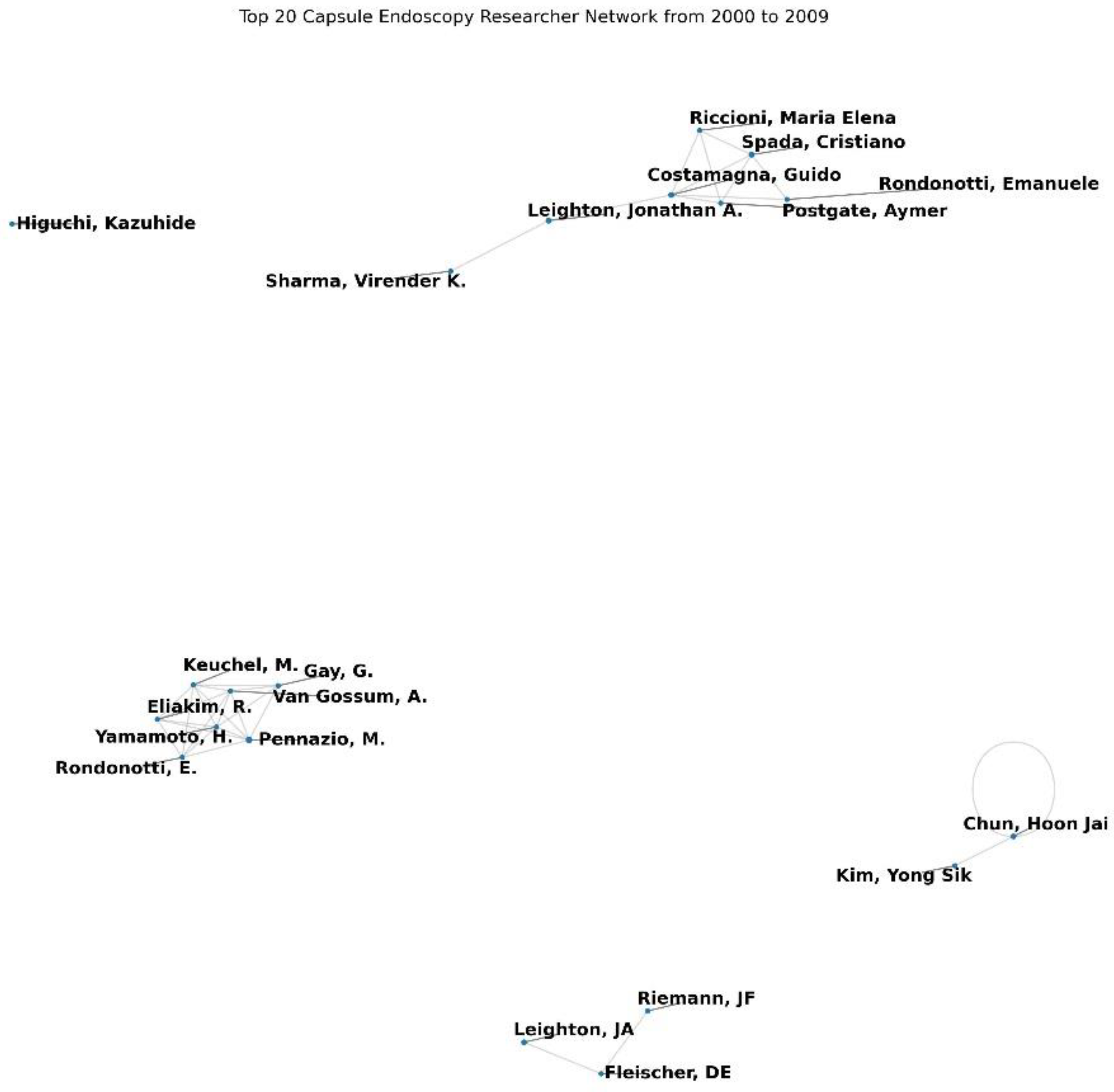
Table 1. Network Metrics.
At the micro level, in terms of degree centrality, the most prominent researchers included Pennazio, M. (0.0123), Costamagna, Guido (0.0099), and Leighton, Jonathan A. (0.0099) (Table 2). These individuals had the highest number of direct collaborations, indicating their central role in the network. Closeness centrality was led by Costamagna, Guido (0.0536), Delvaux, Michel (0.0518), and Gay, Gerard (0.0518), who were well-positioned to disseminate information efficiently across the network (Table 3). Betweenness centrality highlighted Costamagna, Guido (0.0119), Leighton, Jonathan A. (0.0118), and Heresbach, Denis (0.011) as key intermediaries, capable of controlling the flow of information between other researchers (Table 4). These results indicate that Costamagna, Guido (Italy), and Leighton, Jonathan A. (USA) had a strong influence in this period (Tables 2–4).
Table 2. Top 20 Nodes by Degree Centrality.
Table 3. Top 20 Nodes by Closeness Centrality.
Table 4. Top 20 Nodes by Betweenness Centrality.
2010–2019. Network Analysis
The network continued to expand, but the density slightly decreased to 0.000393 (Table 1), reflecting a broader yet still sparsely connected network (Figure 2). The average clustering coefficient remained high at 0.880 (Table 1), indicating persistent clustering tendencies among researchers (Figure 2). The number of components increased to 1,929 (Table 1), indicating further fragmentation, while the average distance remained infinite (Table 1), consistent with the presence of numerous isolated subgroups [8].
In terms of micro-level metrics, degree centrality rankings shifted slightly, with Spada, Cristiano (0.0149), Eliakim, Rami (0.0143), and Rondonotti, Emanuele (0.013) emerging as the most connected researchers (Table 2). In closeness centrality, Eliakim, Rami (0.1685), Rondonotti, Emanuele (0.1661), and Pennazio, Marco (0.1645) were most central, indicating their proximity to other researchers (Table 3). Betweenness centrality was dominated by Koulaouzidis, Anastasios (0.0516), Dray, Xavier (0.0279), and Eliakim, Rami (0.0261), underscoring their roles as vital connectors within the network (Table 4). These results suggest that Eliakim, Rami (Israel), Rondonotti, Emanuele (Italy) had a strong influence in this period (Tables 2–4).
2020–2023. Network Analysis
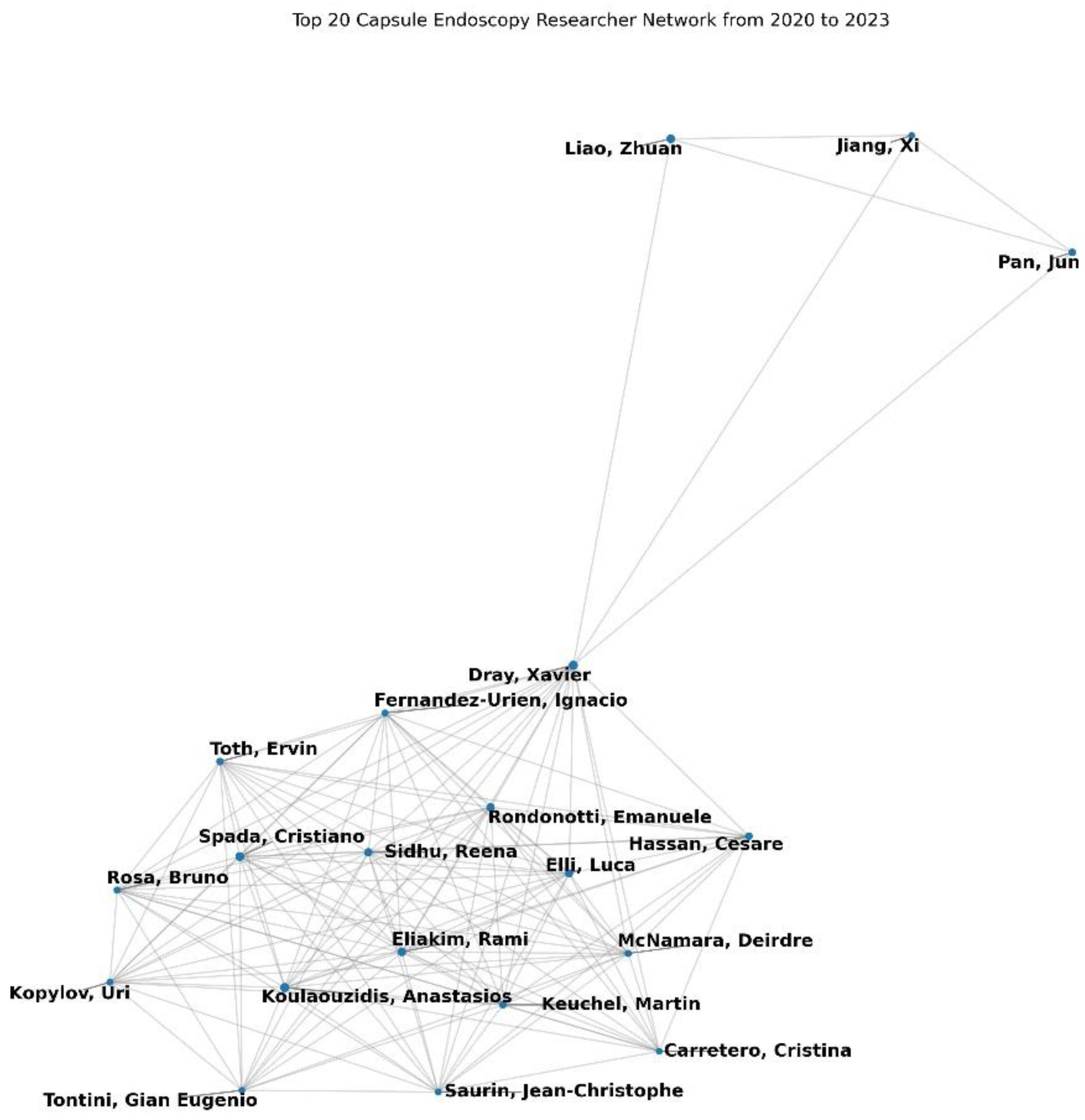
In the most recent period, the network showed a marked increase in density to 0.00128 (Table 1), reflecting a growing number of realized collaborations (Figure 3). The average clustering coefficient also increased to 0.914 (Table 1), suggesting even stronger clustering among researchers (Figure 3). The number of components decreased to 745 (Table 1), indicating greater network cohesion, although the average distance remained infinite due to ongoing fragmentation [8].
At the micro level, degree centrality saw Koulaouzidis, Anastasios (0.0265), Dray, Xavier (0.0265), and Spada, Cristiano (0.0257) as the most connected researchers (Table 2). The closeness centrality measure identified Spada, Cristiano (0.1317), Rondonotti, Emanuele (0.1289), and Eliakim, Rami (0.1286) as key individuals positioned to disseminate information across the network effectively (Table 3). Betweenness centrality highlighted Saito, Yutaka (National Cancer Center, Japan) (0.0356), Dray, Xavier (0.0312), and McNamara, Deirdre (0.0166) as pivotal figures in bridging different parts of the network (Table 4). The results indicate that Dray, Xavier (France) , Spada, Cristiano (Italy) had a strong influence in this period. Other results of Saito, Yutaka (Japan) ranked first in the Betweenness centrality value in recent years, which may play a role in mediating important information in capsule endoscopy research and will be the focus of future research trends (Tables 2–4).
Summary
Overall, the analysis illustrates the dynamic nature of the international co-authorship network in Capsule Endoscopy research, with increasing connectivity and clustering over time, yet persistent fragmentation that presents opportunities for further collaboration.
Discussion
This study analyzed the international network structures of capsule endoscopy research through co-authorship networks from 2000 to 2023 using data from the WoS. The findings reveal significant insights into the evolution of collaborative research efforts and the roles of key researchers in advancing this field. The macro- and micro-level metrics provided a comprehensive understanding of the network’s structure, highlighting both the strengths and challenges in the collaborative landscape of capsule endoscopy research.
From 2000 to 2009, the co-authorship network demonstrated a low density of 0.000996, indicating that only a minimal number of potential collaborations were realized. Despite the network's fragmentation into 816 components, the clustering coefficient was relatively high at 0.886 (Table 1), suggesting that when collaborations occurred, they tended to form cohesive subgroups (Figure 1). This period was characterized by isolated clusters of researchers (Figure 1), with limited interconnectivity, leading to an average distance within the network that was effectively infinite, indicating a lack of overall cohesion.
The micro-level analysis identified key figures such as Pennazio, Marco (Italy), Costamagna, Guido (Italy), and Leighton, Jonathan A. (USA), who had the highest degree of centrality, indicating their prominent roles in fostering collaborations. Costamagna, Guido also led in closeness and betweenness centrality, signifying his central role in efficiently disseminating information and acting as a crucial intermediary within the network (Tables 2–4). These findings align with previous research indicating that the most productive and influential researchers tend to occupy central positions in scientific networks, facilitating the flow of knowledge and collaboration.
During the 2010-2019 period, the network expanded but experienced a slight decrease in density to 0.000393, reflecting the broadening scope of research but continued sparsity in collaboration (Figure 2). The number of components increased to 1,929, indicating further fragmentation, while the average clustering coefficient remained high at 0.88 (Table 1). This suggests that while researchers formed new connections, many still operated in relatively isolated clusters. The average distance within the network continued to be infinite, underscoring the persistent lack of overall connectivity.
Notable shifts occurred in micro-level metrics, with Spada, Cristiano, Eliakim, Rami, and Rondonotti, Emanuele emerging as key figures in degree centrality, reflecting their extensive collaborative reach. Eliakim, Rami and Rondonotti, Emanuele also ranked highly in closeness centrality, indicating their strategic positions close to other network members, enhancing their ability to quickly access and disseminate information. Koulaouzidis, Anastasios, and Dray, Xavier led in betweenness centrality, underscoring their roles as vital connectors who bridged disparate groups within the network (Tables 2–4). These results highlight the evolving dynamics of key contributors who have adapted to the growing complexity of the field by expanding their collaborative networks.
The most recent period, 2020-2023, marked a significant increase in network density to 0.00128, reflecting a growing realization of collaborative potential among researchers. The clustering coefficient also increased to 0.914, suggesting stronger clustering tendencies and more cohesive subgroups. The number of components decreased to 745, indicating enhanced connectivity within the network, although the average distance remained infinite, highlighting ongoing fragmentation (Table 1, Figure 3).
At the micro level, researchers such as Koulaouzidis, Anastasios, Dray, Xavier, and Spada, Cristiano were prominent in degree centrality, highlighting their extensive collaborative activities. Spada, Cristiano also stood out in closeness centrality, alongside Rondonotti, Emanuele, and Eliakim, Rami, suggesting their pivotal roles in the efficient dissemination of information across the network. Betweenness centrality further emphasized the influential roles of researchers like Saito, Yutaka, underscoring their importance in maintaining connectivity and controlling information flow within the network (Tables 2–4).
Overall, the study underscores the importance of international collaborations in capsule endoscopy research, which have facilitated the sharing of innovative techniques and integrated data across diverse healthcare settings. The increased network density and clustering coefficients over time reflect a trend towards greater collaboration and interconnectivity, although persistent fragmentation indicates that opportunities remain to further integrate researchers into a more cohesive global network. This trend of increasing collaboration aligns with the broader goals of enhancing diagnostic accuracy and developing new therapeutic approaches, highlighting the ongoing significance of international cooperation in advancing the field of capsule endoscopy.
Conclusions
Based on the comprehensive analysis of co-authorship networks in capsule endoscopy research from 2000 to 2023, I identified key patterns and trends that underline the evolving dynamics of international collaboration in this field. The study demonstrates that while the network has progressively grown and increased in density, it remains fragmented, suggesting potential areas for further development in collaborative research.
During the 2000-2009 period, the network exhibited low density, with only a small fraction of potential collaborations realized, as indicated by the network density of 0.000996. Despite this, the clustering coefficient was relatively high at 0.886, signifying that the existing collaborations formed cohesive subgroups. However, the presence of 816 components and an infinite average path length reflects a network highly fragmented into isolated clusters, with limited overall cohesion. Key figures such as Pennazio, Marco, Costamagna, Guido, and Leighton, Jonathan A. emerged as central contributors, with significant influence on the dissemination of information within their respective clusters.
In the 2010-2019 period, the network continued to expand, but the density slightly decreased to 0.000393, reflecting an increased scope of research without a corresponding rise in interconnectedness. The number of components rose to 1,929, further indicating network fragmentation, though clustering remained strong with a coefficient of 0.88. Influential researchers during this period included Spada, Cristiano, Eliakim, Rami, and Rondonotti, Emanuele, who were prominent in degree and closeness centrality, highlighting their pivotal roles in connecting researchers and facilitating information flow. Betweenness centrality underscored the importance of Koulaouzidis, Anastasios, and Dray, Xavier as key intermediaries who bridged gaps between disparate clusters.
The most recent period, 2020-2023, showed marked improvements in network cohesion, with density increasing to 0.00128 and the clustering coefficient rising to 0.914. The number of components decreased to 745, indicating greater integration within the network, although the average path length remained infinite, suggesting continued fragmentation. Notable contributors such as Koulaouzidis, Anastasios, Dray, Xavier, and Spada, Cristiano continued to play significant roles, as reflected by their high degree of centrality. Moreover, Saito, Yutaka (Japan) emerged as a key figure in betweenness centrality, underscoring his influence in connecting various parts of the network, particularly in mediating critical information flows.
Overall, the analysis reveals that the international co-authorship network in capsule endoscopy research has become increasingly interconnected and clustered over time, with certain researchers consistently acting as pivotal nodes in the network. Despite these advances, the persistent fragmentation presents ongoing challenges for fostering more comprehensive global collaborations. The findings underscore the importance of targeted initiatives to bridge gaps between isolated groups, thereby enhancing the overall cohesion and impact of collaborative efforts in this vital area of medical research.
Funding
This research received no external funding.
Institutional Review Board Statement
Not applicable.
Conflicts of Interest
The authors declare no conflict of interest.
Abbreviations
WoS, Web of Science; IDE, Integrated Development
References
- Singeap AM, Stanciu C, Trifan A. Capsule endoscopy: The road ahead. World J Gastroenterol. 2016, 22, 369–78. [CrossRef] [PubMed]
- Nakamura, T. Capsule endoscopy in Japan. Dig Endosc. 2022, 34 Suppl. 2, 76–78. [Google Scholar] [CrossRef] [PubMed]
- Lee NM, Eisen GM. 10 years of capsule endoscopy: an update. Expert Rev Gastroenterol Hepatol. 2010, 4, 503–12. [CrossRef] [PubMed]
- Steinmann R, Cortegoso Valdivia P, Nowak T, Koulaouzidis A. An Overview of the Evolution of Capsule Endoscopy Research-Text-Mining Analysis and Publication Trends. Diagnostics 2022, 12, 2238. [CrossRef] [PubMed]
- Wasserman, S., & Faust, K. (1994). Social network analysis: Methods and applications. Cambridge University Press. [CrossRef]
- Newman, M. Scientific collaboration networks. II. Shortest paths, weighted networks, and centrality. Phys. Rev. E 2001, 64, 016132. [Google Scholar] [CrossRef] [PubMed]
- Newman, M.E. The structure of scientific collaboration networks. Proc Natl Acad Sci USA 2001, 98, 404–409. [Google Scholar] [CrossRef] [PubMed]
- Barabasi AL, Albert R. Emergence of scaling in random networks. Science 1999, 286, 509–512. [CrossRef] [PubMed]
Figure 2.
Top 20 Capsule Endoscopy Researcher Network from 2010 to 2019.
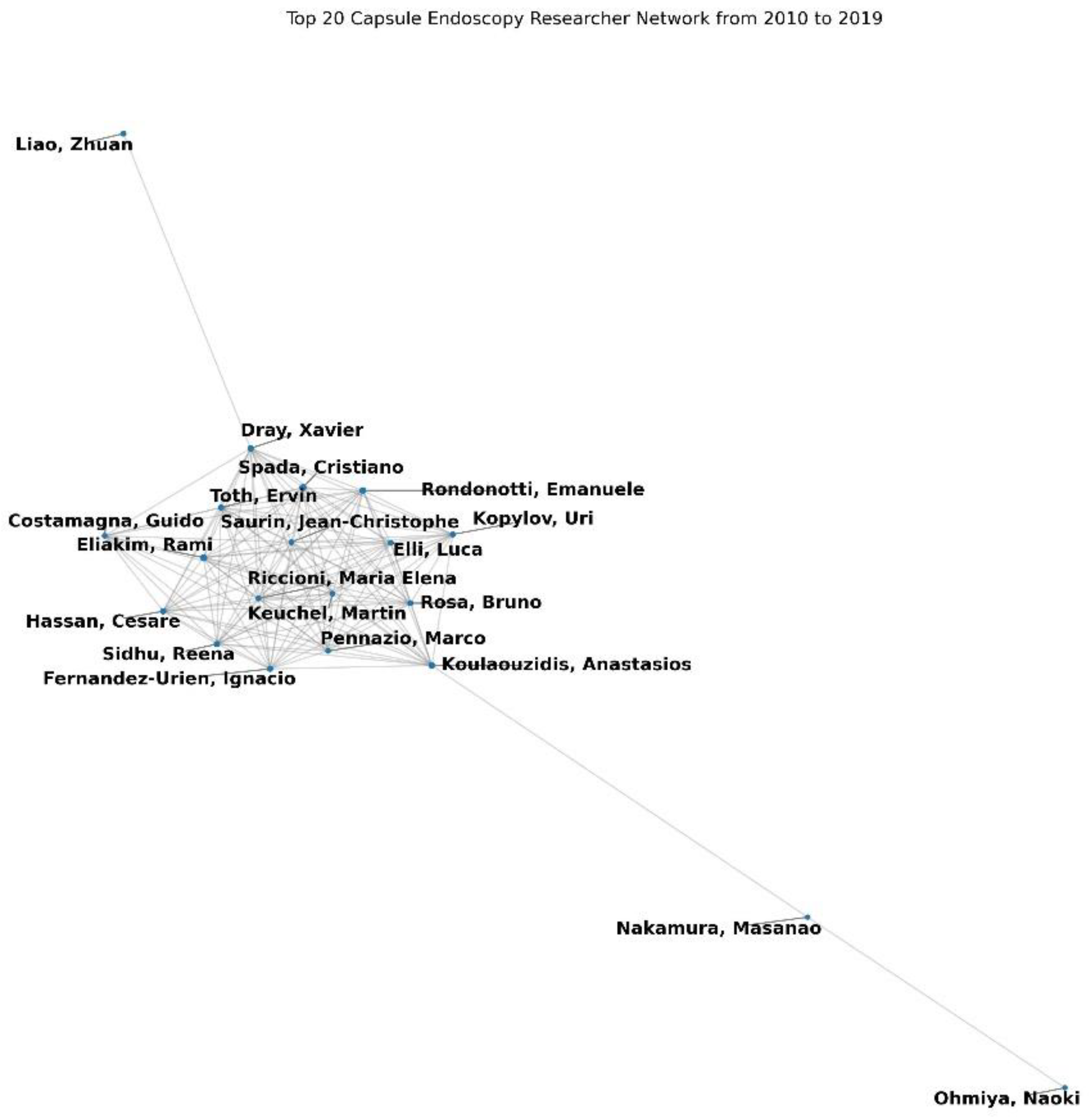
Figure 3.
Top 20 Capsule Endoscopy Researcher Network from 2020 to 2023.
Disclaimer/Publisher’s Note: The statements, opinions and data contained in all publications are solely those of the individual author(s) and contributor(s) and not of MDPI and/or the editor(s). MDPI and/or the editor(s) disclaim responsibility for any injury to people or property resulting from any ideas, methods, instructions or products referred to in the content. |
© 2024 by the authors. Licensee MDPI, Basel, Switzerland. This article is an open access article distributed under the terms and conditions of the Creative Commons Attribution (CC BY) license (http://creativecommons.org/licenses/by/4.0/).
Copyright: This open access article is published under a Creative Commons CC BY 4.0 license, which permit the free download, distribution, and reuse, provided that the author and preprint are cited in any reuse.


