

Submitted:
28 August 2024
Posted:
29 August 2024
You are already at the latest version
Abstract
Carbon tax policies (CTP) are globally acknowledged for curbing energy consumption and emissions. Despite global adoption, China's reluctance to embrace a carbon tax, possibly due to effectiveness and public acceptance concerns, is notable. This study employs Choice-Based Conjoint Analysis to gauge Shanghai residents' preferences on four CTP attributes. Among Shanghai's populace, the annual cost of the carbon tax policy ranks highest (48.87%), followed by implementation transparency (24.72%), revenue utilization (16.68%), and policy implementers (9.73%). Notably, Shanghai residents exhibit an average annual willingness to pay of 1435.28 CNY, indicating increased acceptance. Enhanced public awareness of carbon tax policies significantly boosts willingness to pay, augmenting carbon tax revenues and fostering low-carbon technology development. Additionally, transparency improvements in carbon tax policy yield notable increases in willingness to pay, underscoring the link between understanding CTP and its perceived importance. These findings highlight the potential of carbon tax policies in advancing sustainability and transitioning to low-carbon economies.
Keywords:
Carbon tax
; Willingness to pay
; Transparency
; Conjoint analysis
1. Introduction
Sustainability is closely linked to carbon taxation. As an economic instrument, carbon taxes incentivize businesses and individuals to reduce carbon emissions by raising fossil fuel prices, thereby diminishing environmental impacts and promoting sustainability. Properly designed carbon tax policies can foster energy transition and innovation, encouraging investments in low-carbon technologies and clean energy, thus steering the economy towards a more eco-friendly and sustainable direction. Additionally, the judicious allocation of carbon tax revenues is crucial for achieving sustainability goals, supporting environmental projects, improving environmental quality, and promoting social equity. Therefore, research on the sustainable application of carbon tax pricing facilitates the formulation of more effective policy measures, advancing China's progress towards low-carbon, environmentally friendly, and sustainable development objectives.
Climate change is closely related to human activities. Current global warming, mainly caused by massive emissions of greenhouse gases, has dramatically affected human life and production (Huang G, Xu Z, Qu X, et al., 2020). To solve the many environmental and social problems caused by excessive greenhouse gases emissions, all countries need to make contributions, especially those countries with large emissions like the United States and China.As one of the major carbon-emitting countries in East Asia, China has a large population, as well as processing plants that produce various products and vehicles that use a lot of fossil fuels. From 2000 to 2020, China’s carbon emissions have increased from 3405.2 million tons to 9899 million tons, and China has surpassed the European Union and the United States to become the world's largest carbon emitter (Olivier et.al, 1994). In 2020, the Chinese government announced that its carbon emissions will peak by 2030 and China will achieve carbon neutrality by 2060 (Hao J, Gao, Fang, et al., 2022). For a country with such huge carbon emissions, this is such a difficult goal that to achieve it, some adjustments will have to be made to China's various development policies. Whether based on developmental or environmental goals, limiting domestic carbon emissions has become one of the main goals of Chinese policymakers (Chang W Y, Wang, Song, et al., 2022). In order to reduce carbon emissions and eventually achieve carbon neutrality, many methods have been practiced all over the world, but they are mainly divided into two categories: technical means and policy means. Technical means refer to new technical developments such as energy-saving technology, clean energy technology, carbon capture and storage, and new materials. Policy means are a range of government tools at their disposal to control Greenhouse gas (GHG) emissions, including regulations, information programs, innovation policies, environmental subsidies, and taxes. Environmental taxes are highly regarded by the Organization for Economic Cooperation and Development (OECD) due to their important advantages in terms of efficiency, revenue generation and policy transparency (OECD,2011).
Economists, scientists, and governments have highlighted the important role of carbon pricing, including carbon taxes and emissions trading, in limiting carbon emissions (IMF, 2019; Maestre-Andrés et.al, 2019; World Bank,2019). Focusing on carbon taxes, scholars have assessed the practical utility and social implications of carbon taxes through theoretical and empirical research while targeting different countries. In the research of Williams et al., tax credits and deduction changes to motor fuel taxes were discussed using the US as the example (E. Saez, 2009). McEldowney and Salter examine environmental taxes in the UK to address the impacts of climate change and provide policy recommendations to support the design of environmental taxes in the UK, taking into account climate change taxes, carbon and energy taxes, transport taxes, congestion taxes, and road taxes (J. McEldowney et.al, 2015). Shmelev and Speck investigated an empirical econometric assessment of the effectiveness of Swedish environmental policy on energy and carbon taxes and confirmed the role of environmental taxes as a practical policy tool to effectively reduce carbon emissions (Shmelev and Speck, 2018). Ionescu points out the importance of achieving carbon peaking and carbon neutrality for achieving sustainable development, and explains why carbon taxes, as part of the current environmental tax, are receiving much attention in policy development (Ionescu, 2020).
However, there are also a number of obstacles to the successful implementation of a carbon tax policy. Opposition from vested interests and their own lobbying efforts among the public will likely prevent successful implementation. Understanding public acceptance of the policy is critical for policy makers to implement environmental policies. Public opposition directly led to the rejection of carbon taxes by vote in Washington State in 2016 and 2018, and violent protests against higher fuel taxes to reduce carbon emissions in France in 2018 (Carattini et al., 2019). Environmental taxation is still a new term to the Chinese public. Rushing into a policy related to a carbon tax without pre-surveying public acceptance would be a dangerous move that would undermine the government's credibility.
Investigating the Chinese public's willingness to pay carbon tax is essential for the implementation of a carbon pricing policy to promote the process of carbon neutrality in China. This paper will design a questionnaire based on a conjoint analysis method and collect data from 806 respondents to understand the acceptance of carbon tax policies by Chinese people from different backgrounds in order to support carbon tax policy makers.
The structure of this paper is as follows. Section 2 reviews the relevant literature. Section 3 introduces the experimental method and specific process of the conjoint analysis method. The experimental results are discussed in Section 4. The willingness to pay for carbon tax of the Chinese public is discussed and the conclusions of other scholars are discussed. Comparative analysis. We summarize our experimental conclusions and elaborate them in Section 5.
2. Literature Review
In the conventional view, carbon policies or regulations may limit the productivity, profitability or even the growth potential of businesses. On the other hand, governments may believe that implementing carbon regulations will always reduce emissions and promote the use of green technologies, albeit at the expense of business profitability (Crowley, 2017). While these effects may indeed exist, the real social and economic impacts of carbon policies may be more complex (Fu K. et.al, 2022). A number of studies have confirmed the effectiveness of carbon taxes in achieving goals such as protecting the environment and reducing carbon emissions (Murray B and Rivers N., 2015; Di Cosmo V and Hyland M., 2013; Mori K. 2012). A number of scholars have also pointed out the policy, economic and environmental advantages of carbon tax policies compared to other environmental policies based on similar objectives (Stram B N., 2014; Rivers N and Schaufele B. 2015; Montag J. 2015; Eliasson J and Proost S., 2015; Liu Y and Cirillo C, 2013).
Willingness to pay (WTP) for carbon tax policy acceptance is a good quantitative tool that has been used in a large number of studies. The reason for its widespread use as Tsang and Burge (2011) point out, is that WTP instead reflects people's subjective opinion of the welfare benefits of carbon reduction, which may be higher than its marginal social or abatement costs, implying that there may also be a positive, or even large consumer surplus (social welfare) if a tax is imposed to pay for the damage caused by carbon emissions.
There is extensive literature describing (Fabre A. and Douenne T., 2019; Farrell N., 2017; Rausch S. et.al, 2011) the willingness to pay (WTP) for carbon taxes. For example, Alberini et al. (2018) show that the average WTP to avoid one ton of CO2 emission is 94 and 133 euros in the Czech Republic and Italy, respectively. Similarly, Kotchen et al. (2013) found that the average U.S. citizen is willing to pay $144 for a fossil fuel tax. Benavente (2016) recently concluded that a carbon tax ranging from $13 to $22/tCO2e would reduce carbon emissions in South Africa by 15%, a $23/tCO2e tax would reduce emissions in Australia by 12.4%, and a $27.7/tCO2 e tax would reduce Canada's emissions by 12.5%. WTP varies by study, likely due to differences in countries, payment instruments, methodologies, and survey participant samples. Kotchen et al. (2013) find an average WTP of $79 to $89 per year for a 17% reduction in U.S. GHG emissions through a carbon tax by 2020. The Contingent valuation question describes this impact as an increase in the cost of living for U.S. households. In contrast, Kotchen et al. also estimate the average WTP of a carbon tax as an increase in household energy bills of $177 per year. In contrast to the popular attitudes in these studies toward spending money for a carbon tax to improve the environment in support of green technology development, there are also a number of different studies that point to some of the factors that might make a carbon tax policy objectionable to the public.
Based on an extensive literature review, Carattini et.al (2017) identified five main reasons for public opposition to a carbon tax: excessive personal costs; voters may perceive the government as imposing a carbon tax policy with the goal of increasing revenue; the perception that a carbon tax would affect the broader economy and lead to unemployment; concerns that a carbon tax may not meet stated environmental goals; and without checks and balances, a carbon tax would have a disproportionate negative impacts.
Because of the heterogeneity in income differences, rural-urban differences, and regional differences in the impact of a carbon tax on the welfare of residents, it could exacerbate income inequality in society and potentially increase poverty rates (Saelim, S., 2019). Tovar notes that for every 1% increase in carbon taxes, the likelihood of fuel poverty increases by 0.5% (Reaños M. A. T., 2021). Studies of public support for carbon taxes suggest that pricing policies are generally unpopular (Carattini S. et.al, 2017; Douenne, T. and Fabre, A., 2022; Kallbekken, S. et.al, 2011). Douenne and Fabre (2020) document a massive rejection of carbon taxes in France. The study of Khastar et.al(2020) on carbon tax policies in Finland shows that the cost of effective CO2 reduction is detrimental to the social welfare of the population. Recent studies report that low-income households are more negatively affected by rising carbon prices due to their high share of energy expenditures (Bourgeois C. et.al, 2021). Carbon taxes affect households primarily by reducing purchasing power, so low-income rural households face a greater tax burden than urban households (Reaños and Lynch, 2022). In addition, heavier tax burdens than in developed countries may affect the implementation of carbon policies in relatively poor developing countries (Wesseh and Lin, 2016). Investigations are needed to address the impact of carbon tax policies in developing countries, especially the acceptance of carbon tax policies by residents of developing countries.
In order to overcome the public's distrust of carbon tax policies, many scholars have improved the attributes of carbon tax policies and tested and analyzed the public's acceptance of different carbon tax schemes. Beuermann and Santarius (2006) argue that reassuring the public about the use of carbon taxes can increase the public's acceptance of carbon tax policies. Carattini et al. (2018) argue that providing the public with a detailed explanation of the effectiveness of carbon tax policies can also strengthen their confidence in carbon tax policies. Hammerle et al. (2021) argued that calling them “taxes” may reduce the acceptance of carbon taxes and try to understand whether using different terms with the same meaning can increase the acceptance of carbon tax policies. While there has been a great deal of research on ways to increase the acceptance of carbon taxes, there is a gap in research to achieve this goal by increasing the transparency of the carbon tax policy process.
In comparison with previous studies, our experimental results quantify the specific amount by which increasing the transparency of carbon tax policies can raise the WTP of residents which has important implications for policy makers to weigh the implementation strategies of carbon tax policies.
3. Methodology
A face-to-face survey was designed by Wenjuanxing (WJX) questionnaire web (https://www.wjx.cn/). All data were acquired from Aug 2022 to Sep 2022. Sawtooth software was utilized to build the mathematical model. Based on the data collected from 806 valid questionnaires in Shanghai, we use Choice Based Conjoint Analysis (CBCA) to investigate and analyze the willingness of Shanghai residents to pay carbon tax, and also to conduct an in-depth study on the preferences of carbon tax policies with different attributes, and for the respondents in particular, for carbon tax policies with different transparency. Appendix 1 and 2 showed the 2 questionnaires for the main experiment.
3.1. Conjoint analysis method
After the 1970s, conjoint analysis (CA) was widely used in the field of evaluation of consumers' multi-attribute utility functions (Green and Rao,1971; Johnson R M,1974). The effectiveness of CA for the assessment of individual preferences has made it a common method for market research and scientific studies (Alriksson and Öberg, 2008; Lieder et.al, 2018). CA mimics the trade-off process of real consumers by examining the joint effects of combinations of attributes on respondents. Beggs' work is the first application of conjoint analysis in the environmental domain (Beggs et.al, 1981). Moreover, it has proven effective in assessing non-market values (Daniels and Hensher, 2000). CA has also been promoted for identifying consumers' willingness to pay for environmental issues (Alriksson and Öberg, 2008). It is inferred that CA can be used to examine the attitudes of residents towards different carbon tax policy attributes.
It was found that each experiment of CA should select properties of the problem that cause great concern to the researchers. In practice, large-scale CA studies have had to consider the fatigue effect for respondents due to the excessive number of attributes thus causing distortion of questionnaire results (Gao et.al, 2016; Klahr, 1970). Furthermore, studies of cognitive processes have shown that only a few stimuli have an effective impact when individuals make trade-offs (Raz, C. et.al, 2008). Similarly, Raz noted that only a small number of attributes are considered when influencing people to face choices and make decisions (Bigsby and Ozanne, 2002)
3.2. Sampling process
In this study, all respondents were from the registered respondents of WJX. Since the primary population of our study is Shanghai residents, we selected respondents according to the distribution of education levels expressed in the latest Chinese census data.
We planned to recruit 50 respondents in the pre-experiment and 1000 respondents in the main experiment of the joint analysis. Web-based questionnaires were designed and distributed to the target respondents, and a total of 806 valid questionnaires were collected at the end of the conjoint analysis experiment.
3.3. Experimental process design
Referring to Figure 1, the CTP properties and levels to be considered for this experiment should be determined in Section 1. Previous literature was used to select the attributes. In Section 2, a questionnaire was designed to examine the respondents' characteristics and socioeconomic information (e.g., gender, age, and education level, etc.) as the first part of the questionnaire (See Table. 2). The second part of the questionnaire was then designed to examine different respondents' preferences for CTP based on a combination of different CTP attributes and levels using Sawtooth software. Table. 1 shows the specific attributes and levels. For the questionnaire design process, the attribute of “Cost of carbon tax” needs some further clarification. The amount of carbon tax payment is usually calculated based on the amount of energy used or the amount of carbon dioxide emissions converted from it. Asking respondents how much they would be willing to pay for various sources of carbon tax would greatly increase the complexity of the questionnaire and confuse the respondents. So in this paper, we choose to assume a combination of several carbon tax policy attributes and a total carbon tax payment price for respondents to evaluate. This total price paid will be told to include all energy and other related costs they overpay for carbon emissions. Finally, the respondents' willingness to pay for the total cost of different attribute combinations will be compared to help the government determine the direction of the establishment and reform of the carbon tax system. In the third part, we used the analysis function of Sawtooth software to input the data obtained from the returned questionnaires. Then, during the data process, the questionnaire data were analyzed according to the model built by Sawtooth software. As a result, we obtained results (partial value utility and relative importance) that are representative of the residents' CTP preferences. In the fourth section, we evaluate these results to determine the overall preferences and willingness to pay of residents for CTP attributes.
Figure 2.
Experimental procedures in detailed.
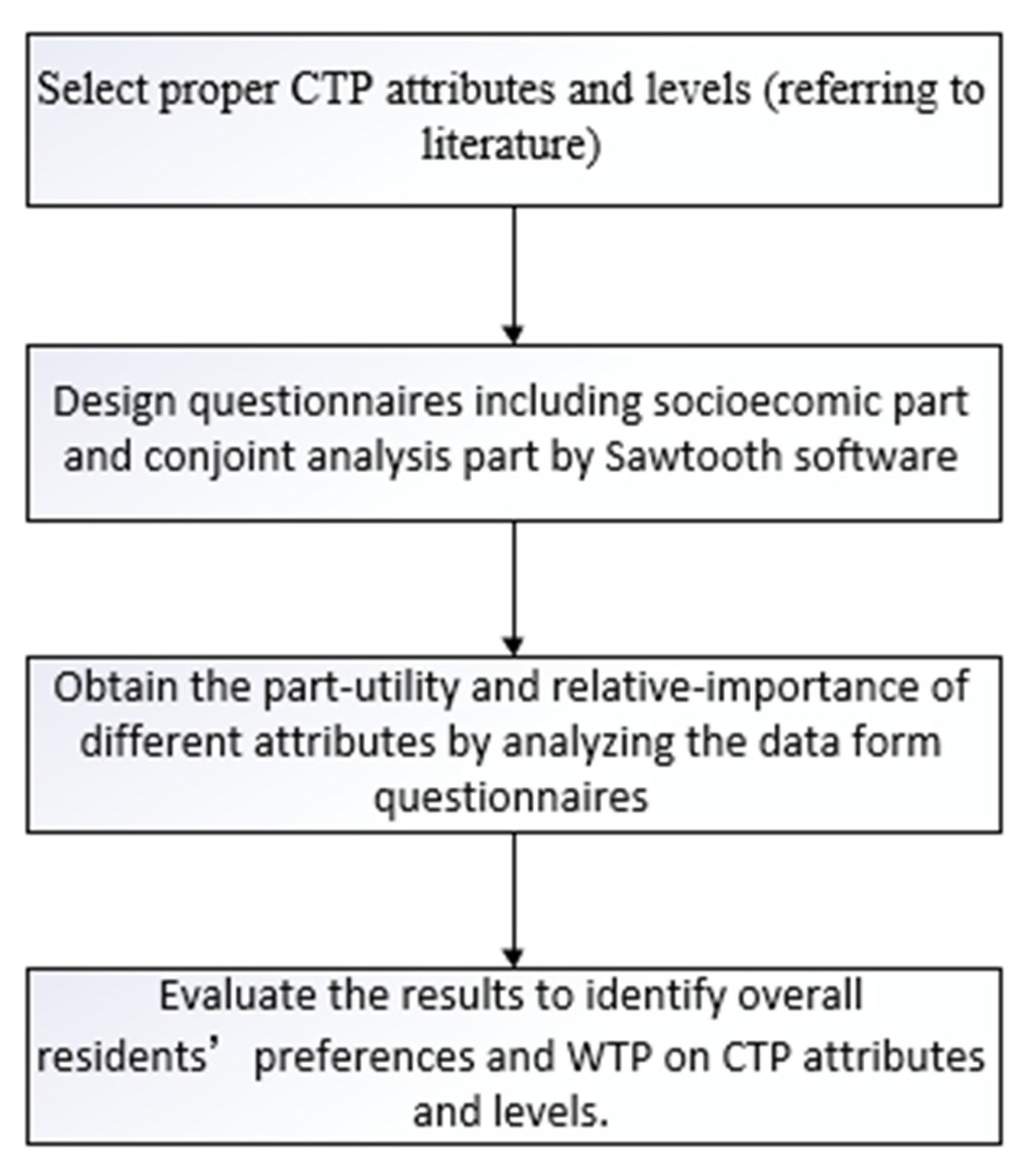

Table 1.
Specific attributes and levels of CBCA experiment.
| Attributes | Levels |
| Use of carbon tax revenue | General tax budget |
| Subsidies/grants for clean energy technology | |
| Subsidies/grants for low-carbon technologies or CCUS | |
| Carbon tax policy implementers | Bank |
| Energy Supplier | |
| Government | |
| Transparency of carbon tax policy implementation process | No process report |
| Report regularly on the official website | |
| Regularly report on the official website under the supervision of an independent third party | |
| Cost of carbon tax (CNY) | 150 |
| 350 | |
| 700 | |
| 1200 | |
| 2000 |
3.4. Mathematical model & Data processing
The findings of the conjoint process of the survey were analyzed for all of the samples and by complying with 12 different social-demographic and personal variables. A function of Shanghai residents’ preference was evaluated from the CBCA data by multinomial logit function. The function calculated the importance of the respective attribute relative to the other attributes in decision making, as well as the part utility for each level of the attributes.
The part-worth utilities denote a value explaining the importance of each attributes' level for the respondents. They are measured on an interval scale of arbitrary origin, so it is meaningless to compare the values of utility at different levels of the attribute. Expressing the utility of partial values in monetary terms is a common way of making them easier to understand. Researchers always set price as a reference attribute in conjoint analysis experiments to calculate how much respondents are willing to pay to improve the level of other attributes. The monetary equivalent of the difference in utility represents the willingness to pay for a unit of utility change. It is considered to be an estimate that helps to evaluate the utility gap at different levels. It is worth noting that the WTP reveals the difference between the two levels, rather than referring to the value of a particular level. The lowest utility level can be set as the baseline value for willingness to pay in the same attribute, and other levels are shown as differences from the baseline value. In addition, relative importance is used to indicate the importance of different attributes to respondents. The value of relative importance is determined by the difference between the highest and lowest utility levels within an attribute.
4. Results and discussions
In this section, the data from the questionnaire and the results from the Sawtooth software analysis process is presented.
4.1. Socioeconomic characteristics of respondents
The data shown in Table 2 consists of the percentage of 805 valid respondents with different socioeconomic characteristics. In order to ensure that the respondents selected for the questionnaire were as close to the reality as possible, we asked WJX to control the proportion of overall respondents according to the proportion of residents with different education levels (high school and below, bachelor and above) obtained from the Shanghai census as much as possible.
It is found that those who believed they are affected by climate change amount to 96.77%, but only 82.61% are aware of the carbon tax policy. This indicates that not all people who are aware of climate change are aware of the details of the carbon tax policy, and there is a need for further dissemination of the carbon tax policy.
4.2. Relative Importance
The result about overall Shanghai residents’ CTP preferences is listed in Figure 4(a). According to Figure 4(a), the critical attribute to the respondents is the Annal cost of the carbon tax policy (48.87%). The second critical attribute is transparency of the carbon tax policy implementation process (24.72%), followed by Use of carbon tax revenue (16.68%) and Carbon tax policy implementers (9.73%). It is easy to find that among the three non-price attributes the relative importance of transparency to residents is at least 50% more than the other attributes. In other words, improving the transparency of carbon tax policy is the most effective way to increase the acceptance of carbon tax policy by the public.
Fig.4 (b)-(d) appeared that the relative importance of different CTP attributes for residents with different understanding level of CTP. From Fig.4 (b) to Fig.4(d), residents’ understanding level of CTP improved from “None” to “Clear”. It is revealed that “Use of carbon tax revenue” and “Carbon tax policy implementers” have similar relative importance of about 18% and 10%, respectively, among residents with different perceptions of CTP. In contrast to the performance of these two CTP attributes, the relative importance of the other attributes changed as residents' knowledge of CTP increased. The relative importance of “Cost of CTP” (50.45%) was much higher for the group with no knowledge of CTP than for the other two groups with knowledge of CTP. And as the understanding level of CTP improved from "some" to "clear", the relative importance of Cost of CTP decreases from 49.75% to 40.65%. In complete contrast to this trend, the relative importance of “Transparency of carbon tax policy implementation process” rises as the level of understanding of CTP rises. For level from "None" to "Clear", the relative importance is ordered as 20.7%, 24.41% and 29.85%. This result clearly shows that as people's understanding of carbon tax policies increases, their sensitivity to the cost of carbon taxes decreases and their demand for transparency in the implementation of carbon tax policies increases. This may be due to the fact that people are less stingy in spending on carbon taxes because they certainly agree that paying carbon taxes can improve the environment and climate. But accordingly, the demand for various attributes of CTP is bound to increase after people fully understand it, especially transparency. Similar to our results, some scholars have identified a lack of trust in government and its processes as a potential barrier to carbon pricing and other environmental policies (Klenert et.al, 2018; Rafaty,2018). Klok et.al. (2006) point out that the implementers of a carbon tax should have a better understanding of the effect of the tax, i.e., whether the required carbon dioxide emission reductions are achieved, as well as informing the public about the tax and making it easier to understand. Furthermore,Carattini et al. (2017) found that public acceptance of carbon taxes increases when there is transparency in the benefits and policy outcomes. Transparency in expected environmental effectiveness can even reduce the need for earmarking, demonstrating that the need for transparency is prioritized over the need for earmarking carbon tax revenues for the population. Based on these results, we propose that policy transparency is the most important CTP attribute and will become even more important in the future as society's understanding of carbon taxes continues to advance.
4.3. Willingness to pay for CTP
Table.3 reveals the total willingness to pay (WTP) for different levels of the carbon tax policy. Compared with putting carbon tax revenue into the General tax budget, respondents in Shanghai are willing to pay more than 500 CNY/year to change the use of revenue to invest in low-carbon technologies or clean energy technologies. In terms of carbon tax policy transparency, respondents expressed their preference with a WTP of more than 1,000 CNY/year. In other words, people are willing to pay more 1000 CNY/year in exchange for reasonable disclosure of the carbon tax collection and use process. In particular, the improvement of the transparency attribute has led to a significant increase in the public's WTP for the carbon tax, which is a testament to the importance of open acceptance in the implementation of the CTP. In addition, it is shown that the government is the best implementer in the residents’ opinion.
Since China does not have a carbon tax system in place, many studies have focused on investigating the willingness of the Chinese population to pay a carbon tax to confirm their acceptance of the CTP. A 2009-2010 study of Chinese residents' carbon tax preferences in four regions of China reported that Chinese residents' willingness to pay a carbon tax was about 230 CNY per year (Duan et.al, 2014), while a 2012 study in Suzhou noted that the carbon tax WTP increased to 396 CNY per year (Yang et.al, 2014). Matthew Winden et.al (2018) conducted a comparative study of Chinese and U.S. willingness to pay a carbon tax, showing that Chinese adults' willingness to pay a carbon tax was about 1252.8 CNY, while U.S. adults' willingness to pay a carbon tax was about 4054.97CNY in 2017. According to the findings of these studies, the Chinese population's willingness to pay has been increasing year over year. Assuming that each carbon tax attribute level has an equal chance of being combined into China's carbon tax policies, then the overall mean increase in WTP for carbon tax would be 1435.28 CNY. Our study calculates a mean increase in WTP gained through improved carbon tax policy attributes that is slightly higher than the WTP of Chinese adults on carbon taxes in 2017.
Table 4 shows the difference in the WTP for Carbon tax for people with different educational levels. In contrast to the findings of previous studies, we find that adults with educational levels below high school are able to obtain a higher WTP for carbon tax (1652 CNY) after improving their understanding of carbon tax attributes. It is not difficult to find that the reason for their larger average WTP increase than those with higher educational levels is their enthusiasm for using carbon tax revenue to support low carbon and clean energy technologies. But the more important factor remains the transparency attribute of the carbon tax policy, which is regarded as the most desirable attribute by people with any level of education which is demonstrated by improving the level of WTP of this attribute.
Table 5 shows that residents with different family disposable income have different performance on the WTP for improving the carbon tax attributes. It shows that members of households with an annual disposable household income between 30,000 and 50,000CNY show a greater interest in investing carbon tax revenues in areas related to low carbon and new energy technologies. In addition, we analyzed the WTP composition of other groups and found that improving the transparency of carbon tax policies is still the most effective means of increasing residents’ WTP because that improved transparency yields the greatest increase in WTP.
Table 6 shows the WTP of residents with different understanding levels of CTP. It is found that when the residents' Understanding level of CTP is raised from "None" to "Some", the mean WTP will increase from 1072.16 CNY to and the "Clear" level corresponds to the highest WTP (3246.18CNY). This proves that increasing the public's awareness of the carbon tax policy can significantly increase their willingness to pay the carbon tax and thus increase the carbon tax revenue to further promote the development of low carbon and new energy technologies. This positive stimulus is significant for carbon tax policies. Similar to our results, a study of Chinese university students found that environmental concern and support for carbon tax policies were positively correlated. In addition, Table 4 reveals that the increase in willingness to pay for carbon tax is mainly concentrated on the attributes "Use of carbon tax revenue" and "Transparency of CTP implementation process". At the same time, the higher the level of understanding of carbon tax, the greater the increase in WTP with the improvement of carbon tax attributes, especially the increase of "Transparency" from "No process report" to "Report regularly on the official process". This part of the data shows that improving the transparency of the carbon taxation process significantly increases the WTP and the effect is more pronounced for people with a higher level of understanding of the CTP. Similarly, studies have shown that improving the transparency of fees in solid waste recycling in Africa is effective in increasing confidence and willingness to pay (Awunyo-Vitor et.al, 2013), and Capasso (2021) shows that improving Fiscal transparency increases Tax morale. Furthermore, Sun et al. (2016) suggest that the new Chinese government should establish some mechanisms to improve the transparency of environmental governance. It can promote residents' support for environmental issues. Compared with these studies, our findings further quantify the environmental and economic benefits that can be gained by improving the transparency of CTP and raising the population's understanding level of CTP which will enhance the determination of policymakers to combat environmental problems through carbon tax policies.
Table 6.
Willingness to pay for different levels of all attributes (respondents with different understanding of carbon tax).
Table 6.
Willingness to pay for different levels of all attributes (respondents with different understanding of carbon tax).
| Attributes | Levels | Willingness to pay | |||
| Understanding of carbon tax (CNY) | |||||
| None | Some | Clear | |||
| Use of carbon tax revenue | General tax budget | 0 | 0 | 0 | |
| Subsidies/grants for clean energy technology | 442.13 | 455.66 | 979.07 | ||
| Subsidies/grants for low-carbon technologies or CCUS | 342.12 | 554.78 | 1749.54 | ||
| Carbon tax policy implementers | Bank | 0.00 | 0.00 | 0.00 | |
| Energy Supplier | 123.40 | 158.68 | 86.41 | ||
| Government | 335.19 | 420.21 | 478.93 | ||
| Transparency of carbon tax policy implementation process | No process report | 0.00 | 0.00 | 0.00 | |
| Report regularly on the official website | 850.72 | 1010.37 | 2847.26 | ||
| Regularly report on the official website under the supervision of an independent third party | 1122.91 | 1342.81 | 3597.32 | ||
| Total | Mean | 1072.16 | 1314.17 | 3246.18 | |
5. Conclusion a5. 5.Conclusion and Suggestions
In this study, we utilized conjoint analysis to assess the significance of Carbon Tax Policy (CTP) attributes among Shanghai residents with varying levels of CTP understanding. We also analyzed overall and group-specific Willingness to Pay (WTP) for different CTP attribute levels.
Data on CTP preferences were collected through questionnaires, and analysis was conducted using a mathematical model in Sawtooth software. Our key findings are as follows:
1. While 96.77% of respondents acknowledge climate change impacts, only 82.61% are aware of carbon tax policy, indicating potential for heightened awareness.
2. Among Shanghai residents, the annual cost of carbon tax policy was most critical (48.87%), followed by transparency in policy implementation (24.72%), carbon tax revenue use (16.68%), and policy implementers' identity (9.73%).
3. Increased public awareness of carbon tax policies substantially raises WTP, augmenting carbon tax revenues and fostering low-carbon and new energy technology development.
4. Contrary to expectations, residents with lower education levels show comparable WTP for carbon tax, with high school-educated individuals favoring carbon tax revenue investment in low-carbon and new energy technology.
5. As household disposable income rises, WTP for enhancing CTP transparency increases significantly.
6. Enhancing transparency, from no progress reporting to regular official website reporting, could increase WTP by 2847.26 CNY, underlining the significant impact of improving transparency on WTP, particularly among those with better CTP understanding.
This study contributes to understanding preferred CTP attribute levels among Chinese residents. WTP assessments can aid policymakers in optimizing carbon tax policy attributes. It is crucial to enhance public awareness alongside improving carbon tax policy attributes.
Future research should explore potential variations in CTP preferences among residents in other Chinese regions, considering economic and educational differences. Adding preference surveys in future studies will provide a broader understanding of national CTP preferences.References
Conflicts of Interest
The authors declare no conflicts of interest.
Appendix A
Questionnaire 1
We are conducting a survey which examines public preferences on the Carbon Tax Policy. We sincerely hope that you can spend a few minutes on this survey, and we would definitely value your opinions! Your identity and answers are absolutely confidential! (Since minors under the age of 16 are not allowed to participate in labor to obtain remuneration in China and have the ability to pay expenses, we require the questionnaire company to distribute the questionnaire to Shanghai citizens who are not younger than 16 years old)
- Sociodemographic characteristics part.
- 1.Gender: Female,Male
- 2.Age:16-30,31-45,46-60,>60
- 3.Marriage:married, single
- 4.Education level:Middle School, High School,Bachelor’s degree,Above bachelor’s degree
- 5.Number of family members: 1, 2, 3, 4, 5, 6, >6
- 6.Residence: Urban, Rural
- 7.Family disposable income per year (CNY): 0-30000, 30000-50000, 50000-100000, 100000-200000, >200000, Inconvenient
- 8.Annual electricity consumption: 0-1000, 1000-2500, 2500-5000, >5000
- 9.Annual gas consumption: 0-800, 800-1500, 1500-3000, >3000
- 10.Annual gasoline consumption: 0-2500, 2500-5000, 5000-10000, >10000
- 11.How to Consider the Impact of Climate Change on Your Life: None, little, some, huge.
- 12.How to evaluate your understanding on carbon tax: None, some, clearly.
- A explanation of policy attributes and classification is as follows:
- The purpose of Use of carbon tax revenue: 1. General tax budget (the income treasury is redistributed according to the will of the state)
- 2. Subsidies/grants for clean energy technology (to encourage the development of new technologies for low carbon dioxide emissions and new bases for absorbing and storing carbon dioxide in the air)
- 3. Subsidies/grants for low-carbon technologies or CCUS (encourage the development of new energy technologies that do not emit carbon dioxide and other pollutants)
- Carbon tax collectors: 1. Energy companies
- 2. Bank
- 3. Government
- The method of disclosure of the carbon tax policy implementation process:
- 1. No process report (the process and data will not be disclosed to the public throughout the process)
- 2. Report regularly on the official website (provide the relevant process and data of carbon tax collection by quarter or year)
- 3. Regularly report on the official website under the supervision of an independent third party (provide carbon tax collection-related progress and data on a quarterly or annual basis under the supervision of a non-interested third-party)
- Cost of carbon tax (CNY): the amount of additional fees paid on energy expenditures and other fee related to carbon emission each year
- Next part is Choice-based conjoint analysis part. Please pick one option from each question. And all of the options indicated four attributes as follow: Use of Carbon Tax Revenue, Carbon tax policy implementers, Transparency of carbon tax policy implementation process and Cost of Carbon Tax.
- 1.Which of the following carbon tax policies do you prefer?
- A. Subsidies/grants for low-carbon technologies or CCUS, Energy Supplier, No process report,700 CNY
- B. Subsidies/grants for clean energy technology, Energy Supplier, no process report, 150 CNY
- C. General tax budget, Government, Regularly report on the official website under the supervision of an independent third party, 1200 CNY
- D. Subsidies/grants for low-carbon technologies or CCUS, Bank, Regularly report on the official website under the supervision of an independent third party, 1200 CNY
- 2.Which of the following carbon tax policies do you prefer?
- A. General tax budget, Bank, Regularly report on the official website under the supervision of an independent third party, 150 CNY
- B. General tax budget, Government, Regularly report on the official website under the supervision of an independent third party, 150 CNY
- C. Subsidies/grants for clean energy technology, Government, No process report, 2000 CNY
- D. Subsidies/grants for low-carbon technologies or CCUS, Government, Report regularly on the official website, 700 CNY
- 3.Which of the following carbon tax policies do you prefer?
- A. Subsidies/grants for clean energy technology, Government, Report regularly on the official website, 700 CNY
- B. Subsidies/grants for clean energy technology, Bank, Regularly report on the official website under the supervision of an independent third party, 350 CNY
- C. Subsidies/grants for low-carbon technologies or CCUS, Energy Supplier
- Regularly report on the official website under the supervision of an independent third party, 2000 CNY
- General tax budget, Government, No process report, 150 CNY
- 4.Which of the following carbon tax policies do you prefer?
- A. Subsidies/grants for low-carbon technologies or CCUS, Government, Regularly report on the official website under the supervision of an independent third party, 2000 CNY
- B. General tax budget, Bank, Report regularly on the official website, 2000 CNY
- C. Subsidies/grants for low-carbon technologies or CCUS, Bank, No process report, 350 CNY
- D. General tax budget, Energy Supplier, No process report, 1200 CNY
- 5.Which of the following carbon tax policies do you prefer?
- A. Subsidies/grants for clean energy technology, Bank, No process report, 150 CNY
- B. Subsidies/grants for low-carbon technologies or CCUS, Government, No process report, 1200 CNY
- C. Subsidies/grants for clean energy technology, Energy Supplier, Report regularly on the official website, 1200 CNY
- D. Subsidies/grants for low-carbon technologies or CCUS, Energy Supplier, Regularly report on the official website under the supervision of an independent third party, 700 CNY
- 6.Which of the following carbon tax policies do you prefer?
- A. Subsidies/grants for clean energy technology, Government, Report regularly on the official website, 350 CNY
- B. Subsidies/grants for clean energy technology, Energy Supplier, Regularly report on the official website under the supervision of an independent third party, 1200 CNY
- C. General tax budget, Energy Supplier, Regularly report on the official website under the supervision of an independent third party, 150 CNY
- D. General tax budget, Bank, Report regularly on the official website, 150 CNY
- 7.Which of the following carbon tax policies do you prefer?
- A. General tax budget, Government, No process report, 350 CNY
- B. Subsidies/grants for clean energy technology, Bank, No process report, 700 CNY
- C. Subsidies/grants for clean energy technology, Energy Supplier, Regularly report on the official website under the supervision of an independent third party, 700 CNY
- D. Subsidies/grants for low-carbon technologies or CCUS, Government, Regularly report on the official website under the supervision of an independent third party, 1200 CNY
- 8. Which of the following carbon tax policies do you prefer?
- A. Subsidies/grants for low-carbon technologies or CCUS, Government, Report regularly on the official website, 1200 CNY
- B. Subsidies/grants for clean energy technology, Bank, No process report, 700 CNY
- C. Subsidies/grants for low-carbon technologies or CCUS, Bank, Regularly, Report on the official website under the supervision of an independent third party, 700 CNY
- D. General tax budget, Energy Supplier, No process report, 350 CNY
- 9.Which of the following carbon tax policies do you prefer?
- A. Subsidies/grants for clean energy technology, Government, Regularly, Report on the official website under the supervision of an independent third party, 2000 CNY
- B. Subsidies/grants for low-carbon technologies or CCUS, Energy Supplier, No process report, 150 CNY
- C. General tax budget, Government, Report regularly on the official website, 350 CNY
- D. General tax budget, Bank, No process report, 2000 CNY
- 10.Which of the following carbon tax policies do you prefer?
- A. Subsidies/grants for low-carbon technologies or CCUS, Energy Supplier, Report regularly on the official website, 2000 CNY
- B. Subsidies/grants for low-carbon technologies or CCUS, Bank, Report regularly on the official website, 350 CNY
- C. Subsidies/grants for clean energy technology, Government, No process report, 700 CNY
- D. General tax budget, Bank, Regularly report on the official website under the supervision of an independent third party, 700 CNY
- 11.Which of the following carbon tax policies do you prefer?
- A. Subsidies/grants for clean energy technology, Energy Supplier, Report regularly on the official website, 350 CNY
- B. Subsidies/grants for clean energy technology, Bank, Report regularly on the official website, 150 CNY
- C. General tax budget, Government, Report regularly on the official website, 2000 CNY
- D. General tax budget, Energy Supplier, Regularly report on the official website under the supervision of an independent third party, 1200 CNY
- 12.Which of the following carbon tax policies do you prefer?
- A. Subsidies/grants for low-carbon technologies or CCUS, Bank, Regularly report on the official website under the supervision of an independent third party, 2000 CNY
- B. Subsidies/grants for clean energy technology, Government, No process report, 350 CNY
- C. General tax budget, Energy Supplier, No process report, 150 CNY
- D. Subsidies/grants for clean energy technology, Bank, Regularly report on the official website under the supervision of an independent third party, 700 CNY
Appendix B
Questionnaire 2
We are conducting a survey which examines public preferences on the Carbon Tax Policy. We sincerely hope that you can spend a few minutes on this survey, and we would definitely value your opinions! Your identity and answers are absolutely confidential! (Since minors under the age of 16 are not allowed to participate in labor to obtain remuneration in China and have the ability to pay expenses, we require the questionnaire company to distribute the questionnaire to Shanghai citizens who are not younger than 16 years old)
- Sociodemographic characteristics part.
- Gender: Female,Male
- Age:16-30,31-45,46-60,>60
- Marriage:married, single
- Education level:Middle School, High School,Bachelor’s degree,Above bachelor’s degree
- Number of family members: 1, 2, 3, 4, 5, 6, >6
- Residence: Urban, Rural
- Family disposable income per year (CNY): 0-30000, 30000-50000, 50000-100000, 100000-200000, >200000, Inconvenient
- Annual electricity consumption: 0-1000, 1000-2500, 2500-5000, >5000
- Annual gas consumption: 0-800, 800-1500, 1500-3000, >3000
- Annual gasoline consumption: 0-2500, 2500-5000, 5000-10000, >10000
- How to Consider the Impact of Climate Change on Your Life: None, little, some, huge.
- How to evaluate your understanding on carbon tax: None, some, clearly.
- A explanation of policy attributes and classification is as follows:
- The purpose of Use of carbon tax revenue: 1. General tax budget (the income treasury is redistributed according to the will of the state)
- 2. Subsidies/grants for clean energy technology (to encourage the development of new technologies for low carbon dioxide emissions and new bases for absorbing and storing carbon dioxide in the air)
- 3. Subsidies/grants for low-carbon technologies or CCUS (encourage the development of new energy technologies that do not emit carbon dioxide and other pollutants)
- Carbon tax collectors: 1. Energy companies
- 2. Bank
- 3. Government
- The method of disclosure of the carbon tax policy implementation process: 1. No process report (the process and data will not be disclosed to the public throughout the process)
- 2. Report regularly on the official website (provide the relevant process and data of carbon tax collection by quarter or year)
- 3. Regularly report on the official website under the supervision of an independent third party (provide carbon tax collection-related progress and data on a quarterly or annual basis under the supervision of a non-interested third-party)
- Cost of carbon tax (CNY): the amount of additional fees paid on energy expenditures and other fee related to carbon emission each year
- Next part is Choice-based conjoint analysis part. Please pick one option from each question. And all of the options indicated four attributes as follow: Use of Carbon Tax Funds, Carbon tax policy implementers, Transparency of carbon tax policy implementation process and Cost of Carbon Tax.
- Which of the following carbon tax policies do you prefer?
- A. Subsidies/grants for clean energy technology, Bank, Regularly report on the official website under the supervision of an independent third party, 700 CNY
- B. General tax budget, Government, No process report, 700 CNY
- C. General tax budget, Bank, No process report, 2000 CNY
- D. Subsidies/grants for low-carbon technologies or CCUS, Government, Report regularly on the official website, 150 CNY
- Which of the following carbon tax policies do you prefer?
- A. Subsidies/grants for low-carbon technologies or CCUS, Energy Supplier, Regularly report on the official website under the supervision of an independent third party, 350 CNY
- B. Subsidies/grants for low-carbon technologies or CCUS, Bank, No process report, 700 CNY
- C. Subsidies/grants for clean energy technology, Government, No process report, 150 CNY
- D. Subsidies/grants for clean energy technology, Energy Supplier, Report regularly on the official website, 350 CNY
- Which of the following carbon tax policies do you prefer?
- A. General tax budget, Bank, Report regularly on the official website, 1200 CNY
- B. Subsidies/grants for clean energy technology, Energy Supplier, No process report, 2000 CNY
- C. Subsidies/grants for clean energy technology, Bank, Regularly report on the official website under the supervision of an independent third party, 700 CNY
- D. Subsidies/grants for low-carbon technologies or CCUS, Bank, No process report, 350 CNY
- Which of the following carbon tax policies do you prefer?
- A. General tax budget, Energy Supplier, Report regularly on the official website, 2000 CNY
- B. Subsidies/grants for clean energy technology, Government, Regularly report on the official website under the supervision of an independent third party, 350 CNY
- C. Subsidies/grants for low-carbon technologies or CCUS, Government, No process report, 350 CNY
- D. Subsidies/grants for low-carbon technologies or CCUS, Energy Supplier, Regularly report on the official website under the supervision of an independent third party, 150 CNY
- Which of the following carbon tax policies do you prefer?
- A. Subsidies/grants for clean energy technology, Energy Supplier, No process report, 1200 CNY
- B. General tax budget, Energy Supplier, Report regularly on the official website, 700 CNY
- C. Subsidies/grants for low-carbon technologies or CCUS, Government, Report regularly on the official website, 150 CNY
- D. General tax budget, Bank, Regularly report on the official website under the supervision of an independent third party, 350 CNY
- Which of the following carbon tax policies do you prefer?
- A. General tax budget, Government, No process report, 700 CNY
- B. Subsidies/grants for clean energy technology, Bank, No process report, 1200 CNY
- C. Subsidies/grants for low-carbon technologies or CCUS, Energy Supplier
- Report regularly on the official website, 350 CNY
- D. Subsidies/grants for low-carbon technologies or CCUS, Government, Report regularly on the official website, 2000 CNY
- Which of the following carbon tax policies do you prefer?
- A. General tax budget, Government, No process report, 350 CNY
- B. Subsidies/grants for clean energy technology, Bank, No process report, 700 CNY
- C. Subsidies/grants for clean energy technology, Energy Supplier, Regularly report on the official website under the supervision of an independent third party, 700 CNY
- D. Subsidies/grants for low-carbon technologies or CCUS, Government, Regularly report on the official website under the supervision of an independent third party, 1200 CNY
- Which of the following carbon tax policies do you prefer?
- A. General tax budget, Bank, No process report, 150 CNY
- B. Subsidies/grants for low-carbon technologies or CCUS, Energy Supplier
- No process report, 700 CNY
- C. Subsidies/grants for clean energy technology, Bank, Regularly report on the official website under the supervision of an independent third party, 1200 CNY
- D. Subsidies/grants for clean energy technology, Government, Regularly report on the official website under the supervision of an independent third party, 2000 CNY
- Which of the following carbon tax policies do you prefer?
- A. General tax budget, Energy Supplier, Regularly report on the official website under the supervision of an independent third party, 350 CNY
- B. Subsidies/grants for clean energy technology, Bank, Report regularly on the official website, 150 CNY
- C. Subsidies/grants for clean energy technology, Government, Regularly report on the official website under the supervision of an independent third party, 1200 CNY
- D. Subsidies/grants for low-carbon technologies or CCUS, Bank, Report regularly on the official website, 2000 CNY
- Which of the following carbon tax policies do you prefer?
- A. General tax budget, Government, No process report, 700 CNY
- B. Subsidies/grants for low-carbon technologies or CCUS, Bank, Regularly report on the official website under the supervision of an independent third party, 2000 CNY
- C. Subsidies/grants for low-carbon technologies or CCUS, Energy Supplier
- No process report, 1200 CNY
- D. General tax budget, Energy Supplier, Report regularly on the official website, 700 CNY
- Which of the following carbon tax policies do you prefer?
- A. Subsidies/grants for clean energy technology, Bank, Report regularly on the official website, 2000 CNY
- B. Subsidies/grants for low-carbon technologies or CCUS, Government, Regularly report on the official website under the supervision of an independent third party, 150 CNY
- C. General tax budget, Government, Report regularly on the official website, 1200 CNY
- D. Subsidies/grants for clean energy technology, Energy Supplier, Regularly report on the official website under the supervision of an independent third party, 350 CNY
- Which of the following carbon tax policies do you prefer?
- A. Subsidies/grants for low-carbon technologies or CCUS, Bank, Regularly report on the official website under the supervision of an independent third party, 2000 CNY
- B. Subsidies/grants for clean energy technology, Government, No process report, 350 CNY
- C. General tax budget, Energy Supplier, No process report, 150 CNY
- D. Subsidies/grants for clean energy technology, Bank, Regularly report on the official website under the supervision of an independent third party, 700 CNY
References
- Alriksson S, Öberg T.,2008, Conjoint analysis for environmental evaluation[J]. Environmental Science and Pollution Research, 15(3): 244-257. [CrossRef]
- Anna Alberini, Andrea Bigano, Milan Ščasný, Iva Zvěřinová,,2018, Preferences for Energy Efficiency vs. Renewables: What Is the Willingness to Pay to Reduce CO2 Emissions? Ecological Economics,Vol 144,Pages 171-185. [CrossRef]
- Awunyo-Vitor, D. , Ishak, S., & Seidu Jasaw, G., 2013. Urban Households' willingness to pay for improved solid waste disposal services in Kumasi Metropolis, Ghana. Urban Studies Research, 2013. [CrossRef]
- Beggs S, Cardell S, Hausman J. 1981, Assessing the potential demand for electric cars[J]. Journal of econometrics, 17(1): 1-19. [CrossRef]
- Benavente, J. M. G. ,2016. Impact of a carbon tax on the Chilean economy: A computable general equilibrium analysis. Energy economics, 57, 106-127. [CrossRef]
- Beuermann, C. , & Santarius, T. 2006. Ecological tax reform in Germany: handling two hot potatoes at the same time. Energy Policy, 34(8), 917-929. [CrossRef]
- Bigsby, H., L.K.J.F.P.J. Ozanne, 2002.The purchase decision: Consumers and environmentally certified wood products. 52(7/8): p. 100-105. https://www.researchgate.net/publication/279714262.
- Bourgeois, C. , Giraudet, L. G., Quirion, P. 2021. Lump-sum vs. energy-efficiency subsidy recycling of carbon tax revenue in the residential sector: A French assessment. Ecological Economics, 184, 107006. [CrossRef]
- Capasso, S. , Cicatiello, L., De Simone, E., Gaeta, G. L., & Mourão, P. R., 2021. Fiscal transparency and tax ethics: does better information lead to greater compliance? Journal of Policy Modeling, 43(5), 1031-1050. [CrossRef]
- Carattini, S. , Kallbekken S. 2019, Orlov A. How to win public support for a global carbon tax. Nature, 565 (7739), pp. 289-29. [CrossRef]
- Carattini, S. , Baranzini, A., Thalmann, P., Varone, F., & Vöhringer, F., 2017. Green taxes in a post-Paris world: are millions of nays inevitable? Environmental and Resource Economics, 68(1), 97-128. [CrossRef]
- Carattini, S. , Carvalho, M., & Fankhauser, S. (2018). Overcoming public resistance to carbon taxes. Wiley Interdisciplinary Reviews: Climate Change, 9(5), e531. [CrossRef]
- Chang W Y, Wang S, Song X, et al. 2022. Economic effects of command-and-control abatement policies under China's 2030 carbon emission goal[J]. Journal of Environmental Management, 312: 114925. [CrossRef]
- Crowley K. 2017. Up and down with climate politics 2013–2016: The repeal of carbon pricing in Australia Wiley Interdiscip. Rev. Clim. Change, 8 (3) (2017), Article e458.
- Daniels R F, Hensher D A. ,2000, Valuation of environmental impacts of transport projects: The challenge of self-interest proximity[J]. Journal of transport economics and policy: 189-214. https://www.jstor.org/stable/20053839.
- Di Cosmo V, Hyland M. 2013, Carbon tax scenarios and their effects on the Irish energy sector[J]. Energy Policy, 59: 404-414. http://aei.pitt.edu/id/eprint/87947.
- Douenne, T. , Fabre, A, 2020, French attitudes on climate change, carbon taxation and other climate policies. Ecological Economics, 169, 106496. [CrossRef]
- Douenne, T. , Fabre, A. 2022. Yellow vests, pessimistic beliefs, and carbon tax aversion. American Economic Journal: Economic Policy, 14(1), 81-110. [CrossRef]
- Duan, H. X. , Yan-Li, L., & Yan, L., 2014. Chinese public’s willingness to pay for CO2 emissions reductions: A case study from four provinces/cities. Advances in Climate Change Research, 5(2), 100-110. [CrossRef]
- E. Saez. 2009. Tax Incidence and Efficiency Costs of Taxation[J]. https://eml.berkeley.edu/~saez/course131/taxincidence_ch19.pdf (accessed 18 October 2022).
- E.S. Shmelev, S.U. Speck, 2018, Green fiscal reform in Sweden: econometric assessment of the carbon and energy taxation scheme Renew. Sustain. Energy Rev., 90, pp. 969-981. [CrossRef]
- Eliasson J, Proost S. 2015. Is sustainable transport policy sustainable? [J]. Transport Policy, 37: 92-100. [CrossRef]
- Fabre, A. , Douenne T., 2019, Can We Reconcile French People with the Carbon Tax? Disentangling Beliefs from Preferences. https://ideas.repec.org/p/fae/wpaper/2019.10.html.
- Farrell, N. 2017, What factors drive inequalities in carbon tax incidence? Decomposing socioeconomic inequalities in carbon tax incidence in Ireland[J]. Ecological Economics, 142: 31-45. [CrossRef]
- Fu, K. , Li Y., Mao H., 2022. Firms’ production and green technology strategies: The role of emission asymmetry and carbon taxes[J]. European Journal of Operational Research. [CrossRef]
- Gao, S., M. Smits, and C. Wang, A conjoint analysis of corporate preferences for the sectoral crediting mechanism: a case study of Shanxi Province in China. Journal of Cleaner Production, 2016. 131: p. 259-269. [CrossRef]
- Green P E, Rao V R., 1971, Conjoint measurement-for quantifying judgmental data[J]. Journal of Marketing research, 8(3): 355-363. [CrossRef]
- Hammerle, M. , Best, R., & Crosby, P. 2021. Public acceptance of carbon taxes in Australia. Energy Economics, 101, 105420. [CrossRef]
- Hao J, Gao F, Fang X, et al. 2022. Multi-factor decomposition and multi-scenario prediction decoupling analysis of China's carbon emission under dual carbon goal[J]. Science of The Total Environment: 156788.
- Huang G, Xu Z, Qu X, et al. 2022. Critical climate issues toward carbon neutrality targets[J]. Fundamental Research, 2(13), 396-400 2022. [CrossRef]
- International Monetary Fund. 2019. Fiscal Monitor: How to Mitigate Climate Change https://www.imf.org/en/Publications/FM/Issues/2019/09/12/fiscal-monitor-october-2019 (accessed 18 October 2022).
- J. McEldowney, D. Salter, 2015. Environmental taxation in the UK: the climate change levy and policy making Denning Law[J], vol 28, pp. 37-65. [CrossRef]
- Johnson R, M. 1974, Trade-off analysis of consumer values[J]. Journal of marketing research, 11(2): 121-127. [CrossRef]
- Kallbekken, S. , Kroll, S., Cherry, T. L.,2011, Do you not like Pigou, or do you not understand him? Tax aversion and revenue recycling in the lab. Journal of Environmental Economics and Management, 62(1), 53-64. [CrossRef]
- Khastar, M. , Aslani, A., & Nejati, M., 2020. How does carbon tax affect social welfare and emission reduction in Finland?. Energy Reports, 6, 736-744. [CrossRef]
- Klenert, D. , Mattauch, L., Combet, E., Edenhofer, O., Hepburn, C., Rafaty, R., & Stern, N. 2018. Making carbon pricing work for citizens. Nature Climate Change, 8(8), 669-677. [CrossRef]
- Klok, J. , Larsen, A., Dahl, A., & Hansen, K. 2006. Ecological tax reform in Denmark: history and social acceptability. Energy Policy, 34(8), 905-916. [CrossRef]
- Kotchen, M. J. , Boyle, K. J., Leiserowitz, A. A.,2013. Willingness-to-pay and policy-instrument choice for climate-change policy in the United States. Energy Policy, 55, 617-625. [CrossRef]
- L. Ionescu, 2020, The economics of the carbon tax: environmental performance, sustainable energy, and green financial behavior Geopolit. Hist. Int. Relat., 12 (1), pp. 101-107. [CrossRef]
- Lieder M, Asif F M A, Rashid A, 2018, A conjoint analysis of circular economy value propositions for consumers: Using “washing machines in Stockholm” as a case study[J]. Journal of cleaner production, 172: 264-273. [CrossRef]
- Liu Y, Cirillo C. 2016, Evaluating policies to reduce greenhouse gas emissions from private transportation[J]. Transportation Research Part D: Transport and Environment, 44: 219-233. [CrossRef]
- Maestre-Andrés, S. , Drews, S., & van den Bergh, J. 2019. Perceived fairness and public acceptability of carbon pricing: a review of the literature. Climate policy, 19(9), 1186-1204. [CrossRef]
- Montag, J. 2015. The simple economics of motor vehicle pollution: A case for fuel tax[J]. Energy Policy, 85: 138-149. [CrossRef]
- Mori, K. 2012. Modeling the impact of a carbon tax: A trial analysis for Washington State[J]. Energy Policy, 48: 627-639. [CrossRef]
- Murray B, Rivers N. 2015. British Columbia’s revenue-neutral carbon tax: A review of the latest “grand experiment” in environmental policy[J]. Energy Policy, 86: 674-683. [CrossRef]
- OECD, Environmental Taxation: A Guide for Policy Makers[J]. URL: https://www.oecd.org/env/tools-evaluation/48164926.pdf, 2011.
- Olivier, J. G. J. , Bouwman, A. F., Van der Maas, C. W. M., & Berdowski, J. J. M. 1994. Emission database for global atmospheric research (EDGAR). Environmental Monitoring and Assessment, 31(1), 93-106. [CrossRef]
- Rafaty, R. , 2018. Perceptions of corruption, political distrust, and the weakening of climate policy. Global Environmental Politics, 18(3), 106-129. [CrossRef]
- Rausch, S. , Metcalf, G. E., Reilly, J. M. 2011, Distributional impacts of carbon pricing: A general equilibrium approach with micro-data for households. Energy economics, 33, S20-S33. [CrossRef]
- Raz, C. , Piper D., Haller R., Nicod H., Dusart N., Giboreau A., 2008. From sensory marketing to sensory design: How to drive formulation using consumers’ input? 19(8): p. 719-726. [CrossRef]
- Reaños, M. A. T. , 2021, Fuel for poverty: A model for the relationship between income and fuel poverty. Evidence from Irish microdata. Energy Policy, 156, 112444. [CrossRef]
- Reaños, M. A. T. , Lynch, M. Á., 2022, Measuring carbon tax incidence using a fully flexible demand system. Vertical and horizontal effects using Irish data. Energy Policy, 160, 112682. [CrossRef]
- Rivers N, Schaufele B. 2015. Salience of carbon taxes in the gasoline market[J]. Journal of Environmental Economics and management, 74: 23-36. [CrossRef]
- Saelim, S. , 2019, Carbon tax incidence on household demand: effects on welfare, income inequality and poverty incidence in Thailand. Journal of Cleaner Production, 234, 521-533. [CrossRef]
- Stram B, N. 2014. A new strategic plan for a carbon tax[J]. Energy Policy, 73: 519-523. [CrossRef]
- Sun, C. , Yuan, X., & Yao, X., 2016. Social acceptance towards the air pollution in China: evidence from public's willingness to pay for smog mitigation. Energy Policy, 92, 313-324. [CrossRef]
- Tsang, F. , Burge, P., 2011. Paying for carbon emissions reduction. Santa Monica, CA: RAND Corporation, 2011. https://www.rand.org/pubs/occasional_papers/OP312.html.
- Wesseh Jr, P. K. , Lin, B. (2016). Modeling environmental policy with and without abatement substitution: a tradeoff between economics and environment? Applied Energy, 167, 34-43. [CrossRef]
- Winden, M. , Jamelske, E., & Tvinnereim, E., 2018. A contingent valuation study comparing citizen’s willingness-to-pay for climate change Mitigation in China and the United States. Environmental Economics and Policy Studies, 20(2), 451-475. [CrossRef]
- World Bank, State and Trends of Carbon Pricing, 2019 https://openknowledge.worldbank.org/handle/10986/31755 (accessed 18 October 2022).
- Yang, J. , Zou, L., Lin, T., Wu, Y., & Wang, H., 2014. Public willingness to pay for CO2 mitigation and the determinants under climate change: A case study of Suzhou, China. Journal of Environmental Management, 146, 1-8. [CrossRef]
Figure 4.
(a) Relative importance of different CTP attributes for total residents; (b) Relative importance of different CTP attributes for residents without understanding of CTP; (c) Relative importance of different CTP attributes for residents with some understanding of CTP; (d) Relative importance of different CTP attributes for residents with clear understanding of CTP.
Figure 4.
(a) Relative importance of different CTP attributes for total residents; (b) Relative importance of different CTP attributes for residents without understanding of CTP; (c) Relative importance of different CTP attributes for residents with some understanding of CTP; (d) Relative importance of different CTP attributes for residents with clear understanding of CTP.
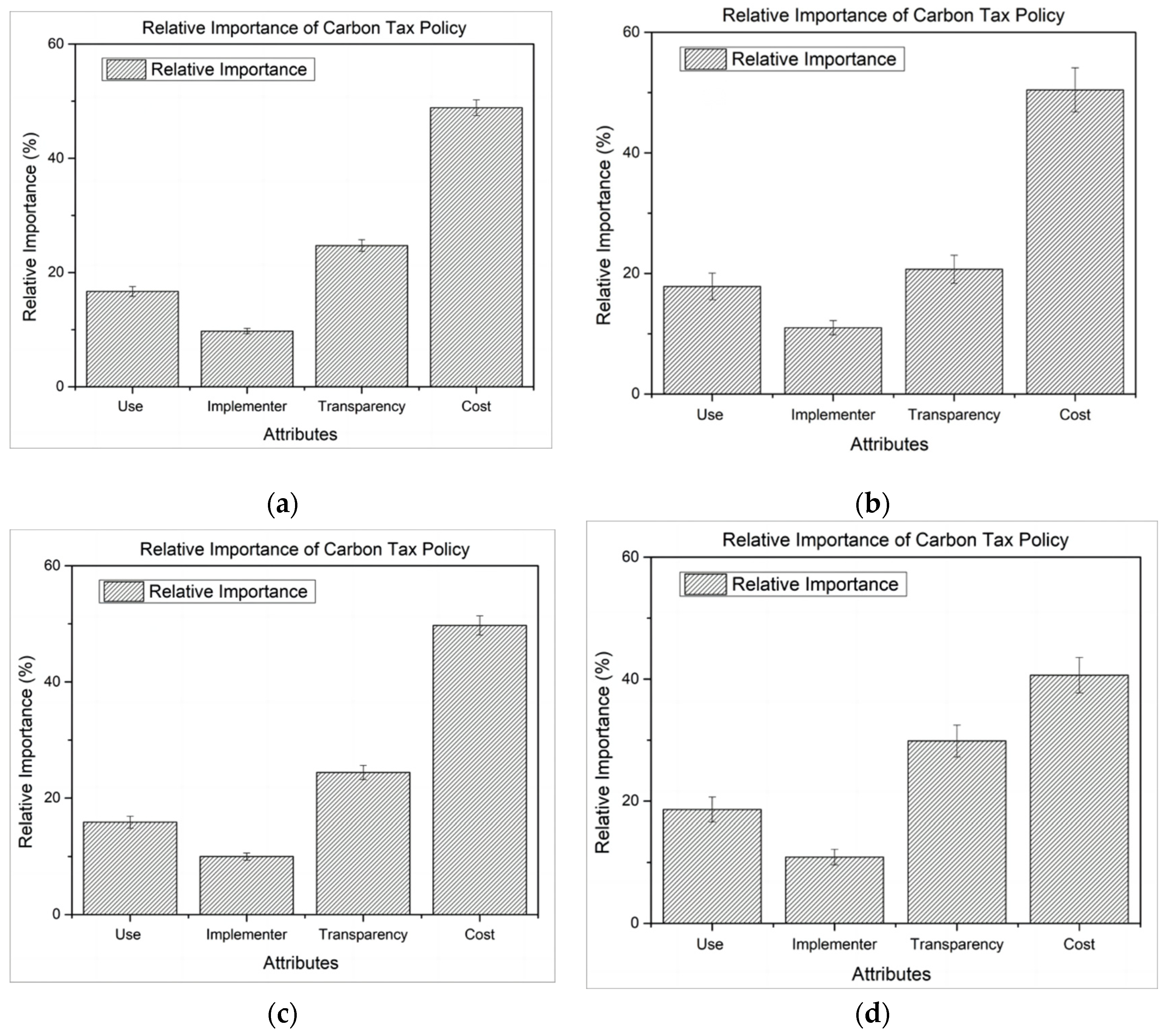
Table 2.
Percentage of respondents with different socioeconomic characteristics.
| Socioeconomic Characteristics | Percentage | |
|---|---|---|
| Gender | Male | 41.24% |
| Female | 58.76% | |
| Age | 16-30 | 53.17% |
| 31-45 | 42.48% | |
| 46-60 | 3.85% | |
| >60 | 0.50% | |
| Marriage | Married | 67.58% |
| Single | 32.42% | |
| Educational level | Middle school or below | 2.48% |
| High school | 62.86% | |
| Bachelor | 30.93% | |
| Master or above | 3.73% | |
| Family members | 1 | 1.12% |
| 2 | 3.73% | |
| 3 | 39.63% | |
| 4 | 27.70% | |
| 5 | 20.50% | |
| 6 | 5.84% | |
| >6 | 1.49% | |
| Residence | Urban | 85.84% |
| Rural | 14.16% | |
| Family disposable income | 0-30,000 | 2.11% |
| 30,000-50,000 | 8.70% | |
| 50,000-100,000 | 19.38% | |
| 100,000-200,000 | 40.37% | |
| >200,000 | 27.08% | |
| Inconvenient | 2.36% | |
| Annual electricity consumption | 0-1000 | 33.17% |
| 1000-2500 | 42.24% | |
| 2500-5000 | 20.99% | |
| >5000 | 3.60% | |
| Annual gas consumption | 0-800 | 41.86% |
| 800-1500 | 37.14% | |
| 1500-3000 | 18.14% | |
| >3000 | 2.86% | |
| Annual gasoline consumption | 0-2500 | 35.78% |
| 2500-5000 | 30.43% | |
| 5000-10000 | 26.46% | |
| >10000 | 7.33% | |
| Climate change impact | None | 3.23% |
| Little | 20.75% | |
| Some | 59.01% | |
| Huge | 17.02% | |
| Understanding of carbon tax | None | 17.39% |
| Some | 67.08% | |
| Clear | 15.53% | |
Table 3.
Willingness to pay for different levels of all attributes.
| Attributes | Levels | Annal willingness to pay (CNY) |
|---|---|---|
| Use of carbon tax revenue | General tax budget | 0.00 |
| Subsidies/grants for clean energy technology | 503.90 | |
| Subsidies/grants for low-carbon technologies or CCUS | 611.81 | |
| Carbon tax policy implementers | Bank | 0.00 |
| Energy Supplier | 160.55 | |
| Government | 424.81 | |
| Transparency of carbon tax policy implementation process | No process report | 0.00 |
| Report regularly on the official website | 1122.74 | |
| Regularly report on the official website under the supervision of an independent third party | 1482.05 | |
| Total | Mean | 1435.28 |
Table 4.
Willingness to pay for different levels of all attributes (respondents with different educational level).
Table 4.
Willingness to pay for different levels of all attributes (respondents with different educational level).
| Attributes | Levels | Willingness to pay | ||
| Educational level (CNY) | ||||
| High school | Bachelor’s degree | Master’s degree or above | ||
| Use of carbon tax revenue | General tax budget | 0.00 | 0.00 | 76.72 |
| Subsidies/grants for clean energy technology | 698.28 | 297.40 | 0.00 | |
| Subsidies/grants for low-carbon technologies or CCUS | 743.72 | 443.06 | 392.44 | |
| Carbon tax policy implementers | Bank | 0.00 | 0.00 | 0.00 |
| Energy Supplier | 163.26 | 119.92 | 65.99 | |
| Government | 495.88 | 338.70 | 283.56 | |
| Transparency of carbon tax policy implementation process | No process report | 0.00 | 0.00 | 0.00 |
| Report regularly on the official website | 1246.08 | 977.76 | 1521.10 | |
| Regularly report on the official website under the supervision of an independent third party | 1608.80 | 1344.60 | 2033.16 | |
| Total | Mean | 1652.00 | 1173.81 | 1457.65 |
Table 5.
Willingness to pay for different levels of all attributes (respondents with family disposable income).
Table 5.
Willingness to pay for different levels of all attributes (respondents with family disposable income).
| Attributes | Levels | Willingness to pay | |||
| Family disposable income per year (CNY) | |||||
| 0-30,000 | 30,000-50,000 | 100,000-200,000 | >200,000 | ||
| Use of carbon tax revenue | General tax budget | 108.95 | 0.00 | 0.00 | 0.00 |
| Subsidies/grants for clean energy technology | 0.00 | 1070.62 | 501.02 | 472.23 | |
| Subsidies/grants for low-carbon technologies or CCUS | 118.10 | 1320.41 | 541.81 | 681.99 | |
| Carbon tax policy implementers | Bank | 0.00 | 0.00 | 0.00 | 0.00 |
| Energy Supplier | 188.23 | 385.03 | 183.64 | 43.75 | |
| Government | 470.71 | 441.62 | 387.75 | 395.71 | |
| Transparency of carbon tax policy implementation process | No process report | 0.00 | 0.00 | 0.00 | 0.00 |
| Report regularly on the official website | 456.71 | 907.38 | 1067.22 | 1489.62 | |
| Regularly report on the official website under the supervision of an independent third party | 575.60 | 1064.44 | 1333.90 | 2048.86 | |
| Total | Mean | 639.43 | 1729.83 | 1338.45 | 1710.72 |
Disclaimer/Publisher’s Note: The statements, opinions and data contained in all publications are solely those of the individual author(s) and contributor(s) and not of MDPI and/or the editor(s). MDPI and/or the editor(s) disclaim responsibility for any injury to people or property resulting from any ideas, methods, instructions or products referred to in the content. |
© 2024 by the authors. Licensee MDPI, Basel, Switzerland. This article is an open access article distributed under the terms and conditions of the Creative Commons Attribution (CC BY) license (http://creativecommons.org/licenses/by/4.0/).
Copyright: This open access article is published under a Creative Commons CC BY 4.0 license, which permit the free download, distribution, and reuse, provided that the author and preprint are cited in any reuse.


