
Submitted:
21 August 2024
Posted:
22 August 2024
You are already at the latest version
Abstract
The risk classification of barrier lake is the key to conducting emergency treatment in a scientific manner. Such difficulties are faced as short time for risk evaluation, complex evaluation indicators, difficulty in obtaining information quickly and quantifying index weights. Based on this, this paper constructs a quantitative risk classification model for barrier lakes based on D-AHP. On the basis of studies on nearly 100 cases of barrier lakes, an 8-factor evaluation index system and quantitative classification are proposed. The methods of rapid calculation of reservoir capacity curve of barrier lake and intelligent identification of particles on the surface of barrier body were developed, which realized the rapid acquisition of 8-factor evaluation index information in emergency environment. The D-AHP method dealt with inconsistent weight assignment to evaluation factors by experts, which helped achieve weight quantification of 8 factors. The risk assessment on15 barrier lakes such as Tangjiashan barrier lake show that the conclusion drawn with risk classification method proposed in this paper is basically consistent with that of the traditional table-lookup method. However, the table-lookup method ignores cumulative loss’s impacts on the risk level of barrier lakes, and considers the extremely severe loss of barrier lakes as a sufficient condition for the evaluation level to be grade I, and thus a deviation in the evaluation. The risk classification method proposed in this paper is more reasonable and reliable.
Keywords:
barrier lake
; risk classification
; weight
; D-AHP
; short window
; information acquisition
1. Forword
Barrier lake is the natural damming of a river by collapse or slide of the bank slope of river valley, which happens worldwide (Figure 1,Shan et al. 2018; Zhong et al. 2023). Such dammed lakes flood upstream areas and damage the critical infrastructures as well as life and property of residents downstream in case of collapse. In 2000, the large Landslide occurring along Yiong Tsangpo River shaped a barrier lake 54m in length, 2,500m in width, 288×108 m3 in storage capacity and 2.8×10⁸~3.0×10⁸ m3 in volume, endangering several millions of residents downstream (Xing et al. 2010; Du et al. 2022). The Wenchuan Earthquake in 2008 induced 257 barrier lakes of which the largest was Tangjiashan barrier lake threatening 1.3 million residents downstream. 275,000 residents were relocated in emergency treatment ( Liu et al. 2008;Wu et al. 2008). Another case was the barrier lake dammed by landslide on Bailong River caused by the sudden extraordinary rainstorm in northern hilly area of Zhouqu County, Gansu Province in 2010, killing 1,799 people (Wang. 2013). The landslide in Baige village on upstream of Jinsha River in 2018 shaped a large barrier lake with maximum reservoir volume of 760 million m3 and relocation of 85,000 residents and direct economic loss of 13.5 billion CNY (Zhou et al. 2021; Zhong et al. 2020).
Studies on 73 barrier lakes by Costa and Schuser from United States Geological Survey (USGS) demonstrate that 85% of the lakes lasted less than 1 year. A case study was done on 352 barrier lake which have collapsed with statistics showing 84.4% of the lakes exists less than 1 year, 68.2% of them with life span shorter than 1 month and 29.8% collapsing within one day (Shen et al., 2008). Peng and Zhang (2012a) and Shen et al. (2020a) also found similar statistical results based on 204 and 352 cases, respectively. Given such diversity in existence duration of barrier lakes and short time for emergency relief, scientific risk classification is critical for targeted and well organized emergency response. As has been defined in Risk Management - Principles and Guidelines ISO31000:2009, the risks of a barrier lake can be quantified by the product of the dam failure probability and loss:R=P×C.Where P is failure probability which represents the hazards and stability of the barrier lake; the more dangerous, the higher the value of P; C is the loss after barrier lake breach, which indicates the loss caused by the barrier lake and floods due to dam failure.
Stability of barrier dam is subjected to several factors. Based on a database of 70 barrier dam cases collected in the northern Apennines, Casagli et al (1999) proposed defined the blockage index (BI) to evaluate barrier dam stability with barrier dam volume Vd and catchment area AL as input parameters. Based on BI methodology, Ermini et al. (2003) further introduced barrier dam height Hd into the BI method and proposed a new dimensionless blockage index (DBI). Based on 43 barrier dam cases in Japan, Dong et al. (2003) proposed a quantitative risk assessment method for barrier dams with inflow water volume from upstream, barrier dam height/width/length selected as input parameters. Subsequently, based on 300 cases in Italy, Stefanelli et al. (2016) identified the hydromorphological dam stability index (HDSI) with barrier dam volume and catchment area as input parameters. Based on 79 barrier dam occurrences, Shi et al. (2020) proposed a quantitative method to evaluate barrier dam stability in which five parameters were adopted as input parameters including barrier dam height/width/length, dammed lake volume, and backwater length. All the parameters selected by above-mentioned scholars fall into two categories, i.e., lake volume relevant and barrier dam relevant, as is shown in Table 1.
Breach of barrier lake dams brings long disaster chain and induces disasters of large scope. Studies show that the loss caused by failure of landslide barriers are similar to that of regular dams, including loss in lives, economy and ecology. Assessment of life loss take into account such factors as population at risk, population density, level of floods, understanding of residents, time of alarming, rate of young adults to the elderly and kids, time of dam failure, weather, distance to dam site, emergency response plan, dam height, reservoir volume, downstream river slope, topography, impact resistance of structures, temperature, rescue capability, etc. (Zhou et al. 2008; Wu et al. 2010; Du et al.2022). Major factors for economic loss include duration of floods, velocity of floods, sediment concentration, flood water temperature, depreciation of properties, time of alarming, pollutant concentration, etc. (Xiao et al. 2009; Yang. 2010;Wang et al. 2014;Liu et al. 2016; Du et al. 2023). Ecological loss is mainly assessed based on factors including geomorphology of river channel, water environment, human ecology, natural reserves, damage to animal species, soil environment, vegetation coverage, production reduction in agriculture, forestry and fishery, air quality, dirty industries (Wang et al.2006; Li et al. 2017;Li et al. 2019;Wu et al. 2019). The factors for assessment on barrier dam failure are demonstrated in Table 2.
Proper allocation of weight to each factor is the key to risk assessment of barrier lakes (Xue et al.2019;Wang et al.2020;Luan et al.2022). There are several occasions in which Analytic Hierarchy Process (AHP) , the traditional risk assessment method, would fail to describe and quantify the weight to factors. So this paper proposes a hybrid fuzzy evaluation method for quantitative risk classification of barrier lake based on an AHP method extended by D numbers (Dehe et al. 2015;Lu et al. 2015;Dong et al. 2015).Occasion 1: All 10 experts consider factor 1 more important than factor 2. 8 of them assigned a weight score of 0.8 to factor 1. However, the rest 2 expert assign weight score of 0.7 to factor 1;Occasion 2: 7 experts out of the 10 consider factor 1 more important than factor 2 and allocate a weight score of 0.6 to factor 1. However, the rest 3 regard both factors as equally important.Occasion 3: 8 experts out of the 10 consider factor 1 more important than factor 2 and allocate a weight score of 0.7 to factor 1. However, the rest 2 give no comment on both factors since they do not have deep understanding on them.
Based on previous studies globally on risk assessment of barrier lakes, in Section 2 a mathematical model is proposed for quantitative risk classification of barrier lakes based on D-AHP with a set of risk evaluation factors, a set of quick information acquisition method and risk classification quantification functions. Section 3 presents the set of risk evaluation factors as well as standards for classification based on studies on about 100 barrier lake cases and domestic studies in China, solving the problem of complex evaluation indicators on the risk evaluation of barrier lake. The proposed set of factors identifies proper ones amid a huge pool of factors and has been included in the Code for Risk Classification and Emergency Measures of Barrier Lake (SL/T 450-2021). In Section 4, an elaboration is presented on calculation method of storage-capacity curve and intelligent identification of particles on surface of dam. Such method would allow quick acquisition of information during emergency rescue. Section 5 and Section 6 elaborates in details on the preference relation matrix and the calculation of weight indicator based on D-AHP, solving the problem of quantifying weights of evaluation factors. In Section 7, the application of such method on 15 barrier lake cases has proved that the proposed method is more scientific and reliable, and shall be promoted for further application.
2. Mathematical Model for Quantitative Risk Classification of Barrier Lakes Based on D-AHP
2.1. The Mathematical Model
The mathematical model for quantitative risks classification of barrier lake based on D-AHP is shown in Figure 2. The model comprises 3 parts:
1) Objective function; 2) Data sets for modelling, including a set of evaluation factors, a set of evaluation grades and a set of information collection methods making sure proper selection of factors, risk classification and quick acquisition of information. 3) Risk classification quantification functions for modelling, including D-AHP preference relation calculation function, weight calculation function, and fuzzy functions, ensuring quantification of weight vector and risk classification.
Explanation of symbols in the mathematical model in Figure 2:
1.U is the set of factors on risk classification of barrier lakes; D is the set of factors on hazards evaluation of the barrier with m elements, namely, d1,d2,……,dm; L is the set of factors for assessment on loss by dam failure with n elements, namely, l1,l2,……,ln.
2.V is the set of evaluation grades with P elements, namely, v1,v2,……,vp.
3.F is the set of information collection methods, with m+n elements, F1,F2,……,Fm+n, which is in compliance with the m elements in set D and information collection methods in number of n in set L.
4.R is the reference matrix of set U to set V. rik indicate the preference relation of i-th parameter to k-th evaluation grade; the range [αik,αik+1] means the range corresponding to the k-th evaluation grade; xi is the i-th parameter. W is the weight vector of U, the set of factors on risk classification of barrier lakes. f1 () is the weight calculation function on the basis of D-AHP; G indicates the vector of evaluation grades, with p elements, g1,g2,……,gp; max () is the function for maximum value.
2.2. Solution through the Model
The solution by the model goes through 5 procedures (see Figure 3) as follows:
1) Establishing set U, the factors set on risk classification including set D, and set L with factors for loss assessment; 2) Building up set V on evaluation grades to identify risk levels (grade I, II, III, etc.) of barrier lakes; 3) Establishing fuzzy preference relation matrix R. Elements in the matrix indicates preference relation of a certain parameter to its risk grade; 4) Calculating W, the weight vector; The calculation of weight vector on evaluation parameters go through following procedure: ①Establishment of D numbers preference relation matrix (D Matrix) ; ②Conversion of D matrix into crisp matrix; ③Establishment of probability matrix based on crisp matrix; ④Ranking of the parameters with triangle method;⑤Calculation weight vectors of the parameters.5) Calculation of risk grade evaluation function grade () based on R, fuzzy preference relation matrix, and W, weight vector, thus getting the risk grade of barrier lakes.
3. Selection and Grading of Risk Evaluation Factors
3.1. Selection and Grading of Risk Evaluation Factors for Barrier Dams
In accordance with the studies worldwide, the risk evaluation factors can be categorized into two groups: reservoir-volume-related factors and dam-body-related factors (see Table 1). The former group mainly include reservoir volume and inflow from upstream, both of which directly influence the damage to barrier body by flood in case of breaching. The latter group mainly comprises the material component and geometry of the dam body. The large the particles on the dam, the better it works against the flushing; the lower the dam, the longer distance the water flows, the smaller potential energy the water flow takes, the less risks.These 4 factors selected, reservoir capacity, inflow from upstream, material component and geometry of the barrier, are reasonable and feasible since they can cover risk evaluation factors adopted in current studies.
D=[d1,d2,d3,d4]=[ reservoir capacity, inflow from upstream, material component and geometry of the barrier] (1)
This paper analyze the relation between such factors and the grading of barrier risks based on studies on about 100 barrier lake cases.
(1) Relation between reservoir volume (d1) and risk grades
The paper studies the relation between reservoir volume and peak flood upon dam failure based on statistics of 86 cases showing a lineal relation in which, the larger the reservoir volume, the higher the flood peak upon dam failure, the more destructive the flood to the barrier, and the higher the risks of the barrier (see Figure 4). When the reservoir volume is smaller than 1 million m3, the peak flow at the breach is normally less than 1000 m3/s. When the reservoir volume is 1 million-10 million m3, the peak flow at the breach is normally 1,000-3,000m3/s. When the reservoir volume is 10 million-100 million m3, the peak flow at the breach is normally 3,000-10,000m3/s. When the reservoir volume is large than 100 million m3, the peak flow at the breach is normally larger than 10000m3/s. Therefore, the barrier lakes and their risk grades can be categorized into 4 groups regarding their reservoir volume, less than 1 million m3/s (low risks) , 1 million-10 million m3/s (moderate risks) , 10 million-100 million m3/s (high risks) , more than 100 million m3/s (extra high risks).
(2) Relation between inflow from upstream (d2) and risk grades
The paper studies the relation between reservoir volume and peak flood upon dam failure based on statistics of 86 cases (see Figure 5). Generally, the inflow from upstream can be categorized into 4 ranges, and the risks of the barrier are categorized into 4 grade correspondingly. 1) 17 cases have an upstream inflow of less than 10 m3/s, 12 of which are evaluated as low risk with risk probability of 70.5%;2) 17 cases have an upstream inflow of 10-50 m3/s, 11 of which are evaluated as medium risk with risk probability of 62.5%;3) 15 cases have an upstream inflow of 50-150 m3/s, 10 of which are evaluated as high risk with risk probability of 64.7%;4) 23 cases have an upstream inflow of more than 150 m3/s, 15 of which are evaluated as extra high risk with risk probability of 65.2%.
(3) Relation between material component of barrier (d3) and risk grades
Studies on the breach and dam failure process show that:1) When the discharge is less than 10 m3/s, the velocity is less than 1-2m/s, the flow being able to flush clay particles and sand;2) When the discharge is 10-50 m3/s, the velocity is about 1-2 m/s, the water flow being able to flush rubble;3) When the discharge is 50-150m3/s, the velocity is about 2-3m/s, the flow being able to flush gravels;4) When the discharge is 150-1,000m3/s, the velocity is about 3-6m/s, the flow being able to flush stones of small size;5) When the discharge is larger than 1,000m3/s, the velocity is about 6-10m/s, the flow being able to flush stones of all sizes.The study by Wang et al. (2016) from Institute of Mountain Hazards and Environment, Chinese Academy of Science reveals that the average grain size of the barrier is explicitly influential on the features of dam failure. The large the average grain size, the more capable the barrier is against the flood flushing, the smaller the risk probability. Based on above-mentioned studies and classification in the Code for Investigation of Geotechnical Engineering (GB50021) , the mid-value (d50) of the grain distribution curve of the barrier is selected as eigenvalue to judge the barrier’s capability to resist flushing. The risk probability is graded as extra high, high, medium, and low when the eigenvalue is less than 2mm, 2mm-20mm, 20mm-200mm, and higher than 200mm, respectively.
(4) Relation between geometry of barrier (d4) and risk grades
The paper collected data on length/height ratio (L/H) of 54 landslide barriers and studied its relation to the duration of barrier lakes (see Figure 6) , showing that:1) When L/H≤5, the barrier collapses after several days of overtopping 2) When 5<L/H<20, the barrier lasts until having being flushed for tens of days to several months;3) When L/H≥20, the barrier lasts for more than 1 year. Furthermore, the height of the barrier decides the potential energy of the water flushing. With reference to Design Code for Rolled Earth-rock Fill Dams (SL274-2020) , the barriers can be categorized into 4 groups in terms of their height, less than 15m, 15m-30m, 30m-70m, more than 70m. In consideration of the 2 factors above, the relation between geometry and risk grading of the barriers can be seen in Figure 7.
3.2. Selection and Grading of Loss Evaluation Factors for Barrier Dams
Previous studies show that factors for loss evaluation in dam failure are mainly in 3 aspects: life loss, economic loss and ecological loss (see Table 2). Life loss mainly indicates the population under barrier risks (Li et al. 2011;He et al. 2019;Wang et al.2024). For example, Tangjiashan barrier lake threatens a population of 1.3 million downstream (Wu, 2008). Economic loss mainly include loss of cities and towns on downstream and loss in public facilities and infrastructures. For example, loss of cities and towns on downstream due to the collapse of Baige barrier lake include 16 villages and towns under 4 counties in Diqing and Lijiang, collapse of 8051 houses, damage to 18189 rooms. Loss in public facilities and infrastructures include damage to road of 632.12km, 13 bridges flushed and destroyed, 13 bridges damaged (Zhou et al. 2021). Ecological loss mainly includes loss in ecological diversity, human ecology, river channel, water environment (Wang et al. 2006). Based on such previous studies and case study on about 100 barriers, evaluation factors loss due to dam failure and grading methods (Table 3) are decided.
L=[l1,l2,l3,l4]=[population at risk, impacted cities and towns, impacted public facilities and infrastructures, impacted ecological environment] (2)
In section 3.1 the hazards of barriers are graded into 4 levels, extra high, high, moderate and low; in section 3.2 the loss induced by dam failure is graded as extremely severe, severe, relatively severe and moderate. Based on these two grading methods, the risk evaluation grades can be classified as grade I (extremely high) , II (high) , III (medium) , and IV (low) , as shown in Eqs. (3).
V=[v1,v2,v3,v4]=grade I, II, III, and IV (3)
Figure 7. Geometry of barriers and the risk grading.
| Grades of loss due to flooding and dam failure | Evaluation Factors | |||
| l1 | l2 | l3 | l4 | |
| Extremely severe | ≥105 | Seat of prefecture-level city | State-level important infrastructures in transportation, power transmission, oil and gas transmission, large water resources and hydropower project, cascade development, large scale chemical industry, pesticide plant, highly toxic chemical industry, heavy metal, etc. | Cultural relics and rare animals/plants of world-level, water sources for urban areas involved; major geological disasters can be induced, leading to river blocking or impacting a population of more than 1000. |
| Severe | 104~105 | Seat of county-level city | Provincial-level important infrastructures in transportation, power transmission, oil and gas transmission, medium-sized water resources and hydropower project, relatively large chemical industry, pesticide plant, highly toxic chemical industry, heavy metal, etc. | Cultural relics and rare animals/plants of state-level, water sources for counties involved; geological disasters can be induced, leading to river narrowing or impacting a population of 300-1000. |
| Relatively severe | 103~104 | Seat of villages and towns | Municipal important infrastructures in transportation, power transmission, oil and gas transmission, mining industry, ordinary chemical industry, heavy metal, | Cultural relics and rare animals/plants of township level, water sources for counties involved; geological disasters can be induced, leading to river narrowing or impacting a population of 100-300. |
| Moderate | <103 | Residential area under villages | infrastructure of smaller size than those in relatively severe level | Cultural relics and rare animals/plants of county level, water sources for villages involved; geological disasters can be induced, leading to river narrowing or impacting a population of less than 100. |
3.4. Information Acquisition on Risk Evaluation Factors
Quick acquisition of information is key to risk grading of barrier lakes under emergency circumstances within short time. Information acquisition method for risk grading with 8 factors is demonstrated in Table 4. 1) Capacity of barrier lake (d1) :Data can be acquired dynamically through predication of possible highest water level based on the capacity curve of the barrier lake (see Section 4.1). 2) Inflow from upstream (d2) :Data can be calculated based on runoff-yielding rules (Lou et al.,2018; Zhao et al. 2022;Zhang et al.2023). 3) Material components (d3) :Data can be calculated dynamically from multiple dimensions including intelligent identification of surface particles, geophysical investigation of space equivalent particle, tracing provenance analysis, etc. (see Section 4.2) 4) Geometry of the barrier (d4) :Data can be obtained through Boolean calculation based on oblique photography with UVA, LiDAR, satellite images, and multi-dimensional 3D modelling with DEM. (Sun et al. 2021, 2023).5) Data on population at risk (l1) will be acquired through quick identification technology based on LBS (Location Based Services) ;6) Data on impacted towns and cities (l2) , impacted public facilities and infrastructures (l3) and impacted ecological environment (l4) can be acquired from corresponding government authorities based on risk map of flooding induced by dam failure.
4.1. Acquisition of Information on Capacity of Barrier Lake (d1)
This paper builds up a topographic database for Tangjiashan barrier lake and produced its capacity curve through overlaying, dynamic checking, elevation unification based on 1:50000, 1:2000 and 1:5000 topographic maps acquired, 1:50000DEM data through remote sensing technology, multispectral data (8m resolution, Beichuan county) and RADAR data (3m resolution, barrier lake area) , and 3D topographic map acquired through airborne LIDAR system. The highest water level for Tangjiashan barrier lake is El. 152m and its capacity (d1) is 320 million m3 as shown in the capacity curve. Figure 8 shows the process of the acquisition of d1.
4.2. Acquisition of Data on Material Components of Barrier (d3)
Qualitative analysis is carried out on material components of barrier through provenance methodology. Surface particles on barrier is identified through intelligent identification methodology. Diameter of particles on barrier is calculated based on longitudinal profile data through natural source surface wave. A grading curve for particles of the barrier is produced based on such above-mentioned data. In accordance with such calculation, mid-value of the diameter (d50) for the particles in Tangjiashan material components (d3) is 83mm; mid-value of the diameter (d50) for the particles in Baige material components (d3) is 4.3mm. Figure 9 shows the process of the acquisition of d3.
5. Solution to Preference Matrix (R)
5.1. The Range for Evaluation and Values of Parameters
As has been listed in Section 3, there are 8 parameters for risk evaluation for barrier lakes, each parameter evaluated within 4 ranges, [αi1=0,αi2=25]、[αi2=25,αi3=50]、[αi3=50,αi4=75]、[αi4=75,αi5=100]. Parameter d1 (capacity) , d2 (inflow from upstream) , d3 (geometry) , d4 (material components of barrier) and l1 (population at risk) can be calculated through linear interpolation. This paper will demonstrate the calculation process of d1 (capacity) as an example. Parameter l2 (impacted cities and towns) , l3 ( impacted public facilities and major infrastructures) and l4 (impacted ecological environment) can be valued through quantifying number of impacted cities and towns, facilities and environment. This paper will demonstrate the calculation process of l2.
(1) Calculation of d1 (capacity)
1) When 0<d1≤100, x1=25×d1/100;
2) When 100<d1≤1000, x1=25+ (50-25) × (d1-100) / (1000-100) ;
3) When 1000<d1≤10000, x1=50+ (75-50) × (d1-1000) / (10000-1000) ;
4) When 10000<d1≤100000, x1=75+ (100-75) × (d1-10000) / (100000-10000) ;
5) When 100000>d1, x1=100.
(2) Calculation of l2 (impacted cities and towns)
1) When the impacted area is residential areas under villages, x6=3×l21 and x6≤25, l21 indicates the number of impacted villages and towns;
2) When the impacted area is seat of villages and towns, x6=25+3×l21 and x6≤50;
3) When the impacted area is seat of county-level cities, x6=50+6×l22 and x6≤75, l21 indicates the number of county-level cities and prefecture-level cities;
4) When the impacted area is seat of prefecture-level cities, x6=75+6×l22 and x6≤100.
5.2. Function for Calculation of Preference Relation
Calculation of preference relation (rik) of i-th parameter to the k-th evaluation grade in the preference relation matrix R (8×4) is shown in Figure 10.
6. Calculating the Weights of the Indicators Based the D-AHP Method
AHP is a multi-criteria decision-making method combining qualitative and quantitative analysis, although simple and practical.However, there are still some deficiencies and limitations when applying this methodology. First, the comparative judgments are subjective because they rely heavily on expert opinion, which may sometimes cause inconsistency. Furthermore, AHP lacks the ability to adequately cope with any inherent uncertainty and imprecision in the data. Finally, in a real situation, an expert may have limited knowledge of and experience with alternatives; the preferred information may contain fuzziness and incompleteness, and AHP is unable to handle this incomplete information. The D-AHP method can represent uncertain information more effectively because it overcomes the shortcomings and deficiencies of the traditional AHP and Dempster-Shafer theories. First, the D-AHP method uses a D numbers preference relation instead of a pair wise comparison; the D numbers preference relation is the classical fuzzy preference relation extended by D numbers. Although the preference relations of the alternatives or criteria given by the experts are imprecise, fuzzy and incomplete, the D numbers preference relation can effectively express this uncertain information without causing inconsistency. Furthermore, the sum of all focal elements in a D numbers preference relation need not equal 1; i.e., if the assessment information given by experts is incomplete, this value may be less than 1. In view of these advantages of D-AHP, this paper uses the D-AHP method instead of the traditional AHP method to determine the weight distribution of the evaluation index.
(1) Definition of D number
D numbers, first developed by Deng (2012) , are a good representation of uncertain information. It is widely used in many fields, such as supplier selection problem (Deng et al, 2014a) , and fault analysis ( Liu et al, 2014).
Definition 1. Let Ω be a finite nonempty set, a D number is a mapping formulated by
Where is an empty set and B is subset of Ω.
From this definition, we notice that the completeness constraint is released if D numbers are used. If, then the information is complete; and if , the information is incomplete.
Suppose that the set Ω={b1,b2,…,bi…bn}, where bi∈R and bi≠bj if i≠j. Then, a special form of D numbers can be expressed as: , where vi>0 and .
Definition 2. Let be a D numbers, the integration representation of D is defined as:
Where, vi>0, and.
(2) D numbers extended fuzzy preference relation
The fuzzy preference relation is provided to construct pair wise comparison matrices based on expert judgment and is described by a fuzzy pair wise comparison with an additive reciprocal (rij + rji = 1) that is different from the multiplicative preference relation. rij denotes the preference degree of an alternative Ai over another alternative Aj and can be expressed as follows:
There are some shortcomings when using the fuzzy preference relation to represent certain situations. For example, if the expert assessments are uncertain or incomplete, it is difficult to construct the fuzzy preference relation. To overcome these shortcomings, Deng et al. (2014a) extended the classical fuzzy preference relation by using D numbers. The derived relation is called a D numbers preference relation, and the corresponding matrix is called a D numbers preference matrix, which can be abbreviated as a D matrix. The D matrix is defined as follows.
Definition 3. A D numbers preference relation RD on a set of alternatives A is represented by a D matrix on the product set A×A, whose elements are formulated by
the D numbers preference relation in matrix form is
Where {1,2,…,n},
 and bkij∈[0,1],∈{1,2,…,m}.
Consequently, with the help of the D numbers preference relation, the preference relations of the three situations presented in section 1 as an example are shown in Eqs. (10) ~ (12) , respectively.
(3) Calculating procedure of the weights of alternatives using the D-AHP method
The calculation process includes five steps:①Establish the D numbers preference matrix (D matrix) ;②Convert the D matrix to a crisp matrix; ③Construct a probability matrix based on the crisp matrix; ④Rank the alternatives using the triangularization method; ⑤ Calculate the relative weights of alternatives.
7. Case Application
Based on D-AHP Method, this paper calculates the risk level of 15 barrier lakes (see Figure 11) , including Jiguanling in Chongqing, Yigong in Tibet, Qingyandong in Chongqing, Houziyan in Dadu River, Hongshiyan in Niulan River, Tangjiashan in Sichuan, Jiala in Tibet, Baige in Jinsha River, Yankou in Guizhou, Shaziba in Hubei, Xiaojiaqiao in Sichuan, Tanggudong in Yalong River, Zhouqu in Gansu, Xiaogangjian in Sichuan, Xujiaba in Sichuan, etc.
7.1. Calculation of Matrix R
7.2. Calculation of Weight Vectors
The D numbers preference matrix (i.e., D matrix) must be constructed before calculating the weights of the indicators using the D-AHP method. The following four indicators of the risk of barrier lakes are taken as an example to construct the D matrix based on the D numbers preference relation as follows:
(1) Ten experts were asked to score the importance of the four indicators, then construct the D matrix based on the D numbers preference relation as follows Eqs. (12):
(2) The D matrix is converted to a crisp matrix Rc using the integration representation of D numbers as follows:
(3) According to the rules proposed to generate the probability matrix by Deng et al. (2014a) , the probability matrix is constructed as below:
(4) Using the triangularization method, the ranking of the indicators is calculated as:d1>>d3>>d2>>d4, where the symbol “>>” indicates preference.
(5) Calculate the relative weights of the indicators. First, based on the ranking of the indicators, the matrix Rc is converted to a triangulated crisp matrix RcT
(6) Using the weight relation of the indicators represented in the matrix,the weight equations are constructed by incorporating necessary constraints:
(7) where wi refers to the weight of the i-th indicator, and λ indicates the granular information about the pair wise comparison and is associated with the cognitive ability of the experts. According to Deng et al. (2014a) , a feasible scheme of λ is:
10 experienced experts have strong cognition towards various indicators. The information reliability is high, thus λ=1. After calculation, the weights of the four indicators d1, d2, d3, d4 are 0.33, 0.245, 0.25 and 0.175, respectively. Similarly, the weights of the four indicators of loss evaluation factors for barrier dams, l1, l2, l3, l4 were calculated to be 0.393, 0.268, 0.228, and 0.113, respectively. The weight indicators for the danger of barrier dam D and the dam-break loss L are 0.525 and 0.475. After integrating the weights of various levels, 8 indicator weight value vectors W=[0.173, 0.129, 0.131, 0.092, 0.186, 0.127, 0.108, 0.053] were obtained.
7.3. Calculation on Risk Level of Barrier Lakes
For comparison, this paper refers to the hybrid fuzzy evaluation method for quantitative risk classification based on D-AHP as Method A. After calculation, the risk levels of 15 barrier lakes are shown in Table 7. The table-lookup method is referred to as Method B, and the corresponding risk level calculation method is shown in Table 8. The comparison of two methods for calculating the level of barrier lakes is shown in Figure 12.
The following conclusions can be drawn from Figure 12:
(1) After calculation, the risk level calculation results of the two methods for 13 barrier lakes are the same, accounting for 86.7%. Overall, the evaluation conclusions of the two methods have shown good consistency.
(2) Analysis of reasons for inconsistent calculation results of risk evaluation levels for two barrier lakes:
1) Tanggudong Barrier Lake: From the preference relation matrix R of Tanggudong barrier lake, the preference relation degrees r11, r21 and r41 corresponding to d1, d2 and d4 are all 1, indicating that the barrier dam is extremely risky. From the perspective of the dam-break losses, the downstream population at risk of Tanggudong barrier lake exceeds 1,000, the regions and facilities at risk include Bayirong Village, Yayihe Village, Bosihe Town, 3 hydrological stations, 8 bridges, 51km of highway, large amount of farmland and township water sources, indicating severe losses. Due to Method B’s belief that the extremely severe loss of the barrier lake is a sufficient condition for the risk evaluation level to be level I, however, based on the scores given by 10 experts, the weight of the risk indicator of the barrier dam is greater than the weight of the dam-break loss, indicating that it is unreasonable to consider the extremely severe losses due to the barrier lake as a sufficient condition for the evaluation level to be level I. Therefore, it is recommended to supplement Method B with the sufficient condition that “the risk level of the barrier lake is extremely high and the losses due to the barrier lake is above relatively severe” for the barrier lake risk level to be classified as Level I.
2) Zhouqu Barrier Lake: The loss indicators l1, l2 and l4 of the Zhouqu Barrier Lake have all reached severe level, but Method B uses the level with the highest loss severity among the l1, l2, l3 and l4 single grading indicators as the level of loss severity for the barrier lake, failing to reflect cumulative losses. Meanwhile, due to the different weights of l1, l2, l3 and l4, there are differences in the social impact brought by the same level of loss. Only using the highest level loss of a certain indicator as the severity level of the barrier lake is one-sided. Method A considers both cumulative losses and weight differences, resulting in a more objective evaluation conclusion.
(3) Based on the above analysis, both Method A and Method B are relatively reliable in evaluating the risk level of barrier lakes. However, Method B has certain deviations in evaluating the risk level of individual cases. It is recommended that Method B supplement “ the risk level of the barrier lake is extremely high and the losses due to the barrier lake is above relatively severe” as a sufficient condition for classifying the risk level of barrier lake into Level I, while considering the impact of cumulative losses on the risk level of barrier lakes.
8. Conclusion
This paper addresses the problems faced by the risk classification of barrier lakes, including short evaluation window period, complex evaluation indicators, difficulty in obtaining information quickly, and difficulty in quantifying index weights. For the first time, a hybrid fuzzy evaluation model for quantitative risk classification of barrier lake based on D-AHP is constructed, and 8-factor evaluation index system and quantitative weight indicators are proposed to achieve the rapid acquisition of 8-factor evaluation index information in emergency rescue condition. The specific conclusions are as follows:
(1) This paper, on the basis of international and domestic researches of risk assessment of barrier lakes, and studies on about 100 barrier lake cases, proposed a set of risk classification factors and grading criteria, which is U=[D,L]=[d1,d2,d3,d4,l1,l2,l3,l4]=[reservoir capacity, inflow from upstream, material component and geometry of the barrier, population at risk, impacted cities and towns, impacted public facilities and infrastructures, impacted ecological environment], solving the problem of complex evaluation indicators on the risk assessment of barrier lake. The proposed set of factors has been included in the Code for Risk Classification and Emergency Measures of Barrier Lake (SL/T 450-2021).
(2) Rapid acquisition of information under short window period and extremely dangerous conditions is the key to risk evaluation of barrier lake. This paper developed the methods of rapid calculation of reservoir capacity curve of barrier lake and intelligent identification of particles on the surface of barrier dam, which realized the rapid acquisition of 8-factor evaluation index information, thus solved the problem of acquiring information within short window period.
(3) This paper proposed a risk classification method for barrier lakes based on D-AHP, which solved the problem of difficult quantification of evaluation index weights. The risk evaluation results of 15 barrier lakes, including Tangjiashan Barrier Lake, show that the proposed barrier lake risk classification method in this paper has good consistency with the results by traditional table-lookup method. The risk classification conclusions of 13 barrier lakes are consistent, but the table-lookup method considers that the extremely severe loss of barrier lakes is a sufficient condition for the evaluation level to be level I, and does not consider the impact of cumulative loss on the risk level of barrier lakes, resulting in deviations in the risk level classification of some individual barrier lake. Further correction is needed for table-lookup method.
(4) The hybrid fuzzy evaluation method for quantitative risk classification of barrier lake based on D-AHP proposed in this paper is reasonable in evaluation index system and classification, feasible in information acquisition methods, scientific in weight evaluation indicators, thus generates reliable risk level evaluation results.
Funding
This study was financially supported by the Joint Research Fund of Changjiang River Water Science Research (Grant No. U2340232).
Conflicts of Interest
The authors declare that they have no known competing financial interests or personal relationships that could have appeared to influence the work reported in this paper.
References
- Shan, Y.B.; Chen, S.H.; Zhong, Q.M. Rapid prediction of landslide dam stability using the logistic regression method. J Landslides 2020, 17, 2931–2956. [Google Scholar] [CrossRef]
- Zhong, Q.M.; Wang, L.; Shan, Y.B.; Mei, S.Y.; Zhang, Q.; Yang, M.; Zhang, L.C. Review on risk assessments of dammed lakes. Frontiers in Earth Science 2023, 10, 981068. [Google Scholar] [CrossRef]
- Xing, A.G.; Xu, N.N.; Song, X.Y. Numerical simulation of lake water down-stream flooding due to sudden breakage of Yigong landslide dam in Tibet. J Journal of Engineering Geology 2010, 18, 78–83. [Google Scholar]
- Du, Z.H.; Zhong, Q.M.; Dong, H.Z.; Shan, Y.B. A review of risk assessment studies on dammed lake. J Journal of Hohai University (Natural Sciences) 2022, 50, 13–25. [Google Scholar]
- Liu, J.J.; Duan, Y.Z. Summary of emergency construction of Tangjiashan barrier lake. J Water Resources and Hydropower Engineering 2008, 39, 10–14. [Google Scholar]
- Wu, G.R.; Yue, X. Emergency rescue construction technology of Tangjiashan barrier lake. J Water Resources and Hydropower Engineering 2008, 39, 5–9. [Google Scholar]
- Wang, G.L. Lessons learned from protective measures associated with the 2010 Zhouqu debris flow disaster in China. J Springer Netherlands 2013, 2013. [Google Scholar] [CrossRef]
- Zhou, X.B.; Zhou, J.P.; Du, X.H.; Chen, Z.Y. Lessons and experiences from emergency management of Baige Barrier Lake on the Jinsha River, China. J Shuili Xuebao 2021, 52, 1229–1239. [Google Scholar]
- Zhong, Q.M.; Chen, S.S.; Shan, Y.B. Numerical modeling of breaching process of Baige dammed lake on Jinsha River. J Advanced Engineering Sciences 2020, 52, 29–37. [Google Scholar]
- Costa, J.E.; Schuster, R.L. The formation and failure of natural dam. J Geological Society of America Bulletin 1988, 1054–1068. [Google Scholar] [CrossRef]
- Shen, D.Y.; Shi, Z.M.; Peng, M.; Zhang, L.M.; Jiang, M.Z. Longevity analysis of landslide dams. J Landslides 2020, 17, 1797–1821. [Google Scholar] [CrossRef]
- Peng, M.; Zhang, L.M. Breaching parameters of landslide dams. J Landslides 2012, 9, 13–31. [Google Scholar] [CrossRef]
- Shi, Z.M.; Ma, X.L.; Peng, M.; Zhang, L.M. Statistical analysis and efficient dam burst modelling of landslide dams based on a large-scale database. J Chinese Journal of Rock Mechanics and Engineering 2014, 33, 1780–1790. [Google Scholar]
- Casagli, N.; Ermini, L. Geomorphic analysis of landslide dams in the Northern Apennine. J Transactions of the Japanese Geomorphological Union 1999, 20, 219–249. [Google Scholar]
- Ermini, L.; Casagli, N. Prediction of the behaviour of landslide dams using a geomorphological dimensionless index. J Earth Surface Processes and Landforms 2003, 28, 31–47. [Google Scholar] [CrossRef]
- Dong, J.Y.; Tung, Y.H.; Chen, C.C.; Liao, J.J.; Pan, Y.W. Logistic regression model for predicting the failure probability of a landslide dam. J Engineering Geology 2011, 117, 52–61. [Google Scholar] [CrossRef]
- Stefanelli, C.T.; Segoni, S.; Casagli, N.; ASAGLIN; Catani, F. Geomorphic indexing of landslide dams evolution. J Engineering Geology 2016, 208, 1–10. [Google Scholar] [CrossRef]
- Shi, Z.M.; Cheng, S.Y.; Zhang, Q.Z.; Xue, D.X. A fast model for landslide dams stability assessment: A case study of Xiaogangjian (Upper) landslide dam. J Journal of Water Resources and Architectural Engineering 2020, 18, 95–100. [Google Scholar]
- Zhou, K.F.; Li, L. Dynamic forecasting evaluation model of flood loss due to dam breach based on socioeconomic development. J Resources and Environment in the Yangtze Basin 2008, 17, 145–148. [Google Scholar]
- Wang, Z.J.; Song, W.T. Study of estimation model of loss of life caused by dam break. J Journal of Hohai University (Natural Sciences) 2014, 205–210. [Google Scholar]
- Yang, S.M.; Huang, Y.F.; Li, S.T.; Li, B. Quantitative assessment on dam break loss based on spatial information technology. J Journal of Yangtze River Scientific Research Institute 2013, 30, 105–108. [Google Scholar]
- Wu, H.Q.; Fu, Q.H.; Dong, J.L. Discussion on the methods of estimating loss of life in dam failure in China. J China Water Resources 2010, 24–26. [Google Scholar]
- Xiao, Q.; Chen, J.R.; Zhou, W.K. Research on the evaluation method of flood economic loss. J Collection of Science, Education and Culture ( first issue) 2009, 180. [Google Scholar]
- Yang, J.M.; Feng, M.Q.; Lu, Q.L.; Han, Q.Q. Prediction of Dam- break Flood Damage in Wenyuhe Reservoir. J Journal Of Wut (Information & Management Engineering) 2010, 32, 598–601. [Google Scholar]
- Wang, Z.J.; Song, W.T.; Ma, X.T. Overview of Fish Barging. J Journal of Yangtze River Scientific Research Institute 2014, 31, 30–34. [Google Scholar]
- Liu, X.X.; Gu, S.P.; Zhao, Y.M.; Lv, W.W.; He, L.; He, J. Study on economic loss assessment method of dam-break flood with modified loss rate. J Journal of Economics of Water Resources 2016, 34, 36–40. [Google Scholar]
- Wang, R.K.; Li, L.; Sheng, J.B. On criterion of social and environmental risk of reservoir dams. J Journal of Safety and Environment 2006, 6, 8–11. [Google Scholar]
- Li, Q. Dam Risk Consequence Evaluation Model Based on Set Pair Analysis. D Zhengzhou University. 2017. [Google Scholar]
- Li, Z.K.; Li, W.; Ge, W.; Xu, H.Y. Dam breach environmental impact evaluation based on set pair analysis-variable fuzzy set coupling model. Journal of Tianjin University (Science and Technology) 2019, 52, 269–276. [Google Scholar]
- Wu, M.M.; Ge, W.; Li, Z.K.; Wu, Z.N.; Zhang, H.X.; Li, J.J.; Pan, Y.P. Improved set pair analysis and its application to environmental impact evaluation of dam break. J Water 2019, 11, 821. [Google Scholar] [CrossRef]
- Xue, D.X.; Jiang, T.; Meng, W.W. Comprehensive rapid risk assessment of barrier dam based on fuzzy analytic hierarchy process System research. J EWRHI 2019, 40, 37–41. [Google Scholar]
- Wang, R.B.; Wang, Y.; Yang, L.; Zhao, Y. risk analysis of barrier dam diseases based on fuzzy analytic hierarchy process and generalized entropy method. J J of China Three Gorges Univ. (Natural Sciences) 2020, 42, 16–21. [Google Scholar]
- Luan, Y.S.; Zhu, M.; Zhang, L. Risk assessment of Gala barrier lake in Yarlung Zangbo River. J Resources Environment &Engineering 2022, 36, 646–650. [Google Scholar]
- Dehe, B.; Bamford, D. Development, test and comparison of two multiple criteria decision analysis (mcda) models: a case of healthcare infrastructure location. J Expert Systems with Applications 2015, 42, 6717–6727. [Google Scholar] [CrossRef]
- Lu, Y.L.; Lian, I.B.; Lien, C.J. The application of the analytic hierarchy process for evaluating creative products in science class and its modification for educational evaluation. J International Journal of Science & Mathematics Education 2015, 13, 413–435. [Google Scholar]
- Dong, M.; Li, S.; Zhang, H. Approaches to group decision making with incomplete information based on power geometric operators and triangular fuzzy AHP. J Expert Systems with Applications 2015, 42, 7846–7857. [Google Scholar] [CrossRef]
- Timothy, R.N. Engineering Geological Assessment of Selected Landslide Dams Formed from the 1929 Murchison and 1968 Inangahua Earthquakes. D University of Canterbury. 2003. [Google Scholar]
- Zhu, Z.H.; Xu, D.H. Compilation of research data on barrier lake management at home and abroad. R Institute of Network and Information Center Information, Changjiang Water Resources Commission. 2008. [Google Scholar]
- Cai, Y.J.; Cheng, H.Y.; Wu, S.F.; Yang, Q.G.; Luan, Y.S.; Chen, Z.Y. Breaches of the Baige Barrier Lake: Emergency response and dam breach flood. J Sci. China Technol. Sci. 2020, 63, 1164–1176. [Google Scholar] [CrossRef]
- Wang, D.Z.; Chen, X.Q.; Luo, Z.G. Experimental Research on Breaking of Barrier Lake Dam under Different Grading Conditions. J Journal of Disaster Prevention and Mitigation Engineering 2016, 36, 827–833. [Google Scholar]
- Li, D.X. Multi-level fuzzy comprehensive evaluation of dam-break consequences based on stochastic simulation.D Huazhong University of Science and Technology. 2011. [Google Scholar]
- He, G.J. Social and environmental impact assessment of dam break based on variable fuzzy sets theory.D xi’an university of technology. 2019. [Google Scholar]
- Wang, L.; Yuan, P.F.; Zhong, Q.M.; Hu, L.; Shan, Y.B.; Xue, Y.F. Research on rapid quantitative risk assessment for barrier lake based on dam breach mechanism. J Journal of Natural Disasters 2024, 33, 51–62. [Google Scholar]
- Luo, Q.Y.; Wang, W.W.; Zhao, Y.Z.; Liu, L.N.; Guo, H.L. Research and application on calculation method of yield and confluence in mountain torrent disaster analysis and evaluation within small watershed. J Water Resources and Power 2018, 36, 59–62. [Google Scholar]
- Zhan, L.D.; Chen, X.H.; Wang, Y.M. A simple yield and confluence calculation method for surface runoff modeling based on DEM data. J Journal of China Hydrology 2023, 43, 51–57. [Google Scholar]
- Zhao, J.F.; Liang, Z.M.; Liu, J.T.; Li, B.Q.; Duan, Y.N. Variable runoff generation layer distributed hydrological model for hilly regions. J Advances in Water Science 2022, 33, 429–441. [Google Scholar]
- Sun, L.M.; Wei, Y.Q.; Wu, S.F.; Xiao, J.Z.; Yan, J. Building of 3d dynamic virtual simulation software platform for barrier lake based on multi? source heterogeneous spatial data. J Yellow River 2023, 45, 133–137. [Google Scholar]
- Sun, L.M. Study on quick information perception and simulative calculation method of landslide dammed-body in alpine and gorge region:taking Baige Landslide-Dammed Lake as study case. J Water Resources and Hydropower Engineering 2021, 52, 44–52. [Google Scholar]
- Deng, Y.D. Numbers: theory and applications. J Journal of Information and Computational Science 2012, 9, 2421–2428. [Google Scholar]
- Deng, X.; Hu, Y.; Deng, Y.; Mahadevan, S. Supplier selection using AHP methodology extended by D numbers. J Expert Systems with Applications 2014, 41, 156–167. [Google Scholar] [CrossRef]
- Liu, H.; You, J.; Fan, X.; Lin, Q. Failure mode and effects analysis using D numbers and grey relational projection method. J Expert Systems with Applications 2014, 41, 4670–4679. [Google Scholar] [CrossRef]
- Rikhtegar, N.; Mansouri, N.; Oroumieh, A. A.; Yazdani-Chamzini, A.; Kazimieras Zavadskas, E.; Kildienė, S. Environmental impact assessment based on group decision-making methods in mining projects. J Economic Research-Ekonomska Istraživanja 2014, 27, 378–39. [Google Scholar] [CrossRef]
Figure 1.
Worldwide distribution of barrier lakes (incomplete statistics).
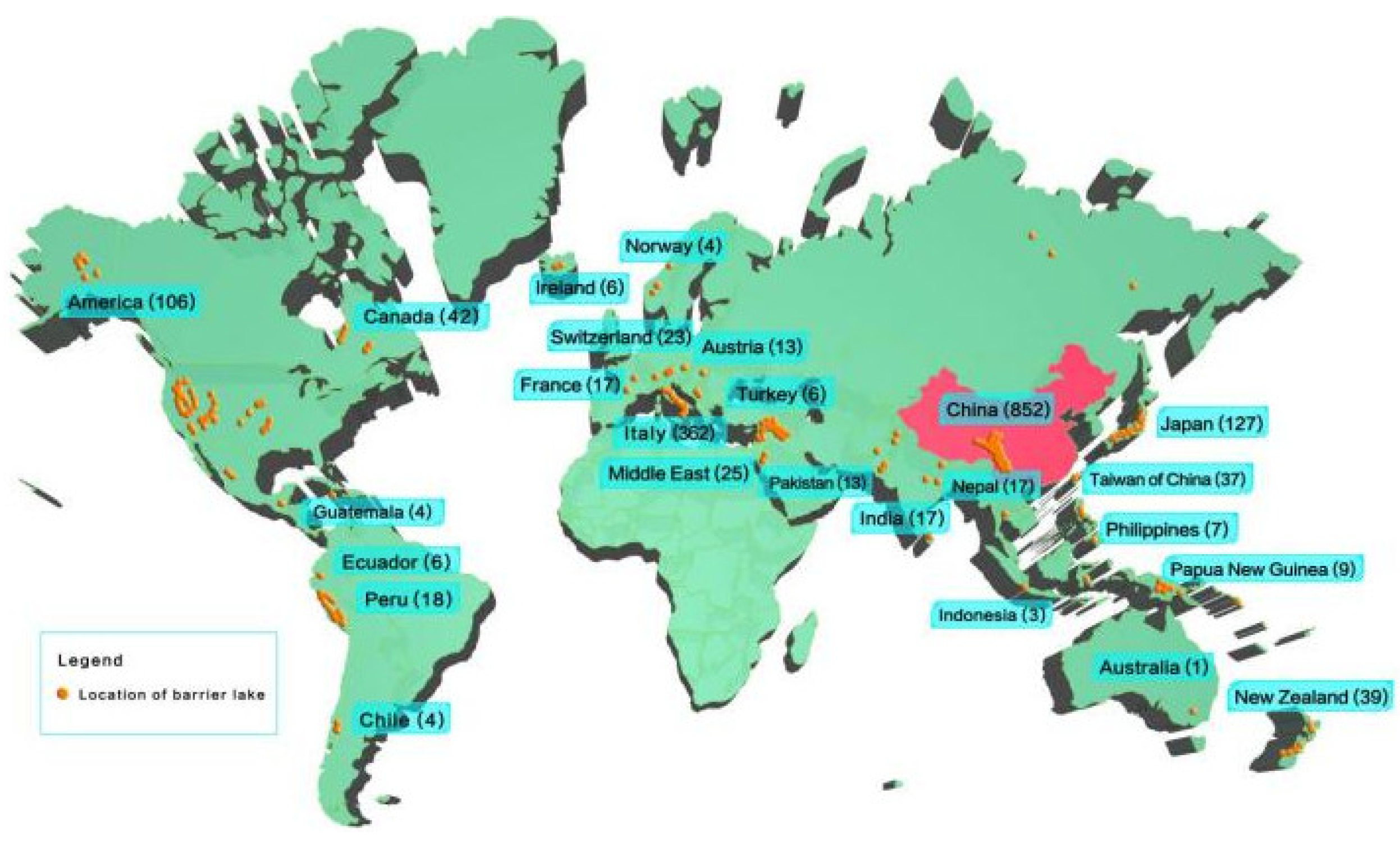
Figure 2.
Mathematical model for quantitative risks classification of barrier lake based on D-AHP.
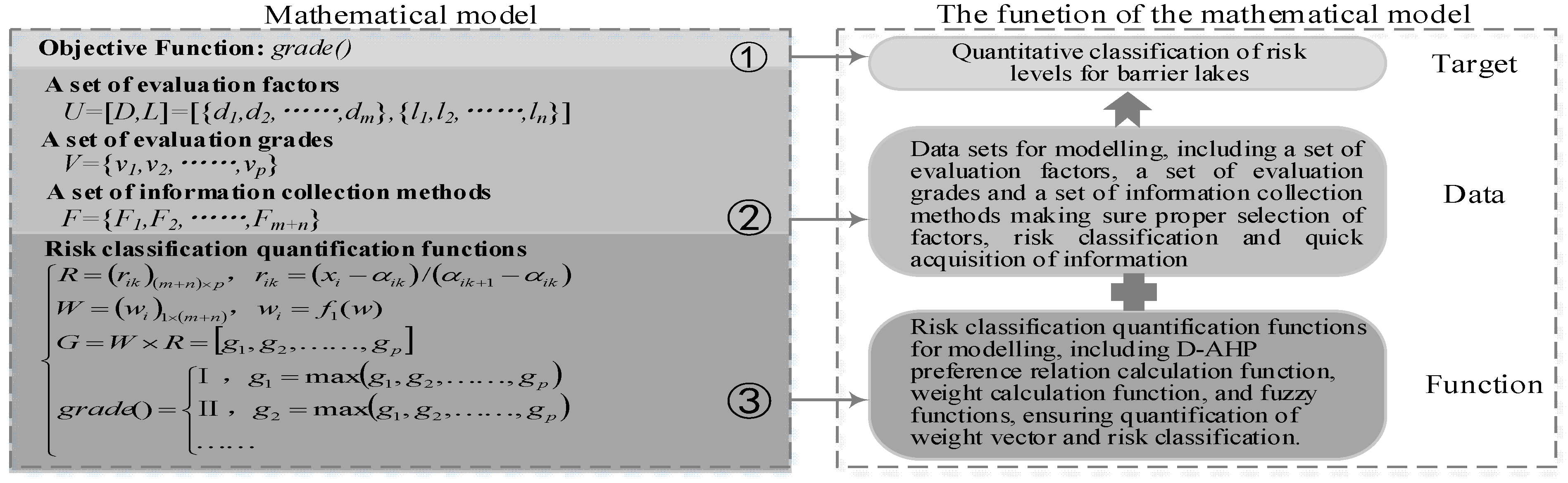
Figure 3.
Procedure of barrier lake risk grading through mathematical model.
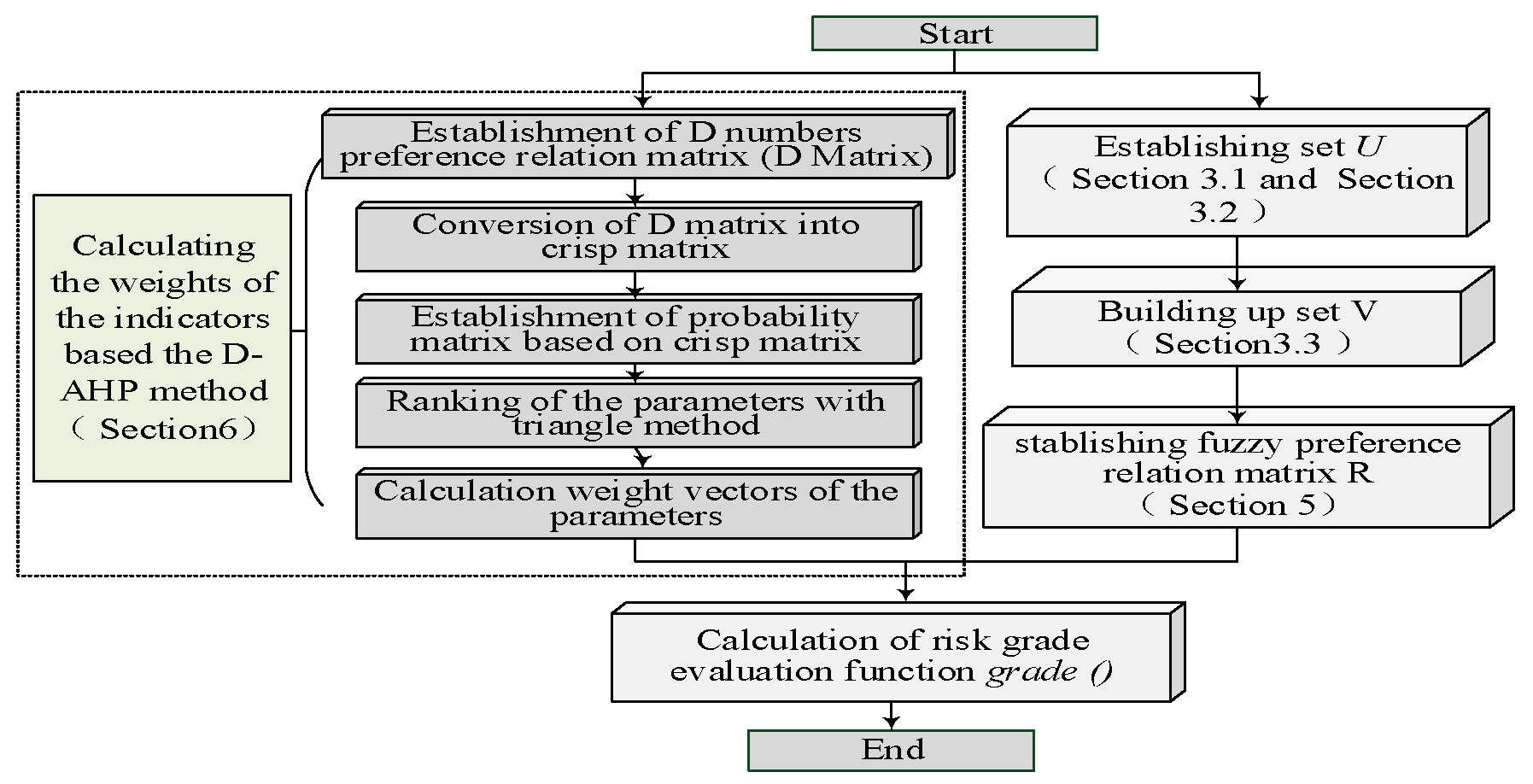
Figure 4.
Relation between lake capacity and peak flood upon collapse.
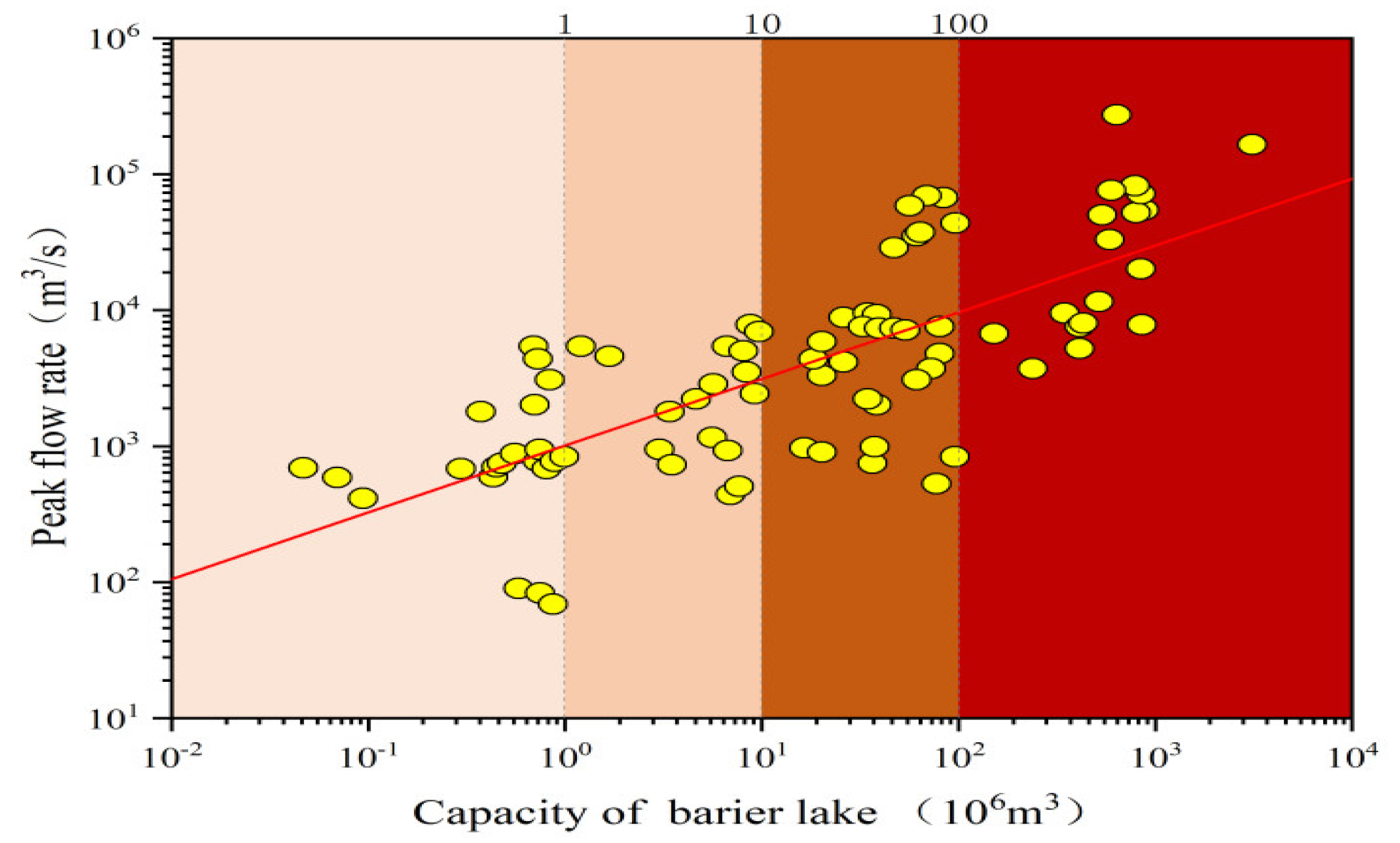
Figure 5.
Relation between inflow from upstream and duration of barrier lake.
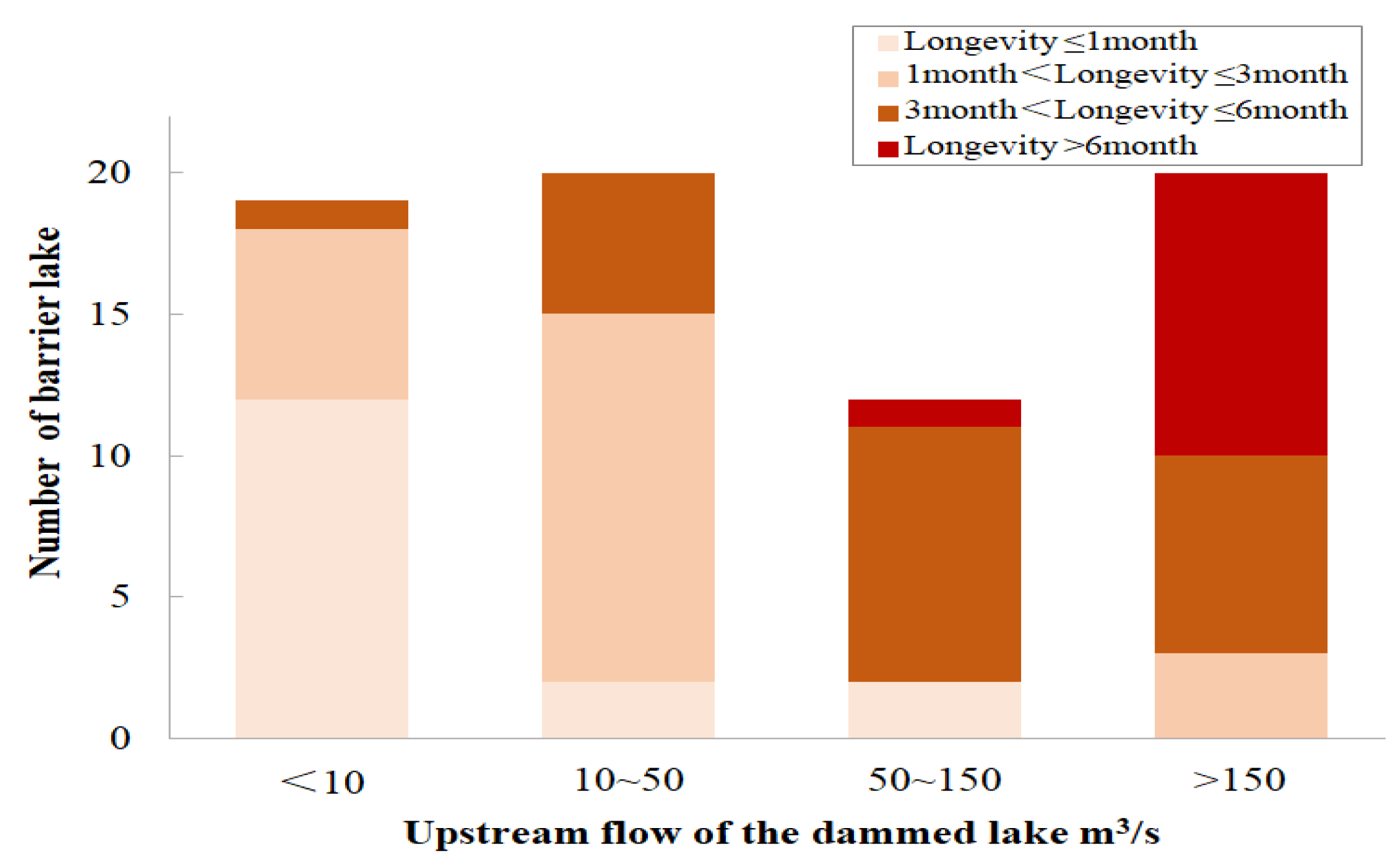
Figure 6.
Relation between L/H and the duration of barrier lakes.
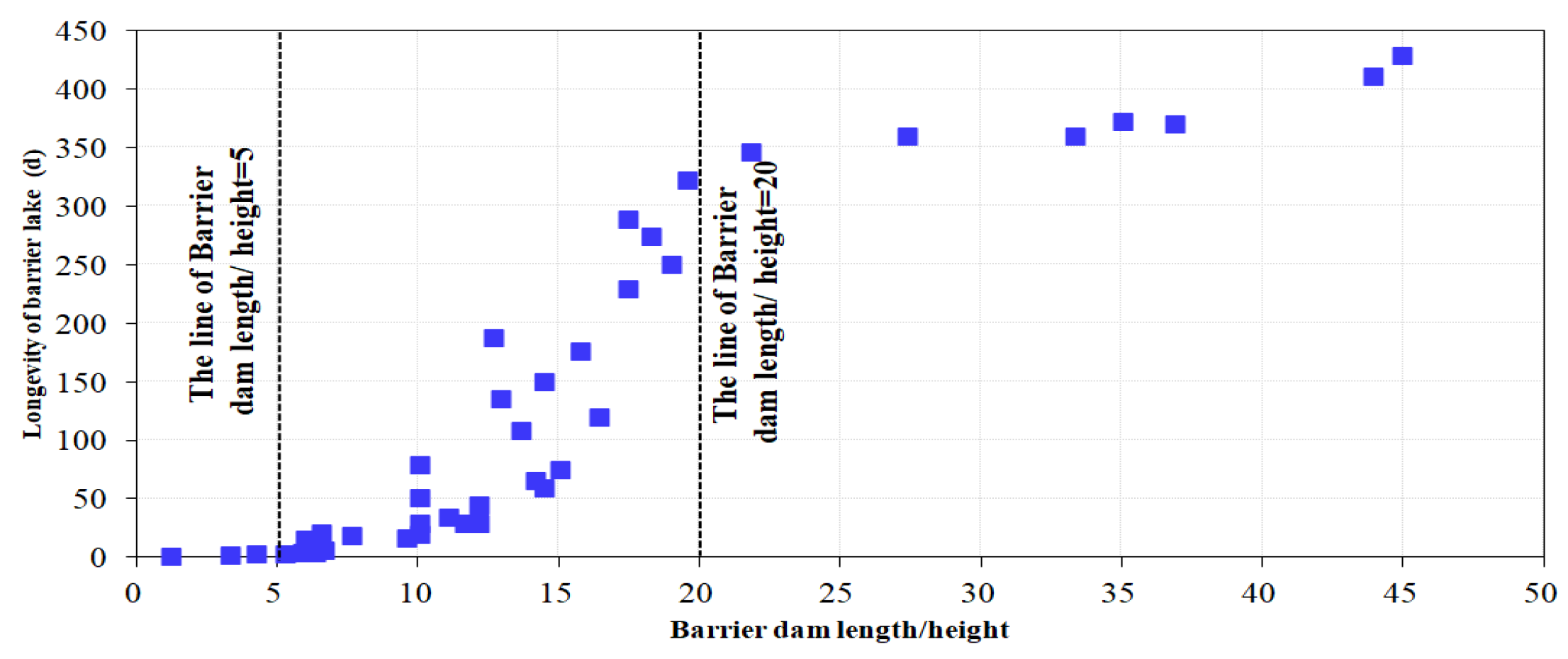
Figure 7.
Geometry of barriers and the risk grading.
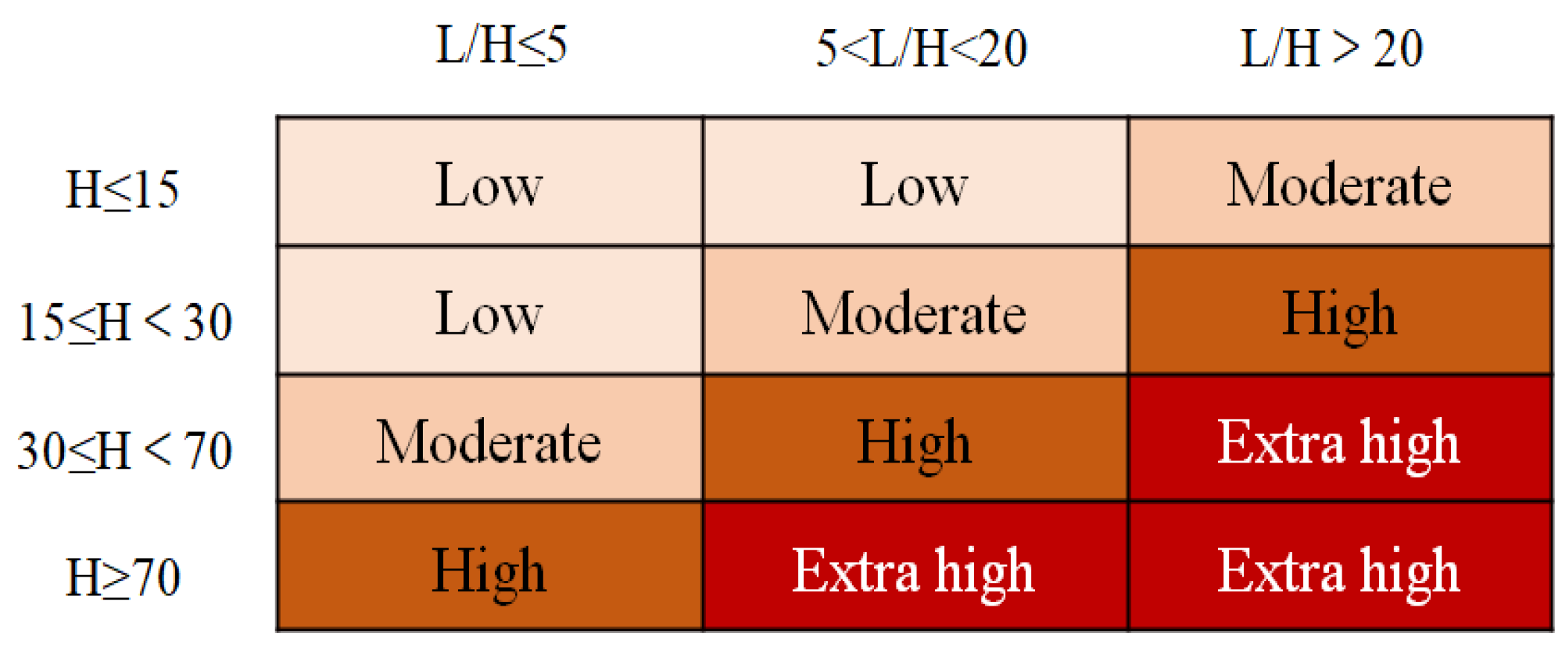
Figure 8.
The process of the acquisition of d1 (case study of Tangjiashan).
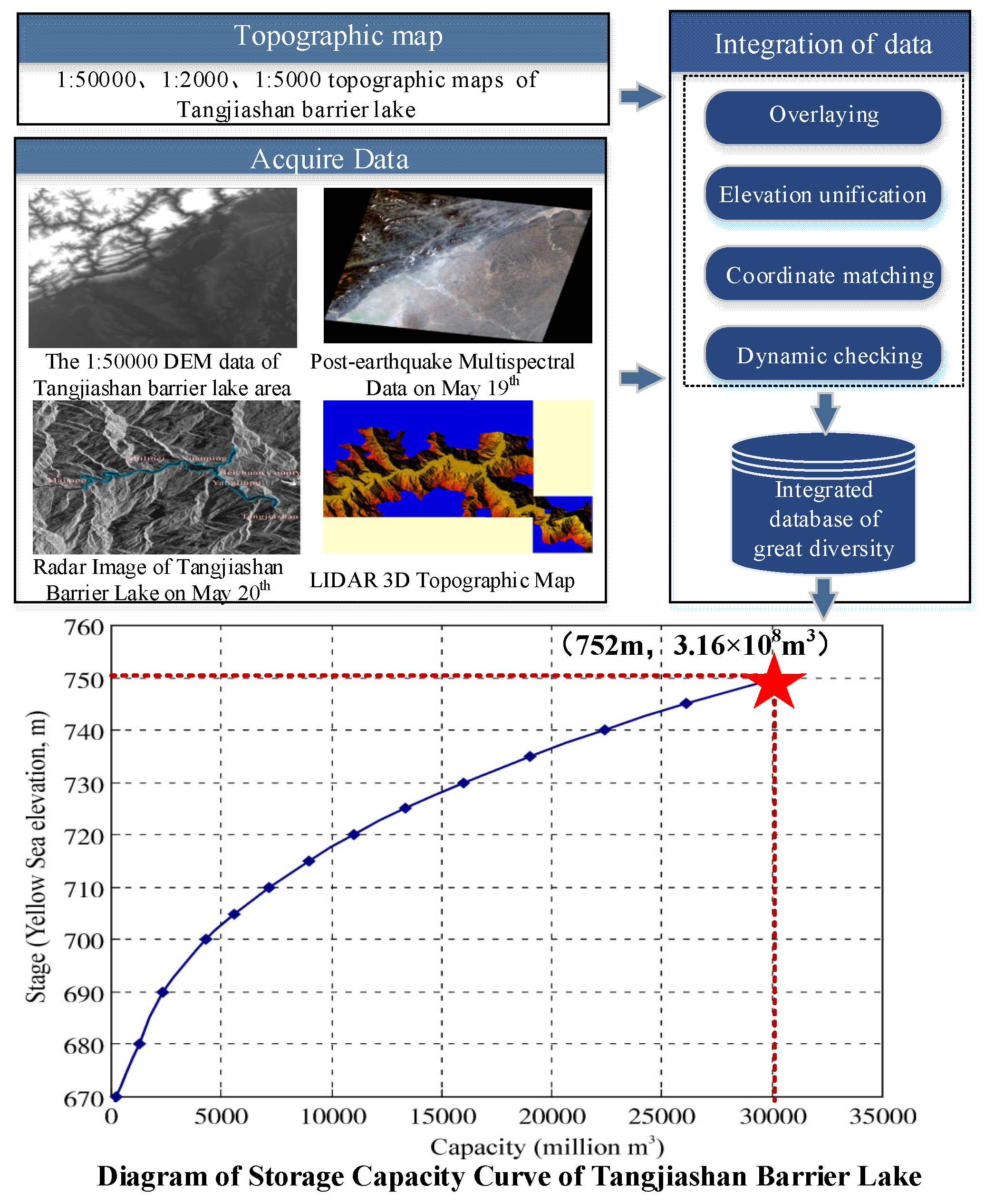
Figure 9.
The process of the acquisition of d3.
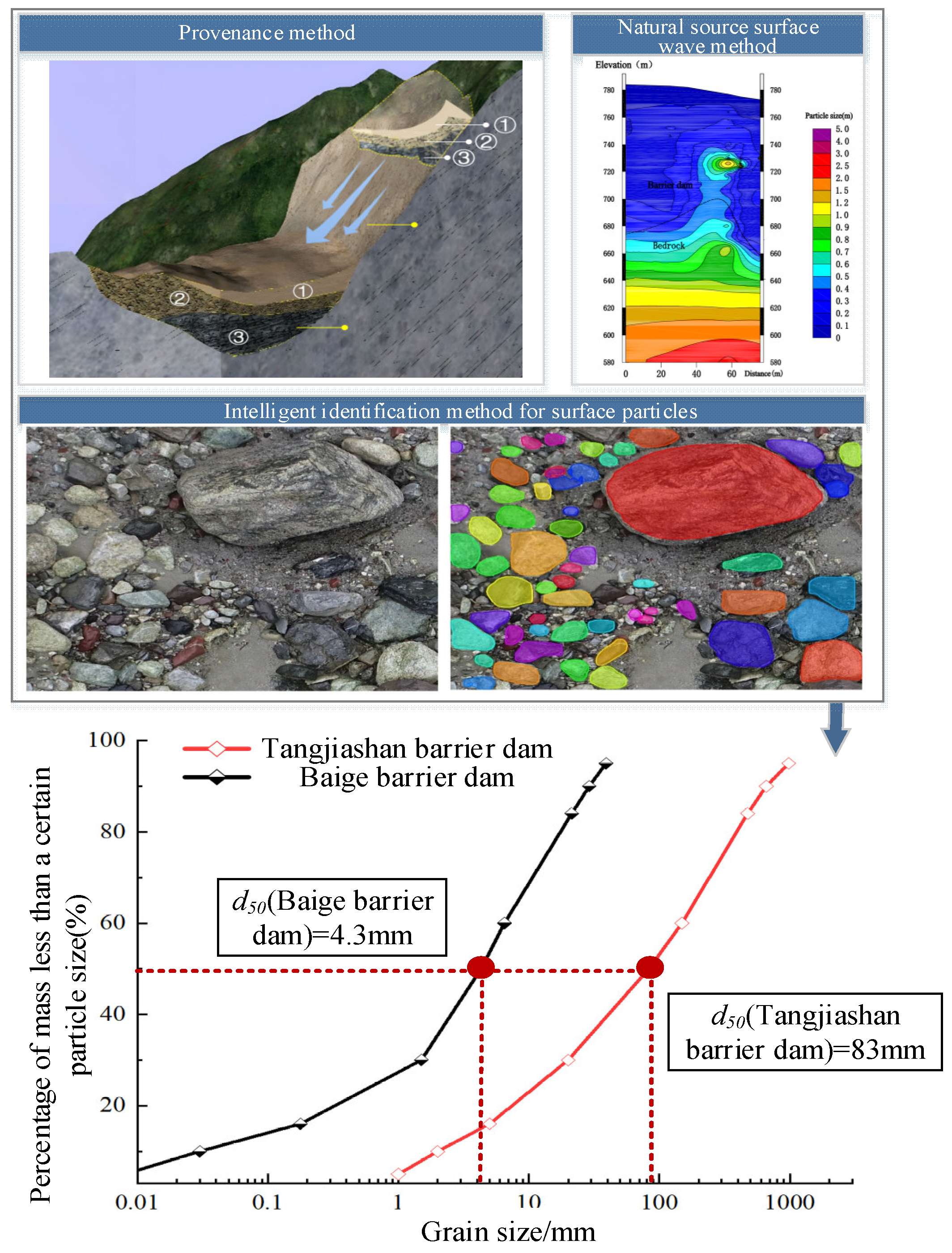
Figure 10.
Calculation function of preference relation rik.
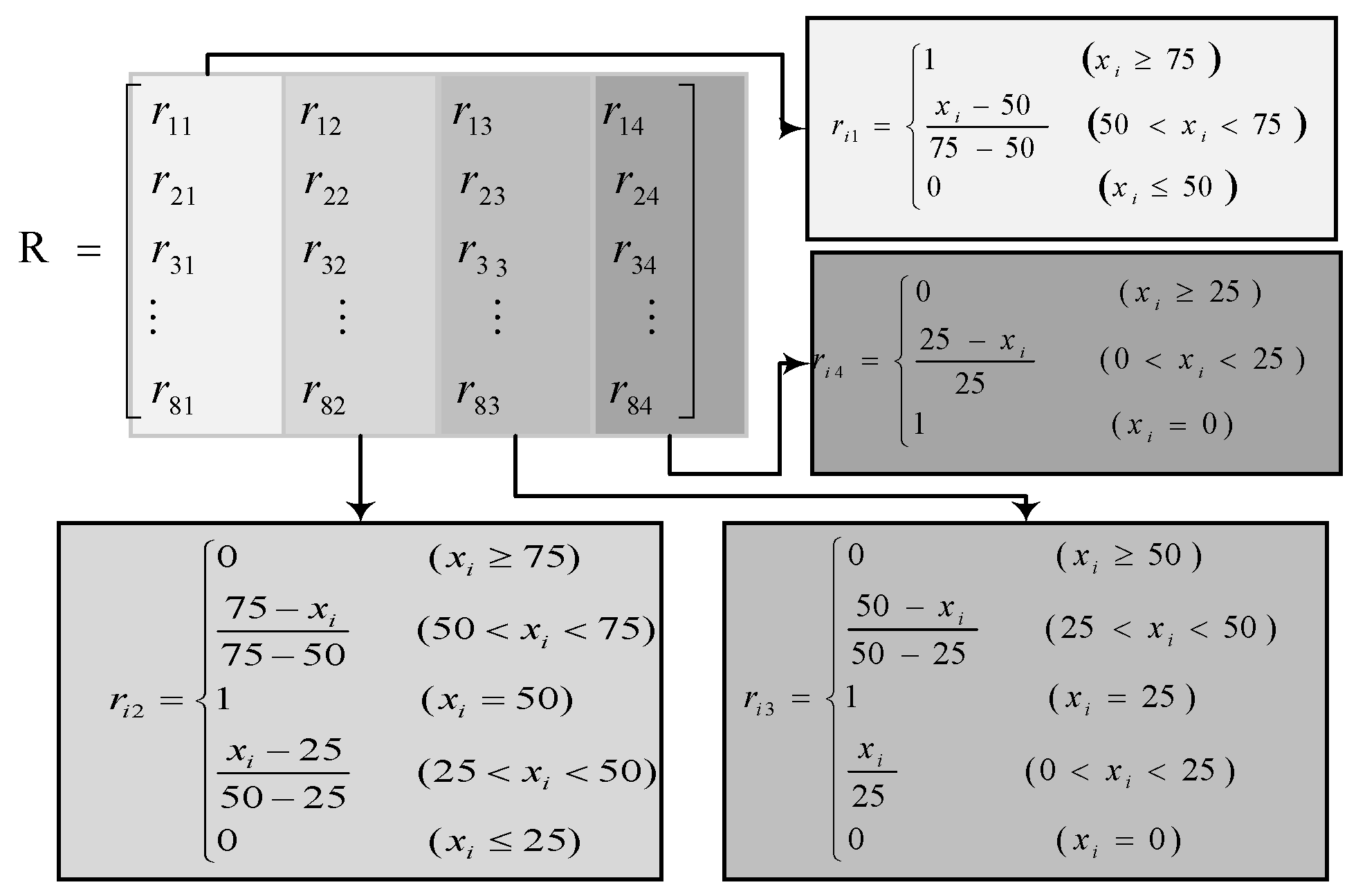
Figure 11.
Location of the 15 Barrier Lakes.
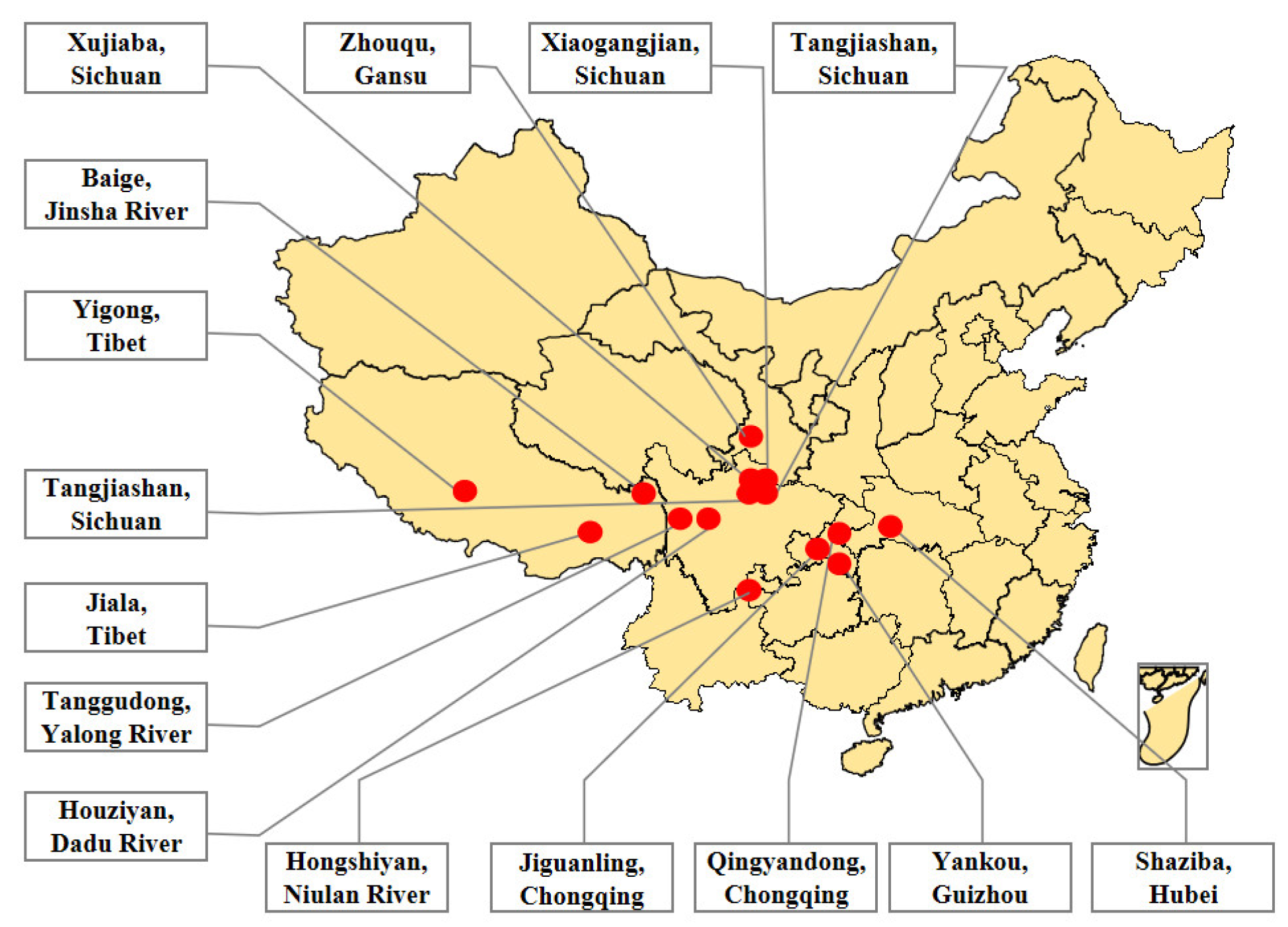
Figure 12.
Comparison between Method A and Method B in calculation results on risk level of barrier lakes.
Figure 12.
Comparison between Method A and Method B in calculation results on risk level of barrier lakes.
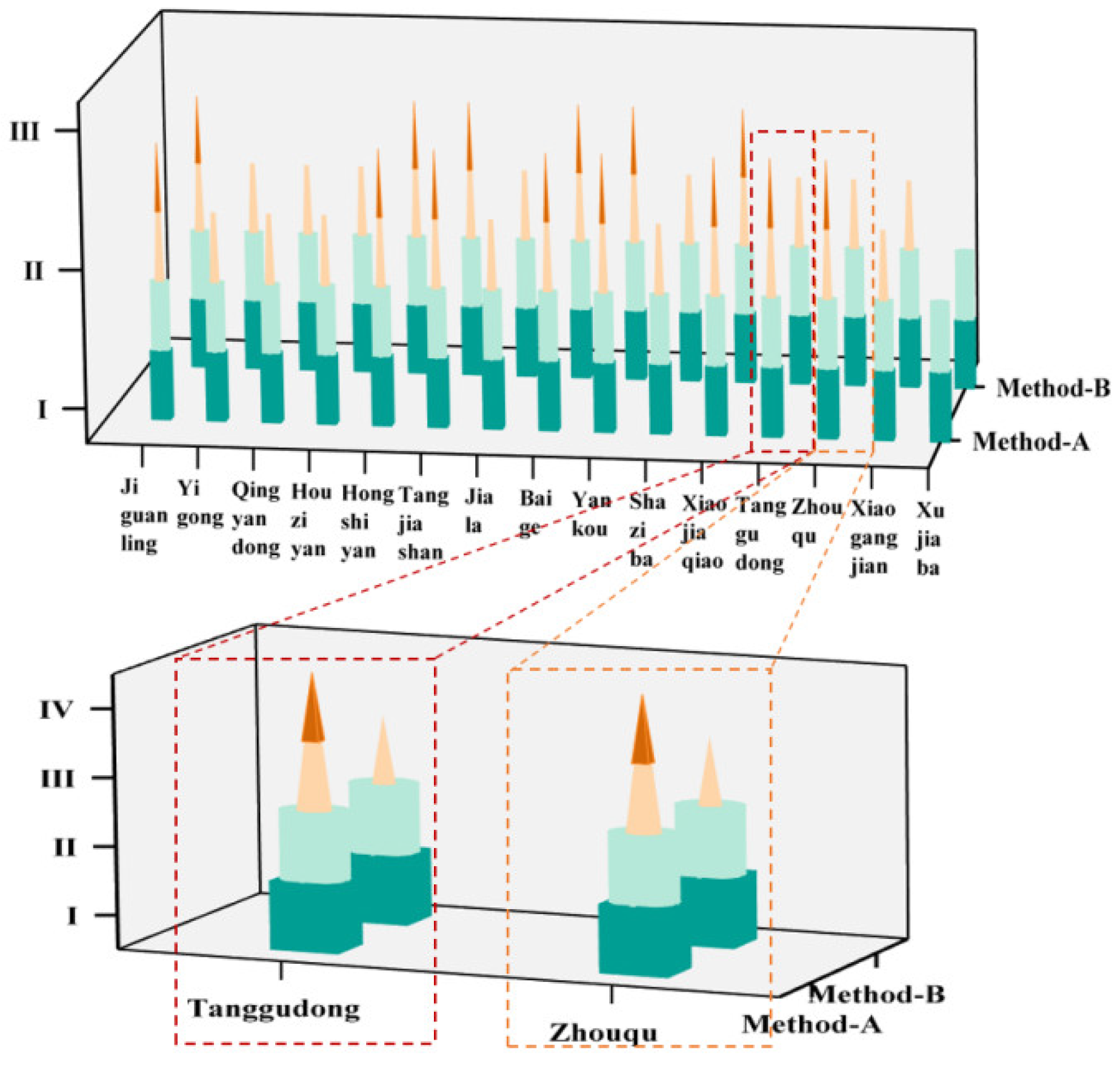

Table 1.
Hazard assessment parameters for barrier dams worldwide.
| List of scholars | No. of samples | Lake volume relevant parameters | Barrier dam relevant parameters | ||||||||
| AL | VL | LL | Q | Vd | Hd | Wd | Ld | Sd | I | ||
| Casagli et al | 70 | √ | √ | ||||||||
| Ermini et al | 84 | √ | √ | √ | |||||||
| Dong et al | 43 | √ | √ | √ | √ | √ | |||||
| Stefanelli et al | 300 | √ | √ | ||||||||
| Shan et al | 115 | √ | √ | √ | √ | ||||||
| Shi et al | 79 | √ | √ | √ | √ | √ | |||||
Table 2.
The factors for assessment on barrier dam failure.
| Authors | Type of loss | Factors |
| Zhou et al.2008;Wu et al.,2010;Du et al.2022 | Life loss | population at risk, population density, level of floods, understanding of residents, time of alarming, rate of young adults to the elderly and kids, time of dam failure, weather, distance to dam site, emergency response plan, dam height, reservoir volume, downstream river slope, topography, impact resistance of structures, temperature, rescue capability |
| Xiao et al., 2009;Yang, 2010;Wang et al.2014;Liu et al.,2016;Du et al.2023 | Economic loss | duration of floods, velocity of floods, sediment concentration, flood water temperature, depreciation of properties, time of alarming, pollutant concentration |
| Wang et al., 2006;Li et al.2017;Li et al.,2019;Wu et al., 2019 | Ecological loss | Geomorphology of river channel, water environment, human ecology, natural reserves, damage to animal species, soil environment, vegetation coverage, production reduction in agriculture, forestry and fishery, air quality, dirty industries |
Table 4.
Information acquisition method for risk grading with 8 factors.
| Factors | Methods of data acquisition | Factors | Methods of data acquisition |
|---|---|---|---|
| d1 | capacity curve of the barrier lake | l1 | acquisition through quick identification technology based on LBS (Location Based Services) |
| d2 | calculated based on runoff-yielding in barrier lake area | l2 | acquisition from corresponding government authorities based on risk map of flooding induced by dam failure |
| d3 | intelligent identification of surface particles, geophysical investigation of space equivalent particle, tracing provenance analysis, etc | l3 | |
| d4 | oblique photography with UVA, LiDAR, satellite images, and multi-dimensional 3D modelling with DEM | l4 |
Table 5.
Assignment results of 8 evaluation indicators for the 15 cases.
| Barrier Lake | d2 | d3 | d4 | l1 | l2 | l3 | l4 |
| Jiguanling | 86.62 | 40.28 | 16.67 | 65.28 | 28 | 79 | 29 |
| Yigong | 59.63 | 48.61 | 59.38 | 38.89 | 34 | 24 | 29 |
| Qingyandong | 40.25 | 41.67 | 50 | 38.89 | 4 | 49 | 29 |
| Houziyan | 100 | 40.97 | 56.25 | 52.78 | 68 | 54 | 54 |
| Hongshiyan | 77.84 | 64.67 | 80.94 | 55.56 | 49 | 33 | 29 |
| Tangjiashan | 58.75 | 41.25 | 79.06 | 80.94 | 74 | 54 | 54 |
| Jiala | 100 | 43.06 | 54.69 | 51.67 | 46 | 4 | 29 |
| Baige | 82.43 | 71.80 | 46.25 | 68.33 | 49 | 79 | 29 |
| Yankou | 26.88 | 43.06 | 90 | 61.11 | 56 | 33 | 54 |
| Shaziba | 75 | 73.61 | 58.13 | 45.55 | 28 | 4 | 29 |
| Xiaojiaqiao | 25.63 | 24.92 | 71.88 | 75.04 | 43 | 79 | 54 |
| Tanggudong | 93.24 | 63.89 | 100 | 25.28 | 34 | 33 | 29 |
| Zhouqu | 69.58 | 65.76 | 15 | 66.5 | 74 | 37 | 54 |
| Xiaogangjian | 28.13 | 10.17 | 75 | 60.33 | 46 | 29 | 29 |
| Xujiaba | 20.02 | 24.92 | 100 | 59.44 | 31 | 8 | 29 |
Table 6.
Calculation results of preference relation for the 15 cases.
| Jiguanling | Yigong | Qingyandong | Houziyan | Hongshiyan |
| Tangjiashan | Jiala | Baige | Yankou | Shaziba |
| Xiaojiaqiao | Tanggudong | Zhouqu | Xiaogangjian | Xujiaba |
Table 7.
Evaluation result of the risk levels of 15 barrier lakes (Method A).
| Barrier Lake | g1 | g2 | g3 | g4 | grade () | Risk Level |
| Jiguanling | 0.524 | 0.177 | 0.269 | 0.031 | 0.524 | Ⅰ |
| Yigong | 0.257 | 0.418 | 0.320 | 0.004 | 0.418 | Ⅱ |
| Qingyandong | 0.000 | 0.483 | 0.410 | 0.107 | 0.483 | Ⅱ |
| Houziyan | 0.386 | 0.567 | 0.047 | 0.000 | 0.567 | Ⅱ |
| Hongshiyan | 0.512 | 0.364 | 0.123 | 0.000 | 0.512 | Ⅰ |
| Tangjiashan | 0.644 | 0.310 | 0.046 | 0.000 | 0.644 | Ⅰ |
| Jiala | 0.332 | 0.459 | 0.119 | 0.091 | 0.459 | Ⅱ |
| Baige | 0.661 | 0.275 | 0.064 | 0.000 | 0.605 | Ⅰ |
| Yankou | 0.318 | 0.453 | 0.229 | 0.000 | 0.453 | Ⅱ |
| Shaziba | 0.282 | 0.360 | 0.266 | 0.091 | 0.360 | Ⅱ |
| Xiaojiaqiao | 0.403 | 0.305 | 0.292 | 0.000 | 0.403 | Ⅰ |
| Tanggudong | 0.467 | 0.149 | 0.384 | 0.000 | 0.467 | Ⅰ |
| Zhouqu | 0.437 | 0.251 | 0.275 | 0.037 | 0.437 | Ⅰ |
| Xiaogangjian | 0.173 | 0.427 | 0.322 | 0.078 | 0.427 | Ⅱ |
| Xujiaba | 0.162 | 0.324 | 0.414 | 0.100 | 0.414 | Ⅲ |
Table 8.
Calculation table of risk level of barrier lake (Method B).
| Risk Level of Barrier Dam | Severity of Losses due to Barrier Lake | Risk Level of Barrier Lake |
| Extra high risk, high risk | Extremely severe | Ⅰ |
| Extra high risk | Severe, relatively severe | Ⅱ |
| High risk | Severe | |
| Moderate risk | Extremely severe, severe | |
| Low risk | Extremely severe | |
| Extra high risk | Moderate | Ⅲ |
| High risk | Relatively severe, moderate | |
| Moderate risk | Relatively severe | |
| Low risk | Severe, relatively severe | |
| Moderate risk, low risk | Moderate | Ⅳ |
| Notes: ①Risk Level of Barrier Dam:When S≥3.0, it is considered as extremely high risk. When 2.25≤S<3.0, it is considered as high risk. When 1.5≤S<2.25, it is considered as moderate risk. When S<1.5, it is considered as low risk. S=0.25 (S1+ S2+ S3+S4) . S1, S2, S3, S4 are the assigned values for the four grading indicators d1, d2, d3, d4, with extra high risk, high risk, moderate risk, low risk assigned values of 4, 3, 2 and 1, respectively. ②Severity of Losses: The level of severity of losses due to the barrier lake is based on the highest level of loss severity among the single grading indicators l1, l2, l3, and l4. | ||
Disclaimer/Publisher’s Note: The statements, opinions and data contained in all publications are solely those of the individual author(s) and contributor(s) and not of MDPI and/or the editor(s). MDPI and/or the editor(s) disclaim responsibility for any injury to people or property resulting from any ideas, methods, instructions or products referred to in the content. |
© 2024 by the authors. Licensee MDPI, Basel, Switzerland. This article is an open access article distributed under the terms and conditions of the Creative Commons Attribution (CC BY) license (http://creativecommons.org/licenses/by/4.0/).
Copyright: This open access article is published under a Creative Commons CC BY 4.0 license, which permit the free download, distribution, and reuse, provided that the author and preprint are cited in any reuse.


