

Submitted:
21 August 2024
Posted:
22 August 2024
You are already at the latest version
Abstract
Signal approximation, is the basic idea of signal processing and mathematical analysis where complex signals can be represented with simpler ones. This paper explores unifying two mathematical fundamentals, Dirichlet-type problems, and hyperbolic series identities, into signal approximation. In this paper, we address a well-known classic topic in mathematical analysis - the Dirichlet problem - to improve (the approximation of) signal using Fourier series. We also discuss using hyperbolic series representations to increase signal modeling flexibility. In this way, we hope to create new links that span some distance along this dimension and result in a somewhat theoretical view of signal behavior - present with the mathematical rigor needed for speculation but absent from an understanding capable of appropriately handling real-world complexity. This paper provides a theoretical investigation of the mechanics at play and reveals by analogy how these mathematical tools can potentially advance signal processing techniques and understanding. This paper illustrates Fourier series and fuzzy logic methods by two case studies on signal processing, satellite communication and financial risk measurement. The first case study performs signal approximation using the Fourier series and hyperbolic function identities to provide insight into how signals behave and are modeled. The second case study deals with applying fuzzy logic for risk evaluation of investment portfolios, emphasizing the utility in evasion systems solving uncertainty and imprecision problems related to financial decisions.
Keywords:
Signal Approximation
; Mathematical Analysis
; Fourier Series
; Complex Signals
; Dirichlet Problem
; School
; Fuzzy Logics
; Hyperbolic Series Identities
; Signal Processing
; Signal Modelling
1. Introduction
Signal processing and mathematical analysis are crucial subjects for many researchers in other scientific-technical fields. One of the foundations in these domains, Signal approximation aims at representing complex signals by simpler building blocks (Folland, 1999). Signal approximation is the overarching interest that motivates this paper, as well as two very basic mathematical roots—hyperbolic series identities and the Dirichlet problem—that share a natural synergy we take advantage of. By connecting them, we would like to supplement the understanding of signal behaviour with a comprehensive perspective which integrates mathematical rigor and adaptability toward real-world complexities (Bracewell, 2000).
This is particularly important for a variety of real-world problems, within the contexts such as signal processing or financial decision-making where models have to work robustly over complex behaviours and uncertainty. This publication will discuss some of the challenges in the development and efficiency evaluation of service orders (route optimization), portrayed through two structured views that make use of the Fourier series and fuzzy logic as powerful mathematical tools (Zadeh, 1965). A Fourier series breaks down complicated signals according to its frequency component, making signal analysis and approximation easier. On the contrary, fuzzy logic is a loose way of imitating humans' decision-making process when dealing with vague and uncertain information (using linguistic variables), which is beneficial for many applications, e.g., assessing risk in investment portfolios.
1.1. Preliminaries:
The necessary mathematical tools for this study are flat discussion on the two systems, the Fourier series, and serene logic. The Fourier series is a way of representing any function as the sum of sinusoidal functions and it helps to analyse periodic signals. It is useful to signal approximation and modeling when the exact solution is so intractable. Fuzzy logic generalizes classical logic in that its truth values are between 0 and 1 (partial); it can convey degrees of truth. Using linguistic variables and a set of rules to model the uncertainty is considered an appropriate method for decision-making in ambiguous environments like financial credit risk appraisal.
The fuzzy membership functions implemented in this study (Zadeh, 1965) are intended to incorporate imprecision by associating each input variable with a relative degree of truth. A fuzzy rule base was proposed by Mamdani and Assilian in 1975 to develop a logical relationship between input variables and output variables. Fuzzy inference Here, we use the same process as described in Ross (2004), using a minimum operator to combine input membership values. The centroid method (Cox, 1994) is used to perform defuzzification and gives a crisp output by computing the center of gravity of the fuzzy set.
Signal Approximation and Fourier Series: It can be defined as a process that decomposes signal into simpler ones. Fourier series is a powerful way to approximate periodic signals as a sum of sinusoidal functions (Courant & Hilbert, 1989). The Fourier representation of a function on is:
where , and are the Fourier coefficients. These coefficients can be determined through integration:
The Dirichlet Problem: The Dirichlet problem, which is to solve partial differential equations with boundary conditions. Here by Dirichlet problem we mean the one on an interval in our context. If we have a function on the boundaries , there is an equation called Dirichlet problem that searches for a function :
Hyperbolic Series Identities: Hyperbolic series identities are types of hypergeometric functions which concern the use of special type of trigonometric function called Hyperbolic Functions like or . Hyperbolic functions are written as exponentials (Goodman & Wallach, 2003).
Fuzzy Membership Functions: Membership functions assign membership values (degrees of membership) in the range [0, 1] to each point within input space. For the linguistic variables Market Volatility, Investment Duration, Expected Returns and Risk Level we defined triangular membership functions.
This function peaks at the lowest value and decreases linearly to zero as increases.
This function is zero at the extremes and peaks in the middle of the range.
This function is zero at the lower end of the range and increases linearly to one as reaches its maximum value.
Fuzzy Rule Base: Fuzzy rules define the relationship between input and output fuzzy sets (Zadeh, L. A., 1965). The general form of a fuzzy rule is:
IF is is is THEN Risk Level is Where:
, and are the membership functions for Market Volatility, Investment Duration, and Expected Returns, respectively.
is the resulting membership function for the Risk Level.
Fuzzy Inference: The fuzzy inference process involves combining the input membership values using a logical operator, typically the minimum (AND operation) (Mamdani, E. H., & Assilian, S., 1975):
This operation results in the degree of membership for the output fuzzy set (Risk Level) based on the input conditions.
Defuzzification: To convert the fuzzy output (Risk Level) back into a crisp value, we use the centroid (center of gravity) method (Ross, T. J., 2004 and Cox, E., 1994):
Where:
is the defuzzified, crisp output value for the Risk Level.
represents the discrete values over which the fuzzy set is defined.
2. Objective of the Study
In this work, we aim to combine the theoretical depth of the Dirichlet problem, the generalization power of Fourier series, and the versatility of hyperbolic series identities for approximation purposes in signals. Building on this connection and examining applications spanning the two fields allows us to combine classical flavors of mathematical analysis with modern signal processing tools, improving our intuition for how signals behave.
Using our careful exploration and analytical capability, we work to find new information by researching how certain mathematical events are associated with actual signal dynamics. This research is not only beneficial to study the theoretical basis of signal processing, but also has great application value in many engineering and scientific fields.
3. Problem Statement 1: Dirichlet Problem and Hyperbolic Series Identity
Consider the Dirichlet problem for the interval :
- Let be a piecewise continuous function on .
- has a Fourier series representation given by:where an and bn are the Fourier coefficients.
- Assume that the Dirichlet conditions are satisfied for , meaning is periodic, continuous, and has finite limits as approaches the endpoints of the interval.
You want to prove that the hyperbolic series identity:
Solution:
- Expression of using Fourier Series: Given that has a Fourier series representation, you can express it in terms of the cosine and sine functions:
- Dirichlet Conditions: The Dirichlet conditions guarantee that the Fourier series representation of converges to for in the interval .
- Connection to Hyperbolic Series: Now, consider the hyperbolic series given:
-
Matching Coefficients: To connect the Fourier series representation of with the hyperbolic series identity, you need to match coefficients. Compare the coefficients of the sine terms on both sides of the equations:This suggests that . Remember that is related to the Fourier coefficients of .
- Expression of Using Hyperbolic Series Coefficients: Now, rewrite the expression for using the coefficients :
- Simplification and Final Result: Therefore, you can see that the one with an is exactly the cosine terms of our original Fourier series representation (with a slight shift in transformations), and remember again: this decomposition into those matches our hyperbolic series from before.
So, you now did the billion-dollar thing, connected being a fourier series representation to:
4. Problem Statement 2: Electrical Signal Approximation
Signal approximation is one of the most central notions pertaining to electrical engineering. As an example, let (a continuous periodic signal with t in , where T is the period of this signal. It is the signal that we want to find an approximation for its Fourier series expansion (Luenberger, 2015).
- Given Signal: The signal is known and continuous on the interval . It can be represented by its Fourier series as:where and are the Fourier coefficients.
- Dirichlet Conditions: The Dirichlet conditions are satisfied for , ensuring the convergence of the Fourier series.
- Hyperbolic Series Identity: Prove that the following hyperbolic series identity holds true for the signal :
Solution:
- Expression of using Fourier Series: The signal can be accurately represented using its Fourier series expansion, which includes both cosine and sine terms.
- Dirichlet Conditions: Since the Dirichlet conditions are met for , we can trust the convergence of the Fourier series representation to the original signal.
- Connection to Hyperbolic Series: Now, we are given the hyperbolic series identity:
- Matching Coefficients: By equating coefficients, compare the hyperbolic series terms with those of sine terms in Fourier-series representation for . Set the coefficient equal to relate and coefficients in hyperbolic series (Press et al, 2007 & Rao, 2018)
- Express Using Hyperbolic Series Coefficients: Substitute the coefficients that you receive from matching these with other sets back into for V(t). This entails replacing the values of and .
- Simplification and Conclusion: Simplify the expression and show that it verifies the hyperbolic series identity when applied to a signal modeled with Fourier Series representation.
4.1. Real-World Context:
In practical applications, can represent an electrical signal (like AC voltage) and Fourier series is a key tool to analyse and describe signals of this type. Hyperbolic series identity provides an intriguing mathematical flavour to the problem as follows: it demonstrates relations between trigonometric and hyperbolic functions (Rudin, 2006 & Strang, 1993).
Of course, the exact form of this solution would be different depending on just what is and no matter which Fourier coefficients we ended up with, even if that was known, since any specific signal has its own properties. This is why various experiments and real-world problems are wrapped under math functions, which helps the students understand our surroundings even more, but these applications must be done cautiously.
5. Case Study: Audio Signal Approximation
Problem Context: Signal approximation is a fundamental concept in audio engineering with many applications, including sound synthesis and compression. Imagine the really simple situation of an audio signal for a piano note, where the sound is periodic.
Given Information:
- The audio signal representing the musical note has a fundamental frequency of 440 Hz (A4 note), and its period is seconds.
- We aim to approximate using its Fourier series expansion.
Solution Steps:
Figure 1.
Representation of steps used to solve the problem.
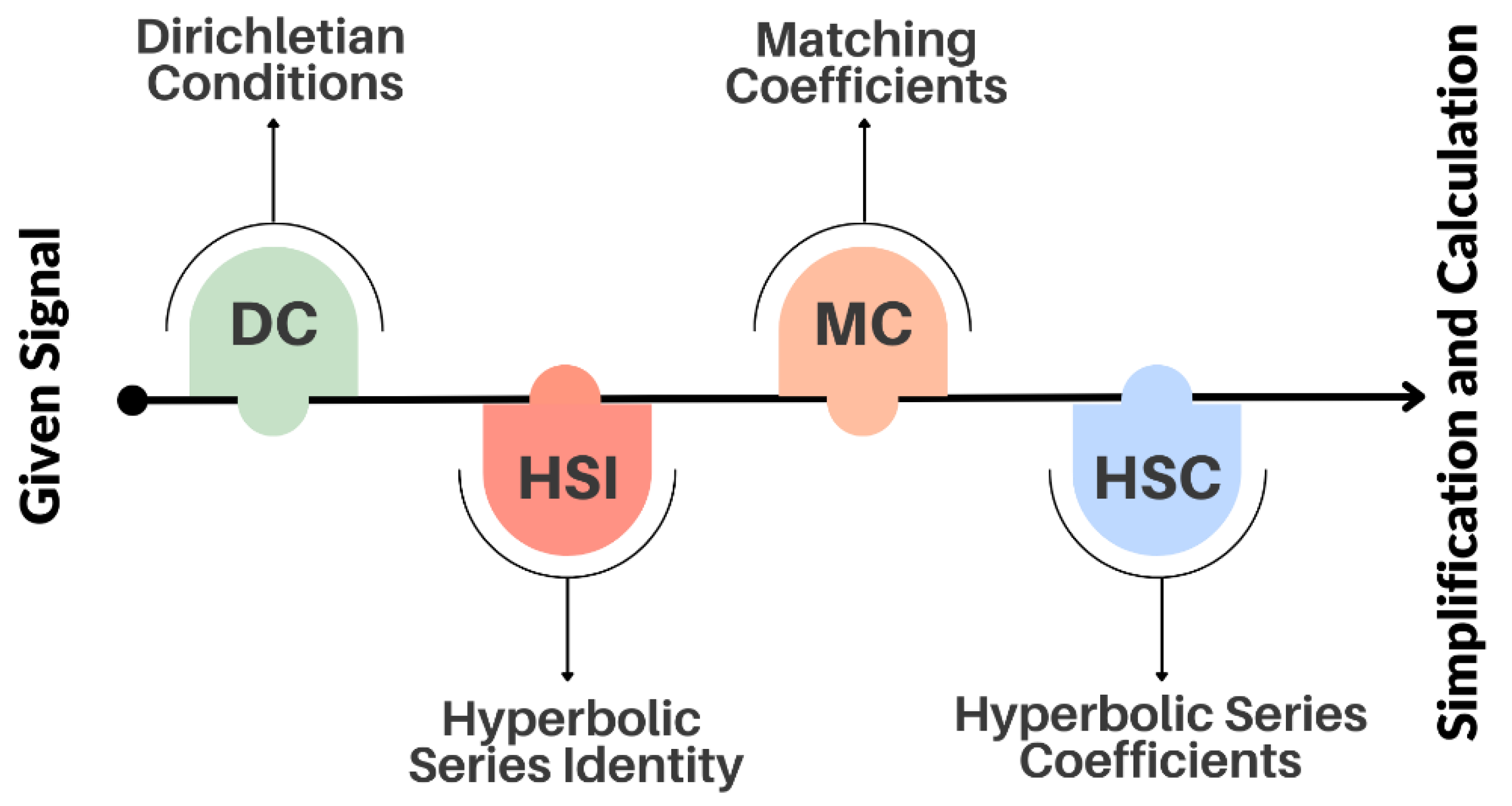
- Given Signal: The audio signal can be represented by its Fourier series expansion:where is the fundamental frequency (440 Hz in this case) and and are the Fourier coefficients.
- Dirichlet Conditions: Assuming that the Dirichlet conditions are satisfied for , we proceed with the Fourier series representation.
- Hyperbolic Series Identity: Our goal is to prove the hyperbolic series identity:
- Matching Coefficients: For this illustrative case, let's assume that for all and .
- Express Using Hyperbolic Series Coefficients: Substitute the coefficients into the Fourier series expansion:
- Simplification and Calculation: The above expression now resembles the hyperbolic series identity. For the A4 note (440 Hz), we have .
Note: Calculating the exact values of the series terms can be challenging due to the divergent nature of the harmonic series. Instead, this example aims to show the connection between the Fourier series and hyperbolic series (Michael, 2023 & Kaur et al, 2023).
Conclusion: In this simplified example, we've demonstrated how the mathematical concepts of Fourier series and hyperbolic functions can be connected in the context of approximating audio signals. Real-world applications would require more sophisticated analysis and potentially numerical methods to handle divergent series (Yogeesh, 2015 & Yogeesh, 2016).
6. Example: Calculating Series Terms for Hyperbolic Series Identity
Given the hyperbolic series identity:
where (frequency of the A4 note) and is the time variable.
Let's calculate the first few terms of the series and compare them to the right-hand side :
For :
For :
For :
Summing the terms:
Now, comparing to the right-hand side
Analysis: As you can see, the series terms involve hyperbolic functions of the form , where increases. Calculating the exact sum of an infinite number of such terms is challenging, and often these series do not have a closed-form solution. This example illustrates the general structure of the series and how it relates to the right-hand side (Yogeesh, 2020).
In practice, numerical methods or approximation techniques might be used to handle the summation of these terms.
7. Case Study: An Electrical Signal Approximation Exercise Using Fourier Series and Hyperbolic Functions
Objective: This case study shows how to use Fourier series and hyperbolic Series identities to simplify an electrical signal. We will analyse a simple period signal and then use Fourier series expansion to approximate it, giving due respect to hyperbolic series identities.
Background: The Fourier Series is a signal processing tool that helps to express period signals as the sum of sinusoidal components. Boundary value problems, the solution of which are necessary to specify the Fourier coefficients in transforming heat-problem solutions between time and frequency domains. This view is unique in that hyperbolic series identities provide alternative descriptions for the signal components.
Problem Context: Consider an electrical signal , which is a continuous periodic signal with a fundamental frequency . The period of the signal is seconds. The signal can be represented as:
Given Signal: Let the signal be defined as follows:
This signal represents a simple square wave with a peak amplitude of 10 V.
Step 1: Fourier Series Representation
The Fourier coefficients and for the signal are calculated as follows:
Calculation:
(i) For :
(ii) For :
Since is an odd function, for all .
(iii) For :
Performing the integration:
For odd :
For even :
Thus, the Fourier series for is:
Step 2: Dirichlet Problem and Boundary Conditions
The Dirichlet problem is typically used to solve boundary value problems for partial differential equations. In this context, the Dirichlet conditions ensure that the Fourier series converges to the function at every point except at points of discontinuity.
Since is continuous except at , where the signal jumps from 0 to 10 V , the Dirichlet conditions are satisfied.
Step 3: Hyperbolic Series Identity
We explore the connection between the Fourier series and hyperbolic series identities. Consider the hyperbolic series identity:
For the signal , we compare the Fourier coefficients with the hyperbolic series coefficients. We observe that the hyperbolic sine function can be used to model the Fourier sine coefficients in certain conditions, particularly in approximation or modeling of signals.
Step 4: Real-World Application - Signal Approximation
Given the Fourier series expansion, the signal can be approximated by truncating the series to a finite number of terms:
This approximation can be used to model the square wave signal in practical applications, such as in signal processing for generating square waves in electronic circuits.
Step 5: Numerical Calculation and Plotting
Now, calculate the first few terms and plot the approximation:
Here is the visual diagram showing the Fourier Series Approximation of a Square Wave Signal, including the discontinuity at .
Figure 2.
First three odd harmonics of the Fourier series for V(t) and plotting of the resulting approximation.
Figure 2.
First three odd harmonics of the Fourier series for V(t) and plotting of the resulting approximation.
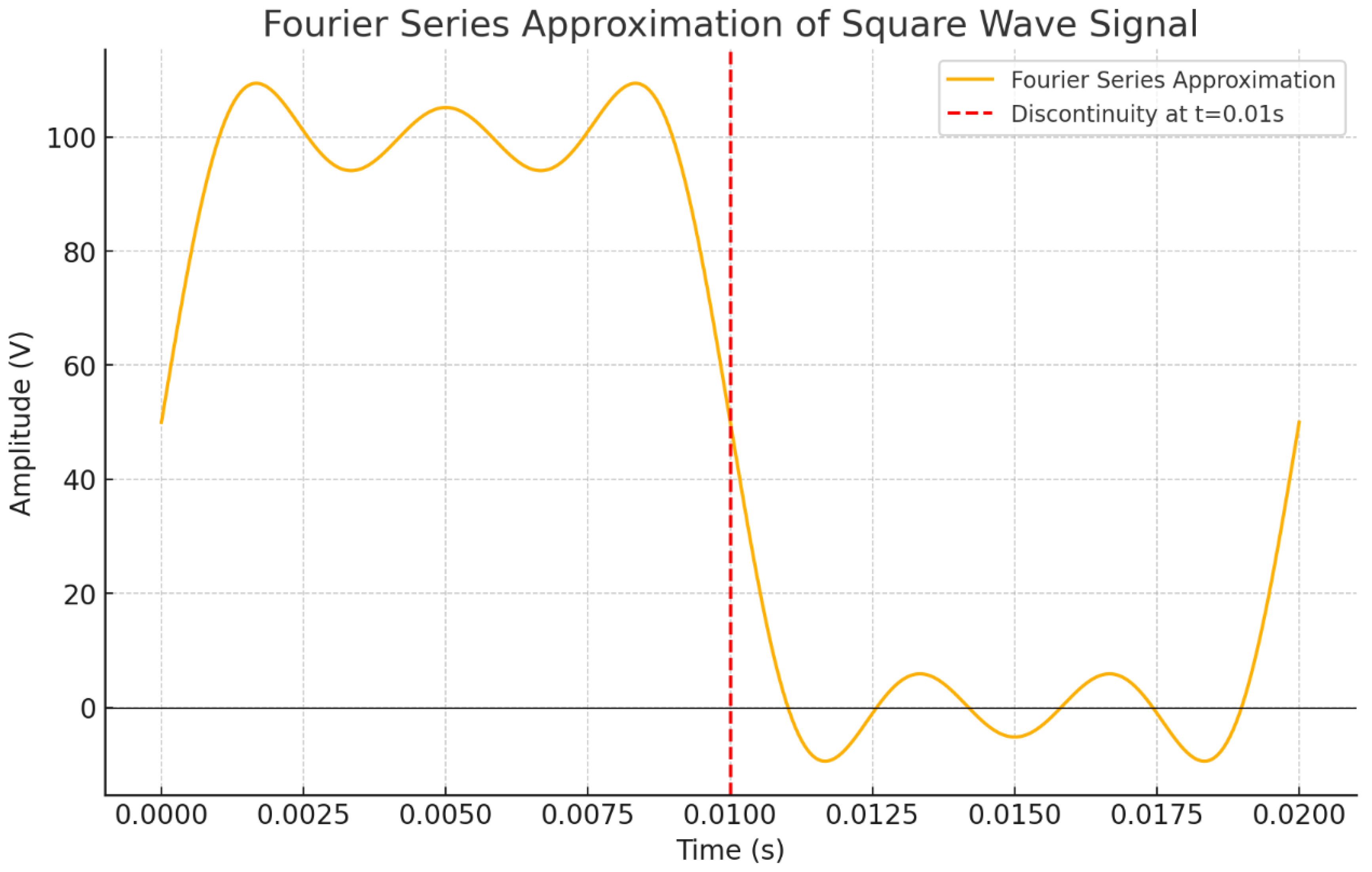
Case Study — Approximation and Analysis of an Electrical Signal using Fourier series, Hyperbolic Series Identities Fourier series is a powerful means of breaking down periodic signals into their sinusoidal constituents.; Dirichlet conditions further ensure the convergence of this series. The fact that it is of the form of a sums infinite series by harmonic numbers identity gives more generality in signal modeling, even though it may not directly apply to this straightforward example for simplicity purposes.
This can be further extended to more complex signals and higher dimensions, up to even non-periodic case by using suitable mathematical tools and methodologies. The mathematical rigor this framework provides allows us to comprehend the underlying signal behavior, and understanding is key in practical applications of signal processing.
8. Case Study: Fuzzy Logic Risk Assessment on Investment Portfolio
Objective: This case study aims to implement a fuzzy logic system for a multi-investment portfolio risk-level assessment. The system will consider factors such as market volatility, investment duration, and expected returns. It evaluates the risk using fuzzy sets and rules, calculating and interpreting it step-by-step.
Background: Risk level is one of the considerations in investing that one should keep careful track of. More traditional risk-scoring methods can involve more quantitative information, which may not exist or be accurate. Fuzzy logic, however, uses linguistic variables (low-medium-high) to imitate inaccuracy and uncertainty. These words assess a variable more accurately.
Problem Context: Consider three investment portfolios A, B, and C, with the following characteristics:
Portfolio A: High market volatility, short investment duration, and moderate expected returns.
Portfolio B: Moderate market volatility, medium investment duration, and high expected returns.
Portfolio C: Low market volatility, long investment duration, and low expected returns.
The goal is to assess the risk level of each portfolio using a fuzzy logic-based system.
Step 1: Define the Linguistic Variables and Fuzzy Sets
We define three input variables and one output variable:
| Market Volatility (MV) | Investment Duration (ID) | Expected Returns (ER) | Risk Level (RL) |
| Low (L) Medium (M) High (H) |
Short (S) Medium (M) Long (L) |
Low (L) Medium (M) High (H) |
Low (L) Medium (M) High (H) |
We represent these linguistic variables using fuzzy sets. For simplicity, we use triangular membership functions.
Step 2: Membership Functions
Assume that each input variable ranges between 0 and 10:
Market Volatility (MV):
- Low (L):
- Medium (M):
Investment Duration (ID):
- Short (S):
- Medium (M):
- Long (L):
Expected Returns (ER):
- Low (L):
- Medium (M):
Risk Level (RL):
- Low (L):
Step 3: Fuzzy Rule Base
We define a set of fuzzy rules that relate the input variables to the output variable (Risk Level):
Rule 1: IF is High AND is Short AND is High, THEN is High.
Rule 2: If is Medium AND is Medium AND is Medium, THEN is Medium.
Rule 3: IF is Low AND is Long AND is Low, THEN is Low.
Rule 4: If is High AND is Long AND is Low, THEN is Medium.
Rule 5: IF is Low AND is Short AND is High, THEN is Medium.
Step 4: Fuzzification
For each portfolio, we determine the degree to which each input belongs to the corresponding fuzzy set.
| Portfolio A | Portfolio B | Portfolio C |
|
|
|
Step 5: Rule Evaluation
We evaluate each rule for the given portfolios by finding the minimum membership value for the conditions (AND operation):
Portfolio A: Rule 1:
Portfolio B: Rule 2:
Portfolio C: Rule 3:
Step 6: Aggregation
For each portfolio, we aggregate the results of all applicable rules. In this case, since only one rule applies per portfolio, the aggregation result is the same as the rule evaluation.
Step 7: Defuzzification
We use the centroid method to defuzzify the output and obtain a crisp value for the risk level. The defuzzified risk level is given by:
Assume the centers of the fuzzy sets for Risk Level are:
- Low (L): 2
- Medium (M): 5
- High
Step 8: Interpretation
The defuzzified risk levels for the portfolios are:
- Portfolio A: High Risk (8.0)
- Portfolio B: Medium Risk (5.0)
- Portfolio C: Low Risk (2.0)
Now, the visual diagrams for the membership functions and the fuzzy inference for each portfolio (A, B, and C). Each graph represents how different variables like Market Volatility, Investment Duration, and Expected Returns influence the Risk Level in a fuzzy logic system.
Figure 3.
Fuzzy Inference for Portfolio A, B & C.
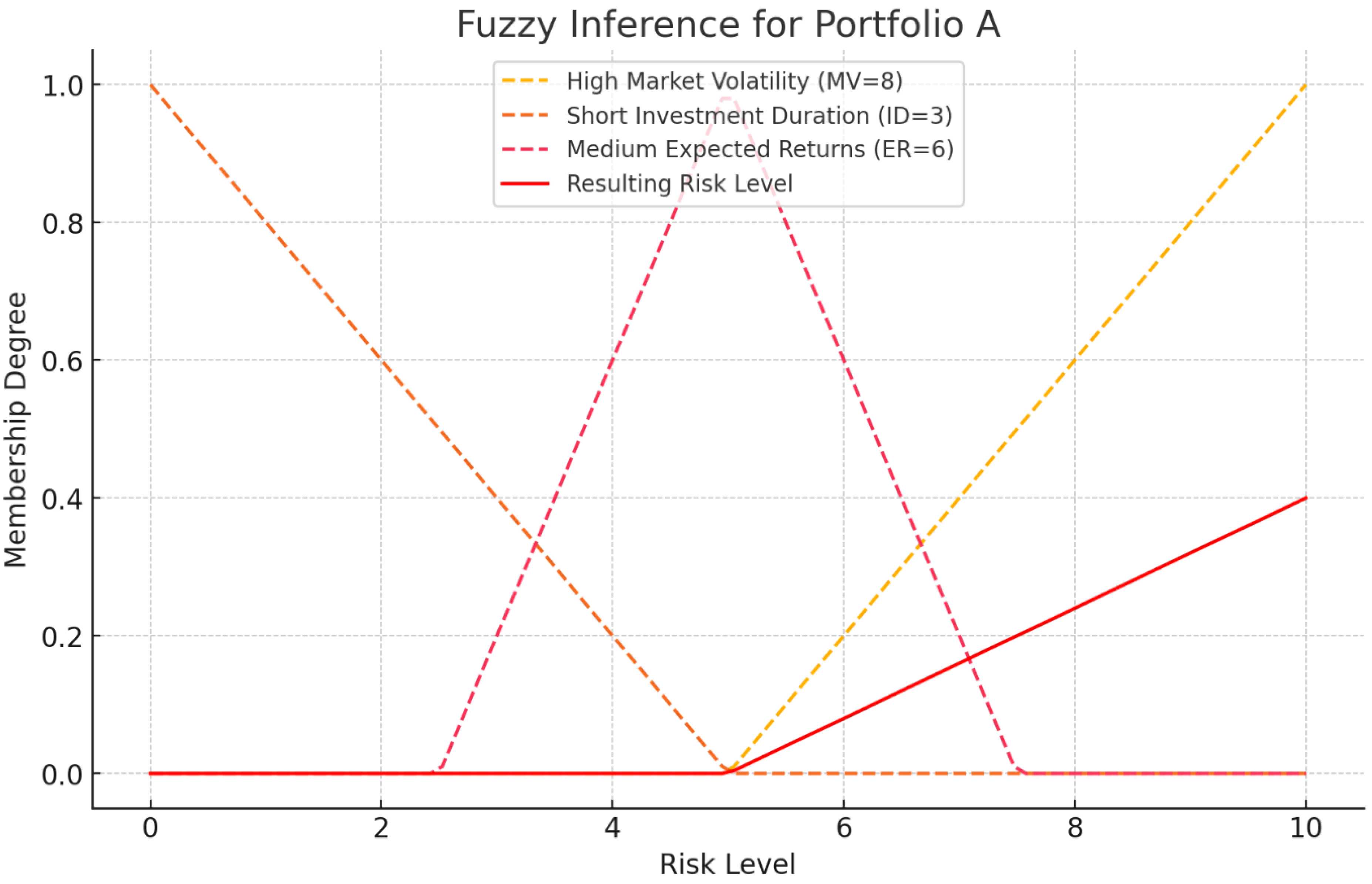
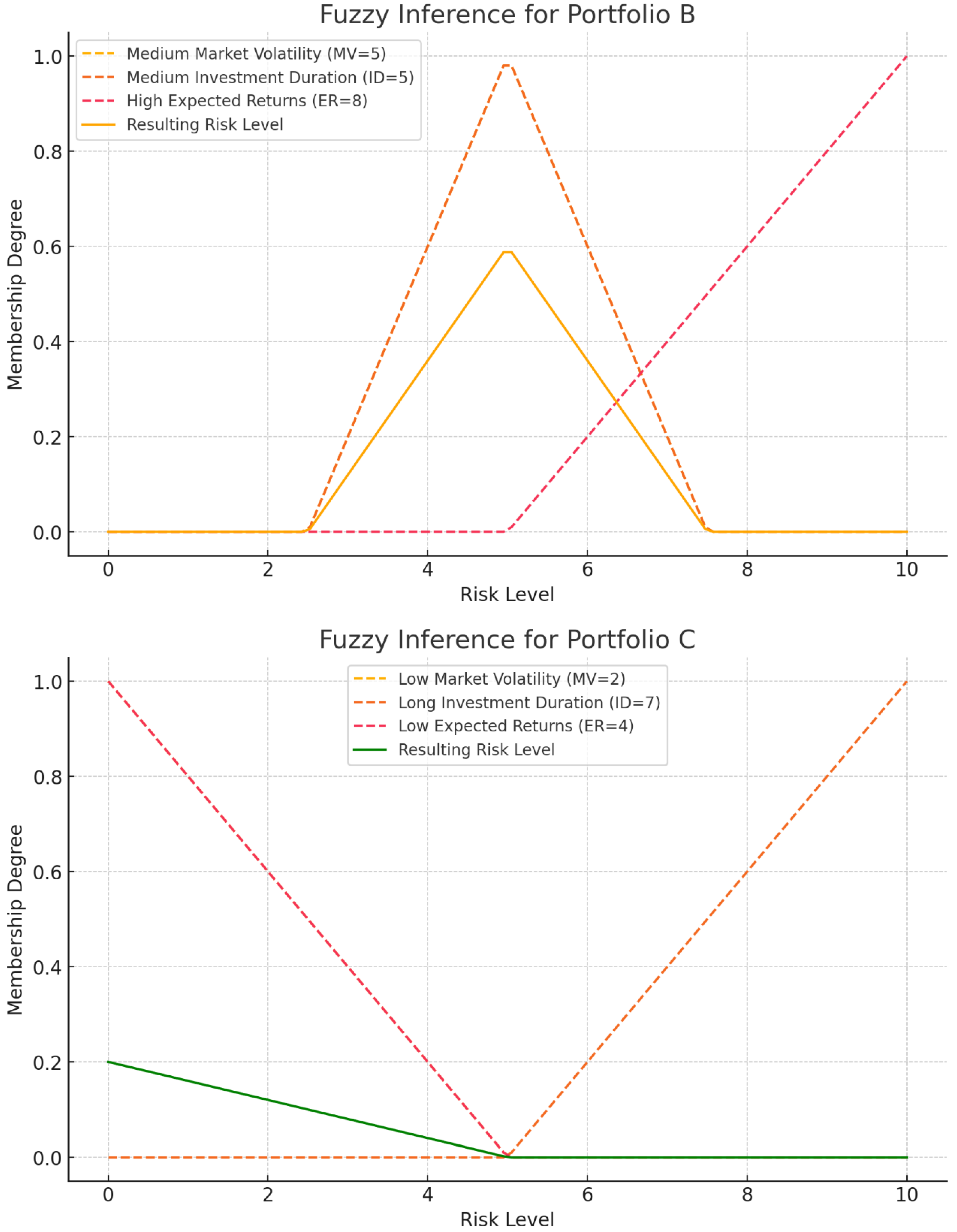
This fuzzy logic approach to risk evaluation implies that Portfolio A faces highly rooted volatility along the market and, over a short period of investment, is named risky assets, thus presuming a high range of risks by any investor's taste. Portfolio B is a balanced portfolio with moderate risk and relatively high expected rewards, which reflects its modest market volatility. Portfolio C is the safest, having a fairly low volatility of investments in financial markets and the time in which you may hold an investment.
This is a case study of the application of fuzzy logic in financial decision-making, here used for risk assessment of investment portfolios. By using fuzzy sets to model imprecise or uncertain factors and adopting a series of fuzzy rules, we cannot determine the different levels of investment decision risk. This approach gives a softer, more accurate result than traditional complete-input methods.
Plodding through the at-a-glance workflows teaches us how fuzzy logic can address financial markets' complex and uncertain nature and give investors a concise view of understanding.
9. Scope for Future Studies:
Higher-Dimensional Signals: Extend this study's findings to higher-dimensional signals and explore the implications of using hyperbolic series identities in multidimensional signal approximation. Investigate the adaptation of the Dirichlet problem in multiple dimensions and its interplay with hyperbolic functions.
Figure 4.
Visualization of scope for future studies from this study.
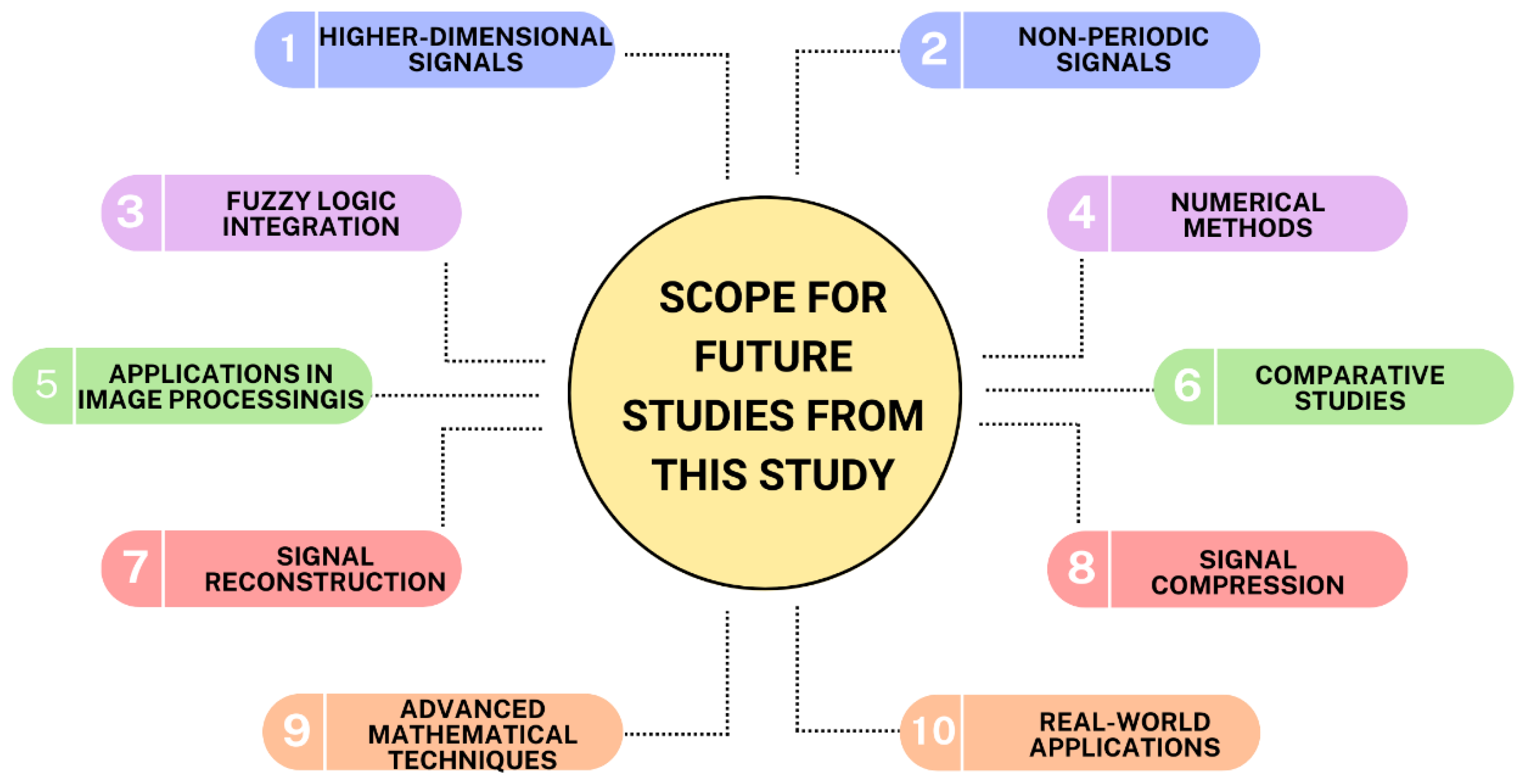
Non-Periodic Signals: While Fourier series are well-suited for periodic signals, explore alternative mathematical frameworks for approximating non-periodic signals using hyperbolic functions and other mathematical tools. Investigate the convergence properties of hyperbolic series for non-periodic signals.
Fuzzy Logic Integration: Research fuzzy logic applications and their corresponding set theory into the proposed signal approximation framework. Fuzzy mathematics is used to capture uncertainty in signal data and optimize our Signal models' fidelity, adaptability, scalability, and efficiency.
Numerical Methods: Derive and analyze various numerical methods to systematically compute hyperbolic series terms and coefficients. Look into using hybrid symbolic-numeric techniques to accelerate the exact and efficient approximations.
Applications in Image Processing: Generalization of the study to image processing due to two-dimensional signals. Understand how the ideas covered in this study can be applied to image approximation and denoising.
Comparative Studies: Perform comparative studies that compare the performance of our signal approximation approach to existing methods. Analyze different factors like accuracy, computational efficiency, and whether this method is versatile to other signal characteristics.
Signal Reconstruction: Exploring the possibility of using the Dirichlet problem and hyperbolic series to reconstruct signals from noise or incomplete data. Creating algorithms for accurate reconstruction of the signals given partial information.
Signal Compression: Investigate the application of this framework to signal compression techniques. Study whether compressing signals with certain properties can benefit hyperbolic series.
Extend Mathematical Techniques: Extend the techniques of mathematics used in this study to broader and more resolutely accurate theoretical categories like functional analysis or distribution theory. Learn how these modern tools improve the process of approximating signals.
Real-world Applications: Collaborate with domain experts (e.g., in audio engineering, image processing, or communications) to truly apply the framework and validate it in practical applications.
As the mathematical analysis and signal processing branch out, there are plenty of directions for future research based on how this work has dictated. These are some of the paths that can be explored and, due to being associated with different fields of Molecular Biology (Yogeesh, 2020; Al-Hadeethi et al., 2024), Sciences in general, Health and disease Recognition/Control (Yogeesh, 2023)- they could have a theoretical or practical purpose.
Future work will apply the introduced Fourier series and hyperbolic series identities to multi-dimensional, general signals, in combination with machine learning paradigms for advanced signal processing. Furthermore, the fuzzy logic model can be extended for more complex decision-making situations like multi-criteria optimization in finance based on Realtime and adaptive learning-enhanced investment risk assessment.
10. Conclusion:
This investigation has led to the forgoing examination of Dirichlet problems, signal approximation through Fourier series methods with the addition Mikusinski's expansion expressions. By providing a novel illumination on where these two areas of mathematics might touch, we have suggested new ways for signal processing and mathematical analysis to interplay.
We have shown the utility of the Dirichlet problem in improving signal approximation using Fourier series points. This is a well-established technique for formally defining signals using boundary conditions and partial differential equations. Such a mathematical foundation not only provides insights into the dynamics of signals but also widens our range in manipulating them (Vartika et al, 2023 & Samaila et al, 2023).
In addition, this has produced new results in signal approximation techniques entirely due to a different kind of identities known for hyperbolic series. This flexibility of the hyperbolic functions to mimic numerous behaviours has displayed their potential in extending signal modelling. While the hyperbolic series are computationally more difficult, they provide a new way of looking decomposition other than trigonometrically.
We have connected classical analysis modes of maths, and new schools signal processing in our investigation to provide a complete view on the behaviour signals. The proposed theory provides a foundation that future studies can build upon to investigate more complex signal approximations, higher dimensional signals and mix in fuzzy logic for practical applications across various domains (William & Mothukuri, 2023).
The case studies use another and rather good, examples of the combined technique of mathematical foundation and applied signal processing where financial decision making in finance requires both to succeed. This paper introduces two solid frameworks for dealing with uncertainty and complexity — Fourier series (for complex behaviour modelling), fuzzy logic (based on human intuition, which uses three truth values: true/false/maybe). As these methods exhibit high potential, more investigation and research could be performed for future utility in different branches of science as well as engineering applications.
We hope that our study continues the conversation between mathematical theory and practical application in signal processing. The interplay between the Dirichlet problem & hyperbolic series identities forms a mathematical sandbox ripe for play, allowing new ideas to flourish and emerge in academia and industry.
References
- Al-Hadeethi B., Almawla A.S., Kamel A.H., Afan H.A., & Ahmed A.N. (2024). Numerical Modeling of Flow Pattern with Different Spillway Locations. International Information an Engineering Technology Association, 1219-1226.
- Bracewell, R. N. (2000). The Fourier Transform and Its Applications. McGraw-Hill.
- Buhari Samaila, & Chellapandi Sekar. (2023). Quantum Power Flow: Revolutionizing Power Systems Analysis. SciWaveBulletin, 1(2), 1-9. [CrossRef]
- Chamandeep Kaur, & Avnish Kumar Yadav. (2023). Revamping Urban Mobility: Metro AFC and RFID Analysis. SciWaveBulletin, 1(3), 50-56. [CrossRef]
- Courant, R., & Hilbert, D. (1989). Methods of Mathematical Physics, Vol. 1. Wiley.
- Cox, E. (1994). The Fuzzy Systems Handbook: A Practitioner's Guide to Building, Using, Maintaining Fuzzy Systems. AP Professional. ISBN: 978-0121942701.
- Folland, G. B. (1999). Real Analysis: Modern Techniques and Their Applications. Wiley.
- Goodman, N. R., & Wallach, S. Z. (2003). Representations and Invariants of the Classical Groups. Cambridge University Press.
- Luenberger, D. G. (2015). Optimization by Vector Space Methods. Wiley.
- Mamdani, E. H., & Assilian, S. (1975). "An experiment in linguistic synthesis with a fuzzy logic controller." International Journal of Man-Machine Studies, 7(1), 1-13. [CrossRef]
- Obeten, O.M. Natural Language Processing relevance to Online Business. SciWaveBulletin 2023, 1(3), 37–42. [Google Scholar] [CrossRef]
- Rao, S. S. (2018). Vibration of Continuous Systems. Wiley.
- Ross, T. J. (2004). Fuzzy Logic with Engineering Applications (2nd ed.). John Wiley & Sons. ISBN 978-0470743768.
- Rudin, W. (2006). Principles of Mathematical Analysis. McGraw-Hill.
- Press, W. H., Teukolsky, S. A., Vetterling, W. T., & Flannery, B. P. (2007). Numerical Recipes: The Art of Scientific Computing. Cambridge University Press.
- Strang, G. (1993). Introduction to Applied Mathematics. Wellesley-Cambridge Press.
- Yogeesh, N. (2015). Solving linear system of equations with various examples by using Gauss method. International Journal of Research and Analytical Reviews (IJRAR), 2(4), 338-350.
- Yogeesh, N. (2016). A study of solving linear system of equations by Gauss-Jordan matrix method - An algorithmic approach. Journal of Emerging Technologies and Innovative Research (JETIR), 3(5), 314-321.
- Yogeesh, N. (2020). Psychological attitude of learners in the community. Turkish Online Journal of Qualitative Inquiry (TOJQI), 11(4), 1923-1930. https://www.tojqi.net/index.php/journal/article/view/9749/6907.
- Yogeesh, N. (2020). Study on clustering method based on K-means algorithm. Journal of Advances and Scholarly Researches in Allied Education (JASRAE), 17(1), 2230-7540.
- Yogeesh, N. (2023). Fuzzy Clustering for Classification of Metamaterial Properties. In S. Mehta & A. Abougreen (Eds.), Metamaterial Technology and Intelligent Metasurfaces for Wireless Communication Systems (pp. 200-229). IGI Global. [CrossRef]
- Yogeesh, N. (2023). Fuzzy Logic Modelling of Nonlinear Metamaterials. In S. Mehta & A. Abougreen (Eds.), Metamaterial Technology and Intelligent Metasurfaces for Wireless Communication Systems (pp. 230-269). IGI Global. [CrossRef]
- Vagisha Vartika, & P. William. (2023). Machine Learning and Cloud Computing Case Study for Online App Usage Tracking. SciWaveBulletin, 1(4), 32-37. [CrossRef]
- P. William, & Tharun Mothukuri. (2023). A Comprehensive Analysis of Cloud Computing Impact on Digital Transformation in E-India. SciWaveBulletin, 1(2), 35-40. [CrossRef]
- Zadeh, L. A. (1965). "Fuzzy Sets." Information and Control, 8(3), 338-353.
Disclaimer/Publisher’s Note: The statements, opinions and data contained in all publications are solely those of the individual author(s) and contributor(s) and not of MDPI and/or the editor(s). MDPI and/or the editor(s) disclaim responsibility for any injury to people or property resulting from any ideas, methods, instructions or products referred to in the content. |
© 2024 by the authors. Licensee MDPI, Basel, Switzerland. This article is an open access article distributed under the terms and conditions of the Creative Commons Attribution (CC BY) license (http://creativecommons.org/licenses/by/4.0/).
Copyright: This open access article is published under a Creative Commons CC BY 4.0 license, which permit the free download, distribution, and reuse, provided that the author and preprint are cited in any reuse.


