

Submitted:
10 August 2024
Posted:
13 August 2024
You are already at the latest version
Abstract
Detrital zircons from two samples of metaterrigenous rocks from the Lykhmanivka Syncline, Middle Dnieper Domain of the Ukrainian Shield (Skelevate Formation of the Kryvyi Rih Group), have been dated by the LA-ICP-MS U-Pb method. Metasandstones from the northern part of the Syncline yield zircons belonging to four age groups: 3205 ± 20 Ma, 3089 ± 11 Ma, 2939 ± 8 Ma, and 2059 ± 4 Ma. In contrast, zircon from metasediments from the southern end of the Lykhmanivka Syncline fall within two age groups: 3174 ± 13 Ma, and 2038 ± 9 Ma. The source area was dominated by rocks of the Auly Group (3.27–3.18 Ga) and the Sura Complex (3.17–2.94 Ga). The proportion of zircons dated at 2.07–2.03 Ga, which reflects the timing of metamorphism, is 5%. The metamorphic nature of the Paleoproterozoic zircon allows us to define the maximum depositional age of the metaterrigenous rocks of the Lykhmanivka Syncline at ca. 2.9 Ga, which is in good agreement with the earlier results from the metaterrigenous rocks of the Kryvyi Rih – Kremenchuk basin. Our data also indicate the local nature of sedimentation and the absence of significant transport and mixing of detrital material within the basin.
Keywords:
Lykhmanivka syncline
; Skelevate Formation
; Vysokopillya greenstone structure
; Kryvyi Rih-Kremenchuk Basin
; Middle Dnieper Domain
; Ukrainian Shield
; Archean
; metasandstone
; detrital zircon
1. Introduction
Banded iron formations (BIFs), a major source of iron ore for the modern steel industry, are of significant economic value. They are quite common in Precambrian sedimentary successions and are important for understanding the Precambrian evolution of the atmosphere and the hydrosphere [1,2]. Moreover, it has been suggested that deposition of major BIFs was coeval with episodes of emplacement and eruptions of large masses of mafic igneous rocks [3]. Indeed, in the Ukrainian Shield, as in many other places worldwide, BIF deposits are closely associated with greenstone belts and are repeatedly interbedded with mafic and felsic volcanic rocks [4,5]. In such cases, the age determination of BIFs is relatively straightforward and can be achieved through the dating of interbedded volcanic rocks. However, in the case of the Kryvyi Rih – Kremenchuk basin, this approach is not suitable as the ca. 4 km-thick sedimentary sequence does not contain any volcanic rocks, except the metabasaltic Novokryvoryzka Formation that occurs at the base of the succession.
Determining the depositional age of the sediments that fill the Kryvyi Rih- Kremenchuk Basin is one of the major geological issues in the Ukrainian Shield. According to the current regional stratigraphic chart of the early Precambrian of the Ukrainian Shield [6], the Kryvyi Rih Group is considered Paleoproterozoic. However, this age attribution is based solely on general considerations, such as its low degree of metamorphism and the presence of amphibolitized mafic dykes that yielded Proterozoic K-Ar ages. No reliable geochronological data were available for these rocks until the 2010s.
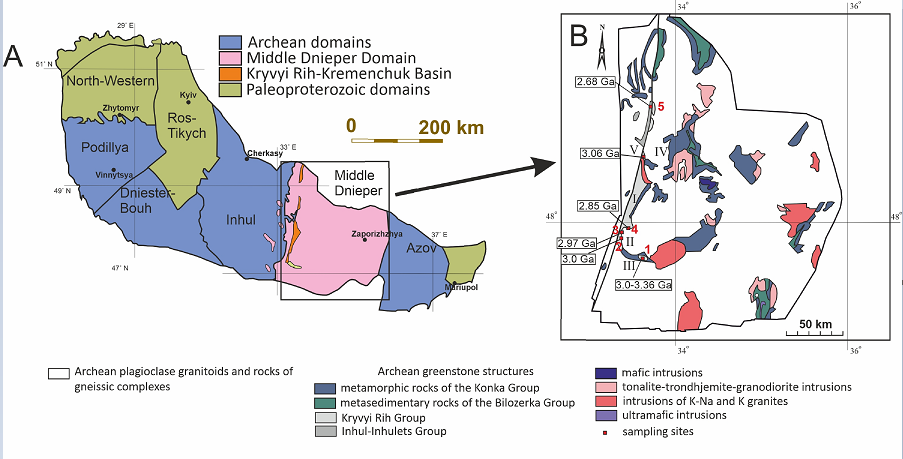
The Kryvyi Rih – Kremenchuk Basin is a narrow (up to 15 km wide), sedimentary basin that extends for over 170 km in an N-S direction (Figure 1). It is located in the central part of the Ukrainian Shield, within the Middle Dnieper Domain, and hosts some 35–40 Gt of iron ore. The Basin is filled with metavolcanic and metasedimentary rocks of the Kryvyi Rih Group and the Hleyuvatka Formation (Figure 2).
The Kryvyi Rih Group includes four formations, from bottom to top:
- -
- The lowermost Novokryvoryzka Formation comprises metabasalts, amphibole schists, metaconglomerates and metasandstones.
- -
- The Skelevate Formation comprises metaterrigenous rocks (sandstones, conglomerates, schists) and a horizon of talk-rich schists. The thickness of the formation is up to 300 m.
- -
- The Saksahan Formation is 650–800 m thick and represents the main productive BIF unit. It is composed of BIFs, separated by several horizons of schists and barren quartzites.
- -
- The Hdantsivka Formation, up to 1100 m thick, composed of schists, marbles, dolostones, sandstones, and ferruginous-siliceous rocks (BIFs). It rests disconformably on the Saksahan Formation.
- -
- The Hleyuvatka Formation comprises the upper part of the sedimentary succession, has a thickness of up to 1800 m, and unconformably overlies the Kryvyi Rih Group. It is composed of metaterrigenous rocks including conglomerates, sandstones and schists.
There have been several attempts to define the age of the rocks of the Kryvyi Rih – Kremenchuk Basin (Figure 1 and Figure 2). The maximum depositional age of the metaterrigenous rocks of the Lativka Horizon that occur at the base of the Novokryvoryzka Formation was defined at 3.0 Ga [7], whereas the age of an overlying metabasalt was established at 2.97 Ga [8]. Detrital zircon and monazite from metaterrigenous rocks of the Skelevate Formation yielded a maximum depositional age of 2.85 Ga [9,10,11]. The East Hannivka Belt yielded a maximum depositional age of ca. 3.05 Ga [12]. The maximum depositional age of detrital zircon from quartzites of the Rodionivka Formation of the Inhul-Inhulets Group (part of the Zhovte Structure in the Pravoberezhna area) was defined at 2.68 Ga [13]. No U-Pb detrital zircon data have been obtained from the metaterrigenous rocks of the Skelevate Formation in the Lykhmanivka Syncline in the southern part of the Kryvyi Rih region.
Figure 1.
А– Simplified tectonic map of the Ukrainian Shield, modified after the tectonic map of the basement of the Ukrainian Shield [14]. B – Schematic geological map of the Middle Dnieper Domain of the Ukrainian Shield. I – Kryvyi Rih Basin; II – Lykhmanivka Syncline; III – Vysokopillya greenstone belt; IV – Verkhivtseve greenstone belt; V – Zhovta Richka structure. C – Schematic geological map of the southern part of the Kryvyi Rih Basin. The Konka Group comprises metamorphosed tholeiitic basalts, komatiites, BIF, sedimentary rocks, andesites and felsic volcanic rocks; the Avdotivka-Oleksandrivka intrusion is composed of metamorphosed layered ultramafic and mafic rocks, diorites, and granodiorites; the Kryvyi Rih Group includes amphibolites, metasandstones, conglomerates, shales, and BIFs; the Dnipro Complex is composed of plagioclase granites; the Sura Complex is represented by quartz-plagioclase porphyries, quartz diorites, tonalites and plagioclase granites; the Demuryne Complex comprises two-feldspathic granites; the Tik Complex embraces potassic subalkaline granites. Locations of the drill holes sampled for detrital zircon dating are indicated. For the approximate ages of various stratigraphic units and intrusive complexes see Figure 2. Sampling sites and corresponding maximum depositional ages: 1 – this work; 2 – [7]; 3 – [8]; 4 – [10,11]; 5 – [12].
Figure 1.
А– Simplified tectonic map of the Ukrainian Shield, modified after the tectonic map of the basement of the Ukrainian Shield [14]. B – Schematic geological map of the Middle Dnieper Domain of the Ukrainian Shield. I – Kryvyi Rih Basin; II – Lykhmanivka Syncline; III – Vysokopillya greenstone belt; IV – Verkhivtseve greenstone belt; V – Zhovta Richka structure. C – Schematic geological map of the southern part of the Kryvyi Rih Basin. The Konka Group comprises metamorphosed tholeiitic basalts, komatiites, BIF, sedimentary rocks, andesites and felsic volcanic rocks; the Avdotivka-Oleksandrivka intrusion is composed of metamorphosed layered ultramafic and mafic rocks, diorites, and granodiorites; the Kryvyi Rih Group includes amphibolites, metasandstones, conglomerates, shales, and BIFs; the Dnipro Complex is composed of plagioclase granites; the Sura Complex is represented by quartz-plagioclase porphyries, quartz diorites, tonalites and plagioclase granites; the Demuryne Complex comprises two-feldspathic granites; the Tik Complex embraces potassic subalkaline granites. Locations of the drill holes sampled for detrital zircon dating are indicated. For the approximate ages of various stratigraphic units and intrusive complexes see Figure 2. Sampling sites and corresponding maximum depositional ages: 1 – this work; 2 – [7]; 3 – [8]; 4 – [10,11]; 5 – [12].
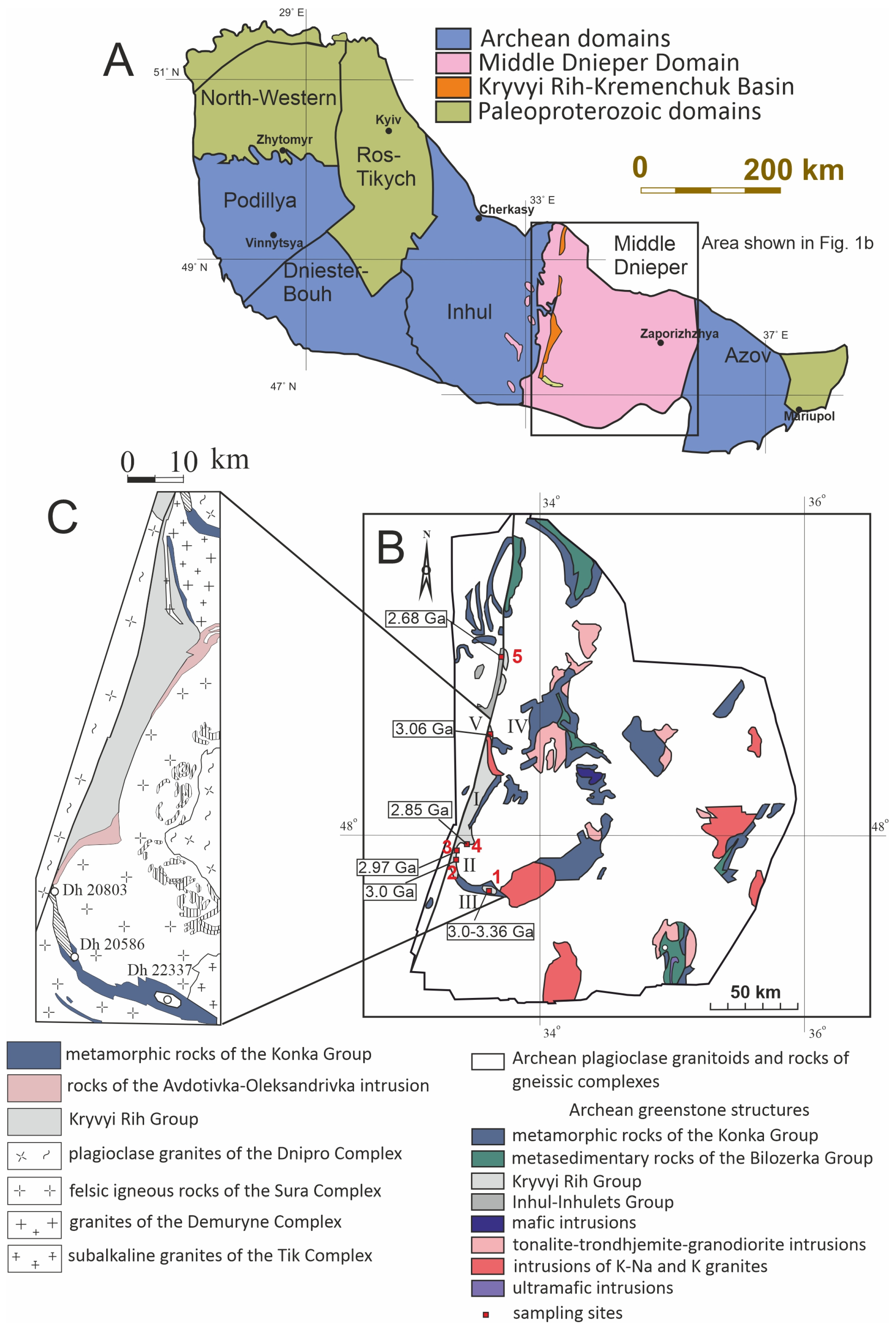
Figure 2.
Schematic stratigraphy of the Middle Dnieper Domain of the Ukrainian Shield (after [6], with authors` corrections).
Figure 2.
Schematic stratigraphy of the Middle Dnieper Domain of the Ukrainian Shield (after [6], with authors` corrections).
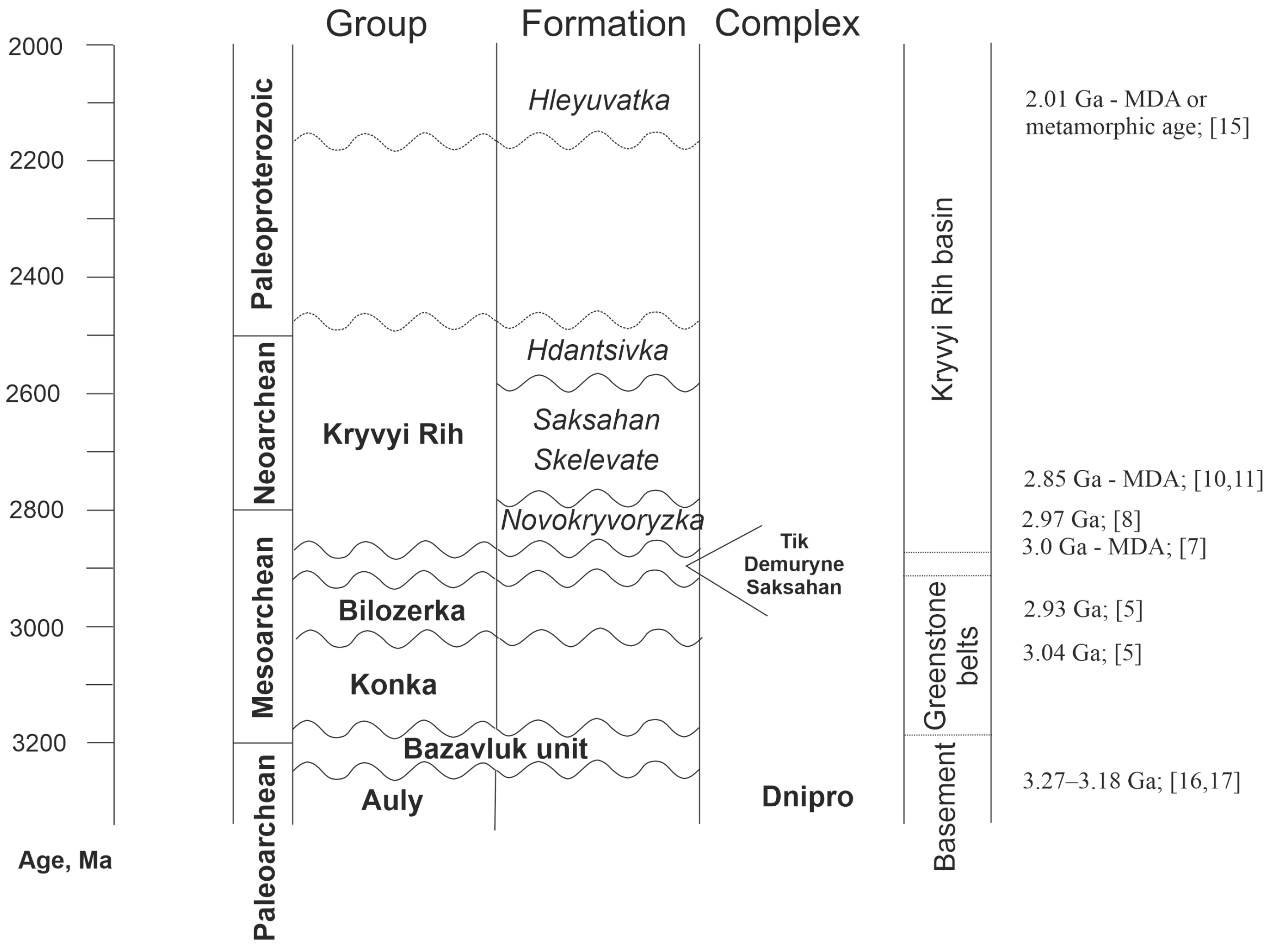
The stratigraphic relationships between volcanogenic-sedimentary rocks of the Kryvyi Rih Group and the successions comprising greenstone structures in the Middle Dnieper Domain of the Ukrainian Shield have been discussed by many researchers [18,19,20,21]. In this regard, the Lykhmanivka and Zhovta Richka tail-shaped structures (Figure 1), adjacent to the Kryvyi Rih-Kremenchuk Basin and linked respectively to the Vysokopillya and Verkhivtseve greenstone belts to the east, are of particular interest. The lower parts of their sections comprise volcanogenic and sedimentary rocks of the Konka Group, whereas the upper parts belong to the Kryvyi Rih Group. We report the results of the first geochronological study of detrital zircons isolated from metaterrigenous rocks of the Lykhmanivka Syncline, which extends from the Main Syncline of the Kryvyi Rih Basin towards the Vysokopillya greenstone structure (Figure 1).
2. Geological Structure of the Studied Area
The Lykhmanivka Syncline is located in the southernmost part of the Kryvyi Rih-Kremenchuk Basin [21,22]. It is a narrow and strongly compressed syncline composed of rocks of the Kryvyi Rih Group, which extends for 30 km from the city of Kryvyi Rih (station of Mykolo-Kozelsk) to the village of Vysokopillya. The width of the syncline varies from 0.5 km in the north to 2 km in the south. In its northern part, the Lykhmanivka Syncline extends into the Kryvyi Rih Main Syncline, and to the south it reaches the Vysokopillya Greenstone Structure. The base of its section is composed of an up to 40 m thick medium- to coarse-grained amphibolite horizon. Above, a 40 – 150 m thick bed of arkoses and phyllites of the Skelevate Formation occur, overlain by a talc horizon. The Saksahan Formation within the syncline is 50 – 300 m thick and comprises two horizons: 1) ferruginous hornfels and slate, 100 –150 m thick, and 2) jaspillite. Chlorite and carbonaceous slates, as well as dolomites of the Hdantsivka Formation overlie the jaspillite horizon, composing a layer up to 200 m thick that comprises the core of the syncline.
The Vysokopillya Greenstone Structure is a monocline characterized by steep rock bedding and tectonic contacts between the different parts of the stratigraphic section [21]. The northern part of the structure is composed of a thick and relatively homogeneous horizon of metamorphosed tholeiitic basalts (Sura Formation, lower sub-formation). Its thickness varies from 2.5 km in the west to 1 km in the east. Fine-grained amphibolites predominate, while amygdaloidal amphibolites are less common. The horizon is complicated by tectonic disturbances and intrusions of ultramafic rocks, and rhyolite and dacite dykes. An older gneiss complex occurs beneath the amphibolite horizon. The contacts are tectonic in all sections. The metamorphosed volcanic rocks of the Chortomlyk Formation occur higher in the section, forming a layer up to 500 m thick. It is composed of metaandesite with subordinate interlayers of rhyodacites and tholeiitic basalts. The subvolcanic felsic rhyolite-dacite association (Solone Formation) comprises veins and dykes cutting through the tholeiitic basalt. The metarhyodacite dykes reach a thickness of up to 100 m. To the south along strike, parts of the Vysokopillya Structure are composed of a schist and gneiss association with isolated thick layers of ferruginous-siliceous rocks. The association comprises a heterogeneous sequence of para- and orthogneisses of primary sedimentary (greywacke, subgreywacke and melanowacke) and volcanogenic (tuff-sandstone, lava breccias, dacite and andesite with subordinate tholeiite interlayers) origin. In addition to ferruginous-siliceous rocks, which compose thin interlayers, there is a thick steeply dipping metagreywacke bed with an apparent thickness of up to 100 m, composed of quartz-magnetite-cummingtonite schist with garnet; in places, the garnet content reaches 30–40%. The schists are relatively poor in iron as for BIF, with a total iron oxide content reaching up to 30–32% and a magnetite iron content of 15–18%. In the section, the garnet-bearing quartz-magnetite-cummingtonite schists alternate with metasandstones.
3. Research Methods
Zircon was separated from metasandstones (samples 87-222 and 87-551) using a shaking table, heavy liquids, and a magnetic separator to produce a heavy non-magnetic fraction. Zircons were hand-picked under a binocular microscope and their morphology was studied under an optical microscope. The U-Th-Pb analyses using laser ablation-inductively coupled mass spectrometry (LA-ICP-MS) on zircon crystals in epoxy mounts were performed at the Department of Geology, Trinity College, Dublin, Ireland. A Photon Machines Analyte Excite 193 nm ArF excimer laser-ablation system with a HelEx 2-volume ablation cell, coupled to an Agilent 7900 mass spectrometer was employed. Line scans on NIST612 standard glass were used to tune the instrument, by obtaining a Th/U ratio close to unity and low oxide production rates (i.e., ThO+/Th+ typically <0.15%). A circular laser spot of 24 μm, a repetition rate of 11 Hz and a fluence of 2.25 J/cm2 were employed. The helium carrier gas was fed into the laser cell at ~0.4 l/min, and was mixed with ~0.6 l/min Ar make-up gas and 11 ml/min N2. Each analysis comprised 27.3 s of ablation (300 shots) and 12 s of washout time and the latter portions of the washout were used for baseline measurements. The data reduction of raw U-Th-Pb isotopic data was undertaken using the freeware IOLITE package [23], with the “Vizual Age” data reduction scheme [24]. The primary U-Pb zircon calibration reference material was 91500 zircon (206Pb-238U age of 1065.4 ± 0.6 Ma, [25,26] and the secondary reference materials were Plešovice zircon (206Pb-238U age of 337.13 ± 0.37 Ma, [27]) which yielded an age of 338.7 ± 1.0 Ma (206Pb-238U age weighted mean age, n = 109) and WRS 1348 zircon (206Pb-238U age of 526.26 ± 0.70, [28]) which yielded an age of 526.6 ± 2.0 Ma (206Pb-238U age weighted mean age, n = 130). Final ages were calculated using Isoplot [29].
Hafnium isotope analyses in zircon were performed by LA-MC-ICP-MS at the MILESTONE Laboratory (RéGEF ISOTOP-MTP, Geosciences Montpellier, France). A Thermo Scientific Neptune XT was coupled to a Teledyne Cetac Analyte Excite+ Excimer laser (193 nm), which was equipped with an optional X-Y Theta dynamic aperture allowing rectangular-shaped beams of any aspect ratio and orientation to be generated. Analyses were carried out on top of the U-Pb ablation pits, using a 40×40 μm beam, a laser frequency of 5 Hz and an energy density of 6 J/cm2. Each analysis included a 30 s background measurement and a 60 s ablation period of 60 cycles of 1 s each. The accuracy and long-term reproducibility of the measurements were determined by performing repeated analyses of three zircon reference standards: Mud Tank (176Hf/177Hf = 0.282512±17, n = 55); Plešovice (176Hf/177Hf = 0.282485±15, n = 57), and Temora-2 (176Hf/177Hf = 0.282673±24, n = 29). The data agree with the accepted 176Hf/177Hf ratios for Mud Tank (0.282504±44, [30]), Plešovice (0.282482±13, [27]) and Temora-2 (0.282680±24, [31]). All errors are given at the 2σlevel. 176Hf/177Hf initial ratios were calculated using the 176Lu decay constant quoted in [32]. εHf(t) values were calculated using 176Lu/177Hf = 0.0336 and 176Hf/177Hf = 0.282785 for the CHUR [33].
4. Results
4.1. Chemistry of Metasandstone
In the southern part of the Lykhmanivka Syncline, metasandstones of the Skelevate Formation overlie volcanogenic rocks of the Sura Formation. The metasandstones are grey, dense, inequigranular and silicified. Clastic material is represented by grey and sporadic blue quartz grains. The quartz grains are well-rounded and set in a sericite and sericite-biotite matrix. The chemical composition (wt. %) of a metasandstone of the Skelevate Formation (drill hole 20586, int. 154–164 m, sample 87-222, Figure 2) is: SiO2 – 69.50; TiO2 – 0.77; Al2O3 – 11.80; Fe2O3 – 1.56; FeO – 4.71; MnO – 0.13; MgO – 2.00; CaO – 4.00; Na2O – 0.50; K2O – 2.30; Stotal – 0.20; P2O5 – not detected; H2O – 0.05; LOI – 1.22; CO2 – 1.17; Total – 100.11; Na2O/K2O – 0.22; SiO2/Al2O3 – 5.89; Al2O3/Na2O – 23.6. On a log (SiO2/Al2O3) – log (Na2O/K2O) diagram [34], the metasandstone plots in the litharenite field (Figure 3).
4.2. Zircon U-Pb Ages and Hf Isotope Composition
Zircon from the Skelevate Formation metasandstone (drillhole 20803, int. 88-101 m, sample 87-551) (Figure 4) is represented by variably rounded light-pink and light-brown, transparent and translucent crystals that range in size from 0.10×0.15 mm to 0.25 × 0.4 mm (Figure 5).
A total of 45 detrital zircon crystals were dated. Twenty of them yielded discordant ages and were omitted from further discussion. The dated zircon grains can be divided into four age groups: a group of 11 crystals has an upper intercept age of 3205 ± 20 Ma; a group of 6 crystals has a concordia age of 3089 ± 11 Ma; 6 crystals yield a concordia age of 2939 ± 8 Ma; the concordia age of the remaining two crystals is 2059 ± 4 Ma (Supplementary Table S1, Figure 5).
Zircons belonging to different Archean age groups have variable initial Hf isotope compositions (Figure 6, Supplementary Table S2). The176Hf/177Hf ratio gradually increases with decreasing age: in zircons from the oldest (3205 ± 20 Ma) group, the176Hf/177Hf ratio varies from 0.280792 – 0.280728 (εHf = 2.8 to 0.2) (Figure 7); in the second (3089 ± 11 Ma) group it varies from 0.280812 – 0.280745 (εHf = 1.0 to -1.3), and in the third Archean group (2939 ± 8 Ma) it ranges from 0.280853 – 0.280848 (εHf = -1.3 to -1.4). Two Paleoproterozoic zircons yielded very different initial 176Hf/177Hf ratios: 0.281193 and 0.280774 (εHf = -9.6 and -23.3 respectively).
The Skelevate Formation at the southern end of the Lykhmanivka Syncline overlies volcanogenic rocks of the Vysokopillya Greenstone Structure. Detrital zircon from a Skelevate Formation metasandstone in this region (drillhole 20586, depth 154–164 m, sample 87-222) is represented by variably rounded, light pink and light brown, transparent and translucent to opaque crystals of up to 0.25 × 0.4 mm in size (Figure 5). A total of 50 zircon grains have been dated; five of them yielded discordant ages and are omitted from further considerations. Forty results plot at the regression line that intercepts the concordia curve at 3174 ± 13 Ma (Figure 6). One grain has a concordant age of 3583 ± 14 Ma, and four others are of Paleoproterozoic age, with the upper intercept at 2038 ± 9 Ma (Supplementary Table S1, Figure 6).
All zircons belonging to the 3174 ± 13 Ma group have similar Hf isotope compositions: the initial 176Hf/177Hf ratio varies from 0.280783 – 0.280754 (εHf = -1.2 to 1.6). Paleoproterozoic zircons have a uniform initial 176Hf/177Hf ratio of 0.281145 – 0.281131 (εHf = -12.2 to -11.7). The only Paleoarchean zircon has a slightly negative εHf value of -1.5 (initial 176Hf/177Hf = 0.280420, Supplementary Table S2, Figure 7).
5. Discussion
5.1. Sources of the Archean Detrital Zircons
The U-Pb dating results demonstrate that the source area was dominated by the gneisses of the Auly Group and granitoids of the Dnipro Complex (3.27–3.18 Ga; [16,17]) and the first intrusive phase of the Sura Complex (3.17–3.1 Ga; [37,38,39]) (60% and 30%, respectively); zircon from plagioclase granites of the second intrusive phase of the Sura Complex (3.09–2.94 Ga) only accounted for up to 5% of grains.
The hafnium isotope composition (Figure 7, Supplementary Table S2) of zircons from sample 87-557 suggests that all three Archean groups had probably originated from similar rock types that crystallized at different times from the same mafic source (lower crust) with a 176Lu/177Hf ratio of about 0.020 [40]. Results of the hafnium isotopic composition determinations of zircon from sample 87-222 demonstrate that the spread of U-Pb ages in the predominant age group (3174 ± 13 Ma) along the regression line is due to the partial loss of radiogenic lead. All zircons in the group have nearly identical initial 176Hf/177Hf ratios which do not vary with age. In terms of U-Pb ages and Hf isotope compositions, detrital zircons from the two oldest age groups in sample 87-557 and the predominant (old) age group in sample 87-222 are very similar.
5.2. The Maximum Depositional Age and Origin of the Paleoproterozoic zircon
The amount of Paleoproterozoic zircons dated at 2.07-2.03 Ga in the studied samples is only ca. 5%. However, their origin raises an important question as the maximum depositional age of the studied rocks depends on the nature of these zircons. If they are detrital, then the maximum depositional age of the entire Kryvyi Rih Structure would be Paleoproterozoic. However, if they were formed in response to Paleoproterozoic metamorphism, then the maximum depositional age of the studied rocks must be ca. 2.9 Ga.
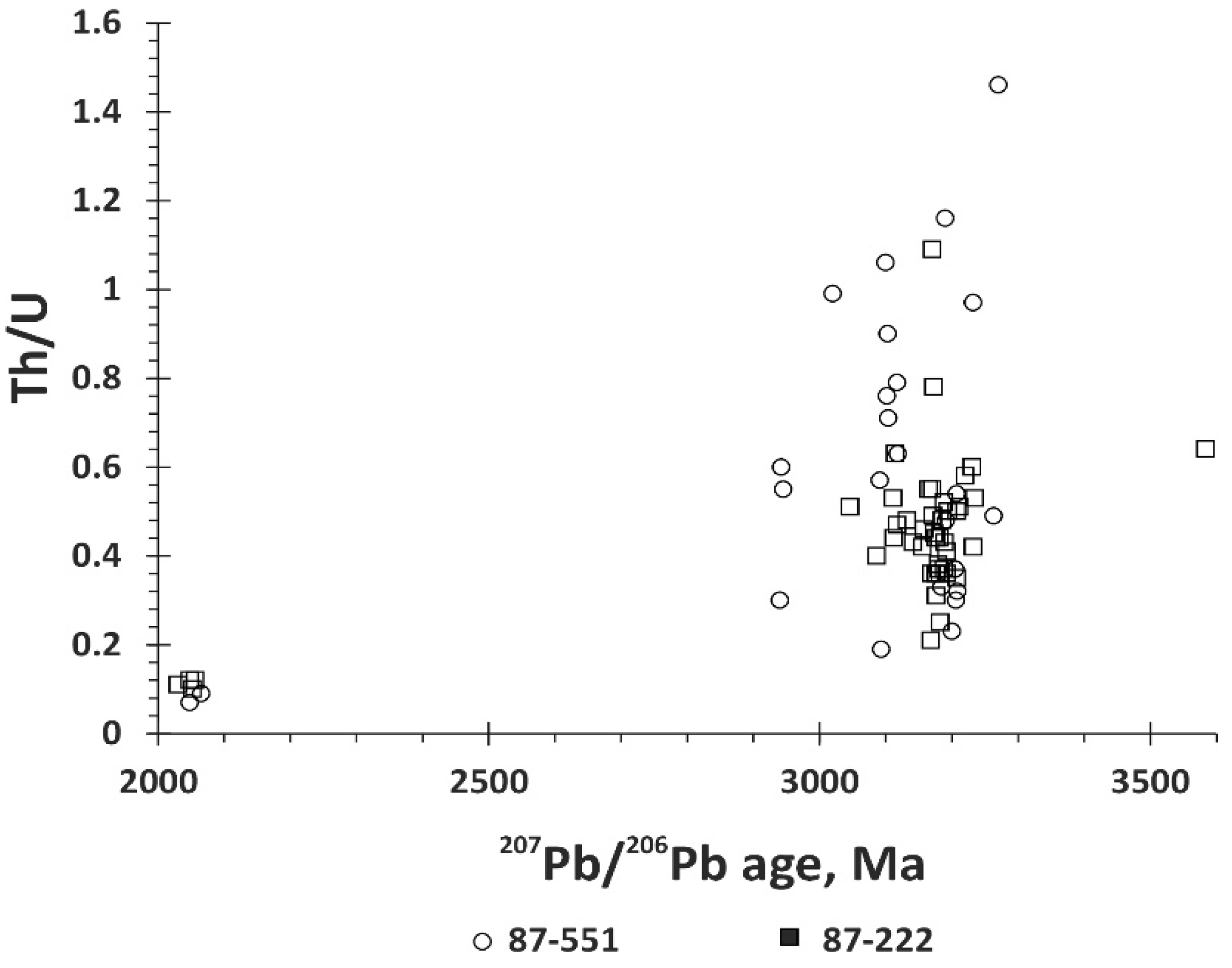
Paleoproterozoic zircons in the two metasandstone samples differ from their Archean counterparts by a low Th/U ratio indicating their metamorphic origin (Figure 8; [41,42,43]). In contrast to the Archean zircons, the Paleoproterozoic ones are enriched in U and Th (Supplementary Table S1). In terms of their Hf isotope composition, most of the Paleoproterozoic zircons have rather homogeneous εHf values (-12.2 to -9.6; average -11.4 ± 1.8) which indicates the input of crustal fluids with an isotope composition that evolved since Archean times with a176Lu/177Hf ratio close to 0.02.
Most of the studied samples of terrigenous rocks of the Kryvyi Rih Group contain no Paleoproterozoic zircons [7, 11, author’s unpublished data]. However, Paleoproterozoic zircons were previously identified in metasedimentary rocks of the Hleyuvatka Formation [15], and in amphibolite (metabasalt) of the Novokryvoryzka Formation [8]. The zircons with a metamorphic protolith in the metasedimentary rocks of Hleyuvatka Formation were considered as detrital, while those from amphibolite were considered as metamorphic. Unfortunately, there is no way to distinguish detrital zircons derived from a metamorphic rock from metamorphic zircons crystallized within a metasedimentary rock [44,45]. Considering this, we rely on indirect arguments to define the origin of the Paleoproterozoic zircons with a metamorphic origin found in our metasandstone samples.
First, we consider in situ metamorphic growth of Paleoproterozoic zircons in the metasandstone samples. Paleoproterozoic metamorphic zircons are common in strongly metamorphosed Archean rocks of the Middle Bouh Domain of the Ukrainian Shield [46,47]. In these rocks, Paleoproterozoic zircon form overgrowths on older cores or occur as newly formed crystals. Some zircon crystals that yielded Paleoproterozoic ages appear to have the same hafnium isotopic composition as Archean zircons, indicating that the apparent Paleoproterozoic age of these crystals resulted from the loss of radiogenic lead. However, the hafnium isotope composition in most of the Paleoproterozoic metamorphic zircons is more radiogenic, suggesting that either juvenile fluids enriched in radiogenic hafnium were involved in their crystallisation, or radiogenic hafnium was, due to metamorphic reactions, derived from other minerals with a high Lu/Hf ratio [48]. A similar situation is observed in our metasandstone samples from the Skelevate Formation – their hafnium isotopic composition is significantly more radiogenic than would be expected in the case of radiogenic lead loss.
The second possibility is that Paleoproterozoic zircons are detrital grains. In general, zircons from Paleoproterozoic granitoids and metamorphic rocks of the Ukrainian Shield are characterised by juvenile hafnium isotopic composition [49,50], although some Paleoproterozoic granitoids with a long crustal residence history are also known [51]. Considering the widespread occurrence of Paleoproterozoic granites and metamorphic rocks [52,53,54], and the wide variability in their Hf isotopic characteristics with a predominance of juvenile Hf isotopic values, we would expect to find many more Paleoproterozoic detrital zircons than those that have actually been found and with wider variations in hafnium isotopic composition. Hence, we assume that the Paleoproterozoic zircons in the studied detrital rocks must be in situ metamorphic/metasomatic in origin, rather than detrital. Thus, the maximum depositional age can be determined at 2.9 Ga.
5.3. Variations in the Provenance of the Sediments in the Kryvyi Rih-Kremenchuk Basin
An important feature of the studied rocks is a variation in the sources of detrital material. Despite the relative spatial proximity of the two sampling sites and their identical stratigraphic position, they reveal different provenance. Moreover, they differ from other metasedimentary rocks of the Skelevate Formation studied previously [11]. These variations indicate the local nature of sedimentation and the absence of significant lateral transport and mixing of detrital material within the sedimentary basin.
Based on detrital zircon studies from rocks of the Kryvyi Rih and Inhul-Inhulets Groups from the Kryvyi Rih-Kremenchuk Basin (Zhovte region) in the north (Figure 1) to the Vysokopillya Greenstone Structure in the south, important regularities in the distribution of the source rocks have been established. Detrital zircon dated at 2.68 Ga was documented in sandstones of the Inhul-Inhulets Group (a possible stratigraphic equivalent of the Kryvyi Rih Group) in the Pravoberezhna region [13]. Their source remains unknown, and the nearest possible provenance is represented by metarhyolites of the Lebedinska Group (2.62 Ga) and granitoids of the Atamanskyi Complex (2.6–2.4 Ga) that occur in the Voronizh Crystalline Massif. In the East Hannivka Belt and the Saksahan Syncline, the composition of metasandstones of the Skelevate Formation is characterized by significant zircon derived from the Saksahan plagioclase granites (3.06 Ga) [11,12]. Sediments of the Lykhmanivka Syncline are dominated by detrital zircon derived from rocks of the Auly Group (3.23–3.18 Ga), and plagioclase granites of the first intrusive phase of the Sura Complex (3.17–3.10 Ga). Detrital zircon with distinct peaks at 3.07, 3.19, 3.26 and 3.32 Ga has been found in metasandstones overlying the Vysokopillya Greenstone Structure [55].
6. Conclusions
Detrital zircon U-Pb dating results from metaterrigenous rocks of the Skelevate Formation in the Lykhmanivka Syncline indicate that metasandstones in the northern part of the Syncline contain zircons belonging to four age groups: 3205 ± 20 Ma, 3089 ± 11 Ma, 2939 ± 8 Ma, and 2059 ± 4 Ma. In contrast, zircon from metasediments from the southern end of the Lykhmanivka Syncline fall into two age groups: 3174 ± 13 Ma, and 2038 ± 9 Ma. The main sources of the detrital material comprise metamorphic rocks of the Auly Group, granites of the Dnipro Complex, and the first intrusive phase of the Sura Complex.
The amount of the Paleoproterozoic zircons in the studied rocks does not exceed 5 % and they are considered to be in situ metamorphic/metasomatic in origin. This allows us to define the maximum depositional age of the metaterrigenous rocks of the Lykhmanivka Syncline at ca. 2.9 Ga. This data is in good agreement with the previously obtained results for metaterrigenous rocks of the Kryvyi Rih – Kremenchuk basin. Our findings indicate local sedimentation with minimal lateral transport and mixing of detrital material within the sedimentary basin.
Supplementary Materials
The following supporting information can be downloaded at: Preprints.org, Supplementary Table S1: Detrital zircon U-Pb data from metasandstones of the Lykhmanivka structure of the Middle Dnieper Domain; Supplementary Table S2: Detrital zircon Hf isotopic data from metasandstones of the Lykhmanivka structure of the Middle Dnieper Domain
Author Contributions
Conceptualization, H.A. and L.S.; methodology, D.C. and B.D.; formal analysis, L.S., F.D., and H.M.; investigation, H.A. and V.B.; data curation, D.C. and B.D.; writing—original draft preparation, H.A.; writing—review and editing, L.S., D.C. and B.D.; supervision, L.S.; project administration, H.A.; funding acquisition, L.S., D.C. and B.D. All authors have read and agreed to the published version of the manuscript.
Funding
This research is part of Project No. 2021/43/P/ST10/02283, jointly funded by the National Science Center and the European Union’s Horizon 2020 Framework Program for Research and Innovation under Marie Sklodowska-Curie Grant Agreement No. 945339. David Chew acknowledges support obtained from Science Foundation Ireland (SFI) through Research Grant 13/RC/2092_P2 (iCRAG Research Centre). This research has received funding from the European Research Council (ERC) under the European Union’s Horizon 2020 research and innovation program (grant agreement No. 817934).
Data Availability Statement
All the analytical data are presented in the paper, including the Supplementary Materials.
Acknowledgments
The paper has benefitted from constructive comments from two anonymous reviewers.
Conflicts of Interest
The authors declare no conflicts of interest.
References
- Bekker, A.; Slack, J.F.; Planavsky, N.J.; Krapež, B.; Hofmann, A.; Konhauser, K.O.; Rouxel, O.J. Iron formation: the sedimentary product of a complex interplay among mantle, tectonic, oceanic, and biospheric processes. Economic Geol. 2010, 105, 467–508. [Google Scholar] [CrossRef]
- Bekker, A.; Planavsky, N.J.; Krapež, B.; Rasmussen, B.; Hofmann, A.; Slack, J.F.; Rouxel, O.J.; Konhauser, K.O. Iron formations: their origins and implications for ancient seawater chemistry. In Treatise on Geochemistry, 2nd ed.; Holland, H.D., Turekian, K.K., Eds.; Elsevier: Amsterdam, Netherland, 2014; Volume 9, pp. 561–628. [Google Scholar] [CrossRef]
- Isley, A.E.; Abbott, D.H. Plume-related mafic volcanism and the deposition of banded iron formation. J. Geophys. Res. 1999, 104, 15461–15477. [Google Scholar] [CrossRef]
- Sukach, V.V. The Mesoarchean greenstone structures of the Middle Dnieper Domain of the Ukrainian Shield: stratigraphic sections, composition and age correlation. Mineral. J. (Ukraine).
- Artemenko, G.V.; Shumlyanskyy, L.V.; Hoffmann, A.; Wilde, S.A.; Bekker, A. U-Pb age and Hf isotope systematics of zircons from rocks of the Bilozerka Greenstone Belt, the Middle Dnieper Domain of the Ukrainian Shield. In 6th International Archean Symposium, Perth, Australia, 25-27 July 2023; Geol. Survey Western Australia, Record 2023/8, p. 4.
- Yesypchuk, K.Y.; Bobrov, O.B.; Stepanyuk, L.M.; Shcherbak, M.P.; Hlevaskiy, E.B.; Skobelev, V.M.; Drannik, A.S.; Heichenko, M.V. Correlation chronostratigraphic chart of the early Precambrian of the Ukrainian Shield (explanatory note). UkrDGRI publisher: Kyiv, Ukraine, 2004; pp. 1-30. (In Ukrainian).
- Bobrov, O.B.; Stepanyuk, L.M.; Paranko, I.S.; Ponomarenko, O.M.; Shumlyanskyy, L.V.; Dhuime, B. Origin of zircon from the “Lativka” Horizon of the Kryvyi Rih Group of the Ukrainian Shield. Mineral. J. (Ukraine).
- Stepanyuk, L.M.; Bobrov, O.B.; Paranko, I.S.; Ponomarenko, O.M. ; Sergeev. S.A. Genesis and age of zircon from amphibolite of the Novokryvoryzka Formation of the Kryvyi Rih Basin. Mineral. J. (Ukraine).
- Shcherbak, N.P.; Polovko, N.I.; Levkovskaya, N.Y. The isotopic age of accessory minerals of the lower formation of the Kryvyi Rih Group. Geol. J. (Ukraine).
- Stepanyuk, L.M.; Paranko, I.S.; Ponomarenko, O.M.; Dovbush, T.I.; Vysotskyi, O.B. The U-Pb age of detrital monazite from metasandstone of the Skelevate Formation of the Kryvyi Rih Basin. Mineral. J. (Ukraine).
- Stepanyuk, L.M.; Shumlyanskyy, L.V.; Hoffmann, A.; Hofmann, M.; Kovalick, A.; Bekker, A. On the Mesoarchean age of detrital zircon from metaterrigenous rocks of the Skelevate and Saksahan Formation of the Kryvyi Rih Basin (according to U-Pb dating results). Mineral. J. (Ukraine) 2020, 42(2), 46-62. (In Ukrainian). [CrossRef]
- Artemenko, G.V.; Shumlyanskyy, L.V.; Bekker, A.Y.; Samborska, I.A.; Martynyuk, A.V.; Hoholev, K.I. The age of detrital zircon from quartzite of the East Hannivka belt. Mineral. J. (Ukraine) 2015, 37(1), 86-94. (In Russian).
- Artemenko, G.V.; Shumlyanskyy, L.V.; Hoffmann, A.; Bekker, A.Y. The age of rocks in the source area of quartzite of the Rodionivka Formation of the Inhul-Inhulets Group (Zhovte area of the Pravoberezhny region). Proceed. NAS Ukraine 2019, 12, 65–74. [Google Scholar] [CrossRef]
- Kyrylyuk, V.P. Tectonic map of Ukraine. Scale 1:1 000 000. Part II. Tectonic map of the basement of the Ukrainian Shield. Scale 1:2 000 000. With explanatory note. UkrSGEI publisher, Kyiv, Ukraine, 2007. pp. 1-78. (In Ukrainian).
- Artemenko, G.V.; Shumlyanskyy, L.V.; Bekker, A.Y. The U-Pb age (LA-ICP-MS) of detrital zircon from the Hleyuvatka Formation of the Kryvbas, the Ukrainian Shield. Geol. J. (Ukraine) 2018, 2, 42–57. [Google Scholar] [CrossRef]
- Samsonov, A.V.; Chernyshev, I.V.; Nutman, A.P.; Compston, W. Evolution of the Archaean Aulian Gneiss Complex, Middle Dnieper gneiss-greenstone terrain, Ukrainian Shield: SHRIMP U-Pb zircon evidence. Precam. Res. 1996, 78, 65–78. [Google Scholar] [CrossRef]
- Bobrov, O.B.; Stepanyuk, L.M.; Sergeev, S.A.; Presniakov, S.L. Metatonalite of the Dnipro Complex and the age stages of their formation (geological setting, composition and results of the SHRIMP dating). Proceed. Ukrainian State Geol. Inst. (In Ukrainian). 2008, 1, 9–24. [Google Scholar]
- Kalyaev, G.I. The Precambrian tectonics of the Ukrainian iron ore province. Naukova dumka: Kyiv, Ukraine, 1965. pp 1-190. (In Russian).
- Bobrov, O.B. New data on the age of deposits of the Bilozerka Formation (Middle Dnieper Domain). Geol. J. (Ukraine) 1993, 53(2), 73-79. (In Russian).
- Bordunov, I.N. Kryvyi Rih – Kursk eugeosyncline. Naukova dumka: Kyiv, Ukraine, 1983. pp. 1-304. (In Russian).
- Zmiivskyi, G.E.; Martynyuk, A.V. The geological structure and geodynamics of the Tik area: Report of the prospecting-survey team on the results of deep geological mapping at a scale of 1:50,000 within sheets L-36-8-B, G (southern halves), L-36-20-A, B, conducted in 1989–1993. Pivdenukrgeologiya: Dnipro, Ukraine, 1994. (In Russian).
- Akimenko, N.M.; Belevtsev, Y.N.; Horoshnikov, B.I.; Dubinkina, R.P.; Ishchenko, D.I.; Karshenbaum, A.P.; Kulishov, M.P.; Lyashchenko, K.P.; Maksimovich, V.L.; Siroshtan, R.I.; Skuridin, S.A.; Tokhtuev, G.V.; Fomenko, V.Y.; Shcherbakova, K.F. Geological structure and iron ores of the Kryvyi Rih Basin. Gosgeoltekhizdat, Moscow, USSR, 1957. Pp. 1-278 p. (In Russian).
- Paton, C.; Hellstrom, J.; Paul, B.; Woodhead, J.; Hergt, J. Iolite: freeware for the visualisation and processing of mass spectrometric data. J. Anal. At. Spectrom. 2011, 26, 2508–2518. [Google Scholar] [CrossRef]
- Petrus, J.A.; Kamber, B.S. Vizual Age: a novel approach to laser ablation ICP-MS U-Pb geochronology data reduction. Geostan. Geoanal. Res. 2012, 36, 247–270. [Google Scholar] [CrossRef]
- Wiedenbeck, M.; Alle, P.; Corfu, F.; Griffin, W.L.; Meier, M.; Oberli, F.; Von Quadt, A.; Roddick, J.C.; Spiegel, W. Three natural zircon standards for U-Th-Pb, Lu-Hf, trace element and REE analysis. Geostand. Newslett 1995, 19, 1–23. [Google Scholar] [CrossRef]
- Wiedenbeck, M.; Hanchar, J.M.; Peck, W.H.; Sylvester, P.; Valley, J.; Whitehouse, M.; Kronz, A.; Morishita, Y.; Nasdala, L.; Fiebig, J.; Franchi, I.; Girard, J.-P.; Greenwood, R.C.; Hinton, R.; Kita, N.; Mason, P.R.D.; Norman, M.; Ogasawara, M.; Piccoli, P.M.; Rhede, D.; Satoh, H.; Schulz-Dobrick, B.; Skår, Ø.; Spicuzza, M.J.; Terada, K.; Tindle, A.; Togashi, S.; Vennemann, T.; Xie, Q.; Zheng, Y.F. Further characterisation of the 91500 zircon crystal. Geostand. Geoanal. Res. 2004, 28, 9–39. [Google Scholar] [CrossRef]
- Sláma, J.; Košler, J.; Condon, D.J.; Crowley, J.L.; Gerde, A.; Hanchar, J.M.; Horstwood, M.S.; Morris, G.A.; Nasdala, L.; Norberg, N. Plešovice zircon – a new natural reference material for U-Pb and Hf isotopic microanalysis. Chem. Geol. 2008, 249, 1–35. [Google Scholar] [CrossRef]
- Pointon, M.A.; Chew, D.M.; Ovtcharova, M.; Sevastopulo, G.D.; Crowley, O.G. New high-precision U-Pb dates from western European Carboniferous tuffs; implications for time scale calibration, the periodicity of late Carboniferous cycles and stratigraphical correlation. J. Geol. Soc. London 2012, 169, 713–271. [Google Scholar] [CrossRef]
- Ludwig, K.R. Isoplot v.4.15: A geochronological toolkit for Microsoft Excel. Berkeley Geochron. Center Spec. Publ. 2011, 4, 1–75. [Google Scholar]
- Woodhead, J.D.; Hergt, J.M. A preliminary appraisal of seven natural zircon reference materials for in situ Hf isotope determination. Geostand. Geoanal. Res. 2005, 29, 183–195. [Google Scholar] [CrossRef]
- Woodhead, J.; Hergt, J.; Shelley, M.; Eggins, S.; Kemp, R. Zircon Hf-isotope analysis with an excimer laser, depth profiling, ablation of complex geometries, and concomitant age estimation. Chem. Geol. 2004, 209, 121–135. [Google Scholar] [CrossRef]
- Söderlund, U.; Patchett, P.J.; Vervoort, J.D.; Isachsen, C.E. The 176Lu decay constant determined by Lu–Hf and U–Pb isotope systematics of Precambrian mafic intrusions. Earth Planet. Sci. Lett. 2004, 219, 311–324. [Google Scholar] [CrossRef]
- Bouvier, A.; Vervoort, J.D.; Patchett, P.J. The Lu–Hf and Sm–Nd isotopic composition of CHUR: constraints from unequilibrated chondrites and implications for the bulk composition of terrestrial planets. Earth Planet. Sci. Lett. 2008, 273, 48–57. [Google Scholar] [CrossRef]
- Pettijohn, F.J.; Potter, P.E.; Seaver, R. Sands and sandstones. Springer-Verlag: Berlin/Heidelberg, Germany, 1973. pp. 1-618.
- Paranko, I.S.; Kholodilin, V.V. Gold prospecting in ancient conglomerates of the Kryvyi Rih Basin (1984-1990). Kryvyi Rih, Ukraine, prospecting report, 1990. (In Russian).
- Zmiivskyi, G.E.; Paranko, I.S.; Zolotareva, L.I. A comprehensive geological study of the drilling area of the Kryvyi Rig superdeep drill hole (second stage, GIP 2). Prospecting-survey team of the Kryvyi Rih State Geological Enterprise, Kryvyi Rih, Ukraine, 1990. (In Russian).
- Shcherbak, N.P.; Artemenko, G.V.; Lesnaya, I.M.; Ponomarenko, A.N. Geochronology of the Early Precambrian of the Ukrainian Shield (Archaean). Naukova dumka: Kyiv, Ukraine, 2006. pp. 1-321 p. (In Russian).
- Samsonov, A.V.; Zhuravlev, D.Z.; Bibikova, E.V. Geochronology and petrogenesis of an Archaean felsic volcano-plutonic suite of the Verchovtseve greenstone belt, Ukrainian Shield. Int. Geol. Rev. 1993, 35, 1166–1181. [Google Scholar] [CrossRef]
- Artemenko, G.V.; Shumlyanskyy, L.V.; Chew, D.; Drakou, F.; Dudik, O.M. The age of sedimentary-volcanogenic rocks of the Chortomlyk iron deposit, the Middle Dnipro Domain of the Ukrainian Shield. Mineral. J. (Ukraine) 2024, 46(2), 74–84. [Google Scholar] [CrossRef]
- Kemp, A.I.S.; Hawkesworth, C.J.; Paterson, B.A.; Kinny, P.D. Episodic growth of the Gondwana supercontinent from hafnium and oxygen isotopes in zircon. Nature 2006, 439, 580–583. [Google Scholar] [CrossRef]
- Hoskin, P.W.O.; Schaltegger, U. The composition of zircon and igneous and metamorphic petrogenesis. Rev. Mineral. Geochem. 2003, 53, 27–62. [Google Scholar] [CrossRef]
- Rubatto, D. Zircon: the metamorphic mineral. Rev. Mineral. Geochem. 2017, 83, 261–295. [Google Scholar] [CrossRef]
- Yakymchuk, C.; Kirkland, C.L.; Clark, C. Th/U ratios in metamorphic zircon. J. Metam. Geol. 2018, 36, 715–737. [Google Scholar] [CrossRef]
- Shumlyanskyy, L.V. The age and isotopic composition of hafnium in zircons from quartzite of the Middle Bouh area of the Ukrainian shield. Geochem. Ore Form. 2012, 31-32, 136–143. (In Ukrainian) [Google Scholar] [CrossRef]
- Kuper, K.M.; Armstrong, R.; Kirkland, C.L.; Olierook, H.K.H.; Clark, C.; Evans, K. Implications of high-grade metamorphism on detrital zircon data sets: a case study from the Fraser Zone, Western Australia. Chem. Geol. 2024, 647, 121918. [Google Scholar] [CrossRef]
- Stepanyuk, L.M.; Shumlyanskyy, L.V.; Ponomarenko, O.M.; Dovbush, T.I.; Vysotskyi, O.B.; Dhuime, B. On the age limits of the Kosharo-Oleksandrivka Formation of the Bouh Group in the Bouh area. Geochem. Ore Form. 2010, 28, 4–10. (In Ukrainian) [Google Scholar]
- Shumlyanskyy, L.; Wilde, S.A.; Nemchin, A.A.; Claesson, S.; Billström, K.; Bagiński, B. Eoarchean rock association in the Dniester-Bouh Domain of the Ukrainian shield: a suite of LILE-depleted enderbites and mafic granulites. Precam. Res. 2021, 352, 106001. [Google Scholar] [CrossRef]
- Moreira, H.; Dhuime, B.; Ionov, D.; Buzenchi, A.; Gusev, N. Hafnium isotope systematics of zircon in high-grade metamorphic rocks of the Anabar Shield, Siberia: radiogenic Hf without mantle input? Chem. Geol. 2023, 636, 121644. [Google Scholar] [CrossRef]
- Shumlyanskyy, L.V. Petrology and geochronology of rock complexes of the North-Western region of the Ukrainian Shield and its western slope. Doctor Sci. thesis, Kyiv, Ukraine, 2012. 463 p. (In Ukrainian).
- Stepanyuk, L.M.; Shumlyanskyy, L.V.; Kurylo, S.I.; Syomka, V.O.; Bondarenko, S.M.; Wilde, S.A.; Nemchin, A.A. The U-Pb geochronology (LA-ICP-MS) of geological processes in granulites of the Middle Bouh area. Paper 3. Rock association of the lower reaches of the Yatran river. Mineral. J. (Ukraine) 2021, 43(1), 34-50. (In Ukrainian). [CrossRef]
- Reshetnyk, M.; Zaiats, O.; Shumlyanskyy, L.; Starokadomsky, D.; Stepanyuk, L. Geochronology and origin of Paleoproterozoic charnockites with old crustal signature in the Haisyn block of the Ukrainian shield. Acta Geochim 2023, 42, 393–408. [Google Scholar] [CrossRef]
- Stepanyuk, L.M.; Dovbush, I.M.; Kurylo, S.I.; Lisna, I.M.; Petrychenko, K.V. The final stage of granitoid magmatism in the Dniester-Bouh Domain of the Ukrainian Shield. Geochem. Ore Form. 2016, 36, 72–81. [Google Scholar] [CrossRef]
- Artemenko, G.V.; Samborska, I.A.; Shvaika, I.A.; Hoholev, K.I.; Dovbush, T.I. Stages of the Paleoproterozoic collision granitoid magmatism and metamorphism in the Azov and Middle Dnieper Domains of the Ukrainian Shield. Mineral. J. (Ukraine) 2018, 40(2), 45–62. (In Russian). [CrossRef]
- Shumlyanskyy, L.V.; Stepanyuk, L.M.; Claesson, S.; Rudenko, K.V.; Bekker, A.Y. U-Pb on zircon and monazite geochronology of granitoids of the Zhytomyr and Sheremetiv complexes, the Northwestern region of the Ukrainian Shield. Mineral. J. (Ukraine) 2018, 40 (2), 63–85. (In Ukrainian). [CrossRef]
- Artemenko, G.V.; Shumlyanskyy, L.V.; Wilde, S.A. The lower age boundary of the formation of metaterrigenous rocks of the Vysokopillya greenstone structure, the Middle Dnieper Domain of the Ukrainian Shield. Geol. J. (Ukraine) 2020, 2, 3–17. [Google Scholar] [CrossRef]
Figure 3.
Log (SiO2/Al2O3) - log (Na2O/K2O) diagram [34] showing the composition of a metasandstone of the Skelevate Formation (drillhole 20586, depth 154-164 m, sample 87-222).
Figure 3.
Log (SiO2/Al2O3) - log (Na2O/K2O) diagram [34] showing the composition of a metasandstone of the Skelevate Formation (drillhole 20586, depth 154-164 m, sample 87-222).
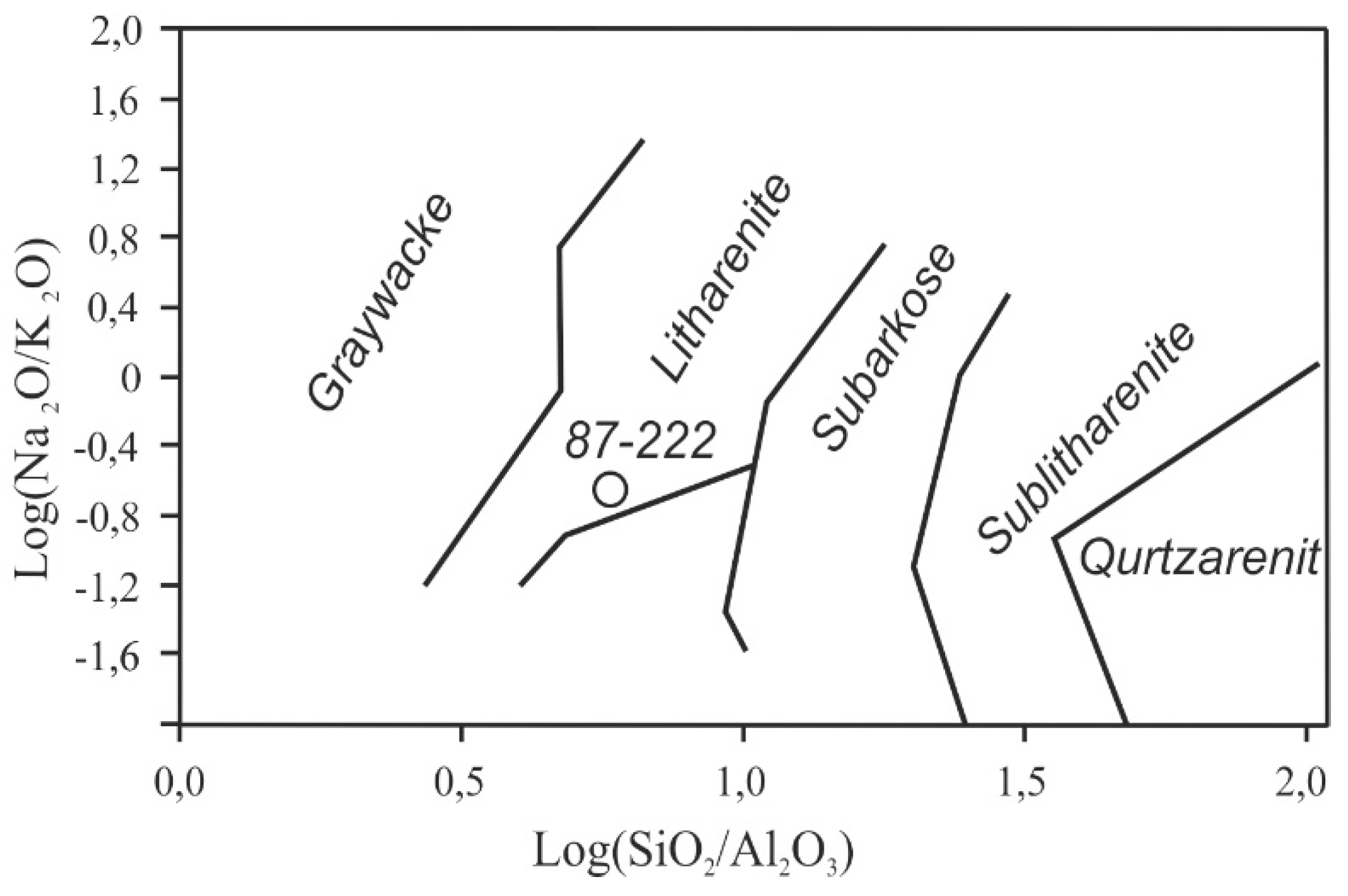
Figure 4.
Schematic logs of drillholes 20803 (Mykolo-Kozelsk area, [35]) and 20586 (Vysokopillya area, [36]).
Figure 4.
Schematic logs of drillholes 20803 (Mykolo-Kozelsk area, [35]) and 20586 (Vysokopillya area, [36]).
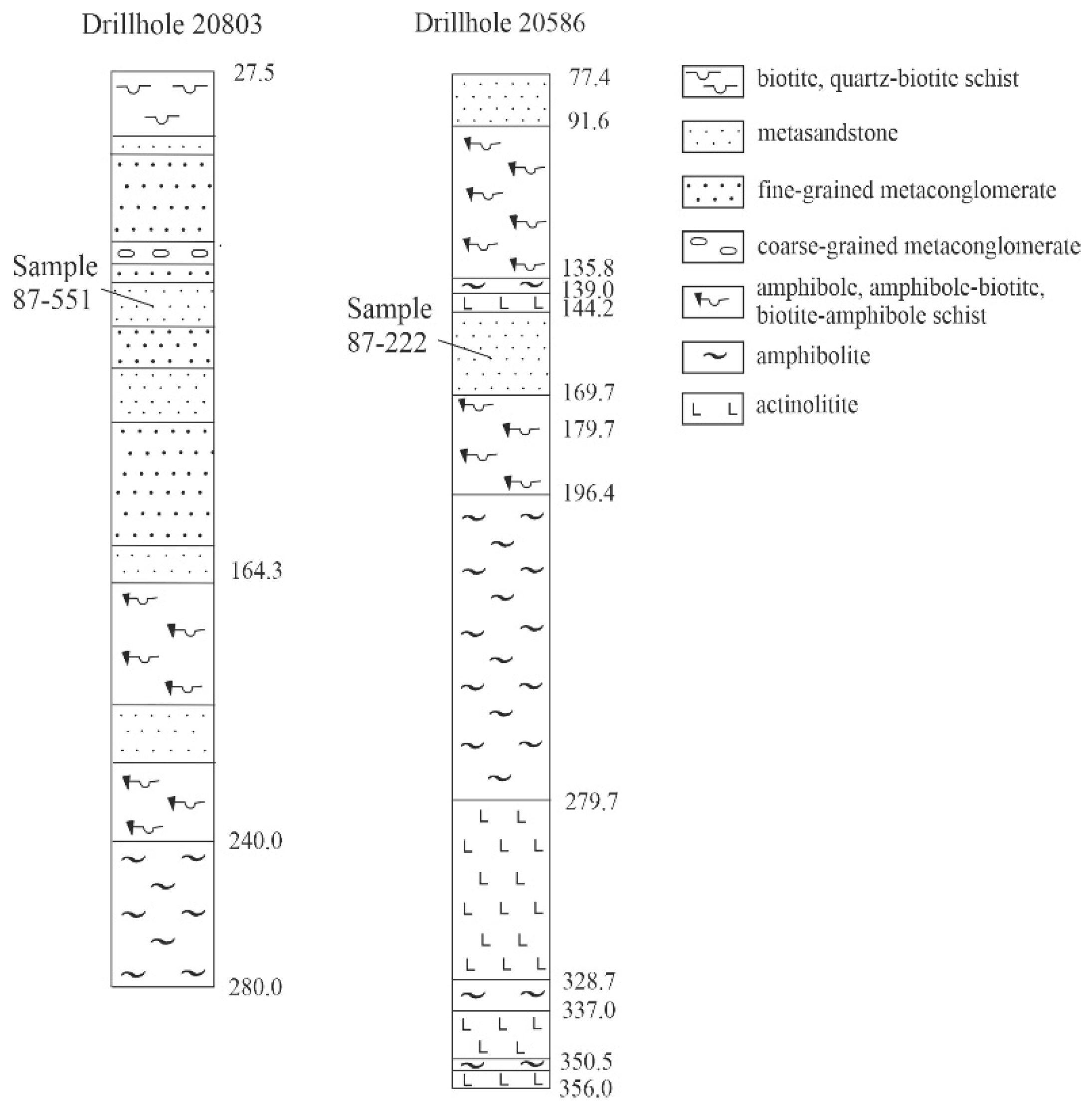
Figure 5.
Optical images of the studied zircon crystals from metasandstone samples 87-551 and 87-222 with the position of the U-Pb analytical spots indicated (see Supplementary Table S1).
Figure 5.
Optical images of the studied zircon crystals from metasandstone samples 87-551 and 87-222 with the position of the U-Pb analytical spots indicated (see Supplementary Table S1).
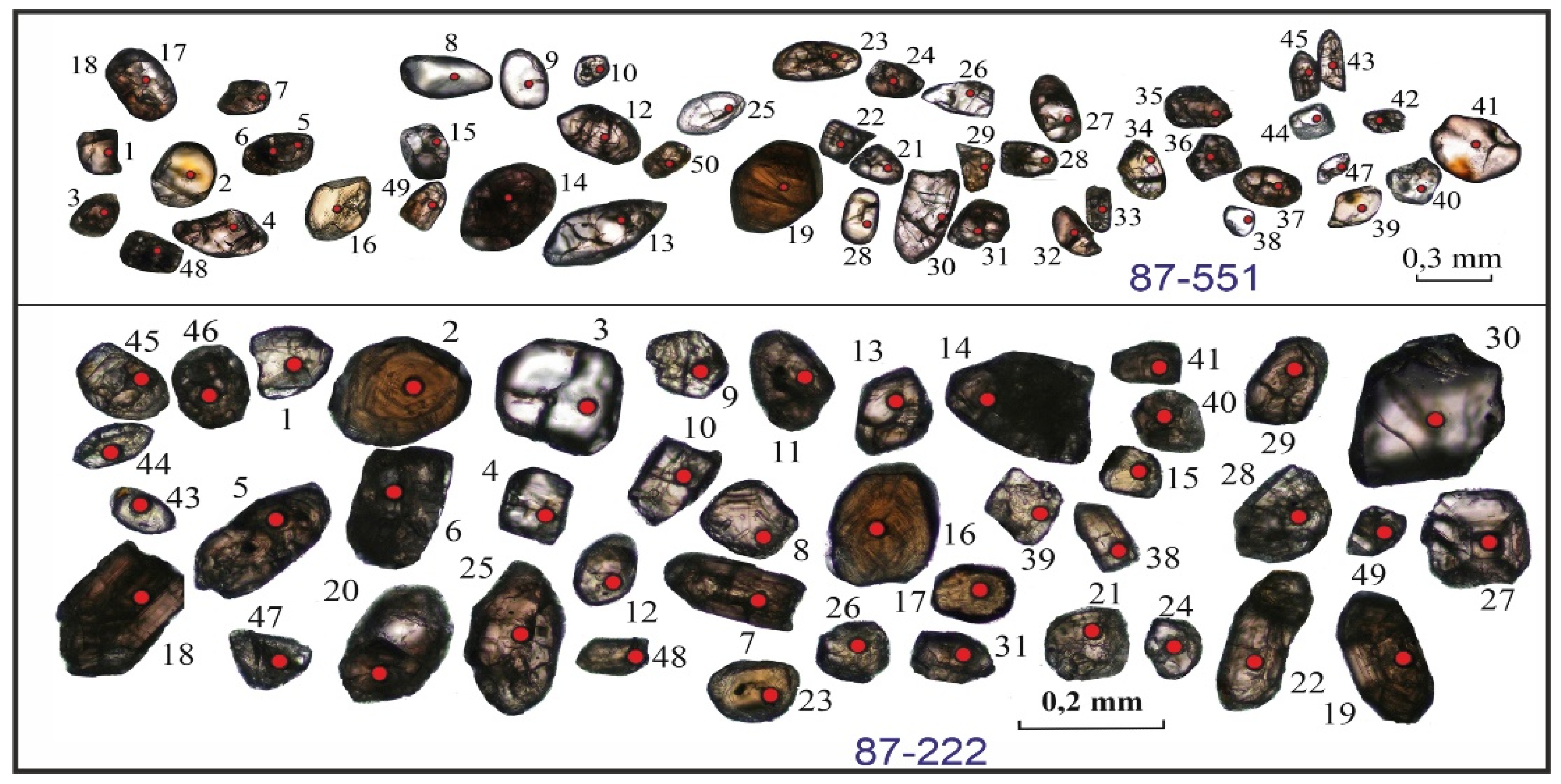
Figure 6.
U-Pb and age distribution diagrams for detrital zircon from metasandstone samples 87-551 and 87-222. Note that the oldest single grain from sample 87-222 is not shown on the age distribution diagram.
Figure 6.
U-Pb and age distribution diagrams for detrital zircon from metasandstone samples 87-551 and 87-222. Note that the oldest single grain from sample 87-222 is not shown on the age distribution diagram.
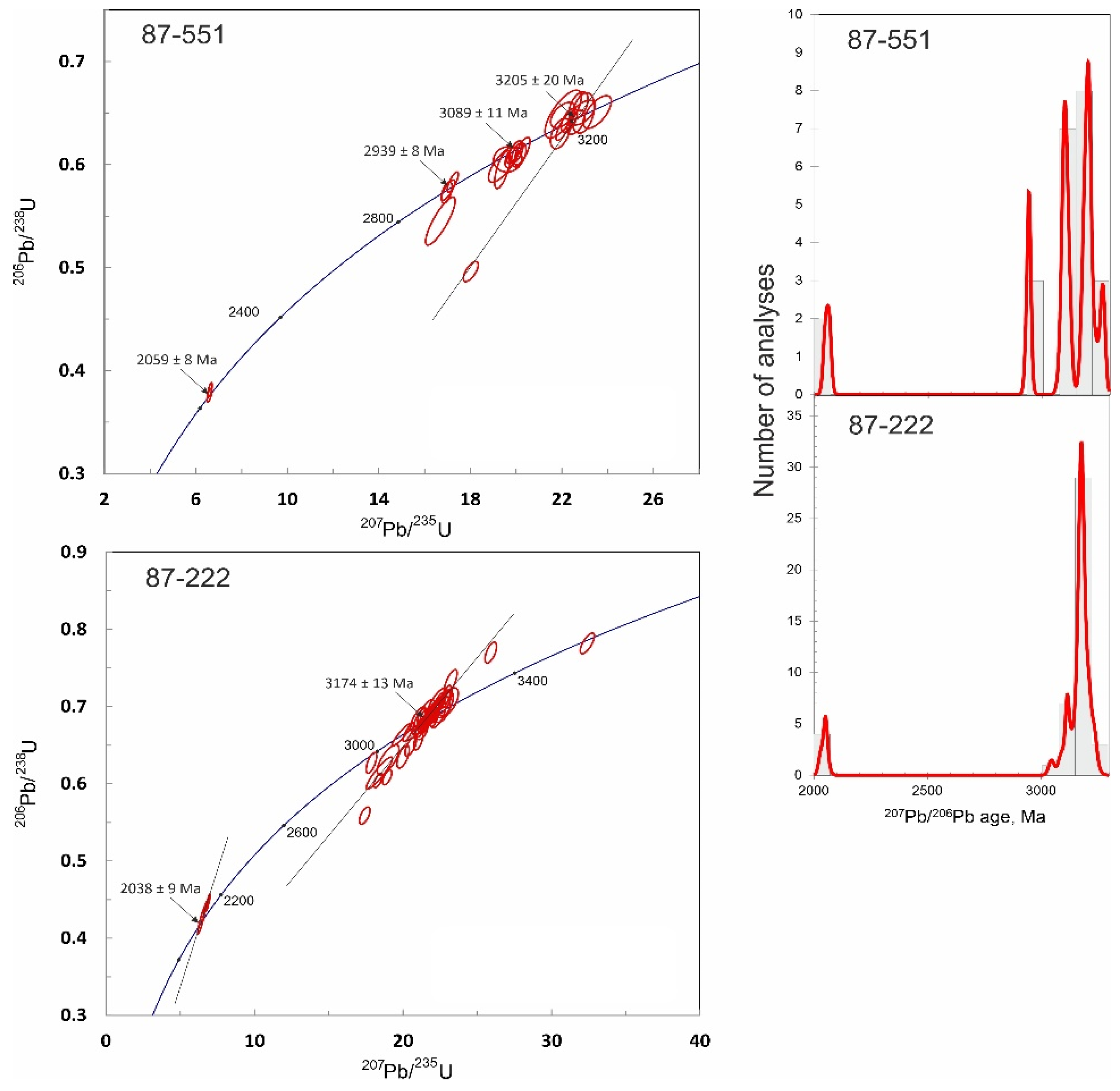
Figure 7.
Hafnium isotope composition of zircon from two metasandstone samples. Panel A demonstrates variations of 176Hf/177Hf(t) plotted against 207Pb/206Pb in individual zircon grains, whereas panel B shows variations in εHf values calculated against the U-Pb ages of each zircon group (see Figure 6). The regression line with 176Lu/177Hf = 0 reflects the evolution of hafnium isotopic composition due to a simple loss of radiogenic lead (zircons lying on this line have the same hafnium isotopic composition regardless of the age). The regression line with 176Lu/177Hf = 0.02 reflects the evolution of the hafnium isotopic composition in the 3.56 Ga old mafic source.
Figure 7.
Hafnium isotope composition of zircon from two metasandstone samples. Panel A demonstrates variations of 176Hf/177Hf(t) plotted against 207Pb/206Pb in individual zircon grains, whereas panel B shows variations in εHf values calculated against the U-Pb ages of each zircon group (see Figure 6). The regression line with 176Lu/177Hf = 0 reflects the evolution of hafnium isotopic composition due to a simple loss of radiogenic lead (zircons lying on this line have the same hafnium isotopic composition regardless of the age). The regression line with 176Lu/177Hf = 0.02 reflects the evolution of the hafnium isotopic composition in the 3.56 Ga old mafic source.
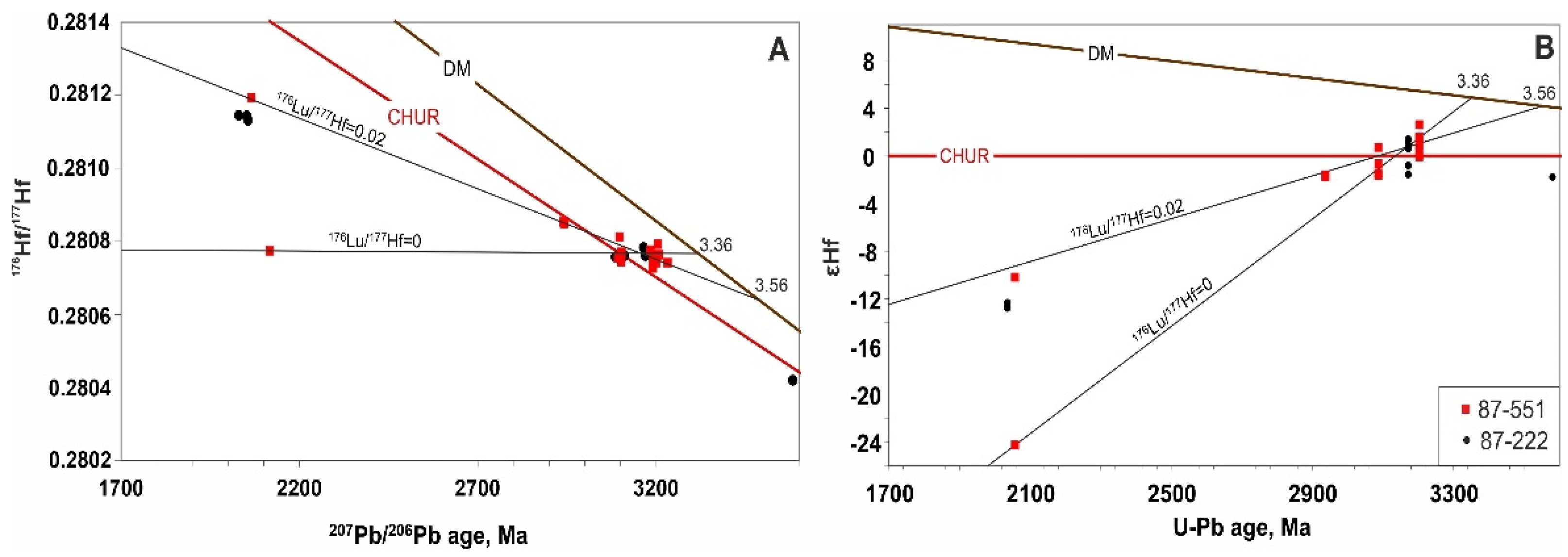
Figure 8.
Variations in Th/U ratio between zircons of different ages from the two metasandstone samples.
Figure 8.
Variations in Th/U ratio between zircons of different ages from the two metasandstone samples.
Disclaimer/Publisher’s Note: The statements, opinions and data contained in all publications are solely those of the individual author(s) and contributor(s) and not of MDPI and/or the editor(s). MDPI and/or the editor(s) disclaim responsibility for any injury to people or property resulting from any ideas, methods, instructions or products referred to in the content. |
© 2024 by the authors. Licensee MDPI, Basel, Switzerland. This article is an open access article distributed under the terms and conditions of the Creative Commons Attribution (CC BY) license (https://creativecommons.org/licenses/by/4.0/).
Copyright: This open access article is published under a Creative Commons CC BY 4.0 license, which permit the free download, distribution, and reuse, provided that the author and preprint are cited in any reuse.


