

Submitted:
10 August 2024
Posted:
14 August 2024
You are already at the latest version
Abstract
Lymphatic filariasis (LF) is a neglected tropical disease associated with poverty and poor environmental conditions. With the inclusion of vector control activities in LF surveillance actions, there is a need to develop simple methods to identify areas with higher mosquito density and consequent risk of W. bancrofti transmission. An ecological study was conducted in Igarassu, Metropolitan Region of Recife, Pernambuco, Brazil. The mosquitoes were captured in 2,060 houses distributed across 117 census tracts. The vector density index (VDI) was constructed, that measures the average number of lymphatic filariasis transmitting mosquitoes per number of houses collected in the risk stratum. Moreover, the social deprivation indicator (SDI) was constructed and was carried out through principal component factor analysis. The average number of female C. quinquefasciatus found in the high-risk stratum was 242, while the low-risk stratum had an average of 108. The overall VDI was 6.8 mosquitoes per household. The VDI for the high-risk stratum was 13.2 mosquitoes per household, while for the low/medium-risk stratum, it was 5.2. This study offers an SDI for the density of C. quinquefasciatus mosquitoes, which reduces the cost associated with data collection and allows for indicating priority areas for vector control actions.
Keywords:
Lymphatic filariasis
; Culex quinquefasciatus
; vector density index
; social deprivation indicator
1. Introduction
Lymphatic filariasis (LF) is a neglected tropical disease transmitted by mosquitoes and associated with poverty and poor environmental conditions [1]. The Global Programme to Eliminate Lymphatic Filariasis (GPELF) was launched in 2000 by the World Health Organization (WHO) with the goal of eliminating the disease as a public health problem by 2030 [2].
In Brazil, LF is an urban disease and its etiological agent is Wuchereria bancrofti, with Culex quinquefasciatus as the transmitting mosquito [4,5]. Maceió - Alagoas [6] and Belém – Pará [7] have indicators of transmission interruption [6,7]. Pernambuco, Recife, Olinda, and Jaboatão dos Guararapes are under surveillance after Mass Drug Administration (MDA), while Paulista provides individual treatment to cases due to low infection prevalence [8]. Nine other municipalities, Abreu e Lima, Cabo de Santo Agostinho, Camaragibe, Igarassu, Ilha de Itamaracá, Ipojuca, Itapissuma, Moreno, and São Lourenço da Mata, which are adjacent to endemic areas, are considered to have undetermined transmission of filariasis [9].
The presence of the transmitting mosquito, unplanned urbanization, and migration pose a risk for LF transmission [9]. In order to implement or develop vector control actions, it is necessary to identify the areas and population groups most exposed to mosquitoes and, therefore, prioritized groups for the surveillance actions [10,11]. Composite indexes appear to be a useful tool for this identification [12,13,14].
With the inclusion of vector control activities in LF surveillance actions, there is a need to develop simple methods to identify areas with higher mosquito density and consequent risk of W. bancrofti transmission [15,16,17]. In this perspective, the objective of this study was to analyze the spatial distribution of C. quinquefasciatus density according to socio-environmental conditions in an area with undetermined transmission of W. bancrofti.
2. Materials and Methods
The study was conducted in the municipality of Igarassu, located in the Metropolitan Region of Recife, Pernambuco, northeastern Brazil. It is one of the nine municipalities with undetermined LF status in Pernambuco, northeastern Brazil. Historically, it has had cases of microfilaremia [18] identified and no treatment interventions in its population. Furthermore, there is no record of any investigation into C. quinquefasciatus mosquitoes [9]. An ecological study was conducted, with the unit of analysis being the urban census tracts of Igarassu.
The Vector Density Index (VDI) measures the average number of lymphatic filariasis transmitting mosquitoes per number of houses collected in the risk stratum. It was calculated using the following formula:
For the construction of the Social Deprivation Indicator (SDI), Pearson correlation of 10 socio-environmental variables provided by the 2010 demographic census (Table 1) was measured, and only variables that showed statistical significance (p < 0.05) remained in the process.
Before initiating the estimation of the SDI, the variables composing it were examined using the Kaiser-Meyer-Olkin (KMO) [20] test and Bartlett's test of sphericity [21].
The correlation between eligible variables and the number of female mosquitoes was evaluated using Spearman's correlation [22]. Variables with significant correlation were selected. The selected variables were then normalized to belong to the interval 0-1 using the following equation:
which,
i = Census tract;
X = Variable to be normalized.
After finding the acceptable factors, the index was normalized to the range 0-1 by the equation:
The construction of the SDI was carried out through principal component factor analysis, which reduces many variables to a smaller number, now referred to as factors. The variables forming a factor need to be correlated with each other for the model to be appropriate [23]. The technique produces regression coefficients (loadings or factorial loadings) that indicate the relationship between the factor and each original variable. Additionally, it determines the percentage of total variance explained for each extracted factor. In this study, among the extracted factors, the one that explained a variance greater than 1 (eigenvalue > 1) was selected. The values of the extracted factor (factor scores) are estimated by regression. This factor constituted the SDI [24].
To obtain strata, the SDI was subjected to the k-means clustering technique, in which the number of SDI bands was identified by the elbow graph. To explain the relationship between the SDI and the VDI, the Poisson-Inverse Gaussian regression model [25] was employed, which showed adjustment according to the Akaike metric (AIC) [26]. All calculations were performed using the R statistical programming language version 4.1.0, and the adopted significance level was 5%.
The mosquitoes were captured in 2,060 houses distributed across 117 census tracts. Maps of the census tracts from the IBGE website [19] were consulted and then manipulated to define quadrants. In each quadrant, a line was drawn diagonally across the 2nd and 3rd quadrants, connecting opposite quadrants. From the midpoint of each quadrant (2nd and 3rd), the streets were defined, in this case, two, that would be in each midpoint of these quadrants. For each street, 10 households were selected, totaling 20 per census tract. This selection followed the listing of the first 10 households (according to the numbering) located on the right side of the street.
The heads of households were given an informed consent form, and upon their agreement to participate, signed the form. Collections were then conducted between 9 and 12 AM using electric aspirators indoors, following the protocol by Ramesh et al. [27]. The mosquitoes were aspirated and stored in fine mesh cages for later storage in a -20ºC freezer. The mosquitoes were identified based on characteristics described by Forattini et al. (1965) [28].
The study was approved by the Research Ethics Committee of the Instituto Aggeu Magalhães, FIOCRUZ - PE, under approval number 039627/2019.
3. Results
The seven variables that comprised the SDI (p < 0.05) were: proportion of households without public water supply, proportion of households without adequate sewage systems, proportion of households without garbage collected by sanitation services, proportion of households with 6 or more residents, proportion of illiterate household heads, per capita household income, and per capita income of household heads.
Bartlett's test of sphericity (χ² = 372.47; p < 0.01) and the KMO (0.68) indicated that the correlations among the variables were suitable for exploratory factor analysis. There was a statistically significant correlation among the seven eligible variables for forming the SDI, considering Spearman's correlation (Table 2). The variables with the greatest weight in the index were per capita household income (-0.474), the proportion of illiterate household heads (0.466), and per capita income of household heads (0.466).
Table 3 presents the correlation matrix, applying exploratory factor analysis via principal components. The index is represented according to equation (2), which the general variance is explained by 43.7% through component 1, which constitutes the SDI:
X1= Proportion of households without public water supply;
X2 = Proportion of households without adequate sewage system;
X3 = Proportion of households without garbage collected by sanitation services;
X4 = Proportion of households with 6 or more residents;
X5 = Proportion of illiterate household heads;
X6 = Per capita household income;
X7 = Per capita income of household heads;
Bartlett's test of sphericity (χ² = 372.47; p < 0.01) and the KMO (0.68) indicated that the correlations among the variables were suitable for exploratory factor analysis. There was a statistically significant correlation among the seven eligible variables for forming the SDI, considering Spearman's correlation (Table 2). The variables with the greatest weight in the index were per capita household income (-0.474), the proportion of illiterate household heads (0.466), and per capita income of household heads (0.466).
To create the SDI strata, the k-means clustering technique was applied, resulting in four chosen strata. The result of the four strata is presented in Table 4. Strata 1, 2, and 3 (very low risk, low risk, and medium risk) were not statistically significant. Stratum 4 (high risk) is statistically significant, meaning that the average number of female C. quinquefasciatus in this stratum is statistically different from the others. Therefore, it was useful to merge the strata that were not significant.
The average number of female C. quinquefasciatus found in the high-risk stratum was 242, while the low-risk stratum had an average of 108. This means the high-risk stratum had 2.24 times more mosquitoes on average than the low-risk stratum (p < 0.01, Table 4).
A total of 26,027 C. quinquefasciatus were collected from the 2,060 investigated households. Of the captured mosquitoes, 14,920 (58%) were female, and among them, 8,783 (59%) were engorged. The overall vector density index (VDI) was 6.8 mosquitoes per household. Figure 1 shows the distribution of the SDI by census tract. The VDI for the high-risk stratum was 13.2 mosquitoes per household, while for the low/medium-risk stratum, it was 5.2 (p < 0.01).
4. Discussion
The SDI proposed in this study was constructed from variables that reflect socio-environmental precarities associated with the density of female C. quinquefasciatus. The worst socio-environmental conditions were associated with a higher vector density index (VDI). The high-risk stratum consisted of 21 census tracts, three of which were considered high-priority areas for potential surveillance actions in the municipality.
Due to the complexity involved in lymphatic filariasis (LF), the environment, and vectors, strategies for its elimination as a public health problem must be tailored to environmental and socio-economic precarities [29,30,31]. Stratifying the space according to these factors serves as a supporting tool for planning disease control actions [32,33,34,35].
The use of census tracts as the spatial unit of analysis in the development of the SDI offers the advantage of representing the most disaggregated level of population and socio-environmental data, likely ensuring better homogeneity among the population. The ability to conduct analyses in micro-areas facilitates the implementation of selective and specific actions for controlling endemic diseases [12,36]. In Brazil, the demographic census uses census tracts for registration control, with updates occurring every ten years [19].
The variables used to analyze the census tracts were related to precarious conditions in sanitation, income, housing conditions, and population density. These variables are often associated with breeding sites for C. quinquefasciatus, which are artificial reservoirs filled with water containing organic matter and decomposing material, having a dirty appearance and always located near human habitations [37,38]. Simonsen et al. (2013) [32], in their review of filarial disease in urban environments, describe precarious socio-environmental conditions as the most common causes for the formation of mosquito breeding sites and thus for LF transmission. In this study, two risk strata were formed, low and high risk, with the latter exhibiting the worst sanitary conditions, the highest number of adult mosquitoes, and thus deserving the most attention from LF surveillance.
The highest Vector Density Index (VDI) was also identified in the high-risk stratum, with 13.2 mosquitoes per household, while the areas considered low-risk had approximately 5.2 mosquitoes per household. Lupenza et al. (2021) [39] emphasize that a high number of mosquitoes increases the bite rates for household occupants, thereby increasing the risk of LF infection. As such, the vector control efforts within the Global Program to Eliminate Lymphatic Filariasis (GPELF) should focus on environmental improvements.
Monitoring LF infection in populations through risk indicators is a simple, easy-to-apply, and low-cost tool for filariasis elimination programs in urban areas [14,40,41]. The ability to link this method's construction with the vector and the sanitary conditions of an area allows for tracking the risk of filariasis transmission in non-endemic locations, with low prevalence, and in the context of elimination. Thus, this study presents a possible method of territorial surveillance based on the detection of new transmission foci independently of human cases.
In 2022, Xavier and collaborators [42] used a socio-environmental risk indicator, previously validated by Bonfim et al. (2011) [43] in a study related to human prevalence for LF, to identify areas with the highest risk for LF vector density. Although they had similar objectives, this current study innovatively presents the construction of an indicator created through principal component analysis to estimate the specific risk of higher vector counts. Using this approach, 10 variables related to precarious socio-environmental conditions were evaluated, and the most statistically significant ones that best described the risk of C. quinquefasciatus breeding sites were selected.
5. Conclusions
Rapidly and cost-effectively detecting areas indicated for vector control can be highly valuable for health services, and the main objective of estimating the chances of filarial infection transmission based on higher vector density has been achieved. The results of this study offer an SDI for the density of C. quinquefasciatus mosquitoes, which reduces the cost associated with data collection and allows for indicating priority areas for vector control actions.
Author Contributions
Conceptualization, A.X. and Z.M.; methodology, C.B.; software, F.S and A.S.; validation, A.X., C.B. and Z.M.; formal analysis, A.S.; investigation, W.B.J.; resources, V.R.; data curation, P.C.; writing—original draft preparation, A.X.; writing—review and editing, Z.M.; visualization, V.R.; supervision, W.B.J.; project administration, Z.M.; funding acquisition, A.X and Z.M. All authors have read and agreed to the published version of the manuscript.
Funding
This research was funded by Coordenação de Aperfeiçoamento de Pessoal de Nível Superior - Brasil (CAPES), grant number Finance Code 001; Fundação de Amparo a Ciência e Tecnologia de Pernambuco (FACEPE), grant number IBPG-0959-4.01/16 to A.T.X; Universidade de Pernambuco [PFA]; and by Fundação de apoio à Fiocruz (FIOTEC) – Geração de conhecimento II, grant number VPPCB-007-FIO-18-2-107.
Informed Consent Statement
Informed consent was obtained from all subjects involved in the study.
Acknowledgments
We would like to thank the City Hall of Igarassu for the partnership in the development of this project, especially the representative Igor Moraes and Renata Maia. The authors are grateful for our collaborator Ana Carla da Silva and our scientific initiation students: Adrielle Nunes (BIC-1204-4.06/19), Romualdo Arthur (PIBIC/CNPq/Fiocruz) and Sara Xavier (PIBIC/CNPq/Fiocruz).
Conflicts of Interest
The authors declare no conflicts of interest.
References
- Durrheim, D.N; Wynd, S.; Liese, B.; Gyapong, J.O. Lymphatic filariasis endemicity–an indicator of poverty? Trop Med Int Health 2004, 9(8), pp. 843-845. [CrossRef]
- Resolution A. RES/70/1. Transforming our world: the 2030 agenda for sustainable development. Seventieth United Nations General Assembly 2015, 25, pp. 86-97.
- World Health Organization. Validation of elimination of lymphatic filariasis as a public health problem. 2017.
- Dreyer, G.; Norões, J.; Figueredo-Silva, J.; Piessens, W.F. Pathogenesis of lymphatic disease in bancroftian filariasis: a clinical perspective. Parasitol Today 2000, 16(12), pp. 544-8.
- Consoli, R.A.G.B; Oliveira, R.L. Principais mosquitos de importância sanitária do Brasil, 1rd ed.; Memórias do Instituto Oswaldo Cruz – Fiocruz: Rio de Janeiro, Brasil, 1994; pp. 228.
- Rocha, A.; Barbosa, C.S.; Brandão Filho, S.P.; Oliveira, C.M.F.; Almeida, A.M.P; Gomes, Y.M. Primeiro workshop interno dos serviços de referência do Centro de Pesquisas Aggeu Magalhães da Fundação Oswaldo Cruz. Rev Soc Bras Med Trop 2009, 42, pp. 228-34.
- Fontes, G.; Leite, A.B.; de Lima, A.R.V.; Freitas, H.; Ehrenberg, J.P.; da Rocha, E.M.M. Lymphatic filariasis in Brazil: epidemiological situation and outlook for elimination. Parasites Vectors 2012, 5(1), pp. 1-11.
- Nascimento, J.B.; Brandão, E.; da Silva, F.D.; Bernart, F.D.; Rocha, A. The ituation of Lymphatic Filariasis in the municipality of Paulista, Pernambuco, Brazil. Rev Pat Trop 2018, 47(4), pp. 217-224.
- Xavier, A.; Oliveira, H.; Aguiar-Santos, A.; Barbosa Júnior, W.; da Silva, E.; Braga, C.; Bonfim, C.; Medeiros, Z. Assessment of transmission in areas of uncertain endemicity for lymphatic filariasis in Brazil. PLoS Negl Trop Dis 2019, 13(11), e0007836–e. [Google Scholar] [CrossRef] [PubMed]
- Wilke, A.B.B.; Vasquez, C.; Carvajal, A.; Moreno, M.; Fuller, D.O.; Cardenas, G.; Petrie, W.D..; Beier, J.C. Urbanization favors the proliferation of Aedes aegypti and Culex quinquefasciatus in urban areas of Miami-Dade County, Florida. Sci Rep 2021, 11(1), pp. 22989. [CrossRef]
- Moise, I.K.; Riegel, C.; Muturi, E.J. Environmental and social-demographic predictors of the southern house mosquito Culex quinquefasciatus in New Orleans, Louisiana. Parasites Vectors 2018, 11(1), pp. 249.
- Ximenes, R.A.A.; Martelli, C.M.T.; Souza, W.V.; Lapa, T.M.; Albuquerque, M.F.M.; Andrade, A.L.S.S.; Morais Neto, O.L.; Silva, S.A.; Lima, M.L.C; Portugal, J.L. Vigilância de doenças endêmicas em áreas urbanas: a interface entre mapas de setores censitários e indicadores de morbidade. Cad Saúde Pública 1999, 15(1), pp. 53-62.
- Domínguez-Berjón, M.F.; Borrell, C.; Cano-Serral, G.; Esnaola, S.; Nolasco, A.; Pasarín, M.I.; Ramisc, R.; Saurinag, C.; Escolar-Pujolarh, A. Constructing a deprivation index based on census data in large Spanish cities(the MEDEA project). Gac Sanit 2008, 22(3), pp. 179-87.
- Braga, C.; Ximenes, R.A.A.; Albuquerque, M.F.P.M.; Souza, W.V.; Miranda, J.; Brayner, F.; Alves, L.; Silva, L.; Dourado, I.. Avaliação de indicador sócio-ambiental utilizado no rastreamento de áreas de transmissão de filariose linfática em espaços urbanos. Cad Saúde Pública 2001, 17(5) pp. 1211-8.
- Weiss, P.S.; Michael, E.; Richards, F.O. Simulating a Transmission Assessment Survey: An evaluation of current methods used in determining the elimination of the neglected tropical disease, Lymphatic Filariasis. Int J Infect Dis 2021, 102, pp. 422-8.
- Wanji, S.; Amvongo-Adjia, N.; Koudou, B.; Njouendou, A.J.; Chounna Ndongmo, P.W.; Kengne-Ouafo, J.A.; Datchoua-Poutcheu, F.R.; Fovennso, B.A.; Tayong, D.B.; Fombad, F.F.; Fischer, P.U.; Enyong, P.I.; Bockarie, M. Cross-reactivity of filariais ICT cards in areas of contrasting endemicity of Loa loa and Mansonella perstans in Cameroon: implications for shrinking of the lymphatic filariasis map in the Central African Region. PLoS Negl Trop Dis 2015, 9(11), e0004184. [Google Scholar] [CrossRef] [PubMed]
- Riches, N.; Badia-Rius, X.; Mzilahowa, T.; Kelly-Hope, L.A. A systematic review of alternative surveillance approaches for lymphatic filariasis in low prevalence settings: Implications for post-validation settings. PLoS Negl Trop Dis 2020, 14(5), e0008289. [Google Scholar] [CrossRef] [PubMed]
- Dobbin Jr, J.; Cruz, A. Inquéritos de filariose em alguns municípios do Litoral-Mata de Pernambuco. Rev Bras Malariol Doenças Trop 1967, 19, pp.45-51.
- Censo Populacional do Instituto Brasileiro de Geografia e Estatística. Available online: http://www.censo2010.ibge.gov.br (accessed on 23 May 2020).
- Kaiser, H.F. An index of factorial simplicity. Psychometrika 1974, 39(1), pp. 31-6.
- Bartlett, M.S. The effect of standardization on a χ 2 approximation in factor analysis. Biometrika 1951, 38(3/4), pp. 337-44.
- Arndt, S.; Turvey, C.; Andreasen, N.C. Correlating and predicting psychiatric symptom ratings: Spearmans r versus Kendalls tau correlation. J Psychiatr Res 1999, 33(2), pp. 97-104.
- Carvalho, F.R.D. Análise fatorial. Dissertação de Mestrado em Matemática apresentada à Faculdade de Ciências e Tecnologia, Universidade de Coimbra, Coimbra, 2013.
- Sharma, S. Applied multivariate techniques. 1996.
- Dean, C.; Lawless, J.F.; Willmot, G.E. A Mixed Poisson-Inverse-Gaussian Regression Model. Can J Statistics 1989, 17(2), pp. 171-81.
- Sakamoto, Y.; Ishiguro, M.; Kitagawa, G. Akaike information criterion statistics. 1rd ed.; KTK Scientific Publishers; D. Reidel; Sold and distributed in the U.S.A. and Canada by Kluwer Academic Publishers. 1986.
- Ramesh, A.; Cameron, M.; Spence, K.; Spaans, R.H. Melo-Santos, M.A.V.; Paiva, M.H.S.; Guedes, D.R.D.; Barbosa, R.M.R.; Oliveira, C.M.F.; Sá, A.; Jeffries, C.L.; Castanha, P.M.S.; Oliveira, P.A.S.; Walker, T.; Alexander, N.; Braga, C. Development of an urban molecular xenomonitoring system for lymphatic filariasis in the Recife Metropolitan Region, Brazil. PLoS Negl Trop Dis 2018, 12(10), e0006816.
- Forattini, O.P. Entomologia médica. USP: São Paulo, Brasil, 1965; pp. 506.
- Eder, M.; Cortes, F.; Teixeira de Siqueira Filha, N.; Araújo de França, G.V.; Degroote, S.; Braga, C.; Ridde, V.; Martelli, C.M.T. Scoping review on vector-borne diseases in urban areas: transmission dynamics, vectorial capacity and co-infection. Infect Dis Poverty 2018; 7(1), pp. 1-24.
- Graves, P.M.; Sheridan, S.; Fuimaono, S.; Lau, C.L. Demographic, socioeconomic and disease knowledge factors, but not population mobility, associated with lymphatic filariasis infection in adult workers in American Samoa in 2014. Parasites Vectors 2020, 13(1), pp. 125-143.
- Zerbo, A.; Castro Delgado, R.; Arcos González, P. Exploring the dynamic complexity of risk factors for vector-borne infections in sub-Saharan Africa: Case of urban lymphatic filariasis. J Biosaf Biosecur 2021, 3(1), pp. 17-21.
- Riches, N.; Badia-Rius, X.; Mzilahowa, T.; Kelly-Hope, L.A. A systematic review of alternative surveillance approaches for lymphatic filariasis in low prevalence settings: Implications for post-validation settings. PLoS Negl Trop Dis 2020, 14(5), :e0008289.
- Simonsen, P.E.; Mwakitalu, M.E. Urban lymphatic filariasis. Parasitol Res 2013, 112(1), pp. 35-44.
- Slater, H.; Michael, E. Mapping, bayesian geostatistical analysis and spatial prediction of lymphatic filariasis prevalence in Africa. PLoS One 2013, 8(8), e71574. [Google Scholar] [CrossRef] [PubMed]
- Stanton, M.C.; Mkwanda, S.; Mzilahowa, T.; Bockarie, M.J.; Kelly-Hope, L.A. Quantifying filariasis and malaria control activities in relation to lymphatic filariasis elimination: a multiple intervention score map (MISM) for Malawi. Trop Med Int Health 2014, 19(2), pp. 224-35.
- Allik, M.; Leyland, A.; Ichihara, M.Y.T.; Dundas, R. Creating small-area deprivation indices: a guide for stages and options. J Epidemiol Community Health 2020, 74(1), pp. 20-5.
- Xavier, M.D.N.; Santos, E.M.M.; Silva, A.; Gomes Júnior, P.P.; Barbosa, R.M.R.; Oliveira, C.M.F. Field evaluation of sticky BR-OVT traps to collect culicids eggs and adult mosquitoes inside houses. Rev Soc Bras Med Trop 2018, 51(3), pp. 297-303.
- Santos, S.A.; Barbosa, R.M. Immature Aedes mosquitoes colonize Culex quinquefasciatus breeding sites in neighborhoods in the municipality of Olinda, State of Pernambuco. Rev Soc Bras Med Trop 2014, 47(6), pp. 775-7.
- Lupenza, E.; Gasarasi, D.B.; Minzi, O.M. Lymphatic filariasis, infection status in Culex quinquefasciatus and Anopheles species after six rounds of mass drug administration in Masasi District, Tanzania. Infect Dis Poverty 2021, 10(1), pp. 20.
- Bonfim, C.; Netto, M.J.; Pedroza, D.; Portugal, J.L.; Medeiros, Z. A socioenvironmental composite index as a tool for identifying urban areas at risk of lymphatic filariasis. Trop Med Int Health 2009, 14(8), pp. 877-84.
- Bonfim, C.; Aguiar-Santos, A.M.; Pedroza Jr, D..; Costa, T.R.; Portugal, J.L.; Oliveira, C.; Medeiros, Z. Social deprivation index and lymphatic filariasis: a tool for mapping urban areas at risk in northeastern Brazil. Int Health 2009, 1(1), pp. 78-84.
- Xavier. A.; Bonfim, C.; Barbosa Júnior, W.; Bezerra, G.; Oliveira, C.; Uchikawa, R.; da Silva, F.; Aguiar-Santos, A.; Medeiros, Z. Influence of social and environmental factors for Culex quinquefasciatus distribution in Northeastern Brazil: a risk index. Int J Environ Health Res 2023, 33(12), pp. 1580-1590. [CrossRef]
- Bonfim, C.; Alves, A.; Costa, T.R.; Alencar, F.; Pedroza, D.; Portugal, J.L.; Medeiros, Z. Spatial analysis and privation index to identify urban areas with a high risk of lymphatic filariasis. Trop Med Int Health 2011, 16(6), pp. 748-755.
Figure 1.
Spatial representation of the social deprivation indicator, Igarassu, 2022.
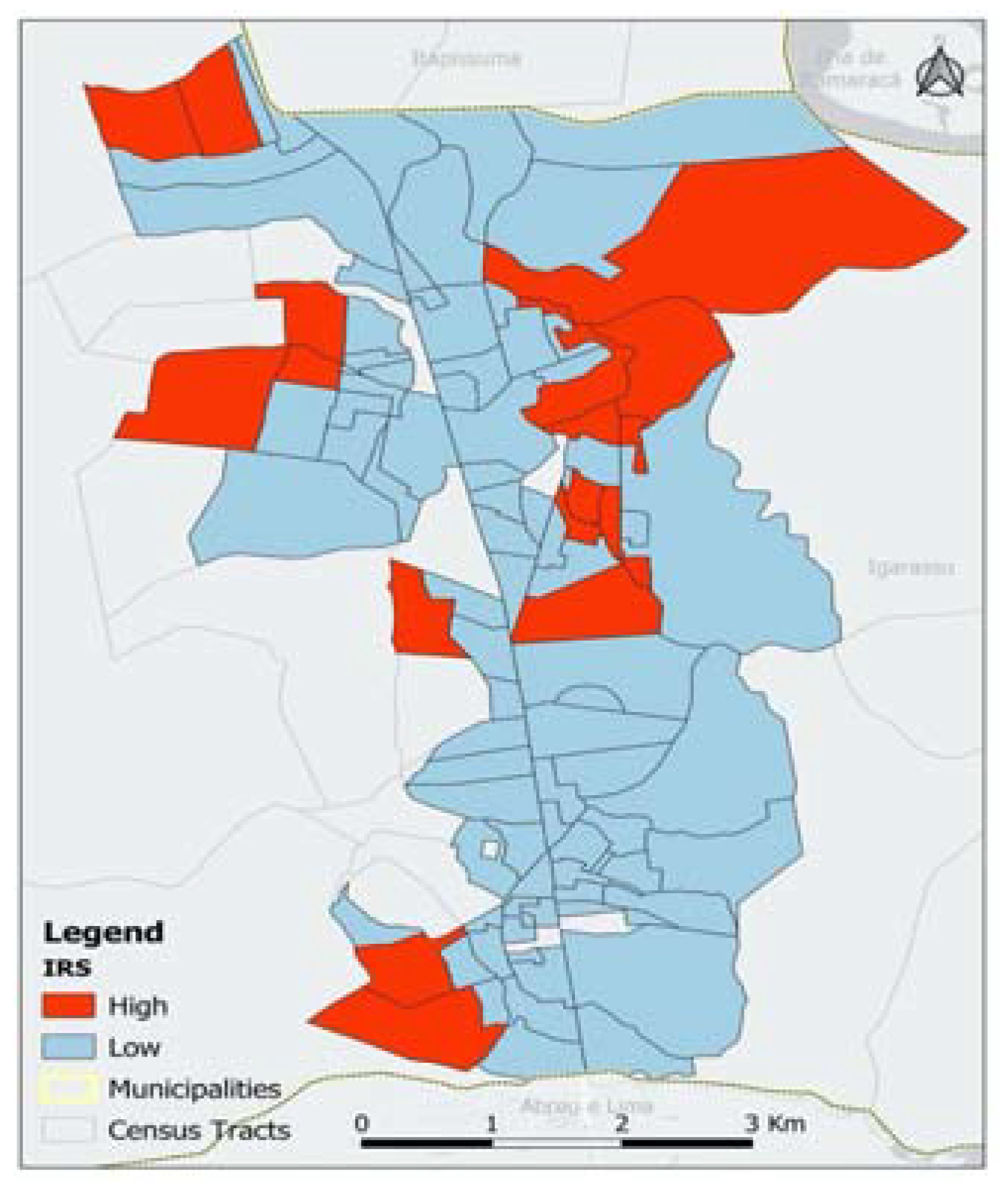

Table 1.
Variables eligible for composing the social deprivation indicator, Igarassu, 2022.
| Variable | Definition | Indicator |
|---|---|---|
| WATS | Households with inadequate water supply | Proportion of households without internal water plumbing and without access to public water supply network relative to the total number of permanent private households |
| BATHR | Households without exclusive use bathrooms for residents | Proportion of households without showers or bathtubs and exclusive use of toilet facilities for household residents. |
| GARB | Households with inadequate garbage collection | Proportion of households with garbage collection by public or private company services relative to the total number of permanent private households. |
| ELEC | Households without electricity | Proportion of households without any type of electricity supply |
| HOUS | Households with 6 or more residents | Proportion of households with 6 or more residents |
| SEW | Households without sewage system | Proportion of households without drainage system for waste from the bathroom or toilet. |
| ISEW | Households with inadequate sewage systems | Proportion of households without plumbing for waste from the bathroom or toilet, connected to a collection system that leads to a general drainage system in the area, region, or municipality, even if the system does not have a sewage treatment plant. |
| ILIND | Illiterate individuals who are household heads | Proportion of household heads who either did not know how to read and write, those who learned but forgot due to an unconsolidated literacy process, and those who could only sign their own name. |
| RACE | Resident individuals self-declared as black race or ethnicity | Proportion of resident individuals self-declared as black race or ethnicity |
| REND | Individuals responsible with no positive income | Proportion of individuals responsible for permanent private households with no positive income, meaning no type of earnings in value. |
Source: IBGE, 2010 [19]
Table 2.
Pearson and Spearman Correlation between the variables comprising the SDI and the number of female C. quinquefasciatus Mosquitoes in Igarassu, 2022.
Table 2.
Pearson and Spearman Correlation between the variables comprising the SDI and the number of female C. quinquefasciatus Mosquitoes in Igarassu, 2022.
| Variable | Acronyms | Pearson Correlation | Spearman Correlation | ||
|---|---|---|---|---|---|
| Estimate | p-value | Estimate | p-value | ||
| Proportion of households without public water supply | WATS | 0,34 | 0,00 | 0,41 | 0,00 |
| Proportion of households without exclusive-use bathrooms for residents | BATHR | 0,06 | 0,54 | 0,34 | 0,00 |
| Proportion of households without any kind of sewage system | SEW | 0,06 | 0,54 | -0,13 | 0,21 |
| Proportion of households without adequate sewage system | ISEW | 0,10 | 0,30 | 0,10 | 0,30 |
| Proportion of households without garbage collected by sanitation services | GARB | 0,37 | 0,00 | 0,32 | 0,00 |
| Proportion of households without electricity | ELEC | 0,03 | 0,74 | 0,23 | 0,02 |
| Proportion of households with 6 or more residents | HOUS | 0,16 | 0,11 | 0,22 | 0,03 |
| Proportion of illiterate individuals responsible for the household | ILIND | 0,26 | 0,01 | 0,10 | 0,30 |
| Proportion of resident individuals of black race/color | RACE | 0,02 | 0,80 | 0,08 | 0,40 |
| Proportion of household heads with no positive income | REND | -0,10 | 0,31 | 0,09 | 0,37 |
| Per capita household income | RENDo | -0,21 | 0,03 | -0,34 | 0,00 |
| Per capita income of household heads | RENDp | -0,16 | 0,11 | -0,32 | 0,00 |
Source: Authors, 2023.
Table 3.
Correlation Matrix of Variables Regarding Socio-Environmental Conditions by Census Tract, Igarassu, 2022.
Table 3.
Correlation Matrix of Variables Regarding Socio-Environmental Conditions by Census Tract, Igarassu, 2022.
| KMO (0,68¹) | Variáveis | WATS | ISEW | GARB | HOUS | ILIND | RENDo | RENp |
|---|---|---|---|---|---|---|---|---|
| 0,56 | WATS | 1 | 0,01 | 0,23 | 0,27 | 0,46 | -0,05 | 0,06 |
| 0,60 | ISEW | 1 | 0,10 | 0,49 | 0,24 | -0,24 | -0,20 | |
| 0,87 | GARB | 1 | 0,25 | 0,47 | -0,36 | -0,30 | ||
| 0,68 | HOUS | 1 | 0,54 | -0,32 | -0,30 | |||
| 0,75 | ILIND | 1 | -0,53 | -0,53 | ||||
| 0,59 | RENDo | 1 | 0,93 | |||||
| 0,57 | RENp | 1 |
Source: Authors, 2023.
Table 4.
Results of the Poisson-Inverse Gaussian regression model and absolute and relative frequencies of the risk strata of the social deprivation indicator, Igarassu, 2022.
Table 4.
Results of the Poisson-Inverse Gaussian regression model and absolute and relative frequencies of the risk strata of the social deprivation indicator, Igarassu, 2022.
| Strata | SDI | Model with 4 bands | Model with 2 bands | |||||||||
|---|---|---|---|---|---|---|---|---|---|---|---|---|
| min | max | Coeff.¹ | p-value | N | % | Coeff.¹ | p-value | N | % | |||
| Very low risk (1)² | 0,00 | 0,20 | 4,51 | 0,00 | 12 | 11,7% | 4,68 | 0,00 | 82 | 79,6% | ||
| Low risk (2) | 0,21 | 0,34 | -0,13 | 0,68 | 37 | 35,9% | - | - | - | - | ||
| Medium risk (3) | 0,35 | 0,48 | 0,45 | 0,16 | 33 | 32,0% | - | - | - | - | ||
| High risk (4) | 0,51 | 1,00 | 0,93 | 0,01 | 21 | 20,4% | 0,81 | 0,00 | 21 | 20,4% | ||
| Dispersion parameter | - | - | 1,66 | 0,01 | - | - | 1,82 | 0,00 | - | - | ||
| Source: Authors, 2023¹ Parameter estimates given by the regression model for the respective risk stratum/dispersion parameter.² Risk stratum 1 represents the intercept of the regression model. | ||||||||||||
Disclaimer/Publisher’s Note: The statements, opinions and data contained in all publications are solely those of the individual author(s) and contributor(s) and not of MDPI and/or the editor(s). MDPI and/or the editor(s) disclaim responsibility for any injury to people or property resulting from any ideas, methods, instructions or products referred to in the content. |
© 2024 by the authors. Licensee MDPI, Basel, Switzerland. This article is an open access article distributed under the terms and conditions of the Creative Commons Attribution (CC BY) license (http://creativecommons.org/licenses/by/4.0/).
Copyright: This open access article is published under a Creative Commons CC BY 4.0 license, which permit the free download, distribution, and reuse, provided that the author and preprint are cited in any reuse.


