

Submitted:
09 August 2024
Posted:
12 August 2024
You are already at the latest version
Abstract
With the compelling popularity of integrated sensing and communication (ISAC), WiFi sensing has drawn increasing attention in recent years. Starting from 2010, WiFi CSI-based wireless sensing has enabled various exciting applications such as indoor localization, target imaging, activity recognition and vital sign monitoring. In this paper, we retrospect the up-to-date achievements of WiFi sensing using commodity-off-the-shelf (COTS) devices over the past 5 years in detail. Specifically, this paper first presents the background of CSI signal and related sensing models. Then, recent researches are categorized from two perspectives, namely according to their application scenario diversity and corresponding sensing methodology difference respectively. Next, this paper points out the challenges faced by WiFi sensing including domain dependency and sensing range limitation. Finally, three imperative research directions are highlighted, which are critical for realizing more ubiquitous and practical WiFi sensing in real-life applications.
Keywords:
WiFi Sensing
; CSI
; Commodity-off-the-shelf
; Integrated Sensing and Communication
1. Introduction
The demand of ubiquitous internet connection has catalyzed the vast deployment of WiFi infrastructures over the past decades, making WiFi signal available almost everywhere. With the rapid progress of wireless communication and signal processing techniques, researchers have successfully reused WiFi as a sensing platform beyond traditional pure communication medium, which further gives birth to the idea of integrated sensing and communication (ISAC) with WiFi [1,2,3]. After years of persistent research, WiFi sensing is drawing huge attention from both academia and industry [4]. Both communities recognize ISAC as a compelling technology for improving the spectrum efficiency and reducing the hardware cost [5]. It is worth mentioning that, starting from 2020, the IEEE 802.11 working group established an IEEE 802.11bf standardization group for encompassing wireless sensing within the new version of 802.11 standard, greatly pushing Wi-Fi sensing into a reality.
The basic rational behind WiFi sensing is quite straightforward [6]. When wireless signal propagates from the transmitter to the receiver through multiple paths, a phenomenon called multi-path effect, the superimposed receiving signal intrinsically contains the signal component reflected or diffracted by the sensing target. Therefore, by analyzing the target "modulated" receiving signals, researchers can recover the rich information regarding the target, such as location and activity. Compared with classic sensor-based and vision-based sensing paradigms, WiFi wireless sensing has the advantages of low-cost ubiquity, wide coverage, non-intrusive and privacy-protection. Due to its appealing superiority, a plenty of WiFi sensing applications have been developed, ranging from coarse-grained motion detection [7], activity recognition [8] to fine-grained localization [9], breath monitoring [10].
Inspired by existing survey papers [11,12,13,14,15], this paper investigates thrilling achievements made within the last 5 years and presents an in-depth analysis of these sensing systems, aiming to facilitate further research of WiFi sensing area. This paper first divides existing works according to different application scenarios, including localization and tracking, activity recognition, vital sign monitoring and target imaging. For each category, both application-specific problems and solutions are compared and summarized. Then this paper further classifies recent studies based on the methodology adopted, whether it is model-based, handcrafted pattern extraction-based or deep learning-based, pointing out the pros and cons of each method. Furthermore, this paper highlights remaining challenges of current works such as generalization issue and large scale perception. Future research directions requiring further study are discussed in the end. The main contributions of this work are summarized as follows.
- To the best of our knowledge, this is the latest comprehensive survey of WiFi sensing area, covering most recently great progresses made over the past 5 years.
- We categorize existing studies from two distinct perspectives, i.e., application-based and methodology-based, and present in-depth analysis of recent works.
- We highlight the key challenges encountered in existing studies and present a thorough discussion about three promising research directions of WiFi sensing.
The rest of this paper is organized as follows. In Section 2, we briefly introduce the concept of CSI and explain several popular sensing models. In Section 3, we classify state-of-art works with regard to two criteria, i.e., application variety and methodology difference. Practical limitations and challenges are analyzed in Section 4. In Section 5, a detailed discussion about future trends of WiFi sensing is provided. Finally, we conclude this article in Section 6.
2. Preliminary
Before analyzing WiFi sensing, we briefly introduce necessary background of channel state information (CSI) and several general signal sensing models.
2.1. Channel State Information
Serving as a key metric of communication system, CSI depicts how a signal propagates through a wireless channel. Indeed, a wireless communication channel can be defined as:
where and are the transmitted and received signal, respectively. is the channel matrix representing CSI and denotes the channel noise.
Y = H * X + N
In a typical indoor environment shown in Figure 1, a signal sent by the transmitter travels through multiple paths before arriving at the receiver , also known as the multi-path effect. Therefore, assuming there are different paths, the wireless channel can be mathematically expressed as channel impulse response (CIR) [6]:
Where , and are the complex amplitude attenuation, phase shift and propagation time delay of the - path, respectively. is the Dirac delta function. Each impulse in the summation of Equation (2) represents a delayed multi-path component, multiplied by its corresponding amplitude and phase variation.
As shown in Figure 1, when a person moves inside the scenario, the human body will inevitably alter certain propagation path, thus changing the CIR. Hence, the underlying principle of wireless sensing is analyzing human-induced channel variation. However, CIR cannot be precisely measured with commodity WiFi devices, especially given limited bandwidth of WiFi. Fortunately, with the adoption of orthogonal frequency division multiplex (OFDM) technique in present IEEE 802.11 standard, researchers resort to study channel frequency response (CFR), an equivalent channel representation of CIR in frequency domain.
where and represent of amplitude-frequency and phase-frequency response of CFR, respectively. With proper driver modification, researchers can obtain an OFDM-based sampling version of CFR with commercial-off-the-shelf (COTS) WiFi network interface card (NIC) since 2010 [16,17], greatly prompting the prosperity of WiFi sensing [12]. To be specific, the extracted CFR depicts the amplitude and phase of different subcarriers:
where is the CFR sampled at the subcarrier with central frequency of . In fact, the CSI data used in most research papers exactly refers to the definition of Equation (4), i.e., a sampled version of CFR at the granularity of subcarrier level.
Generally speaking, this sampled CFR lays the foundation of advanced WiFi sensing, paving the way for the feasibility of various modern applications. CSI data contains rich information of signal propagation and we will simply use CSI to signify the raw WiFi data for brevity in the following part.
2.2. Signal Sensing Models
2.2.1. Fresnel zone-based reflection model
Taking one pair of link as example, Fresnel zones are concentric ellipses with two foci corresponding to the and , as and shown in Figure 2. For a given radio length ,the Fresnel zone boundary containing ellipses can be defined as:
Where is a point on the Fresnel zone boundary. The Fresnel zone refers to the elliptic annulus between the and ellipse boundary, while the innermost ellipse is called the first Fresnel zone (FFZ). Equation (5) indicates that the path length of the signal reflected through the Fresnel Zone boundary is longer than that of the Line-of-Sight (LOS) path, i.e., .
The Fresnel zone-based reflection model [18] characterizes how the amplitude and phase of CSI change when target moves outside the FFZ. The key property of the reflection sensing model is when a target moves across a series of Fresnel zone boundaries, CSI amplitude and phase will show continuous sinusoidal-like pattern, which can be utilized for sensing applications such as respiration and walking direction detection [19].
2.2.2. Fresnel zone-based diffraction model
Figure 3.
Geometry of Fresnel zone diffraction sensing [20].
Figure 3.
Geometry of Fresnel zone diffraction sensing [20].
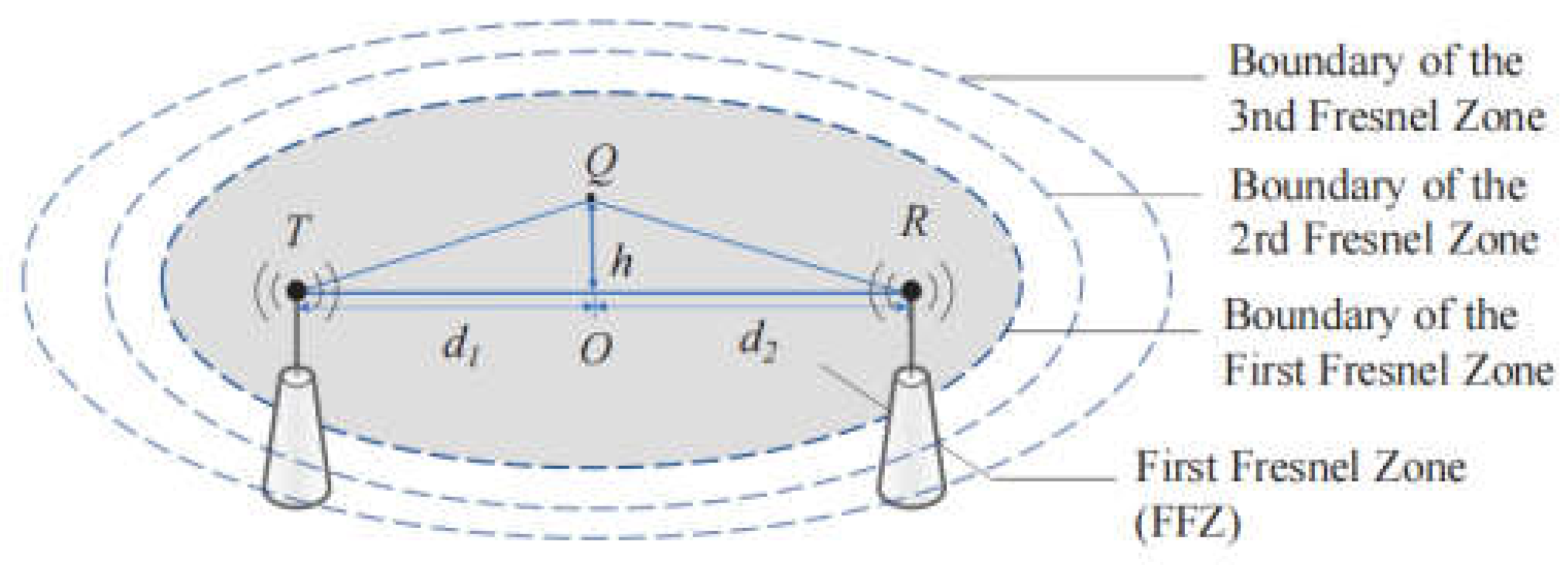
According to RF propagation theory, more than 70% of the signal energy is transferred via the FFZ. Therefore, when a target moves inside the FFZ, signal diffraction becomes more important and dominates the received signal variation. The Fresnel zone-based diffraction model [20] depicts how the amplitude and phase of CSI change when target moves inside the FFT. The key property is when sensing activity inside the FFZ, the CSI amplitude variation will show different shapes, be it either monotonically decrease or non-monotonous “W” according to the target size. Apart from respiration monitoring, diffraction sensing model have also been proved effective for recognizing exercises and daily exercises [8].
2.2.3. Scattering sensing Model
One main limitation of previous models is that the simple reflection or diffraction assumption may not hold true when considering complex target motion, where signals are scattered from multiple human body parts. Different from Fresnel zone-based model, scattering sensing model treats all objects as scatters, taking account of all multipaths together. As shown in Figure 4, intuitively, scattering model considers each scatter as a virtual Tx, e.g., static walls, the arm and leg of moving human. Given numerous multipaths considered, scattering model is in fact a statistical model generally applicable to complex indoor scenarios. Scattering sensing model has been adopted in various speed-oriented tasks [21,22], achieving robust performance even with non-line-of-sight (NLOS) occlusion.
3. WiFi Sensing
Serving as a key property in future wireless system, WiFi sensing has enabled various important applications. In this section, we category recent works from two aspects, i.e., application-oriented and methodology-oriented.
3.1. WiFi sensing applications
Presence detection. Presence detection determines whether target exists or not within the sensing area and serves as the prerequisite for further sensing tasks. Target presence detection could enable many modern applications such as security system and smart home. Although usually included as a detector module in most studies, there have been some new applications based on presence detection. As shown in Table 1, WiCPD [23] studied child presence detection in smart car scenario, preventing potential danger of children if left alone in a vehicle. Hu et al. [24] considered target location relative to the sensing device, supporting more intelligent control system using this area-aware context. Besides, Zhu et al. [25] and WI-MOID [26] further differentiating human from non-human targets to mitigate influence from unwanted objects, avoiding unnecessary false alarm alert.
Gait recognition. Gait, a unique biomarker, refers to the distinctive walking character of different people and has been used for human identification and authentication applications. Early gait sensing works usually required users to walk on fixed trajectories within restricted area, while recent studies, e.g., GaitSense [27], GaitWay [28] and Wi-PIGR [30], aimed for path independent gait recognition where users can waking along arbitrary paths even in through-the-wall scenario. Besides, CAUTION [29], Auto-Fi [31] and GaitFi [32] tried to realize robust gait recognition with limited training data while Wi-Diag [33] further studied more challenging multi-human recognition problem. As depicted in Table 2, all these works greatly contribute to more ubiquitous gait-based sensing applications.
Gesture recognition. Wireless gesture recognition has emerged as an important part of modern human computer interaction, enabling wide applications including smart home control and virtual reality. Previous studies tried to learn the intricate pattern between signal variation and human gesture under the one-to-one mapping assumption. However, this assumption does not hold since the received signal is highly dependent on the relative location and orientation of users, as proved by the Fresnel reflection model [18]. Thus, recent works mainly focused on realizing a position-independent robust gesture recognition system, as illustrated in Table 3. Kang et al. [34], Widar 3.0 [39], UniFi [41], WiTransformer [42] and AirFi [43] leverages various deep learning methods, e.g., adversarial learning, multi-view network and few-shot learning, to realize robust and efficient recognition. On the other hand, WiGesture [35], HandGest [36], DPSense-WiGesture [37], Niu et al. [38] and WiCGesture [44] attempted to extract distinct and consistent feature from a hand-oriented view, realizing reliable and continuous recognition either through more fine-grained signal segmentation or signal quality assessment. Besides, WiFine [40] managed to realize real-time gesture recognition using low-end edge devices, e.g., Raspberry Pi. Overall, these methods bring WiFi gesture recognition one step towards more practical use.
Activity recognition. WiFi-based human activity recognition (HAR) has become the most studied research topic over the past years, covering many applications including people counting [45], fall detection [49,53], door passing detection [56] and daily activities. Table 4 shows the summary of recent HAR works. Most works tried to address the performance degradation due to location, person and environment dynamic, also known as domain-dependent problem [46,47,50,52,54,57,58,59,62,63]. Besides, WiMonitor [48] studied continuous long-term human activity monitoring, capturing user information such as location change, activity intensity and time. Moreover, EfficientFi [51] considered the signal transfer-induced communication problem in large-scale sensing scenario, providing a cloud-enabled solution with efficient CSI compression, while SAT [60] and SecureSense [61] proposed robust sensing schemes under various adversarial attacks. Liu et al. [55] proposed a dynamic Fresnel Zone sensing model using moving receiver such as smartphone, filling the gap of existing fixed-location transceivers.
Localization and tracking. Due to limited channel bandwidth and antenna number of COTS WiFi devices, there have not been much studies for WiFi-based localization and tracking, as shown in Table 5. Recent works tried to improve tracking performance through more accurate target velocity estimation using moving-induced Doppler Frequency Shift (DFS). Niu et al. [64] optimized velocity estimation by devising a dynamic selection scheme, which can choose the optimal set of receivers for tracking. To better track human walking, WiTraj [65] intelligently combined multi-view information provided by different receivers and differentiated walking with in-place activity to avoid tracking error accumulation. FewSense [66] creatively fused phase and information for better DFS estimation, achieving high accuracy even with fewer CSI samples. In addition to these works, Zhang et al. [67,68] achieved sub-centimeter localization accuracy using intelligent reflecting surface (IRS) technique. By constructing IRS, researchers can modulate the spatial distribution of WiFi signal, improving the spatial resolution of WiFi localization. While promising, their current prototype systems are realized using vector network analyzer (VNA), requiring further study with COTS device. Apart from device-free tracking mentioned above, Fan et al. [69] Wi-Drone [70] studied device-based tracking applications. Fan et al. [69] gained accurate moving direction and in-place rotation angle estimation using a single access point, while Wi-Drone [70] realized the first WiFi tracking-based indoor drone flight control system, providing promising candidate solutions for indoor localization and navigation.
Vital sign monitoring. Vital sign plays a crucial role in people’s health and well-being monitoring, providing useful information for early prediction and interference with potential diseases. As shown in Table 6, CSI-based vital sign detection mainly focused on respiration estimation. MultiSense [71] studied multi-person respiration sensing problem, while SMARS [72] and WiFi-Sleep [73] integrated breath monitoring into user’s sleep quality assessment. WiPhone [74] presented a smartphone-based sensing system, achieving robust performance in NLOS scenarios. Xie et al. [76] addressed the motion interference from nearby individuals, bring respiration monitoring closer to practical application.
Pose construction and imaging. WiFi-based pose estimation and target imaging provides a complementary solution to traditional camera-based perception. As listed in Table 7, WiPose [77], GoPose [79], MetaFi++ [81] and PowerSkel [83] proposed different 3D human skeleton construction frameworks, while WiSIA [78], Wiffract [80] and WiProfile [84] further investigated how to recover target images with WiFi signals. Differently, WiMeasure [82] realized millimeter-level high precise target size measurement, making up for a missing piece of WiFi sensing. It should be noted that in order to achieve fine-grained imaging, high sampling rate and even customized antenna deployment are usually required, as shown in later Tables. Therefore, WiFi imaging is only applicable for specific application scenario for the time being.
3.2. WiFi sensing methodologies
Model-based sensing. Since model-based sensing methods have clear advantage of interpretability, researchers have developed several models for describing the physical relationship between CSI variation and target behavior, detailed in Section 2. As shown in Table 8, scattering model has been widely used for velocity and periodic pattern extraction [28,49,72], while diffraction model being adopted in near-the-LOS scenarios, i.e., within FFZ, for fine-grained sensing tasks [56,80,82,84]. Although less mentioned in Table 8 [55], Fresnel zone-based reflection model is in fact the most used model. Reflection model is commonly implicitly incorporated in various sensing systems for quantitatively analyzing signal variations and identifying sensing limitation, thus guiding the implementation of more stable and stable sensing system [85,86,87].
Hand-crafted statistical pattern extraction-based sensing. Derived from feature engineering in traditional machine learning process, researchers have come up with various task-oriented feature extraction schemes, utilizing in-depth analysis of activity characteristics and advanced signal processing techniques. As shown in Table 9, along with signal processing such as signal segmentation and signal energy estimation, statistical features, such as doppler frequency shift and speed estimation, motion navigation primitive (MNP), dynamic phase vector (DPV) and motion rotation variable (MRV), have been derived for various sensing tasks. Albeit promising, since feature extraction and selection plays a key role in system performance, hand-crafted features are usually task-specific, not reusable for new tasks, hindering its usage for ubiquitous sensing.
Automatic deep pattern extraction-based sensing. Since it is challenging to devise effective sensing feature, more and more works began to leverage various deep learning models for better accuracy and robustness, such as Convolution Neural Network (CNN) and Recurrent Neural Network (RNN). As seen in Table 10, the combination of CNN and RNN has been widely adopted in recent works [27,30,32,39,73,77,79] due to its advantage in extracting spatial-temporal feature from CSI signal automatically. Besides, to gain more general representation learning, adversarial learning and few-shot learning have also been used for efficient and robust feature training[29,31,34,43,53,57,60,61]. The end-to-end property of deep learning has made network framework selection and design become the primary factor in sensing system implementation.
Apart from the above differences, we can gain several more findings from Table 1 to Table 10. First, apart from CSI amplitude and phase information, several new base signals, such as BVP of CSI, ACF of CSI and CSI ratio, have been used for alleviating the intrinsic errors of COTS WiFi devices [88]. Among these base signals, CSI ratio is drawing more attention since it can not only remove CSI offset, but also increase the sensing signal-to-noise rate (SNR) [89]. Second, some works have tried to combine pattern-based scheme with model-based scheme to ensure the performance and reliability of complex sensing applications. Third, many systems are developed for single human sensing under constrained deployment, i.e., single room sensing area with LOS condition satisfied.
4. Challenges
Despite of the above endeavors devoted to bring WiFi sensing from laboratory study to real-life applications, either by improving sensing granularity or exploring application scenarios, most of existing works still face great practical challenges. This section presents the challenges and related solution explorations.
Domain dependent issue. As the superposition result of multi-path signals, WiFi is highly sensitive to various factors, such as locations, orientations, targets, environments, also known as the domain-dependence problem [15,18,86]. In order to make WiFi sensing robust in different settings, researchers have explored various methods, as summarized in Table 11. It can be seen from the table that domain-independent feature extraction is most studied, which can be used alone or further integrated with other methods such as transfer learning and data augmentation. To guarantee the robustness and generalization of WiFi sensing, further investigations are needed regarding signal processing techniques and machine learning algorithms.
Sensing range limitation. As declared in last section, existing sensing range is usually just 6-8 m within a single room, while the communication range of WiFi can reach tens of meters. This small sensing range greatly hinders the real-world house environment and several researches have been devoted to push the sensing range limit. FarSense [90] first increased fine-grained sensing range to 8 m using CSI ratio signal, while Zeng et al. [91] and DiverSense [92] further boosted sensing range to 18 m and 40 m by fully utilizing the spatial and frequency diversity. Wang et al. [93] studied the effect of device placement on sensing SNR and doubly expanded the sensing range by properly placing the transmitter and receiver. Sensing range enlargement is still in its infancy and requires further validation in complex real-world scenario.
5. Future research trend discussion
Despite great effort spent on WiFi sensing over the past years, there still exists a great gap for pervasive real-life application. Based on the detailed analysis above, we point out three critical barriers that require further research in this section.
Sensing assessment standardization. One key issue is the lack of standard performance evaluation of various WiFi sensing systems. Unlike widely accepted standard evaluation criterion in computer vision domain, there still lack of effective and consistent testing platform in WiFi sensing. Specifically, the deficiency exists in two aspects, i.e., CSI extraction tool diversity and evaluation dataset scarcity. The diversity of CSI extraction tools is shown in Table 12, with Intel 5300 NIC-based 802.11n CSI Tool being the most popular used. However, sensing techniques developed with old 802.11n protocol have not explored the innovations of newer standards and may even fail on new-generation WiFi cards [108,109]. Besides, as illustrated in Table 13, although there have been some public released datasets, none of them have been widely used. Existing works mostly adopt self-collected dataset collected in different scenarios with different tools, hindering the comparability and replicability of research outcomes. To build comprehensive datasets without labor-intensive and time-consuming efforts, researchers have studied radio signal synthesis [110,111] and physical data augmentation [112], providing promising solutions to the data scarcity problem. We believe a more unified CSI extraction tool compatible with new 802.11 standard and a set of standard datasets for benchmark comparison should be indispensible for the further research cooperation and development of WiFi sensing.
Sensing and communication balance. As illustrated in Table 14, most sensing systems require high sampling rate for reliable performance which will interfere with regular WiFi communication. To be more specific, as shown in Figure 5, the data throughput will undergo great drop when the sampling rate for sensing is higher than 50Hz. SenCom [113] managed to extract CSI from general communication packets, and obtained evenly sampled and sufficient CSI data with detailed signal processing technique. While appealing, SenCom is not yet applicable for COTS clients. Thus, how to enable WiFi sensing while maintaining communication capability, i.e., achieving sensing and communication balance, remains an open problem in current ISAC area.
Sensing generalization and reliability. As noted in Table 12, raw CSI reading is still only accessible with limited hardware, some researchers resorted to sensing with other WiFi signals. For instance, since beamforming feedback matrix (BFM) is readily available with all new-generation MU-MIMO-enabled WiFi cards, researchers have explored generalized WiFi sensing using BFM [114,115]. Besides, to improve the reliability of sensing, multi-modal sensing which integrates WiFi and other sensing modality, e.g., video, is worth studying [32,52,81,116].
6. Conclusion
Owing to the active participation from numerous researchers, notable advances have been made in WiFi sensing techniques in recent years. In an effort to gain insight of future trending, this paper reviews major achievements over the last 5 years and carries out an in-depth analysis of various methods, including limitations and practical challenges faced in existing systems. Moreover, to realize massive real-life applications, this paper highlights three imperative and promising future directions: sensing assessment standardization, sensing and communication balance, sensing generalization and reliability. We hope this review work can help people better understand the progresses and problems within current WiFi sensing research field, inspiring more amazing ideas for the upcoming ubiquitous ISAC.
Author Contributions
Conceptualization, H.Z.; writing—original draft preparation, H.Z., E.D. and M.X.; discussion and supervision, H.L. and F.W. All authors have read and agreed to the published version of the manuscript.
Funding
This work was supported in part by the Young Scientists Fund of the National Natural Science Foundation of China under Grant 61902237 and 52205597, the Key Project of Science and Technology Commission of Shanghai Municipality under Grant 22DZ1100803.
Institutional Review Board Statement
Not applicable.
Informed Consent Statement
Not applicable.
Data Availability Statement
Not applicable.
Conflicts of Interest
The authors declare no conflict of interest.
References
- Liu, A.; et al., "A Survey on Fundamental Limits of Integrated Sensing and Communication," in IEEE Communications Surveys & Tutorials, vol. 24, no. 2, pp. 994-1034, Secondquarter 2022.
- Liu F. et al., "Integrated Sensing and Communications: Toward Dual-Functional Wireless Networks for 6G and Beyond," in IEEE Journal on Selected Areas in Communications, vol. 40, no. 6, pp. 1728-1767, June 2022.
- Meneghello F.; Chen C.; Cordeiro C.; Restuccia F.; "Toward Integrated Sensing and Communications in IEEE 802.11bf Wi-Fi Networks," in IEEE Communications Magazine, vol. 61, no. 7, pp. 128-133, July 2023.
- Wu C.; Wang B.; Au O.; Liu K.; "Wi-Fi Can Do More: Toward Ubiquitous Wireless Sensing," in IEEE Communications Standards Magazine, vol. 6, no. 2, pp. 42-49, June 2022.
- Li X.; Cui Y.; Zhang J.; Liu F.; Zhang D.; Hanzo L.; "Integrated Human Activity Sensing and Communications," in IEEE Communications Magazine, vol. 61, no. 5, pp. 90-96, May 2023.
- Yang Z.; Zhou Z. and Liu Y.; 2013. From RSSI to CSI: Indoor localization via channel response. ACM Comput. Surv. 46, 2, Article 25 (November 2013), 32 pages.
- Zhang F.; Wu C.; Wang B.; Lai H.; Han Y. and Ray Liu K.; 2019. WiDetect: Robust Motion Detection with a Statistical Electromagnetic Model. Proc. ACM Interact. Mob. Wearable Ubiquitous Technol. 3, 3, Article 122 (September 2019), 24 pages.
- Zhang F.; Niu K.; Xiong J.; Jin B.; Gu T.; Jiang Y.; Zhang D.; 2019. Towards a Diffraction-based Sensing Approach on Human Activity Recognition. Proc. ACM Interact. Mob. Wearable Ubiquitous Technol. 3, 1, Article 33 (March 2019), 25 pages.
- Gong W.; Liu J.; 2018. SiFi: Pushing the Limit of Time-Based WiFi Localization Using a Single Commodity Access Point. Proc. ACM Interact. Mob. Wearable Ubiquitous Technol. 2, 1, Article 10 (March 2018), 21 pages.
- Zhang D.; Wang H.; Wu D.; "Toward Centimeter-Scale Human Activity Sensing with Wi-Fi Signals," in Computer, vol. 50, no. 1, pp. 48-57, Jan. 2017.
- Wang, Z.; et al., "A Survey on Human Behavior Recognition Using Channel State Information," in IEEE Access, vol. 7, pp. 155986-156024, 2019.
- Ma Y.; Zhou G.; Wang S.; 2019. WiFi Sensing with Channel State Information: A Survey. ACM Comput. Surv. 52, 3, Article 46 (May 2020), 36 pages.
- Tan S.; Ren Y.; Yang J.; Chen Y.; "Commodity WiFi Sensing in Ten Years: Status, Challenges, and Opportunities," in IEEE Internet of Things Journal, vol. 9, no. 18, pp. 17832-17843, 15 Sept.15, 2022.
- Xiao J.; Li H.; Wu M.; Jin H.; Jamal Deen M.; Cao J.; 2022. A Survey on Wireless Device-free Human Sensing: Application Scenarios, Current Solutions, and Open Issues. ACM Comput. Surv. 55, 5, Article 88 (May 2023), 35 pages.
- Chen C.; Zhou G.; Lin Y.; 2023. Cross-Domain WiFi Sensing with Channel State Information: A Survey. ACM Comput. Surv. 55, 11, Article 231 (November 2023), 37 pages.
- Halperin D.; Hu W.; Sheth A.; Wetherall D.; 2010. Predictable 802.11 packet delivery from wireless channel measurements. SIGCOMM Comput. Commun. Rev. 40, 4 (October 2010), 159–170.
- Halperin D.; Hu W.; Sheth A.; Wetherall D.; 2011. Tool release: gathering 802.11n traces with channel state information. SIGCOMM Comput. Commun. Rev. 41, 1 (January 2011), 53.
- Wang H.; Zhang D.; Ma J.; Wang Y.; Wang Y.; Wu D.; Gu T.; Xie B.; 2016. Human respiration detection with commodity wifi devices: do user location and body orientation matter? In Proceedings of the 2016 ACM International Joint Conference on Pervasive and Ubiquitous Computing (UbiComp '16). Association for Computing Machinery, New York, NY, USA, 25–36.
- Wu D.; Zhang D.; Xu C.; Wang H.; Li X.; "Device-Free WiFi Human Sensing: From Pattern-Based to Model-Based Approaches," in IEEE Communications Magazine, vol. 55, no. 10, pp. 91-97, Oct. 2017.
- Zhang F.; Zhang D.; Xiong J.; Wang H.; Niu K.; Jin B.; Wang Y.; 2018. From Fresnel Diffraction Model to Fine-grained Human Respiration Sensing with Commodity Wi-Fi Devices. Proc. ACM Interact. Mob. Wearable Ubiquitous Technol. 2, 1, Article 53 (March 2018), 23 pages.
- Yang Z.; Zhang Y.; Chi G.; Zhang G.; 2022. "Hands-on wireless sensing with Wi-Fi: A tutorial," 2022. arXiv preprint. arXiv:2206.09532.
- Zhang F.; Chen C.; Wang B.; Liu K. J. R.; "WiSpeed: A Statistical Electromagnetic Approach for Device-Free Indoor Speed Estimation," in IEEE Internet of Things Journal, vol. 5, no. 3, pp. 2163-2177, June 2018.
- Zeng X.; Wang B.; Wu C.; Regani S. D.; Liu K. J. R.; "WiCPD: Wireless Child Presence Detection System for Smart Cars," in IEEE Internet of Things Journal, vol. 9, no. 24, pp. 24866-24881, 15 Dec.15, 2022.
- Hu Y.; Ozturk M. Z.; Wang B.; Wu C.; Zhang F.; Liu K. J. R.; "Robust Passive Proximity Detection Using Wi-Fi," in IEEE Internet of Things Journal, vol. 10, no. 7, pp. 6221-6234, 1 April1, 2023.
- Zhu G.; Wang B.; Gao W.; Hu Y.; Wu C.; Liu K. J. R.; "WiFi-Based Robust Human and Non-human Motion Recognition With Deep Learning," 2024 IEEE International Conference on Pervasive Computing and Communications Workshops and other Affiliated Events (PerCom Workshops), Biarritz, pp. 769-774, France, 2024.
- Zhu G.; Hu Y.; Wang B.; Wu C.; Zeng X.; Liu K. J. R.; "Wi-MoID: Human and Nonhuman Motion Discrimination Using WiFi With Edge Computing," in IEEE Internet of Things Journal, vol. 11, no. 8, pp. 13900-13912, 15 April15, 2024.
- Zhang Y.; Zheng Y.; Zhang G.; Qian K.; Qian C.; Yang Z.; 2021. GaitSense: Towards Ubiquitous Gait-Based Human Identification with Wi-Fi. ACM Trans. Sen. Netw. 18, 1, Article 1 (February 2022), 24 pages.
- Wu C.; Zhang F.; Hu Y.; Liu K. J. R.; 2021. GaitWay: Monitoring and Recognizing Gait Speed Through the Walls. IEEE Transactions on Mobile Computing 20, 6 (June 2021), 2186–2199.
- Wang D.; Yang J.; Cui W.; Xie L.; Sun S.; "CAUTION: A Robust WiFi-Based Human Authentication System via Few-Shot Open-Set Recognition," in IEEE Internet of Things Journal, vol. 9, no. 18, pp. 17323-17333, 15 Sept.15, 202.
- Zhang, L.; Wang, C.; Zhang, D. Wi-PIGR: Path Independent Gait Recognition With Commodity Wi-Fi. IEEE Trans. Mob. Comput. 2021, 21, 3414–3427. [Google Scholar] [CrossRef]
- Yang J.; Chen X.; Zou H.; Wang D.; Xie L.; "AutoFi: Toward Automatic Wi-Fi Human Sensing via Geometric Self-Supervised Learning," in IEEE Internet of Things Journal, vol. 10, no. 8, pp. 7416-7425, 15 April15, 2023.
- Deng L.; Yang J.; Yuan S.; Zou H.; Lu C. X.; Xie L.; "GaitFi: Robust Device-Free Human Identification via WiFi and Vision Multimodal Learning," in IEEE Internet of Things Journal, vol. 10, no. 1, pp. 625-636, 1 Jan.1, 2023.
- Zhang, L.; Ma, Y.; Fan, X.; Fan, X.; Zhang, Y.; Chen, Z.; Chen, X.; Zhang, D. Wi-Diag: Robust Multisubject Abnormal Gait Diagnosis With Commodity Wi-Fi. IEEE Internet Things J. 2023, 11, 4362–4376. [Google Scholar] [CrossRef]
- Kang, H.; Zhang, Q.; Huang, Q. Context-Aware Wireless-Based Cross-Domain Gesture Recognition. IEEE Internet Things J. 2021, 8, 13503–13515. [Google Scholar] [CrossRef]
- Gao R.; Zhang M.; Zhang J.; Li Y.; Yi E.; Wu D.; Wang L.; Zhang D.; 2021. Towards Position-Independent Sensing for Gesture Recognition with Wi-Fi. Proc. ACM Interact. Mob. Wearable Ubiquitous Technol. 5, 2, Article 61 (June 2021), 28 pages.
- Zhang J.; Li Y.; Xiong H.; Dou D.; Miao C.; Zhang D.; "HandGest: Hierarchical Sensing for Robust-in-the-Air Handwriting Recognition With Commodity WiFi Devices," in IEEE Internet of Things Journal, vol. 9, no. 19, pp. 19529-19544, 1 Oct.1, 2022.
- Gao R.; Li W.; Xie Y.; Yi E.; Wang L.; Wu D.; Zhang D.; 2022. Towards Robust Gesture Recognition by Characterizing the Sensing Quality of WiFi Signals. Proc. ACM Interact. Mob. Wearable Ubiquitous Technol. 6, 1, Article 11 (March 2022), 26 pages.
- Niu K.; Zhang F.; Wang X.; Lv Q.; Luo H.; Zhang D.; "Understanding WiFi Signal Frequency Features for Position-Independent Gesture Sensing," in IEEE Transactions on Mobile Computing, vol. 21, no. 11, pp. 4156-4171, 1 Nov. 2022.
- Zhang, Y.; et al., "Widar3.0: Zero-Effort Cross-Domain Gesture Recognition With Wi-Fi," in IEEE Transactions on Pattern Analysis and Machine Intelligence, vol. 44, no. 11, pp. 8671-8688, 1 Nov. 2022.
- Xing T.; Yang Q.; Jiang Z.; Fu X.; Wang J.; Wu C. Q.; Chen X.; 2022. WiFine: Real-Time Gesture Recognition Using Wi-Fi with Edge Intelligence. ACM Trans. Sen. Netw. 19, 1, Article 11 (February 2023), 24 pages.
- Liu Y.; Yu A.; Wang L.; Guo B.; Li Y.; Yi E.; Zhang D.; 2024. UniFi: A Unified Framework for Generalizable Gesture Recognition with Wi-Fi Signals Using Consistency-guided Multi-View Networks. Proc. ACM Interact. Mob. Wearable Ubiquitous Technol. 7, 4, Article 168 (December 2023), 29 pages.
- Yang, M.; Zhu, H.; Zhu, R.; Wu, F.; Yin, L.; Yang, Y.; 2023. WiTransformer: A Novel Robust Gesture Recognition Sensing Model with WiFi. Sensors. 2023; 23(5):2612.
- Wang, D.; Yang, J.; Cui, W.; Xie, L.; Sun, S.; "AirFi: Empowering WiFi-Based Passive Human Gesture Recognition to Unseen Environment via Domain Generalization," in IEEE Transactions on Mobile Computing, vol. 23, no. 2, pp. 1156-1168, Feb. 2024.
- Gao, R.; et al., "WiCGesture: Meta-Motion-Based Continuous Gesture Recognition With Wi-Fi," in IEEE Internet of Things Journal, vol. 11, no. 9, pp. 15087-15099, 1 May1, 2024.
- Wang, F.; Zhang, F.; Wu, C.; Wang, B.; Liu K. J., R.; "Respiration Tracking for People Counting and Recognition," in IEEE Internet of Things Journal, vol. 7, no. 6, pp. 5233-5245, June 2020.
- Ma, Y.; Arshad, S.; Muniraju, S.; Torkildson, E.; Rantala, E.; Doppler, K.; Zhou, G. Location- and Person-Independent Activity Recognition with WiFi, Deep Neural Networks, and Reinforcement Learning. ACM Trans. Internet Things 2021, 2, 1–25. [Google Scholar] [CrossRef]
- Wang, D.; Yang, J.; Cui, W.; Xie, L.; Sun, S.; "Multimodal CSI-Based Human Activity Recognition Using GANs," in IEEE Internet of Things Journal, vol. 8, no. 24, pp. 17345-17355, 15 Dec.15, 2021.
- Niu, X.; Li, S.; Zhang, Y.; Liu, Z.; Wu, D.; Shah R., C.; Tanriover, C.; Lu, H.; Zhang, D.; WiMonitor: Continuous Long-Term Human Vitality Monitoring Using Commodity Wi-Fi Devices. Sensors. 2021; 21(3):751.
- Hu, Y.; Zhang, F.; Wu, C.; Wang, B.; Liu K. J., R.; "DeFall: Environment-Independent Passive Fall Detection Using WiFi," in IEEE Internet of Things Journal, vol. 9, no. 11, pp. 8515-8530, 1 June1, 2022.
- Ding, X.; Hu, C.; Xie, W.; Zhong, Y.; Yang, J.; Jiang, T.; 2022. Device-Free Multi-Location Human Activity Recognition Using Deep Complex Network. Sensors. 2022; 22(16):6178.
- Yang, J.; Chen, X.; Zou, H.; Wang, D.; Xu, Q.; Xie, L.; "EfficientFi: Toward Large-Scale Lightweight WiFi Sensing via CSI Compression," in IEEE Internet of Things Journal, vol. 9, no. 15, pp. 13086-13095, 1 Aug.1, 2022.
- Zhou, Z.; Wang, F.; Yu, J.; Ren, J.; Wang, Z.; Gong, W.; 2022. "Target-oriented Semi-supervised Domain Adaptation for WiFi-based HAR," IEEE INFOCOM 2022 - IEEE Conference on Computer Communications, London, United Kingdom, 2022, pp. 420-429.
- Yang, Z.; Zhang, Y.; Zhang, Q.; "Rethinking Fall Detection With Wi-Fi," in IEEE Transactions on Mobile Computing, vol. 22, no. 10, pp. 6126-6143, 1 Oct. 2023.
- Meneghello, F.; Garlisi, D.; Di Fabbro, N.; Tinnirello, I.; Rossi, M.; "SHARP: Environment and Person Independent Activity Recognition With Commodity IEEE 802.11 Access Points," in IEEE Transactions on Mobile Computing, vol. 22, no. 10, pp. 6160-6175, 1 Oct. 2023.
- Liu J.; Li W.; Gu T.; Gao R.; Chen B.; Zhang F.; Wu D.; Zhang D.; 2023. Towards a Dynamic Fresnel Zone Model to WiFi-based Human Activity Recognition. Proc. ACM Interact. Mob. Wearable Ubiquitous Technol. 7, 2, Article 65 (June 2023), 24 pages.
- Shi W.; Wang X.; Niu K.; Wang L.; Zhang D.; 2023. WiCross: I Can Know When You Cross Using COTS WiFi Devices. In Adjunct Proceedings of the 2023 ACM International Joint Conference on Pervasive and Ubiquitous Computing & the 2023 ACM International Symposium on Wearable Computing (UbiComp/ISWC '23 Adjunct). Association for Computing Machinery, New York, NY, USA, 133–136.
- Zhou Z.; Wang F.; Gong W.; 2024. I-Sample: Augment Domain Adversarial Adaptation Models for WiFi-based HAR. ACM Trans. Sen. Netw. 20, 2, Article 38 (March 2024), 20 pages.
- Yang, J.; Tang, S.; Xu, Y.; Zhou, Y.; Xie, L.; 2024. MaskFi: Unsupervised Learning of WiFi and Vision Representations for Multimodal Human Activity Recognition. arXiv:2402.19258.
- Sheng B.; Han R.; Xiao F.; Guo Z.; Gui L.; 2024. MetaFormer: Domain-Adaptive WiFi Sensing with Only One Labelled Target Sample. Proc. ACM Interact. Mob. Wearable Ubiquitous Technol. 8, 1, Article 39 (March 2024), 27 pages.
- Pan Y.; Zhou Z.; Gong W.; Fang Y.; 2024. "SAT: A Selective Adversarial Training Approach for WiFi-based Human Activity Recognition," in IEEE Transactions on Mobile Computing. [CrossRef]
- Yang J.; Zou H.; Xie L.; "SecureSense: Defending Adversarial Attack for Secure Device-Free Human Activity Recognition," in IEEE Transactions on Mobile Computing, vol. 23, no. 1, pp. 823-834, Jan. 2024.
- Luo F.; Khan S.; Jiang B.; Wu K.; 2024. "Vision Transformers for Human Activity Recognition using WiFi Channel State Information," in IEEE Internet of Things Journal. [CrossRef]
- Zhang Y.; Wang G.; Liu H.; Gong W.; Gao F.; 2024. "WiFi-Based Indoor Human Activity Sensing: A Selective Sensing Strategy and a Multi-Level Feature Fusion Approach," in IEEE Internet of Things Journal. [CrossRef]
- Niu K.; Wang X.; Zhang F.; Zheng R.; Yao Z.; Zhang D.; "Rethinking Doppler Effect for Accurate Velocity Estimation With Commodity WiFi Devices," in IEEE Journal on Selected Areas in Communications, vol. 40, no. 7, pp. 2164-2178, July 2022.
- Wu D. et al., "WiTraj: Robust Indoor Motion Tracking With WiFi Signals," in IEEE Transactions on Mobile Computing, vol. 22, no. 5, pp. 3062-3078, 1 May 2023.
- Li W.; Gao R.; Xiong J.; Zhou J.; Wang L.; Mao X.; Yi E.; Zhang D.; 2024. WiFi-CSI Difference Paradigm: Achieving Efficient Doppler Speed Estimation for Passive Tracking. Proc. ACM Interact. Mob. Wearable Ubiquitous Technol. 8, 2, Article 63 (May 2024), 29 pages.
- Zhang, G.; Zhang, D.; He, Y.; Chen, J.; Zhou, F.; Chen, Y.; "Multi-Person Passive WiFi Indoor Localization With Intelligent Reflecting Surface," in IEEE Transactions on Wireless Communications, vol. 22, no. 10, pp. 6534-6546, Oct. 2023.
- Zhang, G.; Zhang, D.; Deng, H.; Wu, Y.; Zhan, F.; Chen, Y.; 2024. “Practical Passive Indoor Localization With Intelligent Reflecting Surface,” in IEEE Transactions on Mobile Computing ( Early Access ).
- Fan, Y.; Zhang, F.; Wu, C.; Wang, B.; Liu K. J., R.; "RF-Based Indoor Moving Direction Estimation Using a Single Access Point," in IEEE Internet of Things Journal, vol. 9, no. 1, pp. 462-473, 1 Jan.1, 2022.
- Chi G.; Yang Z.; Xu J.; Wu C.; Zhang J.; Liang J.; Liu Y.; 2022. Wi-drone: wi-fi-based 6-DoF tracking for indoor drone flight control. In Proceedings of the 20th Annual International Conference on Mobile Systems, Applications and Services (MobiSys '22). Association for Computing Machinery, New York, NY, USA, 56–68.
- Zeng Y.; Wu D.; Xiong J.; Liu J.; Zhang D.; 2020. MultiSense: Enabling Multi-person Respiration Sensing with Commodity WiFi. Proc. ACM Interact. Mob. Wearable Ubiquitous Technol. 4, 3, Article 102 (September 2020), 29 pages.
- Zhang, F.; Wu, C.; Wang, B.; Wu, M.; Bugos, D.; Zhang, H.; Liu, K.J.R. SMARS: Sleep Monitoring via Ambient Radio Signals. IEEE Trans. Mob. Comput. 2019, 20, 217–231. [Google Scholar] [CrossRef]
- Yu, B.; et al., "WiFi-Sleep: Sleep Stage Monitoring Using Commodity Wi-Fi Devices," in IEEE Internet of Things Journal, vol. 8, no. 18, pp. 13900-13913, 15 Sept.15, 2021.
- Liu J.; Zeng Y.; Gu T.; Wang L.; Zhang D.; 2021. WiPhone: Smartphone-based Respiration Monitoring Using Ambient Reflected WiFi Signals. Proc. ACM Interact. Mob. Wearable Ubiquitous Technol. 5, 1, Article 23 (March 2021), 19 pages.
- Hu, J.; Yang, J.; Ong, J.-B.; Wang, D.; Xie, L.; 2022. "ResFi: WiFi-Enabled Device-Free Respiration Detection Based on Deep Learning," 2022 IEEE 17th International Conference on Control & Automation (ICCA), Naples, Italy, 2022, pp. 510-515.
- Xie, X.; Zhang, D.; Li, Y.; Hu, Y.; Sun, Q.; Chen, Y.; "Robust WiFi Respiration Sensing in the Presence of Interfering Individual," in IEEE Transactions on Mobile Computing, vol. 23, no. 8, pp. 8447-8462, Aug. 2024.
- Jiang W.; Xue H.; Miao C.; Wang S.; Lin S.; Tian C.; Murali S.; Hu H.; Sun Z.; Su L.; 2020. Towards 3D human pose construction using wifi. In Proceedings of the 26th Annual International Conference on Mobile Computing and Networking (MobiCom '20). Association for Computing Machinery, New York, NY, USA, Article 23, 1–14.
- Li C.; Liu Z.; Yao Y.; Cao Z.; Zhang M.; Liu Y.; 2020. Wi-fi see it all: generative adversarial network-augmented versatile wi-fi imaging. In Proceedings of the 18th Conference on Embedded Networked Sensor Systems (SenSys '20). Association for Computing Machinery, New York, NY, USA, 436–44.
- Ren Y.; Wang Z.; Wang Y.; Tan S.; Chen Y.; Yang J.; 2022. GoPose: 3D Human Pose Estimation Using WiFi. Proc. ACM Interact. Mob. Wearable Ubiquitous Technol. 6, 2, Article 69 (July 2022), 25 pages.
- Pallaprolu A.; Korany B.; Mostofi Y.; 2022. Wiffract: a new foundation for RF imaging via edge tracing. In Proceedings of the 28th Annual International Conference on Mobile Computing And Networking (MobiCom '22). Association for Computing Machinery, New York, NY, USA, 255–267.
- Zhou, Y.; Huang, H.; Yuan, S.; Zou, H.; Xie, L.; Yang, J.; "MetaFi++: WiFi-Enabled Transformer-Based Human Pose Estimation for Metaverse Avatar Simulation," in IEEE Internet of Things Journal, vol. 10, no. 16, pp. 14128-14136, 15 Aug.15, 2023.
- Wang, X.; Niu, K.; Yu, A.; Xiong, J.; Yao, Z.; Wang, J.; Li, W.; Zhang, D.; 2023. WiMeasure: Millimeter-level Object Size Measurement with Commodity WiFi Devices. Proc. ACM Interact. Mob. Wearable Ubiquitous Technol. 7, 2, Article 79 (June 2023), 26 pages.
- Yin, C.; et al., "PowerSkel: A Device-Free Framework Using CSI Signal for Human Skeleton Estimation in Power Station," in IEEE Internet of Things Journal, vol. 11, no. 11, pp. 20165-20177, 1 June1, 2024.
- Yao Z.; Wang X.; Niu K.; Zheng R.; Wang J.; Zhang D.; 2024. WiProfile: Unlocking Diffraction Effects for Sub-Centimeter Target Profiling Using Commodity WiFi Devices. In Proceedings of the 30th Annual International Conference on Mobile Computing and Networking (ACM MobiCom '24). Association for Computing Machinery, New York, NY, USA, 185–199.
- Wu, D.; Zeng, Y.; Zhang, F.; et al.; 2022. WiFi CSI-based device-free sensing: from Fresnel zone model to CSI-ratio model. CCF Trans. Pervasive Comp. Interact. 4, 88–102.
- Niu K.; Wang X.; Yao Z.; Zhang F.; Cheng S.; Jiang Y.; Zhang D.; 2023. How Target’s Location and Orientation Affect Velocity Extraction Accuracy in WiFi Sensing Systems. In Proceedings of the ACM Turing Award Celebration Conference - China 2023 (ACM TURC '23). Association for Computing Machinery, New York, NY, USA, 35–36.
- Zhang F.; Jin B.; Zhang D.; 2023. Ubiquitous Wireless Sensing - Theory, Technique and Application. In Proceedings of the ACM Turing Award Celebration Conference - China 2023 (ACM TURC '23). Association for Computing Machinery, New York, NY, USA, 33–34.
- Zhang, J.A.; Wu, K.; Huang, X.; Guo, Y.J.; Zhang, D.; Heath, R.W. Integration of Radar Sensing into Communications with Asynchronous Transceivers. IEEE Commun. Mag. 2022, 60, 106–112. [Google Scholar] [CrossRef]
- Zeng Y.; Wu D.; Xiong J.; Zhang D.; "Boosting WiFi Sensing Performance via CSI Ratio," in IEEE Pervasive Computing, vol. 20, no. 1, pp. 62-70, 1 Jan.-March 2021.
- Zeng Y.; Wu D.; Xiong J.; Yi E.; Gao R.; Zhang D.; 2019. FarSense: Pushing the Range Limit of WiFi-based Respiration Sensing with CSI Ratio of Two Antennas. Proc. ACM Interact. Mob. Wearable Ubiquitous Technol. 3, 3, Article 121 (September 2019), 26 pages.
- Zeng, Y.; Liu, J.; Xiong, J.; Liu, Z.; Wu, D.; Zhang, D.; 2022. Exploring Multiple Antennas for Long-range WiFi Sensing. Proc. ACM Interact. Mob. Wearable Ubiquitous Technol. 5, 4, Article 190 (Dec 2021), 30 pages.
- Li Y.; Wu D.; Zhang J.; Xu X.; Xie Y.; Gu T.; Zhang D.; 2022. DiverSense: Maximizing Wi-Fi Sensing Range Leveraging Signal Diversity. Proc. ACM Interact. Mob. Wearable Ubiquitous Technol. 6, 2, Article 94 (July 2022), 28 pages.
- Wang X.; Niu K.; Xiong J.; Qian B.; Yao Z.; Lou T.; Zhang D.; 2022. Placement Matters: Understanding the Effects of Device Placement for WiFi Sensing. Proc. ACM Interact. Mob. Wearable Ubiquitous Technol. 6, 1, Article 32 (March 2022), 25 pages.
- Xie Y.; Li Z.; Li M.; 2015. Precise Power Delay Profiling with Commodity WiFi. In Proceedings of the 21st Annual International Conference on Mobile Computing and Networking (MobiCom '15). Association for Computing Machinery, New York, NY, USA, 53–64.
- Gringoli F.; Schulz M.; Link J.; Hollick M.; 2019. Free Your CSI: A Channel State Information Extraction Platform For Modern Wi-Fi Chipsets. In Proceedings of the 13th International Workshop on Wireless Network Testbeds, Experimental Evaluation & Characterization (WiNTECH '19). Association for Computing Machinery, New York, NY, USA, 21–28.
- Hernandez S. M.; Bulut E.; 2020. "Lightweight and Standalone IoT Based WiFi Sensing for Active Repositioning and Mobility," 2020 IEEE 21st International Symposium on "A World of Wireless, Mobile and Multimedia Networks" (WoWMoM), Cork, Ireland, 2020, pp. 277-286.
- Hernandez, S.M.; Bulut, E. WiFi Sensing on the Edge: Signal Processing Techniques and Challenges for Real-World Systems. IEEE Commun. Surv. Tutorials 2022, 25, 46–76. [Google Scholar] [CrossRef]
- Gringoli F.; Cominelli M.; Blanco A.; Widmer J.; 2021. AX-CSI: Enabling CSI Extraction on Commercial 802.11ax Wi-Fi Platforms. In Proceedings of the 15th ACM Workshop on Wireless Network Testbeds, Experimental evaluation & CHaracterization (WiNTECH '21). Association for Computing Machinery, New York, NY, USA, 46–53.
- Jiang, Z.; Luan, T.H.; Ren, X.; Lv, D.; Hao, H.; Wang, J.; Zhao, K.; Xi, W.; Xu, Y.; Li, R. Eliminating the Barriers: Demystifying Wi-Fi Baseband Design and Introducing the PicoScenes Wi-Fi Sensing Platform. IEEE Internet Things J. 2021, 9, 4476–4496. [Google Scholar] [CrossRef]
- Yousefi, S.; Narui, H.; Dayal, S.; Ermon, S.; Valaee, S. A Survey on Behavior Recognition Using WiFi Channel State Information. IEEE Commun. Mag. 2017, 55, 98–104. [Google Scholar] [CrossRef]
- Ma Y.; Zhou G.; Wang S.; Zhao H.; Jung W.; 2018. SignFi: Sign Language Recognition Using WiFi. Proc. ACM Interact. Mob. Wearable Ubiquitous Technol. 2, 1, Article 23 (March 2018), 21 pages.
- Palipana S.; Rojas D.; Agrawal P.; Pesch D.; 2018. FallDeFi: Ubiquitous Fall Detection using Commodity Wi-Fi Devices. Proc. ACM Interact. Mob. Wearable Ubiquitous Technol. 1, 4, Article 155 (December 2017), 25 pages.
- Guo, L.; et al., "Wiar: A Public Dataset for Wifi-Based Activity Recognition," in IEEE Access, vol. 7, pp. 154935-154945, 2019.
- Zheng Y.; Zhang Y.; Qian K.; Zhang G.; Liu Y.; Wu C.; Yang Z.; 2019. Zero-Effort Cross-Domain Gesture Recognition with Wi-Fi. In Proceedings of the 17th Annual International Conference on Mobile Systems, Applications, and Services (MobiSys '19). Association for Computing Machinery, New York, NY, USA, 313–325.
- Xiao R.; Liu J.; Han J.; Ren K.; 2021. OneFi: One-Shot Recognition for Unseen Gesture via COTS WiFi. In Proceedings of the 19th ACM Conference on Embedded Networked Sensor Systems (SenSys '21). Association for Computing Machinery, New York, NY, USA, 206–219.
- Yang J.; Chen X.; Zou H.; Lu X.; Wang D.; Yang S. J.; Huang H.; Zhou Y.; Chen X.; Xu Y.; Yuan S.; Zou H.; Lu X.; and Xie L.; 2023. MM-Fi: Multi-Modal Non-Intrusive 4D Human Dataset for Versatile Wireless Sensing. In Advances in Neural Information Processing Systems, A. Oh, T. Naumann, A. Globerson, K. Saenko, M. Hardt, and S. Levine (Eds.), Vol. 36. Curran Associates, Inc., 18756–18768.
- Xie, S.; Xie, L.; 2023. SenseFi: A library and benchmark on deep-learning-empowered WiFi human sensing. Patterns 4, 3 (2023), 100703.
- Cominelli, M.; Gringoli, F.; Restuccia, F.; 2023. "Exposing the CSI: A Systematic Investigation of CSI-based Wi-Fi Sensing Capabilities and Limitations," 2023 IEEE International Conference on Pervasive Computing and Communications (PerCom), Atlanta, GA, USA, 2023, pp. 81–90.
- Yi E.; Zhang F.; Xiong J.; Niu K.; Yao Z.; Zhang D.; 2024. Enabling WiFi Sensing on New-generation WiFi Cards. Proc. ACM Interact. Mob. Wearable Ubiquitous Technol. 7, 4, Article 205 (December 2023), 26 pages.
- Yang, Z.; Zhang, Y.; Qian, K.; Wu, C.; 2023. SLNet: A Spectrogram Learning Neural Network for Deep Wireless Sensing. In 20th USENIX Symposium on Networked Systems Design and Implementation (NSDI 23). USENIX Association, Boston, MA, 1221–1236.
- Chi G.; Yang Z.; Wu C.; Xu J.; Gao Y.; Liu Y.; Han T. X.; 2024. RF-Diffusion: Radio Signal Generation via Time-Frequency Diffusion. In Proceedings of the 30th Annual International Conference on Mobile Computing and Networking (ACM MobiCom '24). Association for Computing Machinery, New York, NY, USA, 77–92.
- Hou W.; Wu C.; 2024. RFBoost: Understanding and Boosting Deep WiFi Sensing via Physical Data Augmentation. Proc. ACM Interact. Mob. Wearable Ubiquitous Technol. 8, 2, Article 58 (May 2024), 26 pages.
- He Y.; Liu J.; Li M.; Yu G.; Han J.; 2024. "Forward-Compatible Integrated Sensing and Communication for WiFi," in IEEE Journal on Selected Areas in Communications. [CrossRef]
- Wu C.; Huang X.; Huang J.; Xing G.; 2023. Enabling Ubiquitous WiFi Sensing with Beamforming Reports. In Proceedings of the ACM SIGCOMM 2023 Conference (ACM SIGCOMM '23). Association for Computing Machinery, New York, NY, USA, 20–32.
- Yi, E.; Wu, D.; Xiong, J.; Zhang, F.; Niu, K.; Li, W.; Zhang, D.; 2024. BFMSense: WiFi Sensing Using Beamforming Feedback Matrix. In 21st USENIX Symposium on Networked Systems Design and Implementation (NSDI24). USENIX Association, Santa Clara, CA, 1697–1712.
- Korany, B.; Karanam C., R.; Cai, H.; Mostofi, Y.; 2019. XModal-ID: Using WiFi for Through-Wall Person Identification from Candidate Video Footage. In The 25th Annual International Conference on Mobile Computing and Networking (MobiCom '19). Association for Computing Machinery, New York, NY, USA, Article 36, 1–15.
Figure 1.
Typical indoor multi-path WiFi propagation.
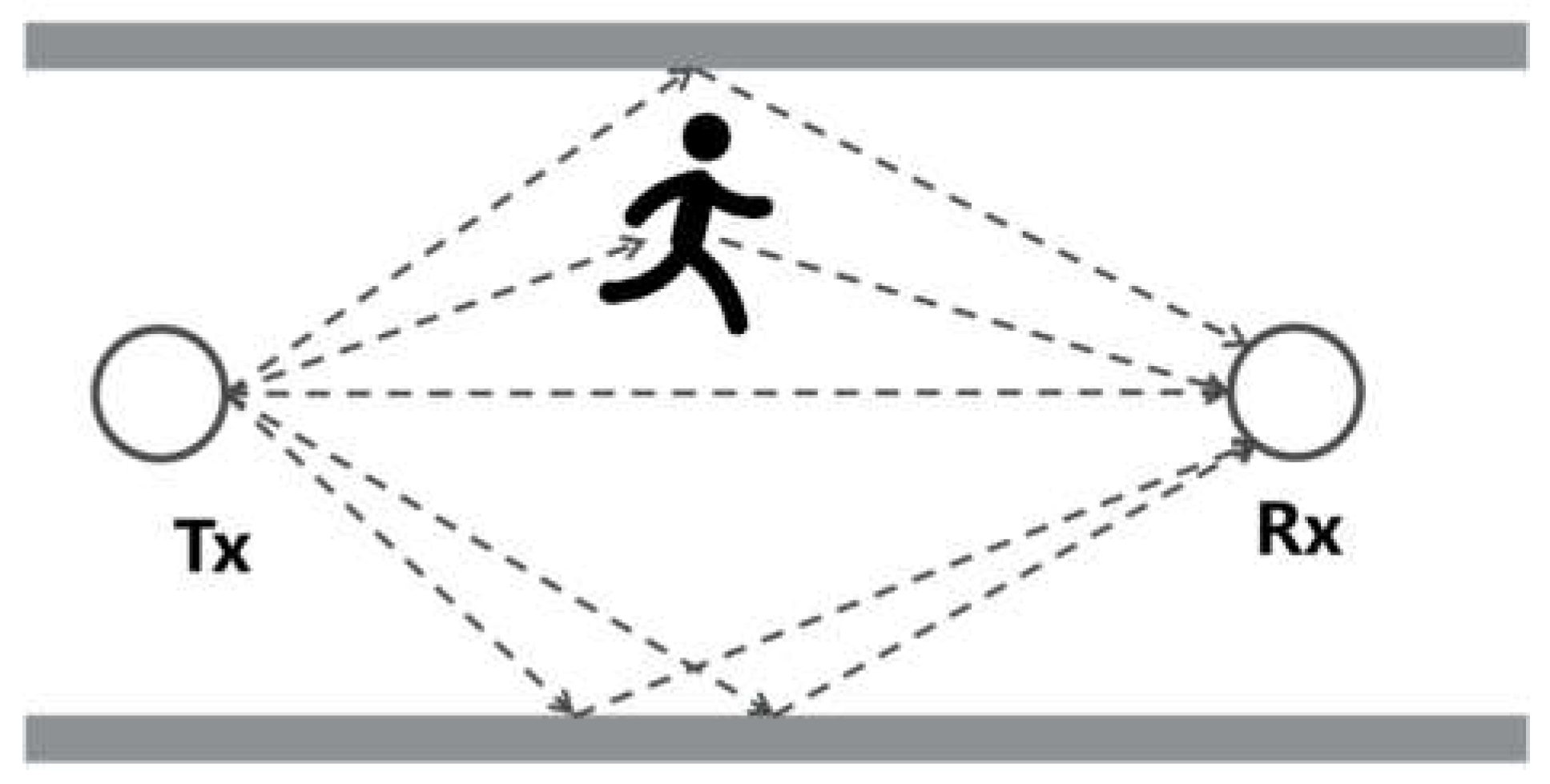
Figure 2.
Geometry of Fresnel zone reflection sensing [18].
Figure 2.
Geometry of Fresnel zone reflection sensing [18].
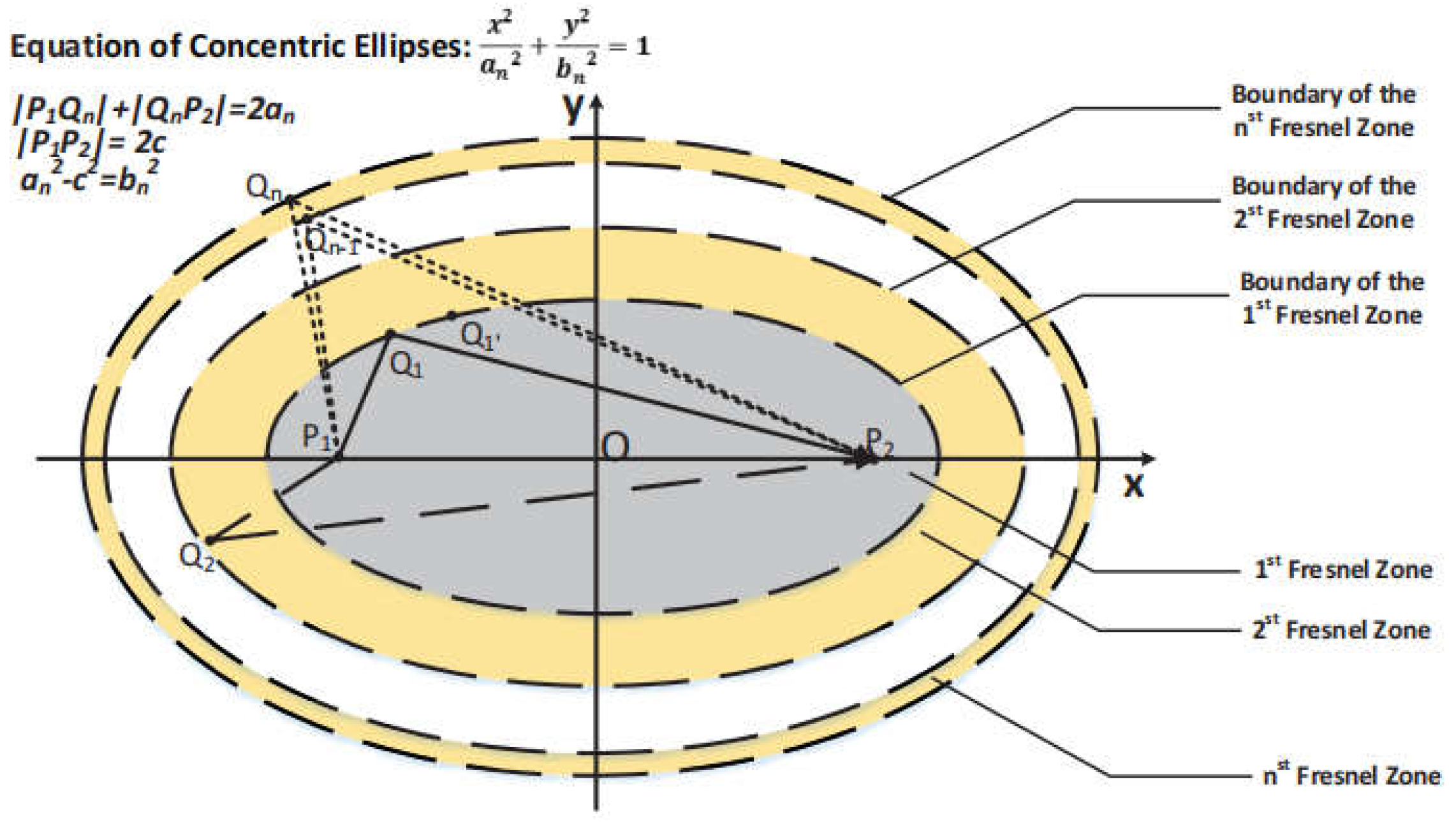
Figure 4.
Signal scattering sensing model [21].
Figure 4.
Signal scattering sensing model [21].
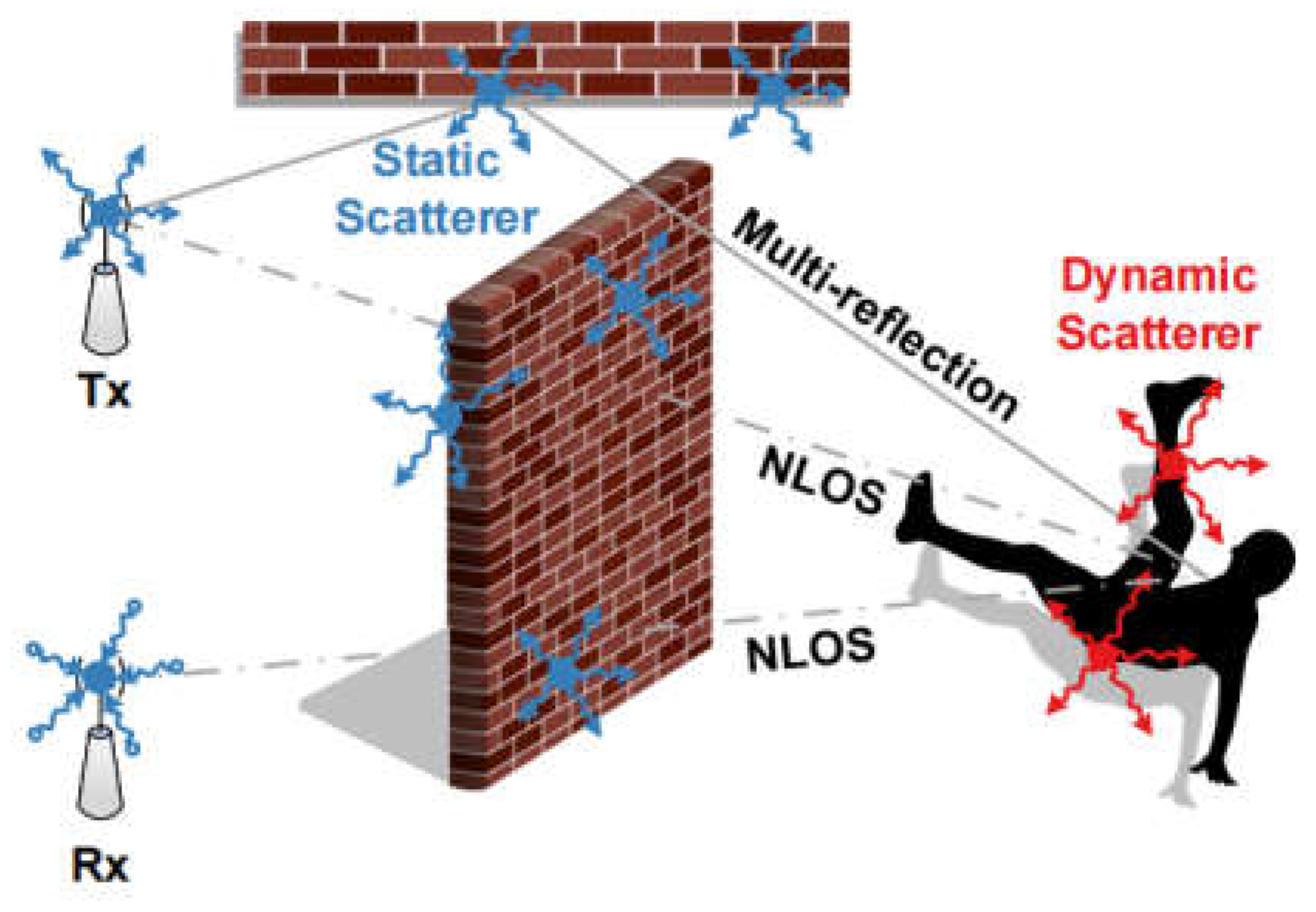
Figure 5.
Impact of sampling rate on WiFi communication [66].
Figure 5.
Impact of sampling rate on WiFi communication [66].
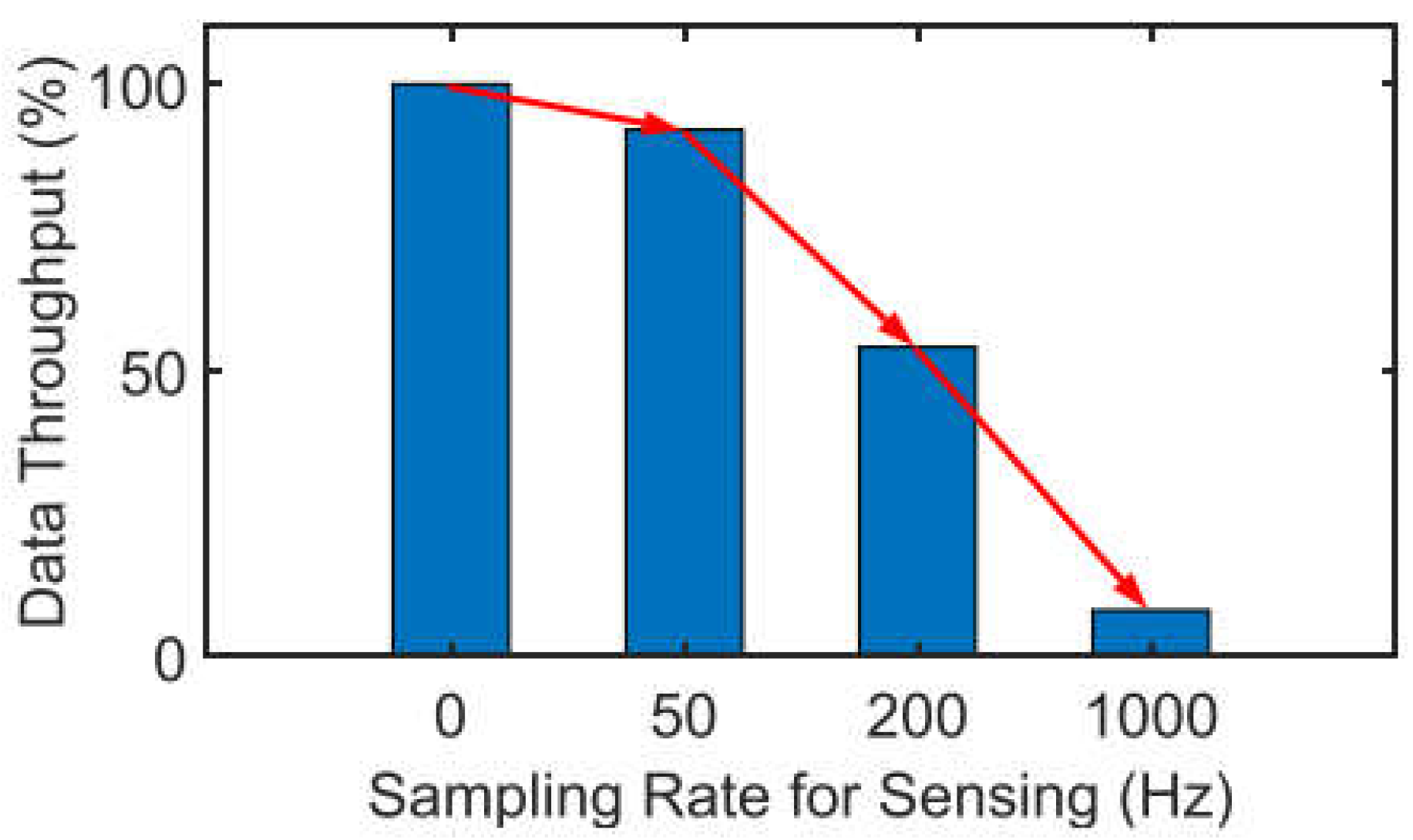

Table 1.
Presence detection.
| Year | Reference | Application | Performance | User number | Device type | NLOS |
|---|---|---|---|---|---|---|
| 2022 | WiCPD [23] | In-car child presence detection | 96.56%-100% real-time detection rate | 1 | NXP Wi-Fi chipset | Y |
| 2023 | Hu et al. [24] | Proximity detection |
95% and 99% true positive rate for distance-based and room-based detection | 1 | NXP Wi-Fi chipset | Y |
| 2024 | Zhu et al. [25] |
Human and non-human differentiation |
95.57% average accuracy | 1 human or pet | COTS device | Y |
| 2024 | WI-MOID [26] | Edge device-based human and non-human differentiation | 97.34% accuracy and 1.75% false alarm rate | 1 human or non-human subject | WiFi edge device | Y |
Table 2.
Gait recognition.
| Year | Reference | Application | Performance | User number | Device type | NLOS |
|---|---|---|---|---|---|---|
| 2021 | GaitSense [27] | Gait-based human identification | 93.2% for 5 users and 76.2% for 11 users | 11 | Intel 5300 | N |
| 2021 | GaitWay [28] | Gait speed estimation | 0.12 m median error | 1 | Intel 5300 | Y |
| 2022 | CAUTION [29] | Gait-based human authentication | 93.06 average accuracy | 15 | TP-Link N750 router | N |
| 2022 | Wi-PIGR [30] | Gait recognition | 93.5% for single user and 77.15% for 50 users | 1-50 | Intel 5300 | N |
| 2023 | Auto-Fi [31] | Gesture and gait recognition | 86.83% for gesture; 79.61% for gait | 1 | Atheros chipset | N |
| 2023 | GaitFi [32] | Gait recognition | 94.2% accuracy | 12 | TP-Link N750 router | N |
| 2024 | Wi-Diag [33] | Multi-subject abnormal gait diagnosis | 87.77% average accuracy | 4 | Intel 5300 | N |
Table 3.
Gesture recognition.
| Year | Reference | Application | Performance | User number | Device type | NLOS |
|---|---|---|---|---|---|---|
| 2021 | Kang et al. [34] | Gesture recognition | 3%-12.7% improvement | 1 | Widar Dataset | N |
| 2021 | WiGesture [35] | Gesture recognition | 92.8%-94.5% accuracy | 1 | Intel 5300 | N |
| 2022 | HandGest [36] | Handwriting recognition | 95% accuracy | 1 | Intel 5300 | N |
| 2022 | DPSense-WiGesture [37] | Gesture recognition | 94% average accuracy | 1 | Intel 5300 | N |
| 2022 | Niu et al. [38] | Gesture recognition | 96% accuracy | 1 | Intel 5300 | Y |
| 2022 | Widar 3.0 [39] | Cross-domain gesture recognition | 92.7% in-domain and 82.6%-92.4% cross-domain accuracy | 1 | Intel 5300 | N |
| 2022 | WiFine [40] | Gesture recognition | 96.03% accuracy in 0.19 seconds | 1 | Raspberry Pi 4B | N |
| 2023 | UniFi [41] | Gesture recognition | 99% and 90%-98% accuracy for in-domain and cross-domain recognition | 1 | Widar dataset | N |
| 2023 | WiTransformer [42] | Gesture recognition | 86.16% accuracy | 1 | Widar dataset | N |
| 2024 | AirFi [43] | Gesture recognition | 90% accuracy | 1 | TP-Link N750 router | N |
| 2024 | WiCGesture [44] | Continuous gesture recognition | 89.6% for digits and 88.3% for Greek letters | 1 | Intel 5300 | N |
Table 4.
Activity recognition.
| Year | Reference | Application | Performance | User number | Device type | NLOS |
|---|---|---|---|---|---|---|
| 2020 | Wang et al. [45] | People counting and recognition | 86% average accuracy | 4 | COTS devices | N |
| 2021 | Ma et al. [46] | Activity recognition | 97% average accuracy | 1 | Intel 5300 | N |
| 2021 | MCBAR [47] | Activity recognition | 90% average accuracy | 1 | Atheros chipset | N |
| 2021 | WiMonitor [48] | Location and activity monitoring | N/A | 1 | Intel 5300 | Y |
| 2022 | DeFall [49] | Fall detection | 95% detection rate and 1.5% false alarm rate | 1 | Intel 5300 | Y |
| 2022 | Ding et al. [50] | Activity recognition | 96.85% average accuracy | 1 | Intel 5300 | N |
| 2022 | EfficientFi [51] | Activity recognition | 98% accuracy | 1 | TP-Link N750 router | N |
| 2022 | TOSS [52] | Activity recognition | 82.69% average accuracy | 1 | Intel 5300 | N |
| 2023 | FallDar [53] | Fall detection | 5.7% false alarm reate and 3.4% missed alarm rate | 1 | Intel 5300 | Y |
| 2023 | SHARP [54] | Activity recognition | 95% average accuracy | 1 | ASUS RT-AC86U router | N |
| 2023 | Liu et al. [55] | Moving receiver-based activity recognition | 10 °, 1 cm and 98% accuracy for direction, displacement and activity estimation | 1 | COTS WiFi 6 device | N |
| 2023 | WiCross [56] | Target passing detection | 95% accuracy | 1 | Intel 5300 | N |
| 2024 | i-Sample [57] | Activity recognition | 10% accuracy gain | 1 | Intel 5300 | N |
| 2024 | MaskFi [58] | Activity recognition | 97.61% average accuracy | 1 | TP-Link N750 router | N |
| 2024 | MetaFormer [59] | Activity recognition | Improved accuracy in various cross-domain scenarios | 1 | SiFi, Widar, Wiar datasets | N |
| 2024 | SAT [60] | Activity recognition | Improved accuracy and robustness | 1 | Intel 5300 | N |
| 2024 | SecureSense [61] | Activity recognition under adversarial attack | Robust performance under various attacks | 1 | TP-Link N750 router | N |
| 2024 | Luo et al. [62] | Activity recognition | 98.78% accuracy | 1 | UT-HAR dataset | N |
| 2024 | WiSMLF [63] | Activity recognition | 92% average accuracy | 1 | Intel 5300 | N |
Table 5.
Localization and Tracking.
| Year | Reference | Application | Performance | User number | Device type | NLOS |
|---|---|---|---|---|---|---|
| 2022 | Niu et al. [64] | Velocity estimation-based tracing | 9.38 cm/s, 13.42° and 31.08cm median error in speed, heading and location estimation | 1 | Intel 5300 | Y |
| 2023 | WiTraj [65] | Human walking tracking | 2.5% median tracking error | 1 | Intel 5300 | N |
| 2024 | FewSense [66] | Tracking | 34 cm median error | 1 | Intel 5300 | N |
Table 6.
Vital sign monitoring.
| Year | Reference | Application | Performance | User number | Device type | NLOS |
|---|---|---|---|---|---|---|
| 2020 | MultiSense [71] | Multi-person respiration sensing | 0.73 bpm mean error | 4 | Intel 5300 | Y |
| 2021 | SMARS [72] | Breath estimation and sleep stage recognition | 0.47 bpm median error and 88% accuracy | 1 | Atheros chipset | Y |
| 2021 | WiFi-Sleep [73] | Sleep stage monitoring | 81.8% accuracy | 1 | Intel 5300 | N |
| 2021 | WiPhone [74] | Respiration monitoring | 0.31 bpm average error | 1 | ASUS RT-AC86U router and Google Nexus 5 smartphone | Y |
| 2022 | ResFi [75] | Respiration detection | 96.05% accuracy | 1 | ASUS RT-AC86U router | N |
| 2024 | Xie et al. [76] | Respiration sensing with interfering individual | 32% mean absolute error reduction | 1 | VNA or Intel 5300 | N |
Table 7.
Pose construction and imaging.
| Year | Reference | Application | Performance | User number | Device type | NLOS |
|---|---|---|---|---|---|---|
| 2020 | WiPose [77] | Pose construction | 2.83 cm average error | 1 | Intel 5300 | N |
| 2020 | WiSIA [78] | Target imaging | N/A | 1 | Intel 5300 | N |
| 2022 | GoPose [79] | 3D human pose estimation | 4.7 cm accuracy | 1 or 2 | Intel 5300 | Y |
| 2022 | Wiffract [80] | Still object imaging | 86.7% letter reading accuracy | 1 | Intel 5300 | Y |
| 2023 | MetaFi++ [81] | Pose estimation | 97.3% for PCK@50 | 1 | TP-Link N750 router | N |
| 2023 | WiMeasure [82] | Object size measurement | 2.6 mm median error | 1 | Intel 5300 | N |
| 2024 | PowerSkel [83] | Pose estimation | 96.27% for PCK@50 | 1 | ESP 32 IoT SoC | N |
| 2024 | WiProfile [84] | 2D target Profiling | 1 cm median absolute error | 1 target with proper size range | Intel 5300 | N |
Table 8.
Pose construction and imaging.
| Year | Reference | Methodology | Performance | Base signal | Sensing range | Setting |
|---|---|---|---|---|---|---|
| 2021 | GaitWay [28] | Scattering model | 0.12 m median error | ACF of CSI | 20 m×23 m | 1500 Hz; single pair of Tx-Rx |
| 2021 | SMARS [72] | Scattering model | 0.47 bpm median error and 88% accuracy | ACF of CSI | 10 m | 30 Hz; single pair of Tx-Rx |
| 2022 | DeFall [49] | Scattering model | 95% detection rate and 1.5% false alarm rate | ACF of CSI | Multi-room | 1500 Hz; single pair of Tx-Rx |
| 2022 | Wiffract [80] | Keller's Geometrical Theory of Diffraction | 86.7% letter reading accuracy | Power of CSI | 1.5 m | two pairs of Tx-Rx; two dimension RX grid synthesis |
| 2023 | Liu et al. [55] | Dynamic Fresnel zone model | 10 °, 1 cm and 98% accuracy for direction, displacement and activity estimation | CSI | Single room | 100 Hz; single pair of Tx-Rx |
| 2023 | WiCross [56] | Diffraction model-based phase pattern extraction | 95% accuracy | CSI ratio | 1 m | 1000 Hz; single pair of Tx-Rx |
| 2023 | WiMeasure [82] | Diffraction model | 2.6 mm median error | CSI ratio | Near the LOS path | 500 Hz; three pairs of Tx-Rx |
| 2024 | WiProfile [84] | Diffraction effect-based profiling + inverse Fresnel transform | 1 cm median absolute error | CSI | 1.5 m×1 m | 500 Hz; single pair of Tx-Rx; One reference receiving antenna connected to Rx via feeder line |
Table 9.
Hand-crafted statistical pattern-based sensing.
| Year | Reference | Methodology | Performance | Base signal | Sensing range | Setting |
|---|---|---|---|---|---|---|
| 2020 | MultiSense [71] | ICA-based BSS | 0.73 bpm mean error | Constructed reference-CSI-based signal ratio | 4 m×7.5 m | 200 Hz; single pair of Tx-Rx |
| 2020 | Wang et al. [45] | Statistical pattern analysis | 86% accuracy | PSD of CSI | 3.5 m | 10 Hz; single pair of Tx-Rx |
| 2021 | WiGesture [35] | MNP feature extraction | 92.8%-94.5% accuracy | CSI ratio | 4 m×7 m | 400 Hz; two pairs of Tx-Rx |
| 2021 | WiMonitor [48] | Doppler frequency and activity intensity pattern extraction | N/A | CSI ratio | Multi-room | 200 Hz; single pair of Tx-Rx |
| 2021 | WiPhone [74] | Ambient reflection-based pattern extraction | 0.31 bpm average error | CSI amplitude | Multi-room apartment | 50 Hz; single pair of Tx-Rx with LOS blocked |
| 2022 | HandGest [36] | Hand-centric feature extraction, i.e., DPV and MRV | 4.7 cm accuracy | CSI ratio | 1 m | 500 Hz; two pairs of Tx-Rx |
| 2022 | Niu et al. [64] | DFS-based velocity estimation + receiver selection | 96.05% accuracy | CSI ratio | 7 m×9.8 m | 1000 Hz; six pairs of Tx-Rx |
| 2022 | DPSense-WiGesture [37] | Signal segmentation + sensing quality-based signal processing | 94% average accuracy | CSI | 1.2 m | 400 Hz; two pairs of Tx-Rx |
| 2022 | Niu et al. [38] | Position-independent feature extraction, i.e., movement fragment and relative motion direction change | 96% accuracy | CSI ratio | 2 m×2 m | 1000 Hz; 2 pairs of Tx-Rx |
| 2022 | WiCPD [23] | feature-based motion, stationary and transition target detector | 96.56%-100% real-time detection rate | ACF of CSI | Car | 30 Hz; single pair of Tx-Rx |
| 2023 | Hu et al. [24] | Sub-carrier correlation and covariance feature extraction | 95% and 99% true positive rate for distance-based and room-based detection | Power of CSI | Multi-room | 30 Hz; single pair of Tx-Rx |
| 2023 | WiTraj [65] | DFS extraction + multi-view trajectory estimation + motion detection | 2.5% median tracking error | CSI ratio | 7 m×6 m | 400 Hz; three pairs of Tx-Rx |
| 2024 | Xie et al. [76] | Respiratory energy-based interference detection and convex optimization-based beam control | 32% mean absolute error reduction | CSI | 9 m×6 m | Single pair of Tx-Rx |
| 2024 | WiCGesture [44] | Meta motion-based signal segmentation and back-tracking searching-based identification | 89.6% for digits and 88.3% for Greek letters | CSI ratio | 1 m | 400 Hz; Two pairs of Tx-Rx |
| 2024 | FewSense [66] | TD-CSI-based doppler speed estimation | 34 cm median error | Time domain CSI difference | 7 m×7 m | 1000 Hz; Two pairs of Tx-Rx |
| 2024 | WI-MOID [26] | Physical and statistical pattern extraction + SVM + state machine | 97.34% accuracy and 1.75% false alarm rate | ACF of CSI | Multi-room | 1500 Hz; single pair of Tx-Rx |
Table 10.
Automatic deep pattern-based sensing.
| Year | Reference | Methodology | Performance | Base signal | Sensing range | Setting |
|---|---|---|---|---|---|---|
| 2020 | WiPose [77] | CNN + LSTM | 2.83 cm average error | 3D velocity profile of CSI | Single room | 1000 Hz; three pairs of Tx-Rx; distributed deployed receiving antennas |
| 2020 | WiSIA [78] | cGAN | N/A | Power of CSI | 2.1 m | 1000 Hz; two pairs od Tx-Rx; receiving antennas orthogonal to each other |
| 2021 | Kang et al. [34] | Adversarial learning and attention scheme | 3%-12.7% improvement | DFS of CSI | 2 m×2m | two pairs of Tx-Rx from Widar dataset |
| 2022 | GaitSense [27] | CNN + LSTM + transfer learning + data augmentation | 98% accuracy | Gait-BVP of CSI | 4.6 m×4.4 m | 1000 Hz; six pairs of Tx-Rx |
| 2021 | Ma et al. [46] | CNN + reinforcement learning | 97% average accuracy | CSI amplitude | 6.8 m×4 m | 100 Hz; single pair of Tx-Rx |
| 2021 | MCBAR [47] | GAN and semi-supervised learning | 90% average accuracy | CSI amplitude | 6.5 m×6.3 m | single pair of Tx-Rx |
| 2021 | WiFi-Sleep [73] | Respiration and movement pattern extraction + CNN-BiLSTM | 81.8% accuracy | CSI ratio | Close to the bed | 200 Hz; single pair of Tx-Rx |
| 2022 | CAUTION [29] | Few-shot learning | 93.06 average accuracy | CSI amplitude | 5.2 m×7.2 m | Single pair of Tx-Rx |
| 2022 | Ding et al. [50] | DCN + transfer learning | 96.85% average accuracy | CSI | 6 m×8 m | 200 Hz; single pair of Tx-Rx |
| 2022 | EfficientFi [51] | DNN | 98% accuracy | CSI amplitude | 6.5 m×5 n | 500 Hz; single pair of Tx-Rx |
| 2022 | GoPose [79] | 2D AOA spectrum + CNN + LSTM | 93.2% for 5 users and 76.2% for 11 users | CSI phase | 4 m×4 m | 1000 Hz; four pairs of Tx-Rx; L-shaped receiving antennas |
| 2022 | ResFi [75] | CNN-based classification | 95% accuracy | CSI amplitude | 1 m | 10 Hz; single pair of Tx-Rx |
| 2022 | TOSS [52] | Meta learning + pseudo label strategy | 82.69% average accuracy | CSI | Single room | Single pair of Tx-Rx |
| 2022 | Widar 3.0 [39] | BVP feature + CNN-RNN | 92.7% in-domain and 82.6%-92.4% cross-domain accuracy | BVP of CSI | 2 m×2 m | 1000 Hz; six pairs of Tx-Rx |
| 2022 | WiFine [40] | data enhancement-based feature extraction + lightweight neural network | 96.03% accuracy in 0.19 seconds | CSI | Single room | Single pair of Tx-Rx |
| 2022 | Wi-PIGR [30] | Spectrogram optimization + CNN + LSTM | 93.5% for single user and 77.15% for 50 users | CSI amplitude | 5m×5 m | 1000 Hz; two pairs of Tx-Rx |
| 2023 | Auto-Fi [31] | Geometric self-supervised learning + few-shot calibration | 86.83% for gesture; 79.61% for gait | CSI amplitude | Single room | 100 Hz; single pair of Tx-Rx |
| 2023 | GaitFi [32] | RCN + LSTM + feature fusion | 94.2% accuracy | CSI + video | 2.1 m | 800 Hz; single pair of Tx-Rx |
| 2023 | MetaFi++ [81] | CNN + Transformer | 97.3% for PCK@50 | CSI + video | Single room | 1000 Hz; single pair of Tx-Rx |
| 2023 | FallDar [53] | Scattering model + VAE generative model + DNN adversarial learning model | 5.7% false alarm rate and 3.4% missed alarm rate | ACF of CSI | 3.6 m×8.4 m | 1000 Hz; single pair of Tx-Rx |
| 2023 | SHARP [54] | Phase correction-based DFS extraction + Nerual network | 95% average accuracy | CSI | 5 m×6 m | 173 Hz; single pair of Tx-Rx |
| 2023 | UniFi [41] | DFS extraction + consistency-guided multi-view deep network + mutual information-based regularization | 99% and 90%-98% accuracy for in-domain and cross-domain recognition | CSI ratio | 2 m×2 m | Widar dataset |
| 2023 | WiTransformer [42] | Transformer | 86.16% accuracy | BVP of CSI | 2 m×2 m | Widar dataset |
| 2024 | AirFi [43] | Data augmentation + adversarial learning +domain generalization | 90% accuracy | CSI amplitude | 4 m×4 m | Single pair of Tx-Rx |
| 2024 | i-Sample [57] | Intermediate sample generation + domain adversarial adaptation | 10% accuracy gain | CSI | Single room | Single pair of Tx-Rx |
| 2024 | MaskFi [58] | Transformer-based encoder + Gate Recurrent Unit network | 97.61% average accuracy | CSI + video | Single room | 1000 Hz; Single pair of Tx-Rx |
| 2024 | MetaFormer [59] | Transformer-based spatial-temporal feature extraction + match-based meta-learning approach | Improved accuracy in various cross-domain scenarios | CSI | Single room | SiFi, Widar, Wiar datasets |
| 2024 | PowerSkel [83] | Knowledge distillation network based on collaborative learning and self-attention | 96.27% for PCK@50 | CSI + Kinect video | Single room | Three pairs of Tx-Rx |
| 2024 | SAT [60] | Calibrated confidence-based adversarial sample selection + adversarial learning | Improved accuracy and robustness | CSI | Single room | Single pair of Tx-Rx |
| 2024 | SecureSense [61] | Consistency-guided adversarial learning | Robust performance under various attacks | CSI amplitude | 5 m×6.5 m | 1000 Hz; single pair of Tx-Rx |
| 2024 | Luo et al. [62] | Transformer | 98.78% accuracy | CSI | Single room | UT-HAR dataset |
| 2024 | Wi-Diag [33] | Independent component analysis-based blind source separation + CycleGAN | 87.77% average accuracy | CSI | 7 m×8 m | 1000 Hz; single pair of Tx-Rx |
| 2024 | WiSMLF [63] | High frequency energy-based sensing scheme selection + VGG/LSTM-based multi-level feature fusion | 92% average accuracy | CSI | Single room | 100 Hz; single pair of Tx-Rx |
| 2024 | Zhu et al. [25] | ResNet18 | 95.57% average accuracy | Amplified ACF of CSI | 6 m×6.5 m | 1500 Hz; single pair of Tx-Rx |
Table 11.
Cross-domain WiFi sensing.
| Cross-domain scheme | Related work |
|---|---|
| Generative adversarial network | [33,47,53,61] |
| Transfer learning | [27,31,34,43,50,57,60] |
| Few-shot learning | [29,31,43,52] |
| Domain-independent feature extraction | [23,24,25,26,27,28,30,34,35,36,37,38,39,41,42,44,49,53,54,64,65,66,72] |
| Data augmentation | [27,43,57] |
| CNN +LSTM/GRU/Transformer | [25,30,32,39,41,42,46,58,59,62,81] |
Table 12.
CSI extraction tools.
| Year | CSI extraction tool | IEEE standard | Related work |
|---|---|---|---|
| 2011 | 802.11n CSI Tool [17] | 802.11 n | [27,28,30,33,35,36,37,38,39,44,46,48,49,50,52,53,56,57,60,63,64,65,66,71,73,77,78,79,80,82,84] |
| 2015 | Atheros CSI Tool [94] | 802.11n | [29,31,32,47,51,58,61,72,81,94] |
| 2019 | Nexmon CSI [95] | 802.11 ac | [40,54,74,75,95] |
| 2020 | ESP32 CSI Tool [96,97] | any computer, smartphone or even standalone | [83,96,97] |
| 2021 | AX-CSI [98] | 802.11 ax | [98] |
| 2022 | PicoScenes [99] | 802.11 a/g/n/ac/ax | [70,99] |
Table 13.
WiFi sensing datasets.
| Year | Dataset | Description | Tool | Related work |
|---|---|---|---|---|
| 2017 | UT-HAR [100] | Activity data | 802.11n CSI Tool | [31,46,62] |
| 2018 | SignFi [101] | Sign data | 802.11n CSI Tool | [40,59] |
| 2018 | FallDeFi [102] | Fall data | 802.11n CSI Tool | [46,53] |
| 2019 | WiAR [103] | Activity and Gesture data | 802.11n CSI Tool | [59] |
| 2019 | Widar [104] | Gesture data | 802.11n CSI Tool | [31,34,39,41,42,43,59] |
| 2021 | OneFi [105] | Gesture data | 802.11n CSI Tool | [105] |
| 2023 | MM-Fi [106] | Multi-modal dataset | Atheros CSI Tool | [58] |
| 2023 | NTU-Fi [107] | Activity and Gait data | Atheros CSI Tool | [62] |
| 2023 | SHARP [54] | Activity data | Nexmon CSI | [54] |
| 2023 | Cominelli [108] | Activity data | AX-CSI | [108] |
| 2023 | WiTraj [65] | Trajectory data | 802.11n CSI Tool | [65] |
Disclaimer/Publisher’s Note: The statements, opinions and data contained in all publications are solely those of the individual author(s) and contributor(s) and not of MDPI and/or the editor(s). MDPI and/or the editor(s) disclaim responsibility for any injury to people or property resulting from any ideas, methods, instructions or products referred to in the content. |
© 2024 by the authors. Licensee MDPI, Basel, Switzerland. This article is an open access article distributed under the terms and conditions of the Creative Commons Attribution (CC BY) license (http://creativecommons.org/licenses/by/4.0/).
Copyright: This open access article is published under a Creative Commons CC BY 4.0 license, which permit the free download, distribution, and reuse, provided that the author and preprint are cited in any reuse.